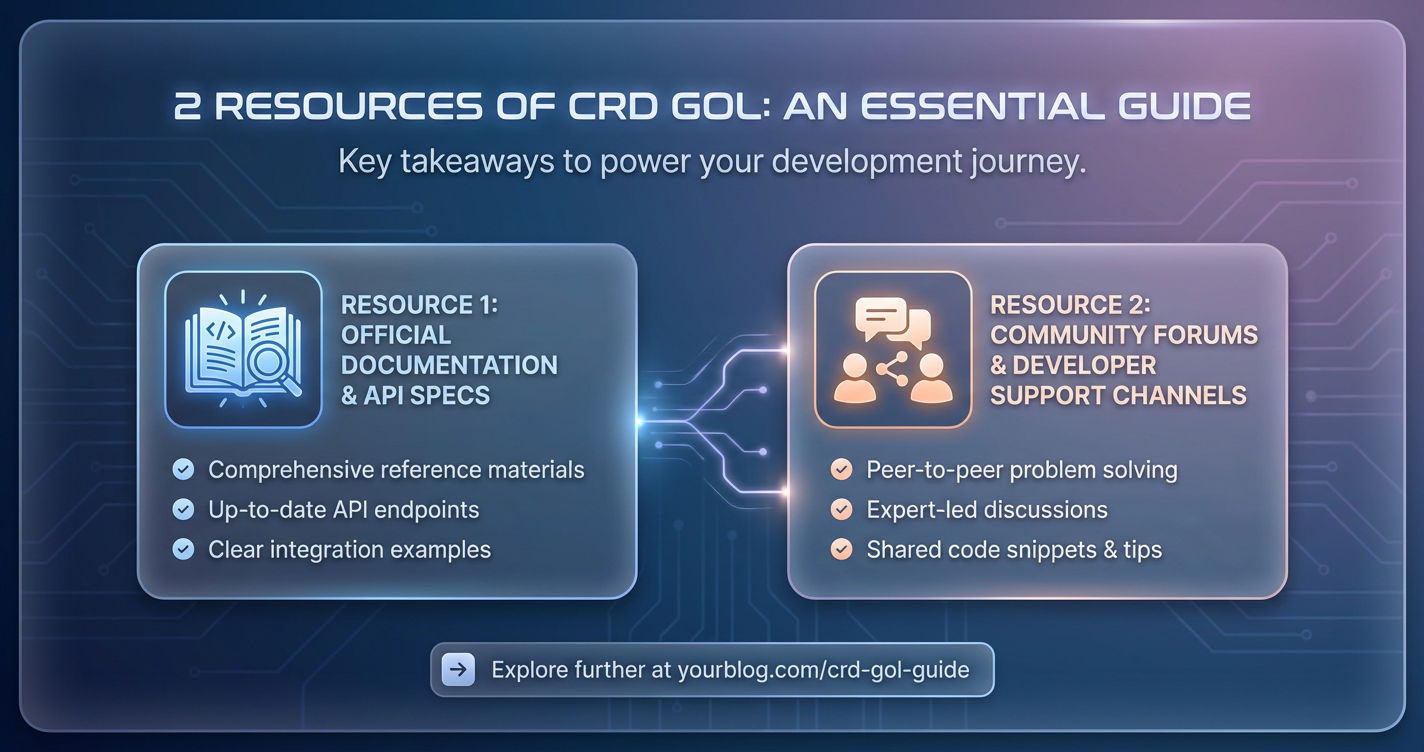
2 Resources of CRD GOL: An Essential Guide


APIPark is a high-performance AI gateway that allows you to securely access the most comprehensive LLM APIs globally on the APIPark platform, including OpenAI, Anthropic, Mistral, Llama2, Google Gemini, and more.Try APIPark now! 👇👇👇
2 Resources of CRD GOL: An Essential Guide to Kubernetes Extensibility
Kubernetes has cemented its position as the de facto standard for container orchestration, revolutionizing how applications are developed, deployed, and managed. A cornerstone of its immense power and flexibility lies in its extensibility, allowing users to tailor its behavior and introduce new types of objects that are treated as first-class citizens within the cluster. This extensibility is primarily driven by Custom Resource Definitions (CRDs), which enable developers to define their own APIs, complete with custom resources (CRs) that extend the Kubernetes API. For those working within the Kubernetes ecosystem, especially when crafting sophisticated operators and controllers, Go (GOL) has emerged as the language of choice due to its robust tooling, performance characteristics, and native client libraries for Kubernetes.
At the heart of building powerful, custom Kubernetes solutions with Go are two fundamental resources: the CRD definition manifest (YAML) and the Go structs that model the custom resource's data. These two components, while distinct, are inextricably linked, forming a powerful synergy that underpins the entire lifecycle of a custom resource within Kubernetes. Understanding their individual roles, their interconnectedness, and the conceptual framework they embody—which we can refer to as the Model Context Protocol (MCP)—is paramount for anyone looking to harness the full potential of Kubernetes extensibility. This comprehensive guide will delve deep into these two critical resources, exploring their structure, purpose, and how they contribute to building resilient and scalable custom resources, while also touching upon advanced concepts like the Claude MCP as a specific application of this protocol in AI-driven contexts.
The Genesis of Extensibility: Understanding Custom Resource Definitions (CRDs) in Kubernetes
Before we dissect the two primary resources, it's crucial to firmly grasp what a Custom Resource Definition (CRD) truly represents within the Kubernetes architecture. At its core, a CRD is a schema declaration; it's a blueprint that tells the Kubernetes API server about a new type of object you wish to introduce into the cluster. This new object, known as a Custom Resource (CR), will then behave just like any built-in Kubernetes object, such as a Pod, Deployment, or Service. The power of CRDs lies in their ability to allow developers to extend Kubernetes' native capabilities without modifying its core source code. Instead, you're essentially programming the Kubernetes control plane to understand and manage new, domain-specific resources.
The journey of a custom resource begins with its CRD. Once a CRD is applied to a Kubernetes cluster, the API server dynamically updates its OpenAPI schema to include the newly defined API type. This means that kubectl and other client tools can then interact with your custom resources using standard Kubernetes commands, just as they would with native resources. This seamless integration provides an unparalleled experience for users and developers alike, ensuring that custom functionalities feel like native extensions rather than bolted-on additions. Furthermore, CRDs are not just about defining new data structures; they are about establishing a new API endpoint, complete with versioning, validation rules, and potentially subresources, allowing for a rich and controlled interaction surface for your custom objects.
The introduction of CRDs marked a significant evolution from previous extensibility mechanisms like ThirdPartyResources (TPRs), offering superior stability, richer validation capabilities (via OpenAPI v3 schema), and better support for versioning. They empower cluster administrators to provide tailored abstractions to their users, enabling them to define high-level application models or infrastructure components that abstract away the underlying complexities of Kubernetes. For example, a cloud provider might define a Database CRD, allowing users to simply declare a database instance, and an associated controller would then provision and manage the actual database resources (e.g., cloud VMs, storage, networking) in the underlying infrastructure. This shift greatly simplifies the developer experience by offering a more declarative and Kubernetes-native approach to managing diverse workloads and infrastructure components.
Resource 1: The CRD Definition Manifest (YAML) – The Blueprint of Your API
The first fundamental resource in defining custom Kubernetes objects with Go is the Custom Resource Definition manifest itself, typically expressed in YAML. This manifest is the declarative specification that you submit to the Kubernetes API server, informing it about the new API type you intend to introduce. It's not just a simple definition; it's a comprehensive contract outlining every aspect of your custom resource's API. This YAML file serves as the blueprint, dictating how your custom resource will appear, behave, and be validated within the Kubernetes ecosystem.
Let's break down the critical components of a CRD YAML manifest, focusing on how each section contributes to establishing the Model Context Protocol (MCP) for your custom resource:
apiVersionandkind: These standard Kubernetes fields identify the type of object being defined. For a CRD,apiVersionisapiextensions.k8s.io/v1(orv1beta1for older clusters) andkindisCustomResourceDefinition. This immediately signals to the Kubernetes API server that you are introducing a new API definition.metadata: This section contains standard Kubernetes metadata such asname(which must be in the format<plural>.<group>, e.g.,myresources.example.com), labels, and annotations. Thenameis particularly important as it uniquely identifies your CRD within the cluster.spec.group: This field defines the API group for your custom resource (e.g.,example.com). It's crucial for namespacing your APIs and preventing naming conflicts with other custom resources or built-in Kubernetes APIs. A well-chosen group reflects the domain or organization responsible for the API.spec.names: This section specifies the various names used to refer to your custom resource. It includes:plural: The plural form used in API paths (e.g.,myresources).singular: The singular form (e.g.,myresource).kind: The Kind name as it appears in resource definitions (e.g.,MyResource). This is case-sensitive and should match the Go struct name for the resource.shortNames: Optional, shorter aliases forkubectlcommands (e.g.,mr).listKind: Optional, the Kind name for the list of resources (e.g.,MyResourceList).
spec.scope: This determines whether your custom resource isNamespaced(can only exist within a Kubernetes namespace) orCluster(exists across the entire cluster, like Nodes or PersistentVolumes). The choice here has significant implications for how your resource is managed and accessed.spec.versions: This is perhaps the most critical section, especially for defining the Model Context Protocol. It allows you to define multiple API versions for your custom resource (e.g.,v1alpha1,v1beta1,v1). Each version can have its own schema, indicating how the resource's data model evolves over time without breaking existing clients. Key properties within each version include:name: The version name (e.g.,v1).served: A boolean indicating if this version is served via the API.storage: A boolean indicating if this version is used for storing the resource in etcd. Only one version can bestorage: true.schema.openAPIV3Schema: This is the heart of the Model Context Protocol definition at the API server level. Here, you define the complete OpenAPI v3 schema for your custom resource'sspecandstatusfields. This schema dictates:- Data Types: What kind of data each field expects (string, integer, boolean, array, object).
- Validation Rules: Constraints like minimum/maximum values for numbers, string patterns (regex), required fields, default values, and immutable fields. This robust validation ensures data integrity before a custom resource object is even persisted to etcd or processed by a controller. It's a critical part of the Model Context Protocol, establishing the ground rules for valid resource instances.
- Field Descriptions: Human-readable descriptions that enhance API discoverability and client-side understanding.
- Subresources: Optional fields like
scale(for horizontal scaling) orstatus(for custom status updates) can be defined here.
spec.conversion: If you have multiple API versions, this section defines how objects are converted between different versions. This can involvewebhookconversions (for complex transformations) ornone(for simple conversions or if only one version is served). Managing version conversion is a sophisticated aspect of the Model Context Protocol, ensuring backward and forward compatibility as your resource evolves.
The CRD YAML manifest, when applied, essentially programs the Kubernetes API server to recognize, validate, and serve your new custom API. It establishes the initial contract – the Model Context Protocol – that all clients and controllers must adhere to when interacting with instances of your custom resource. Without a well-defined and robust CRD YAML, your custom resources would lack validation, proper versioning, and seamless integration into the Kubernetes control plane. It is the declarative source of truth for your API's existence and behavior within the cluster.
Resource 2: The Go Structs for Custom Resources – The Data Model Embodiment
While the CRD YAML manifest tells the Kubernetes API server about your custom resource, it's the Go structs that breathe life into that definition within your controllers, webhooks, and client applications. These Go structs serve as the concrete, programmatic embodiment of your custom resource's data model, directly aligning with the schema defined in the CRD YAML. They are the actual data structures that your Go-based controller code will manipulate, serialize, and deserialize when interacting with the Kubernetes API. The design and implementation of these Go structs are central to how the Model Context Protocol (MCP) is realized in your application logic.
Developing custom resources in Go typically involves defining at least two main structs: one for the core custom resource itself and another for a list of these resources. These structs usually reside in a pkg/apis/<group>/<version> directory within your project (e.g., pkg/apis/example.com/v1).
Let's examine the common structure and purpose of these Go structs:
- The Custom Resource (CR) Struct:
metav1.TypeMeta: Embedded in every Kubernetes object, this providesAPIVersionandKindfields, which are crucial for client-side identification and API marshaling.metav1.ObjectMeta: Also embedded, this struct holds standard object metadata likeName,Namespace,Labels,Annotations,UID, andCreationTimestamp. These fields are universally present in all Kubernetes objects, allowing for consistent management.SpecField: This is where the core configuration and desired state of your custom resource are defined. It's typically a separate Go struct (e.g.,MyResourceSpec) and should exactly mirror thespecschema defined in your CRD YAML. For instance, if your CRDspechas a fieldreplicasof type integer, yourMyResourceSpecmust also have aReplicasfield of typeint32orint.StatusField: This field represents the current observed state of your custom resource, which is managed by your controller. LikeSpec, it's usually a separate Go struct (e.g.,MyResourceStatus) and should align with thestatusschema in your CRD YAML. The controller continuously updates thisStatusto reflect the resource's operational state, conditions, and any observed properties. Clients typically read from theStatusfield but do not directly modify it.- JSON Tags: Each field in your
SpecandStatusstructs will have JSON tags (e.g.,json:"replicas,omitempty"). These tags are critical for marshaling and unmarshaling the Go struct to and from JSON/YAML, ensuring that the field names in your Go code correctly map to the field names expected by the Kubernetes API server (which are typically lowercase camelCase in JSON). - Validation Tags (
+kubebuilder:validation): Tools likekubebuilderandcontroller-genleverage special Go comments (+kubebuilder:validation:Minimum=1,+kubebuilder:validation:Pattern="^[a-z0-9]([-a-z0-9]*[a-z0-9])?(\.[a-z0-9]([-a-z0-9]*[a-z0-9])?)*$") to automatically generate the corresponding OpenAPI v3 schema in your CRD YAML. These tags are a powerful way to define the programmatic part of the Model Context Protocol directly within your Go code, ensuring consistency between your code's understanding of the data model and the API server's validation rules.
- The Custom Resource List Struct:
- Similar to other Kubernetes resources, you also define a
MyResourceListstruct. This struct typically embedsmetav1.TypeMetaandmetav1.ListMetaand contains anItemsfield which is a slice of your custom resource structs ([]MyResource). This struct is used when querying the API for a collection of your custom resources.
- Similar to other Kubernetes resources, you also define a
The "Model Context Protocol" (MCP) Embodied in Go Structs
The Go structs for your custom resources are where the abstract Model Context Protocol (MCP) becomes concrete. They are the actual data structures that encapsulate the rules, types, and relationships defined in your CRD schema. When we talk about MCP, we're discussing a conceptual framework for how models (data structures) are defined, validated, and interacted with within a system. In the context of CRDs in Go:
- Schema Definition: The Go structs explicitly define the fields, their Go types (e.g.,
string,int32,bool,[]string,map[string]string), and embedding of other structs, which directly corresponds to the OpenAPI v3 schema. - Validation Rules: Through
+kubebuilder:validationtags, these structs define the programmatic validation rules that enforce data integrity. These rules are then automatically translated into theopenAPIV3Schemaof the CRD YAML. - Serialization/Deserialization: The
jsontags on struct fields dictate how the Go objects are marshaled into JSON (for API server communication) and unmarshaled back into Go objects. This is a fundamental aspect of the protocol for data exchange. - Interaction Semantics: By defining the
Spec(desired state) andStatus(observed state), the Go structs clearly delineate the interaction semantics for controllers and clients. Controllers update theStatusto reflect reality, while clients declare their desired state in theSpec. - Type Safety and Code Generation: Go's strong typing ensures that your controller code interacts with your custom resources in a type-safe manner. Tools like
controller-genleverage these structs to generate client-go code (clients, informers, listers), further solidifying the protocol's implementation and providing a robust interface for interacting with your custom API.
In essence, the Go structs are not just data containers; they are the active, code-level representation of your custom resource's Model Context Protocol. They guide your controller's logic, inform API validation, and provide a clear, type-safe interface for all programmatic interactions with your custom resources.
Integrating APIPark for Enhanced Management
Managing the lifecycle of such complex custom resources, especially when they involve intricate API logic or integrations with external services, can be significantly streamlined by platforms like APIPark. APIPark, an open-source AI gateway and API management platform, excels at helping developers and enterprises manage, integrate, and deploy AI and REST services. Its capabilities in unifying API formats and encapsulating prompts into REST APIs make it an ideal companion for CRDs that define AI-related custom resources, ensuring seamless management and invocation of your Go-defined models. For example, if your custom resource defines an AI model, APIPark could manage the external API calls to that model, provide unified authentication, and track costs, all while your Go controller manages the Kubernetes-native aspects.
The Synergistic Relationship: CRD YAML and Go Structs
The CRD YAML manifest and the Go structs for custom resources are two sides of the same coin, each indispensable for building robust Kubernetes extensions. Their relationship is symbiotic:
- CRD YAML as the API Contract: The CRD YAML acts as the formal, cluster-wide contract for your API. It declares the API's existence, its versions, its OpenAPI schema for validation, and its scope. This contract is enforced by the Kubernetes API server itself.
- Go Structs as the Code-Level Implementation: The Go structs are the programmatic implementation of this contract. They are the data structures that your controller code understands and manipulates. They ensure type safety, enable code generation, and provide the internal representation of the custom resource within your application.
This synergy is vital. If your Go structs diverge from your CRD YAML's schema (e.g., a field is int in Go but string in the YAML, or a required field in YAML is optional in Go), you will encounter errors during serialization/deserialization, validation failures, or unexpected behavior in your controller. Tools like kubebuilder and controller-gen are designed precisely to maintain this consistency, generating CRD YAML from Go structs and vice-versa, thereby automating the maintenance of the Model Context Protocol.
For instance, when you use controller-gen (often implicitly invoked by make manifests or make generate in kubebuilder projects), it scans your Go structs for specific markers (like +kubebuilder:resource, +kubebuilder:subresource:status, +kubebuilder:printcolumn, and validation tags). It then automatically generates the CRD YAML manifest, ensuring that the openAPIV3Schema within the YAML perfectly reflects the structure and validation rules defined in your Go structs. This automated process is crucial for preventing schema drift and maintaining a consistent Model Context Protocol across your API definition and its programmatic implementation.
Furthermore, schema evolution and versioning highlight this symbiotic relationship. When you introduce a new version of your custom resource (e.g., from v1alpha1 to v1), you'll define a new set of Go structs for that version and update your CRD YAML to include the new version's schema. You might also implement conversion webhooks in Go to handle transformations between different API versions, bridging any structural differences and ensuring backward compatibility. This intricate dance between the declarative YAML and the imperative Go code is what enables flexible and maintainable Kubernetes extensions.
The "Model Context Protocol" (MCP) in Action: Delving Deeper
Having discussed the CRD YAML and Go structs, let's elaborate further on the Model Context Protocol (MCP) itself. As a conceptual framework, MCP defines the holistic understanding of a data model, its characteristics, and how it's interacted with in a distributed, API-driven environment like Kubernetes. It's not a specific technical standard but rather a set of principles that guide the design and implementation of your custom resources.
Key aspects of MCP in the context of CRD GOL include:
- Explicit Schema Definition: Both the CRD YAML's
openAPIV3Schemaand the Go structs with their JSON and validation tags provide an explicit, machine-readable definition of the data model. This clarity is fundamental for automated tooling, client generation, and human understanding. - Robust Validation: MCP mandates rigorous validation. The OpenAPI schema enforces structural and semantic validation at the API server level, preventing malformed resources from even being stored. In Go, controllers implement further business logic validation.
- Clear Interaction Semantics: The clear separation of
Spec(desired state) andStatus(observed state) is a cornerstone of MCP. This separation defines a clean contract for how users (declaring desired state) and controllers (reconciling to observed state) interact with the model. - Version Management: MCP embraces versioning as a necessity for evolving APIs. CRDs support multiple versions, and Go controllers implement conversion logic, allowing the model to adapt over time without breaking existing consumers. This ensures long-term viability and maintainability.
- Extensibility and Composable Patterns: MCP encourages designing models that can be extended (e.g., with webhooks for additional validation/mutation) and composed with other Kubernetes patterns (e.g., using existing Kubernetes secrets or config maps within your custom resource's
spec).
Introducing "Claude MCP": A Conceptual Application
To illustrate the versatility of the Model Context Protocol, let's consider a hypothetical concept: Claude MCP. Imagine a scenario where you're building a Kubernetes operator to manage instances of an AI model, specifically one like Anthropic's Claude. In this context, "Claude MCP" would represent the specific Model Context Protocol defined for managing Claude AI instances or related configurations within your Kubernetes cluster.
Here's how Claude MCP would manifest through CRD GOL:
- CRD Definition for
ClaudeModelConfig: You would define aClaudeModelConfigCRD. Its YAML manifest would specify the schema for configuring a Claude instance.- The
spec.versions[].schema.openAPIV3Schemawould detail fields likemodelName(e.g.,claude-3-opus-20240229),parameters(an object definingtemperature,max_tokens,top_p, etc.),apiKeySecretRef(a reference to a Kubernetes Secret containing the API key),rateLimit(e.g., requests per minute), anddeploymentRegion. - Validation rules would ensure
modelNameis from a predefined list,temperatureis within0.0and1.0, andapiKeySecretRefpoints to a valid secret.
- The
- Controller Implementation: A Go-based controller would then watch for
ClaudeModelConfigcustom resources.- When a
ClaudeModelConfigis created or updated, the controller would read itsSpec(adhering to the Claude MCP). - It would then provision or update the actual Claude AI configuration in the external Anthropic service, using the
apiKeySecretRefto securely access the API key. - The controller would continuously reconcile the observed state of the Claude model (e.g., actual usage, rate limits, deployment status) and update the
ClaudeModelConfig'sStatus(again, adhering to the Claude MCP) to reflect reality within Kubernetes.
- When a
Go Structs for ClaudeModelConfig: Corresponding Go structs would embody this Claude MCP: ```go // api/v1/claudemodelconfig_types.go package v1import ( metav1 "k8s.io/apimachinery/pkg/apis/meta/v1" )// +kubebuilder:object:root=true // +kubebuilder:subresource:status // +kubebuilder:resource:path=claudemodelconfigs,scope=Namespaced,singular=claudemodelconfig // +kubebuilder:printcolumn:name="Model",type="string",JSONPath=".spec.modelName" // +kubebuilder:printcolumn:name="Region",type="string",JSONPath=".spec.deploymentRegion" // +kubebuilder:printcolumn:name="Status",type="string",JSONPath=".status.phase" type ClaudeModelConfig struct { metav1.TypeMeta json:",inline" metav1.ObjectMeta json:"metadata,omitempty"
Spec   ClaudeModelConfigSpec   `json:"spec,omitempty"`
Status ClaudeModelConfigStatus `json:"status,omitempty"`
}// ClaudeModelConfigSpec defines the desired state of ClaudeModelConfig type ClaudeModelConfigSpec struct { // +kubebuilder:validation:Enum=claude-3-opus-20240229;claude-3-sonnet-20240229;claude-3-haiku-20240229 // ModelName specifies the Anthropic Claude model to use. ModelName string json:"modelName"
// +kubebuilder:validation:Minimum=0.0
// +kubebuilder:validation:Maximum=1.0
// Temperature controls the randomness of the output.
// Lower values make the model more deterministic.
Temperature *float32 `json:"temperature,omitempty"`

// MaxTokens specifies the maximum number of tokens to generate.
// +kubebuilder:validation:Minimum=1
MaxTokens *int32 `json:"maxTokens,omitempty"`

// ApiKeySecretRef refers to a Kubernetes Secret containing the Anthropic API key.
ApiKeySecretRef SecretReference `json:"apiKeySecretRef"`

// +kubebuilder:validation:Pattern="^[a-z]+(-[a-z]+)*$"
// DeploymentRegion specifies the geographical region for model inference.
DeploymentRegion string `json:"deploymentRegion,omitempty"`

// RateLimit defines the desired requests per minute for this model instance.
// +kubebuilder:validation:Minimum=1
RateLimit *int32 `json:"rateLimit,omitempty"`
}// SecretReference contains enough information to let you locate the // referenced Secret in the same namespace. type SecretReference struct { Name string json:"name" Key string json:"key,omitempty" // Defaults to "api-key" if not specified. }// ClaudeModelConfigStatus defines the observed state of ClaudeModelConfig type ClaudeModelConfigStatus struct { // +kubebuilder:validation:Enum=Pending;Ready;Error Phase string json:"phase,omitempty" ObservedTokens int64 json:"observedTokens,omitempty" Conditions []metav1.Condition json:"conditions,omitempty" LastUpdated metav1.Time json:"lastUpdated,omitempty" }// +kubebuilder:object:root=true // ClaudeModelConfigList contains a list of ClaudeModelConfig type ClaudeModelConfigList struct { metav1.TypeMeta json:",inline" metav1.ListMeta json:"metadata,omitempty" Items []ClaudeModelConfig json:"items" } `` ThisClaudeModelConfigSpecandClaudeModelConfigStatus` fully define the Claude MCP for configuring and observing Claude AI models within Kubernetes.
This example illustrates how a specific Model Context Protocol (Claude MCP) for AI model management is fully articulated and enforced through the combination of CRD YAML and well-structured Go structs, integrated seamlessly into the Kubernetes ecosystem. It demonstrates how complex external services can be managed in a Kubernetes-native way, offering a declarative interface for AI operations.
Building and Deploying CRDs with Go: Practical Considerations
The journey from conceptualizing a custom resource to having it run effectively in a Kubernetes cluster involves several practical steps, heavily reliant on Go tooling and best practices.
- Project Setup with
kubebuilderor Operator SDK:- For new projects,
kubebuilder(or Operator SDK, which builds onkubebuilder) is the recommended starting point. These tools bootstrap a Go project with all the necessary boilerplate, including directory structures,Makefiletargets,Dockerfile, and initial CRD and controller code. They significantly reduce the manual effort involved in setting up a Kubernetes operator. - A command like
kubebuilder init --domain example.com --repo github.com/myuser/myprojectfollowed bykubebuilder create api --group example --version v1 --kind MyResourcewill set up the basic structure for your custom resource and its controller.
- For new projects,
- Defining Go Structs and API:
- As detailed, you'll define your custom resource's
SpecandStatuswithin Go structs (e.g.,pkg/apis/example/v1/myresource_types.go). This is where you implement the Model Context Protocol in code. - Crucially, use
+kubebuildermarkers to annotate your structs and fields. These markers guidecontroller-genin generating the CRD YAML. For instance,+kubebuilder:validation:Minimumand+kubebuilder:validation:Patterntranslate directly to OpenAPI schema validation rules.
- As detailed, you'll define your custom resource's
- Generating Boilerplate:
- After defining your Go structs, you run
make generate(orcontroller-gen ...) to generate boilerplate code:- CRD YAML: The
config/crd/bases/directory will contain yourCustomResourceDefinitionmanifest, automatically generated from your Go structs' annotations, ensuring consistency. - DeepCopy methods: Necessary for efficient object manipulation in Kubernetes.
- Clients, Informers, Listers: These are Go interfaces and implementations (often in
pkg/client/) that allow your controller and other Go applications to interact with your custom resource API in a type-safe manner. They abstract away the raw HTTP calls to the Kubernetes API server.
- CRD YAML: The
- After defining your Go structs, you run
- Implementing the Controller Logic:
- Your controller (e.g.,
controllers/myresource_controller.go) contains theReconcileloop. This function is called whenever a change to your custom resource (or any related resource) occurs. - Inside
Reconcile, you'll read the desired state from the custom resource'sSpec(adhering to the Model Context Protocol). - You'll then compare this desired state with the current observed state of the world (e.g., external services, other Kubernetes resources).
- Based on the comparison, you'll perform actions to move the world towards the desired state (e.g., create a Deployment, configure an external API, update a database).
- Finally, you'll update the custom resource's
Statusto reflect the current observed state, making it transparent to users.
- Your controller (e.g.,
- Testing:
- Thorough testing is paramount. This includes unit tests for your controller logic, integration tests that simulate Kubernetes API interactions (often using
envtestprovided bykubebuilder), and end-to-end tests that deploy your operator to a real cluster.
- Thorough testing is paramount. This includes unit tests for your controller logic, integration tests that simulate Kubernetes API interactions (often using
- Deployment:
- You'll typically build a Docker image of your controller.
- The CRD YAML and the controller Deployment manifest are then applied to the Kubernetes cluster.
- RBAC (Role-Based Access Control) configurations are essential to grant your controller the necessary permissions to watch, get, list, create, update, and delete your custom resources, as well as any standard Kubernetes resources it manages.
Throughout this process, maintaining a clear understanding of the Model Context Protocol—how your data is structured, validated, and expected to behave—is your guiding star. It ensures that your CRD YAML and Go code remain synchronized, that your controller logic correctly interprets and acts upon the custom resource, and that users can reliably interact with your new Kubernetes API.
Advanced CRD Concepts & Future Trends
As you become more proficient with CRDs and Go, you'll encounter several advanced concepts that enhance the power and robustness of your Kubernetes extensions.
- Webhooks (Validation and Mutation):
- Validating Admission Webhooks: While OpenAPI schema provides basic validation, webhooks offer advanced, dynamic validation. A validating webhook is a custom HTTP server that receives admission requests from the API server (e.g., when a custom resource is created or updated) and can reject them based on complex, programmatic logic that goes beyond schema validation. For instance, it could check external conditions or enforce cross-resource constraints.
- Mutating Admission Webhooks: These webhooks can modify a custom resource before it's persisted by the API server. This is useful for injecting default values, adding labels/annotations, or performing complex transformations that users shouldn't have to specify manually. Both types of webhooks are typically implemented in Go, running as separate deployments within the cluster.
- Subresources (Scale and Status):
- As seen earlier,
statussubresource allows clients to update thestatusof a custom resource independently of itsspec, providing better concurrency and separation of concerns. - The
scalesubresource enables your custom resource to integrate with Kubernetes' native scaling mechanisms, such as Horizontal Pod Autoscalers (HPAs). If your custom resource represents a workload that can be scaled (e.g., a custom queue processing system), defining ascalesubresource allows HPAs to manage its replica count, just like a Deployment.
- As seen earlier,
- Server-Side Apply (SSA) for CRDs:
- Server-Side Apply is a sophisticated mechanism for managing Kubernetes object configurations. Instead of simple
kubectl applywhich performs a client-side merge, SSA allows the API server to manage object fields by tracking which field is "owned" by which controller or user. This is particularly beneficial for CRDs with multiple controllers or users modifying different parts of the resource, preventing conflicts and ensuring consistent state management. Designing your CRDs with SSA in mind is a best practice for complex distributed systems.
- Server-Side Apply is a sophisticated mechanism for managing Kubernetes object configurations. Instead of simple
- Operator SDK and Advanced Patterns:
- The Operator SDK extends
kubebuilderwith additional features tailored for building Kubernetes Operators, including lifecycle management, advanced testing harnesses, and integration with OLM (Operator Lifecycle Manager). - Advanced operator patterns include managing complex application lifecycles (install, upgrade, backup, restore), handling multi-cluster deployments, and implementing self-healing capabilities. These often involve intricate state machines and sophisticated reconciliation logic in your Go controllers, all driven by the well-defined Model Context Protocol of your custom resources.
- The Operator SDK extends
- The Evolving Landscape:
- The Kubernetes extensibility landscape is constantly evolving. New features and best practices emerge regularly, such as API Priority and Fairness, improved client-go mechanisms, and new validation capabilities. Staying abreast of these developments is key to building future-proof and performant custom resources. The core principles of CRD YAML and Go structs, along with the guiding philosophy of the Model Context Protocol, remain central to this evolution, providing a stable foundation for innovation.
The ability to extend Kubernetes with custom resources, backed by Go-based controllers, is arguably its most powerful feature. It allows organizations to encapsulate domain-specific knowledge, automate complex operational tasks, and provide a truly cloud-native experience for their unique applications and infrastructure. By mastering the two resources—the CRD YAML and the Go structs—and understanding the underlying Model Context Protocol, developers gain the keys to unlock Kubernetes' full potential.
| Feature | CRD Definition Manifest (YAML) | Go Structs for Custom Resources |
|---|---|---|
| Primary Role | Defines the API contract and schema at the Kubernetes API server level. | Programmatic embodiment of the data model; used by Go applications. |
| Format | YAML (declarative) | Go language structs (imperative, strongly typed) |
| Location | config/crd/bases/ (generated) or direct definition. |
pkg/apis/<group>/<version>/<kind>_types.go |
| Key Fields/Aspects | spec.group, spec.versions, spec.names, openAPIV3Schema. |
metav1.TypeMeta, metav1.ObjectMeta, Spec, Status, JSON tags, +kubebuilder tags. |
| Validation | Enforces OpenAPI v3 schema validation at API server. | Defines structure and provides source for OpenAPI schema generation. Can implement further programmatic validation in controller. |
| Versioning | Declares multiple API versions (spec.versions). |
Defines distinct Go structs for each API version. |
| Consistency | Generated from Go structs (typically) to ensure consistency. | Source of truth for API definition; controller-gen ensures YAML matches. |
| Interaction | Consumed by Kubernetes API server and kubectl. |
Consumed by Go controllers, webhooks, and client libraries. |
| Model Context Protocol (MCP) Aspect | Establishes the formal, cluster-wide rules for the model's structure, validation, and API endpoint behavior. | Provides the concrete, type-safe implementation of the model's data, allowing for programmatic interaction, marshaling, and unmarshaling. |
Conclusion
The extensibility of Kubernetes, powered by Custom Resource Definitions and the Go programming language, offers an unparalleled opportunity to tailor the platform to virtually any workload or operational requirement. At the core of this extensibility lie two crucial resources: the CRD definition manifest (YAML), which serves as the declarative blueprint and API contract for your custom resource, and the Go structs, which provide the programmatic, type-safe embodiment of that resource's data model. These two components, working in perfect synergy, form the backbone of what we've termed the Model Context Protocol (MCP) – a holistic framework for understanding, defining, and interacting with your custom resources in a consistent and robust manner.
From the explicit schema definitions and validation rules specified in the CRD YAML to the concrete data structures and programmatic validation expressed in Go structs, every detail contributes to a well-defined MCP. This protocol guides the behavior of the Kubernetes API server, informs the logic of your Go-based controllers, and provides a clear interface for anyone interacting with your custom APIs. Whether you're building a simple operator or a sophisticated AI management system like the conceptual Claude MCP, mastering these two resources and the principles of the Model Context Protocol is essential. They are the keys to unlocking the full potential of Kubernetes, enabling you to build highly specialized, scalable, and resilient cloud-native solutions that feel genuinely native to the Kubernetes ecosystem.
Frequently Asked Questions (FAQs)
- What is a Custom Resource Definition (CRD) in Kubernetes? A CRD is a Kubernetes API object that allows you to define your own custom resources, extending the Kubernetes API with new object types. Once a CRD is applied to a cluster, you can create, update, and manage instances of your custom resource as if they were native Kubernetes objects like Pods or Deployments.
- Why is Go (GOL) the preferred language for developing Kubernetes CRDs and controllers? Go is highly preferred for Kubernetes development due to several reasons: it's the language Kubernetes itself is written in, offering native client libraries (
client-go), excellent performance, strong typing, and robust tooling likekubebuilderandcontroller-genthat streamline the development of CRDs and operators. - What is the "Model Context Protocol (MCP)" in the context of CRD GOL? The Model Context Protocol (MCP) is a conceptual framework that encompasses how a custom resource's data model is defined, validated, versioned, and interacted with within Kubernetes. It's realized through the explicit schema in the CRD YAML and the type-safe, validated Go structs that represent the custom resource, ensuring consistency and clear interaction semantics across the API server, controllers, and clients.
- How do the CRD YAML manifest and Go structs work together? The CRD YAML manifest defines the formal API contract for your custom resource at the Kubernetes API server level, including its schema and validation rules. The Go structs are the programmatic implementation of this data model, used by Go-based controllers and clients. Tools like
controller-genensure that the CRD YAML's schema is automatically generated and kept consistent with the Go structs, maintaining the Model Context Protocol. - How can APIPark assist with managing custom resources, especially AI-related ones? APIPark, an open-source AI gateway and API management platform, can significantly streamline the management of complex custom resources, particularly those involving AI models or intricate API logic. It provides capabilities like quick integration of 100+ AI models, unified API formats for AI invocation, and prompt encapsulation into REST APIs. This allows your Go-based CRD controllers to focus on Kubernetes-native orchestration, while APIPark handles the efficient and secure management of the underlying AI model invocations and external API interactions.
🚀You can securely and efficiently call the OpenAI API on APIPark in just two steps:
Step 1: Deploy the APIPark AI gateway in 5 minutes.
APIPark is developed based on Golang, offering strong product performance and low development and maintenance costs. You can deploy APIPark with a single command line.
curl -sSO https://download.apipark.com/install/quick-start.sh; bash quick-start.sh

In my experience, you can see the successful deployment interface within 5 to 10 minutes. Then, you can log in to APIPark using your account.

Step 2: Call the OpenAI API.