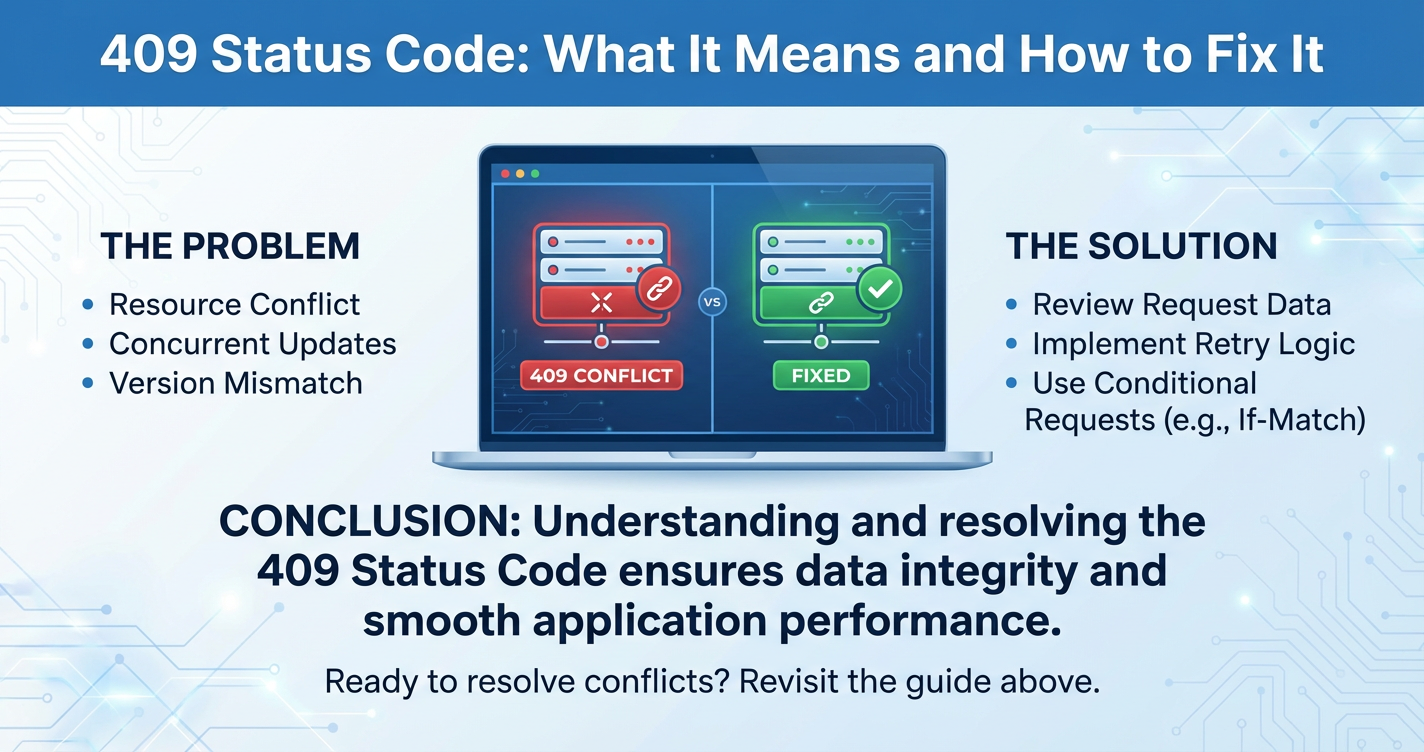
409 Status Code: What It Means and How to Fix It


The digital landscape, powered by an intricate web of interconnected systems, relies heavily on the smooth and precise communication dictated by the Hypertext Transfer Protocol (HTTP). At the heart of this communication lies a diverse set of status codes, each a terse message from a server, conveying the outcome of a client's request. While many developers aspire to see the reassuring 200 OK or 201 Created, the reality of building robust and resilient applications often involves encountering the less celebratory 4xx client error codes. Among these, the 409 Conflict status code holds a particularly interesting and often challenging position, signaling not a malformed request or a lack of authentication, but a fundamental clash with the current state of a resource on the server. Understanding the nuances of this specific error, its origins, and, most importantly, how to effectively prevent and resolve it, is paramount for anyone involved in modern software development, from designing an api to consuming one.
This comprehensive guide will delve deep into the world of HTTP 409 Conflict, peeling back its layers to reveal its precise meaning, the myriad scenarios that give rise to it, and a wealth of strategies for both preventing its occurrence and meticulously addressing it when it inevitably surfaces. We will explore its distinctions from other related 4xx errors, examine the best practices for server-side api design, and equip client-side developers with the knowledge to craft resilient applications capable of gracefully handling such conflicts. Furthermore, we'll touch upon the architectural considerations that can influence conflict resolution and how platforms like an api gateway can play a pivotal role in managing the complexity of api interactions, ultimately fostering a more stable and predictable ecosystem for digital services.
I. Introduction: The Enigmatic World of HTTP Status Codes
In the sprawling architecture of the internet, HTTP serves as the foundational protocol, dictating the language that web clients (like browsers or mobile apps) and web servers use to communicate. Every interaction, from fetching a webpage to submitting a form, is governed by HTTP requests and responses. A critical component of every HTTP response is its status code – a three-digit integer that succinctly conveys the outcome of the server's attempt to fulfill the client's request. These codes are not merely arbitrary numbers; they are a standardized lexicon, providing immediate insight into whether a request succeeded, was redirected, or encountered an error. For developers, understanding this lexicon is not just good practice; it's essential for debugging, building fault-tolerant systems, and ensuring a smooth user experience.
The HTTP protocol, initially conceived for document retrieval, has evolved dramatically to become the backbone of modern web apis, enabling complex interactions between distributed services. In this api-driven world, where microservices communicate constantly and clients interact with intricate backend logic, the precision of status codes becomes even more vital. A 200 OK confirms a successful operation, a 301 Moved Permanently indicates a resource has relocated, and the various 4xx and 5xx codes pinpoint client-side or server-side failures, respectively. Without these clear signals, debugging a distributed system would be akin to navigating a labyrinth blindfolded.
Among the 4xx category, which signifies errors stemming from the client's request, the 409 Conflict stands out. Unlike a 400 Bad Request that implies malformed syntax or a 403 Forbidden that points to authorization issues, 409 Conflict suggests a deeper, more semantic problem: the request itself might be technically valid, but it clashes with the existing state or rules governing the target resource on the server. This status code forces developers to think beyond syntax and consider the intricate dance of resource states, concurrency, and business logic. It's a signal that the server understands the request but cannot fulfill it because doing so would lead to an inconsistent or invalid state for the resource. This guide is dedicated to demystifying this particular code, offering profound insights into its nature and practical strategies for its effective management.
II. Deciphering HTTP Status Codes: A Comprehensive Overview
Before diving exclusively into 409 Conflict, it's beneficial to establish a broader understanding of HTTP status codes. These codes are organized into five main classes, each representing a general category of response. This classification helps in quickly grasping the general nature of an interaction, even before scrutinizing the specific code.
The HTTP Protocol: Foundation of the Web
The Hypertext Transfer Protocol (HTTP) is an application layer protocol for transmitting hypermedia documents, such as HTML. It was designed for communication between web browsers and web servers, but it has since become the foundation for data communication for virtually all forms of client-server interactions, especially in the context of RESTful apis. HTTP is stateless, meaning each request from a client to the server is independent; the server doesn't retain any memory of past requests. This statelessness, while simplifying server design, introduces challenges, particularly when dealing with shared resources and concurrent modifications, which is where the 409 Conflict often comes into play.
Categorization of Status Codes
HTTP status codes are divided into five classes, identified by their first digit:
- 1xx Informational Responses: These codes indicate that the request was received and understood. They are provisional responses, indicating that the client should continue with the request or ignore it if it has already completed.
- 100 Continue: The server has received the request headers and the client should proceed to send the request body.
- 101 Switching Protocols: The client has asked the server to switch protocols and the server has agreed to do so.
- Significance: Rarely encountered by typical
apiconsumers, mostly used in low-level protocol negotiations.
- 2xx Success Responses: These codes indicate that the client's request was successfully received, understood, and accepted.
- 200 OK: The most common success code, indicating that the request has succeeded. The meaning of "success" depends on the HTTP method:
GET: The resource has been fetched and transmitted in the message body.HEAD: The entity headers are in the message body.POST,PUT,DELETE: The result of the action is transmitted in the message body.
- 201 Created: The request has succeeded and a new resource has been created as a result. This is typically sent after a
POSTrequest. - 204 No Content: The server successfully processed the request, but is not returning any content. Often used for
DELETErequests where no further information is needed. - Significance: These are the codes developers strive for, signifying successful operations and predictable
apibehavior.
- 200 OK: The most common success code, indicating that the request has succeeded. The meaning of "success" depends on the HTTP method:
- 3xx Redirection Messages: These codes indicate that the client needs to take further action to complete the request. This typically involves redirecting the client to a different URL.
- 301 Moved Permanently: The requested resource has been permanently moved to a new URL. The client should update its bookmarks/links.
- 302 Found: The requested resource has been temporarily moved to a new URL. The client should continue to use the original URL for future requests.
- 304 Not Modified: Sent in response to a conditional
GETrequest (e.g., withIf-Modified-SinceorIf-None-Matchheaders). It indicates that the resource has not been modified since the version specified by the client, and thus the client can use its cached copy. - Significance: Crucial for managing resource locations and leveraging caching mechanisms to improve performance.
- 4xx Client Error Responses: These codes indicate that the client appears to have made an error. The server could not fulfill a request that appears to be invalid.
- 400 Bad Request: The server cannot or will not process the request due to something that is perceived to be a client error (e.g., malformed request syntax, invalid request message framing, or deceptive request routing).
- 401 Unauthorized: The client must authenticate itself to get the requested response. (Note: often confused with
403 Forbidden). - 403 Forbidden: The client does not have access rights to the content; unlike
401, here the client's identity is known to the server. - 404 Not Found: The server cannot find the requested resource. This is perhaps the most famous error code.
- 405 Method Not Allowed: The request method is known by the server but has been disabled and cannot be used for that resource.
- 429 Too Many Requests: The user has sent too many requests in a given amount of time ("rate limiting").
- Significance: This category is where
409 Conflictresides. These errors are critical forapidevelopers to understand and handle, as they directly relate to how clients interact with theapiand the validity of their requests.
- 5xx Server Error Responses: These codes indicate that the server failed to fulfill a request. The server encountered an unexpected condition that prevented it from fulfilling the request.
- 500 Internal Server Error: A generic error message, given when an unexpected condition was encountered and no more specific message is suitable.
- 502 Bad Gateway: The server, while acting as a
gatewayor proxy, received an invalid response from an upstream server. - 503 Service Unavailable: The server is not ready to handle the request. Common causes include a server that is down for maintenance or is overloaded.
- Significance: These errors typically point to issues within the server's infrastructure or application logic, requiring server-side debugging and resolution.
Focus on 4xx Client Error Responses
The 4xx class is of particular interest when discussing the 409 Conflict. These errors signal that the client's request, in some way, is problematic from the server's perspective. For api developers, this means the client needs to modify its behavior or its understanding of the api's contract. Properly handling 4xx responses is fundamental to building robust client applications, as it allows them to react intelligently to server rejections, provide meaningful feedback to users, or even self-correct and retry requests where appropriate. The distinction between the various 4xx codes is crucial, as each points to a different underlying cause and thus necessitates a different client-side response strategy.
III. The 409 Conflict Status Code: Unveiling Its True Meaning
The 409 Conflict status code is one of the more specific and semantically rich 4xx client error responses. Unlike the broad 400 Bad Request or the access-oriented 403 Forbidden, 409 pinpoints a very particular kind of issue: a direct clash with the current state of a resource on the server. Understanding its precise definition and common manifestations is the first step toward effective management.
The Core Definition: What RFC 7231 Says
According to RFC 7231, Section 6.5.8, the 409 Conflict status code is defined as follows:
"The 409 (Conflict) status code indicates that the request could not be completed due to a conflict with the current state of the target resource. This code is used in situations where the user might be able to resolve the conflict and resubmit the request."Several key phrases in this definition are critical:
- "Could not be completed due to a conflict with the current state of the target resource.": This is the crux of the
409. It's not about invalid syntax or insufficient permissions, but about a logical contradiction with the resource's existing data or state. The server understands the request, but executing it would lead to an inconsistent or undesirable outcome given what's already there. - "The user might be able to resolve the conflict and resubmit the request.": This distinguishes
409from more permanent errors like403 Forbidden(where simply resubmitting won't help without changing permissions) or404 Not Found(where the resource doesn't exist). A409implies a transient or resolvable issue, often requiring the client to obtain the latest resource state, modify its request, and try again. This aspect places a significant burden on both the server (to provide enough context) and the client (to understand and act upon it).
The essence of 409 Conflict lies in the collision of intentions or actions regarding a shared resource. Imagine multiple entities attempting to modify the same piece of data simultaneously, or trying to perform an action that is only valid under specific conditions that are not currently met.
Distinguishing 409 from Other Client Errors
To truly grasp 409 Conflict, it's helpful to compare it with other 4xx codes that might seem similar but convey different underlying problems. Misinterpreting these codes can lead to incorrect client-side handling and prolonged debugging cycles.
- 400 Bad Request: This is a general error indicating that the server cannot process the request due to a client error. This typically means the request itself is malformed, contains invalid syntax, is missing required parameters, or has parameters with incorrect types. The server does not even attempt to process the request's intent because its basic structure is flawed.
- Example: Sending a
POSTrequest to anapiendpoint with a JSON body that contains a syntax error, or providing a non-numeric value for a field expecting an integer. - Distinction from 409: A
400means the request is invalid syntactically or semantically at a basic level, preventing processing. A409means the request is valid in form, but conflicts with the resource's state upon deeper logical evaluation.
- Example: Sending a
- 403 Forbidden: This code signifies that the server understands the request but refuses to authorize it. This typically relates to access control: the client does not have the necessary permissions or privileges to access the resource or perform the requested action, even if authenticated.
- Example: An unprivileged user attempting to access an administrator-only endpoint, or trying to delete a resource they do not own.
- Distinction from 409: A
403is about who you are and what you're allowed to do. A409is about what the resource's state is and whether your requested action is currently logically permissible given that state.
- 412 Precondition Failed: This code is specifically related to conditional requests, particularly when using HTTP headers like
If-MatchorIf-Unmodified-Since. The server indicates that one or more preconditions given in the request header fields evaluated to false. This is often used for optimistic concurrency control to prevent "lost updates."- Example: A client tries to update a resource by sending an
If-Matchheader with an ETag value that no longer matches the current ETag of the resource on the server. This indicates the resource has been modified by someone else since the client last fetched it. - Distinction from 409: While
412is also about resource state, it's very specific to a precondition failure derived directly from request headers.409is broader; it can arise from any logical conflict with the resource's state, even if no explicit preconditions were violated via headers. A412is a technical failure of a stated condition, whereas a409is a logical business rule conflict. Sometimes a409might be returned even ifIf-Matchpasses, if a deeper business rule conflict is detected. However, for direct ETag mismatches,412is the more precise and recommended response.
- Example: A client tries to update a resource by sending an
Here's a comparison table to summarize these distinctions:
| Status Code | Primary Cause | Example Scenario | Client Action Typically Required |
|---|---|---|---|
| 400 Bad Request | Request syntax error, missing parameters, invalid data types. | JSON payload is malformed; required field is missing; string sent for an integer field. | Correct request format/data, then resubmit. |
| 403 Forbidden | Lack of authorization/permissions; client's identity known but access denied. | User tries to delete an admin-only resource without admin privileges. | Obtain necessary permissions/authentication, or do not attempt the action. |
| 409 Conflict | Request conflicts with the current state of the target resource. | Trying to create a user with an email that already exists; concurrent update conflict. | Understand conflict details, fetch latest resource, modify request, then resubmit. |
| 412 Precondition Failed | A specified precondition in request headers (e.g., If-Match) was not met. |
Client tries to update a resource with an outdated ETag in If-Match header. |
Fetch latest resource (with new ETag), re-apply changes, then resubmit with new ETag. |
Common Scenarios Leading to a 409 Conflict
The scenarios triggering a 409 Conflict are diverse, often reflecting the complexities of managing mutable state in distributed systems.
A. Concurrent Updates and Resource Versioning
This is perhaps the most classic scenario for a 409. Imagine a shared document (like a wiki page) being edited by two users simultaneously. * User A fetches the document, starts editing. * User B fetches the same document, starts editing. * User A finishes editing and submits their changes (PUT request). The server accepts this, updating the document. * User B, unaware of User A's changes, finishes editing and submits their changes (PUT request).
If the server simply accepts User B's changes, User A's work would be silently overwritten – a "lost update" problem. To prevent this, the server detects the conflict (e.g., User B's version is based on an older state of the document than what currently exists) and responds with 409 Conflict. The response body should explain that the resource has been modified since the client last fetched it, prompting User B to retrieve the latest version, re-evaluate their changes, and resubmit. This problem is elegantly handled by optimistic concurrency control using ETags and If-Match (though 412 is often the more precise code for direct ETag mismatch, a 409 might still be used if the conflict is deeper than just the ETag).
B. Unique Constraint Violations
Many resources have attributes that must be unique across all instances. For example, a user's email address, a product SKU, or a database primary key. If a client attempts to create a new resource (e.g., via POST) or update an existing one (e.g., via PUT) with a value for a unique attribute that already exists for another resource, a 409 Conflict is an appropriate response. * Example: A POST /users request attempts to create a new user with the email john.doe@example.com, but a user with that email already exists in the system. The server understands the request to create a user, but cannot complete it because it would violate a unique constraint, leading to an inconsistent or invalid state.
C. Resource State Mismatches
Resources often move through various lifecycle states, and certain operations are only valid in specific states. Attempting an operation that is incompatible with the resource's current state can trigger a 409. * Example 1: Order Processing: An e-commerce api might allow cancelling an order only if its status is 'pending' or 'processing'. If a client tries to cancel an order whose status is already 'shipped' or 'delivered', the server could respond with 409 Conflict. The request is understood, but the current state (shipped) conflicts with the ability to perform the 'cancel' operation. * Example 2: Document Workflow: A document management system might have documents with states like 'draft', 'submitted', 'approved', 'published', 'archived'. If a client tries to 'publish' a document that is still in 'draft' state and requires 'approval' first, the server might return 409 Conflict, indicating that the current 'draft' state conflicts with the 'publish' operation's preconditions.
D. Idempotency and Race Conditions
While 409 is often associated with non-idempotent operations, even idempotent operations can suffer from race conditions leading to conflicts. An idempotent operation is one that, when executed multiple times, produces the same result as executing it once. GET, PUT (when updating an entire resource), and DELETE (when deleting a resource that doesn't exist returns a 200 or 204 anyway) are typically idempotent. POST is generally not, as multiple POST requests to create a resource will typically create multiple resources.
However, if a POST request is designed to create a unique resource (e.g., a unique transaction ID), and two requests for the same logical transaction are sent almost simultaneously due to network retries or client-side errors, both might hit the server. The first one creates the resource. The second one, if it attempts to create the same resource again, could correctly receive a 409 Conflict if the api enforces uniqueness for that resource. This highlights how an api's design can turn what would otherwise be a data duplication into a detectable conflict.
E. Complex Business Logic Conflicts
Beyond simple uniqueness or state machines, 409 can also signal conflicts with more intricate business rules. * Example: Booking System: A POST /bookings request attempts to book a meeting room for a specific time slot. If the server checks its calendar and finds the room is already booked for that exact slot, it should return 409 Conflict. The request is valid in format, but the real-world resource (the meeting room) is unavailable due to an existing booking. The client could then be prompted to choose a different time.
The Importance of the Response Body
Critically, a 409 Conflict response should never just return the status code alone. The HTTP specification explicitly states:
"The server SHOULD generate a payload that includes enough information for a user to recognize the source of the conflict and take appropriate action."
This means the response body is paramount. It should contain a clear, descriptive message explaining why the conflict occurred and, ideally, how the client might resolve it. This often involves: * A human-readable error message. * A machine-readable error code (for programmatic handling). * Details about the conflicting field or resource. * If applicable, the current state or version of the resource on the server. * Suggestions for resolving the conflict (e.g., "Please fetch the latest version of the document and reapply your changes").
Adhering to a standardized error format, such as Problem Details for HTTP APIs (RFC 7807), can greatly enhance the utility of 409 responses, allowing clients to robustly parse error information.
IV. Proactive Prevention: Designing APIs to Minimize 409 Conflicts
While 409 Conflict is a valid and necessary response in certain situations, an api that frequently returns 409s without clear guidance can be frustrating for developers and lead to brittle client applications. A well-designed api strives to minimize unnecessary conflicts by incorporating preventative measures at the architectural and implementation levels. This involves careful resource design, strategic use of concurrency control mechanisms, and thoughtful handling of constraints. The goal is not to eliminate 409s entirely (as some are inevitable and correct), but to ensure they are rare, predictable, and resolvable.
A. Robust Resource Design
The way resources are structured and exposed through an api significantly impacts the potential for conflicts.
- Granularity of Resources: More granular resources (smaller, focused units of data) tend to reduce the surface area for conflicts. If a single large resource encompasses many independent fields, modifying one field might unnecessarily conflict with another user modifying a different, unrelated field within the same large resource. By breaking down large resources into smaller, independently addressable ones, concurrent updates are less likely to clash.
- Example: Instead of a single
/user-profileresource that includes personal details, address, and preferences, consider separate/user-details,/user-address, and/user-preferencesresources if these are often updated independently.
- Example: Instead of a single
- Clear State Transitions: For resources that have a lifecycle, clearly defining valid state transitions helps. An
apishould only expose operations that are valid for the resource's current state. Any attempt to perform an invalid transition should result in a409. This implies a clear state machine model for critical resources.- Example: An order can transition from
PendingtoProcessed, then toShipped. Attempting to transition fromShippeddirectly toPendingwould be a conflict with the resource's established state trajectory.
- Example: An order can transition from
B. Implementing Optimistic Concurrency Control (OCC)
Optimistic concurrency control is a strategy used to manage concurrent updates to a resource without locking it. Instead, it "hopes" that conflicts are rare and detects them at the point of update.
- ETags and the
If-MatchHeader: This is the most common and robust form of OCC in HTTPapis.- When a client
GETs a resource, the server includes anETagheader in the response. This ETag is typically a hash or version identifier representing the exact state of the resource. - When the client wants to
PUTorPATCH(update) that resource, it includes theETagit received in anIf-Matchrequest header. - The server then checks:
- If the
ETaginIf-Matchmatches the currentETagof the resource on the server, it means the client's version is up-to-date, and the update proceeds. - If the
ETagdoes not match, it means the resource has been modified by someone else since the client last fetched it. The server should respond with412 Precondition Failed, clearly indicating the conflict.
- If the
- When 409 might still arise: While
412is specifically for ETag mismatch, a409could still be returned if, after passing the ETag check, the server's business logic detects another, deeper conflict with the resource's state (e.g., a unique constraint violation on a field not covered by the ETag, or a state transition conflict). However, for direct version conflicts detected byIf-Match,412is the more precise HTTP status code.
- When a client
- Version Numbers in the Resource: An alternative (or supplementary) to ETags is to include an explicit version number or timestamp directly within the resource's data model. The client retrieves this version, includes it in its update request, and the server verifies that the provided version matches its current version before applying the update. If they don't match, a
409 Conflictis an appropriate response. This is more flexible as the version number is part of the payload, allowing for more complex validation.
C. Handling Unique Constraints Gracefully
When designing apis that manage resources with unique identifiers (e.g., usernames, product SKUs, email addresses), it's crucial to handle uniqueness violations explicitly.
- Server-Side Validation: Before attempting to persist data to a database, the
apiendpoint should perform validation checks for unique constraints. This allows for an immediate409 Conflictresponse with a specific error message, rather than a generic500 Internal Server Error(if the database throws an unhandled exception) or an unclear400 Bad Request. - Specific Error Messages: The
409response body for a unique constraint violation should clearly state which field caused the conflict (e.g., "User with email 'x@y.com' already exists."). This enables the client to guide the user towards a resolution (e.g., suggesting a different email or prompting them to log in).
D. Idempotency for API Operations
While 409 often signals a conflict with state, the concept of idempotency is closely related, especially for POST requests. An idempotent operation yields the same result even if executed multiple times.
- Designing Idempotent
POSTs: For critical operations (like payments or creating unique transactions),POSTrequests can be made effectively idempotent by including a unique "idempotency key" in the request headers or body.- The client generates a unique key for each logical request.
- The server receives the request with the idempotency key.
- Before processing, the server checks if it has already processed a request with that same key.
- If it has, it simply returns the result of the original processing without re-executing.
- If not, it processes the request, stores the result, and associates it with the key. This mechanism prevents duplicate creation of resources or duplicate side effects, which could otherwise lead to
409s if uniqueness is enforced.
E. Eventual Consistency for Distributed Systems
In large, distributed systems, achieving immediate, strong consistency across all replicas or services can be prohibitively expensive or impossible. Sometimes, eventual consistency is a more practical approach, where data will eventually become consistent, but there might be temporary inconsistencies.
- Conflict Resolution Strategies: When conflicts arise in eventually consistent systems, strategies are needed to resolve them:
- Last-Write-Wins (LWW): The most recent modification (based on timestamp) overrides older ones. Simple but can lead to data loss.
- Merge: Attempt to combine conflicting changes (e.g., merging text changes).
- Manual Resolution: Requires human intervention, often for complex business conflicts.
- Asynchronous Processing with Message Queues: For operations that involve multiple steps or services and might encounter conflicts, using message queues can help. Instead of directly updating a resource, a client might
POSTa message to a queue. A worker process then consumes the message, applies the change, and handles conflicts asynchronously. If a conflict occurs, the worker can log it, retry, or send a notification for manual resolution, rather than immediately returning a409to the client. This shifts the conflict resolution logic off the critical request path.
F. The Role of an API Gateway in Conflict Management
An api gateway sits between clients and backend services, acting as a single entry point for all api requests. While a gateway doesn't inherently resolve a 409 Conflict (that's the responsibility of the backend service owning the resource), it can play a crucial role in preventing certain types of conflicts or standardizing their handling.
- Centralized Validation Rules: A
gatewaycan enforce common validation rules (e.g., schema validation for incoming JSON payloads) before requests even reach the backend services. While this typically catches400 Bad Requestscenarios, it can prevent malformed requests from causing unexpected downstream conflicts. - Request Throttling and Rate Limiting: By implementing rate limiting policies, an
api gatewaycan prevent a "thundering herd" problem where a large number of concurrent requests might overwhelm a backend service, increasing the likelihood of race conditions and subsequent409s. While rate limiting typically results in429 Too Many Requests, it indirectly reduces the chances of concurrency-related409s by pacing requests. - Standardized Error Responses: A
gatewaycan ensure that allapis adhere to a consistent error response format (e.g., RFC 7807 for Problem Details). If a backend service returns a raw database error that could be interpreted as a409, thegatewaycould transform it into a standardized, descriptive409 Conflictresponse, making it easier for clients to parse and act upon. - Logging and Monitoring: Advanced
api gatewaysolutions offer centralized logging and analytics. This capability is invaluable for identifying patterns of409 Conflicterrors across multiple services, pinpointing specific endpoints or resource types that are prone to conflicts, and understanding the context in which they occur. For instance, APIPark, an open-source AIgatewayand API management platform, provides "Detailed API Call Logging" and "Powerful Data Analysis." These features can illuminate the frequency and nature of 409 errors, allowing developers to proactively refine theirapidesigns and concurrency strategies. By offering "End-to-End API Lifecycle Management," APIPark supports a structured approach to API development that inherently minimizes the potential for poorly managed resource states leading to conflicts. It allows for the integration of various AI models and REST services, and ensures a unifiedapiformat, contributing to a more predictable and robustapiecosystem where such conflicts are less likely due to clearer contracts and better governance.
APIPark is a high-performance AI gateway that allows you to securely access the most comprehensive LLM APIs globally on the APIPark platform, including OpenAI, Anthropic, Mistral, Llama2, Google Gemini, and more.Try APIPark now! 👇👇👇
V. Reacting to a 409 Conflict: Client-Side Strategies
Encountering a 409 Conflict response on the client side requires a sophisticated handling strategy beyond merely displaying a generic error message. Since the 409 implies a potentially resolvable conflict, the client has a crucial role to play in interpreting the error, informing the user, and attempting to resolve the situation, possibly through retries or by facilitating user intervention. A robust client application transforms a 409 from a roadblock into an opportunity for a guided resolution.
A. Parsing and Interpreting the Error Response
The first and most critical step for a client is to thoroughly parse the 409 response. As emphasized earlier, a well-designed api will provide a descriptive payload.
- Structured Error Payloads: Clients should be designed to expect and parse structured error formats (e.g., JSON objects following RFC 7807 - Problem Details for HTTP APIs). These typically include:
type: A URI that identifies the problem type (e.g.,/errors/unique-constraint,/errors/concurrent-modification).title: A short, human-readable summary of the problem type.status: The HTTP status code (409).detail: A human-readable explanation specific to this occurrence of the problem.instance: A URI reference that identifies the specific occurrence of the problem.- Custom fields: For
409s, this might include fields likeconflictingField,currentResourceState,suggestedAction.
- Extracting Meaningful Information: The client's error handling logic should extract key pieces of information from this payload:
- Specific conflict type: Is it a unique constraint? A concurrent modification? A state mismatch?
- Conflicting data: Which field or value caused the conflict?
- Current server state (if provided): What is the up-to-date version or state of the resource?
- Suggested resolution: Does the server explicitly suggest an action?
Without this detailed parsing, the client is blind to the specific nature of the conflict and cannot provide intelligent feedback or resolution options.
B. User Feedback and Guidance
Once the conflict is understood, the client application must communicate this effectively to the end-user. A generic "An error occurred" is unhelpful and frustrating.
- Clear, Actionable Messages:
- Instead of "Error 409 Conflict," display something like: "This username is already taken. Please choose a different one." or "This document has been updated by another user. Please review the latest changes and try again."
- The message should be polite, non-technical, and clearly explain what happened and why.
- Providing Options: Where applicable, the UI should guide the user towards a resolution.
- For unique constraint violations: Offer an input field to enter a new value, or a link to "Forgot Password" if it's a login attempt with an existing email.
- For concurrent updates:
- "Reload and try again": For simple cases where the user's changes can be easily reapplied.
- "View differences / Merge": For complex document editing, showing a comparison of the user's changes versus the server's current state, allowing the user to selectively merge.
- "Overwrite anyway (use with caution!)": In rare cases, if the user explicitly wants to force their changes and is aware of potential data loss, though this should be an advanced, highly guarded option.
- Visual Cues: Highlight the conflicting fields in forms, or display a notification banner explaining the situation.
C. Implementing Retry Logic (with Caution)
For some 409 scenarios, retrying the request might be a viable strategy, especially if the conflict is transient or easily resolved by fetching the latest state. However, indiscriminate retries can exacerbate problems.
- When to Retry:
- Unique Constraint: Generally, retrying without modification is pointless. The client must change the conflicting data first.
- Concurrent Update: If the server's
409response explicitly includes the latest resource version or an updated ETag, the client can immediately fetch the latest version, re-apply its intended changes to this new version, and then resubmit the request. This is a common pattern for optimistic concurrency. - Transient State Conflicts: If the conflict is due to a temporary resource lock or a rapidly changing state that might resolve itself (e.g., a short period where a resource is being processed), a retry with exponential backoff might be appropriate.
- Exponential Backoff: When retrying, never do so immediately or with a fixed interval. Implement exponential backoff: wait a short period, then a longer period, then even longer, up to a maximum number of retries or a maximum wait time. This prevents overwhelming the server with repeated requests during a transient issue.
- Identifying Retryable vs. Non-Retryable 409s: This depends heavily on the specific error details in the response body. If the
apiprovides specific error codes (e.g.,CONFLICT_CONCURRENT_UPDATEvs.CONFLICT_UNIQUE_EMAIL), the client can use these to decide on a retry strategy.
D. Fetching the Latest Resource State
This is perhaps the most common and effective client-side action for 409s, particularly those related to concurrent updates or state mismatches.
- Receive
409: The server indicates a conflict. - Parse Response: Understand the nature of the conflict.
- Fetch Latest: Send a
GETrequest to retrieve the current, authoritative version of the resource from the server. - Reconcile/Reapply:
- If the user's changes were simple, the client might try to reapply them to the newly fetched data.
- If changes are complex (e.g., text editing), present both the user's unsaved changes and the server's current version to the user, allowing them to manually reconcile.
- Resubmit: Once the client has an updated, non-conflicting version of the resource (either from user input or automatic reconciliation), it can then attempt the
PUTorPATCHrequest again, typically with the updated ETag or version number from the latestGETrequest.
E. Client-Side Conflict Resolution UIs
For applications where concurrent editing or frequent conflicts are expected (e.g., collaborative document editors, complex configuration management tools), a dedicated conflict resolution UI can significantly enhance the user experience.
- Visual Diff: Present a "diff" view, highlighting the differences between the user's local, unsaved changes and the server's current version of the resource.
- Merge Tools: Provide tools for the user to selectively accept or reject individual changes, similar to how version control systems (like Git) handle merge conflicts.
- Preview and Confirmation: Allow the user to preview the merged result before committing it to the server.
Building such sophisticated UIs requires significant effort but is invaluable in environments where 409s are not just errors but a natural part of collaborative workflows.
VI. Diagnosing and Troubleshooting 409 Conflicts: Server-Side Approaches
From the server's perspective, responding with 409 Conflict is an admission that something unexpected (though perhaps valid by design) occurred. While the client needs to react, the server development team is responsible for ensuring that 409s are returned appropriately, with sufficient detail, and that their occurrence is minimized through robust design and effective troubleshooting. A high volume of 409s can indicate underlying issues in api design, concurrency management, or even database performance.
A. Detailed Logging and Monitoring
Effective diagnosis starts with comprehensive logging. When a 409 is returned, the server should log as much relevant information as possible.
- Structured Logs: Use structured logging (e.g., JSON logs) that capture key-value pairs, making it easier to query and analyze logs.
- Request Context: Log the full details of the incoming request:
- HTTP method and URI.
- Request headers (especially
If-Match,If-Unmodified-Since). - Relevant parts of the request body (e.g., the conflicting data).
- Conflict Details: Log the specific reason for the
409:- The exact business rule or unique constraint that was violated.
- The conflicting value(s).
- The current state of the resource on the server at the moment of conflict.
- User ID or session information.
- Timing Information: Log timestamps to identify concurrent requests that might contribute to race conditions.
- Monitoring and Alerting: Implement monitoring dashboards that track the frequency of
409errors. Set up alerts for sudden spikes in409s for specific endpoints, as this could indicate a new race condition, a change in client behavior, or an unexpected data influx. - Leveraging API Management Platforms: Platforms like APIPark are explicitly designed to assist with this. APIPark's "Detailed API Call Logging" capability ensures that every detail of each
apicall, including errors like409, is recorded. Its "Powerful Data Analysis" features then analyze this historical call data to display long-term trends and performance changes, which is invaluable for identifying recurring409patterns and proactively addressing the root causes before they escalate into major issues. This centralized visibility intoapitraffic and errors is a cornerstone of robustapigovernance.
B. Replicating the Conflict
To fix a 409 conflict, developers often need to reproduce it reliably.
- Step-by-Step Reproduction: Based on log data, try to re-enact the exact sequence of events that led to the conflict. This might involve setting up specific initial data states.
- Concurrency Testing: Simulate concurrent requests to trigger race conditions. Tools like Apache JMeter, k6, or custom scripts can be used to send multiple requests to the same endpoint for the same resource simultaneously. This helps identify the exact timing and conditions under which the
409occurs. - Isolation in Test Environments: Perform replication in isolated test or staging environments to avoid impacting production data.
C. Code Review and Debugging
Once a conflict is reproducible, the focus shifts to the server-side code.
- Identifying Race Conditions: Carefully review the code paths that modify the resource. Look for:
- Operations that read data, then perform logic, then write data, without proper locking or atomic operations.
- Shared mutable state that is accessed without synchronization.
- Database Transaction Isolation Levels: Ensure that database transactions are using appropriate isolation levels (e.g.,
READ COMMITTED,REPEATABLE READ,SERIALIZABLE). Weaker isolation levels can allow "dirty reads" or "non-repeatable reads," leading to logical conflicts even if the application code seems correct.SERIALIZABLEoffers the highest isolation but comes with a performance cost. - Unique Constraints and Triggers: Verify that unique constraints are correctly defined in the database schema. If custom triggers or stored procedures are used for validation, ensure their logic is sound and does not introduce unexpected conflicts.
- Business Logic Validation: Scrutinize the application's business logic that enforces state transitions or other rules. Ensure these validations are correctly applied before the resource is persisted or its state is irreversibly changed.
D. Performance Profiling
Sometimes, 409 conflicts are not direct coding errors but symptoms of performance bottlenecks.
- Slow Database Queries: A slow query to retrieve a resource's current state, or a slow write operation, can extend the "window of vulnerability" during which a race condition can occur. Profiling database queries can reveal opportunities for optimization.
- Application Latency: High latency in the application logic itself can also increase the chances of concurrent requests clashing. Profiling the application code can identify hot spots.
E. Post-mortem Analysis
Every 409 incident, especially if unexpected or recurring, should be treated as a learning opportunity.
- Root Cause Analysis: Go beyond the immediate fix to understand the true root cause. Was it a design flaw? An oversight in concurrency control? A new type of client interaction?
- Documentation Update: Document the cause, the fix, and any lessons learned. Update
apidocumentation to clearly inform clients about potential409s for that endpoint and how to resolve them. - Refinement of API Design: Use insights from
409incidents to iteratively improve the overallapidesign, making it more resilient and less prone to conflicts. This could involve changing resource granularity, strengthening concurrency controls, or refining business logic.
VII. Advanced Conflict Resolution Strategies
While the basic strategies for preventing and handling 409 Conflict are sufficient for many scenarios, complex distributed systems and collaborative applications demand more sophisticated conflict resolution mechanisms. These advanced strategies acknowledge that conflicts are sometimes inevitable and focus on how to gracefully reconcile divergent states.
A. Last-Write-Wins (LWW)
Last-Write-Wins (LWW) is a simple conflict resolution strategy where, in the event of concurrent updates, the update with the most recent timestamp (or version number, if timestamps are synchronized) is accepted, and older updates are discarded.
- How it Works: Each modification to a resource is tagged with a timestamp. When a conflict occurs, the server compares the timestamps of the conflicting versions and applies only the one with the latest timestamp.
- Pros: Easy to implement, predictable outcome.
- Cons: Can lead to data loss if an older, logically more important change is overwritten by a newer, less significant change. It's often suitable for data where the "latest" version is genuinely the most important (e.g., ephemeral status updates, cached values).
- When it's Appropriate: LWW is typically used in systems with eventual consistency where the value of a single data point is more important than preserving every intermediate modification. It's common in NoSQL databases that prioritize availability and partition tolerance over strong consistency. It's generally not recommended for critical data where every change must be preserved or merged.
B. Merge Conflicts
Merge conflicts occur when two or more distinct changes are made to the same part of a resource, and these changes cannot be automatically combined. This is a common problem in version control systems like Git.
- Three-Way Merge: The most common approach for merging involves three versions:
- The base version (the common ancestor from which both conflicting changes originated).
- Version A (the first conflicting change).
- Version B (the second conflicting change). A merge algorithm attempts to combine changes from A and B relative to the base. If changes are to different parts, they can be merged automatically. If changes are to the same part, a conflict is detected.
- Requires Sophisticated Logic: Implementing a robust merge strategy, especially for complex data structures (beyond simple text), is challenging. It often requires:
- Semantic Understanding: The system needs to understand the meaning of the data being merged, not just its syntax.
- Client-Side UI: As discussed, a client-side user interface is usually required to present the conflicting parts to the user and allow for manual resolution.
- When it's Appropriate: Collaborative editing applications, configuration management systems, and any scenario where preserving the maximum amount of user work is critical, even in the face of conflict.
C. Operational Transformation (OT)
Operational Transformation (OT) is a complex technique used in real-time collaborative editing systems (like Google Docs). It allows multiple users to concurrently modify a shared document without conflicts by transforming operations performed by one user so that they can be applied correctly to the document state after another user's operation has been applied.
- How it Works: Instead of sending full document versions, clients send "operations" (e.g., "insert character 'A' at position 5," "delete word 'foo' from range [10, 13]"). When an operation arrives at the server, it might be transformed (adjusted) based on other operations that have already been applied, ensuring that the final document state remains consistent across all clients.
- Pros: Enables true real-time collaborative editing with seamless user experience.
- Cons: Extremely complex to implement correctly, with many edge cases. Typically requires deep expertise in distributed systems and algorithms.
- When it's Appropriate: Highly specialized applications that demand real-time, low-latency collaborative editing of text or structured data.
D. Conflict-Free Replicated Data Types (CRDTs)
CRDTs are data structures that can be replicated across multiple machines, allowing concurrent updates to be applied without requiring coordination. The magic of CRDTs is that they are designed such that concurrent operations are always commutative, associative, and idempotent, meaning they can be applied in any order and still converge to the same consistent state.
- How it Works: CRDTs come in various forms (e.g., G-counters for increments, LWW-element-sets for unique elements). Each type of CRDT is specifically designed to handle a certain type of data modification without explicit conflict resolution. For instance, in a G-counter, each replica only increments its own counter, and when replicas sync, their counters are simply summed.
- Pros: Naturally handle conflicts, providing strong eventual consistency without complex merge logic or central coordination. Excellent for highly available and partition-tolerant distributed systems.
- Cons: Requires rethinking data modeling, as not all data types can be easily mapped to CRDTs. There's a learning curve and a limited set of off-the-shelf implementations.
- When it's Appropriate: Distributed databases, collaborative applications, and other systems where high availability and eventual consistency are paramount, and the data can be structured to leverage CRDT properties.
VIII. Best Practices for API Management and Gateway Configuration
Beyond the individual api endpoints and client applications, the broader api management strategy and the role of an api gateway are crucial for creating a robust and resilient ecosystem that effectively handles, and ideally prevents, 409 Conflict errors. A well-managed api landscape minimizes friction for developers and ensures predictable behavior.
A. Consistent Error Handling
One of the most significant improvements an organization can make is to standardize error handling across all its apis.
- Unified Error Format: Mandate the use of a consistent error response format (e.g., RFC 7807 Problem Details) for all
4xxand5xxerrors, including409 Conflict. This allows client developers to build generic error handling logic that works across allapis, reducing boilerplate and improving consistency. - Clear Error Codes: Define a standardized set of machine-readable error codes (e.g.,
conflict.user.email_exists,conflict.document.modified_concurrently) that accompany the409status. These codes provide granular context for programmatic client-side decisions (e.g., "should I retry?", "what field is wrong?"). - Descriptive Messages: Ensure that human-readable error messages are consistent in tone and provide actionable advice. These messages should be localized if the
apiserves a global audience.
B. Documentation is Key
Even the best api will be difficult to use if it's poorly documented. For 409 conflicts, comprehensive documentation is absolutely essential.
- Endpoint-Specific
409Scenarios: For eachapiendpoint that can return a409, document:- The specific conditions under which a
409will be returned (e.g., "Attempting to create a user with an existing email will result in a409 Conflict"). - The expected structure of the
409response payload (error codes, specific fields). - Recommended client-side resolution strategies (e.g., "Client should refetch the resource and reapply changes," "Client should prompt user for a new unique identifier").
- The specific conditions under which a
- Examples: Provide concrete examples of
409responses for each documented scenario, making it easy for client developers to test their error handling. - General
4xxHandling Guide: Offer a general guide on how to approach4xxerrors, outlining best practices for parsing error payloads, retries, and user feedback.
C. Versioning Your APIs
While not directly preventing 409 conflicts, proper api versioning helps manage change and reduces the overall complexity of an api ecosystem, which can indirectly contribute to fewer unexpected conflicts.
- Semantic Versioning: Use clear versioning schemes (e.g.,
v1,v2) to indicate breaking changes. - Client Compatibility: Good versioning ensures that older clients continue to work against older
apiversions, preventing unexpected4xx(including409s) that might arise from suddenapicontract changes. - Deprecation Strategy: Clearly communicate the deprecation of older
apiversions, giving clients ample time to migrate and adapt to newerapidesigns that might have better conflict handling.
D. Leverage API Gateway Features
An api gateway is a powerful component in a modern api architecture. Beyond simple routing, it can enforce policies and provide insights that significantly impact how 409 conflicts are managed.
- Policy Enforcement: A
gatewaycan enforce policies that standardize request formats, validate headers, or even inject identifiers for idempotency, all of which can reduce the likelihood of upstream conflicts. - Centralized Logging and Analytics: As previously mentioned, a core benefit of an
api gatewayis its ability to centralize request and response logging across allapis. This unified view is invaluable for identifying409trends, correlating conflicts with specific clients or backend services, and performing in-depth root cause analysis. Platforms like APIPark, as an open-source AIgatewayand API management platform, excels in this area. Its "Detailed API Call Logging" and "Powerful Data Analysis" capabilities provide the deep visibility necessary to understand why409errors are occurring, which services are most affected, and under what conditions. This data-driven approach allows for proactiveapidesign adjustments or more targeted client-side guidance. - API Lifecycle Management: APIPark offers "End-to-End API Lifecycle Management," which means it assists with design, publication, invocation, and decommission. By providing a structured framework for
apidevelopment and deployment, it helps ensure thatapis are designed with conflict avoidance in mind from the outset. Features like "Unified API Format for AI Invocation" and "Prompt Encapsulation into REST API" contribute to clearerapicontracts, reducing ambiguity that can lead to unexpected state conflicts. Furthermore, the platform's ability to "regulate API management processes, manage traffic forwarding, load balancing, and versioning of published APIs" creates a controlled environment whereapibehavior, including error responses, is more predictable and manageable.
E. Testing for Concurrency
Testing is crucial to ensure an api behaves as expected, especially under load and with concurrent interactions.
- Unit and Integration Tests: Include specific test cases that simulate
409scenarios (e.g., trying to create a resource with a duplicate unique identifier, or updating a stale resource with an old ETag). These tests should verify that the409is returned with the correct status code and a descriptive payload. - Stress and Load Tests: Incorporate concurrency tests into CI/CD pipelines. These tests should simulate multiple clients attempting to modify the same resources simultaneously to deliberately trigger race conditions and
409s. This helps validate the server's optimistic concurrency control mechanisms and identify any remaining windows for lost updates or unexpected behavior. - Chaos Engineering (Advanced): For highly critical systems, deliberately introduce latency or network partitions to see how the system, including its
409handling, reacts under adverse conditions.
IX. Conclusion: Mastering the Art of Conflict Resolution in APIs
The 409 Conflict status code, though sometimes perceived as a nuisance, is in reality a crucial signal in the intricate dance between clients and servers in an api-driven world. It serves as a guardian of data integrity and resource consistency, explicitly informing the client that its requested action, while syntactically sound, clashes with the current reality of the server's resources. Mastering this particular HTTP response is not about eliminating it entirely – as some conflicts are a legitimate and necessary outcome of concurrent operations – but about understanding its profound implications and responding to it with intelligence and foresight.
For api designers and server-side developers, the journey to 409 mastery begins with meticulous resource modeling, the strategic implementation of optimistic concurrency control (often with ETags and versioning), and robust validation of business rules and unique constraints. It demands a commitment to providing rich, actionable error messages in the response payload, transforming a terse status code into a guiding narrative for resolution. Furthermore, comprehensive logging, vigilant monitoring, and rigorous testing for concurrency are indispensable tools for diagnosing the root causes of conflicts and continuously refining api resilience. The effective utilization of an api gateway, such as APIPark, can significantly enhance this process by centralizing logging, standardizing error formats, and providing end-to-end management capabilities that inherently foster more predictable and robust api interactions.
Client-side developers, in turn, must equip their applications with sophisticated 409 handling logic. This involves not just recognizing the status code, but meticulously parsing the accompanying error details, providing clear and actionable feedback to end-users, and implementing intelligent retry mechanisms or user-friendly conflict resolution UIs. The ability of a client to gracefully recover from a 409 – by fetching the latest resource state, allowing for reconciliation, and then resubmitting the request – is a hallmark of a resilient and user-centric application.
In essence, the 409 Conflict is a call for collaboration. It's a dialogue between client and server, a mutual agreement to uphold the integrity of shared resources. By embracing the principles outlined in this guide – from careful api design and robust server-side implementation to intelligent client-side reaction and comprehensive api management – developers can transform the challenge of 409 conflicts into an opportunity to build more stable, predictable, and ultimately, more successful digital experiences. The path to truly robust and resilient apis is paved not by avoiding errors, but by understanding and expertly managing every conflict along the way.
X. Frequently Asked Questions (FAQs)
1. What exactly does a 409 Conflict status code mean?
The 409 Conflict status code indicates that the server understood the client's request but could not complete it due to a conflict with the current state of the target resource. This isn't about invalid syntax (400 Bad Request) or insufficient permissions (403 Forbidden), but rather a logical clash. For instance, you might be trying to create a resource with a unique identifier that already exists, or trying to update a document that has been modified by another user since you last fetched it. The server cannot perform the requested action without causing an inconsistency or violating a business rule.
2. How is 409 Conflict different from 412 Precondition Failed?
While both relate to resource state, 412 Precondition Failed is more specific. It's returned when a request header precondition (like If-Match with an ETag) fails. This directly means the version of the resource the client believed it was interacting with no longer matches the server's version. 409 Conflict is broader; it signals a more general logical conflict with the resource's current state that might be detected after some server-side processing, even if no explicit HTTP header preconditions were set or failed. For direct ETag mismatches, 412 is generally the more precise response.
3. What are common scenarios that cause a 409 Conflict?
Several common scenarios trigger a 409 Conflict: * Concurrent Updates: Two users or systems try to modify the same resource simultaneously, leading to one update overwriting the other if not handled. The server detects this and prevents the "lost update." * Unique Constraint Violations: Attempting to create or update a resource with a value for a field (like an email address or username) that must be unique but already exists in the system. * Resource State Mismatches: Trying to perform an operation that is invalid given the resource's current lifecycle state (e.g., trying to cancel an order that is already shipped, or publish a document that is still in draft). * Business Logic Conflicts: More complex application-specific rules that prevent an action due to other system conditions (e.g., booking a meeting room that is already occupied).
4. As a client developer, what should I do when I receive a 409 Conflict?
When a client receives a 409 Conflict, it should: 1. Parse the response body: The server should provide a detailed message explaining the specific conflict. This often follows a structured format (like RFC 7807 Problem Details). 2. Inform the user: Provide a clear, actionable, and non-technical message to the end-user (e.g., "This username is taken," "Document was updated by another user"). 3. Fetch the latest resource: For concurrent update conflicts, immediately send a GET request to retrieve the current version of the resource from the server. 4. Reconcile or reapply changes: If possible, reapply the user's intended changes to the newly fetched resource or prompt the user to manually resolve the conflict (e.g., review differences and merge). 5. Resubmit the request: Once the conflict is resolved or changes are re-applied to the latest version, resubmit the PUT or PATCH request, potentially including an updated ETag.
5. How can api gateway solutions help manage 409 errors?
An api gateway doesn't directly resolve a 409 conflict, as that's typically a backend service's responsibility based on resource state. However, it can significantly aid in preventing and managing these errors by: * Centralized Logging and Monitoring: Providing a unified view of all api traffic and errors, including 409s, allowing developers to identify patterns, root causes, and affected services. Platforms like APIPark offer robust logging and data analysis features for this purpose. * Standardized Error Responses: Enforcing a consistent error format across all backend services, making 409 responses easier for clients to parse and handle programmatically. * API Lifecycle Management: Contributing to better api design and governance from the outset, reducing the likelihood of ill-defined resource states that could lead to conflicts. * Policy Enforcement: Implementing policies like rate limiting (which reduces the chance of concurrency-related conflicts) or input validation before requests reach backend services.
🚀You can securely and efficiently call the OpenAI API on APIPark in just two steps:
Step 1: Deploy the APIPark AI gateway in 5 minutes.
APIPark is developed based on Golang, offering strong product performance and low development and maintenance costs. You can deploy APIPark with a single command line.
curl -sSO https://download.apipark.com/install/quick-start.sh; bash quick-start.sh

In my experience, you can see the successful deployment interface within 5 to 10 minutes. Then, you can log in to APIPark using your account.

Step 2: Call the OpenAI API.