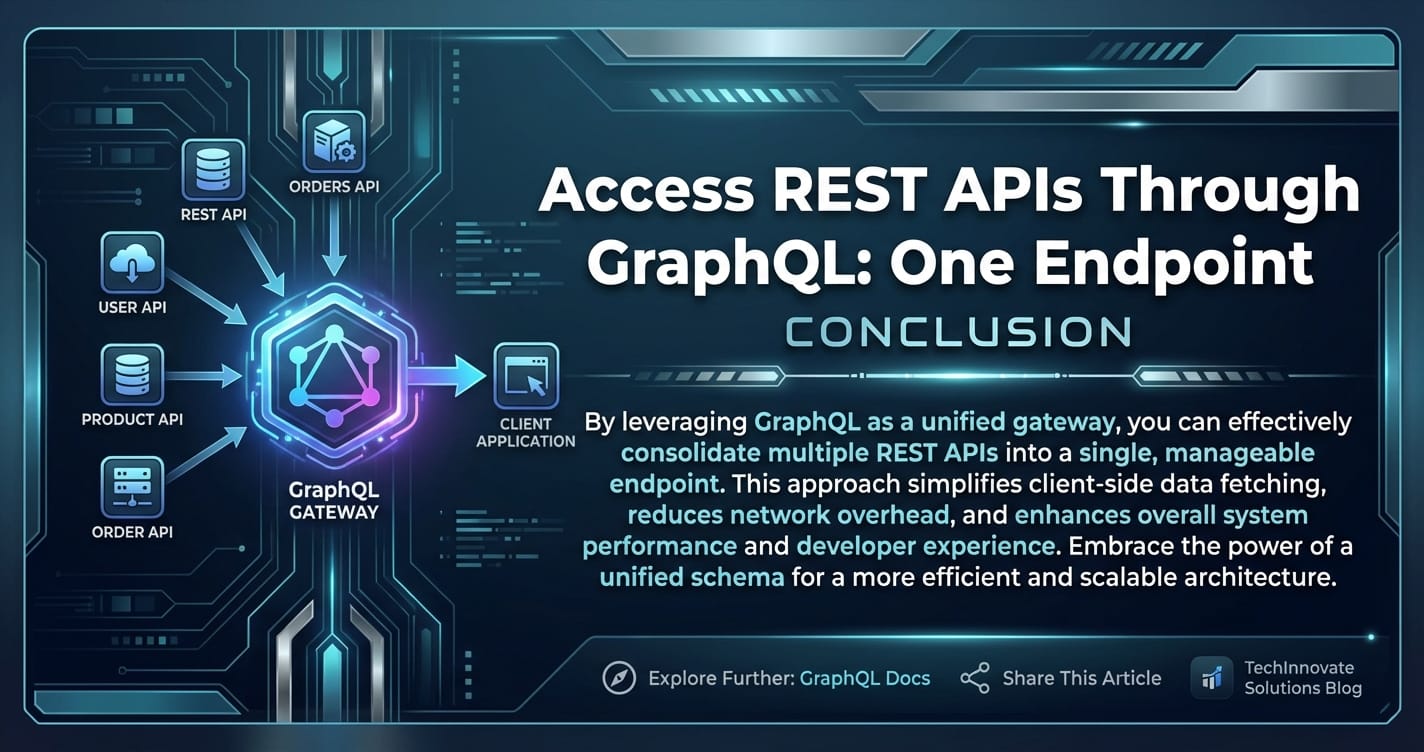
Access REST APIs Through GraphQL: One Endpoint


In the vast and interconnected digital landscape of today, the efficient and flexible exchange of data is paramount. For decades, Representational State Transfer (REST) APIs have served as the bedrock of web service communication, enabling disparate systems to interact with a simple, stateless paradigm. However, as applications grow in complexity, requiring data from an ever-increasing number of services and presenting it across diverse client platforms, the limitations of REST can become increasingly apparent. Developers often find themselves wrestling with issues of over-fetching, under-fetching, multiple round trips, and the daunting task of managing versioning across numerous endpoints.
This exhaustive exploration delves into a powerful architectural pattern that addresses these challenges head-on: accessing existing REST APIs through a single GraphQL endpoint. By introducing a GraphQL layer, often implemented as an API gateway, organizations can transform their fragmented REST landscape into a unified, client-centric data graph. This approach not only streamlines development and enhances performance but also future-proofs their API infrastructure, providing a flexible interface that empowers clients to precisely request the data they need, when they need it, from a solitary access point. We will meticulously dissect the rationale, the architectural considerations, the implementation strategies, potential pitfalls, and the profound benefits of this transformative paradigm, ensuring a comprehensive understanding for developers, architects, and business leaders alike.
The Evolution of APIs: From Monoliths to Microservices and the Rise of Data Complexity
The journey of Application Programming Interfaces (APIs) mirrors the broader evolution of software architecture itself. In the early days, monolithic applications often communicated internally, or exposed simple, often bespoke, remote procedure call (RPC) interfaces. As the web matured, the need for standardized, interoperable communication became critical. This gave rise to SOAP (Simple Object Access Protocol), a robust, XML-based protocol known for its strong typing, extensive tooling, and reliance on Web Services Description Language (WSDL) for contract definition. While powerful for enterprise-level integrations, SOAP's verbosity and complexity often made it cumbersome for lighter-weight web applications.
Then came REST, championed by Roy Fielding in his doctoral dissertation. REST introduced a paradigm shift, emphasizing simplicity, statelessness, and the use of standard HTTP methods (GET, POST, PUT, DELETE) to manipulate resources identified by URLs. Its adoption exploded due to its ease of use, human-readable format (often JSON), and alignment with the principles of the web itself. RESTful APIs quickly became the de facto standard for building web services, enabling the proliferation of rich web and mobile applications.
The microservices architecture further accelerated REST's dominance. By breaking down large monolithic applications into smaller, independent, and loosely coupled services, microservices enabled agile development, independent deployment, and scalability. Each microservice typically exposed its own set of REST APIs, handling a specific business capability. This architectural shift, while offering immense benefits in terms of development velocity and resilience, also introduced new challenges.
Clients, particularly front-end applications, often needed to aggregate data from multiple microservices to construct a single view. For instance, displaying a user's profile might require fetching data from a user service, their orders from an order service, and their recommendations from a recommendation service. This led to what became known as the "N+1 problem" in a client-server context, where a single user action could trigger numerous successive API calls, leading to increased latency, network overhead, and complexity on the client side.
Furthermore, RESTful APIs, by their very nature, expose fixed data structures for each endpoint. If a client only needed two fields out of twenty, it would still receive the entire payload (over-fetching). Conversely, if it needed data from a related resource not included in the initial response, it would have to make an additional request (under-fetching). This inefficiency often forced front-end developers to perform client-side data filtering and aggregation, duplicating logic and increasing the burden on client applications, especially critical for mobile devices with limited bandwidth and processing power. Versioning also posed a perpetual challenge; evolving API requirements often led to the creation of new API versions (e.g., /v1/users, /v2/users), complicating client updates and maintenance. It became clear that while REST was a powerful tool, the evolving demands of modern applications required a more flexible and efficient data fetching mechanism.
Introducing GraphQL: A Query Language for Your API
Against this backdrop of increasing data complexity and client-side demands, Facebook open-sourced GraphQL in 2015. GraphQL is fundamentally a query language for your API and a runtime for fulfilling those queries with your existing data. Unlike REST, where clients interact with multiple endpoints, each representing a specific resource, GraphQL exposes a single, powerful endpoint, typically /graphql. Through this singular endpoint, clients can send precise queries to request exactly the data they need, in the structure they desire, across multiple resources.
The core principles of GraphQL are transformative:
- Declarative Data Fetching: Clients declare what data they need, and the server responds with precisely that data, and nothing more. This eliminates over-fetching and under-fetching, which are common pain points with REST.
- Single Endpoint: All data interaction happens through one endpoint. This simplifies client-side code and network management, as clients no longer need to keep track of numerous resource-specific URLs.
- Strongly Typed Schema: At the heart of every GraphQL API is a schema, which is a strongly typed contract defining all the data and operations (queries, mutations, subscriptions) that clients can perform. This schema serves as a universal interface, enabling powerful introspection capabilities, robust validation, and excellent tooling. It acts as a self-documenting blueprint of the API's capabilities.
- Hierarchical Queries: GraphQL queries mirror the structure of the data requested, allowing clients to traverse relationships between different data types in a single request. For instance, you can query a
userand, within the same query, request theirordersand theproductswithin those orders. - Mutations for Data Modification: Just as
GETrequests are typically used for data retrieval in REST, GraphQL uses "mutations" to modify data. Mutations are structured similarly to queries but explicitly indicate that they are intended to change server-side data. - Subscriptions for Real-time Data: GraphQL also supports "subscriptions," which enable real-time data streaming. Clients can subscribe to specific events, and the server will push updates to them when those events occur, facilitating live dashboards, chat applications, and other dynamic experiences.
The power of GraphQL lies not in replacing existing backend data sources, but in providing an elegant abstraction layer over them. It acts as an intelligent intermediary, receiving client requests, understanding the specific data fields required, and then orchestrating the fetching of that data from various underlying services or databases. This makes it an ideal candidate for unifying access to a collection of existing REST APIs, transforming them into a cohesive and client-friendly data graph.
The "Why": Profound Benefits of Unifying REST with GraphQL
The decision to introduce a GraphQL layer in front of existing REST APIs is not merely a technical one; it's a strategic move that delivers significant advantages across the entire software development lifecycle and business operations. The benefits span improved developer experience, enhanced performance, streamlined maintenance, and greater agility.
1. Simplified Client-Side Development: One Request, Precise Data
For front-end developers, the most immediate and tangible benefit is the radical simplification of data fetching logic. Instead of making multiple REST calls to different endpoints, aggregating responses, and then filtering out unneeded data, a single GraphQL query can retrieve all necessary information. This dramatically reduces the amount of code required on the client side to manage network requests and data transformations. Developers can focus on building user interfaces rather than wrestling with data orchestration. The declarative nature of GraphQL means clients explicitly state their data requirements, leading to more predictable and easier-to-debug code. This is particularly impactful for mobile applications, where network efficiency and reduced processing overhead are critical.
2. Reduced Network Overhead and Improved Performance
By eliminating over-fetching, GraphQL queries ensure that only the exact data requested is transmitted over the network. This reduction in payload size is a significant performance boost, especially for clients on cellular networks or with limited bandwidth. Furthermore, the ability to fetch related data in a single request prevents the dreaded "N+1" problem, where a client might initially fetch a list of items and then make N subsequent requests to fetch details for each item. With GraphQL, these N+1 requests are consolidated into one efficient query, dramatically reducing round trips and overall latency. This not only makes applications feel snappier but also contributes to better user engagement and retention.
3. Enhanced Developer Experience (DX) and Self-Documenting API
A GraphQL schema acts as a single source of truth for your entire API. It clearly defines all available types, fields, and operations, along with their relationships. This strong typing and introspection capability mean that developers can use powerful tooling (like GraphQL Playground or GraphiQL) to explore the API, discover capabilities, and even generate queries automatically. This eliminates the need for external API documentation that often falls out of sync with the actual API implementation. New team members can onboard faster, and existing developers can work more efficiently, confident in the accuracy of the API's contract. The self-documenting nature fostered by a GraphQL gateway significantly improves the overall developer experience, reducing friction and accelerating feature delivery.
4. Faster Feature Development and Iteration
With a flexible GraphQL endpoint, front-end teams can build new features and adapt to evolving requirements without waiting for backend teams to modify or create new REST endpoints. If a new UI component requires a slightly different combination of data, the front-end simply adjusts its GraphQL query. There's no need for backend redeployments or coordination around new API versions. This decoupling accelerates development cycles, fosters independent team workflows, and allows businesses to respond more rapidly to market demands and user feedback. This agility is a key competitive advantage in today's fast-paced digital environment.
5. Simplified API Versioning
Versioning is a persistent headache in REST API management. New requirements often necessitate new versions of an endpoint (e.g., /api/v2/users), leading to fragmentation, maintenance overhead for older versions, and a migration burden for clients. GraphQL inherently handles evolution gracefully. Since clients request specific fields, adding new fields to existing types in the schema doesn't break older clients; they simply ignore the new fields. Deprecating fields can be explicitly marked in the schema, allowing clients to gradually migrate without abrupt breakage. This flexible evolution strategy dramatically simplifies API maintenance and reduces the need for disruptive version bumps, making API management through a unified api gateway much more manageable.
6. Microservices Orchestration and Data Aggregation
In a microservices architecture, a single client request might require data from several independent services. A GraphQL gateway acts as an ideal aggregation layer, orchestrating calls to multiple underlying REST services, combining their responses, and presenting a unified view to the client. This shifts the complexity of inter-service communication from the client to the gateway, which is much better equipped to handle concerns like error resilience, caching, and load balancing across internal services. This pattern, often referred to as a "Backend for Frontend" (BFF) when GraphQL is specific to a client application, centralizes data fetching logic and simplifies the client's responsibility.
7. Enhanced Security and Observability at the API Gateway Level
Placing a GraphQL layer behind an api gateway provides a single choke point for enforcing security policies, authentication, and authorization. The api gateway can validate tokens, apply access controls, and rate-limit requests before they even reach the underlying REST services. Furthermore, all incoming client queries can be logged and analyzed, providing a holistic view of data access patterns. Comprehensive logging and data analysis are crucial for understanding API usage, identifying potential bottlenecks, and proactively addressing security threats. Tools like APIPark, an open-source AI gateway and API management platform, excel in this area, offering detailed API call logging and powerful data analysis capabilities. By acting as a central control point, APIPark helps regulate API management processes, manage traffic forwarding, load balancing, and versioning of published APIs, ensuring system stability and data security.
These benefits collectively paint a compelling picture for adopting GraphQL as a façade for your existing REST infrastructure. It's an investment in a more agile, performant, and developer-friendly API ecosystem.
The "How": Architecting the Bridge from REST to GraphQL
Implementing a GraphQL layer over existing REST APIs requires careful architectural planning and a clear understanding of how the GraphQL server will interact with your backend services. The core idea is to map your REST resources and their relationships to a coherent GraphQL schema, and then implement "resolvers" that know how to fetch data from the appropriate REST endpoints. This unified api gateway approach creates a seamless experience for clients, abstracting away the underlying complexity of your service landscape.
1. Schema Design: Mapping Existing REST Resources
The very first step is to design your GraphQL schema. This involves identifying the key entities (or resources) from your REST APIs and defining them as GraphQL types. Consider a system with REST APIs for users, products, and orders.
- Identify Root Types: You'll typically have
Queryfor data retrieval,Mutationfor data modification, and potentiallySubscriptionfor real-time updates. - Define Object Types: Map your REST resources to GraphQL object types.
Usertype:id,name,email,address.Producttype:id,name,description,price.Ordertype:id,date,total,status.
- Establish Relationships: This is where GraphQL truly shines. Connect these types based on how they relate in your domain.
- An
Ordermight have acustomerfield that returns aUsertype. - An
Ordermight have anitemsfield that returns a list ofProducttypes (perhaps wrapped in anOrderItemtype to include quantity). - A
Usermight have anordersfield that returns a list ofOrdertypes.
- An
- Define Query Fields: On the
Querytype, define fields that allow clients to fetch instances of your types.user(id: ID!): Userusers: [User!]product(id: ID!): Productproducts(limit: Int): [Product!]order(id: ID!): Order
- Define Mutation Fields: On the
Mutationtype, define fields for creating, updating, or deleting resources.createUser(input: CreateUserInput!): User(whereCreateUserInputis anInputTypefor the user's data).updateProduct(id: ID!, input: UpdateProductInput!): Product
The schema design process should be collaborative, involving both front-end and backend teams, to ensure it meets client needs while accurately reflecting the capabilities of the underlying REST services. The beauty of the schema is its flexibility; it can combine data from multiple REST endpoints into a single, cohesive representation.
2. Resolvers: The Core Logic Fetching Data from REST Services
Once the schema is defined, the next crucial step is implementing "resolvers." A resolver is a function responsible for fetching the data for a specific field in the schema. When a client sends a GraphQL query, the GraphQL execution engine traverses the query's fields, calling the corresponding resolver function for each field.
For a GraphQL layer fronting REST APIs, these resolvers will primarily be responsible for:
- Making HTTP Requests: The resolver for a field like
user(id: ID!)would typically make an HTTP GET request to your/users/{id}REST endpoint. - Transforming Data: The REST API might return data in a slightly different format than what your GraphQL schema expects. Resolvers transform this incoming REST data into the GraphQL type definition. For example, if a REST
userobject hasfirst_nameandlast_name, but your GraphQLUsertype has a singlenamefield, the resolver would concatenate them. - Handling Relationships: This is where resolvers get more complex and powerful.
- If a
Usertype has anordersfield, theordersresolver within theUsertype would take theuser.id(from the parentUserobject) and make a GET request to a REST endpoint like/users/{id}/orders. - This is where the N+1 problem can re-emerge if not handled carefully. If you query for a list of users, and then for each user's orders, without optimization, the
ordersresolver would make a separate REST call for each user.
- If a
- Data Loaders for Batching and Caching: To mitigate the N+1 problem, GraphQL implementations often leverage "Data Loaders." A Data Loader is a utility that batches multiple individual requests for data into a single request to the underlying backend (e.g., fetching multiple user orders in one REST call that accepts a list of user IDs) and caches previously fetched results. This significantly optimizes performance when dealing with nested data structures and relationships, ensuring that resolvers make as few backend calls as possible.
3. Gateway Implementation: The GraphQL API Gateway
The entire GraphQL layer, especially when it acts as a unified entry point for multiple backend services, is often referred to as a GraphQL gateway or API Gateway. This gateway is a server application that:
- Exposes the Single GraphQL Endpoint: It listens for incoming HTTP requests, typically POST requests, to a
/graphqlpath. - Parses and Validates Queries: It receives the client's GraphQL query string, parses it, and validates it against the defined schema.
- Executes Queries with Resolvers: It orchestrates the execution of the query, invoking the appropriate resolvers to fetch data.
- Aggregates and Formats Responses: It collects the data returned by the resolvers, structures it according to the client's query, and sends back a single JSON response.
- Handles Cross-Cutting Concerns: A robust
API gatewayalso manages:- Authentication and Authorization: Verifying client identity and permissions before allowing query execution or propagating credentials to downstream REST services.
- Rate Limiting: Protecting backend services from excessive requests.
- Caching: Storing frequently accessed data to reduce load on REST services.
- Logging and Monitoring: Tracking requests, performance, and errors.
- Traffic Management: Load balancing and routing requests to appropriate backend services.
This API gateway becomes the central nervous system for all client-to-backend communication, offering a unified, high-performance, and secure access point. For platforms dealing with a multitude of APIs, including AI models and traditional REST services, a comprehensive API gateway solution like APIPark becomes indispensable. APIPark offers end-to-end API lifecycle management, performance rivaling Nginx, and detailed API call logging, making it an excellent candidate for organizations looking to manage and scale their API landscape effectively. APIPark’s capabilities extend to integrating over 100+ AI models with a unified management system for authentication and cost tracking, further solidifying its role as a versatile gateway for modern, AI-driven applications.
4. Tooling and Libraries
Building a GraphQL gateway involves using various libraries and frameworks depending on your chosen programming language:
- Node.js: Apollo Server, Express-GraphQL, GraphQL.js (the reference implementation).
- Python: Graphene, Ariadne.
- Java: GraphQL-Java, DGS Framework.
- Go: GraphQL-Go.
These tools provide the core GraphQL server functionality, allowing you to define schemas, implement resolvers, and handle HTTP requests. Client-side libraries like Apollo Client, Relay, or Urql simplify consuming GraphQL APIs in web and mobile applications, providing features like caching, normalization, and UI integration.
By carefully designing the schema, implementing efficient resolvers (leveraging Data Loaders), and deploying a robust GraphQL API gateway, organizations can successfully bridge their existing REST infrastructure with the modern, flexible world of GraphQL, all through a single, powerful endpoint.
Deep Dive into Implementation Strategies for GraphQL over REST
Beyond the foundational concepts of schema design and resolvers, integrating GraphQL with existing REST APIs involves nuanced strategies to handle complex scenarios, ensure performance, and maintain a robust architecture. The choice of strategy often depends on the scale of your API landscape, the autonomy of your teams, and your desired level of GraphQL adoption.
1. Schema Stitching vs. Federation: Combining Multiple GraphQL Services
As your application grows, you might find yourself with multiple independent GraphQL services, or even existing REST APIs that you've wrapped with their own smaller GraphQL layers. Combining these into a single, cohesive graph exposed by your api gateway becomes a critical concern.
- Schema Stitching: This traditional approach involves programmatically merging multiple GraphQL schemas into one larger schema. The
gatewaythen routes parts of a client query to the appropriate stitched sub-schema. While powerful, it can become complex to manage, especially with overlapping types or conflicting fields across schemas. It requires thegatewayto have detailed knowledge of all sub-schemas and handle field-level delegation. - GraphQL Federation (e.g., Apollo Federation): This is a more modern and highly scalable approach designed for microservices environments. In Federation, each sub-service (called a "subgraph") defines its own GraphQL schema, and declares which types it "owns" and how it extends types owned by other subgraphs. The
gateway(often called a "supergraph router" or "federation gateway") then intelligently composes these subgraphs into a single "supergraph" at runtime. The key advantage is that each team owns and develops its subgraph independently, and thegatewayhandles the complex query planning and execution across these distributed services. Federation is particularly well-suited for large organizations with many teams managing different parts of the overall data graph, abstracting the composition logic into theapi gatewayitself.
When bridging REST, you might wrap each logical group of REST APIs (e.g., all user-related REST endpoints, all product-related REST endpoints) into its own small GraphQL service (a subgraph). These subgraphs then collectively form the federated graph, managed by the central GraphQL api gateway.
2. Data Transformation and Harmonization
REST APIs often return data in formats that might not perfectly align with the ideal GraphQL schema. For example: * Snake_case vs. camelCase: REST APIs frequently use snake_case (e.g., user_id, product_name), while GraphQL best practices suggest camelCase (e.g., userId, productName). Resolvers must perform this transformation. * Flattened Structures: A REST endpoint might return a flattened structure, where related data is embedded directly. GraphQL allows for nested, hierarchical structures, so resolvers need to reconstruct these relationships. * Date Formats: Dates can come in various string formats (ISO 8601, Unix timestamp). Resolvers might need to normalize these into a consistent DateTime scalar type or custom scalar. * Error Structures: REST APIs return errors with various HTTP status codes and body structures. Resolvers should catch these and translate them into a consistent GraphQL error format, typically including an errors array in the response.
This transformation logic resides within the resolvers, ensuring that the client always receives data in a predictable and consistent GraphQL format, regardless of the underlying REST API's idiosyncrasies.
3. Authentication and Authorization Across the Gateway
Security is paramount. The GraphQL api gateway serves as an enforcement point for authentication and authorization:
- Authentication: The
gatewaytypically intercepts incoming requests and authenticates the user (e.g., by validating an OAuth token, JWT, or API key). - Authorization: Based on the authenticated user's identity and roles, the
gatewaydecides whether the user has permission to access certain GraphQL fields or perform specific mutations. This can involve:- Field-level Authorization: Restricting access to individual fields within a type (e.g., only admins can see a user's
salaryfield). - Type-level Authorization: Restricting access to entire types (e.g., only authenticated users can query
Orderobjects). - Resolver-level Authorization: Implementing business logic within resolvers to check permissions before fetching data from REST APIs (e.g., ensuring a user can only see their own orders).
- Field-level Authorization: Restricting access to individual fields within a type (e.g., only admins can see a user's
- Propagating Credentials: Once authenticated, the
gatewaymust securely propagate the user's identity or authorization tokens to the downstream REST APIs. This often involves forwarding HTTP headers (likeAuthorization) or transforming them into a format expected by the backend services.
A robust api gateway like APIPark can centralize these security concerns, providing features like independent API and access permissions for each tenant and requiring approval for API resource access, preventing unauthorized API calls and potential data breaches, even before the GraphQL layer processes the query.
4. Caching Strategies
Caching is critical for performance and scalability, especially when dealing with expensive or frequently accessed REST endpoints.
- HTTP Caching (at the Gateway): Standard HTTP caching headers (Cache-Control, ETag) can be applied to the GraphQL endpoint for
GETrequests (though GraphQL queries are typicallyPOST). - Response Caching (at the Gateway): The
api gatewaycan cache the entire GraphQL response for specific queries, particularly for idempotent queries that don't change frequently. - Data Loader Caching: Data Loaders inherently provide a per-request caching mechanism, batching and deduplicating calls within a single GraphQL request.
- Resolver-level Caching: Resolvers can implement their own caching logic, using in-memory caches, Redis, or other caching layers, especially for data fetched from REST APIs that have varying freshness requirements.
- Client-side Caching: GraphQL clients like Apollo Client have sophisticated client-side caching mechanisms that store query results and update the cache as mutations occur, further reducing network requests.
A multi-layered caching strategy, combining api gateway caching with resolver and client-side caching, offers the best performance gains.
5. Rate Limiting and Throttling
To protect underlying REST services from abuse or overload, the GraphQL api gateway should implement robust rate limiting and throttling:
- Per-User/Per-Client Rate Limiting: Limiting the number of requests or query complexity per authenticated user or API key within a given time window.
- Depth Limiting: Restricting how deeply nested a query can be, preventing excessively complex or resource-intensive queries that could overwhelm backend services.
- Complexity Analysis: Assigning a "cost" to each field in the schema and rejecting queries that exceed a predefined total complexity score.
- Burst Limiting: Allowing short bursts of high traffic while ensuring sustained traffic remains within acceptable limits.
These mechanisms, often built into advanced api gateway solutions, are essential for maintaining the stability and availability of your backend infrastructure.
By strategically applying these implementation deep dives, organizations can build a highly performant, secure, and maintainable GraphQL gateway that elegantly abstracts away the complexities of their existing REST API landscape.
APIPark is a high-performance AI gateway that allows you to securely access the most comprehensive LLM APIs globally on the APIPark platform, including OpenAI, Anthropic, Mistral, Llama2, Google Gemini, and more.Try APIPark now! 👇👇👇
Challenges and Considerations When Adopting GraphQL Over REST
While the benefits of unifying REST APIs under a single GraphQL endpoint are compelling, the transition is not without its challenges. Awareness of these potential pitfalls and planning for them proactively is crucial for a successful adoption.
1. Initial Setup Complexity and Learning Curve
Introducing GraphQL, especially as a gateway over existing REST services, adds a new layer of abstraction and technology to your stack. * GraphQL Concepts: Developers, particularly those accustomed to REST, will need to learn GraphQL's schema definition language, query syntax, mutation patterns, and the concept of resolvers. * Gateway Implementation: Setting up the GraphQL gateway itself involves choosing a framework, designing the schema, and meticulously implementing resolvers for all desired REST endpoints. This can be a significant upfront effort. * Tooling and Ecosystem: While GraphQL has excellent tooling, integrating it into existing CI/CD pipelines, monitoring systems, and development workflows requires effort. * Team Training: Investing in training for both front-end and backend teams is essential to ensure a smooth transition and effective utilization of the new api gateway.
This initial complexity can be daunting, but the long-term benefits in terms of developer productivity and API agility often outweigh the upfront investment.
2. Potential Performance Overhead (If Not Optimized)
A poorly implemented GraphQL gateway can introduce performance bottlenecks rather than alleviate them. * N+1 Problem (Revisited): As discussed, without proper optimization using Data Loaders or batching, nested GraphQL queries can lead to a flood of individual REST calls, resulting in increased latency and load on backend services. * Over-reliance on Resolvers: If resolvers are complex, perform heavy computations, or make synchronous calls without proper concurrency, they can become slow. * Gateway Latency: The gateway itself adds an extra hop in the request-response cycle. While often negligible, inefficient gateway processing (e.g., slow parsing, unoptimized query execution) can add measurable latency. * Resource Management: The gateway server needs adequate CPU, memory, and network resources to handle concurrent requests and orchestrate backend calls efficiently. Solutions like APIPark, which boasts performance rivaling Nginx (over 20,000 TPS with just an 8-core CPU and 8GB of memory), highlight the importance of choosing a performant api gateway to mitigate this.
Thorough performance testing, profiling, and continuous optimization are critical to ensure the GraphQL gateway enhances performance, not degrades it.
3. Error Handling and Observability
Translating errors from diverse REST APIs into a consistent GraphQL error format can be challenging. * Varied REST Error Formats: Different REST services might return errors with varying HTTP status codes, error codes, and message structures. Resolvers need to normalize these into the GraphQL errors array, providing meaningful information to the client without exposing internal details. * Distributed Tracing: When a GraphQL query fan-outs to multiple REST services, tracing the entire request flow for debugging can be complex. Implementing distributed tracing (e.g., using OpenTelemetry or Jaeger) across the gateway and backend services is essential for effective troubleshooting. * Logging: Comprehensive logging at the gateway level, capturing query details, resolver execution times, and backend API responses, is crucial. APIPark's detailed API call logging capabilities can be invaluable here, providing insights into every aspect of an API call, from request to response, assisting businesses in quickly tracing and troubleshooting issues.
Effective error handling and robust observability are key to maintaining a stable and debuggable GraphQL layer.
4. File Uploads and Binary Data
GraphQL's primary strength is structured data. While extensions exist, handling file uploads and other binary data directly through standard GraphQL mutations can be less straightforward than traditional REST multipart/form-data endpoints. * Multipart Requests: GraphQL clients and servers need to support multipart requests to handle file uploads effectively. * Alternative Approaches: Often, for large file uploads, a hybrid approach is used: the GraphQL gateway might initiate a secure, temporary pre-signed URL (from a storage service like S3) through a mutation, and the client then uploads the file directly to that URL using a standard HTTP PUT, bypassing the gateway for the actual binary transfer.
This is a consideration that might lead to keeping some specific REST endpoints alive for file operations, even with a GraphQL gateway in place.
5. Real-time Updates (Subscriptions)
While GraphQL supports subscriptions for real-time data, implementing them over existing REST APIs requires additional infrastructure. * Polling: The simplest, but least efficient, method is for a subscription resolver to poll the REST API at regular intervals. * WebSockets/SSE: A more robust solution involves having the REST APIs emit events (e.g., to a message queue like Kafka or RabbitMQ) when data changes. The GraphQL gateway can then subscribe to these events and push updates to clients via WebSockets or Server-Sent Events (SSE). This often requires modifying the backend REST services to publish events.
Adding real-time capabilities can significantly increase the complexity of the gateway implementation and potentially require architectural changes in the underlying REST services.
6. Managing State and Side Effects
GraphQL mutations are designed to have side effects, but ensuring consistency and handling complex transactions across multiple REST services can be intricate. * Transactional Consistency: If a single GraphQL mutation needs to update data in several independent REST services, ensuring atomicity (all or nothing) in case of failure requires careful design, potentially using sagas or distributed transaction patterns. * Idempotency: Designing mutations to be idempotent, where applying the same mutation multiple times has the same effect as applying it once, is good practice, but not always trivial when interacting with stateful REST APIs.
By acknowledging these challenges and implementing thoughtful solutions, organizations can successfully leverage GraphQL to transform their REST API landscape into a more agile and client-friendly data graph.
Use Cases and Real-World Examples
The pattern of accessing REST APIs through a single GraphQL endpoint is immensely versatile and finds application across a wide spectrum of scenarios. Its utility is particularly pronounced where data aggregation, client-side flexibility, and streamlined development are paramount.
1. Mobile Backend for Frontend (BFF)
One of the most canonical use cases for a GraphQL gateway is implementing a Backend for Frontend (BFF) pattern, especially for mobile applications. Mobile apps often require highly specific subsets of data, tailored to small screen real estate and optimized for low bandwidth. * Scenario: A mobile e-commerce app needs to display a product page that shows product details (from the Product REST API), user reviews (from the Review REST API), related recommendations (from the Recommendation microservice), and stock availability (from the Inventory REST API). * Traditional REST: The mobile client would make 4-5 separate HTTP requests, each potentially over-fetching data, leading to slow loading times and increased battery drain. * GraphQL Solution: A GraphQL gateway acts as the BFF. The mobile client sends a single GraphQL query asking for product details, reviews, recommendations, and stock in one go. The gateway orchestrates calls to the 4 underlying REST services, aggregates the responses, and returns a lean, optimized JSON payload precisely matching the client's needs. This drastically reduces network round trips, improves responsiveness, and simplifies mobile client development.
2. Aggregating Data from Disparate Microservices
Organizations adopting microservices often end up with a fragmented data landscape. Different teams own different services, each exposing its own REST APIs. Clients (web apps, internal tools, partner integrations) then struggle to piece together a holistic view. * Scenario: A company has separate microservices for Customer Management, Order Processing, Shipping, and Payment. An internal dashboard needs to show a complete view of a customer's activity, including their profile, all their orders, their shipping statuses, and payment history. * Traditional REST: The dashboard application would need to know the endpoints for all four services, make multiple calls, and then join the data on the client side. This becomes brittle if any service changes its API. * GraphQL Solution: A central GraphQL api gateway defines a unified schema that incorporates types from all four microservices (Customer, Order, ShippingStatus, PaymentTransaction). The dashboard simply queries this gateway for a customer and their orders, shipping statuses, and payment transactions in a single query. The gateway intelligently resolves these fields by calling the respective REST microservices, abstracts away the service boundaries, and presents a coherent data graph to the dashboard. This empowers developers to build rich applications without deep knowledge of the underlying microservice topology.
3. Third-Party API Integration
Integrating with multiple external third-party APIs (e.g., payment gateways, shipping carriers, CRM systems) can introduce a lot of boilerplate code and inconsistent data formats. * Scenario: An application needs to integrate with FedEx for shipping, Stripe for payments, and Salesforce for customer data, each exposing its own distinct REST API. * Traditional REST: The application would have to manage separate API keys, authentication methods, error handling, and data transformations for each third-party API. * GraphQL Solution: A GraphQL gateway can wrap these third-party REST APIs. The gateway handles all the complexities of authentication, rate limiting, and data transformation specific to each external API. The internal application then interacts with the gateway using a consistent GraphQL schema, making third-party integrations much cleaner and easier to manage. This creates a powerful abstraction layer, shielding the core application from external API changes and complexities.
4. Public API Exposure
When exposing a public API to external developers, providing a flexible and well-documented interface is key to fostering adoption. * Scenario: A company wants to expose its vast internal data and services to partners and third-party developers, who will build their own applications on top of it. * Traditional REST: Exposing numerous REST endpoints might lead to confusion, under-utilization, and difficulty in finding specific data. * GraphQL Solution: A GraphQL api gateway can serve as the public-facing API. The self-documenting schema, powerful introspection, and flexible querying capabilities of GraphQL significantly enhance the developer experience for external partners. They can explore the API, write precise queries, and integrate more quickly, leading to greater ecosystem engagement. The gateway also provides a centralized point for managing API keys, access permissions, and usage analytics for external consumers, a capability where APIPark truly shines with its comprehensive API lifecycle management features.
These real-world examples demonstrate how a GraphQL layer, acting as a sophisticated api gateway, can unlock significant value by streamlining data access, improving developer agility, and creating a more robust and scalable API infrastructure.
Security Aspects of a GraphQL Gateway for REST APIs
While providing flexibility and performance, a GraphQL gateway also introduces new security considerations that must be diligently addressed. As the single point of entry to your backend REST APIs, it becomes a critical defense layer, and its security posture directly impacts the integrity and confidentiality of your entire system.
1. Authentication and Authorization (Re-emphasized)
This remains paramount. The gateway must be the primary enforcer of who can access what. * Robust Authentication: Implement industry-standard authentication mechanisms (JWT, OAuth 2.0, API Keys) to verify the identity of every client making a request. The gateway should validate these credentials before processing any GraphQL query. * Granular Authorization: Beyond simply allowing or denying access to the entire gateway, authorization must be applied at a granular level. * Role-Based Access Control (RBAC): Define roles (e.g., admin, user, guest) and associate permissions with these roles. GraphQL fields or types can then be restricted based on the authenticated user's role. * Contextual Authorization: Within resolvers, implement business logic to ensure users can only access or modify resources they own or are authorized for (e.g., a user can only view their own order details, not another user's). * Schema Directives: Use GraphQL schema directives (@auth, @hasRole) to declaratively define authorization rules directly within the schema, making them transparent and easier to manage.
APIPark offers features like "Independent API and Access Permissions for Each Tenant" and "API Resource Access Requires Approval," which directly address these granular authorization needs, ensuring a secure and controlled environment for API consumption.
2. Input Validation and Sanitization
GraphQL queries involve dynamic inputs (arguments to fields, mutation input objects). These inputs are prime targets for malicious attacks. * Schema-Level Validation: GraphQL's strong typing provides basic validation (e.g., ensuring an Int is indeed an integer). * Custom Scalar Validation: For more complex types like Email, UUID, or PhoneNumber, define custom scalar types with robust validation logic. * Resolver-Level Validation: Within resolvers, perform detailed validation of all input arguments before passing them to downstream REST APIs. This prevents injection attacks, malformed data, or attempts to bypass security rules. * Sanitization: If any input data is eventually displayed to users, ensure it is properly sanitized to prevent Cross-Site Scripting (XSS) attacks.
Never trust client input; always validate and sanitize.
3. Query Depth and Complexity Limiting
Malicious or poorly designed GraphQL queries can become extremely resource-intensive, leading to Denial of Service (DoS) attacks. * Query Depth Limiting: Prevent excessively nested queries (e.g., user { orders { products { category { ... } } } }). A gateway can reject queries that exceed a predefined depth limit (e.g., 10 levels deep). * Query Complexity Analysis: Assign a "cost" to each field in your schema (e.g., fetching a list of products might cost more than fetching a single product). The gateway can then calculate the total complexity of an incoming query and reject it if it exceeds a maximum threshold. This is more sophisticated than depth limiting as it considers the actual resources consumed. * Rate Limiting: As discussed earlier, limiting the number of requests per client over a time window is crucial for preventing brute-force attacks and overwhelming the server.
These measures protect your gateway and underlying REST services from being brought down by resource-intensive queries.
4. Preventing Data Leaks and Sensitive Data Masking
Ensure that sensitive data is never accidentally exposed through the GraphQL layer. * Careful Schema Design: Only expose the data fields necessary for clients. Avoid exposing internal IDs, sensitive database fields, or raw error messages that could reveal system vulnerabilities. * Resolver Data Filtering: Resolvers must explicitly filter out sensitive data from REST API responses before returning it to the client, even if the REST API provides it. * Masking/Redaction: For certain fields (e.g., partial credit card numbers, masked email addresses), resolvers should implement logic to mask or redact portions of the data based on the user's authorization level. * Error Message Control: Ensure that error messages returned by the GraphQL gateway are generic and do not expose internal stack traces, database errors, or other sensitive system information.
5. Transport Layer Security (TLS/SSL)
All communication with the GraphQL gateway must occur over HTTPS. * End-to-End Encryption: Ensure TLS/SSL is configured correctly on your gateway and all communication between the gateway and your backend REST services is also encrypted (internal TLS/mTLS) where possible, especially in cloud or containerized environments. * Strong Ciphers and Protocols: Use modern TLS versions (e.g., TLS 1.2 or 1.3) and strong cryptographic ciphers to protect data in transit.
6. Logging and Monitoring for Security Audits
Comprehensive logging is not just for debugging; it's a critical security tool. * Detailed Access Logs: Log every GraphQL query, including the client's IP, authenticated user ID, timestamp, and the specific fields requested. * Anomaly Detection: Monitor logs for suspicious patterns, such as an unusually high number of requests from a single IP, repeated failed authentication attempts, or queries targeting sensitive data by unauthorized users. * Integration with SIEM: Integrate gateway logs with Security Information and Event Management (SIEM) systems for centralized security monitoring and alerting.
APIPark's "Detailed API Call Logging" and "Powerful Data Analysis" features provide the necessary foundation for robust security auditing and proactive threat detection, making it an ideal choice for a secure API gateway implementation.
By rigorously applying these security measures, organizations can ensure that their GraphQL gateway not only provides a flexible and efficient interface but also stands as a strong bastion protecting their backend infrastructure and sensitive data.
Performance Optimization for Your GraphQL Gateway
Achieving optimal performance for a GraphQL gateway over REST APIs is not an afterthought; it's an ongoing process of strategic design and continuous tuning. While GraphQL inherently helps reduce network overhead on the client side, the gateway itself must be a highly performant component to avoid becoming a bottleneck.
1. Batching and Caching (Revisited for Impact)
These are arguably the most critical performance optimizations for a GraphQL gateway aggregating REST data. * Data Loaders: Absolutely essential for solving the N+1 problem. Data Loaders should be integrated into resolvers wherever fetching related data could lead to multiple individual REST calls. They collect all requests for a given type of data within a single GraphQL query execution and then execute a single, batched REST call (e.g., /users?ids=1,2,3). They also provide in-memory caching for the duration of a single request, preventing duplicate fetches. * External Caching: Implement a robust caching layer (e.g., Redis, Memcached) for frequently accessed, immutable, or slow-to-fetch data from REST APIs. Resolvers can check the cache first before making an HTTP request. The gateway itself can also implement full-response caching for specific, highly stable queries. * HTTP Caching for REST Services: Ensure your underlying REST services are also optimized with appropriate HTTP caching headers (Cache-Control, ETag, Last-Modified). The GraphQL gateway can then respect these headers when making requests to backend services.
2. Asynchronous Resolvers and Concurrency
GraphQL resolvers are often asynchronous by nature, especially when making network calls. * Promise-based Resolvers: Ensure resolvers return Promises (or use async/await) so that the GraphQL execution engine can run them concurrently. This allows multiple REST calls for different parts of a query to happen in parallel, significantly reducing the total query time. * Efficient Event Loop Management: For Node.js-based gateways, ensure that CPU-bound operations are offloaded or handled efficiently to avoid blocking the event loop.
3. Connection Pooling for HTTP Clients
Making numerous HTTP requests to backend REST services can lead to overhead if new connections are established for every request. * Keep-Alive: Configure your HTTP client within the gateway to use HTTP persistent connections (Keep-Alive) with backend services. This reuses existing TCP connections for multiple requests, reducing latency associated with connection establishment. * Connection Pools: Use a connection pooling library for your HTTP client. This manages a pool of open connections to each backend service, further optimizing resource utilization and reducing overhead.
4. Database Optimization (If Directly Connected)
While this article focuses on GraphQL over REST, many gateways might eventually connect to databases directly for certain resolvers. If so: * Index Optimization: Ensure database tables are properly indexed for fields frequently used in queries. * Efficient Queries: Write efficient SQL queries or use ORMs that generate optimized queries. * Database Caching: Utilize database-level caching or ORM query caches.
5. Efficient Serialization and Deserialization
JSON parsing and stringification can be CPU-intensive, especially for large payloads. * Optimized JSON Parsers: Use fast JSON parsing libraries in your chosen language. * Minimize Payload Size: GraphQL naturally helps with this by only returning requested fields. Ensure resolvers don't inadvertently include unnecessary data during transformation. * Compression: Enable GZIP or Brotli compression for both the GraphQL gateway's responses to clients and its requests to backend REST services (if supported).
6. Monitoring, Logging, and Profiling
You cannot optimize what you cannot measure. * Detailed Performance Metrics: Monitor gateway metrics like request latency, error rates, CPU usage, memory consumption, and concurrent connections. * Resolver Performance Logging: Instrument your resolvers to log their execution times. This helps identify slow resolvers that might be making inefficient calls to REST services. * Distributed Tracing: Implement distributed tracing to visualize the entire lifecycle of a GraphQL query, from client request through the gateway to multiple backend REST services. This is invaluable for pinpointing bottlenecks. * Query Analysis: Analyze common GraphQL queries to understand typical access patterns and optimize accordingly. Look for frequently expensive queries that could benefit from dedicated caching.
APIPark's "Detailed API Call Logging" and "Powerful Data Analysis" features are specifically designed to provide these critical insights. By analyzing historical call data to display long-term trends and performance changes, APIPark helps businesses with preventive maintenance before issues occur, making it a powerful ally in the continuous quest for optimal gateway performance.
By rigorously applying these optimization techniques, organizations can ensure their GraphQL gateway provides not only unparalleled flexibility but also maintains the high performance required for modern, data-intensive applications.
Future Trends: The Evolving Landscape of APIs
The API ecosystem is in a constant state of flux, driven by technological advancements and evolving business needs. The intersection of GraphQL, REST, and advanced api gateway solutions is particularly dynamic, promising an even more integrated and intelligent future for data exchange.
1. Continued Adoption of GraphQL
GraphQL's popularity is only set to grow. Its ability to provide client-centric data access, coupled with powerful tooling and a vibrant community, makes it an attractive choice for both new projects and for modernizing existing API infrastructures. As more organizations experience the benefits of reduced client-side complexity and faster feature development, GraphQL will likely become a standard component in the api gateway layer for many modern applications. The rise of schema-first development and the emphasis on strong typing will further cement its place.
2. Evolution of API Gateway Solutions
The role of the api gateway is expanding far beyond simple routing and security. Future api gateway solutions will be even more intelligent and feature-rich. * AI-Powered Gateways: The integration of Artificial Intelligence and Machine Learning directly into api gateway functionalities is a significant trend. AI can power advanced anomaly detection, intelligent traffic shaping, predictive scaling, and even automated API discovery and transformation. * Policy-as-Code: Managing gateway configurations and security policies through code, integrated into CI/CD pipelines, will become standard, enabling greater automation and consistency. * Edge Computing Integration: API gateway functions will increasingly move closer to the data source and the client, leveraging edge computing to reduce latency and improve responsiveness. * Unified Control Planes: Expect api gateway platforms to offer increasingly sophisticated unified control planes that can manage diverse API types (REST, GraphQL, gRPC) and handle various deployment environments (on-prem, multi-cloud, edge) from a single interface. Products like APIPark, which serves as an open-source AI gateway and API management platform, are at the forefront of this evolution, demonstrating the power of integrating AI capabilities with comprehensive API gateway functionalities. Its ability to quickly integrate 100+ AI models and standardize their invocation points to a single format highlights this forward-looking approach.
3. Hybrid API Architectures
The debate between REST and GraphQL is often framed as an "either/or" choice, but the reality is increasingly "both/and." Hybrid architectures will become more common: * GraphQL as an Aggregation Layer: GraphQL will continue to excel as an aggregation and client-facing layer, abstracting away the complexities of underlying REST services. * REST for Specific Use Cases: REST will remain relevant for simple CRUD operations, large file transfers, and scenarios where a fixed interface is perfectly adequate or external compatibility is paramount. * gRPC for Internal Microservices: For high-performance, low-latency inter-service communication within a microservices architecture, gRPC (with its efficient binary protocol and strong typing) will continue to gain traction. A sophisticated api gateway might even expose GraphQL to clients while internally communicating with backend services via gRPC.
The future API landscape will be polyglot, leveraging the strengths of each protocol where it makes the most sense. The api gateway will be the intelligent orchestrator that seamlessly bridges these diverse communication paradigms.
4. GraphQL Subscriptions and Real-time Data
As real-time applications become more ubiquitous, the demand for efficient real-time data streaming will grow. GraphQL subscriptions, leveraging WebSockets or Server-Sent Events, will become a more common feature, requiring api gateway solutions to evolve their real-time capabilities and integrate more deeply with event-driven architectures.
5. API Resource Sharing and Collaboration
Platforms that enable easy API sharing, discovery, and collaboration within and across organizations will be crucial. This includes developer portals, centralized API registries, and robust permission management systems. APIPark's features like "API Service Sharing within Teams" and "Independent API and Access Permissions for Each Tenant" are precisely aligned with this trend, facilitating seamless collaboration and governance of API resources.
In conclusion, the API landscape is moving towards greater intelligence, flexibility, and integration. GraphQL, particularly when implemented as a unifying api gateway over existing REST APIs, is a key enabler of this future. Organizations that embrace these evolving trends, leveraging powerful platforms and architectural patterns, will be best positioned to innovate and thrive in the digital economy.
Conclusion: The Unified API Gateway as a Catalyst for Modern Development
The journey through the intricate landscape of API evolution, from the simplicity of REST to the declarative power of GraphQL, underscores a fundamental truth: the demands of modern application development continually push the boundaries of data access and integration. While REST has undeniably served as the workhorse of web services for over a decade, its inherent limitations in addressing issues like over-fetching, under-fetching, and the N+1 problem have become increasingly pronounced with the rise of complex client applications and distributed microservices architectures.
The strategy of accessing REST APIs through a single GraphQL endpoint, orchestrated by a robust API Gateway, emerges not merely as a technical workaround, but as a profound architectural paradigm shift. It represents a commitment to client-centric design, empowering front-end developers with unprecedented flexibility to query precisely the data they need, in a single, efficient request. This unification drastically simplifies client-side development, reduces network overhead, and significantly accelerates feature delivery. The GraphQL gateway effectively acts as an intelligent abstraction layer, transforming a fragmented ecosystem of REST APIs into a cohesive, self-documenting data graph.
We have meticulously explored the myriad benefits: from enhanced developer experience and simplified API versioning to powerful microservices orchestration and improved security posture. We have dissected the "how," delving into the critical aspects of schema design, the implementation of intelligent resolvers (bolstered by Data Loaders), and the central role of the API Gateway in managing cross-cutting concerns. Furthermore, we've navigated the implementation deep dives, considering advanced strategies like Federation, data transformation, robust authentication, and sophisticated caching mechanisms, all crucial for building a high-performance and secure gateway. The challenges, too, have been laid bare – from initial complexity to potential performance bottlenecks and the intricacies of real-time subscriptions – emphasizing the need for thoughtful planning and continuous optimization.
The practical use cases, spanning mobile Backend for Frontends, enterprise-wide data aggregation, and seamless third-party integrations, illustrate the tangible value this pattern delivers across diverse business contexts. Critically, the discussion on security aspects highlighted the gateway's pivotal role as a control point for authentication, authorization, query validation, and comprehensive logging, providing an essential shield for your backend services. Platforms like APIPark, with its focus on open-source AI gateway capabilities, comprehensive API lifecycle management, performance, and detailed analytics, epitomize the kind of sophisticated API gateway solution required to effectively implement and manage such a unified API strategy.
In an increasingly interconnected and AI-driven world, the future of APIs is poised for even greater intelligence, flexibility, and consolidation. A GraphQL gateway over existing REST APIs is not just a trend; it's a foundational component for building agile, scalable, and developer-friendly systems. It offers a clear pathway to unlock the full potential of your existing REST investments while paving the way for future innovations, all accessible through that single, powerful, and unifying endpoint. Embrace this transformative approach, and you will not only modernize your API infrastructure but also empower your development teams to build richer, faster, and more robust applications for years to come.
Frequently Asked Questions (FAQs)
1. What is the primary advantage of accessing REST APIs through a GraphQL endpoint?
The primary advantage is client-side flexibility and efficiency. Instead of making multiple HTTP requests to different REST endpoints and dealing with over-fetching or under-fetching of data, clients can send a single GraphQL query to one endpoint. This query precisely specifies all the data fields needed from various underlying REST resources, resulting in reduced network overhead, fewer round trips, and simplified client-side data aggregation logic, leading to faster application performance and a better developer experience.
2. Does implementing a GraphQL gateway mean I have to rewrite all my existing REST APIs?
No, absolutely not. The core philosophy of this approach is to leverage your existing REST APIs without rewriting them. The GraphQL gateway acts as an abstraction layer or façade. Its resolvers are responsible for making HTTP calls to your current REST endpoints, transforming the data if necessary, and then presenting it in the GraphQL schema's defined format. This allows you to modernize your API access without disrupting your stable backend services.
3. What are the main challenges when integrating GraphQL with existing REST services?
Key challenges include the initial setup complexity (designing the GraphQL schema to accurately reflect REST resources and their relationships), implementing efficient resolvers (especially managing the N+1 problem with tools like Data Loaders), translating diverse REST error formats into a consistent GraphQL error structure, and ensuring robust authentication and authorization at the gateway level. Performance optimization, thorough logging, and handling specific scenarios like file uploads also require careful consideration.
4. How does an API Gateway like APIPark fit into this architecture?
An API Gateway like APIPark plays a crucial role by providing the foundational infrastructure for your GraphQL layer. It can act as the centralized gateway that exposes your single GraphQL endpoint while handling critical cross-cutting concerns. APIPark can manage API lifecycle, authenticate requests, enforce authorization policies, apply rate limiting, monitor traffic, and provide detailed logging and analytics for all API calls (both GraphQL client requests and the gateway's calls to backend REST APIs). Its ability to manage various API types and even integrate AI models makes it a comprehensive solution for a modern API ecosystem.
5. Can GraphQL replace REST entirely, or should they coexist?
While GraphQL offers significant advantages for data fetching, it's more accurate to see it as complementary to REST rather than a complete replacement. REST remains excellent for simple CRUD operations on clearly defined resources, large file uploads, and when dealing with external third-party APIs that only offer REST interfaces. The most effective strategy is often a hybrid approach: use a GraphQL gateway as your primary client-facing API for flexible data access, while your internal microservices or specific external integrations might continue to leverage REST (or even gRPC) for their particular strengths. This allows you to harness the best of both worlds.
🚀You can securely and efficiently call the OpenAI API on APIPark in just two steps:
Step 1: Deploy the APIPark AI gateway in 5 minutes.
APIPark is developed based on Golang, offering strong product performance and low development and maintenance costs. You can deploy APIPark with a single command line.
curl -sSO https://download.apipark.com/install/quick-start.sh; bash quick-start.sh

In my experience, you can see the successful deployment interface within 5 to 10 minutes. Then, you can log in to APIPark using your account.

Step 2: Call the OpenAI API.