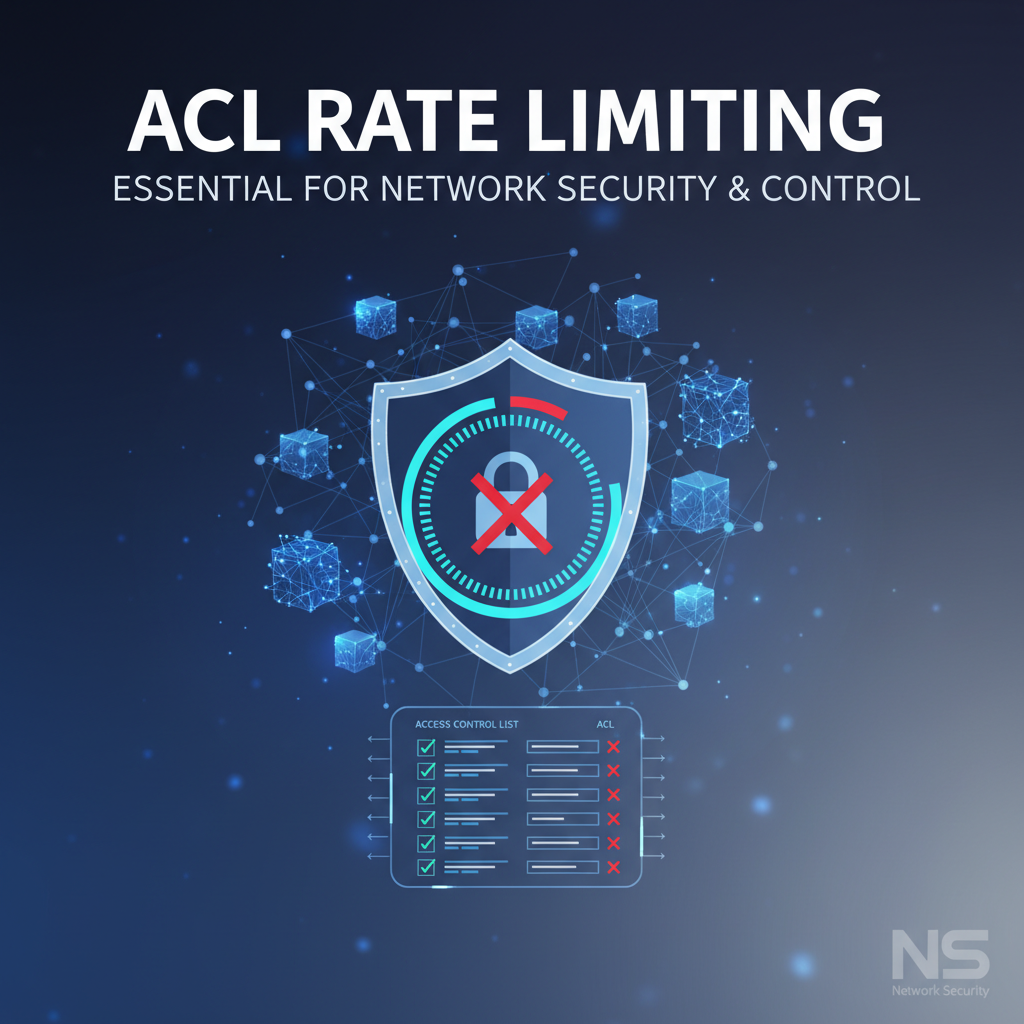
ACL Rate Limiting: Essential for Network Security & Control


In the perpetually evolving landscape of network security, where threats become more sophisticated with each passing day, organizations grapple with the monumental task of safeguarding their digital assets and ensuring the uninterrupted availability of their services. The sheer volume of legitimate and malicious traffic traversing modern networks necessitates a multi-layered, intelligent approach to defense. Among the most potent tools in a network administrator's arsenal are Access Control Lists (ACLs) and Rate Limiting. While each serves a distinct purpose, their combined application, known as ACL Rate Limiting, creates a formidable defense mechanism that is not merely reactive but proactively manages and controls network traffic with unparalleled precision. This synergy is indispensable for maintaining network integrity, preventing resource exhaustion, and defending against a wide spectrum of cyber threats, from sophisticated Denial-of-Service (DoS) attacks to more insidious attempts at data exfiltration or API abuse.
This article delves deep into the intricate world of ACL Rate Limiting, dissecting its foundational components, exploring the myriad ways it bolsters network security and control, and providing a comprehensive guide to its effective implementation. We will uncover the nuances of various ACL types and rate limiting algorithms, demonstrating how their judicious combination can safeguard critical infrastructure, secure modern applications, and ensure a resilient digital presence for any enterprise. From the foundational principles to advanced deployment strategies, this exploration aims to equip network professionals with the knowledge to leverage ACL Rate Limiting as a cornerstone of their cybersecurity posture, ensuring that networks remain robust, responsive, and resistant to the ever-present dangers lurking in the digital realm.
Understanding Access Control Lists (ACLs): The Gatekeepers of Your Network
At its core, an Access Control List (ACL) is a set of rules that governs what traffic is permitted or denied entry into, exit from, or passage through a network device. Think of ACLs as highly selective gatekeepers positioned at various checkpoints within your network infrastructure. Their primary function is to filter network traffic based on a predefined set of criteria, thereby enforcing security policies and controlling network resource access. ACLs are fundamental to network security because they provide the first line of defense against unauthorized access and the spread of malicious activities, allowing administrators to dictate precisely which types of data packets can flow between different network segments or reach specific hosts. Without ACLs, networks would be largely open, making them vulnerable to a plethora of attacks and unmanaged traffic flows.
The granular control offered by ACLs extends far beyond simple allow/deny decisions. They can be configured to examine various aspects of a network packet, including its source IP address, destination IP address, source port, destination port, protocol type (TCP, UDP, ICMP), and even specific flags within the packet header. This level of detail empowers administrators to craft highly specific rules that align with their organization's security requirements, effectively segmenting the network and isolating sensitive resources. For instance, an ACL might permit HTTP traffic from the internet to a public web server but simultaneously deny all other types of traffic, or it might restrict SSH access to network devices only from a specific range of administrative IP addresses, thereby significantly reducing the attack surface.
Types of ACLs: Tailoring Control to Specific Needs
The versatility of ACLs is further enhanced by their different types, each designed to address specific filtering requirements and complexities. Understanding these distinctions is crucial for designing an effective network security policy.
- Standard ACLs: These are the simplest form of ACLs. They filter traffic based solely on the source IP address of the incoming packet. Standard ACLs are typically applied closer to the destination to minimize disruption, as they make a broad decision (permit or deny) for all protocols once a match is found. Their simplicity makes them easy to configure but limits their granularity. For example, a standard ACL might permit all traffic originating from a trusted internal subnet while denying all traffic from a particular external network. While effective for basic network segmentation, they fall short when more intricate filtering is required.
- Extended ACLs: Offering a much higher degree of granularity, Extended ACLs allow filtering based on a wider range of criteria, including source IP address, destination IP address, protocol type (TCP, UDP, ICMP, etc.), source port, and destination port. This makes them significantly more powerful for enforcing precise security policies. Extended ACLs are usually placed closer to the source of the traffic to prevent unwanted traffic from consuming bandwidth unnecessarily across the network. A common use case involves permitting specific web traffic (e.g., HTTP/HTTPS) from certain sources to particular destinations while blocking other protocols like FTP or Telnet, thereby tightly controlling application-layer access. Their ability to discriminate based on port numbers is particularly valuable in securing applications and services.
- Named ACLs: While not functionally different from standard or extended ACLs in terms of filtering capabilities, Named ACLs provide the convenience of assigning a descriptive name to an ACL rather than relying solely on numerical identifiers. This significantly improves readability, manageability, and troubleshooting, especially in large and complex network environments where numerous ACLs are deployed. An administrator can create an
IP access-list extended "WEB_SERVER_ACCESS"instead ofaccess-list 110, making the purpose of the ACL immediately clear. This organizational benefit is paramount for long-term network maintenance and team collaboration. - Dynamic ACLs (Lock-and-Key ACLs): These are session-based ACLs that allow temporary access to a specific host or network segment after a successful authentication process. Initially, a standard ACL blocks all traffic to a protected resource. When a user attempts to access it, they are redirected to an authentication server (e.g., TACACS+ or RADIUS). Upon successful authentication, a temporary extended ACL is dynamically generated and applied, permitting the authenticated user access for a specified duration. This provides an on-demand, secure access method, particularly useful for remote administration or vendor access, where persistent access is undesirable and a higher level of scrutiny is required for each session.
- Reflexive ACLs: Designed primarily for providing basic stateless firewall-like functionality, Reflexive ACLs allow outbound traffic and then permit return traffic only if it is a response to a previously permitted outbound conversation. They achieve this by creating temporary entries in a dynamic ACL when an outbound packet is matched. These entries are then used to allow the corresponding inbound return traffic. This mechanism helps secure internal networks by allowing internal users to initiate connections to external resources while blocking unsolicited external connections, without the overhead of a full stateful firewall. For example, an internal user initiating an HTTP request to an external web server will have their return HTTP response permitted, but no external user can initiate an HTTP connection to an internal host.
- Time-Based ACLs: As the name suggests, these ACLs allow administrators to control traffic based on specific times of the day or days of the week. This adds another dimension of control, enabling policies that vary depending on operational hours or specific schedules. For instance, an organization might allow employees to access certain non-critical external websites only during lunch breaks or after working hours, or restrict administrative access to servers only during specific maintenance windows. Time-based ACLs are typically combined with extended ACLs to apply these time constraints to specific protocols and ports, enhancing the flexibility of security enforcement and supporting compliance requirements.
How ACLs Work: The Implicit Deny Principle
The operational mechanics of ACLs adhere to a clear, hierarchical process. When a network device, such as a router or a firewall, receives a packet, it compares the packet's attributes against the rules defined in the relevant ACL, starting from the top of the list and proceeding downwards. The first rule that the packet matches dictates the action taken – either permit or deny. Once a match is found and an action is executed, the device stops processing that packet against any subsequent rules in the ACL.
A critical principle governing all ACLs is the "implicit deny" at the end of every ACL. This unwritten rule states that if a packet does not match any explicitly defined permit statement within the ACL, it will be implicitly denied and dropped. This implicit deny is a crucial security feature, ensuring that only traffic explicitly permitted is allowed to pass, thereby preventing any unspecified or unaddressed traffic from bypassing security controls. Network administrators must always remember this principle when designing ACLs; if a type of traffic is not explicitly permitted, it will be blocked. This necessitates careful planning to ensure that all legitimate traffic flows are accounted for and allowed, while everything else is discarded. Failing to account for essential traffic can inadvertently block critical services, leading to network outages or application failures.
In essence, ACLs are more than just packet filters; they are a declarative language for network behavior, allowing granular control over who, what, when, and where traffic can flow. Their proper design and placement are foundational to building a secure, segmented, and well-controlled network infrastructure.
The Imperative of Rate Limiting: Safeguarding Against Overload and Abuse
While ACLs excel at determining who or what can access network resources, they don't inherently control how often or how much access is granted. This is where Rate Limiting becomes indispensable. Rate Limiting is a technique used to control the amount of traffic sent or received by a network entity over a specific period. Its primary objective is to prevent resource exhaustion, mitigate abuse, ensure fair usage, and maintain the stability and performance of services. In today's interconnected world, where applications and APIs are constantly bombarded with requests, rate limiting is no longer a luxury but a fundamental necessity for any robust system.
The proliferation of online services, cloud computing, and microservices architectures has amplified the need for effective rate limiting. Without it, a single malicious actor or even an unintended surge of legitimate traffic could overwhelm a server, an application, or an entire network segment, leading to degraded performance, service outages, or complete system collapse. Rate limiting acts as a crucial circuit breaker, allowing systems to gracefully handle overload situations by selectively delaying or dropping requests that exceed predefined thresholds, rather than succumbing to the pressure.
Why is Rate Limiting Necessary? A Multi-faceted Defense
The motivations behind implementing rate limiting are diverse and address a wide array of operational and security challenges:
- Denial-of-Service (DoS) and Distributed Denial-of-Service (DDoS) Prevention: This is arguably the most critical role of rate limiting. Malicious actors launch DoS/DDoS attacks by flooding a target with an overwhelming volume of traffic, intending to exhaust its resources (CPU, memory, bandwidth, connection tables) and render it unavailable to legitimate users. Rate limiting, by capping the number of requests accepted from a single source or across the entire system, can significantly dampen the impact of such attacks, allowing legitimate traffic to continue flowing even under duress.
- Brute-Force Attack Mitigation: Attacks targeting authentication mechanisms, such as login pages or API keys, often involve rapid, repetitive attempts to guess credentials. Rate limiting these attempts (e.g., limiting login attempts per IP address or user ID per minute) dramatically slows down the attacker, making brute-force attacks impractical and often causing them to fail before success can be achieved.
- API Abuse and Fair Usage Enforcement: Modern applications are heavily reliant on APIs. Without rate limiting, a single user or application could make an excessive number of API calls, monopolizing resources, incurring high operational costs for the provider, or even potentially exploiting vulnerabilities by overwhelming specific API endpoints. Rate limiting enforces fair usage policies, ensuring that all consumers receive equitable access to shared resources and preventing any single entity from monopolizing the system. It's also crucial for managing different service tiers, where premium users might have higher rate limits than free-tier users.
- Cost Control: For services hosted on cloud platforms where resources like bandwidth, compute cycles, and database queries are metered and billed, uncontrolled traffic can lead to exorbitant costs. Rate limiting helps keep these costs in check by preventing excessive resource consumption, whether from legitimate spikes or malicious activity.
- Crawl and Scraper Protection: Automated bots and scrapers can hammer websites and APIs, consuming bandwidth and server resources, and potentially extracting sensitive data or competitive information. Rate limiting helps identify and throttle these automated clients, protecting intellectual property and ensuring that legitimate users have a smooth experience.
- System Stability and Performance: Even without malicious intent, sudden spikes in legitimate user traffic can overwhelm systems not designed for such loads. Rate limiting acts as a pressure release valve, allowing systems to maintain stability and acceptable performance levels by shedding excess load, rather than crashing entirely. It ensures that core services remain available, albeit possibly with slightly increased latency for some users during peak periods, which is often preferable to a complete outage.
Types of Rate Limiting Algorithms: The Mechanics of Control
Various algorithms are employed to implement rate limiting, each with its own characteristics, trade-offs, and suitability for different scenarios:
- Token Bucket Algorithm: This is one of the most widely used and flexible algorithms. Imagine a bucket of tokens that are filled at a fixed rate (e.g., 10 tokens per second). Each request consumes one token. If the bucket is empty, the request is either dropped or queued. The bucket also has a maximum capacity, meaning it can only hold a certain number of tokens. This allows for bursts of traffic (up to the bucket's capacity) while still maintaining an average rate.
- Pros: Allows for bursts, relatively simple to implement, handles short-term traffic spikes gracefully.
- Cons: Can be complex to tune effectively; if the burst capacity is too high, it might not prevent large, sudden attacks.
- Leaky Bucket Algorithm: In contrast to the token bucket, the leaky bucket emphasizes output rate control. Imagine a bucket with a hole at the bottom (the "leak"). Requests fill the bucket, and the leak allows requests to pass through at a constant rate. If the bucket overflows, new requests are dropped. This algorithm smooths out traffic bursts into a steady output stream.
- Pros: Enforces a very smooth output rate, excellent for preventing bursts from overwhelming downstream systems.
- Cons: Drops requests immediately if the bucket is full, which can be less forgiving for legitimate bursts; does not allow for dynamic burst capacity.
- Fixed Window Counter Algorithm: This is one of the simplest algorithms. It defines a time window (e.g., 60 seconds) and a maximum number of requests allowed within that window. A counter tracks requests. Once the window starts, requests are permitted until the counter hits the limit. After the window ends, the counter resets.
- Pros: Easy to understand and implement.
- Cons: Suffers from the "burst at the edge" problem. If the window is, say, 60 seconds, and the limit is 100 requests, a client could make 100 requests in the last second of window 1 and another 100 requests in the first second of window 2, effectively making 200 requests in a very short period around the window boundary. This can lead to temporary overloads.
- Sliding Window Log Algorithm: This method attempts to address the "burst at the edge" problem of the fixed window. It keeps a timestamp for every request made by a client. When a new request arrives, it counts the number of requests within the past window duration (e.g., 60 seconds). If this count exceeds the limit, the request is denied.
- Pros: Very accurate and handles bursts at window edges effectively.
- Cons: Requires storing a timestamp for every request, which can consume a significant amount of memory, especially for high-traffic services.
- Sliding Window Counter Algorithm: This algorithm offers a compromise between the simplicity of the fixed window and the accuracy of the sliding log. It divides the time into fixed windows but estimates the count for the current "sliding window" by combining the current window's count with a weighted count from the previous window. For example, if a 60-second window is used, and a request comes in 30 seconds into the current window, it would consider the current window's count plus half of the previous window's count.
- Pros: More accurate than fixed window, less memory-intensive than sliding window log.
- Cons: Still an approximation, not perfectly precise, and can be slightly more complex to implement than fixed window.
Where is Rate Limiting Applied? Distributed Control
Rate limiting can be implemented at various layers of the network and application stack, offering a layered defense:
- Network Devices (Routers, Firewalls): These devices can perform basic rate limiting based on IP addresses, protocols, or port numbers, often using policing or shaping mechanisms. This is effective for preventing network-layer DoS attacks or controlling egress bandwidth.
- Web Servers (Nginx, Apache): Popular web servers offer modules and directives for rate limiting requests based on IP, user agent, URL path, and other HTTP headers. This protects the web server itself and the applications it hosts from excessive traffic.
- Reverse Proxies and Load Balancers: Devices like HAProxy, F5 BIG-IP, or cloud load balancers can implement rate limiting before traffic even reaches the application servers. They can distribute load and filter malicious requests, often providing more sophisticated rate limiting capabilities than individual web servers.
- Application Servers: Custom application logic can implement rate limiting to protect specific business operations, database calls, or internal services. This offers the most granular control, allowing limits to be based on user ID, API keys, or specific application-level contexts.
- API Gateways: This is a particularly effective and strategic location for rate limiting. An API Gateway acts as a single entry point for all API requests, making it an ideal centralized enforcement point for policies, including authentication, authorization, caching, and critically, rate limiting. It can apply limits per consumer, per API endpoint, per method, or based on custom attributes, providing sophisticated control over API consumption.
The choice of algorithm and implementation location depends on the specific requirements, scale, and complexity of the system being protected. Often, a combination of these approaches provides the most robust and resilient rate limiting strategy.
The Synergy: ACL Rate Limiting in Action
The true power of network security and control emerges when Access Control Lists (ACLs) and Rate Limiting are integrated and deployed in concert. While ACLs define the static boundaries of access – who can reach what resources and through which protocols – Rate Limiting introduces a dynamic element, governing the frequency and volume of that permitted access. This combination ensures that not only is unauthorized access blocked, but also that authorized access cannot be abused or inadvertently lead to system degradation. ACL Rate Limiting transforms security from a binary pass/fail decision to a nuanced system that intelligently manages traffic flow, ensuring both security and operational stability.
The interplay between these two mechanisms is profound. ACLs provide the initial layer of filtering, determining the legitimacy of a connection attempt based on its origin, destination, and protocol. Only traffic that successfully traverses the ACL barrier is then subjected to rate limiting policies. This layered approach is critical because it significantly reduces the surface area for rate limiting to act upon. Instead of rate limiting all inbound traffic indiscriminately, which would be resource-intensive and potentially inefficient, an ACL first prunes illegitimate connections. This allows the rate limiter to focus its resources on managing the flow of permitted traffic, making the overall system more efficient and resilient.
Enhanced Security: Beyond Basic Access Control
The synergy of ACLs and Rate Limiting offers a multi-dimensional security enhancement:
- Preventing Authorized User Abuse: An authorized user, or an application with valid credentials, could still potentially launch an accidental or intentional DoS attack if not rate-limited. For example, a developer might inadvertently put an API into an infinite loop, or a legitimate client application might experience a bug that causes it to send excessive requests. An ACL would permit this traffic because it's authorized, but rate limiting would catch the surge in requests, preventing it from overwhelming the backend services. This is especially vital in multi-tenant environments where one tenant's misbehavior could impact others.
- Granular Control Against Targeted Attacks: Combining ACLs with rate limiting allows for highly specific attack mitigation. For instance, an ACL could permit specific administrative ports (e.g., SSH, RDP) only from a defined management subnet. However, even within that trusted subnet, a malicious insider or a compromised workstation could attempt a brute-force attack on those administrative services. Rate limiting applied after the ACL permits the initial connection, would cap the number of connection attempts per minute to those ports, effectively mitigating the brute-force risk while still allowing legitimate administrators to connect.
- Mitigating Application-Layer Attacks: Many modern attacks target specific vulnerabilities in web applications or APIs, often involving a sequence of requests. An ACL might allow HTTP/HTTPS traffic to a web server, but rate limiting can be configured to detect and block abnormal request patterns to specific URLs or API endpoints that might indicate an SQL injection attempt, cross-site scripting (XSS) probe, or an enumeration attack. By limiting the number of requests to a specific
/loginendpoint from a single IP, for example, brute-force login attempts are thwarted. - Protecting Specific Infrastructure Components: Consider a scenario where an organization runs several web servers behind a load balancer, and a database server is only accessible from these web servers. An ACL on the database server would explicitly permit connections only from the web server IPs and block all other traffic. However, if one of the web servers is compromised, it could potentially flood the database with requests. Rate limiting on the database itself (or on the firewall protecting it, or on the gateway between the web server and database) could then limit the number of connections or queries from the web server, containing the damage and preventing the database from being overwhelmed.
Granular Control: Tailoring Policies to Context
The true elegance of ACL Rate Limiting lies in its ability to offer incredibly granular control over network behavior:
- User/Role-Based Rate Limiting: In environments where user roles are defined (e.g., administrator, standard user, guest), ACLs can identify users or groups, and then different rate limits can be applied to them. An administrator might have a higher rate limit for querying diagnostic APIs than a standard user.
- API Endpoint Specific Limits: For an API Gateway, an ACL might permit access to a set of APIs. However, within that set, a
GET /productsendpoint might have a very high rate limit, while aPOST /ordersendpoint (which is resource-intensive or critical) could have a much lower rate limit per second or minute. This protects the most vulnerable or resource-heavy parts of an application more rigorously. - Tenant Isolation in Multi-tenant Architectures: In cloud-based multi-tenant applications, each tenant shares underlying infrastructure. ACLs ensure tenants can only access their own data and services. Rate limiting ensures that one tenant's high usage or malicious activity doesn't degrade performance for other tenants, effectively isolating their performance impact. This is crucial for maintaining service level agreements (SLAs) and ensuring fair resource allocation across all customers.
- Geo-IP Based Limitations: ACLs can block traffic from known malicious countries or geographic regions. Rate limiting can then be applied more aggressively to traffic originating from regions that are permitted but have a higher propensity for suspicious activity, providing an additional layer of risk-based control.
Use Cases for Combined ACL Rate Limiting
- Protecting Critical Infrastructure (e.g., DNS Servers, NTP Servers): ACLs permit DNS queries only from internal networks to internal DNS servers. Rate limiting on these DNS servers can then cap the number of queries per source IP per second to prevent DNS amplification attacks or to prevent a single misconfigured client from flooding the server. Similarly, NTP servers can be protected against abuse.
- Securing Web Applications and APIs: This is a paramount use case. An API Gateway fronting microservices or a monolithic API application will use ACLs to enforce authentication and authorization (e.g., only authenticated users with valid tokens can access specific API endpoints). On top of this, the API Gateway applies rate limits to protect each API endpoint from excessive calls, mitigating DoS attacks, brute-force attempts on login APIs, and ensuring fair usage across different consumers or subscription tiers. For instance, a public API might allow 100 requests per minute for unauthenticated users but 10,000 requests per minute for authenticated premium users, all managed and enforced by the gateway based on ACLs and associated rate limits.
- Mitigating Specific Attack Vectors: SYN flood attacks, for example, involve sending a high volume of SYN packets to a server to exhaust its connection table. An ACL can filter out some known malicious IPs, but rate limiting on SYN packets at the firewall or router can prevent the server from being overwhelmed by a flood from many different sources, even if individual sources are not immediately identifiable as malicious.
- Enforcing Fair Usage Policies: For internet service providers (ISPs) or cloud providers, ACLs might allow certain types of traffic (e.g., torrents) but rate limiting will cap the bandwidth or connection count for these types of traffic to prevent any single user from monopolizing network resources, ensuring a satisfactory experience for all subscribers.
In essence, ACL Rate Limiting represents a mature approach to network and application security. It moves beyond simple binary access decisions to a dynamic, intelligent system that actively manages traffic flow, ensuring that even legitimate access adheres to predefined boundaries of frequency and volume. This dual-layered control is not just about blocking threats; it's equally about optimizing resource utilization, maintaining service quality, and building resilient systems capable of withstanding the unpredictable nature of network traffic and malicious intent.
APIPark is a high-performance AI gateway that allows you to securely access the most comprehensive LLM APIs globally on the APIPark platform, including OpenAI, Anthropic, Mistral, Llama2, Google Gemini, and more.Try APIPark now! 👇👇👇
Implementing ACL Rate Limiting: A Multi-Layered Approach
The implementation of ACL Rate Limiting is not a one-size-fits-all endeavor. It typically involves a layered approach, with different mechanisms and tools employed at various points within the network and application stack. The choice of where and how to apply these controls depends on the specific resources being protected, the nature of the traffic, and the capabilities of the existing infrastructure. Effective implementation requires a deep understanding of network topology, application architecture, and the specific security policies to be enforced.
Network Level: Routers and Firewalls
At the network perimeter and within core network segments, routers and dedicated firewalls are the primary enforcement points for ACLs and basic rate limiting. These devices operate at lower layers of the OSI model, making them highly efficient for filtering large volumes of traffic.
- Configuring ACLs on Network Devices:
- Routers: Cisco, Juniper, and other router vendors provide extensive capabilities for configuring ACLs. Standard ACLs are typically applied to interfaces closer to the destination, filtering based on source IP. Extended ACLs are placed closer to the source, allowing filtering based on source/destination IP, ports, and protocols. For example, a Cisco router might use commands like
access-list 101 permit tcp any host 192.168.1.100 eq 80to allow HTTP traffic to a specific web server. - Firewalls: Dedicated firewalls (e.g., Palo Alto Networks, Fortinet, Check Point, pfSense) offer stateful packet inspection and more advanced rule sets. They combine ACL-like functionality with application-aware filtering, often allowing rules to be based on user identities, applications (e.g., Facebook, Salesforce), and threat intelligence feeds. Firewalls are the preferred choice for perimeter defense due to their comprehensive security features.
- Routers: Cisco, Juniper, and other router vendors provide extensive capabilities for configuring ACLs. Standard ACLs are typically applied to interfaces closer to the destination, filtering based on source IP. Extended ACLs are placed closer to the source, allowing filtering based on source/destination IP, ports, and protocols. For example, a Cisco router might use commands like
- Implementing Policing and Shaping for Rate Limiting:
- Policing: On routers and firewalls, policing is a mechanism used to limit the input or output rate of traffic to or from an interface. If traffic exceeds the configured rate limit, it is typically dropped. Policing is a "drop if exceeded" mechanism and is often used to protect critical services from being overwhelmed. Commands like
policeon Cisco devices allow administrators to specify a committed information rate (CIR) and a burst size (Bc), with actions for conform (transmit), exceed (drop or mark down), and violate (drop). - Shaping: Unlike policing, shaping buffers excess traffic that exceeds a configured rate and sends it out later when the rate falls below the threshold. This mechanism is used to smooth out traffic bursts and prevent network congestion, ensuring a consistent bandwidth allocation. Shaping is typically applied on outbound interfaces.
- Hardware vs. Software Considerations: Modern network devices often leverage specialized hardware (ASICs) for packet processing, allowing them to apply ACLs and rate limits at line speed without significantly impacting performance, even for very high traffic volumes. Software-based implementations, while more flexible, can introduce latency and impact CPU utilization on general-purpose servers.
- Policing: On routers and firewalls, policing is a mechanism used to limit the input or output rate of traffic to or from an interface. If traffic exceeds the configured rate limit, it is typically dropped. Policing is a "drop if exceeded" mechanism and is often used to protect critical services from being overwhelmed. Commands like
Application Level: Web Servers, Proxies, and Load Balancers
Closer to the applications, web servers, reverse proxies, and load balancers offer more context-aware rate limiting capabilities, often operating at the HTTP layer.
- Nginx and Apache:
- Nginx: The
ngx_http_limit_req_moduleandngx_http_limit_conn_moduleare powerful tools for rate limiting.limit_reqlimits the rate of requests, whilelimit_connlimits the number of concurrent connections. These can be configured per IP address, per URL, or based on other variables. For instance,limit_req_zone $binary_remote_addr zone=mylimit:10m rate=10r/s;defines a rate limit zone that allows 10 requests per second per unique IP address. - Apache: Modules like
mod_evasiveormod_qosprovide rate limiting functionality, primarily to mitigate DoS attacks by tracking requests per IP and blocking those that exceed thresholds. While Nginx generally offers more robust and configurable rate limiting out-of-the-box, Apache can be extended to achieve similar goals.
- Nginx: The
- Reverse Proxies and Load Balancers: Solutions like HAProxy, F5 BIG-IP, or cloud-managed load balancers (AWS ELB/ALB, Azure Load Balancer, GCP Load Balancing) sit in front of application servers. They can terminate client connections, inspect HTTP headers, and apply sophisticated rate limiting rules before forwarding traffic to the backend. This offloads the rate limiting burden from application servers and provides a centralized point of control for multiple applications. They can also use ACL-like rules to determine which requests get rate-limited based on URL path, HTTP method, headers, or client certificates.
API Gateways: Centralized API Control and Protection
For modern microservices architectures and external-facing APIs, an API Gateway is the quintessential enforcement point for ACLs and rate limiting. It acts as a single, intelligent gateway for all API traffic, providing a comprehensive suite of management, security, and governance features.
An API Gateway is strategically positioned to enforce fine-grained access control and sophisticated rate limiting policies. Before any request reaches the backend services, the API Gateway can: 1. Authenticate and Authorize: Validate API keys, OAuth tokens, or other credentials (ACL functionality). 2. Route Requests: Direct requests to the correct backend service based on URL paths or headers. 3. Apply Rate Limits: Enforce limits based on client ID, API key, user ID, API endpoint, or custom attributes. This allows for differentiated service tiers (e.g., free vs. premium API access), fair usage policies, and protection against abuse and DoS attacks specifically targeting APIs. 4. Transform and Cache: Modify requests/responses and cache common responses to reduce backend load. 5. Monitor and Log: Provide detailed insights into API usage and performance.
The power of an API Gateway in ACL Rate Limiting is its ability to centralize these policies. Instead of configuring rate limits on each individual microservice or web server, the gateway provides a unified control plane. This significantly simplifies management, ensures consistency, and provides a clear choke point for securing all API traffic.
For example, a robust API Gateway like APIPark offers comprehensive API lifecycle management, including powerful capabilities for access control and rate limiting. APIPark, an open-source AI gateway and API developer portal, allows organizations to define granular policies that protect their APIs from overuse and malicious attacks. With APIPark, you can quickly integrate and manage over 100 AI models and REST services, applying unified authentication and sophisticated rate limits to specific API endpoints based on client credentials or other criteria. Its end-to-end API lifecycle management ensures that your APIs are not only discoverable and usable but also secure and performant. By centralizing the management of these policies, APIPark empowers developers and enterprises to easily enforce ACLs and rate limits, ensuring that only authorized traffic within specified thresholds reaches their valuable backend services. Its ability to handle large-scale traffic, rivaling Nginx in performance, means that even under heavy load, your ACLs and rate limits are robustly enforced, securing your APIs and preventing resource exhaustion. The platform's features, such as API resource access requiring approval and independent API and access permissions for each tenant, further enhance its ACL capabilities, while detailed API call logging and powerful data analysis provide the insights needed to fine-tune rate limiting policies.
Cloud-Native Environments
In cloud environments, traditional network devices are abstracted, and security services are often provided as managed offerings.
- AWS WAF, Azure Firewall, GCP Cloud Armor: These cloud-native security services provide web application firewall (WAF) capabilities, including the ability to define ACL-like rules (e.g., block IPs, filter based on HTTP headers) and apply rate-based rules. For instance, AWS WAF can block requests from IP addresses that send more than a specified number of requests within a five-minute period. These services are typically deployed at the edge of the cloud network, protecting applications and services from common web exploits and volumetric attacks.
- Service Mesh (Istio, Linkerd): In microservices architectures orchestrated by Kubernetes, a service mesh can implement sophisticated access control and rate limiting at the application layer. Sidecar proxies (e.g., Envoy in Istio) deployed alongside each service can enforce policies, allowing granular control over inter-service communication. This enables defining ACLs (e.g.,
service A can call service B but not service C) and applying rate limits (e.g.,service A can call service B no more than 100 times per second) directly within the service mesh, providing resilience and security for east-west traffic.
Comparative Table of Implementation Methods
| Implementation Point | Primary Function | ACL Capability | Rate Limiting Capability | Pros | Cons |
|---|---|---|---|---|---|
| Network Devices | Packet Filtering, Routing | IP/Port/Protocol-based filtering (Standard/Extended) | Basic Policing/Shaping (packet/byte rates) | High performance, line-speed processing; First line of defense | Less application-aware; Limited context for complex policies |
| Web Servers (Nginx, Apache) | Serve Web Content, Reverse Proxy | IP/URL/Header-based (mod_rewrite, allow/deny) | Request/Connection-based (modules like limit_req) |
Application-aware, flexible; Protects individual server/application | Can consume server resources; Less centralized for multiple applications |
| Reverse Proxies/Load Balancers | Distribute Traffic, SSL Offload | IP/URL/Header-based, sometimes WAF-like | Request/Connection/Bandwidth-based | Centralized control, offloads backend; Robust DoS protection | Adds another hop; Configuration complexity can be high |
| API Gateways | API Management, Security, Routing | API Key/Token validation, User-based access | Per API/Endpoint/Consumer, varied algorithms | Centralized, highly granular, application-specific; Full API lifecycle | Requires specialized gateway product; Can be a single point of failure (if not HA) |
| Cloud WAF/Security Services | Edge Security, DDoS Mitigation | IP, Geo-IP, HTTP Header/Body filtering | Request-based (rate-based rules) | Scalable, managed service; Integrates with cloud ecosystem | Vendor-specific; May incur additional costs; Less control over internals |
| Service Mesh | Inter-service Communication Control | Service-to-service access, authorization | Request-based per service/endpoint | Granular microservices control; East-west traffic protection | Specific to microservices; Adds complexity to architecture |
Choosing the right implementation points involves considering the criticality of the resource, the volume and type of traffic, and the desired level of granularity. A robust security posture often combines several of these approaches, creating a layered defense where ACLs and rate limits are enforced at multiple levels, from the network edge to the individual application service.
Advanced Strategies and Considerations for ACL Rate Limiting
Beyond the foundational implementation of ACLs and rate limiting, modern network security demands more sophisticated strategies to combat evolving threats and optimize resource utilization. These advanced considerations focus on dynamic adaptation, intelligent decision-making, and seamless integration with broader security ecosystems. Merely setting static rules is often insufficient in environments characterized by dynamic IP addresses, polymorphic attacks, and rapidly changing traffic patterns.
Dynamic ACLs and Rate Limiting: Adapting to Change
The digital landscape is anything but static. Malicious IPs emerge and disappear rapidly, user behaviors shift, and application requirements evolve. Static ACLs and rate limits, while effective for known threats and predictable patterns, can quickly become outdated or cumbersome to manage.
- Threat Intelligence Integration: Dynamic ACLs can be automatically updated by integrating with threat intelligence feeds. These feeds provide real-time lists of known malicious IP addresses, botnets, and attack sources. An automated system can consume these feeds and dynamically update firewalls or routers to block traffic from these IPs, preventing them from even reaching the first ACL. Similarly, rate limits can be dynamically adjusted based on the perceived risk level associated with a source IP.
- Behavioral Anomaly Detection: Instead of predefined static thresholds, dynamic rate limiting can leverage machine learning and behavioral analysis to establish baselines of normal traffic patterns for specific users, applications, or API endpoints. Any significant deviation from this baseline – an unusual spike in requests, a change in request frequency, or an abnormal sequence of API calls – can trigger a dynamic adjustment of rate limits or the temporary application of stricter ACLs. This allows the system to detect zero-day attacks or novel forms of abuse that static rules might miss.
- Contextual Rate Limiting: This goes beyond simple IP-based limiting. It considers the context of a request: Has the user successfully authenticated? What is their role? What is their historical behavior? For example, an e-commerce platform might allow a higher request rate for an authenticated, long-term customer browsing products, but severely rate limit an unauthenticated IP making rapid, consecutive attempts to access sensitive account pages. ACLs can establish the user context, and then the rate limiter applies policies accordingly.
Behavioral Analysis and Machine Learning for Intelligent Rate Limiting
The integration of artificial intelligence and machine learning is revolutionizing how rate limiting is performed. These technologies enable systems to move beyond simple threshold-based decisions to a more proactive and intelligent approach.
- Baseline Establishment: ML models can continuously monitor network traffic and API call patterns to establish a "normal" baseline. This includes metrics like average requests per second, typical byte transfer rates, common user agent strings, and expected geographical origins.
- Anomaly Detection: Once a baseline is established, the models can identify deviations in real-time. For instance, an IP address that suddenly starts sending 100 times its usual request volume to a specific API endpoint would be flagged. The system can then automatically impose a temporary, stricter rate limit on that specific IP or even trigger a more comprehensive block via an ACL update.
- Adaptive Rate Limits: Instead of fixed limits, ML can enable adaptive rate limiting where the thresholds dynamically adjust based on current network load, available resources, and the perceived threat level. During periods of low system utilization, limits might be more relaxed, while during high load or a detected attack, they could tighten automatically.
- Identifying Sophisticated Attacks: Advanced persistent threats (APTs) and sophisticated botnets often mimic legitimate user behavior to evade detection. ML can identify subtle patterns that human analysts or static rules might miss, such as slightly irregular timing of requests across a distributed set of IPs, or sequences of requests that are technically valid but indicative of malicious intent when viewed holistically.
Distributed Rate Limiting for Microservices and Large-Scale Deployments
In highly distributed architectures, particularly those built on microservices, rate limiting at a single choke point might not be sufficient or efficient.
- Edge Rate Limiting (API Gateway/Load Balancer): This remains crucial for protecting the entire system from volumetric attacks and ensuring fair usage for external consumers. As discussed, an API Gateway like APIPark is ideal for this.
- Service-to-Service Rate Limiting (Service Mesh): Within a microservices architecture, individual services need protection from other misbehaving or compromised services. A service mesh, such as Istio, allows defining rate limits on calls between services. This prevents a single service from overwhelming its dependencies, fostering resilience and preventing cascading failures. ACLs within the service mesh dictate which services can communicate, and then rate limits control the intensity of that communication.
- Client-Side Rate Limiting (with Server Enforcement): For internal clients or trusted partners, client-side rate limiting can be implemented (e.g., using SDKs or libraries) to proactively manage their request rates. However, this must always be coupled with server-side enforcement, as client-side controls can be bypassed. The server-side ACLs and rate limits act as the ultimate safeguard.
Integration with SIEM and Monitoring Systems
Effective ACL Rate Limiting is not an isolated function; it must be deeply integrated with broader security operations.
- Centralized Logging: All ACL hits, rate limit breaches, and subsequent actions (drops, blocks, delays) should be logged and forwarded to a Security Information and Event Management (SIEM) system. This provides a holistic view of security events, enabling correlation with other logs to identify larger attack campaigns.
- Real-time Alerting: Thresholds can be set in SIEMs or monitoring tools to alert security teams when specific ACLs are frequently triggered or when rate limits are consistently exceeded. This allows for rapid response to potential incidents.
- Forensic Analysis: Detailed logs of rate-limited events, including source IP, destination, timestamp, and specific rule triggered, are invaluable for post-incident forensic analysis, helping to understand the scope and nature of an attack.
Graceful Degradation and User Experience Considerations
Aggressive rate limiting, while necessary for security, can inadvertently impact legitimate users. Strategies must be put in place to ensure a balance.
- Soft vs. Hard Limits: Implement soft limits that trigger warnings or a slight delay before imposing hard limits that drop requests.
- Error Responses: When a request is rate-limited, provide clear, standardized error responses (e.g., HTTP 429 Too Many Requests) with a
Retry-Afterheader, instructing clients when they can try again. This helps legitimate clients adapt their behavior rather than just failing silently. - Prioritization: Implement a prioritization scheme where critical services or premium users receive preferential treatment during overload situations, ensuring essential functionalities remain available even when less critical services are throttled.
Bursting and Throttling: Differentiating and Applying
While often used interchangeably, it's important to understand the subtle differences and how they apply to rate limiting.
- Bursting: Refers to allowing a temporary spike in traffic above the average rate, often managed by algorithms like the token bucket. This accommodates legitimate, short-lived increases in demand without immediately penalizing the client.
- Throttling: Is a more general term that implies controlling the rate of consumption. It can be a synonym for rate limiting but often specifically refers to reducing the rate rather than a hard cap. For example, a system might throttle a user's bandwidth after they exceed a certain data transfer limit, rather than outright blocking them.
Stateful vs. Stateless Rate Limiting
- Stateless Rate Limiting: Each request is evaluated independently, without considering the history of previous requests from the same source (beyond simple counters). This is simpler to implement but less precise. For example, a basic Nginx
limit_reqcan be considered largely stateless within the context of a single server. - Stateful Rate Limiting: The system maintains context about past requests (e.g., timestamps of the last N requests, current connection count). This allows for more sophisticated algorithms like sliding window log and can make more informed decisions based on a client's recent behavior. Stateful rate limiting often requires shared storage or coordination across multiple instances in a distributed environment, adding complexity but offering greater accuracy and protection.
By adopting these advanced strategies and considerations, organizations can move beyond basic perimeter defense to a more intelligent, adaptive, and resilient security posture, where ACLs and rate limits work in tandem to protect their most valuable digital assets against an ever-evolving threat landscape.
Best Practices for Effective ACL Rate Limiting
Implementing ACL Rate Limiting is a continuous process that requires careful planning, meticulous configuration, and ongoing monitoring. Adhering to best practices ensures that these powerful security mechanisms are effective, efficient, and do not inadvertently disrupt legitimate network operations. A well-executed ACL Rate Limiting strategy is a cornerstone of robust network security, providing both defense and control.
1. Define Clear Policies and Objectives
Before configuring any ACLs or rate limits, clearly articulate what you intend to achieve. * Identify Critical Assets: What resources (servers, APIs, databases, applications) are most critical and require the strictest controls? * Understand Traffic Patterns: What are the normal traffic volumes and patterns for these assets? What constitutes legitimate access (source IPs, ports, protocols, request rates)? * Threat Modeling: What are the specific threats you are trying to mitigate (DoS, brute-force, API abuse, data exfiltration)? * Usage Policies: What are the fair usage policies for different types of users or API consumers? Having clear objectives will guide the design and implementation of your rules, ensuring they are aligned with business needs and security requirements. Avoid implementing rules reactively; a proactive, policy-driven approach is always superior.
2. Start Small and Scale Up: Avoid Over-Limiting
When introducing new ACLs or rate limits, especially in production environments, begin with a cautious approach. * Audit Mode (if available): Some security devices or WAFs allow rules to be configured in "audit" or "log-only" mode, where they detect and log violations without actively blocking traffic. This provides valuable insights into potential impacts before full enforcement. * Liberal Initial Limits: Start with higher, more permissive rate limits and ACLs, gradually tightening them as you gather data and understand the real-world impact. Overly restrictive rules from the outset can lead to widespread service disruptions and a negative user experience. * Phased Rollout: Implement changes in stages, perhaps starting with a non-critical segment of the network or a subset of users, before rolling out more broadly.
3. Monitor and Adjust Continuously
ACLs and rate limits are not "set it and forget it" configurations. The digital environment is dynamic, and your policies must adapt. * Real-time Monitoring: Continuously monitor traffic logs, system performance metrics, and security alerts related to ACL and rate limit enforcement. Look for patterns of dropped packets, blocked IPs, and resource utilization spikes. * Log Analysis: Regularly review logs from firewalls, API Gateways, web servers, and application servers. These logs provide crucial data on who is trying to access what, how often, and from where. This data is invaluable for identifying both legitimate traffic that is being inadvertently blocked and new attack vectors. * Performance Metrics: Track key performance indicators (KPIs) such as latency, error rates, and resource utilization (CPU, memory, network I/O). If these metrics degrade after implementing new rules, it could indicate an issue with your ACLs or rate limits. * Iterative Refinement: Be prepared to adjust your rules based on monitoring feedback. If legitimate users are consistently hitting rate limits, adjust the thresholds. If new attack patterns emerge, update ACLs to block them proactively.
4. Test Thoroughly: Prevent Legitimate Traffic Disruption
Before deploying any new ACLs or rate limits to production, comprehensive testing is non-negotiable. * Staging Environments: Test new configurations in dedicated staging or pre-production environments that mimic your production setup as closely as possible. * Simulated Traffic: Use traffic generators and load testing tools to simulate both normal and high-volume legitimate traffic, as well as various attack scenarios. This helps ensure that legitimate traffic flows unimpeded while malicious traffic is effectively mitigated. * User Acceptance Testing (UAT): Involve actual users or client application developers in testing to ensure that the rules do not negatively impact their legitimate workflows.
5. Adopt a Layered (Defense-in-Depth) Approach
Never rely on a single point of enforcement for ACLs and rate limiting. Implement them at multiple strategic points across your infrastructure. * Perimeter: Network firewalls and cloud WAFs should provide initial, high-level ACLs and rate limits to block known malicious sources and volumetric attacks. * Mid-tier: API Gateways and load balancers should apply more granular, application-aware ACLs and rate limits for external-facing APIs and web applications. * Internal: Network segmentation with ACLs and rate limits between internal network segments or microservices (via service mesh) protects against lateral movement and internal abuse. * Application Level: Specific application code can implement fine-grained rate limits for highly sensitive operations (e.g., password changes, financial transactions) that might not be caught by higher-level controls. This layered approach provides redundancy and ensures that if one layer fails, others are still in place to protect your assets.
6. Document Everything
Comprehensive documentation is crucial for manageability, troubleshooting, and compliance. * Rule Rationale: Document the purpose behind each ACL rule and rate limit, including the specific threat it addresses or the policy it enforces. * Configuration Details: Record the exact configuration of ACLs and rate limits, including the devices they are applied to, interface direction (inbound/outbound), thresholds, and actions (permit/deny/drop/mark). * Change Management: Maintain a strict change management process for all modifications to ACLs and rate limits, including who made the change, when, and why. * Impact Analysis: Document any known or potential impacts of the rules on specific applications or user groups.
7. Consider the Business Impact: Don't Just Block, Inform
While security is paramount, it should not come at the expense of usability or business continuity. * Graceful Degradation: Design your rate limiting to allow for graceful degradation during high load, rather than outright blocking, where possible. This means critical services might remain available even if less critical ones are temporarily throttled. * User Feedback: For clients or users who hit a rate limit, provide informative error messages (e.g., HTTP 429 Too Many Requests with a Retry-After header) rather than generic errors or silent failures. This helps them understand the issue and adapt their behavior. * Communication: If significant changes to rate limits or access policies are being implemented, communicate them clearly to affected users or developers well in advance.
8. Regular Review and Updates
The threat landscape and your network environment are constantly changing. * Scheduled Reviews: Periodically review all ACLs and rate limits (e.g., quarterly or annually) to ensure they are still relevant, effective, and do not contain any outdated or redundant rules. * Incident-Driven Updates: After any security incident or major change in network architecture, review and update your ACLs and rate limits to address new vulnerabilities or adapt to the new environment. * Compliance: Ensure your ACL and rate limiting policies align with any regulatory compliance requirements (e.g., GDPR, HIPAA, PCI DSS).
By diligently following these best practices, organizations can construct a resilient and intelligent security posture that leverages the combined power of ACLs and rate limiting. This proactive approach not only fends off external threats but also ensures the efficient and fair use of network resources, contributing significantly to the overall stability and reliability of digital operations. The effort invested in careful planning, continuous monitoring, and iterative refinement of these controls will yield substantial dividends in network security and operational excellence.
Conclusion
In the intricate tapestry of modern network security, the intertwined capabilities of Access Control Lists (ACLs) and Rate Limiting emerge as indispensable threads, weaving together a robust defense against an ever-escalating barrage of threats. This comprehensive exploration has illuminated how ACLs act as the discerning gatekeepers, meticulously defining who or what is permitted to traverse the digital arteries of an organization, based on granular criteria from IP addresses to specific protocols and ports. Concurrently, Rate Limiting functions as the vigilant traffic controller, ensuring that even authorized access adheres to predefined volumetric and temporal constraints, thereby preventing resource exhaustion, mitigating abuse, and safeguarding the stability of critical services.
The true potency, however, lies in their synergistic application: ACL Rate Limiting. This combined approach elevates security beyond mere binary decisions, enabling a nuanced, context-aware management of network traffic. By first filtering illegitimate requests through ACLs and then applying intelligent rate limits to the remaining authorized traffic, organizations can construct a multi-layered defense that is both efficient and profoundly resilient. This strategy is not only vital for fending off pervasive cyber threats such as DoS/DDoS attacks, brute-force attempts, and sophisticated API abuse, but also crucial for maintaining the quality of service, enforcing fair usage policies, and optimizing operational costs across increasingly complex infrastructures, particularly in cloud-native and microservices environments where an API Gateway plays a central role in unifying and enforcing these policies for diverse APIs.
The implementation of ACL Rate Limiting demands a strategic, iterative, and deeply informed approach. From configuring basic rules on network devices and web servers to deploying advanced, AI-driven adaptive limits within API Gateways like APIPark and service meshes, each layer contributes to a formidable security posture. Adhering to best practices—meticulously defining policies, testing rigorously, monitoring ceaselessly, and adopting a layered defense—ensures that these controls are not only effective but also seamlessly integrated into the broader security ecosystem.
As the digital frontier continues to expand, accompanied by an unrelenting evolution of threat actors and attack methodologies, the importance of proactive and adaptive security measures will only intensify. ACL Rate Limiting stands as a testament to the power of intelligent control, offering a crucial bulwark that empowers organizations to not only withstand the storms of the internet but to thrive securely and reliably within them. The future of network security will undoubtedly lean heavily on dynamic, intelligent systems that can rapidly adapt to new challenges, and ACL Rate Limiting, with its inherent adaptability and precision, will remain a cornerstone of this evolving defense strategy, ensuring that networks remain controlled, secure, and ready for whatever the future may hold.
5 FAQs about ACL Rate Limiting
1. What is the fundamental difference between an ACL and Rate Limiting, and why are they best used together? An ACL (Access Control List) determines who or what is allowed to access specific network resources based on criteria like IP address, port, and protocol (e.g., "only allow SSH from my office IP"). Rate Limiting, on the other hand, controls how often or how much allowed traffic can occur over a given period (e.g., "allow 5 SSH attempts per minute from that office IP"). They are best used together because ACLs provide the initial layer of access control, filtering out unauthorized traffic, while Rate Limiting then manages the volume and frequency of authorized traffic, preventing abuse, resource exhaustion, and specific types of attacks (like brute-force) even from legitimate sources. This creates a multi-layered and highly granular security defense.
2. Where are the most common places to implement ACLs and Rate Limiting, and what are the trade-offs? ACLs and Rate Limiting can be implemented at various points: * Network Devices (Routers, Firewalls): Excellent for high-performance, basic IP/port filtering and network-level rate limiting (policing/shaping). Trade-off: Less application-aware. * Web Servers (Nginx, Apache): Good for HTTP-layer rate limiting and access control (e.g., per URL, per IP). Trade-off: Consumes server resources, less centralized for multiple applications. * API Gateways: Ideal for centralized, highly granular access control (e.g., API key validation) and sophisticated rate limiting (per API, per consumer, per endpoint). Trade-off: Requires a dedicated gateway infrastructure, potential single point of failure if not highly available. * Cloud WAFs/Security Services: Managed services offering edge protection, WAF capabilities, and rate-based rules. Trade-off: Vendor-specific, potentially less internal control. * Service Mesh: For microservices, provides inter-service access control and rate limiting. Trade-off: Adds complexity to the architecture. The best approach often involves a layered strategy, leveraging the strengths of each implementation point.
3. How does ACL Rate Limiting help defend against DDoS attacks and API abuse? For DDoS attacks, ACLs can block traffic from known malicious IP ranges or specific countries, while rate limiting at the network edge (firewall, load balancer, or API Gateway) can cap the number of requests per source IP or total requests per second, effectively dampening the attack's impact and allowing legitimate traffic to pass. For API abuse, an API Gateway uses ACLs to enforce authentication and authorization (e.g., valid API keys, user roles). On top of this, rate limits are applied per API endpoint or per API consumer, preventing a single user or application from making an excessive number of calls, thus ensuring fair usage, protecting backend resources, and mitigating brute-force attacks on login APIs.
4. What are some advanced techniques for ACL Rate Limiting, beyond simple static rules? Advanced techniques involve dynamic and intelligent approaches: * Dynamic ACLs/Rate Limiting: Integrating with threat intelligence feeds to automatically update block lists or adjusting rate limits based on real-time network conditions. * Behavioral Analysis and Machine Learning: Using AI to establish baselines of normal traffic and user behavior, then dynamically adjusting ACLs or rate limits when anomalies are detected, allowing for adaptive defense against novel threats. * Contextual Rate Limiting: Applying different rate limits based on user role, authentication status, or specific application context, rather than just source IP. * Distributed Rate Limiting: Implementing controls not just at the perimeter but also between internal microservices (e.g., via a service mesh) to prevent lateral abuse and cascading failures. These techniques move beyond static configurations to provide more adaptive and resilient security.
5. What are the key best practices for ensuring effective ACL Rate Limiting without impacting legitimate users? Key best practices include: * Define Clear Policies: Understand what you're protecting and from what threats. * Start Small and Test Thoroughly: Begin with permissive limits and thoroughly test in staging environments before production deployment to avoid disrupting legitimate traffic. * Monitor and Adjust Continuously: Regularly review logs and performance metrics, and be prepared to refine your rules based on real-world feedback and evolving threats. * Layered Approach: Implement ACLs and rate limits at multiple points (network, API Gateway, application) for redundant defense. * Document Everything: Maintain clear documentation of rule rationale, configurations, and change history. * Graceful Degradation: When rate limits are hit, provide clear error messages (e.g., HTTP 429 with Retry-After) to help legitimate clients adapt, rather than just silently dropping requests.
🚀You can securely and efficiently call the OpenAI API on APIPark in just two steps:
Step 1: Deploy the APIPark AI gateway in 5 minutes.
APIPark is developed based on Golang, offering strong product performance and low development and maintenance costs. You can deploy APIPark with a single command line.
curl -sSO https://download.apipark.com/install/quick-start.sh; bash quick-start.sh

In my experience, you can see the successful deployment interface within 5 to 10 minutes. Then, you can log in to APIPark using your account.

Step 2: Call the OpenAI API.