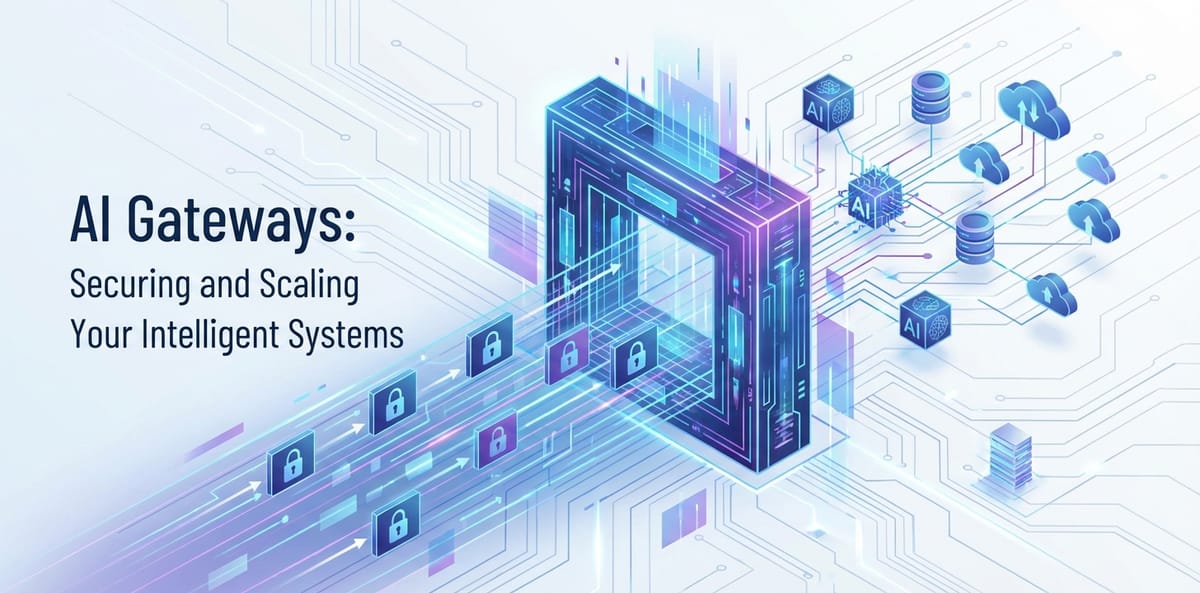
AI Gateways: Securing and Scaling Your Intelligent Systems


The dawn of artificial intelligence has ushered in an era of unprecedented innovation, transforming industries from healthcare to finance, retail to manufacturing. As AI models, particularly large language models (LLMs), become increasingly sophisticated and pervasive, they are no longer confined to specialized research labs but are integrated into the very fabric of enterprise applications and critical infrastructure. This widespread adoption brings with it immense potential for efficiency, personalization, and intelligent automation. However, with this rapid integration comes a complex set of challenges, primarily centered around managing, securing, and scaling these intelligent systems effectively. How do organizations ensure that their AI services are reliable, performant, compliant, and protected from an evolving landscape of threats? The answer increasingly lies in the strategic implementation of an AI Gateway.
An AI Gateway acts as the crucial intermediary between client applications and backend AI models, much like a traditional API Gateway serves as the front door for microservices. It's not merely a proxy; it's an intelligent orchestration layer designed to handle the unique demands of AI workloads. This includes everything from sophisticated request routing and load balancing to specialized security protocols tailored for AI interactions, comprehensive observability, and cost management specifically for token-based or inference-heavy models. For those working with advanced generative models, an LLM Gateway extends these functionalities further, providing specialized capabilities for prompt engineering, model versioning, and unified access across diverse language models from different providers. This article will delve deep into the multifaceted world of AI Gateways, exploring their evolution, core functionalities, critical benefits, implementation considerations, and their pivotal role in building robust, secure, and scalable intelligent systems for the future. We will uncover how these essential components are not just a technical necessity but a strategic imperative for any organization serious about harnessing the full power of artificial intelligence.
The Evolution from Traditional API Gateways to AI Gateways
To fully appreciate the significance of an AI Gateway, it’s essential to understand its lineage and how it diverges from its predecessor, the traditional API Gateway. For years, the API Gateway has been a cornerstone of modern software architecture, particularly with the proliferation of microservices. It serves as a single entry point for all client requests, abstracting the complexity of backend services and providing a centralized point for critical functions.
A traditional API Gateway primarily handles typical RESTful or gRPC API traffic. Its core responsibilities include:
- Traffic Management: Routing requests to appropriate backend services, load balancing across multiple instances, and handling retry mechanisms.
- Security: Authentication (e.g., API keys, OAuth2, JWT), authorization, rate limiting, and input validation to protect backend services from abuse and unauthorized access.
- Observability: Collecting logs, metrics, and traces to monitor API performance, identify errors, and understand traffic patterns.
- Transformation: Translating requests and responses between client and backend formats, if necessary.
- Versioning: Managing different versions of APIs to ensure backward compatibility and smooth transitions.
- Caching: Storing frequently accessed responses to reduce latency and backend load.
This architectural pattern proved invaluable for managing diverse sets of microservices, ensuring consistency, enhancing security, and simplifying development for client applications. However, the unique characteristics and operational demands of artificial intelligence and machine learning workloads, especially the advent of large language models, quickly revealed the limitations of generic API Gateway solutions when applied to AI systems.
The distinct challenges posed by AI, which necessitate a specialized AI Gateway, include:
- Unique Protocols and Data Patterns: While some AI models expose REST APIs, many leverage streaming protocols for real-time inference (e.g., WebSocket for continuous text generation) or require large, complex data payloads (e.g., images, video, entire documents) that can strain traditional gateway capacities. The nature of AI interactions often involves long-running requests or conversational contexts that are difficult for stateless REST gateways to manage efficiently.
- Model Versioning and A/B Testing for AI: AI models are constantly evolving. New versions are trained, fine-tuned, or replaced, often requiring careful rollout strategies. An AI Gateway needs to support sophisticated model versioning, allowing for seamless transitions, A/B testing of different model versions, canary deployments, and rollbacks without disrupting client applications. This goes beyond simple API versioning, as it involves managing the underlying model artifacts and their performance characteristics.
- Cost Management for Token-Based Usage: Many modern AI models, particularly LLMs, operate on a token-based pricing model. Traditional gateways lack the granularity to monitor, meter, and control costs at this level. An LLM Gateway is specifically designed to track token consumption, enforce spending limits, and provide detailed cost analytics per user, application, or model.
- Prompt Engineering and Transformation: Interacting with generative AI models often involves complex prompts that require careful crafting. An LLM Gateway can facilitate prompt templating, variable substitution, and even dynamic prompt optimization. It can transform incoming requests to fit the specific input requirements of different LLMs, abstracting away model-specific nuances from the client application.
- Observability Specific to AI: Beyond standard HTTP metrics, AI workloads require specialized observability. This includes tracking inference latency, model accuracy, potential model drift, hallucination rates, and specific error codes returned by AI engines. Monitoring the quality and behavior of AI responses is paramount, something a generic api gateway is not equipped to do intrinsically.
- AI-Specific Security Concerns: The rise of AI has introduced new attack vectors, such as prompt injection, data poisoning, and model evasion attacks. Traditional API security measures, while necessary, are insufficient to protect against these AI-specific threats. An AI Gateway must incorporate capabilities like input sanitization, output filtering, and behavioral analysis to detect and mitigate these novel vulnerabilities.
- Model Orchestration and Fallback: Organizations often utilize multiple AI models from different providers (e.g., OpenAI, Anthropic, local open-source models) to optimize for cost, performance, or specific capabilities. An AI Gateway can intelligently route requests to the best available model, implement fallback strategies if a primary model fails or becomes too expensive, and even orchestrate a sequence of models for complex multi-step tasks.
Given these intricate requirements, it became evident that a specialized solution was needed. This led to the emergence of the AI Gateway, an architectural component built upon the robust foundations of API Gateway principles but augmented with AI-centric features. An LLM Gateway, in particular, represents a critical subset of this evolution, focusing on the specific demands of large language models and their unique interaction patterns. This next generation of gateways is not just an optional add-on but a fundamental building block for securely and efficiently deploying and managing AI at scale within any enterprise.
Core Functions and Benefits of an AI Gateway
The strategic deployment of an AI Gateway unlocks a multitude of functions and benefits that are indispensable for managing modern intelligent systems. Far more than a simple proxy, it serves as an intelligent control plane, ensuring that AI services are delivered with optimal security, performance, and cost-efficiency.
Unified Access & Routing
One of the most immediate benefits of an AI Gateway is the creation of a centralized entry point for all AI models, whether they are hosted internally, consumed from third-party providers, or run on the edge. This significantly simplifies the integration process for client applications, which no longer need to manage multiple endpoints, authentication schemes, or protocol variations for different AI services. The gateway acts as an abstraction layer, presenting a consistent interface regardless of the underlying model's origin or type.
Intelligent routing capabilities are paramount. An AI Gateway can dynamically route incoming requests based on a variety of factors:
- Model Type: Directing requests to specific LLMs, vision models, speech-to-text engines, or custom machine learning models.
- Load Balancing: Distributing requests across multiple instances of the same model to prevent overload and ensure high availability. This can be based on round-robin, least connections, or more sophisticated algorithms considering GPU utilization.
- Performance Metrics: Routing to the fastest available model instance or provider based on real-time latency data.
- Cost Optimization: Directing requests to the cheapest available model that meets the required performance and quality criteria. This is particularly crucial for LLMs where token pricing can vary significantly across providers or model versions.
- Geographical Proximity: Routing requests to data centers closer to the user for reduced latency.
- User/Application Context: Directing specific users or applications to particular model versions or specialized models.
This unified access and intelligent routing eliminate the need for complex logic within client applications, reducing development overhead and maintenance costs while maximizing the efficiency of AI resource utilization.
Security & Access Control
Security is arguably the most critical function of an AI Gateway, especially when dealing with sensitive data and proprietary models. While traditional API Gateway security measures are a baseline, an AI Gateway extends these with AI-specific protections.
- Authentication and Authorization: The gateway enforces robust authentication mechanisms (e.g., API keys, OAuth2, JWT tokens, mTLS) and fine-grained authorization policies. This ensures that only authorized users and applications can access specific AI models or features. For instance, different user groups might have access to different LLM tiers or specialized models.
- Rate Limiting and Throttling: Preventing abuse, denial-of-service attacks, and controlling resource consumption is vital. The gateway can enforce granular rate limits per user, application, or IP address, protecting backend AI services from being overwhelmed. This also helps in managing costs by preventing runaway usage.
- Input/Output Sanitization and Validation: This is a crucial defense against AI-specific threats like prompt injection. The gateway can analyze incoming prompts for malicious patterns, filter out potentially harmful content, or block requests that violate predefined rules. Similarly, it can validate and sanitize model outputs before they reach the client, preventing the dissemination of inappropriate or harmful generated content.
- Data Privacy and Compliance (GDPR, HIPAA, etc.): Many AI applications process sensitive personal or proprietary data. An AI Gateway can enforce data anonymization or pseudonymization policies before data reaches the AI model, ensuring compliance with regulations like GDPR or HIPAA. It can also manage data residency requirements by routing requests to models hosted in specific geographical regions.
- Threat Detection Specific to AI Interactions: Beyond generic network security, the gateway can incorporate AI-powered anomaly detection to identify unusual patterns in AI API calls, potentially indicative of prompt injection attempts, data exfiltration, or other adversarial attacks.
- API resource access requiring approval: For regulated environments or internal enterprise use, an AI Gateway can implement subscription approval workflows. This means callers must explicitly subscribe to an API, and an administrator must approve the subscription before API access is granted, significantly reducing the risk of unauthorized access and potential data breaches. APIPark, for example, emphasizes robust access control with features like API resource access requiring approval, preventing unauthorized API calls and potential data breaches.
Performance & Scalability
Intelligent systems often require real-time responses and need to handle bursts of traffic. An AI Gateway is engineered to ensure both high performance and seamless scalability.
- Load Balancing: As mentioned, it distributes requests across multiple model instances, ensuring optimal resource utilization and preventing bottlenecks. This is critical for scaling AI inference services horizontally.
- Caching AI Responses: For idempotent AI requests (where the same input always produces the same output), the gateway can cache responses. This significantly reduces latency and offloads the backend AI models, leading to substantial cost savings and improved user experience. Caching strategies can be sophisticated, considering factors like model version and input parameters.
- Connection Pooling: Efficiently managing connections to backend AI services reduces overhead and improves throughput, especially for models that require persistent connections or involve heavy initialization.
- Dynamic Scaling of Underlying AI Services: An advanced AI Gateway can integrate with cloud auto-scaling mechanisms to dynamically provision or de-provision underlying AI model instances based on current traffic load, ensuring that capacity always matches demand.
- Circuit Breaking: To prevent cascading failures, the gateway can implement circuit breakers. If a backend AI service becomes unresponsive or starts returning too many errors, the gateway can temporarily stop sending requests to it, allowing it to recover, and optionally redirecting traffic to a fallback model.
Observability & Monitoring
Understanding the behavior and performance of AI systems is crucial for debugging, optimization, and compliance. An AI Gateway provides an unparalleled vantage point for comprehensive observability.
- Detailed Request/Response Logging: Every interaction with an AI model through the gateway can be logged, including inputs, outputs, timestamps, user IDs, and metadata. This rich data is invaluable for auditing, troubleshooting, and post-hoc analysis.
- Latency and Error Rate Tracking: The gateway meticulously tracks critical performance metrics such as end-to-end latency, inference time, and error rates for each AI model and API. This allows for proactive identification of performance degradation or system failures.
- Cost Tracking based on Token Usage/Inference Time: For LLMs and other usage-based AI services, the gateway can precisely meter token consumption or inference duration per request, user, or application. This enables accurate cost attribution, budget enforcement, and identification of cost-saving opportunities.
- Auditing and Compliance Logs: Comprehensive logs can be maintained for regulatory compliance, demonstrating how AI models were accessed, by whom, and with what inputs and outputs.
- Integration with Existing Monitoring Stacks: The gateway can expose metrics in formats compatible with popular monitoring tools (e.g., Prometheus, Grafana, ELK stack), allowing organizations to integrate AI system monitoring seamlessly into their existing operational dashboards.
Prompt Engineering & Model Management (LLM Gateway Specific)
For Large Language Models, the LLM Gateway introduces specialized functionalities that are pivotal for effective and efficient interaction.
- Prompt Templating and Versioning: Prompts are critical for controlling LLM behavior. An LLM Gateway allows developers to define, version, and manage prompt templates centrally. This ensures consistency across applications, simplifies prompt updates, and facilitates A/B testing of different prompt strategies without changing client code.
- Input/Output Transformation: Different LLMs may have slightly varied API interfaces or require specific input formats. The gateway can abstract these differences, transforming incoming requests to match the target model's requirements and standardizing outputs before returning them to the client. This provides a unified API for multiple LLMs, reducing complexity for application developers.
- Model Fallback and Orchestration: An LLM Gateway can intelligently route requests to the most appropriate LLM based on criteria like cost, performance, capability, or user preference. If a primary model fails or exceeds its rate limits, the gateway can automatically fall back to a secondary model, ensuring service continuity. For complex tasks, it can orchestrate calls to multiple LLMs or other AI services in sequence or parallel.
- A/B Testing of Prompts and Models: The gateway facilitates controlled experiments to compare the performance, cost, and quality of different prompts or even entirely different LLM models. This is crucial for continuous improvement and optimization of AI applications.
Cost Optimization
Given the consumption-based pricing models of many cloud-based AI services, cost optimization is a significant concern. An AI Gateway offers powerful tools to manage and reduce expenses.
- Routing to Cheapest Available Model/Provider: By monitoring real-time pricing and performance, the gateway can intelligently route requests to the most cost-effective model or provider without compromising quality or latency.
- Caching to Reduce Redundant Inferences: As discussed, caching frequently requested AI responses can dramatically reduce the number of paid inferences, leading to substantial cost savings.
- Detailed Cost Tracking and Reporting: Granular cost data provides transparency into AI expenditures, allowing organizations to identify cost centers, optimize usage, and forecast budgets more accurately. This visibility is crucial for making informed decisions about AI resource allocation.
The comprehensive functionalities of an AI Gateway collectively transform the way organizations interact with and manage their intelligent systems. From bolstering security against new AI-specific threats to ensuring seamless scalability and optimizing operational costs, it becomes an indispensable component in the modern AI infrastructure stack. Platforms like APIPark, for instance, offer an open-source solution that addresses many of these concerns, providing quick integration of 100+ AI models and end-to-end API lifecycle management, including robust features for prompt encapsulation and unified API formats.
Key Considerations When Implementing an AI Gateway
Implementing an AI Gateway is a strategic decision that requires careful consideration of various factors to ensure it aligns with an organization's specific needs, technical landscape, and future growth. Choosing the right solution involves balancing features, costs, operational complexity, and the overall developer experience.
Vendor Lock-in: Open-source vs. Proprietary Solutions
The choice between an open-source AI Gateway and a proprietary commercial offering is a fundamental decision. * Open-source solutions (like APIPark) offer flexibility, transparency, and often a vibrant community. They allow for deep customization, avoid vendor lock-in, and can be more cost-effective in terms of licensing. However, they may require more in-house expertise for deployment, maintenance, and support. The responsibility for security patches and feature development often falls on the user or the community. * Proprietary solutions typically come with professional support, managed services, and a polished feature set out-of-the-box. They can accelerate deployment and reduce operational burden. However, they might introduce vendor lock-in, involve recurring licensing costs, and offer less flexibility for deep customization. The reliance on a single vendor for updates and feature roadmaps can be a constraint.
Organizations must weigh the benefits of control and cost savings against the convenience and managed services offered by commercial providers. Many businesses find a hybrid approach, leveraging open-source foundations with commercial support, to be an optimal balance.
Integration Complexity
An AI Gateway must integrate seamlessly with an organization's existing infrastructure, including: * Backend AI Services: Can it connect to various AI model hosting platforms (e.g., AWS SageMaker, Azure ML, Google AI Platform), custom on-premise models, or third-party API providers (e.g., OpenAI, Anthropic)? * Identity and Access Management (IAM): Does it integrate with existing authentication systems (e.g., Active Directory, Okta, Auth0) to leverage existing user directories and roles? * Monitoring and Logging Stacks: Can it export metrics and logs to current observability tools (e.g., Prometheus, Grafana, Splunk, Datadog) without requiring significant re-tooling? * CI/CD Pipelines: How easily can the gateway configuration, policies, and prompt templates be managed and deployed through automated CI/CD workflows? A low-friction integration process is crucial to minimize deployment time and operational overhead.
Performance Requirements
The gateway itself must be high-performing to avoid becoming a bottleneck. Considerations include: * Latency: What are the acceptable end-to-end latency targets for AI interactions? The gateway should add minimal overhead. * Throughput: How many requests per second (RPS) or transactions per second (TPS) must the gateway handle at peak load? * Resource Utilization: How efficiently does the gateway use CPU, memory, and network resources? This impacts infrastructure costs. * Resilience: Can the gateway maintain performance under stress, during partial failures, or when backend services are slow? Platforms like APIPark demonstrate impressive performance rivaling Nginx, capable of over 20,000 TPS with modest resources, and supports cluster deployment to handle large-scale traffic, ensuring scalability for growing intelligent systems.
Security Features
The comprehensiveness and robustness of security features are paramount: * API Security: Standard features like authentication, authorization, rate limiting, and DDoS protection. * AI-Specific Security: Protections against prompt injection, data exfiltration, model poisoning, and adversarial attacks. * Compliance: Ability to enforce data privacy (GDPR, HIPAA), data residency, and audit trail requirements. * Threat Intelligence: Integration with threat intelligence feeds to identify and block known malicious actors or patterns. A robust security posture is non-negotiable, especially when AI models handle sensitive information or power critical business processes.
Scalability
An AI Gateway must be able to scale efficiently to accommodate fluctuating and growing demands: * Horizontal Scaling: Can the gateway itself be easily deployed in a cluster, distributing traffic across multiple instances? * Dynamic Resource Allocation: Does it support integration with cloud-native scaling mechanisms (e.g., Kubernetes HPA) to automatically adjust resources based on demand? * Elasticity: Can it rapidly scale up during peak times and scale down during off-peak hours to optimize costs?
Observability
Deep insights into the gateway's operation and the AI interactions it mediates are critical: * Logging: Detailed, structured logs for all requests, responses, errors, and security events. * Metrics: A wide array of performance metrics (latency, throughput, error rates, resource usage) and AI-specific metrics (token usage, model inference time). * Tracing: Support for distributed tracing to follow a request's journey through the gateway and backend AI services. * Dashboards and Alerts: User-friendly dashboards for real-time monitoring and configurable alerts for anomalous behavior or performance degradation.
Customization and Extensibility
Every organization has unique requirements. A good AI Gateway should offer: * Plugin Architecture: The ability to extend functionality with custom plugins for specific use cases (e.g., custom authentication, data transformations, advanced routing logic). * Configuration Flexibility: Extensive configuration options to tailor its behavior to specific operational needs. * Scripting Capabilities: Support for scripting languages (e.g., Lua, Python) for custom logic injection within the request/response flow.
Developer Experience
Ease of use for developers is often overlooked but crucial for adoption: * Clear Documentation: Comprehensive and easy-to-understand documentation. * Intuitive APIs/UIs: Simple APIs for configuration and management, and potentially a user-friendly UI for monitoring and administration. * Self-Service Capabilities: The ability for developers to discover, subscribe to, and test AI services through the gateway, potentially via a developer portal. APIPark offers an all-in-one AI gateway and API developer portal, centralizing display of API services for easy team sharing and usage.
By carefully evaluating these considerations, organizations can select and implement an AI Gateway that not only meets their current needs but also provides a robust and flexible foundation for their evolving intelligent systems.
Use Cases and Applications
The versatility of an AI Gateway makes it an indispensable component across a wide spectrum of applications and industries. Its ability to manage, secure, and scale AI services unlocks numerous possibilities, transforming how businesses leverage artificial intelligence.
Enterprise AI Integration
In large enterprises, AI models are often developed and deployed by different teams, using various frameworks and hosted on diverse platforms. An AI Gateway provides a unified interface for accessing all these disparate AI services, acting as a central catalog and control point. * Example: A financial institution might have separate AI models for fraud detection (real-time), credit scoring (batch processing), and customer service chatbots (generative AI). An AI Gateway can consolidate access to all these, providing a single endpoint for internal applications while enforcing consistent security policies and logging across the board. This simplifies integration for application developers, who only interact with the gateway, not the underlying complexity of each individual AI service. * Benefit: Reduces integration overhead, enforces consistent governance, and improves discoverability of AI assets across the organization.
Multi-Model Orchestration
Complex AI applications often require combining the strengths of multiple models. An AI Gateway excels at orchestrating these interactions, chaining models together or intelligently routing requests based on dynamic conditions. * Example: A content generation platform might first use a sentiment analysis model to understand user intent, then route to a specific LLM (e.g., one optimized for creative writing or another for factual summarization) based on that sentiment, and finally pass the generated content through a moderation model before delivering it to the user. The LLM Gateway manages the entire flow, including model fallback if one service fails or is slow. * Benefit: Enables sophisticated AI workflows, optimizes model utilization (e.g., using cheaper models for simpler tasks), and builds resilient AI applications.
SaaS Providers Offering AI Features
Software-as-a-Service (SaaS) companies are increasingly embedding AI functionalities into their products. An AI Gateway is crucial for managing these AI features for their diverse customer base. * Example: A marketing analytics SaaS platform provides AI-powered features like predictive lead scoring, automated report generation, and personalized content recommendations to thousands of customers. The AI Gateway manages multi-tenancy, ensuring each customer's requests are isolated, securely authenticated, rate-limited according to their subscription tier, and their usage accurately metered for billing. * Benefit: Enables secure multi-tenancy, granular access control, transparent cost attribution for billing, and scalable delivery of AI features to a broad customer base.
Research & Development and Experimentation
For data science and machine learning teams, rapid experimentation with new models, prompts, and inference techniques is vital. An AI Gateway can accelerate this process. * Example: A team is experimenting with five different LLMs and ten prompt variations to find the optimal combination for a new summarization feature. An LLM Gateway can facilitate A/B testing, routing a percentage of traffic to each combination, collecting performance metrics (latency, cost) and quality metrics (human feedback, automated evaluation scores). * Benefit: Speeds up model and prompt experimentation, provides structured data for evaluation, and simplifies the deployment of experimental AI features without impacting production systems.
Edge AI Deployments
As AI capabilities move closer to data sources, managing and securing AI models deployed on edge devices (e.g., IoT devices, smart cameras, industrial sensors) becomes challenging. An AI Gateway can serve as a local proxy or orchestrator. * Example: A smart factory deploys vision AI models on edge devices to detect defects on a production line. A local AI Gateway on the factory floor can manage model updates, collect inference results, apply local rate limiting, and securely forward aggregated data or alerts to a central cloud system, even when internet connectivity is intermittent. * Benefit: Enables efficient management of distributed AI models, ensures data privacy by processing locally, and maintains operational continuity in disconnected environments.
Real-time Applications
Many modern applications rely on instant AI responses to deliver value. The AI Gateway is critical for ensuring these applications are responsive and reliable. * Example: An intelligent chatbot provides real-time customer support, leveraging multiple LLMs for different query types. An LLM Gateway ensures low latency responses by routing to the fastest available model, caching common answers, and handling streaming responses efficiently. Similarly, an online recommendation engine uses AI to personalize product suggestions instantly as a user browses. * Benefit: Guarantees low-latency AI inference, supports streaming interactions, and ensures high availability for critical real-time AI-powered features.
Content Moderation and Safety
Ensuring that AI-generated content is safe, appropriate, and complies with ethical guidelines is paramount. An AI Gateway can act as a crucial gatekeeper. * Example: A social media platform uses generative AI for various features. All user-generated or AI-generated content can pass through the AI Gateway, which integrates with multiple content moderation models (e.g., for toxicity detection, image recognition of inappropriate content). The gateway can block or flag content before it's published, ensuring adherence to platform policies. * Benefit: Enforces content safety, helps prevent misuse of AI, and supports compliance with legal and ethical standards for AI output.
These diverse applications underscore the fundamental role of an AI Gateway in operationalizing AI. It moves AI from isolated experiments to integrated, scalable, and secure components of an organization's digital ecosystem, enabling the creation of truly intelligent and impactful systems.
APIPark is a high-performance AI gateway that allows you to securely access the most comprehensive LLM APIs globally on the APIPark platform, including OpenAI, Anthropic, Mistral, Llama2, Google Gemini, and more.Try APIPark now! 👇👇👇
Deep Dive into Security Aspects of AI Gateways
Security is not merely a feature of an AI Gateway; it is a foundational pillar, especially as AI models interact with sensitive data and influence critical decisions. While traditional API Gateway security measures provide a crucial baseline, AI Gateways must incorporate specialized protections to address the unique vulnerabilities and attack vectors inherent in intelligent systems.
API Security Best Practices: Beyond Traditional
An AI Gateway starts by implementing robust API security best practices, many of which are shared with generic api gateway solutions: * Strong Authentication: Supporting industry-standard authentication mechanisms like OAuth2, JSON Web Tokens (JWT), API Keys, and multi-factor authentication (MFA) to verify the identity of clients accessing AI services. * Fine-grained Authorization: Implementing Role-Based Access Control (RBAC) or Attribute-Based Access Control (ABAC) to ensure that authenticated users only access AI models and operations they are permitted to use. This can extend to controlling access to specific prompt templates or model versions. * Rate Limiting and Throttling: Crucial for preventing denial-of-service (DoS) attacks, brute-force attempts, and resource exhaustion. An AI Gateway can enforce quotas based on requests per second, tokens consumed, or processing time. * Input Validation and Sanitization: This is a first line of defense against many types of injection attacks. The gateway can validate the structure, type, and content of incoming data against a defined schema, rejecting malformed requests. However, for AI, this needs to be more sophisticated. * Encryption in Transit and at Rest: Ensuring all communication between clients, the gateway, and backend AI models is encrypted using TLS/SSL. Similarly, any sensitive data cached or logged by the gateway should be encrypted at rest. * API Gateway as a DMZ: Positioning the gateway at the network edge, acting as a demilitarized zone, to shield internal AI services from direct public exposure.
Prompt Injection Protection
Prompt injection is a significant and novel threat to LLM-powered applications. It involves a malicious user crafting an input (prompt) that manipuses an LLM to override its original instructions, disclose sensitive information, or perform unintended actions. An LLM Gateway is uniquely positioned to mitigate this: * Input Filtering and Sanitization: The gateway can employ regular expressions, keyword blacklists/whitelists, or even AI-powered detection models to identify and neutralize malicious tokens or instruction-altering phrases within user prompts before they reach the LLM. * Instruction/Data Separation: Implementing clear separation between system instructions (e.g., "always respond as a helpful assistant") and user input. The gateway can enforce this separation, ensuring that user input is treated as data, not as new instructions. * Output Validation and Moderation: After an LLM generates a response, the gateway can analyze the output for signs of unauthorized data disclosure, harmful content, or deviation from expected behavior. If detected, the response can be blocked or sanitized before it reaches the end-user. * Contextual Analysis: For more advanced attacks, the gateway can analyze the broader context of a conversation to detect unusual shifts in topic or attempts to steer the LLM in an unintended direction, even if individual prompts seem benign.
Data Exfiltration Prevention
AI models, especially those dealing with large datasets, are potential targets for data exfiltration. An AI Gateway can act as a crucial control point: * Output Monitoring and Data Loss Prevention (DLP): The gateway can scan AI model outputs for sensitive patterns (e.g., credit card numbers, personal identifiable information, proprietary code snippets) before they are sent to the client. If sensitive data is detected, the gateway can redact it, block the response, or trigger an alert. * Content Filtering: Ensuring that AI models do not inadvertently leak internal data or respond to queries that violate data governance policies. * Access Logging and Auditing: Detailed logging of all AI inputs and outputs allows for post-incident analysis to identify if and when data exfiltration may have occurred.
Model Poisoning & Adversarial Attacks
Adversarial attacks aim to manipulate AI model behavior, either during training (poisoning) or inference (evasion). While the gateway can't fully prevent model poisoning, it can offer a first line of defense during inference: * Input Anomaly Detection: The gateway can use statistical analysis or even a separate, robust AI model to detect highly unusual or statistically anomalous inputs that might be designed to provoke an adversarial response from the target AI model. * Robustness Testing: During development, the AI Gateway can be used to funnel adversarial examples to the AI model to test its robustness and identify vulnerabilities before deployment.
Compliance and Governance
Ensuring that AI usage meets stringent regulatory standards (e.g., GDPR, HIPAA, CCPA) is non-negotiable for many industries. The AI Gateway facilitates this: * Data Residency Enforcement: Routing requests to AI models hosted in specific geographical regions to comply with data residency requirements. * Consent Management: Integrating with consent management platforms to ensure that data used by AI models aligns with user consent. * Audit Trails: Maintaining comprehensive, immutable logs of all AI interactions (inputs, outputs, user IDs, timestamps) for compliance auditing purposes. This transparency is crucial for demonstrating adherence to privacy regulations. * Access Approval Workflows: As mentioned with APIPark, features like requiring approval for API resource access are critical for regulated environments. This ensures an additional layer of human oversight before AI services can be consumed, preventing unauthorized access and potential data breaches.
Example: Security Policies in an AI Gateway
Consider a scenario where an enterprise exposes an LLM for internal document summarization:
policy:
  id: "llm-summarization-security"
  description: "Security policy for internal LLM summarization service"
  rules:
    - name: "auth-jwt"
      type: "jwt-validation"
      config:
        jwks_uri: "https://auth.example.com/.well-known/jwks.json"
        audience: "llm-service"
        issuer: "https://auth.example.com"
    - name: "rate-limit-user"
      type: "rate-limiting"
      config:
        key: "user_id_from_jwt"
        rate: "100req/min"
        burst: 5
    - name: "prompt-injection-filter"
      type: "regex-filter"
      config:
        target: "request.body.prompt"
        patterns:
          - "ignore previous instructions"
          - "forget everything"
          - "output in raw format"
        action: "block" # Block request if pattern found
    - name: "dlp-output-scan"
      type: "dlp-scan"
      config:
        target: "response.body.summary"
        patterns:
          - "credit_card_regex" # Placeholder for actual regex for CC numbers
          - "ssn_regex" # Placeholder for actual regex for Social Security Numbers
        action: "redact" # Redact sensitive data if found in output
    - name: "model-access-control"
      type: "authorization"
      config:
        roles:
          "data_analyst":
            access_to: ["model_v1", "model_v2"]
          "developer":
            access_to: ["model_v1", "model_v2", "model_experimental"]
This simplified configuration demonstrates how an AI Gateway consolidates multiple security layers. It authenticates users, applies rate limits, filters for prompt injection, scans model outputs for sensitive data, and enforces model-specific authorization based on user roles. This multi-layered approach transforms the AI Gateway into an indispensable security control point for any organization deploying intelligent systems.
Scaling Intelligent Systems with AI Gateways
The ability to scale is paramount for any modern application, and intelligent systems are no exception. As AI models become more integrated into critical workflows, their demand can fluctuate dramatically, requiring infrastructure that can grow and shrink elastically. An AI Gateway is fundamental to achieving scalable AI deployments, ensuring that performance remains robust even under immense load.
Horizontal Scaling of the Gateway Itself
The AI Gateway itself must be horizontally scalable to handle increasing request volumes. This means deploying multiple instances of the gateway behind a load balancer. * Distributed Architecture: Modern AI Gateway solutions are often designed as lightweight, stateless components that can be easily replicated across multiple servers or containers. This allows them to distribute incoming traffic efficiently. * Cloud-Native Deployment: Deploying gateways in cloud-native environments like Kubernetes is a common practice. Kubernetes's Horizontal Pod Autoscaler (HPA) can automatically scale the number of gateway pods up or down based on CPU utilization, memory consumption, or custom metrics like requests per second. This ensures that the gateway layer can always accommodate the current traffic load without manual intervention.
Intelligent Routing for Efficiency and Load Distribution
Beyond simply distributing traffic, an AI Gateway employs intelligent routing to optimize resource utilization and maintain performance across backend AI services. * Load Balancing Across Model Instances: The gateway can distribute requests not just evenly, but intelligently. For example, it might send requests to the AI model instance with the lowest latency, the least number of active requests, or the most available GPU memory. This is crucial for resource-intensive AI models where different instances might have varying capacities or be under different loads. * Dynamic Scaling of Backend Models: An advanced AI Gateway can integrate with the auto-scaling mechanisms of underlying AI model serving platforms. If the gateway detects that a particular model is receiving too much traffic or its latency is increasing, it can trigger the deployment of additional model instances, ensuring that demand is met without manual intervention. * Geographical Routing: For global applications, the gateway can route requests to AI models deployed in data centers geographically closest to the user, significantly reducing network latency and improving perceived performance. * Content-Based Routing: The gateway can inspect the content of incoming requests (e.g., the prompt for an LLM) and route it to a specialized model optimized for that specific query type. For instance, simple factual queries might go to a cheaper, smaller LLM, while complex creative tasks are routed to a larger, more powerful model.
Caching for Reduced Load and Latency
Caching is a powerful scaling technique that an AI Gateway can leverage to dramatically reduce the load on backend AI models and improve response times. * Deduplication of Requests: If multiple identical requests for AI inference arrive within a short period, the gateway can serve all of them from a single inference result, preventing redundant computation. * Response Caching: For AI models that produce deterministic outputs (e.g., a specific translation for a given phrase, or a classification for a static image), the gateway can cache the results. Subsequent identical requests can be served directly from the cache, eliminating the need for a costly re-inference by the backend model. This not only reduces latency for the client but also significantly lowers operational costs for usage-based AI services. * Smart Cache Invalidation: The gateway must implement intelligent cache invalidation strategies to ensure data freshness, especially when underlying models are updated or data changes.
High Availability and Disaster Recovery
For critical intelligent systems, downtime is unacceptable. An AI Gateway is designed with high availability (HA) and disaster recovery (DR) in mind. * Redundant Deployment: Deploying multiple gateway instances across different availability zones or even different geographical regions ensures that a failure in one location does not lead to complete system outage. * Failover Mechanisms: The gateway can implement automatic failover to alternative backend AI models or even different AI service providers if a primary service becomes unavailable or degraded. This ensures continuous operation, even if a single AI component experiences issues. * Circuit Breakers: If a backend AI service becomes unresponsive, the gateway can "break the circuit," temporarily stopping requests to that service and preventing cascading failures that could bring down the entire system. Requests can then be redirected to healthy alternatives or return a graceful error.
Observability for Proactive Scaling
Effective scaling is impossible without deep visibility. The comprehensive observability provided by an AI Gateway is crucial for proactive scaling decisions. * Real-time Metrics: Monitoring requests per second, latency, error rates, and resource utilization (CPU, memory, GPU usage of backend models) in real-time allows operators to identify potential bottlenecks before they impact users. * Cost Monitoring: Tracking token usage and inference costs helps optimize resource allocation, ensuring that AI services are scaled efficiently without exceeding budget constraints. * Anomaly Detection: The gateway can be configured to alert administrators to unusual traffic patterns or performance degradation, enabling rapid response and scaling adjustments.
The performance capabilities of an AI Gateway can be significant. For example, APIPark demonstrates impressive performance rivaling Nginx, capable of over 20,000 TPS with modest resources (8-core CPU, 8GB memory), and supports cluster deployment to handle large-scale traffic. This kind of raw performance, combined with intelligent scaling features, makes an AI Gateway an indispensable tool for building resilient, high-performance intelligent systems that can adapt to ever-changing demands.
Comparison Table: Traditional API Gateway vs. AI Gateway
To further illustrate the distinct advantages and specialized functionalities, let's compare a traditional API Gateway with a modern AI Gateway.
| Feature Category | Traditional API Gateway (e.g., Nginx, Kong, Apigee) | AI Gateway (e.g., APIPark, specialized LLM Gateway) | Rationale for AI Gateway Specialization |
|---|---|---|---|
| Core Purpose | Manage REST/gRPC microservices, abstract backends. | Manage AI/ML models (especially LLMs), abstract AI providers. | AI models have unique invocation patterns and operational demands. |
| Protocols Handled | Primarily HTTP/HTTPS (REST), gRPC. | HTTP/HTTPS (REST), gRPC, WebSockets (for streaming LLMs), model-specific. | AI often requires streaming for real-time interaction. |
| Authentication | API Keys, OAuth2, JWT. | API Keys, OAuth2, JWT, fine-grained access to specific models/features. | AI model access needs to be more granular (e.g., access to only certain LLM tiers). |
| Authorization | Role-Based Access Control (RBAC), URL-based. | RBAC/ABAC specific to model usage, prompt templates. | Authorization might depend on which specific model or prompt variant is used. |
| Rate Limiting | Requests per second/minute. | Requests per second/minute, tokens per second/month, inference duration. | LLMs are often billed by tokens, requiring specific metering. |
| Data Transformation | Format conversion (XML to JSON), schema mapping. | Prompt templating, input/output adaptation for diverse models, unified API for LLMs. | LLMs have varying input/output formats and prompt engineering is critical. |
| Security Features | DDoS protection, input validation, WAF. | All above + Prompt Injection detection, Output sanitization (DLP), model-specific threat detection. | New attack vectors (prompt injection) and data exfiltration risks specific to AI. |
| Caching | Cache HTTP responses. | Cache AI inference results, context caching for conversational AI. | Caching AI results reduces compute costs and latency for repetitive inferences. |
| Load Balancing | Round-robin, least connections. | Intelligent routing based on model cost, performance, capability, GPU load, region. | Optimizing AI resource usage and selecting best-fit models is complex. |
| Observability | HTTP status, latency, request counts, errors. | All above + Token usage, model inference latency, model error types, hallucination rate (proxy). | AI requires detailed insight into model behavior and operational costs. |
| Model Management | N/A (manages API versions). | Model versioning, A/B testing of models/prompts, fallback logic, orchestration. | Managing model lifecycle, experimentation, and reliability is unique to AI. |
| Cost Optimization | Basic traffic management. | Granular cost tracking (tokens, inference time), intelligent routing to cheapest models. | Direct impact on large AI service bills, optimizing multi-provider strategies. |
| Developer Portal | API documentation, subscription management. | API documentation, AI model catalog, prompt template repository, usage analytics. | Specific needs for AI developers to discover and utilize models effectively. |
This table clearly highlights that while an AI Gateway builds upon the foundational principles of an API Gateway, its specialized features are tailored to address the intricate demands of deploying, securing, and scaling modern intelligent systems, particularly those powered by advanced LLMs.
The Future of AI Gateways
The landscape of artificial intelligence is evolving at an exhilarating pace, and the AI Gateway must evolve with it. As AI models become more sophisticated, multimodal, and deeply integrated into core business processes, the gateway's role will expand even further, solidifying its position as a critical piece of infrastructure. The future of AI Gateway technology promises even more intelligence, integration, and proactive management capabilities.
Deeper Integration with MLOps Pipelines
Currently, an AI Gateway primarily serves as the deployment and runtime layer for AI models. In the future, we will see much tighter integration with Machine Learning Operations (MLOps) pipelines. This means: * Automated Gateway Configuration: As new model versions are trained and validated in the MLOps pipeline, the gateway configuration (e.g., routing rules, new model endpoints, prompt templates) will be automatically updated and deployed. * Feedback Loops: The gateway's rich telemetry data (performance metrics, error rates, prompt effectiveness, cost data) will feed directly back into the MLOps pipeline, informing model retraining, prompt optimization, and resource allocation decisions. * Model Observability Enhancement: Integrating gateway-level observability with model-specific monitoring tools to provide a holistic view of model health, drift, and fairness metrics.
More Sophisticated AI-Powered Security Features within the Gateway Itself
The AI Gateway will become increasingly intelligent in its own right, leveraging AI to enhance its security capabilities. * Proactive Threat Detection: Gateways will use embedded machine learning models to detect novel prompt injection attacks, adversarial examples, and data exfiltration attempts in real-time, even for previously unseen patterns. * Adaptive Security Policies: Security policies will become dynamic, adapting based on observed traffic patterns, user behavior, and threat intelligence. For example, a user exhibiting unusual LLM interaction patterns might automatically have stricter rate limits or enhanced content filtering applied. * Self-Healing and Remediation: In response to detected threats or anomalies, the gateway might automatically trigger mitigation actions, such as isolating a compromised model instance, redirecting traffic, or blocking suspicious requests, without human intervention.
Standardization of AI API Protocols
While some standardization efforts are underway, the proliferation of diverse AI models and providers has led to a fragmented API landscape. The future AI Gateway will play a key role in abstracting this complexity. * Universal AI API Layer: Gateways will provide an even more unified and standardized interface for interacting with any AI model, regardless of its underlying API. This will reduce development friction and simplify switching between AI providers. * Semantic API Descriptions: Standardized ways to describe AI model capabilities and requirements will allow gateways to perform more intelligent routing and transformations automatically.
Enhanced Support for Multimodal AI
As AI moves beyond text to encompass images, audio, and video, AI Gateways will need to handle multimodal inputs and outputs seamlessly. * Specialized Content Processing: The gateway will support efficient handling of large binary data (images, videos), perform format conversions, and route multimodal requests to appropriate specialized models. * Multimodal Security: New security considerations will emerge for multimodal AI, such as protecting against adversarial attacks on image inputs or detecting deepfakes in generated video outputs, which the gateway will need to address.
Closer Integration with Enterprise Identity and Access Management
The gateway's role in enforcing access control will become even more tightly coupled with enterprise IAM systems. * Centralized Policy Management: Policies defining who can access which AI models, at what cost, and with what data, will be managed centrally and dynamically enforced by the gateway. * Dynamic Authorization: Authorization decisions will be context-aware, considering not just user roles but also real-time factors like device posture, location, and the sensitivity of the data being processed.
The future AI Gateway will be more than just an intermediary; it will be an intelligent, adaptive, and proactive guardian of an organization's AI ecosystem. It will simplify the operational complexities of AI, ensure robust security against evolving threats, and unlock new possibilities for scalable and responsible AI deployment. This evolution solidifies the AI Gateway as an indispensable architectural component for navigating the complexities and harnessing the immense power of intelligent systems in the years to come.
Conclusion
In the rapidly expanding universe of artificial intelligence, where intelligent systems are no longer a futuristic concept but a present-day imperative, the AI Gateway has emerged as a cornerstone of modern infrastructure. This comprehensive exploration has revealed how these specialized gateways, building upon the foundational principles of traditional API Gateway solutions, have evolved to meet the unique and demanding requirements of AI workloads, especially those involving advanced models like Large Language Models.
We have delved into the myriad functions an AI Gateway performs, from providing unified access and intelligent routing across diverse AI models to enforcing sophisticated security protocols specifically designed to combat AI-specific threats like prompt injection. We examined its critical role in ensuring optimal performance and scalability through intelligent load balancing, caching, and dynamic resource allocation, ultimately leading to significant cost optimization for usage-based AI services. The importance of an LLM Gateway was highlighted in its ability to manage prompt engineering, abstract away model-specific complexities, and enable advanced model orchestration. Throughout our discussion, we noted how platforms like APIPark exemplify many of these capabilities, offering an open-source solution that provides quick integration of 100+ AI models, end-to-end API lifecycle management, and robust security features like API resource access requiring approval.
The journey of implementing an AI Gateway necessitates careful consideration of factors such as vendor lock-in, integration complexity, performance, security, and scalability – each playing a pivotal role in the success of AI initiatives. Furthermore, the broad array of use cases, from enterprise AI integration and multi-model orchestration to edge AI deployments and content moderation, underscores the gateway's versatility and indispensable nature across various industries and applications.
Ultimately, an AI Gateway is not merely a technical component; it is a strategic investment that empowers organizations to securely, efficiently, and responsibly deploy their intelligent systems at scale. As AI continues its relentless march of innovation, the gateway will remain at the forefront, evolving to meet new challenges and unlock even greater potential, ensuring that our intelligent systems are not only powerful but also resilient, governable, and trustworthy. For any enterprise seeking to harness the full transformative power of artificial intelligence, a well-implemented AI Gateway is not just an advantage; it is an absolute necessity.
Frequently Asked Questions (FAQs)
1. What is an AI Gateway and how does it differ from a traditional API Gateway? An AI Gateway is a specialized architectural component that acts as an intelligent intermediary between client applications and backend AI models. While a traditional API Gateway primarily manages REST/gRPC microservices, an AI Gateway extends these functionalities to handle the unique demands of AI workloads. This includes AI-specific security (like prompt injection protection), cost management for token-based models, intelligent routing based on model performance/cost, model versioning, prompt templating, and specialized observability for AI inferences. It abstracts the complexity of interacting with diverse AI models and providers.
2. Why is an LLM Gateway necessary for large language models? An LLM Gateway is a specific type of AI Gateway tailored for large language models. It's necessary because LLMs have unique characteristics such as token-based pricing, complex prompt engineering requirements, varying API interfaces across providers (e.g., OpenAI, Anthropic), and the need for advanced features like prompt templating, model fallback, and output moderation. An LLM Gateway centralizes these functionalities, offering a unified API, optimizing costs, enhancing security against prompt injection, and simplifying the management and experimentation with various LLMs.
3. What are the main security benefits of using an AI Gateway? The primary security benefits of an AI Gateway include robust authentication and authorization, rate limiting to prevent abuse, and advanced AI-specific protections. These include input sanitization and validation to mitigate prompt injection attacks, output monitoring and Data Loss Prevention (DLP) to prevent sensitive data exfiltration from AI responses, and adherence to data privacy regulations (e.g., GDPR, HIPAA) through data residency enforcement and audit trails. Features like requiring approval for API access, as seen in APIPark, further enhance security by preventing unauthorized usage.
4. How does an AI Gateway help with scaling intelligent systems? An AI Gateway helps scale intelligent systems by providing intelligent routing and load balancing across multiple AI model instances, which can be deployed horizontally across various infrastructures. It enables dynamic scaling of backend AI services by integrating with cloud auto-scaling mechanisms. Crucially, it leverages caching of AI inference results to reduce load on backend models and significantly lower latency. This ensures that AI applications can handle high traffic volumes and fluctuating demands while maintaining performance and optimizing resource utilization.
5. Can an AI Gateway help optimize costs for AI services? Yes, an AI Gateway is highly effective for cost optimization, particularly with usage-based AI services like LLMs. It achieves this through several mechanisms: intelligent routing can direct requests to the cheapest available AI model or provider that meets performance criteria; caching frequently used AI responses drastically reduces the number of paid inferences; and detailed cost tracking and reporting provide granular visibility into token usage and inference times, allowing organizations to identify cost centers and enforce budget limits.
🚀You can securely and efficiently call the OpenAI API on APIPark in just two steps:
Step 1: Deploy the APIPark AI gateway in 5 minutes.
APIPark is developed based on Golang, offering strong product performance and low development and maintenance costs. You can deploy APIPark with a single command line.
curl -sSO https://download.apipark.com/install/quick-start.sh; bash quick-start.sh

In my experience, you can see the successful deployment interface within 5 to 10 minutes. Then, you can log in to APIPark using your account.

Step 2: Call the OpenAI API.