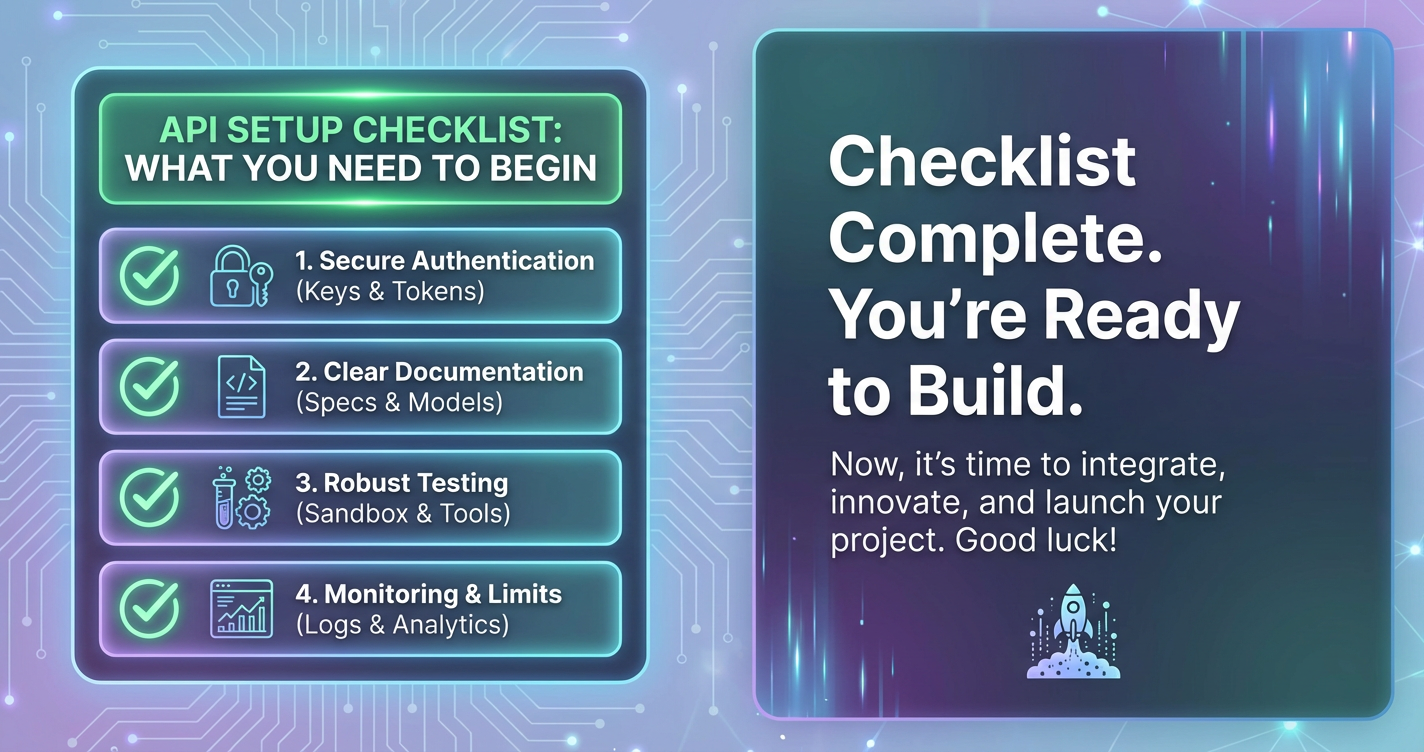
API Setup Checklist: What You Need to Begin


Setting up an Application Programming Interface (API) is a foundational step for modern software development, enabling seamless communication between disparate systems, fostering innovation, and driving business growth. In today's interconnected digital landscape, an organization's ability to effectively design, implement, and manage APIs often dictates its agility, scalability, and market reach. However, the journey from conceptualizing an API to its successful deployment and ongoing operation is fraught with complexities, demanding meticulous planning and adherence to best practices. This comprehensive guide serves as an essential API setup checklist, meticulously detailing the critical considerations, technical requirements, and strategic decisions necessary to embark on this endeavor with confidence and foresight. From the initial glimmer of an idea to the intricate details of security protocols and long-term maintenance, we will navigate each phase, ensuring you are equipped with the knowledge to build robust, scalable, and developer-friendly APIs.
The proliferation of digital services and the increasing demand for data exchange have elevated the importance of APIs from a mere technical component to a strategic asset. Whether you're building a mobile application, integrating with third-party services, enabling internal system communications, or exposing data to partners, a well-conceived API is paramount. Skipping crucial steps or making ill-informed decisions early on can lead to significant technical debt, security vulnerabilities, performance bottlenecks, and a poor developer experience, ultimately undermining the very purpose of the API. Therefore, approaching API setup with a structured checklist ensures that every critical aspect, from architectural design to deployment and governance, is thoroughly addressed. Our exploration will cover a vast landscape, touching upon everything from defining clear business objectives and designing intuitive interfaces using OpenAPI specifications, to implementing robust security measures, choosing the right API gateway, and establishing an effective management lifecycle.
1. Defining Your API's Purpose and Requirements: The "Why" Before the "How"
Before a single line of code is written or a server is provisioned, the most crucial step in any API setup is to unequivocally define its purpose and the problems it aims to solve. This initial phase is not merely a formality; it is the strategic bedrock upon which the entire API architecture will be built. Without a clear understanding of the "why," subsequent technical decisions risk being misaligned with business objectives, leading to an API that is either underutilized, overly complex, or fails to deliver anticipated value.
1.1. Business Objectives and Value Proposition
Every API should serve a tangible business purpose. Is it intended to unlock new revenue streams by exposing data to partners? Is it to streamline internal operations by integrating disparate systems? Perhaps it's to enhance customer experience by enabling third-party developers to build innovative applications on your platform. Articulating these objectives with precision is vital. For instance, if the goal is to enable partners to access customer data for analytics, the API's design must prioritize data consistency, real-time access, and robust security. Conversely, an internal API for microservice communication might prioritize low latency and high throughput. Consider the specific business problems the API will solve and the value it will create for its target users. This often involves engaging with stakeholders from various departments—product management, marketing, sales, and operations—to gather diverse perspectives and ensure the API aligns with broader organizational goals. The definition of success metrics, such as adoption rates, usage frequency, or impact on business KPIs, should also begin here, providing a framework for evaluating the API's performance post-launch.
1.2. Identifying the Target Audience and Use Cases
Understanding who will be consuming your API is fundamental to its design and documentation. Will it be internal development teams building interconnected microservices? External third-party developers creating novel applications? Mobile app developers? Or perhaps data scientists requiring programmatic access to datasets? Each audience has distinct expectations regarding ease of use, documentation quality, and support. For external developers, intuitive design, clear examples, and comprehensive tutorials are paramount. They need to quickly grasp how to integrate your API into their applications without extensive hand-holding. For internal teams, consistency with existing APIs and alignment with established architectural patterns might be more important.
Concurrently, identifying specific use cases clarifies the functionalities the API must support. For example, if your API allows users to manage orders, typical use cases might include "create order," "retrieve order details," "update order status," and "cancel order." Each use case dictates the necessary endpoints, input parameters, and expected output structures. Documenting these scenarios helps in designing a pragmatic and focused API that directly addresses user needs, preventing feature bloat and unnecessary complexity. Detailed use case descriptions should include pre-conditions, post-conditions, actor roles, and the expected flow of information, forming a crucial reference point for both development and testing phases.
1.3. Non-Functional Requirements: Performance, Scalability, and Reliability
Beyond core functionalities, an API must meet critical non-functional requirements (NFRs) to be considered successful. These requirements define the quality attributes of the system and significantly influence architectural decisions.
- Performance: What are the acceptable latency levels for different API calls? How quickly must the API respond to requests? For real-time applications, sub-millisecond responses might be critical, while for batch processing, response times in seconds could be acceptable. Performance requirements dictate the choice of backend technologies, database design, and caching strategies.
- Scalability: How many requests per second (RPS) or transactions per second (TPS) must the API be able to handle, both currently and in the foreseeable future? Scalability is about the API's ability to grow with demand without compromising performance or reliability. This often involves architectural patterns like load balancing, horizontal scaling, and the use of elastic cloud infrastructure. A robust API gateway plays a crucial role in managing and distributing this load effectively.
- Reliability: What is the acceptable uptime percentage? How resilient must the API be to failures in its dependencies or underlying infrastructure? Reliability considerations include redundancy, fault tolerance, disaster recovery plans, and robust error handling mechanisms.
- Security: This is paramount for any API handling sensitive data or critical operations. What authentication and authorization schemes are required? How will data be encrypted in transit and at rest? What measures will be in place to prevent common vulnerabilities like injection attacks, broken authentication, or excessive data exposure? This is such a critical aspect that it warrants its own dedicated section later in the checklist.
- Maintainability: How easy will it be to update, patch, or extend the API in the future? This relates to code quality, documentation, and the architectural modularity.
- Observability: How will the API's health, performance, and usage be monitored? What logging and tracing capabilities are needed to diagnose issues quickly?
Defining these NFRs early on provides quantifiable targets for the development and operations teams, guiding technical decisions and ensuring the API meets user expectations under various operational conditions.
2. API Design Principles: Crafting a Coherent and Usable Interface
The design of your API is arguably the most critical factor influencing its adoption and long-term success. A well-designed API is intuitive, consistent, predictable, and delightful to use, minimizing the learning curve for developers and reducing integration headaches. Conversely, a poorly designed API can quickly become a source of frustration, leading to low adoption rates and increased support costs. This phase moves from the "why" to the "what" and "how" of the API's interface.
2.1. Choosing the Right API Style and Architectural Pattern
The landscape of API styles has evolved, with several prominent patterns dominating the scene. The choice depends heavily on the specific use cases, data requirements, and the nature of the interactions your API will facilitate.
- REST (Representational State Transfer): The most prevalent API style, RESTful APIs leverage standard HTTP methods (GET, POST, PUT, DELETE) to perform operations on resources, which are identified by URLs. They are stateless, cacheable, and emphasize a uniform interface. REST is excellent for resource-oriented services and public APIs where simplicity and widespread tooling support are key. Its ubiquitous nature makes it a default choice for many, fostering interoperability and ease of consumption across diverse platforms.
- GraphQL: A query language for APIs and a runtime for fulfilling those queries with your existing data. GraphQL allows clients to request exactly the data they need, no more and no less, solving the over-fetching and under-fetching problems common in REST. It's particularly well-suited for complex data models, mobile applications with varying data needs, and scenarios where multiple client types consume the same backend. While offering great flexibility, it introduces a new learning curve and requires different tooling.
- RPC (Remote Procedure Call): This style emphasizes functions or actions rather than resources. Clients invoke procedures or functions on a remote server, often using protocols like gRPC (Google's Remote Procedure Call) or Apache Thrift. RPC is highly efficient, often using binary serialization, and excels in high-performance microservices communication within a tightly coupled system. However, it can be less discoverable and more tightly coupled than REST or GraphQL.
For most general-purpose public and internal APIs, REST remains the de facto standard due to its simplicity, HTTP compatibility, and rich ecosystem of tools and libraries. However, understanding the strengths and weaknesses of each pattern is essential for making an informed decision that best suits your API's context.
2.2. Consistent Naming Conventions and Resource Modeling
Consistency is the cornerstone of a great API. This applies to everything from endpoint naming to parameter formats and error responses.
- Resource Naming: In RESTful APIs, resources should be named using plural nouns (e.g.,
/users,/products,/orders). Avoid verbs in endpoint URLs, as the HTTP method itself indicates the action (GET /users to retrieve users, POST /users to create a user). - Parameter Naming: Use consistent casing (e.g., camelCase or snake_case) for query parameters, request body fields, and response attributes.
- Data Modeling: Define clear and unambiguous data structures for requests and responses. Use standard data types where possible and provide clear examples. For instance, timestamps should adhere to ISO 8601 format.
- HTTP Methods: Use HTTP methods correctly and semantically. GET for retrieving data, POST for creating resources, PUT for full updates, PATCH for partial updates, and DELETE for removing resources. Misusing these methods can lead to confusion and incorrect caching behavior.
A well-defined resource model reflects the domain accurately and naturally, making the API intuitive to understand and interact with. This also ties into the use of OpenAPI (discussed next), which helps formalize these conventions.
2.3. Versioning Strategy
As your API evolves, changes are inevitable. A robust versioning strategy allows you to introduce new features, modify existing functionalities, or deprecate older ones without breaking existing client integrations. Common versioning approaches include:
- URI Versioning: Including the version number directly in the URL (e.g.,
/v1/users,/v2/users). This is straightforward but violates the principle of unique resource identification as the same resource is accessed via different URLs. - Header Versioning: Passing the version in a custom HTTP header (e.g.,
X-API-Version: 1). This keeps the URL clean but can be less discoverable. - Query Parameter Versioning: Using a query parameter (e.g.,
/users?api-version=1). Similar to header versioning, this keeps the URI clean but might be overlooked. - Content Negotiation Versioning: Using the
Acceptheader to specify the desired media type and version (e.g.,Accept: application/vnd.mycompany.v1+json). This is often considered the most RESTful approach but can be more complex to implement.
Regardless of the chosen method, clearly communicate the versioning strategy to developers, provide clear deprecation policies, and offer ample transition time before retiring older versions.
2.4. Effective Error Handling and Standardized Responses
When things go wrong, an API should communicate errors clearly, consistently, and informatively. A well-designed error handling mechanism is crucial for debugging and a positive developer experience.
- HTTP Status Codes: Use standard HTTP status codes to indicate the general nature of an error.
2xxfor success (e.g.,200 OK,201 Created,204 No Content).4xxfor client-side errors (e.g.,400 Bad Request,401 Unauthorized,403 Forbidden,404 Not Found,429 Too Many Requests).5xxfor server-side errors (e.g.,500 Internal Server Error,502 Bad Gateway,503 Service Unavailable).
- Standardized Error Response Body: Provide a consistent JSON (or XML) structure for error responses that includes details such as:
code: An internal, application-specific error code.message: A human-readable, developer-friendly message explaining the error.details: Optional, an array of specific validation errors or additional context.traceId: A unique identifier for the request, useful for debugging and linking to logs.
For example:
{
  "code": "VALIDATION_ERROR",
  "message": "One or more validation errors occurred.",
  "details": [
    {
      "field": "email",
      "message": "Email is not a valid format."
    },
    {
      "field": "password",
      "message": "Password must be at least 8 characters long."
    }
  ],
  "traceId": "abc-123-xyz"
}
Avoid exposing sensitive internal error details, such as stack traces, directly in public API responses.
2.5. Idempotency, Pagination, Filtering, and Sorting
These are design considerations that enhance the usability and robustness of your API.
- Idempotency: An operation is idempotent if executing it multiple times produces the same result as executing it once. GET, PUT, and DELETE operations should ideally be idempotent. POST operations are generally not. For non-idempotent operations like POST, consider mechanisms (e.g., unique request IDs) to handle duplicate requests safely, especially in distributed systems where network retries are common.
- Pagination: When dealing with large collections of resources, direct retrieval can be inefficient or overwhelming. Implement pagination (e.g.,
limitandoffsetparameters, or cursor-based pagination) to allow clients to fetch data in manageable chunks. - Filtering: Provide query parameters that enable clients to filter collections based on specific criteria (e.g.,
/products?category=electronics&status=available). - Sorting: Allow clients to specify the order in which results should be returned (e.g.,
/products?sort=price_ascor/products?sort=-createdAt).
These features empower developers to build more efficient and flexible applications that interact with your API effectively.
3. Defining Your API Contract with OpenAPI: The Blueprint for Success
Once the design principles are established, the next crucial step is to formalize this design into a machine-readable specification. This is where OpenAPI (formerly Swagger) comes into play. An OpenAPI specification acts as the blueprint for your API, providing a comprehensive, language-agnostic description of its capabilities.
3.1. What is OpenAPI and Why is it Essential?
OpenAPI Specification (OAS) is a standardized, language-agnostic interface description for RESTful APIs. It allows both humans and computers to discover and understand the capabilities of a service without access to source code, documentation, or network traffic inspection. In essence, it's a contract between the API provider and the API consumer.
The benefits of using OpenAPI are manifold:
- Automated Documentation: Tools can generate interactive documentation (like Swagger UI) directly from your OpenAPI definition, ensuring it's always up-to-date with the API's implementation. This significantly reduces manual documentation efforts and ensures accuracy.
- Client Code Generation: OpenAPI specifications can be used to automatically generate client SDKs in various programming languages, accelerating integration for developers.
- Server Stubs Generation: Developers can also generate server-side stubs, allowing them to start implementing the API logic while adhering to the defined contract.
- Testing and Validation: The specification can be used to generate test cases, validate incoming requests against the defined schema, and ensure that the API behaves as expected.
- Design-First Approach: OpenAPI promotes a design-first API development approach. By defining the API contract before implementation, teams can iterate on the design, gather feedback, and identify potential issues early in the development cycle.
- Improved Collaboration: It serves as a single source of truth for all stakeholders—developers, testers, product managers—ensuring everyone has a consistent understanding of the API.
- API Gateway Integration: Many API gateway solutions can ingest OpenAPI specifications to automatically configure routing, validation, and even security policies, simplifying deployment and management.
3.2. How to Write an OpenAPI Specification
An OpenAPI specification is typically written in YAML or JSON format. It describes:
- API Metadata: Title, version, description, contact information.
- Servers: The base URLs for the API (e.g.,
https://api.example.com/v1). - Paths (Endpoints): Each API endpoint (e.g.,
/users/{id}). - Operations: For each path, the HTTP methods it supports (GET, POST, PUT, DELETE) and details about each operation.
- Parameters: Inputs for each operation (path parameters, query parameters, header parameters, request body). This includes data types, required status, and descriptions.
- Request Bodies: The structure and schema of data sent in POST/PUT/PATCH requests.
- Responses: The possible HTTP status codes an operation can return and the schema of their response bodies (including error responses).
- Schemas: Reusable definitions for data models (e.g., a
Userobject, anOrderobject). - Security Schemes: Definitions for authentication methods (e.g., API keys, OAuth 2.0).
- Tags: Grouping related operations for better organization in documentation.
Crafting a comprehensive OpenAPI specification requires meticulous attention to detail, ensuring every aspect of the API's interface is accurately captured. Several tools exist to aid in this process, from text editors with OpenAPI extensions to specialized API design platforms.
3.3. Tools for OpenAPI Definition and Documentation
The OpenAPI ecosystem is rich with tools that facilitate the design, implementation, and consumption of APIs.
- Swagger Editor: An in-browser editor that allows you to write OpenAPI specifications in YAML and instantly view the rendered documentation. It provides real-time validation and helpful hints.
- Swagger UI: A dynamic, interactive, and self-documenting interface for your API generated directly from your OpenAPI specification. It allows developers to visualize and interact with the API's resources without any implementation logic in place.
- Stoplight Studio/Postman/Insomnia: These are popular API development environments that offer robust features for designing APIs, including visual OpenAPI editors, request builders, and testing capabilities.
- Code Generation Tools (e.g., OpenAPI Generator): These tools can take an OpenAPI specification and generate client SDKs, server stubs, and even documentation in various formats, significantly accelerating development workflows.
By leveraging OpenAPI, you establish a strong foundation for your API, fostering clear communication, accelerating development, and ensuring long-term maintainability.
4. Security: Fortifying Your API Against Threats
Security is not an afterthought; it must be ingrained in every stage of the API setup checklist, from initial design to ongoing operations. A single vulnerability can expose sensitive data, disrupt services, or lead to reputational damage. Protecting your API means implementing a multi-layered security strategy that addresses authentication, authorization, input validation, rate limiting, and data encryption. The role of an API gateway in enforcing many of these policies is paramount.
4.1. Authentication: Verifying Identities
Authentication is the process of verifying the identity of an API consumer. Without proper authentication, any entity could access your API, leading to unauthorized data exposure or manipulation. Common authentication methods include:
- API Keys: Simple alphanumeric strings used to identify an application or user. API keys are easy to implement but offer limited security. They typically provide identification rather than strong authentication, and their compromise can grant broad access. They are best suited for public APIs where the data is not highly sensitive or for rate limiting purposes. They should always be treated as sensitive credentials and transmitted securely (e.g., over TLS).
- OAuth 2.0: A powerful authorization framework that allows third-party applications to obtain limited access to an HTTP service, on behalf of a resource owner (e.g., a user). It delegates user authentication to the service that hosts the user account and authorizes third-party applications to access that user account. OAuth 2.0 is complex but offers granular control and is ideal for scenarios where user consent and delegation of authority are required. It typically involves roles like resource owner, client, authorization server, and resource server.
- JWT (JSON Web Tokens): A compact, URL-safe means of representing claims to be transferred between two parties. JWTs are often used with OAuth 2.0 as access tokens. They contain information about the user and their permissions, signed by the server, allowing clients to present them with each request without requiring the server to repeatedly query a database for authentication. JWTs are stateless, reducing server load, but require careful handling of revocation and expiration.
- Mutual TLS (mTLS): Provides two-way authentication between client and server, where both parties present and verify digital certificates. This offers the strongest form of authentication and is often used in highly secure environments, such as service-to-service communication within a microservices architecture.
The choice of authentication method should align with the API's security requirements, the sensitivity of the data, and the nature of its consumers.
4.2. Authorization: Granting Permissions
Once an API consumer is authenticated, authorization determines what actions they are permitted to perform and what resources they can access.
- Role-Based Access Control (RBAC): Assigns permissions to roles (e.g., 'admin', 'editor', 'viewer'), and users are assigned one or more roles. This simplifies management of permissions for a large number of users.
- Attribute-Based Access Control (ABAC): Grants permissions based on attributes of the user, resource, and environment. This offers more granular and flexible control than RBAC but is more complex to implement and manage.
- Scope-Based Authorization (with OAuth 2.0): OAuth 2.0 uses "scopes" to define the specific permissions an application is requesting from a user (e.g.,
read:profile,write:orders). The user grants consent for these scopes, and the API then enforces them.
Authorization logic must be implemented at the API endpoint level, ensuring that every request is checked against the user's or application's granted permissions before sensitive operations are executed or data is returned.
4.3. Input Validation
All data received through an API must be rigorously validated before processing. This is a primary defense against common vulnerabilities such as injection attacks (SQL injection, XSS) and buffer overflows.
- Schema Validation: Validate request bodies against the defined OpenAPI schema, ensuring data types, formats, and required fields are correct.
- Sanitization: Cleanse user input by removing or escaping potentially malicious characters.
- Business Logic Validation: Ensure that input values adhere to business rules (e.g., an order quantity cannot be negative).
Input validation should occur as early as possible in the request processing pipeline, ideally at the API gateway or the first layer of your service.
4.4. Rate Limiting and Throttling
To protect your API from abuse, denial-of-service (DoS) attacks, and uncontrolled consumption, implement rate limiting and throttling.
- Rate Limiting: Restricts the number of API requests a client can make within a given time frame (e.g., 100 requests per minute per IP address). When the limit is exceeded, the API should return a
429 Too Many RequestsHTTP status code. - Throttling: Similar to rate limiting, but often used to smooth out traffic spikes rather than strictly enforce hard limits. It might delay requests rather than outright deny them.
An API gateway is typically the ideal place to implement these controls, protecting your backend services from being overwhelmed.
4.5. Data Encryption (TLS/SSL)
All communication with your API must be encrypted using Transport Layer Security (TLS/SSL). This prevents eavesdropping, tampering, and message forgery during data transmission between the client and the server. Always enforce HTTPS, redirecting any HTTP requests to their secure counterparts. Ensure you use strong TLS configurations, including modern cipher suites and robust certificate management.
4.6. API Gateway Security Features
An API gateway acts as a single entry point for all API requests, making it a critical control point for security enforcement. A well-chosen API gateway offers a suite of security features:
- Centralized Authentication and Authorization: Offload authentication and authorization logic from individual microservices to the gateway, simplifying development and ensuring consistent enforcement.
- IP Whitelisting/Blacklisting: Control access based on source IP addresses.
- Threat Protection: Detect and block common API threats like SQL injection, XSS, and XML bomb attacks.
- CORS Management: Configure Cross-Origin Resource Sharing (CORS) policies to control which domains can access your API.
- Security Policy Enforcement: Apply granular security policies based on API paths, users, or applications.
- API Key Management: Generate, manage, and revoke API keys.
4.7. OWASP API Security Top 10
Familiarize yourself with the OWASP API Security Top 10, which outlines the most critical security risks to APIs. Regularly review your API against these risks and implement appropriate mitigations. Key areas include Broken Object Level Authorization, Broken User Authentication, Excessive Data Exposure, Lack of Resources & Rate Limiting, and Security Misconfiguration. Ongoing security audits and penetration testing are also vital to identify and remediate vulnerabilities proactively.
APIPark is a high-performance AI gateway that allows you to securely access the most comprehensive LLM APIs globally on the APIPark platform, including OpenAI, Anthropic, Mistral, Llama2, Google Gemini, and more.Try APIPark now! 👇👇👇
5. Development and Implementation Best Practices
With the design and security blueprint in place, the focus shifts to the actual development and implementation of the API. This phase is about translating the specification into functional code while adhering to engineering best practices that ensure code quality, testability, and maintainability.
5.1. Choosing the Right Technology Stack
The choice of programming language, framework, and database for your API backend depends on several factors, including existing organizational expertise, performance requirements, scalability needs, and ecosystem support.
- Programming Languages: Popular choices include Python (with Flask/Django), Node.js (with Express/NestJS), Java (with Spring Boot), Go (with Gin/Echo), and C# (with ASP.NET Core). Each has its strengths in terms of performance, concurrency, development speed, and community support.
- Frameworks: Frameworks provide a structured way to build APIs, offering features like routing, middleware, ORMs (Object-Relational Mappers), and testing utilities. They accelerate development and enforce best practices.
- Databases:
- Relational Databases (SQL): PostgreSQL, MySQL, SQL Server, Oracle. Ideal for structured data, complex queries, and applications requiring strong transactional consistency (ACID properties).
- NoSQL Databases: MongoDB, Cassandra, Redis, DynamoDB. Suited for unstructured or semi-structured data, high scalability, and flexible schema requirements. Chosen for specific use cases like real-time analytics, caching, or large-scale document storage.
Consider factors like developer familiarity, available libraries, performance benchmarks, and deployment complexity when making these choices. A heterogeneous architecture (polyglot persistence, polyglot programming) might even be appropriate for microservices, allowing teams to choose the best tool for each specific service.
5.2. Robust Testing Strategies
Comprehensive testing is non-negotiable for API quality, reliability, and security. A multi-faceted testing strategy ensures that the API behaves as expected under various conditions.
- Unit Tests: Test individual components or functions in isolation to ensure they work correctly. These are typically written by developers during implementation.
- Integration Tests: Verify the interaction between different components or services, ensuring they communicate correctly. This might involve testing the API's interaction with a database, external services, or other microservices.
- End-to-End (E2E) Tests: Simulate real user scenarios, covering the entire flow from the client application to the backend API and its dependencies. These ensure the complete system functions correctly from a user's perspective.
- Performance/Load Tests: Assess the API's behavior under anticipated and peak load conditions to identify bottlenecks, measure response times, and verify scalability. Tools like JMeter, Locust, or k6 are commonly used.
- Security Tests: Conduct penetration testing, vulnerability scanning, and fuzz testing to identify security flaws. This also includes testing authentication, authorization, input validation, and rate-limiting mechanisms.
- Contract Testing: Using the OpenAPI specification as a contract, contract tests verify that the API implementation adheres strictly to its defined interface, preventing breaking changes and ensuring consumer compatibility.
Automating these tests within a CI/CD pipeline is crucial for maintaining rapid development cycles and ensuring continuous quality.
5.3. Monitoring and Logging
Once deployed, an API needs continuous monitoring and comprehensive logging to ensure its health, performance, and security.
- Logging: Implement structured logging that captures key information for every API request and response, including request headers, body, timestamps, IP addresses, user IDs, error messages, and trace IDs. Logs are invaluable for debugging, auditing, and security analysis. Centralized logging solutions (e.g., ELK Stack, Splunk, Datadog Logs) aggregate logs from all services, making them searchable and analyzable.
- Metrics and Monitoring: Collect metrics on API usage, performance, and errors.
- Usage: Number of requests, unique users/applications, most popular endpoints.
- Performance: Latency (average, p95, p99), throughput (RPS/TPS), error rates.
- Health: Server CPU/memory usage, database connection pools, dependency health checks.
- Business Metrics: Metrics directly tied to business objectives (e.g., number of successful orders, new user registrations via API). Tools like Prometheus, Grafana, Datadog, or New Relic provide dashboards and alerting capabilities based on these metrics.
- Distributed Tracing: For microservices architectures, distributed tracing (e.g., OpenTelemetry, Jaeger, Zipkin) is essential to follow a single request across multiple services, pinpointing performance bottlenecks and failures in complex distributed systems.
Proactive monitoring allows teams to detect and address issues before they significantly impact users, while detailed logging facilitates rapid troubleshooting and root cause analysis.
5.4. Continuous Integration/Continuous Deployment (CI/CD)
A robust CI/CD pipeline is indispensable for efficient API development and deployment.
- Continuous Integration (CI): Automates the process of integrating code changes from multiple developers into a shared repository. It typically involves automated builds, unit tests, integration tests, and static code analysis, providing immediate feedback on code quality and potential issues.
- Continuous Deployment (CD): Automates the release of validated code changes to production environments. This enables frequent, reliable, and low-risk deployments, ensuring that new API features and bug fixes are delivered to users rapidly.
A well-configured CI/CD pipeline ensures that every code change undergoes a rigorous validation process before deployment, reducing the risk of introducing bugs or security vulnerabilities into your production API.
6. Deployment and Infrastructure Considerations: Bringing Your API to Life
Deploying an API involves making it accessible to its consumers while ensuring it operates reliably, scales effectively, and remains secure. This phase focuses on the infrastructure, environment, and tooling required for operational excellence.
6.1. Cloud vs. On-premise Deployment
The choice between cloud and on-premise deployment significantly impacts infrastructure management, scalability, and cost.
- Cloud Deployment: Leveraging public cloud providers (AWS, Azure, Google Cloud) offers immense flexibility, scalability, and a pay-as-you-go model. Cloud services abstract away much of the infrastructure management, allowing teams to focus on API development. Benefits include:
- Elastic Scalability: Easily scale resources up or down based on demand.
- High Availability: Built-in redundancy and disaster recovery options.
- Managed Services: Access to databases, message queues, serverless functions, and API gateway solutions without managing underlying infrastructure.
- Cost Efficiency: Pay only for what you use, potentially reducing CapEx.
- On-premise Deployment: Deploying on your own data centers offers maximum control over infrastructure, data, and security. This is often preferred for highly sensitive data, strict regulatory compliance, or environments with existing large infrastructure investments. However, it requires significant upfront investment, operational overhead for maintenance, and manual scaling efforts.
Many organizations adopt a hybrid approach, using cloud for elasticity and agility while retaining some critical systems on-premise.
6.2. Scalability and Load Balancing
To handle varying traffic loads and ensure high availability, scalability and load balancing are crucial.
- Horizontal Scaling: Adding more instances of your API service to distribute incoming requests. This is generally preferred over vertical scaling (increasing resources of a single instance) for cloud-native architectures.
- Load Balancers: Distribute incoming API traffic across multiple instances of your backend services. This prevents any single instance from becoming a bottleneck, improves overall performance, and enhances fault tolerance. Load balancers can operate at different layers (Layer 4 TCP, Layer 7 HTTP/HTTPS) and offer features like health checks, session stickiness, and SSL termination.
6.3. Containerization (Docker, Kubernetes)
Containerization has revolutionized API deployment, offering consistency, portability, and efficient resource utilization.
- Docker: Packages your API application and all its dependencies into a standardized unit called a container. This ensures that the API runs consistently across different environments (development, testing, production), eliminating "it works on my machine" issues.
- Kubernetes: An open-source container orchestration platform that automates the deployment, scaling, and management of containerized applications. Kubernetes provides features like self-healing, rolling updates, service discovery, and declarative configuration, making it ideal for managing complex microservices architectures and large-scale API deployments.
Adopting containerization and orchestration streamlines the deployment process, improves resource efficiency, and enhances the resilience of your API infrastructure.
6.4. The Critical Role of an API Gateway
An API gateway is a fundamental component in modern API architectures, acting as the single entry point for all client requests. It sits in front of your backend services, routing requests to the appropriate service, and performing cross-cutting concerns. The API gateway is not just a proxy; it’s an intelligent layer that adds significant value to your API ecosystem.
Its functionalities extend far beyond simple routing:
- Request Routing: Directs incoming requests to the correct microservice or backend endpoint based on rules configured in the gateway.
- Load Balancing: Distributes requests evenly across multiple instances of your services to ensure optimal performance and high availability.
- Authentication and Authorization Enforcement: Centralizes the handling of API keys, OAuth 2.0 tokens, JWTs, and other security mechanisms, offloading this burden from individual services.
- Rate Limiting and Throttling: Protects backend services from being overwhelmed by controlling the number of requests clients can make within a specified timeframe.
- Caching: Stores responses to frequently requested data, reducing the load on backend services and improving response times for clients.
- Request/Response Transformation: Modifies request or response payloads, headers, or parameters to adapt to different client needs or backend service requirements.
- Logging and Monitoring: Centralizes logging of API traffic and collects metrics on performance, usage, and errors, providing a unified view of API operations.
- Versioning: Facilitates the management of different API versions, allowing smooth transitions and backward compatibility.
- Circuit Breaking: Protects services from cascading failures by temporarily routing around failing dependencies.
- Security Policy Enforcement: Applies WAF (Web Application Firewall) capabilities, IP whitelisting/blacklisting, and other security policies.
Choosing the right API gateway is a critical decision, as it forms the backbone of your API infrastructure. Many options exist, from cloud-native gateways (AWS API Gateway, Azure API Management, Google Apigee) to self-hosted open-source solutions like Kong, Tyk, and Apache APISIX.
In this context, considering a platform like APIPark can be highly beneficial. APIPark is an open-source AI gateway and API management platform designed to simplify the management, integration, and deployment of both AI and REST services. It offers quick integration with over 100 AI models, providing a unified management system for authentication and cost tracking, which is particularly relevant in the era of pervasive AI integration. APIPark standardizes the request data format across AI models, ensuring that application changes or prompt modifications do not disrupt services, thereby reducing maintenance overhead. Furthermore, it allows users to encapsulate prompts into REST APIs, enabling the rapid creation of new services like sentiment analysis or translation APIs from existing AI models. Beyond its AI capabilities, APIPark provides robust end-to-end API lifecycle management, assisting with design, publication, invocation, and decommissioning, while also regulating traffic forwarding, load balancing, and versioning. Its impressive performance, rivaling Nginx with over 20,000 TPS on modest hardware, makes it suitable for handling large-scale traffic, and its detailed API call logging and powerful data analysis features are invaluable for troubleshooting, security, and performance optimization. For organizations prioritizing open-source solutions with a focus on both traditional RESTful APIs and emerging AI service integration, APIPark presents a compelling option, offering a comprehensive suite of features to address many points on this API setup checklist.
7. API Management and Governance: Beyond Deployment
Deploying an API is just the beginning. Effective API management and governance are crucial for its long-term success, ensuring that it remains discoverable, usable, secure, and evolves gracefully over time. This involves establishing processes and tools to oversee the entire API lifecycle.
7.1. Version Management and Deprecation Strategy
As previously discussed, APIs evolve. A clear version management strategy is essential to introduce new features or changes without breaking existing integrations. Equally important is a well-defined deprecation strategy for older API versions or specific endpoints.
- Communicate Changes Clearly: Announce deprecation plans well in advance through developer portals, email newsletters, or direct communication.
- Provide Migration Guides: Offer clear instructions and tools to help developers migrate from older versions to newer ones.
- Grace Period: Provide a sufficient grace period (e.g., 6-12 months) before completely retiring an older API version, allowing ample time for consumers to adapt.
- Monitor Usage: Track usage of deprecated APIs to identify which clients still rely on them and offer targeted support.
7.2. Full API Lifecycle Management
An API goes through several stages from conception to retirement. Effective management requires overseeing this entire lifecycle:
- Design: Initial planning, requirement gathering, and OpenAPI specification creation.
- Develop: Implementation, testing, and integration with backend services.
- Publish: Making the API discoverable through a developer portal, with clear documentation.
- Consume: Enabling developers to find, understand, and integrate with the API.
- Operate: Monitoring, scaling, and maintaining the API in production.
- Deprecate/Retire: Gradually phasing out older versions and eventually removing them.
A comprehensive API management platform often provides tools to govern each stage of this lifecycle, ensuring consistency and control.
7.3. Developer Portal: The Gateway to Adoption
A well-designed developer portal is critical for API discoverability, adoption, and a positive developer experience. It acts as a central hub where developers can find everything they need to integrate with your API.
Key components of a developer portal include:
- Interactive Documentation: Automatically generated from OpenAPI specifications, allowing developers to explore endpoints, parameters, and responses.
- Getting Started Guides: Step-by-step tutorials to help new users quickly integrate the API.
- SDKs and Code Examples: Ready-to-use client libraries in various programming languages and practical code snippets.
- API Key Management: A self-service portal for developers to generate, manage, and revoke their API keys or OAuth credentials.
- Support Resources: FAQs, forums, contact information, and channels for reporting bugs or seeking assistance.
- Analytics Dashboard: For developers to monitor their own API usage, performance, and billing information.
- Status Page: Real-time updates on API availability and incident reports.
A good developer portal fosters a thriving ecosystem around your API, encouraging usage and feedback.
7.4. Analytics and Reporting
Collecting and analyzing API usage data provides invaluable insights into its performance, adoption, and areas for improvement.
- Usage Trends: Track the number of calls over time, peak usage hours, and growth patterns.
- Top Consumers: Identify the most active applications or users.
- Endpoint Popularity: Determine which endpoints are most frequently used.
- Performance Metrics: Monitor average response times, error rates, and latency for different endpoints.
- Business Impact: Correlate API usage with business outcomes (e.g., new sign-ups, revenue generated).
These analytics enable product managers to make data-driven decisions about API evolution, identify potential issues, and demonstrate the API's business value.
7.5. Access Control and Permissions for API Consumers
Managing who can access which APIs and what they can do is a fundamental aspect of governance.
- Subscription Models: Allow developers to subscribe to specific APIs or tiers of service (e.g., free, premium, enterprise). This enables differentiated access and monetization strategies.
- Approval Workflows: For sensitive APIs, require administrators to approve subscriptions before access is granted. This ensures that only authorized applications or partners can integrate with critical services, preventing unauthorized calls and potential data breaches. Many API gateway platforms offer this feature.
- Multi-tenancy: If your platform serves multiple internal teams or external organizations, ensure that each tenant has independent applications, data, user configurations, and security policies, while potentially sharing underlying infrastructure. This improves resource utilization and isolation.
Effective access control, often facilitated by an API gateway and a developer portal, ensures that your API ecosystem remains secure, manageable, and aligned with your business model.
8. Monitoring, Observability, and Maintenance: Sustaining API Health
The final phase of the API setup checklist, and indeed an ongoing process, involves ensuring the API remains healthy, performs optimally, and adapts to changing requirements. This requires robust monitoring, deep observability, and proactive maintenance strategies.
8.1. Real-time Monitoring and Alerting
Continuous real-time monitoring is essential to detect operational issues promptly. This goes beyond simple uptime checks to cover a spectrum of performance and error metrics.
- Key Metrics: Monitor response times, throughput (requests per second), error rates (HTTP 4xx and 5xx), CPU utilization, memory usage, network I/O, and database query performance.
- Custom Business Metrics: Track application-specific metrics crucial to your business, such as the number of successful payment transactions, failed user authentications, or specific feature usage.
- Service Level Indicators (SLIs): Define specific, measurable metrics that indicate the level of service being provided (e.g., 99.9% of requests respond in under 300ms).
- Alerting: Configure alerts based on predefined thresholds for these metrics. When an SLI deviates, an alert should be triggered, notifying the appropriate on-call teams via various channels (email, Slack, PagerDuty). Alerts should be actionable, clear, and include relevant context to facilitate rapid incident response.
The effectiveness of monitoring lies not just in collecting data, but in being able to interpret it and respond quickly to anomalies.
8.2. Observability: Understanding System Behavior
While monitoring tells you if a system is working, observability helps you understand why it's working the way it is. It's the ability to infer the internal states of a system by examining its external outputs. This is especially critical for complex distributed systems and microservices architectures.
Key pillars of observability include:
- Metrics: Aggregated numerical data over time (e.g., request counts, error rates, latency percentiles).
- Logs: Discrete, immutable records of events that happened at a specific point in time (e.g., API requests, error messages, system events). Detailed API call logging, which records every detail of each API call, is invaluable here. This feature allows businesses to quickly trace and troubleshoot issues in API calls, ensuring system stability and data security, and many API gateway platforms provide such capabilities.
- Traces: Represent the end-to-end journey of a single request or transaction as it propagates through multiple services and components in a distributed system. Tracing helps pinpoint performance bottlenecks and identify the root cause of failures across services.
By combining these three pillars, engineering teams can gain deep insights into their API's behavior, debug complex issues more efficiently, and make informed decisions about performance optimization and architectural improvements. Furthermore, powerful data analysis tools that analyze historical call data to display long-term trends and performance changes can help businesses with preventive maintenance, anticipating issues before they impact users.
8.3. Performance Tuning and Optimization
Even a well-designed API can develop performance bottlenecks over time as traffic grows or data volumes increase. Regular performance tuning is crucial.
- Profiling: Use profiling tools to identify code hotspots and inefficient database queries.
- Caching Strategies: Implement caching at various layers (client-side, CDN, API gateway, application, database) to reduce redundant computations and database calls.
- Database Optimization: Optimize database queries, indexes, and schema design.
- Resource Optimization: Ensure efficient use of CPU, memory, and network resources.
- Asynchronous Processing: Use message queues and background jobs for long-running or non-critical tasks to avoid blocking API requests.
Regular performance reviews and stress testing help identify areas for optimization before they become critical issues.
8.4. Incident Response and Post-Mortems
Despite best efforts, incidents will occur. Having a clear incident response plan is vital.
- Defined Roles and Responsibilities: Clearly assign roles for incident commander, communication lead, and technical responders.
- Communication Plan: Establish channels and protocols for communicating with internal stakeholders, API consumers (via status pages), and support teams.
- Runbooks: Document step-by-step procedures for diagnosing and resolving common issues.
- Post-Mortem Analysis: After an incident is resolved, conduct a blameless post-mortem to understand the root cause, identify contributing factors, and implement preventative measures. This fosters continuous learning and improvement.
8.5. User Feedback Loops and Continuous Improvement
An API is a product, and like any product, it benefits from user feedback.
- Developer Forums/Communities: Provide platforms for developers to ask questions, share insights, and report issues.
- Support Channels: Offer clear channels for developers to get technical support.
- Surveys and Interviews: Periodically gather feedback from your API consumers on usability, documentation, and feature requests.
- Feature Request Prioritization: Use feedback and usage analytics to inform your API roadmap and prioritize new features or enhancements.
Treating your API as an evolving product, continually iterating based on data and feedback, is key to its sustained success and relevance.
Conclusion: The Journey of a Resilient API
Embarking on the journey of API setup is a multifaceted undertaking, demanding a blend of strategic foresight, meticulous technical planning, and an unwavering commitment to operational excellence. This comprehensive checklist has traversed the entire spectrum, from the fundamental imperative of defining an API's purpose to the intricate nuances of its ongoing maintenance and evolution. We have underscored the critical importance of a design-first approach, leveraging the clarity and consistency offered by OpenAPI specifications to forge robust contracts between providers and consumers. The discussion on security has highlighted its non-negotiable status, advocating for multi-layered defenses from authentication to rate limiting, with a strong emphasis on the protective capabilities of an API gateway. Furthermore, we delved into the best practices for development, deployment on scalable infrastructure, and the continuous management, monitoring, and improvement that define a truly resilient API.
In an era where digital ecosystems thrive on seamless interconnection, a well-implemented and thoughtfully managed API is not merely a technical conduit; it is a strategic differentiator, a catalyst for innovation, and a gateway to new opportunities. By diligently following each step outlined in this API setup checklist, organizations can significantly mitigate risks, accelerate development cycles, enhance security posture, and ultimately deliver an exceptional experience for developers and end-users alike. Remember, the journey does not end with deployment; it evolves into a continuous cycle of monitoring, optimization, and adaptation. With this exhaustive guide as your companion, you are now equipped to navigate the complexities of API setup, build powerful digital bridges, and unlock the full potential of your interconnected world.
Frequently Asked Questions (FAQs)
Q1: What is the most critical first step when setting up a new API?
The most critical first step is unequivocally defining the API's purpose and its business objectives. Before considering any technical details, you must clearly understand why you are building the API, what problem it solves, and what value it delivers to its target audience. This foundational understanding guides all subsequent design, security, and implementation decisions, preventing misaligned efforts and ensuring the API meets its strategic goals.
Q2: Why is using OpenAPI specification so important for API development?
OpenAPI specification (OAS) is crucial because it creates a standardized, machine-readable contract for your API. This contract enables automated generation of interactive documentation, client SDKs, and server stubs, significantly accelerating development and improving consistency. It promotes a design-first approach, facilitates collaboration among diverse teams, and allows API gateway solutions to automatically configure routing and validation, ensuring that all stakeholders have a clear, consistent understanding of the API's capabilities from the outset.
Q3: What is an API Gateway, and why is it essential for API management?
An API gateway acts as a single, intelligent entry point for all client requests to your backend services. It is essential for API management because it centralizes critical cross-cutting concerns that would otherwise need to be implemented in every service. This includes enforcing security policies (authentication, authorization, rate limiting), routing requests, load balancing, caching, request/response transformation, and comprehensive logging. By offloading these responsibilities, an API gateway simplifies development, enhances security, improves performance, and provides a unified point for monitoring and managing your entire API ecosystem.
Q4: How can I ensure the security of my API?
Ensuring API security requires a multi-layered approach. Key measures include: 1. Strong Authentication and Authorization: Implement robust schemes like OAuth 2.0 or JWTs for verifying identities and granting granular permissions. 2. Input Validation and Sanitization: Rigorously validate all incoming data to prevent injection attacks and other vulnerabilities. 3. Rate Limiting and Throttling: Protect against abuse and DoS attacks by restricting request volumes. 4. Data Encryption: Enforce HTTPS/TLS for all data in transit. 5. API Gateway Security Features: Utilize the gateway for centralized security policy enforcement. 6. Regular Audits and Compliance: Adhere to security best practices like the OWASP API Security Top 10 and conduct regular security testing.
Q5: What is the role of a Developer Portal in API adoption?
A Developer Portal is critical for API adoption because it serves as the central hub for API consumers. It provides all the necessary resources for developers to discover, understand, and integrate with your API efficiently. This includes interactive documentation (often generated from OpenAPI), getting started guides, SDKs, code examples, self-service API key management, support channels, and usage analytics. A well-designed developer portal minimizes the learning curve, fosters a positive developer experience, and encourages the growth of an active API ecosystem around your offerings.
🚀You can securely and efficiently call the OpenAI API on APIPark in just two steps:
Step 1: Deploy the APIPark AI gateway in 5 minutes.
APIPark is developed based on Golang, offering strong product performance and low development and maintenance costs. You can deploy APIPark with a single command line.
curl -sSO https://download.apipark.com/install/quick-start.sh; bash quick-start.sh

In my experience, you can see the successful deployment interface within 5 to 10 minutes. Then, you can log in to APIPark using your account.

Step 2: Call the OpenAI API.