Asynchronously Send Information to Two APIs: Best Practices
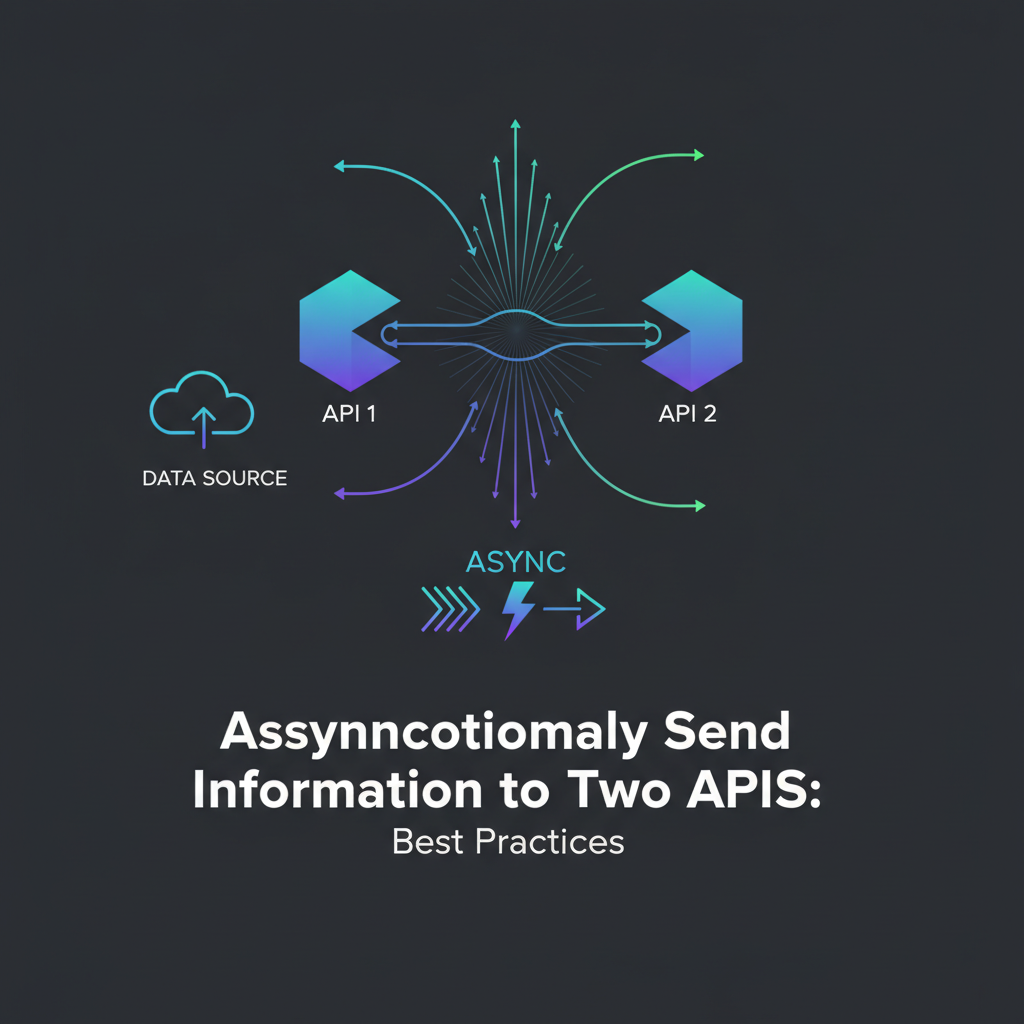


In the intricate tapestry of modern distributed systems, the ability to communicate efficiently and reliably between various services and external platforms is paramount. Enterprises today frequently find themselves in situations where a single business operation necessitates updates or interactions with multiple downstream systems, often exposed through distinct Application Programming Interfaces (APIs). While the immediate impulse might be to execute these calls synchronously, waiting for each to complete before proceeding, this approach quickly introduces bottlenecks, increases latency, and significantly degrades system responsiveness and resilience. This is where the profound power of asynchronous communication truly shines, particularly when the requirement is to dispatch information concurrently to two or more independent APIs.
The challenge of orchestrating simultaneous or near-simultaneous updates to multiple APIs asynchronously is not merely a technical hurdle; it’s a strategic design decision that impacts scalability, fault tolerance, and the overall user experience. Imagine an e-commerce platform processing an order: it might need to deduct inventory via one API, trigger a shipping label creation through another, and update a customer relationship management (CRM) system via a third. Performing these synchronously would mean the customer waits until all these external systems respond, a delay that is often unacceptable in today's fast-paced digital world. Moreover, a failure in any one of these external APIs would halt the entire process, potentially leaving the system in an inconsistent state.
This comprehensive guide delves deep into the best practices for asynchronously sending information to two APIs, exploring the underlying principles, architectural patterns, technological choices, and critical considerations for building robust, scalable, and resilient distributed applications. We will dissect common scenarios, weigh the pros and cons of various approaches, and provide actionable insights to navigate the complexities inherent in multi-API asynchronous integrations.
The Indispensable Role of Asynchronous Communication in Modern Architectures
Before we embark on the specifics of dual API interactions, it's vital to firmly grasp the foundational concepts and benefits of asynchronous communication itself. At its core, asynchronous communication allows a calling service to initiate an operation and then immediately continue with its own processing, without waiting for the response from the called service. The response, if any, is handled at a later time, through callbacks, events, or message polling.
What is Asynchronous Communication?
Think of ordering a custom-made suit from a tailor. In a synchronous model, you'd wait in the shop while the tailor measures, cuts, and sews the entire suit from scratch. You couldn't leave until it was finished. In an asynchronous model, you provide your measurements, the tailor tells you it will be ready in two weeks, and you can go about your day. When the suit is ready, you receive a notification to pick it up.
In software terms, this translates to:
- Non-blocking operations: The initiating service (producer) doesn't block its thread waiting for the recipient service (consumer) to process the request.
- Decoupling: Producers and consumers are largely independent. They don't need to be available at the exact same moment.
- Intermediate storage: Often, a message queue or event bus acts as a buffer between the producer and consumer, storing messages until the consumer is ready to process them.
Why is Asynchronous Communication Crucial?
The shift towards microservices, cloud-native applications, and high-performance computing has made asynchronous patterns not just an option, but often a necessity.
- Enhanced Responsiveness: For user-facing applications, asynchronous operations mean that users experience faster responses. Heavy backend tasks can be offloaded, allowing the frontend to quickly acknowledge user input and update the UI, providing a perception of speed.
- Improved Scalability: By decoupling services, each component can scale independently based on its specific load. If one downstream API is temporarily slow, it doesn't backlog the entire system. Message queues can buffer spikes in traffic, allowing consumers to process messages at their own pace.
- Increased Resilience and Fault Tolerance: If a downstream API or service is temporarily unavailable, asynchronous systems can queue requests and retry them later, preventing total system failure. The system can gracefully degrade rather than crash. This is crucial for maintaining service availability.
- Better Resource Utilization: Instead of threads lying idle, waiting for I/O operations to complete, they can be freed up to handle other requests, leading to more efficient use of computational resources.
- Architectural Decoupling: Services become more independent, reducing tight coupling. This facilitates independent deployment, easier maintenance, and greater flexibility for technology choices within different services.
- Simplified Complexity (in the long run): While initial setup might seem complex, managing failures, retries, and retries in a synchronous, tightly coupled system becomes exponentially harder than in a well-designed asynchronous one.
The Challenge of Dual API Integration
Sending information to two APIs simultaneously, or in close succession, introduces a unique set of complexities. Before diving into solutions, let's understand why this requirement arises and what inherent difficulties it presents.
Common Scenarios Requiring Dual API Integration
Businesses often integrate with multiple external or internal APIs for various reasons:
- Primary Data Store & Analytics: A user registration might update your primary user database (API 1) and simultaneously send user demographic data to an analytics platform (API 2).
- Order Fulfillment & Notification: An order placement might trigger an inventory update (API 1) and send a confirmation email or SMS to the customer (API 2).
- CRM & Marketing Automation: Updating customer details in your CRM (API 1) could also update segments in a marketing automation tool (API 2) to tailor campaigns.
- Main Service & Audit Logging: Every critical transaction might update your core business logic (API 1) and record a detailed, immutable audit trail in a separate logging service (API 2).
- Caching & Database Update: A write operation might update the primary database (API 1) and invalidate or update a cache (API 2).
- Cross-Platform Synchronization: A change in one application might need to be replicated in a partner's application (API 1) and an internal reporting dashboard (API 2).
Inherent Difficulties in Synchronous Dual API Calls
If one were to attempt these dual API calls synchronously, the challenges quickly become apparent:
- Increased Latency: The total response time becomes the sum of the response times of both APIs, plus any network overhead. If API A takes 500ms and API B takes 700ms, the minimum latency for the calling service is 1200ms.
- Cascading Failures: If API A fails, the entire operation fails, and API B is never called. If API A succeeds but API B fails, the system is left in an inconsistent state, and the user likely receives an error message, even though part of the operation completed.
- Tight Coupling: The calling service is directly dependent on the immediate availability and performance of both downstream APIs.
- Resource Bottlenecks: Threads remain blocked, consuming resources unnecessarily while waiting for external responses, limiting the number of concurrent requests the calling service can handle.
- Lack of Retry Mechanisms: Implementing robust retry logic for two sequential synchronous calls, especially with potential partial failures, becomes exceedingly complex.
The shift to asynchronous communication gracefully mitigates many of these problems, allowing for more resilient and performant dual API integrations.
Core Principles for Asynchronous Dual API Integration
Successful asynchronous integration isn't just about picking a technology; it's about adhering to fundamental architectural principles that ensure robustness and maintainability.
1. Decoupling
The cardinal rule of distributed systems. Services should not directly depend on each other's immediate availability or internal implementation details. When sending data to two APIs asynchronously, the primary service should simply "fire and forget" or "fire and acknowledge," relying on an intermediate broker or mechanism to ensure delivery. This allows each API to process data at its own pace and fail independently without bringing down the entire system.
2. Reliability and Durability
Asynchronous communication doesn't absolve the system of responsibility for data delivery. In fact, it shifts the responsibility to the asynchronous mechanism. The system must guarantee that once a message is published, it will eventually be delivered and processed by all intended consumers. This requires:
- Persistence: Messages stored on disk (or in memory with replication) so they survive service restarts.
- Acknowledgments: Consumers confirming successful processing, allowing the broker to remove the message or mark it as complete.
- Guaranteed Delivery: Mechanisms like "at-least-once" delivery, ensuring messages are not lost, even if they are processed multiple times.
3. Scalability
The chosen architecture must be able to handle increasing volumes of data and requests without significant re-architecture. This implies:
- Horizontal Scaling: Easily adding more consumers or broker instances to handle higher loads.
- Load Balancing: Distributing messages across available consumers.
- Throttling/Flow Control: Preventing overloaded consumers from being swamped with messages.
4. Observability
When operations span multiple services and asynchronous boundaries, understanding the system's behavior becomes critical. This principle demands comprehensive:
- Logging: Detailed, structured logs for each service, showing message flow and processing steps.
- Monitoring: Metrics on queue lengths, processing times, error rates, and resource utilization.
- Distributed Tracing: The ability to follow a single request's journey across all services, including asynchronous hops, providing end-to-end visibility. This helps pinpoint bottlenecks and failures in complex systems.
5. Idempotency
A transaction is idempotent if executing it multiple times produces the same result as executing it once. This is crucial in asynchronous systems because messages might be delivered and processed more than once (e.g., due to retries after a temporary failure, or "at-least-once" delivery guarantees). Both target APIs must be designed to handle duplicate requests without causing unintended side effects (e.g., deducting inventory twice, sending two welcome emails).
Architectural Patterns and Technologies for Asynchronous Dual API Integration
There are several proven architectural patterns and technologies that facilitate asynchronous communication, particularly for the challenge of sending data to two APIs. Each has its strengths, weaknesses, and ideal use cases.
1. Message Queues (MQ)
Message queues are a foundational component in many distributed asynchronous systems. They act as intermediaries that store messages temporarily between producers (senders) and consumers (receivers).
How They Work:
- Producer: A service generates a message (e.g., "new order placed" with order details) and publishes it to a specific queue or topic on the message broker.
- Message Broker/Queue: The broker receives the message and stores it securely in a queue. It's responsible for managing message persistence, delivery, and acknowledgments.
- Consumers: Services interested in processing specific types of messages subscribe to queues. When a new message arrives, the broker delivers it to one or more interested consumers.
- Fan-out Pattern for Dual APIs: For sending information to two APIs, the producer sends one message to the message queue. Then, two separate consumers (or groups of consumers) are set up. Each consumer is responsible for calling one of the target APIs.
- Consumer A: Reads the message, extracts relevant data, calls API 1.
- Consumer B: Reads the same message (or a copy of it, depending on the queue type), extracts relevant data, calls API 2.
- This is often achieved using "publish-subscribe" or "fan-out" mechanisms where a single message published to a topic is delivered to multiple distinct queues, each with its own consumer.
Examples of Message Queue Technologies:
- RabbitMQ: A robust, open-source message broker that implements AMQP (Advanced Message Queuing Protocol). Excellent for complex routing scenarios and fine-grained control over message delivery.
- Apache Kafka: A distributed streaming platform known for high throughput, fault tolerance, and durability. Ideal for real-time data feeds, event streaming, and handling massive volumes of messages. Can act as both a message queue and an event log.
- AWS SQS (Simple Queue Service): A fully managed message queuing service by Amazon Web Services. Highly scalable and cost-effective, offering standard and FIFO (First-In, First-Out) queues.
- Azure Service Bus: Microsoft's fully managed enterprise message broker, offering queues and topics for highly reliable messaging, often used in hybrid cloud scenarios.
- Google Cloud Pub/Sub: Google's real-time messaging service, designed for scale and reliability, facilitating communication between independently written applications.
Detailed Application for Dual API Calls:
Let's consider an example where an e-commerce service processes a PaymentProcessed event. This event needs to trigger two actions: 1. Update the InventoryService (API 1). 2. Send a ConfirmationEmail to the customer (API 2).
- E-commerce Service (Producer): After a successful payment, it publishes a
PaymentProcessedmessage to a designated topic (e.g.,ecommerce.payments). - Message Broker (e.g., Kafka or RabbitMQ Exchange): The broker receives this message.
- If using Kafka, there would be a
paymentstopic. - If using RabbitMQ, the message would be sent to an exchange (e.g.,
payment_exchange) which then routes it to multiple queues.
- If using Kafka, there would be a
- Inventory Consumer: A dedicated microservice or worker subscribed to the
ecommerce.paymentstopic (orinventory_update_queue) consumes thePaymentProcessedmessage. It extracts order details and calls theInventoryServiceAPI to deduct items. - Email Consumer: Another dedicated microservice or worker, also subscribed to the
ecommerce.paymentstopic (oremail_queue), consumes the samePaymentProcessedmessage. It extracts customer and order details and calls theEmailServiceAPI to send a confirmation.
Pros of Message Queues:
- Strong Decoupling: Producers and consumers are highly independent.
- Reliability: Messages are persisted, and various delivery guarantees (at-least-once, at-most-once) can be configured.
- Load Leveling/Buffering: Queues can absorb bursts of traffic, protecting downstream services from being overwhelmed.
- Scalability: Easily scale consumers independently to match processing demand.
- Error Handling: Built-in mechanisms for retries, dead-letter queues (DLQs) for messages that repeatedly fail processing.
Cons of Message Queues:
- Increased Complexity: Introduces another component to manage, monitor, and troubleshoot.
- Operational Overhead: Requires deployment, configuration, and maintenance of the message broker.
- Potential for Latency: While asynchronous, the time taken for a message to travel through the queue and be processed by a consumer can vary.
- Order Guarantees: Ensuring strict message order across multiple consumers can be challenging or require specific configurations (e.g., Kafka topics with single partitions for ordered processing, SQS FIFO queues).
2. Event-Driven Architecture (EDA)
EDA is an architectural paradigm centered around the production, detection, consumption, and reaction to events. While often implemented using message queues or streaming platforms, EDA is a broader concept that focuses on propagating state changes as events.
How It Works:
- Event Producer: A service, upon completing a significant state change (e.g., "user created," "order paid"), publishes an event describing what happened. This event is immutable and typically contains enough information for consumers to react.
- Event Broker/Bus: A central component (often a message queue like Kafka or a dedicated event bus like AWS EventBridge) receives and distributes events.
- Event Consumers: Other services that are interested in specific types of events subscribe to them. When an event occurs, all interested consumers receive a copy and react accordingly by executing their own business logic, which might include calling an API.
- Fan-out for Dual APIs: Similar to message queues, the single event published by the producer can be consumed by multiple services, each calling one of the target APIs. The key difference here is the semantic focus on events as immutable facts, rather than just messages to be processed.
Examples of Event-Driven Technologies:
- Apache Kafka: As mentioned, Kafka is excellent for event streaming.
- AWS EventBridge: A serverless event bus that makes it easy to connect applications together using data from your own apps, SaaS apps, and AWS services.
- Azure Event Grid: A fully managed event routing service that allows for easy consumption of events from various sources and dispatch to various handlers.
- NATS: A lightweight, high-performance messaging system often used for event distribution.
Detailed Application for Dual API Calls:
Revisiting the PaymentProcessed example:
- E-commerce Service (Event Producer): Publishes a
PaymentProcessedevent to the event broker (e.g., an EventBridge custom event bus). - Event Broker (e.g., EventBridge):
- A rule is configured to match
PaymentProcessedevents and forward them to a Lambda function (Consumer 1). - Another rule is configured to match
PaymentProcessedevents and forward them to a different Lambda function (Consumer 2).
- A rule is configured to match
- Inventory Update Lambda (Consumer 1): Triggered by the
PaymentProcessedevent. It extracts order details and calls theInventoryServiceAPI. - Email Sender Lambda (Consumer 2): Also triggered by the
PaymentProcessedevent. It extracts customer and order details and calls theEmailServiceAPI.
Pros of Event-Driven Architecture:
- Ultimate Decoupling: Services have minimal knowledge of each other, only reacting to events.
- Scalability: Easily add new consumers (subscribers) without modifying existing producers or consumers.
- Real-time Responsiveness: Events are processed as they occur, enabling real-time reactions.
- Extensibility: Easy to extend system functionality by adding new event consumers for new business requirements.
- Auditability: Event streams can act as an audit log of all system activities.
Cons of Event-Driven Architecture:
- Complexity: Can be harder to trace a single business transaction across many event hops.
- Eventual Consistency: Data across services might not be immediately consistent, requiring careful design.
- Debugging Challenges: Distributed tracing tools become essential for understanding event flows.
- Schema Evolution: Managing event schema changes without breaking consumers can be complex.
- Cost: Managed event services or self-hosted streaming platforms can incur significant costs.
3. Background Jobs/Workers
This pattern involves offloading long-running or non-essential tasks to separate background processes or worker queues.
How They Work:
- Main Application: The primary service receives a request, performs immediate necessary actions (e.g., validating input, saving to a local database), and then enqueues a job describing the task to be performed asynchronously.
- Task Queue: A specialized queue (often built on top of a message broker like Redis or RabbitMQ) stores these jobs.
- Worker Processes: Dedicated background processes continuously poll the task queue. When a job is found, a worker picks it up, executes the associated logic, and marks the job as complete.
- Dual API Calls: A single job enqueued by the main application can contain instructions to call both API 1 and API 2. The worker process would execute these calls sequentially or concurrently within its own context.
Examples of Background Job Technologies:
- Celery (Python): A powerful, distributed task queue for Python, often used with Redis or RabbitMQ as the message broker.
- Sidekiq (Ruby): A simple, efficient background processing for Ruby applications, powered by Redis.
- Hangfire (.NET): An in-process background job server for .NET applications.
- Quartz Scheduler (Java): A robust open-source job scheduling system.
- Dedicated Worker Services: Custom-built services that poll a database table or a message queue for tasks.
Detailed Application for Dual API Calls:
Consider a user onboarding process where, after initial registration, two external services need to be updated: 1. Add user to a CRM (API 1). 2. Enroll user in a welcome email sequence (API 2).
- User Registration Service (Main Application):
- Registers the user in its local database.
- Creates a
UserOnboardJobcontaining user details. - Enqueues this job into the task queue (e.g., Celery with Redis backend).
- Immediately returns a "User registered successfully" response to the user.
- Worker Process (e.g., Celery Worker):
- Picks up the
UserOnboardJobfrom the queue. - Executes a function that first calls the CRM API to add the user.
- Then, it calls the Marketing API to enroll the user in the email sequence.
- If any call fails, the job can be retried by the worker according to configured policies.
- Picks up the
Pros of Background Jobs:
- Simpler to Implement for "Fire and Forget" Scenarios: Especially if the logic for calling both APIs is tightly coupled and can reside within a single worker process.
- Retry Logic: Most frameworks provide robust, configurable retry mechanisms.
- Resource Management: Offloads heavy processing from the main application thread.
- Visibility: Often comes with monitoring dashboards to view job status, failures, and retries.
Cons of Background Jobs:
- Tight Coupling of Calls: If both API calls are made within the same worker job, a failure in the first might prevent the second from ever being attempted unless specifically handled, or a retry might re-execute the first successful call (requiring idempotency). This pattern doesn't inherently decouple the processing of the two API calls as much as separate consumers in MQ/EDA.
- Scalability of Workers: Requires scaling worker processes and the task queue backend.
- Potential for Bottlenecks: If a single worker handles all aspects of a job, a slow API call can block the worker from processing other jobs.
- Limited Fan-out: Not inherently designed for broadcasting a single event to many independent consumers without explicit job creation for each.
4. Serverless Functions
Serverless computing allows you to run code without provisioning or managing servers. Functions are triggered by events (e.g., HTTP requests, database changes, messages in a queue).
How They Work:
- Trigger: An event (e.g., an API Gateway HTTP request, a message arriving in an SQS queue, a new object in an S3 bucket) invokes a serverless function.
- Function Execution: The function's code runs in a managed environment, performing its task.
- Dual API Calls: A single serverless function can be written to make two API calls concurrently, or it can trigger other serverless functions or asynchronous services that make the calls.
- Option A (Single Function, Concurrent Calls): The function directly calls API 1 and API 2 in parallel using asynchronous programming constructs (e.g.,
Promise.allin Node.js,asyncioin Python). - Option B (Function Orchestration): The initial function publishes a message to a queue or an event to an event bus, which then triggers two separate functions, each responsible for one API call. This essentially combines serverless with MQ/EDA.
- Option C (Workflow Orchestration): Use a serverless workflow service (like AWS Step Functions or Azure Logic Apps) to define a state machine that orchestrates the two API calls, including parallel execution, error handling, and retries.
- Option A (Single Function, Concurrent Calls): The function directly calls API 1 and API 2 in parallel using asynchronous programming constructs (e.g.,
Examples of Serverless Function Technologies:
- AWS Lambda: Amazon's serverless compute service.
- Azure Functions: Microsoft's serverless compute service.
- Google Cloud Functions: Google's serverless compute service.
- AWS Step Functions: A serverless workflow service to coordinate multiple AWS services into serverless workflows.
- Azure Logic Apps: A cloud service that helps you schedule, automate, and orchestrate tasks, business processes, and workflows when you need to integrate apps, data, devices, and cloud-based services.
Detailed Application for Dual API Calls:
Let's use the order processing example, but with a serverless approach. When an order is completed, we want to: 1. Update inventory (API 1). 2. Send a shipping notification (API 2).
Using Workflow Orchestration (AWS Step Functions):
- Order Processing Service: Upon order completion, it invokes an AWS Step Functions state machine execution.
- Step Functions State Machine:
- Initial Step: Receive order details.
- Parallel Step: Define two parallel branches.
- Branch 1 (Inventory Update): Invokes an AWS Lambda function (
UpdateInventoryLambda) that calls theInventoryServiceAPI. - Branch 2 (Shipping Notification): Invokes an AWS Lambda function (
SendShippingNotificationLambda) that calls theShippingServiceAPI.
- Branch 1 (Inventory Update): Invokes an AWS Lambda function (
- Completion Step: After both parallel branches complete, the state machine finishes.
- Step Functions inherently handles error handling, retries, and can even define compensating transactions.
Using a Single Lambda with Concurrent Calls:
- API Gateway / SQS Queue: An incoming request (via API Gateway) or message (via SQS) triggers a single Lambda function (
ProcessOrderLambda). ProcessOrderLambda:- Receives order data.
- Uses
Promise.all(Node.js) orasyncio.gather(Python) to concurrently execute:- A function that calls
InventoryServiceAPI. - A function that calls
ShippingServiceAPI.
- A function that calls
- Handles aggregated success or failure.
Pros of Serverless Functions:
- No Server Management: Reduces operational burden.
- Automatic Scaling: Functions scale automatically based on demand.
- Pay-per-Execution: Cost-effective for intermittent workloads.
- Fast Iteration: Developers can focus purely on business logic.
- Integration with Cloud Ecosystem: Seamlessly integrates with other cloud services.
- Workflow Orchestration: Services like Step Functions provide powerful visual workflow design, fault tolerance, and complex state management.
Cons of Serverless Functions:
- Vendor Lock-in: Code and configuration can become highly specific to a cloud provider.
- Cold Starts: Initial invocations might experience higher latency.
- Debugging Challenges: Distributed tracing is essential, but local testing can be difficult.
- Cost Management: While pay-per-execution, high volume can still lead to significant costs.
- Complexity with Many Functions: Managing a large number of small functions can become an architectural challenge.
5. API Gateway (with Backend Orchestration)
While an API Gateway primarily acts as the single entry point for all API requests, forwarding them to the appropriate backend services, it plays a crucial role in managing and exposing services that implement asynchronous dual API calls. An API gateway typically does not perform the asynchronous fan-out itself in a single request/response cycle directly. Instead, it routes incoming requests to the initiating service (which then uses one of the above asynchronous patterns) or to a service specifically designed to put a message on a queue.
When orchestrating complex interactions involving multiple backend APIs, especially in an asynchronous fashion, an API gateway becomes an indispensable component. Products like APIPark offer robust API lifecycle management capabilities, making it easier to define, publish, and secure the endpoints that eventually trigger these asynchronous dual calls. While APIPark itself is not a message queue, it can front-end services that use message queues or event buses to achieve asynchronous fan-out to multiple downstream APIs. It ensures that the external interface to your complex asynchronous system remains clean, secure, and well-managed, handling concerns like authentication, rate limiting, and request transformation before the request even hits the backend logic that initiates the asynchronous fan-out.
How it integrates:
- External Request: A client sends a request to the API Gateway.
- Gateway Routing & Policy Enforcement: The API Gateway authenticates, authorizes, rate-limits, and potentially transforms the request.
- Forward to Asynchronous Initiator: The Gateway then routes the request to a backend service specifically designed to initiate the asynchronous fan-out. This backend service could be:
- A simple service that immediately publishes a message to a queue/topic.
- A serverless function that triggers a Step Functions workflow.
- A microservice that enqueues a background job.
- Immediate Response (Optional): The API Gateway can immediately return a 202 Accepted status to the client, indicating that the request has been received and will be processed asynchronously, without waiting for the dual API calls to complete.
Pros of API Gateway in this Context:
- Centralized Entry Point: Simplifies client interactions and provides a single endpoint for all services.
- Security: Enforces authentication, authorization, and API key management at the edge.
- Traffic Management: Handles rate limiting, throttling, and load balancing.
- Request Transformation: Can modify requests and responses, shielding clients from backend changes.
- API Management: Offers features like versioning, documentation, and developer portals, which are crucial for any API-driven architecture. Platforms like APIPark excel in this domain, streamlining the entire API lifecycle from design to deprecation, making it easier to manage the external interface for complex asynchronous backend systems.
- Decouples Clients from Backend Complexity: Clients don't need to know the intricate asynchronous implementation details.
Cons of API Gateway:
- Single Point of Failure (if not highly available): Must be designed for resilience.
- Increased Latency (minimal): Adds a small hop to the request path.
- Configuration Overhead: Requires careful configuration of routing, policies, and integrations.
- Not a Replacement for Asynchronous Patterns: The gateway itself doesn't perform the asynchronous fan-out; it facilitates the connection to systems that do.
APIPark is a high-performance AI gateway that allows you to securely access the most comprehensive LLM APIs globally on the APIPark platform, including OpenAI, Anthropic, Mistral, Llama2, Google Gemini, and more.Try APIPark now! 👇👇👇
Key Considerations and Best Practices
Implementing asynchronous dual API calls successfully goes beyond selecting a pattern; it requires meticulous attention to operational details and architectural principles.
1. Idempotency: The Golden Rule for Retries
In asynchronous systems, especially with "at-least-once" delivery guarantees, a message or event might be processed multiple times. This can occur due to network failures, consumer crashes, or explicit retry mechanisms. If your API calls are not idempotent, these retries can lead to disastrous side effects (e.g., duplicate orders, incorrect inventory deductions, multiple emails).
Best Practices:
- Design APIs for Idempotency: The target APIs should be able to handle receiving the same request multiple times without causing side effects. This is often achieved by including a unique
idempotency_key(e.g., a UUID generated by the producer) in the request header or body. The API then checks if it has already processed a request with that key. - Use Transaction IDs: For a series of operations, a unique transaction ID can help track the overall process and ensure that only one successful completion is recorded.
- Check State Before Action: Before performing an action, check the current state of the resource. For example, if updating inventory, first check if the deduction has already been applied for that specific order ID.
2. Robust Error Handling and Retry Mechanisms
Failures are inevitable in distributed systems. A well-designed asynchronous system embraces this reality and incorporates resilient error handling.
Best Practices:
- Configurable Retries: Implement automatic retries for transient failures (e.g., network timeouts, HTTP 5xx errors from the target API).
- Exponential Backoff: Increase the delay between retries exponentially to avoid overwhelming a struggling service.
- Jitter: Add a random component to the backoff delay to prevent all retries from hitting at the same time ("thundering herd" problem).
- Circuit Breakers: Implement circuit breakers to prevent an overloaded or failing downstream API from being hit repeatedly. If an API consistently fails, the circuit breaker "trips," short-circuiting subsequent calls to that API for a period, allowing it to recover.
- Dead-Letter Queues (DLQs): For messages that consistently fail after a maximum number of retries, move them to a DLQ. This prevents poison messages from blocking the main queue and allows manual inspection and reprocessing.
- Alerting and Monitoring: Set up alerts for messages in DLQs or excessive retry rates.
- Compensating Transactions: For critical business processes, consider implementing compensating transactions. If one part of a multi-step process fails irrevocably, you might need to "undo" previously completed steps to maintain consistency.
3. Data Consistency: Eventual Consistency vs. Strong Consistency
When updating two different APIs, especially if they belong to separate services or external systems, achieving immediate strong consistency across both can be challenging and often counterproductive to the benefits of asynchronous communication. Most asynchronous patterns lean towards eventual consistency.
Best Practices:
- Embrace Eventual Consistency: Understand that data in API 1 might be updated moments before data in API 2. Design your system and user experience to gracefully handle this temporary inconsistency.
- Define Consistency Boundaries: Clearly define which data needs strong consistency and which can be eventually consistent. Critical financial transactions might require more stringent consistency guarantees.
- Saga Pattern: For complex, multi-step business transactions involving multiple services, consider the Saga pattern. A saga orchestrates a sequence of local transactions, and if any local transaction fails, compensating transactions are executed to undo the changes made by previous local transactions. This helps maintain consistency across distributed systems.
4. Observability: Seeing What's Happening Under the Hood
In an asynchronous, distributed environment, a single user request can fan out to multiple services and queues. Without proper observability, debugging and understanding system behavior becomes a nightmare.
Best Practices:
- Structured Logging: Ensure all services emit structured logs (e.g., JSON format) with correlation IDs.
- Correlation IDs (Trace IDs): Generate a unique correlation ID at the very beginning of a request (e.g., at the API Gateway) and pass it through every service, message, and event in the system. This allows you to trace a complete transaction end-to-end across all asynchronous boundaries.
- Centralized Logging: Aggregate logs from all services into a central logging system (e.g., ELK Stack, Splunk, Datadog) for easy searching and analysis.
- Metrics and Monitoring: Collect metrics (queue lengths, message processing times, error rates, API call latencies) from all components (message brokers, consumers, APIs). Use monitoring tools (e.g., Prometheus, Grafana, CloudWatch) to visualize these metrics and set up alerts for anomalies.
- Distributed Tracing: Implement distributed tracing (e.g., OpenTelemetry, Zipkin, Jaeger). This allows you to visualize the entire path of a request, including all synchronous and asynchronous calls, showing timings and dependencies. It’s invaluable for performance tuning and troubleshooting.
5. Security
Securing communication in an asynchronous dual API integration involves multiple layers.
Best Practices:
- Authentication & Authorization:
- API Gateway: Authenticate incoming client requests at the API Gateway using mechanisms like API keys, OAuth 2.0, or JWTs.
- Internal Service-to-Service: Use mTLS (mutual TLS), short-lived credentials, or signed requests for secure communication between your internal services (e.g., between a consumer and the target API).
- External APIs: Properly manage API keys or OAuth tokens for external APIs.
- Encryption in Transit: Use TLS/SSL for all network communication, both internal and external.
- Encryption at Rest: Ensure messages stored in queues or event logs are encrypted.
- Least Privilege: Grant only the necessary permissions to services and users. For instance, a consumer service should only have permissions to call its specific target API, not arbitrary endpoints.
- Vulnerability Scanning: Regularly scan your services and dependencies for security vulnerabilities.
6. Performance Tuning
While asynchronous by nature, performance considerations remain vital.
Best Practices:
- Batching: If a target API supports it, batch multiple updates into a single API call to reduce network overhead and API call limits. This is often applicable for analytics or logging APIs.
- Concurrency Limits: Implement limits on how many messages a single consumer can process concurrently to prevent overwhelming the target API or the consumer itself.
- Payload Optimization: Send only the necessary data in messages and API calls to minimize network bandwidth and processing time.
- Consumer Scaling: Auto-scale consumer services based on queue depth to ensure timely processing during peak loads.
7. Choosing the Right Tool/Pattern
The "best" solution depends entirely on your specific context.
Factors to Consider:
- Scale and Throughput: How many messages per second/minute? Kafka excels at high throughput.
- Latency Requirements: How critical is near real-time processing? Event-driven architectures are often faster.
- Complexity Tolerance: How much operational overhead can your team handle? Serverless solutions reduce this.
- Cost: Managed services have operational ease but might have higher direct costs at scale. Self-hosted solutions require more human resources.
- Existing Infrastructure: What tools and platforms are already in use and familiar to your team?
- Reliability Guarantees: Do you need strict message ordering (FIFO), or are "at-least-once" guarantees sufficient?
- Transactionality: How critical is atomic execution across multiple services? (Saga pattern might be needed).
Example Scenario: E-commerce Order Processing
Let's illustrate the application of these patterns with a common use case: an e-commerce platform processing a new order. Upon successful order placement, two actions are required: 1. Update Inventory: Deduct the ordered items from the stock management system (API 1). 2. Send Confirmation Email: Notify the customer about their order (API 2).
The core requirement is that the customer should receive an immediate "Order Confirmed!" response, even if inventory updates or email sending take a few moments.
| Architectural Pattern | How it Handles Dual APIs | Pros | Cons |
|---|---|---|---|
| Message Queue | Order service publishes OrderPlaced message. Two separate consumers (InventoryConsumer, EmailConsumer) subscribe to this message. Each calls its respective API. |
High decoupling, excellent reliability, scalable. | Adds operational complexity of managing MQ. Requires careful handling of idempotency for both APIs. |
| Event-Driven | Order service publishes OrderPlaced event to an event bus. Two separate event subscribers (e.g., Lambda functions) react to the event. Each calls its respective API. |
Maximum decoupling, highly extensible, real-time potential. | Eventual consistency, increased debugging effort, potential for 'event spaghetti' if not managed well. |
| Background Job | Order service enqueues a ProcessOrderJob. A worker picks up the job, then sequentially (or concurrently) calls Inventory API and Email API. |
Simpler for tightly coupled tasks, robust retry handling. | Less inherent decoupling of the processing for the two calls. A single failure in worker affects both. |
| Serverless Functions (Orchestrated) | Order service triggers a Step Functions workflow. Workflow executes two parallel Lambda functions: one for Inventory, one for Email. | No server management, pay-per-execution, built-in retry/error handling. | Vendor lock-in, cold start latency (potentially), complex debugging if no good tracing. |
For an e-commerce system with varying load, needing high reliability, and expecting future extensions (e.g., adding loyalty points, fraud detection), a Message Queue or Event-Driven Architecture would typically be the most robust choice. They offer the best decoupling and resilience against failures in individual downstream systems. A serverless orchestrated workflow (like AWS Step Functions) is also a very strong contender, especially if operating entirely within a cloud ecosystem, as it provides a visual, managed way to orchestrate the asynchronous steps.
Deployment and Operations
The design phase is only half the battle; robust deployment and operational practices are critical for maintaining a healthy asynchronous dual API integration.
Infrastructure Considerations
- High Availability: Ensure your message broker, event bus, and worker services are deployed in a highly available configuration (e.g., across multiple availability zones) to prevent single points of failure.
- Scalability: Design your infrastructure to scale horizontally. This means easily adding more message broker nodes, consumer instances, or worker processes as traffic increases. Auto-scaling groups are essential for cloud environments.
- Resource Provisioning: Properly size your message brokers and worker machines. Under-provisioning can lead to message backlogs and performance degradation. Over-provisioning leads to unnecessary costs.
- Networking: Optimize network paths between your services, broker, and target APIs. Low latency and high bandwidth are crucial.
Monitoring and Alerting
- End-to-End Latency: Monitor the total time from message publication to final API call completion.
- Queue Depths: Keep an eye on the number of messages waiting in queues. Spikes often indicate a bottleneck downstream.
- Consumer Lag: For Kafka/Event Stream systems, monitor how far behind consumers are from the latest published events.
- Error Rates: Track error rates for message processing and calls to target APIs.
- Resource Utilization: Monitor CPU, memory, and network I/O of all components.
- DLQ Monitoring: Actively monitor dead-letter queues for messages that couldn't be processed.
Automated Deployment (CI/CD)
- Infrastructure as Code (IaC): Manage your queues, topics, worker services, and serverless functions using IaC tools (e.g., Terraform, CloudFormation, Pulumi). This ensures consistent, repeatable deployments.
- Automated Testing: Implement integration tests that simulate end-to-end asynchronous flows, including publishing messages and verifying actions in downstream APIs (mocked or real).
- Canary Deployments/Blue-Green Deployments: When deploying updates, use strategies that minimize downtime and allow for quick rollbacks if issues arise.
Conclusion
Asynchronously sending information to two APIs is a ubiquitous requirement in modern, distributed systems. It's a powerful pattern that unlocks significant advantages in terms of responsiveness, scalability, and resilience compared to traditional synchronous approaches. However, this power comes with increased complexity, demanding thoughtful design and robust implementation across several key areas.
The choice of architectural pattern – whether leveraging the robust buffering of message queues, the flexible decoupling of event-driven architectures, the straightforward task management of background jobs, or the agile scalability of serverless functions – depends heavily on your specific use case, technical capabilities, and operational context. Regardless of the chosen path, adherence to core principles like idempotency, comprehensive error handling, meticulous observability through structured logging and distributed tracing, and a strong focus on data consistency models is non-negotiable for success.
Furthermore, integrating an API gateway like APIPark at the front end provides an essential layer of management, security, and abstraction, shielding clients from the underlying asynchronous complexities and ensuring that even the most intricate multi-API interactions are exposed consistently and reliably. By combining the right architectural choices with disciplined operational practices, development teams can build systems that not only meet current demands but are also poised for future growth and evolution in an ever-more interconnected digital landscape. Embracing asynchronous communication is not just a technical decision; it's a strategic move towards building more agile, fault-tolerant, and performant applications that stand the test of time and scale.
5 Frequently Asked Questions (FAQs)
Q1: What is the primary benefit of asynchronously sending information to two APIs compared to doing it synchronously? A1: The primary benefit is significantly improved system responsiveness and resilience. Synchronous calls force the initiating service to wait for both APIs to respond, increasing latency and creating a single point of failure if one API is slow or unavailable. Asynchronous communication allows the initiating service to "fire and forget" or quickly acknowledge receipt, offloading the actual dual API calls to background processes or separate consumers. This makes the system faster for the user, more scalable under load, and more fault-tolerant against downstream API failures.
Q2: What is idempotency, and why is it crucial for asynchronous dual API integrations? A2: Idempotency means that executing an operation multiple times produces the same result as executing it once. It's crucial in asynchronous systems because messages or events might be delivered and processed more than once due to retries, network issues, or "at-least-once" delivery guarantees inherent in many messaging systems. If your target APIs are not idempotent, duplicate processing could lead to unintended side effects like double inventory deductions, duplicate charges, or sending the same email multiple times. Designing APIs with an idempotency_key (e.g., a unique transaction ID) in the request is a common way to achieve this.
Q3: Which architectural pattern is best for sending data to two APIs asynchronously? A3: There isn't a single "best" pattern; the optimal choice depends on specific requirements like scale, latency tolerance, operational overhead, and existing infrastructure. * Message Queues (MQ) or Event-Driven Architectures (EDA) are excellent for high decoupling, reliability, and scalability, allowing multiple consumers to react to a single message/event. * Background Jobs/Workers can be simpler for tightly coupled dual API calls where the processing logic for both resides in a single worker. * Serverless Functions with Orchestration (e.g., AWS Step Functions) provide a managed, scalable, and visual way to orchestrate sequential or parallel API calls with built-in error handling. Each pattern has its trade-offs in complexity, cost, and control.
Q4: How does an API Gateway contribute to asynchronous dual API calls? A4: An API Gateway, such as APIPark, acts as the single entry point for clients, managing the external face of your APIs. While it typically doesn't perform the asynchronous fan-out itself, it plays a vital role by: 1. Routing: Directing incoming requests to the backend service responsible for initiating the asynchronous process (e.g., publishing a message to a queue). 2. Security: Handling authentication, authorization, and rate limiting at the edge before requests reach your backend. 3. Abstraction: Hiding the internal complexities of your asynchronous implementation from clients. It allows the initiating service to immediately return a 202 Accepted response to the client, signifying that the request has been received and will be processed asynchronously.
Q5: What are the key challenges in debugging and monitoring asynchronous systems involving multiple APIs? A5: Debugging and monitoring asynchronous systems are significantly more complex than synchronous ones because operations span multiple services, queues, and timeframes. Key challenges include: * Lack of Direct Call Stack: A single user request doesn't follow a linear path. * Eventual Consistency: Data might not be immediately consistent across all systems, making it hard to verify states. * Identifying Bottlenecks: Pinpointing where latency or failures occur across distributed components. To overcome these, essential best practices include implementing structured logging with correlation IDs (trace IDs), using centralized logging systems, collecting detailed metrics from all components (queues, consumers, APIs), and leveraging distributed tracing tools (like OpenTelemetry) to visualize the entire flow of a request across all asynchronous hops.
🚀You can securely and efficiently call the OpenAI API on APIPark in just two steps:
Step 1: Deploy the APIPark AI gateway in 5 minutes.
APIPark is developed based on Golang, offering strong product performance and low development and maintenance costs. You can deploy APIPark with a single command line.
curl -sSO https://download.apipark.com/install/quick-start.sh; bash quick-start.sh

In my experience, you can see the successful deployment interface within 5 to 10 minutes. Then, you can log in to APIPark using your account.

Step 2: Call the OpenAI API.