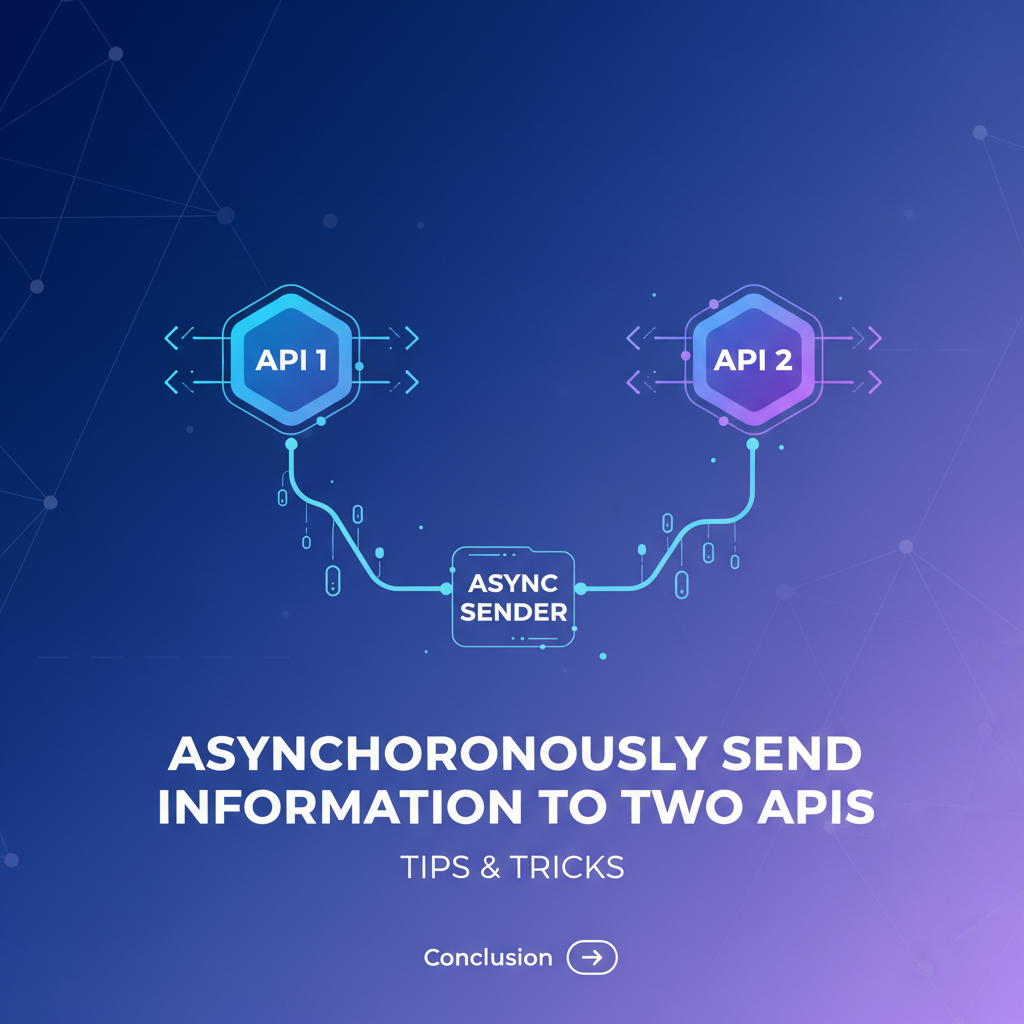
Asynchronously Send Information to Two APIs: Tips & Tricks


In the intricate tapestry of modern software development, where microservices reign supreme and cloud-native architectures are the norm, applications rarely operate in isolation. Instead, they constantly interact with a myriad of external services and internal components through Application Programming Interfaces (APIs). The ability to seamlessly and efficiently exchange data across these digital interfaces is not merely a convenience; it is a fundamental requirement for building robust, responsive, and scalable systems. As organizations strive to deliver increasingly sophisticated functionalities, often this necessitates sending crucial information to not just one, but sometimes two, three, or even more distinct APIs concurrently or in rapid succession. This seemingly straightforward task, however, can introduce significant complexities, particularly when reliability, performance, and user experience are paramount.
The traditional approach of making sequential, synchronous API calls can quickly become a bottleneck. Imagine a scenario where a single user action, such as submitting an order on an e-commerce platform, triggers an update to an inventory management system and simultaneously sends a notification to a shipping logistics provider. If these calls are made synchronously, the user's request might remain pending for the cumulative duration of both API calls, plus any network latency or processing delays incurred by the remote services. This can lead to frustratingly slow response times, perceived system sluggishness, and ultimately, a subpar user experience. Moreover, a failure in one of these sequential calls could halt the entire process, leaving the system in an inconsistent state or failing to complete critical operations.
This is precisely where the power of asynchronous communication patterns comes into play. By embracing asynchrony, developers can design systems that offload non-blocking operations, allowing the primary application thread to remain free and responsive while data is dispatched to external APIs in the background. This paradigm shift not only dramatically improves performance and user responsiveness but also fundamentally enhances the resilience and scalability of the entire system. When the requirement specifically involves sending information to two distinct APIs, adopting an asynchronous strategy becomes not just advantageous, but often an absolute necessity to navigate the inherent challenges of distributed systems effectively. This comprehensive guide will delve deep into the principles, strategies, and best practices for mastering the art of asynchronously sending information to two APIs, equipping you with the knowledge to build more efficient, robust, and user-friendly applications. We will explore various architectural approaches, consider critical implementation details, and highlight the pivotal role that tools like an APIPark can play in streamlining this complex task.
Understanding Asynchronous Communication
Before we delve into the intricacies of sending data to multiple APIs, it's crucial to firmly grasp the foundational concepts of asynchronous communication. This understanding forms the bedrock upon which efficient and resilient multi-API interactions are built.
What is Asynchronous Communication?
At its core, asynchronous communication refers to a non-blocking mode of operation where a task is initiated, and the initiating entity does not wait for that task to complete before moving on to other operations. Instead, it proceeds with other work and is notified or "called back" once the initiated task has finished. This contrasts sharply with synchronous communication, where an operation blocks the initiating entity until it has fully completed and returned a result.
Consider a simple analogy: imagine you're at a coffee shop. In a synchronous world, you'd order your coffee, and then stand perfectly still, unable to do anything else (like check your phone, read a newspaper, or even blink) until your coffee is handed to you. Only then can you move on. In an asynchronous world, you order your coffee, perhaps receive a number or a pager, and then you're free to find a seat, chat with a friend, or browse your phone. When your coffee is ready, you're alerted, and you go pick it up. The key difference is that your "main thread" of activity (your personal experience at the coffee shop) was not blocked waiting for the coffee to be made.
In the context of software and APIs, this means that when your application makes an asynchronous call to an external api, it doesn't pause its execution and wait for the response. Instead, it registers a callback or a promise, continues processing other tasks, and when the api call eventually completes (either successfully or with an error), the registered callback or promise handler is invoked. This non-blocking nature is the cornerstone of building responsive and performant applications.
Why Asynchronous for APIs?
The benefits of adopting asynchronous communication patterns, particularly when interacting with external APIs, are manifold and profoundly impact the performance, scalability, and overall user experience of an application.
Improved User Experience and Responsiveness
One of the most immediate and tangible benefits of asynchronous api calls is the enhancement of the user experience. In a web or mobile application, synchronous api calls can lead to a "frozen" UI, where the user cannot interact with the application until a background operation completes. This is frustrating and often perceived as a bug or poor performance. By making api calls asynchronously, the user interface remains responsive, allowing users to continue interacting with the application while data is fetched or submitted in the background. For instance, a user submitting a form might receive an immediate "processing your request" message, rather than a spinner that blocks the entire page, while the backend dispatches data to various external services.
Enhanced Performance and Throughput
Asynchronous operations enable a system to perform multiple tasks concurrently without the need for multiple heavy operating system threads in many modern runtime environments (like Node.js's event loop model). When an application makes a blocking I/O call (such as a network request to an api), it essentially sits idle, waiting for data to arrive. In a synchronous model, this idle time means wasted computational resources. Asynchronous api calls, however, allow the system to initiate an api request and then immediately switch to processing other pending requests or tasks while waiting for the api response. This significantly increases the application's overall throughput, enabling it to handle a greater number of concurrent requests efficiently. For applications heavily reliant on external service integrations, this translates directly into better resource utilization and faster overall processing.
Increased Scalability
The ability to handle more requests and process tasks concurrently without getting bogged down by waiting for I/O operations inherently makes a system more scalable. Asynchronous architectures are often a prerequisite for building highly scalable microservices that can respond to fluctuating loads. When a service doesn't block on api calls, it can process more requests per unit of computational resource, meaning it can scale horizontally (by adding more instances) more effectively to meet growing demand. This is particularly crucial for applications that experience peak loads or need to interact with apis that might have varying response times.
Greater Resilience and Fault Tolerance
Decoupling the initiation of a task from its completion also fosters greater resilience. When your application makes an api call asynchronously, it can implement sophisticated retry mechanisms, circuit breakers, and dead-letter queues more effectively without holding up the primary request path. If a dependent api is temporarily unavailable or slow, the asynchronous process can attempt retries in the background without causing the user's primary interaction to fail outright. This allows for graceful degradation or eventual consistency, ensuring that critical operations eventually succeed even if external dependencies experience transient issues. Moreover, by isolating these operations, a failure in one api call does not necessarily cascade and bring down the entire application or subsequent operations. This separation of concerns helps in maintaining system stability and reliability even in the face of external service disruptions.
In summary, asynchronous communication for APIs is not just an optimization; it's a paradigm shift that enables developers to build modern, responsive, scalable, and resilient applications that can confidently navigate the complexities of a distributed environment where interactions with external services are the norm rather than the exception.
Core Concepts and Technologies for Asynchronous API Calls
Implementing asynchronous api calls, especially when targeting multiple external services, relies on several fundamental concepts and technological approaches. Understanding these building blocks is crucial for choosing the most appropriate strategy for your specific use case.
Threads and Processes
Historically, concurrency in computing was primarily achieved through threads and processes. * Processes: An independent execution environment with its own memory space. Communicating between processes typically requires inter-process communication (IPC) mechanisms, which can be resource-intensive. * Threads: Lighter-weight units of execution within a single process, sharing the same memory space. This makes data sharing easier but also introduces challenges like race conditions and deadlocks, necessitating careful synchronization mechanisms (locks, mutexes).
In the context of api calls, a common pattern in multi-threaded languages (like Java, C#, Go) is to dedicate a separate thread to make an api call. While the api call is blocking for that specific thread, the main application thread can continue its work. This provides a form of concurrency. However, managing a large number of threads can introduce significant overhead (memory consumption, context switching) and complexity. Furthermore, in many modern web applications, particularly those built with JavaScript (Node.js) or Python's asyncio, explicit thread management for I/O is often abstracted away or handled differently.
Event Loops (Node.js, Python Asyncio)
Many contemporary programming environments, especially those optimized for I/O-bound tasks like web servers, leverage an "event loop" model. * Concept: A single-threaded process that continuously monitors for events (like an incoming api request, a completed database query, or a resolved external api call). When an event occurs, it dispatches it to a corresponding handler function. * Non-Blocking I/O: Crucially, when an api call is made, the event loop doesn't block. Instead, it registers the api request with the underlying operating system and continues processing other events. When the api response arrives, the OS notifies the event loop, which then schedules the appropriate callback function to run. * Benefits: This model allows a single thread to manage a vast number of concurrent I/O operations very efficiently, without the overhead of context switching between many threads. It's particularly well-suited for api-intensive applications. Node.js is a prime example, where asynchronous api calls are fundamental to its performance model. Python's asyncio library provides similar capabilities for asynchronous programming.
Message Queues (RabbitMQ, Kafka, SQS, Azure Service Bus, Google Cloud Pub/Sub)
For scenarios requiring high reliability, strong decoupling, and robust error handling when communicating with multiple apis, message queues are an indispensable tool. * Mechanism: An application (the "producer") publishes messages (representing events or data to be processed) to a queue. Other applications or services (the "consumers" or "workers") subscribe to this queue and retrieve messages for processing. * Decoupling: The producer does not need to know anything about the consumers, nor does it wait for the consumers to process the message. It simply places the message on the queue and moves on. This significantly decouples services. * Reliability: Messages can be persisted on the queue, ensuring that they are not lost even if consumers fail. Most queues offer "at-least-once" delivery guarantees and can be configured for retries. * Load Balancing: Multiple consumers can process messages from the same queue in parallel, effectively distributing the workload and enabling horizontal scaling. * Use Cases: Ideal for background processing, long-running tasks, distributing tasks to multiple services (fan-out), and ensuring eventual consistency across different systems or apis. If you need to send information to two apis, you might publish one message, and two separate consumers pick it up, each calling one of the target apis, or a single consumer processes the message and then calls both apis asynchronously.
Background Jobs/Workers (Celery, Sidekiq, AWS Lambda)
Closely related to message queues are background job processing systems. * Concept: These systems allow an application to offload computationally intensive, long-running, or non-critical tasks to dedicated worker processes. The main application thread places a job into a queue (often backed by a message queue), and a worker picks up that job later to execute it in the background. * Examples: Celery (Python), Sidekiq (Ruby), AWS Lambda (serverless functions), Azure Functions, Google Cloud Functions. * Benefits: Prevents the main application from being blocked, improves user experience, allows for retries and error handling for background tasks, and enables scheduled tasks. When sending information to two apis, a common pattern is to create a background job that encapsulates the logic for calling both apis asynchronously, handling any failures, and ensuring eventual success. This keeps the primary user-facing request path lean and fast.
Webhooks
Webhooks represent a paradigm shift in api communication, moving from a polling model to an event-driven "push" model. * Concept: Instead of constantly polling an api to check for updates, your system provides a callback URL to another service. When a specific event occurs in that service, it makes an HTTP POST request to your provided URL, essentially "web-hooking" your system with information. * "Reverse APIs": Webhooks are often described as "user-defined HTTP callbacks" or "reverse APIs," where the data provider calls the consumer, rather than the consumer polling the provider. * Challenges: Implementing robust webhook receivers requires careful attention to security (validating the source of the webhook), idempotency (handling duplicate deliveries), and reliability (ensuring your endpoint is always available). * Use Cases: While not directly used to send information to two APIs from your perspective, webhooks can be the trigger for such an action. For example, a webhook indicating a new payment might trigger your system to asynchronously update both your CRM api and an accounting api.
Promises/Futures/Observables
These are programming constructs designed to manage asynchronous operations within application code, making it easier to write, read, and maintain asynchronous logic. * Promises (JavaScript, Python asyncio): Represent the eventual completion (or failure) of an asynchronous operation and its resulting value. They allow you to chain asynchronous operations, handle errors centrally, and compose complex asynchronous workflows. Promise.all in JavaScript is a prime example of how promises can be used to wait for multiple asynchronous api calls to complete in parallel. * Futures (Java CompletableFuture, C++ std::future): Similar to promises, futures provide a way to access the result of an asynchronous computation once it's available. They facilitate non-blocking computations. * Observables (Reactive Programming - RxJS, RxJava): Offer a more powerful paradigm for handling streams of asynchronous events. They provide rich operators for transforming, filtering, and combining asynchronous data streams, making them suitable for complex event-driven architectures where multiple api calls might be part of a continuous flow of data.
In combining these core concepts, developers gain a rich toolkit for orchestrating complex asynchronous interactions. For instance, an api gateway might use an event loop internally to handle concurrent api requests, while a message queue dispatches jobs to workers that, in turn, use promises to manage multiple api calls. This layered approach ensures that systems remain performant, resilient, and manageable.
Scenarios Requiring Asynchronous Calls to Two APIs
The necessity to asynchronously send information to two distinct APIs arises in a multitude of real-world application scenarios. These situations typically involve operations that are either non-critical to the immediate user response, require strong decoupling, or benefit significantly from parallel execution to maintain system performance and consistency. Understanding these common use cases helps in identifying when an asynchronous multi-API strategy is the most appropriate architectural choice.
Data Replication and Synchronization
One of the most prevalent scenarios involves ensuring data consistency or duplication across disparate systems. Modern enterprises often rely on a patchwork of specialized applications, each managing a subset of critical business data. * Example: When a customer's profile is updated in a primary Customer Relationship Management (CRM) system, it might also need to be synchronized with an email marketing platform api to update their contact preferences and with a business intelligence (BI) api to refresh analytics dashboards. Performing these updates synchronously could significantly delay the CRM's response, especially if one of the external systems is slow. Asynchronous calls ensure the CRM remains responsive while the updates propagate to other systems in the background. If one api call fails, the primary system isn't blocked, and robust retry mechanisms can be put in place for the failed synchronization. * Another Instance: In an IoT platform, sensor data might be ingested into a real-time analytics database api, but also simultaneously archived to a long-term cold storage api. The real-time ingestion needs to be fast and non-blocking, making asynchronous calls to both destinations ideal.
Event Notification & Logging
Many business processes generate events that need to trigger multiple downstream actions or be recorded in various systems for auditing and analysis. * Example: When a new user registers on a platform, this event needs to trigger several actions: sending a welcome email via a third-party email service api (e.g., SendGrid, Mailgun) and creating an entry in an internal audit logging system api. Neither of these operations is critical to the immediate success of the user registration itself (the user is registered regardless of whether the email or log succeeds instantly), making them perfect candidates for asynchronous execution. The primary registration process can complete quickly, providing immediate feedback to the user, while the email dispatch and logging happen reliably in the background. * Security Context: A suspicious activity detection might need to alert a security operations center (SOC) api and simultaneously update a fraud detection system api. The immediacy of the detection and the need for prompt action make asynchronous notification a robust choice, ensuring that neither notification delays the other or the detection system's core function.
Enrichment & Transformation
Complex workflows often involve fetching data from one source, processing or enriching it, and then sending the augmented data to another destination. While not strictly "sending to two APIs" at the same time in the initial request, these chained asynchronous operations frequently involve multiple distinct api calls. * Example: A user uploads a document to a cloud storage service. Your application's backend could asynchronously trigger a text extraction api on the document, and once the text is extracted, it might then asynchronously send this text to a sentiment analysis api. The results of the sentiment analysis could then be pushed to an analytics api. Although sequential, the entire chain is asynchronous relative to the user's initial upload, ensuring a responsive user experience. * Geospatial Data: A platform that tracks assets might receive raw GPS coordinates. An asynchronous process could first call a reverse geocoding api to convert coordinates to human-readable addresses, and then, with the enriched location data, update an asset tracking database api and perhaps a mapping visualization api. This pattern allows the initial ingestion of raw data to be very fast, with enrichment happening in the background.
Fan-out Pattern
The fan-out pattern describes a situation where a single event triggers multiple independent downstream actions or notifications. This is a classic use case for asynchronous multi-API interactions, often facilitated by message queues or api gateways. * Example: When an e-commerce order is successfully placed, this single event could fan out to multiple apis: 1. An inventory management system api to decrement stock levels. 2. A payment gateway api for final authorization and charge. 3. A shipping logistics api to initiate the delivery process. 4. An analytics api to record the transaction for business intelligence. 5. A customer notification api to send an order confirmation. * Making all these calls synchronously would be incredibly slow and fragile. Asynchronous processing allows all these independent actions to be initiated concurrently, improving overall system responsiveness and fault tolerance. If the shipping api is temporarily down, it doesn't prevent the inventory update or payment processing from proceeding. The system can implement retries for the shipping api call, ensuring eventual consistency without holding up the entire order placement process. This pattern is fundamental for event-driven architectures and microservices.
In each of these scenarios, the underlying motivation for choosing an asynchronous approach to interact with two or more apis remains consistent: to enhance performance, improve user experience, increase system resilience, and facilitate greater scalability by decoupling operations and processing them independently in the background. The choice of specific technologies and strategies will depend on the exact requirements for reliability, latency, and complexity tolerance.
Strategies for Asynchronously Sending Information to Two APIs
When it comes to sending information to two distinct APIs asynchronously, several architectural strategies can be employed, each with its own set of advantages, disadvantages, and ideal use cases. The selection of the most appropriate strategy depends on factors such as the criticality of the operation, required reliability, desired latency, system complexity, and existing infrastructure.
Client-Side Asynchronous Calls
This is arguably the simplest approach, where the client application (e.g., a web browser, mobile app) directly initiates two separate, parallel api calls to different endpoints.
- Description: After a user action (e.g., clicking a button), the client-side JavaScript or mobile application code sends two distinct HTTP requests to two different
apiendpoints. Modern browser APIs likefetchor libraries like Axios make it straightforward to initiate these requests in parallel. The client can then use constructs likePromise.all(in JavaScript) to wait for both responses or handle them independently as they arrive. - Pros:
- Immediate Feedback: The client can update its UI very quickly, potentially even before both API calls have fully resolved.
- Simplicity for Non-Critical Updates: For simple logging or analytics
apicalls that aren't critical to the core user flow, this can be a quick and easy solution to implement. - Reduced Server Load: Your backend doesn't have to orchestrate these calls, offloading some work to the client.
- Cons:
- Dependency on Client Network: Reliability is entirely dependent on the user's network connection. If the client loses connectivity, the
apicalls might fail without any server-side retry mechanism. - Security Risks: Exposing
apikeys or sensitive logic directly in client-side code is generally a poor security practice, making this unsuitable for secure, critical operations. - No Guaranteed Delivery: There's no inherent mechanism for retries or guaranteed delivery if one of the client-initiated calls fails.
- CORS Issues: Cross-Origin Resource Sharing (CORS) policies can complicate direct client-to-API communication if the
apis are hosted on different domains and not configured to allow cross-origin requests from your client.
- Dependency on Client Network: Reliability is entirely dependent on the user's network connection. If the client loses connectivity, the
- Use Cases: Non-sensitive client-side analytics tracking, logging non-critical user interactions, or updating user preferences where occasional failure is acceptable and doesn't impact core functionality.
Example (JavaScript Fetch API): ```javascript async function sendDataToTwoApisClientSide(data) { const apiAUrl = 'https://api.example.com/serviceA/data'; const apiBUrl = 'https://api.another-example.com/serviceB/logs';
try {
    const [responseA, responseB] = await Promise.all([
        fetch(apiAUrl, {
            method: 'POST',
            headers: { 'Content-Type': 'application/json' },
            body: JSON.stringify(data.forApiA)
        }),
        fetch(apiBUrl, {
            method: 'POST',
            headers: { 'Content-Type': 'application/json' },
            body: JSON.stringify(data.forApiB)
        })
    ]);

    if (!responseA.ok) console.error('API A failed:', await responseA.text());
    if (!responseB.ok) console.error('API B failed:', await responseB.text());

    console.log('API A status:', responseA.status);
    console.log('API B status:', responseB.status);
    // Process successful responses or handle specific errors
} catch (error) {
    console.error('An error occurred during API calls:', error);
}
} ```
Server-Side Asynchronous Calls (Application Layer)
This is a more robust and commonly used approach where your backend application initiates the two api calls asynchronously. The application itself handles the concurrency.
- Description: Your server-side application receives a request (e.g., from a client). Instead of waiting for the external
apicalls to complete sequentially, it leverages language-specific asynchronous programming constructs (likeasync/await,CompletableFuture, goroutines) to make bothapicalls in parallel. The main request handler can then either wait for both to complete before responding to the client or respond immediately while theapicalls continue in the background. - Pros:
- Centralized Control and Security: All
apikeys and sensitive logic remain on the server. - Robust Error Handling and Retries: Your server can implement sophisticated retry logic (e.g., exponential backoff), circuit breakers, and logging for failures.
- Guaranteed Delivery (Server-Side): If the server successfully initiates the call, it can manage retries, ensuring eventual delivery better than a client.
- Decoupling from Client Network: The server handles
apicommunication independently of the client's network conditions.
- Centralized Control and Security: All
- Cons:
- Can Still Block Main Request: If the server-side code waits for both
apicalls to complete before responding to the client, the client still experiences cumulative latency. If the calls are truly backgrounded (fire-and-forget), then this isn't an issue for the client's immediate response. - Complexity of Concurrency: Managing concurrent operations, shared resources, and error propagation can be complex.
- Resource Consumption: While generally efficient, an excessive number of concurrent outgoing
apicalls from a single server instance can consume network connections and memory.
- Can Still Block Main Request: If the server-side code waits for both
- Implementation:
- Python (
asyncio): Useasync/awaitwithaiohttpandasyncio.gather. - Node.js (
async/await): Useaxiosornode-fetchwithPromise.all. - Java (
CompletableFuture): UseHttpClientwithCompletableFuture.allOf. - Go (Goroutines): Use goroutines and channels to concurrently make HTTP requests.
- Python (
Example (Node.js async/await): ```javascript const axios = require('axios');async function sendDataToTwoApisServerSide(data) { const apiAUrl = 'https://backend.example.com/serviceA/update'; const apiBUrl = 'https://backend.another-example.com/serviceB/notify';
// Assuming data.forApiA and data.forApiB are prepared payloads
const payloadA = data.forApiA;
const payloadB = data.forApiB;

try {
    // Initiate both API calls in parallel
    const [responseA, responseB] = await Promise.all([
        axios.post(apiAUrl, payloadA, {
            headers: { 'Authorization': `Bearer ${process.env.API_A_TOKEN}` }
        }),
        axios.post(apiBUrl, payloadB, {
            headers: { 'X-Api-Key': process.env.API_B_KEY }
        })
    ]);

    console.log('API A successful:', responseA.data);
    console.log('API B successful:', responseB.data);
    return { success: true, message: 'Both APIs processed' };
} catch (error) {
    console.error('Error sending data to APIs:', error.message);
    // Implement robust error handling, logging, and retry mechanisms here
    if (error.response) {
        console.error('API Response Error:', error.response.status, error.response.data);
    }
    // Decide whether to return partial success, full failure, or trigger a retry
    return { success: false, message: 'One or more API calls failed' };
}
}// Example of usage within an Express route, responding immediately // app.post('/process-something', async (req, res) => { // // Send a quick acknowledgment to the client // res.status(202).send({ message: 'Request received, processing in background.' });// // Then, asynchronously initiate the API calls without waiting for them to complete // sendDataToTwoApisServerSide(req.body) // .then(result => console.log('Background processing result:', result)) // .catch(err => console.error('Background processing error:', err)); // }); ```
Using a Message Queue/Broker
For high-volume, mission-critical, or inherently asynchronous operations, a message queue (e.g., RabbitMQ, Kafka, AWS SQS) provides the highest degree of decoupling and reliability.
- Description: When an event occurs in your application that requires interaction with two external APIs, your application (the "producer") publishes a message detailing this event to a message queue. This message contains all necessary data for the
apicalls. Crucially, the producer does not wait for the message to be processed; it simply puts it on the queue and considers its immediate task complete. Separately, "worker" services (the "consumers") constantly monitor this queue. When a worker retrieves the message, it then proceeds to make the asynchronous calls to the two target APIs. You could have one worker processing a message and making two parallel API calls, or even two distinct types of workers, each responsible for calling one specific API. - Pros:
- Maximum Decoupling: The producer is completely unaware of how or when the message is processed. This enhances modularity and reduces inter-service dependencies.
- High Reliability and Persistence: Messages are typically stored on the queue until successfully processed, ensuring no data loss even if consumers fail. Built-in retry mechanisms, dead-letter queues (DLQs), and acknowledgments guarantee eventual processing.
- Scalability: Easily scale consumers independently based on message volume. Add more workers to increase processing throughput.
- Load Balancing: The queue naturally distributes messages among available workers.
- Error Isolation: A failure in one
apicall by a worker won't directly affect the primary application or other workers. - Backpressure Handling: Queues can buffer messages during spikes, preventing downstream services from being overwhelmed.
- Cons:
- Increased Complexity: Introduces another layer of infrastructure, requiring setup, monitoring, and management of the message queue itself.
- Operational Overhead: Managing a message queue can be complex, especially in a distributed environment, requiring expertise in queue configuration, scaling, and troubleshooting.
- Eventual Consistency: Since processing is asynchronous, there's a delay between the message being published and the
apicalls being completed. This means the system achieves "eventual consistency" rather than immediate consistency.
- Architecture:
- Application: Receives user request, publishes message to Message Queue, responds to user.
- Message Queue: Stores the message reliably.
- Worker 1 (Consumer): Picks up message, calls API A.
- Worker 2 (Consumer): Picks up message, calls API B (or Worker 1 calls both API A and B).
- Use Cases: E-commerce order processing, real-time data pipelines, complex event-driven architectures, user activity logging, bulk data processing, and any scenario where high reliability and decoupling are critical.
Leveraging an API Gateway for Fan-out
An API Gateway sits in front of your backend services and acts as a single entry point for all API requests. Many modern api gateways can perform intelligent routing, transformation, and even fan-out patterns.
- Description: In this strategy, your client application or an upstream service sends a single request to the
api gateway. The gateway is then configured to receive this request, potentially transform its payload, and subsequently fan out the request to two or more internal or external APIs. Theapi gatewaycan orchestrate these calls in parallel and either aggregate the responses before sending a single response back to the client or handle them asynchronously in the background. - Pros:
- Centralized Control: Consolidates authentication, authorization, rate limiting, logging, and monitoring at a single point.
- Simplified Client: Clients only need to know about one
api gatewayendpoint, abstracting away the complexity of multiple backendapis. - Abstraction and Decoupling: Hides the underlying microservice architecture or external
apiintegrations from the client. - Performance: Gateways are often highly optimized for performance and can execute fan-out calls efficiently in parallel.
- Policy Enforcement: Apply consistent security and traffic management policies across all
apicalls. - Payload Transformation: Many gateways allow for request/response transformation, which is crucial if the two target
apis expect different data formats from your originating request.
- Cons:
- Single Point of Failure (if not highly available): The gateway itself becomes a critical component; if it goes down, all
apitraffic is affected. Requires robust deployment and scaling. - Adds Latency: There's an overhead for the request to pass through the gateway.
- Vendor Lock-in/Complexity: Depends on the capabilities and configuration complexity of the chosen
api gateway.
- Single Point of Failure (if not highly available): The gateway itself becomes a critical component; if it goes down, all
- Mentioning APIPark: This is a perfect context to introduce APIPark. As an open-source AI gateway and API management platform, APIPark is specifically designed to manage, integrate, and deploy various AI and REST services. When you're faced with the challenge of sending information to two different APIs, especially if one or both might be AI models or require specific prompt encapsulation, APIPark can serve as a powerful orchestrator.
- It can simplify the integration by providing a unified API format for AI invocation, meaning even if your two target APIs are drastically different in their expected inputs (e.g., one a traditional REST API, the other an AI model requiring a specific prompt structure), APIPark can normalize the requests.
- The Prompt Encapsulation into REST API feature allows you to define a single API endpoint in APIPark that, when invoked, translates your request into the appropriate prompts or parameters for an AI model (or even a sequence of models), and then possibly sends the results to another API. This effectively creates a composite
apithat handles the complexity of multiple downstream calls. - Furthermore, APIPark's End-to-End API Lifecycle Management and API Service Sharing within Teams features make it an invaluable tool for enterprises. It helps regulate API management processes, manage traffic forwarding, load balancing, and versioning for these composite APIs. Its Detailed API Call Logging and Powerful Data Analysis capabilities are crucial for monitoring the success rates and performance of these multi-API interactions, allowing you to quickly trace and troubleshoot issues.
- Imagine a scenario where a user provides a text input. APIPark could be configured to receive this input, send it to a sentiment analysis AI model (which it integrates), then take the sentiment score and send it to an analytics database
api. All this orchestration is managed by the gateway, invisible to the client, ensuring performance, security, and traceability.
- Keywords:
api gateway,api.
Service Mesh Sidecar Pattern
Primarily used in microservices architectures, a service mesh (e.g., Istio, Linkerd) deploys a "sidecar" proxy alongside each service instance.
- Description: The sidecar intercepts all incoming and outgoing network traffic for its associated service. While primarily focused on observability, traffic management, and security between microservices, it can also be configured to implement patterns like fan-out for external
apicalls or inject asynchronous behavior. - Pros:
- Service-level Observability: Provides deep insights into inter-service communication (metrics, logs, traces).
- Policy Enforcement: Apply network policies (retries, timeouts, circuit breakers) automatically to outgoing requests.
- Language Agnostic: The sidecar handles network concerns, so services can be written in any language.
- Cons:
- High Complexity: Adds significant operational complexity to your infrastructure, generally only justified for large-scale microservices deployments.
- Overhead: Each service instance gets its own proxy, consuming resources.
- Use Cases: Highly distributed microservices where fine-grained control over network traffic and consistent policy enforcement for external
apicalls is required.
Serverless Functions (AWS Lambda, Azure Functions, Google Cloud Functions)
Serverless computing platforms provide a powerful, event-driven way to execute code without managing servers, making them excellent for asynchronous multi-API interactions.
- Description: An event (e.g., an HTTP request, a message on a queue, a file upload) triggers a serverless function. This function then contains the logic to asynchronously call two (or more) external APIs. The function execution environment takes care of scaling and infrastructure management.
- Pros:
- Highly Scalable: Automatically scales to handle bursts of traffic without manual intervention.
- Cost-Effective: You only pay for the compute time consumed by your function when it runs, making it very economical for sporadic or event-driven workloads.
- No Server Management: Reduces operational overhead significantly.
- Integration with Cloud Ecosystems: Seamlessly integrates with other cloud services (queues, databases, storage,
api gateways).
- Cons:
- Cold Starts: Initial invocations after a period of inactivity can experience higher latency ("cold start" penalty).
- Vendor Lock-in: Tightly coupled to the specific cloud provider's ecosystem.
- Debugging and Local Development: Can be more challenging than traditional applications.
- Execution Limits: Functions often have memory, CPU, and time limits, which might restrict very long-running or resource-intensive tasks.
- Use Cases: Event-driven processing (e.g., triggered by new data in a database or a file upload), webhook receivers, backend for mobile apps, light
apiorchestrations, and offloading background tasks that interact with multiple externalapis. A common pattern is for an HTTP request to hit anapi gateway, which then triggers a Lambda function, and that function makes the two asynchronousapicalls.
Each of these strategies offers a unique blend of benefits and trade-offs. The choice will heavily depend on your specific system architecture, reliability requirements, performance targets, and existing operational capabilities. Often, a combination of these strategies (e.g., an api gateway triggering a message queue, which then dispatches to serverless functions) is employed in complex, highly distributed systems.
APIPark is a high-performance AI gateway that allows you to securely access the most comprehensive LLM APIs globally on the APIPark platform, including OpenAI, Anthropic, Mistral, Llama2, Google Gemini, and more.Try APIPark now! 👇👇👇
Detailed Implementation Considerations & Best Practices
Beyond choosing an architectural strategy, the successful implementation of asynchronously sending information to two APIs hinges on a meticulous attention to detail and adherence to best practices. Overlooking these aspects can lead to fragile systems, data inconsistencies, and operational nightmares.
Error Handling and Retries
The asynchronous nature of multi-API communication inherently introduces a higher probability of partial failures and transient errors. Robust error handling is paramount.
- Idempotency: This is a crucial concept. An idempotent operation is one that can be applied multiple times without changing the result beyond the initial application. When retrying an
apicall, you must ensure that the targetapiis idempotent. For instance, if sending aPOSTrequest to create a resource, a retry might create a duplicate if theapiisn't idempotent. Using unique transaction IDs in request payloads and having theapicheck for duplicates on its end is a common strategy. If anapioperation is not idempotent (e.g., charging a credit card), retries must be handled with extreme care to avoid unintended side effects. - Exponential Backoff: When an
apicall fails due to transient network issues or rate limiting, immediately retrying often exacerbates the problem. Exponential backoff involves waiting for progressively longer periods between retries (e.g., 1 second, then 2, then 4, then 8, up to a maximum). This gives the remoteapior network a chance to recover. Add a small random jitter to the backoff period to prevent a "thundering herd" problem where many retries occur simultaneously. - Circuit Breakers: This pattern prevents your application from repeatedly making requests to a failing
api. If anapiconsistently fails or times out, the circuit breaker "trips," stopping further requests to thatapifor a defined period. After the timeout, it enters a "half-open" state, allowing a few test requests to see if theapihas recovered. This protects your application from being overloaded by waiting for non-responsive services and prevents the failingapifrom being hammered further. - Dead-Letter Queues (DLQs): When using message queues, a DLQ is a designated queue for messages that cannot be processed after a specified number of retries or due to invalid content. Messages in a DLQ can be inspected manually or automatically processed by a separate service for debugging, archiving, or manual intervention, ensuring no data is lost without investigation.
- Partial Failures and Compensation Logic: What happens if the call to
API Asucceeds, but the call toAPI Bfails?- Rollback/Compensation: For critical operations where atomicity is desired (both succeed or both fail), you might need to implement compensation logic. If
API Asucceeds butAPI Bfails, you might need to make a compensating call toAPI Ato undo its previous action. This is complex and often leads to distributed transaction challenges. - Eventual Consistency: More commonly, systems accept eventual consistency. If
API Asucceeds andAPI Bfails, you log the failure forAPI Band retry it independently. The system might be temporarily inconsistent, but eventually,API Bwill be updated. This requires careful design to handle the interim states and inform users appropriately. - Monitoring and Alerting: Ensure immediate alerts are triggered for partial failures, allowing operations teams to intervene if automatic retries are insufficient.
- Rollback/Compensation: For critical operations where atomicity is desired (both succeed or both fail), you might need to implement compensation logic. If
Observability (Monitoring, Logging, Tracing)
In distributed, asynchronous systems, understanding the flow of information and pinpointing failures is significantly harder. Robust observability practices are non-negotiable.
- Centralized Logging: Aggregate logs from all your services and external
apiinteractions into a central logging platform (e.g., ELK Stack, Splunk, Datadog). Ensure logs capture sufficient detail: request/response payloads (sanitized for sensitive data),apiendpoint URLs, HTTP status codes, latency, and correlation IDs. - Distributed Tracing: Implement distributed tracing (e.g., OpenTelemetry, Jaeger, Zipkin). Assign a unique
correlation IDortrace IDto each incoming request and propagate this ID through all subsequent internal service calls and externalapicalls. This allows you to visualize the entire path of a request, identify bottlenecks, and quickly pinpoint whichapicall failed or caused delays. - Metrics and Alerts: Monitor key performance indicators (KPIs) for each external
apicall: success rates, error rates (distinguishing between transient and permanent errors), average latency, and timeouts. Set up alerts for deviations from normal behavior (e.g., a sudden spike in 5xx errors from a specificapior unusually high latency). This proactive monitoring allows you to detect issues before they impact users.
Security
Interacting with external apis, especially asynchronously, introduces security considerations that must be carefully managed.
- Authentication & Authorization: Securely manage and transmit credentials (API keys, OAuth tokens, JWTs). Never hardcode credentials. Use environment variables, secure secret management systems (e.g., AWS Secrets Manager, HashiCorp Vault), or
api gatewayfeatures for injecting credentials securely. Ensure your calls are authorized with the minimum necessary privileges. - Data Encryption (TLS/SSL): Always use HTTPS (TLS/SSL) for all
apicommunications to protect data in transit from eavesdropping and tampering. - Input Validation: Thoroughly validate all data received from external
apis before processing it. Malicious or malformed data can lead to security vulnerabilities (e.g., injection attacks) or system instability. Similarly, sanitize data sent to externalapis. - Rate Limiting and Throttling: Implement rate limiting on your outgoing
apicalls to respect the limits of the targetapis and prevent your system from being blocked. Conversely, if your system exposes its ownapis, implement ingress rate limiting to protect against abuse.
Performance Optimization
While asynchronous calls inherently improve performance, further optimizations can be made.
- Connection Pooling: Reusing HTTP connections rather than establishing a new TCP handshake for every
apicall significantly reduces overhead and latency, especially for frequent calls to the same host. Most modern HTTP client libraries offer connection pooling. - Timeouts: Configure appropriate timeouts for each
apicall (connection timeout and read timeout). Indefinite waiting for a non-responsiveapican exhaust resources and lead to cascading failures. Timeouts work hand-in-hand with retry mechanisms. - Batching: If the target
apis support it, consider batching multiple logical operations into a singleapicall. For example, updating 10 inventory items in oneapirequest can be far more efficient than 10 individual requests. This reduces network overhead andapicall count. - Caching: For frequently accessed but slowly changing
apidata, implement caching. Cacheapiresponses on your side to reduce the number of external calls.
Concurrency Management
Managing the number of concurrent api calls is vital to prevent resource exhaustion and respect external service limits.
- Resource Limits: Configure maximum concurrent
apicalls your application can make. Exceeding operating system limits for open file descriptors or network connections can destabilize your service. - Throttling/Rate Limiting: Implement client-side throttling to ensure your service does not exceed the rate limits imposed by the external
apis. When anapireturns a 429 Too Many Requests status code, your client should back off and retry later.
Idempotency and Consistency
Ensuring data integrity across multiple systems when operations are asynchronous and potentially retried is complex.
- Guaranteed Uniqueness: When an action needs to be applied only once (e.g., processing a payment), use a unique transaction ID or
idempotency keygenerated by your system. This key should be sent with theapirequest, and the targetapishould use it to detect and ignore duplicate requests. - Eventual Consistency Mechanisms: For scenarios where immediate consistency across all systems is not strictly required, design for eventual consistency. This involves ensuring that all systems will eventually reach a consistent state, even if there's a temporary lag. Message queues with retries and DLQs are ideal for this.
- Reconciliation: In systems that must be eventually consistent, implement reconciliation processes. These are background jobs that periodically check the state of different systems and correct any discrepancies that may have arisen from partial failures.
Payload Transformation and Mapping
External APIs often have different data schemas and formats. Your system needs to efficiently handle these transformations.
- Data Mapping Layers: Implement clear data mapping layers within your code or configuration to transform your internal data structures into the formats expected by
API AandAPI B. This keeps your core business logic clean and isolated from externalapispecifics. - API Gateway for Transformation: An APIPark or similar
api gatewaycan be invaluable here. Its ability to perform Unified API Format for AI Invocation and Prompt Encapsulation into REST API isn't just for AI models; it demonstrates the capability to standardize and transform requests. You can configure the gateway to receive a single incoming payload and transform it into two distinct payloads, each tailored forAPI AandAPI B, before fanning them out. This centralizes the transformation logic, making it easier to manage changes to externalapischemas without modifying your core application code.
Testing Strategies
Asynchronous and distributed systems are notoriously difficult to test comprehensively.
- Unit Tests: Test your asynchronous logic components in isolation, mocking external
apicalls. Verify that promises, futures, or callbacks are handled correctly. - Integration Tests: Test the interaction between your service and the external
apis. Use test doubles (mocks or stubs) for the externalapis to simulate various responses, including success, failure, timeouts, and edge cases. - End-to-End Tests: Conduct full system tests involving your application, the
api gateway(if used), message queues (if used), and potentially real externalapis (in a staging environment). - Chaos Engineering: Introduce controlled failures into your system (e.g., simulating
apitimeouts, network latency, service outages) to test the resilience of your asynchronous multi-apicommunication. This helps uncover unexpected failure modes.
By meticulously addressing these implementation considerations and integrating these best practices, you can build asynchronous multi-api communication patterns that are not only performant and scalable but also robust, secure, and maintainable in the face of the inherent complexities of distributed systems.
Case Study: Processing an E-commerce Order
Let's consider a common e-commerce scenario that perfectly illustrates the need for asynchronously sending information to two APIs: the finalization of a customer order. When a customer successfully places an order, several critical backend operations must occur, two of which are often independent but essential: updating inventory and notifying the shipping provider.
Scenario: A customer clicks "Place Order" on an e-commerce website. Core Actions Required: 1. Update Inventory API: Decrement the stock count for each ordered item in the inventory management system. This is crucial to prevent overselling. 2. Notify Shipping API: Send the order details (customer address, items, shipping method) to a third-party shipping logistics api to initiate package processing.
Challenges if Synchronous: If these two operations were performed synchronously, the user would wait for both the inventory update and the shipping notification to complete before receiving an "Order Placed" confirmation. * If the inventory api is slow, the user waits. * If the shipping api is slow, the user waits. * If either api fails, the entire order placement fails, requiring a complex rollback or retry mechanism, and frustrating the customer.
Asynchronous Approaches: By implementing asynchronous communication, the initial "Place Order" request can return almost immediately, giving the user a quick confirmation, while the inventory and shipping updates happen reliably in the background. Below, we compare three strategies for this scenario:
| Feature / Approach | Server-Side Application Layer Async | Message Queue (e.g., RabbitMQ, SQS) | API Gateway (e.g., APIPark) |
|---|---|---|---|
| Description | E-commerce backend makes parallel async calls to Inventory API and Shipping API. |
E-commerce backend publishes "Order Placed" message to queue; separate workers process and call respective APIs. | E-commerce backend calls API Gateway with order details; Gateway configured to fan out to Inventory API and Shipping API. |
| Complexity | Moderate: Requires async/await patterns in application code, manual retry logic. |
High: Requires setup, management, and monitoring of a message broker; worker services deployment and scaling. | Moderate (Configuration): Initial gateway setup and configuration, but simpler application code. |
| Reliability | Good (with retries): If async calls fail, app needs to implement custom retry and error handling. |
Excellent (persistent queues): Messages are durable, guaranteeing delivery; dead-letter queues for failures. | Good (depends on gateway): Gateway handles retries and status reporting; its own reliability is key. |
| Decoupling | Moderate: Application still directly initiates calls to both APIs. | High: Producer (e-commerce backend) is completely decoupled from consumers (workers calling APIs). | Moderate: Client (e-commerce backend) is decoupled from direct API calls, but dependent on gateway configuration. |
| Scalability | Good (with app scaling): Application scales, and its concurrent async calls scale with it. |
Excellent (queue & workers): Queue handles high volume; workers scale independently based on message load. | Good (gateway scaling): Gateway scales horizontally to handle increased traffic and fan-out operations. |
| Operational Overhead | Low-Moderate: Managed within the existing application deployment. | High: Requires managing and monitoring an additional distributed system (the message queue). | Low-Moderate: Gateway configuration and monitoring are central; potentially less app-specific dev-ops. |
| Real-time Feedback | Yes (if desired): Can respond to user after both async calls complete, or fire-and-forget. |
Delayed: User gets immediate "Order Placed" but API updates happen in background, eventual consistency. | Yes (if desired): Gateway can aggregate responses for immediate client feedback, or respond quickly and process async. |
| Best For | Medium traffic, direct control over business logic, existing async capabilities. |
High volume, mission-critical operations, strong fault tolerance, eventual consistency. | Centralized API management, hiding complexity, consistent policies, and potentially diverse backend APIs. |
| APIPark Relevance | N/A | N/A | High: APIPark can receive the "Place Order" request, perform payload transformations (if needed for inventory/shipping APIs), and then fan out the request to the Inventory Management API and the Shipping Logistics API. It provides centralized logging, security, and performance metrics for these critical backend interactions. The End-to-End API Lifecycle Management would apply to how these order processing flows are designed, published, and monitored through the gateway. Its high performance rivaling Nginx would ensure that even under heavy order traffic, the fan-out operations are executed efficiently. |
This comparison highlights that while server-side application-layer asynchronous calls are a good starting point for many scenarios, message queues offer superior reliability and decoupling for high-stakes, high-volume operations. For managing a complex web of APIs, especially when dealing with diverse formats or the need for centralized control, an api gateway like APIPark emerges as a powerful and often more elegant solution, streamlining the fan-out process and providing crucial management features.
The Role of API Gateways in Multi-API Communication
In the intricate landscape of modern distributed systems, the Application Programming Interface (API) Gateway has emerged as an indispensable architectural component. It acts as a single, intelligent entry point for all client requests, routing them to the appropriate backend services or external APIs. When faced with the challenge of asynchronously sending information to two or more APIs, an api gateway can significantly simplify the architecture, enhance capabilities, and improve the overall resilience and manageability of the system.
Centralization and Abstraction
One of the primary benefits of an api gateway is its ability to centralize common concerns that cut across multiple API interactions. Instead of each backend service or client needing to know about the specifics of every other service it interacts with, the gateway abstracts this complexity. * Single Point of Entry: Clients interact solely with the gateway, which then takes on the responsibility of orchestrating calls to multiple underlying services. This reduces client-side complexity and makes it easier to evolve your backend services without impacting client applications. * Hiding Service Complexity: The gateway can hide the details of a microservices architecture or the specifics of external api providers. For instance, a single /order-placed endpoint on the gateway could trigger updates to inventory, shipping, and analytics APIs, all unbeknownst to the client.
Enhanced Security
Security is paramount in any api ecosystem, and an api gateway provides a critical enforcement point. * Centralized Authentication and Authorization: All incoming requests are authenticated and authorized by the gateway before being forwarded. This eliminates the need for each individual backend service to handle authentication, ensuring consistent security policies. * Threat Protection: Gateways can implement measures like IP whitelisting/blacklisting, WAF (Web Application Firewall) capabilities, and payload validation to protect against common api attacks. * Credential Management: Sensitive api keys or tokens for downstream services can be securely managed and injected by the gateway, preventing them from being exposed in client-side code or even in every backend service.
Traffic Management and Routing
An api gateway is adept at managing and controlling the flow of traffic to your apis, which is particularly useful when dealing with multiple downstream services. * Intelligent Routing: It can route requests based on various criteria (e.g., URL path, headers, request body content) to different versions of services, specific environments, or entirely different external apis. For multi-API scenarios, it can intelligently fan out a single incoming request to multiple target APIs in parallel. * Rate Limiting and Throttling: The gateway can enforce rate limits at a global, per-consumer, or per-API level, preventing individual services from being overwhelmed and protecting external APIs from abuse. This is crucial when your system needs to interact with multiple external apis, each potentially having its own rate limits. * Load Balancing: Requests can be distributed across multiple instances of a backend service, improving performance and availability.
Observability and Monitoring
Understanding the performance and health of api interactions is vital, and a gateway offers a centralized vantage point. * Aggregated Logging: All api requests and responses passing through the gateway can be logged in a single, consistent format. This simplifies debugging and auditing across multiple services. * Metrics Collection: The gateway can collect detailed metrics on request counts, latency, error rates, and more for each api interaction, providing a holistic view of system health and performance. * Distributed Tracing Integration: Many gateways integrate with distributed tracing systems, allowing a trace ID to be injected and propagated through all subsequent downstream calls, making it easier to follow a request through multiple apis.
APIPark: An Open-Source Solution for Multi-API Management
This is where an innovative platform like APIPark truly shines, offering a comprehensive solution for managing the complexities of interacting with multiple APIs, especially in asynchronous scenarios. As an open-source AI gateway and API management platform released under the Apache 2.0 license, APIPark is designed with the demands of modern, API-driven architectures in mind.
Consider how APIPark directly addresses the challenges of asynchronously sending information to two APIs:
- Quick Integration of 100+ AI Models & Unified API Format: While primarily highlighted for AI models, this capability extends to general REST APIs. APIPark can standardize the request data format across different backend services. This means your application sends a single, consistent request to APIPark, and the gateway handles the necessary transformations to match the distinct payload requirements of
API AandAPI B. This is particularly powerful for asynchronous fan-out, as your application doesn't need to know the specific schemas of the downstream APIs. - Prompt Encapsulation into REST API: This feature allows users to combine AI models with custom prompts to create new APIs. Imagine taking data from your application, sending it to APIPark, which then uses this data to trigger a prompt for an AI service (e.g., generating a summary), and then takes that summary and sends it to a content management
apifor publication, while simultaneously sending metadata to an analyticsapi. All this intricate orchestration can be encapsulated behind a single, well-definedREST APIendpoint managed by APIPark. - End-to-End API Lifecycle Management: For scenarios involving multiple
apis, APIPark assists with managing the entire lifecycle of these composite APIs. From designing the fan-out logic to publishing the endpoint, monitoring its invocation, and eventually decommissioning it, APIPark provides the framework to regulate these complex processes, including traffic forwarding, load balancing, and versioning. - API Service Sharing within Teams: In larger organizations, different teams might need to consume the combined output of two asynchronously updated APIs. APIPark facilitates this by allowing centralized display and easy discovery of all
apiservices, fostering collaboration and reuse. - Performance Rivaling Nginx: For asynchronous fan-out operations, performance is critical. APIPark's high-performance architecture, capable of achieving over 20,000 TPS on modest hardware, ensures that even under heavy load, requests are fanned out and responses are managed efficiently. This is crucial for maintaining low latency when orchestrating calls to multiple APIs.
- Detailed API Call Logging and Powerful Data Analysis: When dealing with asynchronous calls to two different APIs, understanding success rates, error patterns, and latencies for each downstream call is vital for troubleshooting and optimization. APIPark's comprehensive logging and data analysis capabilities provide granular insights into every API call, enabling businesses to quickly identify and resolve issues, ensuring system stability and data security. This diagnostic capability is essential for managing the inherent complexities of multi-API interactions.
- Quick Deployment: Getting an
api gatewayup and running can sometimes be an arduous task. APIPark simplifies this with a quick 5-minute deployment via a single command line, allowing developers to rapidly integrate and manage their multi-API workflows without significant setup overhead.
In essence, an api gateway like APIPark transforms the challenge of asynchronously sending information to two apis from a complex, code-heavy problem into a manageable, configurable one. It provides the necessary infrastructure, tooling, and features to centralize control, enhance security, improve performance, and gain deep visibility into your multi-API communications, ultimately empowering developers to build more robust and scalable systems.
Conclusion
The journey of asynchronously sending information to two APIs, while fraught with potential complexities, is an essential endeavor in the landscape of modern, distributed computing. As applications become increasingly modular and reliant on external services, the ability to efficiently and reliably orchestrate multiple api interactions in a non-blocking manner directly correlates with an application's performance, responsiveness, and overall resilience. We have explored the fundamental principles of asynchronous communication, contrasting it with its synchronous counterpart, and illuminated the profound benefits it offers in terms of user experience, throughput, scalability, and fault tolerance.
Our deep dive into core concepts and technologies, from event loops and message queues to serverless functions and promises, has equipped us with a robust toolkit for crafting sophisticated asynchronous workflows. Understanding scenarios such as data replication, event notification, and the fan-out pattern underscores the widespread applicability and critical importance of these techniques. Moreover, we have meticulously detailed various strategies for implementation, ranging from simple client-side calls to complex, enterprise-grade solutions leveraging message queues and api gateways.
Crucially, the success of any asynchronous multi-api communication pattern lies not just in choosing the right strategy, but in adhering to stringent best practices. Robust error handling with idempotency and circuit breakers, comprehensive observability through centralized logging and distributed tracing, stringent security measures, and meticulous performance optimizations are not mere suggestions but absolute necessities. These considerations ensure that while operations occur asynchronously in the background, they do so reliably, securely, and efficiently, maintaining data consistency and system integrity.
The pivotal role of an api gateway in this ecosystem cannot be overstated. By acting as a centralized control plane, it simplifies client interactions, enhances security, optimizes traffic flow, and provides invaluable insights into multi-api calls. Products like APIPark exemplify this capability, offering an open-source, high-performance solution that specifically addresses the nuances of integrating and managing diverse APIs, even extending to the complex realm of AI model invocation and prompt encapsulation. Its comprehensive features, from end-to-end lifecycle management to detailed logging and data analysis, make it an indispensable asset for any organization navigating the intricate landscape of asynchronous api interactions.
Ultimately, mastering the art of asynchronously sending information to two APIs is about building smarter, more resilient systems. It's about ensuring that your application remains responsive even when external dependencies falter, that data flows seamlessly across disparate services, and that your infrastructure can gracefully scale to meet ever-increasing demands. By carefully designing your architecture, selecting appropriate technologies, and diligently implementing best practices, you can transform the challenge of multi-api communication into a powerful competitive advantage, delivering superior user experiences and robust operational performance.
Frequently Asked Questions (FAQs)
Q1: What's the main difference between synchronous and asynchronous API calls?
A1: The main difference lies in blocking behavior. A synchronous API call blocks the execution of the calling program or thread until it receives a response from the API. The program waits idly during this time. In contrast, an asynchronous API call initiates the request and then immediately allows the calling program to continue executing other tasks. The program does not wait for the response but instead relies on a callback mechanism, a promise, or a separate thread/process to handle the response when it eventually arrives. This non-blocking nature is key to improving responsiveness and efficiency in modern applications.
Q2: When should I choose a message queue over direct server-side asynchronous calls for two APIs?
A2: You should choose a message queue for orchestrating calls to two APIs when high reliability, strong decoupling, and robust scalability are paramount. Message queues excel in scenarios involving high message volume, critical data processing where messages must not be lost (due to persistence), and situations where producers should be completely unaware of consumers. They provide built-in retry mechanisms, dead-letter queues, and load balancing across worker services. Direct server-side asynchronous calls are suitable for medium traffic, less critical operations, or when you need more immediate feedback to the client, but they place the burden of reliability and scaling directly on your application code.
Q3: How do I handle partial failures when sending data to two APIs asynchronously?
A3: Handling partial failures (where one API call succeeds and the other fails) requires careful design. Common strategies include: 1. Eventual Consistency: Log the failure for the failed API call and implement a retry mechanism. The system might be temporarily inconsistent but will eventually reach a consistent state. 2. Compensation Logic: For critical operations requiring atomicity, if one API succeeds and the other fails, you might need to make a compensating call to "undo" the action of the successful API. This is complex and should be used judiciously. 3. Alerting and Monitoring: Ensure that partial failures trigger immediate alerts to operations teams, allowing for manual intervention or debugging if automated retries are insufficient. Implementing idempotency in your API calls is crucial to safely retry operations without unintended side effects.
Q4: What role does an API Gateway play in asynchronous multi-API communication?
A4: An APIPark plays a pivotal role by acting as a single entry point for all API requests, capable of orchestrating complex interactions with multiple backend APIs. For asynchronous multi-API communication, it can receive a single request from a client, transform the payload if necessary, and then "fan out" that request to two or more target APIs in parallel. It centralizes common concerns such as authentication, authorization, rate limiting, and logging, simplifying client-side logic and enhancing security. An API Gateway like APIPark also offers features for unified API format, prompt encapsulation, and detailed monitoring, making the management of diverse and asynchronous API interactions much more efficient and robust.
Q5: Is idempotency always necessary for asynchronous API calls?
A5: While not always strictly "necessary" for every single asynchronous API call, idempotency is highly recommended and often critical, especially when implementing retry mechanisms. Without idempotency, if an asynchronous API call fails after initially being processed (e.g., due to a network timeout on the response), a retry could lead to duplicate operations (e.g., creating a duplicate resource, double-charging a customer). Designing target APIs to be idempotent ensures that calling an operation multiple times with the same inputs produces the same result as calling it once, which is vital for building reliable and fault-tolerant asynchronous systems.
🚀You can securely and efficiently call the OpenAI API on APIPark in just two steps:
Step 1: Deploy the APIPark AI gateway in 5 minutes.
APIPark is developed based on Golang, offering strong product performance and low development and maintenance costs. You can deploy APIPark with a single command line.
curl -sSO https://download.apipark.com/install/quick-start.sh; bash quick-start.sh

In my experience, you can see the successful deployment interface within 5 to 10 minutes. Then, you can log in to APIPark using your account.

Step 2: Call the OpenAI API.