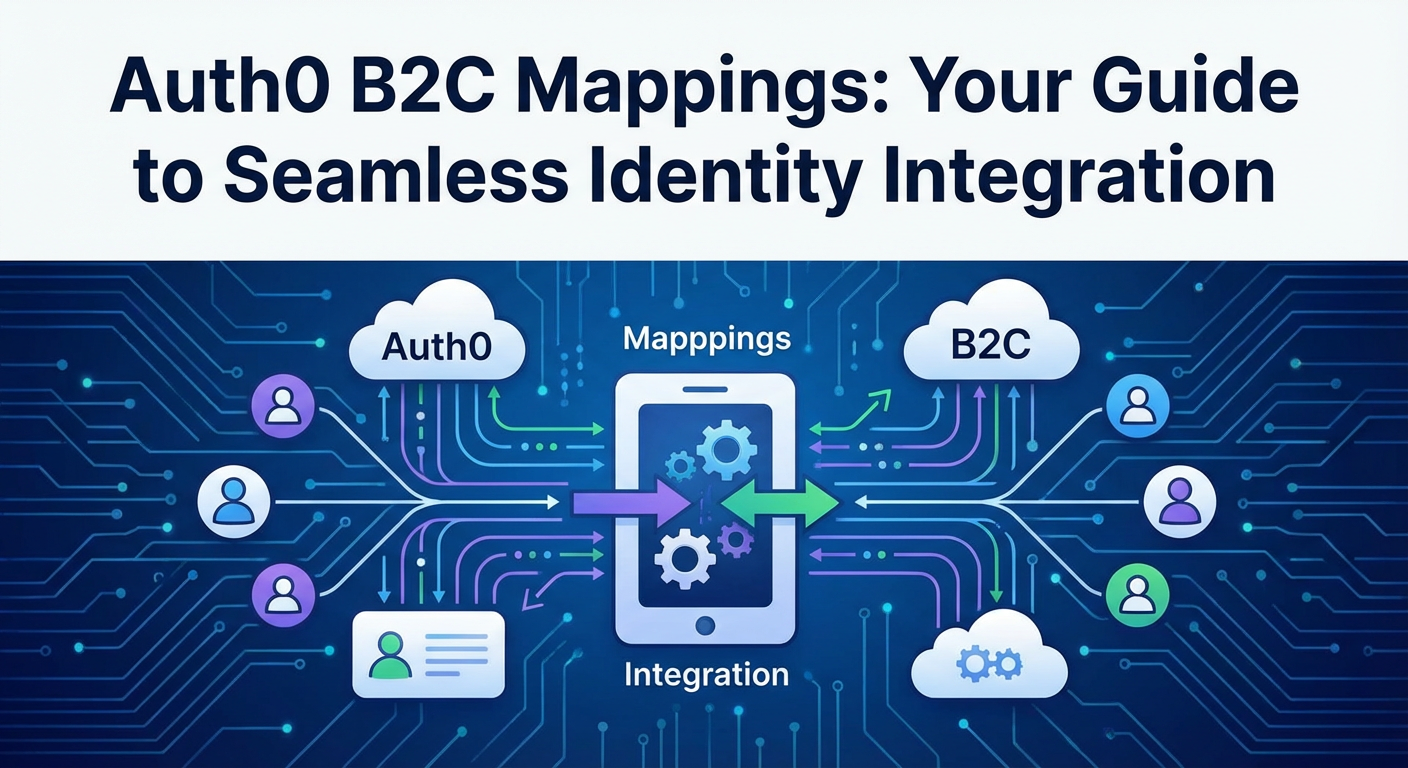
Auth0 B2C Mappings: Your Guide to Seamless Identity Integration


In the rapidly evolving digital landscape, where user experience and security stand as twin pillars of successful online engagement, managing consumer identities (B2C) has become an intricate dance of technology and strategy. Businesses of all sizes, from nascent startups to global enterprises, grapple with the challenge of providing secure, scalable, and effortlessly smooth authentication and authorization for their vast and diverse customer bases. The expectation from today's digital consumer is nothing less than instant access, personalized experiences, and unwavering trust in how their data is handled. Meeting these expectations while maintaining a robust security posture and compliance with ever-tightening regulations is a monumental task that often outstrips the capabilities of in-house, custom-built identity solutions. This is precisely where specialized Identity-as-a-Service (IDaaS) platforms, such as Auth0, emerge as indispensable tools, offering a sophisticated, flexible, and developer-friendly approach to identity management.
Auth0, renowned for its extensive capabilities and ease of integration, empowers organizations to offload the complexities of user authentication and authorization, allowing them to focus on their core product offerings. However, the true power of Auth0, particularly in a B2C context, lies not just in its ability to authenticate users, but in its sophisticated mechanisms for "mapping" identity attributes. These mappings are the unsung heroes that bridge the gap between a user's initial login credentials (be it a social profile, an enterprise directory, or a simple email/password combination) and the rich, contextual information an application needs to deliver a personalized, secure, and fully functional experience. Without effective mappings, an application might only know a user's email, missing crucial details like their preferred language, subscription tier, or specific permissions required to access certain features. This guide will embark on a comprehensive journey into the world of Auth0 B2C mappings, dissecting their importance, exploring the various methods Auth0 provides for their implementation, and outlining best practices for achieving truly seamless identity integration within your application ecosystem. By understanding and leveraging these powerful capabilities, developers and architects can unlock the full potential of Auth0, transforming raw authentication events into rich, actionable identity intelligence that drives superior user experiences and robust security.
Chapter 1: Understanding B2C Identity Management in the Modern Digital Era
The landscape of Business-to-Consumer (B2C) identity management is characterized by a unique set of challenges and requirements that differentiate it significantly from its Business-to-Employee (B2E) or Business-to-Business (B2B) counterparts. At its core, B2C identity management revolves around serving a potentially enormous, often unpredictable, and highly diverse user base comprised of individual consumers interacting directly with digital services. Unlike employees within an organization, consumers typically expect immediate gratification, minimal friction during signup and login processes, and a highly personalized experience tailored to their individual preferences and past interactions. This dynamic environment necessitates identity solutions that are not only supremely scalable but also inherently flexible, secure, and user-centric, capable of adapting to a multitude of access methods and data privacy expectations.
Defining B2C identity extends beyond mere authentication; it encompasses the entire lifecycle of a consumer's relationship with a brand, from initial discovery and registration to ongoing engagement, preference management, and eventually, account termination. Key characteristics include the prevalence of self-service options, where users manage their own profiles, passwords, and multi-factor authentication (MFA) settings, placing a heavy burden on the underlying identity system to be intuitive and robust. The user base can span geographical boundaries, cultural nuances, and technological proficiencies, demanding support for various social logins (Google, Facebook, Apple), passwordless authentication methods (magic links, biometrics), and traditional email/password combinations. Each of these authentication sources brings its own set of identity attributes, and effectively consolidating and normalizing this diverse data into a unified user profile is a foundational challenge.
The challenges inherent in B2C identity management are manifold and often complex. Firstly, scalability is paramount. A sudden viral marketing campaign or a seasonal peak in demand can see user registrations surge from thousands to millions in a short span. Traditional, on-premise identity solutions often struggle to handle such elastic demand without significant upfront investment and operational overhead. Secondly, security is non-negotiable. B2C applications are prime targets for credential stuffing, phishing attacks, and data breaches, making robust authentication mechanisms (like MFA, adaptive authentication), threat detection, and secure data storage absolutely critical. A single breach can devastate consumer trust and lead to severe financial and reputational damage.
Thirdly, user experience (UX) directly impacts conversion rates and retention. Lengthy signup forms, confusing login flows, or inconsistent identity experiences across different brand touchpoints can lead to user abandonment. Consumers expect a seamless, single sign-on (SSO) experience across an organization's various applications and services, minimizing the need to re-authenticate or re-enter information. Fourthly, compliance with global data privacy regulations, such as GDPR in Europe, CCPA in California, and similar mandates worldwide, adds another layer of complexity. These regulations impose strict requirements on how consumer data is collected, stored, processed, and managed, including provisions for user consent, data portability, and the right to be forgotten. Ensuring that identity systems are built with these regulatory frameworks in mind is not merely good practice but a legal imperative.
Traditional identity solutions, often designed for internal enterprise use cases with a finite number of users and controlled access points, frequently fall short when confronted with the unique demands of the B2C space. They might lack the flexibility to integrate diverse social identity providers, the scalability to handle massive user loads, or the sophisticated user-facing features required for a modern consumer application. Custom-building an identity solution, while seemingly offering complete control, typically results in significant development costs, ongoing maintenance burdens, and a perpetual race to keep up with evolving security threats and industry standards. This diverts valuable engineering resources away from core product innovation and introduces substantial risk.
This is precisely why the rise of Identity-as-a-Service (IDaaS) platforms has been a transformative development for B2C organizations. IDaaS providers offer cloud-native, fully managed identity solutions that abstract away the complexities of infrastructure, security patching, and compliance adherence. They provide pre-built integrations with a vast array of social and enterprise identity providers, robust authentication methods, and comprehensive user management dashboards. The benefits of adopting an IDaaS like Auth0 are profound: immediate scalability, enhanced security built on industry best practices, simplified compliance efforts, and a dramatically improved user experience through features like SSO and personalized journeys. By leveraging such platforms, businesses can significantly accelerate their time to market, reduce operational costs, and, most importantly, deliver the seamless, secure, and trustworthy digital identity experience that modern consumers demand and expect.
Chapter 2: Auth0: A Foundation for B2C Success
Auth0 stands as a preeminent Identity-as-a-Service (IDaaS) platform, specifically engineered to simplify the complex landscape of identity management for developers and enterprises alike. At its core, Auth0 provides a centralized, cloud-based solution for handling authentication, authorization, and user management across a myriad of applications, devices, and user types. For B2C scenarios, Auth0 offers a compelling suite of features that directly address the aforementioned challenges of scalability, security, and user experience, enabling businesses to create secure and seamless login experiences without having to build and maintain intricate identity infrastructure themselves. This allows development teams to concentrate their efforts on innovating their core product rather than becoming identity experts.
Auth0's core offerings extend across the entire identity lifecycle. It provides robust authentication services, supporting various methods from traditional username/password to social logins (Google, Facebook, Apple, etc.), enterprise connections (SAML, OpenID Connect), and modern passwordless techniques (magic links, biometrics). This versatility ensures that businesses can cater to the diverse preferences of their consumer base, offering convenience without compromising security. Beyond mere authentication, Auth0 also delivers sophisticated authorization capabilities, allowing applications to determine what authenticated users are permitted to do. This is achieved through mechanisms like roles, permissions, and custom claims embedded within tokens, which applications can then use to enforce fine-grained access control. Finally, comprehensive user management features provide tools for administrators to manage user profiles, track activity, enforce security policies, and facilitate self-service options for end-users, such as password resets and profile updates.
The architectural design of Auth0 is a testament to its flexibility and extensibility, making it particularly well-suited for dynamic B2C environments. One of its standout features is its extensibility through custom code, primarily via Rules and Hooks. Rules are JavaScript functions executed during the authentication pipeline, allowing developers to augment user profiles, add custom claims to tokens, integrate with external systems, and implement adaptive authentication logic. Hooks, on the other hand, are event-driven extension points that enable custom logic to be triggered at specific moments in the identity lifecycle, such as before user registration or after a successful login. These programmatic hooks provide unparalleled control over the identity flow, making it possible to tailor Auth0's behavior to virtually any business requirement without forking the core platform. Furthermore, Auth0 supports custom databases, allowing organizations to integrate their existing user stores while leveraging Auth0 for authentication and authorization. Its extensive array of connections – including social providers, enterprise identity providers, and custom databases – ensures that users can authenticate using their preferred method, streamlining the onboarding process and enhancing user satisfaction.
For B2C specific needs, Auth0 offers a robust set of features designed to cater to the consumer market. Social logins are a cornerstone, enabling users to register and log in using their existing social accounts, significantly reducing friction and improving conversion rates. This also helps in reducing "password fatigue" for consumers. Multi-Factor Authentication (MFA), including SMS, push notifications, and TOTP (Time-based One-Time Password), provides an essential layer of security, protecting consumer accounts from unauthorized access and bolstering trust. Passwordless authentication options, such as magic links sent to email or SMS, or even biometric authentication through WebAuthn, offer a modern, secure, and user-friendly alternative to traditional passwords, which are often a point of vulnerability and frustration. Finally, Auth0's comprehensive self-service portals empower users to manage their own profiles, linked accounts, and security settings, offloading administrative tasks from customer support teams and enhancing the overall user experience.
In essence, Auth0 dramatically simplifies complex identity workflows by abstracting away the underlying infrastructure and security challenges. Instead of spending valuable engineering cycles on building and maintaining an authentication system, development teams can leverage Auth0's robust platform to implement secure, scalable, and user-friendly identity solutions with minimal effort. This simplification translates into faster development cycles, reduced operational costs, enhanced security posture, and, most importantly, a superior identity experience for the end consumer. By providing a rich toolkit for handling diverse authentication methods, flexible authorization policies, and extensive user management capabilities, Auth0 establishes itself as a powerful foundation for any B2C application striving for success in today's competitive digital marketplace.
Chapter 3: The Concept of Mappings in Identity Systems: Bridging the Digital Divide
In the realm of digital identity, the concept of "mappings" is not merely a technical detail but a fundamental pillar that underpins the seamless operation and secure functioning of modern applications. At its heart, identity mapping is the process of translating, transforming, or associating identity attributes and contextual information from one system or format into another, effectively bridging the gap between an identity provider (IdP) and a consuming application or service. This translation is crucial because, while an IdP like Auth0 might authenticate a user and hold a comprehensive profile, the specific information an application needs to function correctly—or to personalize a user's experience—might be represented differently, or even reside in entirely separate systems. Without robust mapping capabilities, the rich identity data held by the IdP would remain siloed, unable to power the tailored interactions and secure access control that modern digital services demand.
The necessity of identity mappings stems from several critical factors. Firstly, data consistency is paramount. Different identity sources, whether they are social media accounts (Google, Facebook), enterprise directories (Active Directory), or custom databases, will inevitably store user attributes with varying schemas and naming conventions. A user's full name might be firstName and lastName in one system, given_name and family_name in another, or simply a single name field elsewhere. Mappings normalize these disparate representations into a consistent format that applications can universally understand and process, eliminating the need for each application to handle the idiosyncrasies of every potential IdP. This standardization greatly simplifies application development and reduces potential errors arising from data mismatches.
Secondly, attribute transformation is a common requirement. Sometimes, the raw attributes provided by an IdP are not directly usable by an application and need to be modified or combined. For instance, an application might require a user's age based on their date of birth, or a derived security clearance based on a combination of their department and job title. Mappings allow for the execution of custom logic to perform these transformations, enriching the identity data before it reaches the application. This ensures that applications receive information in the exact format and content they expect, enabling more sophisticated business logic and personalized experiences without embedding transformation logic within every application.
Thirdly, mappings are indispensable for establishing authorization context. Beyond simply knowing who a user is, applications often need to know what a user is allowed to do. This requires mapping identity attributes to roles, permissions, or access levels within the application's authorization framework. For example, a user authenticated through Auth0 might have an app_metadata.roles attribute containing "administrator" and "premium_customer." Through mapping, these roles can be translated into specific permissions that dictate which features or data the user can access within a dashboard. This separation of concerns—authentication handled by the IdP, and authorization enforced by the application based on mapped attributes—enhances security and maintainability.
Common mapping scenarios encountered in identity systems are diverse and illustrative of their broad applicability. User profile attributes are perhaps the most straightforward. This involves mapping fundamental details like email address, name, profile picture, locale, and time zone from the IdP's raw claims to the application's internal user profile schema. For B2C applications, accurately capturing and utilizing these attributes is key to personalization, such as displaying a user's name, pre-filling forms, or showing content in their preferred language.
Role-based access control (RBAC) is another critical use case. Many applications organize access permissions around roles (e.g., "customer," "support agent," "admin"). Identity mappings are used to assign these roles to users based on attributes received from the IdP, or based on custom logic applied during the authentication flow. These roles are then passed to the application, often as claims within a security token, allowing the application to enforce access policies.
Furthermore, custom claims and metadata are frequently mapped. Applications often require specific pieces of information unique to their business logic, which may not be standard identity attributes. Auth0, for example, allows storing user_metadata for user-editable attributes and app_metadata for application-specific, often immutable, attributes. Mappings facilitate the creation and inclusion of these custom claims into tokens or user profiles, providing rich context to downstream services. For instance, mapping a user's subscription tier (premium, basic) as a custom claim enables an e-commerce application to dynamically adjust available features.
The importance of standardized protocols like OpenID Connect (OIDC) and OAuth 2.0 cannot be overstated in facilitating these mappings. OIDC, built on top of OAuth 2.0, provides a standard way for identity providers to issue identity tokens (ID Tokens) that contain claims about the authenticated user. These claims are essentially attribute-value pairs, such as sub (subject identifier), name, email, etc., defined in a predictable and machine-readable format. OAuth 2.0 primarily focuses on delegated authorization, allowing clients to obtain access tokens that grant access to protected resources. Together, these protocols provide a robust framework for securely transmitting identity information and authorization context, making it far simpler to define and implement consistent mappings across different services and applications. By adhering to these standards, identity systems and applications can communicate effectively, ensuring that mapped attributes are correctly understood and securely leveraged to power dynamic and personalized user experiences.
APIPark is a high-performance AI gateway that allows you to securely access the most comprehensive LLM APIs globally on the APIPark platform, including OpenAI, Anthropic, Mistral, Llama2, Google Gemini, and more.Try APIPark now! 👇👇👇
Chapter 4: Deep Dive into Auth0 B2C Mappings: Architecting Personalized Identity Flows
Auth0’s power in B2C identity management truly shines through its sophisticated mechanisms for identity attribute mapping. These capabilities allow developers to precisely control how user data is captured, transformed, and presented to applications, ensuring that every user interaction is tailored, secure, and contextually rich. By leveraging Auth0's flexible architecture, organizations can move beyond basic authentication to orchestrate complex identity flows that meet specific business requirements and enhance the overall customer experience. Understanding these core mapping mechanisms is crucial for any developer or architect looking to maximize Auth0's potential.
Core Mapping Mechanisms in Auth0
- Connections: At the foundational level, Auth0's "Connections" define how users authenticate. Whether it's through social identity providers (Google, Facebook, Apple), enterprise connections (SAML, OpenID Connect, LDAP), or a custom database, each connection brings with it a specific set of raw user attributes. Auth0 acts as a normalized layer, attempting to standardize these attributes into a common profile schema. However, different connections might provide varying levels of detail or use different attribute names. Mapping begins here, as Auth0 ingests these attributes, often transforming them into its internal user profile structure. For instance, a social connection might provide
given_nameandfamily_name, while a database connection might just have afull_namefield. Auth0 intelligently processes these, forming the initial basis of the user's profile. - User Profiles:
user_metadataandapp_metadata: Once a user authenticates through a connection, Auth0 creates and maintains a canonical user profile. This profile is where all identity attributes reside and are managed. Critically, Auth0 distinguishes between two types of custom metadata for user profiles, which are key for mapping application-specific data:user_metadata: This is designed for attributes that users themselves can manage or view, such as their preferred language, communication preferences, or a public profile bio. Applications can read and (with proper authorization) updateuser_metadatathrough the Auth0 Management API or by embedding forms in their user settings.app_metadata: This is for application-specific attributes that typically should not be modified by the user directly.app_metadatais ideal for storing internal application roles, subscription tiers, internal IDs, or any other data that drives application logic but is managed by the application or an administrator. This data is often populated or updated through Auth0 Rules, Hooks, or the Management API, forming a critical basis for authorization and feature gating. These metadata fields are invaluable for storing mapped attributes that go beyond the standard claims provided by an IdP.
- Rules & Hooks: The Primary Tools for Custom Attribute Mapping and Transformation: These are the most powerful and flexible mechanisms within Auth0 for customizing the authentication and authorization pipeline, making them central to advanced B2C mappings.
- Rules: Auth0 Rules are JavaScript functions executed synchronously during the authentication pipeline after a user authenticates but before the token is issued to the application. This makes them ideal for dynamically enriching user profiles, adding custom claims to ID and Access Tokens, integrating with external systems, and implementing conditional logic.
- Examples of Rules for Mappings:
- Enriching Profiles: A Rule can fetch additional user data from a CRM (e.g., loyalty points, purchase history) using an external
apicall and add it touser_metadataorapp_metadata. - Assigning Roles: Based on a user's email domain or a lookup in an external database, a Rule can assign application-specific roles (e.g.,
premium_user,admin) toapp_metadata.roles. These roles can then be mapped into custom claims in the ID Token. - Custom Claims: Beyond roles, any derived or external data can be injected as custom claims into the ID Token (for identity information) or Access Token (for authorization information), providing granular context to the consuming application. For example, mapping a user's geographical region from their IP address to a
regionclaim. - Attribute Transformation: If an incoming attribute needs reformatting (e.g., converting a numeric value to a descriptive string), a Rule can perform this transformation before the attribute is passed to the application.
- Enriching Profiles: A Rule can fetch additional user data from a CRM (e.g., loyalty points, purchase history) using an external
- Examples of Rules for Mappings:
- Hooks: Auth0 Hooks are event-driven extensibility points that allow developers to execute custom Node.js code at specific lifecycle events. While Rules run during the login transaction, Hooks run after or before certain events, offering slightly different use cases for mapping and data synchronization.
- Examples of Hooks for Mappings:
post-user-registrationHook: After a new user registers, this hook can be used to synchronize their basic profile information to a downstream CRM or a data warehouse. It could also assign initial default roles based on registration details and map these toapp_metadata.pre-user-registrationHook: This hook can validate incoming registration data, enrich it with external information (e.g., checking if an email belongs to a known partner), or even prevent registration if certain criteria aren't met, mapping outcomes to user attributes.post-loginHook: Similar to Rules, but typically used for more extensive, potentially asynchronous operations like updating external systems with login activity or performing complex user profile reconciliations after an authentication event.
- Examples of Hooks for Mappings:
- Rules: Auth0 Rules are JavaScript functions executed synchronously during the authentication pipeline after a user authenticates but before the token is issued to the application. This makes them ideal for dynamically enriching user profiles, adding custom claims to ID and Access Tokens, integrating with external systems, and implementing conditional logic.
- Custom Database Connections: For organizations with existing user directories that they wish to retain, Auth0's custom database connections provide a powerful mapping solution. You can write custom scripts (in Node.js) that define how Auth0 interacts with your database for
login,create,verify, andchange passwordoperations. Within these scripts, you have full control over how attributes from your database are mapped to the Auth0 user profile (user_metadata,app_metadata) before they are passed back to Auth0. This allows for fine-grained control over attribute synchronization and transformation directly from your authoritative user store. - API Authorization & Scopes: While not directly a mapping mechanism for user profile attributes,
APIAuthorization in Auth0 heavily relies on mapping user attributes to permissions. When an application requests an Access Token from Auth0, it typically requests specificscopes(permissions). Auth0 can then issue an Access Token that, based on the authenticated user'sapp_metadata(e.g., roles) and Auth0'sAPIsettings, contains specific permissions (scopes) and custom claims. These claims effectively map the user's identity and roles to what they are allowed to do with a specificAPI. For instance, a user withadminrole inapp_metadatamight be mapped toread:usersandwrite:usersscopes for a user managementAPI. The receivingAPIcan then validate these scopes and claims to enforce access control.
Practical Scenarios & Examples
- Mapping social provider attributes to custom application claims: A user logs in with Google. Google provides
email,name,picture. A Rule can take theemailand check an internal system to determine the user'ssubscription_tier(e.g.,free,premium) andsegment(e.g.,new_user,loyal_customer). These are then mapped toapp_metadataand injected as custom claims (https://myapp.com/subscription_tier,https://myapp.com/segment) into the ID Token, allowing the application to immediately personalize the user experience. - Synchronizing user roles from an external system: An organization uses an existing HR system where user roles are defined. Upon user login, an Auth0 Rule makes an
APIcall to the HR system with the user's email. The HR system returns the user's roles (manager,employee). The Rule maps these roles intoapp_metadata.rolesin Auth0, and then adds them as a customhttps://myapp.com/rolesclaim in the Access Token. - Transforming incoming attributes for downstream services: A social login provider might return a
localeattribute asen_US. A Rule can transform this to a simplerenor check if the application supportsen_USand default toenif not. This ensures consistency for downstream services that might expect a specific format. - Enriching user profiles based on application-specific logic: Upon registration, a
post-user-registrationHook can check if the user registered with a corporate email domain. If so, it might automatically assign acorporate_user: trueflag to theirapp_metadata, which could unlock specific features or pricing in the application.
Security Considerations in Mappings
While powerful, mapping mechanisms must be approached with security at the forefront: * Data Privacy: Be judicious about what information you map and store. Only map attributes that are strictly necessary for the application's function. Avoid storing sensitive PII in custom claims unless absolutely required and properly encrypted. Ensure compliance with data privacy regulations (GDPR, CCPA) when handling and transforming user data. * Sensitive Attribute Handling: If mapping highly sensitive attributes, ensure they are not exposed in tokens unnecessarily. Use app_metadata for internal, non-exposed data, and only expose claims in tokens that are essential for immediate authorization or personalization by the consuming application. * Least Privilege: Adhere to the principle of least privilege. Only grant applications access to the claims and user data they absolutely need. Over-exposing attributes can create unnecessary security risks. * Rule/Hook Security: Rules and Hooks execute custom code. Ensure this code is well-tested, free of vulnerabilities, and follows secure coding practices. Avoid hardcoding sensitive credentials; use Auth0's configuration variables for secrets. Regularly audit and review your custom scripts.
By diligently applying these core mechanisms and considering the security implications, developers can craft highly effective and secure Auth0 B2C mappings, transforming raw identity data into a precise, actionable resource that drives an exceptional user experience while maintaining a robust security posture.
Chapter 5: Integrating Auth0 Mappings with Your Application Ecosystem: Powering the Digital Architecture
The true value of Auth0 B2C mappings materializes when the carefully crafted identity attributes and custom claims are seamlessly integrated into and consumed by the broader application ecosystem. An identity system, however robust, is only as effective as its ability to communicate its intelligence to the services it protects and informs. This chapter delves into how applications receive and interpret the rich, mapped data from Auth0, how this data flows into downstream systems, and the crucial role of APIs and gateways in securing and orchestrating these interactions.
Receiving Mapped Data
Once a user successfully authenticates through Auth0 and the mapping rules and hooks have executed, the refined identity information needs to be transmitted to the client application or backend services. Auth0 primarily leverages industry-standard security tokens for this purpose:
- ID Tokens and Access Tokens (JWTs):
- ID Tokens: Issued as JSON Web Tokens (JWTs), ID Tokens are designed to carry identity information about the authenticated user. They contain standard claims (like
sub,name,email) and can be extended with custom claims that represent your mapped attributes. For instance, if a Rule addedsubscription_tiertoapp_metadataand then mapped it to a custom claim (https://yourdomain.com/subscription_tier), this claim would be present in the ID Token. Client-side applications (SPAs, mobile apps) decode and validate the ID Token to establish the user's identity and personalize their immediate experience. - Access Tokens: Also typically JWTs, Access Tokens are used for authorizing access to protected
APIresources. While ID Tokens are for the client to know who the user is, Access Tokens are for the backendAPIto know what the user is allowed to do. Auth0 can inject custom claims, often derived fromapp_metadata(likerolesorpermissionsassociated with a specificAPI), into Access Tokens. When a client makes anAPIcall, it presents the Access Token, and theAPI(or anAPI gatewayin front of it) validates the token and inspects its claims to determine if the requested operation is authorized. This mechanism forms the bedrock of fine-grained access control in microservices architectures.
- ID Tokens: Issued as JSON Web Tokens (JWTs), ID Tokens are designed to carry identity information about the authenticated user. They contain standard claims (like
- User Info Endpoint: For more detailed or less frequently needed user profile information, applications can make an authenticated request to Auth0's
/userinfoendpoint. This endpoint returns the user's complete profile, includinguser_metadataandapp_metadata, as a JSON object. This is particularly useful when an application needs to display a user's full profile settings or update certain user-managed attributes, without needing all that information in every token. - Auth0 Management API: For backend services or administrative tools that require programmatic access to user data (e.g., updating
app_metadata, revoking sessions, managing users), the Auth0 ManagementAPIprovides a comprehensive interface. Applications can use an Auth0 ManagementAPItoken (with appropriate scopes) to read and write directly to user profiles, allowing for sophisticated backend integrations and data synchronization workflows. This is often used for batch updates, integrating with CRM systems, or building custom administrative dashboards.
Downstream System Integration
The identity intelligence gleaned from Auth0 mappings often needs to propagate beyond the immediate client application to various downstream systems, forming a cohesive data ecosystem:
- Microservices and
APIs: In a microservices architecture, individual services might need specific identity claims to perform their functions. An Access Token issued by Auth0, carrying custom roles or permissions, allows each microservice to independently authorize requests without needing to query a central identity store. For example, a "Product Catalog" service might check for apremium_userclaim to display exclusive products, while an "Order Processing" service might requireadminrole for certain operations. - CRMs, Marketing Automation, Data Warehouses: Mapped user attributes (e.g.,
subscription_tier,segment,loyalty_points) are invaluable for personalizing customer interactions in CRM systems, segmenting audiences in marketing automation platforms, and enriching analytical data in data warehouses. Webhooks orpost-user-registration/post-loginHooks can be configured in Auth0 to push relevant user profile updates to these systems in real-time or near real-time, ensuring consistency across all customer touchpoints.
The Role of APIs and Gateways in Identity Flow
The interaction between Auth0, applications, and downstream services is heavily reliant on robust APIs and the strategic deployment of API gateways. An API gateway serves as the single entry point for all client requests, sitting in front of your backend services and performing crucial functions like traffic management, security enforcement, and policy application.
- Auth0 and
APIAuthorization: Auth0 is anAPIauthorization server. It issues tokens that authorize access to yourAPIs. When an application calls your backendAPIs, it presents an Access Token obtained from Auth0. TheAPI gatewayplays a pivotal role here: it intercepts the incoming request, validates the Access Token (checking its signature, expiration, audience, and issuer), and then inspects the claims within the token to determine if the user has the necessary permissions (scopes) to access the requested resource. This offloads authentication and basic authorization from individual microservices to a centralizedgateway, simplifying development and enhancing security. API Gatewayfor Policy Enforcement: Beyond token validation, anAPI gatewaycan enforce fine-grained access policies based on the mapped claims in the Access Token. For example, if an Access Token contains aregion: EUclaim, thegatewaycan route the request to an EU-specific service endpoint or block access to certain data sources. This acts as a critical enforcement point for the identity mappings orchestrated in Auth0.OpenAPIand Data Contracts: To ensure seamless integration and clarity between Auth0's identity claims and yourAPIs, the use ofOpenAPIspecifications is highly recommended.OpenAPI(formerly Swagger) provides a language-agnostic, human-readable, and machine-readable interface for describingAPIs. By documenting the expected claims in yourAPIendpoints'OpenAPIspecifications, you create a clear data contract between your identity system (Auth0 and its mappings) and yourAPIconsumers. This ensures that developers consuming yourAPIs know exactly what claims to expect in the Access Token and how to interpret them for authorization purposes, leading to more robust and less error-prone integrations.
For organizations managing a diverse ecosystem of APIs, especially those leveraging AI models, an advanced API gateway becomes indispensable. Platforms like APIPark, an open-source AI gateway and API management platform, offer robust solutions for unified API format for AI invocation, end-to-end API lifecycle management, and secure API resource access, complementing Auth0's identity capabilities by providing a secure and performant layer for API exposure and control. APIPark's ability to quickly integrate 100+ AI models and standardize AI invocation formats means that identity context (derived from Auth0 mappings) can be consistently applied across various AI services, ensuring that even AI-driven features respect user permissions and preferences. Its features like end-to-end API lifecycle management, API service sharing within teams, and independent API and access permissions for each tenant further enhance the utility of Auth0's granular identity mappings by providing a structured environment for API governance and consumption, whether for human-facing applications or machine-to-machine AI interactions. The combination of Auth0's flexible identity management and a powerful API gateway like APIPark creates a secure, efficient, and highly extensible digital architecture.
Orchestrating Complex Workflows
Beyond direct consumption of tokens, Auth0 mappings can also trigger complex, event-driven workflows. Auth0 webhooks can be configured to send notifications to external systems whenever specific identity events occur (e.g., user registration, profile update). These webhooks can then initiate serverless functions (e.g., AWS Lambda, Azure Functions) or message queue events, allowing for asynchronous processing and integration with virtually any system. For instance, a webhook triggered by a new user registration could send the mapped user profile data to a billing system to set up a new account, to a welcome email service, and to a customer data platform for analytics, all orchestrated by the initial Auth0 mapping. This event-driven approach ensures that all relevant systems are updated with the latest identity information, maintaining data consistency and enabling real-time business processes driven by consumer interactions.
In conclusion, the integration of Auth0 mappings into your application ecosystem is a multi-faceted process that spans token consumption, data propagation to downstream systems, and the strategic use of APIs and gateways. By thoughtfully designing how mapped identity data flows through your architecture, you can unlock personalized experiences, enforce granular security policies, and build highly scalable and resilient digital services that truly understand and respond to your B2C users.
Chapter 6: Best Practices for Auth0 B2C Mappings: Crafting a Resilient Identity Foundation
Implementing Auth0 B2C mappings effectively requires more than just understanding the technical mechanisms; it demands a strategic approach centered on efficiency, security, maintainability, and future scalability. Adhering to best practices ensures that your identity solution is not only robust today but also adaptable to evolving business requirements and security threats. By thoughtfully designing and managing your mappings, you can establish a resilient identity foundation that supports a superior user experience and safeguards your digital assets.
1. Keep Mappings Lean and Relevant
The temptation might be to map every conceivable attribute from every possible source into your user profiles and tokens. However, this approach often leads to bloat, increased token sizes, and unnecessary complexity. * Principle: Only map attributes that are genuinely needed by your applications for authentication, authorization, or core personalization. * Action: Carefully evaluate each attribute. Does the client application absolutely need it in the ID Token? Does a backend API specifically require it in the Access Token? If an attribute is only needed for display on a profile page or for a specific, infrequent backend process, consider retrieving it via the /userinfo endpoint or the Management API rather than embedding it in every token. Larger tokens increase network overhead and can impact performance.
2. Prioritize Security and Data Privacy
Identity data is highly sensitive, and its handling is subject to stringent regulations. Security must be an inherent part of your mapping design. * Principle: Treat all identity attributes as potentially sensitive. Minimize exposure and protect data at rest and in transit. * Action: * Least Privilege: Ensure that applications and APIs only receive the minimum set of claims and user data necessary for their function. Avoid exposing sensitive PII in tokens if possible. * Secure Storage: Use app_metadata for application-internal, non-user-editable data, and ensure appropriate access controls are in place for the Management API that can manipulate this data. * Input Validation & Sanitization: If your Rules or Hooks accept external input or integrate with external systems, rigorously validate and sanitize all data to prevent injection attacks or data corruption. * Compliance: Design mappings with data privacy regulations (GDPR, CCPA, etc.) in mind. Ensure consent mechanisms are respected and that users have appropriate control over their user_metadata.
3. Test Mappings Thoroughly Across Different User Flows
Mappings can be complex, especially with multiple connections, Rules, and Hooks. Inadequate testing is a common source of production issues. * Principle: Rigorously test all mapping logic for every relevant user journey and authentication path. * Action: * Unit Testing: Write unit tests for your Auth0 Rules and Hooks logic. * Integration Testing: Test the full authentication flow from different connections (social, email/password, custom database) to ensure claims are correctly mapped and received by your applications. * Edge Cases: Test for edge cases, such as missing attributes from an IdP, users with no assigned roles, or errors in external API calls made by Rules. * Auth0's "Try It" Feature: Use Auth0's built-in "Try It" feature for Rules to simulate authentication and see the resulting user profile and tokens.
4. Document Your Mapping Logic and Attribute Definitions
As your identity solution grows, a clear understanding of what each attribute means and how it's derived becomes vital. * Principle: Maintain comprehensive documentation for all mapped attributes, custom claims, and the logic within your Rules and Hooks. * Action: * Attribute Dictionary: Create a central repository (e.g., Confluence, Wiki, OpenAPI spec) detailing each custom attribute and claim, its purpose, its source, and how it's mapped. * Rule/Hook Comments: Heavily comment your Rule and Hook code, explaining complex logic, external dependencies, and expected outcomes. * Architecture Diagrams: Maintain diagrams showing the flow of identity data, highlighting where mappings occur and how tokens are consumed by different services.
5. Use Version Control for Auth0 Configurations
Auth0 Rules and Hooks are code. Treating them as such is crucial for team collaboration, change management, and disaster recovery. * Principle: Manage Auth0 Rules, Hooks, APIs, and application configurations as code using a version control system (e.g., Git). * Action: * Auth0 Deploy CLI/Management API: Utilize the Auth0 Deploy CLI or programmatically interact with the Management API to export and import configurations. * CI/CD Pipeline: Integrate your Auth0 configuration management into a Continuous Integration/Continuous Deployment (CI/CD) pipeline. This allows for automated testing and deployment of identity changes, reducing manual errors and ensuring consistency across environments. * Rollback Capability: Version control provides a safety net, allowing you to easily roll back to previous, stable configurations if a change introduces issues.
6. Monitor Mapping Execution and Performance
Visibility into your identity pipeline is essential for proactive problem-solving and performance optimization. * Principle: Implement robust monitoring and alerting for your Auth0 authentication pipeline, especially for custom logic. * Action: * Auth0 Logs: Regularly review Auth0 logs for errors, warnings, and unusual activity related to your Rules and Hooks. * External Logging: Integrate Auth0 logs with your centralized logging system (e.g., Splunk, ELK, Datadog) for comprehensive analysis and custom alerting. * Performance Metrics: Monitor the execution time of your Rules and Hooks. Long-running scripts can impact login performance and user experience. Optimize API calls within Rules to external services to ensure they are efficient.
7. Consider Future Scalability and Flexibility
Identity systems are long-lived, and business requirements will undoubtedly change. Design your mappings with an eye towards the future. * Principle: Build mappings that are extensible and can accommodate new identity providers, applications, or attribute requirements without major re-architecture. * Action: * Modular Rules: Break down complex mapping logic into smaller, focused Rules or Helper Functions within Rules. * Configuration over Code: Where possible, drive mapping behavior through configurable metadata (e.g., environment variables, Auth0 app_metadata on the tenant level) rather than hardcoding values directly into Rules. * Standard Protocols: Leverage standard protocols like OIDC and OAuth 2.0. This makes it easier to integrate with new applications and identity providers that also adhere to these standards.
Mapping Mechanism Comparison Table
To summarize the utility of Auth0's various mapping mechanisms, consider the following comparison:
| Mechanism | Primary Use Case | Best For | Complexity | Real-time Impact on Auth Flow | Admin Control | User Interaction |
|---|---|---|---|---|---|---|
| Auth0 Connections | Initial attribute ingestion from IdP | Standardizing basic profile data (email, name, picture) from various login sources. | Low | Yes (direct) | High | Low (user picks IdP) |
user_metadata |
User-managed profile attributes | Storing user preferences, public profile info, communication settings. | Low-Medium | Indirect | Medium | High |
app_metadata |
Application-specific, admin-managed attributes | Storing internal roles, permissions, subscription tiers, internal IDs. | Low-Medium | Indirect | High | Low |
| Rules | Real-time attribute transformation, custom claims | Enriching tokens with dynamic roles, custom claims, calling external APIs during login, adaptive auth. |
Medium-High | Yes (synchronous) | High | Low |
| Hooks | Event-driven custom logic (pre/post events) | Synchronizing data with external systems, validating registrations, asynchronous profile updates. | Medium-High | Yes (async/sync) | High | Low |
| Custom DB Connections | Integrating existing user stores | Mapping attributes from an external legacy database into Auth0 profiles. | High | Yes (direct) | High | Low |
API Authorization Scopes |
Mapping user identity to API access permissions |
Controlling granular access to specific APIs or API operations based on user roles/attributes. |
Medium | Yes (token claims) | High | Low |
By internalizing and applying these best practices, developers and architects can not only leverage Auth0's powerful mapping capabilities to their fullest but also build a secure, efficient, and future-proof identity solution for their B2C applications. This diligent approach will minimize technical debt, enhance developer productivity, and ultimately contribute to a superior, trustworthy experience for millions of consumers.
Conclusion: Forging Seamless Digital Identities with Auth0 B2C Mappings
In the complex and competitive landscape of modern digital experiences, the ability to seamlessly manage and integrate consumer identities is not merely a feature but a fundamental prerequisite for success. This guide has journeyed through the intricate world of Auth0 B2C mappings, revealing their profound importance in transforming raw authentication events into rich, actionable identity intelligence. From the foundational understanding of B2C identity challenges to the detailed exploration of Auth0's powerful mapping mechanisms, we've seen how thoughtful design and implementation can elevate the entire user journey.
Auth0, with its robust architecture encompassing connections, user_metadata, app_metadata, and the highly flexible Rules and Hooks, provides an unparalleled toolkit for orchestrating sophisticated identity workflows. These mechanisms empower developers to precisely control how user attributes are captured, transformed, and delivered to applications, ensuring that every interaction is personalized, secure, and aligned with specific business logic. Whether it's deriving application-specific roles from social logins, synchronizing user profiles with downstream CRMs, or embedding custom claims for fine-grained API authorization, Auth0's mapping capabilities are the linchpin of a truly integrated identity system.
The benefits of mastering Auth0 B2C mappings are multifaceted. For users, it translates into a frictionless, personalized, and trustworthy experience—one where they can effortlessly log in, manage their preferences, and access services tailored to their needs. For businesses, it means enhanced security posture through robust authentication and authorization enforcement, improved operational efficiency by offloading identity complexities, and accelerated innovation as development teams can focus on core product features. Furthermore, the strategic integration of Auth0 with APIs and API gateways, as exemplified by platforms like APIPark, ensures that these meticulously mapped identity attributes are not only transmitted securely but also leveraged effectively across the entire application ecosystem, from human-facing interfaces to AI-driven backend services.
As the digital world continues to evolve, bringing new authentication methods, tighter privacy regulations, and higher consumer expectations, the agility and extensibility provided by Auth0's mapping capabilities will remain indispensable. By adhering to best practices—keeping mappings lean, prioritizing security, rigorous testing, comprehensive documentation, version control, and continuous monitoring—organizations can build a resilient identity foundation that is both current and future-proof. Auth0 B2C mappings are more than just a technical configuration; they are a strategic investment in creating secure, scalable, and ultimately, more human-centric digital experiences that foster trust and drive enduring customer relationships. Embracing these powerful tools will undoubtedly pave the way for seamless identity integration and sustained success in the dynamic digital age.
Frequently Asked Questions (FAQs)
1. What is the primary purpose of Auth0 B2C mappings? The primary purpose of Auth0 B2C mappings is to transform, enrich, and standardize user identity attributes received from various authentication sources (like social logins or custom databases) into a consistent format that applications can use for personalization, authorization, and data synchronization. They bridge the gap between how an Identity Provider stores data and what an application specifically needs to function, ensuring a seamless and secure user experience. This allows for dynamic assignment of roles, custom claims, and targeted content based on user attributes derived during the login process.
2. How do Auth0 Rules and Hooks differ in their role for identity mapping? Auth0 Rules are synchronous JavaScript functions that execute during the authentication pipeline, after a user logs in but before a token is issued. They are ideal for real-time attribute transformation, adding custom claims to tokens, and performing conditional logic. Auth0 Hooks, on the other hand, are event-driven Node.js functions that execute before or after specific identity lifecycle events, such as user registration (post-user-registration hook) or password changes. While both can perform mapping, Rules are typically for in-flow data manipulation affecting tokens, whereas Hooks are often used for broader, potentially asynchronous integrations with external systems or more extensive profile updates.
3. What are user_metadata and app_metadata, and when should I use each for mappings? user_metadata and app_metadata are custom fields within an Auth0 user profile for storing additional, application-specific attributes. user_metadata is intended for attributes that users can view and potentially manage themselves (e.g., preferred language, public bio). app_metadata is for application-specific attributes that are typically managed by administrators or backend processes and should not be directly editable by the user (e.g., internal roles, subscription tiers, feature flags). For identity mappings, app_metadata is particularly useful for storing derived or externally sourced data that dictates authorization logic, while user_metadata supports user personalization.
4. How does an API gateway like APIPark fit into Auth0's identity mappings? An API gateway like APIPark plays a crucial role as an enforcement point for Auth0's identity mappings. After Auth0 authenticates a user and issues an Access Token containing mapped claims (e.g., roles, permissions), the API gateway intercepts calls to your backend APIs. It validates the Access Token and then inspects these mapped claims to determine if the user is authorized to access the requested resource. APIPark, as an advanced API gateway, further enhances this by providing features for unified API format for AI invocation, end-to-end API lifecycle management, and secure API resource access, allowing for consistent application of Auth0's identity context across all your APIs, including those powering AI models.
5. What are the key security considerations when implementing Auth0 B2C mappings? When implementing Auth0 B2C mappings, key security considerations include adhering to the principle of least privilege, meaning only mapping attributes that are strictly necessary and exposing the minimum amount of data in tokens. It's crucial to protect sensitive attributes, store application-internal data in app_metadata rather than user-editable fields, and avoid hardcoding secrets in Rules or Hooks. Rigorous testing of custom code for vulnerabilities, implementing robust logging and monitoring, and ensuring compliance with global data privacy regulations (like GDPR and CCPA) are also paramount to safeguard user data and maintain trust.
🚀You can securely and efficiently call the OpenAI API on APIPark in just two steps:
Step 1: Deploy the APIPark AI gateway in 5 minutes.
APIPark is developed based on Golang, offering strong product performance and low development and maintenance costs. You can deploy APIPark with a single command line.
curl -sSO https://download.apipark.com/install/quick-start.sh; bash quick-start.sh

In my experience, you can see the successful deployment interface within 5 to 10 minutes. Then, you can log in to APIPark using your account.

Step 2: Call the OpenAI API.