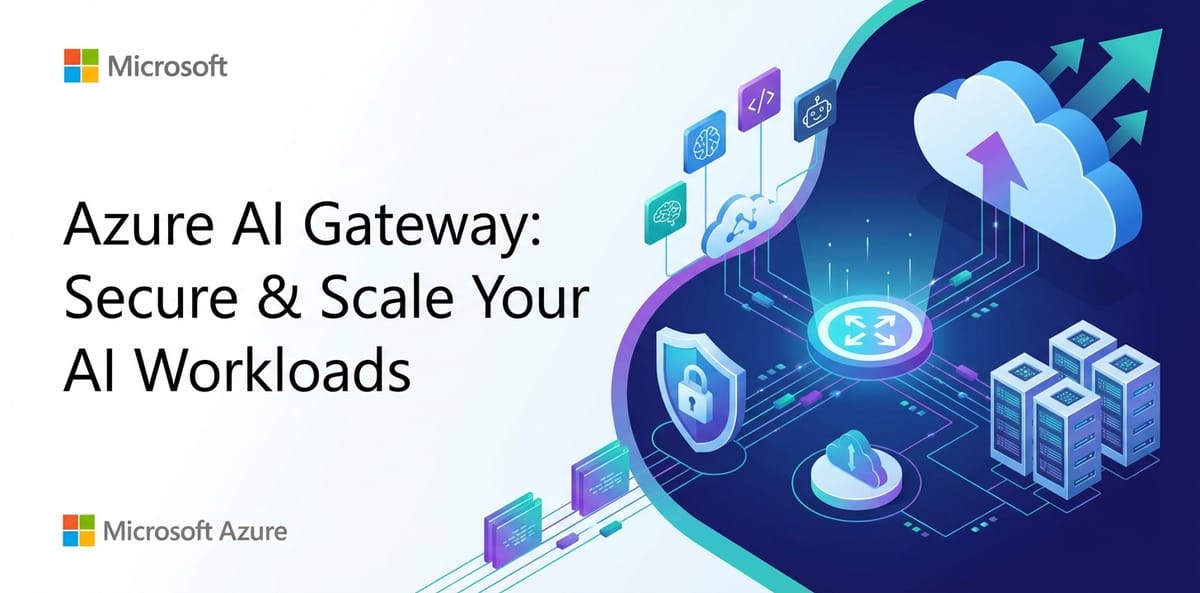
Azure AI Gateway: Secure & Scale Your AI Workloads


The rapid ascent of Artificial Intelligence (AI) has fundamentally reshaped the technological landscape, empowering businesses to unlock unprecedented insights, automate complex processes, and deliver transformative customer experiences. From intelligent chatbots and predictive analytics to sophisticated recommendation engines and groundbreaking research tools, AI is no longer a futuristic concept but a vital operational imperative. At the heart of this revolution lies the complex challenge of deploying, managing, and securing these sophisticated AI models, particularly in dynamic cloud environments like Microsoft Azure. As enterprises increasingly integrate diverse AI services – including the burgeoning category of Large Language Models (LLMs) – they encounter a myriad of complexities related to access control, performance optimization, cost management, and regulatory compliance. It is in addressing these critical challenges that the concept of an AI Gateway emerges as an indispensable architectural component, serving as the central nervous system for secure and scalable AI operations.
An AI Gateway functions as an intelligent intermediary, sitting between client applications and the multitude of AI services, whether they are hosted on Azure Cognitive Services, Azure OpenAI, custom machine learning endpoints, or even third-party AI APIs. This strategic placement allows the gateway to orchestrate and govern every interaction with AI models, abstracting away underlying complexities and enforcing a consistent layer of policy and control. Without such a robust management layer, organizations risk fragmented security protocols, inefficient resource utilization, uncontrolled costs, and a significant impediment to the agility required to innovate rapidly in the AI space. This comprehensive guide will delve into the critical role of an Azure AI Gateway, exploring its core functionalities, the benefits it confers, and best practices for its design and implementation within the Microsoft Azure ecosystem, ultimately enabling businesses to securely and efficiently scale their AI workloads to meet the demands of an increasingly intelligent future.
The AI Revolution and its Intrinsic Challenges in the Cloud Environment
The current era is characterized by an explosion in AI capabilities, marked most notably by the proliferation of sophisticated Large Language Models (LLMs). These foundational models, exemplified by those within Azure OpenAI Service, possess an incredible ability to understand, generate, and process human language, opening doors to applications previously unimaginable. However, this transformative power comes with an inherent set of operational challenges that can quickly overwhelm even the most technologically advanced organizations if not properly addressed. Managing this diverse landscape of AI models, which can range from pre-trained services to custom-built models deployed on Azure Machine Learning, requires a strategic and unified approach.
One of the foremost challenges lies in the sheer complexity of integrating and orchestrating numerous AI models. Enterprises often utilize a mix of models for different tasks: a sentiment analysis model from Azure Cognitive Services, a custom fraud detection model deployed on an Azure Kubernetes Service (AKS) cluster, and an Azure OpenAI model for content generation. Each of these models might have different API specifications, authentication mechanisms, rate limits, and deployment environments. Developing applications that directly interact with each distinct endpoint can lead to tangled codebases, increased development overhead, and a fragile architecture that is difficult to maintain and scale. This fragmented approach also complicates the process of swapping out models or introducing new ones, hindering agility and slowing down innovation cycles.
Security stands as another paramount concern in the realm of AI. Exposing AI model endpoints directly to client applications or internal services without proper safeguards is an open invitation for a host of vulnerabilities. Unauthorized access to AI models can lead to intellectual property theft, data exfiltration, or the malicious manipulation of model outputs. Furthermore, the sensitive nature of data often processed by AI models – ranging from personal identifiable information (PII) to proprietary business data – necessitates stringent data privacy and compliance measures. Techniques like prompt injection, where malicious input can manipulate an LLM into performing unintended actions or revealing confidential information, represent a new class of security threat that traditional API security mechanisms alone may not fully address. Ensuring robust authentication, authorization, data encryption in transit and at rest, and comprehensive auditing becomes not merely a best practice, but a regulatory and ethical imperative.
Scalability and performance are equally critical considerations. As AI applications gain traction and user bases grow, the underlying AI models must be capable of handling increasing volumes of requests without degradation in latency or accuracy. Without proper traffic management, a sudden surge in requests can overwhelm an AI endpoint, leading to service interruptions, poor user experience, and potential financial losses. Managing rate limits imposed by cloud providers or specific AI services, optimizing latency for global users through intelligent routing, and ensuring efficient resource utilization to control costs are complex undertakings. The dynamic nature of AI inference, where resource demands can fluctuate significantly, further complicates traditional scaling strategies. For LLMs, specifically, the concept of "tokens per second" and the cost associated with each token require meticulous tracking and optimization to prevent spiraling expenditures.
Finally, the absence of robust governance and observability mechanisms can render AI initiatives opaque and uncontrollable. Without centralized logging, monitoring, and analytics, it becomes exceedingly difficult to understand how AI models are being used, identify performance bottlenecks, diagnose errors, or track adherence to operational policies. Cost attribution across different teams or applications becomes a guessing game, making financial planning and optimization nearly impossible. Moreover, meeting regulatory requirements such as GDPR, HIPAA, or industry-specific compliance standards demands comprehensive audit trails and transparent data handling practices, which are challenging to achieve with disparate AI service deployments. These intrinsic challenges underscore the fundamental need for a sophisticated architectural layer that can abstract, secure, scale, and govern AI workloads effectively within the Azure cloud.
What is an AI Gateway? A Specialized API Gateway for Intelligence
At its core, an AI Gateway is a specialized form of an API Gateway, meticulously designed to address the unique requirements and challenges inherent in managing Artificial Intelligence services. While a general-purpose API Gateway acts as the single entry point for all API calls, routing requests to appropriate backend services and enforcing common policies like authentication, rate limiting, and caching, an AI Gateway extends these functionalities with AI-specific intelligence. It stands as an intelligent proxy, mediating all interactions between client applications and a diverse ecosystem of AI models, abstracting their underlying complexities and providing a unified, secure, and scalable access layer.
The fundamental objective of an AI Gateway is to simplify the consumption of AI models for developers, enhance the security posture of AI deployments, optimize performance and cost, and provide comprehensive observability into AI operations. By centralizing these critical functions, the gateway transforms a potentially chaotic landscape of disparate AI endpoints into a streamlined, governable, and resilient service.
Let's delve into the core functionalities that define an AI Gateway:
- Unified Access and Abstraction: One of the primary benefits is providing a single, consistent API endpoint for multiple AI models. Instead of applications needing to know the specific URLs, authentication mechanisms, and request/response formats for each individual AI service (e.g., Azure Cognitive Services, Azure OpenAI, custom ML models), they interact solely with the gateway. The gateway then intelligently routes requests to the correct backend AI model, translating request and response formats as necessary. This abstraction dramatically simplifies client-side development and makes it easier to swap out or upgrade AI models without impacting consuming applications.
- Enhanced Security Posture: Security is paramount for AI workloads. An AI Gateway acts as a robust enforcement point for all security policies.
- Authentication & Authorization: It centralizes authentication (e.g., API keys, OAuth 2.0, JWT validation) and authorization, ensuring only legitimate and authorized users or applications can access specific AI models or functionalities. This prevents direct exposure of sensitive AI model credentials.
- Rate Limiting & Throttling: The gateway can enforce granular rate limits per user, application, or AI model, preventing abuse, mitigating DDoS attacks, and ensuring fair usage across shared resources.
- Data Masking & Redaction: For sensitive inputs or outputs, the gateway can automatically identify and redact or mask PII or confidential information before it reaches the AI model or before it's returned to the client, bolstering data privacy and compliance.
- Web Application Firewall (WAF) Integration: By integrating with WAF capabilities, the gateway can protect AI endpoints from common web vulnerabilities and malicious traffic.
- Intelligent Traffic Management: Optimizing the flow of requests to AI models is crucial for performance and cost efficiency.
- Load Balancing & Routing: The gateway can distribute requests across multiple instances of an AI model or route them to different models based on criteria like model version, performance, cost, or geographical proximity. This ensures high availability and optimal resource utilization.
- Caching: For idempotent AI requests or frequently queried data, the gateway can cache responses, significantly reducing latency and offloading requests from backend AI services, thereby saving computational resources and costs.
- Retry Mechanisms & Circuit Breaking: The gateway can implement resilient patterns like automatic retries for transient failures and circuit breakers to prevent cascading failures when a backend AI service becomes unresponsive.
- Comprehensive Observability & Monitoring: Understanding the operational health and usage patterns of AI services is vital.
- Centralized Logging: The gateway captures detailed logs of every AI request and response, including metadata like caller ID, request duration, model invoked, and token usage (especially for LLMs). This provides an invaluable audit trail and aids in debugging.
- Performance Monitoring: It collects metrics on latency, error rates, throughput, and resource utilization across all AI services, feeding into centralized monitoring dashboards.
- Analytics & Reporting: By aggregating and analyzing usage data, the gateway can provide insights into popular models, peak usage times, cost breakdowns, and potential areas for optimization.
- Cost Management and Optimization: AI inference can be expensive, especially with token-based pricing for LLMs.
- Token Usage Tracking: For LLMs, the gateway can meticulously track input and output token counts for each request, enabling precise cost attribution and consumption monitoring.
- Cost-Aware Routing: The gateway can dynamically route requests to the most cost-effective AI model version or provider, perhaps favoring a cheaper, smaller model for less critical tasks while reserving premium models for complex queries.
- Quota Enforcement: It can enforce usage quotas per user or application to prevent runaway costs.
- Prompt Engineering & Versioning (for LLMs): This is a specialized feature crucial for LLM Gateways. The gateway can manage and version prompts, allowing developers to A/B test different prompt strategies, ensure consistent prompt application, and protect against prompt injection by validating or sanitizing inputs.
- Compliance and Governance: An AI Gateway facilitates adherence to regulatory standards by enforcing data residency, access control policies, and providing auditable records of AI interactions. It helps standardize API governance across diverse AI models.
In essence, an AI Gateway elevates the management of AI workloads from a collection of disparate endpoints to a cohesive, secure, and highly optimized service fabric. It empowers organizations to harness the full potential of AI by providing the architectural foundation for control, efficiency, and innovation.
The Azure AI Gateway Landscape: Options and Approaches
Within the Microsoft Azure ecosystem, organizations have a variety of robust services and architectural patterns at their disposal to construct a powerful AI Gateway. While Azure doesn't offer a single product explicitly named "Azure AI Gateway," the capabilities for building one are distributed across several foundational services. The choice of approach often depends on the specific requirements for flexibility, level of control, existing infrastructure, and the nature of the AI workloads being managed.
Azure API Management (APIM) as a Foundational AI Gateway
Azure API Management (APIM) is arguably the most natural and comprehensive choice for building an AI Gateway on Azure. APIM is a fully managed service that provides a scalable and secure entry point for all APIs, and its rich policy engine makes it exceptionally well-suited for AI workloads.
How APIM Extends to AI Workloads:
- Unified API Endpoint: APIM allows you to define a single API endpoint (e.g.,
https://your-apim.azure-api.net/ai/predict) that can front multiple backend AI services. You can create different API operations within APIM for various AI models (e.g.,/sentiment,/generate-text,/custom-prediction). - Centralized Security:
- Authentication & Authorization: APIM excels here, offering out-of-the-box support for API key management, OAuth 2.0, JWT validation, client certificate authentication, and Azure Active Directory integration. This ensures that only authenticated and authorized applications can invoke your AI models, without directly exposing the model's underlying credentials.
- IP Filtering: Policies can restrict access to specific IP ranges.
- Network Integration: APIM can be deployed within a Virtual Network (VNet), providing private connectivity to AI models deployed in other VNets or on-premises, enhancing security and isolating traffic.
- Traffic Management & Optimization:
- Rate Limiting & Throttling: Granular policies can be applied globally, per product, per API, or per operation, preventing abuse and ensuring fair usage of expensive AI resources.
- Caching: APIM's caching policies can significantly reduce latency and offload requests for idempotent AI inference calls, especially useful for static AI model lookups or frequently requested completions.
- Load Balancing & Routing: While APIM primarily routes to a single backend URL for an operation, its policy engine can be used to dynamically change the backend URL based on request parameters (e.g., routing a request for
/generate-texttoopenai-model-v1oropenai-model-v2based on a header or query parameter), effectively implementing a form of model routing. - Transformation Policies: Request and response bodies can be transformed using Liquid templates or C# expressions, allowing APIM to standardize input/output formats across diverse AI models. This is invaluable for abstracting away model-specific peculiarities.
- Observability: APIM integrates seamlessly with Azure Monitor, Application Insights, and Azure Log Analytics, providing comprehensive metrics, logs, and tracing for every API call. This visibility is crucial for monitoring AI model performance, identifying bottlenecks, and debugging issues.
- Developer Portal: APIM offers an integrated developer portal, allowing you to publish documentation for your AI APIs, enable self-service subscription, and provide example code, accelerating developer onboarding.
Limitations Specific to AI (and how to address them):
While APIM is powerful, it has some limitations when it comes to highly specialized AI Gateway features, particularly for LLMs:
- Native Token Counting: APIM doesn't natively understand LLM token usage. To track token costs, you might need to implement custom logic within APIM policies (e.g., using C# expressions to count tokens based on content length or integrate with an external token counter service) or rely on the backend AI service's reporting.
- Advanced Prompt Management: Managing prompt templates, A/B testing prompts, or advanced prompt injection prevention directly within APIM policies can become cumbersome for complex scenarios. This often requires custom logic in an Azure Function or a dedicated service behind APIM.
- Cost-Aware Dynamic Routing: While APIM can route based on rules, implementing sophisticated cost-aware routing (e.g., dynamically switching to a cheaper LLM if performance requirements are met, or based on real-time cost data) often requires more complex policy logic or an external decision service.
Azure Functions / App Service with Custom Logic
For organizations requiring ultimate flexibility or highly specialized AI Gateway functionalities, building a custom gateway layer using Azure Functions or Azure App Service is a viable option.
- Azure Functions: These are serverless compute services ideal for event-driven, short-lived tasks. You can use an HTTP-triggered function to act as an AI Gateway:
- Pros: High flexibility to implement any custom logic (e.g., advanced prompt engineering, custom token counting, complex model routing based on external data, sophisticated data redaction). Cost-effective for intermittent workloads (pay-per-execution).
- Cons: Requires significant development and maintenance effort. Managing security, scaling, and observability needs to be handled programmatically. You might still place APIM in front of Azure Functions for its broader API management capabilities.
- Azure App Service: For more persistent, stateful, or long-running custom gateway logic, App Service provides a platform for hosting web applications and APIs.
- Pros: Full control over the runtime environment, suitable for complex microservices acting as an AI Gateway.
- Cons: Higher operational overhead compared to serverless functions, potentially higher cost if not properly scaled.
Azure Front Door / Application Gateway
These services act as Layer 7 load balancers and web application firewalls, complementing APIM or custom gateway solutions.
- Azure Front Door: Ideal for global, multi-region deployments. It provides global routing, WAF capabilities, DDoS protection, and SSL offloading. It can sit in front of APIM or directly in front of AI endpoints (if simpler routing is sufficient) to provide global scale and security.
- Azure Application Gateway: Best for regional, VNet-integrated deployments. It offers WAF, SSL termination, and advanced routing capabilities within a specific Azure region. It can protect APIM instances or custom AI gateway services.
These services primarily handle ingress traffic, basic routing, and WAF functions, but lack the granular policy enforcement, developer portal, and deep API management features of APIM. They are often used in conjunction with APIM or custom solutions to build a comprehensive AI Gateway architecture.
Open-Source and Third-Party Solutions
For organizations seeking even greater control, flexibility, or specific features not natively available, open-source AI Gateways and API management platforms present compelling alternatives. These solutions can be deployed on Azure Virtual Machines, Azure Kubernetes Service (AKS), or even integrated with Azure services.
One such robust solution is APIPark, an open-source AI gateway and API management platform that offers quick integration of 100+ AI models, unified API formats for invocation, and prompt encapsulation into REST APIs, alongside comprehensive API lifecycle management and high-performance capabilities. APIPark is designed to help developers and enterprises manage, integrate, and deploy AI and REST services with ease, supporting capabilities like end-to-end API lifecycle management, independent API and access permissions for each tenant, and detailed API call logging. Its ability to standardize request data formats across AI models means that changes in underlying AI models or prompts do not affect the application, significantly simplifying AI usage and maintenance. For enterprises, APIPark provides a powerful, flexible, and efficient governance solution for their AI and API landscapes.
Hybrid Approaches
The most common and effective strategy involves a hybrid approach, leveraging the strengths of multiple Azure services:
- APIM as the primary AI Gateway: Handles core API management, security, and traffic policies.
- Azure Functions/Logic Apps: Used for specialized AI-specific logic (e.g., complex prompt orchestration, advanced data redaction, custom token counting, dynamic cost-aware routing that APIM policies alone cannot easily achieve). APIM can call these functions as backend services.
- Azure Front Door/Application Gateway: Provides global/regional WAF, DDoS protection, and high-level routing in front of APIM.
- Azure Monitor/Log Analytics: For comprehensive observability across all components.
This layered approach ensures that organizations can build a highly customizable, secure, and scalable Azure AI Gateway that precisely meets their unique requirements while maximizing the benefits of managed cloud services.
APIPark is a high-performance AI gateway that allows you to securely access the most comprehensive LLM APIs globally on the APIPark platform, including OpenAI, Anthropic, Mistral, Llama2, Google Gemini, and more.Try APIPark now! 👇👇👇
Deep Dive into LLM Gateway Functionality in Azure
The emergence of Large Language Models (LLMs) has introduced a new dimension of complexity and opportunity into the AI landscape. While a general AI Gateway provides foundational services for all AI models, the specific characteristics of LLMs – their conversational nature, token-based billing, potential for bias, and susceptibility to novel attack vectors like prompt injection – necessitate a specialized set of features that transform an AI Gateway into a dedicated LLM Gateway. Within Azure, these functionalities are crucial for effectively managing Azure OpenAI Service, custom-deployed LLMs, or any other LLM endpoint.
The LLM Gateway specifically addresses the unique lifecycle and operational demands of these powerful language models, ensuring they are consumed securely, efficiently, and responsibly.
1. Prompt Management and Versioning
Prompts are the lifeblood of LLM interactions. Crafting effective prompts is both an art and a science, and their quality directly impacts the utility and accuracy of an LLM's output.
- Centralized Prompt Storage: An LLM Gateway can serve as a central repository for prompt templates. Instead of embedding prompts directly into application code, applications can call the gateway with a prompt ID and input variables. The gateway then retrieves the appropriate prompt template, injects the variables, and constructs the final prompt for the LLM. This allows for prompt changes without redeploying applications.
- Prompt Versioning & A/B Testing: Different versions of a prompt can be stored and managed. The gateway can route a percentage of traffic to a new prompt version (A/B testing) to evaluate its performance (e.g., response quality, token usage, user satisfaction) before a full rollout. This iterative refinement is critical for optimizing LLM interactions.
- Prompt Validation & Sanitization: To counter prompt injection attacks or prevent malformed requests, the gateway can validate and sanitize user-provided inputs that are incorporated into prompts. It can also enforce rules on prompt structure or content.
- Prompt Encapsulation into REST API: As mentioned with APIPark, the ability to quickly combine AI models with custom prompts to create new, specialized APIs (e.g., a "summarize document" API or a "translate to French" API) simplifies development and ensures consistency. The LLM Gateway abstracts the underlying LLM calls and prompt logic into a clean, easy-to-consume REST endpoint.
2. Token Management and Cost Optimization
LLM usage is often billed by the number of input and output tokens. Managing and optimizing these costs is a significant concern for enterprises.
- Real-time Token Counting: The LLM Gateway can perform accurate, real-time counting of input and output tokens for each request and response. This granular data is essential for cost attribution, budgeting, and identifying potential areas of waste.
- Cost-Aware Model Routing: Based on real-time cost data, performance metrics, or predefined rules, the gateway can intelligently route requests to different LLMs or model versions. For instance, less critical tasks might be routed to a cheaper, smaller LLM, while complex or critical tasks go to a more powerful but expensive model. This dynamic routing can significantly reduce overall inference costs.
- Quota Enforcement & Budget Management: The gateway can enforce token-based quotas per user, application, or team, preventing unexpected cost overruns. It can also trigger alerts when usage approaches predefined budget limits.
- Response Caching for LLMs: For identical or highly similar LLM prompts, the gateway can cache responses. This not only reduces latency but, more importantly, avoids redundant token consumption, leading to substantial cost savings. This is particularly effective for read-heavy applications with recurring queries.
3. Response Moderation & Content Filtering
Ensuring the safety, compliance, and appropriateness of LLM outputs is paramount.
- Post-Processing & Filtering: The LLM Gateway can inspect LLM responses for undesirable content (e.g., hate speech, violence, profanity) using pre-trained content moderation models (like Azure AI Content Safety) or custom rules. If problematic content is detected, the response can be blocked, sanitized, or flagged for human review.
- Sensitive Data Redaction in Responses: Similar to input data masking, the gateway can identify and redact sensitive information (PII, financial data) from LLM-generated responses before they reach the end-user, enhancing data privacy.
- Guardrails & Hallucination Mitigation: While challenging, the gateway can integrate with techniques or services designed to reduce LLM hallucinations or steer responses towards desired guardrails, enhancing the reliability of AI outputs.
4. Model Routing & Fallback Strategies
Reliability and performance are critical for production AI applications.
- Dynamic Model Selection: The gateway can implement sophisticated logic to select the best LLM for a given request based on various factors:
- Performance: Route to the model with the lowest latency or highest throughput.
- Cost: Route to the most cost-effective model given the current context.
- Availability: Route away from models experiencing issues.
- Capabilities: Route to a specific model known to excel at certain types of queries (e.g., summarization vs. code generation).
- Fallback Mechanisms: If a primary LLM service becomes unavailable or returns an error, the gateway can automatically failover to a secondary model or a different provider, ensuring continuous service availability and resilience.
- Version Control & Rollbacks: Managing different versions of an LLM allows the gateway to direct traffic to specific versions, facilitate A/B testing, and enable quick rollbacks to a previous stable version if issues arise.
5. Observability for LLMs
Traditional API monitoring needs to be augmented with LLM-specific metrics.
- Detailed LLM-Specific Logging: Beyond standard API logs, the gateway captures information like prompt content (optionally sanitized), full LLM response, input/output token counts, model version used, latency breakdown (gateway processing vs. LLM inference), and moderation results.
- Custom Metrics & Dashboards: Integrate token usage, cost per request, hallucination rates (if detectable), and content moderation flags into Azure Monitor dashboards, providing LLM-specific insights.
- Request Tracing: End-to-end tracing of LLM requests, showing the path through the gateway, prompt processing, LLM call, and response moderation, is crucial for debugging complex AI workflows.
6. Security for LLMs (Beyond General API Security)
While general API security applies, LLMs introduce unique concerns.
- Prompt Injection Prevention: The gateway can act as the first line of defense, implementing rules or even using a separate AI model to detect and block malicious prompt injection attempts before they reach the target LLM.
- Sensitive Data Handling: Enforcing strict policies on what data is allowed in prompts and responses, coupled with automatic redaction, is critical.
- Access Control Granularity: Controlling which applications or users can access specific LLMs or even specific prompt templates.
By incorporating these specialized functionalities, an LLM Gateway in Azure transforms the management of powerful language models from a complex, risky, and expensive endeavor into a controlled, efficient, and secure operation. It empowers organizations to confidently integrate LLMs into their applications, knowing that the underlying infrastructure is robustly managed and optimized.
Designing and Implementing an Azure AI Gateway: Best Practices
Building an effective Azure AI Gateway requires careful planning and adherence to best practices across several key architectural and operational domains. The goal is to create a solution that is not only functional but also secure, scalable, cost-efficient, and easily maintainable.
1. Security First Approach
Security must be foundational to any AI Gateway design, especially given the sensitive nature of data often processed by AI models and the intellectual property they represent.
- Zero Trust Principles: Assume breach and verify explicitly. Every request, whether internal or external, must be authenticated and authorized.
- Least Privilege Access: Grant only the minimum necessary permissions to users, applications, and services interacting with the gateway and the underlying AI models. Use Azure Managed Identities for Azure services to authenticate securely without managing credentials.
- Robust Authentication & Authorization:
- Leverage Azure Active Directory (Azure AD) for identity management.
- Implement API key management, OAuth 2.0, or JWT validation via Azure API Management policies.
- Use Azure Role-Based Access Control (RBAC) to define granular permissions for managing the gateway itself.
- Network Isolation: Deploy the AI Gateway (e.g., Azure API Management) into a Virtual Network (VNet). This allows for private, secure communication with backend AI services (like Azure Machine Learning endpoints or Azure OpenAI instances configured for VNet integration) and restricts inbound/outbound traffic. Use Azure Private Endpoints for accessing AI services privately.
- Data Encryption: Ensure all data is encrypted in transit (TLS/SSL) and at rest (Azure Storage encryption for logs, configurations).
- Web Application Firewall (WAF): Place Azure Application Gateway or Azure Front Door with WAF capabilities in front of your AI Gateway to protect against common web vulnerabilities, DDoS attacks, and sophisticated bot traffic.
- Sensitive Data Handling: Implement policies for data masking, redaction, or tokenization within the gateway for any sensitive data flowing to or from AI models. Ensure compliance with data residency and privacy regulations.
2. Scalability and Resiliency
AI workloads can be highly variable, demanding a gateway that can scale on demand and withstand failures.
- Auto-Scaling: Configure Azure services (APIM, Azure Functions, App Service) to auto-scale based on load metrics (CPU, request rate). This ensures that the gateway can handle peak loads without manual intervention and scales down during low periods to save costs.
- Regional Deployment & Geo-Redundancy: For global applications, deploy the AI Gateway across multiple Azure regions using Azure Front Door for global traffic distribution. This provides disaster recovery capabilities and low-latency access for users worldwide.
- Load Balancing: Utilize Azure Load Balancer or Azure Front Door/Application Gateway to distribute traffic efficiently across gateway instances and backend AI model instances.
- Circuit Breakers & Retries: Implement resilient patterns within the gateway. Circuit breakers can prevent cascading failures by quickly failing requests to an unhealthy backend AI service. Retry policies can handle transient errors gracefully.
- Asynchronous Processing (for long-running tasks): For AI tasks that take a long time to complete, consider an asynchronous pattern using Azure Queue Storage or Azure Service Bus to decouple the client request from the AI inference, providing a more responsive user experience.
3. Comprehensive Observability
Visibility into the gateway's operation and the performance of underlying AI models is crucial for diagnostics, optimization, and compliance.
- Centralized Logging: Aggregate all logs from APIM, Azure Functions, Application Gateway, and backend AI services into Azure Log Analytics. This provides a single pane of glass for monitoring and troubleshooting. Capture detailed information including request/response headers, body (sanitized), latency, errors, and specific AI metrics (e.g., token counts for LLMs).
- Monitoring & Alerting: Use Azure Monitor to collect and visualize key metrics such as API call volume, error rates, latency, CPU/memory utilization, and token consumption. Configure proactive alerts for anomalies, performance degradations, or security incidents.
- Distributed Tracing: Implement end-to-end tracing using Application Insights to understand the full lifecycle of a request as it passes through the gateway and interacts with multiple backend AI services. This helps pinpoint performance bottlenecks.
- Cost Monitoring: Track AI model usage and costs through Azure Cost Management and custom metrics from the gateway (e.g., token usage per application).
4. Cost Management and Optimization
AI services, especially LLMs, can incur significant costs. The gateway should be designed to optimize expenditures.
- Granular Quotas: Enforce usage quotas (e.g., requests per minute, tokens per month) per application or user to prevent runaway costs.
- Cost-Aware Routing: Implement intelligent routing policies within the gateway to direct traffic to the most cost-effective AI models or instances, considering performance requirements.
- Caching: Aggressively cache AI responses where appropriate to reduce the number of calls to expensive backend AI services.
- Right-Sizing: Continuously monitor resource utilization of your gateway components and adjust scaling parameters or service tiers to match actual demand, avoiding over-provisioning.
- Budget Alerts: Integrate with Azure Cost Management to set up alerts for budget thresholds.
5. Deployment and Management Best Practices
Efficient deployment and ongoing management are critical for a stable and agile AI Gateway.
- Infrastructure as Code (IaC): Define your AI Gateway infrastructure (APIM instances, Azure Functions, networking, WAF) using IaC tools like Azure Resource Manager (ARM) templates, Bicep, or Terraform. This ensures consistent, repeatable, and version-controlled deployments.
- CI/CD Pipelines: Implement Continuous Integration and Continuous Deployment (CI/CD) pipelines for deploying gateway configurations, policies, and any custom code (Azure Functions). This automates the deployment process, reduces manual errors, and speeds up innovation.
- API Lifecycle Management: Treat your AI APIs as products. Use the gateway's capabilities (like APIM's developer portal) for designing, publishing, versioning, and eventually deprecating AI APIs.
- Version Control: Store all gateway configurations, policies, and custom code in a version control system (e.g., Azure DevOps Repos, GitHub).
- Documentation: Maintain comprehensive documentation for your AI APIs, including usage examples, authentication details, rate limits, and expected behaviors. The developer portal can serve as the primary source.
Table: Comparison of Azure Services for AI Gateway Components
| Feature / Service | Azure API Management (APIM) | Azure Functions / App Service (Custom) | Azure Front Door / Application Gateway |
|---|---|---|---|
| Primary Role | API Gateway, policy enforcement, developer portal | Custom logic, highly flexible AI-specific processing | Global/Regional Load Balancer, WAF, DDoS protection |
| Authentication/Auth. | Robust (API keys, OAuth, JWT, AAD) | Custom (via code), integrates with AAD | Basic (IP filter), offloads to backend |
| Rate Limiting/Throttling | Granular policies, flexible | Custom (via code) | Basic (WAF rate limits, DDoS) |
| Caching | Built-in response caching | Custom (Redis, etc.) | No native API response caching |
| Request/Response Transform | Rich policy engine (Liquid, C#) | Full flexibility (any language) | Basic URL rewrite, header manipulation |
| LLM Token Management | Custom policies (C# expressions), external integration | Full flexibility (custom code) | No |
| Prompt Management | Limited (requires custom logic/external service) | Full flexibility (custom code, DB) | No |
| Cost-Aware Routing | Moderate (policy-driven rules) | High (complex algorithms via code) | No |
| Observability Integration | Excellent (Azure Monitor, App Insights, Log Analytics) | Excellent (Azure Monitor, App Insights, Log Analytics) | Good (Azure Monitor, Log Analytics) |
| Developer Portal | Yes, built-in | No (requires custom build) | No |
| Deployment Complexity | Moderate | High (for comprehensive gateway) | Low-Moderate |
| Cost Model | Consumption/Tier-based | Consumption/Tier-based | Tier-based |
By meticulously applying these best practices, organizations can construct an Azure AI Gateway that not only addresses current operational demands but also provides a resilient, secure, and adaptable foundation for future AI innovations and scaling initiatives.
Use Cases and Real-World Scenarios for an Azure AI Gateway
The strategic implementation of an Azure AI Gateway transforms theoretical benefits into tangible operational advantages across a diverse range of real-world scenarios. It moves beyond simply connecting to AI models, instead focusing on enabling controlled, efficient, and scalable AI consumption within enterprise environments.
1. Enterprise-Wide AI Platform for Multiple Teams
Scenario: A large enterprise has numerous departments (e.g., Marketing, Sales, Product Development, HR) all leveraging various AI models. Marketing uses an Azure OpenAI model for content generation, Sales uses a custom ML model for lead scoring, Product Development uses Azure Cognitive Services for image analysis, and HR uses an LLM for internal knowledge base Q&A. Each team has different usage patterns, security requirements, and budget constraints.
AI Gateway Solution: An Azure AI Gateway, primarily built with Azure API Management and augmented by Azure Functions for LLM-specific logic, provides a centralized "AI-as-a-Service" platform. * Unified Access: Each team consumes AI through a single gateway endpoint, abstracting away the complexity of diverse backend AI services. * Access Control & Isolation: APIM's product and subscription management capabilities allow administrators to create distinct API products for each department, granting specific access to relevant AI models. Each team can have its own API keys, with access policies enforced at the gateway level. * Cost Attribution & Quotas: The gateway tracks individual team usage (requests, tokens for LLMs) and enforces quotas, enabling accurate cost attribution to each department and preventing unexpected budget overruns. * Consistent Security: All AI traffic passes through the gateway, ensuring every request is authenticated, authorized, and potentially sanitized, maintaining a consistent security posture across the entire organization. * Developer Experience: The APIM Developer Portal provides a central hub for all internal teams to discover available AI APIs, access documentation, and generate API keys, fostering self-service and accelerating AI adoption.
2. Serving External AI APIs Securely and Monetizing AI Services
Scenario: A company wants to expose its proprietary AI models (e.g., a highly accurate industry-specific fraud detection model or a unique data analytics algorithm) to external partners or customers as a paid service, similar to a SaaS offering. Security, reliability, and monetization are critical.
AI Gateway Solution: An Azure AI Gateway with robust security, traffic management, and metering capabilities is indispensable. * Secure Exposure: The gateway acts as the sole public-facing endpoint, shielding the backend AI models from direct exposure. APIM enforces strong authentication (e.g., OAuth 2.0, API keys with granular permissions) for external consumers. Azure Front Door with WAF protection provides global DDoS and web attack mitigation. * Traffic Management & SLA Enforcement: The gateway enforces rate limits per customer or subscription tier, ensuring fair usage and preventing resource monopolization. It can also implement caching for common requests to improve performance and reduce backend load. * Monetization & Metering: APIM's analytics capabilities provide detailed usage reports, which can be integrated with billing systems to accurately charge customers based on API calls, data processed, or tokens consumed (for LLMs). Custom policies can augment this for fine-grained metering. * Versioning & Lifecycle: New versions of the AI model can be deployed behind the gateway, and traffic can be gradually shifted to the new version using APIM's revision management, ensuring minimal disruption to paying customers.
3. Cost-Optimizing LLM Inference at Scale
Scenario: An application heavily relies on LLMs for various tasks like customer support, content summarization, and code generation. The cost of LLM inference is significant, and there's a need to balance performance with cost-efficiency. Different LLMs (e.g., Azure OpenAI's GPT-4, GPT-3.5-Turbo, or even open-source models deployed on AKS) have varying costs and capabilities.
AI Gateway Solution (LLM Gateway Focus): A specialized LLM Gateway built using a combination of APIM and Azure Functions for advanced logic. * Intelligent Model Routing: The gateway dynamically routes requests to the most appropriate LLM based on specific criteria. For example: * Low-priority internal summarization requests go to a cheaper GPT-3.5-Turbo. * High-priority customer-facing chat responses go to GPT-4. * Sensitive data queries are routed to an LLM hosted in a secure, isolated environment. * Requests needing specific domain knowledge might be routed to a fine-tuned open-source model. * This logic can be implemented via Azure Function called by APIM policies. * Token-Aware Caching: For common conversational prompts or knowledge base queries, the gateway caches LLM responses, significantly reducing redundant token usage and improving response times. * Prompt Engineering & Versioning: The gateway manages different prompt templates for various tasks. Developers can test new prompt strategies, and the gateway can A/B test prompt versions, routing a small percentage of traffic to a new prompt to evaluate its effectiveness and cost implications before full rollout. * Real-time Cost Monitoring: The gateway meticulously tracks input and output tokens for every LLM call, providing real-time cost visibility and alerting for potential overspending, enabling proactive cost control.
4. Enforcing Data Privacy and Compliance for AI Models
Scenario: An organization operating in a highly regulated industry (e.g., healthcare, finance) uses AI models that process sensitive customer data. They need to ensure strict adherence to regulations like GDPR, HIPAA, and industry-specific compliance standards, including data residency, PII redaction, and audit trails.
AI Gateway Solution: A highly secure and auditable Azure AI Gateway. * Data Masking/Redaction: Before sending data to any AI model, the gateway automatically identifies and redacts or masks PII, PHI (Protected Health Information), or financial data from the input. Similarly, it scrubs any sensitive data from the AI model's response before it reaches the client. This is often achieved with Azure Functions integrated with Azure Purview or custom regex patterns. * Access Control & Audit Trails: The gateway enforces strict role-based access to AI models and maintains immutable, detailed audit logs of every request, including who accessed which model, what data was sent (pre-redaction), and the response. These logs are stored in Azure Log Analytics for long-term retention and compliance reporting. * Data Residency: Policies within the gateway (and underlying Azure infrastructure) ensure that data processed by AI models stays within specified geographical regions to comply with data residency requirements. * Content Moderation: For LLMs, the gateway integrates with Azure AI Content Safety or similar services to filter out any inappropriate, harmful, or biased content generated by the LLM, ensuring responsible AI usage.
These scenarios illustrate how an Azure AI Gateway transcends simple connectivity to become a pivotal strategic asset, enabling enterprises to harness the power of AI securely, efficiently, and responsibly at scale. It provides the necessary abstraction, control, and intelligence to navigate the complexities of modern AI deployments.
Conclusion: Empowering the Future of AI with Azure AI Gateways
The journey through the intricate world of Artificial Intelligence reveals a landscape teeming with innovation, but also fraught with challenges. As enterprises increasingly embed AI – particularly the transformative capabilities of Large Language Models – into the very fabric of their operations, the need for a robust, intelligent, and centralized management layer becomes unequivocally clear. The Azure AI Gateway emerges not merely as an optional component, but as an indispensable architectural cornerstone for any organization aiming to securely and efficiently scale their AI workloads within the dynamic Azure cloud environment.
We have explored how the inherent complexities of diverse AI models, the critical demands of security, the imperative for scalable performance, and the necessity for stringent governance collectively underscore the vital role of an AI Gateway. It stands as the intelligent intermediary, abstracting away the underlying intricacies of AI services and providing a unified control plane. By leveraging powerful Azure services such as Azure API Management, complemented by Azure Functions for bespoke logic, and fortified by Azure Front Door or Application Gateway for advanced security and global routing, organizations can construct a highly customized and resilient AI Gateway.
Furthermore, the specific demands of Large Language Models have necessitated the evolution into an LLM Gateway, equipping it with specialized functionalities. From centralized prompt management and versioning to intelligent token tracking for cost optimization, and from dynamic model routing for performance and cost balancing to comprehensive content moderation and advanced security features, an LLM Gateway ensures that the powerful capabilities of these models are harnessed responsibly and economically.
The best practices for designing and implementing an Azure AI Gateway emphasize a "security first" mindset, prioritizing robust authentication, network isolation, and data privacy. They advocate for built-in scalability and resilience through auto-scaling, geo-redundancy, and circuit breaker patterns. Comprehensive observability, achieved through centralized logging, monitoring, and tracing, provides the crucial insights needed for continuous optimization and rapid troubleshooting. Finally, a strong emphasis on cost management, along with modern deployment practices like Infrastructure as Code and CI/CD, ensures the gateway remains efficient and agile.
In conclusion, an Azure AI Gateway empowers developers with simplified access to AI, provides operations teams with unprecedented control and visibility, and assures business managers of secure, cost-effective, and compliant AI deployments. It transforms a collection of disparate AI endpoints into a cohesive, governed, and highly optimized service fabric. As AI continues its relentless march forward, the strategic deployment of an Azure AI Gateway will not just be a competitive advantage, but a fundamental prerequisite for unlocking the full potential of Artificial Intelligence, driving innovation, and securing a data-driven future.
Frequently Asked Questions (FAQs)
1. What is an Azure AI Gateway, and why do I need one? An Azure AI Gateway is a specialized API Gateway designed to manage, secure, and scale access to various Artificial Intelligence (AI) models and services within the Azure ecosystem. You need one to centralize security (authentication, authorization, rate limiting), abstract away the complexity of diverse AI models, optimize performance and cost, and provide comprehensive observability and governance over your AI workloads. This is particularly crucial for Large Language Models (LLMs) due to their unique cost and security considerations.
2. Which Azure services are typically used to build an Azure AI Gateway? The core service for building an Azure AI Gateway is often Azure API Management (APIM), which provides robust API management features, security policies, and a developer portal. It can be augmented with Azure Functions or Azure App Service for implementing custom AI-specific logic (e.g., advanced prompt management, complex cost-aware routing, token counting). Azure Front Door or Azure Application Gateway are often placed in front for global/regional load balancing, Web Application Firewall (WAF) protection, and DDoS mitigation.
3. How does an LLM Gateway differ from a general AI Gateway? An LLM Gateway is a specialized type of AI Gateway that focuses on the unique requirements of Large Language Models. Beyond general AI Gateway features, an LLM Gateway provides capabilities like: * Prompt Management: Storing, versioning, and A/B testing prompt templates. * Token Management: Real-time tracking of input/output tokens for cost attribution and optimization. * Cost-Aware Routing: Dynamically choosing LLMs based on cost, performance, and specific task. * Response Moderation: Filtering LLM outputs for safety and compliance. * Prompt Injection Prevention: Specific security measures against malicious prompt manipulation.
4. How does an Azure AI Gateway help with cost optimization for LLMs? An Azure AI Gateway optimizes LLM costs by: * Token Tracking: Accurately measuring input and output tokens for precise cost attribution. * Cost-Aware Routing: Directing requests to the most cost-effective LLM variant or service based on the task's requirements. * Caching: Storing responses for common prompts to reduce redundant LLM calls and associated token usage. * Quota Enforcement: Setting usage limits per application or user to prevent unexpected overspending.
5. Can I use an Azure AI Gateway to manage both Azure-native AI services and third-party or custom AI models? Absolutely. One of the primary benefits of an Azure AI Gateway is its ability to provide a unified interface for a diverse range of AI services. Whether your models are hosted on Azure Cognitive Services, Azure OpenAI, custom machine learning endpoints deployed on Azure Kubernetes Service, or even external third-party AI APIs, the gateway can act as a single, consistent entry point, abstracting their specific implementation details and enforcing uniform policies across all of them.
🚀You can securely and efficiently call the OpenAI API on APIPark in just two steps:
Step 1: Deploy the APIPark AI gateway in 5 minutes.
APIPark is developed based on Golang, offering strong product performance and low development and maintenance costs. You can deploy APIPark with a single command line.
curl -sSO https://download.apipark.com/install/quick-start.sh; bash quick-start.sh

In my experience, you can see the successful deployment interface within 5 to 10 minutes. Then, you can log in to APIPark using your account.

Step 2: Call the OpenAI API.