Azure AI Gateway: Simplify, Secure, and Scale Your AI
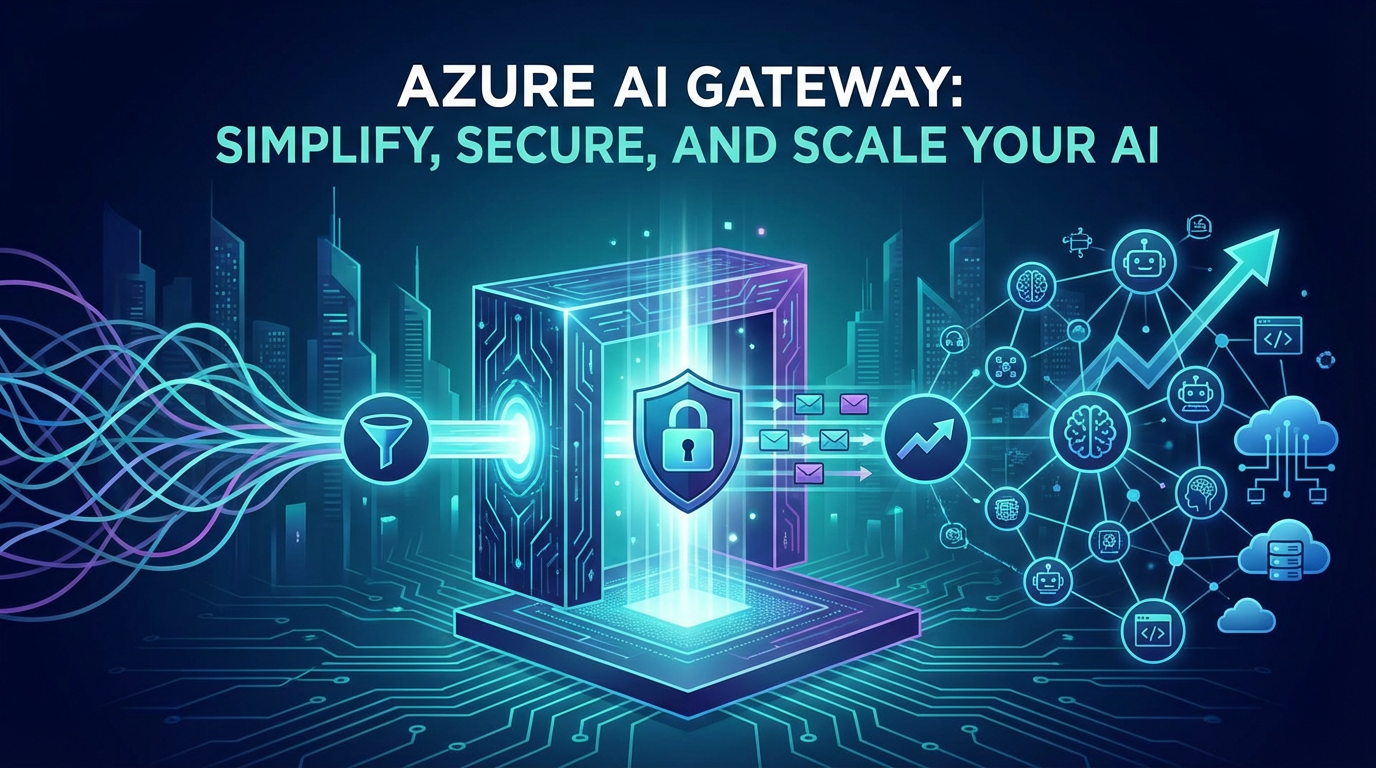


The relentless march of artificial intelligence (AI) is transforming every facet of industry, from automating mundane tasks to powering groundbreaking scientific discoveries. Businesses across the globe are keenly aware of AI's immense potential to unlock unprecedented efficiency, create novel customer experiences, and generate profound insights from vast datasets. However, harnessing this power is often far from straightforward. The landscape of AI models, services, and deployment methodologies is fragmented and complex, presenting significant challenges in terms of integration, management, security, and scalability. This is where the concept of an AI Gateway emerges as a critical architectural component, acting as the intelligent intermediary that orchestrates and optimizes the interaction between your applications and the diverse world of AI services.
Specifically, for enterprises entrenched in the Microsoft Azure ecosystem, the Azure AI Gateway represents a strategic imperative. It's not merely a theoretical construct but a practical realization through various Azure services that collectively empower organizations to simplify the consumption of AI, fortify their AI deployments against myriad threats, and scale their intelligent applications with unwavering reliability and performance. This comprehensive exploration will delve into the intricacies of what constitutes an Azure AI Gateway, its profound benefits, the underlying technologies that bring it to life, and how it addresses the most pressing concerns in modern AI adoption, particularly in the realm of Large Language Models (LLMs). We will unravel how a robust API Gateway infrastructure becomes the backbone for an effective AI strategy, evolving into an LLM Gateway to meet the unique demands of generative AI.
The AI Revolution and Its Architectural Demands
The current wave of AI innovation, fueled by advancements in machine learning, deep learning, and transformer architectures, has ushered in an era where AI is no longer a niche technology but a pervasive operational necessity. From sophisticated natural language processing (NLP) models capable of generating human-like text to computer vision systems that can interpret complex visual data, the range and capability of AI services are expanding exponentially. Enterprises are leveraging these capabilities for chatbots, predictive analytics, content generation, fraud detection, personalized recommendations, and much more.
However, integrating these powerful AI models into existing enterprise applications and workflows introduces a unique set of challenges:
- Diversity of Models and Endpoints: AI models come in various forms – pre-trained cognitive services, custom-built machine learning models, and foundational models from different providers (e.g., Azure OpenAI Service, Hugging Face, proprietary APIs). Each might have its own API specification, authentication mechanism, and deployment environment.
- Complex Authentication and Authorization: Securing access to AI models requires robust mechanisms. Managing API keys, tokens, and user permissions across a multitude of services can quickly become an unmanageable chore.
- Performance and Scalability: AI inference can be computationally intensive. Applications need to invoke AI models with low latency and handle fluctuating demand, often requiring dynamic scaling and efficient load balancing.
- Cost Management and Optimization: AI services, especially LLMs, can incur significant costs based on usage (e.g., tokens processed, requests made). Monitoring and optimizing these costs are crucial for maintaining budget discipline.
- Data Governance and Compliance: AI models often process sensitive data. Ensuring data privacy, residency, and compliance with regulations like GDPR, HIPAA, or local data protection laws is paramount.
- Prompt Management and Versioning (especially for LLMs): For generative AI, the quality and consistency of prompts are critical. Managing, versioning, and A/B testing prompts across different applications can be complex.
- Observability and Monitoring: Understanding how AI models are being used, identifying performance bottlenecks, and troubleshooting issues require comprehensive logging, metrics, and alerting.
- Resilience and Reliability: AI applications need to be resilient to failures in individual AI services or network disruptions, requiring retry mechanisms, circuit breakers, and failover strategies.
These challenges underscore the need for an intelligent orchestration layer – a central point of control that can abstract away the underlying complexity of diverse AI services, enforce security policies, optimize performance, and provide comprehensive observability. This layer is precisely what an AI Gateway delivers.
The Foundation: Understanding the API Gateway
Before diving deeper into the specifics of an AI Gateway, it’s essential to grasp the concept of a traditional API Gateway. In modern microservices architectures, an API Gateway serves as the single entry point for all client requests into the system. Instead of clients interacting directly with individual microservices, they communicate with the API Gateway, which then intelligently routes requests to the appropriate backend service.
Key functionalities of a generic API Gateway include:
- Request Routing: Directing incoming requests to the correct backend service based on defined rules.
- Load Balancing: Distributing traffic across multiple instances of a service to ensure high availability and optimal performance.
- Authentication and Authorization: Verifying the identity of clients and ensuring they have the necessary permissions to access requested resources.
- Rate Limiting and Throttling: Controlling the number of requests a client can make within a specified timeframe to prevent abuse and ensure fair usage.
- Monitoring and Analytics: Collecting metrics on API usage, performance, and errors.
- Request/Response Transformation: Modifying requests before sending them to services and responses before sending them back to clients (e.g., data format conversion, header manipulation).
- Caching: Storing frequently accessed responses to reduce latency and load on backend services.
- Security Policies: Implementing Web Application Firewall (WAF) rules, DDoS protection, and other security measures.
An API Gateway fundamentally simplifies client applications, centralizes cross-cutting concerns, improves security, and enhances the overall resilience and scalability of distributed systems.
Evolution to the AI Gateway: Addressing AI's Unique Demands
While a traditional API Gateway provides a solid foundation, the unique characteristics of AI services necessitate an evolution of these capabilities. An AI Gateway extends the core functionalities of an API Gateway with specialized features tailored for AI workloads. It becomes the intelligent fabric that weaves together disparate AI models and services into a cohesive, manageable, and secure ecosystem.
Here’s how an AI Gateway differentiates itself:
- Unified Access to Heterogeneous AI Models: Instead of a single backend service, an AI Gateway might front-end dozens of AI models – some hosted in Azure Cognitive Services, others as custom models in Azure Machine Learning, and still others as external third-party APIs or specialized LLMs. The gateway provides a consistent API interface to abstract away this diversity.
- AI-Specific Security Policies: Beyond generic authentication, an AI Gateway can enforce security policies relevant to AI, such as data masking for sensitive PII before it reaches an AI model, or content moderation for AI-generated outputs.
- Intelligent Routing and Fallback: An AI Gateway can dynamically route requests to different AI models based on factors like performance, cost, model version, or even specific prompt characteristics. It can implement fallback strategies if a primary model fails or returns a low-confidence response.
- Prompt Engineering and Management: For generative AI, the gateway can store, version, and apply prompt templates, allowing developers to invoke AI capabilities without needing to manage complex prompt engineering logic in their applications. This includes injecting system messages, few-shot examples, or safety instructions.
- Cost Optimization for AI Inference: An AI Gateway can monitor token usage for LLMs, enforce budget limits, and route requests to the most cost-effective model instance or provider.
- Model Versioning and Lifecycle Management: It can manage different versions of AI models, enabling seamless updates, A/B testing of new models, and graceful deprecation of older ones.
- Observability for AI Metrics: Beyond traditional API metrics, an AI Gateway tracks AI-specific metrics like token count, inference latency, model confidence scores, and hallucination rates.
The AI Gateway effectively creates a single pane of glass for all AI interactions, transforming a chaotic collection of endpoints into a harmonized, controlled, and optimized AI landscape.
The Specialized Realm: The LLM Gateway
Within the broader category of AI Gateways, the LLM Gateway represents a further specialization driven by the explosive growth and unique characteristics of Large Language Models (LLMs). Generative AI, powered by LLMs, presents its own set of challenges and opportunities that warrant dedicated gateway capabilities.
What makes an LLM Gateway unique?
- Prompt Engineering as a Service: The effectiveness of LLMs heavily relies on well-crafted prompts. An LLM Gateway can abstract away prompt construction, allowing applications to send simple requests while the gateway dynamically injects complex, optimized prompts, system instructions, and contextual data. This allows for prompt versioning and A/B testing directly at the gateway level, decoupling prompt logic from application code.
- Context Management: Maintaining conversational context across multiple turns is crucial for effective chatbots and interactive AI experiences. An LLM Gateway can manage and persist conversational history, injecting it into subsequent prompts without burdening the client application.
- Token Management and Cost Control: LLM costs are often calculated per token. An LLM Gateway can monitor token usage in real-time, enforce quotas, and route requests to different LLM providers or models based on token limits or cost-effectiveness. It can also estimate token usage pre-emptively.
- Model Interoperability and Vendor Agnosticism: The LLM landscape is rapidly evolving with models from OpenAI, Anthropic, Google, Meta, and open-source communities. An LLM Gateway can normalize API interfaces across these diverse providers, preventing vendor lock-in and allowing organizations to switch models or providers with minimal application changes.
- Safety and Content Moderation: LLMs can generate undesirable, biased, or harmful content. An LLM Gateway can integrate content moderation filters (e.g., Azure AI Content Safety) to scan both input prompts and output responses, blocking or redacting inappropriate content.
- Hallucination Mitigation and Response Validation: While challenging, an LLM Gateway can implement heuristics or integrate with external fact-checking services to flag or attempt to mitigate LLM "hallucinations" or factually incorrect statements before they reach end-users.
- Streaming Support: Many LLM APIs support streaming responses for a faster perceived user experience. An LLM Gateway must be capable of efficiently handling and proxying these streaming connections.
An LLM Gateway is therefore not just about routing traffic; it's about intelligently managing the conversational flow, optimizing costs, ensuring safety, and providing flexibility in the rapidly changing world of generative AI.
Azure's Ecosystem for AI and the Role of the AI Gateway
Microsoft Azure offers a comprehensive suite of AI services, designed to cater to various needs, from pre-built cognitive APIs to powerful platforms for custom model development. The challenge for enterprises is often how to knit these disparate services together seamlessly and securely. An Azure AI Gateway, constructed using native Azure services, provides that crucial unifying layer.
Key Azure AI services that benefit from an AI Gateway:
- Azure OpenAI Service: Provides access to OpenAI's powerful language models (GPT-3.5, GPT-4, DALL-E) and embeddings models within Azure's secure and compliant infrastructure.
- Azure Cognitive Services: A collection of pre-built AI APIs for vision, speech, language, and decision-making (e.g., Azure AI Vision, Azure AI Speech, Azure AI Language, Anomaly Detector).
- Azure Machine Learning: A platform for building, training, deploying, and managing custom machine learning models at scale.
- Azure AI Search: Formerly Azure Cognitive Search, an AI-powered cloud search service for enriching and indexing data.
An Azure AI Gateway acts as the orchestrator, enabling applications to interact with these services through a single, consistent interface, regardless of their underlying complexity or specific API contracts.
Core Pillars of the Azure AI Gateway: Simplify, Secure, Scale
The fundamental promise of an Azure AI Gateway revolves around three critical objectives: simplification, security, and scalability. Each of these pillars is meticulously addressed by leveraging Azure's robust cloud infrastructure and specialized services.
1. Simplification: Unifying AI Access and Management
The sheer diversity of AI models and endpoints can be daunting. An Azure AI Gateway streamlines this complexity by offering a unified approach to AI consumption.
- Unified Access Point for Diverse AI Models: Imagine your application needing to use Azure OpenAI for text generation, Azure AI Vision for image analysis, and a custom sentiment analysis model deployed on Azure Machine Learning. Without a gateway, your application would need to manage separate SDKs, authentication mechanisms, and API endpoints for each. An Azure AI Gateway provides a single URL and a consistent API interface. It acts as a facade, abstracting away the specifics of each backend AI service. This means developers can write code that targets one standardized gateway interface, and the gateway handles the routing and translation to the correct underlying AI model.
- Simplified Authentication and Authorization: Integrating with Azure Active Directory (AAD) is a cornerstone of Azure AI Gateway. Instead of managing individual API keys or tokens for each AI service, the gateway centralizes authentication. Client applications can authenticate once with the gateway, often using OAuth 2.0 or managed identities, and the gateway handles the secure propagation of credentials or appropriate tokens to the backend AI services. This reduces the surface area for security vulnerabilities and simplifies credential management significantly. Role-Based Access Control (RBAC) can be applied directly at the gateway level, controlling which users or applications can access specific AI capabilities.
- Consistent API Interface for Different Models: One of the most powerful aspects of an AI Gateway is its ability to normalize API calls. If two different AI models (e.g., two different LLMs) perform similar functions but have slightly different input or output formats, the gateway can perform the necessary data transformations. This ensures that application developers don't have to rewrite code when switching between models or integrating new ones. For example, a "summarize text" API exposed by the gateway could be backed by GPT-3.5 today and GPT-4 tomorrow, or even a specialized open-source model, without the consuming application noticing the change in the underlying service API.
- Streamlined Deployment and Management: An Azure AI Gateway centralizes the deployment and management of AI-related APIs. Changes to backend AI models (e.g., new versions, different providers) can be managed within the gateway without requiring changes to consuming applications. This accelerates development cycles and reduces operational overhead. The gateway can also be managed through Infrastructure as Code (IaC) tools like Azure Bicep or Terraform, ensuring consistent and repeatable deployments.
- Prompt Encapsulation into REST API: This is a particularly powerful simplification for LLMs. Imagine you have a complex prompt for sentiment analysis that includes system messages, few-shot examples, and specific output formatting instructions. Instead of every application needing to construct this prompt, the AI Gateway can encapsulate it. An application simply calls a REST API endpoint like
/api/sentimentwith the text, and the gateway automatically constructs the full, optimized prompt and sends it to the LLM. This allows prompt engineering to be managed centrally, versioned, and updated without touching application code. This feature aligns perfectly with what platforms like APIPark offer, simplifying AI usage and reducing maintenance costs by standardizing request data formats and allowing users to quickly combine AI models with custom prompts to create new APIs.
2. Security: Fortifying Your AI Landscape
Security is paramount when dealing with AI, especially with sensitive data and the potential for misuse. An Azure AI Gateway provides multiple layers of defense and control.
- Centralized Authentication and Authorization (AAD Integration): As mentioned, integrating with Azure Active Directory is key. It allows for single sign-on (SSO) for internal applications and users, and secure identity management for external consumers. OAuth 2.0 and OpenID Connect can be used for robust token-based authentication. The gateway becomes the enforcement point for who can access which AI API.
- API Key Management: For external or third-party consumers, the gateway can issue and manage API keys, allowing granular control over access. Keys can be rotated, revoked, and have specific usage policies attached.
- Network Security: Deploying the AI Gateway within an Azure Virtual Network (VNet) is crucial. This allows for private endpoints, ensuring that traffic to and from your AI services never traverses the public internet, significantly reducing exposure to threats. Network Security Groups (NSGs) can be applied to control inbound and outbound traffic at the network interface level.
- Rate Limiting and Throttling: Preventing denial-of-service (DoS) attacks, abuse, and controlling costs is achieved through rate limiting. The gateway can enforce policies on the number of requests per second, minute, or hour that a specific client or IP address can make. Throttling mechanisms can gracefully degrade service instead of outright rejecting requests when limits are approached.
- Data Privacy and Compliance (GDPR, HIPAA, etc.): The gateway can enforce data masking or redaction rules on both incoming requests and outgoing responses to ensure sensitive information (e.g., PII, PHI) never reaches the AI model or is exposed inappropriately. This is critical for compliance with strict data protection regulations. The ability to audit all data flows through the gateway provides an important compliance trail.
- Threat Protection and Anomaly Detection: Integrating with Azure Security Center and Azure Sentinel allows the AI Gateway to be part of a broader security monitoring strategy. WAF (Web Application Firewall) capabilities, often provided by services like Azure Application Gateway or Azure Front Door, can protect against common web vulnerabilities like SQL injection and cross-site scripting.
- API Resource Access Requires Approval: For sensitive AI models or premium services, the gateway can implement a subscription approval workflow. Callers must subscribe to an API and await administrator approval before they can invoke it. This prevents unauthorized API calls and potential data breaches by creating a controlled access mechanism. This feature is a core offering of robust API management platforms, including APIPark, which emphasizes controlled API consumption.
3. Scalability: Ensuring Performance and Reliability
AI applications often face unpredictable and fluctuating demand. An Azure AI Gateway is engineered to handle massive scale with high availability and low latency.
- Load Balancing Across Multiple AI Endpoints: The gateway can intelligently distribute requests across multiple instances of an AI model, whether they are deployed within Azure Machine Learning endpoints or different regions of Azure Cognitive Services. This ensures optimal resource utilization and prevents any single instance from becoming a bottleneck. Advanced load balancing algorithms can consider latency, availability, and cost.
- Auto-scaling Capabilities: Integrated with Azure's auto-scaling features (e.g., for Azure Functions, Azure Container Apps, Azure API Management), the gateway infrastructure itself can dynamically scale out or in based on incoming traffic load. This ensures that the gateway can handle sudden spikes in demand without manual intervention, maintaining consistent performance.
- Caching Strategies for Frequently Accessed Responses: For AI models that produce deterministic or slowly changing outputs (e.g., certain classification tasks, common knowledge queries), the gateway can cache responses. This significantly reduces the load on backend AI services, lowers inference costs, and drastically improves response times for repeated requests. Cache invalidation strategies are crucial to ensure data freshness.
- High Availability and Disaster Recovery: Deploying the AI Gateway across multiple Azure regions or availability zones ensures resilience against regional outages. Azure services provide built-in redundancy and failover mechanisms. The gateway configuration can be backed up and restored, ensuring business continuity.
- Performance Considerations (Latency, Throughput): The gateway itself is designed for low latency. By centralizing common functions like authentication and routing, it reduces the computational burden on individual AI services, allowing them to focus purely on inference. Techniques like connection pooling and efficient protocol handling contribute to high throughput.
- Performance Rivaling Nginx: When it comes to raw performance, a well-architected AI Gateway solution, whether custom-built or using specialized platforms, can achieve very high transaction per second (TPS) rates. For instance, platforms like APIPark are engineered for high performance, with benchmarks indicating over 20,000 TPS with modest hardware, supporting cluster deployment to handle large-scale traffic. This kind of performance is critical for enterprise-grade AI integration where sub-second response times are often non-negotiable.
APIPark is a high-performance AI gateway that allows you to securely access the most comprehensive LLM APIs globally on the APIPark platform, including OpenAI, Anthropic, Mistral, Llama2, Google Gemini, and more.Try APIPark now! 👇👇👇
Advanced Features and Capabilities of an Azure AI Gateway
Beyond the core pillars, a sophisticated Azure AI Gateway offers a wealth of advanced functionalities that elevate its utility and strategic value.
Observability and Monitoring
Understanding the operational state and performance of your AI APIs is critical.
- Comprehensive Logging (Request/Response, Errors): The gateway captures detailed logs for every API call, including request headers, body, response status, response body (with optional masking for sensitive data), and any errors encountered. These logs are invaluable for debugging, auditing, and security analysis.
- Metrics and Dashboards (Usage, Latency, Cost): Integration with Azure Monitor provides rich telemetry. Key metrics include request count, average latency, error rates, data transfer volume, and resource consumption. Custom dashboards can be built to provide a real-time overview of AI API health and usage trends.
- Alerting and Anomaly Detection: Automated alerts can be configured based on predefined thresholds for metrics (e.g., high error rate, increased latency, unusual usage spikes). Anomaly detection, powered by Azure Machine Learning, can identify unusual patterns in AI API usage that might indicate security breaches or operational issues.
- Detailed API Call Logging and Powerful Data Analysis: Platforms designed for API management, such as APIPark, excel in this area. They provide comprehensive logging capabilities, recording every detail of each API call, which allows businesses to quickly trace and troubleshoot issues. Furthermore, powerful data analysis tools can analyze historical call data to display long-term trends and performance changes, helping businesses with preventive maintenance and optimizing their AI strategies before issues occur.
Cost Management and Optimization
AI services, especially LLMs, can be costly. The gateway plays a pivotal role in controlling and optimizing expenditure.
- Tracking Token Usage for LLMs: For generative AI, the gateway can precisely track token consumption for both input prompts and generated responses across different LLM providers. This granular data is essential for accurate cost allocation and budgeting.
- Budget Enforcement and Alerts: Policies can be set to enforce budget limits for specific AI APIs or consumer groups. When usage approaches these limits, automated alerts can be triggered, or even automatic throttling/blocking can occur to prevent budget overruns.
- Routing Based on Cost and Performance: The gateway can implement intelligent routing logic to select the most cost-effective or highest-performing AI model instance. For example, if a cheaper, slightly less powerful LLM is sufficient for routine tasks, the gateway can route those requests there, reserving more expensive, higher-fidelity models for critical applications.
- Vendor-Agnostic Routing to Leverage Best Pricing: With multiple LLM providers, pricing structures can vary. An LLM Gateway that abstracts providers allows you to dynamically switch or distribute traffic to the provider offering the best price-to-performance ratio for a given type of request, minimizing vendor lock-in and maximizing cost savings.
Prompt Management and Versioning
For LLMs, managing prompts is as crucial as managing code.
- Storing and Managing Prompts: The gateway can act as a central repository for prompt templates, system messages, and few-shot examples. This ensures consistency and reusability across all applications consuming LLM services.
- A/B Testing Prompts: Different versions of a prompt can be tested against each other to determine which yields the best results (e.g., accuracy, tone, conciseness). The gateway can route a percentage of traffic to different prompt versions, collecting metrics for comparison.
- Version Control for Prompts and Models: Just like code, prompts should be versioned. The gateway supports linking specific prompt versions to specific model versions, ensuring that updates to either component can be managed gracefully.
- Guardrails for Prompt Injection and Undesirable Outputs: The gateway can implement pre- and post-processing steps to filter prompts for malicious injections and scan generated responses for harmful, biased, or irrelevant content, acting as a crucial safety layer.
- Unified API Format for AI Invocation: A key benefit, particularly highlighted by platforms like APIPark, is the standardization of the request data format across all integrated AI models. This ensures that changes in AI models or prompt strategies do not necessitate modifications in the application or microservices, significantly simplifying AI usage and reducing ongoing maintenance costs.
Policy Enforcement
The gateway is the ideal location to enforce various operational and business policies.
- Customizable Policies for Data Transformation, Caching, Security: Policies can be defined using code (e.g., Azure API Management policies written in C# expressions) or declarative configurations to handle a wide range of tasks: transforming JSON to XML, encrypting/decrypting data, adding/removing headers, validating payloads, applying conditional routing, or implementing custom logging.
- Governance and Compliance Enforcement: By centralizing policy enforcement, organizations can ensure that all AI interactions adhere to internal governance standards and external regulatory requirements, such as data residency rules.
Developer Experience
A well-designed AI Gateway significantly enhances the developer experience.
- Developer Portal for Documentation, API Discovery: Providing a self-service developer portal, integrated with the gateway, allows developers to easily discover available AI APIs, access interactive documentation (e.g., OpenAPI/Swagger), and understand how to consume them.
- Self-Service Subscription and Access Management: Developers can subscribe to AI APIs, generate API keys, and manage their applications through the portal, reducing the administrative burden on operations teams.
- API Service Sharing within Teams: For large enterprises, different departments and teams might develop and consume a multitude of internal APIs. A platform that allows for the centralized display of all API services, like the one offered by APIPark, makes it easy for various teams to find and use the required API services, fostering collaboration and reuse.
- End-to-End API Lifecycle Management: Managing APIs from design to publication, invocation, and eventual decommission is a complex process. Comprehensive platforms support this entire lifecycle, assisting with traffic forwarding, load balancing, and versioning of published APIs. This streamlines development and ensures APIs remain robust and current.
- Independent API and Access Permissions for Each Tenant: For multi-tenant environments or large organizations with distinct business units, the ability to create multiple teams (tenants) each with independent applications, data, user configurations, and security policies is invaluable. While sharing underlying infrastructure, this tenant isolation, as supported by APIPark, improves resource utilization and reduces operational costs while maintaining necessary separation and security.
Implementing Azure AI Gateway: Practical Approaches
Azure doesn't offer a single product called "Azure AI Gateway." Instead, it's an architectural pattern and a combination of several robust Azure services that can be orchestrated to achieve AI Gateway functionality.
Key Azure Services for Building an AI Gateway:
- Azure API Management (APIM): This is the flagship service for enterprise API management and is typically the core component of an Azure AI Gateway.
- Features: Provides request routing, load balancing (to backend services), authentication (API keys, OAuth 2.0, AAD), rate limiting, caching, request/response transformation, policy enforcement (e.g., for data masking, content moderation pre-processing), and a developer portal.
- AI Specifics: APIM can front-end Azure OpenAI Service endpoints, Azure Cognitive Services, Azure Machine Learning endpoints, and even external AI APIs. Its extensive policy engine allows for AI-specific logic like token counting for LLMs, prompt enrichment, or response filtering.
- Azure Front Door: A scalable, secure, and intelligent entry point for global web applications.
- Features: Global load balancing, WAF (Web Application Firewall), DDoS protection, SSL offloading, caching (at the edge), and URL-based routing.
- AI Specifics: Useful for distributing AI API traffic globally, ensuring low latency for users worldwide, and providing robust security at the edge before traffic even reaches your regional API Management instance. Can route traffic to different APIM instances or directly to AI endpoints based on geography or latency.
- Azure Application Gateway: A web traffic load balancer that enables you to manage traffic to your web applications.
- Features: Layer 7 load balancing, WAF, SSL termination, URL-based routing, session affinity.
- AI Specifics: Can be used in conjunction with APIM for regional load balancing and WAF capabilities, particularly if your AI services are deployed within a VNet.
- Azure Functions/Azure Container Apps: Serverless compute options for custom logic.
- Features: Event-driven compute, custom code execution, integrates with other Azure services.
- AI Specifics: Can be used to implement highly customized AI Gateway logic that might be too complex for APIM policies alone. For example, complex prompt chaining, multi-model orchestration, advanced fallback mechanisms, or custom content moderation logic that involves external services could be implemented as Azure Functions, fronted by APIM. Azure Container Apps offer more flexibility for containerized workloads with built-in HTTP scale and KEDA integration for event-driven scaling.
- Azure Active Directory (AAD): For identity and access management.
- Features: Centralized user management, single sign-on, multi-factor authentication, RBAC.
- AI Specifics: Provides the core authentication and authorization layer for secure access to the AI Gateway and, by extension, your AI services.
- Azure Monitor / Azure Log Analytics: For observability and monitoring.
- Features: Collects metrics and logs from all Azure services, centralized logging, querying, alerting, and dashboarding.
- AI Specifics: Essential for tracking AI API usage, performance, errors, and token consumption.
Architectural Patterns:
A typical Azure AI Gateway architecture might involve:
- Clients accessing Azure Front Door (for global distribution and edge security).
- Azure Front Door routing to Azure API Management (the core gateway for policy enforcement, authentication, and routing).
- Azure API Management then invoking:
- Azure OpenAI Service
- Azure Cognitive Services
- Custom AI models deployed on Azure Machine Learning endpoints
- Azure Functions for custom AI orchestration or pre/post-processing logic.
- All traffic within Azure often flows through Azure Virtual Networks with Private Endpoints for enhanced security.
- Azure Active Directory handles all identity and access management.
- Azure Monitor provides comprehensive observability across all components.
This modular approach allows organizations to select and combine Azure services to build an AI Gateway that precisely fits their requirements, scales dynamically, and adheres to stringent security and compliance standards.
Best Practices for Design and Operation:
- Start Simple, Iterate Complex: Begin with core gateway functionalities and gradually add advanced features as needs arise.
- Infrastructure as Code (IaC): Manage your gateway configuration (APIM policies, routing rules, security settings) using Bicep or Terraform for consistency, version control, and automated deployments.
- Monitoring and Alerting: Implement robust monitoring from day one, with clear dashboards and actionable alerts for performance, security, and cost anomalies.
- Security First: Always prioritize security. Use VNet integration, private endpoints, strong authentication, and regularly review access policies.
- Version Control for APIs and Policies: Treat your gateway APIs and policies like code. Use source control for all configurations.
- Performance Testing: Regularly test the gateway's performance under load to ensure it can handle expected and peak traffic.
Real-World Use Cases and Benefits of an Azure AI Gateway
The practical applications of an Azure AI Gateway are vast and span across industries, delivering tangible benefits in efficiency, security, and innovation.
1. Enterprise AI Integration:
- Connecting Legacy Systems to Modern AI: Many enterprises operate with legacy systems that cannot directly integrate with modern AI APIs. The gateway can act as an adapter, transforming requests from older systems into a format consumable by AI models and vice-versa, breathing new life into existing applications.
- Integrating AI into CRM/ERP Systems: Powering customer relationship management (CRM) systems with sentiment analysis for customer interactions, or enterprise resource planning (ERP) systems with predictive analytics for supply chain optimization. The gateway provides the seamless, secure bridge for these integrations.
2. Building Intelligent Applications:
- Advanced Chatbots and Virtual Assistants: An LLM Gateway simplifies the development of sophisticated conversational AI. It handles prompt engineering, context management, model routing, and content moderation, allowing application developers to focus on the user experience.
- Personalized Recommendation Engines: Utilizing AI models for personalized product recommendations, content suggestions, or service offerings. The gateway ensures that diverse recommendation models are invoked efficiently and securely, with consistent results.
- AI-Powered Content Generation and Curation: From marketing copy to internal documentation, AI can generate vast amounts of content. The gateway ensures that prompts are consistent, outputs are moderated, and costs are managed across multiple content generation models.
3. AI-Powered Analytics and Data Processing:
- Automated Document Processing: Using AI for optical character recognition (OCR), entity extraction, and classification of documents. The gateway can orchestrate calls to multiple cognitive services and custom models for a complete document processing pipeline.
- Enhanced Data Insights: Processing large datasets with AI models for anomaly detection, trend analysis, and predictive modeling. The gateway ensures secure and scalable access to these analytical AI capabilities.
Challenges Overcome by an AI Gateway:
- Vendor Lock-in: By abstracting the underlying AI models, an LLM Gateway particularly allows organizations to switch between different LLM providers (e.g., Azure OpenAI, custom open-source models) with minimal changes to consuming applications, preventing reliance on a single vendor.
- Shadow AI: Without a centralized gateway, individual teams might independently integrate AI services, leading to inconsistent security practices, duplicated efforts, and uncontrolled costs. The gateway provides governance and visibility.
- Security Risks: Direct access to AI models increases the attack surface. The gateway acts as a security enforcement point, centralizing controls and reducing risks.
- Scalability Bottlenecks: Manual scaling of AI integrations is cumbersome. The gateway's auto-scaling and load balancing capabilities ensure that AI applications can handle fluctuating demand without performance degradation.
In essence, an Azure AI Gateway transforms the consumption of AI from a complex, risky, and expensive endeavor into a streamlined, secure, and cost-effective operational capability.
The Role of Open-Source Alternatives and Complements
While Azure provides a robust suite of services for constructing a powerful AI Gateway, some organizations might seek the flexibility, transparency, or specific feature sets offered by open-source solutions. These open-source alternatives can serve as primary gateway solutions, or even complement existing cloud-native deployments, especially in hybrid or multi-cloud scenarios.
Open-source AI gateways often appeal to organizations prioritizing:
- Customization and Control: The ability to modify the source code to precisely fit unique requirements.
- Cost Efficiency: Avoiding proprietary licensing fees, though operational costs still apply.
- Community Support: Leveraging a vibrant developer community for issue resolution and feature development.
- Avoiding Vendor Lock-in: Ensuring complete control over the gateway infrastructure regardless of cloud provider.
Introducing APIPark: An Open-Source AI Gateway & API Management Platform
For instance, platforms like APIPark offer an open-source AI gateway and API management platform under the Apache 2.0 license. It is designed to help developers and enterprises manage, integrate, and deploy AI and REST services with ease. APIPark provides a comprehensive set of features that align perfectly with the advanced capabilities discussed for an AI Gateway, offering a compelling alternative or supplementary solution for organizations.
Here's how APIPark's features illustrate key AI Gateway concepts:
- Quick Integration of 100+ AI Models: This directly addresses the need for unified access to heterogeneous AI models, allowing organizations to manage a variety of AI models with a single system for authentication and cost tracking.
- Unified API Format for AI Invocation: This tackles the complexity of diverse AI model APIs by standardizing the request data format. This ensures application resilience, as changes in underlying AI models or prompts don't affect consuming applications, simplifying AI usage and reducing maintenance.
- Prompt Encapsulation into REST API: A critical LLM Gateway feature, allowing users to combine AI models with custom prompts to create new, specialized APIs (e.g., sentiment analysis, translation). This centralizes prompt management and streamlines development.
- End-to-End API Lifecycle Management: Going beyond just AI, APIPark assists with managing the entire lifecycle of all APIs – design, publication, invocation, and decommission. This helps regulate API management processes, manage traffic forwarding, load balancing, and versioning, which are essential for stable AI deployments.
- API Service Sharing within Teams: This fosters collaboration by centralizing the display of all API services, making it easy for different departments and teams to find and use the required API services – a key aspect of developer experience.
- Independent API and Access Permissions for Each Tenant: For larger enterprises, this multi-tenancy support allows for creating isolated environments for different teams, each with independent applications, data, user configurations, and security policies, while sharing underlying infrastructure to improve resource utilization.
- API Resource Access Requires Approval: A crucial security feature, enabling subscription approval features to ensure callers must subscribe to an API and await administrator approval before invocation, preventing unauthorized access.
- Performance Rivaling Nginx: Demonstrates a commitment to high-performance capabilities, essential for real-time AI inference. With just an 8-core CPU and 8GB of memory, APIPark can achieve over 20,000 TPS, supporting cluster deployment to handle large-scale traffic.
- Detailed API Call Logging: Provides comprehensive logging of every API call, allowing businesses to quickly trace and troubleshoot issues, ensuring system stability and data security.
- Powerful Data Analysis: Analyzes historical call data to display long-term trends and performance changes, assisting with preventive maintenance and optimization.
APIPark, developed by Eolink, one of China's leading API lifecycle governance solution companies, represents a robust open-source option that embodies many of the advanced features required for a comprehensive AI Gateway. Its quick deployment and commercial support options make it a versatile choice for a wide range of organizations, from startups seeking basic API resource needs to leading enterprises requiring advanced features and professional technical support.
| Feature Category | Traditional API Gateway (e.g., Nginx, basic APIM) | AI Gateway (e.g., Azure APIM + Functions) | LLM Gateway (e.g., specialized APIM policies, APIPark) |
|---|---|---|---|
| Core Routing | Generic HTTP/S traffic routing | Routing to diverse AI services | Routing to specific LLMs based on cost/performance |
| Authentication | API Keys, Basic Auth, OAuth 2.0 | AAD, OAuth 2.0, Managed Identities | Same, plus potentially per-model specific creds |
| Rate Limiting | Generic request limits | AI service-specific limits | Token-based rate limiting, cost quotas |
| Caching | HTTP response caching | AI inference response caching | LLM prompt/response caching, context caching |
| Security | WAF, DDoS protection, IP filtering | Data masking (AI input), Content Moderation (AI output) | Prompt injection guardrails, Output validation |
| Observability | HTTP logs, general metrics | AI-specific metrics (inference latency) | Token usage, hallucination flags, prompt version metrics |
| Data Transformation | Header/body modification | AI model input/output normalization | Prompt templating, response reformatting |
| Model Management | N/A | Basic model version routing | Prompt versioning, A/B testing prompts, model orchestration |
| Cost Control | N/A | Basic usage tracking | Real-time token tracking, dynamic cost-based routing |
| Prompt Management | N/A | Limited prompt enrichment | Centralized prompt library, prompt chaining |
| Vendor Agnostic | N/A | Basic multi-service integration | Normalized API for multiple LLM providers, failover |
| Deployment | Relatively static | Dynamic scaling | Highly dynamic and adaptable to LLM provider changes |
This table illustrates the clear progression of capabilities from a generic API Gateway to highly specialized AI and LLM Gateways, highlighting why a dedicated approach is essential for modern AI initiatives.
Future Trends in AI Gateways
The evolution of AI is relentless, and the role of the AI Gateway will continue to expand in response to emerging technologies and architectural patterns.
- Edge AI Integration: As AI moves closer to the data source (e.g., IoT devices, manufacturing floors), gateways will play a crucial role in orchestrating calls to edge-deployed AI models, managing data synchronization, and ensuring secure communication between edge and cloud AI.
- Serverless AI Functions: The trend towards serverless architectures will see more AI inferencing deployed as lightweight, event-driven functions. AI Gateways will become adept at managing and scaling these ephemeral AI endpoints, optimizing cold start times and resource utilization.
- Autonomous AI Agents Requiring Gateway Orchestration: The rise of autonomous AI agents that can interact with complex environments and make decisions will require even more sophisticated gateway orchestration. These gateways will need to manage agent state, choreograph interactions between multiple agents and tools, and provide auditing capabilities for autonomous actions.
- Advanced Security (Homomorphic Encryption, Federated Learning Gateway): Future gateways might incorporate advanced cryptographic techniques like homomorphic encryption to perform AI inferences on encrypted data without decrypting it, offering unprecedented privacy. For federated learning, a gateway could manage the secure aggregation of model updates from distributed sources.
- Ethical AI Governance Through Gateways: As AI becomes more pervasive, ethical considerations are paramount. Future AI Gateways will likely incorporate more sophisticated tools for detecting and mitigating bias, ensuring fairness, providing explainability for AI decisions, and enforcing responsible AI principles directly at the API layer. This could include integrating with explainable AI (XAI) services or auditing AI decisions against ethical guidelines.
- Multi-Modal AI Gateway: With AI moving beyond text to include vision, audio, and other modalities, gateways will need to support and orchestrate multi-modal AI models seamlessly, handling diverse input types and synthesizing multi-modal outputs.
The AI Gateway is not merely a transient architectural pattern but a foundational component that will adapt and grow with the increasing sophistication and pervasive nature of artificial intelligence.
Conclusion
The journey into artificial intelligence, particularly with the advent of powerful Large Language Models, is fraught with complexities. From managing a dizzying array of models and ensuring robust security to scaling efficiently and controlling costs, organizations face significant architectural and operational challenges. The Azure AI Gateway emerges as the quintessential solution, providing the intelligent orchestration layer necessary to navigate this intricate landscape.
By leveraging a combination of services like Azure API Management, Azure Front Door, Azure Functions, and Azure Active Directory, enterprises can construct a highly effective AI Gateway that delivers on its core promise: to simplify the consumption of AI services, secure sensitive AI interactions and data, and scale intelligent applications with unparalleled reliability. This architectural pattern transforms disparate AI endpoints into a unified, manageable, and performant ecosystem.
Furthermore, specialized LLM Gateways address the unique demands of generative AI, offering advanced features for prompt management, token cost optimization, content moderation, and vendor agnosticism. Whether building a custom solution with Azure services or leveraging powerful open-source platforms like APIPark, the principles and benefits of a well-implemented AI Gateway remain universally critical.
As AI continues to embed itself deeper into enterprise operations, the AI Gateway will not just be an advantage but an absolute necessity. It is the architectural linchpin that empowers businesses to unlock the full potential of artificial intelligence, driving innovation, enhancing efficiency, and securing their competitive edge in the intelligent era. Embracing a robust AI Gateway strategy is not merely an IT decision; it's a strategic imperative for any organization aspiring to thrive in an AI-first world.
5 FAQs about Azure AI Gateway
1. What exactly is an Azure AI Gateway, and how does it differ from a regular API Gateway? An Azure AI Gateway is an architectural pattern implemented using a combination of Azure services (like Azure API Management, Azure Functions, Azure Front Door, etc.) that acts as a unified, secure, and scalable entry point for all your AI service interactions. While a regular API Gateway routes and manages general API traffic (often for microservices), an AI Gateway specializes in addressing the unique challenges of AI models. This includes handling diverse AI model APIs, managing AI-specific authentication, optimizing for AI inference costs (especially token usage for LLMs), enforcing AI-specific security and content moderation policies, and providing advanced prompt management capabilities for generative AI.
2. What are the primary benefits of implementing an Azure AI Gateway for my organization? The main benefits revolve around simplification, security, and scalability. It simplifies AI consumption by providing a single, consistent interface to various AI models, reducing development complexity. It enhances security through centralized authentication (Azure AD integration), rate limiting, network isolation (VNets, private endpoints), and AI-specific content moderation. For scalability, it offers load balancing across AI models, auto-scaling of the gateway itself, and caching to ensure high performance and reliability even under heavy load. Additionally, it helps in cost management for AI services and streamlines prompt engineering for LLMs.
3. Which Azure services are typically used to build an Azure AI Gateway? There isn't a single "Azure AI Gateway" product. Instead, it's an architectural solution built by orchestrating several Azure services. The core component is often Azure API Management (APIM) for its robust API management, policy enforcement, and developer portal features. Azure Front Door or Azure Application Gateway can be used for global traffic management, WAF, and DDoS protection. Azure Functions or Azure Container Apps provide serverless compute for custom AI orchestration logic or advanced pre/post-processing. Azure Active Directory handles identity and access management, and Azure Monitor provides comprehensive observability and alerting for the entire solution.
4. How does an Azure AI Gateway specifically help with Large Language Models (LLMs) and generative AI? For LLMs, an Azure AI Gateway (acting as an LLM Gateway) offers specialized capabilities. It can centralize prompt management and versioning, allowing applications to invoke AI without handling complex prompt engineering logic. It supports token usage tracking and cost optimization by routing requests based on cost or performance, and enforcing budgets. It enables model interoperability and vendor agnosticism, allowing you to switch or distribute traffic across different LLM providers (e.g., Azure OpenAI, custom models) with minimal application changes. Furthermore, it can implement safety guardrails like content moderation for both input prompts and generated responses.
5. Can I use open-source AI Gateway solutions with Azure AI services, and what are their advantages? Yes, you can absolutely use open-source AI Gateway solutions with Azure AI services. Many organizations choose open-source for greater customization, control, transparency, and to avoid vendor lock-in. Platforms like APIPark offer comprehensive open-source AI gateway and API management features, including quick integration of diverse AI models, unified API formats, prompt encapsulation, and robust performance. These solutions can complement or act as alternatives to Azure's native services, particularly in hybrid cloud environments or when specific functional requirements are best met by an open-source approach, providing flexibility and potentially lower initial licensing costs.
🚀You can securely and efficiently call the OpenAI API on APIPark in just two steps:
Step 1: Deploy the APIPark AI gateway in 5 minutes.
APIPark is developed based on Golang, offering strong product performance and low development and maintenance costs. You can deploy APIPark with a single command line.
curl -sSO https://download.apipark.com/install/quick-start.sh; bash quick-start.sh

In my experience, you can see the successful deployment interface within 5 to 10 minutes. Then, you can log in to APIPark using your account.

Step 2: Call the OpenAI API.