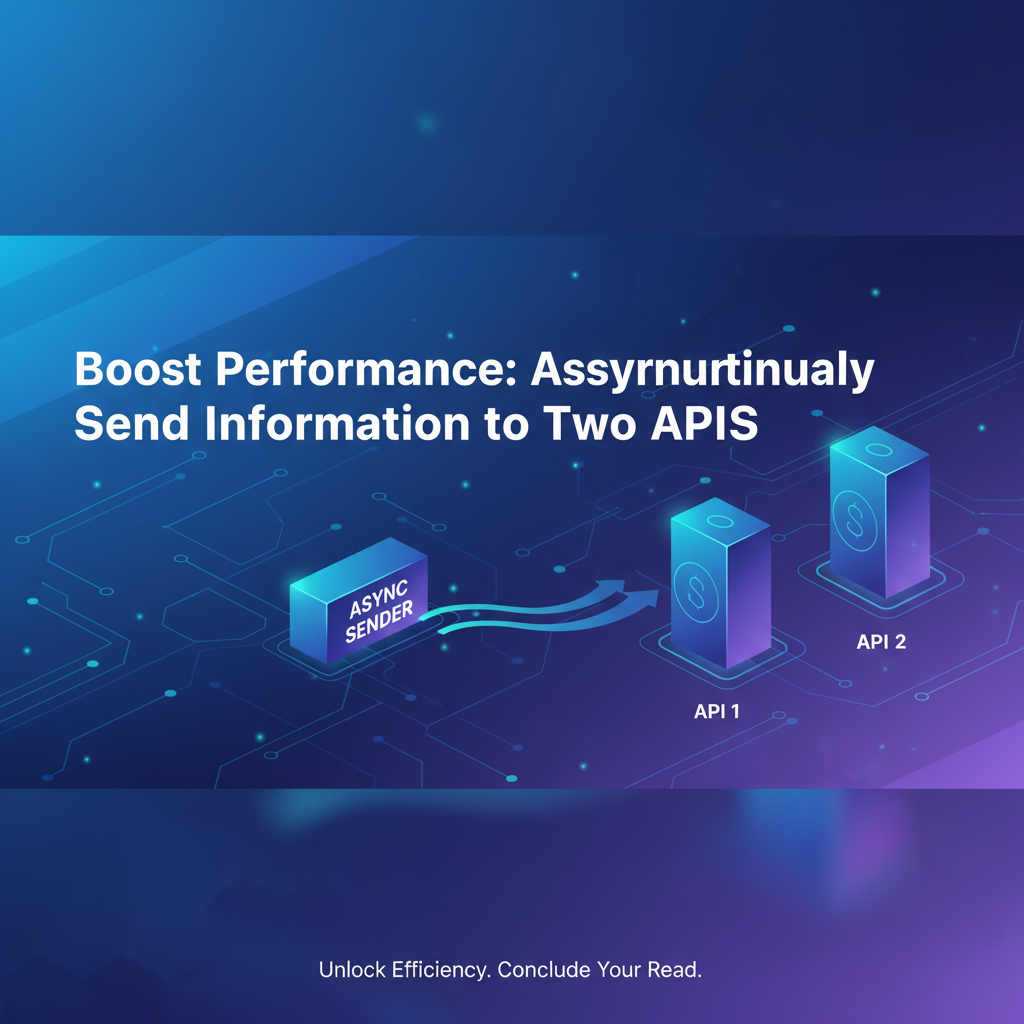
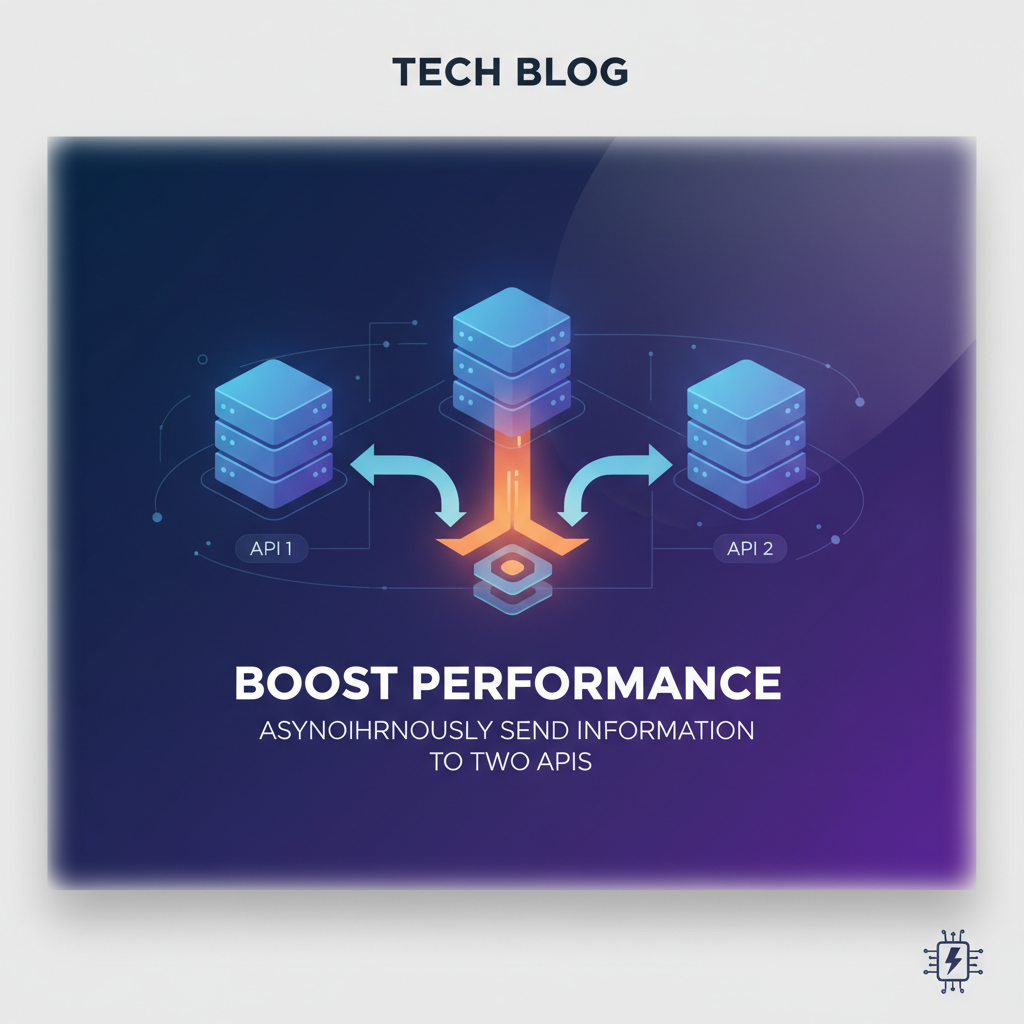
Boost Performance: Asynchronously Send Information to Two APIs


In the intricate tapestry of modern software architecture, the ability to communicate efficiently between various services and external platforms stands as a cornerstone of performance, scalability, and user experience. As systems grow more distributed and microservices become the de facto standard, the demand for robust and rapid data exchange intensifies. While synchronous API calls have long been the traditional method for interaction, their inherent blocking nature presents significant bottlenecks, particularly when an application needs to interact with multiple external services. The challenge escalates when these interactions are critical to the core functionality, yet must not impede the immediate responsiveness perceived by the end-user.
This comprehensive guide delves into the transformative power of asynchronously sending information to two APIs, a critical strategy for boosting application performance and resilience. We will explore the fundamental limitations of synchronous approaches, elucidate the myriad benefits of embracing asynchronous patterns, and meticulously examine various architectural solutions. From the foundational concepts of message queues and event-driven systems to the strategic deployment of API gateways and custom asynchronous workers, we will dissect the methodologies that enable applications to simultaneously update multiple disparate systems without compromising on speed or reliability. Furthermore, we will address crucial implementation details, best practices for error handling, monitoring, and data consistency, ensuring that the transition to an asynchronous paradigm is not only successful but also sustainable. By the end of this exploration, developers and architects will possess a profound understanding of how to leverage asynchronous communication to unlock unparalleled performance gains and build more robust, scalable, and responsive applications in today's demanding digital landscape.
The Bottleneck of Synchronous Operations: Why Traditional API Calls Fall Short
At its core, a synchronous API call implies a waiting game. When your application initiates a synchronous request to an external API, it pauses its current execution thread, patiently waiting for a response from the remote server before proceeding with any further tasks. While seemingly straightforward and easy to implement for simple, isolated interactions, this model quickly unravels into a severe performance impediment when dealing with multiple or slow external services. The cumulative waiting time can dramatically increase the overall response time of your application, leading to sluggish user interfaces, frustrated users, and ultimately, a detrimental impact on business operations.
Consider a typical scenario in an e-commerce platform. When a customer places an order, the system might need to perform several critical operations: deducting inventory from a stock management system, processing payment via a third-party payment API, and sending an order confirmation email through a notification API. If each of these operations is performed synchronously, the entire order placement process will only complete after the slowest of these external calls returns a response. If the inventory API takes 500ms, the payment API 800ms, and the notification API 300ms, the user is forced to wait for at least 800ms (plus any internal processing time) before receiving confirmation that their order has been successfully placed. In high-traffic scenarios, this accumulation of latency can lead to cascading failures, resource exhaustion as threads remain blocked, and a significant reduction in the system's ability to handle concurrent requests. The application's throughput plummets, and its ability to scale horizontally is severely constrained by these external dependencies.
Moreover, synchronous calls tightly couple your application's logic to the availability and performance of external services. If any one of the dependent APIs experiences downtime, network issues, or performance degradation, your application could hang, throw errors, or become completely unresponsive to the end-user. This creates a single point of failure that undermines the overall resilience and stability of your system. Debugging such issues can also be challenging, as the root cause might lie in an external service over which you have no direct control, making it difficult to pinpoint whether the delay or error originates internally or from a third party. The resource consumption also becomes a concern, as active threads are held captive, consuming memory and CPU cycles while awaiting external responses, rather than being released to process other pending requests. For any modern application striving for responsiveness, scalability, and fault tolerance, the limitations of synchronous API interactions necessitate a fundamental shift towards more efficient, non-blocking communication paradigms.
The Paradigm Shift: Embracing Asynchronous Communication for Dual API Interactions
The solution to the inherent limitations of synchronous operations lies in the adoption of asynchronous communication patterns. Asynchronous calls fundamentally alter the interaction model: instead of waiting for a response, your application initiates a request and immediately continues with other tasks. The response, when it eventually arrives, is handled by a separate mechanism, often a callback, an event, or a background worker. This non-blocking nature is the cornerstone of improved performance, allowing your application to maintain responsiveness and process multiple operations concurrently, even when dealing with slow or numerous external dependencies.
When extending this principle to sending information to two APIs, the benefits are compounded. Imagine the e-commerce scenario again. Instead of waiting for the inventory update and email notification, your application can immediately confirm the order to the user, while simultaneously initiating these secondary operations in the background. This drastically reduces the perceived latency for the user, as their primary interaction is completed swiftly. The application becomes significantly more responsive, as its main thread is freed up to handle new incoming requests rather than being tied up waiting for I/O operations from external services.
The advantages of this paradigm shift are multifaceted:
- Improved Responsiveness and User Experience: The most immediate and noticeable benefit is the reduction in latency for user-facing interactions. Users receive feedback much faster, leading to a smoother and more satisfying experience.
- Higher Throughput and Scalability: By not blocking threads, the application can handle a significantly greater number of concurrent requests. Resources (CPU, memory) are utilized more efficiently, as they are not idle during I/O waits. This inherently boosts the system's throughput and enables easier horizontal scaling.
- Enhanced Fault Tolerance and Resilience: If one of the two external APIs experiences a delay or failure, it does not directly block the main application flow or the other API call. Asynchronous mechanisms often incorporate retry logic, dead-letter queues, and circuit breakers, allowing for graceful degradation and recovery without disrupting the core service. This decoupling makes the system more robust against transient external issues.
- Decoupled System Architecture: Asynchronous communication naturally promotes a decoupled architecture. Components that send information no longer need to know the intricate details of how and when the receiving services process that information. This separation of concerns simplifies development, testing, and maintenance, as changes in one service are less likely to impact others.
- Better Resource Utilization: Instead of keeping threads open and consuming resources while waiting for network I/O, asynchronous models allow threads to be released and reused for other tasks, optimizing the utilization of available computing power.
The strategic decision to send information to two APIs asynchronously transforms potential bottlenecks into parallel processes, ensuring that critical operations are performed reliably and efficiently, all while maintaining a highly responsive and scalable application environment. This approach is not merely an optimization; it is a fundamental architectural choice that defines the robustness and future-proof nature of modern distributed systems.
Why the Specificity of "Two" APIs? Use Cases and Motivations for Dual Asynchronous Dispatch
While the general benefits of asynchronous communication are clear, the specific requirement to send information to "two" APIs asynchronously highlights a common and critical set of use cases in enterprise-grade applications. This dual dispatch pattern isn't arbitrary; it addresses scenarios where concurrent, non-blocking updates to distinct systems are essential for data consistency, operational completeness, real-time analytics, or compliance. The ability to perform these parallel operations without adding latency to the primary user interaction is a powerful architectural advantage.
Let's delve into the compelling motivations and practical scenarios where sending information to two APIs asynchronously becomes an indispensable strategy:
- Data Duplication and Replication for Resiliency and Analytics: Many applications require data to be stored in multiple locations for different purposes. For instance, a primary operational database might handle transactional data, while a separate data warehouse or a NoSQL store is used for analytics, reporting, or long-term archiving. When a new record is created or an existing one updated in the primary system, it often needs to be replicated to the secondary system. Asynchronously sending this data to both the primary persistence API and the analytics API ensures that the primary transaction is committed quickly, while the secondary replication happens in the background, preventing any lag in user-facing operations. This improves data availability and enables real-time insights without burdening the transactional system.
- Cross-System Synchronization and Business Process Orchestration: In complex enterprise environments, a single business event might trigger updates across several disparate systems, each managed by its own API. Consider an order fulfillment process: once an order is confirmed, it might need to update an inventory management system (via its API) to deduct stock and simultaneously notify a shipping logistics system (via its API) to prepare for dispatch. Performing these synchronously would chain dependencies and increase the overall processing time for the order. By dispatching these updates asynchronously, the order confirmation can be given to the customer instantly, while the background systems coordinate in parallel, ensuring the entire business process is initiated swiftly and efficiently.
- Event Sourcing and Side Effects: In an event-driven architecture, a primary event (e.g.,
UserRegistered,OrderShipped) often has multiple side effects. These side effects might involve calling different external services. For example, aUserRegisteredevent might trigger an API call to a CRM system to create a new customer record, and another API call to an email marketing service to send a welcome email. Asynchronous handling ensures that all necessary side effects are processed without delaying the primary event's completion. The application publishes the event, and distinct services, potentially through distinct API Gateway routes or dedicated workers, consume and act upon it by calling their respective external APIs. - Real-time Analytics, Monitoring, and Auditing: Modern applications frequently need to feed operational data into various monitoring, logging, and analytics platforms in real-time. Every significant transaction or event might need to be sent to a primary processing API and concurrently to an analytics API (e.g., for dashboard updates), an auditing API (for compliance logs), or a monitoring API (for performance metrics). Asynchronous dual dispatch ensures that the core functionality remains unburdened by the overhead of these secondary, yet vital, data streams. This is especially critical in highly regulated industries where every action must be logged without impeding the user experience.
- A/B Testing, Shadowing, and Canary Deployments: When deploying new versions of an API or a service, it's often desirable to compare its performance or behavior against an existing version without impacting production traffic. Shadowing involves sending a copy of production requests to a new API (the "shadow" service) while the primary request still goes to the old one. This allows for real-world testing without exposing users to potential issues. Similarly, in A/B testing, some requests might go to API A while others go to API B for comparison. Asynchronously sending requests to both the active and shadow APIs (or different versions) allows for robust evaluation without affecting the primary user experience. An API Gateway can be instrumental in managing such traffic splitting.
- Caching Invalidation and Data Refresh: When data is updated in a primary system, it might also necessitate invalidating or refreshing cached data in a separate caching service. For example, an update to a product description in the product management system (via its API) would also need to trigger an asynchronous call to a caching API to purge the old cached version. This ensures data consistency across the application ecosystem without adding latency to the primary update operation.
In each of these scenarios, the asynchronous dispatch to two APIs serves to decouple concerns, improve responsiveness, enhance fault tolerance, and optimize resource utilization. It transforms what could be a blocking, fragile sequence of operations into a robust, parallel execution flow, thereby significantly boosting the overall performance and resilience of the system. This pattern is not just about speed; it's about building a more intelligent, adaptable, and performant architecture that can handle the complexities of modern distributed systems with grace.
Architectural Patterns for Asynchronous Dual-API Communication
Implementing asynchronous communication to two APIs effectively requires careful consideration of various architectural patterns, each with its strengths, weaknesses, and ideal use cases. The choice of pattern often depends on factors such as the scale of operations, existing infrastructure, team expertise, and specific requirements for reliability, ordering, and data consistency. Here, we delve into the most prevalent and effective architectural patterns, providing detailed explanations of how they facilitate robust dual-API dispatch.
1. Message Queues
Message queues are perhaps the most classic and robust pattern for achieving asynchronous communication and decoupling services. They act as intermediaries, storing messages (data or commands) from producers (sending applications) and delivering them to consumers (receiving applications) in a reliable manner. Popular message queue systems include RabbitMQ, Apache Kafka, Amazon SQS, Azure Service Bus, and Google Cloud Pub/Sub.
How it works for Dual-API Communication:
- Producer Dispatches: Your primary application (the producer) performs its critical, synchronous task (e.g., confirming an order).
- Message Enqueue: Instead of directly calling the two external APIs, the producer constructs a message containing the necessary data and sends it to a message queue. This operation is typically very fast, allowing the producer to quickly resume its primary tasks.
- Consumer Processing: One or more dedicated worker services (consumers) continuously listen to the message queue. When a new message arrives, a consumer picks it up.
- Dual API Invocation: Upon receiving the message, the consumer's logic is responsible for parsing the data and making separate, potentially parallel, asynchronous calls to the two target external APIs. For example, one call to the Inventory Update API and another to the Customer Notification API.
- Acknowledgement: After successfully calling both APIs, the consumer sends an acknowledgment back to the message queue, indicating that the message has been processed and can be removed. If any API call fails, the consumer might not acknowledge the message, allowing the queue to redeliver it for a retry, or move it to a dead-letter queue for manual inspection.
Pros: * Decoupling: Producers and consumers are completely independent. They don't need to know about each other's availability or implementation details. * Scalability: Both producers and consumers can scale independently based on load. You can add more consumer instances to process messages faster. * Resilience and Reliability: Messages are typically persisted, ensuring they are not lost even if consumers fail. Built-in retry mechanisms and dead-letter queues enhance fault tolerance. * Load Leveling: Queues can buffer bursts of traffic, smoothing out spikes and preventing downstream systems from being overwhelmed. * Auditing and Monitoring: Message queues often provide excellent tools for monitoring message flow, processing times, and potential bottlenecks.
Cons: * Increased Complexity: Introduces another component to manage, requiring operational expertise for deployment, configuration, and monitoring. * Ordering Challenges: While some queues guarantee order for a single partition, ensuring strict ordering across multiple consumers or complex message routing can be challenging. * Latency: There's a slight inherent delay between a message being enqueued and processed by a consumer.
2. Event-Driven Architectures
Event-driven architectures (EDA) are a broader concept often implemented using message queues or specialized event streaming platforms like Apache Kafka, Amazon Kinesis, or Google Cloud Pub/Sub. The core idea is that services communicate by emitting and reacting to events, rather than direct calls. An event represents a significant change in state (e.g., OrderCreated, ProductUpdated).
How it works for Dual-API Communication:
- Event Emission: When a significant action occurs in your primary service, it publishes an event to an event bus or stream (e.g.,
OrderConfirmedEvent). This is a fast, non-blocking operation. - Multiple Subscribers: Instead of a single consumer, multiple independent services (subscribers) can listen for and react to specific events. Each subscriber encapsulates a distinct piece of business logic.
- Dedicated API Invocation:
- Subscriber 1: For example, an
InventoryManagementServicesubscribes toOrderConfirmedEvent. Upon receiving it, this service makes an asynchronous call to the external Inventory API to deduct stock. - Subscriber 2: Concurrently, a
NotificationServicealso subscribes toOrderConfirmedEvent. It then makes an asynchronous call to the external Customer Notification API to send an email or SMS.
- Subscriber 1: For example, an
- Parallel Execution: Both subscribers process the same event independently and in parallel, each responsible for interacting with one of the target APIs.
Pros: * Extreme Decoupling: Services are highly independent, leading to microservices-friendly architectures. * Scalability: Individual event handlers (subscribers) can scale independently. * Flexibility: Easily add new functionalities (new subscribers) by simply reacting to existing events without modifying existing services. * Real-time Processing: Well-suited for real-time data flows and reactions.
Cons: * Distributed State Management: Maintaining data consistency across multiple services reacting to events can be complex (eventual consistency). * Debugging Complexity: Tracing the flow of an event through multiple services can be challenging. * Overhead: Requires robust event infrastructure and potentially more sophisticated error handling (e.g., Saga patterns for distributed transactions).
3. Dedicated Asynchronous Workers/Services
For situations where a full-fledged message queue or event streaming platform might be overkill, or for simpler background tasks, dedicated asynchronous workers or background job processors can be a viable alternative. These workers are separate processes or threads that run in the background, specifically designed to handle long-running or non-blocking tasks. Examples include Celery (Python), Sidekiq (Ruby), Go routines with worker pools (Go), or even simple daemon processes.
How it works for Dual-API Communication:
- Task Offloading: The main application, after completing its synchronous user-facing tasks, enqueues a job into a local or shared task queue (often a database table, Redis, or an in-memory queue). This job contains all the necessary data to call the two external APIs.
- Worker Pool: A pool of dedicated worker processes constantly monitors this task queue. When a new job appears, an available worker picks it up.
- Dual API Invocation: The worker's logic is designed to perform the two asynchronous API calls. It can execute these calls concurrently using language-specific constructs (e.g.,
async/awaitin Python/JavaScript,goroutinesin Go,CompletableFuturein Java) or sequentially if dependencies exist. - Status Reporting: The worker can update the job's status (success, failure, retry) in the task queue, which can then be monitored by the main application or an admin dashboard.
Pros: * Simplicity (for smaller scale): Easier to set up and manage than a full message queue for specific background tasks. * Direct Control: You have direct control over the worker's execution environment and logic. * Language-Specific Integration: Often integrates well with existing application frameworks and languages.
Cons: * Scalability Limitations: Can become a bottleneck if the worker pool isn't scaled properly. The task queue itself might become a single point of failure if not robust. * Persistence: Without an external message broker, ensuring job persistence across worker crashes requires careful implementation (e.g., using a durable database for the task queue). * Retry Mechanisms: Requires custom implementation for retries, exponential backoff, and dead-letter handling.
4. Proxy/Gateway Layer: The Role of an API Gateway
An API Gateway acts as a single entry point for all client requests, routing them to appropriate backend services. Beyond simple routing, modern API Gateway solutions offer a rich set of features including authentication, authorization, rate limiting, caching, and crucially, advanced traffic management and transformation capabilities. For asynchronously sending information to two APIs, an API Gateway can play a pivotal role, especially when dealing with external consumers or complex microservices architectures.
How it works for Dual-API Communication:
- Single Entry Point: A client sends a single request to the API Gateway.
- Request Transformation and Fan-out: The API Gateway is configured to receive this single request. Based on its internal logic (e.g., rules, policies, or custom plugins), it transforms the incoming request data and then initiates multiple internal or external asynchronous calls to the two target backend APIs. This "fan-out" pattern can be implemented through various means:
- Direct Asynchronous Dispatch: Some advanced gateways can internally execute multiple HTTP requests in parallel and return a consolidated response or an immediate
202 Acceptedstatus, indicating background processing. - Integration with Message Queues: The API Gateway can be configured to, upon receiving the client request, immediately send a message to an internal message queue (as described in Pattern 1). A backend worker then picks up this message and calls the two external APIs. The gateway might then return an immediate success response to the client.
- Service Chaining/Orchestration: The gateway might orchestrate a sequence of calls, where some are asynchronous, or it might trigger a background processing service that in turn calls the two APIs.
- Direct Asynchronous Dispatch: Some advanced gateways can internally execute multiple HTTP requests in parallel and return a consolidated response or an immediate
Natural Integration of APIPark:
For enterprises dealing with complex API ecosystems, particularly those involving AI models and REST services, an advanced API Gateway like APIPark can be a game-changer. APIPark, an open-source AI gateway and API management platform, excels in streamlining the management, integration, and deployment of various services. Its capabilities in managing traffic forwarding, load balancing, and offering unified API formats can significantly simplify the task of asynchronously dispatching information to multiple APIs, ensuring both efficiency and robust lifecycle management.
APIPark can act as the central point where a single incoming request is received. Through its powerful configuration and plugin architecture, it can be set up to: * Intercept the incoming request and perform initial validations and authentications. * Asynchronously trigger multiple downstream API calls. While APIPark primarily focuses on proxying and managing API traffic, its robust gateway capabilities enable developers to implement logic that, upon receiving a request, can fan out to multiple backend services. This can be achieved by integrating with message queues or by utilizing custom plugins that can initiate parallel HTTP requests. * Leverage its API lifecycle management features to define, publish, and version the composite API that internally orchestrates the dual asynchronous calls. * Utilize its performance rivalry with Nginx to handle high TPS, ensuring that the gateway itself doesn't become a bottleneck when fanning out requests, even under heavy load. * Provide detailed API call logging and powerful data analysis for all fan-out calls, giving visibility into the success and latency of each downstream API interaction, which is crucial for debugging and monitoring asynchronous processes. * Its ability to integrate 100+ AI models with a unified management system also means that if one of your two APIs is an AI service, APIPark can standardize the invocation and management, further simplifying the asynchronous dispatch process.
By centralizing the logic for fan-out and managing the complexities of multiple downstream services, an API Gateway like APIPark provides a powerful and scalable solution for asynchronously sending information to two APIs, offering significant advantages in terms of control, security, and observability across your API landscape.
Pros: * Centralized Control: A single point for managing security, rate limiting, monitoring, and routing. * Decoupling Clients from Backends: Clients only interact with the gateway, unaware of the backend complexities. * Protocol Transformation: Can handle different protocols between clients and backends. * Traffic Management: Excellent for load balancing, routing, and implementing patterns like A/B testing or canary deployments. * Reduced Client Complexity: Clients don't need to know about or manage multiple API endpoints.
Cons: * Single Point of Failure (if not highly available): The gateway itself must be robust and scalable. * Increased Latency (minimal): Adds an extra hop to the request path. * Complexity: Configuring an advanced gateway for complex routing and transformation logic can be intricate.
5. Language-Specific Asynchronous Constructs
For applications that have direct control over their execution environment and prefer to manage concurrency at the code level, modern programming languages offer powerful built-in asynchronous constructs. These allow developers to write non-blocking code directly within their application without relying on external infrastructure like message queues (though they can still be used in conjunction).
How it works for Dual-API Communication:
- Initiate Parallel Calls: After completing any synchronous, immediate tasks, the application uses its language's asynchronous features to concurrently initiate two separate HTTP requests to the target APIs.
- Python: Using
asynciowithawaitandasync defto makehttpxoraiohttpcalls in parallel. - JavaScript (Node.js): Using
Promisesandasync/awaitwithfetchoraxiosto make parallel requests.Promise.all()is a common pattern here. - Java: Using
CompletableFutureor reactive frameworks like Project Reactor/RxJava to execute non-blocking HTTP calls (e.g., withWebClient). - Go: Using
goroutinesandchannelsto spin up lightweight concurrent tasks that make HTTP requests.
- Python: Using
- Handle Responses (or not):
- Fire-and-Forget: In some cases, the application might simply launch the asynchronous calls and not wait for their completion, especially if the responses are not critical for the primary flow (e.g., logging or non-essential notifications).
- Awaited Asynchronous: If the application needs to know the outcome for error handling or subsequent logic (though still non-blocking for the primary thread), it can
awaitthe completion of both parallel calls before proceeding. The key is that theawaithappens for both in parallel, not sequentially.
Pros: * Fine-grained Control: Developers have direct control over the concurrency logic within the application code. * No External Infrastructure (for basic cases): Doesn't necessarily require an external message queue or dedicated worker service, reducing infrastructure overhead. * Performance (for I/O-bound tasks): Excellent for maximizing CPU utilization by switching between tasks during I/O wait times.
Cons: * Complexity (for advanced scenarios): Managing complex asynchronous flows, error handling, retries, and back pressure can become intricate and prone to "callback hell" or difficult-to-debug race conditions. * Limited Scalability: While effective for a single application instance, it doesn't inherently scale across multiple application instances for persistent background tasks in the same way message queues do. * No Inherent Persistence/Retries: If the application crashes, ongoing asynchronous operations might be lost. Implementing robust retry mechanisms requires significant custom code. * Resource Management: Can consume significant memory if too many concurrent operations are launched without proper throttling.
Each of these architectural patterns offers a distinct approach to achieving asynchronous dual-API communication. The optimal choice depends heavily on the specific context, including the criticality of the data, the desired level of decoupling, the required resilience, and the existing infrastructure landscape. Often, a hybrid approach combining elements from multiple patterns provides the most robust and flexible solution.
Here's a comparison table summarizing the key aspects of these patterns:
| Feature | Message Queues | Event-Driven Architectures | Dedicated Asynchronous Workers | API Gateway Layer | Language-Specific Constructs |
|---|---|---|---|---|---|
| Decoupling | High | Very High | Medium | High | Low-Medium |
| Scalability | Excellent | Excellent | Good | Excellent (for fan-out) | Good (per instance) |
| Reliability/Persistence | High (messages durable) | High (events durable) | Medium (requires custom) | High (gateway itself) | Low (application-dependent) |
| Complexity | Moderate-High | High | Low-Moderate | Moderate-High | Moderate |
| Real-time Potential | Medium-High | High | Medium | High | High |
| Error Handling/Retries | Built-in | Built-in (event replay) | Custom | Configurable (policy) | Custom |
| Use Cases | Background tasks, microservices, load leveling | Complex microservices, state changes, stream processing | Simple background tasks, less critical operations | Centralized API management, traffic fan-out, security | In-process concurrency, I/O bound tasks |
Implementation Details and Best Practices for Robust Dual Asynchronous Dispatch
Successfully implementing a system that asynchronously dispatches information to two APIs requires meticulous attention to various implementation details and adherence to best practices. Beyond choosing the right architectural pattern, ensuring reliability, data consistency, observability, and security is paramount for a production-ready solution. Neglecting these aspects can lead to silent failures, data corruption, and operational nightmares.
1. Error Handling and Retries: Building for Resilience
The nature of distributed systems means that failures are not an exception but a certainty. Network issues, temporary unavailability of external APIs, or transient processing errors can occur at any time. Robust error handling and retry mechanisms are therefore essential for asynchronous dual-API calls.
- Idempotency for APIs: Design your target APIs to be idempotent. An idempotent operation produces the same result regardless of how many times it is executed. For example, if updating an inventory item is called twice due to a retry, it should not double-deduct the item. This is critical for preventing unintended side effects during retries.
- Exponential Backoff: When an API call fails due to a transient error, don't immediately retry. Implement an exponential backoff strategy, waiting for progressively longer periods between retries (e.g., 1s, 2s, 4s, 8s). This prevents overwhelming the failing external API and gives it time to recover.
- Retry Limits and Dead-Letter Queues (DLQs): Define a maximum number of retries. If an API call consistently fails after several attempts, the message or task should be moved to a Dead-Letter Queue (DLQ). A DLQ is a dedicated queue for messages that couldn't be processed successfully. This prevents poison pill messages from endlessly retrying and blocking other messages, allowing for manual investigation and resolution.
- Circuit Breakers: Implement the circuit breaker pattern. If an external API is consistently failing, the circuit breaker can "trip" (open), immediately failing subsequent requests to that API without even attempting the call. This prevents your service from wasting resources on doomed requests and protects the external API from being hammered during recovery. After a configured timeout, the circuit breaker transitions to a "half-open" state, allowing a few test requests to see if the API has recovered.
- Bulkhead Pattern: Isolate different external API calls into separate resource pools (e.g., thread pools). If one API is slow or failing, it won't consume all resources, thereby preventing its issues from affecting calls to the other API.
2. Monitoring and Observability: Seeing into the Asynchronous Flow
Asynchronous operations introduce complexity in understanding the end-to-end flow and identifying where problems occur. Comprehensive monitoring and observability tools are indispensable.
- Logging: Implement structured and detailed logging at every critical step: when a message is enqueued, when a worker picks it up, before and after each API call, and upon success or failure. Include correlation IDs (trace IDs) to link related log entries across different services and stages of processing. This is where a platform like APIPark, with its detailed API call logging, proves invaluable, providing a unified view of all calls going through the gateway.
- Distributed Tracing: Utilize distributed tracing systems (e.g., OpenTelemetry, Zipkin, Jaeger) to visualize the entire request flow across multiple services, message queues, and external API calls. This helps pinpoint latency hotspots and error origins in complex asynchronous paths.
- Metrics: Collect key performance indicators (KPIs) for each stage of the asynchronous process:
- Queue Lengths: Monitor the size of your message queues to detect backlogs.
- Processing Latency: Measure the time taken from message enqueue to successful processing, and the latency of individual API calls.
- Error Rates: Track the percentage of failed API calls or messages moved to DLQs.
- Throughput: Monitor the number of messages processed per second or API calls made per second.
- Alerting: Set up alerts for critical thresholds, such as increasing queue lengths, high error rates, or prolonged processing delays. Proactive alerts enable quick incident response. APIPark's powerful data analysis capabilities can help identify long-term trends and performance changes, enabling preventive maintenance and more intelligent alerting strategies.
3. Data Consistency Challenges: Eventual Consistency and Beyond
Asynchronous communication often implies eventual consistency, meaning that data across different systems might not be immediately consistent after an update. While the primary system might confirm a transaction, secondary systems might take a short while to reflect the change.
- Understand Eventual Consistency: Accept that for many non-critical secondary operations (like sending an email or updating an analytics dashboard), eventual consistency is acceptable. Clearly define what level of consistency is required for each API interaction.
- Compensating Transactions: For more critical scenarios where strong consistency is desired across multiple asynchronous steps, consider implementing compensating transactions (often part of the Saga pattern). If a later step in an asynchronous flow fails, compensating transactions are executed to undo the effects of previous successful steps, restoring consistency.
- Idempotent Consumers: Ensure your consumers are idempotent. If a message is redelivered (due to retry or network issues), the consumer should process it multiple times without causing duplicate side effects (e.g., sending the same email twice, or duplicating a database record).
4. Security Considerations: Protecting Your Asynchronous Flows
Security cannot be an afterthought, even in asynchronous pipelines. Each component involved in the communication chain needs to be secured.
- Authentication and Authorization: Ensure that calls to both external APIs are properly authenticated and authorized using API keys, OAuth tokens, or other appropriate mechanisms. If an API Gateway is used, it can centrally manage and enforce these policies.
- Data Encryption: Encrypt data both in transit (using HTTPS/TLS for API calls and secure protocols for message queues) and at rest (if messages are stored durably in queues or databases).
- Least Privilege: Configure all services and workers with the minimum necessary permissions to perform their tasks.
- Rate Limiting: Protect your external APIs from being overwhelmed by your asynchronous workers, especially during retry storms. Implement rate limiting mechanisms. An API Gateway like APIPark is ideal for enforcing API access permissions and rate limits centrally.
- Input Validation: Always validate and sanitize input data before sending it to external APIs, even if it originated from internal systems, to prevent injection attacks or malformed requests.
5. Scalability of Asynchronous Components: Growing with Demand
The asynchronous architecture itself must be scalable to handle increasing loads.
- Horizontal Scaling of Workers/Consumers: Design your worker services or message queue consumers to be stateless and easily horizontally scalable. Add more instances as message volume increases.
- Database and Queue Sizing: Ensure your message queue infrastructure and any databases used by your workers are appropriately sized and configured for high throughput and durability.
- Throttling: Implement throttling mechanisms in your workers to control the rate at which they call external APIs, respecting the external API's rate limits and preventing overwhelming them.
By meticulously addressing these implementation details and adopting these best practices, you can build a highly performant, resilient, and secure system that effectively leverages asynchronous communication to send information to two APIs, transforming potential points of failure into robust, parallel execution paths.
APIPark is a high-performance AI gateway that allows you to securely access the most comprehensive LLM APIs globally on the APIPark platform, including OpenAI, Anthropic, Mistral, Llama2, Google Gemini, and more.Try APIPark now! 👇👇👇
Deep Dive into an Example Scenario: E-commerce Order Processing with Dual Async Updates
To solidify our understanding, let's walk through a concrete, detailed example: the asynchronous processing of an e-commerce order that requires updating two distinct external APIs after the initial synchronous transaction.
Scenario: A customer successfully places an order on an e-commerce website. The core synchronous requirement is to confirm the order to the customer as quickly as possible. However, several critical background tasks need to occur: 1. Deducting Inventory: The stock for the purchased items must be reduced in an external Inventory Management System (IMS) via its API. 2. Customer Notification: An order confirmation email/SMS must be sent to the customer via an external Notification Service API.
Performing these synchronously would significantly delay the order confirmation page for the customer, leading to a poor user experience.
Architecture Choice: Message Queue with Dedicated Consumers
For this scenario, given the need for reliability, eventual consistency, and decoupling, a Message Queue pattern with dedicated consumer services is an excellent choice. It ensures that even if the IMS or Notification API is temporarily down, the messages will be retried, and the order information will eventually be processed without impacting the customer's immediate experience.
Step-by-Step Flow:
- Customer Places Order (Synchronous Part):
- The customer interacts with the e-commerce website (Frontend).
- The Frontend sends a
POST /ordersrequest to the main Order Service (Backend). - The Order Service performs immediate, critical synchronous tasks:
- Validates the order.
- Persists the order details to its primary database.
- Processes payment with a payment gateway (this could be synchronous for immediate feedback on payment success/failure, or could itself be partially asynchronous, but for simplicity, let's assume it's part of the fast synchronous flow here).
- Generates an
orderId.
- Crucially, at this point, before calling any external APIs for inventory or notification, the Order Service immediately returns a
200 OK(or201 Created) response to the Frontend, providing the customer with anorderIdand a "Order Placed Successfully!" message. This ensures the best possible user experience.
- Asynchronous Message Enqueue (Offloading the Work):
- Immediately after successfully processing the synchronous part and returning the response to the customer, the Order Service constructs a message containing relevant order details (e.g.,
orderId,itemsList,customerId,customerEmail,shippingAddress). - This message is then published to a dedicated
order-processing-queuein a Message Queue system (e.g., RabbitMQ, Kafka, SQS). This enqueue operation is typically very fast (milliseconds). - Example message payload (JSON):
json { "eventType": "OrderPlaced", "orderId": "ORD-12345", "customerId": "CUST-67890", "items": [ {"productId": "PROD-001", "quantity": 2}, {"productId": "PROD-005", "quantity": 1} ], "customerEmail": "customer@example.com", "shippingAddress": "123 Main St, Anytown" }
- Immediately after successfully processing the synchronous part and returning the response to the customer, the Order Service constructs a message containing relevant order details (e.g.,
- Dedicated Consumer Services (Parallel Processing):
- InventoryUpdateService (Consumer 1):
- This dedicated service constantly listens to the
order-processing-queue. - When it receives the
OrderPlacedmessage, it extracts theitemslist. - It then makes an API call to the external Inventory Management System (IMS):
PUT /inventory/deductwith theitemsdata. - It implements robust error handling: if the IMS API call fails (e.g., 500 Internal Server Error from IMS, or network timeout), it will use exponential backoff and retry the call a few times. If it still fails after maximum retries, the message is moved to a Dead-Letter Queue for manual intervention or a separate process to handle.
- Upon successful deduction, it acknowledges the message to the Message Queue.
- This dedicated service constantly listens to the
- NotificationService (Consumer 2):
- This service also listens to the same
order-processing-queue. - When it receives the
OrderPlacedmessage, it extracts thecustomerEmail,orderId, anditems. - It constructs an email/SMS content and makes an API call to the external Notification Service:
POST /send-emailorPOST /send-sms. - It also implements error handling and retries for the Notification Service API call. Failed messages are moved to a DLQ.
- Upon successful notification, it acknowledges the message to the Message Queue.
- This service also listens to the same
- InventoryUpdateService (Consumer 1):
- Monitoring and Observability:
- Dashboards display queue lengths, consumer processing rates, and success/failure rates for both the InventoryUpdateService and NotificationService.
- Distributed tracing logs show the journey of the
orderIdfrom the initialPOST /ordersrequest, through the message queue, and into the two consumer services' API calls. - Alerts are configured for excessive queue lengths or high error rates in either consumer.
Benefits Realized in this Scenario:
- Instant Customer Feedback: The customer gets immediate confirmation of their order, leading to a superior user experience.
- Decoupling: The Order Service is completely decoupled from the IMS and Notification Service. It doesn't need to know their availability or implementation details.
- Resilience: If the IMS or Notification Service is temporarily unavailable, the order message simply waits in the queue and will be processed once the services recover. Retries prevent data loss.
- Scalability: If order volume spikes, more instances of InventoryUpdateService and NotificationService can be spun up independently to handle the increased message load without affecting the core Order Service.
- Resource Efficiency: The Order Service's threads are released immediately after enqueuing the message, ready to serve other customer requests, instead of being blocked waiting for external API responses.
- Auditing: The message queue provides a reliable audit trail of
OrderPlacedevents, and logs from each consumer detail their interactions with the external APIs.
This detailed example illustrates how asynchronous communication to two APIs, particularly through a message queue pattern, transforms a potentially fragile and slow synchronous process into a robust, responsive, and scalable solution for critical business operations like e-commerce order fulfillment.
Performance Metrics and Benchmarking in Asynchronous Dual-API Communication
When adopting asynchronous patterns for dual-API communication, it's not enough to simply implement the architecture; validating its effectiveness requires rigorous measurement and benchmarking. Understanding the impact on performance metrics is crucial for optimizing the system, justifying the architectural shift, and ensuring it meets its operational requirements.
Key Performance Indicators (KPIs) to Monitor:
- Perceived Latency (User Response Time):
- This is the most critical metric from the end-user's perspective. It measures the time taken from the user's initiation of an action (e.g., clicking "Place Order") to receiving the first meaningful response from the application (e.g., "Order Confirmed").
- Impact of Async: With asynchronous dual-API calls, this metric should dramatically decrease compared to synchronous approaches, as the primary application thread is unblocked much faster. The user doesn't wait for the two external APIs to respond.
- Measurement: Use real user monitoring (RUM) tools or synthetic monitoring from the client side.
- System Throughput (Requests Per Second / Transactions Per Second - RPS/TPS):
- This measures the number of operations (e.g., order placements) the system can successfully process per unit of time.
- Impact of Async: By freeing up application threads from I/O wait, asynchronous processing allows the system to handle a much higher volume of concurrent requests. More requests can be processed with the same amount of resources.
- Measurement: Load testing tools (JMeter, k6, Locust) or API Gateway metrics (like those offered by APIPark) are essential here. APIPark's reported performance of over 20,000 TPS with an 8-core CPU and 8GB memory demonstrates the kind of throughput benefits achievable with robust gateway solutions in an asynchronous setup.
- Background Processing Latency (End-to-End Latency for Async Tasks):
- While perceived latency for the user is low, it's vital to monitor how long the background tasks actually take. This measures the time from the moment an asynchronous task is initiated (e.g., message enqueued) to when all its sub-tasks (e.g., both API calls) are successfully completed.
- Impact of Async: This metric might be slightly higher than the sum of synchronous calls (due to queueing delays, worker startup, etc.), but the key is that it doesn't block the user. It also shows the efficiency of your background workers and external APIs.
- Measurement: Distributed tracing, message queue monitoring (message age in queue), and consumer-side logging.
- Resource Utilization (CPU, Memory, Network I/O):
- Monitoring how effectively your servers, message queues, and worker services are using their CPU, memory, and network bandwidth.
- Impact of Async: Asynchronous systems generally lead to more efficient resource utilization. Threads are not idling, CPU cycles are spent on processing rather than waiting, and network resources are managed more effectively. This often means you can handle more load with fewer servers.
- Measurement: Infrastructure monitoring tools (Prometheus, Grafana, cloud provider monitoring services).
- Error Rates and Retry Success Rates:
- The percentage of failed API calls, messages moved to DLQs, and the success rate of retry attempts.
- Impact of Async: While asynchronous systems might see transient errors, their robust retry mechanisms should ensure a high ultimate success rate for background tasks, even if initial attempts fail.
- Measurement: Application logs, message queue metrics, API Gateway logs (APIPark's detailed logging is useful here).
Benchmarking and Optimization Strategy:
- Establish Baselines: Before implementing asynchronous patterns, benchmark your existing synchronous system to establish baseline metrics for perceived latency, throughput, and resource utilization.
- Isolate and Measure Components: When transitioning to asynchronous, measure the performance of each component individually: message enqueue time, message consumption time, individual API call latency, worker processing time.
- Load Testing: Conduct comprehensive load tests to simulate peak traffic conditions.
- Test different loads (e.g., 50%, 100%, 150% of expected peak).
- Monitor the KPIs mentioned above under increasing load.
- Identify bottlenecks: Is the message queue becoming a bottleneck? Are the workers overloaded? Are the external APIs themselves slow?
- Monitor External API Performance: The performance of the two external APIs is still critical for the completion of your asynchronous tasks. Monitor their availability, latency, and error rates from your side.
- Optimize Bottlenecks:
- If perceived latency is still high, ensure your synchronous path is as lean as possible.
- If throughput is low, scale your workers horizontally or optimize their code.
- If background processing latency is too high, investigate external API performance, worker efficiency, or message queue configuration.
- Tune message queue parameters (e.g., batching, message size, consumer concurrency).
- Optimize worker concurrency and resource allocation.
- Continuous Monitoring: Performance is not a one-time setup. Implement continuous monitoring in production to detect performance degradations, track trends, and identify potential issues before they impact users. APIPark's powerful data analysis capabilities can be leveraged to track these long-term trends and proactively address performance changes.
By meticulously tracking these performance metrics and engaging in iterative benchmarking and optimization, organizations can fully harness the power of asynchronous dual-API communication, translating architectural improvements into tangible gains in speed, efficiency, and system resilience.
Challenges and Trade-offs of Asynchronous Dual-API Communication
While the benefits of asynchronously sending information to two APIs are substantial, it's crucial to acknowledge the inherent challenges and trade-offs that come with this architectural shift. No silver bullet exists in software engineering, and the decision to adopt asynchronous patterns requires a clear understanding of the complexities involved and how to mitigate them.
1. Increased Complexity in Design and Debugging
- Distributed Nature: Moving from a simple sequential flow to a decoupled, event-driven, or message-queued system inherently increases architectural complexity. You're adding new components (message brokers, worker services, gateways) that need to be deployed, configured, and managed.
- Non-Linear Flow: Debugging becomes more challenging because the execution flow is no longer strictly linear. A single user action might trigger multiple parallel processes across different services, making it harder to trace the root cause of an issue. Tools like distributed tracing become essential but also add to the complexity.
- State Management: Maintaining consistent state across loosely coupled, asynchronous services can be tricky, especially when dealing with failures and retries. This leads to concerns around eventual consistency, which requires different design patterns than strong consistency.
2. Data Consistency Issues: Embracing Eventual Consistency
- Delayed Consistency: Asynchronous operations mean that an update in one system might not be immediately reflected in another. For example, an order might be confirmed to the user, but the inventory might take a few milliseconds or seconds to actually update in the background. This "eventual consistency" is often acceptable for non-critical secondary operations but must be understood and managed.
- Race Conditions: If not carefully designed, parallel asynchronous operations can lead to race conditions where the order of operations becomes unpredictable, potentially leading to incorrect data.
- Compensating Transactions: For business-critical operations where eventual consistency is not enough, complex patterns like Sagas (a sequence of local transactions, where each transaction updates data and publishes an event to trigger the next transaction) or compensating transactions are needed. These add significant complexity to design and implementation.
3. Operational Overhead
- Infrastructure Management: Deploying and maintaining message queues, event streaming platforms, or dedicated worker services adds to the operational burden. These components require monitoring, patching, scaling, and troubleshooting.
- Monitoring and Alerting: Establishing effective monitoring and alerting for a distributed asynchronous system is more involved. You need to track not just individual service health but also message queue depths, message processing rates, latency across service boundaries, and the health of all external APIs.
- Deployment Strategies: Orchestrating deployments for multiple, interdependent asynchronous services requires more sophisticated CI/CD pipelines.
4. Potential for "Silent Failures" if Not Monitored Properly
- In a synchronous system, if an API call fails, the client immediately receives an error, and the process stops. In an asynchronous system, a background task might fail repeatedly, sending messages to a dead-letter queue, but the user and the primary application might remain unaware unless robust monitoring and alerting are in place. These "silent failures" can accumulate and lead to data inconsistencies or missed business processes if not detected and addressed promptly.
5. Increased Resource Consumption (Potentially)
- While asynchronous systems are generally more resource-efficient for handling I/O-bound tasks, the overhead of running message brokers, additional worker services, and more complex logging/tracing infrastructure can sometimes lead to a net increase in resource consumption compared to a very simple synchronous setup, especially at smaller scales. The benefits typically outweigh this at scale, but it's a factor.
Trade-offs Summary:
| Aspect | Synchronous Approach | Asynchronous Approach (Dual API) |
|---|---|---|
| User Experience | Potentially high latency, blocking | Low perceived latency, highly responsive |
| Throughput | Limited by slowest API, low concurrency | High concurrency, high throughput |
| Resilience | Low (single point of failure) | High (decoupled, retries, circuit breakers) |
| Complexity | Low (simple sequential flow) | High (distributed components, non-linear flow) |
| Data Consistency | Strong (immediate) | Eventual (managed carefully with patterns) |
| Operational Effort | Low | High (more components, advanced monitoring) |
| Debugging | Straightforward | Challenging (distributed tracing required) |
| Resource Usage | Potentially inefficient (idle threads) | Efficient (for I/O bound), but more infrastructure needed |
The decision to adopt asynchronous communication for dual-API interactions is a strategic one, trading immediate simplicity for long-term gains in performance, scalability, and resilience. It requires a commitment to robust design, comprehensive monitoring, and a deep understanding of distributed systems principles. When executed effectively, the benefits far outweigh the challenges, enabling organizations to build highly adaptable and performant applications capable of meeting the demands of the modern digital landscape.
Future Trends and Evolution in Asynchronous API Management
The landscape of API management and asynchronous communication is continuously evolving, driven by advancements in cloud computing, serverless architectures, and the increasing sophistication of AI and machine learning. These trends are shaping the next generation of tools and practices for efficiently sending information to multiple APIs.
1. Serverless Functions for Asynchronous Tasks
Serverless computing platforms like AWS Lambda, Azure Functions, and Google Cloud Functions are revolutionizing how asynchronous tasks are handled. Instead of provisioning and managing dedicated worker servers, developers can write small, single-purpose functions that are automatically triggered by events.
- Event-Driven Triggers: Serverless functions can be directly triggered by message queues (e.g., SQS, Kafka), event streams (e.g., Kinesis, Pub/Sub), or even HTTP requests from an API Gateway.
- Automatic Scaling: The cloud provider automatically scales the functions up and down based on demand, eliminating the need for manual scaling of worker instances.
- Cost-Effectiveness: You only pay for the compute time your functions consume, making it highly cost-effective for intermittent or variable workloads.
- Simplified Operations: Reduces operational overhead as the underlying infrastructure management is handled by the cloud provider.
- Dual API Invocation: A single serverless function can be triggered by an event, and then it can concurrently invoke two different external APIs, with built-in retry mechanisms and dead-letter queues often provided by the platform itself.
This trend greatly simplifies the deployment and management of asynchronous workers, making it easier for teams to adopt sophisticated event-driven patterns without extensive infrastructure expertise.
2. Service Meshes for Advanced Traffic Management and Observability
Service meshes (e.g., Istio, Linkerd, Consul Connect) are emerging as a powerful layer for managing communication between microservices. While primarily focused on synchronous, inter-service communication, their capabilities extend to enhancing asynchronous patterns.
- Transparent Traffic Management: Service meshes can handle retries, timeouts, and circuit breaking policies transparently at the network level, without requiring changes to application code. This is particularly useful for calls made by asynchronous workers to external APIs.
- Enhanced Observability: They provide out-of-the-box distributed tracing, metrics, and logging for all service-to-service communication, simplifying debugging in complex asynchronous flows.
- Policy Enforcement: Centralized policy enforcement for security, rate limiting, and access control can be applied to all outgoing calls from services, including those to external APIs.
- Canary Deployments and Traffic Splitting: Service meshes excel at managing traffic for blue/green deployments, A/B testing, and canary releases, which can involve routing a percentage of asynchronous tasks to a new version of a service or API.
While a service mesh primarily operates within a cluster, its sidecar proxy model can be extended to control and observe outbound traffic to external APIs, complementing asynchronous worker patterns.
3. AI-Driven API Management and Orchestration
The integration of Artificial Intelligence and Machine Learning into API management platforms is an exciting frontier. This is an area where platforms like APIPark are already making significant strides, particularly with their focus on AI gateway capabilities.
- Intelligent Traffic Routing: AI algorithms can analyze historical traffic patterns, latency data, and error rates to dynamically route API requests (including asynchronous ones) to the most performant or available backend, or even predictively scale resources.
- Automated Anomaly Detection: AI can continuously monitor API traffic, call logs, and performance metrics to automatically detect unusual patterns, potential security threats, or performance degradation, often before they become critical. APIPark's powerful data analysis to display long-term trends and performance changes is a step in this direction, helping businesses with preventive maintenance.
- Automated API Generation and Prompt Encapsulation: Platforms are beginning to use AI to assist in API design, validation, and even the generation of code snippets. APIPark's feature allowing users to quickly combine AI models with custom prompts to create new APIs (e.g., sentiment analysis as a REST API) is a prime example. This streamlines the creation of new services that might be part of an asynchronous dual-API flow.
- Predictive Scaling: AI can forecast future API demand and automatically scale underlying infrastructure (including asynchronous workers and message queues) to meet anticipated load, optimizing costs and preventing outages.
- Enhanced Security: AI-powered security features can detect and block sophisticated attacks by analyzing API request patterns and identifying malicious behavior.
As these trends mature, the ability to asynchronously send information to two APIs will become even more streamlined, intelligent, and cost-effective. The tools and platforms will evolve to abstract away more of the underlying complexity, allowing developers to focus more on business logic and less on infrastructure management, all while leveraging the power of AI to optimize every aspect of API communication and governance.
Conclusion: The Imperative of Asynchronous Dual-API Communication for Modern Performance
In the relentless pursuit of performance, scalability, and resilience, modern distributed applications can no longer afford the synchronous bottleneck. The ability to asynchronously send information to two APIs emerges not merely as an optimization technique but as a fundamental architectural imperative for any system striving to deliver superior user experiences and robust functionality in today's interconnected digital landscape.
We have traversed the critical shortcomings of traditional blocking operations, highlighting how they impede responsiveness and introduce fragility. In contrast, the adoption of asynchronous patterns unleashes a torrent of benefits: from dramatically improved user perceived latency and significantly higher system throughput to enhanced fault tolerance and a truly decoupled, scalable architecture. The specificity of sending data to "two" APIs, as explored through diverse use cases like data replication, cross-system synchronization, event-driven side effects, and real-time analytics, underscores its ubiquity and indispensability in complex enterprise environments.
Through a meticulous examination of architectural patterns—including the robust reliability of message queues, the flexible decoupling of event-driven architectures, the focused efficiency of dedicated asynchronous workers, and the centralized power of an API Gateway like APIPark—we have laid out the diverse toolkit available to developers. Each pattern, while offering unique advantages, converges on the shared goal of non-blocking, parallel execution. We emphasized that the journey doesn't end with pattern selection; it extends into rigorous implementation details, encompassing resilient error handling, comprehensive monitoring and observability, meticulous data consistency strategies, and stringent security measures. An illustrative e-commerce scenario vividly demonstrated how these principles translate into tangible improvements, transforming slow, fragile processes into swift, resilient operations.
The future promises even greater simplification and intelligence in this domain, with serverless functions abstracting infrastructure, service meshes enhancing inter-service communication, and AI-driven API management platforms, such as APIPark, ushering in a new era of automated orchestration and optimized performance. These innovations will further empower developers to build systems that not only perform exceptionally but also adapt intelligently to ever-changing demands.
Ultimately, the choice to embrace asynchronous communication for dual-API interactions is a strategic investment. It signifies a commitment to building applications that are not just fast, but also future-proof, capable of scaling to meet unforeseen loads, gracefully handling inevitable failures, and delivering an uncompromised experience to every user. By mastering these principles, developers and architects are well-equipped to unlock unprecedented levels of performance and build the next generation of truly resilient and responsive software systems.
5 Frequently Asked Questions (FAQs)
1. What is the primary benefit of sending information to two APIs asynchronously instead of synchronously? The primary benefit is a significant boost in performance and user experience. Synchronous calls block the application's main thread, making the user wait for all external APIs to respond. Asynchronous calls allow the application to immediately continue processing and provide feedback to the user, while the secondary API calls happen in the background. This leads to lower perceived latency, higher system throughput, and better resource utilization.
2. When is it necessary to send information to two distinct APIs asynchronously? This pattern is crucial in several scenarios, such as: * Data Replication: Updating a primary database and an analytics data store simultaneously. * Cross-System Synchronization: Updating an inventory system and a shipping logistics system after an order. * Event-Driven Side Effects: A single event triggering actions in multiple downstream services (e.g., creating a user record in CRM and sending a welcome email via a notification service). * Auditing and Monitoring: Sending transaction data to a processing API and also to a separate auditing or monitoring API. The common thread is the need for concurrent, non-blocking updates to different systems without impacting the main user flow.
3. What are the common architectural patterns for implementing asynchronous dual-API communication? Several patterns can be employed: * Message Queues: (e.g., RabbitMQ, Kafka, SQS) for robust, decoupled, and reliable background processing. * Event-Driven Architectures: Utilizing event buses where multiple subscribers react to a single event by calling their respective APIs. * Dedicated Asynchronous Workers/Services: Background job processors (e.g., Celery, Sidekiq) to offload API calls. * API Gateways: An API Gateway (like APIPark) can intercept a single request and fan it out to multiple downstream APIs, potentially integrating with message queues for asynchronous handling. * Language-Specific Constructs: Using built-in async/await, promises, or goroutines for in-application concurrency.
4. What are the main challenges when implementing asynchronous dual-API communication? The main challenges include: * Increased Complexity: More moving parts (queues, workers, gateways) and non-linear execution flows make design, debugging, and monitoring more challenging. * Data Consistency: Dealing with eventual consistency where data across systems isn't immediately synchronized. This might require complex patterns like compensating transactions for critical operations. * Operational Overhead: Managing and scaling additional infrastructure components (message brokers, worker pools). * Error Handling: Ensuring robust retry mechanisms, dead-letter queues, and circuit breakers to handle transient failures gracefully without losing data or blocking processes. * Observability: Needing sophisticated logging, tracing, and metrics to understand the end-to-end flow and identify issues in a distributed system.
5. How can an API Gateway like APIPark help in this context? An API Gateway like APIPark can significantly streamline asynchronous dual-API communication by providing a centralized control point. It can: * Centralize Request Entry: Act as a single endpoint for client requests, abstracting the complexity of multiple backend calls. * Fan-out Logic: Implement logic to receive a single request and asynchronously dispatch it to two or more backend APIs, potentially integrating with internal message queues. * Traffic Management: Handle load balancing, rate limiting, and routing for these asynchronous calls. * Enhanced Observability: Provide detailed logging and analytics for all API calls, including the fan-out requests, making it easier to monitor and troubleshoot. * Security: Enforce authentication, authorization, and other security policies centrally for all outgoing API calls, including those in the asynchronous flow.
🚀You can securely and efficiently call the OpenAI API on APIPark in just two steps:
Step 1: Deploy the APIPark AI gateway in 5 minutes.
APIPark is developed based on Golang, offering strong product performance and low development and maintenance costs. You can deploy APIPark with a single command line.
curl -sSO https://download.apipark.com/install/quick-start.sh; bash quick-start.sh

In my experience, you can see the successful deployment interface within 5 to 10 minutes. Then, you can log in to APIPark using your account.

Step 2: Call the OpenAI API.