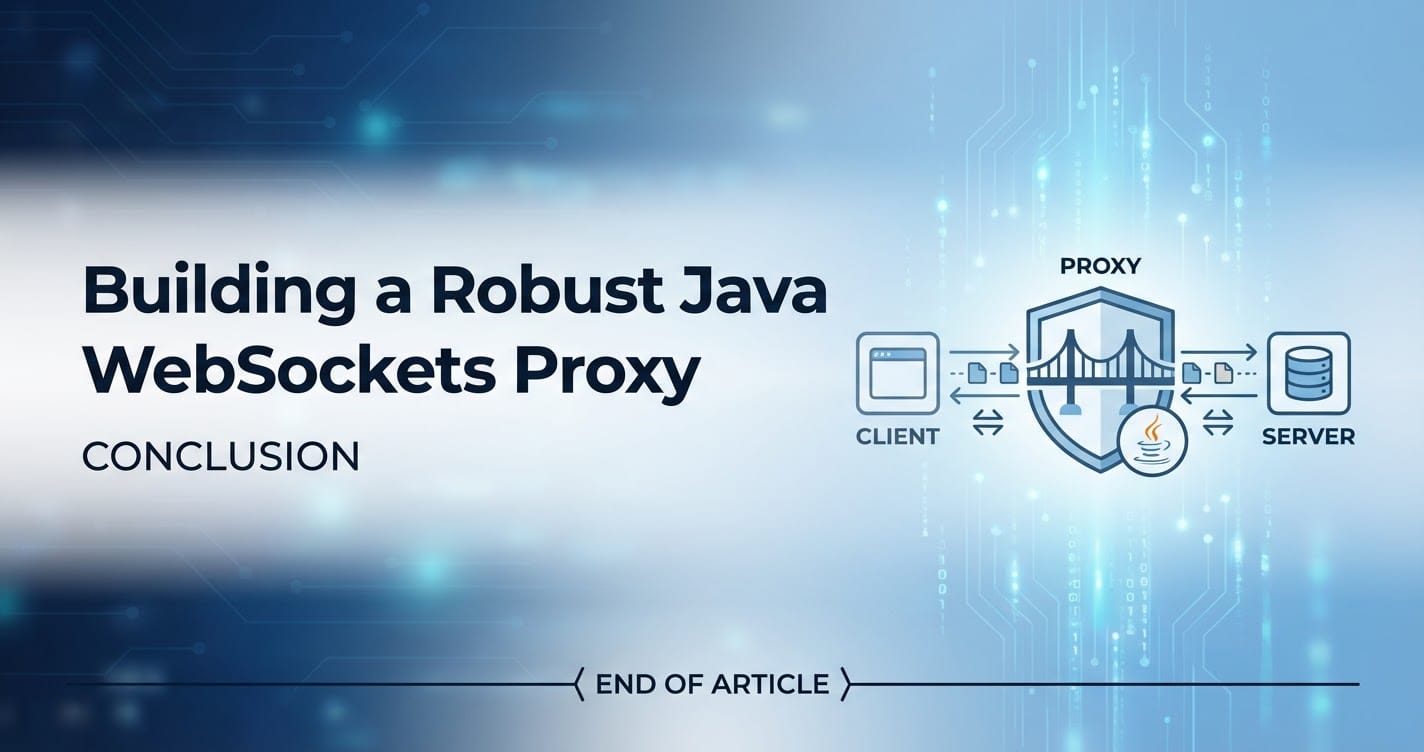
Building a Robust Java WebSockets Proxy
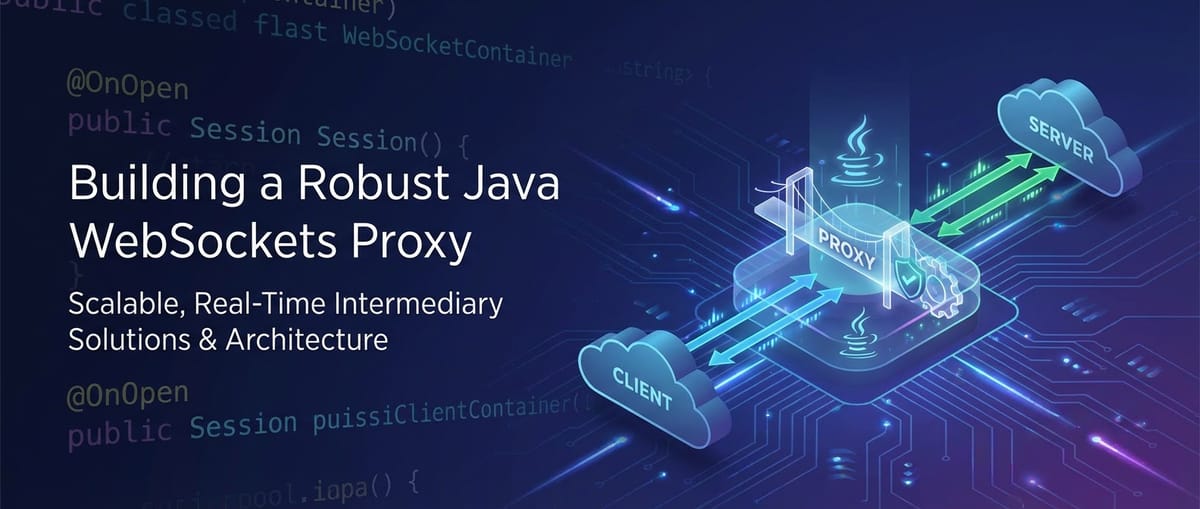


The landscape of modern web applications is relentlessly shifting towards real-time interactivity, pushing the boundaries of traditional request-response paradigms. From instant messaging platforms and live stock tickers to collaborative document editing and multiplayer online games, the demand for immediate, bidirectional communication between clients and servers has never been higher. This evolution is largely powered by WebSockets, a protocol that provides full-duplex communication channels over a single TCP connection. While direct client-to-server WebSocket connections are feasible for simpler scenarios, the complexities multiply dramatically as applications scale, security requirements tighten, and the underlying service architecture becomes distributed. This is precisely where the concept of a WebSockets proxy becomes not just advantageous, but indispensable.
A WebSockets proxy acts as an intelligent intermediary, sitting between your client applications and your backend WebSocket services. It intercepts client requests, applies a set of rules and transformations, and then forwards them to the appropriate upstream service. This might seem straightforward, but for WebSockets, which maintain persistent, stateful connections, the engineering challenges are considerably more nuanced than those encountered with stateless HTTP proxies. When we speak of a "proxy" in this context, we are often delving into the realm of a specialized gateway, a sophisticated traffic manager that provides a single, unified entry point for all client interactions. More broadly, such a component is often part of a larger API gateway strategy, managing the entirety of an organization's API traffic, be it RESTful, GraphQL, or indeed, WebSocket-based.
This article embarks on a comprehensive journey to explore the intricacies of building a robust WebSockets proxy using Java. We will delve into the fundamental motivations behind deploying such a proxy, dissect the architectural considerations that govern its design, and illuminate the practical implementation details that bring it to life. Furthermore, we will explore advanced features essential for a production-grade system, including sophisticated load balancing, stringent security measures, and comprehensive observability. Our aim is to provide a deep dive into creating a high-performance, resilient, and manageable Java-based WebSockets proxy that not only handles the demands of real-time applications but also integrates seamlessly into a broader API management ecosystem. By the end, readers will possess a thorough understanding of how to architect, implement, and deploy such a critical piece of infrastructure, ensuring their real-time applications are both scalable and secure.
Understanding WebSockets and the Imperative for a Proxy
Before diving into the mechanics of building a Java WebSockets proxy, it's crucial to solidify our understanding of WebSockets themselves and articulate the compelling reasons for introducing an intermediary layer. This foundation will underscore the design decisions and implementation complexities we will tackle later.
WebSockets Fundamentals: A Paradigm Shift in Communication
At its core, the WebSocket protocol (standardized as RFC 6455) represents a fundamental departure from the traditional HTTP request-response model that has long dominated web communication. Where HTTP is inherently stateless and connectionless—each request typically opening and closing a new connection—WebSockets establish a persistent, full-duplex communication channel over a single TCP connection. This channel, once established, allows for simultaneous, bidirectional data exchange between the client and the server without the overhead of repeated handshakes or polling.
The process begins with a standard HTTP handshake, where the client sends an HTTP GET request to the server with specific upgrade headers (e.g., Upgrade: websocket, Connection: Upgrade). If the server supports WebSockets and agrees to the upgrade, it responds with an HTTP 101 Switching Protocols status code. At this point, the underlying TCP connection is "upgraded" from HTTP to the WebSocket protocol, and both client and server can send data frames to each other at any time, independently. This eliminates the latency and overhead associated with HTTP's request-response cycle, making WebSockets ideal for applications demanding low-latency, real-time updates. The protocol supports text and binary data frames, control frames (like pings, pongs, and close frames), and can be secured using TLS/SSL, transforming ws:// to wss:// for encrypted communication.
The Indispensable Role of a WebSockets Proxy: Beyond Direct Connections
While direct client-to-server WebSocket connections are technically feasible, particularly for smaller, less complex applications, relying solely on them in a production environment quickly exposes a multitude of challenges. These challenges range from security vulnerabilities and scalability bottlenecks to operational complexities and the absence of centralized control. A WebSockets proxy, acting as a sophisticated gateway, addresses these issues by providing a critical layer of abstraction and control. Let's elaborate on the multifaceted benefits a proxy offers:
- Enhanced Security: The First Line of Defense: A proxy serves as the paramount security perimeter for your backend WebSocket services. It can perform TLS/SSL termination, offloading the computationally intensive encryption and decryption tasks from your application servers. This not only improves backend performance but also centralizes certificate management. More crucially, the proxy can enforce stringent authentication and authorization policies before any connection reaches your sensitive backend services. It can validate API keys, JWT tokens, or OAuth2 credentials during the initial WebSocket handshake, rejecting unauthorized access attempts at the edge. Furthermore, it can implement IP whitelisting, rate limiting, and protection against various attack vectors, shielding your internal network topology from direct client exposure. This makes the proxy a crucial security gateway.
- Sophisticated Load Balancing and Scalability: Distributing WebSocket connections across multiple backend servers is vital for scalability and high availability. Unlike stateless HTTP connections, where any server can handle any request, WebSocket connections are persistent and stateful. This means that once a client establishes a connection with a specific backend server, subsequent messages from that client typically need to be routed back to the same server to maintain session state. A robust WebSockets proxy can implement advanced load balancing strategies, such as sticky sessions (based on client IP, cookies, or custom headers), to ensure session persistence while still distributing new connections effectively. It can also monitor the health of backend services, automatically rerouting traffic away from unhealthy instances, thereby enhancing resilience and ensuring continuous service availability. This is a primary function of any high-performance API gateway.
- Centralized API Management and Governance: In a microservices architecture, managing a multitude of APIs can quickly become overwhelming. A WebSockets proxy, particularly when integrated into a broader API gateway solution, offers a centralized point for API management and governance. It can enforce uniform policies across all WebSocket endpoints, including:
- Rate Limiting and Throttling: Preventing abuse, ensuring fair usage, and protecting backend services from being overwhelmed by traffic surges.
- Quotas: Applying usage limits per client or application.
- Logging and Monitoring: Providing a single point for collecting comprehensive logs and metrics about WebSocket traffic, connection durations, message counts, and error rates. This unified observability is invaluable for troubleshooting, performance analysis, and security auditing.
- Auditing: Recording who connected, when, and what operations were performed.
- Traffic Routing and Versioning: Dynamically routing WebSocket connections to different backend service versions based on client requirements or A/B testing strategies.
- Protocol Translation and Adaptation: While a pure WebSockets proxy primarily forwards WebSocket traffic transparently, more advanced gateway implementations might offer protocol translation capabilities. For instance, it could bridge between different real-time protocols or adapt older client communication styles to modern backend WebSocket services. This provides flexibility in evolving your application architecture without forcing immediate client updates.
- Network Topology Hiding and Abstraction: By acting as the sole public-facing endpoint, the proxy effectively hides the internal network topology of your backend WebSocket services. Clients interact only with the proxy's public IP address or domain name, never directly with individual backend servers. This enhances security by preventing direct attacks on internal services and simplifies network configuration, allowing backend services to be deployed in private subnets without public exposure. It provides a clean abstraction layer for your real-time APIs.
- Resilience and Circuit Breaking: A robust proxy can implement circuit breaker patterns. If an upstream WebSocket service experiences failures or becomes unresponsive, the proxy can "open the circuit," temporarily stopping traffic to that service and preventing cascading failures. This allows the failing service time to recover without bringing down the entire system. Once the service recovers, the circuit can "close," resuming normal traffic flow.
In summary, a WebSockets proxy transcends the role of a simple forwarder; it is a critical component for building scalable, secure, and manageable real-time applications. It embodies many of the principles of a modern API gateway, extending its capabilities to the unique demands of persistent, bidirectional communication.
Architectural Considerations for a Java WebSockets Proxy
Building a robust Java WebSockets proxy requires careful architectural planning, considering not only the immediate functional requirements but also long-term scalability, maintainability, and operational efficiency. The choice of core components and Java frameworks will significantly influence the proxy's performance characteristics and development velocity.
Core Components of a WebSockets Proxy
A functional WebSockets proxy is composed of several interdependent modules, each responsible for a specific aspect of connection handling and message routing:
- Frontend Listener (Client-Facing): This is the entry point for all client WebSocket connections. It's responsible for accepting incoming
ws://orwss://connections, performing the initial HTTP handshake upgrade to the WebSocket protocol, and then managing the lifecycle of these client-side WebSocket sessions. Forwss://connections, it must handle TLS termination, decrypting incoming data and encrypting outgoing data. - Backend Connector (Upstream-Facing): This component is responsible for establishing and managing WebSocket connections to the actual backend application servers. When a new client connection arrives, the proxy needs to determine which upstream server to connect to (potentially involving load balancing logic) and then initiate a client-side WebSocket connection to that server. It also manages the lifecycle of these upstream connections, including reconnections in case of failure.
- Message Router and Forwarder: This is the heart of the proxy's logic. Once a client WebSocket connection and a corresponding upstream WebSocket connection are established, the message router facilitates the bidirectional flow of data. It receives WebSocket frames (text, binary, control) from the client, decodes them, potentially applies policies (e.g., rate limiting), and then re-encodes and forwards them to the appropriate upstream connection. Conversely, it receives frames from the upstream server, decodes them, and forwards them back to the original client. This component must efficiently manage the mapping between client-side and upstream-side connections.
- Connection Mapper: Given the stateful nature of WebSockets, the proxy needs to maintain a clear mapping between each incoming client WebSocket session and its corresponding outgoing upstream WebSocket session. This mapping is crucial for ensuring that messages from a specific client are always routed to the correct backend session, and responses from that backend session are returned to the correct client. Data structures like concurrent hash maps or specialized session stores are typically used here.
- Authentication and Authorization Module: Integrated with the frontend listener, this module intercepts the initial WebSocket handshake to perform security checks. It validates client credentials (e.g., API keys in headers, JWT tokens in cookies or custom protocols) and determines if the client is authorized to establish a connection or access specific backend resources. This is a key function for any secure API gateway.
- Configuration Management: A robust proxy needs a mechanism for managing its operational parameters, such as the addresses of backend WebSocket services, routing rules, load balancing algorithms, rate limits, and security policies. This configuration might be static (loaded at startup) or dynamic (updated at runtime via a configuration service or admin API).
- Logging, Monitoring, and Metrics: For operational visibility, the proxy must extensively log events (connection attempts, successes, failures, errors, messages processed) and expose metrics (active connections, message rates, latency, error rates). These are crucial for health checks, performance analysis, troubleshooting, and security auditing.
Choice of Java Frameworks and Libraries
Java offers a rich ecosystem of libraries and frameworks suitable for network programming, each with its own strengths and trade-offs. The choice often boils down to the desired level of control, performance requirements, and development complexity.
- Netty: The High-Performance Workhorse Netty is a high-performance, asynchronous, event-driven network application framework. It provides a non-blocking I/O model (NIO) that is ideal for building highly concurrent network services like proxies and gateways. Netty offers fine-grained control over network protocols and buffers, making it incredibly efficient for handling large numbers of concurrent connections and high message throughput. Its robust WebSocket support (via
netty-handler-codec-http-websocket) allows developers to implement both client and server-side WebSocket protocols with precision.- Pros: Exceptional performance, low-level control, widely used in industry for critical infrastructure.
- Cons: Higher learning curve, requires more boilerplate code compared to higher-level frameworks.
- Spring WebFlux with Reactor Netty: Reactive and Scalable Spring WebFlux is a reactive web framework that is part of the Spring ecosystem, built on Project Reactor. It leverages a non-blocking, event-driven architecture, often using Reactor Netty as its underlying server. WebFlux provides a higher-level abstraction than raw Netty, simplifying the development of asynchronous, backpressure-aware services. Its reactive programming model (Mono, Flux) is well-suited for handling the continuous stream of data inherent in WebSocket communication.
- Pros: Integrates seamlessly with the Spring ecosystem, powerful reactive programming model, good balance of control and abstraction.
- Cons: Reactive programming paradigm can have a steep learning curve for developers new to it.
- Jetty and Undertow (Embedded Servers): Simpler Embedding Jetty and Undertow are popular, lightweight embedded web servers that also provide robust support for WebSockets. They can be easily embedded within a Java application, offering a simpler path for creating a WebSocket server or client. While they might not offer the same ultra-low-level control as Netty, they are often easier to get started with for simpler proxying needs. Undertow, in particular, is known for its excellent performance and low memory footprint.
- Pros: Easy to embed and configure, good performance for many use cases, less boilerplate than raw Netty.
- Cons: May offer less fine-grained control over network events compared to Netty, potentially slightly less performant at extreme scales.
Here's a comparative overview of these Java WebSocket frameworks/libraries:
| Feature / Library | Netty (via netty-handler-codec-http-websocket) |
Spring WebFlux (with Reactor Netty) | Jetty (Embedded) | Undertow (Embedded) |
|---|---|---|---|---|
| Paradigm | Low-level, Event-driven I/O | Reactive, Non-blocking | Servlet-based, Asynchronous | Servlet-based, Asynchronous |
| Control Level | Very High (fine-grained network control) | High (Reactive Streams, leveraging Netty) | Moderate (servlet API abstraction) | Moderate (direct access to XNIO) |
| Performance | Excellent (highly optimized, minimal overhead) | Excellent (inherits Netty's performance) | Good (efficient, widely adopted) | Excellent (known for low overhead and high throughput) |
| Complexity | Higher (requires deep understanding of networking) | Moderate (steep learning curve for reactive) | Lower (familiar Servlet API) | Lower (straightforward API) |
| Integrations | Foundational for many other frameworks/servers | Seamless with Spring ecosystem (DI, AOP) | Widely used embedded server | Popular embedded server, part of WildFly/JBoss EAP |
| Backpressure Support | Manual (via channel read/write management) | Automatic (built into Reactive Streams) | Implicit (via container's thread pools) | Implicit (via container's thread pools) |
| Suitability for Robust Proxy | Excellent (for maximum control and raw performance, ideal for critical infrastructure) | Excellent (for reactive architecture, good balance of control and abstraction, enterprise-ready) | Good (for simpler proxy needs, easy embedding, established) | Good (for high-performance, simpler proxies, modern and efficient) |
For building a truly robust and high-performance WebSockets proxy, Netty or Spring WebFlux with Reactor Netty are generally the preferred choices. Netty offers unparalleled control and raw performance, making it suitable for demanding, low-latency scenarios where every millisecond counts. Spring WebFlux, on the other hand, provides a powerful reactive programming model that simplifies the handling of asynchronous data streams and backpressure, making it an excellent choice for complex, enterprise-grade proxies within the Spring ecosystem.
Deployment Models
The chosen deployment model significantly impacts the operational aspects of the WebSockets proxy:
- Standalone Service: Packaging the proxy as a single executable JAR file. This offers simplicity but requires manual management for scaling and high availability.
- Containerized (Docker): Encapsulating the proxy and its dependencies within a Docker image. This provides isolation, portability, and easier deployment. Docker containers are lightweight and allow for consistent environments across development, testing, and production.
- Orchestrated (Kubernetes): Deploying Dockerized proxy instances within a Kubernetes cluster. Kubernetes provides advanced features for service discovery, automatic scaling (horizontal pod autoscaling), self-healing (restarting failed pods), load balancing, and rolling updates. This is the de facto standard for highly available and scalable microservices deployments, making it ideal for a production-grade WebSockets proxy acting as an API gateway.
By carefully considering these architectural elements, developers can lay a strong foundation for a Java WebSockets proxy that is not only functional but also performant, secure, and ready for the rigors of production environments.
Implementation Details in Java: Bringing the Proxy to Life
With the architectural blueprint in place, let's delve into the practical implementation aspects of a Java WebSockets proxy. We'll focus on the core logic: establishing connections, proxying messages, and handling the intricacies of bidirectional communication. While full code examples are beyond the scope of this detailed narrative, we will describe the essential components and patterns using conceptual language that resonates with common Java networking frameworks.
Establishing WebSocket Connections: Frontend and Backend
The proxy's fundamental role involves establishing two distinct sets of WebSocket connections: one with the client (frontend) and another with the upstream backend service (backend).
1. Server-Side (Frontend) WebSocket Connection Handling: The proxy needs to act as a WebSocket server to accept connections from clients. This involves:
- Listening for HTTP Upgrade Requests: The initial client request will be an HTTP GET request with
Upgrade: websocketandConnection: Upgradeheaders. The proxy must detect these headers. - Performing the Handshake: Upon detecting an upgrade request, the proxy initiates the WebSocket handshake. If successful, it sends an HTTP 101 Switching Protocols response and the connection transitions to the WebSocket protocol.
- Managing Client Sessions: Each successfully established client WebSocket connection represents a session. The proxy needs to manage these sessions, typically associating them with a unique identifier (e.g., a channel ID in Netty or a session ID in Spring's WebSocket API).
- Netty Example: In Netty, this is handled by a
ChannelInitializerthat adds aHttpServerCodec(to handle HTTP), aHttpObjectAggregator(to aggregate HTTP parts), and crucially, aWebSocketServerProtocolHandler. TheWebSocketServerProtocolHandlerautomatically manages the HTTP handshake and subsequent WebSocket frame encoding/decoding. Custom handlers are then inserted into the pipeline after this protocol handler to process the WebSocket frames themselves. - Spring WebFlux Example: Spring provides a higher level of abstraction with the
WebSocketHandlerinterface. You implement methods likehandle(WebSocketSession session)where you can react to incoming messages (usingsession.receive()) and send outgoing messages (session.send()). AWebSocketHandlerAdapterand aWebSocketMapping(e.g., using@WebSocketMapping("/techblog/en/ws/proxy")) route incoming WebSocket requests to your handler.
- Netty Example: In Netty, this is handled by a
2. Client-Side (Backend) WebSocket Connection Handling: For each incoming client WebSocket connection, the proxy must typically establish a corresponding outgoing WebSocket connection to an upstream backend service.
- Upstream Service Discovery: Before connecting, the proxy needs to determine the target upstream WebSocket server's address (host and port). This might involve simple static configuration, more advanced service discovery mechanisms (e.g., Eureka, Consul, Kubernetes DNS), or load balancing decisions.
- Initiating a WebSocket Client Handshake: The proxy acts as a WebSocket client, sending an HTTP GET request with upgrade headers to the chosen upstream server.
- Managing Upstream Sessions: Similar to client sessions, the proxy manages these backend WebSocket sessions, linking them to their corresponding client sessions.
- Netty Example: A
Bootstrapis used to configure and initiate the client connection. AChannelInitializerfor the client pipeline includes aHttpClientCodecand aWebSocketClientProtocolHandler(orWebSocketClientHandshaker) to manage the client-side handshake and frame processing. - Spring WebFlux Example: Spring's
WebSocketClientinterface (e.g.,ReactorNettyWebSocketClient) allows you to programmatically connect to a WebSocket URI. It returns aMono<Void>indicating connection completion, and you provide aWebSocketHandlerto manage the client-side session.
- Netty Example: A
Proxying Logic: The Bidirectional Message Flow
Once both the client-side and upstream-side WebSocket connections are established and mapped, the core proxying logic comes into play. This involves intercepting messages from one side, preparing them, and forwarding them to the other side, and vice-versa.
- Incoming Client Messages:
- Decoding: The proxy receives WebSocket frames (text, binary, ping, pong, close) from the client. These frames are already decoded by the WebSocket protocol handler (e.g., Netty's
WebSocketServerProtocolHandleror Spring's internal handlers) into manageable objects. - Processing: Before forwarding, the proxy might apply certain policies:
- Authentication/Authorization: Although often handled during the handshake, per-message authorization could be implemented for very sensitive operations.
- Rate Limiting: Check if the client has exceeded its message rate limit.
- Message Validation: Basic checks on message size or format to prevent abuse or malformed data.
- Logging: Log the message content or metadata for auditing and debugging.
- Forwarding: The processed message (or a transformed version) is then sent to the corresponding upstream WebSocket connection. This involves re-encoding the message into a WebSocket frame format suitable for the backend.
- Decoding: The proxy receives WebSocket frames (text, binary, ping, pong, close) from the client. These frames are already decoded by the WebSocket protocol handler (e.g., Netty's
- Incoming Upstream Messages:
- Decoding: Similarly, messages from the upstream server are received and decoded by the proxy's client-side WebSocket protocol handler.
- Processing: The proxy might apply policies specific to upstream responses:
- Content Transformation: Modify the message content if necessary (e.g., sanitizing sensitive data).
- Error Handling: Detect and handle upstream errors, potentially generating a client-friendly error message or closing the connection gracefully.
- Logging: Log upstream responses for debugging.
- Forwarding: The processed message is then sent back to the original client WebSocket connection, re-encoded into a WebSocket frame.
Key Data Structure: Connection Mapping A central challenge is efficiently mapping a clientChannel (or clientSession) to its upstreamChannel (or upstreamSession). A ConcurrentHashMap<ChannelId, Channel> or Map<String, WebSocketSession> is typically used. When a client connects, the proxy: 1. Establishes a connection to an upstream server. 2. Stores clientChannel -> upstreamChannel mapping. 3. Stores upstreamChannel -> clientChannel mapping (for bidirectional lookup). When a message arrives on clientChannel, the proxy retrieves upstreamChannel from the map and forwards the message. The reverse happens for messages from upstream.
Handling Disconnections: Graceful handling of disconnections is paramount for robustness. * Client Disconnection: If a client disconnects, the proxy must detect this (e.g., Netty's channelInactive event, Spring's session.close()) and cleanly close the corresponding upstream connection and remove entries from the connection map. * Upstream Disconnection: If an upstream server disconnects, the proxy must detect this and gracefully close the corresponding client connection (sending a WebSocket close frame with an appropriate status code, e.g., 1001 for going away, or a custom application-level code). It then removes entries from the connection map. * Heartbeats/Pings: WebSocket supports ping/pong control frames. The proxy should ideally handle pings from clients (responding with pongs) and send pings to upstream servers to ensure liveness, closing connections that become unresponsive.
Security Implementation: Hardening the Proxy
Security must be woven into the fabric of the proxy, not merely bolted on. The proxy, as a gateway, is the primary point of defense.
- TLS/SSL Termination (
wss://):- For
wss://connections, the proxy must handle TLS termination. This involves configuring SSLContext with your certificates (e.g., JKS, PKCS12 keystores). - In Netty,
SslContextandSslHandlerare added to the pipeline. In Spring, this is often configured via properties inapplication.ymlfor embedded servers or by placing the proxy behind a dedicated load balancer/reverse proxy (like Nginx or an API gateway like APIPark) that handles TLS.
- For
- Authentication:
- During Handshake: The most common approach is to authenticate the client during the initial HTTP handshake. This can involve:
- API Keys: Extracting an API key from a custom HTTP header (e.g.,
X-API-Key) or a query parameter and validating it against a secure store. - JWT (JSON Web Tokens): Extracting a JWT from an
Authorizationheader (e.g.,Bearer <token>) or a cookie, validating its signature, expiration, and claims. - OAuth2 Tokens: Similar to JWTs, validating access tokens.
- API Keys: Extracting an API key from a custom HTTP header (e.g.,
- If authentication fails, the proxy should respond with an HTTP 401 Unauthorized during the handshake, preventing the WebSocket connection from ever being established.
- During Handshake: The most common approach is to authenticate the client during the initial HTTP handshake. This can involve:
- Authorization:
- Once authenticated, the client's identity and roles can be used to determine if they are authorized to connect to the requested upstream service or to perform specific actions over the WebSocket.
- This might involve checking against an internal authorization service or policy engine. For instance, a client might be authenticated but only authorized to access the chat service, not the admin service.
- Input Validation and Sanitization:
- While WebSockets carry raw data frames, it's prudent to implement basic validation on message sizes to prevent denial-of-service attacks (e.g., extremely large messages).
- If the proxy performs any content transformation or interpretation, sanitization against common vulnerabilities (e.g., injection attacks if messages are parsed as XML/JSON and then used in database queries) is essential.
Implementing these details carefully ensures that the Java WebSockets proxy is not just functional but also resilient, secure, and capable of handling the demands of real-world, high-traffic real-time applications.
Advanced Features and Robustness: Building a Production-Ready System
A basic WebSockets proxy, while functional, falls short of the demands of a production environment. To achieve true robustness, high availability, and scalability, a Java WebSockets proxy must incorporate a suite of advanced features, transforming it into a sophisticated gateway for real-time applications.
Load Balancing Strategies for Stateful Connections
Load balancing is critical for distributing client connections across multiple instances of your backend WebSocket services, preventing any single server from becoming a bottleneck and ensuring high availability. However, the stateful nature of WebSockets introduces unique challenges compared to stateless HTTP.
- Connection-Based Load Balancing (New Connections): For new WebSocket connections, standard load balancing algorithms can be applied:
- Round-Robin: Distributes new connections sequentially among available servers.
- Least Connections: Routes new connections to the server with the fewest active connections.
- Weighted Round-Robin/Least Connections: Prioritizes servers with higher capacity or better performance. The proxy maintains a list of available upstream WebSocket servers, often discovered dynamically.
- Sticky Sessions (Session Persistence): This is the most crucial aspect for WebSockets. Once a client establishes a connection with a specific backend server, subsequent messages from that client must be routed back to the same server if that server maintains session-specific state (e.g., chat history, game state, user preferences).
- Implementation: The proxy can achieve stickiness by:
- Client IP Hashing: Hashing the client's IP address to consistently route them to the same backend server. This is simple but can suffer if clients are behind shared NATs.
- Cookie-Based Stickiness: The backend server sets a special cookie, which the proxy reads on subsequent connections (or reconnection attempts) to route to the correct server. This is more reliable than IP hashing.
- Custom Header Stickiness: The backend service (or the proxy itself upon initial connection) injects a custom header (e.g.,
X-Backend-Id) into the WebSocket upgrade response, which the client might then send back on subsequent requests or reconnects. - Internal Connection Mapping: The proxy itself stores the mapping of a client ID (derived from authentication or initial handshake) to a specific backend instance.
- Implementation: The proxy can achieve stickiness by:
- Integration with Service Discovery: Instead of hardcoding backend server addresses, a robust proxy integrates with a service discovery system (e.g., Spring Cloud Eureka, HashiCorp Consul, Kubernetes DNS). The proxy dynamically queries the service registry to obtain a list of healthy, available WebSocket backend service instances, allowing for flexible scaling and automatic handling of service churn.
Rate Limiting and Throttling: Guarding Against Overload
Rate limiting is a critical API gateway feature that protects backend services from being overwhelmed by excessive requests, prevents abuse, and ensures fair resource utilization. For WebSockets, this can apply to connection establishment rates or message rates per active connection.
- Connection Rate Limiting: Limits the number of new WebSocket connections a client (identified by IP, API key, or user ID) can establish within a given time window.
- Techniques: Token bucket or leaky bucket algorithms.
- Message Rate Limiting: Limits the number of messages a client can send over an active WebSocket connection within a given time. This is particularly important for chat applications or data streaming services.
- Techniques:
- Token Bucket: A fixed capacity bucket that is filled with tokens at a constant rate. Each message consumes a token. If the bucket is empty, the message is dropped or queued. Allows for bursts up to the bucket capacity.
- Leaky Bucket: Messages are put into a bucket, which "leaks" at a constant rate. If the bucket overflows, messages are dropped. This smooths out bursty traffic.
- Granularity: Rate limits can be applied globally, per client, per API endpoint, or per authenticated user.
- Techniques:
Circuit Breakers and Retries: Enhancing Resilience
Circuit breakers are a design pattern crucial for building fault-tolerant distributed systems. They prevent a failing service from causing cascading failures throughout the system by "breaking" the circuit to that service.
- Circuit Breaker Pattern:
- If the proxy detects repeated failures (e.g., connection errors, high error rates, timeouts) when trying to establish or communicate with an upstream WebSocket service, the circuit breaker "opens."
- When open, subsequent requests to that service immediately fail (fail-fast) without even attempting to connect. This gives the failing service time to recover and prevents the proxy from wasting resources on doomed requests.
- After a configurable "half-open" period, the circuit allows a few test requests to pass through. If these succeed, the circuit closes; otherwise, it returns to the open state.
- Libraries like Resilience4j (a modern Hystrix alternative) or Netflix Hystrix provide robust implementations for Java.
- Retry Mechanisms:
- For transient upstream failures (e.g., momentary network glitch during handshake), the proxy can implement an intelligent retry mechanism with exponential backoff.
- However, indiscriminate retries can exacerbate problems during widespread outages, hence the importance of coupling retries with circuit breakers.
High Availability and Scalability: Ensuring Uninterrupted Service
A robust proxy must be designed for continuous operation and capable of handling increasing loads.
- Clustering and Horizontal Scaling:
- Multiple instances of the Java WebSockets proxy should be run concurrently, ideally behind a network load balancer (e.g., AWS ELB, Nginx, Kubernetes Ingress Controller).
- The network load balancer distributes incoming client TCP connections to the proxy instances.
- Each proxy instance operates independently, maintaining its own set of client-to-upstream connection mappings. For sticky sessions across proxy instances, the outer load balancer needs to support sticky sessions (e.g., based on client IP or cookies), or the proxy itself needs to use an external shared state for routing decisions (e.g., Redis). However, a truly stateless proxy design is often preferred for simpler horizontal scaling.
- Stateless vs. Stateful Proxy Design:
- Stateless: If the proxy itself doesn't maintain any unique, persistent state about client sessions (beyond the active connection mapping), instances can be added or removed dynamically, simplifying scaling. All critical state is pushed down to the backend WebSocket services. This is generally the goal for maximum scalability.
- Stateful (Distributed State): If the proxy needs to maintain some global state (e.g., for very advanced sticky session logic across proxy restarts or dynamic routing rules), this state must be externalized to a distributed key-value store (like Redis, Cassandra, or ZooKeeper) to be accessible by all proxy instances. This adds complexity.
Observability: Seeing Inside the Black Box
Understanding the health, performance, and behavior of the proxy in real-time is non-negotiable for a production system. This requires comprehensive logging, metrics, and distributed tracing.
- Detailed Logging:
- Structured Logging: Emit logs in a structured format (e.g., JSON) using libraries like SLF4J with Logback or Log4j2. This makes logs easily parsable and queryable by log aggregation systems (ELK stack, Splunk, Grafana Loki).
- Key Information: Log connection attempts (success/failure), client/upstream connection details (IPs, IDs), message counts, errors, warnings, and latency measurements. Include correlation IDs for end-to-end tracing.
- Metrics and Monitoring:
- Standard Metrics: Track active client connections, active upstream connections, messages sent/received (bytes and count), connection establishment rates, error rates, CPU/memory usage.
- Latency Metrics: Measure latency from client to proxy, and from proxy to upstream.
- Integration: Use a library like Micrometer (which integrates with Spring Boot Actuator) to expose metrics in a format compatible with monitoring systems like Prometheus. Visualize these metrics using dashboards in Grafana.
- Distributed Tracing:
- Crucial in microservices architectures, distributed tracing allows you to trace a single request (or in this case, a WebSocket session's lifecycle or a specific message) as it flows through multiple services, including the proxy and various backend components.
- Implementation: Use OpenTelemetry (or Zipkin, Jaeger) to inject trace context (trace ID, span ID) into WebSocket frames (e.g., as custom headers or within the message payload if appropriate) and propagate it to upstream services. This provides end-to-end visibility into latency and bottlenecks.
- Health Checks:
- The proxy should expose health endpoints (e.g.,
/health,/actuator/healthin Spring Boot) that report its operational status, connectivity to backend services, and internal resource usage. These are used by orchestrators like Kubernetes to determine if a proxy instance is healthy and ready to receive traffic.
- The proxy should expose health endpoints (e.g.,
By diligently implementing these advanced features, the Java WebSockets proxy transcends being a mere message forwarder. It becomes a resilient, scalable, and observable component, forming a robust gateway that safeguards your real-time APIs and ensures a seamless experience for your users.
APIPark Integration: A Broader Perspective on API Management
While building a custom Java WebSockets proxy provides granular control over real-time communication, it's essential to recognize its role within a broader API infrastructure. For enterprises managing a diverse portfolio of APIs—including REST, GraphQL, and increasingly, AI-driven services—a dedicated API management platform becomes indispensable. Such platforms abstract away many of the complexities we've discussed, offering a comprehensive solution for the entire API lifecycle. This is where solutions like APIPark offer significant value, often complementing or even encompassing the functionalities of a custom proxy within a unified API gateway ecosystem.
APIPark is an all-in-one AI gateway and API developer portal that is open-sourced under the Apache 2.0 license. It's meticulously designed to help developers and enterprises manage, integrate, and deploy AI and REST services with unparalleled ease. While our custom Java WebSockets proxy provides a specialized solution for real-time traffic, APIPark extends these gateway capabilities to a much broader range of APIs and management concerns, providing a holistic platform for API management.
Let's explore how APIPark's key features align with and expand upon the concepts of a robust API gateway, demonstrating its relevance to modern API strategy:
- Quick Integration of 100+ AI Models & Unified API Format for AI Invocation: In today's rapidly evolving technological landscape, AI APIs are becoming paramount. APIPark stands out by offering the capability to integrate a vast array of AI models with a unified management system for authentication and cost tracking. Crucially, it standardizes the request data format across all AI models. This means that applications and microservices can invoke diverse AI services (e.g., a sentiment analysis AI from one provider, a translation AI from another) using a consistent API format. This standardization is a highly advanced form of protocol translation and abstraction, akin to what a WebSockets proxy does for real-time data but applied to the complex and fragmented world of AI services. It ensures that changes in underlying AI models or prompts do not ripple through and affect the application, significantly simplifying AI usage and reducing maintenance costs. This demonstrates APIPark's strength as an intelligent gateway for emerging technologies.
- Prompt Encapsulation into REST API: APIPark allows users to quickly combine AI models with custom prompts to create new APIs, such as custom sentiment analysis, translation, or data analysis APIs. This feature showcases a powerful aspect of an API gateway: transforming complex backend logic (AI models + prompts) into user-friendly, consumable RESTful APIs. It empowers developers to expose sophisticated functionalities as simple, well-defined endpoints, adhering to the principles of good API design and management.
- End-to-End API Lifecycle Management: While our custom Java WebSockets proxy focuses on runtime traffic, APIPark assists with managing the entire lifecycle of APIs, from design and publication to invocation and decommissioning. It helps regulate API management processes, manage traffic forwarding, load balancing, and versioning of published APIs. This comprehensive approach is what elevates a simple proxy to a full-fledged API gateway and management platform, ensuring that APIs are well-governed throughout their existence. The traffic forwarding and load balancing features discussed for WebSockets are fundamental to APIPark's operation for all API types.
- API Service Sharing within Teams & Independent API and Access Permissions for Each Tenant: Collaboration and structured access are vital in large organizations. APIPark enables the centralized display of all API services, making it easy for different departments and teams to find and use required API services. Furthermore, it supports multi-tenancy, allowing the creation of multiple teams (tenants) each with independent applications, data, user configurations, and security policies, while sharing underlying applications and infrastructure. This provides critical organizational and security segmentation, a feature highly desirable in any enterprise-grade API gateway.
- API Resource Access Requires Approval: Security and control are paramount. APIPark allows for the activation of subscription approval features, ensuring that callers must subscribe to an API and await administrator approval before they can invoke it. This prevents unauthorized API calls and potential data breaches, adding an essential layer of governance to the gateway's security framework—a capability far beyond a basic proxy.
- Performance Rivaling Nginx & Detailed API Call Logging & Powerful Data Analysis: APIPark is built for performance and observability. With just an 8-core CPU and 8GB of memory, it can achieve over 20,000 Transactions Per Second (TPS), supporting cluster deployment to handle large-scale traffic. This level of performance is critical for any API gateway, whether it's managing high-volume REST traffic or serving as an entry point for real-time systems. It also provides comprehensive logging capabilities, recording every detail of each API call. This feature is directly analogous to the logging and monitoring we discussed for our custom proxy, but centralized and standardized across all APIs. Furthermore, APIPark analyzes historical call data to display long-term trends and performance changes, aiding in preventive maintenance. These powerful data analysis features complement and extend the basic metrics and monitoring we would implement in a custom proxy, providing deeper operational insights into the entire API ecosystem.
- Easy Deployment: APIPark can be quickly deployed in just 5 minutes with a single command line. This ease of deployment lowers the barrier to entry for robust API management, contrasting with the considerable effort involved in building and deploying a custom proxy from scratch.
In essence, while a custom Java WebSockets proxy solves the specific needs of real-time communication at the gateway level, APIPark provides a comprehensive solution for managing the entire API ecosystem. It offers a powerful, open-source API gateway and API management platform that integrates advanced features for AI APIs, lifecycle governance, security, performance, and observability. Enterprises can leverage APIPark to streamline their API strategy, enhance security, and optimize performance for a diverse range of APIs, allowing developers to focus on core business logic rather than reinventing complex gateway functionalities. For those looking for an overarching API management solution that complements their specialized proxies, or even subsumes many of their roles for general API traffic, APIPark presents a compelling option.
Practical Considerations and Pitfalls: Navigating the Complexities
Even with robust architecture and advanced features, building a production-ready Java WebSockets proxy involves navigating several practical considerations and potential pitfalls. Awareness of these can prevent significant operational headaches down the line.
Resource Management: Taming the JVM and Network I/O
Java applications, particularly those dealing with high concurrency and persistent connections like a WebSockets proxy, require careful resource management.
- File Descriptors: Each open TCP connection (both client and upstream) consumes a file descriptor. A high volume of concurrent WebSocket connections can quickly exhaust the operating system's default file descriptor limits. It's crucial to raise these limits (e.g.,
ulimit -non Linux) on the host machines where the proxy runs. Failure to do so leads to "Too many open files" errors and connection failures. - Memory Usage:
- Direct Byte Buffers (Netty): Netty extensively uses direct byte buffers for I/O operations, which are allocated outside the JVM heap. While efficient, uncontrolled allocation can lead to out-of-memory errors on the native memory side. Proper buffer pooling and release mechanisms (Netty handles much of this, but custom handlers must be careful) are vital.
- Heap Usage: Each WebSocket session, its associated objects, and message buffers consume heap memory. Monitoring JVM heap usage and tuning garbage collection parameters (
-Xmx, GC algorithms) are essential to prevent frequent or long-pause garbage collection cycles that can impact real-time performance.
- Thread Pools: While non-blocking I/O frameworks like Netty and WebFlux minimize thread usage, they still rely on worker thread pools for event processing. Properly sizing these pools (not too small to create bottlenecks, not too large to cause context switching overhead) is crucial. Avoid blocking operations in event-loop threads.
Error Handling and Graceful Disconnections: Maintaining Stability
Errors are inevitable in distributed systems. A robust proxy must handle them gracefully to maintain stability and provide a good user experience.
- Upstream Failures: If an upstream WebSocket server suddenly disconnects or becomes unresponsive, the proxy must detect this promptly. It should then:
- Cleanly Close Client Connection: Send a WebSocket close frame to the affected client with an informative status code (e.g., 1001 for "going away," 1011 for "internal error," or a custom application-level status).
- Log and Alert: Record the upstream failure and trigger alerts for operational teams.
- Remove Mappings: Delete the stale client-to-upstream mappings.
- Client Disconnections: When a client disconnects, the proxy must ensure its resources are released:
- Cleanly Close Upstream Connection: Send a WebSocket close frame to the corresponding upstream server.
- Remove Mappings: Delete the mappings.
- Backpressure: A critical concept in reactive programming, backpressure prevents a fast producer (e.g., a client sending messages rapidly) from overwhelming a slow consumer (e.g., a backend service or even the network connection to it). Reactive frameworks like Spring WebFlux (Project Reactor) provide built-in backpressure mechanisms. In lower-level Netty, this requires manual management of channel read/writeability and buffer consumption. Failing to handle backpressure can lead to memory exhaustion or dropped messages.
Protocol Compliance: Adhering to the Standard
Strict adherence to the WebSocket RFC 6455 is paramount for interoperability and stability.
- Frame Handling: Correctly handle all WebSocket frame types (text, binary, ping, pong, close, continuation) including fragmentation. A robust proxy should not just pass bytes; it should understand and correctly reassemble fragmented messages.
- Control Frames: Ping/Pong frames are essential for connection liveness. The proxy should respond to client Pings with Pongs and optionally send Pings to upstream servers. Close frames (and their status codes) must be handled appropriately for graceful session termination.
- Handshake: Ensure the WebSocket handshake (HTTP Upgrade request/response) strictly follows the protocol, including header validation (
Sec-WebSocket-Key,Sec-WebSocket-Accept).
Testing: Ensuring Quality at Scale
A WebSockets proxy, dealing with high concurrency and real-time data, requires a rigorous testing strategy.
- Unit Tests: Test individual components (e.g., message router logic, authentication module) in isolation.
- Integration Tests: Verify the interaction between different components of the proxy, and between the proxy and mock (or actual) client and upstream WebSocket services.
- Performance and Load Testing: This is perhaps the most critical. Simulating thousands or tens of thousands of concurrent WebSocket connections and high message throughput is essential to:
- Identify bottlenecks (CPU, memory, network I/O).
- Verify load balancing and sticky session behavior under stress.
- Test resilience features (circuit breakers, retries) under fault injection.
- Tools like Gatling, JMeter (with WebSocket plugins), or custom-built clients are invaluable here.
- Chaos Engineering: For extreme robustness, periodically inject failures (e.g., killing upstream services, network latency, packet loss) into the system to observe and improve the proxy's resilience.
By paying meticulous attention to these practical considerations and proactively addressing potential pitfalls, developers can build a Java WebSockets proxy that is not only functional but also exceptionally stable, performant, and reliable under the most demanding real-world conditions. This commitment to detail transforms a simple proxy into a truly robust and resilient API gateway for real-time applications.
Conclusion: The Indispensable Role of a Robust Java WebSockets Proxy
The journey of building a robust Java WebSockets proxy is an intricate one, demanding a comprehensive understanding of networking fundamentals, thoughtful architectural design, meticulous implementation, and a proactive approach to advanced features and operational challenges. As real-time communication becomes an increasingly integral component of modern applications, the need for an intelligent intermediary—a specialized gateway—for WebSockets is undeniable. This proxy stands as a critical enabler for scalability, security, and manageability in a world driven by instant updates and bidirectional data flows.
We have traversed the core motivations for deploying such a proxy, emphasizing its crucial role in enhancing security through TLS termination and authentication, facilitating sophisticated load balancing for stateful connections, and centralizing API management policies like rate limiting and observability. We delved into the architectural bedrock, weighing the merits of high-performance Java frameworks like Netty and Spring WebFlux, and outlining the essential components from frontend listeners to message routers. The implementation details highlighted the intricacies of bidirectional message flow, connection mapping, and the pervasive need for robust error handling and adherence to protocol standards. Furthermore, we explored advanced features such as circuit breakers for resilience, dynamic service discovery, and comprehensive observability through logging, metrics, and distributed tracing—all pivotal for a production-grade gateway.
Finally, we broadened our perspective to situate the custom Java WebSockets proxy within the larger ecosystem of API management. While a bespoke proxy offers unparalleled control for specific real-time requirements, the comprehensive capabilities of platforms like APIPark cannot be overstated. APIPark, as an open-source AI gateway and API management platform, demonstrates how many of the gateway functionalities we discussed—from traffic management and security policies to logging and data analysis—can be unified and extended to manage a diverse portfolio of APIs, including the burgeoning category of AI services. It underscores the ongoing evolution of the API gateway concept, moving beyond simple proxies to sophisticated platforms that empower enterprises to govern their entire API lifecycle with efficiency and security.
In essence, whether building a custom Java WebSockets proxy as a specialized component or leveraging a comprehensive solution like APIPark for broader API management, the underlying principles of robust gateway design remain paramount. The digital landscape will continue to demand faster, more reliable, and more secure real-time interactions. By mastering the art and science of building and managing these critical intermediaries, developers and organizations can ensure their applications not only meet but exceed the expectations of an ever-connected world, delivering seamless and engaging user experiences powered by resilient and well-governed APIs.
Frequently Asked Questions (FAQs)
- What are the primary benefits of using a WebSockets proxy instead of direct client-to-server connections? A WebSockets proxy offers several significant advantages: enhanced security (TLS termination, authentication/authorization at the edge), improved scalability and high availability through intelligent load balancing, centralized API management (rate limiting, logging, monitoring), network topology hiding, and resilience features like circuit breakers. It acts as a dedicated gateway for real-time traffic, abstracting backend complexities and protecting services.
- Which Java framework is best suited for building a high-performance WebSockets proxy? For high-performance and fine-grained control, Netty is an excellent choice due to its asynchronous, event-driven I/O model. Alternatively, Spring WebFlux with Reactor Netty provides a powerful reactive programming model built on Netty, offering a good balance of abstraction and performance, seamlessly integrating with the broader Spring ecosystem. The choice often depends on the team's familiarity with reactive programming and the desired level of control.
- How does a WebSockets proxy handle security for real-time applications? A WebSockets proxy significantly enhances security by performing TLS/SSL termination (
wss://), centralizing authentication (e.g., validating JWT tokens or API keys during the handshake), and implementing authorization checks before connections reach backend services. It can also enforce IP whitelisting, apply rate limits to prevent abuse, and hide the internal network structure of backend services, making it a crucial security gateway. - What are the key differences in load balancing WebSockets compared to traditional HTTP? The main difference lies in the stateful nature of WebSockets. While HTTP requests can often be routed to any available server, WebSocket connections are persistent. Therefore, a WebSockets proxy must implement "sticky sessions" to ensure that once a client connects to a specific backend server, subsequent messages over that connection (or reconnection attempts) are routed back to the same server to maintain session state. This often involves using client IP hashing, cookies, or custom headers for session persistence.
- When should I consider using a full API gateway like APIPark instead of just a custom WebSockets proxy? You should consider a full API gateway like APIPark when your needs extend beyond just proxying WebSockets. If you manage a diverse portfolio of APIs (REST, GraphQL, AI APIs), require comprehensive API lifecycle management (design, publication, versioning), need robust features like detailed API access approval workflows, multi-tenancy support, or advanced analytics across all your APIs, a full API management platform offers a more integrated and scalable solution. APIPark excels at abstracting AI model integration and providing an all-encompassing API gateway solution that complements or replaces bespoke proxy implementations for broader API management challenges.
🚀You can securely and efficiently call the OpenAI API on APIPark in just two steps:
Step 1: Deploy the APIPark AI gateway in 5 minutes.
APIPark is developed based on Golang, offering strong product performance and low development and maintenance costs. You can deploy APIPark with a single command line.
curl -sSO https://download.apipark.com/install/quick-start.sh; bash quick-start.sh

In my experience, you can see the successful deployment interface within 5 to 10 minutes. Then, you can log in to APIPark using your account.

Step 2: Call the OpenAI API.