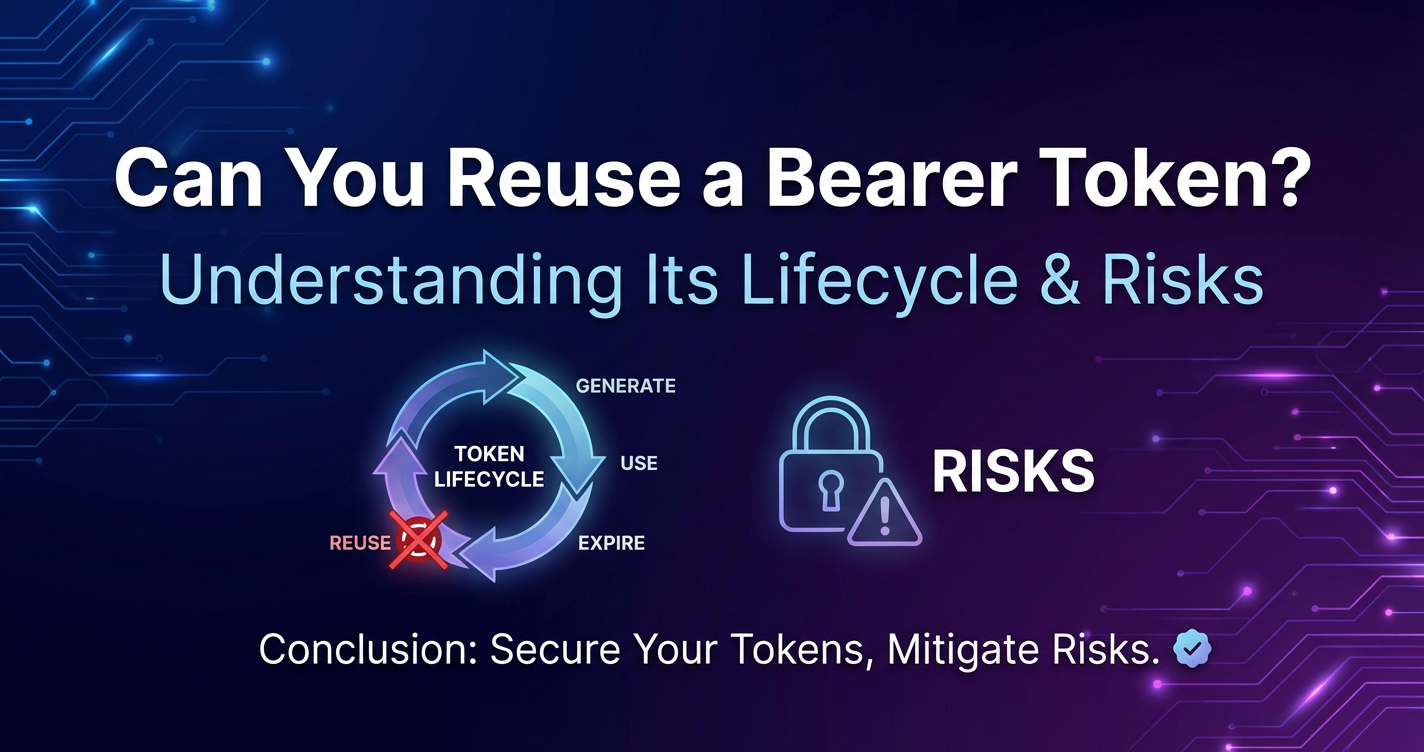
Can You Reuse a Bearer Token? Understanding Its Lifecycle & Risks


In the intricate world of modern web services and application programming interfaces (APIs), the bearer token stands as a ubiquitous, yet often misunderstood, cornerstone of secure communication. It's the digital equivalent of a "ticket to ride," granting access to protected resources simply by virtue of its possession. For anyone interacting with an API, whether as a developer building a client application or an administrator managing backend services, a comprehensive understanding of how these tokens function, their lifecycle, and the inherent risks associated with their handling is not merely beneficial—it's absolutely critical. The central question, "Can you reuse a bearer token?", while seemingly straightforward, unravels a complex tapestry of security implications, architectural choices, and best practices that shape the resilience and integrity of our digital interactions.
The widespread adoption of protocols like OAuth 2.0 and OpenID Connect has firmly cemented the bearer token, particularly in its JSON Web Token (JWT) format, as the preferred method for delegated authorization. These tokens represent an authorization grant, allowing the token holder (the "bearer") to access specific resources on behalf of an authenticated user. This elegance of simplicity—present the token, get access—is both its greatest strength and its most significant vulnerability. Without a profound appreciation for its design principles and the threats it faces, systems relying on bearer tokens can become unwitting targets for sophisticated attacks, compromising data, service availability, and user trust. This extensive exploration aims to demystify the bearer token, delving into its fundamental nature, tracing its journey from issuance to expiration, dissecting the nuances of its reusability, and, most importantly, illuminating the multifaceted security risks and the robust mitigation strategies required to safeguard API ecosystems.
The Foundational Concept: What Exactly is a Bearer Token?
At its core, a bearer token is a security credential that, when presented to a protected resource (typically an API endpoint), grants the bearer access to that resource. The name itself, "bearer," is indicative of its primary characteristic: whoever possesses the token is authorized to use it. There's no additional proof of identity required beyond presenting the token itself. This contrasts sharply with other authentication methods that might require a secret key or a digital signature to prove the client's identity. In essence, possessing a bearer token is tantamount to possessing the authorization.
Most commonly, bearer tokens are implemented as JSON Web Tokens (JWTs). A JWT is a compact, URL-safe means of representing claims to be transferred between two parties. These claims, typically in JSON format, contain information about the entity and additional data. A JWT is typically composed of three parts, separated by dots (.):
- Header: This part usually consists of two fields: the type of the token (JWT) and the signing algorithm used (e.g., HMAC SHA256 or RSA).
- Payload: This section contains the claims. Claims are statements about an entity (typically, the user) and additional data. There are three types of claims: registered, public, and private claims. Registered claims are a set of predefined claims that are not mandatory but recommended for interoperability (e.g.,
issfor issuer,expfor expiration time,subfor subject). Public claims can be defined by anyone using JWTs; they should be collision-resistant. Private claims are custom claims created to share information between parties that agree on using them. - Signature: To create the signature, the encoded header, the encoded payload, a secret, and the algorithm specified in the header are taken. This signature is used to verify that the sender of the JWT is who it says it is and to ensure that the message hasn't been changed along the way.
When a client application (e.g., a mobile app, a web browser, or another backend service) needs to access a protected API, it first obtains a bearer token from an authorization server. This usually happens after a user successfully authenticates. Once obtained, the client includes this token in the Authorization header of its HTTP requests, typically in the format Authorization: Bearer <token>. The API gateway or resource server then intercepts this request, validates the token (checking its signature, expiration, and claims), and if valid, grants access to the requested resource. This entire process underpins the modern decentralized authorization model, enabling single sign-on experiences and securing distributed microservice architectures. Without a clear understanding of these fundamental components, any discussion about reusability or risk would lack the necessary context to appreciate the nuanced security challenges involved. The architectural implications for securing these tokens, especially within complex API landscapes, are profound, requiring robust mechanisms for their generation, distribution, and validation.
The Comprehensive Lifecycle of a Bearer Token
Understanding the lifecycle of a bearer token is crucial for both its secure implementation and effective management. This journey involves several distinct phases, each with its own set of considerations and potential pitfalls. From its initial issuance to its eventual expiration or revocation, every step impacts the token's security posture and its utility in granting access to protected resources.
Phase 1: Issuance – The Birth of a Token
The lifecycle of a bearer token begins with its issuance by an authorization server, often part of an Identity and Access Management (IAM) system. This process is typically initiated after a user successfully authenticates their identity, usually through credentials like a username and password, or through more sophisticated multi-factor authentication (MFA) mechanisms. The most common protocol governing this issuance is OAuth 2.0, which defines various "grant types" or authorization flows:
- Authorization Code Flow: This is the most secure and recommended flow for web applications and mobile apps. After the user authenticates with the authorization server, an authorization code is returned to the client. The client then exchanges this code for an access token (the bearer token) and, optionally, a refresh token, directly with the authorization server. This exchange is performed server-side, keeping the access token out of the user's browser history and making it less susceptible to interception. The Proof Key for Code Exchange (PKCE) extension further enhances the security of this flow for public clients (like mobile apps) by mitigating authorization code interception attacks.
- Client Credentials Flow: Used when a client application needs to access resources it controls, rather than on behalf of a user. The client authenticates directly with the authorization server using its own client ID and secret, receiving a bearer token that grants it access to predefined resources. This flow is common for machine-to-machine communication, where no user is directly involved.
- Implicit Flow: Once popular for single-page applications (SPAs), this flow is now largely deprecated due to security concerns. It directly returns the access token to the client (typically in the URL fragment) after user authentication, making it vulnerable to interception and other client-side attacks. Modern SPAs are encouraged to use the Authorization Code Flow with PKCE.
During issuance, the authorization server embeds various claims into the token, such as the subject (the user or client ID), the issuer, the audience (the resource server the token is intended for), the expiration time, and the scopes (the permissions granted to the token). These claims are vital for subsequent validation and authorization decisions. The robustness of this issuance phase directly correlates with the overall security of the entire API ecosystem, necessitating strong authentication mechanisms and careful scope management.
Phase 2: Usage – Presenting the Credential
Once a client application obtains a bearer token, it utilizes this token to access protected resources by including it in the Authorization header of subsequent HTTP requests. The standard format is Authorization: Bearer <access_token>. This is where the term "bearer" truly comes into play: the resource server (or an API gateway acting as a proxy) doesn't need to know who obtained the token, only that someone possesses it and is presenting it.
Upon receiving a request with a bearer token, the resource server performs several critical validation steps:
- Signature Verification: The server verifies the token's signature using the public key of the authorization server (if asymmetric cryptography like RSA is used) or a shared secret (if symmetric cryptography like HMAC is used). This step ensures the token's authenticity and integrity, confirming that it was issued by the legitimate authorization server and has not been tampered with.
- Expiration Check: The server checks the
exp(expiration) claim to ensure the token is still valid. Expired tokens are rejected. - Audience and Issuer Check: The server verifies the
aud(audience) claim to ensure the token is intended for this particular resource server and theiss(issuer) claim to confirm it came from a trusted authorization server. - Scope Validation: The server checks the
scopeclaims within the token to determine if the requested action (e.g., reading user data, writing a new entry) is permitted by the granted permissions.
Only after successfully passing all these validation checks will the resource server grant access to the requested data or functionality. This granular control over access based on validated tokens is a cornerstone of modern API security. The efficiency and security of this usage phase are heavily influenced by the performance of the API gateway or resource server in executing these validation steps.
Phase 3: Expiration and Renewal – The Inevitable End and a Fresh Start
Bearer tokens are deliberately designed to be short-lived. This is a crucial security measure. If a token were to be compromised, its limited lifespan reduces the window of opportunity for an attacker to misuse it. The expiration time (exp claim) is set by the authorization server during issuance. Once this time passes, the token becomes invalid and will be rejected by resource servers.
To provide a seamless user experience without requiring re-authentication every few minutes, OAuth 2.0 introduces the concept of refresh tokens. Unlike access tokens, refresh tokens are typically:
- Longer-lived: They have a much longer validity period, often days, weeks, or even months.
- More restricted in use: They can only be used to obtain new access tokens (and potentially new refresh tokens) from the authorization server, not to directly access protected resources.
- Stored more securely: Due to their longer lifespan and power, refresh tokens should be stored with greater care, often server-side or in secure, encrypted storage mechanisms on the client.
When an access token expires, the client application can use its refresh token to request a new access token from the authorization server, without requiring the user to re-enter their credentials. This process is silent and happens in the background, maintaining user session continuity. If the refresh token itself expires or is revoked, the user must then re-authenticate to obtain new tokens.
Phase 4: Revocation – Forcing an Early Retirement
While expiration is a natural end, there are circumstances where a bearer token (or its associated refresh token) needs to be invalidated before its natural expiration. This is known as revocation and is a critical security feature for responding to incidents. Common scenarios for revocation include:
- User Logout: When a user logs out, their active tokens should be revoked to prevent continued access.
- Password Change: Changing a password often triggers the revocation of all active tokens associated with that user to ensure old sessions are invalidated.
- Security Breach/Compromise: If a token is suspected to be compromised or stolen, immediate revocation is necessary to limit potential damage.
- Administrator Action: An administrator might revoke a token or a user's access for various policy reasons.
Revocation mechanisms typically involve:
- Token Revocation Endpoint: OAuth 2.0 defines a standard endpoint where clients can send tokens to be revoked. The authorization server then adds these tokens to a blacklist (or deny list).
- Introspection Endpoint: A resource server can use an introspection endpoint to query the authorization server about the current status of a token (active or inactive, and its associated claims). This is particularly useful for resource servers that cannot directly validate JWT signatures or need real-time revocation checks.
- Session Management: Authorization servers may maintain a session ID linked to tokens. Invalidating the session ID effectively revokes all associated tokens.
The ability to revoke tokens on demand is a powerful tool in an organization's security arsenal, offering a critical defense against ongoing unauthorized access. Effective API gateway solutions often integrate deeply with these revocation mechanisms, enforcing real-time checks against blacklists or introspection endpoints before forwarding requests to backend services. This comprehensive lifecycle, from creation to destruction, underscores the dynamic nature of bearer tokens and the continuous vigilance required for their secure deployment and management within any API-driven architecture.
Can You Reuse a Bearer Token? Unpacking the Core Question
The question of whether a bearer token can be reused is central to understanding its security implications. Technically, yes, a bearer token is designed to be reused multiple times within its validity period by the client that obtained it, for accessing the specific resources it's authorized for. This reusability is precisely what makes bearer tokens efficient for subsequent API calls after initial authentication. However, the true complexity and associated risks emerge when considering "reusability" in the context of unauthorized or malicious access.
The Intended Reusability: Efficiency and Session Continuity
For a legitimate client, the ability to reuse a bearer token is fundamental to its operation. Once an access token is issued, the client holds onto it and includes it in the Authorization header of every subsequent request to the protected API endpoint until the token expires. This avoids the overhead of re-authenticating the user or re-negotiating access permissions for each individual API call, thereby improving performance and user experience.
Consider a mobile banking application: 1. The user logs in with their credentials, and the app obtains a bearer token from the bank's authorization server. 2. The app then uses this single token to fetch the user's account balance, transaction history, and recent statements, each requiring a separate API call. 3. As long as the token is valid, the app can continue making these calls without requiring the user to re-enter their password or re-authenticate. 4. Once the token expires (e.g., after 15 minutes of inactivity), the app uses a refresh token (if available and valid) to silently obtain a new bearer token, or prompts the user to log in again if the refresh token is also expired or revoked.
This intended reusability is a feature, not a bug. It underpins the entire model of delegated authorization and makes stateless API servers viable. The resource server doesn't maintain session state for the client; it merely validates the token presented with each request. This statelessness is a significant architectural advantage, allowing for easier scaling and resilience.
The Malicious Reusability: The Threat of Token Theft and Replay Attacks
The "bearer" nature of these tokens is where the primary security risk lies. If a bearer token falls into the wrong hands, the unauthorized party can simply present the token to the resource server and gain access to the resources it authorizes, impersonating the legitimate user. This is the essence of token theft and replay attacks.
Imagine the banking app scenario again, but this time, an attacker manages to intercept the bearer token while it's in transit or steal it from the client's storage. With that stolen token, the attacker can then make unauthorized API calls to the bank's servers, potentially viewing sensitive financial data or even initiating transactions, all before the token naturally expires or is revoked.
The ease with which a stolen token can be reused by an attacker makes its protection paramount. Unlike session cookies, which are often bound to the client's IP address or other session-specific identifiers (though this is not foolproof), standard bearer tokens generally lack such strong binding. Their reusability by any party in possession is precisely the risk that demands robust mitigation strategies. This is a critical distinction that often gets overlooked. The technical reusability is intended; the security vulnerability arises from the ease of unauthorized reusability if the token is compromised. Therefore, while technically reusable, the focus must shift to ensuring that only authorized entities can perform that reuse, effectively minimizing the window of opportunity for attackers to exploit stolen tokens. The role of a robust API gateway becomes pivotal here, acting as the first line of defense against such malicious reuse attempts.
Security Risks Associated with Bearer Tokens
Despite their widespread use and efficiency, bearer tokens, by their very nature, introduce a specific set of security risks that must be meticulously understood and mitigated. The "bearer" characteristic means that possession equals access, making token theft the primary vector of attack.
1. Token Theft and Interception
This is the most significant risk. An attacker who obtains a valid bearer token can impersonate the legitimate user or client and access protected resources. Token theft can occur through various means:
- Man-in-the-Middle (MITM) Attacks: If communication between the client and the server is not encrypted (i.e., using HTTP instead of HTTPS/TLS), an attacker can intercept the token as it travels across the network. This highlights the absolute necessity of using TLS for all API communication.
- Cross-Site Scripting (XSS) Attacks: If a web application is vulnerable to XSS, an attacker can inject malicious scripts into web pages. These scripts can then steal tokens stored in the browser (e.g., in
localStorageorsessionStorage) and send them to the attacker's server. - Insecure Storage on Client Devices: Mobile applications or desktop applications might store tokens insecurely in local files, unencrypted preferences, or easily accessible memory. If the device is compromised, these tokens become vulnerable.
- Confidential Client Credentials Exposure: For confidential clients (like server-side applications), the client ID and client secret used to obtain tokens must be kept absolutely confidential. If these are exposed, an attacker can directly request tokens from the authorization server.
- Phishing/Social Engineering: Attackers might trick users into revealing their authentication credentials, which then allows the attacker to obtain a valid bearer token directly from the authorization server.
2. Replay Attacks
A replay attack occurs when an attacker intercepts a valid data transmission, including a bearer token, and then resends it to the server to perform an unauthorized action. While closely related to token theft, the emphasis here is on the re-sending of the entire request or just the token to repeat a legitimate action. If a token is stolen, it can be "replayed" by the attacker to make identical requests or completely new requests within the scope of the token. The stateless nature of many API designs means that the server typically has no way of knowing if a token has been presented before, only that it is valid.
3. Insecure Transport (Lack of HTTPS)
This cannot be stressed enough: Bearer tokens MUST only ever be transmitted over HTTPS/TLS. Using HTTP leaves tokens exposed in plaintext, making them trivial to intercept by anyone on the network path. All modern APIs and clients should enforce TLS encryption to prevent MITM attacks and ensure confidentiality and integrity of token transmission. The security of the entire API chain hinges on this fundamental transport layer protection.
4. Long-Lived Tokens and Excessive Scopes
While refresh tokens allow for longer sessions, access tokens (bearer tokens) should always be short-lived. A longer lifespan for an access token increases the window of opportunity for an attacker if the token is compromised. Similarly, granting a token excessive permissions (scopes) beyond what is strictly necessary for the immediate task broadens the attack surface. If a token with broad read/write access to all user data is stolen, the damage is far greater than if only a token with read-only access to a specific piece of information is compromised. Adhering to the principle of least privilege is paramount.
5. Lack of Cryptographic Binding (Proof-of-Possession)
Standard bearer tokens, especially JWTs, are not inherently bound to the client that obtained them. This means that any party in possession of the token can use it. This lack of "proof-of-possession" is what enables replay attacks and token theft to be so effective. While some advanced protocols (like mTLS or DPoP - Demonstrating Proof of Possession) attempt to cryptographically bind the token to the client's TLS session or a specific cryptographic key, these are more complex to implement and not universally adopted for all bearer tokens.
6. Client-Side Storage Vulnerabilities
How a client application stores the bearer token is a frequent source of vulnerability:
localStorageandsessionStorage: While convenient for web applications, these browser storage mechanisms are susceptible to XSS attacks. If an XSS vulnerability exists, malicious scripts can easily read and exfiltrate tokens stored here.- Cookies: HTTP-only cookies can provide better protection against XSS as JavaScript cannot access them. However, they are still vulnerable to Cross-Site Request Forgery (CSRF) if not properly protected with
SameSiteattributes and CSRF tokens. They are also subject to automatic browser sending with every request to the domain, which might not always be desired for API tokens. - URL Parameters: Passing tokens in URL query parameters is highly insecure as they can be logged in server logs, browser history, and referer headers. This practice should be strictly avoided.
- Native App Storage: Mobile and desktop apps need to use secure, encrypted storage mechanisms provided by the operating system (e.g., iOS Keychain, Android Keystore, encrypted files) rather than plain text storage.
7. Denial-of-Service (DoS) and Brute-Force Attacks (on the Authorization Server)
While not directly related to the bearer token itself, the authorization server that issues tokens is a critical component. If an attacker can overwhelm this server with requests or brute-force user credentials, they can disrupt service or gain unauthorized access to issue tokens. Rate limiting and robust authentication protections are crucial for the authorization server.
8. Impersonation of the Authorization Server
If an attacker can compromise or impersonate the authorization server, they can issue fake bearer tokens. Clients, trusting the issuer, might then accept these malicious tokens, granting access to the attacker. This underscores the importance of securely managing the authorization server's signing keys and certificates.
These risks highlight that while bearer tokens are powerful, their power comes with responsibility. A layered security approach, encompassing secure design, robust implementation, and continuous monitoring, is essential to mitigate these vulnerabilities and ensure the integrity of the API ecosystem.
Mitigation Strategies and Best Practices for Bearer Token Security
Securing bearer tokens is not a single task but a continuous process involving multiple layers of defense. By adopting a comprehensive set of mitigation strategies and adhering to best practices, organizations can significantly reduce the risks associated with token theft and misuse.
1. Enforce HTTPS/TLS Everywhere
This is the most fundamental and non-negotiable security measure. All communications involving bearer tokens—from the client obtaining the token from the authorization server, to the client sending the token to the resource API, and any internal API calls—must be encrypted using HTTPS/TLS. This prevents Man-in-the-Middle (MITM) attacks from intercepting tokens in transit. Implement HSTS (HTTP Strict Transport Security) to ensure browsers only connect via HTTPS.
2. Implement Short-Lived Access Tokens and Robust Refresh Token Mechanisms
- Short Access Token Lifespan: Access tokens should have a very short expiration time (e.g., 5-30 minutes). This significantly limits the window of opportunity for an attacker to misuse a stolen token.
- Secure Refresh Token Usage: Refresh tokens, used to obtain new access tokens, can have a longer lifespan but must be stored and handled with extreme care. They should ideally be:
- One-time use or rotating: Each use of a refresh token should ideally invalidate the old one and issue a new one.
- Sent over HTTPS only.
- Stored securely: Not in
localStoragefor web applications. For web, consider HTTP-only, secure cookies. For mobile, use platform-specific secure storage. - Subject to revocation: Ensure a mechanism to revoke refresh tokens immediately upon user logout, password change, or suspected compromise.
3. Secure Client-Side Storage
How tokens are stored on the client side is critical:
- Avoid
localStorageandsessionStoragefor sensitive tokens: These are vulnerable to XSS attacks. If an SPA must use them, implement rigorous input validation and output encoding to prevent XSS. Consider techniques like Web Crypto API for encryption before storage. - HTTP-only, Secure Cookies: For traditional web applications and SPAs, storing access tokens in HTTP-only, secure,
SameSite=LaxorStrictcookies can offer better XSS protection. HTTP-only prevents JavaScript access, andSecureensures transmission only over HTTPS.SameSitemitigates CSRF. However, CSRF protection still needs consideration for POST requests. - In-memory storage (short-term): For very sensitive, short-lived tokens, keeping them only in memory for the duration of a single request or a very short session can be an option, but this is complex to manage and doesn't persist across page reloads.
- Native Mobile/Desktop Apps: Use platform-specific secure storage solutions like iOS Keychain, Android Keystore, or secure password managers for desktop applications. These leverage hardware-backed encryption where available.
4. Implement Robust Token Revocation
Provide mechanisms for immediate token invalidation:
- OAuth 2.0 Token Revocation Endpoint: Implement this standard endpoint on your authorization server to allow clients to explicitly revoke access and refresh tokens.
- Session Management and Blacklisting: Maintain a centralized system (e.g., a database or distributed cache like Redis) for blacklisting revoked tokens. All resource servers and API gateways must check this blacklist before validating any bearer token.
- OAuth 2.0 Token Introspection Endpoint: For resource servers that cannot directly validate JWT signatures or need real-time revocation checks, an introspection endpoint allows them to query the authorization server about a token's active status and metadata.
5. Principle of Least Privilege (Scope Management)
Issue tokens with the narrowest possible scope of permissions. A token should only grant access to the specific resources and operations absolutely required by the client for its current task. Avoid issuing "god tokens" with excessive privileges. This limits the blast radius if a token is compromised.
6. Robust Input Validation and Output Encoding
Prevent XSS, SQL injection, and other injection attacks that could lead to token theft or compromise. All data received by the API or presented to the user should be rigorously validated and encoded.
7. Rate Limiting and Abuse Detection
Implement rate limiting on API endpoints (especially authentication and token issuance endpoints) to prevent brute-force attacks, credential stuffing, and excessive resource consumption. Monitor for unusual access patterns, high error rates, or access from suspicious IP addresses, which could indicate token misuse or an ongoing attack.
8. Centralized Token Validation and Policy Enforcement with an API Gateway
An API gateway is an indispensable component in a secure API architecture. It acts as the single entry point for all API requests, centralizing authentication, authorization, and policy enforcement. For bearer tokens, an API gateway can:
- Unify Token Validation: All incoming requests are routed through the gateway, which performs comprehensive token validation (signature, expiration, claims, blacklist checks) before forwarding requests to backend services. This offloads validation logic from individual microservices.
- Enforce Security Policies: The gateway can apply policies such as rate limiting, IP whitelisting/blacklisting, and request/response transformation.
- Integrate with IAM: It can seamlessly integrate with your Identity and Access Management (IAM) system for robust authentication and authorization.
- Provide Auditing and Logging: Detailed logs of all API calls and token validations offer crucial data for security monitoring and incident response.
For organizations managing a diverse array of APIs, including AI models and REST services, an open-source solution like APIPark serves as a powerful AI gateway and API management platform. It offers features such as unified management for authentication and cost tracking, standardizing API formats for AI invocation, and end-to-end API lifecycle management. By centralizing these critical functions, APIPark helps enforce security policies, manage traffic, and provide detailed call logging, all of which are essential for robust bearer token security and overall API governance. Its ability to integrate over 100+ AI models and encapsulate prompts into REST APIs further streamlines secure API usage.
9. Consider Proof-of-Possession (PoP) Tokens
For environments requiring the highest level of assurance, explore Proof-of-Possession (PoP) tokens (e.g., DPoP - Demonstrating Proof of Possession). These mechanisms cryptographically bind the access token to the client's cryptographic key or TLS session, making it much harder for a stolen token to be reused by an unauthorized party. If an attacker steals the token, they typically won't have the associated private key needed to prove possession.
10. Regular Security Audits and Penetration Testing
Continuously assess the security posture of your APIs and authorization infrastructure. Regular security audits, vulnerability scanning, and penetration testing can identify weaknesses in token handling, storage, and validation before they can be exploited by attackers.
By meticulously implementing these best practices, organizations can build a resilient API ecosystem where bearer tokens, while inherently powerful and "bearer," are handled with the care and security commensurate with their critical role in delegated authorization.
APIPark is a high-performance AI gateway that allows you to securely access the most comprehensive LLM APIs globally on the APIPark platform, including OpenAI, Anthropic, Mistral, Llama2, Google Gemini, and more.Try APIPark now! 👇👇👇
Bearer Tokens vs. Other Authentication Methods: A Comparative Analysis
While bearer tokens, particularly JWTs, have become the de facto standard for API authorization in modern architectures, they are not the only method available. Understanding their strengths and weaknesses in comparison to other authentication approaches provides valuable context for choosing the right solution for specific use cases.
1. Bearer Tokens (e.g., JWTs)
How they work: Client obtains a token from an authorization server after authentication. The token contains claims (identity, permissions, expiration) and is signed. Client includes Authorization: Bearer <token> in subsequent API requests.
Pros: * Stateless: Resource servers don't need to maintain session state, improving scalability and resilience. * Self-contained: JWTs carry all necessary information, reducing database lookups for each request. * Decentralized: Can be issued by one server and validated by multiple resource servers, enabling microservices. * Standardized: OAuth 2.0 and OpenID Connect provide well-defined flows. * Mobile-Friendly: Well-suited for native mobile applications.
Cons: * Vulnerable to Theft: If stolen, any bearer can use it (unless PoP is implemented). * Revocation Challenges: Hard to revoke immediately without centralized blacklisting or introspection. * Token Size: Can become large with many claims, increasing request overhead. * Client-Side Storage Risks: Requires careful handling on the client to prevent XSS.
2. API Keys
How they work: A secret string or hash provided to the client, which includes it in request headers or query parameters (e.g., X-API-Key: <key>). The server looks up the key in a database to verify identity and permissions.
Pros: * Simplicity: Very easy to implement for basic access control. * Fast: Quick lookup for validation. * Direct control: Server has full control over key lifecycle.
Cons: * No User Context: Typically tied to an application or developer, not an end-user. Poor for user-specific authorization. * Insecure Transmission: Often sent as plaintext, making them vulnerable if not combined with HTTPS. * Management Overhead: Revocation and rotation can be cumbersome across many clients. * No Expiration by Default: Keys are often long-lived unless manually rotated, increasing risk if compromised. * Limited Scope: Basic "all or nothing" access, lacks granular permissions of OAuth scopes.
3. Basic Authentication
How it works: Client sends credentials (username and password) base64-encoded in the Authorization header (Authorization: Basic <base64(username:password)>) with every request.
Pros: * Universally Supported: Works with almost all HTTP clients and servers. * Simple: Easy to understand and implement.
Cons: * Highly Insecure: Credentials are sent with every request, even if base64-encoded (which is not encryption). Extremely vulnerable without HTTPS. * No Logout: No way to "logout" or invalidate a session without changing the user's password. * Poor UX: Not suitable for user-facing applications due to repeated credential transmission. * Statelessness: Server must re-authenticate for every request.
4. Mutual TLS (mTLS)
How it works: Both the client and the server present and verify each other's X.509 certificates during the TLS handshake. This establishes mutual trust at the transport layer. Often used in conjunction with bearer tokens.
Pros: * Strongest Identity Verification: Cryptographically verifies both client and server identity. * Prevents Impersonation: Extremely difficult for an attacker to spoof either party. * Enhances Bearer Token Security: Can bind bearer tokens to the mTLS session, providing proof-of-possession.
Cons: * Complex Implementation: Requires managing client certificates, certificate authorities, and client-side certificate installation. * User Experience: Can be challenging for general consumer applications (e.g., browser-based). * Scalability Challenges: Certificate management can become complex in large-scale deployments.
5. Session Cookies
How they work: After initial authentication, the server issues a session ID (often in an HTTP-only cookie). The browser automatically sends this cookie with subsequent requests. The server maps the session ID to user data.
Pros: * Good for Traditional Web Apps: Seamless user experience for browser-based applications. * XSS Protection (HTTP-only): HTTP-only cookies are inaccessible to JavaScript, mitigating XSS for session theft. * CSRF Protection: Can be secured against CSRF with SameSite attributes and CSRF tokens.
Cons: * Stateful: Requires the server to maintain session state, which can be a scaling challenge for distributed systems/microservices. * Not Ideal for APIs: Primarily designed for browser-to-server communication, less suitable for mobile apps or machine-to-machine APIs. * Domain-Bound: Cookies are restricted to a specific domain, limiting cross-domain API use without complex CORS setups.
Comparison Summary Table
| Feature | Bearer Tokens (JWT) | API Keys | Basic Authentication | Mutual TLS (mTLS) | Session Cookies |
|---|---|---|---|---|---|
| Primary Use Case | Delegated Authorization, Microservices, Mobile | Machine-to-Machine, Simple API Access | Legacy Apps, Quick Dev | High-Security, Service Mesh | Traditional Web Apps, User Sessions |
| Identity Context | User or Client | Application/Developer | User (Direct Credentials) | Client Certificate, Implicit Identity | User |
| Statelessness | Yes | Yes | Yes | Yes (if separate from token) | No (Stateful on server) |
| Security Risk (Theft) | High (if stolen, any bearer uses) | Moderate (if stolen, limited context) | Very High (credentials sent repeatedly) | Low (requires key theft + impersonation) | Moderate (session hijacking) |
| Revocation | Requires explicit mechanism (blacklist) | Manual or via management platform | Change password only | Revoke certificate (complex) | Server-side invalidation |
| Granularity of Access | High (Scopes) | Low (often all-or-nothing) | Low | Low (often for connection, not granular) | Medium (role-based) |
| Client-Side Storage | Complex (localStorage, cookies, secure store) | Simple (file, env var) | None (sent repeatedly) | Certificate store (OS/browser) | Browser cookies (auto-sent) |
| Complexity | Moderate-High (OAuth flows) | Low | Low | High (certificate management) | Moderate (session management) |
This comparative analysis highlights that while bearer tokens offer significant advantages in modern distributed API environments, no single authentication method is a panacea. The choice depends heavily on the specific security requirements, application architecture, user experience considerations, and the sensitivity of the resources being protected. Often, a combination of these methods (e.g., bearer tokens over mTLS for critical internal services, or bearer tokens protected by an API gateway for external APIs) provides the most robust security posture.
The Indispensable Role of an API Gateway in Bearer Token Management
In contemporary API architectures, particularly those built on microservices, the API gateway has evolved from a simple reverse proxy to an indispensable, intelligent intermediary that plays a crucial role in managing and securing bearer tokens. It acts as the first line of defense, the central enforcement point, and the primary controller for all inbound API traffic, significantly enhancing the security, efficiency, and manageability of an API ecosystem.
Centralized Authentication and Authorization
One of the most significant benefits of an API gateway is its ability to centralize authentication and authorization logic. Instead of each backend microservice needing to implement its own token validation mechanism, the gateway can handle this responsibility for all incoming requests.
- Unified Token Validation: The API gateway intercepts every incoming request containing a bearer token. It then performs all necessary validation checks: verifying the token's signature, checking its expiration time, ensuring the issuer and audience claims are correct, and validating the granted scopes against the requested resource. This offloads repetitive security tasks from backend services, allowing developers to focus on core business logic.
- Integration with IAM Systems: A robust API gateway can seamlessly integrate with various Identity and Access Management (IAM) systems (e.g., OAuth 2.0 authorization servers, OpenID Connect providers). This allows for consistent and centralized user and client authentication across all APIs, regardless of the underlying backend service.
- Policy-Based Authorization: Beyond simple token validation, the gateway can enforce granular authorization policies. It can inspect the token's claims (e.g., user roles, team affiliations, custom attributes) and combine them with other context (e.g., source IP, time of day) to make sophisticated access decisions before routing the request to the appropriate backend service.
Enhanced Security Measures
The API gateway provides a critical vantage point to implement several security measures that directly impact bearer token protection:
- Token Revocation Enforcement: By integrating with the authorization server's token revocation endpoint or a centralized blacklist, the gateway can immediately reject requests bearing revoked tokens, preventing unauthorized access even before the token naturally expires.
- Rate Limiting and Throttling: To protect backend services and prevent abuse, the gateway can enforce rate limits based on client IDs, user IDs (extracted from the token), or IP addresses. This mitigates brute-force attacks and denial-of-service (DoS) attempts against both the API endpoints and the authorization server.
- IP Whitelisting/Blacklisting: The gateway can filter traffic based on source IP addresses, allowing access only from trusted networks or blocking known malicious sources.
- API Security Policies: It can enforce various security policies, such as requiring specific HTTP headers, enforcing schema validation for request bodies, or detecting and blocking common attack patterns (e.g., SQL injection attempts in parameters).
- HTTPS Enforcement: The API gateway can act as the TLS termination point, ensuring that all external traffic uses HTTPS, thereby protecting bearer tokens in transit. It can then forward requests to backend services over an internal, trusted network, potentially still using mTLS for stronger internal security.
Comprehensive API Lifecycle Management
Beyond security, an API gateway is instrumental in managing the entire API lifecycle, from design and publication to monitoring and decommissioning.
- Traffic Management: It handles traffic routing, load balancing across multiple instances of backend services, and provides capabilities for blue-green deployments or canary releases.
- API Versioning: The gateway can manage multiple versions of an API, routing requests to the appropriate backend based on version headers or URL paths, ensuring backward compatibility.
- Developer Portal Integration: Often, the API gateway is tightly coupled with a developer portal, providing a centralized location for developers to discover, subscribe to, and manage access to APIs.
- Monitoring and Logging: The gateway generates comprehensive logs of all API calls, including request and response details, latency, errors, and authentication outcomes. This data is invaluable for performance monitoring, troubleshooting, auditing, and security analytics.
For instance, an open-source AI gateway and API management platform like APIPark exemplifies these capabilities. APIPark is designed to unify the management of diverse APIs, including AI models and REST services. It offers robust features such as quick integration of over 100 AI models with unified authentication, end-to-end API lifecycle management, and detailed API call logging. By leveraging APIPark, organizations can not only ensure consistent and secure bearer token validation across all their APIs but also gain powerful insights into API performance and usage, helping with preventive maintenance and threat detection. Its ability to encapsulate prompts into REST APIs and standardize API formats for AI invocation means that token security and access control are consistently applied, even as the underlying AI models evolve. This centralized approach significantly streamlines API governance and enhances the overall security posture.
In summary, the API gateway serves as a critical control point in a modern API architecture. By centralizing token validation, enforcing security policies, and providing extensive monitoring capabilities, it significantly enhances the security and reliability of systems relying on bearer tokens, making it an indispensable component for any organization serious about API security and management.
Deep Dive into OAuth 2.0 and OIDC with Bearer Tokens
To fully grasp the nuances of bearer tokens, it's essential to understand their context within the OAuth 2.0 authorization framework and the OpenID Connect (OIDC) authentication layer built on top of it. These two specifications define how bearer tokens are issued, used, and secured in most modern API ecosystems.
OAuth 2.0: The Authorization Framework
OAuth 2.0 is an authorization framework that enables an application (client) to obtain limited access to a user's resources hosted by an HTTP service (resource server), without exposing the user's credentials to the client. It's about delegated authorization. The bearer token, specifically the access token, is the central credential in this framework.
Key Roles in OAuth 2.0:
- Resource Owner: The entity capable of granting access to a protected resource (usually the end-user).
- Client: The application requesting access to a protected resource on behalf of the resource owner.
- Authorization Server: The server that authenticates the resource owner and issues access tokens (bearer tokens) to the client upon successful authorization.
- Resource Server: The server hosting the protected resources, capable of accepting and validating access tokens to grant access. This is where your APIs reside.
Common Authorization Flows (Grant Types) and Bearer Tokens:
- Authorization Code Grant (with PKCE): This is the most recommended and secure flow for confidential clients (like web servers) and public clients (like single-page applications and mobile apps) when paired with Proof Key for Code Exchange (PKCE).
- Request Authorization: The client redirects the user to the authorization server, requesting specific
scopes. - User Authentication & Consent: The user authenticates with the authorization server and grants consent.
- Authorization Code Issued: The authorization server redirects the user back to the client with a short-lived
authorization code. - Token Exchange: The client's backend (or client for public apps) sends the
authorization code(along with itsclient_idandclient_secretfor confidential clients, orcode_verifierfor PKCE) directly to the authorization server's token endpoint. - Access & Refresh Tokens Issued: The authorization server validates the code and issues an access token (the bearer token) and, optionally, a refresh token. The access token is then used by the client to make API calls.
- Request Authorization: The client redirects the user to the authorization server, requesting specific
- Client Credentials Grant: This flow is used when a client application needs to access protected resources it controls, without a user's direct involvement (e.g., machine-to-machine communication).
- Request Token: The client sends its
client_idandclient_secretdirectly to the authorization server's token endpoint. - Access Token Issued: The authorization server validates the client and issues an access token.
- Request Token: The client sends its
- Implicit Grant (Deprecated): This flow was once common for SPAs. It directly returned the access token in the URL fragment after user authorization. However, due to its vulnerability to interception and lack of refresh token support, it's now widely considered insecure and deprecated in favor of Authorization Code Grant with PKCE.
The access token, once issued, serves as the bearer token. Its scope claim defines what permissions it grants, its exp claim dictates its lifespan, and its aud claim specifies which resource servers can accept it.
OpenID Connect (OIDC): Authentication on Top of OAuth 2.0
While OAuth 2.0 is about authorization, OpenID Connect (OIDC) is an identity layer built on top of OAuth 2.0. OIDC allows clients to verify the identity of the end-user based on the authentication performed by an authorization server, as well as to obtain basic profile information about the end-user. The key new credential introduced by OIDC is the ID Token.
Key Components of OIDC:
- ID Token: A security token (always a JWT) that contains claims about the authentication of an end-user by an authorization server and, optionally, about the end-user itself. It proves who the user is and when they authenticated. It is primarily for the client application to know the user's identity.
- UserInfo Endpoint: A protected OAuth 2.0 resource that returns claims about the authenticated end-user.
How OIDC Works with Bearer Tokens:
In an OIDC flow (typically using the Authorization Code Grant), the authorization server issues three tokens:
- Access Token: The OAuth 2.0 bearer token used to access protected resources (like an API on a resource server).
- Refresh Token: (Optional) The OAuth 2.0 token used to obtain new access tokens and ID tokens.
- ID Token: The OIDC JWT containing user identity information. The client validates this token to confirm the user's identity.
The relationship is crucial: * The ID Token is for the client to know the user's identity. * The Access Token (bearer token) is for the client to access protected resources (the APIs). * The API Gateway or resource server primarily validates the Access Token to authorize requests, not the ID Token (unless it's an API specifically designed to provide user profile information).
Understanding these underlying protocols illuminates why bearer tokens are structured as they are, how their claims are populated, and the robust (or sometimes vulnerable) flows through which they are obtained and utilized. Misconfigurations in these OAuth 2.0 and OIDC flows are frequent sources of security vulnerabilities, emphasizing the need for meticulous implementation and continuous auditing.
Implementation Considerations for Developers
Developers are on the front lines of bearer token security. The choices made during implementation, from client-side storage to server-side validation and revocation, directly impact the system's resilience against attacks. Here are critical considerations for developers building API-driven applications.
Client-Side Handling (SPAs, Mobile Apps, Traditional Web)
The client application is where bearer tokens are generated, received, stored, and sent. This is often the most vulnerable point for token theft.
- Token Acquisition:
- Always use Authorization Code Flow with PKCE: For web (SPAs) and mobile applications, this is the most secure method. It prevents token exposure in the URL and protects against authorization code interception.
- Do not use Implicit Flow: It's deprecated for a reason due to security vulnerabilities.
- Handle Errors Gracefully: Design the client to respond appropriately when token acquisition fails (e.g., network errors, invalid credentials).
- Secure Storage:
- Web Applications (SPAs):
- HTTP-only, Secure Cookies: For access tokens (if they are short-lived and combined with proper CSRF protection) and especially for refresh tokens, this is often the most secure browser-based storage against XSS. Ensure
SameSite=LaxorStrictandSecureattributes are set. - Web Workers & In-memory (limited use): For highly sensitive operations, tokens might be kept only in memory within a Web Worker, away from the main thread DOM, for the shortest possible duration. This is complex and doesn't persist.
- Avoid
localStorageandsessionStorage: If an SPA absolutely must use them (e.g., for very short-lived tokens and extreme performance needs), it must have robust XSS protection in place across the entire application.
- HTTP-only, Secure Cookies: For access tokens (if they are short-lived and combined with proper CSRF protection) and especially for refresh tokens, this is often the most secure browser-based storage against XSS. Ensure
- Mobile Applications:
- Platform-Specific Secure Storage: Use iOS Keychain, Android Keystore, or secure encrypted storage within a secure enclave. These leverage hardware-backed encryption and restrict access.
- Avoid Custom File Storage: Do not store tokens in plain text files or insecure application preferences.
- Web Applications (SPAs):
- Token Transmission:
- HTTPS/TLS Only: Ensure all API calls, including those sending bearer tokens, are made over HTTPS. Implement client-side checks to enforce this.
AuthorizationHeader: Always send the bearer token in theAuthorization: Bearer <token>header, not in URL parameters or request bodies.
- Token Expiration and Refresh:
- Monitor Expiration: Client applications must monitor the expiration time of the access token.
- Silent Refresh: When the access token is about to expire, use the refresh token (if available) to silently request a new access token from the authorization server. This maintains user sessions without interruption.
- Handle Refresh Token Expiration/Revocation: If the refresh token expires or is revoked, the client must gracefully prompt the user for re-authentication.
Server-Side Handling (Resource Servers, Microservices, API Gateway)
The server side is responsible for validating tokens and protecting resources. An API gateway often centralizes many of these functions.
- Token Validation (API Gateway / Resource Server):
- Signature Verification: Verify the JWT signature using the public key from the authorization server. This ensures the token's authenticity and integrity. Caching the public key (with a TTL) can improve performance.
- Expiration Check: Reject tokens where
exp(expiration time) is in the past. - Audience (
aud) and Issuer (iss) Verification: Ensure the token is intended for this specific resource server and was issued by a trusted authorization server. - Not Before (
nbf) Check: If present, ensure the current time is after thenbf(not before) time. - Scope (
scope) Validation: Check if the requested action on the API endpoint is permitted by the scopes granted in the token. - Blacklist/Revocation Check: Always check against a centralized blacklist or use an OAuth 2.0 introspection endpoint to ensure the token hasn't been explicitly revoked. This is critical for immediate invalidation.
- Idempotency: For critical operations (e.g., financial transactions), implement idempotency keys to prevent unintended side effects from replayed requests, even if the token is valid.
- Error Handling:
- Standard Error Responses: Return clear, standard error codes (e.g., 401 Unauthorized for invalid/missing token, 403 Forbidden for insufficient scope) without revealing excessive internal details.
- Logging: Log all token validation failures (e.g., invalid signature, expired, revoked) for security monitoring and auditing.
- Secure Communication (Internal):
- Internal Microservice Communication: Even for internal calls between microservices, consider using mTLS or propagating a validated (and potentially truncated) token to ensure trust and proper authorization within the service mesh.
- Avoid Direct Token Forwarding (if possible): If the API gateway has already validated the token and extracted necessary claims (e.g., user ID, roles), it might be more secure to pass these claims as internal headers to the backend services rather than the full bearer token. This limits the exposure of the full token to internal services.
- Key Management:
- Securely Store Signing Keys: The authorization server's private key (for JWT signing) must be stored securely (e.g., HSM, KMS) and rotated regularly.
- Distribute Public Keys: Public keys (for signature verification) should be made available via standard endpoints (e.g., JWKS endpoint) and handled securely.
By meticulously considering these implementation details, developers can build robust, secure APIs that effectively leverage bearer tokens while mitigating their inherent risks. This proactive approach to security is paramount in today's threat landscape.
The Future of API Security and Bearer Tokens
The landscape of API security is in constant evolution, driven by new attack vectors, advancements in cryptography, and the increasing complexity of distributed systems. Bearer tokens, while a robust solution for delegated authorization today, are also subject to this ongoing evolution. Understanding the trends and potential future directions is vital for designing resilient API ecosystems.
Evolving Standards and Protocols
The underlying specifications that govern bearer tokens, primarily OAuth 2.0 and OpenID Connect, are not static. New RFCs and best current practices (BCPs) are continually being published to address emerging threats and improve security:
- DPoP (Demonstrating Proof-of-Possession): As mentioned earlier, DPoP is gaining traction. It uses cryptographic proofs to bind an access token to the client's public key, making it significantly harder for a stolen token to be reused. This effectively transforms a simple bearer token into a proof-of-possession token, enhancing its security posture without fully resorting to the complexity of mTLS for every client. The adoption of DPoP is expected to become a standard recommendation for higher-assurance scenarios, especially for public clients like SPAs and mobile apps where traditional client secrets are difficult to protect.
- PAR (Pushed Authorization Requests): This OAuth 2.0 extension aims to improve the security and privacy of authorization requests by allowing clients to push the authorization request parameters directly to the authorization server rather than sending them via the redirect URI in the browser. This prevents parameter leakage and simplifies complex requests.
- JAR (JWT Secured Authorization Requests): This mechanism allows authorization request parameters to be signed and optionally encrypted using JWTs, providing integrity and confidentiality for the authorization request itself.
- FAPI (Financial-grade API Security Profile): For highly regulated industries like finance, the FAPI standard provides stricter security profiles for OAuth and OIDC, including recommendations for DPoP, mTLS, and strong client authentication, pushing the boundaries of what's considered secure for sensitive data.
These evolving standards demonstrate a clear trend towards stronger cryptographic binding, enhanced privacy, and more secure authorization request handling, all of which indirectly or directly improve the security of bearer tokens.
Quantum Security Implications
The rise of quantum computing poses a long-term, yet significant, threat to current cryptographic algorithms. Many of the algorithms used to sign JWTs (e.g., RSA, ECDSA) and establish TLS (e.g., RSA, ECC for key exchange) could eventually be broken by sufficiently powerful quantum computers.
- Post-Quantum Cryptography (PQC): Research and development into post-quantum cryptographic algorithms are ongoing. In the future, bearer tokens and the underlying TLS connections will likely need to adopt these new, quantum-resistant algorithms for their digital signatures and key exchanges. This will involve a massive migration effort across the entire digital infrastructure, from operating systems to API gateways and client applications.
- Agile Cryptography: Organizations will need to build more "cryptographically agile" systems that can quickly adapt and swap out cryptographic primitives as new threats emerge or new standards are adopted.
While the immediate impact of quantum computing on bearer tokens is still some years away, it's a critical long-term consideration for architects designing future-proof API security.
Machine Learning for Threat Detection
Machine learning (ML) and artificial intelligence (AI) are increasingly being leveraged to enhance API security, especially in detecting anomalies and sophisticated attacks that might bypass traditional rule-based systems.
- Behavioral Analytics: ML models can analyze patterns in API call data (e.g., request frequency, origin IP, user-agent strings, resource access patterns) to establish baselines of normal behavior. Deviations from these baselines could indicate token theft, account takeover attempts, or other forms of abuse.
- Anomaly Detection: By continuously monitoring API traffic and token usage, ML can identify unusual activity, such as a token being used from an unexpected geographical location, at an unusual time, or to access resources outside its normal pattern.
- Automated Response: In the future, ML-driven systems could not only detect anomalies but also trigger automated responses, such as revoking a suspicious token, temporarily blocking an IP address, or escalating an alert to security teams.
Platforms like APIPark, with its powerful data analysis capabilities, are already laying the groundwork for this future. By logging every detail of each API call and analyzing historical data to display long-term trends, APIPark enables businesses to proactively detect performance changes and potential security issues before they escalate. This kind of robust data collection and analysis is fundamental for training and deploying effective ML-driven security solutions.
Increased Granularity and Contextual Authorization
Future API security might move towards even finer-grained and more contextual authorization:
- Attribute-Based Access Control (ABAC): Instead of just roles or scopes, access decisions could be based on a multitude of attributes (user attributes, resource attributes, environment attributes) evaluated in real-time. This can provide highly dynamic and adaptive authorization.
- Continuous Authentication: Instead of a single authentication event, systems might continuously re-evaluate a user's identity and risk based on ongoing behavioral signals, potentially challenging users for re-authentication if risk levels rise.
The evolution of bearer tokens and API security is a dynamic field. While the core principle of delegated authorization remains, the mechanisms to protect these powerful credentials are constantly being refined and bolstered. Staying abreast of these advancements, incorporating new standards, and leveraging intelligent security tools will be paramount for maintaining robust API security in the years to come.
Conclusion: Balancing Convenience and Security in the Age of APIs
The question of "Can you reuse a bearer token?" reveals a critical duality inherent in modern API security. Technically, yes, a bearer token is designed for reuse within its validity period to provide efficient and seamless access to protected resources. This inherent reusability is a cornerstone of stateless API architectures, enabling scalability, resilience, and a smooth user experience across distributed systems. However, this convenience comes with a significant caveat: the "bearer" nature of these tokens means that possession equals access, making them a prime target for theft and malicious reuse if not meticulously protected.
The journey of a bearer token, from its secure issuance by an authorization server through its utilization by a client, to its eventual expiration or forced revocation, is fraught with potential vulnerabilities at every stage. Risks such as token theft through XSS or MITM attacks, replay attacks, and insecure client-side storage necessitate a proactive and multi-layered security strategy. Ignoring these risks can lead to severe consequences, including data breaches, unauthorized access, and significant reputational damage.
Effective mitigation strategies are not optional but essential. These include the universal enforcement of HTTPS/TLS, the judicious use of short-lived access tokens combined with secure refresh token mechanisms, robust token revocation capabilities, and the principle of least privilege in scope management. Furthermore, comprehensive client-side storage best practices, rigorous input validation, and continuous security auditing are fundamental.
Perhaps most critically, the role of an API gateway emerges as indispensable in securing bearer token-based API ecosystems. By centralizing authentication and authorization, enforcing security policies like rate limiting and revocation checks, and providing detailed logging and monitoring, an API gateway acts as a powerful shield, offloading critical security responsibilities from individual microservices and ensuring consistent protection across the entire API landscape. Solutions like APIPark offer comprehensive API management and AI gateway capabilities that streamline this process, enabling organizations to secure their APIs, manage their lifecycle, and analyze usage with greater efficiency and confidence.
In conclusion, while bearer tokens are powerful tools for modern API authorization, their true strength and security are derived not just from their design but from the meticulous implementation and continuous vigilance of those who deploy and manage them. By understanding their lifecycle, appreciating the inherent risks, and diligently applying best practices and robust architectural components like API gateways, developers and organizations can harness the full power of bearer tokens while safeguarding their digital assets against an ever-evolving threat landscape. The future of API security will undoubtedly see continued innovation, with advancements like DPoP and AI-driven threat detection further fortifying the defenses around these crucial digital credentials.
Frequently Asked Questions (FAQs)
1. What is a bearer token and why is it called "bearer"? A bearer token is a security credential that grants access to protected resources to whoever possesses it. It's called "bearer" because the holder ("bearer") of the token is authorized to use it without further proof of identity. Most commonly, these are JSON Web Tokens (JWTs) obtained from an authorization server after a user or client authenticates.
2. Can a stolen bearer token be reused by an attacker? Yes, absolutely. This is the primary security risk associated with bearer tokens. If an attacker obtains a valid bearer token before it expires or is revoked, they can present it to the resource server and gain unauthorized access to the resources the token authorizes, impersonating the legitimate user or client. This is why protecting bearer tokens from theft is paramount.
3. What are the best practices for storing bearer tokens on the client side (e.g., in a web browser or mobile app)? For web browsers, HTTP-only, secure, and SameSite cookies are generally recommended for access tokens (short-lived) and refresh tokens (longer-lived) to mitigate XSS attacks. For mobile apps, use platform-specific secure storage mechanisms like iOS Keychain or Android Keystore, which leverage hardware-backed encryption. Avoid storing sensitive tokens in localStorage, sessionStorage, or plain text files, as these are highly vulnerable to XSS and other attacks.
4. How can I mitigate the risk of a compromised bearer token? Key mitigation strategies include: always using HTTPS/TLS, implementing very short-lived access tokens, employing secure refresh token mechanisms, establishing robust token revocation capabilities (e.g., blacklisting), using the principle of least privilege for token scopes, and leveraging an API gateway for centralized token validation and policy enforcement. For higher assurance, consider Proof-of-Possession (DPoP) tokens.
5. What role does an API gateway play in securing bearer tokens? An API gateway is critical for securing bearer tokens. It acts as a central enforcement point, performing unified token validation (signature, expiration, claims), enforcing security policies (rate limiting, IP filtering), integrating with IAM systems for authentication, and providing detailed logging and monitoring. It offloads these security concerns from individual backend services, ensuring consistent and robust protection across the entire API ecosystem. For instance, platforms like APIPark offer comprehensive API management functionalities, including unified authentication and detailed logging, which significantly enhance bearer token security and overall API governance.
🚀You can securely and efficiently call the OpenAI API on APIPark in just two steps:
Step 1: Deploy the APIPark AI gateway in 5 minutes.
APIPark is developed based on Golang, offering strong product performance and low development and maintenance costs. You can deploy APIPark with a single command line.
curl -sSO https://download.apipark.com/install/quick-start.sh; bash quick-start.sh

In my experience, you can see the successful deployment interface within 5 to 10 minutes. Then, you can log in to APIPark using your account.

Step 2: Call the OpenAI API.