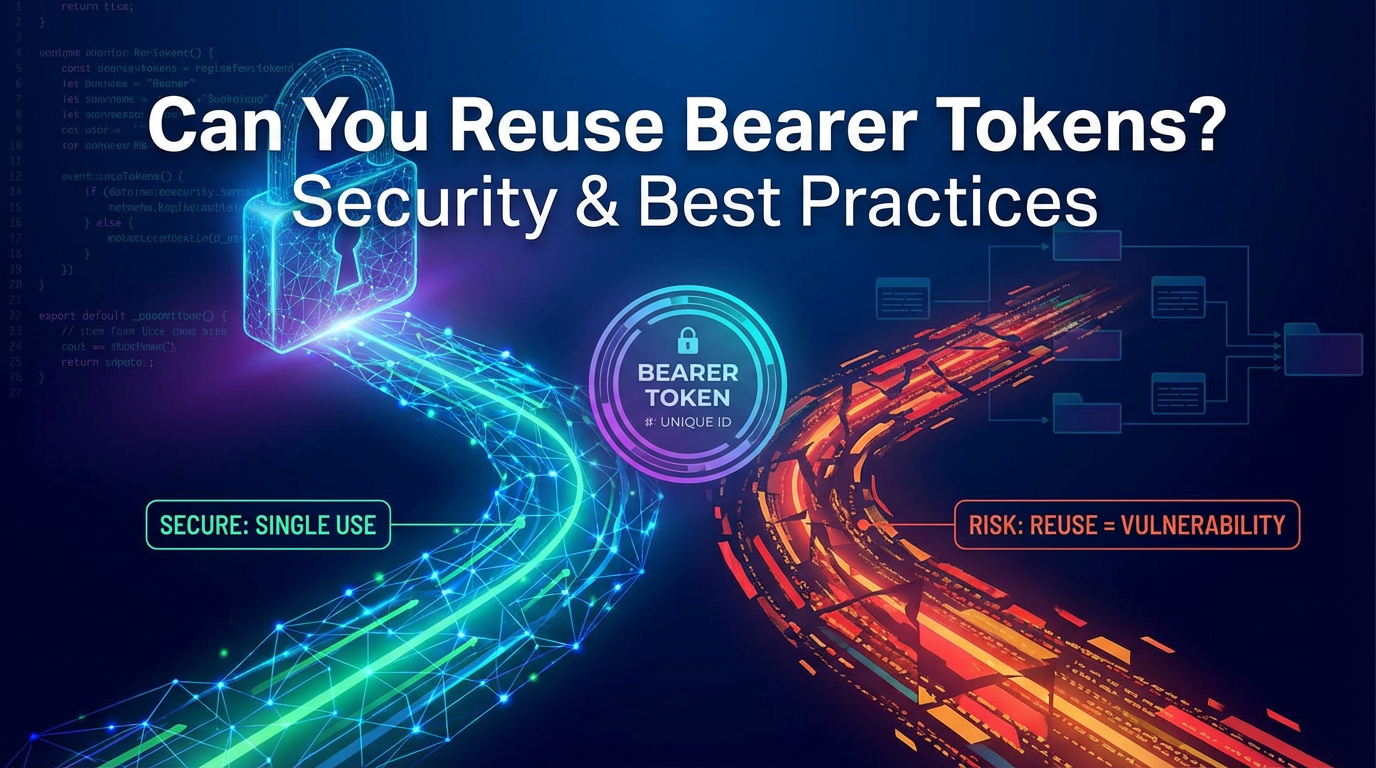
Can You Reuse Bearer Tokens? Security & Best Practices


In the intricate landscape of modern web services and application programming interfaces (APIs), authentication and authorization mechanisms stand as critical gatekeepers, ensuring that only legitimate users and services can access protected resources. Among the myriad of security tokens, the bearer token has emerged as a ubiquitous and powerful tool, simplifying client-server interactions by abstracting the complexities of user authentication into a single, transferable credential. However, the very simplicity and transferability that make bearer tokens so efficient also raise profound questions about their reusability, posing significant security implications that demand a comprehensive understanding. This article delves deep into the nature of bearer tokens, dissects the nuances of their reusability, and outlines a robust set of security best practices to safeguard your digital assets. We will explore how proper token management, fortified by advanced architectural components like api gateways and sound API Governance principles, is paramount in mitigating risks associated with token misuse.
Unpacking the Fundamentals: What Exactly are Bearer Tokens?
At its core, a bearer token is a security credential that grants access to a specific resource or set of resources to anyone who "bears" or possesses it. Unlike other tokens that might require cryptographic proof of possession by the client, a bearer token's power lies in its mere presence. Think of it like a concert ticket: whoever holds the ticket gets entry, without needing to prove they were the original purchaser. In the digital realm, this means that if an attacker obtains a bearer token, they can use it to impersonate the legitimate user and access the protected apis or services until the token expires or is revoked.
Bearer tokens are predominantly used in the OAuth 2.0 framework, where they serve as access tokens. Upon successful authentication (e.g., providing username and password, or through a social login), an authorization server issues an access token to the client application. This token is then sent with every subsequent request to the resource server (which hosts the apis) to authorize the request.
Most commonly, bearer tokens are implemented as JSON Web Tokens (JWTs). A JWT is a compact, URL-safe means of representing claims to be transferred between two parties. The claims in a JWT are encoded as a JSON object that is digitally signed using a JSON Web Signature (JWS) or encrypted using JSON Web Encryption (JWE). This signature ensures the token's integrity – meaning it hasn't been tampered with since it was issued – but crucially, it does not encrypt the token's contents unless specifically configured for encryption. A typical JWT consists of three parts separated by dots: 1. Header: Contains metadata about the token, such as the type of token (JWT) and the signing algorithm being used (e.g., HS256, RS256). 2. Payload: Contains the claims, which are statements about an entity (typically the user) and additional data. Common claims include iss (issuer), sub (subject), aud (audience), exp (expiration time), iat (issued at time), and custom application-specific claims. 3. Signature: Created by taking the encoded header, the encoded payload, a secret key, and the algorithm specified in the header, and signing them. This signature is used by the resource server to verify that the token is legitimate and hasn't been altered.
The elegance of JWTs lies in their self-contained nature. The resource server doesn't need to perform a database lookup for every request to validate the token's information, only to verify its signature and expiration. This statelessness significantly boosts performance and scalability for apis, especially in distributed microservices architectures. However, this self-contained nature also complicates token revocation, as a signed JWT remains valid until its expiration, regardless of whether the user has logged out or their permissions have changed, unless a specific revocation mechanism is in place. Understanding this fundamental architecture is critical before we delve into the question of reusability.
The Nuance of Reusability: An Inherent Design vs. Malicious Exploitation
The question "Can you reuse bearer tokens?" is not a simple yes or no. It hinges on the context and intent behind the "reuse." In their fundamental design, bearer tokens are inherently intended to be reused for the duration of their validity for legitimate purposes.
Intended and Necessary Reuse: The Core Functionality
When a client application receives a bearer token from the authorization server, it is expected to send this same token with every subsequent api request to the resource server until the token expires. This is the very definition of how bearer tokens facilitate authenticated sessions. The token acts as a temporary session key. Without this form of reuse, the token would be a one-time password, defeating its purpose of providing continuous access to an authenticated session. For example, if a user logs into an online banking application, the access token received allows them to check their balance, transfer funds, and view transaction history for the next 15 minutes (or whatever the configured lifespan is), all using the same access token. This is efficient, stateless, and greatly simplifies the client-server interaction model.
The api gateway plays a crucial role here. Upon receiving a request with a bearer token, the api gateway intercepts it. It validates the token's signature, checks its expiration, and ensures it matches the intended audience before forwarding the request to the backend service. This pre-validation step is a form of controlled, legitimate reuse management.
Malicious Reuse: The Security Nightmare
The critical security concern arises when a bearer token is "reused" in an unauthorized or malicious manner. Because anyone who possesses the token can use it, if an attacker intercepts a legitimate user's bearer token, they can then reuse it to impersonate that user and access protected resources. This is known as a session hijacking or token replay attack.
Consider a scenario where a user connects to a public Wi-Fi network that is compromised. If the connection is not secured with HTTPS (a grave mistake, as we will discuss), an attacker might be able to sniff network traffic and intercept the bearer token sent by the user's application. Once obtained, the attacker can then use this token in their own requests to the apis, masquerading as the legitimate user. Since the api only sees a valid token, it grants access, completely unaware that it is interacting with an attacker.
The self-contained nature of JWTs exacerbates this problem. If a JWT is configured with a long expiration time (e.g., several hours or days), an intercepted token provides a much longer window for an attacker to exploit. This is why short-lived access tokens are a fundamental best practice. The risk associated with malicious reuse underscores the importance of every security measure discussed in the following sections. It's not about preventing all reuse, but preventing unauthorized reuse.
The Security Vortex: Implications of Bearer Token Reuse
The potential for unauthorized reuse of bearer tokens introduces a range of significant security implications that can compromise the confidentiality, integrity, and availability of sensitive data and services. Understanding these risks is the first step towards building resilient api security.
1. Session Hijacking and Impersonation
This is the most direct and alarming threat. If an attacker gains possession of a valid bearer token, they can effectively hijack the user's session. They can then send requests to the apis as if they were the legitimate user, accessing personal data, performing transactions, or manipulating resources without authorization. The api server, only seeing a valid token, has no way of discerning the attacker from the actual user. This threat is particularly potent with long-lived tokens.
2. Replay Attacks
A replay attack is a specific type of session hijacking where an attacker intercepts a data transmission (including the bearer token) and then "replays" it later to gain unauthorized access or effect an unauthorized action. While the core issue is token compromise, replay attacks often target specific actions. For instance, if a token is intercepted during a funds transfer request, the attacker might replay the entire request to execute the transfer again, assuming the api does not have sufficient idempotency checks or unique transaction identifiers.
3. Confidentiality Breaches
If an attacker successfully reuses a token, they gain access to all the data that the legitimate user is authorized to view. This can include sensitive personal information, financial data, intellectual property, or confidential business records, leading to severe privacy violations and compliance penalties. The impact can range from individual data breaches to large-scale corporate espionage.
4. Integrity Compromises
Beyond simply viewing data, an attacker reusing a token might also be able to modify, delete, or create data, depending on the permissions granted to the token. This could lead to data corruption, unauthorized system changes, or even the injection of malicious content, severely impacting the integrity of the application and its underlying data stores. Imagine an attacker reusing a token to modify an e-commerce order or inject malicious code into a user profile.
5. Escalation of Privilege (via Scopes)
Bearer tokens often come with defined scopes that specify what actions the token holder is authorized to perform (e.g., read_profile, write_data). While well-designed systems implement the principle of least privilege, if an attacker compromises a token with broad scopes, they gain broad access. Furthermore, if a system is vulnerable to token "swapping" or improper scope validation, an attacker might be able to present a token for an unintended api or resource, effectively escalating their privileges.
6. Denial of Service (Indirect)
While not a direct DoS vector, if an attacker abuses a compromised token to make an excessive number of requests or trigger resource-intensive operations, it could inadvertently lead to a denial of service for legitimate users by overwhelming the backend apis. Such a scenario highlights the need for robust rate limiting and throttling mechanisms, often managed by an api gateway.
7. Difficult Token Revocation
As mentioned, a significant challenge with JWTs is their default statelessness, which makes immediate revocation difficult. Once a JWT is signed and issued, it remains valid until its exp (expiration) claim is reached. If a token is compromised before its expiration, and there's no explicit revocation mechanism in place (like a blacklist or token store lookup), the attacker can continue to use it. This complicates incident response and limits the ability to quickly contain a breach.
The severity of these implications underscores the absolute necessity of implementing rigorous security measures around bearer token management. Every decision, from token lifespan to storage, directly impacts the potential for these risks to materialize.
Fortifying Defenses: Best Practices for Bearer Token Management
To mitigate the inherent risks associated with bearer token reuse, a multi-layered approach incorporating robust security practices is essential. These practices span token generation, transmission, storage, and validation, forming a comprehensive defense strategy.
1. Enforce Short Lifespans for Access Tokens
This is perhaps the most critical and universally recommended best practice. Access tokens should have very short expiration times, typically ranging from a few minutes to an hour. * Reduced Attack Window: A short lifespan dramatically reduces the window of opportunity for an attacker to exploit a compromised token. Even if an attacker intercepts a token, its utility is limited to a brief period. * Frequent Re-Authentication (Indirect): Short-lived access tokens necessitate more frequent acquisition of new tokens, often facilitated by refresh tokens (discussed below). This process, while seemingly more complex, strengthens security by regularly validating the client's identity. * Improved Revocation: While short-lived tokens don't solve the immediate revocation challenge entirely, they make it less critical. If a token expires quickly, its malicious reuse potential naturally diminishes.
2. Implement Robust Token Revocation Mechanisms
Despite short lifespans, situations arise where immediate token revocation is necessary (e.g., user logout, password change, account compromise). For JWTs, statelessness makes direct revocation challenging. Common strategies include: * Blacklisting/Denylist: The api gateway maintains a list of compromised or invalidated tokens. For every incoming request, the gateway checks if the token is on this list. If it is, the request is rejected. This requires a performant, distributed store for the blacklist. * Token Store Lookup (for Opaque Tokens or Hybrid JWTs): Instead of fully stateless JWTs, some systems use opaque tokens (random strings) or JWTs that contain only a token ID (jti). The actual token claims are stored in a database or cache, and the api gateway performs a lookup on every request. This allows for immediate invalidation by deleting the entry from the store. This approach adds state and a database lookup overhead but provides absolute control over revocation. * Session Management: Link the access token to an active user session managed by the authorization server. If the session is terminated (e.g., user logs out), all associated access tokens can be invalidated. Revocation is a cornerstone of effective API Governance and incident response, allowing administrators to swiftly nullify compromised credentials.
3. Mandate HTTPS/TLS for All Communication
Encrypting all communication channels with HTTPS (TLS) is non-negotiable. This prevents attackers from passively sniffing network traffic and intercepting bearer tokens "in transit." * End-to-End Encryption: TLS encrypts data between the client and the server, making it unreadable to eavesdroppers. * Server Authentication: TLS also authenticates the server to the client, preventing man-in-the-middle attacks where an attacker might try to impersonate the api server. Without HTTPS, even the most robust token generation and validation mechanisms are rendered useless if the token can be easily intercepted. This is a fundamental security requirement for any api.
4. Secure Client-Side Storage of Tokens
Where and how a client application stores its bearer token is a critical security consideration, as client-side environments are inherently less secure than server-side. * HTTP-Only, Secure Cookies: Generally considered the most secure option for web browsers. An HttpOnly cookie cannot be accessed via client-side JavaScript, mitigating cross-site scripting (XSS) attacks. A Secure flag ensures the cookie is only sent over HTTPS. The SameSite attribute (e.g., Lax, Strict) helps prevent cross-site request forgery (CSRF). * Memory (in-app): For native mobile or desktop applications, storing the token only in memory and never persisting it to disk offers good security, but it means the user has to re-authenticate more frequently. * Local Storage/Session Storage: Generally discouraged for sensitive tokens. While convenient for developers, tokens in localStorage or sessionStorage are vulnerable to XSS attacks, as malicious JavaScript injected into the page can easily read them. * Web Workers & PostMessage: A more advanced technique where tokens are stored in a Web Worker and communicated to the main thread only via postMessage, reducing exposure to XSS in the main thread. * In-App Secure Storage (Mobile): For mobile apps, platform-specific secure storage mechanisms (e.g., iOS Keychain, Android Keystore) are the preferred choice, as they provide hardware-backed encryption.
The choice of storage mechanism must be carefully weighed against the application's specific security profile and the associated risks.
5. Leverage Refresh Tokens for Renewals
Refresh tokens are long-lived tokens that are used specifically to obtain new, short-lived access tokens without requiring the user to re-authenticate. They act as a persistent credential for the client application, allowing for a seamless user experience while maintaining the security benefits of short-lived access tokens. * Separate Lifespans: Refresh tokens typically have a much longer lifespan (e.g., days, weeks, months) and are usually kept more securely by the client (e.g., in an HTTP-only cookie). * One-Time Use or Rotating: For enhanced security, refresh tokens can be designed for one-time use (requiring a new refresh token with each access token request) or with rotation (where a new refresh token is issued along with the new access token, and the old refresh token is immediately invalidated). * Strict Validation: Refresh tokens should always be exchanged for new access tokens only at the authorization server, using client authentication for confidential clients. * Revocable: Unlike access tokens, refresh tokens must be easily revocable by the authorization server.
This model provides a balance between security and user convenience.
6. Implement Client Authentication for Confidential Clients
For applications that can securely store a client secret (e.g., traditional web applications, backend services), OAuth 2.0 client authentication (e.g., client ID and client secret, or private key JWTs) should be used when exchanging authorization codes for tokens, and when using refresh tokens. This verifies the identity of the client application itself, adding another layer of trust. Public clients (e.g., SPAs, mobile apps) cannot securely store secrets, so they rely more heavily on other security measures like PKCE (Proof Key for Code Exchange) to prevent authorization code interception attacks.
7. Restrict Token Audience and Scope
- Audience Restriction (
audclaim): Bearer tokens should include anaud(audience) claim, specifying the resource server orapis for which the token is intended. Theapi gatewayor resource server must validate that the token's audience matches itself, preventing tokens issued for one service from being reused against another. - Scope Restriction (
scopeclaim): Tokens should only be granted the minimum necessary permissions (scopes) required for the specific task. Adhering to the principle of least privilege limits the damage an attacker can do if a token is compromised.API Governancepolicies should strictly define and enforce scope management.
8. Enforce Rate Limiting and Throttling
While primarily an availability control, rate limiting on the api gateway can also indirectly help mitigate token reuse attacks. By limiting the number of requests a client can make within a given period, it makes brute-force attempts to reuse a token, or rapid exploitation of a compromised token, more difficult and detectable. This prevents attackers from making an excessive number of api calls with a stolen token before it expires or is revoked.
9. Comprehensive Logging and Monitoring
Implement detailed logging of all authentication and authorization events, including token issuance, validation failures, and suspicious access patterns. * Anomaly Detection: Monitor these logs for unusual activity, such as an excessive number of failed token validations, requests from unusual geographic locations, or unexpected api call volumes for a specific user. * Audit Trails: Logs provide crucial audit trails for forensic analysis in the event of a security incident, helping to determine how a token was compromised and what actions were performed. Effective API Governance mandates robust logging and a proactive monitoring strategy.
10. Consider Proof of Possession (PoP) Tokens (e.g., DPoP)
For the highest level of security, particularly against token replay attacks, Proof of Possession (PoP) tokens are gaining traction. DPoP (Demonstrating Proof-of-Possession at the Application Layer) is an OAuth 2.0 specification that binds an access token to a client's cryptographic key. * Client Key Binding: With DPoP, the client generates a cryptographic key pair and proves possession of the private key when requesting an access token and when using the access token. The access token then becomes cryptographically bound to the client's public key. * Replay Attack Mitigation: If an attacker intercepts a DPoP access token, they cannot reuse it because they do not possess the corresponding private key required to generate the proof-of-possession for the request. This significantly raises the bar for attackers. While more complex to implement, DPoP offers superior protection against token theft and replay attacks, making bearer tokens non-reusable by anyone other than the legitimate client.
11. Input Validation and Output Encoding
While not directly about tokens, these are crucial for general api security and preventing vulnerabilities (like XSS or SQL injection) that could lead to token compromise. * Input Validation: Sanitize and validate all input received from clients to prevent malicious data from being processed. * Output Encoding: Encode all data before rendering it in HTML or other contexts to prevent XSS attacks that could steal tokens.
By diligently applying these best practices, organizations can significantly enhance the security posture of their apis and minimize the risks associated with bearer token reuse.
APIPark is a high-performance AI gateway that allows you to securely access the most comprehensive LLM APIs globally on the APIPark platform, including OpenAI, Anthropic, Mistral, Llama2, Google Gemini, and more.Try APIPark now! 👇👇👇
The Indispensable Role of the API Gateway in Bearer Token Security
In a world increasingly driven by microservices and distributed architectures, the api gateway has evolved from a simple reverse proxy to a central enforcement point for security, routing, and policy management. Its role in securing bearer tokens is not merely beneficial; it is absolutely indispensable. An api gateway sits between clients and backend api services, acting as the first line of defense and the primary enforcer of API Governance policies.
1. Centralized Authentication and Authorization
The api gateway can offload authentication and authorization responsibilities from individual backend services. * Token Validation: The gateway performs initial validation of incoming bearer tokens (e.g., JWT signature verification, expiration check, audience validation, issuer verification). If the token is invalid, expired, or malformed, the request is rejected at the edge, preventing illegitimate traffic from reaching backend services. * Policy Enforcement: Based on the claims within the token (e.g., user roles, scopes), the gateway can enforce fine-grained authorization policies, determining which backend apis or resources the client is allowed to access. This ensures that even if a token is valid, it's only used for its intended purpose and permissions.
2. Token Revocation Integration
As discussed, robust token revocation is key. The api gateway is the ideal place to integrate revocation checks. * Blacklist Management: The gateway can maintain and consult a distributed blacklist of revoked tokens, rejecting any request carrying an invalidated token. * Session Lookup: For more stateful revocation, the gateway can query a session store or authorization server to confirm token validity.
3. Traffic Management and Rate Limiting
The api gateway is uniquely positioned to manage and control api traffic, which indirectly contributes to token security. * Rate Limiting: By enforcing limits on the number of requests per client or per token within a time window, the gateway mitigates brute-force attacks and limits the impact of a compromised token being reused excessively. * Throttling: It can dynamically adjust traffic flow to prevent backend services from being overwhelmed.
4. Protocol Translation and Security Enhancement
- HTTPS Enforcement: The gateway can terminate TLS connections, ensuring all client-to-gateway communication is encrypted, and then re-encrypt traffic to backend services (or use mutual TLS for higher security).
- Request/Response Transformation: It can add or remove security headers, cleanse request bodies, or transform responses to meet specific security requirements.
5. Logging, Monitoring, and Auditing
The api gateway serves as a central point for logging all api requests and responses, including details about token usage. * Security Observability: Comprehensive logs provide invaluable data for security monitoring, anomaly detection, and forensic analysis in the event of a breach. * Compliance: This centralized logging capability is crucial for meeting regulatory compliance requirements and establishing clear audit trails.
6. Integration with Identity Providers (IdPs)
Many api gateways seamlessly integrate with various identity providers (e.g., OAuth 2.0 authorization servers, OpenID Connect providers, SAML IdPs), simplifying the authentication flow and ensuring that tokens are issued by trusted sources.
APIPark: An Open Source AI Gateway & API Management Platform
For organizations navigating the complexities of api security and management, especially in the burgeoning field of AI services, robust api gateways are not just a luxury but a necessity. Platforms like the open-source APIPark AI Gateway and API Management Platform exemplify how modern gateways can centralize and strengthen these security practices. APIPark, designed to manage, integrate, and deploy both AI and REST services, offers features critical for secure bearer token handling.
APIPark facilitates: * Unified Authentication & Cost Tracking for 100+ AI Models: It provides a single management system for authentication, ensuring tokens are handled consistently across diverse AI apis. * End-to-End API Lifecycle Management: From design to publication and decommission, APIPark assists in regulating api management processes, including traffic forwarding, load balancing, and versioning of published apis. This holistic approach naturally extends to embedding security controls for tokens at every stage. * API Resource Access Approval: Its subscription approval features ensure that callers must subscribe to an api and await administrator approval before invocation, preventing unauthorized api calls and potential data breaches that could arise from misuse of tokens. * Detailed API Call Logging and Data Analysis: Crucial for detecting and troubleshooting issues related to token usage, ensuring system stability and data security. APIPark’s capabilities here are essential for proactive security monitoring.
By deploying an api gateway like APIPark, organizations can establish a strong, centralized security layer that significantly enhances the protection of bearer tokens, enforces API Governance policies, and streamlines api management across their entire digital ecosystem. This strategic architectural choice moves security from an afterthought to a foundational element of api operations.
Establishing Order: API Governance and Bearer Token Strategy
Beyond the technical implementation details and the architectural role of an api gateway, the effective and secure management of bearer tokens fundamentally relies on sound API Governance. API Governance encompasses the processes, policies, and standards that guide the design, development, deployment, and management of apis throughout their lifecycle. When it comes to bearer tokens, robust API Governance ensures consistency, security, and compliance across an organization's entire api landscape.
1. Defining Clear Token Policies
A cornerstone of good API Governance is the establishment of clear, well-documented policies regarding bearer tokens. These policies should address: * Token Lifespans: Explicit guidelines for the expiration times of both access tokens and refresh tokens across different types of applications (e.g., web apps, mobile apps, machine-to-machine). * Scope Definitions: Standardized definitions and best practices for creating and assigning api scopes, ensuring the principle of least privilege is consistently applied. * Audience Management: Policies for how aud claims are generated and validated, ensuring tokens are only usable by their intended consumers. * Revocation Procedures: Defined processes for token revocation, including how and when tokens are blacklisted, how long blacklisted tokens are maintained, and the integration of revocation with user logout or account compromise events. * Client Credential Management: Guidelines for managing client IDs and secrets, including rotation policies and secure storage requirements.
These policies provide a framework for developers and operations teams, reducing ambiguity and promoting secure development practices.
2. Standardizing Token Formats and Issuance
API Governance should enforce standardization across the organization's apis regarding token formats and issuance. * Consistent Token Type: Whether using JWTs, opaque tokens, or DPoP tokens, consistency simplifies api gateway configuration and client-side implementation. * Unified Issuance Source: Designating a single, trusted authorization server or identity provider for issuing tokens ensures that all tokens originate from a secure and auditable source. This avoids fragmented authentication systems that can introduce vulnerabilities. * Claim Standardization: Standardize the claims included in tokens (e.g., user ID, roles, permissions) to ensure consistent interpretation across all resource servers and apis.
3. Developer Education and Training
Even the most well-defined policies are ineffective if developers are unaware of them or do not understand their importance. API Governance mandates continuous education and training for developers on: * Bearer Token Security Risks: Deep understanding of session hijacking, replay attacks, and other vulnerabilities. * Best Practices for Token Handling: Proper client-side storage, secure transmission, and responsible use of scopes. * Compliance Requirements: Ensuring developers are aware of any regulatory or industry-specific compliance mandates related to data security and authentication (e.g., GDPR, HIPAA, PCI DSS). * Security by Design: Promoting a mindset where security considerations are integrated from the very beginning of the api design and development process.
4. Auditing and Compliance
Regular audits are crucial to ensure that token management practices adhere to established policies and regulatory requirements. * Security Audits: Periodic reviews of api code, api gateway configurations, and token-related infrastructure for vulnerabilities. * Compliance Checks: Verifying adherence to industry standards and legal obligations regarding data protection and access control. * Continuous Monitoring: Integrating token-related metrics and logs into security information and event management (SIEM) systems for real-time anomaly detection and proactive threat hunting.
5. Versioning and Evolution of Token Strategy
As security threats evolve and new authentication technologies emerge (like DPoP), API Governance provides a mechanism for adapting token strategies. * Planned Evolution: Establish processes for reviewing and updating token policies, potentially introducing new token types or security enhancements as needed. * Backward Compatibility: Carefully plan for backward compatibility when introducing changes to token formats or validation rules, especially for public apis.
By embedding these governance principles into an organization's api ecosystem, the complex question of bearer token reuse transforms from a potential security nightmare into a managed, secure, and resilient aspect of api operations. It shifts the focus from merely reacting to threats to proactively building security into the very fabric of the api landscape.
Technical Deep Dive: Implementation Details and Advanced Considerations
Beyond the foundational best practices, several technical considerations and advanced concepts can further refine and secure bearer token implementation. These delve into the specifics of token types, binding mechanisms, and storage strategies.
JWT vs. Opaque Tokens: A Balancing Act
The choice between JWTs and opaque tokens carries significant implications for security and scalability.
- JSON Web Tokens (JWTs):
- Pros: Self-contained, stateless validation (resource server doesn't need to consult a database), excellent for distributed systems and microservices.
- Cons: Cannot be easily revoked immediately (unless using a blacklist or
jticheck), contents are base64 encoded, not encrypted by default (sensitive data should not be placed in the payload without encryption), can become large if too many claims are added.
- Opaque Tokens:
- Pros: Simply a random string, easy to revoke (just delete the entry from the token store), no sensitive information exposed if intercepted.
- Cons: Requires a database or cache lookup on every request, introducing state and potential performance overhead.
- Use Cases: Often used for refresh tokens where revocation is critical, or in systems where a single authorization server handles all token validation.
Hybrid Approach: A common pattern is to use short-lived JWTs for access tokens and long-lived, opaque, and revocable tokens for refresh tokens. This leverages the benefits of both, with the api gateway handling the validation of JWTs efficiently and the authorization server managing the refresh token lifecycle securely.
Proof of Possession (PoP) Tokens: Elevating Security
As briefly mentioned, PoP tokens like DPoP (Demonstrating Proof-of-Possession at the Application Layer) significantly enhance security against token theft and replay attacks. * Mechanism: The client generates a cryptographic key pair. The public key is then bound to the access token during issuance (e.g., embedded in a JWT claim). When the client uses the access token, it must sign a part of the HTTP request (e.g., the HTTP method and URI) with its private key. The api gateway or resource server then verifies this signature using the public key from the token. * Benefit: If an attacker steals the access token, they cannot use it because they do not possess the private key required to generate the proof-of-possession signature. This makes the token effectively non-reusable by unauthorized parties. * Complexity: DPoP adds complexity to both client and server implementations, requiring cryptographic operations on both sides. However, for high-security applications, the benefits often outweigh the implementation cost.
Token Binding: Another Layer of Protection
Token Binding is a related standard that cryptographically binds security tokens to the underlying TLS connection. * Mechanism: When a TLS connection is established, the client and server negotiate a unique TLS-level binding key. This key is then included in the token when issued. When the token is presented, the server verifies that the binding key in the token matches the binding key of the current TLS connection. * Benefit: This prevents an attacker from stealing a token from one TLS session and replaying it in a different TLS session, even if they manage to intercept the token. It essentially "ties" the token to the specific TLS connection. * Browser Support: Requires browser and client support for Token Binding.
Hashing/Encryption of Tokens at Rest
If, for any reason, access tokens need to be persisted on the server-side (e.g., in a session store, or for audit purposes), they should always be hashed or encrypted. * Hashing: Storing a hash of the token (using a strong, salted hashing algorithm) means the original token cannot be recovered if the storage is compromised. However, the original token is still needed for api requests. * Encryption: Encrypting the token (using strong encryption algorithms and securely managed keys) allows for its retrieval and decryption when needed. * Never Store Plaintext: Under no circumstances should sensitive tokens be stored in plaintext in databases or logs.
Contextual Validation
Beyond standard JWT validation, api gateways can perform contextual validation based on the request itself: * IP Address/User Agent Binding: While not foolproof (due to NAT, proxies, and spoofing), binding a token to the client's IP address or User-Agent string can make token reuse more difficult for attackers, especially for sensitive operations. If the IP address or User-Agent changes mid-session, it could trigger a re-authentication or raise an alert. * Geofencing: Restricting api access based on geographic location derived from the client's IP address. * Time-based Access: Restricting api access to specific hours of the day.
These advanced considerations, when thoughtfully integrated, provide a formidable defense against various token-based attacks, demonstrating a mature approach to api security and API Governance.
Real-World Scenarios and Practical Applications
Understanding the theoretical aspects of bearer tokens and their security is crucial, but seeing how these concepts apply in different real-world scenarios brings the discussion to life. The strategies for managing bearer token reuse vary slightly depending on the client type and application architecture.
1. Traditional Web Applications (Server-Rendered)
In server-rendered web applications, the server typically handles the OAuth 2.0 flow, exchanges the authorization code for tokens, and stores the access token (and refresh token) securely on the server-side, often in a session. * Token Storage: Access tokens are rarely sent directly to the browser. Instead, the server uses a secure, HttpOnly, SameSite, and Secure cookie to maintain the user's session ID. The server then retrieves the access token from its secure storage for each api call. * Reuse Context: The "reuse" here primarily refers to the server reusing the token for subsequent backend api calls on behalf of the user. Malicious reuse would involve an attacker compromising the server's storage or session cookie. * Security Focus: Server-side token storage, strong session management (e.g., session revocation), and protection against server-side vulnerabilities (e.g., SQL injection, directory traversal) are paramount. The api gateway ensures server-to-server calls using the token are authorized.
2. Single Page Applications (SPAs)
SPAs, running entirely in the user's browser, present a more challenging environment for token storage due to the inherent insecurity of client-side JavaScript. * Token Storage Dilemma: As discussed, localStorage is vulnerable to XSS. sessionStorage is slightly better as it clears on tab close but is still XSS-vulnerable. HttpOnly cookies are generally preferred, but they can be cumbersome for SPA developers wanting direct JS access to the token, and they can be vulnerable to CSRF if not properly protected with SameSite attributes and CSRF tokens. * Implicit Grant vs. Authorization Code Grant with PKCE: The OAuth 2.0 Implicit Grant Flow (where tokens are returned directly in the URL fragment) is now largely deprecated for SPAs due to its susceptibility to token leakage. The Authorization Code Grant with Proof Key for Code Exchange (PKCE) is the recommended secure alternative for public clients like SPAs. * Reuse Context: The browser-based SPA reuses the token to make api calls directly from the user's browser. Malicious reuse occurs if an attacker intercepts the token (e.g., via XSS) and uses it from their own browser. * Security Focus: Strict CSP (Content Security Policy), XSS prevention, short-lived access tokens, refresh tokens with secure storage (e.g., HttpOnly cookie), and implementing DPoP are critical. The api gateway validates every incoming token from the SPA.
3. Native Mobile Applications
Mobile applications also present their own set of considerations for token reuse. * Secure Storage: Mobile operating systems provide secure storage mechanisms (e.g., iOS Keychain, Android Keystore). These are the preferred locations for storing both access and refresh tokens, as they offer hardware-backed encryption and isolate credentials from other apps. * Reuse Context: The mobile app reuses the token for subsequent api calls. Malicious reuse involves an attacker gaining access to the device's secure storage or intercepting traffic (if not using HTTPS). * Security Focus: Secure storage, certificate pinning (to prevent MITM attacks even with trusted but malicious CAs), HTTPS, short-lived access tokens, refresh tokens, and robust client-side validation. API Governance should include guidelines for mobile app security.
4. Machine-to-Machine (M2M) Communication
In M2M scenarios (e.g., a backend service calling another backend service), client credentials grant access. * Client Credentials Grant: This OAuth 2.0 grant type allows an application to obtain an access token using its own client ID and client secret, without a user's context. * Token Storage: Client secrets and access tokens are stored securely on the server-side, ideally in environment variables, secret management systems (e.g., Vault), or encrypted configuration files. * Reuse Context: The service reuses the token for subsequent calls to other services. Malicious reuse occurs if the service's credentials or tokens are compromised. * Security Focus: Strong client authentication, secure secret management, network segmentation (restricting api access to internal networks), mutual TLS (mTLS) for service-to-service communication, short-lived tokens, and strict API Governance over service account permissions.
Each scenario highlights that while the concept of "reuse" is central to bearer tokens, the specific security challenges and best practices adapted to mitigate unauthorized reuse differ based on the deployment environment. A holistic security strategy must account for these variations.
Conclusion: Mastering the Art of Secure Bearer Token Reuse
The question "Can you reuse bearer tokens?" is answered with a nuanced understanding: yes, they are designed for reuse within their valid lifespan to facilitate authenticated sessions, but this inherent reusability introduces significant security vulnerabilities if not managed with utmost care. The power and efficiency of bearer tokens, especially in stateless architectures leveraging apis, come with the critical responsibility of comprehensive security implementation.
We have traversed the fundamental nature of bearer tokens, illuminated the dark corners of malicious reuse, and meticulously outlined a robust framework of best practices. From the absolute necessity of short-lived tokens and ubiquitous HTTPS to the strategic deployment of api gateways and the overarching directives of sound API Governance, every layer contributes to forming an impenetrable shield around your digital assets. The distinction between intended, controlled reuse and unauthorized, malicious exploitation is paramount. By enforcing stringent measures like secure client-side storage, implementing advanced revocation mechanisms, and exploring innovations such as Proof of Possession tokens, organizations can transform a potential security Achilles' heel into a reliable pillar of their api ecosystem.
Ultimately, secure bearer token management is not a one-time configuration but an ongoing commitment to vigilance, continuous improvement, and adaptive security practices. It demands a holistic approach that integrates technical controls, architectural patterns, and organizational policies, ensuring that the convenience and scalability offered by bearer tokens do not come at the expense of robust security. By adhering to these principles, you empower your apis to function efficiently and securely, safeguarding user data and maintaining the integrity of your services in an ever-evolving threat landscape.
Frequently Asked Questions (FAQs)
1. What is a bearer token and how does it work?
A bearer token is a security credential that grants access to specific resources to anyone who possesses it. It's typically issued after successful user authentication (e.g., using OAuth 2.0) and is then sent with every subsequent request to an api server in the Authorization: Bearer <token> header. The api server validates the token (e.g., checks its signature, expiration, and claims) and, if valid, grants access to the requested resource. Common formats include JSON Web Tokens (JWTs).
2. Is it safe to reuse bearer tokens?
Bearer tokens are inherently designed to be reused by the legitimate client for the duration of their validity period. This is how they enable continuous access to authenticated sessions. However, if a bearer token is intercepted by an unauthorized party, it can be "reused" maliciously to impersonate the legitimate user and gain unauthorized access to resources. This risk necessitates strict security measures like short token lifespans, HTTPS, and secure storage to prevent unauthorized reuse.
3. What's the difference between an access token and a refresh token?
An access token (often a bearer token) is a short-lived credential used to access protected api resources directly. It represents the authorization granted to the client. A refresh token is a long-lived credential used specifically to obtain new access tokens when the current one expires, without requiring the user to re-authenticate. Refresh tokens are typically stored more securely and are only sent to the authorization server, never directly to resource apis. This separation allows for short-lived access tokens (better security) while maintaining a seamless user experience (via refresh tokens).
4. How do API Gateways enhance bearer token security?
An api gateway acts as a central enforcement point. It intercepts all incoming requests and performs critical security functions before forwarding them to backend apis. For bearer tokens, this includes: * Centralized Validation: Verifying token signatures, expiration, audience, and issuer. * Policy Enforcement: Applying authorization rules based on token scopes and claims. * Rate Limiting: Preventing abuse and excessive reuse of tokens. * Revocation Checks: Consulting blacklists or token stores to deny access to compromised tokens. * Logging & Monitoring: Providing audit trails for security analysis. Platforms like APIPark offer comprehensive api gateway functionalities for managing and securing both AI and REST apis.
5. What are the best practices for storing bearer tokens on the client side?
Storing bearer tokens securely on the client side is challenging. * For Web Browsers (SPAs): HttpOnly, Secure, and SameSite cookies are generally considered the most secure option, as they are not accessible via JavaScript and are protected against CSRF. Storing tokens in localStorage or sessionStorage is generally discouraged due to vulnerability to Cross-Site Scripting (XSS) attacks. * For Native Mobile Apps: Utilize platform-specific secure storage mechanisms like iOS Keychain or Android Keystore, which offer hardware-backed encryption. * Always use HTTPS/TLS for all communication to prevent interception regardless of storage location. Short-lived access tokens and refresh tokens should also be part of the strategy.
🚀You can securely and efficiently call the OpenAI API on APIPark in just two steps:
Step 1: Deploy the APIPark AI gateway in 5 minutes.
APIPark is developed based on Golang, offering strong product performance and low development and maintenance costs. You can deploy APIPark with a single command line.
curl -sSO https://download.apipark.com/install/quick-start.sh; bash quick-start.sh

In my experience, you can see the successful deployment interface within 5 to 10 minutes. Then, you can log in to APIPark using your account.

Step 2: Call the OpenAI API.