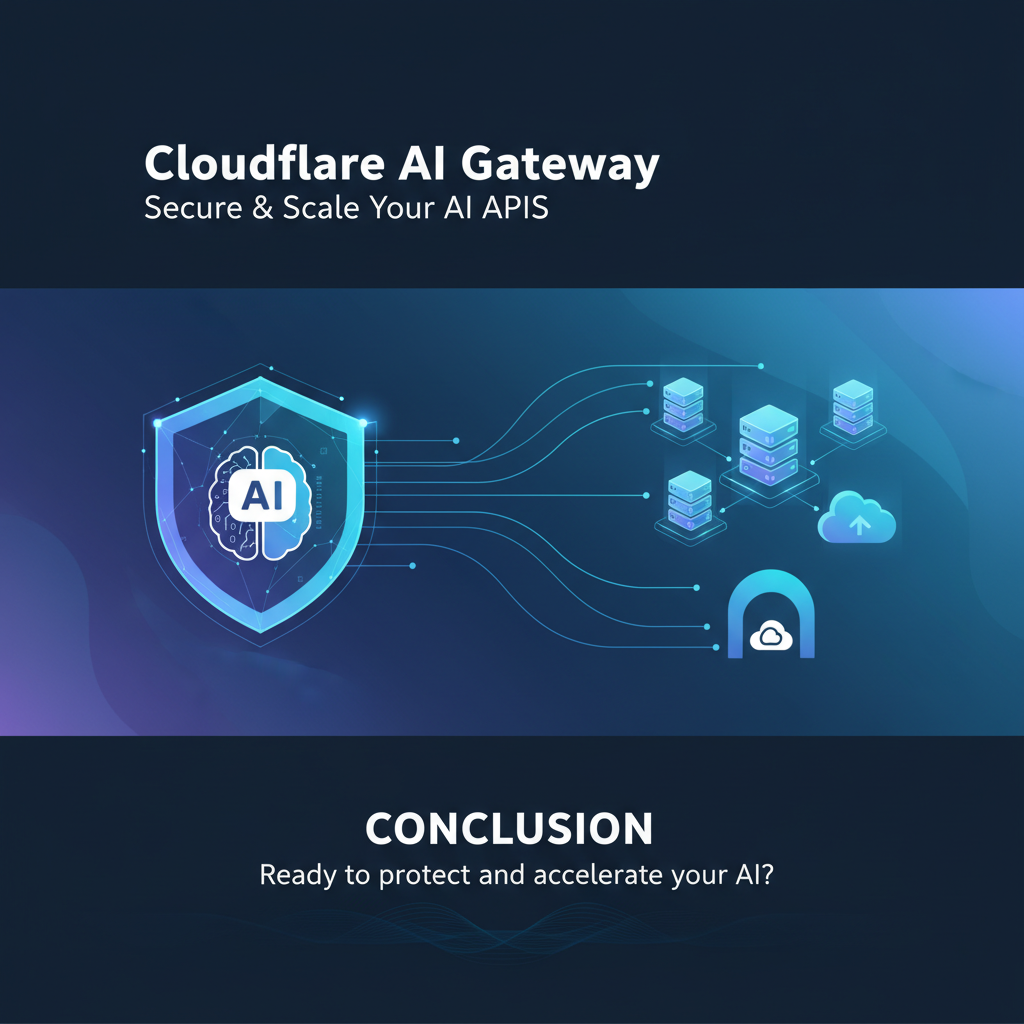
Cloudflare AI Gateway: Secure & Scale Your AI APIs


In an era increasingly defined by the transformative power of artificial intelligence, businesses globally are rapidly integrating AI models into their core operations, products, and services. From sophisticated large language models (LLMs) that power intelligent chatbots and content generation tools to advanced computer vision systems enhancing security and automation, AI is no longer a futuristic concept but a present-day imperative. This pervasive adoption, however, introduces a new frontier of challenges, particularly concerning the reliable, secure, and scalable management of AI models, which are predominantly consumed through Application Programming Interfaces (APIs). As organizations increasingly expose their AI capabilities or rely on third-party AI services, the need for a specialized infrastructure layer to govern these interactions becomes paramount. This is precisely where the AI Gateway emerges as a critical component, bridging the gap between raw AI potential and practical, secure, and high-performing deployments. Among the leaders pioneering this essential infrastructure, Cloudflare stands out with its innovative Cloudflare AI Gateway, a solution designed from the ground up to not only secure and optimize AI API calls but also to fundamentally transform how enterprises scale their AI applications across the globe.
The advent of AI has dramatically reshaped the digital landscape, pushing the boundaries of what applications can achieve. Yet, the very nature of AI, with its complex computational demands, sensitive data inputs, and often unpredictable usage patterns, necessitates a robust and intelligent intermediary. Traditional API Gateway solutions, while highly effective for managing conventional RESTful services, often fall short in addressing the unique requirements of AI workloads. These include the intricate nuances of token-based billing, the imperative for real-time inference with minimal latency, stringent data privacy considerations, and the dynamic nature of evolving AI models. Cloudflare’s approach is to extend its renowned global network and security infrastructure to create an AI Gateway that not only secures the perimeter but also intelligently accelerates and manages every interaction with AI models, regardless of where they reside. This article will meticulously explore the profound capabilities of the Cloudflare AI Gateway, delving into its unparalleled security features, its architecture for global scalability and performance, and its role in enabling businesses to harness the full potential of artificial intelligence with confidence and efficiency. We will uncover how this sophisticated platform addresses the most pressing challenges of AI integration, providing a comprehensive solution for enterprises looking to future-proof their AI strategies.
The AI Revolution and its API Imperative
The past decade has witnessed an unprecedented surge in artificial intelligence, transforming from academic curiosity to a foundational technology driving innovation across virtually every industry. From the sophisticated algorithms that recommend products on e-commerce sites to the intricate neural networks powering autonomous vehicles, AI's footprint is expanding rapidly. The recent explosion of generative AI models, particularly Large Language Models (LLMs) like GPT-4, Llama 2, and others, has democratized access to advanced AI capabilities, making them accessible to developers and businesses of all sizes. These models are not merely static software packages; they are dynamic, constantly evolving engines of intelligence that must be integrated into existing applications, workflows, and user experiences. The primary conduit for this integration is, almost universally, the Application Programming Interface (API).
The reliance on api for AI consumption is logical. APIs provide a standardized, programmatic way for different software systems to communicate, request services, and exchange data. For AI, this means sending input data (e.g., a text prompt, an image, a sensor reading) to a model and receiving an output (e.g., a generated response, an identified object, a prediction). However, the characteristics of AI APIs differ significantly from those of typical RESTful services, introducing a unique set of challenges that demand a specialized approach to management and governance.
Firstly, AI models, especially state-of-the-art LLMs, are computationally intensive. Each inference call, particularly for complex tasks or lengthy inputs/outputs, can consume substantial processing power, typically involving GPUs. This translates to higher operational costs and a critical need for efficient resource utilization. Without proper management, a sudden spike in API requests can overwhelm backend AI infrastructure, leading to service degradation or exorbitant expenses.
Secondly, latency is often a paramount concern for AI applications. Real-time interactions, such as those in conversational AI, live translation, or real-time fraud detection, require near-instantaneous responses. Delays measured in hundreds of milliseconds can severely impact user experience and the efficacy of the AI system. Traditional API gateways might introduce additional latency due to their processing overhead or geographical distance from the user or the AI model.
Thirdly, the data flowing through AI APIs can be highly sensitive. Users might input proprietary information, personal identifiable information (PII), protected health information (PHI), or financial data into prompts for analysis, summarization, or generation. Ensuring the privacy and security of this data, both in transit and at rest, is not just a regulatory requirement (like GDPR, HIPAA) but a fundamental trust imperative. Data leakage or unauthorized access to AI prompts and responses could have catastrophic consequences for businesses and their customers.
Fourthly, cost management for AI APIs is uniquely complex due to their usage-based pricing models, often tied to "tokens" or compute time. Unlike traditional APIs where requests are a simple metric, AI models require detailed tracking of input/output tokens, compute units, or even specific model versions to accurately attribute costs. Without a granular understanding and control over these metrics, budgets can quickly spiral out of control, especially as AI adoption scales.
Finally, the AI landscape is incredibly dynamic. New models emerge, existing models are updated, and fine-tuned versions are deployed frequently. Managing model versions, routing traffic to specific endpoints, handling deprecations, and ensuring backward compatibility add significant operational overhead. A robust api gateway specifically designed for AI needs to abstract away some of this complexity, providing a consistent interface to applications while allowing the underlying AI infrastructure to evolve.
These distinct characteristics underscore why a generic api gateway is often insufficient for modern AI deployments. While traditional gateways excel at authentication, basic routing, and caching for static content, they lack the AI-specific intelligence required for token management, prompt injection protection, dynamic model routing, and cost optimization for inference workloads. The imperative, therefore, is for a purpose-built AI Gateway – a sophisticated control plane that understands the unique demands of AI APIs and provides the specialized tools necessary to secure, scale, and optimize them effectively. Cloudflare's vision addresses these challenges head-on, leveraging its global network to deliver an AI Gateway that is both powerful and inherently integrated into the fabric of the internet.
Understanding the Core Concept: What is an AI Gateway?
To truly appreciate the value of the Cloudflare AI Gateway, it's essential to first establish a clear understanding of what an AI Gateway is and how it differentiates itself from a conventional api gateway. At its heart, an AI Gateway is a specialized type of api gateway that is specifically engineered to manage, secure, and optimize interactions with artificial intelligence models and services. While it inherits many foundational principles from traditional API gateways, such as traffic management, authentication, and monitoring, it extends these capabilities with features tailored to the unique demands of AI workloads.
A traditional api gateway acts as a single entry point for all client requests, routing them to the appropriate backend services. It provides a layer of abstraction, decoupling clients from the complexities of the microservices architecture, and offering cross-cutting concerns like security, rate limiting, and analytics. It centralizes API management, making it easier to expose, consume, and govern a collection of APIs. For standard RESTful APIs, this architecture has proven incredibly effective, simplifying development, enhancing security, and improving overall system resilience.
However, the proliferation of AI models, particularly the resource-intensive and data-sensitive nature of large language models (LLMs), vision models, and speech processing services, introduced new complexities that generic api gateway solutions were not primarily designed to handle. This is where the AI Gateway steps in, adding a crucial layer of intelligence and specific functionality.
Key Distinctions and Functions of an AI Gateway:
- AI-Specific Security Measures: Beyond generic WAF (Web Application Firewall) protection, an AI Gateway incorporates advanced security features like prompt injection detection and prevention. It understands that the input to an AI model can itself be an attack vector, attempting to manipulate the model's behavior or extract sensitive data. It can also offer more granular data masking and anonymization capabilities directly on prompts and responses to protect sensitive information (PII, PHI) before it reaches the model or before it leaves the system.
- Cost Management and Optimization: AI models are often billed based on usage metrics such as tokens processed (for LLMs), inference time, or compute units. An AI Gateway provides real-time tracking of these metrics, enabling granular cost attribution, setting spending limits, and alerting when thresholds are approached. This level of detail is crucial for financial control and optimizing expenditure on expensive AI resources. It can also implement intelligent caching strategies specifically for AI responses, significantly reducing the number of expensive inference calls to backend models.
- Model Abstraction and Routing: Organizations often utilize multiple AI models from different providers or different versions of the same model. An AI Gateway can provide a unified api interface to these diverse models, abstracting away their underlying differences. It can intelligently route requests to the most appropriate model based on criteria like cost, performance, availability, or specific task requirements. This simplifies application development and makes it easier to swap out or upgrade AI models without impacting client applications.
- Performance Acceleration for Inference: Given the latency-sensitive nature of many AI applications, an AI Gateway is often deployed at the edge of the network, close to the end-users. It can leverage global content delivery network (CDN) principles, caching frequently requested AI responses, and optimizing network paths to reduce latency for inference calls. Some advanced AI Gateway solutions, like Cloudflare's, even allow for running inference directly on the edge, further minimizing round-trip times.
- Observability Tailored for AI: While traditional gateways log HTTP requests, an AI Gateway captures more pertinent details for AI interactions. This includes logging the actual prompts, model outputs (if permissible and anonymized), token counts, model IDs, and specific error messages from the AI backend. This rich telemetry is invaluable for debugging, performance analysis, auditing, and understanding AI model behavior in production.
- Rate Limiting and Abuse Prevention: Beyond standard rate limiting by IP address or API key, an AI Gateway can implement more sophisticated rate limiting based on token consumption, preventing malicious or accidental over-usage of costly AI resources. It can also employ advanced bot detection to distinguish legitimate AI consumers from automated scrapers or attackers.
In essence, an AI Gateway is not just an api gateway with a new label; it's an evolved piece of infrastructure designed to be the intelligent control plane for all AI interactions. It understands the nuances of AI, from the security risks inherent in prompt inputs to the economic implications of token usage. By centralizing these specialized functions, it empowers developers to integrate AI more easily, operations teams to manage AI services more effectively, and businesses to deploy AI applications more securely and cost-efficiently at scale. Cloudflare's AI Gateway exemplifies this evolution, harnessing its global network to deliver these advanced capabilities at the internet's edge.
Cloudflare's Vision for AI Infrastructure
Cloudflare has long been recognized as a leader in network security, performance, and reliability, operating one of the largest and most interconnected global networks. Their infrastructure, spanning hundreds of cities worldwide, processes a significant portion of internet traffic, offering services like CDN, DDoS protection, WAF, and DNS. This foundational strength positions Cloudflare uniquely to address the emerging demands of AI infrastructure, particularly for AI Gateway solutions. Cloudflare's vision for AI infrastructure is not merely about adding new features; it's about extending its core principles of edge computing, security, and developer-centric tools to the rapidly evolving landscape of artificial intelligence.
At the heart of Cloudflare's strategy is the concept of bringing compute and intelligence as close as possible to the data and the end-user – the "edge." This distributed architecture is inherently advantageous for AI workloads, which often demand low latency and high throughput. By processing requests at an edge location near the user, Cloudflare can drastically reduce the round-trip time required for an api call to an AI model, especially when compared to routing all traffic back to a centralized cloud region. This localized processing capability is critical for real-time AI applications where every millisecond counts, such as live speech translation, interactive chatbots, or dynamic content generation.
Cloudflare's existing suite of developer tools forms a robust ecosystem for building and deploying AI applications. Cloudflare Workers, their serverless platform, allows developers to run JavaScript, Rust, C, and C++ (via WebAssembly) code directly on Cloudflare's edge network. This means AI-related logic, such as data preprocessing, response post-processing, authentication, or even lightweight inference, can execute at the global edge, minimizing latency and reducing reliance on origin servers. This integration of compute at the edge is a game-changer for AI deployments, offering unprecedented speed and flexibility.
Complementing Workers, Cloudflare R2 provides object storage compatible with S3 APIs, designed for cost-effective storage without egress fees. This is crucial for AI, where large datasets for training, model artifacts, or generated content need to be stored and accessed efficiently. Similarly, Cloudflare KV offers a globally distributed, low-latency key-value store, perfect for caching AI model metadata, user session information, or frequently accessed AI responses at the edge. These building blocks—compute, storage, and data—are all distributed across Cloudflare's network, creating a "Supercloud" environment that is intrinsically optimized for the demands of modern AI.
The "Supercloud" concept, as envisioned by Cloudflare, extends beyond mere infrastructure. It represents a unified, programmable platform where developers can build and deploy applications, including AI-powered ones, that seamlessly leverage Cloudflare's global network for performance, security, and scalability. For an AI Gateway, this means that every request to an AI model benefits from Cloudflare's mature security stack – DDoS protection, WAF, bot management – before it even reaches the AI service. It also means that caching, load balancing, and routing decisions can be made intelligently at the edge, informed by real-time network conditions and application-specific logic.
Moreover, Cloudflare is actively investing in Workers AI, a platform that allows developers to run inference for popular open-source AI models (like Llama 2, Stable Diffusion, Whisper) directly on Cloudflare's global network using GPUs deployed at its edge locations. This blurs the line between the AI Gateway and the AI model itself, offering an even more integrated and performant solution where the gateway can potentially be the inference engine for certain workloads. This is a significant leap forward, as it eliminates the need to route requests to external AI providers for every inference, reducing latency, improving privacy, and potentially lowering costs.
In essence, Cloudflare's vision for AI infrastructure is about providing a ubiquitous, intelligent, and secure fabric for all AI interactions. By leveraging its global network, powerful edge compute capabilities (Workers, Workers AI), and integrated storage solutions (R2, KV), Cloudflare aims to be the indispensable layer that connects users and applications to AI models, ensuring they are not only secure and fast but also highly manageable and cost-effective. The Cloudflare AI Gateway is a direct manifestation of this vision, offering a powerful control plane that makes AI accessible and performant for enterprises worldwide, solidifying Cloudflare's role as a foundational infrastructure provider in the age of AI.
Deep Dive into Cloudflare AI Gateway Features for Security
Security is arguably the most critical aspect of any AI Gateway, especially when dealing with the sensitive inputs and outputs that characterize many AI applications. The Cloudflare AI Gateway is built upon Cloudflare's renowned global security infrastructure, offering a multi-layered defense strategy specifically adapted to the unique vulnerabilities and compliance requirements of AI APIs. Protecting AI models from abuse, ensuring data privacy, and preventing unauthorized access are paramount concerns that Cloudflare addresses with comprehensive and intelligent features.
Unified Authentication & Authorization
Securing access to AI models begins with robust authentication and authorization. The Cloudflare AI Gateway provides a flexible framework to control who can invoke your AI APIs and with what permissions.
- Diverse Authentication Methods: The gateway supports a variety of industry-standard authentication mechanisms, including API keys, JSON Web Tokens (JWTs), and OAuth 2.0. This flexibility allows organizations to integrate the AI Gateway seamlessly into their existing identity and access management (IAM) systems. For instance, a mobile application might use an OAuth token obtained after user login, while an internal service could use a long-lived API key. Cloudflare Workers can be leveraged to implement custom authentication logic, verifying tokens or API keys against internal databases or third-party identity providers at the edge, thus minimizing latency and offloading this task from backend AI services.
- Granular Access Control: Beyond mere authentication, the AI Gateway enables fine-grained authorization. This means you can define policies that dictate which users or applications can access specific AI models, specific versions of a model, or even specific endpoints (e.g., text generation vs. image classification). For example, a development team might have access to a beta version of an LLM, while production applications are restricted to a stable, audited version. This level of control is essential for managing access within large enterprises and for adhering to regulatory compliance. Role-based access control (RBAC) can be implemented to assign permissions based on user roles, ensuring that only authorized personnel or systems interact with critical AI resources.
Rate Limiting & Abuse Prevention
AI models are expensive to run, and uncontrolled access can lead to exorbitant costs or denial-of-service (DoS) attacks. Cloudflare's AI Gateway offers sophisticated rate limiting and abuse prevention mechanisms.
- Intelligent Rate Limiting: Traditional rate limiting often applies uniformly based on the number of requests per time unit. However, AI models often have costs associated with tokens (for LLMs) or compute time. The AI Gateway can implement advanced rate limiting policies that consider these AI-specific metrics. For example, you can limit the total number of tokens processed per user or application within a given window, effectively preventing a single entity from monopolizing resources or racking up excessive costs. Adaptive rate limiting, leveraging Cloudflare's machine learning, can dynamically adjust limits based on historical usage patterns and detected anomalies, providing a more intelligent defense against surges.
- Bot Management and Anomaly Detection: Cloudflare's industry-leading bot management solution is integrated, helping to distinguish legitimate API consumers from automated bots, crawlers, and malicious scripts. For AI APIs, this is particularly important as attackers might attempt to scrape model outputs, conduct prompt injection attacks at scale, or probe for vulnerabilities using automated tools. Anomaly detection algorithms constantly monitor traffic patterns for unusual behavior that might indicate an attack, allowing the gateway to block or challenge suspicious requests in real-time. This protects your AI services from being exploited or overloaded by non-human traffic.
Data Masking & Data Loss Prevention (DLP)
The input prompts and output responses of AI models frequently contain sensitive information, making data privacy and compliance a major concern. The Cloudflare AI Gateway provides capabilities to manage and protect this data at the edge.
- Configurable Data Masking: Organizations can configure the gateway to automatically mask or redact sensitive data within AI prompts and responses before they reach the AI model or before they are returned to the client. This is crucial for compliance with regulations like GDPR, HIPAA, and PCI DSS. For instance, personally identifiable information (PII) such as social security numbers, credit card numbers, or medical record identifiers can be detected and obfuscated using regular expressions or AI-driven pattern matching. This ensures that sensitive data never leaves your control or touches the third-party AI model in its original form, drastically reducing the risk of data breaches.
- Data Loss Prevention (DLP) Policies: Beyond masking, the AI Gateway can enforce DLP policies to prevent specific types of sensitive data from being exfiltrated via AI model outputs. If an AI model inadvertently generates or reveals sensitive information in its response, the gateway can detect this and block the response, or redact the sensitive portions. This acts as a crucial last line of defense against both malicious attempts to extract data and accidental disclosure by the AI model itself.
Threat Intelligence & Web Application Firewall (WAF)
Leveraging Cloudflare's extensive global threat intelligence network, the AI Gateway provides advanced protection against known and emerging threats.
- Layer 7 Protection for AI-Specific Attacks: Cloudflare's Web Application Firewall (WAF) extends its protection to AI APIs, defending against common web vulnerabilities and specific AI-related attack vectors. This includes protection against the OWASP API Security Top 10, as well as emerging threats like prompt injection, model poisoning, and data exfiltration through crafted queries. The WAF can identify and block malicious patterns in AI prompts that attempt to bypass security filters, manipulate the model's behavior, or gain unauthorized access to underlying systems. Cloudflare's global network continuously gathers threat intelligence from millions of internet properties, allowing its WAF rules to be updated in real-time to counter the latest attack techniques.
- Behavioral Anomaly Detection: Beyond signature-based detection, the AI Gateway employs behavioral analysis to identify and mitigate sophisticated attacks. This involves profiling normal usage patterns of your AI APIs and flagging any deviations that could indicate a zero-day exploit or a highly targeted attack. For instance, unusual sequences of prompts, rapid changes in request parameters, or unexpected origins of requests could trigger alerts or automatic blocking.
API Security Best Practices
The Cloudflare AI Gateway facilitates adherence to modern API security best practices, including:
- OWASP API Security Top 10: The gateway’s features directly address the vulnerabilities outlined in the OWASP API Security Top 10, such as broken object-level authorization, excessive data exposure, and security misconfigurations. By centralizing authentication, authorization, rate limiting, and input validation, the gateway reduces the attack surface for AI APIs.
- Zero Trust Architecture: Cloudflare's AI Gateway aligns perfectly with a Zero Trust security model. Every request to an AI model is treated as potentially malicious, requiring explicit verification of identity and authorization before access is granted. This “never trust, always verify” principle is applied at the edge, ensuring that only authenticated and authorized traffic, free from known threats, is allowed to interact with your valuable AI services.
In summary, the Cloudflare AI Gateway provides an impenetrable shield for your AI APIs, leveraging Cloudflare's global security infrastructure and specialized AI-aware protections. From unified access control and intelligent rate limiting to sophisticated data masking and threat intelligence, it offers a comprehensive solution for securing your AI investments, safeguarding sensitive data, and maintaining compliance in an increasingly complex threat landscape. This robust security posture is not merely an add-on but a fundamental pillar that enables organizations to confidently deploy and scale their AI initiatives.
Deep Dive into Cloudflare AI Gateway Features for Performance & Scalability
Beyond security, the ability to deliver high performance and scale AI applications globally is a cornerstone of the Cloudflare AI Gateway. Leveraging its expansive network and edge computing capabilities, Cloudflare transforms how AI models are accessed, ensuring minimal latency, maximum throughput, and resilient operation even under immense load. The focus is on optimizing every facet of the api interaction with AI models, from the initial request to the final response, to provide a seamless and lightning-fast experience for end-users and applications.
Global Edge Network & Low Latency
The fundamental advantage of Cloudflare's infrastructure for AI is its global edge network.
- Proximity to Users: With data centers in over 300 cities worldwide, Cloudflare's network brings the AI Gateway functionality geographically closer to end-users and client applications. When an application makes an api call to an AI model, the request is intercepted by the nearest Cloudflare edge location. This significantly reduces the physical distance the data has to travel, minimizing network latency (round-trip time or RTT). For real-time AI applications like live transcription, instant translation, or interactive virtual assistants, every millisecond saved in network latency translates directly into a more responsive and natural user experience.
- Optimized Network Routing: Cloudflare's intelligent routing algorithms dynamically choose the fastest and most reliable path across the internet. Unlike standard internet routing, which can be inefficient, Cloudflare's private backbone network ensures optimal performance by bypassing congested internet exchange points. For AI APIs, this means requests and responses traverse the most efficient route, even if the backend AI model is hosted in a distant cloud region. This global optimization is crucial for maintaining consistent performance for a globally distributed user base.
Intelligent Caching
One of the most powerful features for enhancing performance and reducing costs for AI APIs is intelligent caching.
- Caching AI Responses: Many AI queries, especially for common tasks, might produce identical or very similar responses. For example, a popular translation phrase, a frequently asked question to a chatbot, or the classification of a common image. The Cloudflare AI Gateway can cache the responses from AI models at the edge. When a subsequent, identical request arrives, the cached response is served instantly from the nearest edge location without needing to query the backend AI model. This dramatically improves response times and, crucially, reduces the load and associated costs on expensive AI inference engines.
- Granular Cache Control: The caching mechanism is not a blunt instrument. It allows for granular control over what gets cached, for how long, and under what conditions. Developers can specify caching rules based on api endpoint, request parameters, or even the content of the AI prompt itself. Cache invalidation strategies are also critical; the gateway supports mechanisms to purge cached responses when underlying AI models are updated or when data changes, ensuring freshness and accuracy. This intelligent caching is a game-changer for reducing AI inference costs and boosting performance for often-repeated queries.
Load Balancing & Traffic Management
Ensuring high availability and efficient distribution of AI inference workloads is vital for scalability.
- Global Load Balancing: The Cloudflare AI Gateway can act as a global load balancer for your AI services. If you have multiple instances of an AI model deployed across different regions or with different providers, the gateway can intelligently distribute incoming requests to the most optimal backend. This could be based on geographical proximity, current server load, response times, or even cost considerations. This ensures that no single AI instance becomes a bottleneck and that requests are always routed to a healthy and performant endpoint.
- Failover and Health Checks: Robust failover mechanisms are critical for maintaining service uptime. The AI Gateway continuously monitors the health of your backend AI models. If an instance becomes unresponsive or reports errors, the gateway automatically directs traffic away from it to healthy instances. This proactive health monitoring and automatic failover significantly enhance the resilience and reliability of your AI applications, preventing downtime and ensuring continuous operation.
- Traffic Steering and A/B Testing: For organizations deploying new AI models or experimenting with different versions, the AI Gateway provides powerful traffic steering capabilities. You can direct a percentage of traffic to a new model version (e.g., for canary deployments or A/B testing) while the majority of traffic continues to use the stable version. This allows for controlled rollouts and performance comparisons without impacting all users, facilitating continuous improvement and safe experimentation with AI models.
Request Optimization & Transformation
The Cloudflare AI Gateway can pre-process requests and post-process responses to further optimize performance and compatibility.
- Data Compression: The gateway can automatically compress requests sent to AI models and responses received from them. This reduces the amount of data transferred over the network, leading to faster transfer times and lower bandwidth costs, especially for large inputs (e.g., high-resolution images) or verbose outputs (e.g., long text generations).
- Schema Validation and Transformation: Requests can be validated against predefined schemas at the edge, catching malformed requests before they consume valuable AI compute resources. The gateway can also transform request or response formats to ensure compatibility between client applications and diverse AI models, abstracting away differences in api specifications. This simplifies integration and reduces the need for custom client-side or backend transformation logic.
Serverless Execution with Workers AI
Cloudflare's commitment to performance is exemplified by its Workers AI platform, which integrates seamlessly with the AI Gateway.
- Edge Inference: Workers AI allows developers to run inference for popular open-source AI models (e.g., Llama 2, Mistral, Stable Diffusion) directly on Cloudflare's global network using GPUs deployed at the edge. This means that for certain workloads, the AI Gateway can not only manage and secure the api calls but also perform the inference itself at a location extremely close to the user. This eliminates the latency associated with routing requests to a centralized cloud provider for inference, offering unparalleled speed.
- Cost-Effective and Private Inference: Running inference at the edge can also be more cost-effective for many use cases, as it leverages Cloudflare's optimized infrastructure. Furthermore, by keeping the inference localized to the edge, it can enhance data privacy by reducing the need to send sensitive data to third-party AI providers.
In essence, the Cloudflare AI Gateway is more than just a security layer; it's a performance multiplier and a scalability enabler for AI applications. By intelligently leveraging Cloudflare's global edge network, sophisticated caching, dynamic load balancing, and integrated edge inference capabilities, it ensures that your AI APIs are not only secure but also consistently fast, reliable, and capable of handling the demands of a global user base. This comprehensive approach to performance and scalability ensures that businesses can confidently deploy and grow their AI initiatives without compromising on user experience or operational efficiency.
APIPark is a high-performance AI gateway that allows you to securely access the most comprehensive LLM APIs globally on the APIPark platform, including OpenAI, Anthropic, Mistral, Llama2, Google Gemini, and more.Try APIPark now! 👇👇👇
Observability and Cost Management with Cloudflare AI Gateway
Beyond securing and accelerating AI applications, a critical function of an effective AI Gateway is to provide comprehensive visibility into operations and granular control over costs. The Cloudflare AI Gateway offers robust observability features and intelligent cost management tools, empowering businesses to understand how their AI models are being used, identify performance bottlenecks, debug issues, and ensure that AI expenditures remain within budget. This level of insight is indispensable for operational efficiency, resource allocation, and strategic decision-making in the era of pervasive AI.
Comprehensive Logging & Analytics
Understanding every interaction with your AI models is foundational for both operational excellence and security auditing.
- Detailed API Call Logging: The Cloudflare AI Gateway captures comprehensive logs for every api call made to your AI models. Unlike generic HTTP access logs, these logs are enriched with AI-specific metadata. This includes details such as:
- Request details: Source IP, user agent, authentication method, request headers.
- AI-specific inputs: Anonymized or masked versions of the input prompts or data payloads sent to the AI model. (Note: Full prompt logging must be carefully considered for privacy and compliance, but aggregated or tokenized versions are valuable).
- AI-specific outputs: Similarly, masked or anonymized versions of the AI model's responses.
- Model identifiers: Which specific AI model (e.g., GPT-4, Llama 2), version, or endpoint was invoked.
- Performance metrics: Latency (gateway processing, network, AI backend response time), request duration.
- Usage metrics: Crucially, token counts for both input and output (for LLMs), or compute units consumed.
- Error codes: Specific error messages from the AI model or the gateway.
- Debugging and Auditing Capabilities: This rich dataset of logs is invaluable for debugging issues. If an application receives an unexpected AI response or an error, detailed logs allow developers to trace the entire transaction, identify where the problem occurred (e.g., malformed prompt, AI model error, network issue), and quickly resolve it. For compliance and security purposes, these logs provide an immutable audit trail of all AI interactions, which is essential for demonstrating adherence to regulations and investigating potential security incidents. Cloudflare's integration with popular log management and SIEM (Security Information and Event Management) tools ensures that these logs can be easily ingested and analyzed within existing operational workflows.
Monitoring & Alerting
Real-time insights into the health and performance of your AI APIs are crucial for proactive management.
- Real-time Dashboards: The Cloudflare AI Gateway provides intuitive dashboards that offer real-time visualization of key metrics. These dashboards display live traffic patterns, api call volumes, latency trends, error rates, cache hit ratios, and aggregate token consumption. This allows operations teams to get an immediate overview of the AI system's health and performance at a glance. Customizable views enable focused monitoring on specific AI models, applications, or user segments.
- Customizable Alerts: Beyond passive monitoring, the gateway supports configurable alerting mechanisms. Users can set up alerts for various conditions:
- Performance degradation: High latency thresholds for specific AI models.
- Error rate spikes: Sudden increases in HTTP 5xx errors from AI backends.
- Usage anomalies: Unusually high token consumption by a particular user or application, potentially indicating abuse or a misconfigured client.
- Security incidents: Detection of prompt injection attempts or suspicious access patterns.
- Rate limit breaches: Notifications when an api consumer hits their defined rate limits. These alerts can be delivered via email, Slack, PagerDuty, or webhooks, ensuring that relevant teams are immediately notified of critical events, enabling rapid response and issue remediation.
Cost Optimization
For many organizations, managing the expenditure on AI models, especially third-party services, is a major challenge. The Cloudflare AI Gateway provides the necessary tools for granular cost control and optimization.
- Visibility into Token Usage: One of the most significant cost drivers for LLMs is token usage. The AI Gateway meticulously tracks token consumption for both input and output across all AI api calls. This data is presented in clear, actionable reports, allowing businesses to see exactly which applications, users, or even specific prompts are consuming the most tokens. This granular visibility is critical for understanding where AI costs are accumulating.
- Budget Alerts and Spending Limits: Organizations can set up budget alerts based on total token usage or estimated costs. For instance, an alert could be triggered when 80% of a monthly AI budget has been consumed, giving teams time to adjust usage or procurement strategies. The gateway could also enforce hard spending limits by temporarily blocking api calls from an entity once its budget is exhausted, preventing unexpected cost overruns.
- Leveraging Caching for Cost Reduction: As previously discussed, intelligent caching significantly reduces the number of calls to expensive backend AI models. By serving cached responses from the edge, the AI Gateway directly lowers inference costs, especially for frequently repeated queries. Analytics dashboards provide insights into cache hit rates, demonstrating the direct financial impact of caching strategies.
- Chargeback Mechanisms: For large enterprises with multiple departments or internal teams using shared AI infrastructure, the detailed usage data from the AI Gateway enables effective chargeback mechanisms. Each department's AI usage (tokens, requests, compute) can be accurately tracked and attributed, fostering accountability and efficient resource allocation across the organization.
The Cloudflare AI Gateway transforms AI operations from a black box into a transparent, manageable system. By providing comprehensive logging, real-time monitoring, actionable alerts, and granular cost analytics, it equips businesses with the tools needed to optimize the performance, reliability, and financial efficiency of their AI deployments. This robust observability and cost management framework ensures that organizations can confidently scale their AI initiatives, making informed decisions that drive both innovation and fiscal responsibility.
A Complementary Approach: APIPark for Comprehensive AI & API Management
While the Cloudflare AI Gateway excels at providing an intelligent, secure, and performant edge for your AI API traffic, the broader landscape of managing all forms of APIs – both AI and traditional REST services – often necessitates a more encompassing platform, particularly for organizations valuing open-source flexibility and end-to-end API lifecycle governance. This is where platforms like ApiPark offer a valuable and complementary solution, providing a comprehensive open-source AI Gateway and API management platform that caters to a wide array of enterprise needs.
For organizations seeking a robust, self-hosted solution that offers deep control over the entire api lifecycle, from design to deprecation, APIPark stands out as a powerful choice. It’s an all-in-one AI Gateway and API developer portal, open-sourced under the Apache 2.0 license, designed to help developers and enterprises manage, integrate, and deploy AI and REST services with remarkable ease. While Cloudflare focuses on the network edge and traffic optimization, APIPark provides the centralized control plane for how those APIs are developed, published, consumed internally, and managed through their complete lifecycle.
APIPark addresses several critical aspects that complement the edge-focused capabilities of solutions like Cloudflare's. For instance, its quick integration of 100+ AI models with a unified management system for authentication and cost tracking means you can standardize access to a diverse portfolio of AI services, irrespective of their backend. This is particularly useful for internal developer portals where different teams might need to consume various AI models. Furthermore, its feature for a unified API format for AI invocation ensures that changes in underlying AI models or prompts do not disrupt consuming applications, drastically simplifying AI usage and reducing maintenance costs within an organization. This abstraction layer is invaluable for maintaining application stability as AI technologies rapidly evolve.
Moreover, APIPark allows for prompt encapsulation into REST API, enabling users to quickly combine AI models with custom prompts to create new, specialized APIs (e.g., a sentiment analysis API, a translation API tailored to specific terminology). This empowers internal teams to rapidly prototype and expose AI capabilities as easily consumable REST endpoints. Its end-to-end API lifecycle management features help regulate API management processes, covering design, publication, invocation, and decommission, alongside managing traffic forwarding, load balancing, and versioning of published APIs—capabilities that are crucial for mature API programs.
The platform also emphasizes API service sharing within teams, centralizing the display of all api services, thereby making it simple for different departments to discover and utilize required APIs efficiently. For larger organizations, independent API and access permissions for each tenant allows for the creation of multiple teams, each with independent applications, data, and security policies, while sharing underlying infrastructure to improve resource utilization. With features like API resource access requiring approval, APIPark adds another layer of security, ensuring that callers must subscribe to an API and await administrator approval, preventing unauthorized calls and potential data breaches.
Performance-wise, APIPark is engineered for high throughput, with benchmarks showing it can achieve over 20,000 TPS on modest hardware, supporting cluster deployment for large-scale traffic. Its detailed API call logging and powerful data analysis capabilities provide the granular visibility necessary for troubleshooting, auditing, and understanding long-term trends and performance changes—echoing the observability needs met by edge gateways but tailored for comprehensive lifecycle management within a self-controlled environment.
In essence, while Cloudflare AI Gateway provides an unparallelled edge for optimizing and securing AI API calls in transit, platforms like APIPark offer the deeper, self-managed infrastructure for designing, building, governing, and making available those APIs within an enterprise context. They are not mutually exclusive but rather complementary, forming a robust ecosystem where APIPark manages the internal API program and model abstraction, while Cloudflare AI Gateway ensures global performance, advanced security, and cost optimization at the internet's edge. Together, they represent a powerful combination for organizations serious about fully harnessing the potential of AI and API-driven innovation.
Use Cases and Industries Benefiting from Cloudflare AI Gateway
The versatility and robust capabilities of the Cloudflare AI Gateway make it an invaluable asset across a diverse range of industries and specific use cases. Any organization leveraging AI models, whether internally or for customer-facing applications, stands to benefit from its enhanced security, performance, scalability, and cost management features. The unique demands of different sectors, from stringent regulatory compliance to real-time responsiveness, are effectively addressed by this sophisticated AI Gateway.
Financial Services
In the financial sector, AI is transforming everything from fraud detection to personalized wealth management. However, this industry is heavily regulated and deals with extremely sensitive customer data (e.g., account numbers, transaction history, personal financial information).
- Fraud Detection: AI models are crucial for identifying fraudulent transactions in real-time. The Cloudflare AI Gateway ensures that api calls to these models are secure, protected against prompt injection attacks that could trick the AI into approving fraudulent activities, and that sensitive transaction data is masked before being sent to the AI service. Its low latency ensures that fraud detection occurs fast enough to prevent losses.
- Personalized Advice and Chatbots: AI-powered chatbots and virtual assistants provide personalized financial advice or customer support. The gateway secures these interactions, ensures PII and financial data are protected during transmission to and from LLMs, and intelligently caches common queries to reduce costs and improve response times for a smooth customer experience.
- Regulatory Compliance: With regulations like PCI DSS, GDPR, and local financial privacy laws, the data masking and DLP features of the AI Gateway are critical for ensuring that sensitive financial information is never exposed to unauthorized entities or third-party AI models in an unredacted form. The detailed logging provides an auditable trail for compliance verification.
Healthcare
The healthcare industry is rapidly adopting AI for diagnostics, drug discovery, and patient care, often involving highly sensitive Protected Health Information (PHI).
- Diagnostics and Medical Imaging: AI models assist in analyzing medical images (X-rays, MRIs) or patient data for diagnostic purposes. The AI Gateway ensures the security and privacy of PHI as it's transmitted to and from these AI services, adhering to HIPAA and other health data regulations. Its performance features are vital for rapid analysis, supporting timely clinical decisions.
- Drug Discovery and Research: AI accelerates the drug discovery process by analyzing vast datasets. The gateway secures access to these research APIs, protects proprietary research data, and manages the cost of highly specialized AI models used in simulations.
- Patient Engagement: AI-powered virtual assistants for patient scheduling or information access require robust security and low latency. The gateway ensures these interactions are secure, patient data is protected, and the experience is responsive, enhancing patient trust and satisfaction.
E-commerce and Retail
AI drives personalization, recommendation engines, and customer service in the competitive e-commerce landscape.
- Recommendation Engines: AI models suggest products to customers based on their browsing history and preferences. The AI Gateway accelerates these api calls, caching frequently recommended items to provide instant suggestions, enhancing the shopping experience, and directly boosting sales.
- Intelligent Chatbots and Customer Support: AI-powered chatbots handle customer inquiries, order tracking, and support. The gateway secures these interactions, handles high volumes of requests during peak seasons, and ensures quick responses, improving customer satisfaction and reducing call center load.
- Dynamic Pricing and Inventory Management: AI optimizes pricing strategies and predicts demand. The gateway secures access to these critical business intelligence APIs and ensures high availability and performance for real-time adjustments.
SaaS Providers and Developers
SaaS companies integrating AI features into their platforms and developers building AI-powered applications benefit significantly.
- AI Feature Integration: SaaS providers can seamlessly integrate third-party or proprietary AI models into their products (e.g., AI-powered content creation, data analysis features). The AI Gateway simplifies this integration by providing a unified interface, managing authentication, and optimizing performance, allowing developers to focus on product innovation rather than infrastructure complexities.
- Cost Management for AI APIs: For SaaS companies whose business model relies on consuming external AI services, managing token costs is paramount. The gateway's detailed cost tracking and budget alerts are essential for controlling expenses and optimizing resource allocation across different customer tiers or features.
- Developer Experience: By providing a secure, performant, and well-managed AI Gateway, SaaS providers improve the experience for their own developers and for external partners consuming their AI-powered APIs, accelerating development cycles.
Automotive (Especially Autonomous Driving)
The automotive industry, particularly in the realm of autonomous vehicles, requires ultra-low latency, extreme reliability, and robust security for AI-driven systems.
- Real-time Sensor Processing: Autonomous vehicles rely on AI for real-time processing of sensor data (Lidar, cameras, radar) to perceive their environment. While much of this is on-device, for cloud-augmented perception or map updates, the AI Gateway can ensure secure, low-latency communication with remote AI services.
- Fleet Management and Predictive Maintenance: AI models analyze vehicle telemetry for predictive maintenance or optimize logistics. The gateway secures these data flows, ensures high availability of analytics APIs, and helps manage the massive data volumes involved.
Gaming
AI enhances player experiences through dynamic content, intelligent NPCs, and personalized gameplay.
- Dynamic Content Generation: AI can generate game assets, quests, or storylines in real-time. The AI Gateway secures access to these generative AI models, handles bursts of traffic during peak gaming hours, and caches frequently requested content to reduce latency.
- Intelligent Non-Player Characters (NPCs): AI models can drive complex NPC behaviors, making game worlds more immersive. The gateway ensures low-latency api calls for these interactions, crucial for responsive and believable game dynamics.
In conclusion, the Cloudflare AI Gateway is a foundational technology for any enterprise navigating the complexities of AI integration. Its comprehensive suite of features—from stringent security and global performance optimization to granular observability and cost control—addresses the critical needs of a wide array of industries. By centralizing the management of AI APIs, it empowers organizations to unlock the full potential of artificial intelligence, building robust, scalable, and secure AI-powered applications that drive innovation and deliver tangible business value.
Implementing Cloudflare AI Gateway: A Practical Overview
Implementing the Cloudflare AI Gateway involves integrating it into your existing infrastructure, configuring security policies, optimizing performance settings, and setting up monitoring. While the exact steps will vary based on your specific AI architecture and Cloudflare setup, this conceptual guide provides a practical overview of the general process, emphasizing its seamless integration capabilities.
1. Setting Up Your Cloudflare Account and Domain
The first step is to ensure you have an active Cloudflare account and that your domain (or a subdomain dedicated to your AI APIs) is managed through Cloudflare.
- Domain Configuration: Your AI API endpoints will likely be exposed via a specific domain (e.g.,
ai-api.yourcompany.com). This domain needs to be pointed to Cloudflare's DNS, allowing Cloudflare to proxy and manage the traffic. - Cloudflare Workers Setup: Many advanced features of the AI Gateway, including custom authentication logic, request/response transformations, and even edge inference, are implemented using Cloudflare Workers. You'll need to familiarize yourself with the Workers platform and have a Workers project ready for your AI Gateway logic.
2. Defining Your AI API Endpoints
You need to tell the Cloudflare AI Gateway where your actual AI models or services reside.
- Origin Configuration: For each of your backend AI services (e.g., an LLM hosted on AWS Sagemaker, a computer vision model on Azure ML, or an internal Kubernetes cluster), you'll configure an "origin" within Cloudflare. This tells the gateway the IP address or hostname of your AI backend.
- Routing Rules: Define rules that map incoming api requests (based on URL path, hostname, headers, etc.) to the correct backend AI origin. For example, requests to
ai-api.yourcompany.com/generate-textmight go to your LLM service, whileai-api.yourcompany.com/image-classifygoes to your vision model.
3. Configuring Security Policies
This is a critical phase to protect your AI APIs from threats and ensure data privacy.
- Web Application Firewall (WAF): Enable Cloudflare's WAF for your AI API endpoints. Configure managed rulesets (Cloudflare's default rules for common vulnerabilities) and consider creating custom WAF rules specifically designed to detect and block AI-specific attacks like prompt injection. Cloudflare's Bot Management can also be activated to filter out malicious or unwanted automated traffic.
- Authentication and Authorization:
- API Keys/JWT Validation: Implement logic in a Cloudflare Worker to validate API keys or JWTs present in incoming requests. This Worker would check against your identity provider or an internal key store.
- Access Rules: Use Cloudflare Access policies to enforce granular authorization. You can define rules based on user groups, network location, or specific api paths, ensuring only authorized identities can invoke certain AI models.
- Rate Limiting: Configure rate limiting rules based on request volume, IP address, authenticated user, or even custom logic (e.g., token consumption if tracked by a Worker). This prevents abuse, DoS attacks, and uncontrolled cost accumulation.
- Data Masking/DLP: If sensitive data is expected in prompts or responses, implement Workers scripts or Cloudflare's data loss prevention features to identify and redact PII, PHI, or other sensitive information before it reaches the AI model or leaves your control.
4. Implementing Performance Optimizations
Leverage Cloudflare's network to accelerate your AI APIs.
- Intelligent Caching: Set up caching rules for your AI API responses. For instance, responses to common, non-dynamic AI queries can be cached for a specific time-to-live (TTL). This requires careful consideration of cache keys (e.g., ensure the cache key includes relevant prompt parameters) and invalidation strategies. Cloudflare's Cache API in Workers provides granular control.
- Load Balancing (if applicable): If you have multiple AI model instances or services, configure Cloudflare Load Balancing. Define health checks for your origins and set up rules for traffic distribution (e.g., least outstanding requests, round robin, geo-steering).
- Workers AI Integration: For inference of supported open-source models, consider directly using Cloudflare Workers AI. This integrates inference at the edge, potentially offering the lowest latency and simplified deployment without needing an external AI origin. Your AI Gateway Worker would call the Workers AI API directly.
5. Setting Up Observability and Cost Management
Gain deep insights into your AI API usage and manage costs effectively.
- Logging: Ensure detailed logging is enabled for your AI Gateway traffic. Cloudflare's Logpush can send these logs to your preferred SIEM or analytics platform (e.g., Splunk, Datadog, S3). Within a Worker, you can enrich logs with AI-specific details like token counts before pushing them.
- Monitoring and Alerts: Use Cloudflare Analytics dashboards to monitor key metrics such as api request volume, latency, error rates, and cache performance. Configure custom alerts for anomalies, performance degradations, or security incidents, ensuring your team is notified promptly.
- Cost Tracking: Implement Workers logic to parse AI responses for token counts (for LLMs) or other usage metrics. Store this data in Cloudflare KV or push it to your analytics platform for granular cost attribution and reporting. Set up alerts for budget thresholds.
6. Continuous Integration/Continuous Deployment (CI/CD)
Integrate your Cloudflare AI Gateway configuration and Workers scripts into your existing CI/CD pipelines.
- Version Control: Store all your Worker code, routing rules, and configuration as code in a version control system (e.g., Git).
- Automated Deployment: Use Cloudflare's API or tools like
wrangler(for Workers) to automate the deployment of changes to your AI Gateway configuration, enabling rapid iteration and ensuring consistency.
Implementing the Cloudflare AI Gateway effectively transforms how your organization interacts with AI models. It moves security, performance, and management to the network edge, providing a robust, scalable, and intelligent control plane. While the initial setup requires thoughtful planning, the long-term benefits in terms of enhanced security, reduced latency, optimized costs, and simplified operations for your AI APIs are substantial, making it an indispensable component for modern AI infrastructure.
The Future of AI Gateways and Cloudflare's Role
The landscape of artificial intelligence is in a perpetual state of rapid evolution, with new models, paradigms, and applications emerging at an astonishing pace. This dynamic environment necessitates an equally adaptable and forward-looking infrastructure, and the AI Gateway is poised to become an increasingly critical component in this future. Cloudflare, with its strategic investments in edge computing, developer tools, and a global network, is uniquely positioned to shape and lead the future of AI Gateway technology.
One significant trend is the continued decentralization of AI inference. While large, powerful models are often trained in centralized data centers, the demand for real-time, low-latency AI applications is pushing inference closer to the data source and the end-user – whether that's a mobile device, an IoT sensor, or an edge server. This proliferation of AI capabilities across a distributed infrastructure amplifies the need for a ubiquitous control plane like an AI Gateway. Cloudflare's Workers AI, which enables inference on GPUs at its edge locations, is a direct response to this trend. In the future, the AI Gateway won't just proxy requests; it will actively participate in the inference process itself, dynamically choosing between a backend cloud model, an edge-deployed model, or even a local model, based on latency, cost, and data privacy requirements.
Another crucial area of development will be in the sophistication of AI governance and ethics. As AI becomes more autonomous and makes decisions with real-world impact, ensuring fairness, transparency, and accountability is paramount. Future AI Gateway solutions will likely integrate more advanced capabilities for:
- Model Monitoring and Bias Detection: Proactively analyzing inputs and outputs for potential biases or deviations from expected behavior.
- Explainability (XAI): Providing mechanisms to log and audit the decision-making process of AI models, offering insights into why a particular output was generated.
- Ethical AI Policies: Enforcing specific ethical guidelines, such as preventing the generation of harmful content or ensuring non-discrimination, directly at the gateway layer through advanced content filtering and policy engines.
The security challenges for AI APIs will also grow in complexity. Beyond prompt injection, new forms of attacks targeting model integrity, data leakage, and adversarial examples will emerge. The AI Gateway will evolve into an even more intelligent security layer, leveraging its own AI capabilities to detect and mitigate these sophisticated threats in real-time. This could involve using machine learning to identify anomalous prompts, detect subtle patterns of data exfiltration in responses, or even anticipate novel attack vectors. Cloudflare's vast threat intelligence network and its constant learning from billions of internet requests provide an unparalleled advantage in this arms race.
Furthermore, the management of diverse AI ecosystems will become more streamlined. Organizations will likely use a mix of open-source models, proprietary models from different vendors, and custom-trained models. The AI Gateway will serve as an essential abstraction layer, providing a unified api interface regardless of the underlying model, simplifying development, and enabling seamless switching between models based on performance, cost, or regulatory requirements. This "AI model orchestration" at the gateway level will significantly reduce vendor lock-in and increase agility for businesses.
The integration of AI Gateway functionality will also extend deeper into the developer workflow. Tools that allow developers to define, test, and deploy AI Gateway policies alongside their application code will become standard. This shift towards "Gateway-as-Code" will enable greater automation, version control, and collaboration, mirroring the evolution of traditional infrastructure management.
Cloudflare's role in this future is multifaceted. Its global network provides the foundational infrastructure for low-latency edge AI. Its developer platforms like Workers and Workers AI empower developers to build and deploy intelligent AI Gateway logic directly at the edge. Its leading security services offer unparalleled protection against evolving AI threats. As AI becomes further embedded into the fabric of the internet, Cloudflare is strategically positioned to become the ubiquitous control plane for all AI interactions, ensuring that these transformative technologies are deployed securely, performantly, and responsibly. The Cloudflare AI Gateway is not just a product; it's a testament to this vision, a critical step towards a more intelligent, secure, and performant internet driven by artificial intelligence.
Conclusion
The rapid and widespread adoption of artificial intelligence marks a pivotal moment in technological advancement, ushering in an era where intelligent systems are no longer a luxury but a fundamental necessity for innovation and competitive advantage. However, unlocking the full potential of AI is inextricably linked to effectively managing and securing the underlying api infrastructure through which these models are accessed and consumed. The unique demands of AI workloads—characterized by their computational intensity, data sensitivity, latency requirements, and complex cost structures—have rendered traditional api gateway solutions insufficient. This is where the specialized AI Gateway steps in, acting as an indispensable intermediary layer.
Cloudflare, with its expansive global network and deep expertise in edge computing, security, and developer-centric tools, has emerged as a frontrunner in delivering a powerful Cloudflare AI Gateway. This solution is not merely an incremental improvement; it represents a paradigm shift in how organizations can confidently deploy and scale their AI initiatives. We have meticulously explored how Cloudflare AI Gateway provides unparalleled capabilities across several critical dimensions:
- Robust Security: Offering multi-layered defenses, including unified authentication and authorization, intelligent rate limiting, sophisticated bot management, and crucial data masking capabilities. These features are specifically tailored to combat AI-specific threats like prompt injection and to ensure strict compliance with data privacy regulations.
- Exceptional Performance and Scalability: Leveraging Cloudflare’s global edge network, the AI Gateway drastically reduces latency for AI inference, brings intelligent caching to the forefront, and provides advanced load balancing and traffic management to ensure high availability and responsiveness even under extreme loads. The integration with Workers AI further pushes inference closer to the user, redefining speed.
- Comprehensive Observability and Cost Management: Providing granular logging, real-time monitoring, and actionable alerts that offer deep insights into AI api usage, performance, and potential issues. Crucially, it empowers businesses with detailed token-based cost tracking and optimization tools, ensuring financial control over expensive AI resources.
For organizations seeking a holistic approach to API management that extends beyond edge traffic, encompassing the full lifecycle of both AI and traditional REST APIs within an open-source, self-hosted environment, platforms like ApiPark offer a powerful and complementary solution. APIPark provides an all-in-one AI Gateway and API developer portal, delivering comprehensive features for model integration, unified API formats, prompt encapsulation, and end-to-end API lifecycle governance, all while offering robust performance and detailed analytics. While Cloudflare optimizes the edge, platforms like APIPark empower internal teams with granular control over API development, publication, and internal consumption, fostering a complete and secure API ecosystem.
In conclusion, the Cloudflare AI Gateway stands as a foundational pillar for any enterprise navigating the complexities of the AI revolution. By strategically placing security, performance, and intelligent management at the internet's edge, it transforms the challenges of AI integration into opportunities for innovation. It allows businesses to harness the immense power of artificial intelligence with confidence, efficiency, and scale, ensuring their AI-powered applications are not only cutting-edge but also resilient, secure, and cost-effective. As AI continues its inexorable march forward, solutions like Cloudflare AI Gateway will remain indispensable for building the intelligent, secure, and high-performing digital future.
Comparison: Traditional API Gateway vs. Cloudflare AI Gateway
To further illustrate the distinctions and advancements offered by an AI Gateway, particularly one built on Cloudflare's infrastructure, let's compare its core functionalities against those of a traditional API Gateway.
| Feature Area | Traditional API Gateway (General Purpose) | Cloudflare AI Gateway (Specialized for AI) |
|---|---|---|
| Primary Focus | Routing, security, and management for generic RESTful APIs. | Optimized routing, enhanced security, and management specifically for AI APIs. |
| Authentication | API keys, OAuth, JWT validation (basic). | API keys, OAuth, JWT validation (advanced, often with edge Workers for custom logic). |
| Security | Generic WAF, DDoS protection, rate limiting (based on requests). | AI-aware WAF, prompt injection prevention, data masking/DLP, token-based rate limiting, advanced bot management. |
| Data Privacy | Basic encryption (TLS). | TLS encryption + granular data masking/redaction (PII, PHI) in prompts/responses at the edge. |
| Performance | Basic caching (static assets), generic load balancing. | Intelligent AI response caching, global edge network for lowest latency, optimized network routing, Workers AI (edge inference). |
| Cost Management | Tracks API call counts. | Granular tracking of AI-specific metrics (tokens, compute units), budget alerts, cost attribution, cache-driven cost reduction. |
| Observability | HTTP access logs, basic metrics. | Enriched logs (AI prompts/responses, token counts, model IDs), real-time AI-specific dashboards, advanced alerts. |
| Traffic Management | Standard load balancing, simple routing. | Global load balancing, geo-steering, smart routing (cost/latency aware), A/B testing for AI models, failover. |
| AI Model Awareness | None. Treats AI APIs as standard HTTP endpoints. | Deep understanding of AI workloads: prompt analysis, model versioning, token-based billing. |
| Integration | Connects to any backend service. | Connects to any AI model (cloud, on-prem, Workers AI), unifies diverse AI APIs. |
| Complexity Handled | Microservices architecture, general API governance. | AI model abstraction, dynamic AI model routing, managing AI-specific vulnerabilities. |
5 Frequently Asked Questions (FAQs)
Q1: What is the primary difference between a traditional API Gateway and Cloudflare AI Gateway? A1: A traditional API Gateway primarily focuses on generic RESTful service management, providing routing, basic security, and traffic control. The Cloudflare AI Gateway, while retaining these functions, specializes in AI workloads. It offers AI-specific security features like prompt injection prevention and data masking, intelligent caching for AI responses, token-based cost management, and leverages Cloudflare's global edge network for ultra-low latency inference, directly addressing the unique demands of AI APIs.
Q2: How does Cloudflare AI Gateway protect sensitive data in AI prompts and responses? A2: Cloudflare AI Gateway employs advanced data masking and Data Loss Prevention (DLP) features. It can be configured to automatically detect and redact sensitive information (like PII, PHI, or credit card numbers) within prompts before they reach the AI model and in responses before they are returned to the client. This ensures that sensitive data never leaves your control in an unredacted form, significantly enhancing privacy and regulatory compliance.
Q3: Can Cloudflare AI Gateway help reduce the cost of using expensive AI models? A3: Absolutely. The Cloudflare AI Gateway offers several cost-saving mechanisms. Its intelligent caching system can store frequently requested AI responses at the edge, reducing the number of expensive inference calls to backend AI models. Furthermore, it provides granular tracking of AI-specific usage metrics like token counts, enabling precise cost attribution, setting budget alerts, and identifying areas for optimization, helping you manage and control AI expenditures.
Q4: Is Cloudflare AI Gateway compatible with various AI models and platforms? A4: Yes, the Cloudflare AI Gateway is designed for broad compatibility. It can act as a unified control plane for AI models hosted on various platforms, whether they are third-party cloud AI services (e.g., OpenAI, AWS Sagemaker, Google AI), self-hosted models, or even open-source models run directly on Cloudflare's Workers AI platform at the edge. It abstracts away the underlying complexities, providing a consistent API interface to your applications.
Q5: What role does Cloudflare's edge network play in the AI Gateway's performance? A5: Cloudflare's extensive global edge network is central to the AI Gateway's performance. By deploying gateway functions and, in some cases, AI inference (via Workers AI) at data centers geographically close to end-users, it drastically reduces network latency and round-trip times for AI API calls. This "edge intelligence" ensures real-time responsiveness for AI applications, enhanced user experience, and efficient data processing by optimizing routing and leveraging local caching.
🚀You can securely and efficiently call the OpenAI API on APIPark in just two steps:
Step 1: Deploy the APIPark AI gateway in 5 minutes.
APIPark is developed based on Golang, offering strong product performance and low development and maintenance costs. You can deploy APIPark with a single command line.
curl -sSO https://download.apipark.com/install/quick-start.sh; bash quick-start.sh

In my experience, you can see the successful deployment interface within 5 to 10 minutes. Then, you can log in to APIPark using your account.

Step 2: Call the OpenAI API.