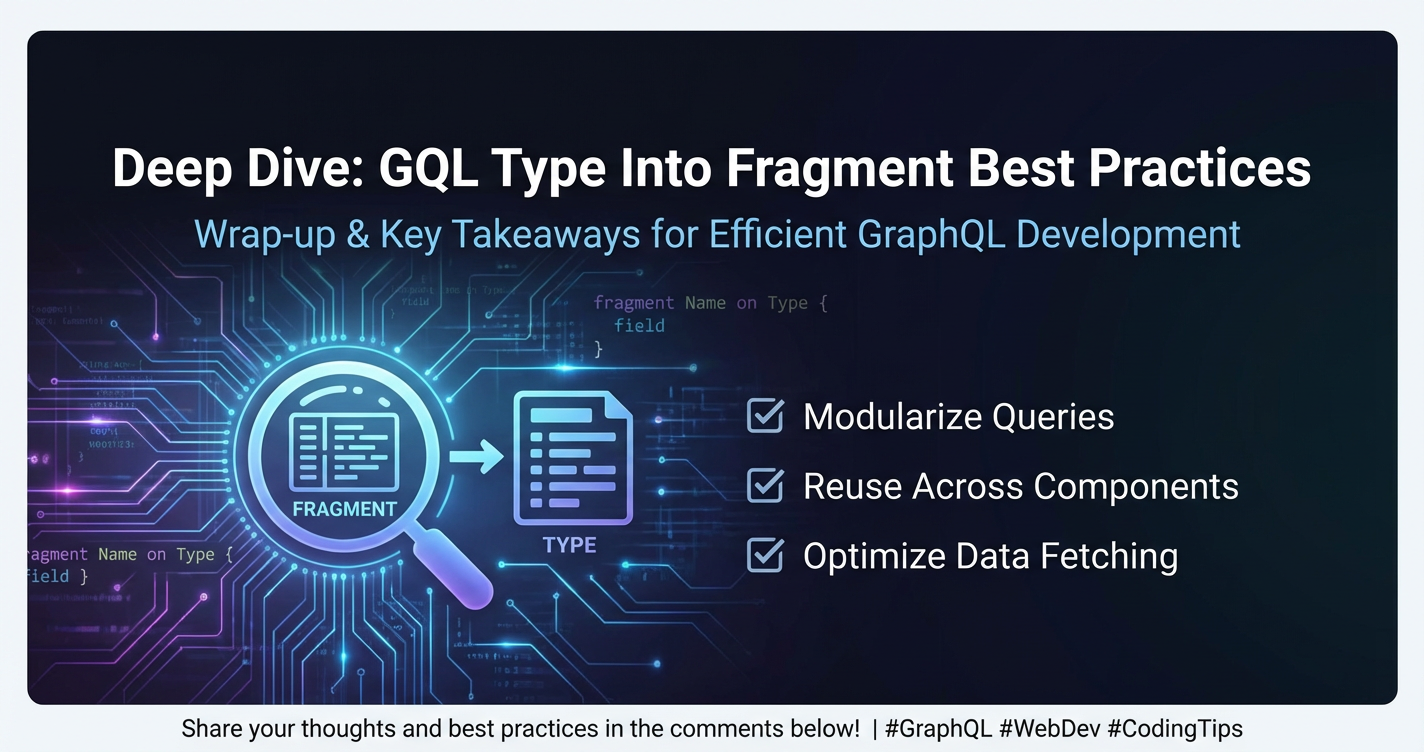
Deep Dive: GQL Type Into Fragment Best Practices



The digital landscape is continuously reshaped by innovative technologies that streamline data access and enhance developer productivity. Among these, GraphQL has emerged as a formidable alternative to traditional REST APIs, offering clients the power to request precisely the data they need, nothing more, nothing less. At the heart of GraphQL's efficiency and flexibility lies a crucial concept: fragments. These reusable units of query logic are fundamental to building scalable, maintainable, and performant GraphQL applications. This deep dive aims to demystify GraphQL fragments, particularly focusing on the best practices for typing into them, ensuring robust data fetching, and fostering a clean, evolvable codebase. We will explore the nuances of their application, the architectural considerations they entail, and how they integrate within a broader API ecosystem, which often includes sophisticated API gateway solutions, some of which, like ApiPark, even specialize in AI integration and comprehensive API management.
The Foundation: Understanding GraphQL Fragments
Before delving into the intricacies of typing into fragments, it is imperative to grasp what GraphQL fragments are and why they are indispensable. In essence, a GraphQL fragment is a reusable piece of a GraphQL query. Imagine you have multiple parts of your application that need to display similar sets of data for a given type, such as a user's name and avatar URL. Instead of duplicating this selection set in every query, you can define it once as a fragment and then include that fragment wherever needed.
fragment UserInfo on User {
  id
  name
  avatarUrl
}
This UserInfo fragment declares that when applied to a User type, it will always fetch id, name, and avatarUrl. The on User syntax is critical; it specifies the type condition under which the fragment is valid, providing a clear contract between the fragment and the data it expects. This explicit typing is the cornerstone of fragment robustness and the central theme of this discussion.
The primary motivations for using fragments are rooted in improving developer experience, code maintainability, and query efficiency:
- Reusability: Fragments allow developers to define data requirements once and reuse them across multiple queries or even other fragments. This reduces redundancy and promotes a "Don't Repeat Yourself" (DRY) principle, which is paramount in large-scale applications.
- Co-location: A powerful pattern in GraphQL is to co-locate data requirements with the UI components that consume them. A React component, for instance, can declare the specific fragment it needs, making it self-contained and easier to understand its data dependencies. When the component moves or changes, its data requirements move with it, simplifying refactoring.
- Modularity: Fragments enable breaking down complex data structures into smaller, manageable units. Each fragment can represent a specific aspect or view of an object, leading to a more modular and organized data fetching strategy.
- Performance (indirectly): While fragments don't directly optimize network requests (the overall query payload still dictates what's fetched), they lead to cleaner, more intentional queries. This intentionality reduces the likelihood of over-fetching data due to poorly constructed, monolithic queries. By using fragments, you ensure components only ask for what they declare they need, which indirectly helps prevent unnecessary data transfer.
Understanding these foundational aspects sets the stage for appreciating the critical role of type conditions within fragments, leading us into the best practices for defining and utilizing them effectively.
The Significance of Type Conditions: on Type
The on Type clause in a GraphQL fragment is not merely syntactic sugar; it is a powerful declarative mechanism that explicitly binds a fragment to a specific GraphQL type. This binding is fundamental to ensuring type safety, predictability, and clarity in your data fetching logic. Without on Type, a fragment would be ambiguous about the context in which it operates, potentially leading to runtime errors or unexpected data shapes.
Consider a GraphQL schema where you have an Animal interface, and concrete types like Dog and Cat implement this interface.
interface Animal {
  id: ID!
  name: String!
}

type Dog implements Animal {
  id: ID!
  name: String!
  breed: String!
}

type Cat implements Animal {
  id: ID!
  name: String!
  color: String!
}
If you want to fetch common Animal fields, you might define:
fragment AnimalFields on Animal {
  id
  name
}
This fragment can then be used on any field that returns an Animal or any type that implements Animal. The on Animal clause tells the GraphQL engine and any client-side tooling that this fragment expects to operate on an object that conforms to the Animal interface.
The real power of type conditions shines when dealing with polymorphic fields (interfaces and unions). When a field can return multiple different types, you often need to fetch different data depending on the concrete type returned. This is where inline fragments and named fragments with type conditions become invaluable.
Inline Fragments vs. Named Fragments with Type Conditions
While both inline fragments and named fragments utilize type conditions, they serve slightly different purposes and offer distinct advantages.
Inline Fragments: An inline fragment allows you to specify a selection set for a particular type directly within a query, without defining a separate named fragment. They are often used for conditional data fetching on polymorphic types.
query GetPetDetails {
  pet { # assuming 'pet' can return Dog or Cat
    id
    name
    ... on Dog {
      breed
    }
    ... on Cat {
      color
    }
  }
}
In this example, ... on Dog and ... on Cat are inline fragments. They specify that if the pet field resolves to a Dog, fetch its breed; if it resolves to a Cat, fetch its color. They are excellent for one-off conditional selections that are not intended for broad reuse. The on Dog and on Cat explicitly dictate the type context for the enclosed fields.
Named Fragments with Type Conditions: As seen earlier, named fragments are defined separately and then included in queries. They are the preferred choice for reusable logic.
fragment DogSpecificFields on Dog {
  breed
}

fragment CatSpecificFields on Cat {
  color
}

query GetPetDetails {
  pet {
    id
    name
    ...DogSpecificFields
    ...CatSpecificFields
  }
}
Here, DogSpecificFields and CatSpecificFields are named fragments, each with a clear on Type condition. They offer:
- Enhanced Readability: Breaking down complex queries into named, logical units improves clarity.
- Maximum Reusability: Once defined, these fragments can be used in any query or even nested within other fragments.
- Strong Typing Guarantees: The explicit
on Typecondition provides compile-time and runtime guarantees about the data shape, which is invaluable for client-side code generation and type checking.
Choosing between inline and named fragments often boils down to reusability and complexity. For simple, isolated conditional fetches, inline fragments suffice. For patterns that repeat or represent distinct conceptual units, named fragments with explicit type conditions are the superior choice. The on Type clause in both instances is the glue that binds the selection set to its expected data structure, preventing type mismatches and ensuring robust data consumption.
Best Practices for GQL Type Into Fragment
Leveraging fragments effectively requires adhering to a set of best practices that enhance maintainability, performance, and developer experience. These practices often revolve around how fragments are typed, structured, and integrated into an application.
1. Co-locate Fragments with Their Consuming Components
One of the most impactful best practices is to co-locate GraphQL fragments directly with the UI components or modules that consume them. This pattern, popularized by client libraries like Relay, drastically improves code organization and understanding.
Rationale: When a component is responsible for rendering specific data, defining the fragment that fetches that data within the component's file ensures that: * Data Dependencies are Obvious: A developer looking at a component immediately sees what data it requires. * Easier Refactoring: If a component moves or changes, its data requirements (the fragment) move or change with it, reducing the chance of breaking other parts of the application. * Increased Modularity: Components become self-sufficient units, encapsulating both their UI and their data needs.
Example (Conceptual React/Next.js component):
```typescript jsx // components/UserCard.tsx import { graphql } from 'relay-runtime'; // Or a similar client library
export const UserCard = ({ user }) => (
{user.name}
ID: {user.id}
);
// Co-located fragment for UserCard's data needs UserCard.fragments = graphqlfragment UserCard_user on User { id name avatarUrl };
In this example, `UserCard_user` is a named fragment specifically typed `on User`. It explicitly defines the data the `UserCard` component expects. This pattern greatly enhances the readability and maintainability of your codebase.

#### 2. Name Fragments Clearly and Consistently

Fragment naming conventions are crucial for readability and preventing naming collisions, especially in larger codebases. A commonly adopted pattern, particularly with co-location, is `ComponentName_propName on Type`.

**Rationale:**
*   **Clarity:** The name immediately tells you which component consumes the fragment and what prop it expects it on.
*   **Uniqueness:** By incorporating the component name, you significantly reduce the chance of naming conflicts between fragments from different parts of the application.
*   **Type Hint:** The `on Type` clause (though not part of the fragment name itself, but its definition) always reminds you of the underlying GraphQL type it operates on.

**Example:**
*   `UserList_users on User`: A fragment for a list of `User` objects in a `UserList` component.
*   `ProductDetail_product on Product`: A fragment for a single `Product` object in a `ProductDetail` component.
*   `Comment_author on Author`: A fragment for an `Author` within a `Comment` component.

Adhering to a consistent naming scheme makes it easier for developers to navigate the codebase, understand fragment purposes, and integrate new features without ambiguity.

#### 3. Favor Named Fragments for Reusability and Complexity

While inline fragments have their place for one-off conditional selections, named fragments, typed explicitly with `on Type`, should be the default choice for any data selection that is intended for reuse or represents a significant conceptual unit.

**Rationale:**
*   **Modularity:** Named fragments enforce modularity by encapsulating specific data requirements, making queries cleaner and easier to reason about.
*   **Strong Typing:** When using code generation tools (e.g., GraphQL Code Generator), named fragments provide better hooks for generating precise TypeScript interfaces or Flow types, leading to safer client-side code. The `on Type` clause is directly translated into type definitions, ensuring that your client-side code expects the exact shape of data the fragment fetches.
*   **Testing:** Separating data fetching logic into named fragments can simplify testing, as you can test the fragment's behavior independently.
*   **Schema Evolution:** When your schema evolves, changes related to a specific type's fields can often be isolated to a few named fragments, rather than scattered across many inline fragments in various queries.

**When to Use Inline Fragments (Judiciously):**
*   **Single-use conditional fetching:** When you have a polymorphic field and only need to fetch specific fields for one or two concrete types, and this specific selection is unlikely to be reused elsewhere.
*   **Small, context-specific selections:** For very minor conditional additions to an existing query.

For anything beyond these simple cases, a named fragment with a clear `on Type` condition is almost always the superior choice for long-term maintainability and type safety.

#### 4. Avoid Deeply Nested, Opaque Fragments

While fragments promote modularity, it's possible to overdo nesting, leading to fragments that are difficult to trace and understand their full data requirements. A good fragment should ideally be a clear, self-contained unit.

**Rationale for Caution:**
*   **Reduced Clarity:** A fragment that includes many other fragments, which in turn include more fragments, can obscure the total data being fetched, making it hard to debug or optimize.
*   **Accidental Over-fetching:** Deep nesting can sometimes lead to inadvertently fetching more data than a specific component actually needs, if child fragments contain fields not relevant to the current context. This is where mindful typing and precise field selection within each fragment is key.
*   **Increased Complexity:** Understanding the full data graph requested by a query composed of many layers of nested fragments can become a cognitive burden.

**Best Practice:**
*   **Limit Nesting Depth:** Aim for a reasonable nesting depth. If a component needs data from a related object, create a separate fragment for that related object and apply it to the appropriate field.
*   **Prioritize Readability:** Ensure that the immediate parent fragment or query explicitly lists the fragments it's using.
*   **Focus on Domain Concepts:** Design fragments around domain concepts (e.g., `ProductPriceInfo`, `UserContactDetails`) rather than purely technical groupings. This makes their purpose clearer.

#### 5. Leverage Fragments on Interfaces and Unions for Polymorphic Data

As discussed, interfaces and unions are core to GraphQL's ability to handle polymorphic data. Fragments are the primary mechanism to interact with these types effectively. When you have a field that can return different types, using fragments with specific type conditions (`on Type`) allows you to conditionally fetch fields relevant to each concrete type.

**Example Revisited:**

```graphql
# fragment definitions
fragment DogDetails on Dog {
  breed
  barkVolume # specific to Dog
}

fragment CatDetails on Cat {
  color
  purrFrequency # specific to Cat
}

query GetMyAnimals {
  animals { # returns [Animal]
    id
    name
    ...DogDetails
    ...CatDetails
    # If there's common data across all animals, put it in a fragment on Animal
    # fragment AnimalCommonFields on Animal { commonField }
    # ...AnimalCommonFields
  }
}
Rationale: * Type Safety: The on Dog and on Cat ensure that breed and color are only requested when the object is indeed of that specific type, preventing runtime errors. * Precision: You only fetch the fields relevant to the specific concrete type, avoiding over-fetching unnecessary data. * Clear Logic: The query clearly expresses the different data requirements for each possible type, making it easy to understand and maintain. * Client-side Typing: This pattern is invaluable for client-side type generation, as tools can create precise discriminated unions or interfaces that reflect the conditional data, leading to robust client applications.
6. Utilize Fragment Collocation for Granular Access Control and Schema Stitching
Beyond basic data fetching, fragments play a crucial role in advanced GraphQL architectures, particularly when dealing with schema stitching or federation, and even influencing how granular access control might be implemented.
Schema Stitching/Federation: In a federated GraphQL API architecture, different microservices own different parts of the overall schema. Fragments are essential for declaring cross-service data requirements. A gateway (not necessarily an API gateway in the traditional sense, but a GraphQL gateway) can then use these fragments to fan out requests to the appropriate backend services and stitch the results back together. The on Type clause ensures that the gateway knows which service owns which part of the data for a given type.
Access Control: While GraphQL resolvers typically handle authorization at the field level, fragments can implicitly guide access control. If a component uses a fragment that includes sensitive fields, the mere presence of that fragment in a query informs the backend about the data being requested. A well-designed API gateway or GraphQL server can inspect the entire query, including fragments, to apply fine-grained authorization rules before data is fetched from the underlying services. For instance, if ...AdminDetails on User is requested, the gateway might check for specific admin roles.
This highlights the fact that while GraphQL fragments focus on data selection, they operate within a broader API ecosystem where an intelligent gateway can leverage query structure for various operational and security concerns.
Fragments in a Broader API Ecosystem: The Role of the API Gateway
While GraphQL provides an elegant solution for client-server data interaction, it operates within a larger API landscape. Modern architectures often feature an API gateway as the single entry point for all client requests, orchestrating communication with various backend services. This is where the concepts of GraphQL fragments intersect with the broader concerns of api management, security, performance, and observability that an API gateway addresses.
A GraphQL server itself often acts as a specialized gateway to multiple underlying data sources (databases, REST APIs, other microservices). However, a comprehensive API gateway typically sits in front of the GraphQL server (and other non-GraphQL apis) at the edge of the network. Its responsibilities are distinct but complementary:
- Global Authentication and Authorization: The
API gatewaycan handle initial authentication (e.g., JWT validation, OAuth) and coarse-grained authorization before requests even reach the GraphQL server. This prevents unauthorized traffic from consuming GraphQL server resources. - Rate Limiting and Throttling: To protect backend services from abuse and ensure fair usage, the
API gatewayenforces rate limits across allapis. - Traffic Management: Load balancing, routing, caching, and circuit breaking are crucial for performance and resilience, and these are often managed by the
API gateway. - Logging and Monitoring: The
gatewayprovides a centralized point for logging all incomingapirequests and responses, offering a holistic view of system health and activity. - API Lifecycle Management: From publishing and versioning to deprecation, a robust
API gatewayhelps manage the entire lifecycle of variousapis, including REST, gRPC, and potentially GraphQL endpoints.
Integrating GraphQL with an API Gateway: When integrating GraphQL with an API gateway, the gateway can route GraphQL queries to the appropriate GraphQL server (or potentially multiple federated GraphQL services). While the GraphQL server processes the query and uses fragments for efficient data fetching, the API gateway handles the cross-cutting concerns.
For instance, consider a scenario where a client makes a GraphQL query that includes fragments like ...UserDetails on User and ...ProductReviews on Product. Before this query reaches the GraphQL server, the API gateway might: 1. Authenticate the user making the request. 2. Check if the user's IP address is within rate limits. 3. Perform WAF (Web Application Firewall) checks. 4. Apply a global cache policy if applicable. 5. Route the request to the correct GraphQL endpoint.
This layered approach ensures that the GraphQL server can focus on its core competency – resolving data requests based on the schema and fragments – while the API gateway manages the operational complexities of exposing apis to the outside world.
APIPark: Enhancing the API Gateway Landscape
In this context of modern API architecture, platforms like ApiPark emerge as powerful tools, especially when dealing with a diverse set of apis, including the growing presence of AI models. APIPark is an all-in-one AI gateway and API developer portal, open-sourced under the Apache 2.0 license. It's designed to help developers and enterprises manage, integrate, and deploy AI and REST services with ease, but its comprehensive API management capabilities extend its value to any environment needing a robust gateway solution.
While GraphQL offers client-side query flexibility with fragments, APIPark addresses the server-side and operational challenges of managing a portfolio of apis. Imagine you have a GraphQL service for your core application data, several REST apis for legacy systems, and a growing number of AI models providing sentiment analysis or translation. APIPark can sit in front of all these, acting as a unified gateway that provides:
- Quick Integration of 100+ AI Models: While not directly managing GraphQL fragments, this capability highlights APIPark's strength in unifying diverse
apis. A GraphQL service might even query these AI models through APIPark. - Unified API Format for AI Invocation: This standardizes
apiinteractions, a similar goal to GraphQL fragments reducing query duplication, but at the invocation level for AI services. - End-to-End API Lifecycle Management: Crucial for any
api, including a GraphQLapi, APIPark helps regulateapimanagement processes, manage traffic forwarding, load balancing, and versioning. This complements GraphQL's data fetching by ensuring the GraphQLapiitself is well-governed. - Performance Rivaling Nginx: An API gateway must be performant. APIPark’s ability to achieve over 20,000 TPS on modest hardware means it can handle high-volume traffic for all your
apis, including those serving GraphQL queries. - Detailed API Call Logging and Powerful Data Analysis: Observability is key. APIPark provides comprehensive logging and analytics, giving insights into all
apicalls, which is vital for troubleshooting and understanding usage patterns, regardless of whether the underlyingapiis REST or GraphQL. - API Resource Access Requires Approval & Independent API and Access Permissions for Each Tenant: These features are critical for security and multi-tenancy, providing a robust governance layer above individual
apis and their internal logic like GraphQL fragments.
In essence, while GraphQL fragments excel at optimizing data requests from the client's perspective, platforms like APIPark provide the overarching gateway infrastructure for managing, securing, and scaling the entire api portfolio, ensuring that both GraphQL and other apis operate efficiently and securely within a unified framework.
Advanced Fragment Patterns and Considerations
Beyond the fundamental best practices, there are several advanced patterns and considerations that further refine the use of GraphQL fragments with type conditions.
1. Dynamic Fragments and Conditional Inclusion
While fragments are statically defined, the inclusion of fragments in a query can sometimes be dynamic, especially when using client-side GraphQL libraries that allow for programmatic query construction. This is distinct from conditional fields within a fragment; it's about conditionally adding an entire fragment.
Use Case: Imagine a component that renders a list of items. Depending on a user's role or a global feature flag, each item might need to fetch additional, specific details.
fragment BasicItemFields on Item {
  id
  name
}

fragment AdminItemDetails on Item {
  internalNotes
  auditLogLink
}

query GetItems($includeAdminDetails: Boolean!) {
  items {
    ...BasicItemFields
    ...AdminItemDetails @include(if: $includeAdminDetails) # Conditionally include
  }
}
Here, the @include directive (a standard GraphQL feature) allows AdminItemDetails to be included only if the $includeAdminDetails variable is true. The on Item type condition ensures that AdminItemDetails is only applied when the object is indeed an Item. This allows for highly flexible and efficient data fetching based on runtime conditions without altering the fragment's definition.
2. Fragment Masking (Relay Specific)
Relay, a popular GraphQL client library, introduces the concept of "fragment masking" or "data masking." This means that a component can only access the data explicitly declared in its co-located fragment. If a parent query fetches more data than a child component's fragment specifies, the child component will only receive the data it declared.
Rationale: * Strong Encapsulation: Components are truly self-contained regarding their data needs, promoting independent development and reasoning. * Prevents Accidental Over-fetching: A component cannot accidentally rely on data fetched by a parent component but not declared in its own fragment. * Easier Refactoring: Changes to a parent's data fetching won't inadvertently break a child component, as the child is guaranteed to only see what its fragment requests.
While fragment masking is a feature specific to client libraries like Relay, the principle of defining explicit data requirements (on Type) within fragments aligns perfectly with this concept and enhances overall architectural robustness.
3. Fragments and GraphQL Code Generation
One of the most significant benefits of strongly typed fragments (on Type) is their seamless integration with GraphQL code generation tools (e.g., GraphQL Code Generator, Apollo CLI). These tools analyze your GraphQL schema and query/fragment definitions to automatically generate TypeScript interfaces, Flow types, or other language-specific data structures.
Impact: * End-to-End Type Safety: From the GraphQL schema to your client-side application code, types are consistently enforced. * Reduced Boilerplate: Developers no longer need to manually write interfaces for every data shape returned by a query or fragment. * Improved Developer Experience: Auto-completion, compile-time error checking, and clear data contracts lead to faster, more confident development. * Refactoring Safety: When you change a field in a fragment (and its on Type definition), the code generator will update the corresponding types, and your IDE/compiler will highlight any parts of your client code that need adjustment.
For instance, a fragment fragment UserAvatar on User { id avatarUrl } will likely generate a TypeScript interface like UserAvatar_user. This explicit typing based on the fragment definition is crucial for building robust, large-scale applications.
4. Managing Fragment Versioning and Deprecation
As your GraphQL schema and application evolve, fragments will inevitably change. Best practices for managing these changes include:
- Semantic Versioning for Fragments (Implicit): While you don't version fragments explicitly like an
api, changes to a fragment (adding/removing fields) should be treated with care. Removing a field that a consumer relies on is a breaking change. - Deprecation Directives: GraphQL's
@deprecateddirective can be applied to fields within a fragment, signaling to clients that a field should no longer be used. This allows for a graceful transition period. - Clear Documentation: Documenting the purpose and usage of each fragment, especially if it's widely reused, helps other developers understand its contract.
Effective fragment management is part of broader API governance, ensuring that the data contracts provided by your GraphQL api remain stable and reliable for consumers.
Challenges and Mitigations in Fragment Usage
Despite their numerous benefits, fragments are not without potential pitfalls. Understanding these challenges and how to mitigate them is key to truly mastering fragment best practices.
1. Over-fetching with Shared Fragments
Challenge: If a highly reusable fragment defines many fields, but a specific consumer only needs a subset, you might end up over-fetching data. This is particularly relevant if the fragment is applied to a large object. Mitigation: * Create Smaller, Granular Fragments: Instead of one monolithic UserDetailedInfo fragment, create UserBasicInfo, UserContactInfo, UserFinancialInfo. Components can then compose these smaller fragments as needed. * Selective Field Addition: Only add fields to a fragment if they are truly common to all its consumers. If a field is only needed by one or two consumers, consider adding it directly to their query or a very specific fragment. * Client-side Post-processing (Use with Caution): While generally discouraged for performance reasons, if a tiny amount of over-fetched data is unavoidable, clients can discard unwanted fields. However, ideally, the GraphQL query should be precise.
2. Naming Collisions in Large Codebases
Challenge: Without a consistent naming convention, two different teams or developers might create fragments with the same name, leading to conflicts during build or runtime. Mitigation: * Strict Naming Conventions: Enforce a clear naming convention (e.g., ComponentName_propName_type or DomainConcept_purpose_type). * Namespace Fragments: If your client library or build system supports it, you might be able to namespace fragments based on their module or folder. * Code Generation Tools: Tools often help manage this by ensuring uniqueness or by providing clear error messages when collisions occur.
3. Complexity of Deeply Nested Fragments
Challenge: As discussed, deeply nested fragments can make it difficult to trace data dependencies and understand the full query, impacting debugging and maintenance. Mitigation: * Limit Nesting Depth: Encourage developers to keep nesting shallow. * Focus on Domain-Driven Design: Organize fragments around logical domain entities and their specific views. * Visualization Tools: Some GraphQL IDEs or tools can visualize the query structure, which helps in understanding complex fragment compositions. * Client Library Conventions: Libraries like Relay manage fragment ownership, making it clear which component is responsible for which part of the data.
4. Managing Schema Evolution and Fragment Updates
Challenge: When the GraphQL schema changes (e.g., a field is renamed, type structure changes), corresponding fragments need to be updated, which can be a tedious process in a large application. Mitigation: * Code Generation: This is the most effective mitigation. If your fragments are used to generate types, changes in the schema will trigger build errors in your client code, immediately highlighting where fragments need to be updated. * GraphQL Linting Tools: Linters can identify fragments that refer to non-existent fields or types based on your schema. * Automated Testing: Comprehensive tests that cover data fetching (especially for components that use fragments) will quickly identify broken queries after schema changes. * Deprecation Strategy: Use GraphQL's @deprecated directive to signal upcoming changes, allowing consumers to update fragments proactively.
5. Performance Impacts of Fragment Processing on the Server
Challenge: While fragments improve client-side developer experience, the GraphQL server still needs to parse and resolve the entire query. If fragments are excessively complex or numerous, it could add a slight overhead to the server. Mitigation: * Query Batching (at the API Gateway or client): Group multiple queries into a single HTTP request to reduce network overhead. Some API gateway solutions might offer this as a feature. * Persisted Queries: Send a hash of the query to the server instead of the full query string. The server then retrieves the full query (including fragments) from a pre-defined store. This reduces network payload and parsing time. An API gateway could potentially manage the caching of persisted query mappings. * Server-Side Caching: Implement robust caching strategies at the resolver level or using a data loader pattern to prevent redundant database queries, regardless of how the data is requested via fragments. * Optimize Resolvers: The most significant performance gains often come from optimizing the underlying data fetching logic within the resolvers themselves, rather than focusing solely on fragment structure.
By consciously addressing these potential challenges, developers can unlock the full power of GraphQL fragments, creating highly performant, maintainable, and type-safe data fetching layers for their applications.
Conclusion: Mastering the Art of Typed Fragments
The journey through GraphQL fragments, particularly the nuances of typing into them with on Type conditions, reveals a powerful paradigm for building robust and scalable data fetching layers. Fragments are far more than just reusable query snippets; they are explicit contracts that define the precise data requirements of specific parts of your application, enforcing type safety and promoting modularity from the GraphQL schema all the way to the consuming client components.
Adhering to best practices such as co-locating fragments with their components, employing clear naming conventions, favoring named fragments for reusability, and judiciously using them with interfaces and unions, paves the way for a codebase that is easier to read, maintain, and evolve. These practices are amplified by modern tooling, especially GraphQL code generators, which translate these well-defined fragment contracts into tangible type safety across your entire application stack.
Furthermore, it's crucial to recognize that GraphQL, with all its internal elegance and fragment-driven efficiency, does not operate in a vacuum. It exists within a broader API ecosystem, often guarded and managed by a comprehensive API gateway. Solutions like ApiPark exemplify how a robust gateway can provide an essential layer of security, performance, and management for all your APIs, including GraphQL endpoints, RESTful services, and even specialized AI models. While GraphQL fragments optimize how clients request data, an API gateway optimizes how access to that data is controlled, logged, and scaled, offering a symbiotic relationship that strengthens the overall architecture.
By deeply understanding and diligently applying these best practices for GQL type into fragment usage, developers can unlock unparalleled efficiency and reliability in their GraphQL applications. This mastery not only streamlines data fetching but also fosters a more disciplined and predictable development workflow, ultimately leading to more resilient and performant systems capable of adapting to the ever-changing demands of the digital world.
Frequently Asked Questions (FAQs)
1. What is the primary purpose of the on Type clause in a GraphQL fragment? The on Type clause explicitly binds a fragment to a specific GraphQL type, ensuring that the fragment's selection set is only applied when the parent object is of that specified type or implements that interface. This is crucial for type safety, predictability, and for correctly fetching data from polymorphic fields (interfaces and unions). It acts as a contract, telling the GraphQL engine and client-side tooling what data shape to expect.
2. When should I use an inline fragment versus a named fragment? You should use an inline fragment for simple, one-off conditional data fetching on polymorphic fields that are unlikely to be reused elsewhere. For example, if a field can return Dog or Cat, and you only need to fetch breed if it's a Dog directly within that single query. You should use a named fragment for reusable data selections, particularly when a selection set is used by multiple components or queries, or when it represents a significant conceptual unit of data. Named fragments improve readability, promote modularity, and offer better support for code generation and maintenance.
3. How do GraphQL fragments help with type safety in client-side applications? When combined with GraphQL code generation tools, fragments, especially those with explicit on Type conditions, provide excellent type safety. These tools analyze your schema and fragment definitions to automatically generate precise TypeScript interfaces or Flow types. This means that your client-side code will have strong typing for the data received, enabling compile-time error checking, auto-completion, and ensuring that your components only interact with data structures guaranteed by your GraphQL schema and fragment definitions.
4. Can fragments lead to over-fetching of data, and how can this be mitigated? Yes, fragments can potentially lead to over-fetching if a large, generic fragment is used in a context where only a subset of its fields is needed. For example, if a UserDetailFragment includes many fields, but a specific UI component only needs the user's name, using the large fragment will fetch unnecessary data. To mitigate this, it's best to: * Create smaller, more granular fragments focused on specific data subsets (e.g., UserBasicInfo, UserContactInfo). * Only include fields in a fragment if they are truly common across all its consumers. * Consider using GraphQL directives like @include or @skip for truly conditional field inclusion if supported by your client.
5. What role does an API Gateway play in an architecture that heavily utilizes GraphQL fragments? While GraphQL fragments optimize data fetching from the client to the GraphQL server, an API gateway typically sits in front of the GraphQL server (and other backend services) at the edge of the network. Its role is to handle cross-cutting concerns for all incoming API traffic, regardless of whether it's GraphQL or REST. This includes global authentication, authorization, rate limiting, traffic management, caching, and comprehensive logging. The API gateway complements the GraphQL server by ensuring that the GraphQL API itself is secure, performant, and well-governed within the broader enterprise API landscape, allowing the GraphQL server to focus purely on query resolution and data fetching based on the schema and fragments.
🚀You can securely and efficiently call the OpenAI API on APIPark in just two steps:
Step 1: Deploy the APIPark AI gateway in 5 minutes.
APIPark is developed based on Golang, offering strong product performance and low development and maintenance costs. You can deploy APIPark with a single command line.
curl -sSO https://download.apipark.com/install/quick-start.sh; bash quick-start.sh

In my experience, you can see the successful deployment interface within 5 to 10 minutes. Then, you can log in to APIPark using your account.

Step 2: Call the OpenAI API.