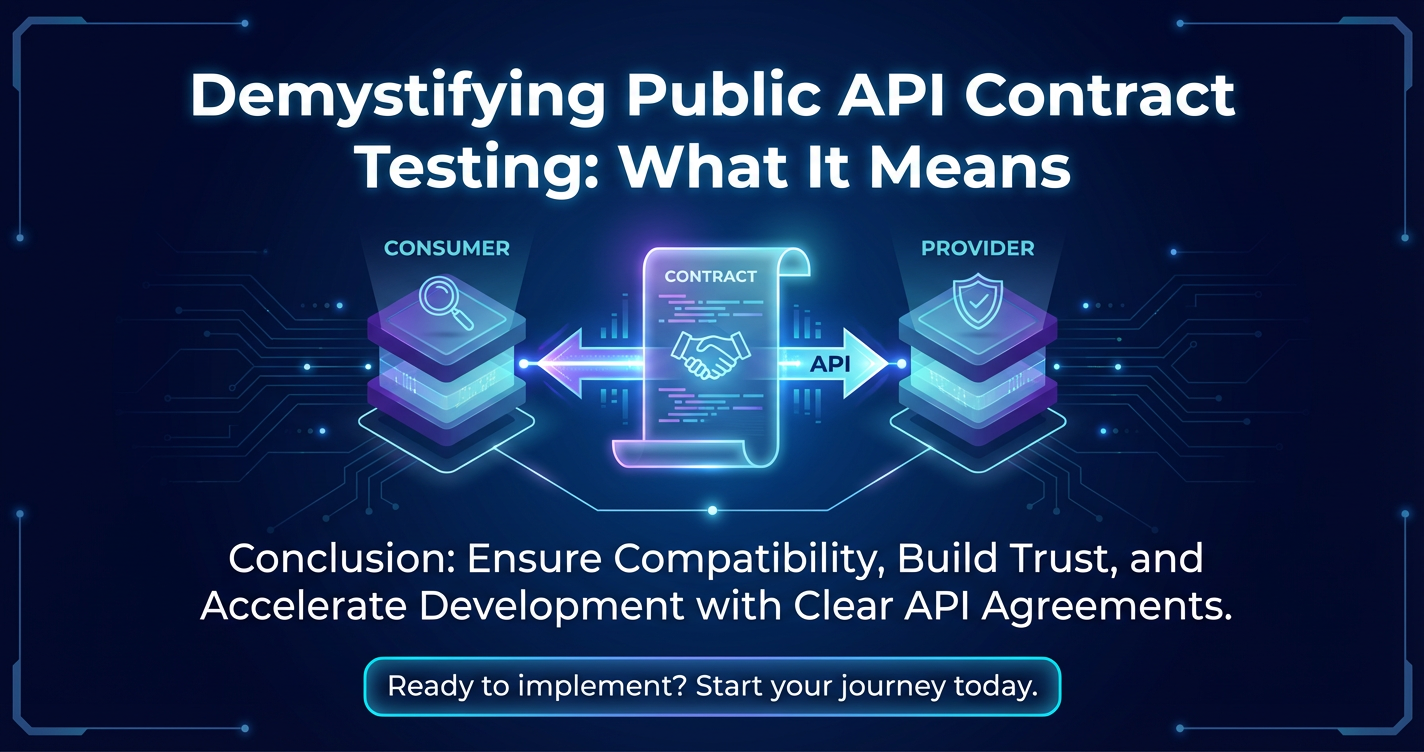
Demystifying Public API Contract Testing: What It Means


In the sprawling digital landscape of the 21st century, Application Programming Interfaces (APIs) have emerged as the foundational pillars upon which modern software ecosystems are built. They are the silent workhorses, enabling disparate systems to communicate, share data, and unlock unprecedented levels of innovation and collaboration. From mobile applications seamlessly fetching real-time data to complex enterprise systems orchestrating intricate business processes across clouds, the ubiquitous api is the invisible thread weaving together the fabric of our interconnected world. However, the immense power and flexibility offered by APIs come with a significant challenge: ensuring their reliability, consistency, and compatibility, particularly for public-facing interfaces. This is where the critical discipline of Public API Contract Testing steps into the spotlight, acting as a vital guardian of these digital interactions.
A public API, by its very definition, is an interface exposed to external developers, partners, and the broader internet. Unlike internal APIs, where communication and coordination between teams can be more direct and controlled, public APIs serve a diverse and often unknown multitude of consumers. The stakes are considerably higher; a breaking change or an unexpected deviation in behavior can ripple through an entire ecosystem, disrupting countless applications, eroding developer trust, and inflicting substantial financial and reputational damage upon the API provider. The underlying agreement between an API provider and its consumers — the "contract" — becomes paramount. This contract, often meticulously defined, dictates the precise format of requests and responses, the expected data types, error codes, authentication mechanisms, and overall behavior. When this contract is violated, intentionally or unintentionally, chaos ensues.
This article will embark on a comprehensive journey to demystify Public API Contract Testing, dissecting its core principles, exploring its methodologies, and elucidating its profound implications for robust API Governance. We will delve into how the OpenAPI Specification has become an indispensable tool in formalizing these contracts, and how various testing strategies ensure that both providers and consumers adhere to their agreed-upon terms. By understanding and implementing effective contract testing, organizations can foster resilient API ecosystems, cultivate stronger developer relationships, and ensure the long-term stability and success of their digital initiatives. This deep dive will illuminate why contract testing is not merely a technical exercise but a strategic imperative in the age of API-first development.
Understanding the Landscape of Public APIs
Before we delve into the intricacies of contract testing, it is essential to establish a clear understanding of what constitutes a "public API" and why its nature inherently demands a higher degree of diligence in testing and governance. A public API is deliberately designed to be consumed by external parties, often independent developers, third-party applications, or partner organizations that operate outside the immediate control and purview of the API provider. Think of payment gateways, social media integration APIs, weather data APIs, or cloud service APIs – these are quintessential examples of public interfaces that power countless downstream applications and services globally.
What differentiates a public API from its internal or partner counterparts? Firstly, accessibility. Public APIs are typically well-documented and discoverable, often listed in developer portals or marketplaces, making them readily available for integration by anyone who meets the access criteria. Secondly, and perhaps most critically, is the expectation of stability and backward compatibility. External consumers build their entire applications and business logic around the public API's promise. Any sudden, undocumented, or breaking change can render their integrations dysfunctional, leading to significant rework, system outages, and a rapid erosion of trust. For internal APIs, changes can often be coordinated directly between a handful of teams. For partner APIs, there might be formal agreements and direct communication channels. But for public APIs, with potentially thousands or millions of consumers, such direct coordination is practically impossible.
The "contract" metaphor, therefore, gains immense significance here. Just as a legal contract binds parties to specific terms and conditions, an API contract represents a binding agreement between the API provider and its consumers regarding the interface's behavior, data structures, and operational semantics. This contract is not merely implied; it needs to be explicitly defined, communicated, and rigorously enforced. When an API provider publishes a public API, it essentially issues a promise to the world: "This is how you can interact with our service, and this is what you can expect in return." Breaking this promise has far-reaching consequences.
The challenges associated with managing public APIs are multifaceted. Versioning becomes a delicate dance, balancing the need for innovation and new features with the imperative of maintaining compatibility for existing consumers. Communication of changes, deprecations, and new features must be meticulously planned and executed through developer portals, changelogs, and clear documentation. Security is paramount, as public APIs are exposed to the internet's myriad threats. Above all, reliability is non-negotiable; public APIs must be available, performant, and consistently deliver on their stated contract. Any deviation from these expectations can lead to a cascade of failures across dependent applications, damaging the provider's reputation and potentially impacting their core business.
In this context, traditional testing approaches, while valuable, often fall short. Unit tests verify individual components, integration tests confirm interactions between a few closely coupled services, and end-to-end tests simulate complete user flows. While these are all crucial pieces of a comprehensive testing strategy, none specifically target the agreement between independent services, especially when one service is publicly exposed and consumed by an unknown number of external entities. This void is precisely what API contract testing seeks to fill, by focusing specifically on validating that both sides of an API interaction adhere to a shared, explicit understanding of the interface. It acts as the guardian of that critical promise made by public API providers to their vast and varied consumer base.
The Essence of API Contract Testing
At its core, api contract testing is a methodology focused on verifying that interactions between services conform to a predefined agreement, or "contract." This contract outlines the expected format, structure, and semantics of requests and responses exchanged between an API provider (the service offering the API) and an API consumer (the service using the API). Unlike other forms of testing that might focus on internal logic or complete system workflows, contract testing zeroes in on the interface boundary, ensuring that both parties adhere to the shared understanding of how they should communicate.
What, precisely, constitutes this "contract"? It's far more than just a vague understanding. For an API, the contract encompasses: * Endpoints and HTTP Methods: The specific URLs and operations (GET, POST, PUT, DELETE, etc.) available. * Request Parameters: The names, types, constraints, and required/optional status of query parameters, path parameters, and headers. * Request Body Schema: The detailed structure, data types, and validations for any data sent in the request body (e.g., JSON schema). * Response Status Codes: The expected HTTP status codes (e.g., 200 OK, 201 Created, 400 Bad Request, 500 Internal Server Error) for different scenarios. * Response Body Schema: The detailed structure, data types, and validations for data returned in the response body. * Authentication and Authorization: The mechanisms for securing the API (e.g., API keys, OAuth2, JWT) and the permissions required for various operations. * Error Handling: The format and content of error messages for various failure conditions. * Performance Expectations: While not always part of the explicit schema, implicit expectations around response times can also be considered part of the broader service contract.
The primary motivation behind implementing API contract testing is to mitigate the risk of integration failures and prevent breaking changes from impacting consumers. In complex, distributed systems, particularly those involving public APIs, changes to a provider service can inadvertently break numerous consumer applications without the provider being immediately aware. Traditional testing methods often miss these "silent breaks" because they might not cover the specific interaction patterns of every single consumer.
Let's clarify the distinctions between contract testing and other common testing types:
- Unit Testing: Focuses on verifying the smallest isolated components of an application (e.g., a single function or class) in isolation. It ensures internal logic works correctly but doesn't test external interactions.
- Integration Testing: Verifies the interactions between two or more integrated components or services. This often involves testing how your service interacts with a database, a message queue, or another specific internal service. The scope is typically within a defined system boundary. While contract tests are a form of integration testing, they are a specific type focused on the agreement rather than the full operational integration.
- End-to-End (E2E) Testing: Simulates a complete user journey through the entire application stack, from the UI down to the backend services and databases. E2E tests are comprehensive but can be slow, brittle, and expensive to maintain, especially for public APIs with myriad complex usage scenarios. They are excellent for verifying critical business flows but less efficient for detecting subtle contract violations.
The unique value proposition of contract testing lies in its ability to: 1. Early Detection of Breaking Changes: By validating interactions against a predefined contract, discrepancies are caught much earlier in the development lifecycle, often before deployment to production, saving significant time and resources. 2. Reduced Reliance on Costly E2E Tests: Contract tests allow development teams to ensure compatibility between services without needing to spin up and orchestrate entire environments for full end-to-end tests for every change. This promotes faster feedback loops. 3. Enabled Independent Development and Deployment: Services can be developed and deployed independently, provided they continue to adhere to their agreed-upon contracts. This fosters true microservices architecture principles and continuous delivery. 4. Clear Communication and Documentation: The contract itself serves as living, executable documentation of the API's behavior, reducing ambiguity and improving collaboration between teams. 5. Enhanced Reliability for Public APIs: For public APIs, where coordinating with countless external consumers is impossible, contract testing is a safety net. It ensures that the provider's API continues to meet the expectations of its consumers, preserving trust and preventing widespread outages caused by unforeseen changes. It ensures the "promise" of the API remains intact, crucial for fostering a robust and healthy ecosystem.
The emphasis for public APIs in contract testing is particularly acute. When an internal team consumes an API from another internal team, there's always the possibility of direct communication or even shared codebase knowledge to resolve issues. But with public APIs, consumers are often unknown, geographically dispersed, and using vastly different technology stacks. A provider cannot simply "call them up" to notify them of a change or coordinate a fix. The contract, therefore, must be unimpeachable, and contract testing becomes the primary mechanism to ensure that the public interface remains consistent and dependable, fulfilling its role as a stable foundation for external innovation.
The Indispensable Role of OpenAPI in Public API Contracts
In the realm of api development, especially concerning public interfaces, the clarity and precision of the API contract are paramount. Ambiguity leads to integration headaches, inconsistent implementations, and ultimately, frustrated developers. This is precisely where the OpenAPI Specification (OAS), formerly known as Swagger Specification, steps in as an indispensable tool. It has rapidly become the de facto standard for defining API contracts, providing a language-agnostic, human-readable, and machine-readable format for describing the capabilities of RESTful APIs.
At its essence, OpenAPI is a powerful interface description language. It allows API providers to meticulously detail every aspect of their API's contract in a structured, standardized format, typically YAML or JSON. This includes:
- API Metadata: Information about the API itself, such as its title, version, description, and contact information.
- Servers: The base URLs for the API, allowing for different environments (development, staging, production).
- Paths and Operations: A comprehensive list of all available endpoints (paths) and the HTTP methods (GET, POST, PUT, DELETE, PATCH) supported for each.
- Parameters: For each operation, OpenAPI specifies the parameters, including their name, location (query, header, path, cookie), data type, whether they are required, and optional descriptions and examples.
- Request Bodies: Detailed schemas (often using JSON Schema) for the data expected in request bodies, complete with data types, properties, constraints, and examples.
- Responses: For each operation and possible HTTP status code (e.g., 200, 201, 400, 500), OpenAPI defines the expected response body schema, headers, and examples.
- Security Schemes: Definitions of how the API is secured, such as API keys, OAuth2 flows, or HTTP Basic authentication.
- Components (Schemas, Responses, Parameters, Examples, etc.): Reusable definitions that promote consistency and reduce redundancy across the API specification.
The benefits of utilizing OpenAPI for public APIs are profound and far-reaching:
- Clear, Unambiguous Documentation: An OpenAPI document serves as the single source of truth for the API contract. It provides a crystal-clear understanding of how the API functions, removing guesswork and fostering consistency in integration. This is particularly vital for public APIs, where consumers cannot simply walk over to the provider's desk for clarification.
- Rich Tooling Ecosystem: The widespread adoption of OpenAPI has spawned a vibrant ecosystem of tools. This includes:
- Interactive Documentation Generators: Tools like Swagger UI or Redoc can automatically generate beautiful, interactive documentation portals directly from an OpenAPI specification, making it easy for external developers to explore and understand the API.
- Code Generators: Client SDKs in various programming languages (e.g., Java, Python, JavaScript) can be automatically generated from an OpenAPI spec, accelerating consumer integration. Similarly, server stubs can be generated, helping providers implement the API according to the defined contract.
- Mock Servers: Tools can automatically create mock API servers that simulate the API's behavior based on the OpenAPI definition, allowing consumers to develop and test their applications even before the actual API provider service is fully implemented.
- Validation Tools: Linters and validators can check an OpenAPI specification for adherence to best practices, consistency, and correctness.
- Foundation for Contract Testing: The machine-readable nature of OpenAPI is a cornerstone for automated contract testing. Both provider and consumer can use the OpenAPI definition as the definitive source against which their actual API interactions are validated. A provider can ensure its implementation strictly adheres to the schema defined in the OpenAPI spec, and consumers can use the same spec to validate the responses they receive, thereby establishing a shared understanding that is programmatically verifiable.
- Facilitates Communication and Collaboration: By providing a common language and a standardized format, OpenAPI significantly improves communication between API providers, consumers, product managers, and testers. It enables discussions to focus on the API's design and behavior rather than on ambiguities in documentation.
While OpenAPI offers tremendous advantages, it also introduces a critical challenge: maintaining accuracy and currency. The OpenAPI definition is the contract. If the API implementation deviates from the OpenAPI specification, the contract is broken, and all the benefits are undermined. Therefore, strict processes must be in place to ensure that the OpenAPI document is always synchronized with the actual API implementation. This often involves either generating the OpenAPI spec from code (code-first approach) or generating code from the OpenAPI spec (design-first approach) and having automated validation in the CI/CD pipeline.
For organizations managing a multitude of AI and REST services, particularly those embracing modern architectural patterns, tools that can unify API formats and streamline management become invaluable. This is where platforms like APIPark demonstrate their utility. APIPark, an open-source AI gateway and API management platform, offers capabilities to integrate a variety of AI models and standardize the request data format across them. This unified API format ensures that changes in underlying AI models or prompts do not affect the consuming application, directly supporting the principles of a stable and predictable API contract. By centralizing management and standardizing formats, APIPark helps to enforce the consistency and reliability that OpenAPI definitions aim to achieve, making it easier to define, manage, and validate contracts across diverse services, whether they are traditional REST APIs or cutting-edge AI invocations. The synergy between a well-defined OpenAPI contract and a robust API management platform ensures that the public face of an organization's digital offerings remains stable, trustworthy, and efficient.
Methodologies for Public API Contract Testing
With the foundational understanding of public APIs and the role of OpenAPI in defining their contracts, we can now explore the diverse methodologies employed in API contract testing. For public APIs, the chosen methodology must address the inherent challenges of scale, unknown consumers, and the critical need for backward compatibility. Broadly, contract testing can be categorized into two main approaches: Consumer-Driven Contract Testing and Provider-Driven Contract Testing, with hybrid models often emerging to leverage the strengths of both.
1. Consumer-Driven Contract Testing (CDC)
Philosophy: Consumer-Driven Contract Testing (CDC) flips the traditional testing paradigm. Instead of the provider dictating the contract, the consumers define their specific expectations of the provider API. Each consumer specifies the exact requests they will make and the exact responses they expect to receive from the API provider. These expectations are then captured in a "contract" file (often called a "pact").
How it Works: 1. Consumer Side: * The consumer service writes tests against a mock of the provider service. These tests don't interact with the real provider API. * During these tests, the consumer framework (e.g., Pact) records the interactions between the consumer and the mock provider. This recording includes the exact request (HTTP method, path, headers, body) and the expected response (status, headers, body). * These recorded interactions are saved into a JSON file, known as a "pact file." This pact file represents the consumer's explicit contract with the provider. * The consumer then "publishes" this pact file to a central repository, typically a Pact Broker. 2. Provider Side: * The API provider retrieves the pact files relevant to its service from the Pact Broker. * The provider then runs its own verification tests. During verification, the provider replays the requests defined in each pact file against its actual API implementation. * For each request, the provider's API generates a real response, which is then compared against the expected response defined in the pact file. * If the actual response matches the expected response for all consumer-defined interactions, the contract is considered valid from that consumer's perspective. If there's a mismatch, the provider is alerted to a breaking change from that specific consumer's viewpoint.
Benefits: * Prevents Breaking Changes from the Consumer's Perspective: This is the strongest advantage. The provider is explicitly tested against what its consumers actually need and expect, significantly reducing the risk of inadvertently breaking downstream applications. * Enables Independent Releases: Both consumer and provider teams can develop and deploy independently, as long as they uphold their side of the contract. * Reduced Provider Risk: The provider gains confidence that changes to its api will not negatively impact its known consumers, as these changes are verified against real consumer expectations. * Clear Communication: Pact files serve as concrete, executable documentation of consumer expectations, fostering better understanding between teams.
Challenges: * Overhead for Many Consumers: For public APIs with hundreds or thousands of consumers, managing individual pacts for every single consumer can become incredibly complex and unwieldy. Each unique consumer interaction might require a new pact. * Initial Learning Curve: Implementing CDC, especially with tools like Pact, can have a steeper learning curve compared to simpler testing methods. * State Management: Testing interactions that involve complex state changes can be challenging within the CDC model.
Tools: * Pact: The most popular and mature framework for Consumer-Driven Contract Testing, supporting numerous languages. * Spring Cloud Contract: A framework tailored for Spring-based applications, offering a more integrated approach within the Spring ecosystem.
2. Provider-Driven Contract Testing
Philosophy: In Provider-Driven Contract Testing, the API provider is the authoritative source for the contract definition. The provider explicitly defines what its API offers, typically using a formal specification language like OpenAPI. Consumers then use this provider-defined contract to validate their interactions with the API.
How it Works: 1. Provider Side: * The API provider meticulously defines its api contract using OpenAPI (or a similar specification). This specification details all endpoints, request/response schemas, parameters, authentication, and error codes. * The provider implements its API according to this specification. * The provider then runs tests to ensure its own API implementation strictly adheres to the published OpenAPI specification. This might involve generating mock requests based on the spec and validating the responses, or using tools that compare the running API's behavior against its schema definition. 2. Consumer Side: * The consumer retrieves the official OpenAPI specification from the provider (e.g., from a developer portal or an API registry). * The consumer then uses this specification to generate client code, create mock servers for development, and most importantly, to validate the actual responses it receives from the real provider API. For example, a consumer might write tests that send requests to the provider and then assert that the received response bodies conform to the schema defined in the OpenAPI spec.
Benefits: * Centralized Contract Definition: A single, authoritative contract (the OpenAPI spec) simplifies management, especially for public APIs with many consumers. * Easier for Many Consumers: Consumers don't need to generate and publish their own contracts; they simply consume the provider's definition. This is ideal for public APIs where the provider has little control over external consumers. * Strong Documentation: The OpenAPI specification itself serves as excellent, machine-readable documentation. * Facilitates Design-First Approach: Encourages defining the API contract before implementation, leading to more thoughtful and consistent designs.
Challenges: * Risk of Unforeseen Breaking Changes: While the provider ensures it adheres to its own contract, there's a risk that the contract might not perfectly align with the actual needs of all consumers. A change that seems backward compatible to the provider might still break a specific consumer's logic if that consumer relied on an undocumented or implicitly understood behavior. * Consumer Diligence Required: Consumers must diligently validate against the provider's specification. If a consumer doesn't perform this validation, they might be unknowingly using a broken integration until a problem manifests in production.
Tools: * Dredd: An HTTP API validation tool that verifies an API's implementation against its OpenAPI (or API Blueprint) specification. * Postman/Newman: Postman collections can be used to define requests and then validate responses against JSON schemas derived from OpenAPI. Newman allows these collections to be run in CI/CD. * Karate: A BDD-style testing framework that can read OpenAPI specifications and perform powerful API testing and schema validation. * Spectral: An OpenAPI linter that enforces style guides and best practices, ensuring the contract itself is well-formed and consistent.
3. Hybrid Approaches
Many organizations find success by adopting a hybrid strategy that combines elements of both CDC and Provider-Driven approaches, especially for public APIs where there are both known partners and a broader, unknown consumer base.
- For a core set of critical internal or trusted partner integrations, a CDC approach might be used to ensure tight coupling and minimize breaking changes from the consumer's perspective.
- For the vast majority of public consumers, a Provider-Driven approach, leveraging a meticulously maintained OpenAPI specification, serves as the primary contract and validation mechanism. The provider enforces adherence to this spec, and consumers are expected to validate against it.
Key Considerations for Public APIs:
- Scalability of Testing: The chosen methodology must scale to potentially hundreds or thousands of external consumers without becoming an unbearable operational burden. Provider-driven testing with OpenAPI often scales better for the sheer volume of unknown public consumers.
- Version Management in Contracts: A clear strategy for versioning both the API and its associated contract (e.g., using semantic versioning for the API and reflecting major/minor changes in the OpenAPI spec) is crucial to manage evolution gracefully.
- Communication of Contract Changes: Regardless of the methodology, proactive and transparent communication with consumers about any contract changes (especially breaking ones) is paramount. Developer portals, changelogs, and deprecation policies are essential components.
- Automating Contract Validation in CI/CD Pipelines: To truly realize the benefits of contract testing, all validation steps must be fully automated and integrated into the Continuous Integration/Continuous Delivery pipeline. This ensures that any contract violation is detected immediately upon code commit, preventing broken APIs from reaching production environments.
Choosing the right methodology involves weighing the specific context, the number and type of consumers, the resources available, and the desired level of assurance. For public APIs, a strong emphasis on a well-defined, provider-maintained OpenAPI specification, complemented by robust provider-side validation, often forms the backbone of a reliable contract testing strategy, potentially augmented by CDC for critical partnerships.
APIPark is a high-performance AI gateway that allows you to securely access the most comprehensive LLM APIs globally on the APIPark platform, including OpenAI, Anthropic, Mistral, Llama2, Google Gemini, and more.Try APIPark now! 👇👇👇
Tools and Frameworks for Public API Contract Testing
Implementing effective public api contract testing requires robust tools and frameworks that can automate the validation process, integrate seamlessly into development workflows, and leverage the power of standardized contract definitions like OpenAPI. The ecosystem of API testing tools is rich and diverse, offering solutions for various methodologies and technical stacks. Here, we'll explore some of the most prominent tools and frameworks, particularly those well-suited for public API contract testing.
OpenAPI-Based Validators
These tools leverage the OpenAPI Specification as the authoritative source for the API contract, enabling providers to validate their implementation against the defined spec and consumers to validate their interactions.
- Dredd:
- Focus: Provider-driven contract testing.
- How it works: Dredd is an HTTP API validation tool that takes an API description document (like an OpenAPI spec) and checks if the implementation of the API actually matches the specification. It makes HTTP requests to the API endpoints described in the spec, and then compares the actual responses (status code, headers, body) against the expected responses defined in the spec.
- Strengths: Excellent for ensuring the provider's API adheres strictly to its documented contract. Supports various hooks for custom logic (e.g., authentication, setup/teardown).
- Use Case: Ideal for API providers who want to guarantee their live API behavior precisely mirrors their published OpenAPI specification.
- Stoplight Studio & Spectral:
- Stoplight Studio: A visual design-first API platform that includes tools for designing, documenting, and testing APIs using OpenAPI. It facilitates a collaborative environment for API definition.
- Spectral: An open-source JSON/YAML linter for API descriptions. It can enforce style guides and best practices on OpenAPI (and AsyncAPI, JSON Schema) definitions.
- How they work: While Stoplight Studio helps create and manage the OpenAPI spec, Spectral focuses on validating the spec itself. Spectral ensures that the contract document is well-formed, consistent, and adheres to organizational standards before it's even used for testing the implementation.
- Strengths: Crucial for maintaining the quality and consistency of the OpenAPI definition, which is the foundation of provider-driven contract testing. Spectral can be integrated into CI pipelines to prevent non-compliant specs from being published.
- Use Case: Essential for ensuring high-quality, standardized OpenAPI definitions across an organization, a critical component of strong API Governance.
- Swagger UI/Editor + OpenAPI Generator:
- Swagger UI/Editor: These are tools for visualizing and interactively trying out APIs based on their OpenAPI specifications. The editor also helps create and validate OpenAPI documents.
- OpenAPI Generator: A command-line tool that can generate client SDKs, server stubs, and documentation from an OpenAPI specification.
- How they work: While not directly "testing" tools in the traditional sense, they are fundamental to contract-first development. The OpenAPI spec becomes the source for client code (consumer side) and server interfaces (provider side), inherently promoting adherence to the contract. The generated code implicitly enforces the contract's structure.
- Strengths: Accelerates development, reduces boilerplate code, and ensures that both consumer clients and provider implementations are derived from the same contract.
- Use Case: Part of a holistic strategy to build robust API ecosystems where the contract is central to both development and consumption.
Consumer-Driven Contract Testing Tools
These tools facilitate the consumer-driven approach, where consumers define their expectations.
- Pact:
- Focus: Consumer-driven contract testing.
- How it works: Pact allows consumers to define their expected interactions with a provider service and generates "pact files." The provider then uses a Pact Verifier to replay these expected requests against its actual service and compare the responses.
- Strengths: Extremely effective at preventing breaking changes from the consumer's perspective. Provides strong guarantees about compatibility. Supports a wide range of programming languages.
- Use Case: Ideal for critical internal APIs or specific partner integrations where explicit guarantees about consumer compatibility are paramount. For public APIs with a vast, unknown consumer base, it might be challenging to manage countless individual consumer pacts, but for a subset of major integrations, it's invaluable.
- Spring Cloud Contract:
- Focus: Consumer-driven contract testing within the Spring ecosystem.
- How it works: Similar to Pact, but deeply integrated with Spring Boot and Spring Cloud. Contracts are defined using Groovy DSL, YAML, or OpenAPI, and the framework generates consumer-side stubs and provider-side verification tests.
- Strengths: Seamless integration for Spring-based microservices. Supports both CDC and provider-driven approaches through contract generation.
- Use Case: Excellent for organizations primarily using the Spring framework for their backend services, offering a streamlined CDC experience.
Generic API Testing Frameworks Adaptable for Contracts
These tools are broader API testing frameworks that, with careful configuration, can be used to implement aspects of contract testing, especially schema validation against an OpenAPI definition.
- Postman / Newman:
- Focus: API development, testing, and collaboration.
- How it works: Postman allows users to create collections of API requests. Within Postman, or using its CLI runner Newman, tests can be written (in JavaScript) to validate responses. This includes validating response status codes, headers, and importantly, validating response bodies against JSON schemas. These schemas can be derived directly from an OpenAPI specification.
- Strengths: User-friendly GUI, highly versatile, easy to get started. Newman enables integration into CI/CD pipelines. Can import OpenAPI specifications to generate collections.
- Use Case: A great starting point for both provider and consumer teams to manually test and then automate basic contract validations, especially when combined with schema validation based on OpenAPI.
- Karate DSL:
- Focus: BDD-style API test automation.
- How it works: Karate uses a simple, English-like syntax to write API tests. It's built on top of Cucumber and provides rich capabilities for making HTTP calls, handling JSON/XML, and performing assertions. Crucially, Karate can read OpenAPI/Swagger definitions and validate API responses against the schemas defined within them.
- Strengths: Easy to write and read tests, powerful data manipulation, built-in assertion capabilities, can handle complex scenarios like chaining requests and authentication. Can perform both functional and contract-level validation.
- Use Case: Excellent for teams looking for a versatile API automation framework that can also perform strong contract validation against OpenAPI specifications, especially for those who prefer a BDD approach.
- RestAssured (Java), Requests (Python), Supertest (Node.js):
- Focus: Programmatic API testing within a specific language ecosystem.
- How they work: These are libraries that allow developers to write API tests directly in their preferred programming language. They provide fluent APIs for making HTTP requests and asserting on responses. Developers can integrate JSON Schema validators within their tests to check response bodies against OpenAPI-derived schemas.
- Strengths: Full flexibility and control, fits naturally within existing codebases, leverages familiar language features and testing frameworks.
- Use Case: For teams who prefer to keep their API tests alongside their application code and want maximum programmatic control over their contract validation logic.
Integration with CI/CD
Regardless of the tools chosen, the ultimate effectiveness of public API contract testing hinges on its seamless integration into the Continuous Integration/Continuous Delivery (CI/CD) pipeline. Contract tests should run automatically on every code commit, providing immediate feedback on any contract violations. This ensures that breaking changes are caught at the earliest possible stage, preventing them from propagating to production and impacting external consumers. Automation is key to scaling contract testing for public APIs.
Here's a comparative overview of some key contract testing tools:
| Feature/Tool | Pact (CDC) | Dredd (Provider-Driven) | Postman/Newman (Generic, Adaptable) | Spectral (OpenAPI Linter) |
|---|---|---|---|---|
| Methodology | Consumer-Driven Contract | Provider-Driven Contract | Hybrid (can do both, but not strictly contract-focused) | OpenAPI Specification Linter |
| Primary Use | Preventing breaking changes for known consumers | Validating API implementation against spec | Functional API testing, manual exploration | Ensuring quality and consistency of API spec |
| Contract Source | Consumer-defined pact files | OpenAPI (or API Blueprint) spec | Manual requests, imported OpenAPI | OpenAPI (or AsyncAPI, JSON Schema) spec |
| Focus | Agreement between consumer/provider | Provider's adherence to its own documented contract | End-to-end API interaction, response validation | Contract definition quality and standards |
| Strengths | Strongest compatibility guarantee for consumers | Ensures documentation accuracy, simple setup | Easy to use, GUI, flexible scripting, CI/CD with Newman | Enforces best practices, integrates with CI/CD |
| Challenges | Can be complex with many consumers, learning curve | Relies on accurate spec, less consumer-centric | Requires manual scripting for robust contract validation | Does not test the actual API implementation |
| Public API Fit | Good for critical partners, less for vast public | Excellent for public APIs, ensuring spec adherence | Versatile, good for provider and consumer validation | Essential for maintaining high-quality public API specs |
The strategic selection and implementation of these tools, combined with a commitment to automation and a design-first mindset, form the bedrock of a robust public API contract testing strategy, ensuring reliability and fostering trust in an increasingly API-driven world.
API Governance and Public API Contract Testing
In the complex tapestry of modern software development, where APIs are the lifeblood of interconnected systems, simply building and deploying APIs is no longer sufficient. To ensure their long-term success, security, and consistent value, organizations must embrace a holistic approach known as API Governance. This isn't just about technical processes; it's a strategic imperative that encompasses the entire lifecycle of an api, from initial design to eventual deprecation. Public API contract testing is not merely a technical task within this lifecycle; it is a vital, non-negotiable component of effective API Governance, acting as an enforcer of standards, quality, and reliability.
What is API Governance?
API Governance can be defined as the comprehensive set of policies, processes, guidelines, tools, and best practices that dictate how APIs are designed, developed, documented, secured, deployed, consumed, managed, and eventually retired within an organization. Its primary goal is to bring order, consistency, and strategic alignment to an organization's API landscape, ensuring that APIs contribute positively to business objectives rather than becoming sources of technical debt or security vulnerabilities.
For public APIs, governance is even more critical. These APIs represent the digital front door of an organization, directly impacting external developer experience, partner relationships, and ultimately, the organization's reputation and bottom line. Poorly governed public APIs can lead to: * Inconsistency: Varied design patterns, authentication methods, and error handling make integration difficult. * Security Vulnerabilities: Lack of standardized security practices exposes sensitive data or systems. * Reliability Issues: Breaking changes or undocumented behavior cause cascading failures in consumer applications. * Poor Discoverability: Lack of clear documentation or a centralized portal hinders adoption. * High Maintenance Costs: Inconsistent APIs are harder to evolve and support.
How Contract Testing Fits into API Governance
Contract testing plays a foundational role in bolstering each pillar of API Governance:
- Standardization and Consistency:
- Governance Objective: To ensure all APIs adhere to agreed-upon design standards, naming conventions, data formats, and authentication mechanisms.
- Contract Testing's Role: By validating API interactions against a formal contract (like an OpenAPI specification), contract testing programmatically enforces these standards. It ensures that the actual API implementation reflects the documented design, preventing deviations that lead to inconsistency across the API portfolio. Tools like Spectral, when integrated with CI/CD, can even lint the OpenAPI definitions themselves, ensuring the contract document adheres to internal standards.
- Quality Assurance and Reliability:
- Governance Objective: To deliver high-quality, reliable, and performant APIs that meet consumer expectations and minimize downtime.
- Contract Testing's Role: It acts as a crucial safety net against breaking changes. By catching contract violations early in the development cycle, contract testing prevents faulty API versions from reaching production, thereby significantly enhancing the reliability of public APIs. For public APIs, where widespread outages can have severe consequences, this preventive capability is invaluable.
- Version Control and Backward Compatibility:
- Governance Objective: To manage API evolution gracefully, ensuring new versions introduce features while minimizing disruption to existing consumers.
- Contract Testing's Role: It is instrumental in enforcing backward compatibility. When a new version of a public API is developed, contract tests (especially consumer-driven ones or provider-driven ones rigorously comparing against previous contract versions) can immediately flag any changes that violate the previous contract. This encourages thoughtful API evolution and adherence to semantic versioning principles, a cornerstone of sustainable public API ecosystems.
- Communication and Collaboration:
- Governance Objective: To foster clear and unambiguous communication between API providers and consumers, minimizing integration friction.
- Contract Testing's Role: The contract itself, particularly when expressed in a machine-readable format like OpenAPI, serves as the definitive source of truth and a common language. Executable contract tests provide undeniable proof that both sides understand and adhere to this agreement, reducing misinterpretations and fostering trust.
- Risk Mitigation:
- Governance Objective: To identify, assess, and mitigate risks associated with API development and consumption, including security, performance, and operational risks.
- Contract Testing's Role: It directly mitigates the risk of integration failures and the reputational damage caused by broken public APIs. By ensuring the interface remains stable and consistent, it reduces the operational burden on support teams and prevents consumer churn. While primarily focused on functional correctness, stable contracts also indirectly contribute to security by ensuring expected input/output behaviors.
- API Lifecycle Management:
- Governance Objective: To manage APIs effectively through their entire lifecycle – from design and development to publication, invocation, and eventual decommissioning.
- Contract Testing's Role: It is integrated at various stages. In design, it ensures the contract is well-defined. In development, it validates the implementation. In publication, it ensures the published API matches its documentation. During invocation, monitoring can ensure ongoing adherence.
A robust API management platform is often an essential enabler of comprehensive API Governance, providing the infrastructure and tools to enforce these policies. Platforms like APIPark offer end-to-end API lifecycle management capabilities, encompassing design, publication, invocation, and decommissioning. By regulating API management processes, managing traffic forwarding, load balancing, and versioning of published APIs, APIPark directly contributes to the consistency and quality that API Governance aims for. Its ability to unify API formats, for instance, naturally complements the goal of standardized contracts, making it easier for organizations to define, enforce, and validate their API agreements, whether for traditional REST services or integrated AI models. Such platforms provide the centralized control and visibility necessary to ensure that contract testing is not just an ad-hoc activity but an ingrained part of the API's journey, guaranteeing that the promises made in the API contract are consistently kept.
In essence, API Governance without contract testing is like building a house without a blueprint and hoping all the rooms connect correctly. Contract testing provides that critical layer of verification, ensuring that the blueprint (the contract) is accurate and that the construction (the API implementation) faithfully follows it. It shifts the focus from merely reacting to integration problems to proactively preventing them, which is indispensable for any organization serious about building a reliable, scalable, and trustworthy public API ecosystem.
Challenges and Best Practices in Public API Contract Testing
While the benefits of public api contract testing are undeniable, its implementation is not without its challenges. Navigating these complexities and adopting a set of best practices is crucial for maximizing its effectiveness and ensuring its sustainable integration into the development lifecycle.
Challenges in Public API Contract Testing
- Managing Contract Complexity and Evolution: As APIs grow, so do their contracts. A complex API with numerous endpoints, operations, and nested data structures can lead to very large and intricate OpenAPI specifications or numerous pact files. Evolving these contracts without breaking existing consumers, especially in a public context, requires meticulous planning and rigorous testing.
- Ensuring Contract Accuracy: The contract is only as good as its accuracy. If the OpenAPI specification doesn't perfectly reflect the API's actual behavior, or if a consumer's pact file misrepresents its needs, the contract tests will provide false positives or negatives, leading to a false sense of security or unnecessary rework. Keeping the contract synchronized with the implementation is a continuous challenge.
- Overhead of Implementing CDC for Many Consumers: For truly public APIs with hundreds or thousands of unknown external consumers, implementing Consumer-Driven Contract (CDC) testing for every single consumer is often impractical due to the sheer volume of pact files and the effort required to manage them. This typically limits CDC to critical internal services or specific partner integrations.
- Dealing with External Dependencies and Stateful APIs: Contract testing often focuses on stateless interactions. APIs that involve complex state changes (e.g., creating an order, processing it, then shipping it) or rely on external, non-mockable services can be challenging to test purely through contract validation. Setting up the correct test data and ensuring idempotent operations for testing purposes can be difficult.
- Integrating into Diverse CI/CD Pipelines: Organizations often use a variety of tools and platforms for their CI/CD pipelines. Integrating contract testing tools, configuring them correctly, and ensuring they provide timely feedback can require significant effort and expertise, especially across different teams and technology stacks.
- Cultural Shift Required: Adopting a contract-first or consumer-driven mindset requires a significant cultural shift within development teams. Developers must embrace the idea of defining the interface before implementation, collaborating closely on contract definitions, and understanding the implications of contract changes for consumers. This can be a substantial hurdle in organizations accustomed to traditional development patterns.
- Versioning Strategy: A clear versioning strategy for both the API and its contract is paramount. What constitutes a major, minor, or patch change? How are breaking changes communicated and managed? Without a consistent approach, contract testing can become chaotic.
Best Practices for Public API Contract Testing
- Embrace Contract-First Design:
- Principle: Define the api contract (ideally using OpenAPI) before writing any implementation code. This ensures a well-thought-out, consistent interface and makes the contract the authoritative source of truth from the outset.
- Action: Start with a collaborative design phase, involving both potential providers and consumers in defining the OpenAPI spec. Use tools like Stoplight Studio to facilitate this.
- Automate Everything in CI/CD:
- Principle: Contract tests should be a mandatory, automated step in every CI/CD pipeline for both API providers and consumers.
- Action: Integrate provider-driven contract validation (e.g., Dredd, Postman/Newman with schema validation) into the provider's build process. For critical internal consumers, integrate Pact verification into their pipelines. Any contract violation should break the build.
- Maintain a Single Source of Truth for the Contract:
- Principle: The OpenAPI specification must always be synchronized with the actual API implementation. Discrepancies invalidate the entire contract testing effort.
- Action: Adopt a design-first approach where code is generated from the OpenAPI spec, or ensure comprehensive provider-side tests validate the implementation against the spec. Store the OpenAPI definition in version control alongside the API code.
- Implement a Clear Versioning Strategy (Semantic Versioning):
- Principle: Clearly define how API versions will be managed and what constitutes a breaking change.
- Action: Follow semantic versioning (MAJOR.MINOR.PATCH) for public APIs. Use contract tests to automatically identify if a proposed change constitutes a major (breaking) change, and ensure that such changes are accompanied by clear deprecation policies and communication.
- Communicate Changes Proactively and Transparently:
- Principle: External consumers must be informed well in advance of any upcoming changes, especially breaking ones.
- Action: Maintain a developer portal with comprehensive documentation generated from OpenAPI, a changelog, and a clear deprecation policy. Use communication channels (email lists, forums) to notify developers about upcoming changes and new versions.
- Choose the Right Tools for the Job:
- Principle: Select contract testing tools that best fit the organization's technology stack, team structure, and the specific needs of its public and internal APIs.
- Action: For general public APIs, provider-driven testing with OpenAPI validators (Dredd, Karate with schema validation) is often the most scalable. For critical internal or partner integrations, Pact can provide stronger guarantees.
- Treat Contracts as Code:
- Principle: The OpenAPI definition or pact files are critical assets and should be managed with the same rigor as application code.
- Action: Store contract definitions in version control (Git), subject them to peer review, and ensure they are part of the regular development workflow.
- Monitor and Alert on Contract Test Failures:
- Principle: Quickly identify and address any instances where an API implementation deviates from its contract.
- Action: Ensure CI/CD pipelines provide immediate feedback on contract test failures. Integrate these alerts with team communication channels (Slack, email).
- Combine with Broader API Governance:
- Principle: Contract testing is most effective when embedded within a comprehensive API Governance framework.
- Action: Use an API management platform that facilitates API Governance, from design to deployment. Ensure contract testing is a mandated phase within your API lifecycle. This provides a holistic approach to ensuring consistency, security, and quality across your entire API portfolio.
By diligently addressing these challenges and adhering to these best practices, organizations can transform their public API contract testing efforts from a mere compliance exercise into a strategic advantage, fostering trust, accelerating innovation, and building resilient API ecosystems that stand the test of time.
Conclusion
In an increasingly interconnected digital world, where apis serve as the fundamental currency of interaction between diverse systems and services, the stability and reliability of public interfaces are not just desirable traits — they are absolute necessities. The journey through demystifying Public API Contract Testing has illuminated its profound significance, revealing it as an indispensable practice for any organization serious about building, maintaining, and scaling a robust API ecosystem. We've explored how contract testing specifically addresses the unique challenges posed by public APIs, where the stakes are high, consumers are numerous and often unknown, and the consequences of breaking changes can be catastrophic.
At the heart of effective public API contract testing lies the concept of a clearly defined agreement, a "contract," that dictates the precise behavior and structure of API interactions. The OpenAPI Specification has emerged as the industry's most powerful tool for formalizing these contracts, providing a machine-readable, human-understandable blueprint that acts as the single source of truth for all stakeholders. By leveraging OpenAPI, providers can meticulously document their offerings, while consumers gain clarity and the ability to confidently integrate.
We've delved into the two primary methodologies: Consumer-Driven Contract Testing, which empowers consumers to define their expectations, offering unparalleled protection against unexpected breaking changes from their perspective; and Provider-Driven Contract Testing, where the provider dictates the contract via OpenAPI, offering scalability and centralized control for a vast public consumer base. The choice between these, or often a judicious blend, depends on the specific dynamics of the API ecosystem. Alongside these methodologies, a rich array of tools—from Dredd for provider validation to Pact for consumer-driven guarantees, and versatile platforms like Postman and Karate for broader API testing and schema validation—exist to automate and streamline the entire process.
Crucially, Public API Contract Testing is not an isolated technical discipline. It is an integral, non-negotiable component of a robust API Governance strategy. It acts as the operational arm of governance, ensuring that the policies and standards defined are actively enforced at the code level. By embedding contract testing into the API lifecycle, organizations ensure standardization, enhance quality and reliability, manage versioning gracefully, improve communication, mitigate risks, and ultimately, foster trust with their external developer communities. Tools and platforms that facilitate end-to-end API lifecycle management, like APIPark, play a vital role in integrating contract testing seamlessly into a broader governance framework, ensuring that the promises enshrined in the API contract are consistently met throughout the API's journey.
The challenges associated with contract complexity, accuracy, and the cultural shift required are real, but they are surmountable through the adoption of best practices: embracing contract-first design, automating everything in CI/CD, maintaining a single source of truth for the contract, implementing clear versioning, and communicating changes transparently. When these practices are ingrained, contract testing transforms from a reactive bug-finding exercise into a proactive strategy for building resilient, predictable, and trustworthy public APIs.
In an API-driven world, where businesses increasingly rely on interconnected services to innovate and deliver value, robust Public API Contract Testing is no longer just a best practice; it is a fundamental requirement for success. It is the assurance that when an API makes a promise, that promise is kept, fostering an environment of reliability, collaboration, and sustained growth across the digital economy.
Frequently Asked Questions (FAQ)
1. What is the primary difference between API contract testing and integration testing?
While both API contract testing and integration testing focus on interactions between services, their primary scope and intent differ significantly. Integration testing verifies that two or more specific components or services work correctly when connected, often within a defined system boundary or between closely coupled services. It focuses on the operational integration and data flow. API contract testing, on the other hand, specifically verifies that the interface agreement (the "contract") between a producer and consumer service is upheld. It doesn't necessarily test the full operational flow or internal logic, but rather ensures that requests sent by the consumer conform to the provider's expectations and that responses received by the consumer conform to its expectations (or the provider's definition). Contract testing allows for more independent development and deployment, as it focuses solely on the agreed-upon interface, making it especially suitable for public APIs with many unknown consumers.
2. Why is OpenAPI crucial for public API contract testing?
OpenAPI is crucial for public API contract testing because it provides a standardized, machine-readable, and human-understandable way to define the complete contract of a RESTful API. For public APIs, where providers have limited direct communication with a vast, diverse consumer base, OpenAPI serves as the single source of truth for the API's capabilities, expected request formats, and response structures. This clarity reduces ambiguity, enables the generation of client SDKs and mock servers, and most importantly, forms the bedrock for automated provider-driven contract testing. Tools can directly read the OpenAPI specification to validate that the API implementation adheres to its documented contract, ensuring consistency and preventing regressions that could break external integrations.
3. When should a team use Consumer-Driven Contract Testing versus Provider-Driven Contract Testing for public APIs?
For public APIs, Provider-Driven Contract Testing (where the provider defines the contract, typically via OpenAPI, and both sides validate against it) is generally more scalable and practical. This is because managing individual "pacts" from potentially thousands of unknown external consumers in a Consumer-Driven Contract (CDC) model would be an overwhelming overhead. Provider-driven testing allows the API provider to maintain a single, authoritative contract. However, Consumer-Driven Contract Testing is highly valuable for critical internal APIs or specific trusted partner integrations where explicit guarantees about consumer compatibility are paramount. For these specific, high-value relationships, CDC provides the strongest protection against breaking changes from the consumer's unique perspective, even for public-facing services. Many organizations adopt a hybrid approach, using provider-driven for the broad public and CDC for a select few critical integrations.
4. How does API Governance relate to contract testing for public APIs?
API Governance is the overarching framework of policies and processes for managing APIs throughout their lifecycle, ensuring consistency, security, quality, and strategic alignment. Contract testing is a fundamental operational component of effective API Governance for public APIs. It actively enforces many governance objectives: * Standardization: Ensures API implementations adhere to defined design standards in the contract. * Quality Assurance: Catches breaking changes early, enhancing API reliability. * Version Management: Facilitates graceful API evolution by validating backward compatibility. * Risk Mitigation: Reduces the risk of integration failures and reputational damage. By embedding contract testing into the API lifecycle, governance ensures that the promises made by public APIs are consistently kept, fostering trust and a healthy API ecosystem.
5. Can contract testing completely replace end-to-end testing?
No, contract testing cannot completely replace end-to-end (E2E) testing, nor is it designed to. While contract tests verify that services adhere to their agreed-upon interfaces, ensuring compatibility at the boundaries, they typically do not test the full operational flow of an application, the integration of multiple complex systems, the user experience, or the overall business logic spanning multiple services. E2E tests are still essential for simulating real-world user journeys, verifying complex system interactions, and ensuring that the entire application stack delivers the expected business value. Contract testing serves as a faster, more stable, and cost-effective way to catch interface-level regressions early, reducing the burden on more expensive and slower E2E tests, but not eliminating their necessity.
🚀You can securely and efficiently call the OpenAI API on APIPark in just two steps:
Step 1: Deploy the APIPark AI gateway in 5 minutes.
APIPark is developed based on Golang, offering strong product performance and low development and maintenance costs. You can deploy APIPark with a single command line.
curl -sSO https://download.apipark.com/install/quick-start.sh; bash quick-start.sh

In my experience, you can see the successful deployment interface within 5 to 10 minutes. Then, you can log in to APIPark using your account.

Step 2: Call the OpenAI API.