eBPF: Extracting Key Information from Incoming Packets


In the ever-evolving landscape of modern computing, where applications are increasingly distributed and microservices communicate across intricate networks, the ability to deeply understand and precisely control network traffic has become paramount. Traditional methods of network monitoring and kernel interaction often fall short, struggling with performance bottlenecks, limited visibility, and the inherent complexity of modifying core system components. This is where eBPF, the extended Berkeley Packet Filter, emerges as a revolutionary technology, offering unprecedented power to program the Linux kernel without requiring changes to its source code or recompiling it. At its heart, eBPF empowers developers and operators to extract critical information from incoming packets, providing unparalleled insights into network behavior, enhancing security postures, and optimizing performance across a myriad of use cases, from simple traffic analysis to sophisticated API gateway functions.
This extensive exploration delves into the foundational principles of eBPF, unraveling its architectural elegance and its profound impact on how we interact with the network stack within the Linux kernel. We will embark on a journey through the intricate pathways of packet processing, identifying the strategic junctures where eBPF programs can be attached to intercept, analyze, and even modify network traffic. Our focus will be on the diverse techniques eBPF offers for extracting granular data from incoming packets, ranging from fundamental header information to more elusive application-layer insights. Furthermore, we will connect these low-level capabilities to high-level network constructs, illustrating how eBPF serves as a powerful enabling technology for building and managing robust systems, including advanced gateways that orchestrate complex API traffic. By the end of this deep dive, the transformative potential of eBPF in shaping the future of networking and system observability will become abundantly clear.
The Intricate Dance of Packets: Understanding the Linux Network Stack
Before diving into the specifics of eBPF, it's crucial to appreciate the complex journey an incoming network packet undertakes within the Linux kernel. This journey is a finely choreographed dance across multiple layers and subsystems, each performing a specific function. When a packet arrives at a Network Interface Card (NIC), it is first handled by the hardware, which might perform initial checksums and potentially some offloading operations. Once the packet data is transferred from the NIC's buffer to kernel memory, often via DMA (Direct Memory Access), it enters the realm of the kernel's software network stack.
The very first point of contact for a newly arrived packet in the software stack is typically the NIC driver. This driver is responsible for receiving the raw frames, performing basic validation, and passing them up to the generic networking code. From there, the packet traverses through various layers, each corresponding to different protocols and functionalities. It moves from the Data Link Layer (Layer 2, Ethernet) to the Network Layer (Layer 3, IP), where routing decisions are made, and then potentially to the Transport Layer (Layer 4, TCP or UDP), where connections are managed and port numbers identify specific services. Along this path, numerous kernel subsystems—like the routing table, Netfilter (for firewalling), QoS (Quality of Service) mechanisms, and protocol handlers—inspect, process, and potentially modify the packet. Understanding these stages is critical because eBPF provides hooks at various points along this path, allowing precise intervention and data extraction. Traditional kernel modules, while powerful, often require kernel recompilation and carry significant risks to system stability if not perfectly written, making them an unwieldy solution for dynamic network observability and control.
eBPF: A Revolutionary Paradigm Shift in Kernel Programmability
The advent of eBPF marks a significant paradigm shift in how we extend and interact with the Linux kernel. Originally conceived as a filter for network packets (Berkeley Packet Filter, or BPF), its capabilities have been dramatically expanded over the years, leading to the "extended" BPF (eBPF) we know today. eBPF allows developers to write small, sandboxed programs that can be loaded into the kernel and execute in response to various events, including network packet arrival, system calls, function calls, and more. This is achieved without the need to modify the kernel source code or load traditional, less secure kernel modules.
The core brilliance of eBPF lies in its security and performance guarantees. Every eBPF program undergoes a rigorous verification process by the in-kernel eBPF verifier before it is loaded. This verifier ensures that the program terminates, does not contain infinite loops, does not access invalid memory addresses, and does not otherwise compromise system stability. Once verified, the eBPF bytecode is translated into native machine code by a Just-In-Time (JIT) compiler, ensuring near-native execution speed. These programs can then interact with eBPF maps, which are kernel data structures shared between eBPF programs and user-space applications, enabling powerful data aggregation and communication. This combination of safety, performance, and flexibility makes eBPF an incredibly powerful tool for dynamic introspection, tracing, and packet manipulation, opening up possibilities that were previously difficult, dangerous, or impossible to achieve without extensive kernel development. It fundamentally changes how we observe and control network flows, providing a highly efficient and safe mechanism for custom kernel-level logic.
The Core Concept: eBPF for Packet Extraction
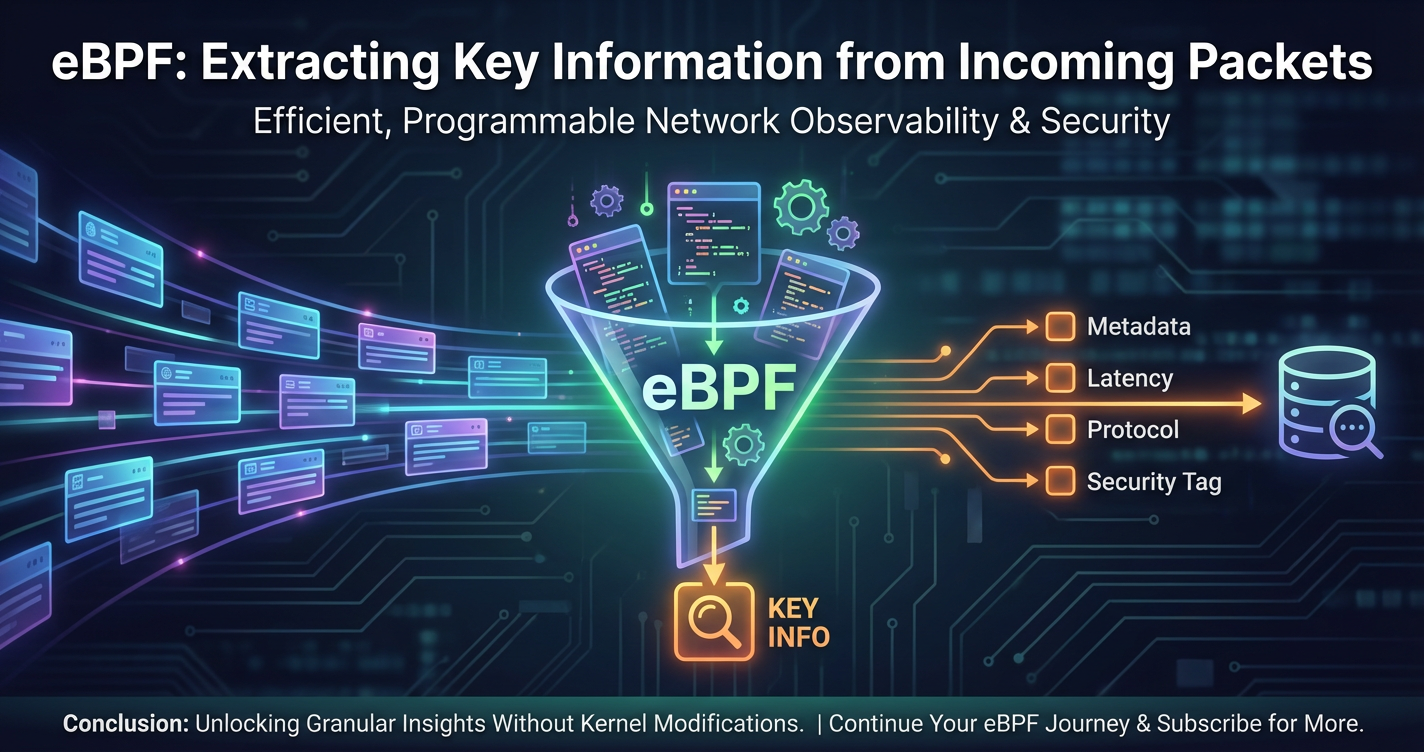
The ability to extract key information from incoming packets is perhaps one of eBPF's most compelling applications. This capability is vital for a multitude of purposes: robust network monitoring, advanced security analysis, meticulous performance debugging, and the implementation of custom networking policies. When a packet enters the kernel, an eBPF program attached at a specific hook point can gain access to the packet's raw data. The program can then parse this data, identifying and extracting various fields and values.
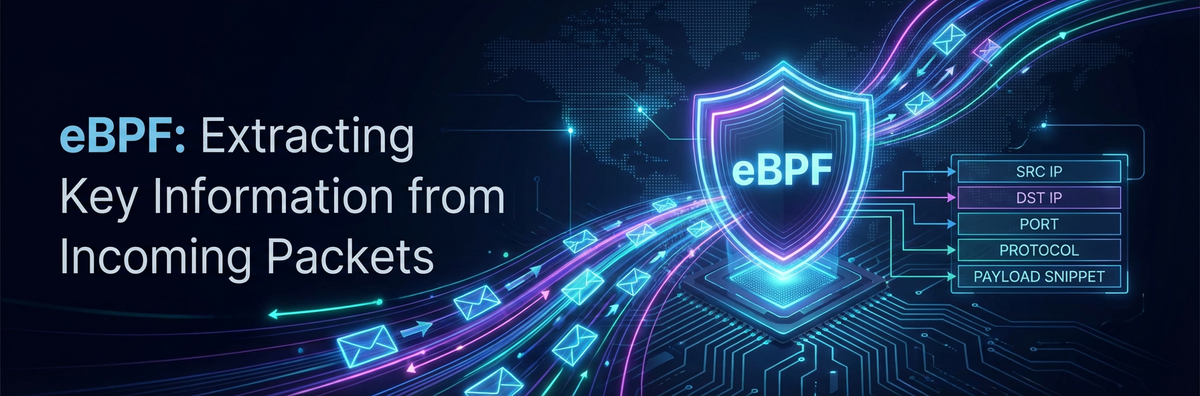
What exactly can be extracted? Virtually any part of a packet. This includes low-level details such as Ethernet MAC addresses, VLAN tags, IP addresses (source and destination), IP protocol numbers, and TCP/UDP port numbers. Beyond basic headers, eBPF programs can be crafted to delve deeper into the packet's payload, extracting snippets of application-layer data, such as HTTP method, URL paths, or even specific fields within application-defined protocols. The choice of what to extract depends entirely on the specific use case. For a security system, extracting source IP and port might be crucial for identifying malicious traffic. For a load balancer, destination IP and port are essential for routing decisions. For an observability platform, detailed HTTP header analysis could reveal application-specific latencies or errors. The power of eBPF lies in its programmability, allowing for highly tailored extraction logic directly within the kernel, providing a granular level of insight that traditional user-space tools often struggle to achieve with equivalent performance and minimal overhead.
Deep Dive into XDP: eXpress Data Path for Early Packet Processing
One of the most potent eBPF program types for high-performance packet processing and information extraction is XDP, or eXpress Data Path. XDP programs are designed to execute at the earliest possible point in the network driver's receive path, even before the kernel's full network stack has processed the packet. This "zero-copy" architecture means that an XDP program operates on the raw packet data as it arrives from the NIC, minimizing CPU cycles spent on copying data and traversing complex kernel structures. The close proximity to the hardware allows XDP to handle packets with extreme efficiency, making it ideal for high-throughput, low-latency scenarios.
When an XDP program is attached to a network interface, it receives a pointer to the raw packet data and its metadata. The program can then decide what to do with the packet by returning one of several actions: * XDP_PASS: Allows the packet to continue its normal journey up the kernel network stack. The XDP program merely observes and extracts information without altering the packet's path. * XDP_DROP: Discards the packet immediately at the driver level. This is incredibly effective for DDoS mitigation, where large volumes of unwanted traffic can be dropped before consuming significant kernel resources. * XDP_TX: Transmits the packet back out of the same network interface. This is useful for building network appliances that respond to certain packets or for creating simple loopback mechanisms. * XDP_REDIRECT: Redirects the packet to another network interface or to a user-space application via a specific eBPF map type (e.g., a cpumap or devmap). This enables highly efficient software-defined networking components, such as load balancers or custom forwarders.
For information extraction, an XDP program can parse the Ethernet header to get MAC addresses, then the IP header to obtain source/destination IP addresses and protocol type, and further into the TCP or UDP header for port numbers. Because XDP operates so early, it's perfect for quickly filtering based on these low-level details, dropping unwanted traffic, or fast-pathing critical packets. For example, a high-performance API gateway might utilize XDP to quickly drop requests from blacklisted IP addresses or to load balance incoming API requests across multiple backend servers based on simple hash values derived from source/destination IPs, all before the packets even reach the more resource-intensive user-space proxy logic. This early processing significantly reduces the load on the rest of the system, enhancing overall performance and security.
Deep Dive into Traffic Control (TC) with eBPF: Advanced Packet Processing
While XDP excels at early-stage, high-performance packet processing, there are scenarios where more nuanced, later-stage intervention is required. This is where the Traffic Control (TC) framework, enhanced by eBPF, becomes invaluable. The Linux TC subsystem is a powerful, long-standing mechanism for managing network traffic flow, traditionally used for Quality of Service (QoS), shaping, and policing. By integrating eBPF programs (cls_bpf for classification and act_bpf for actions) into the TC framework, developers gain the ability to execute highly sophisticated packet processing logic at various points within the kernel's network stack, typically after the initial driver processing but before or after routing decisions have been made.
The primary advantage of TC-eBPF over XDP is its position in the network stack. TC programs operate at a higher level of abstraction, providing access to more complete packet metadata and kernel context. This allows for more complex classification rules and actions. While XDP is about raw speed and early drops/redirects, TC-eBPF can perform more intricate parsing and decision-making. For instance, an XDP program might extract basic IP/port information, but a TC-eBPF program can parse deeper into the TCP payload to extract HTTP headers, identifying specific URLs or HTTP methods. This capability is crucial for implementing fine-grained application-layer policies.
Consider an API gateway that needs to enforce rate limits based on client API keys embedded in HTTP headers, or route requests to different backend services based on the URL path. While a full API gateway in user space would handle this, TC-eBPF could offload some of the initial, high-volume filtering or QoS decisions. For example, it could prioritize traffic for critical API endpoints or detect and rate-limit malformed HTTP requests early. The ability to attach eBPF programs to both ingress (incoming) and egress (outgoing) points within the TC framework provides symmetrical control over network traffic, enabling comprehensive monitoring and policy enforcement. The trade-off is slightly higher latency compared to XDP, as packets have traversed further up the stack, but the increased context and flexibility often justify this.
eBPF Maps for Data Aggregation and Communication: Bridging Kernel and User Space
The true power of eBPF for information extraction isn't just in observing and processing packets within the kernel; it's also in its ability to efficiently communicate that extracted data to user-space applications for analysis, aggregation, and display. This communication is primarily facilitated through eBPF maps. Maps are highly efficient, in-kernel key-value data structures that can be accessed by both eBPF programs and user-space programs, serving as the crucial bridge between these two environments.
There are various types of eBPF maps, each optimized for different data transfer patterns:
- Hash Maps: These are general-purpose key-value stores, ideal for maintaining state or aggregating counts. An eBPF program could increment a counter in a hash map for each unique source IP seen, allowing a user-space application to monitor traffic volume per client.
- Array Maps: Simple arrays indexed by integers, often used for static configurations or performance counters.
- Perf Buffer Maps: Designed for high-volume, asynchronous data transfer from kernel to user space. When an eBPF program extracts detailed information from a packet (e.g., full HTTP request details, or specific network events), it can write this data to a perf buffer. User-space applications can then asynchronously read from this buffer, minimizing kernel overhead and avoiding context switches. This is especially useful for capturing detailed logs or traces of
APIcalls processed by agateway. - Ring Buffer Maps: A newer, often more efficient alternative to perf buffers for unidirectional data transfer from kernel to user space, offering better memory efficiency and simpler API.
- LRU Hash/Array Maps: Least Recently Used (LRU) variants that automatically prune old entries, useful for maintaining a bounded cache of active connections or frequent events.
An eBPF program, after parsing a packet and extracting relevant fields (like source IP, destination port, TCP flags, or even parts of the payload), can write this information into an eBPF map. For instance, an XDP program might record the timestamp and source IP of every dropped packet into a perf buffer, allowing a user-space intrusion detection system to analyze potential DDoS attacks. Similarly, a TC-eBPF program could aggregate counts of HTTP methods per API endpoint in a hash map, giving an API gateway operator real-time insights into API usage patterns. The efficiency of eBPF maps ensures that this data transfer incurs minimal overhead, making real-time, high-fidelity network observability a practical reality.
APIPark is a high-performance AI gateway that allows you to securely access the most comprehensive LLM APIs globally on the APIPark platform, including OpenAI, Anthropic, Mistral, Llama2, Google Gemini, and more.Try APIPark now! 👇👇👇
Security Implications of Packet Extraction with eBPF
The ability of eBPF to deeply inspect and extract information from network packets, operating directly within the kernel, brings with it significant security implications, both as a tool for defense and as a potential avenue for misuse if not properly controlled. On the one hand, eBPF is a formidable asset in enhancing network security; on the other, careful consideration must be given to data privacy and the potential for sensitive information exposure.
As a defensive mechanism, eBPF can be leveraged to build highly effective intrusion detection and prevention systems (IDS/IPS). By attaching eBPF programs at critical network ingress points, systems can detect and respond to malicious traffic patterns with unparalleled speed. For instance, an eBPF program can monitor for suspicious connection attempts, unusual port scans, or even application-layer attacks by analyzing packet payloads for known exploit signatures. If an attack is detected, the eBPF program can immediately drop the offending packets (XDP_DROP or TC actions), block the source IP, or redirect the traffic to a honeypot, all without involving user-space processes. This kernel-level enforcement dramatically reduces the window of opportunity for attackers and the overhead on host resources. For an API gateway, eBPF can provide an additional layer of security, identifying and blocking malformed requests or denial-of-service attempts even before they reach the main API processing logic, thus safeguarding critical API infrastructure.
However, the power to inspect all incoming packets also raises critical privacy concerns. When eBPF programs extract data, they might inadvertently capture sensitive information such as user credentials, personally identifiable information (PII), or confidential business data if the traffic is unencrypted. Therefore, robust practices for data anonymization and redaction are essential. Systems employing eBPF for packet extraction must be designed with privacy by design principles, ensuring that only necessary information is collected and that sensitive fields are either masked, hashed, or never stored. Access to eBPF tools and the data they collect must be strictly controlled through granular permissions. The kernel's built-in verifier provides a strong security boundary, preventing eBPF programs from accessing arbitrary memory, but the logic within the program itself still determines what data is extracted and how it is handled. Misconfigured or malicious eBPF programs could potentially exfiltrate sensitive network traffic details, making careful auditing and strict deployment policies for eBPF crucial for maintaining system integrity and user trust.
Performance Benefits and Critical Considerations
One of the most compelling advantages of using eBPF for packet extraction and network processing is the significant performance boost it offers compared to traditional user-space solutions or even older kernel module approaches. This performance gain stems from several key architectural decisions and optimizations inherent to the eBPF design.
Firstly, eBPF programs execute directly within the kernel space. This eliminates the costly context switches that occur when data is copied between kernel and user space for processing. In traditional network monitoring, packets are often copied multiple times and passed up to user-space applications, incurring substantial CPU overhead and latency. With eBPF, processing happens where the packets arrive, minimizing these transitions. Secondly, the eBPF JIT compiler translates the bytecode into native machine code optimized for the host CPU architecture. This means eBPF programs run at near-native speeds, often comparable to compiled kernel code. For operations like packet filtering or simple routing, this can translate to millions of packets per second throughput, making it ideal for high-volume network environments. Furthermore, eBPF's access to hardware features like XDP, which operates at the NIC driver level, allows for "zero-copy" packet processing, where packets are never moved from their initial kernel buffer, dramatically reducing memory bandwidth consumption.
However, despite these impressive performance benefits, critical considerations must be taken into account when developing and deploying eBPF programs for packet extraction. The efficiency of an eBPF program is highly dependent on its design and complexity. Overly complex parsing logic or extensive data manipulation within an eBPF program can introduce overhead, negating some of the performance advantages. The kernel's verifier imposes limits on program size and complexity (e.g., maximum instructions, loop bounds), indirectly guiding developers towards efficient code, but careful optimization is still required. Minimizing memory accesses within the eBPF program, efficiently utilizing eBPF maps, and focusing on the critical path of packet processing are key to achieving optimal performance. Debugging eBPF programs can also be challenging due to their kernel-space execution and sandboxed nature, requiring specialized tools and methodologies. Therefore, while eBPF offers unprecedented performance, it demands a deep understanding of networking, kernel internals, and meticulous programming practices to truly harness its power without introducing new bottlenecks or instability.
eBPF in the Context of Modern Networking and Gateways
The capabilities of eBPF for deep packet inspection and kernel-level programmability are profoundly reshaping modern networking, extending far beyond simple monitoring into the realm of intelligent traffic management, security, and performance optimization for critical infrastructure. In this evolving landscape, the role of gateways – and specifically API gateways – is central to orchestrating microservices, managing external access, and ensuring the reliability and security of API ecosystems. eBPF serves as a powerful enabling technology that can fundamentally enhance these gateway functions, providing a layer of control and observability that was previously unattainable.
A modern API gateway acts as the single entry point for all client requests, handling routing, authentication, authorization, rate limiting, caching, and more. These are complex, high-performance systems that must process enormous volumes of network traffic. While much of an API gateway's logic resides in user space, dealing with application-layer protocols like HTTP, eBPF can provide crucial support at the underlying network layers. For instance, eBPF programs can be deployed to implement highly efficient, kernel-level rate limiting based on source IP addresses or specific TCP flows, protecting the API gateway itself from being overwhelmed before it even begins processing application-layer requests. Similarly, sophisticated load balancing algorithms can be offloaded to eBPF programs, directing incoming API packets to specific API gateway instances or backend services based on custom hashing functions, achieving significantly higher throughput and lower latency than traditional user-space load balancers.
Moreover, eBPF provides unparalleled observability for API gateway operations. By attaching eBPF programs to the network interfaces that handle API traffic, it's possible to collect microsecond-level latency metrics for every packet, identify network bottlenecks, and even detect specific network events that precede API errors. This granular data can be pushed to user-space monitoring tools via eBPF perf buffers, enriching telemetry with crucial low-level insights that complement application-level monitoring. This holistic view, blending kernel-level network data with application-level API metrics, is invaluable for diagnosing complex distributed system issues.
Consider platforms like APIPark, an open-source AI gateway and API management platform. While APIPark focuses on the higher-level management, integration, and deployment of API services, ensuring seamless AI model invocation, unified API formats, and comprehensive lifecycle management, the foundational networking layers that handle the incoming packets – the very packets eBPF excels at monitoring and manipulating – are crucial for its performance and reliability. Technologies like eBPF provide the kernel-level efficiency and observability that enable such high-performance API gateways to scale and secure their operations, ensuring efficient processing of every API request. By offloading specific, performance-critical network tasks to the kernel via eBPF, an API gateway can free up user-space resources to focus on complex API logic, leading to a more robust, scalable, and responsive platform. The continuous evolution of eBPF means that the synergies between kernel-level packet processing and high-level API management will only grow, creating more resilient and performant API infrastructures.
Practical Examples and Essential Tooling
While eBPF can seem daunting due to its kernel-level nature, a robust ecosystem of tools and libraries has emerged to simplify its development and deployment. These tools abstract away much of the low-level complexity, allowing developers to focus on the logic of their eBPF programs.
One of the most popular and comprehensive toolchains is BCC (BPF Compiler Collection). BCC provides a Python (and C++) front-end that simplifies writing eBPF programs by handling the interaction with kernel APIs, compilation, and loading. With BCC, one can write eBPF programs in a C-like syntax, embed them directly into Python scripts, and easily attach them to various kernel hook points. For instance, a BCC script could include a C function for an XDP program that parses an incoming Ethernet frame, extracts the source and destination IP addresses, and then records these in a hash map, all controlled from a user-space Python script. This greatly accelerates prototyping and deployment of eBPF-based solutions.
Another powerful tool is bpftrace. This high-level tracing language is specifically designed for dynamic tracing and analysis of Linux systems, heavily leveraging eBPF. With bpftrace, users can write concise, one-liner scripts to answer complex questions about system behavior, including network traffic. For example, to count HTTP GET requests hitting a specific port, a bpftrace script could probe kernel network functions, parse the TCP payload for "GET", and increment a counter. While bpftrace is excellent for rapid prototyping and interactive analysis, it's generally not used for persistent, high-performance packet processing or modification.
For more production-grade, standalone eBPF applications, libbpf is the go-to library. libbpf is a C/C++ library that provides a stable, low-level API for loading and managing eBPF programs and maps. It often works in conjunction with BPF CO-RE (Compile Once – Run Everywhere), which allows eBPF programs to be compiled once and run on different kernel versions, addressing a historical challenge of eBPF development. Projects that build sophisticated network monitoring tools, custom load balancers, or kernel-level firewalls often utilize libbpf to achieve maximum performance and reliability. These tools collectively empower developers to harness the full potential of eBPF for deep packet extraction and system introspection, making advanced kernel-level functionalities accessible to a broader audience.
Challenges and Future Directions of eBPF
Despite its immense power and transformative potential, eBPF is not without its challenges. The most significant hurdle for many developers is the steep learning curve. Understanding kernel internals, network stack intricacies, and the specific nuances of eBPF programming (including the verifier's constraints and the various map types) requires a significant investment of time and effort. Debugging eBPF programs can also be complex; errors within the kernel are notoriously difficult to diagnose, and while eBPF's sandbox prevents system crashes, understanding why a program isn't behaving as expected often requires specialized knowledge and tools. The rapid evolution of eBPF, with new features and program types continually being added to the kernel, also means that staying current with best practices and available functionalities is an ongoing task.
Furthermore, deploying and managing eBPF programs at scale in production environments introduces operational complexities. Ensuring that eBPF programs are compatible across different kernel versions, handling upgrades gracefully, and integrating eBPF-derived data into existing observability pipelines requires robust tooling and automation. While BPF CO-RE has significantly improved cross-kernel compatibility, vigilance is still required.
Looking to the future, eBPF is poised for even deeper integration and broader application. We can anticipate advancements in:
- Application-Layer Visibility: While eBPF already provides some application-layer insights, future developments might allow for more sophisticated parsing of common protocols (e.g., HTTP/2, gRPC) directly within the kernel, further reducing the need for user-space proxies for certain tasks.
- Hardware Offloading: As NICs become more intelligent, we may see increased capabilities for offloading eBPF programs directly to network hardware, pushing packet processing even closer to the wire for ultimate performance.
- Security Enhancements: eBPF's role in security will continue to expand, with more advanced use cases in threat detection, network segmentation, and runtime application self-protection (RASP) at the kernel level.
- Simplified Development: The tooling ecosystem will continue to mature, with higher-level languages and frameworks potentially emerging to lower the barrier to entry for eBPF development, making it accessible to a wider range of developers.
- Integration with Cloud-Native Architectures: eBPF is becoming a cornerstone of cloud-native networking and security, especially in Kubernetes environments. Its ability to dynamically program the network for service mesh, load balancing, and policy enforcement will only grow.
As eBPF continues to mature, its impact will reverberate across the entire software stack, fundamentally changing how we build, secure, and operate networked systems, from the lowest kernel layers to the highest-level API gateway functions.
Comparing XDP and TC for Packet Processing and Extraction
To summarize the distinct characteristics and ideal use cases for XDP and TC with eBPF, the following table provides a comparative overview. This helps in understanding when to choose one over the other for specific packet processing and information extraction tasks within the Linux kernel.
| Feature | XDP (eXpress Data Path) | TC (Traffic Control) with eBPF |
|---|---|---|
| Execution Point | Earliest possible point in NIC driver's receive path. | Various points in the kernel network stack (e.g., ingress/egress hooks on qdisc). |
| Performance | Extremely high throughput, lowest latency ("zero-copy"). | High throughput, but generally higher latency than XDP due to later execution. |
| Context/Metadata Access | Minimal kernel context; access to raw packet data only. | Richer kernel context, access to more packet metadata (e.g., socket buffer information). |
| Complexity of Logic | Best for simple, fast decisions (drop, redirect, pass, transmit). | Capable of more complex logic, intricate parsing, stateful operations. |
| Use Cases | DDoS mitigation, fast-path load balancing, custom forwarders, high-speed packet filtering. | Advanced QoS, custom routing, application-layer filtering/manipulation, detailed performance monitoring, sophisticated firewalling. |
| Packet Modification | Can modify raw packet data (e.g., MAC addresses) before stack. | Can modify packet metadata and data, often with more awareness of kernel structures. |
| Security | Excellent for early defense, dropping malicious traffic before it consumes resources. | Effective for fine-grained security policies based on deeper packet inspection. |
| Resource Usage | Very low CPU and memory footprint, operates on xdp_buff buffer. |
Low CPU/memory footprint, operates on sk_buff buffer. |
| Primary Goal | Maximize packet rate, minimize latency. | Granular control over traffic flow, implement complex policies. |
This table underscores that XDP and TC-eBPF are not mutually exclusive but rather complementary tools, each excelling in different stages and aspects of kernel-level packet processing. Choosing the right mechanism depends on the specific requirements for performance, complexity, and the desired point of intervention in the network stack.
Conclusion
eBPF stands as a monumental achievement in kernel programmability, fundamentally altering the landscape of how we interact with and extend the Linux kernel. Its unparalleled ability to extract key information from incoming packets, coupled with its robust security model and exceptional performance, has opened up a new era of dynamic introspection, sophisticated network control, and advanced security. From enabling high-throughput data plane components at the earliest stages of packet reception with XDP to empowering intricate policy enforcement deeper within the network stack using TC-eBPF, this technology offers a versatile toolkit for addressing the complex demands of modern networked systems.
The insights gained from eBPF-driven packet extraction are critical for optimizing system performance, fortifying network security, and gaining granular visibility into the behavior of distributed applications. Whether it's for identifying and mitigating DDoS attacks, implementing custom load balancing algorithms, performing deep application-layer telemetry, or bolstering the capabilities of high-performance API gateways, eBPF provides the foundational technology to achieve these goals with efficiency and safety. As the ecosystem continues to evolve with more user-friendly tools and expanded capabilities, eBPF's influence will only grow, cementing its position as an indispensable technology for anyone building, operating, or securing complex network infrastructures in the cloud-native era. Its power transforms the Linux kernel from a black box into a programmable, observable, and highly adaptable platform, capable of handling the most demanding challenges of digital communication.
FAQ
1. What is eBPF and how does it differ from traditional kernel modules? eBPF (extended Berkeley Packet Filter) is a powerful technology that allows developers to run sandboxed programs within the Linux kernel without requiring changes to the kernel source code or loading insecure kernel modules. Unlike traditional kernel modules, which require recompilation for different kernel versions and can potentially crash the entire system if faulty, eBPF programs are verified by an in-kernel verifier for safety and then Just-In-Time (JIT) compiled into native machine code for optimal performance. This provides a secure, efficient, and flexible way to extend kernel functionality, particularly for networking, tracing, and security.
2. How does eBPF extract information from network packets? eBPF programs are attached to specific "hook points" within the Linux kernel's network stack, such as the XDP (eXpress Data Path) layer at the NIC driver or the TC (Traffic Control) layer higher up. When a packet arrives at these hook points, the attached eBPF program can access its raw data. The program then parses the packet's headers (e.g., Ethernet, IP, TCP/UDP) and potentially parts of its payload to extract specific fields like source/destination IP addresses, port numbers, protocol types, or even application-layer data (e.g., HTTP methods). This extracted information can then be processed or communicated to user-space applications via eBPF maps.
3. What are the main performance benefits of using eBPF for network processing? eBPF offers significant performance benefits primarily due to its kernel-level execution and JIT compilation. By executing directly in the kernel, eBPF programs avoid costly context switches between kernel and user space, which are common in traditional network monitoring solutions. The JIT compiler translates eBPF bytecode into highly optimized native machine code, allowing programs to run at near-native CPU speeds. Furthermore, technologies like XDP enable "zero-copy" packet processing at the NIC driver, minimizing memory bandwidth usage and maximizing throughput for high-volume traffic.
4. Can eBPF be used to enhance the security of an API gateway? Absolutely. eBPF can significantly enhance the security of an API gateway by providing kernel-level protection and observability. For example, eBPF programs can be deployed at the network ingress to implement highly efficient DDoS mitigation by dropping malicious traffic based on IP patterns or connection rates at the earliest possible stage (XDP). They can also provide granular firewalling, enforce network segmentation, and detect suspicious behavior by analyzing packet metadata or payloads. This allows the API gateway itself to focus on its core application-layer logic, offloading critical low-level security tasks to the more performant and secure eBPF layer within the kernel.
5. What are eBPF maps and how do they facilitate communication? eBPF maps are efficient in-kernel key-value data structures that serve as the primary mechanism for communication between eBPF programs and user-space applications, as well as between different eBPF programs. After an eBPF program extracts information from a packet or performs an operation, it can store this data in a map. User-space applications can then read from these maps to aggregate, analyze, or display the collected data. Common map types include hash maps (for general key-value storage), array maps (for performance counters), and perf/ring buffer maps (for high-volume, asynchronous kernel-to-user-space data transfer, ideal for detailed logging and tracing). This efficient communication bridge is crucial for making eBPF-derived insights actionable in user-space tools and dashboards.
🚀You can securely and efficiently call the OpenAI API on APIPark in just two steps:
Step 1: Deploy the APIPark AI gateway in 5 minutes.
APIPark is developed based on Golang, offering strong product performance and low development and maintenance costs. You can deploy APIPark with a single command line.
curl -sSO https://download.apipark.com/install/quick-start.sh; bash quick-start.sh

In my experience, you can see the successful deployment interface within 5 to 10 minutes. Then, you can log in to APIPark using your account.

Step 2: Call the OpenAI API.