eBPF Insights: What Incoming Packet Data Reveals
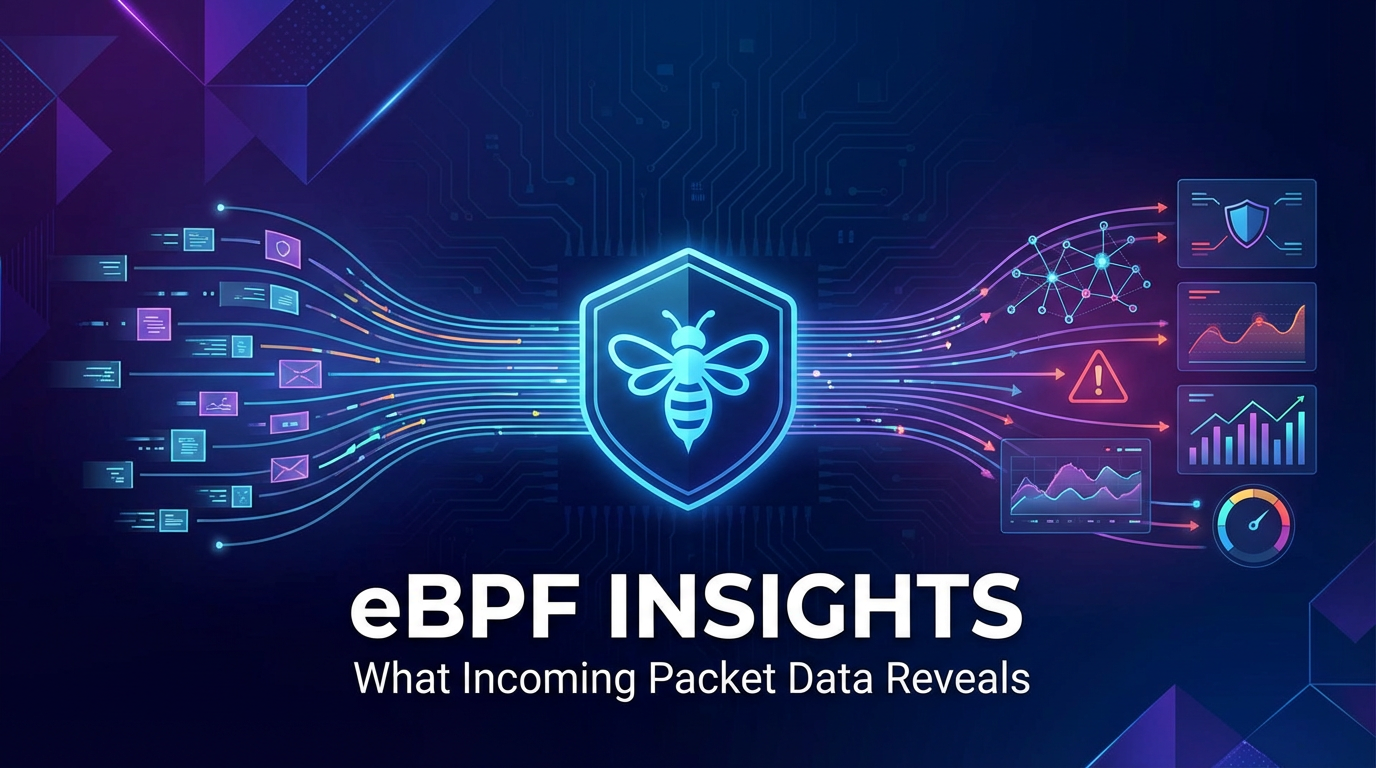


The Invisible Tapestry: Unveiling Network Secrets with eBPF
In the vast and intricate world of modern computing, information travels at the speed of light, often unseen and unheard beneath the surface of our operating systems. Every click, every keystroke, every data transfer across the internet, begins its journey as a humble network packet. These discrete bundles of data are the lifeblood of our digital existence, yet their intricate dance within the kernel often remains a mystery, hidden from traditional observability tools. For decades, developers and system administrators have grappled with the challenge of truly understanding what transpires at the network's most fundamental layer, often relying on high-level metrics or intrusive, performance-impacting techniques. This lack of deep, real-time visibility has historically posed significant hurdles for performance optimization, security analysis, and root-cause troubleshooting. The sheer volume and velocity of network traffic in today's hyper-connected environments only amplify this challenge, transforming what was once a complex problem into an almost insurmountable one for conventional approaches.
Enter eBPF (extended Berkeley Packet Filter), a revolutionary technology that has fundamentally transformed our ability to peer into the kernel's inner workings, particularly concerning network packet data. Far from a mere evolution of its predecessor, the classic BPF, eBPF reimagines kernel programmability, allowing user-defined programs to run safely and efficiently within the operating system kernel. This paradigm shift grants unprecedented access to granular system events, including, most critically for our discussion, the journey of every incoming network packet. No longer are we confined to observing the network from the outside in; eBPF empowers us to become an intrinsic part of the kernel's data plane, observing, filtering, and acting upon packets with surgical precision and minimal overhead. This capability moves beyond simple monitoring, ushering in an era of dynamic, intelligent network control and deep, context-rich observability.
The implications of eBPF's network superpowers are profound and far-reaching. By attaching small, event-driven programs to various kernel hooks, particularly those within the network stack, eBPF can capture, analyze, and even modify packet data as it arrives, long before it reaches user-space applications. This direct, in-kernel vantage point offers a goldmine of information about network performance, potential security threats, and underlying system behavior that was previously inaccessible or prohibitively expensive to obtain. Imagine pinpointing the exact moment a packet is dropped, understanding the precise latency introduced at different layers of the network stack, or identifying malicious traffic patterns before they can exploit vulnerabilities. eBPF makes these scenarios not just possible, but practical and performant.
This article embarks on an extensive exploration of "eBPF Insights: What Incoming Packet Data Reveals." We will delve deep into the mechanics of eBPF, understanding how it operates within the kernel and its specific strengths in network packet analysis. We will trace the lifecycle of an incoming packet, highlighting the various eBPF attachment points that offer unique perspectives into its journey. Our journey will reveal how eBPF empowers us to extract critical data from different layers of the network stack, offering unparalleled visibility into everything from MAC addresses and IP headers to TCP flags and application-level payloads. Furthermore, we will examine the transformative impact of these insights on network performance monitoring, security analysis, troubleshooting, and advanced architectural paradigms like service meshes and sophisticated API gateway solutions. By the end of this exploration, readers will gain a comprehensive understanding of how eBPF not only observes but fundamentally enhances our control over the very fabric of our digital communications, reshaping the landscape of modern systems engineering and cyber security.
eBPF Fundamentals: A New Epoch for Kernel Programmability
To truly appreciate the power eBPF brings to network packet analysis, it's essential to first grasp its foundational principles and understand why it represents such a significant leap forward in operating system technology. For decades, the Linux kernel, like other monolithic kernels, was a bastion of tightly controlled, highly privileged code. While this design ensured stability and security, it also presented a significant barrier to extensibility and dynamic observation. Instrumenting the kernel traditionally required modifying source code, recompiling, and rebooting, a process fraught with risk and impractical for production environments. Debugging or adding new features often meant delving into complex kernel modules, which, if poorly written, could lead to system instability, crashes, or security vulnerabilities, underscoring the delicate balance between functionality and integrity.
The Kernel's New Frontier: Breaking Traditional Barriers
The inherent challenge with traditional kernel instrumentation stemmed from the delicate balance between security and flexibility. Allowing arbitrary code to run in the kernel is a recipe for disaster, as a single bug could compromise the entire system. Conversely, restricting kernel access severely limits the ability to observe and modify system behavior dynamically, which is crucial for modern, complex applications and infrastructure. Previous attempts to bridge this gap, such as kernel modules, offered some extensibility but came with their own set of drawbacks: they required specific kernel versions, were difficult to distribute, and carried the ever-present risk of introducing instability, making them unsuitable for widespread, dynamic deployment, particularly in multi-tenant or rapidly evolving environments.
eBPF shatters this dichotomy by introducing a safe, performant, and programmable interface to the kernel. At its core, eBPF is a virtual machine embedded within the Linux kernel. It allows user-space programs, written in a restricted C-like language (often compiled from C or Rust via LLVM), to be loaded, verified, and executed directly within the kernel context. This execution occurs at specific, well-defined "attachment points," which act as hooks into various kernel events, ranging from system calls and function entries/exits to, most relevant for our discussion, network packet ingress and egress. The brilliance of eBPF lies in its meticulous design, which prioritizes safety and efficiency above all else.
How eBPF Works: The Architecture of Observability
The eBPF ecosystem operates through a sophisticated, multi-layered architecture designed to ensure both power and stability. Understanding these components is key to appreciating its capabilities:
- eBPF Programs: These are the small, event-driven bytecode programs written by developers. They are typically authored in a subset of C, which is then compiled into eBPF bytecode using a specialized compiler toolchain (e.g., LLVM). These programs are designed to perform specific tasks, such as filtering network packets, tracing system calls, or collecting performance metrics, and must adhere to strict security and resource constraints, ensuring they cannot endlessly loop or access arbitrary memory locations.
- eBPF Verifier: Before any eBPF program can be loaded into the kernel and executed, it must pass through a stringent kernel-level verifier. This component is a cornerstone of eBPF's security model. The verifier performs a static analysis of the eBPF bytecode to ensure several critical properties:
- Termination: The program must guarantee termination, meaning it cannot contain infinite loops.
- Memory Safety: It must not access out-of-bounds memory or dereference null pointers.
- Resource Limits: The program must not consume excessive CPU cycles or stack space.
- Privilege Escalation: It must not attempt any operations that could lead to privilege escalation. This rigorous verification process ensures that even untrusted user-space programs cannot crash the kernel or compromise system security, providing a level of safety unprecedented for in-kernel execution, which is a major departure from traditional kernel modules.
- eBPF JIT Compiler: Once verified, the eBPF bytecode is typically compiled by a Just-In-Time (JIT) compiler into native machine code. This step significantly boosts performance, allowing eBPF programs to execute at speeds comparable to natively compiled kernel code, rather than suffering the overhead of interpreted bytecode, making them suitable for high-throughput, low-latency scenarios like network packet processing.
- eBPF Maps: eBPF programs are stateless by design to simplify verification and ensure atomic execution. However, they often need to share state or communicate data back to user-space applications. This is achieved through eBPF maps, which are kernel-managed data structures (e.g., hash tables, arrays, ring buffers) that can be accessed by both eBPF programs and user-space applications. Maps enable powerful capabilities such as:
- Stateful Filtering: Storing connection states for more intelligent packet filtering.
- Metric Aggregation: Accumulating counts or latency measurements.
- Data Export: Sending collected data back to user-space for analysis, visualization, or further processing.
- Attachment Points: eBPF programs are event-driven, meaning they are triggered by specific events within the kernel. These "attachment points" are crucial for defining where and when an eBPF program will execute. For network-related tasks, key attachment points include:
- XDP (eXpress Data Path): Extremely early in the network driver, providing the fastest possible packet processing.
- Traffic Control (TC) ingress/egress hooks: Further up the networking stack, offering more context and richer APIs.
- Socket filters: Attached directly to sockets, allowing filtering of packets destined for a specific application.
- Kernel probes (kprobes), User probes (uprobes), Tracepoints: Generic hooks for tracing arbitrary kernel or user-space functions, which can also be used to observe network-related events within specific kernel functions.
Why eBPF for Network Data: Unparalleled Visibility and Safety
The combination of in-kernel execution, rigorous safety guarantees, high performance, and flexible attachment points makes eBPF an ideal technology for dissecting network packet data. Traditional network analysis tools like tcpdump and Wireshark operate primarily from user space. While incredibly useful, they suffer from inherent limitations: * Performance Overhead: Capturing large volumes of raw packets in user space involves significant context switching and data copying between kernel and user space, which can introduce considerable performance overhead and even cause packet drops in high-throughput environments. * Limited Context: User-space tools often lack the deep, real-time context available within the kernel. They see packets after the kernel has processed them to some extent, making it difficult to understand events like kernel-level drops, routing decisions, or specific interactions within the network stack. * Static Filtering: While tcpdump uses a BPF filter, it's a classic BPF filter, which is less powerful and less programmable than eBPF. It primarily filters on packet headers and cannot execute complex logic or maintain state within the kernel.
eBPF overcomes these limitations by bringing the analysis directly into the kernel's data path. It can filter, modify, and redirect packets at line rate, often before the full network stack even processes them, thanks to mechanisms like XDP. This allows for: * Minimal Overhead: Processing packets directly in the kernel avoids costly context switches and data copying, resulting in superior performance and the ability to handle extremely high network loads. * Deep Context: eBPF programs have access to kernel internal data structures, providing unparalleled insight into why a packet is behaving in a certain way, whether it's related to a specific socket, a routing table entry, or a firewall rule. * Programmable Logic: Unlike static filters, eBPF programs can implement complex, stateful logic to make intelligent decisions about packets based on dynamic conditions, enabling advanced use cases like custom load balancing, sophisticated intrusion detection, and adaptive rate limiting.
In essence, eBPF transforms the kernel from a black box into a programmable, observable, and adaptable network processing engine. It provides the magnifying glass and the surgical tools necessary to not only see but also interact with the invisible tapestry of incoming network packet data, revealing secrets that were once locked away within the operating system's deepest layers.
Diving Deep into Incoming Packet Data with eBPF
Having established eBPF's foundational principles, we now turn our attention to its specific application in dissecting incoming network packet data. To fully appreciate what eBPF reveals, it's crucial to understand the typical journey of a packet as it traverses the network interface card (NIC) and progresses through the various layers of the kernel's network stack. Each stage of this journey offers a unique vantage point, and eBPF provides the hooks to observe and influence packets at these critical junctures, offering unparalleled granularity and control.
The Packet's Journey: From Wire to Application
Imagine a network packet arriving at your server. Its journey is a meticulously orchestrated sequence of events:
- Physical Layer (NIC): The packet, as an electrical or optical signal, first hits the Network Interface Card (NIC). The NIC's primary role is to convert these signals into digital frames and perform initial hardware-level checks (e.g., checksums, framing errors).
- Data Link Layer (Layer 2): The NIC's driver picks up the incoming frame. At this stage, the packet is processed as an Ethernet frame (or equivalent), containing source and destination MAC addresses, and potentially VLAN tags. The kernel needs to decide which network interface (e.g.,
eth0) the packet belongs to. - Network Layer (Layer 3): Once the kernel identifies the interface, it examines the IP header. This layer is responsible for logical addressing (source and destination IP addresses), routing decisions, and fragmentation if necessary. The kernel determines if the packet is destined for the local machine or needs to be forwarded. If local, it checks routing tables and firewall rules.
- Transport Layer (Layer 4): For packets destined for the local machine, the kernel proceeds to the transport layer (TCP, UDP, ICMP). Here, source and destination port numbers are crucial. The kernel matches incoming packets to existing connections (for TCP) or listens to sockets (for UDP), performing checks like TCP sequence number validation, flag processing (SYN, ACK, FIN), and checksum verification.
- Application Layer (Layer 7): Finally, if all checks pass and a listening application is found, the packet's payload data is passed up to the user-space application, which then interprets it based on the application protocol (HTTP, DNS, SSH, etc.).
At each of these layers, valuable metadata and payload content are available, offering distinct insights into the network communication. Traditional tools often struggle to provide a coherent, low-overhead view across these layers, especially in real-time. This is where eBPF shines, offering surgical precision at critical points within this journey.
eBPF's Vantage Points: Where to Intercept and Observe
eBPF offers several powerful attachment points within the network stack, each providing a unique perspective and level of control over incoming packets:
1. XDP (eXpress Data Path): The Earliest Intervention
XDP is arguably the most performant eBPF hook for network packet processing. It allows eBPF programs to execute directly within the network driver, often before the packet is even allocated a full kernel sk_buff (socket buffer) structure. This "pre-stack" processing capability makes XDP incredibly efficient, enabling line-rate packet processing with minimal overhead.
- How it works: When a packet arrives at the NIC, the driver, if XDP-enabled, passes the raw packet data directly to an attached eBPF program. The eBPF program receives a pointer to the raw packet buffer and its length. It then returns one of several action codes:
XDP_PASS: Allow the packet to proceed normally through the kernel network stack.XDP_DROP: Immediately drop the packet at the earliest possible point, preventing it from consuming further kernel resources.XDP_REDIRECT: Redirect the packet to another network interface, another CPU, or a user-space application (viaAF_XDPsockets) for further processing.XDP_TX: Send the packet back out of the same network interface it arrived on, potentially after modification.
- What it reveals: At this stage, eBPF programs can access raw Layer 2 (MAC addresses, VLAN tags) and Layer 3 (IP addresses, protocols) headers. While direct access to Layer 4 (TCP/UDP) payload might be possible, it’s usually more efficient to focus on header inspection for early filtering.
- Use cases:
- DDoS Mitigation: XDP's ability to
XDP_DROPmalicious traffic at line rate, often before anysk_buffallocation, makes it an incredibly effective tool for protecting against high-volume volumetric attacks. - High-Performance Load Balancing:
XDP_REDIRECTcan be used to steer incoming connections to specific backend servers or CPU cores, enabling ultra-low-latency load balancing and even kernel-bypass networking. - Custom Firewalling: Implementing highly specific, performance-critical firewall rules based on IP addresses, ports, or even subtle header anomalies.
- Early Telemetry: Collecting basic packet counts, byte counts, and flow information with minimal impact on performance.
- DDoS Mitigation: XDP's ability to
2. TC (Traffic Control) Ingress Hooks: Deeper Context, Broader Control
While XDP provides raw speed, TC ingress hooks offer a more feature-rich environment further up the networking stack. These hooks are integrated with Linux's powerful Traffic Control subsystem, meaning eBPF programs here have access to a more complete sk_buff structure and more context about the packet's journey, including routing decisions and firewall states.
- How it works: An eBPF program is attached to the ingress queue discipline of a network interface (e.g.,
tc filter add dev eth0 ingress bpf ...). It receives thesk_buffas an input context, which contains a wealth of information about the packet, already parsed by the kernel. - What it reveals: TC ingress eBPF programs can easily inspect Layer 2, Layer 3, and Layer 4 headers. This includes:
- Layer 2: Source/Destination MAC, VLAN ID.
- Layer 3: Source/Destination IP, TTL, IP flags, protocol (TCP, UDP, ICMP).
- Layer 4: Source/Destination Ports, TCP flags (SYN, ACK, FIN, RST), TCP sequence/acknowledgment numbers, UDP length.
- Payload access: Accessing a portion of the payload is also possible, enabling inspection for application-level patterns, though this should be done judiciously due to potential performance implications.
- Use cases:
- Advanced Firewalling and Policy Enforcement: Implementing more complex, stateful firewall rules than XDP, often leveraging eBPF maps to maintain connection state or blacklists.
- Traffic Shaping and Rate Limiting: Dynamically adjusting bandwidth or limiting connection rates based on observed traffic patterns, user identity, or application priority.
- Intrusion Detection/Prevention (IDS/IPS): Analyzing packet headers and limited payloads for known attack signatures or anomalous behavior, such as port scanning, unusual protocol usage, or malformed packets.
- Network Observability: Collecting detailed metrics on packet flows, latency, retransmissions, and specific error conditions within the kernel network stack, providing richer data than XDP alone.
3. Socket Filters (SO_ATTACH_BPF): Application-Specific Packet Control
Socket filters allow eBPF programs to be attached directly to individual sockets. This means the eBPF program only sees packets that are specifically destined for that socket and have already passed through much of the kernel's network stack. This provides a highly granular, application-centric view of network traffic.
- How it works: A user-space application can load an eBPF program and attach it to its listening or connected socket using
setsockopt(SO_ATTACH_BPF). The eBPF program then filters packets before they are delivered to the application's receive buffer. - What it reveals: At this point, the packet has been fully parsed by the kernel's network stack. The eBPF program has access to the
sk_buffstructure, providing complete Layer 2, Layer 3, and Layer 4 header information, as well as the packet payload. This context is specific to the application using the socket. - Use cases:
- Application-Specific Filtering: Filtering out unwanted or malformed packets for a specific application without impacting other applications on the system.
- Custom Application-Layer Load Balancing: For applications that handle multiple sub-protocols or tenants, a socket filter can quickly route internal requests based on initial payload bytes.
- Intrusion Detection for Applications: Detecting application-layer attacks (e.g., specific HTTP request patterns for a web server) before the application code needs to process them, reducing attack surface and resource consumption.
- Network Policy Enforcement for Containers: In containerized environments, socket filters can be used to enforce network policies on a per-container or per-pod basis with high precision.
What Data Can Be Extracted: A Comprehensive View
Regardless of the attachment point, eBPF empowers developers to extract a wealth of information from incoming packets. The level of detail depends on the hook used and the kernel context available.
- Layer 2 (Data Link Layer):
- MAC Addresses: Source and destination hardware addresses. Crucial for identifying endpoints within a local network segment.
- VLAN Tags: Virtual LAN identifiers. Essential in segmented network environments to ensure packets reach the correct logical network.
- EtherType: Identifies the protocol encapsulated in the payload of the Ethernet frame (e.g., IP, ARP).
- Layer 3 (Network Layer):
- IP Addresses: Source and destination IP addresses (IPv4 or IPv6). Fundamental for identifying communicating hosts across the internet.
- Protocol: Identifies the next-level protocol (e.g., TCP, UDP, ICMP).
- Time-to-Live (TTL): Indicates the maximum number of hops a packet can take before being discarded. Low TTLs can sometimes indicate local network issues or specific attack patterns.
- IP Flags: Don't Fragment (DF), More Fragments (MF) — provide insights into fragmentation behavior.
- IP Header Length & Total Length: Useful for validating packet integrity and identifying potential anomalies.
- Layer 4 (Transport Layer):
- Port Numbers: Source and destination port numbers. Essential for identifying the specific application or service involved in the communication (e.g., port 80 for HTTP, 443 for HTTPS, 22 for SSH).
- TCP Flags: SYN, ACK, PSH, URG, FIN, RST. These flags provide critical insights into the state of a TCP connection (e.g., SYN for connection initiation, ACK for acknowledgment, FIN for termination, RST for abrupt reset). Analyzing these flags helps in understanding connection establishment, tear-down, and potential anomalies like half-open connections or unexpected resets.
- TCP Sequence and Acknowledgment Numbers: Used for reliable, ordered delivery of data. Monitoring these can reveal retransmissions, out-of-order packets, or potential TCP hijacking attempts.
- UDP Length: The length of the UDP payload.
- Checksums: Verification of data integrity at Layer 3 and Layer 4.
- Payload Inspection (Layer 7 and beyond):
- While eBPF programs can access parts of the packet payload, it requires careful consideration. Deep packet inspection (DPI) within the kernel can be resource-intensive and complex to verify. However, for specific, simple pattern matching (e.g., checking for a magic byte sequence, a specific HTTP method in the initial request line, or the start of a TLS handshake), it can be highly effective. This is particularly useful for identifying specific application protocols or anomalies without parsing the entire payload.
Practical Examples and Use Cases: Turning Data into Action
The granular insights provided by eBPF enable a wide array of practical applications:
- Network Performance Monitoring:
- Latency Measurement: By timestamping packets at various eBPF hooks (e.g., XDP ingress, TC ingress, socket receive), one can precisely measure the latency introduced by different parts of the kernel's network stack. This helps pinpoint bottlenecks, whether they are in the driver, the IP stack, or the TCP layer.
- Throughput Analysis: Counting bytes and packets at XDP or TC ingress provides accurate, real-time throughput metrics.
- Retransmission Detection: Monitoring TCP sequence and acknowledgment numbers can identify retransmitted packets, indicating network congestion or packet loss.
- Dropped Packet Analysis: eBPF can track why and where packets are being dropped within the kernel, providing crucial diagnostic information for network troubleshooting. This could be due to full queues, invalid checksums, or firewall rules.
- Security Analysis and Intrusion Detection:
- Port Scanning Detection: An XDP or TC eBPF program can quickly identify a flood of SYN packets to multiple ports on a server, indicating a port scan, and can then immediately
XDP_DROPsubsequent packets from the scanner's IP. - DDoS Attack Mitigation: As mentioned, XDP is phenomenal for dropping high volumes of spoofed or junk traffic at the earliest point, preserving kernel resources.
- Unusual Protocol Detection: Identifying unexpected protocols or non-standard port usage (e.g., SSH traffic on port 80).
- Malicious Payload Pattern Matching: For specific, simple attack patterns (e.g., known exploit signatures in the first few bytes of a request), eBPF can perform fast in-kernel checks.
- Unauthorized Access Attempts: Monitoring for failed connection attempts to sensitive ports (e.g., SSH, database ports) and blocking repeated attempts.
- Port Scanning Detection: An XDP or TC eBPF program can quickly identify a flood of SYN packets to multiple ports on a server, indicating a port scan, and can then immediately
- Troubleshooting Network Issues:
- Connectivity Problems: By tracing a packet's journey with eBPF, one can determine if a packet is even reaching the server, if it's being dropped by a firewall, or if it's getting stuck within the kernel.
- Application Misconfiguration: If an application isn't receiving traffic, eBPF at the socket level can confirm if packets are reaching the socket filter, thus narrowing down whether the issue is network-related or within the application itself.
- Identifying "Silent Drops": These are the most insidious network problems, where packets are dropped without explicit error messages. eBPF provides the visibility to uncover these hidden losses.
- Custom Firewall Rules:
- Beyond
iptables, eBPF allows for highly dynamic and context-aware firewalling. Rules can be based on real-time network load, application state, or even historical traffic patterns stored in eBPF maps. This enables incredibly flexible and performant security policies.
- Beyond
- Load Balancing and Traffic Steering:
- At the XDP layer, eBPF can act as an ultra-fast software load balancer, distributing incoming connections across multiple backend servers based on various algorithms (e.g., consistent hashing, round-robin). This can be used to direct traffic to different replicas of a service or to specialized processing units. The insights gained from incoming packet data, such as source IP or destination port, are critical for making intelligent load balancing decisions, effectively turning the kernel into a high-performance
gatewayfor network traffic.
- At the XDP layer, eBPF can act as an ultra-fast software load balancer, distributing incoming connections across multiple backend servers based on various algorithms (e.g., consistent hashing, round-robin). This can be used to direct traffic to different replicas of a service or to specialized processing units. The insights gained from incoming packet data, such as source IP or destination port, are critical for making intelligent load balancing decisions, effectively turning the kernel into a high-performance
By leveraging these eBPF vantage points and the wealth of data they reveal, engineers can gain an unprecedented level of insight and control over their network infrastructure, transforming how they approach observability, security, and performance optimization.
| eBPF Attach Point | Location in Network Stack | Primary Data Access | Key Use Cases | Performance Impact |
|---|---|---|---|---|
| XDP | Network Driver (pre-stack) | Raw L2/L3 Headers, Packet Buffer | DDoS Mitigation, Ultra-Fast Load Balancing, Custom NIC Offloads, Early Packet Filtering | Extremely Low |
| TC Ingress | Traffic Control (post-XDP) | L2/L3/L4 Headers, sk_buff Context |
Advanced Firewalling, Traffic Shaping, IDS/IPS, Detailed Network Telemetry, Service Chaining | Low to Moderate |
| Socket Filters | Socket Layer (pre-application) | Full sk_buff (L2-L4, Payload), Application Context |
Application-Specific Filtering, Custom App-Layer Load Balancing, Container Network Policy, App-Specific DPI | Moderate |
| kprobes/tracepoints | Generic Kernel Functions | Context-dependent (any kernel variable) | Debugging specific kernel functions (e.g., ip_rcv_finish, tcp_v4_rcv), Understanding kernel decision-making |
Moderate to High |
This table illustrates the diverse capabilities of eBPF across different layers of the network stack, emphasizing its versatility and depth of insight.
APIPark is a high-performance AI gateway that allows you to securely access the most comprehensive LLM APIs globally on the APIPark platform, including OpenAI, Anthropic, Mistral, Llama2, Google Gemini, and more.Try APIPark now! 👇👇👇
Architectural Implications and Advanced Use Cases
The profound insights eBPF provides into incoming packet data are not merely academic curiosities; they have transformative implications for system architecture, enabling new paradigms in observability, security, and performance optimization. By granting unprecedented, safe access to the kernel's inner workings, eBPF allows engineers to build more resilient, efficient, and secure systems from the ground up. The data revealed by eBPF isn't just about what's in a packet, but what that packet's journey signifies for the entire distributed system.
Revolutionizing Observability: The End of Guesswork
Traditional network observability often relies on sampling, aggregated metrics, or complex log analysis, leading to gaps in understanding and delays in problem identification. eBPF fundamentally changes this by enabling continuous, full-fidelity observability directly from the kernel.
- Deep Contextual Metrics: Instead of just knowing "network usage is high," eBPF can tell you which process, which socket, which specific connection, and which packets are contributing to that usage. It can report per-connection latency, retransmission rates, and even application-level request/response timing by correlating network events with process activities. This level of detail moves beyond simple monitoring to true understanding, allowing for precise identification of performance bottlenecks caused by network contention, faulty NICs, or inefficient kernel configurations.
- Real-time Event Tracing: eBPF can trace every network-related event in real-time – from a packet arriving at the NIC, to being processed by various kernel layers, to finally being delivered to an application. This end-to-end tracing capability is invaluable for debugging intermittent issues, identifying "silent drops," or understanding the exact path a critical request takes through the system, giving engineers the ability to perform a digital autopsy of network events with surgical precision.
- Reduced Overhead: Because eBPF programs run in-kernel and are highly optimized, they can collect vast amounts of telemetry data with significantly less overhead than traditional user-space agents, making deep observability feasible even in high-performance production environments where every CPU cycle counts. This minimizes the observer effect, ensuring that the act of monitoring doesn't itself distort the system's behavior.
Fortifying Security: Real-time Threat Detection and Prevention
The ability to inspect and act upon incoming packet data at the earliest possible stages of its journey offers unparalleled opportunities for enhancing system security. eBPF shifts security from reactive detection to proactive, in-kernel prevention.
- Granular Network Policy Enforcement: eBPF allows for the implementation of dynamic, context-aware network policies that go far beyond traditional firewall rules. Policies can be based on process identity, container labels, application behavior, or even time-of-day, adapting to the dynamic nature of modern cloud-native environments. For instance, an eBPF program can ensure that only specific microservices can communicate on certain ports, regardless of IP addresses.
- Advanced Intrusion Detection and Prevention Systems (IDS/IPS): By analyzing packet headers and limited payloads at line rate, eBPF programs can detect sophisticated attack patterns (e.g., specific scan techniques, protocol anomalies, unexpected payload structures) and immediately
XDP_DROPorXDP_REDIRECTmalicious traffic. This provides a crucial layer of defense against zero-day exploits and sophisticated threats that might bypass traditional perimeter defenses, acting as an intelligent bouncer at the kernel's front door. - Runtime Security Monitoring: eBPF can monitor process network activity, flagging unusual connections, unauthorized port bindings, or attempts to communicate with suspicious external IPs. This provides a powerful tool for detecting compromised applications or insider threats by observing deviations from expected network behavior.
- Supply Chain Security: By observing which network connections are initiated by specific binaries or containers, eBPF can help verify the integrity of the software supply chain at runtime, ensuring that only trusted components communicate as expected.
Optimizing Performance: Kernel-Bypass and Smart Offloading
eBPF's in-kernel capabilities open new avenues for extreme performance optimization, particularly in data-intensive workloads and high-throughput network environments.
- Kernel-Bypass Networking (AF_XDP): For applications demanding the absolute lowest latency and highest throughput, XDP combined with
AF_XDPsockets allows packets to bypass much of the kernel's network stack entirely, sending them directly from the NIC to a user-space application. This significantly reduces overhead, making it ideal for specialized applications like high-frequency trading, real-time analytics, and NFV (Network Function Virtualization). - Smart Network Offloading: eBPF can offload specific network tasks from the main CPU to programmable NICs (SmartNICs) or to the kernel's network processing units. This includes tasks like checksum calculation, encryption/decryption, or even parts of load balancing logic, freeing up CPU cycles for application workloads.
- Adaptive Congestion Control: By observing real-time network conditions (e.g., queue lengths, packet drops) with eBPF, the kernel can dynamically adjust congestion control algorithms or traffic shaping policies, optimizing network flow and preventing bottlenecks before they become critical.
Service Mesh Integration and the Role of Gateways
In modern microservices architectures, service meshes provide a dedicated infrastructure layer for managing service-to-service communication. Sidecar proxies (like Envoy) are traditionally used for this, handling traffic routing, load balancing, security, and observability. eBPF is emerging as a powerful complement and even an alternative to sidecars, particularly for enhancing performance and reducing resource consumption.
- Sidecar Augmentation: eBPF can augment existing sidecar proxies by offloading certain tasks to the kernel. For example, eBPF can handle low-latency packet filtering, TCP connection setup/teardown, or even some telemetry collection directly in the kernel, reducing the CPU and memory footprint of the sidecar. This means the sidecar can focus on higher-level logic, while eBPF ensures the underlying network operations are as efficient as possible.
- Sidecar Replacement (eBPF-powered Service Mesh): In some advanced deployments, eBPF programs can perform many of the functions traditionally handled by sidecars, such as transparent traffic redirection, load balancing, and policy enforcement, without the need for a separate user-space proxy. This significantly reduces the data path latency and resource consumption, offering a "proxyless" service mesh experience for performance-critical applications. By observing incoming packets and understanding their destination (e.g., which service or pod), eBPF can directly route them, enforce
APIcontracts, and collect metrics with minimal overhead.
While eBPF operates at the kernel level, providing unparalleled insights into raw packet data, these low-level observations are often crucial for understanding and optimizing higher-level application behaviors. For instance, the performance and security of application programming interfaces (APIs) are directly impacted by the underlying network conditions that eBPF can monitor. In complex microservices environments, where APIs are the backbone of communication, ensuring their reliability, security, and efficient routing becomes paramount. This is where dedicated solutions like an API gateway come into play. A sophisticated API gateway not only manages the lifecycle of APIs but also acts as a crucial control point for traffic, authentication, and security.
Products like APIPark, an open-source AI gateway and API management platform, exemplify this need. APIPark provides robust features for quick integration of AI models, unified API invocation, end-to-end API lifecycle management, and detailed call logging, all of which rely on a healthy and observable network foundation. For example, APIPark's capability to offer quick integration of 100+ AI models and manage their authentication and cost tracking relies on the assumption that the underlying network can reliably and securely deliver these API requests. Similarly, its feature for prompt encapsulation into REST APIs, creating new services like sentiment analysis, depends on efficient network communication. The insights gained from eBPF, though distinct, can provide invaluable context for troubleshooting performance bottlenecks or identifying security anomalies that might impact the services managed by an API gateway like APIPark, ensuring the robust and secure operation of critical business APIs. Its powerful data analysis and detailed API call logging directly benefit from a well-understood and optimized network layer, allowing enterprises to proactively address issues before they impact API performance or security. Ultimately, the meticulous network insights offered by eBPF contribute to the seamless and secure operation of high-level API management platforms such as APIPark, forming a synergistic relationship between low-level network control and high-level service delivery.
Challenges and Future Directions
While eBPF offers revolutionary capabilities for network packet analysis and system observability, its adoption and implementation are not without challenges. Understanding these hurdles and the ongoing efforts to address them is crucial for anyone considering leveraging this powerful technology. Furthermore, recognizing the trajectory of eBPF's development allows us to glimpse the exciting future of kernel programmability and its profound impact on computing.
Navigating the Complexity of eBPF
The primary challenge associated with eBPF is its inherent complexity. Developing eBPF programs requires a deep understanding of:
- Kernel Internals: To write effective eBPF programs, one must possess a solid grasp of Linux kernel networking stack, system calls, and data structures. Unlike user-space programming, there’s no abstraction layer; you’re interacting directly with the kernel’s mechanics.
- eBPF Programming Model: The eBPF instruction set, the constraints imposed by the verifier, and the specific
contextavailable at each attachment point demand a new way of thinking about program design. Writing programs that are both efficient and safe within these constraints can be daunting. - Debugging: Debugging eBPF programs can be notoriously difficult. Traditional debugging tools often don't apply, and error messages from the kernel verifier can be cryptic. While the tooling ecosystem is improving, it's still a steep learning curve compared to user-space development. This necessitates a careful, iterative approach to development, relying heavily on logging to eBPF maps and analyzing kernel logs.
- Kernel Version Compatibility: While eBPF is part of the mainline Linux kernel, new features and APIs are continually being added. Ensuring eBPF programs are compatible across a range of kernel versions can sometimes be a challenge, though the community strives for backward compatibility where possible.
Addressing this complexity is an ongoing effort within the eBPF community, focusing on improved development tools, higher-level language support (e.g., Rust for eBPF), and more user-friendly frameworks that abstract away some of the low-level kernel details.
Security Concerns and the Role of the Verifier
Despite eBPF's stringent verifier, security remains a paramount concern. Running user-defined code in the kernel, no matter how verified, always carries inherent risks.
- Verifiers' Limitations: While incredibly robust, even the verifier is a piece of software and could theoretically have bugs or edge cases that allow malicious code to slip through. Ongoing research and continuous auditing are essential to maintain its integrity.
- Privileged Execution: Loading eBPF programs typically requires
CAP_BPForCAP_SYS_ADMINcapabilities, which are highly privileged. Misconfigurations or vulnerabilities in systems managing eBPF program deployment could lead to unauthorized code execution in the kernel context. - Side-Channel Attacks: Researchers are continually exploring potential side-channel vulnerabilities where eBPF programs, despite their sandboxing, could leak sensitive information or be exploited indirectly.
- Denial-of-Service: A poorly written, though verified, eBPF program could consume excessive resources if not carefully optimized, potentially leading to performance degradation or denial of service, even if it doesn't crash the kernel.
The community mitigates these risks through continuous improvement of the verifier, strict security guidelines for eBPF application development, and robust access control mechanisms for loading eBPF programs. Regular security audits and fostering a culture of secure coding practices are also vital.
The Evolving Tooling Ecosystem
The eBPF ecosystem, while rapidly maturing, is still evolving. This presents both a challenge and an opportunity.
- Fragmentation: There are numerous tools, libraries, and frameworks built on top of eBPF (e.g., Cilium, Falco, bpftrace, BCC). While this indicates a vibrant community, it can also lead to fragmentation and a steeper learning curve for newcomers to navigate the best tool for their specific needs.
- Integration with Existing Systems: Integrating eBPF insights into existing monitoring, logging, and security information and event management (SIEM) systems requires developing connectors and adapters. Standardized output formats and APIs are still emerging to streamline this process.
- Higher-Level Abstractions: The need for higher-level abstractions to simplify eBPF development is critical for broader adoption. Projects like
libbpfandeunomia-bpfare making strides in providing more user-friendly interfaces, but there’s still work to be done to make eBPF accessible to a wider audience of developers who may not be kernel experts.
Future Directions: A Glimpse into Tomorrow
The trajectory of eBPF development points towards an even more pervasive and powerful role in future computing architectures.
- Enhanced Hardware Acceleration: As SmartNICs become more prevalent, eBPF programs will increasingly be offloaded to these specialized hardware devices, further boosting performance and freeing up host CPU resources. This enables true network processing at the edge, closer to the data source.
- Cross-Platform Adoption: While primarily a Linux technology today, there is growing interest and early efforts to bring eBPF-like capabilities to other operating systems, potentially leading to a more standardized approach to kernel programmability across different platforms.
- Deeper Integration with Cloud-Native Stacks: eBPF will continue to deepen its integration with Kubernetes and other cloud-native orchestration platforms, becoming an even more fundamental building block for networking, security, and observability in containerized environments. This means more seamless policy enforcement, intelligent load balancing, and granular telemetry collection for microservices.
- AI/ML at the Kernel Edge: The ability to process data at line rate in the kernel could enable new applications for AI and Machine Learning. Imagine eBPF programs performing real-time anomaly detection using lightweight ML models directly on network packets or system calls, allowing for instantaneous responses to emerging threats or performance degradations. This pushes the intelligence closer to the data source, reducing latency and reliance on centralized processing.
- Standardization and Ecosystem Maturity: As the eBPF ecosystem matures, we can expect more standardized APIs, robust frameworks, and improved debugging tools, making eBPF development more accessible and predictable for a broader range of engineers and organizations. The establishment of eBPF foundations and working groups indicates a clear path toward industry-wide adoption and collaboration.
In summary, while challenges remain in complexity, security, and tooling, the future of eBPF is incredibly bright. It is poised to become an even more indispensable technology, driving innovation in network security, performance, and observability, fundamentally reshaping how we interact with and control the deepest layers of our operating systems. The insights eBPF provides into incoming packet data are just the beginning of its journey to redefine kernel capabilities.
Conclusion: The Unseen Becomes Clear
Our extensive journey through the world of eBPF and its unparalleled capabilities in dissecting incoming network packet data reveals a technology that is fundamentally transforming the landscape of modern computing. For too long, the kernel's network stack remained a semi-opaque realm, its intricate dance of packets and protocols largely hidden from detailed, real-time observation. Traditional tools offered glimpses, but often at the cost of performance or a lack of granular context. eBPF, however, has rewritten this narrative, providing a safe, efficient, and deeply programmable interface directly into the heart of the operating system.
We began by understanding the revolutionary nature of eBPF, moving beyond the limitations of traditional kernel instrumentation to embrace a paradigm of in-kernel, event-driven programmability. The eBPF verifier, JIT compiler, and the concept of maps collectively create an environment where user-defined code can run at native speeds with kernel-level privileges, yet without compromising stability or security. This architectural brilliance is what underpins its power in network analysis.
Our deep dive into the incoming packet's journey highlighted the critical vantage points eBPF offers. From the raw, high-speed processing at the XDP layer, ideal for DDoS mitigation and ultra-fast load balancing, to the more contextual and feature-rich environment of TC ingress hooks, perfect for advanced firewalling and detailed telemetry, and finally to the application-specific granularity of socket filters, eBPF provides a comprehensive toolkit. We explored the vast array of data that can be extracted from each layer of the network stack – from MAC and IP addresses to TCP flags and even judicious payload inspection – transforming abstract concepts into actionable intelligence. This level of detail empowers engineers to pinpoint bottlenecks, identify threats, and troubleshoot elusive network issues with unprecedented accuracy.
The architectural implications of eBPF are nothing short of transformative. It has ushered in an era of full-fidelity network observability, providing deep contextual metrics and real-time event tracing with minimal overhead, replacing guesswork with hard data. In the realm of security, eBPF fortifies defenses by enabling granular, dynamic network policy enforcement and sophisticated, in-kernel intrusion detection and prevention, often acting as the kernel's first line of defense. For performance, it pushes the boundaries with kernel-bypass networking and smart offloading, unlocking new levels of efficiency for data-intensive applications. Furthermore, its integration into service meshes, both as an augmentation and a potential replacement for traditional sidecar proxies, underscores its pivotal role in the evolution of cloud-native architectures. The ability to monitor, secure, and optimize network traffic at such a fundamental level provides a robust foundation for higher-level services, including those managed by an API gateway like APIPark, ensuring their performance, security, and reliability.
While challenges related to complexity, debugging, and tooling ecosystem maturity persist, the eBPF community is actively addressing these. The future promises even greater integration with hardware acceleration, deeper penetration into cloud-native stacks, and potentially even real-time AI/ML capabilities at the kernel edge. eBPF is not merely a tool; it is a fundamental shift in how we build, observe, and secure our digital infrastructure.
The insights gained from observing incoming packet data through the lens of eBPF reveal the intricate ballet of network communication in unprecedented detail. This power to see the unseen, to understand the formerly opaque, is empowering engineers and organizations to build more resilient, performant, and secure systems than ever before. As the digital world continues to grow in complexity and demands for speed and security intensify, eBPF stands ready as a cornerstone technology, continuously evolving to meet the challenges of tomorrow, making the unseen clear and the unknown knowable.
5 FAQs about eBPF and Network Packet Analysis
1. What is eBPF and how does it differ from traditional kernel modules or tcpdump? eBPF (extended Berkeley Packet Filter) is a revolutionary in-kernel virtual machine that allows user-defined programs to run safely and efficiently within the Linux kernel. It differs from traditional kernel modules because eBPF programs are verified for safety and resource limits by the kernel's verifier before execution, preventing system crashes and ensuring security, unlike potentially unstable kernel modules. Compared to tcpdump, which is a user-space tool based on classic BPF filters, eBPF operates directly in the kernel's data path with significantly lower overhead, allowing for more complex, stateful logic, and access to deeper kernel context, enabling line-rate packet processing and dynamic action.
2. Where can eBPF programs attach in the network stack, and what are the benefits of each attachment point? eBPF programs can attach at various points: * XDP (eXpress Data Path): Attaches in the network driver, providing the earliest possible packet processing. Benefits include ultra-low latency, line-rate performance for DDoS mitigation, and high-speed load balancing due to its ability to drop, redirect, or modify packets before full kernel stack processing. * TC (Traffic Control) Ingress/Egress: Attaches higher up the network stack (after XDP), offering more context via the sk_buff structure. Benefits include more advanced firewalling, traffic shaping, detailed network telemetry, and sophisticated intrusion detection. * Socket Filters (SO_ATTACH_BPF): Attaches directly to individual sockets. Benefits include application-specific packet filtering, custom application-layer load balancing, and fine-grained network policy enforcement for specific processes or containers, seeing only traffic relevant to that application.
3. What kind of incoming packet data can eBPF reveal, and why is this useful for security? eBPF can reveal extensive data from Layer 2 (MAC addresses, VLAN tags), Layer 3 (source/destination IP, TTL, IP flags, protocol), Layer 4 (source/destination ports, TCP flags, sequence/acknowledgment numbers, UDP length), and even limited payload content. This granular visibility is incredibly useful for security because it enables: * Early Threat Detection: Identifying suspicious patterns like port scans, DDoS attacks, or unusual protocol usage at the earliest possible stage. * Granular Policy Enforcement: Implementing dynamic, context-aware firewall rules based on process identity or application behavior. * Runtime Security Monitoring: Detecting unauthorized network connections or deviations from expected application behavior indicative of a compromise. * Intrusion Prevention: Directly dropping or redirecting malicious traffic in the kernel before it can impact applications.
4. How does eBPF contribute to network performance optimization? eBPF significantly enhances network performance through several mechanisms: * Reduced Overhead: By processing packets in-kernel, eBPF avoids costly context switches and data copying to user space, leading to higher throughput and lower latency. * Kernel-Bypass Networking (AF_XDP): For extreme performance, XDP with AF_XDP allows specific applications to directly receive packets from the NIC, bypassing most of the kernel network stack. * Smart Offloading: eBPF can offload network tasks to programmable NICs (SmartNICs), freeing up main CPU resources. * Optimized Routing and Load Balancing: eBPF programs can implement highly efficient, custom load balancing algorithms and intelligent traffic steering directly in the data path, responding to real-time network conditions.
5. Can eBPF replace an API gateway or service mesh sidecar? eBPF is not a direct replacement for an API gateway or a complete service mesh sidecar, but it can significantly augment or even partially replace some of their functionalities, especially at the network layer. An API gateway like APIPark focuses on higher-level API management, such as authentication, rate limiting, routing to backend services, and API lifecycle management. A service mesh sidecar handles service-to-service communication with features like traffic management, policy enforcement, and observability at the application level. eBPF can: * Augment: Offload low-latency packet filtering, connection setup/teardown, and telemetry collection from sidecars to the kernel, reducing their overhead. * Partially Replace: For specific, performance-critical tasks, eBPF can implement transparent traffic redirection, load balancing, and network policy enforcement in a "proxyless" manner, providing a very efficient data plane. However, eBPF typically lacks the higher-level application logic, rich configuration, and developer portal features inherent in a full API gateway or the comprehensive traffic management and resilience patterns of a full-fledged service mesh. It operates at a lower level, providing the foundation for these higher-level solutions to run more efficiently and securely.
🚀You can securely and efficiently call the OpenAI API on APIPark in just two steps:
Step 1: Deploy the APIPark AI gateway in 5 minutes.
APIPark is developed based on Golang, offering strong product performance and low development and maintenance costs. You can deploy APIPark with a single command line.
curl -sSO https://download.apipark.com/install/quick-start.sh; bash quick-start.sh

In my experience, you can see the successful deployment interface within 5 to 10 minutes. Then, you can log in to APIPark using your account.

Step 2: Call the OpenAI API.