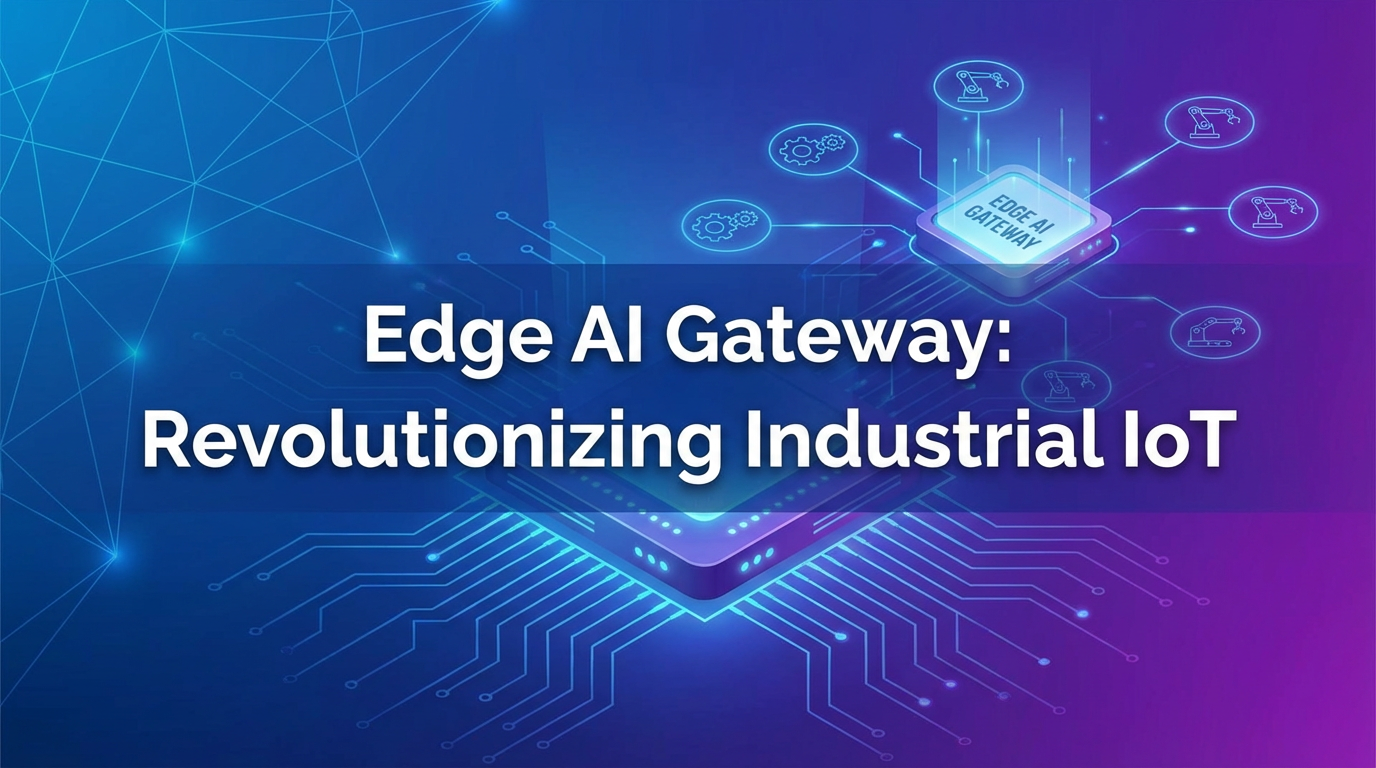
Edge AI Gateway: Revolutionizing Industrial IoT


The sprawling landscapes of modern industry are undergoing a profound transformation, driven by an inexorable convergence of physical and digital realms. This paradigm shift, often encapsulated by the term Industrial IoT (IIoT), sees an unprecedented proliferation of intelligent sensors, sophisticated machinery, and interconnected systems working in concert to generate a colossal torrent of operational data. From the manufacturing floor to vast energy grids, and from intricate logistics networks to complex smart city infrastructures, the promise of IIoT is immense: unparalleled operational efficiency, predictive maintenance capabilities, enhanced worker safety, and the unlocking of entirely new business models. Yet, harnessing the true power of this data, especially for critical real-time decision-making, has traditionally faced formidable challenges when relying solely on centralized cloud computing models. The inherent limitations of latency, bandwidth constraints, persistent security concerns, and the sheer volume of data make a purely cloud-centric approach often impractical, costly, or even dangerous in time-sensitive industrial environments.
It is precisely within this crucible of challenge and opportunity that the Edge AI Gateway emerges as a revolutionary force. Moving beyond the rudimentary data aggregation functions of traditional industrial gateways, these advanced devices integrate powerful artificial intelligence and machine learning capabilities directly into the operational technology (OT) environment, at the very edge of the network. This strategic shift allows for instantaneous data processing, real-time analytics, and autonomous decision-making where and when it matters most – right next to the machines, processes, and people generating the data. An AI Gateway at the edge doesn't merely shuttle data; it intelligently filters, analyzes, and acts upon it, transforming raw sensor readings into actionable insights within milliseconds. This article will delve deep into the profound impact of Edge AI Gateways, exploring their architecture, capabilities, critical role in industrial applications, and how they are fundamentally reshaping the future of Industrial IoT, further empowered by concepts like the LLM Gateway and sophisticated Model Context Protocol to create truly intelligent and adaptive industrial ecosystems.
Chapter 1: Understanding the Industrial IoT Landscape and its Challenges
The Industrial Internet of Things (IIoT) represents a monumental leap in the evolution of industrial operations, extending the principles of the consumer IoT to factories, energy plants, logistics hubs, and other critical infrastructure. It is characterized by the interconnectedness of industrial assets, equipped with advanced sensors, actuators, and computing power, all communicating within a vast network. This intricate web generates an unprecedented volume of data, offering a digital mirror to the physical world of operations.
1.1 The Rise of Industrial IoT (IIoT): A New Era of Connectivity
At its core, IIoT is about instrumenting, interconnecting, and integrating physical assets with digital intelligence. The scope of IIoT is expansive, touching every major industrial sector. In manufacturing, it translates to smart factories where machines self-monitor, diagnose issues, and even optimize production schedules autonomously. In the energy sector, IIoT powers smart grids, enabling real-time demand response, predictive maintenance of transmission lines, and optimized resource allocation. Logistics and supply chains benefit from real-time asset tracking, predictive vehicle maintenance, and optimized route planning, leading to significant efficiencies. Even within the realm of smart cities, IIoT sensors manage traffic flow, monitor environmental conditions, and optimize public utility services.
The benefits derived from this deep level of instrumentation and connectivity are multifold. Predictive maintenance, for instance, allows for the anticipation of equipment failure by analyzing vibration, temperature, and current data patterns, preventing costly unplanned downtime and extending the lifespan of valuable assets. Operational efficiency is dramatically improved through real-time monitoring and optimization of processes, leading to reduced energy consumption and higher throughput. Quality control can be enhanced by continuous, automated inspection processes that detect anomalies far beyond human capability. Furthermore, worker safety is bolstered by monitoring hazardous environments, tracking personnel, and ensuring compliance with safety protocols. The sheer scale and granularity of data generated by IIoT systems offer insights previously unattainable, driving continuous improvement and innovation across industrial value chains.
1.2 Inherent Challenges in IIoT Data Management: The Weight of Connectivity
Despite the transformative potential of IIoT, its implementation is fraught with significant challenges, particularly concerning the management and processing of the immense data streams it produces. These challenges often become bottlenecks, hindering the full realization of IIoT's promise if not addressed strategically.
Volume, Velocity, Variety: The Three Vs at Industrial Scale
The "3 Vs" of big data — Volume, Velocity, and Variety — take on a magnified significance in an industrial context. The sheer volume of data generated by thousands of sensors, cameras, and machines across a large industrial facility can quickly reach petabytes daily. Transmitting all this raw data to a centralized cloud for processing becomes economically and technically unfeasible. The velocity at which this data is generated and the speed at which decisions must be made in industrial operations is often critical; milliseconds can make the difference between preventing a catastrophic failure and incurring massive losses. Delay-sensitive processes, such as robotic control or safety systems, simply cannot afford the round-trip latency to a distant cloud server. Finally, the variety of data sources and formats, ranging from structured sensor readings to unstructured video feeds, audio snippets, and complex machine logs, necessitates robust and flexible data ingestion and normalization strategies.
Latency-Sensitive Operations: The Imperative of Real-time Action
Many industrial processes are inherently time-critical. For instance, a robotic arm on a production line needs to respond to changes in its environment within fractions of a second. A sudden spike in temperature or pressure in a chemical reactor demands immediate automated intervention. In autonomous guided vehicles (AGVs) navigating a warehouse, even minor delays in processing sensor input could lead to collisions. Relying on cloud infrastructure for these real-time control loops introduces unacceptable latency, which can compromise safety, disrupt production, and lead to significant financial losses. The imperative for immediate action is a fundamental driver for pushing intelligence closer to the data source.
Bandwidth Constraints: The High Cost of Data Transmission
Industrial environments are often remote, distributed, or characterized by limited and expensive network connectivity. Oil rigs, remote mining operations, agricultural fields, and even sprawling factory complexes might struggle with reliable high-bandwidth connections. Continuously streaming gigabytes or terabytes of raw sensor data or high-resolution video feeds to the cloud can quickly exhaust available bandwidth, leading to network congestion, data loss, and exorbitant communication costs. This financial burden, coupled with the technical limitations, makes selective and intelligent data transmission a necessity rather than a luxury.
Security and Privacy Concerns: Protecting Critical Infrastructure
Industrial control systems (ICS) and operational technology (OT) are prime targets for cyberattacks, given their critical role in national infrastructure and economic stability. Transmitting sensitive operational data, proprietary manufacturing processes, or intellectual property to the cloud introduces additional attack vectors and increases the surface area for potential breaches. Ensuring the confidentiality, integrity, and availability of data and operations is paramount. Moreover, data privacy regulations and industry-specific compliance requirements often mandate that certain data remain within specific geographic boundaries or even on-premises, further complicating cloud-centric approaches. The need for robust, localized security measures is a non-negotiable aspect of IIoT deployments.
Interoperability Issues: A Patchwork of Legacy Systems
The industrial world is a tapestry woven from decades of technological evolution, resulting in a vast array of legacy machines, proprietary protocols (e.g., Modbus, OPC, Profinet), and disparate control systems. Integrating these heterogeneous components into a cohesive IIoT architecture is a complex undertaking. Traditional IIoT gateways provide some level of protocol translation, but a deeper level of semantic interoperability and unified data management is required to truly unlock the value of combined data streams, especially when introducing advanced AI functionalities.
Cost of Cloud Processing: Balancing Computation with Expenditure
While cloud computing offers unparalleled scalability and flexibility, continuously ingesting, storing, and processing the enormous volumes of IIoT data can become prohibitively expensive. Every byte transferred, every compute cycle consumed, and every hour of storage accumulates costs. For many industrial applications, especially those generating high-frequency data from thousands of endpoints, the operational expenditure (OpEx) associated with a pure cloud approach can negate the efficiency gains sought from IIoT. Optimizing where and when data is processed, and transmitting only the most relevant insights, becomes critical for economic viability.
These profound challenges collectively underscore the limitations of a purely centralized approach to IIoT data management and processing. They pave the way for a distributed intelligence paradigm, where processing capabilities are brought closer to the source of data generation – a concept effectively addressed by the advent of edge computing and, more specifically, the Edge AI Gateway.
Chapter 2: The Emergence of Edge Computing in IIoT
The realization of the challenges inherent in a cloud-only approach to IIoT has spurred the rapid adoption of edge computing. This architectural paradigm shift fundamentally redefines where data processing occurs, moving computation away from distant data centers and closer to the operational frontier.
2.1 What is Edge Computing? Processing Where It Matters Most
Edge computing refers to a distributed computing paradigm that brings computation and data storage closer to the data sources, rather than relying solely on a centralized cloud or data center. In essence, it extends the network edge to include micro-data centers or computing devices located geographically nearer to the generators of data – be it sensors on a factory floor, cameras in a retail store, or autonomous vehicles on the road. The core principle is to minimize the physical distance data has to travel, thereby reducing latency and bandwidth consumption, and enhancing real-time responsiveness.
This concept stands in stark contrast to traditional cloud computing, where raw data from numerous endpoints is first transmitted to a remote central server for processing, analysis, and storage. While cloud computing offers immense scalability, powerful processing capabilities, and centralized management, its inherent geographical distance from the data source introduces unavoidable latency. Edge computing complements the cloud, rather than replacing it. It acts as an intelligent intermediary, handling immediate, time-sensitive processing locally, while potentially forwarding aggregated or pre-processed data to the cloud for deeper analytics, long-term storage, or global model training.
The benefits of deploying edge computing in industrial environments are particularly compelling:
- Reduced Latency: By processing data locally, decisions can be made and actions can be taken in milliseconds, critical for real-time control systems, safety applications, and high-speed manufacturing processes.
- Bandwidth Savings: Instead of transmitting all raw data to the cloud, edge devices can filter, aggregate, and analyze data locally, sending only relevant insights or exceptions upstream. This drastically reduces the volume of data traversing wide area networks (WANs), saving on communication costs and preventing network congestion.
- Enhanced Security and Privacy: Processing sensitive operational data closer to its source, and even keeping it entirely on-premises, reduces its exposure to external threats. Data can be anonymized or aggregated at the edge before being sent to the cloud, addressing privacy concerns and compliance requirements.
- Improved Resilience and Offline Capabilities: Edge devices can operate autonomously even when connectivity to the cloud is interrupted or unreliable. This ensures continuous operation of critical industrial processes, maintaining safety and productivity irrespective of network availability.
- Lower Operational Costs: Beyond bandwidth savings, reduced reliance on constant cloud interaction can lower overall cloud computing costs, optimizing the balance between local and remote processing.
2.2 Edge Devices and Architectures: A Spectrum of Intelligence
The "edge" itself is not a monolithic entity but rather a continuum of computing capabilities, ranging from tiny embedded systems to powerful industrial servers. Understanding this spectrum is crucial for designing effective IIoT solutions.
- Sensors and Microcontrollers (Device Edge): These are the most basic forms of edge devices, often embedded directly into machinery or infrastructure. They collect raw data (temperature, pressure, vibration, position) and may perform minimal local processing, such as analog-to-digital conversion or basic thresholding. Examples include smart meters, RFID tags, and individual machine sensors. Their processing power is highly constrained, and they typically communicate with more capable edge devices or gateways.
- Embedded Systems and Industrial PCs (Local Edge): Stepping up in capability, these devices offer more robust processing power, memory, and storage. They are designed to withstand harsh industrial environments (temperature extremes, vibration, dust). Industrial PCs (IPCs) or specialized embedded controllers can run operating systems, execute more complex algorithms, and aggregate data from multiple sensors. They are often found on the factory floor, directly controlling machines or monitoring entire production lines.
- Specialized Gateways (Local Edge/Regional Edge): These devices act as critical intermediaries, bridging the gap between operational technology (OT) networks and information technology (IT) networks. They are designed to aggregate data from diverse industrial protocols (e.g., Modbus, Profibus, EtherNet/IP, OPC UA), translate them into common IT protocols (e.g., MQTT, HTTP), and provide secure connectivity to the cloud or other enterprise systems. They often possess sufficient computing resources to perform data filtering, compression, and basic analytics.
The architectural layout of edge computing in IIoT often follows a hierarchical model:
- Device Edge: Individual sensors and actuators performing rudimentary tasks.
- Local Edge: Gateways, industrial PCs, or localized servers processing data from a cluster of devices within a specific operational area (e.g., a single production line or a section of a plant). This is where many Edge AI Gateway functionalities reside.
- Regional Edge: Larger data centers or mini-clouds that serve a broader geographical area or an entire factory complex, potentially aggregating data from multiple local edge deployments before sending it to the global cloud.
- Cloud: The centralized data center for global analytics, long-term storage, AI model training, and enterprise-wide applications.
2.3 Bridging the Gap: The Role of Edge Gateways
Traditionally, edge gateways served primarily as communication bridges. Their main functions included:
- Data Aggregation: Collecting data from numerous heterogeneous devices.
- Protocol Translation: Converting proprietary industrial protocols (like Modbus TCP/IP, OPC UA, EtherCAT, Profinet) into standard IT protocols (like MQTT, HTTP) that can be understood by cloud platforms. This is vital for interoperability.
- Connectivity Management: Providing secure and reliable uplink connectivity (Ethernet, Wi-Fi, cellular) to the cloud or corporate networks.
- Basic Data Filtering and Buffering: Performing rudimentary checks and temporarily storing data in case of network outages.
However, the increasing demand for real-time intelligence and autonomous operations in IIoT environments has pushed the evolution of these gateways. They are no longer just passive conduits; they are becoming "smart" gateways. This evolution marks the transition from simple data forwarding devices to intelligent processing hubs – the very definition of an AI Gateway at the edge. These new generations of gateways integrate substantial processing power and memory, enabling them to host advanced analytics, machine learning models, and even elements of artificial intelligence directly at the edge, revolutionizing their role in the IIoT ecosystem.
Chapter 3: Edge AI Gateway: A Paradigm Shift
The evolution from traditional industrial gateways to Edge AI Gateways represents a fundamental shift in how industrial data is perceived and utilized. No longer are gateways simply conduits for data; they are becoming intelligent, proactive decision-making hubs, capable of transforming raw operational information into immediate, actionable insights. This paradigm shift is central to unlocking the full potential of Industrial IoT.
3.1 Defining the Edge AI Gateway: Beyond Traditional Functions
An Edge AI Gateway is an advanced industrial gateway equipped with significant computational power, specialized hardware accelerators (such as GPUs, NPUs, or FPGAs), and a robust software stack capable of hosting and executing artificial intelligence and machine learning models directly at the network's edge. Unlike its predecessors, which primarily focused on data aggregation and protocol translation, an Edge AI Gateway is designed to perform complex analytics, real-time inference, and autonomous decision-making in close proximity to the industrial assets and data sources.
The core distinction lies in its ability to embed intelligence. While a traditional gateway might convert Modbus data to MQTT and send it to the cloud, an Edge AI Gateway can receive that Modbus data, apply a trained machine learning model to detect anomalies indicative of machine failure, and then trigger an immediate local alert or even initiate a control action, all within milliseconds and without requiring cloud connectivity. This capacity for local, intelligent processing makes the Edge AI Gateway a pivotal component in modern IIoT architectures.
Key functionalities that define an Edge AI Gateway include:
- Intelligent Data Ingestion and Pre-processing: Beyond simple aggregation, the gateway can intelligently filter noisy data, normalize disparate formats, enrich data with contextual information, and compress it for efficient processing.
- AI/ML Inference: The ability to run pre-trained AI models (e.g., neural networks for image recognition, anomaly detection algorithms, predictive analytics models) locally on incoming data streams.
- Local Decision-Making and Control: Based on the AI inference results, the gateway can autonomously execute control commands, trigger alarms, adjust operational parameters, or interact with actuators in real-time.
- Secure Communication and Data Management: While performing local processing, the gateway also maintains robust, secure communication channels to the cloud for model updates, aggregated data reporting, and remote management. It ensures data security both at rest and in transit.
3.2 The "AI Gateway" Concept at the Edge: Why Local Intelligence is Crucial
The integration of AI capabilities directly at the edge is not merely an enhancement; it is often a necessity for critical IIoT applications. The concept of an AI Gateway at the edge addresses the fundamental limitations of cloud-only AI deployments in industrial contexts, primarily driven by the imperative for speed, reliability, and data sovereignty.
Why is AI at the edge so crucial for IIoT?
- Ultra-Low Latency for Immediate Actions: Many industrial processes demand sub-millisecond response times. Imagine a high-speed production line where a defect must be identified and rectified instantly to prevent significant waste. Or a safety system detecting an impending equipment malfunction that requires immediate shutdown. Sending data to the cloud, awaiting processing, and then receiving a response simply takes too long. Edge AI processes data in real-time, enabling instantaneous decision-making and control actions, directly impacting operational safety and efficiency.
- Improved Resilience and Autonomous Operation: In environments where network connectivity is intermittent, unreliable, or completely absent (e.g., remote sites, moving vehicles), edge AI allows operations to continue uninterrupted. The AI Gateway can function autonomously, executing critical tasks and making intelligent decisions even when isolated from the cloud. This resilience ensures business continuity and enhances overall system robustness.
- Significant Cost Reduction: By performing most of the data processing locally, Edge AI Gateways drastically reduce the volume of data that needs to be transmitted to the cloud. This translates into substantial savings on bandwidth costs, especially for cellular or satellite connections in remote areas. Furthermore, less data sent to the cloud means lower cloud storage and computation costs, making the overall IIoT solution more economically viable at scale.
- Enhanced Data Security and Privacy: Keeping sensitive operational data within the confines of the industrial network minimizes its exposure to external cyber threats. Processing data locally also helps in complying with stringent data residency and privacy regulations specific to certain industries or regions. The AI Gateway can anonymize or aggregate data before any communication with the cloud, adding an extra layer of protection.
- Optimized Resource Utilization: Edge AI Gateways can intelligently filter out redundant or irrelevant data, sending only actionable insights or critical alerts to the cloud. This optimization ensures that cloud resources are utilized more efficiently for high-level analytics, long-term trend analysis, and model retraining, rather than being bogged down by raw, voluminous data streams.
In essence, the AI Gateway at the edge empowers industrial assets to become truly "smart," capable of perceiving, analyzing, and acting upon their environment with minimal human intervention or external dependency. This localized intelligence is not just a convenience; it's a cornerstone for building the next generation of highly autonomous, efficient, and secure industrial systems.
3.3 Core Components and Capabilities of an Edge AI Gateway: Anatomy of Intelligence
To deliver on its promise, an Edge AI Gateway integrates a sophisticated array of hardware and software components, meticulously designed for the rigors of industrial environments and the demands of AI processing.
Hardware: The Foundation for AI Performance
The physical foundation of an Edge AI Gateway is significantly more powerful and specialized than that of a traditional gateway:
- Powerful CPUs: Multi-core processors (e.g., Intel Atom, ARM Cortex-A series, AMD EPYC Embedded) are essential for managing the operating system, orchestrating software containers, and handling general-purpose computing tasks.
- GPUs (Graphics Processing Units): Increasingly common, GPUs (like NVIDIA Jetson series) provide the parallel processing capabilities crucial for accelerating complex AI/ML inference, especially for tasks involving computer vision or deep learning models.
- NPUs (Neural Processing Units) / AI Accelerators: Dedicated hardware optimized specifically for AI workloads, offering superior energy efficiency and inference performance for neural networks compared to general-purpose CPUs or even GPUs in certain contexts. Examples include Intel Movidius VPU, Google Edge TPU, or custom ASICs.
- FPGAs (Field-Programmable Gate Arrays): Offer a flexible and reconfigurable hardware architecture that can be customized to accelerate specific AI algorithms or pre-processing tasks, providing a balance of performance and adaptability.
- Ruggedization: Industrial-grade enclosures, wide operating temperature ranges, vibration and shock resistance, and ingress protection (IP ratings) are standard requirements to ensure reliable operation in harsh factory or outdoor environments.
- Connectivity Options: Robust industrial communication ports (Ethernet, USB, Serial, CAN Bus) and wireless capabilities (Wi-Fi, 4G/5G LTE, LoRaWAN, Zigbee, Bluetooth) for diverse device and network integration.
- I/O Ports: A variety of input/output options to connect directly to industrial sensors, actuators, and control systems.
Software Stack: Orchestrating Intelligence
The software running on an Edge AI Gateway is equally critical, providing the intelligence layer and manageability:
- Operating System (OS): Typically a lightweight, robust Linux distribution (e.g., Yocto Linux, Ubuntu Core, Debian) optimized for embedded systems, often with real-time capabilities (RTOS extensions) for critical control applications.
- Containerization (Docker, Kubernetes): Container technologies are essential for packaging, deploying, and managing AI models and application logic in an isolated, portable, and scalable manner. Kubernetes at the Edge (K3s, KubeEdge) is gaining traction for orchestrating larger fleets of gateways.
- Machine Learning Runtimes and Frameworks: Optimized versions of popular ML frameworks like TensorFlow Lite, PyTorch Mobile, OpenVINO, or ONNX Runtime enable efficient execution of pre-trained AI models on edge hardware, often leveraging hardware accelerators.
- Data Orchestration and Message Brokers: Middleware like MQTT brokers or Apache Kafka clients handle high-volume data ingestion, buffering, and routing between local applications and potentially the cloud.
- Edge Management Software: Tools for remote provisioning, configuration, monitoring, and over-the-air (OTA) updates of software, firmware, and AI models across a fleet of gateways. This is critical for scalability and maintenance.
- Security Stack: Comprehensive security features including secure boot, hardware-rooted trust, encryption (for data at rest and in transit), access control mechanisms, firewall capabilities, and intrusion detection systems.
Connectivity: Bridging OT and IT
Beyond basic network interfaces, Edge AI Gateways specialize in diverse connectivity:
- Industrial Protocols: Native support for a wide range of operational technology (OT) protocols such as Modbus TCP/IP, OPC UA, EtherCAT, Profinet, CAN Bus, and various serial protocols, allowing direct integration with legacy and modern industrial equipment.
- Cloud/IT Protocols: Seamless communication with cloud platforms and enterprise IT systems using standard protocols like MQTT, AMQP, HTTP/REST, and WebSockets.
- Wireless Technologies: Support for industrial Wi-Fi, 4G/5G cellular, and low-power wide-area networks (LPWAN) like LoRaWAN for connectivity in challenging or remote environments.
Security: Guarding the Edge
Security is not an afterthought but a foundational element of Edge AI Gateways:
- Hardware-Level Security: Trusted Platform Modules (TPMs) or Hardware Security Modules (HSMs) provide secure key storage, secure boot processes, and cryptographic operations.
- Secure Boot and Firmware Integrity: Ensuring that only authorized and untampered software runs on the device from startup.
- Data Encryption: Encrypting sensitive data both when it's stored on the device and when it's transmitted over networks.
- Identity and Access Management: Robust authentication and authorization mechanisms for devices, applications, and users accessing the gateway.
- Network Segmentation: Isolating OT networks from IT networks and the internet to contain potential breaches.
- Regular Updates: A robust mechanism for secure, over-the-air (OTA) updates for software, firmware, and AI models to patch vulnerabilities.
Manageability: Simplifying Distributed AI
Managing a fleet of intelligent gateways across geographically dispersed industrial sites requires sophisticated tools:
- Remote Deployment and Configuration: Ability to deploy new applications, AI models, and configuration changes remotely and at scale.
- Monitoring and Diagnostics: Real-time visibility into the health, performance, and operational status of the gateway and its running AI models.
- Over-the-Air (OTA) Updates: Secure and reliable delivery of software, firmware, and AI model updates to all deployed gateways, crucial for improving performance, patching vulnerabilities, and evolving AI capabilities.
- Centralized Orchestration: Tools to manage the entire lifecycle of edge applications and AI models, from deployment to retirement, potentially integrating with broader MLOps pipelines.
In summary, the Edge AI Gateway is a sophisticated, purpose-built computing platform designed to bring the power of artificial intelligence directly into the heart of industrial operations. Its combination of specialized hardware, intelligent software, diverse connectivity, and robust security measures positions it as a cornerstone for the next generation of intelligent, autonomous, and efficient Industrial IoT systems.
Chapter 4: Advanced Capabilities: LLM Gateway and Model Context Protocol at the Edge
As the landscape of artificial intelligence continues to evolve, especially with the dramatic rise of large language models (LLMs), the capabilities expected of edge devices are expanding. While deploying full-fledged LLMs directly on constrained edge hardware remains a significant challenge, the concepts of an LLM Gateway and a sophisticated Model Context Protocol are becoming increasingly relevant at the edge, enabling more nuanced, intelligent, and context-aware AI applications in Industrial IoT. These advanced capabilities bridge the gap between resource-intensive cloud AI and the immediate, real-time demands of the industrial edge.
4.1 The Rise of Large Language Models (LLMs) and their Edge Implications
Large Language Models (LLMs) have revolutionized natural language processing, demonstrating unprecedented capabilities in understanding, generating, and summarizing human language. Their potential applications in industrial settings are vast and exciting:
- Natural Language Interfaces: Empowering technicians to query complex machinery status or operational manuals using natural language, making human-machine interaction more intuitive.
- Complex Troubleshooting and Diagnostics: An LLM, trained on vast industrial documentation, maintenance logs, and troubleshooting guides, could assist engineers in diagnosing obscure equipment failures by suggesting potential causes and remedies based on observed symptoms.
- Smart Documentation and Knowledge Management: Automatically generating summaries of operational reports, translating technical specifications across languages, or creating intelligent search capabilities for extensive industrial knowledge bases.
- Anomaly Description and Explanation: Beyond merely detecting an anomaly, an LLM could provide a human-readable explanation of why an anomaly might be occurring, linking it to potential root causes or historical precedents.
However, the deployment of full-scale LLMs directly on typical edge devices presents considerable challenges. These models often comprise billions of parameters, demanding immense computational resources (GPUs with large memory footprints), substantial power consumption, and significant storage – capabilities that exceed the current practical limits of many industrial edge gateways. The latency introduced by sending every LLM query to the cloud and back for real-time applications can also be prohibitive.
This is where the concept of an LLM Gateway at the edge becomes crucial. Rather than attempting to run a full LLM, an Edge LLM Gateway focuses on enabling LLM-like interactions by intelligently orchestrating queries, processing, and responses between the edge and the cloud, or by leveraging highly optimized, smaller models locally:
- Intelligent Query Pre-processing and Routing: The edge gateway can analyze a natural language query, extract key entities and intent, and then decide whether the query can be answered by a compact local model (e.g., for simple status checks), or if it needs to be forwarded to a more powerful LLM in the cloud. This saves bandwidth and reduces cloud processing load.
- Local Prompt Engineering and Data Retrieval: The gateway can dynamically augment user queries with local contextual data (e.g., current machine status, recent sensor readings, operational history) before sending them to a cloud LLM. This ensures that the LLM receives the most relevant and up-to-date information, leading to more accurate and contextually appropriate responses. It can also perform semantic search over local, proprietary industrial data for quicker local answers.
- Model Quantization, Distillation, and Pruning: For certain tasks, smaller, specialized language models can be highly optimized and deployed directly on the edge. The LLM Gateway can manage these lightweight models, allowing for local processing of specific natural language tasks like sentiment analysis of operator comments, keyword extraction from audio logs, or simple command parsing, without cloud dependency.
- Federated Learning for Privacy-Preserving LLM Updates: The edge can play a role in training or fine-tuning smaller LLMs locally using sensitive on-premises data, only sending aggregated model updates (not raw data) to a central server, thus preserving data privacy and reducing data transfer.
- Filtering and Guardrails for Cloud LLM Interaction: The gateway can act as a crucial security layer, filtering out potentially malicious or inappropriate queries before they reach a cloud LLM, and ensuring that responses from the cloud LLM adhere to safety and operational guidelines before being presented to users.
The LLM Gateway at the edge is therefore not just about bringing LLMs to the edge, but rather about creating an intelligent interface that maximizes the benefits of LLMs while respecting the constraints and requirements of industrial edge environments. It ensures that the right model, with the right context, is applied at the right location for optimal performance and security.
4.2 Leveraging the "Model Context Protocol": Ensuring Intelligent Adaptation
Beyond processing individual data points or queries, many advanced AI applications in IIoT require the AI model to understand the history, state, and environment in which it operates. This necessitates a sophisticated mechanism to manage and feed contextual information to the models, which is where the Model Context Protocol comes into play.
A Model Context Protocol refers to a standardized framework, set of rules, or a defined communication mechanism that facilitates the persistent management, retrieval, and injection of relevant contextual information into AI models, particularly for sequential, stateful, or adaptive operations. It’s about more than just current data input; it’s about providing the narrative or background that enables an AI model to make more informed and accurate predictions or decisions.
Why is a robust Model Context Protocol critical at the edge for industrial AI?
- Maintaining State Across Inferences: Many industrial processes are continuous. For example, monitoring a machine's health isn't just about the current vibration reading, but how that reading has trended over the last hour, day, or week, and how it compares to its historical operating profile. A Model Context Protocol ensures that the AI model at the edge has access to this temporal state, allowing it to identify subtle deviations over time that a stateless model would miss.
- Enriching Model Inputs with Local Environmental Data: The performance of an industrial asset can be influenced by environmental factors (ambient temperature, humidity), operational parameters (load, speed), or even human interventions. The protocol can automatically collect and append these contextual data points to the primary sensor inputs, providing a richer, more holistic picture to the AI model. For instance, an anomaly detection model for a motor might perform better if it knows the motor's current load and the ambient temperature, which can both legitimately affect its operational signature.
- Ensuring Consistency and Relevance of AI Outputs: In dynamic industrial environments, conditions change constantly. A Model Context Protocol ensures that the AI's output is always relevant to the current operational context. For example, a predictive maintenance model might adjust its prediction of remaining useful life based on whether the machine is currently operating under heavy load versus idle.
- Facilitating Adaptive AI Models: Some edge AI models are designed to learn and adapt over time. The Model Context Protocol can manage the historical data or feedback loops necessary for these models to refine their performance based on real-world outcomes and changing operational conditions. This is crucial for continuous improvement and maintaining accuracy as industrial processes evolve.
- Domain-Specific Knowledge Integration: In many industrial applications, tribal knowledge, specific safety regulations, or unique process parameters are crucial. The protocol can allow for the injection of this static or semi-static domain-specific knowledge as context, guiding the AI model towards more industrially sound conclusions.
Example Scenarios for Model Context Protocol:
- Predictive Maintenance: An Edge AI Gateway monitors vibration data. The Model Context Protocol ensures that the model also receives the machine's operational history (hours run since last maintenance, previous fault codes), current load, and even the type of material being processed. This rich context allows the model to differentiate between normal operational variations and genuine indicators of impending failure, reducing false positives.
- Adaptive Quality Control: A computer vision system inspects products on a line. The Model Context Protocol provides information about the current product batch, the specific machine performing the operation upstream, and recent adjustments made by operators. This context helps the vision model adapt its defect detection criteria, ensuring consistent quality even with slight variations in raw materials or machine settings.
- Anomaly Detection in Energy Grids: An AI Gateway monitoring a section of a smart grid uses the Model Context Protocol to access historical load profiles, weather conditions, and scheduled maintenance activities. This context enables the anomaly detection model to distinguish between expected load fluctuations (e.g., during peak hours or specific weather events) and genuine power grid anomalies or component failures.
By systematically managing and integrating context, the Model Context Protocol elevates Edge AI Gateways from reactive inference engines to truly proactive and intelligent decision-making systems, making them indispensable for complex, dynamic Industrial IoT applications.
4.3 Integration with Broader AI Management Platforms: Streamlining Distributed Intelligence
The proliferation of AI models, especially across a distributed architecture involving cloud and numerous edge devices, introduces significant management overhead. Deploying, monitoring, updating, and securing these models, along with managing the vast data flows, necessitates sophisticated management platforms. This is where comprehensive AI Gateway and API management solutions prove invaluable, providing a unified operational layer.
As the complexity of managing diverse AI models across hybrid cloud-edge deployments grows, platforms like APIPark become indispensable. APIPark, an open-source AI gateway and API management platform, excels at unifying the invocation and management of diverse AI models, whether they reside in the cloud or are deployed as optimized versions at the edge. Its ability to standardize API formats, encapsulate prompts into REST APIs, and provide end-to-end API lifecycle management significantly simplifies the deployment and oversight of AI functionalities across an industrial landscape. This kind of unified approach is crucial for maintaining a coherent and manageable AI infrastructure from core to edge.
Consider the practical benefits of integrating an Edge AI Gateway strategy with a platform like APIPark:
- Unified API Format for AI Invocation: A key challenge in distributed AI is the varied interfaces and data formats of different AI models (e.g., a TensorFlow Lite model on the edge, a PyTorch model in the cloud, an external LLM API). APIPark standardizes the request and response data format across all AI models, irrespective of their underlying framework or deployment location. This means that applications or microservices interacting with AI functionalities don't need to be rewritten if an underlying model changes or is moved from cloud to edge. This significantly simplifies AI usage and reduces maintenance costs in complex IIoT deployments where models might be optimized for edge or escalated to the cloud based on specific needs.
- Prompt Encapsulation into REST API: For applications interacting with LLMs or other prompt-driven AI models, managing prompts directly within application code can be cumbersome. APIPark allows users to quickly combine AI models with custom prompts to create new, specialized APIs. For instance, an industrial operator could use APIPark to expose an "Equipment Status Query" API that leverages an LLM (potentially via an LLM Gateway on the edge that pre-processes the query) without the operator's application needing to know the intricacies of the LLM or its prompt structure. This abstraction streamlines the development of intelligent industrial applications, such as sentiment analysis of operator log entries, translation of service manuals, or data analysis APIs tailored to specific operational metrics.
- End-to-End API Lifecycle Management: In a dynamic IIoT environment, AI models and the APIs that expose them constantly evolve. APIPark assists with managing the entire lifecycle of these APIs, including design, publication, invocation, and decommission. For Edge AI Gateways, this means managing traffic forwarding, load balancing (if multiple gateways are performing similar tasks), and versioning of published AI APIs. This structured approach helps regulate API management processes, ensuring that changes are rolled out smoothly and with minimal disruption to ongoing industrial operations.
- API Service Sharing within Teams: Industrial organizations often have multiple teams (operations, maintenance, engineering, IT) that need to access AI-driven insights. APIPark provides a centralized display of all API services, making it easy for different departments and teams to find and use the required AI APIs. This fosters collaboration and accelerates the adoption of AI-driven solutions across the enterprise, including those powered by AI Gateways at various edge locations.
- Detailed API Call Logging and Data Analysis: For both operational monitoring and compliance, understanding how AI APIs are being invoked is crucial. APIPark provides comprehensive logging capabilities, recording every detail of each API call, including those directed to or processed by edge models. This feature allows businesses to quickly trace and troubleshoot issues in AI calls, ensuring system stability and data security. Furthermore, APIPark analyzes historical call data to display long-term trends and performance changes, helping businesses with preventive maintenance of their AI infrastructure itself before issues occur, optimizing model performance and resource allocation across the edge and cloud.
- Independent API and Access Permissions for Each Tenant: In large enterprises or multi-tenant industrial parks, different departments or even different companies might share underlying infrastructure while requiring independent control over their AI deployments. APIPark enables the creation of multiple teams (tenants), each with independent applications, data, user configurations, and security policies, while sharing underlying applications and infrastructure to improve resource utilization and reduce operational costs. This is particularly relevant for managing diverse Edge AI deployments across different business units or customer sites.
By leveraging platforms like APIPark, organizations can effectively tame the complexity of a distributed AI landscape. They can standardize interactions with various AI models, including those running on Edge AI Gateways, manage their lifecycle with precision, ensure robust security, and gain invaluable insights into their performance and usage. This centralized management approach is essential for scaling AI solutions, from the most powerful cloud LLMs down to the most constrained edge AI devices, thus maximizing their impact on industrial efficiency and innovation.
APIPark is a high-performance AI gateway that allows you to securely access the most comprehensive LLM APIs globally on the APIPark platform, including OpenAI, Anthropic, Mistral, Llama2, Google Gemini, and more.Try APIPark now! 👇👇👇
Chapter 5: Key Use Cases and Applications in Industrial IoT
The transformative power of Edge AI Gateways is best illustrated through their diverse and impactful applications across various industrial sectors. By bringing AI capabilities directly to the source of data, these gateways are enabling real-time insights and autonomous actions that were previously unattainable or economically unfeasible.
5.1 Predictive Maintenance and Anomaly Detection: Safeguarding Critical Assets
One of the most widely adopted and valuable applications of Edge AI Gateways in IIoT is predictive maintenance. Traditional reactive maintenance (repairing after failure) and even preventative maintenance (scheduled repairs) lead to inefficiencies and unnecessary downtime. Predictive maintenance, by contrast, anticipates equipment failure, allowing maintenance to be scheduled precisely when needed, minimizing disruption and extending asset lifespan.
Edge AI Gateways excel in this domain by performing real-time analysis of continuous sensor data streams from industrial machinery. These sensors monitor various parameters such as vibration, temperature, current, pressure, acoustics, and oil quality. The AI models deployed on the gateway are trained to recognize patterns indicative of impending failures – a subtle shift in vibration frequency, a gradual increase in motor temperature, or an unusual current draw.
When an anomaly is detected, the Edge AI Gateway can immediately:
- Trigger an Alert: Sending real-time notifications to maintenance teams via SMS, email, or integration with a SCADA/MES system.
- Isolate the Issue: Pinpointing the specific component or subsystem likely to fail.
- Initiate Corrective Action: In some cases, the gateway can autonomously adjust machine parameters (e.g., reduce speed, switch to a backup component) to mitigate immediate damage or prolong operational time until maintenance can be performed.
- Provide Diagnostic Data: Sending pre-processed, contextualized data to the cloud for deeper analysis or to human experts, streamlining the diagnostic process.
The ability to perform local inference means that critical warnings are generated within milliseconds, preventing catastrophic failures, reducing unplanned downtime, and optimizing maintenance schedules, leading to significant cost savings and improved operational continuity.
5.2 Quality Control and Defect Detection: Ensuring Product Excellence
Maintaining consistent product quality is paramount in manufacturing. Traditional quality control often relies on manual inspection or periodic sampling, which can be slow, prone to human error, and unable to keep up with high-speed production lines. Edge AI Gateways, particularly when coupled with computer vision systems, revolutionize this process.
High-resolution cameras capture images or video feeds of products as they move along the production line. The Edge AI Gateway processes these visual data streams in real-time, applying deep learning models (e.g., convolutional neural networks) trained to identify a wide array of defects such as cracks, scratches, misalignments, incorrect labeling, or missing components.
Key benefits include:
- Faster Response Times: Defects are identified instantly as they occur, allowing immediate rectification of the manufacturing process rather than discovering faults at the end of the line, which would result in significant waste.
- Higher Accuracy and Consistency: AI models can detect subtle flaws that might be missed by the human eye, and they do so consistently across shifts and operators.
- Reduced Waste and Rework: By identifying defects early, the system can trigger immediate alerts or even automatically reject faulty products, preventing further processing of defective items and reducing material waste and rework costs.
- Data for Process Optimization: The data collected by the Edge AI Gateway on defect types and frequencies can be analyzed to identify root causes in the manufacturing process, enabling continuous improvement.
The processing of high-resolution image and video data is computationally intensive. By performing this inference at the edge, organizations avoid the prohibitive bandwidth costs and latency associated with sending all raw video feeds to the cloud, making real-time visual quality control economically viable.
5.3 Process Optimization and Autonomous Operations: The Self-Optimizing Factory
Edge AI Gateways are instrumental in moving industrial processes towards higher levels of automation and autonomy. They facilitate the creation of intelligent control loops that can continuously monitor, analyze, and optimize operational parameters in real-time.
- Adaptive Manufacturing: In dynamic manufacturing environments, an Edge AI Gateway can analyze production data (e.g., material properties, machine status, energy consumption) and adjust machine parameters (e.g., tool speed, temperature, pressure) to optimize throughput, minimize energy usage, or maintain product quality under varying conditions. This results in more agile and efficient production.
- Robotics and Autonomous Guided Vehicles (AGVs): Edge AI Gateways provide the necessary low-latency processing for navigation, obstacle avoidance, and task execution for robots and AGVs in warehouses, factories, and logistics hubs. By processing sensor data (Lidar, cameras, ultrasonic) locally, these autonomous systems can make real-time decisions, ensuring safe and efficient movement without constant reliance on cloud connectivity.
- Resource Management: AI at the edge can optimize the consumption of resources like energy, water, or raw materials. For instance, in a chemical plant, an Edge AI Gateway could analyze sensor data to fine-tune reactor parameters, minimizing byproduct formation and optimizing yield.
The ability of Edge AI Gateways to process complex data and execute control commands with ultra-low latency is critical for closing these real-time control loops, enabling truly autonomous and self-optimizing industrial operations.
5.4 Worker Safety and Environmental Monitoring: Protecting Personnel and Planet
Ensuring the safety of workers and monitoring environmental conditions are paramount responsibilities in industrial settings. Edge AI Gateways offer powerful tools for enhancing both.
- Personnel Safety:
- PPE Compliance: Computer vision models on Edge AI Gateways can monitor work areas to ensure that workers are wearing required personal protective equipment (PPE) like hard hats, safety vests, or goggles.
- Hazard Zone Monitoring: Detecting if workers enter prohibited or dangerous zones, or if machinery is operating unsafely near personnel.
- Fall Detection and Lone Worker Monitoring: AI can detect falls or prolonged periods of inactivity, automatically alerting supervisors in case of an emergency.
- Environmental Monitoring:
- Gas Leak Detection: Integrating with gas sensors, Edge AI Gateways can identify unusual concentrations of hazardous gases and trigger immediate alarms.
- Pollution Monitoring: Analyzing air and water quality data to detect pollution incidents and ensure compliance with environmental regulations.
- Predicting Equipment Malfunctions leading to Environmental Hazards: For example, detecting early signs of a pump failure that could lead to a chemical spill.
In these safety-critical scenarios, the immediate response capability of Edge AI Gateways is literally life-saving. The local processing ensures that alerts are triggered instantly, without relying on external network connectivity or cloud processing delays.
5.5 Energy Management and Resource Optimization: Sustainable and Efficient Operations
Energy consumption is a significant operational cost and environmental concern for industries. Edge AI Gateways play a crucial role in optimizing energy usage and managing other resources effectively.
- Smart Energy Management: Edge AI can analyze real-time energy consumption patterns of individual machines, production lines, or entire facilities. By understanding usage trends and identifying anomalies, the gateway can recommend or even autonomously implement adjustments to optimize energy consumption. This could involve scheduling energy-intensive tasks during off-peak hours, automatically shutting down idle equipment, or dynamically adjusting HVAC systems based on occupancy and environmental conditions.
- Demand-Side Management: In smart grids, Edge AI Gateways at industrial facilities can communicate with grid operators, enabling dynamic load adjustments to balance supply and demand, potentially reducing energy costs and improving grid stability.
- Water and Waste Optimization: Similar to energy, AI at the edge can monitor water usage in processes, detect leaks, and optimize treatment cycles. It can also analyze waste streams to identify opportunities for reduction, reuse, or recycling.
By providing granular, real-time insights into resource consumption and enabling immediate optimization actions, Edge AI Gateways contribute significantly to both the economic sustainability and environmental responsibility of industrial operations.
These diverse use cases highlight how Edge AI Gateways are not merely incremental improvements but rather foundational technologies driving a revolution in Industrial IoT. They are enabling industries to achieve unprecedented levels of efficiency, safety, and autonomy, fundamentally transforming how physical assets are managed and operated.
Chapter 6: Architectural Considerations and Deployment Strategies
Successfully implementing Edge AI Gateways in Industrial IoT requires careful planning and robust architectural design. The choices made regarding hardware, software, data management, and deployment models directly impact performance, scalability, security, and maintainability.
6.1 Edge AI Gateway Hardware Selection: Tailoring Power to Purpose
The selection of appropriate hardware for an Edge AI Gateway is a critical initial step, driven by the specific demands of the industrial environment and the complexity of the AI workloads.
- Ruggedization: Industrial environments are often harsh. Gateways must withstand extreme temperatures (e.g., -40°C to +70°C), high humidity, dust, vibration, and shock. Fanless designs are preferred to prevent dust ingress and ensure reliability. Look for certifications like IP ratings (IP65, IP67) for dust and water resistance, and MIL-STD-810G for shock and vibration.
- Processing Power (CPU/GPU/NPU): This is perhaps the most crucial hardware specification.
- CPU: For basic AI tasks, data aggregation, and general system management, a multi-core industrial-grade CPU (e.g., Intel Atom, ARM Cortex-A series) is sufficient.
- GPU: For compute-intensive AI inference, especially computer vision (e.g., image classification, object detection), a powerful embedded GPU (e.g., NVIDIA Jetson modules, AMD Ryzen Embedded with integrated Vega graphics) is often necessary.
- NPU/AI Accelerators: For highly efficient, low-power inference of neural networks, dedicated NPUs (e.g., Intel Movidius VPU, Google Edge TPU) or custom ASICs offer superior performance-per-watt. The choice depends on the model size, inference speed requirements, and power budget.
- Memory and Storage: Adequate RAM is vital for running multiple containers and complex AI models. Industrial-grade solid-state drives (SSDs) or eMMC storage are preferred over traditional hard drives due to their durability and speed, with sufficient capacity for local data caching, model storage, and operating system.
- Connectivity Options: The gateway must support a wide array of industrial and networking interfaces:
- Wired: Multiple Gigabit Ethernet ports, USB, serial ports (RS-232/485), CAN Bus, for connecting to legacy and modern industrial equipment, and for network uplink.
- Wireless: Robust industrial-grade Wi-Fi (802.11ac/ax), 4G/5G LTE cellular modules (with dual SIM for failover), and LPWAN technologies (LoRaWAN) for connectivity in remote or mobile scenarios.
- Power Efficiency: For battery-powered applications or environments with limited power infrastructure, low power consumption is a key consideration. The choice of processor and accelerators significantly impacts this.
- I/O Ports: The number and type of input/output ports (digital I/O, analog inputs, HDMI for display) should match the sensors, actuators, and human-machine interfaces (HMIs) it needs to interact with.
6.2 Software Stack and Ecosystem: Building the Intelligent Core
The software stack defines the capabilities and flexibility of the Edge AI Gateway, from the operating system to the application layer.
- Operating Systems (OS):
- Linux Distributions: Most Edge AI Gateways run purpose-built Linux distributions like Yocto Linux, Ubuntu Core, or Debian. These offer flexibility, a large software ecosystem, and robust security features.
- Real-time Operating Systems (RTOS): For applications demanding ultra-low latency and deterministic execution (e.g., direct machine control), an RTOS or a real-time patched Linux kernel (e.g., PREEMPT_RT) might be necessary.
- Containerization for Portability and Scalability:
- Docker: Widely used for packaging AI models and applications into isolated containers, ensuring consistent execution across different gateways and simplifying deployment.
- Kubernetes at the Edge (K3s, KubeEdge): For managing larger fleets of gateways and orchestrating complex multi-container applications, lightweight Kubernetes distributions extend cloud-native orchestration capabilities to the edge. This provides robust deployment, scaling, and self-healing for edge applications.
- ML Frameworks and Runtimes:
- TensorFlow Lite, PyTorch Mobile, OpenVINO, ONNX Runtime: These optimized runtimes enable efficient execution of pre-trained AI models on constrained edge hardware, often leveraging hardware accelerators. They support various model formats and provide APIs for integrating AI inference into edge applications.
- Model Optimization Tools: Techniques like model quantization, pruning, and distillation are crucial for shrinking model size and reducing computational requirements to fit edge constraints.
- Orchestration and Management Tools: Beyond container orchestration, dedicated edge management platforms (often cloud-managed) are essential for:
- Remote device provisioning and configuration.
- Over-the-air (OTA) updates for OS, firmware, and AI models.
- Monitoring device health, application performance, and AI model drift.
- Secure lifecycle management of edge applications and AI models.
6.3 Data Management and Security at the Edge: Protecting and Utilizing Information
Effective data management and uncompromised security are foundational for any Edge AI Gateway deployment.
- Data Filtering, Aggregation, and Local Storage: The gateway must intelligently filter raw, high-volume data to send only relevant insights or exceptions to the cloud, saving bandwidth. Local storage is needed for temporary buffering, historical data for context (as discussed with Model Context Protocol), and potentially for federated learning. Robust local databases (e.g., SQLite, InfluxDB) or time-series databases are often employed.
- Encryption: Data at rest on the gateway's storage should be encrypted. Data in transit, both between local devices and the gateway, and between the gateway and the cloud, must be secured using protocols like TLS/SSL, VPNs, or IPsec.
- Access Control and Identity Management: Strict authentication and authorization mechanisms are needed for devices connecting to the gateway, for applications running on it, and for users accessing its management interfaces. This might involve X.509 certificates, mutual TLS, and integration with enterprise identity providers.
- Secure Boot and Firmware Updates: Ensuring that only trusted software runs on the device from startup is critical. A secure OTA update mechanism is vital for patching vulnerabilities and updating capabilities without physical access to thousands of deployed gateways.
- Network Segmentation and Firewalls: Edge AI Gateways often sit at the convergence of OT and IT networks. Proper network segmentation, using internal firewalls, VLANs, or physical separation, helps contain potential breaches and protect critical operational systems.
- Compliance: Adherence to industry-specific security standards (e.g., IEC 62443 for industrial automation and control systems) and data privacy regulations (e.g., GDPR, CCPA) is non-negotiable.
6.4 Deployment Models: Hybrid Architectures for Optimal Performance
Edge AI Gateway deployments rarely operate in isolation; they are typically part of a larger, hybrid cloud-edge architecture, carefully balancing distributed intelligence with centralized management.
- Standalone Edge Deployments: For critical applications where cloud connectivity is unreliable, impossible, or extremely costly, some Edge AI Gateways can operate almost entirely autonomously. They perform all data processing, AI inference, and decision-making locally, only occasionally sending aggregated reports or health checks to a central system. This model prioritizes resilience and low latency.
- Hybrid Cloud-Edge Architectures: This is the most common and powerful model.
- Data Training in Cloud, Inference at Edge: Large AI models are trained in the cloud using vast datasets and powerful computational resources. These trained models are then optimized (quantized, pruned) and deployed to the Edge AI Gateways for real-time inference.
- Edge for Real-time, Cloud for Deep Analytics: The edge handles immediate, time-sensitive processing and local control. Aggregated, filtered, or exception-based data is then sent to the cloud for long-term storage, deeper historical analysis, business intelligence, and global model retraining. This optimizes bandwidth and cloud costs.
- Centralized Model Management: The cloud often serves as the central hub for managing the entire fleet of Edge AI Gateways, including model deployment, version control, monitoring, and updates. Platforms like APIPark can be instrumental here, offering a unified control plane for managing the APIs that expose AI functionalities across both edge and cloud environments.
- Federated Learning for Privacy-Preserving Model Updates: In scenarios where data privacy is paramount, or data cannot leave the local premises, federated learning allows AI models to be trained collaboratively. Each Edge AI Gateway trains its model locally on its own data, only sending aggregated model updates (gradients, not raw data) to a central server in the cloud. The central server then aggregates these updates to create a global model, which is then distributed back to the edge. This iterative process allows models to learn from diverse edge data without compromising privacy or incurring high data transfer costs.
By carefully considering these architectural elements and deployment models, organizations can design and implement Edge AI Gateway solutions that are robust, secure, scalable, and perfectly tailored to the unique demands of their Industrial IoT applications, unlocking the full potential of distributed intelligence.
Chapter 7: Challenges and Future Directions
While Edge AI Gateways are revolutionizing Industrial IoT, their implementation and widespread adoption are not without complexities. Understanding the current challenges and anticipating future trends is crucial for navigating this evolving technological landscape and maximizing the benefits of edge intelligence.
7.1 Current Challenges: Navigating the Complexities of the Edge
The distributed nature of Edge AI, coupled with the unique demands of industrial environments, presents several significant hurdles:
- Resource Constraints vs. Model Complexity: While Edge AI Gateways are increasingly powerful, they still operate under resource constraints compared to cloud data centers. Deploying complex AI models, especially large language models (LLMs) or sophisticated deep learning architectures, requires significant optimization (quantization, pruning, distillation) to fit within the memory, processing power, and energy budget of edge devices. Balancing model accuracy and performance with these constraints is a continuous challenge. Moreover, the dynamic nature of industrial data means models need to be continually updated, raising concerns about model drift and the efficiency of retraining at scale.
- Model Management and Orchestration at Scale: Managing a vast fleet of potentially thousands of Edge AI Gateways, each running multiple AI models and applications, is immensely complex. This involves:
- Deployment: Securely deploying model updates and application logic to remote, often disconnected, gateways.
- Version Control: Tracking different model versions across the fleet and ensuring compatibility.
- Monitoring: Real-time monitoring of model performance, identifying drift, detecting inference errors, and diagnosing hardware failures.
- Troubleshooting: Debugging issues in a distributed environment where physical access might be limited.
- Lifecycle Management: Orchestrating the entire lifecycle of AI models, from training and deployment to retirement and retraining. This is where platforms like APIPark offer substantial value, providing a unified approach to manage AI model APIs across distributed environments.
- Interoperability with Diverse Legacy Industrial Systems: Industrial environments are characterized by a heterogeneous mix of old and new machinery, proprietary protocols (Modbus, OPC UA, Profinet, CAN Bus), and disparate control systems. Integrating Edge AI Gateways seamlessly into this diverse landscape, ensuring reliable data ingestion and control, requires significant effort in protocol translation, data normalization, and custom adapter development. The lack of universal standards for OT-IT integration remains a hurdle.
- Security and Trust in Exposed Environments: Edge devices are often deployed in physically exposed or less secure locations than centralized data centers, making them vulnerable to tampering, physical theft, or network attacks. Ensuring end-to-end security – from hardware-rooted trust and secure boot to encrypted communication, robust access control, and continuous vulnerability management – is paramount. A single compromised edge device could become a gateway into critical operational networks, necessitating a "zero-trust" approach.
- Skills Gap: There is a significant shortage of professionals with expertise spanning both operational technology (OT) and information technology (IT), as well as deep knowledge in AI and edge computing. Bridging this skills gap through training, upskilling existing workforces, and fostering cross-disciplinary collaboration is essential for successful Edge AI adoption.
- Data Governance and Sovereignty: Deciding what data to process at the edge, what to send to the cloud, and what to discard, while adhering to data privacy regulations and corporate governance policies, is a complex task. Ensuring data sovereignty, where data remains within specific geographical or corporate boundaries, adds another layer of complexity to distributed AI architectures.
7.2 Future Trends: The Evolving Landscape of Edge Intelligence
Despite the challenges, the trajectory of Edge AI Gateways is one of continuous innovation and expansion. Several key trends are poised to shape their future development:
- More Powerful and Specialized Edge AI Hardware: Expect continued advancements in miniaturization, power efficiency, and processing capabilities of edge AI hardware. Dedicated AI accelerators (NPUs, custom ASICs) will become even more prevalent, offering unprecedented performance for specific AI workloads while consuming minimal power. This will enable more complex AI models, including lightweight versions of LLMs, to run entirely on the edge.
- TinyML and Ultra-Efficient AI: The focus on developing extremely small, efficient AI models (TinyML) that can run on microcontrollers and highly constrained edge devices will intensify. This will bring AI intelligence to the very periphery of the network, embedded directly into sensors and actuators, leading to hyper-distributed intelligence.
- Enhanced Edge-Cloud Collaboration and Orchestration: The relationship between edge and cloud will become more dynamic and intelligent. Sophisticated orchestration platforms will automatically manage the distribution of workloads, AI models, and data flows between the edge and the cloud, based on real-time conditions (network availability, latency, cost, processing needs). This will include more advanced capabilities for federated learning and distributed inference.
- Self-Healing and Adaptive Edge Systems: Future Edge AI Gateways will incorporate more meta-AI capabilities, allowing them to monitor their own performance, detect model drift, self-diagnose hardware issues, and even autonomously update or retrain models using local data, all while minimizing human intervention. The Model Context Protocol will evolve to support these self-adaptive learning capabilities.
- Hyper-Personalized Industrial Processes: As edge AI becomes more granular and adaptive, it will enable highly personalized optimization of individual machines, production batches, or even individual products. This will lead to mass customization capabilities in manufacturing and ultra-efficient, dynamic resource allocation.
- Augmented Human-Machine Interaction: The integration of advanced natural language processing (via LLM Gateway capabilities) and multimodal AI (vision, audio, haptics) at the edge will create more intuitive and natural human-machine interfaces. Technicians will be able to interact with complex machinery using voice commands, gesture controls, and receive AI-generated insights and troubleshooting advice in real-time.
- Quantum Edge Computing (Long-term): While nascent, early explorations into quantum computing principles at the edge could emerge in the distant future. This might involve quantum-inspired optimization algorithms running on specialized edge hardware to solve complex industrial problems currently intractable for classical computers.
The future of Industrial IoT is intrinsically linked to the continued evolution and refinement of Edge AI Gateways. These devices will serve as the intelligent nerve centers of industrial operations, driving unprecedented levels of automation, efficiency, safety, and innovation, ultimately transforming industries into highly intelligent, autonomous, and adaptive ecosystems. Navigating this future successfully will require continued investment in research and development, standardization, cybersecurity, and talent development.
Chapter 8: Economic Impact and ROI
The deployment of Edge AI Gateways in Industrial IoT is not merely a technological advancement; it is a strategic investment that yields substantial economic benefits and a compelling return on investment (ROI). By addressing the inherent limitations of cloud-only approaches and unlocking new operational efficiencies, these intelligent edge devices drive tangible value across the enterprise.
8.1 Cost Savings: Reducing Waste and Operational Expenditure
One of the most immediate and significant impacts of Edge AI Gateways is the reduction in operational costs.
- Reduced Bandwidth and Cloud Processing Costs: By processing the vast majority of raw data locally and sending only aggregated insights or critical alerts to the cloud, organizations drastically cut down on data transmission costs (especially for expensive cellular or satellite links) and cloud ingestion, storage, and computation fees. This optimization of data flow results in direct and measurable savings on cloud bills.
- Minimized Downtime and Maintenance Costs: Predictive maintenance, powered by Edge AI, shifts operations from reactive to proactive. By anticipating equipment failures, companies can schedule maintenance precisely, avoiding costly unplanned shutdowns. Reduced downtime means higher asset utilization and increased production output. Furthermore, maintenance activities can be optimized, replacing parts only when necessary, rather than on a fixed schedule, thus saving on spare parts inventory and labor costs.
- Reduced Waste and Rework: In manufacturing, real-time quality control enabled by Edge AI Gateways identifies defects immediately, preventing further processing of faulty products. This leads to a significant reduction in material waste, energy consumption for defective items, and labor associated with rework or scrap.
- Optimized Energy Consumption: Edge AI applications in energy management can identify inefficiencies and recommend or autonomously implement adjustments to lighting, HVAC, and machinery operations, leading to substantial reductions in energy bills.
8.2 Increased Efficiency and Productivity: Streamlining Operations
Edge AI Gateways empower businesses to operate more efficiently and productively by providing real-time intelligence and automating decision-making.
- Faster Decision-Making and Response Times: The ultra-low latency of edge processing allows for immediate actions in critical situations, whether it's adjusting a robotic arm, shutting down a faulty machine, or rerouting logistics. This agility translates directly into higher throughput, smoother operations, and improved responsiveness to dynamic conditions.
- Optimized Resource Allocation: AI at the edge can continuously analyze operational parameters and adjust resource allocation (e.g., raw materials, energy, labor) to maximize output and minimize waste, leading to a more streamlined and efficient production process.
- Enhanced Throughput: By preventing bottlenecks, optimizing machine performance, and reducing quality-related stoppages, Edge AI Gateways contribute to higher overall equipment effectiveness (OEE) and increased production capacity.
- Automated Tasks: Automating routine monitoring, inspection, and control tasks frees up human workers to focus on more complex problem-solving, innovation, and strategic initiatives, thereby increasing overall workforce productivity.
8.3 Enhanced Safety and Compliance: Mitigating Risks
The proactive capabilities of Edge AI Gateways have a profound impact on worker safety and regulatory compliance, reducing risks and associated costs.
- Proactive Risk Mitigation: Real-time anomaly detection for equipment, hazardous gas leaks, or safety protocol violations allows for immediate intervention, preventing accidents, injuries, and environmental incidents. This reduces potential legal liabilities, insurance costs, and damage to reputation.
- Improved Compliance: Automated monitoring and logging of operational parameters, safety procedures, and environmental conditions facilitate easier compliance with industry regulations and standards. The detailed audit trails provided by the AI Gateway can be invaluable in demonstrating adherence to regulatory bodies.
8.4 New Business Models: Unlocking Innovation
Beyond direct cost savings and efficiency gains, Edge AI Gateways pave the way for entirely new revenue streams and innovative business models.
- Data Monetization: By collecting and processing highly contextualized operational data at the edge, companies can generate valuable insights that can be sold as data services or used to create new analytics products for customers.
- Service Innovation: Manufacturers can transition from selling products to offering "as-a-service" models (e.g., machine-as-a-service, uptime-as-a-service), where the performance and reliability of equipment are guaranteed and monitored by Edge AI, creating recurring revenue streams.
- Enhanced Customer Experience: Real-time monitoring and predictive capabilities allow companies to offer superior service, such as proactive maintenance alerts to customers or optimized product recommendations based on real-world usage patterns.
- Competitive Advantage: Companies that embrace Edge AI gain a significant competitive edge through their ability to innovate faster, operate more efficiently, and offer more resilient and intelligent products and services.
8.5 Competitive Advantage: Agility and Responsiveness
In today's fast-paced industrial landscape, agility and responsiveness are key differentiators. Edge AI Gateways provide:
- Faster Time-to-Market for New Features: The ability to rapidly deploy and update AI models and applications at the edge allows businesses to introduce new functionalities and adapt to market changes much more quickly.
- Enhanced Adaptability: AI at the edge can help industrial systems adapt dynamically to changing production requirements, supply chain disruptions, or evolving environmental conditions, fostering greater resilience.
The economic case for Edge AI Gateways is robust and multifaceted. By driving substantial cost savings, boosting efficiency and productivity, enhancing safety, and enabling new business models, these intelligent edge devices represent a powerful catalyst for innovation and growth across the Industrial IoT landscape, delivering a significant and measurable ROI for forward-thinking enterprises.
Conclusion
The journey through the intricate world of Edge AI Gateways reveals a technology that is far more than a mere incremental upgrade to traditional industrial computing. It represents a profound shift, fundamentally redefining the capabilities and potential of Industrial IoT. We've explored how the relentless march of data volume, the imperative for ultra-low latency, and the critical need for security and resilience have made a purely cloud-centric AI strategy untenable for the most demanding industrial applications. It is within this demanding environment that the Edge AI Gateway emerges not just as a solution, but as a revolutionary agent.
By embedding potent artificial intelligence and machine learning capabilities directly into the operational heart of industrial environments, these intelligent gateways enable real-time analysis, autonomous decision-making, and proactive control at the very source of data generation. This localized intelligence mitigates the inherent challenges of bandwidth limitations, cloud latency, and data privacy concerns, paving the way for unprecedented levels of efficiency, safety, and operational agility across sectors like manufacturing, energy, and logistics.
Concepts like the LLM Gateway at the edge are beginning to unlock natural language interfaces and sophisticated troubleshooting for complex industrial systems, even as full-scale LLMs remain primarily cloud-bound. Through intelligent query processing and local context enrichment, the edge becomes a smart conduit, maximizing the benefits of advanced language models. Crucially, the Model Context Protocol provides the architectural backbone for these intelligent systems, allowing AI models to leverage historical data, environmental conditions, and operational states, thus making more accurate, adaptive, and context-aware predictions and decisions. This rich contextual understanding transforms reactive inference into proactive intelligence.
Furthermore, the complexity of managing these distributed AI models and their associated data flows, from the cloud to thousands of edge devices, underscores the indispensable role of comprehensive AI management platforms. As we've seen, solutions like APIPark offer a unified framework to standardize AI invocation, manage the full lifecycle of AI APIs, ensure robust security, and provide detailed operational insights across this hybrid architecture. Such platforms are vital for scaling AI deployments, maintaining operational coherence, and realizing the full potential of edge intelligence.
From predictive maintenance that dramatically reduces downtime and cost, to real-time quality control that minimizes waste, and from process optimization that drives autonomous operations to advanced safety monitoring that protects lives, the applications of Edge AI Gateways are diverse and impactful. They are not only driving significant cost savings and efficiency gains but also unlocking entirely new business models and competitive advantages for industrial enterprises.
While challenges remain, particularly in resource optimization, model orchestration at scale, and securing exposed environments, the future promises even more powerful and efficient edge hardware, increasingly sophisticated TinyML solutions, and highly adaptive, self-healing edge systems. The convergence of cloud-based training and edge-based inference, orchestrated by intelligent management platforms, will continue to refine the hybrid AI paradigm.
In conclusion, the Edge AI Gateway is more than a technological component; it is the intelligent nerve center of the modern industrial world. It is the key to unlocking the full promise of Industry 4.0, transforming raw data into actionable wisdom, making industrial operations not just connected, but truly intelligent, autonomous, and resilient. The revolution has begun, and the edge is leading the charge.
5 FAQs about Edge AI Gateways
1. What is the fundamental difference between a traditional industrial gateway and an Edge AI Gateway?
A traditional industrial gateway primarily functions as a communication bridge, aggregating data from various industrial devices (sensors, PLCs) using different protocols, translating them into standard IT protocols (like MQTT), and sending them to a centralized cloud or server. It performs minimal processing. An Edge AI Gateway, in contrast, integrates significant computational power and specialized hardware (like GPUs or NPUs) to host and execute AI/ML models directly at the network's edge. This allows it to perform real-time data analysis, AI inference, and even autonomous decision-making locally, without constantly sending data to the cloud, thus reducing latency and bandwidth usage.
2. Why are Edge AI Gateways particularly important for Industrial IoT (IIoT) applications?
Edge AI Gateways are crucial for IIoT due to the specific demands of industrial environments. They address challenges such as: * Latency-Sensitive Operations: Enabling real-time control and immediate responses (e.g., robotic actions, safety shutdowns) that cannot tolerate cloud latency. * Bandwidth Constraints: Reducing the volume of data sent to the cloud by processing and filtering it locally, saving on communication costs and preventing network congestion. * Security and Privacy: Keeping sensitive operational data on-premises or closer to the source, reducing exposure to cyber threats and aiding compliance with data residency regulations. * Reliability: Allowing operations to continue autonomously even when cloud connectivity is intermittent or unavailable. They empower localized intelligence, resilience, and efficiency that a purely cloud-centric approach cannot provide.
3. How do concepts like "LLM Gateway" and "Model Context Protocol" relate to Edge AI?
- An LLM Gateway at the edge doesn't necessarily run a full Large Language Model (LLM) locally due to resource constraints. Instead, it intelligently orchestrates interactions with LLMs. It might pre-process natural language queries, extract intent, augment prompts with local contextual data, or route queries to appropriate smaller local models or more powerful cloud LLMs. This enables LLM-like functionalities (e.g., natural language interfaces, advanced troubleshooting) in industrial settings while optimizing resources and respecting edge constraints.
- A Model Context Protocol is a framework that manages and injects relevant contextual information (historical data, environmental conditions, operational state) into AI models. At the edge, this protocol is vital for AI models to make more informed and accurate predictions, especially for sequential or adaptive tasks like predictive maintenance. It helps AI understand the "story" behind the data, rather than just isolated data points, making edge AI more intelligent and robust.
4. What are the key benefits of deploying Edge AI Gateways in an industrial setting?
The benefits are extensive and impactful: * Cost Savings: Reduced bandwidth, cloud processing fees, unplanned downtime, and waste. * Increased Efficiency & Productivity: Real-time decision-making, optimized processes, and higher asset utilization. * Enhanced Safety: Proactive anomaly detection and immediate alerts for critical safety situations, protecting personnel and assets. * Improved Resilience: Autonomous operation even with lost cloud connectivity, ensuring business continuity. * New Business Models: Enabling data monetization, "as-a-service" offerings, and advanced customer services. * Greater Security: Processing sensitive data locally reduces external exposure and helps meet compliance requirements.
5. How do platforms like APIPark support the management of AI models across Edge AI Gateways?
Platforms like APIPark serve as a centralized control plane for managing a distributed AI infrastructure. For Edge AI Gateways, APIPark provides invaluable capabilities such as: * Unified API Format: Standardizing how applications interact with diverse AI models (cloud-based or edge-deployed), reducing development and maintenance complexity. * Prompt Encapsulation: Turning complex AI model prompts into simple REST APIs, making AI functionalities easier to consume for industrial applications. * End-to-End API Lifecycle Management: Overseeing the deployment, versioning, monitoring, and retirement of AI models and their APIs across the fleet of edge gateways. * Detailed Logging & Analytics: Providing comprehensive insights into AI model usage and performance, essential for troubleshooting, optimization, and compliance. * Team Collaboration & Access Control: Facilitating secure sharing of AI services among different teams and enforcing granular access permissions for edge-deployed AI functionalities. This streamlines the operationalization and governance of AI solutions from core to edge.
🚀You can securely and efficiently call the OpenAI API on APIPark in just two steps:
Step 1: Deploy the APIPark AI gateway in 5 minutes.
APIPark is developed based on Golang, offering strong product performance and low development and maintenance costs. You can deploy APIPark with a single command line.
curl -sSO https://download.apipark.com/install/quick-start.sh; bash quick-start.sh

In my experience, you can see the successful deployment interface within 5 to 10 minutes. Then, you can log in to APIPark using your account.

Step 2: Call the OpenAI API.