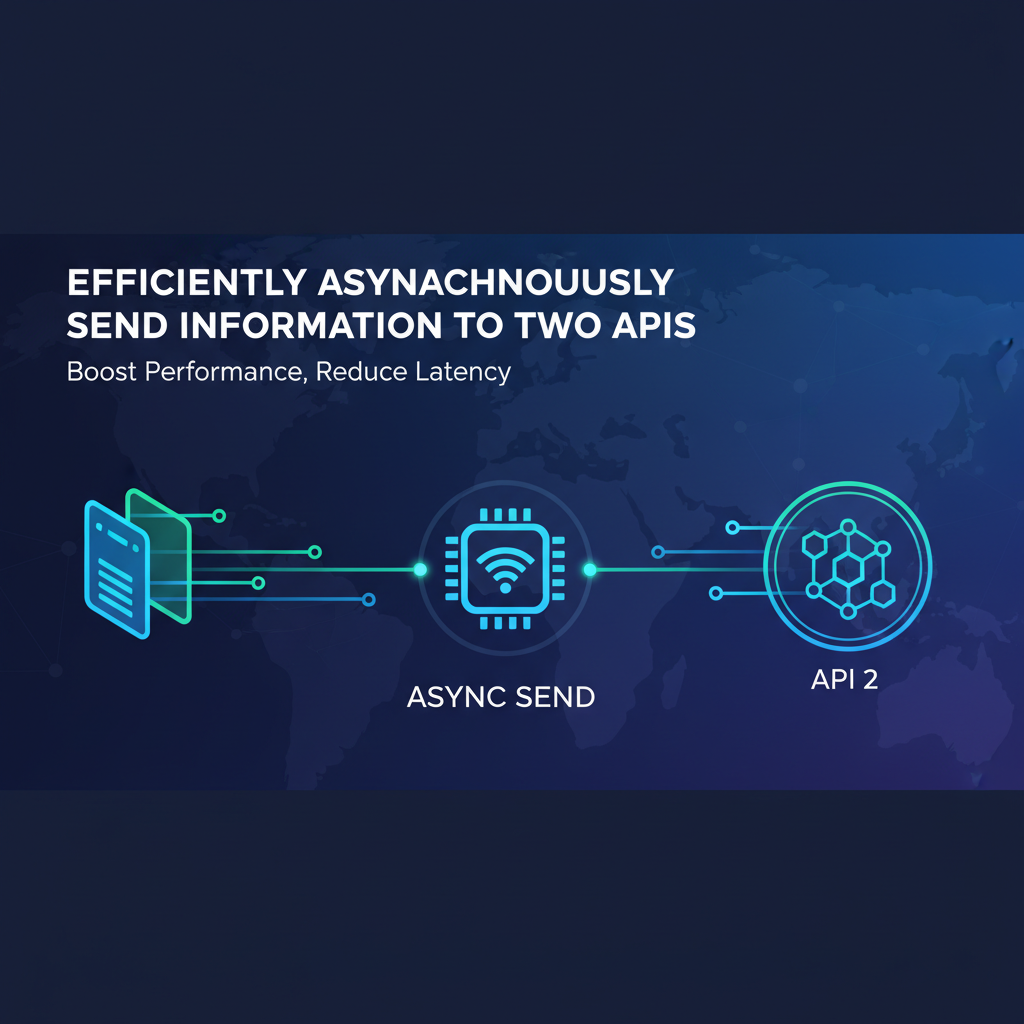
Efficiently Asynchronously Send Information to Two APIs


In the rapidly evolving digital landscape, the ability of software systems to communicate seamlessly and efficiently with a multitude of external services is not just an advantage, but a fundamental requirement. Modern applications rarely exist in isolation; they are instead intricate ecosystems that regularly exchange data with other applications, databases, and third-party platforms through Application Programming Interfaces (APIs). From updating customer relationship management (CRM) systems and processing payments to sending notifications and synchronizing inventory, the flow of information across different services is the lifeblood of today's interconnected business operations.
The challenge intensifies significantly when an application needs to send the same or related pieces of information to multiple external APIs simultaneously or near-simultaneously. Imagine a scenario where a user action, such as submitting an order, necessitates updating an inventory management system via one API and simultaneously triggering a shipping fulfillment process via another distinct API. If these operations are performed sequentially and synchronously, the application's responsiveness can be severely impacted, leading to frustrating delays for the user and inefficient utilization of system resources. This is where the strategic implementation of asynchronous communication patterns becomes not just beneficial, but absolutely critical for building high-performance, resilient, and scalable applications.
The pursuit of efficiency in such dual-API communication is multifaceted. It’s not merely about making calls happen faster; it's about designing a system that can gracefully handle network latencies, transient errors, varying service availability, and potential rate limits imposed by external providers, all while maintaining a smooth and responsive user experience. This necessitates a deep dive into asynchronous programming paradigms, robust error handling strategies, and often, the architectural elegance provided by components like message queues or, more comprehensively, an API gateway. These tools and patterns allow developers to decouple the initial request from the subsequent processing, ensuring that the primary application thread remains unblocked and ready to serve new requests, even as complex background tasks are being orchestrated. Understanding and mastering these techniques is paramount for any developer or architect aiming to build robust, future-proof systems that can effortlessly manage the complexities of modern multi-service integration.
Understanding the Need for Dual API Communication
The contemporary software architecture paradigm often revolves around microservices and distributed systems, leading to a proliferation of specialized services, each exposed via its own API. This modularity offers significant benefits in terms of scalability, maintainability, and independent deployment. However, it also introduces inherent complexities, especially when a single logical operation within an application requires interaction with multiple disparate services. The need to send information to two or more APIs concurrently arises in a vast array of business scenarios, each demanding a thoughtful approach to ensure data consistency, operational efficiency, and a superior user experience.
Consider a typical e-commerce platform. When a customer successfully places an order, this seemingly singular event triggers a cascade of actions across various backend systems. Firstly, the core order processing system needs to record the transaction. Simultaneously, the inventory management system must decrement the stock level for the purchased items. In parallel, a payment gateway needs to be notified to finalize the financial transaction. Furthermore, a customer notification service might need to send an order confirmation email or SMS, and perhaps a separate analytics API would log the purchase for business intelligence purposes. While our focus here is on two APIs, this example vividly illustrates how a single user action can fan out into multiple, interdependent API calls. If the inventory update fails but the payment succeeds, or vice versa, it leads to data inconsistency and operational headaches that are costly and time-consuming to resolve.
Another common use case involves data synchronization across different platforms. Businesses often use multiple software-as-a-service (SaaS) products for different functions – a CRM for sales, an enterprise resource planning (ERP) system for operations, and a marketing automation platform for customer engagement. When a new customer signs up or updates their details, this information might need to be propagated to both the CRM and the marketing platform via their respective APIs to ensure all systems have the most current customer profile. Performing these updates synchronously and sequentially would mean that the user has to wait for the slowest of these operations to complete, which can be an unacceptable delay if one of the external APIs is experiencing high latency or temporary unavailability.
Beyond data consistency and synchronization, dual API communication is also vital for enabling cross-platform notifications and orchestrating complex workflows. For instance, in a system designed for incident management, when a critical alert is triggered, the application might need to simultaneously create a ticket in an issue tracking system (like Jira) and send an urgent notification to on-call engineers via a communication platform (like PagerDuty or Slack). Each of these actions targets a distinct API, and the promptness of these parallel updates is paramount for effective incident response. Similarly, in a content management system, publishing an article might involve updating the primary content API and simultaneously notifying a search indexing service API to ensure the new content is discoverable.
The perils of neglecting efficient, asynchronous communication in these scenarios are significant. The most immediate impact is on performance. Synchronous, sequential calls mean that the total response time for the initial request is the sum of the latencies of all individual API calls, plus any processing overhead. If each external API introduces even a few hundred milliseconds of latency, two such calls quickly push the total response time beyond acceptable limits for a responsive user interface. This directly degrades the user experience, potentially leading to user abandonment or dissatisfaction.
Furthermore, synchronous calls introduce a heightened risk of system fragility. If one of the downstream APIs becomes unresponsive or experiences an error, the entire upstream process might block or fail, leading to cascading failures. This tightly coupled dependency makes the system less resilient to external service disruptions. An upstream service waiting indefinitely for a slow downstream API can exhaust its own connection pools, threads, or memory, eventually becoming unresponsive itself. This highlights why breaking the direct, synchronous dependency between the initiating request and the fulfillment of multiple external API calls is not merely an optimization but a fundamental architectural principle for building robust and scalable distributed applications. The adoption of an API gateway can often serve as an initial layer to abstract these complexities, offering a centralized point to manage and orchestrate such concurrent interactions, thereby mitigating many of the aforementioned pitfalls.
The Fundamentals of Asynchronous Programming
At its core, asynchronous programming is a paradigm designed to improve the responsiveness and efficiency of applications by allowing operations to run independently of the main program flow. Unlike synchronous programming, where tasks are executed sequentially and each task must complete before the next one can begin, asynchronous operations can initiate a task and then immediately move on to other work, checking back on the initiated task later to retrieve its result. This distinction is particularly crucial in scenarios involving I/O-bound operations, such as network requests, file access, or database queries, which inherently involve waiting for external resources.
To truly grasp asynchronous programming, it’s helpful to contrast it with its synchronous counterpart. In a synchronous model, when an application makes an API call, the program execution pauses, or "blocks," at that line of code. It waits for the API server to respond, processes the response, and only then does it proceed to the next line of code. This is straightforward to reason about, as the flow of control is linear and predictable. However, when dealing with multiple API calls, especially to external services over a network, this blocking behavior becomes a significant bottleneck. While the application is waiting for one API response, it cannot do anything else, leading to wasted CPU cycles and a non-responsive user interface.
Asynchronous programming tackles this by fundamentally altering how waiting is handled. Instead of blocking, an asynchronous operation initiates the I/O request (e.g., sending an API request), and then "yields" control back to the main program or an event loop. The main program can then perform other tasks, such as processing user input, responding to other requests, or initiating another API call. When the initial API response eventually arrives, a predefined mechanism (like a callback function, a promise resolution, or an await instruction) is triggered, and the program resumes processing the result of that specific API call. This non-blocking I/O is the cornerstone of improved responsiveness and efficient resource utilization.
The key benefits derived from this approach are substantial:
- Non-blocking I/O: The most prominent advantage. Applications remain responsive even when waiting for slow external services. This is crucial for user-facing applications where a frozen UI is unacceptable, and for backend services that need to handle many concurrent requests without getting bogged down.
- Improved Responsiveness: By not blocking, an application can quickly react to user interactions or incoming network requests, leading to a smoother and more dynamic experience.
- Better Resource Utilization: Instead of having threads idly waiting for I/O operations to complete, asynchronous patterns allow a smaller number of threads to manage a large number of concurrent operations. When a thread initiates an I/O request, it can switch to another ready task instead of blocking, thereby making more effective use of CPU cycles and memory. This is particularly beneficial for servers that handle thousands of concurrent client connections.
Various programming paradigms have evolved to facilitate asynchronous operations, each with its own advantages and historical context:
- Callbacks: This is one of the earliest forms. You pass a function (the callback) to an asynchronous operation, and that function gets executed once the operation completes. While simple, complex sequences of asynchronous operations using callbacks can lead to "callback hell" or the "pyramid of doom," where code becomes deeply nested and difficult to read, debug, and maintain.
- Promises/Futures: Introduced to address the challenges of callbacks, Promises (or Futures in some languages) represent the eventual result of an asynchronous operation. A Promise can be in one of three states: pending, fulfilled (successful), or rejected (failed). They allow for chaining asynchronous operations (
.then()) and provide cleaner error handling (.catch()). This significantly flattens the code structure compared to nested callbacks. For instance, in JavaScript,Promise.all()is a powerful construct that takes an array of promises and returns a single promise that resolves when all the input promises have resolved, or rejects if any of them reject, making it ideal for concurrent API calls. - Async/Await: Building upon Promises/Futures,
async/awaitsyntax provides an even more synchronous-like way of writing asynchronous code, making it highly readable and easier to reason about. Anasyncfunction implicitly returns a Promise, and theawaitkeyword can only be used inside anasyncfunction to pause its execution until a Promise settles, and then resume with the Promise's result. This eliminates explicit Promise chaining in many cases and makes error handling withtry...catchblocks feel familiar. Python'sasynciomodule withasyncandawait, JavaScript's native support, C#'sasyncandawaitkeywords, and Java'sCompletableFuture(though not strictlyasync/await, it offers similar composability) are prime examples. - Event Loops: Many asynchronous frameworks and runtimes (like Node.js, Python's
asyncio) are built around an event loop. This is a single-threaded process that continuously checks for events (e.g., incoming network data, timer expirations) and dispatches them to appropriate handlers. When an I/O operation is initiated, the request is handed off to the operating system, and the event loop continues processing other tasks. When the OS signals that the I/O is complete, the event loop picks up that event and triggers the corresponding callback or promise resolution. This model efficiently multiplexes I/O operations without resorting to creating a new thread for every concurrent operation, making it highly scalable.
By embracing these asynchronous fundamentals, developers can construct applications that are not only performant but also inherently more resilient to the vagaries of network communication and external service dependencies. This foundational understanding is crucial before delving into the architectural patterns that leverage these concepts for effective dual API interaction.
Architectural Patterns for Sending Data to Multiple APIs
When the requirement arises to send information to two or more APIs, the choice of architectural pattern significantly influences the system's performance, resilience, maintainability, and scalability. Simply making two synchronous API calls sequentially is almost always the least desirable option due to the aforementioned blocking and latency issues. Modern architectures offer a spectrum of sophisticated approaches, ranging from direct parallel calls within the application code to introducing dedicated infrastructure components.
1. Direct Asynchronous Calls
This is often the most straightforward approach when the application itself has the capability to make concurrent, non-blocking network requests. Most modern programming languages and frameworks provide built-in constructs for this:
JavaScript: Promise.all() is the quintessential tool. Given an array of Promises, Promise.all() returns a single Promise that resolves when all input Promises have resolved, or rejects as soon as any input Promise rejects. ```javascript async function sendToTwoApis(data) { try { const api1Call = fetch('https://api1.example.com/endpoint', { method: 'POST', body: JSON.stringify(data) }); const api2Call = fetch('https://api2.example.com/endpoint', { method: 'POST', body: JSON.stringify(data) });
    const [response1, response2] = await Promise.all([api1Call, api2Call]);

    // Process responses
    const result1 = await response1.json();
    const result2 = await response2.json();

    console.log('API 1 Success:', result1);
    console.log('API 2 Success:', result2);
} catch (error) {
    console.error('One of the API calls failed:', error);
    // Handle specific errors, perhaps retry one API if the other succeeded
}
} * **Python:** The `asyncio` library, coupled with `aiohttp` for HTTP requests, provides `asyncio.gather()`.python import asyncio import aiohttpasync def send_to_two_apis(data): async with aiohttp.ClientSession() as session: try: task1 = session.post('https://api1.example.com/endpoint', json=data) task2 = session.post('https://api2.example.com/endpoint', json=data)
        responses = await asyncio.gather(task1, task2, return_exceptions=True) # return_exceptions allows individual task failures without stopping all

        for i, resp in enumerate(responses):
            if isinstance(resp, Exception):
                print(f"API {i+1} call failed: {resp}")
            else:
                resp.raise_for_status() # Raise an exception for bad status codes
                result = await resp.json()
                print(f"API {i+1} Success: {result}")

    except aiohttp.ClientError as e:
        print(f"An HTTP client error occurred: {e}")
    except Exception as e:
        print(f"An unexpected error occurred: {e}")
* **Java:** `CompletableFuture.allOf()` allows for combining multiple `CompletableFuture` instances into a single `CompletableFuture` that completes when all of them complete.java import java.net.URI; import java.net.http.HttpClient; import java.net.http.HttpRequest; import java.net.http.HttpResponse; import java.util.concurrent.CompletableFuture;public class DualApiSender {
private static final HttpClient client = HttpClient.newBuilder().build();

public static CompletableFuture<Void> sendToTwoApis(String data) {
    HttpRequest request1 = HttpRequest.newBuilder()
            .uri(URI.create("https://api1.example.com/endpoint"))
            .header("Content-Type", "application/json")
            .POST(HttpRequest.BodyPublishers.ofString(data))
            .build();

    HttpRequest request2 = HttpRequest.newBuilder()
            .uri(URI.create("https://api2.example.com/endpoint"))
            .header("Content-Type", "application/json")
            .POST(HttpRequest.BodyPublishers.ofString(data))
            .build();

    CompletableFuture<HttpResponse<String>> future1 = client.sendAsync(request1, HttpResponse.BodyHandlers.ofString());
    CompletableFuture<HttpResponse<String>> future2 = client.sendAsync(request2, HttpResponse.BodyHandlers.ofString());

    return CompletableFuture.allOf(future1, future2)
            .thenAccept(v -> {
                try {
                    HttpResponse<String> response1 = future1.join(); // .join() gets the result, blocking if not complete
                    HttpResponse<String> response2 = future2.join();
                    System.out.println("API 1 Response Status: " + response1.statusCode() + ", Body: " + response1.body());
                    System.out.println("API 2 Response Status: " + response2.statusCode() + ", Body: " + response2.body());
                } catch (Exception e) {
                    System.err.println("Error processing responses: " + e.getMessage());
                }
            })
            .exceptionally(e -> {
                System.err.println("One of the API calls failed: " + e.getMessage());
                return null; // Return null to complete the exceptionally stage
            });
}
} ```
When to use: This pattern is suitable for simpler cases where the initiating application has direct control over the API calls, the number of target APIs is small, and the logic for error handling and retries can be managed within the application itself. It's highly efficient for minimizing latency from the client's perspective as calls are truly parallel.
Challenges: As the complexity grows, so do the challenges. Managing independent error handling for each API (e.g., what if one succeeds and the other fails?), implementing robust retry mechanisms with exponential backoff, handling rate limits, and incorporating circuit breakers for individual external services can quickly clutter the application logic. This approach can also expose the client directly to the latencies and failures of all integrated services.
2. Message Queues/Brokers
For more robust, scalable, and resilient asynchronous communication, especially when decoupling is a priority, message queues (or message brokers) are an excellent choice.
Workflow: 1. The initiating application publishes a message (e.g., containing the data to be sent) to a designated topic or queue in the message broker. This is a very fast, non-blocking operation for the application. 2. The message broker durably stores the message. 3. One or more consumer services (often small, dedicated microservices) subscribe to that topic/queue. 4. Consumer A reads the message from the queue and sends the information to API 1. 5. Consumer B reads the same message (or a copy of it, in a pub/sub model) from the queue and sends the information to API 2.
Examples: Apache Kafka, RabbitMQ, AWS SQS, Azure Service Bus, Google Cloud Pub/Sub.
Pros: * Decoupling: The producer (initiating application) is completely decoupled from the consumers (services interacting with APIs). It doesn't need to know about the target APIs or how many consumers there are. * Reliability & Durability: Message brokers are designed for reliable message delivery. Messages are persisted until successfully processed, ensuring that transient API failures or consumer crashes don't lead to data loss. * Scalability: Consumers can be scaled independently. If API 1 is slower or receives more load, you can deploy more instances of Consumer A without affecting Consumer B or the producer. * Load Leveling: Message queues act as a buffer, smoothing out spikes in demand. If an API experiences a temporary slowdown, messages can queue up without overwhelming the API or causing the producer to block. * Retries and Dead-Letter Queues (DLQ): Message brokers often have built-in mechanisms for retrying message delivery and routing unprocessable messages to a DLQ for later investigation, greatly simplifying error handling.
Cons: * Increased Complexity: Introduces another infrastructure component to manage, monitor, and maintain. * Eventual Consistency: Since messages are processed asynchronously and independently, there's no immediate guarantee that both APIs will be updated at the exact same time. The system moves towards "eventual consistency." * Operational Overhead: Requires expertise in managing message brokers, which can be complex for large-scale deployments.
3. Serverless Functions (FaaS)
Serverless functions, such as AWS Lambda, Azure Functions, or Google Cloud Functions, provide an event-driven execution model that is well-suited for orchestrating asynchronous API calls.
Workflow: 1. The initiating application triggers a serverless function. This can be done directly via an API gateway (which acts as a trigger) or by publishing a message to a queue that the function is subscribed to. 2. The serverless function is invoked. 3. Inside the function, the logic for making parallel API calls (using language-native asynchronous constructs like Promise.all or asyncio.gather) is executed. 4. The function handles responses, errors, and retries. 5. For complex, multi-step workflows, serverless orchestration tools (e.g., AWS Step Functions, Azure Durable Functions) can manage the state and flow between multiple functions, ensuring that each API call occurs in the correct sequence, with appropriate error handling and compensation logic.
Pros: * Simplified Deployment and Scaling: Cloud providers manage the underlying infrastructure, abstracting away server management. Functions automatically scale up and down based on demand. * Cost-Effective: You only pay for the compute time consumed by your functions. * Event-Driven: Naturally aligns with event-driven architectures, making it easy to trigger functions based on various events (e.g., a new message in a queue, a file upload). * Built-in Integrations: Serverless platforms often integrate seamlessly with other cloud services, simplifying logging, monitoring, and security.
Cons: * Vendor Lock-in: Code and configuration can become tied to a specific cloud provider's ecosystem. * Cold Starts: Infrequently used functions might experience a slight delay (cold start) on their first invocation as the runtime environment needs to be initialized. * Monitoring and Debugging: Distributed nature can make monitoring and debugging challenging without robust tooling.
4. The Role of an API Gateway
An API gateway acts as a single entry point for all clients consuming your APIs, abstracting the complexities of the backend services. While often associated with routing, authentication, and rate limiting, an intelligent API gateway can also play a pivotal role in orchestrating asynchronous communication to multiple backend APIs.
A sophisticated API gateway can receive a single request from a client, and then, based on its internal configuration or custom logic, fan out that request to multiple backend services or APIs concurrently. It aggregates the responses (if needed) and returns a single, unified response to the client. This offloads the complexity of parallel calling and response aggregation from the client application.
Benefits of using a gateway for dual API calls: * Reduced Client-Side Complexity: Clients only need to interact with a single endpoint, simplifying their code and reducing their dependency on individual backend services. * Centralized Control: All logic for routing, security, monitoring, and even fan-out to multiple APIs is managed in one place. * Service Abstraction: The gateway can hide the underlying service architecture, allowing backend services to change without impacting clients. * Policy Enforcement: Apply policies like rate limiting, caching, and authentication uniformly across all fan-out requests. * Enhanced Observability: A well-configured gateway provides a central point for logging and monitoring all incoming and outgoing API traffic, making it easier to trace requests and debug issues.
For more advanced scenarios, especially when dealing with a multitude of APIs, varying backend services, or even different types of AI models, an intelligent API gateway becomes indispensable. Platforms like APIPark exemplify how a robust open-source solution can streamline such complex integrations. APIPark, as an AI gateway and API management platform, not only provides unified API format for AI invocation but also excels at end-to-end API lifecycle management, offering features that directly support efficient asynchronous communication patterns across diverse services, including REST and AI models. It enables quick integration of 100+ AI models and helps in standardizing API invocation, ensuring that updates to multiple backend systems or AI models can be orchestrated with a single, managed entry point. With capabilities like performance rivaling Nginx, APIPark can achieve over 20,000 TPS on modest hardware, supporting cluster deployment for handling large-scale fan-out traffic. Its detailed API call logging and powerful data analysis features are particularly valuable when orchestrating complex asynchronous workflows involving multiple backend services, providing the deep insights necessary to troubleshoot and optimize.
Furthermore, an API gateway can integrate with other patterns. For instance, a gateway might receive a request, validate it, and then publish a message to a queue, which then triggers downstream consumers to interact with multiple APIs. Or, it could directly invoke multiple serverless functions in parallel. This combination allows for highly flexible and resilient architectures.
The choice among these patterns depends heavily on the specific requirements of the application, including the desired level of coupling, the need for transactional consistency, scalability demands, and the operational overhead you are willing to accept. Often, a hybrid approach leveraging the strengths of multiple patterns provides the optimal solution.
APIPark is a high-performance AI gateway that allows you to securely access the most comprehensive LLM APIs globally on the APIPark platform, including OpenAI, Anthropic, Mistral, Llama2, Google Gemini, and more.Try APIPark now! 👇👇👇
Implementation Deep Dive: Code Examples and Best Practices
Implementing efficient asynchronous communication to multiple APIs involves more than just initiating parallel network requests. It requires a comprehensive approach to error handling, data transformation, observability, security, and performance tuning to build truly resilient and production-ready systems. This section delves into these critical aspects, providing practical insights and illustrative examples.
1. Error Handling and Retries
Network operations are inherently unreliable. External APIs can experience transient failures, timeouts, rate limits, or return application-specific errors. A robust system must account for these possibilities.
- Graceful Degradation: Design your system so that if one API call fails, it doesn't necessarily block or completely fail the entire process. Can the application proceed with partial success? For instance, if sending a notification to a secondary system fails, the primary data update might still be committed.
- Exponential Backoff: When an API returns a transient error (e.g., 429 Too Many Requests, 500 Internal Server Error, or a network timeout), don't immediately retry. Instead, wait for an increasing amount of time between retries. This prevents overwhelming the struggling API and allows it time to recover. A common pattern is
delay = base * 2^n, wherebaseis an initial delay andnis the retry attempt number. - Jitter: To avoid a "thundering herd" problem where many clients simultaneously retry after the same backoff period, introduce a small random component (jitter) to the delay. This spreads out the retry attempts, reducing the load spikes on the external API.
- Circuit Breakers: This pattern prevents an application from repeatedly trying to invoke a service that is likely to fail. When a service experiences a certain number of failures within a threshold, the circuit breaker "opens," and subsequent calls to that service immediately fail without attempting to hit the actual service. After a configurable "half-open" period, a single request is allowed through to test if the service has recovered. This prevents cascading failures and gives the struggling service time to heal. Libraries like Hystrix (Java, though maintenance mode) or Polly (.NET) provide implementations. In other languages, you might implement this logic yourself or use similar patterns. ```python # Conceptual Python example for retry with exponential backoff and jitter import asyncio import random import httpx # A modern HTTP client for Pythonasync def call_api_with_retry(url, data, retries=5, base_delay=1.0): for i in range(retries): try: response = await httpx.post(url, json=data, timeout=5) response.raise_for_status() # Raises an exception for 4xx/5xx responses return response.json() except httpx.HTTPStatusError as e: if e.response.status_code in {429, 500, 502, 503, 504} and i < retries - 1: delay = base_delay * (2 ** i) + random.uniform(0, 0.5 * base_delay * (2 ** i)) # Exponential backoff with jitter print(f"API call to {url} failed with {e.response.status_code}. Retrying in {delay:.2f}s...") await asyncio.sleep(delay) else: raise # Re-raise for non-retryable errors or after all retries except httpx.RequestError as e: # Network error, timeout etc. if i < retries - 1: delay = base_delay * (2 ** i) + random.uniform(0, 0.5 * base_delay * (2 ** i)) print(f"API call to {url} failed with network error {e}. Retrying in {delay:.2f}s...") await asyncio.sleep(delay) else: raise raise Exception(f"Failed to call {url} after {retries} attempts.")
`` * **Idempotency:** Ensure that repeated requests to an API (e.g., due to retries) produce the same result and do not cause unintended side effects (like duplicating records). Many APIs support anIdempotency-Key` header for this purpose. If an API is not inherently idempotent, your system must incorporate mechanisms (e.g., checking for existence before creation) to achieve idempotency for the entire operation.
2. Data Transformation and Schema Management
Rarely do two distinct APIs expect the exact same data format. Information originating from your application might need to be transformed to meet the specific schema requirements of each target API.
- Mapping Layers: Implement clear mapping layers that translate your internal data model into the format expected by API 1 and API 2. This can involve renaming fields, reformatting values (e.g., date formats), restructuring nested objects, or even enriching data from other sources.
- Schema Validation: Before sending data, validate it against the target API's schema (if available, e.g., using JSON Schema or OpenAPI Specification). This catches errors early, preventing unnecessary network calls and server-side errors.
- Version Management: External APIs evolve. Your transformation logic must be adaptable to new API versions, handling deprecations or changes in required fields gracefully. Using an API gateway can help here by allowing centralized management of transformations and versions, effectively abstracting these changes from the client.
3. Observability
When interacting with multiple external systems asynchronously, understanding what's happening becomes complex. Robust observability is crucial.
- Logging: Implement detailed, structured logging for every API call. Log request payloads (sensitive data obfuscated), response payloads, status codes, and latency. Correlate logs across different stages of the asynchronous process using a unique
correlation_idortrace_id. This allows you to trace a single logical operation across multiple systems. APIPark offers "Detailed API Call Logging," which records every detail of each API call, providing businesses with the ability to quickly trace and troubleshoot issues, ensuring system stability and data security. - Monitoring: Collect metrics on the performance and health of your asynchronous API calls. Key metrics include:
- Latency: Time taken for each API call.
- Throughput: Number of successful requests per second.
- Error Rates: Percentage of failed requests, categorized by error type (network, 4xx, 5xx).
- Queue Depths: If using message queues, monitor how many messages are pending.
- Circuit Breaker State: Is the circuit open or closed for a particular API?
- Tracing: Distributed tracing tools (e.g., OpenTelemetry, Jaeger, Zipkin) allow you to visualize the entire request flow across multiple services and even into external API calls. This is invaluable for identifying bottlenecks and understanding the dependencies in a complex asynchronous workflow.
4. Security Considerations
Sending data to multiple external APIs introduces additional security vectors that must be carefully managed.
- Authentication and Authorization: Each external API likely requires its own form of authentication (e.g., API keys, OAuth tokens, JWTs). Ensure these credentials are securely stored (e.g., in environment variables, secret managers) and transmitted. Authorization policies must ensure your application only accesses the necessary resources on the external API.
- Data Encryption: All data transmitted to external APIs should be encrypted in transit (using HTTPS/TLS). Sensitive data at rest (e.g., API keys) should also be encrypted.
- Least Privilege: Configure permissions for your application to interact with external APIs using the principle of least privilege, granting only the necessary access.
- Input Validation: Always validate and sanitize any data received from external APIs before processing it to prevent injection attacks or other vulnerabilities.
- API Gateways are powerful for centralizing security. They can manage API key validation, OAuth flows, and even granular access control before requests are fanned out to backend services. APIPark supports features like "API Resource Access Requires Approval," where callers must subscribe and await administrator approval, preventing unauthorized calls and potential data breaches.
5. Performance Tuning
While asynchronous communication inherently improves performance, further optimizations can be made.
- Connection Pooling: Reusing HTTP connections reduces the overhead of establishing new TCP connections and TLS handshakes for each API call. Most modern HTTP client libraries offer connection pooling.
- Timeouts: Implement strict timeouts for all external API calls. An API that never responds is as bad as one that responds with an error, consuming resources indefinitely.
- Batching Requests: If an external API supports it, consider batching multiple logical operations into a single API request. This can significantly reduce network overhead, though it introduces complexity in error handling for individual items within the batch.
- Load Testing and Profiling: Regularly load test your system to identify performance bottlenecks, especially under high concurrency. Profile your application to pinpoint areas consuming excessive CPU or memory.
Comparison of Asynchronous Communication Methods
To summarize the various strategies, here's a table comparing their characteristics:
| Feature | Direct Asynchronous Calls (e.g., Promise.all) |
Message Queues (e.g., Kafka, RabbitMQ) | Serverless Functions (e.g., Lambda) | API Gateway with Fan-out (e.g., APIPark) |
|---|---|---|---|---|
| Complexity of Setup | Low to Medium | High | Medium | Medium to High |
| Decoupling | Low (Producer coupled to API endpoints) | High (Producer decoupled from consumers) | Medium (Trigger to function) | Medium (Client decoupled from backends) |
| Reliability/Durability | Low (depends on client's retry logic) | High (Messages persisted) | Medium to High (managed by provider) | Medium (depends on gateway configuration) |
| Scalability | Medium (limited by client's resources) | High (Consumers scale independently) | High (Auto-scaling) | High (Gateway scales, backends independent) |
| Real-time Latency | Low (Direct parallel calls) | High (Queue processing delay) | Medium (Cold starts possible) | Low (Direct parallel calls from gateway) |
| Error Handling | Manual (Client must implement) | Built-in (DLQs, retries) | Managed (Platform features) | Centralized (Gateway configuration) |
| Observability | Client-side logs, tracing | Broker monitoring, consumer logs | Cloud logging/monitoring | Centralized logs, metrics, traces |
| Use Case Examples | Simple updates, parallel data fetching | Event-driven architectures, long-running tasks, high volume | Event processing, lightweight tasks | Centralized API management, complex routing, microservices orchestration |
| Operational Overhead | Low | High | Low | Medium |
This deep dive illustrates that efficiently sending information to two APIs is a nuanced challenge requiring careful consideration of architectural patterns, robust error handling, comprehensive observability, and strong security practices. By mastering these areas, developers can build resilient, high-performance systems capable of navigating the complexities of multi-service integration.
Choosing the Right Strategy
The decision of which architectural pattern or combination of patterns to employ for efficiently asynchronously sending information to two APIs is not a one-size-fits-all proposition. It demands a careful evaluation of several factors unique to your specific application, organizational context, and operational capabilities. The "best" strategy is the one that most effectively balances technical requirements, resource constraints, and future growth potential.
Here are the critical factors to consider when making this choice:
- Complexity of Logic and Business Rules:
- Simple fan-out: If the data sent to both APIs is identical or requires minimal, static transformation, and the success of one operation is largely independent of the other, direct asynchronous calls from your application or a basic API gateway fan-out might suffice.
- Complex workflows: If the interaction with API 2 depends on the outcome of API 1, or if there's complex conditional logic, state management, and compensation actions required for failures, then serverless orchestration (like AWS Step Functions) or a robust message queue with sophisticated consumers become more appropriate. A dedicated API gateway might handle the initial fan-out, but deeper orchestration might reside elsewhere.
- Required Reliability and Consistency:
- "Fire-and-forget" / Eventual Consistency: If it's acceptable for updates to happen independently and for the system to reach consistency over time, direct async calls, message queues, or serverless functions are excellent choices. This often applies to non-critical updates like analytics logging or sending non-essential notifications.
- High Consistency / Transactional Needs: If both API calls must succeed together, or if a failure in one must roll back the other (true distributed transaction), then none of the purely asynchronous patterns inherently provide this out-of-the-box. You would need to implement complex compensating transactions, sagas, or use specialized two-phase commit protocols (which are generally avoided in distributed systems due to their performance overhead). In such rare cases, message queues with dedicated idempotency and rollback logic in consumers might be the least intrusive compromise, but careful design is paramount.
- Scalability Needs:
- Low to Moderate Load: For applications with predictable, moderate transaction volumes, direct asynchronous calls or a single API gateway instance might handle the load without issues.
- High Throughput / Spiky Load: If your application is expected to handle a massive volume of concurrent requests or experiences unpredictable traffic spikes, then message queues (acting as buffers and enabling horizontal scaling of consumers) or auto-scaling serverless functions are superior. An API gateway like APIPark designed for high performance and cluster deployment can also handle extreme traffic demands effectively by acting as the initial entry point for these high-volume requests.
- Development Team's Expertise and Operational Overhead:
- Simplicity preferred: If your team has limited experience with distributed systems or desires minimal operational overhead, direct asynchronous calls are the easiest to implement. Serverless functions also simplify operations significantly.
- Infrastructure expertise: Implementing and managing your own message broker (like Kafka or RabbitMQ) requires dedicated operational expertise in deployment, monitoring, and troubleshooting, which can be a significant undertaking. While managed cloud services for these components reduce some burden, they still require architectural understanding. A comprehensive API gateway often strikes a balance, providing powerful features with manageable operational complexity, especially if it's open-source and well-supported.
- Cost Implications:
- On-demand pricing: Serverless functions are generally very cost-effective for infrequent or spiky workloads due to their pay-per-execution model.
- Infrastructure costs: Running self-managed message brokers or a dedicated API gateway requires provisioning and maintaining servers, which incurs fixed costs regardless of usage. However, for constant high loads, this might be more cost-effective than per-invocation fees. Cloud-managed message queues and gateways often provide a good balance.
- Real-time vs. Eventual Consistency:
- If immediate feedback to the user regarding the success of both API calls is crucial, then direct asynchronous calls from the client, or a gateway that makes parallel calls and aggregates responses, would be preferred.
- If the user can be informed that their request is being processed, and updates to the secondary API can happen in the background, then message queues or serverless functions are suitable.
Scenario-Based Recommendations:
- Scenario 1: Simple, low-volume, client-initiated parallel updates.
- Recommendation: Direct asynchronous calls within the client application (e.g.,
Promise.allin JavaScript,asyncio.gatherin Python). - Rationale: Minimal overhead, straightforward to implement.
- Recommendation: Direct asynchronous calls within the client application (e.g.,
- Scenario 2: Backend service needing to update two external systems, with moderate reliability requirements, but sensitive to latency.
- Recommendation: A dedicated API gateway with fan-out capabilities, potentially combined with direct asynchronous calls from a backend service if the gateway itself doesn't offer the necessary orchestration logic.
- Rationale: Centralized control, hides complexity from client, but maintains responsiveness. APIPark is particularly well-suited here, offering both an intelligent gateway and API management, allowing a unified approach to managing these calls.
- Scenario 3: High-volume, mission-critical events requiring guaranteed delivery and significant decoupling, with complex error handling.
- Recommendation: Message Queue with dedicated consumer services.
- Rationale: Provides extreme durability, scalability, and built-in retry mechanisms. Suitable for long-running processes where immediate response is not critical.
- Scenario 4: Event-driven architecture, fluctuating workloads, minimizing operational overhead.
- Recommendation: Serverless Functions triggered by an event (e.g., HTTP request via API gateway, or a message in a queue).
- Rationale: Auto-scaling, pay-per-use, integrates well with other cloud services.
In many real-world architectures, a hybrid approach often emerges as the most effective. For example, an API gateway might serve as the initial entry point, validating requests and then publishing an event to a message queue. Serverless functions or dedicated microservices then consume these messages and make the actual, possibly parallel, API calls. This layered approach combines the strengths of various patterns to create a highly resilient, scalable, and efficient system for multi-API communication. The continuous monitoring and data analysis capabilities of platforms like APIPark become invaluable in such complex, distributed environments, providing the insights needed to ensure everything is operating as expected.
Conclusion
The journey of sending information efficiently and asynchronously to two APIs, or indeed to many, is a microcosm of modern software development challenges. It encapsulates the fundamental shifts from monolithic, synchronous systems to distributed, event-driven, and highly concurrent architectures. As applications grow in complexity and rely increasingly on external services, mastering these communication patterns ceases to be a luxury and becomes an absolute necessity for building resilient, scalable, and performant systems.
We've explored the foundational principles of asynchronous programming, contrasting it with the inherent limitations of synchronous models and highlighting its indispensable role in ensuring non-blocking I/O, responsiveness, and efficient resource utilization. We then delved into a spectrum of architectural patterns, from the straightforwardness of direct asynchronous calls within application code to the robust decoupling offered by message queues, the operational simplicity of serverless functions, and the centralized power of an API gateway. Each pattern presents a unique set of trade-offs, making the selection a strategic decision informed by factors like complexity, reliability, scalability, cost, and team expertise.
Crucially, implementing these patterns effectively goes beyond mere code; it demands meticulous attention to best practices. Robust error handling, incorporating strategies like exponential backoff and circuit breakers, is vital for navigating the inherent unreliability of network communication. Thoughtful data transformation ensures compatibility between disparate API schemas. Comprehensive observability through detailed logging, monitoring, and tracing provides the insights needed to understand system behavior and troubleshoot issues in distributed environments—a capability greatly enhanced by platforms like APIPark with its detailed API call logging and powerful data analysis. Furthermore, stringent security measures, from authentication and authorization to data encryption, are non-negotiable when dealing with sensitive information across multiple service boundaries.
Ultimately, the most effective solution often emerges from a judicious combination of these patterns, tailored to the specific context of the application. Whether it's the client-side elegance of Promise.all(), the enterprise-grade reliability of a message queue, the serverless agility, or the centralized control and fan-out capabilities of an intelligent API gateway, the goal remains consistent: to enable seamless, efficient, and resilient information flow across the digital ecosystem. By embracing these principles and tools, developers and architects can construct the high-performance, future-proof systems that define the modern digital landscape, ensuring that user experiences remain fluid and business operations run uninterrupted, even in the face of increasing complexity.
5 FAQs
1. Why is sending information to two APIs asynchronously generally preferred over synchronously? Sending information asynchronously is preferred because it prevents the application from "blocking" or waiting for each API call to complete sequentially. This significantly improves application responsiveness, especially in user-facing applications, and enhances resource utilization in backend services by allowing the system to perform other tasks while awaiting API responses. It also makes the system more resilient to latency or temporary unresponsiveness from external APIs, as a slow API won't hold up the entire process.
2. What are the main methods or architectural patterns for achieving asynchronous dual API communication? The main methods include: * Direct Asynchronous Calls: Using native language features (e.g., Promise.all in JavaScript, asyncio.gather in Python) to make parallel requests from the initiating application. * Message Queues/Brokers: Publishing a message to a queue, which is then consumed by separate services that interact with each API, decoupling the producer from the consumers. * Serverless Functions (FaaS): Triggering cloud functions that orchestrate the parallel API calls, benefiting from auto-scaling and event-driven execution. * API Gateway: Using an intelligent API gateway to act as a single entry point that receives a request and then fans it out to multiple backend APIs concurrently, aggregating responses before returning to the client.
3. When should I consider using an API Gateway for fan-out to multiple APIs, and how does APIPark fit in? You should consider an API gateway for fan-out when you need to centralize control, abstract backend services from clients, apply consistent policies (authentication, rate limiting), and enhance observability for multiple API integrations. An API gateway offloads the complexity of parallel calling and response aggregation from client applications. APIPark is an excellent example of an open-source AI gateway and API management platform that excels in such scenarios. It provides features like unified API formats, end-to-end lifecycle management, and high-performance fan-out capabilities for diverse services, including both REST and AI models, making it ideal for managing complex, asynchronous multi-API interactions at scale.
4. What are the key error handling strategies for asynchronous API calls to multiple services? Effective error handling is crucial. Key strategies include: * Graceful Degradation: Designing your system to function even if one of the API calls fails. * Exponential Backoff with Jitter: Retrying failed API calls with increasing delays and a randomized component to avoid overwhelming the external service. * Circuit Breakers: Preventing repeated attempts to call an unresponsive service, allowing it time to recover and preventing cascading failures. * Idempotency: Ensuring that retrying an API call doesn't cause unintended side effects (e.g., duplicate data). * Dead-Letter Queues (DLQs): For message queue patterns, using DLQs to capture messages that cannot be processed successfully after multiple retries for later investigation.
5. How can I ensure observability when sending data to two APIs asynchronously? Observability is critical for debugging and monitoring distributed asynchronous systems. You can ensure it by: * Detailed Logging: Implementing structured logging for every API request and response, including status codes, latency, and payloads (with sensitive data obfuscated). * Correlation IDs/Trace IDs: Using unique identifiers to link related log entries across multiple services and API calls within a single logical operation. * Monitoring: Collecting metrics on API call latency, throughput, and error rates for each external API. * Distributed Tracing: Employing tools (e.g., OpenTelemetry, Jaeger) to visualize the entire flow of a request across different services and APIs, helping identify bottlenecks. Platforms like APIPark often provide built-in detailed API call logging and powerful data analysis features to facilitate comprehensive observability.
🚀You can securely and efficiently call the OpenAI API on APIPark in just two steps:
Step 1: Deploy the APIPark AI gateway in 5 minutes.
APIPark is developed based on Golang, offering strong product performance and low development and maintenance costs. You can deploy APIPark with a single command line.
curl -sSO https://download.apipark.com/install/quick-start.sh; bash quick-start.sh

In my experience, you can see the successful deployment interface within 5 to 10 minutes. Then, you can log in to APIPark using your account.

Step 2: Call the OpenAI API.