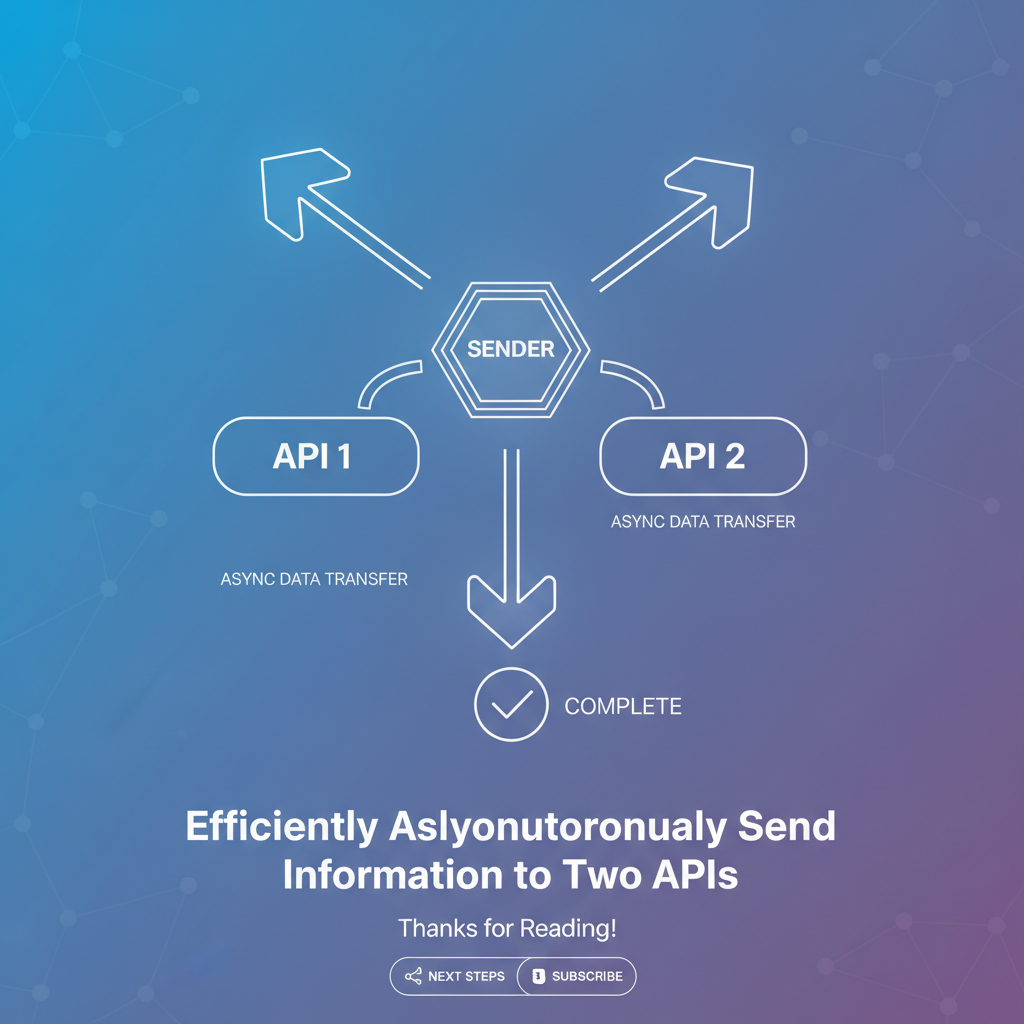
Efficiently Asynchronously Send Information to Two APIs


In the intricate tapestry of modern software architecture, microservices and third-party integrations reign supreme. Applications are no longer monolithic behemoths but rather sophisticated compositions of specialized services, each communicating through a series of Application Programming Interfaces (APIs). A common, yet often underestimated, challenge arises when a single user action or internal process necessitates sending information to not just one, but two or more distinct APIs simultaneously or near-simultaneously. The quest for efficiency in this scenario is paramount, driving developers towards asynchronous communication patterns that optimize performance, enhance user experience, and ensure system resilience.
This exhaustive exploration delves into the principles, patterns, and practicalities of efficiently and asynchronously sending information to two APIs. We will dissect the architectural considerations, weigh the pros and cons of various approaches, and equip you with the knowledge to design robust and scalable solutions. Our journey will cover everything from fundamental asynchronous programming concepts to advanced architectural patterns involving message queues and API gateways, ensuring a comprehensive understanding of this critical domain.
The Imperative of Asynchronous Communication in a Multi-API Landscape
Imagine a user registering on an e-commerce platform. This seemingly simple action might trigger a cascade of backend operations: creating a user profile in the primary database, subscribing the user to a marketing newsletter via a third-party email service API, and perhaps updating a customer relationship management (CRM) system through another API. If these operations are performed sequentially and synchronously, the user experience would suffer dramatically. Each API call introduces latency, and waiting for one to complete before initiating the next can lead to unacceptably long response times, potentially causing user frustration and abandonment.
Synchronous operations, by their very nature, block the calling thread or process until a response is received. In a multi-API interaction, this means that if one API is slow or temporarily unavailable, the entire chain of operations grinds to a halt. This blocking behavior translates directly into:
- Increased Latency: The total response time becomes the sum of individual API call latencies plus any processing time in between.
- Reduced Throughput: The system can only handle a limited number of requests concurrently because threads are tied up waiting for I/O operations.
- Poor Resource Utilization: Server resources (CPU, memory, network connections) remain idle while waiting for external responses, leading to inefficient use of expensive infrastructure.
- Cascading Failures: A failure or timeout in one API call can directly impact subsequent calls and, in a worst-case scenario, bring down the entire service that initiated the multi-API interaction.
Asynchronous communication offers a potent antidote to these challenges. By allowing operations to proceed independently without blocking the main execution flow, it unlocks significant advantages:
- Enhanced Responsiveness: The system can initiate API calls and immediately move on to other tasks, processing responses as they arrive. This means the user receives a quicker acknowledgement, even if backend processes are still underway.
- Improved Throughput: Resources are utilized more effectively. Threads or processes aren't idled; instead, they are free to handle new requests or perform other computations while waiting for I/O to complete.
- Greater Resilience: Asynchronous patterns often incorporate mechanisms for retries, error handling, and fallback logic, making the system more robust against transient API failures.
- Scalability: Decoupled components can scale independently, and the non-blocking nature allows a single service to manage a larger volume of concurrent outbound API requests.
The ability to efficiently send information to two APIs asynchronously is not merely an optimization; it is a fundamental pillar for building high-performance, resilient, and scalable distributed systems in today's API-driven world.
The Anatomy of Asynchronous Programming: Core Concepts
Before diving into architectural patterns, it's crucial to understand the foundational concepts of asynchronous programming. While the specific syntax varies across programming languages, the underlying principles remain consistent.
Non-Blocking I/O
At its heart, asynchronous programming relies on non-blocking I/O operations. When your application initiates an API call, instead of waiting for the response, the operating system immediately returns control to your application. The API call is then handled in the background, often by a separate thread, an event loop, or specialized kernel functions. When the API response eventually arrives, a notification or event is triggered, allowing your application to process the result without having been stalled.
Callbacks
Callbacks are one of the most basic mechanisms for asynchronous programming. You define a function (the callback) and pass it to an asynchronous operation. When the operation completes (e.g., an API call returns a response), the system invokes your callback function, passing it the results or any errors.
- Example (JavaScript):
``javascript function fetchDataFromAPI(url, callback) { // Simulate async network request setTimeout(() => { const data = { message:Data from ${url}` }; const error = null; // Or an error object if something went wrong callback(error, data); }, 1000); }fetchDataFromAPI('https://api.example.com/data1', (err, data) => { if (err) { console.error('Error fetching data 1:', err); return; } console.log('Received data 1:', data); }); ```
While callbacks are straightforward, they can lead to "callback hell" or "pyramid of doom" when dealing with multiple sequential asynchronous operations, making code difficult to read and maintain.
Promises/Futures/Tasks
To address the complexities of nested callbacks, many languages introduced higher-level abstractions like Promises (JavaScript), Futures (Java, Scala, Python's concurrent.futures), or Tasks (C#, Python's asyncio). These objects represent the eventual result of an asynchronous operation. They can be in one of three states:
- Pending: The operation is still in progress.
- Fulfilled/Resolved: The operation completed successfully, and the promise holds the resulting value.
- Rejected: The operation failed, and the promise holds an error reason.
Promises provide a cleaner way to chain asynchronous operations and handle errors.
- Example (JavaScript with Promises):
``javascript function fetchDataFromAPI(url) { return new Promise((resolve, reject) => { setTimeout(() => { // Simulate success or failure if (Math.random() > 0.1) { // 90% chance of success resolve({ message:Data from ${url}}); } else { reject(new Error(Failed to fetch from ${url}`)); } }, 500); }); }fetchDataFromAPI('https://api.example.com/data1') .then(data => console.log('Received data 1:', data)) .catch(error => console.error('Error fetching data 1:', error)); ```
Promises are particularly powerful for coordinating multiple asynchronous API calls, as we'll see shortly with Promise.all.
Async/Await
Building on Promises (or Futures/Tasks), async/await syntax provides an even more synchronous-looking way to write asynchronous code, making it highly readable and easier to reason about. An async function implicitly returns a Promise, and the await keyword can only be used inside an async function to pause its execution until a Promise settles (resolves or rejects).
- Example (JavaScript with Async/Await): ```javascript async function fetchAndProcessData(url) { try { const response = await fetchDataFromAPI(url); // Pauses here until promise resolves console.log('Processed data:', response); return response; } catch (error) { console.error('Failed to process data:', error); throw error; // Re-throw to propagate error } }fetchAndProcessData('https://api.example.com/data2'); ```
Async/await significantly improves the developer experience when dealing with complex asynchronous flows, reducing the cognitive load associated with managing callbacks or then() chains.
Strategies for Sending Information to Two APIs Asynchronously
With the fundamentals in place, let's explore practical strategies for orchestrating asynchronous communication to two distinct APIs. Each approach has its merits and ideal use cases, ranging from client-side simplicity to robust server-side decoupling.
1. Client-Side Concurrency with Parallel Requests
This is often the most straightforward approach for simple scenarios where the client application itself initiates requests to multiple APIs simultaneously. Modern programming languages and HTTP client libraries provide excellent support for this pattern.
How it Works:
The client application initiates both API calls almost concurrently, without waiting for the first to complete before starting the second. It then collects and processes the responses as they arrive.
Implementation Details:
Java: CompletableFuture is the modern, powerful way to handle asynchronous operations and composition. ```java import java.net.URI; import java.net.http.HttpClient; import java.net.http.HttpRequest; import java.net.http.HttpResponse; import java.util.concurrent.CompletableFuture;public class TwoApiSender {
private static final HttpClient client = HttpClient.newHttpClient();

public static CompletableFuture<String> sendToApi(String url, String jsonData) {
    HttpRequest request = HttpRequest.newBuilder()
            .uri(URI.create(url))
            .header("Content-Type", "application/json")
            .POST(HttpRequest.BodyPublishers.ofString(jsonData))
            .build();

    return client.sendAsync(request, HttpResponse.BodyHandlers.ofString())
            .thenApply(HttpResponse::body);
}

public static CompletableFuture<Void> sendToTwoApisClientSide(String dataForApi1, String dataForApi2) {
    CompletableFuture<String> future1 = sendToApi(
        "https://api.example.com/order_processing", dataForApi1);
    CompletableFuture<String> future2 = sendToApi(
        "https://api.example.com/notification_service", dataForApi2);

    return CompletableFuture.allOf(future1, future2)
            .thenAccept(v -> {
                try {
                    System.out.println("API 1 Response: " + future1.get());
                    System.out.println("API 2 Response: " + future2.get());
                } catch (Exception e) {
                    System.err.println("Error retrieving future results: " + e.getMessage());
                }
            })
            .exceptionally(ex -> {
                System.err.println("One or both API calls failed: " + ex.getMessage());
                return null; // Return null to complete the exceptionally stage
            });
}

public static void main(String[] args) {
    String data1 = "{\"orderId\": \"ABC123\", \"status\": \"placed\"}";
    String data2 = "{\"message\": \"Order ABC123 placed successfully\", \"recipient\": \"user@example.com\"}";

    sendToTwoApisClientSide(data1, data2).join(); // .join() blocks until completion for example
    System.out.println("Finished sending to APIs.");
}
} ```
Python: The asyncio library provides asyncio.gather() for this purpose. ```python import asyncio import aiohttp # Asynchronous HTTP clientasync def send_to_api(session, url, data): async with session.post(url, json=data) as response: response.raise_for_status() # Raise an exception for bad status codes return await response.json()async def send_to_two_apis_client_side(data_for_api1, data_for_api2): async with aiohttp.ClientSession() as session: task1 = send_to_api(session, 'https://api.example.com/endpoint1', data_for_api1) task2 = send_to_api(session, 'https://api.example.com/endpoint2', data_for_api2)
    # Run tasks concurrently
    results = await asyncio.gather(task1, task2, return_exceptions=True)

    api1_result, api2_result = results

    if isinstance(api1_result, Exception):
        print(f"API 1 call failed: {api1_result}")
    else:
        print(f"API 1 Response: {api1_result}")

    if isinstance(api2_result, Exception):
        print(f"API 2 call failed: {api2_result}")
    else:
        print(f"API 2 Response: {api2_result}")

    return {'api1': api1_result, 'api2': api2_result}
Example Usage:
asyncio.run(send_to_two_apis_client_side(
{'product_id': 'P123', 'quantity': 5},
{'inventory_change': -5, 'product_id': 'P123'}
))
```
JavaScript (Browser/Node.js): Using Promise.all() is the idiomatic way. Promise.all() takes an array of Promises and returns a single Promise that resolves when all the input Promises have resolved, or rejects as soon as any of the input Promises rejects. ```javascript async function sendToTwoAPIsClientSide(dataForApi1, dataForApi2) { try { const api1Promise = fetch('https://api.example.com/endpoint1', { method: 'POST', headers: { 'Content-Type': 'application/json' }, body: JSON.stringify(dataForApi1) }); const api2Promise = fetch('https://api.example.com/endpoint2', { method: 'POST', headers: { 'Content-Type': 'application/json' }, body: JSON.stringify(dataForApi2) });
    // Await both promises concurrently
    const [response1, response2] = await Promise.all([api1Promise, api2Promise]);

    const result1 = await response1.json();
    const result2 = await response2.json();

    console.log('API 1 Response:', result1);
    console.log('API 2 Response:', result2);

    return { api1: result1, api2: result2 };

} catch (error) {
    console.error('One or both API calls failed:', error);
    // Handle specific errors or rollbacks if necessary
    throw error;
}
}// Example Usage: sendToTwoAPIsClientSide( { user: 'Alice', action: 'create' }, { log: 'User Alice created', level: 'info' } ); `` For scenarios where you want to wait for *all* promises to settle (regardless of success or failure),Promise.allSettled()` can be used, which returns an array of objects indicating the status and value/reason for each promise.
Advantages:
- Simplicity: Easiest to implement for basic cases.
- Direct Control: The client has full control over the requests and how responses are handled.
- Low Overhead: No additional infrastructure (like message queues) is required.
Disadvantages:
- Client Responsibility: The client must handle all error recovery, retries, and coordination. If the client crashes or loses connection, the operations might be incomplete.
- Network Dependency: Relies heavily on the client's network stability and latency to both target APIs.
- Limited Scalability for Complex Workflows: Not ideal for operations that require complex orchestration, guaranteed delivery, or significant processing after API responses.
- Public Exposure: Client-side logic for calling external APIs can expose credentials or business logic if not carefully managed (e.g., using a backend proxy).
2. Server-Side Orchestration with a Service Layer
For more critical operations or when the calling application shouldn't directly interact with external APIs, a dedicated server-side service can orchestrate the calls. This service acts as an intermediary, receiving a single request from the client and then fanning out asynchronous calls to the target APIs.
How it Works:
A backend service receives a request (e.g., via its own REST endpoint). Instead of blocking, it uses its own internal asynchronous mechanisms (threads, event loops, non-blocking HTTP clients) to call the two external APIs concurrently. It then aggregates the results and returns a single response to the original client.
Implementation Details:
This approach uses the same asynchronous programming constructs (Promises, async/await, CompletableFuture, asyncio) as client-side concurrency, but the logic resides on a server. The key difference is the context and implications:
- Decoupling: The client is completely decoupled from the specific external APIs, interacting only with the intermediary service.
- Robustness: The intermediary service can implement sophisticated error handling, retry logic, caching, and circuit breakers, shielding the client from upstream API instability.
- Security: External
APIkeys and sensitive configurations are managed securely on the server, never exposed to the client. - Centralized Logic: Business logic related to combining or transforming
APIresponses resides in a single, manageable place.
Advantages:
- Improved Security: API credentials are kept server-side.
- Enhanced Reliability: The server can implement robust error handling, retries, and fallback mechanisms.
- Centralized Business Logic: Easier to maintain and evolve complex workflows.
- Reduced Client Load: Clients receive a single, consolidated response, simplifying client-side logic.
- Better Monitoring: Server-side
APIcalls are easier to monitor and log comprehensively.
Disadvantages:
- Increased Latency (Potentially): Adds an extra hop (client -> intermediary service -> external APIs). However, the parallel nature of the calls from the intermediary often offsets this.
- Increased Complexity: Requires managing and deploying an additional service.
- Single Point of Failure (if not designed for high availability): The intermediary service itself must be robust and scalable.
3. Asynchronous Communication with Message Queues/Brokers
For scenarios demanding high reliability, guaranteed delivery, dynamic scaling, and complete decoupling, message queues (like RabbitMQ, Apache Kafka, Amazon SQS, Google Cloud Pub/Sub) are an excellent architectural choice.
How it Works:
Instead of directly calling the two APIs, the initial service (producer) publishes a message (an event) to a message queue. This message contains all the necessary information for the subsequent operations. Dedicated worker services (consumers) subscribe to this queue. When a message arrives, a consumer picks it up and then asynchronously calls one or both of the target APIs. This creates a highly decoupled, event-driven architecture.
Implementation Details:
- Consumer 1 (e.g., Email Service Integrator): Subscribes to the 'user_registrations' queue. When a message arrives, it extracts the user's email, constructs the request for the email
API(e.g., Mailgun, SendGrid), and sends it asynchronously. - Consumer 2 (e.g., CRM Integrator): Also subscribes to the 'user_registrations' queue (or a separate queue if fan-out is handled by the broker). It extracts user details and calls the CRM
API(e.g., Salesforce, HubSpot) asynchronously.
Consumer Services: You would typically have one or more distinct consumer services.```python
Consumer 1 example (Python with RabbitMQ pika client)
This consumer handles sending to the Email API
import pika import json import httpx # Async HTTP clientasync def call_email_api(user_email, username): print(f" [Email Consumer] Sending welcome email to {user_email} for {username}") # Simulate an async API call async with httpx.AsyncClient() as client: response = await client.post( 'https://api.emailservice.com/send', json={'to': user_email, 'subject': 'Welcome!', 'body': f'Hello {username}, welcome!'} ) response.raise_for_status() print(f" [Email Consumer] Email API response: {response.json()}") return response.json()def callback_email_consumer(ch, method, properties, body): message = json.loads(body) print(f" [Email Consumer] Received {message}") user_email = message['email'] username = message['username'] # In a real async consumer, you'd run this with asyncio.run() or similar # For simplicity in this non-async pika example, we'll block briefly # In a proper async app, this would be an await try: asyncio.run(call_email_api(user_email, username)) ch.basic_ack(method.delivery_tag) # Acknowledge message if successful except Exception as e: print(f" [Email Consumer] Error sending email: {e}") ch.basic_nack(method.delivery_tag, requeue=True) # Negative acknowledge, requeue
Consumer setup
connection = pika.BlockingConnection(pika.ConnectionParameters('localhost'))
channel = connection.channel()
channel.queue_declare(queue='user_registrations')
channel.basic_consume(queue='user_registrations', on_message_callback=callback_email_consumer)
print(' [Email Consumer] Waiting for messages. To exit press CTRL+C')
channel.start_consuming()
`` (Note: A fullasyncioconsumer withpika.AsyncioConnection` would be more complex but fully non-blocking.)
Producer Service: When an event occurs (e.g., user registration), the service creates a message containing relevant data and publishes it to a specific topic or queue. It then returns an immediate response to the client, indicating that the request has been received and will be processed. ```python # Producer example (Python with RabbitMQ pika client) import pika import jsondef publish_user_registration_event(user_data): connection = pika.BlockingConnection(pika.ConnectionParameters('localhost')) channel = connection.channel() channel.queue_declare(queue='user_registrations') # Ensure queue exists
message = {
    'event_type': 'user_registered',
    'user_id': user_data['id'],
    'email': user_data['email'],
    'username': user_data['username']
}
channel.basic_publish(
    exchange='',
    routing_key='user_registrations',
    body=json.dumps(message),
    properties=pika.BasicProperties(
        delivery_mode=2, # Make message persistent
    )
)
print(f" [x] Sent '{message}'")
connection.close()
Call this from your main application logic
publish_user_registration_event({'id': 'U001', 'email': 'test@example.com', 'username': 'testuser'})
```
Advantages:
- Extreme Decoupling: Producer and consumer services have no direct knowledge of each other, communicating solely through the queue.
- Guaranteed Delivery: Message queues often offer persistence and retry mechanisms, ensuring messages are processed even if consumers are temporarily down.
- Scalability: Consumers can be scaled independently based on workload. Multiple consumers can process messages concurrently, increasing throughput.
- Load Leveling: Queues can buffer bursts of requests, smoothing out processing spikes.
- Auditability: Messages in the queue can serve as an audit log for operations.
- Fan-out Capabilities: A single message can be consumed by multiple distinct services (e.g., a "user_registered" event can trigger both email and CRM updates).
Disadvantages:
- Increased Complexity: Introduces new infrastructure (the message broker) and requires managing message schemas, consumer logic, and potential message ordering issues.
- Eventual Consistency: The initial client request receives an immediate "accepted" response, but the downstream API calls happen later. The client might not get immediate confirmation of all operations, leading to "eventual consistency" models.
- Debugging Challenges: Tracing an operation through a message queue can be more complex than direct
APIcalls. - Operational Overhead: Message brokers need to be managed, monitored, and scaled.
4. API Gateway Orchestration
An API Gateway acts as a single entry point for all API requests, providing a robust layer between clients and backend services. Beyond basic routing and security, a powerful API Gateway can also orchestrate complex interactions, including asynchronously sending information to multiple backend APIs in response to a single client request.
How it Works:
The API Gateway receives a request from a client. Instead of forwarding it directly to one service, it intelligently fans out this request to multiple upstream APIs, potentially transforming the data for each, executing them in parallel, and then aggregating their responses before sending a consolidated response back to the client. This offloads the orchestration logic from individual services or clients to a specialized gateway layer.
Implementation Details:
Modern API Gateways offer features like:
- Request Fan-Out: The
gatewayis configured to map a single incomingAPIendpoint to multiple backendAPIcalls. - Parallel Execution: The
gateway's internal architecture is designed to execute these backend calls concurrently and asynchronously. - Response Aggregation: It collects responses from all backend
APIs and combines them into a single, unified response format. - Data Transformation: The
gatewaycan transform the incoming client request payload to match the expectations of individual backendAPIs and similarly transform backend responses before aggregation. - Error Handling and Retries: Many
gatewaysoffer configurable retry policies, timeouts, and circuit breakers for backend calls. - Caching: Responses from frequently accessed backend APIs can be cached at the
gatewaylevel.
For organizations dealing with a myriad of API integrations, particularly in the burgeoning field of AI, platforms like ApiPark offer a compelling solution. APIPark is an open-source AI gateway and API management platform that excels at unifying API formats, encapsulating prompts into REST APIs, and managing the entire API lifecycle. It can act as that central gateway to efficiently orchestrate calls to various AI models or traditional REST services, handling the underlying complexities of asynchronous execution and response aggregation. This capability simplifies the integration burden on developers, allowing them to focus on business logic rather than low-level communication patterns. APIPark’s performance, rivaling Nginx, ensures that even complex multi-API orchestrations don't become a bottleneck. Its unified API format for AI invocation means that a single gateway endpoint can trigger multiple AI models asynchronously and combine their results, presenting a consistent interface to the consuming application.
Advantages:
- Centralized Orchestration: All multi-API coordination logic resides in one place, making it easier to manage and update.
- Decoupling: Clients interact only with the
gateway, completely unaware of the underlying backendAPIs. - Improved Performance: The
gatewayhandles parallel execution, often with highly optimized network I/O. - Enhanced Security: The
gatewayprovides a single point for authentication, authorization, rate limiting, and threat protection, shielding backend services. - Reduced Backend Complexity: Backend services can remain simpler, focusing on their core domain logic without needing to implement multi-API orchestration.
- Consistency: Ensures a consistent
APIinterface and behavior for clients, even if backendAPIs change. - Observability: Provides a central point for logging and monitoring all
APItraffic, including backend call performance.
Disadvantages:
- Single Point of Failure (if not highly available): The
gatewayitself becomes a critical component that must be robust and scalable. - Increased Latency (Minor): Adds an extra network hop, though often optimized to be negligible.
- Vendor Lock-in/Platform Dependency: Choosing an
API Gatewaymight involve committing to a specific vendor or open-source ecosystem. - Configuration Complexity: Configuring complex orchestration, data transformations, and error handling rules can be involved.
Comparative Analysis of Asynchronous Strategies
To aid in decision-making, let's summarize the key characteristics of these strategies in a comparative table.
| Feature | Client-Side Concurrency | Server-Side Orchestration | Message Queues | API Gateway Orchestration |
|---|---|---|---|---|
| Complexity | Low | Medium | High | Medium to High |
| Decoupling | Low | Medium | High | High |
| Reliability | Low (client dependent) | Medium (server retries) | Very High (guaranteed delivery) | High (gateway retries, circuit breakers) |
| Real-time Response | High (direct, parallel) | High (direct, parallel) | Low (eventual consistency) | High (direct, parallel) |
| Scalability | Client dependent | Good (service scaling) | Excellent (producer/consumer scaling) | Excellent (gateway scaling) |
| Security | Low (exposes credentials) | High (credentials server-side) | High (broker auth) | Very High (centralized auth, throttling) |
| Error Handling | Client must handle | Server handles (retries, fallbacks) | Message broker (DLQ, retries) | Gateway handles (retries, circuit breakers) |
| Infrastructure | Minimal | Requires dedicated service | Message broker infrastructure | API Gateway infrastructure |
| Use Cases | Simple UI updates, independent data fetching | Complex business logic, secure integrations | Event-driven architecture, background tasks, high-volume processing | Centralized API management, microservices routing, complex request aggregation |
This table provides a high-level overview. The optimal choice depends heavily on specific project requirements, scale, team expertise, and existing infrastructure.
APIPark is a high-performance AI gateway that allows you to securely access the most comprehensive LLM APIs globally on the APIPark platform, including OpenAI, Anthropic, Mistral, Llama2, Google Gemini, and more.Try APIPark now! 👇👇👇
Implementation Details and Best Practices for Robust Asynchronous API Interactions
Regardless of the chosen strategy, several best practices are critical for building reliable, efficient, and maintainable asynchronous systems that interact with multiple APIs.
1. Robust Error Handling and Retries
External APIs are inherently unreliable. Network glitches, service outages, rate limits, and transient errors are inevitable. Your asynchronous solution must anticipate and gracefully handle these situations.
- Distinguish Error Types:
- Transient Errors: Temporary issues (e.g., network timeout, service busy, 5xx errors). These are often resolvable by retrying the request.
- Permanent Errors: Non-recoverable issues (e.g., 4xx client errors like authentication failures, invalid input, or business logic violations). Retrying these is futile and can exacerbate problems.
- Exponential Backoff with Jitter: When retrying transient errors, instead of immediately retrying, wait for increasingly longer periods between attempts (exponential backoff). Add a small random delay (jitter) to prevent all retries from hammering the
APIat the exact same moment, which can worsen congestion. - Max Retries: Always define a maximum number of retries to prevent infinite loops and eventually fail fast if an
APIremains unresponsive. - Dead-Letter Queues (DLQs): For message queue-based systems, messages that fail after all retries should be moved to a DLQ for later inspection and manual intervention, preventing them from blocking the main queue.
- Idempotency: Design
APIcalls to be idempotent where possible. An idempotent operation can be executed multiple times without changing the result beyond the initial application. For example, updating a user's status to "active" is idempotent, but a "deposit money" operation might not be without careful transaction IDs. This is crucial for safe retries.
2. Timeouts
Unresponsive APIs can tie up resources indefinitely. Implement strict timeouts for all outbound API calls.
- Connection Timeout: The maximum time allowed to establish a connection.
- Read/Write Timeout: The maximum time allowed for data transfer after a connection is established.
- Total Request Timeout: The overall time limit for the entire
APIrequest-response cycle.
When a timeout occurs, treat it as a transient error and consider retrying, but also be mindful of the overall maximum time an operation can take.
3. Circuit Breakers
Inspired by electrical circuit breakers, this pattern prevents a system from repeatedly trying to invoke a failing remote service, thereby preventing cascading failures.
- How it Works: The circuit breaker monitors calls to a service. If the error rate or latency exceeds a threshold, the circuit "trips" open, and subsequent calls to that service immediately fail (or return a fallback response) without attempting to hit the actual service. After a configurable "half-open" period, a single request is allowed to pass to test if the service has recovered. If successful, the circuit closes; otherwise, it remains open.
- Benefits: Protects the failing service from being overwhelmed, allows it time to recover, and prevents the calling service from wasting resources on doomed requests.
- Implementation: Libraries like Hystrix (Java, though now in maintenance mode, concepts live on), Polly (.NET), or custom implementations can be used. API Gateways often offer built-in circuit breaker functionality.
4. Concurrency Limits
While asynchronous operations allow for many concurrent requests, there's a limit to how many an upstream API can handle or how many resources your own service should commit.
- Rate Limiting: Your service should adhere to any rate limits imposed by the target APIs. Implement client-side rate limiting to avoid getting blocked.
- Max Concurrent Requests: Limit the number of simultaneous outbound
APIcalls your service makes. This prevents resource exhaustion on your side and avoids overwhelming the downstream services. This can be managed with thread pools, semaphore patterns, or specific configurations inAPI Gatewaysolutions.
5. Data Consistency and Idempotency
When coordinating operations across two APIs, ensuring data consistency is paramount, especially if one call succeeds and the other fails.
- Transaction Management (Distributed): For truly critical, multi-API operations that must either all succeed or all fail, distributed transaction patterns (like the Saga pattern) might be necessary. This is significantly more complex than simple asynchronous calls.
- Compensating Transactions: If one
APIcall succeeds but a subsequent one fails, you might need to "undo" the first operation with a compensating transaction. This requires careful design of your APIs to support such reversals. - Eventual Consistency: Often, for non-critical operations (like sending a marketing email after user registration), eventual consistency is acceptable. The system will eventually reach a consistent state, even if there's a temporary discrepancy. This is common with message queue architectures.
6. Monitoring and Logging
In distributed asynchronous systems, observability is non-negotiable.
- Comprehensive Logging: Log every
APIcall, its request payload, response, latency, and any errors. Ensure logs include correlation IDs to trace an entire end-to-end operation across multiple services. - Metrics: Collect key performance indicators (KPIs) for each outbound
APIcall:- Latency: Average, p95, p99 (percentile latency)
- Throughput: Requests per second
- Error Rates: Percentage of failed requests, categorized by error type
- Availability: Uptime of the external service
- Alerting: Set up alerts for deviations in these metrics (e.g., increased error rates, elevated latency).
- Distributed Tracing: Tools like Jaeger, Zipkin, or OpenTelemetry allow you to visualize the flow of a single request across multiple services and
APIcalls, which is invaluable for debugging complex asynchronous interactions. API gateways like ApiPark inherently offer detailed API call logging and powerful data analysis tools that display long-term trends and performance changes, significantly aiding in preventive maintenance and troubleshooting.
7. Security Considerations
Interacting with external APIs, especially asynchronously, introduces several security vectors that must be addressed.
- Authentication & Authorization: Ensure all
APIcalls use appropriate authentication mechanisms (e.g., OAuth 2.0, API keys, JWTs). The intermediary service orAPI Gatewayshould securely manage and inject these credentials. For internal services, consider mutual TLS. - Input Validation: Always validate incoming data from clients and ensure that any data passed to external APIs is sanitized and meets their expectations, preventing injection attacks or malformed requests.
- Data Encryption: Use HTTPS/TLS for all communication with external APIs to protect data in transit. Ensure sensitive data is encrypted at rest if stored temporarily.
- Least Privilege: Configure
APIclients (whether your service or agateway) with the minimum necessary permissions to perform their intended actions on external APIs.
8. Performance Tuning
While asynchronous programming inherently boosts performance, further tuning can yield significant gains.
- Connection Pooling: Reusing HTTP connections rather than opening a new one for each request reduces overhead. Most modern HTTP clients handle this automatically.
- Batching Requests: If possible, and if the target APIs support it, batch multiple logical operations into a single
APIcall to reduce network round trips. - Caching: Cache responses from static or infrequently changing
APIdata. This can be done at theAPI Gatewaylevel, within your service, or even client-side. - Concurrency Settings: Carefully tune the number of concurrent requests, thread pool sizes, or event loop configurations to match your system's resources and the capabilities of the downstream APIs.
Choosing the Right Approach: A Decision Framework
The "best" strategy for asynchronously sending information to two APIs is not one-size-fits-all. It depends on several critical factors:
- Nature of the Operation:
- Critical vs. Non-Critical: Does the failure of one
APIcall necessitate rolling back the other? (e.g., payment processing vs. logging an event). - Immediate Feedback Required? Does the user need instant confirmation that both operations succeeded, or is eventual consistency acceptable?
- Data Dependency: Does the second
APIcall depend on the result of the first? (If so, sequential async calls are needed, not parallel).
- Critical vs. Non-Critical: Does the failure of one
- Scale and Performance Requirements:
- Volume: How many such operations per second are anticipated?
- Latency Targets: What are the acceptable response times for the client?
- Resilience Needs: How critical is it for the system to withstand external
APIfailures?
- Security Posture:
- Can external
APIcredentials be exposed to the client? (Generally, no). - What level of authentication and authorization is required?
- Can external
- Architectural Context:
- Existing Infrastructure: Do you already have a message queue, an
API Gateway, or a robust service mesh in place? - Microservices vs. Monolith: How decoupled are your services?
- Team Expertise: What are your team's strengths in terms of asynchronous programming, distributed systems, and specific technologies?
- Existing Infrastructure: Do you already have a message queue, an
- Cost and Complexity:
- What is the overhead of implementing and maintaining a given solution? (Infrastructure, development time, debugging).
General Guidelines:
- For simple, non-critical, independent
APIcalls from a trusted backend service where immediate consolidated feedback is needed, server-side orchestration is often a good balance. It offers robustness without the overhead of a message queue. - For high-volume, background processing, event-driven architectures, or when extreme decoupling and guaranteed delivery are paramount, message queues are the superior choice. They excel when eventual consistency is acceptable.
- When you need to centralize API management, apply consistent policies (security, rate limiting), and provide a unified interface to complex backend orchestrations for multiple clients, an
API Gatewayis invaluable. It abstracts away much of the complexity from developers. Platforms like ApiPark are specifically designed for these scenarios, especially when dealing with a diverse set of AI and REST services. - Client-side concurrency should generally be reserved for frontend applications fetching display-only data from public or already authenticated APIs where the client directly benefits from parallel fetching and isn't performing critical business logic.
Advanced Patterns and Considerations
As systems grow more complex, you might encounter scenarios that require more sophisticated patterns:
- Saga Pattern: For distributed transactions where atomicity across multiple services is required. A Saga is a sequence of local transactions, where each transaction updates data within a single service and publishes an event that triggers the next step. If a step fails, compensating transactions are executed to undo the preceding steps. This is a very complex pattern but necessary for certain business-critical operations.
- Request Aggregation (beyond two APIs): An
API Gatewayor a dedicated aggregation service can combine data from many backend services into a single response, reducing the number of requests a client needs to make. - Fan-out/Fan-in: A request triggers multiple independent operations (fan-out), and then the system waits for all (or a subset) of those operations to complete and aggregates their results (fan-in). This is a common pattern handled effectively by message queues (fan-out via topics) and
API Gateways. - Serverless Functions (FaaS): Cloud-native serverless functions (e.g., AWS Lambda, Azure Functions, Google Cloud Functions) can be excellent vehicles for asynchronous
APIorchestration. They can be triggered by events (HTTP requests, message queue messages, database changes) and then execute parallelAPIcalls, abstracting away much of the server management. This can be a very cost-effective and scalable approach.
The landscape of API communication is constantly evolving, with new tools and patterns emerging regularly. Staying abreast of these developments, while grounding decisions in fundamental architectural principles, is key to building future-proof systems.
Conclusion
Efficiently and asynchronously sending information to two APIs is not merely a technical task; it's an architectural imperative in the distributed systems of today. From the foundational concepts of non-blocking I/O and promises to sophisticated patterns involving message queues and API Gateways, each approach offers a distinct set of trade-offs regarding complexity, reliability, scalability, and performance.
By meticulously understanding your specific requirements – the criticality of operations, desired latency, fault tolerance needs, and existing infrastructure – you can judiciously select the most appropriate strategy. Whether leveraging client-side concurrency for simple data fetches, employing server-side orchestration for secure and robust backend workflows, harnessing the power of message queues for ultimate decoupling and reliability, or utilizing a comprehensive API Gateway like ApiPark for centralized management and complex orchestration, the goal remains the same: to create responsive, resilient, and scalable applications that thrive in an API-driven world.
Embracing asynchronous principles and implementing best practices in error handling, monitoring, and security will not only enhance the user experience but also safeguard your system against the inherent unpredictability of external API dependencies, paving the way for a more robust and efficient digital future.
Frequently Asked Questions (FAQs)
1. Why is asynchronous communication particularly important when sending data to multiple APIs? Asynchronous communication prevents your application from waiting idly for each API call to complete sequentially. When sending data to multiple APIs, it allows these calls to be initiated in parallel, significantly reducing the total time taken for the entire operation. This improves application responsiveness, increases throughput, and makes better use of system resources, preventing your service from becoming a bottleneck due to external API latencies.
2. What are the main differences between client-side concurrency and server-side orchestration for multi-API calls? Client-side concurrency means the user's browser or mobile app directly initiates parallel requests to multiple APIs. While simple, it often exposes API credentials and relies on the client's network. Server-side orchestration involves a dedicated backend service receiving a single request from the client, and then this service asynchronously fans out requests to the target APIs. This approach enhances security (API keys are server-side), allows for more robust error handling, and centralizes complex business logic, providing a more reliable and secure solution for critical operations.
3. When should I consider using a message queue for asynchronous API interactions instead of direct API calls? Message queues are ideal for scenarios requiring high reliability, guaranteed delivery, and complete decoupling between services. They are best suited for background processing, event-driven architectures, and high-volume operations where immediate feedback for all sub-operations is not strictly necessary (eventual consistency). Message queues buffer requests, handle retries automatically, and allow consumer services to scale independently, making your system more resilient to downstream API failures and traffic spikes.
4. How does an API Gateway help in efficiently sending information to two APIs? An API Gateway acts as a central proxy and orchestration layer. When configured, it can receive a single client request and then internally fan out that request to multiple backend APIs concurrently and asynchronously. It collects the responses, aggregates them, and sends a single, consolidated response back to the client. This offloads complex orchestration, security, rate limiting, caching, and error handling logic from individual services or clients to a dedicated gateway layer, simplifying application development and enhancing overall system management and performance. Products like ApiPark exemplify this, especially for AI and REST service integration.
5. What are circuit breakers and why are they important in multi-API asynchronous communication? Circuit breakers are a design pattern used to prevent cascading failures in distributed systems. In multi-API asynchronous communication, if one of the target APIs starts to fail or becomes unresponsive, continuously sending requests to it will waste resources and potentially overload the struggling API further. A circuit breaker monitors the success/failure rate of calls to an API. If failures exceed a certain threshold, it "trips" open, causing subsequent calls to that API to immediately fail (or return a fallback) without even attempting the actual network request. This gives the failing API time to recover and protects your service from being impacted by its instability, significantly improving the overall resilience of your application.
🚀You can securely and efficiently call the OpenAI API on APIPark in just two steps:
Step 1: Deploy the APIPark AI gateway in 5 minutes.
APIPark is developed based on Golang, offering strong product performance and low development and maintenance costs. You can deploy APIPark with a single command line.
curl -sSO https://download.apipark.com/install/quick-start.sh; bash quick-start.sh

In my experience, you can see the successful deployment interface within 5 to 10 minutes. Then, you can log in to APIPark using your account.

Step 2: Call the OpenAI API.