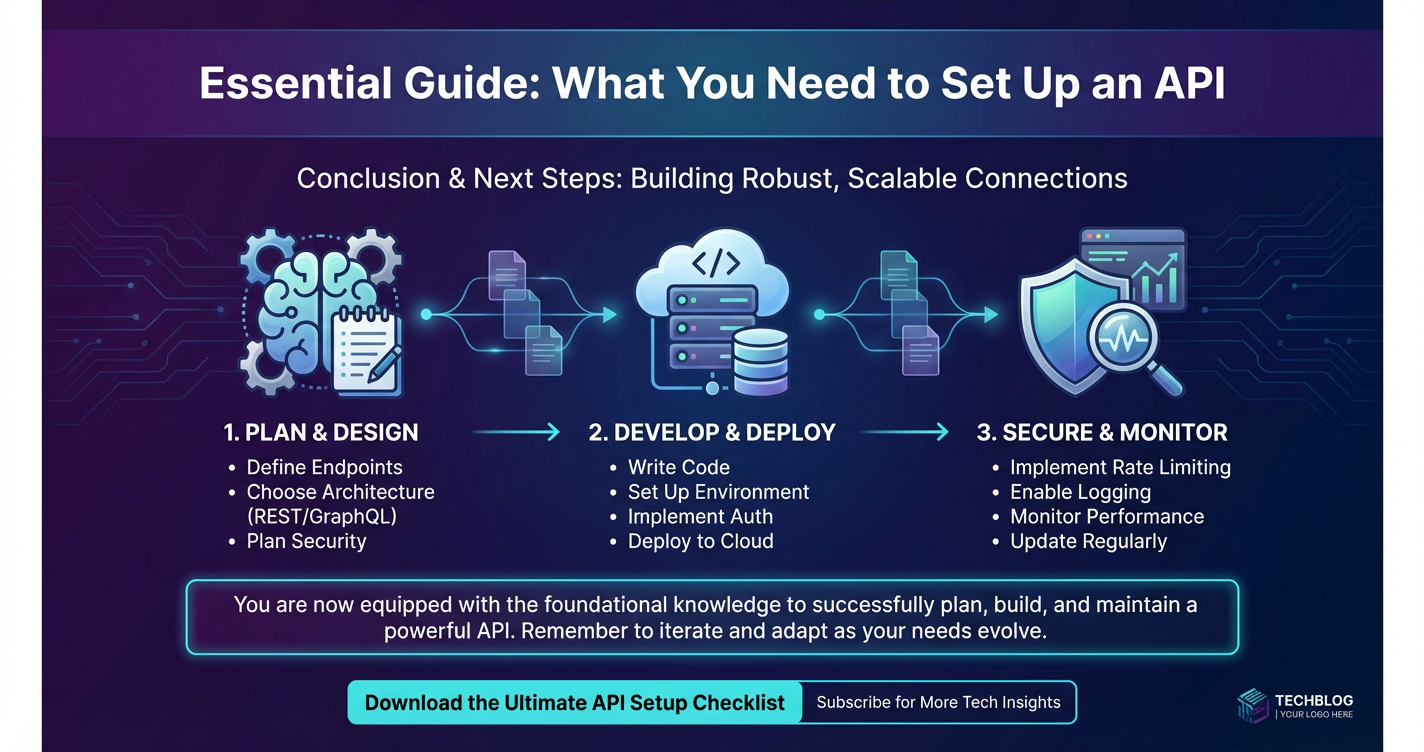
Essential Guide: What You Need to Set Up an API



In the sprawling digital landscape of the 21st century, where applications and services constantly exchange data, the Application Programming Interface (API) stands as the indispensable connective tissue. It is the silent workhorse behind every seamless interaction, from checking your social media feed to making an online purchase, or even the sophisticated operations within complex enterprise systems. An API is more than just a piece of code; it is a contract, a precisely defined set of rules and protocols that allows different software components to communicate with each other. Without APIs, the modern interconnected web, mobile applications, and the burgeoning world of artificial intelligence would simply grind to a halt.
The journey of setting up an api is multifaceted, encompassing careful design, robust development, rigorous security measures, comprehensive documentation, and ultimately, effective deployment and management. It's a process that demands foresight, attention to detail, and a deep understanding of the underlying principles that govern robust software interactions. This guide will meticulously walk you through every critical aspect, from conceptualization and design to the crucial role of an api gateway and the standardization power of OpenAPI, ensuring you have a holistic understanding of what it truly takes to build and maintain a successful API ecosystem. Whether you're a budding developer, a seasoned architect, or a business leader looking to leverage the power of programmatic access, this comprehensive exploration will illuminate the path to constructing efficient, secure, and scalable APIs that drive innovation and connectivity.
I. Introduction to APIs: The Digital Connective Tissue
The concept of an api is elegantly simple yet profoundly impactful. At its core, an API acts as an intermediary that allows two separate software applications to talk to each other. Imagine a waiter in a restaurant: you, the customer, represent one application, and the kitchen represents another. You don't go into the kitchen yourself to get your food; instead, you tell the waiter what you want (a request). The waiter takes your request to the kitchen, translates it, and brings back your food (the response). In this analogy, the waiter is the API – facilitating communication without requiring either party to understand the internal workings of the other.
This abstraction is precisely why APIs are so essential in modern software development. They enable modularity, allowing developers to build complex systems by assembling smaller, independent components. Instead of rewriting code for common functionalities like user authentication, payment processing, or map services, developers can simply integrate existing APIs provided by specialized services. This not only dramatically accelerates development cycles but also ensures higher quality and reliability, as these integrated APIs are often maintained and optimized by dedicated teams. The result is a vibrant ecosystem where innovation flourishes, as developers can focus on unique features rather than reinventing foundational wheels. Moreover, APIs foster a culture of open innovation, allowing third-party developers to build new applications and services on top of existing platforms, thereby extending their reach and utility far beyond their original scope. This extensibility is a cornerstone of platforms like social media giants, e-commerce marketplaces, and cloud providers, all of which heavily rely on robust API offerings to power their vast ecosystems.
Historically, APIs have evolved significantly. Early forms were often tightly coupled libraries or operating system interfaces. With the advent of the internet, the focus shifted to web APIs, which leverage standard internet protocols like HTTP. While various types exist, such as SOAP (Simple Object Access Protocol) which relies on XML and strict contracts, and GraphQL which offers more flexibility in data fetching, the dominant paradigm for web APIs today is REST (Representational State Transfer). RESTful APIs are stateless, use standard HTTP methods (GET, POST, PUT, DELETE), and typically transmit data in JSON or XML formats, making them highly scalable, flexible, and easy to consume across diverse client applications, from web browsers to mobile apps and IoT devices. Understanding these foundational concepts is the first crucial step in embarking on the journey of setting up your own API. This guide will primarily focus on the principles and practices of building RESTful APIs, given their widespread adoption and versatility, while also touching upon how other modern api paradigms fit into the broader development landscape.
II. The Foundational Pillars: Understanding Your API's Purpose and Design
Before a single line of code is written, the most critical phase in setting up an api is the conceptualization and design. Just as an architect would never begin construction without detailed blueprints, an API developer must meticulously plan the API's purpose, scope, and structure. This foundational work dictates not only the ease of development but, more importantly, the API's usability, scalability, and long-term maintainability. Rushing through this stage often leads to costly redesigns, frustrated consumers, and a tangled mess of code that is difficult to evolve.
Defining Your API's Purpose and Scope
Every successful API begins with a clear understanding of its raison d'être. What specific problem is this API designed to solve? Is it to allow external applications to retrieve user profiles, process payments, manage inventory, or perhaps integrate with an artificial intelligence model? Clearly articulating the core functionality prevents scope creep and ensures the API remains focused and efficient. Consider the target consumers: are they internal development teams, trusted partners, or the general public? The audience will influence everything from the security mechanisms to the level of detail in the documentation.
Next, define the data models and resources that the API will expose or manipulate. In a RESTful API, everything is treated as a resource, identifiable by a unique URI. For example, if you're building an API for an e-commerce platform, resources might include /products, /users, /orders, and /categories. Each resource will have specific attributes (e.g., a product might have name, price, description). A clear understanding of these data structures, their relationships, and the operations that can be performed on them (create, read, update, delete – CRUD) is paramount. This mapping forms the bedrock of your API contract and ensures consistency across all endpoints. Moreover, delve into the business logic that governs these interactions. What rules apply when creating a new user? What validations must a product submission pass? These rules inform the API's behavior and response patterns, ensuring it aligns with the underlying business requirements.
Designing Your API for Usability and Scalability
Designing an API is an art and a science, balancing functional requirements with principles of good software engineering. The goal is to create an API that is intuitive for developers to use, robust in its performance, and adaptable to future changes.
RESTful Principles and Naming Conventions
For RESTful APIs, adherence to core principles is key. Resources should be identified by nouns (e.g., /users, /products), not verbs (e.g., /getUsers). HTTP methods should define the action: GET for retrieval, POST for creation, PUT for complete replacement, PATCH for partial updates, and DELETE for removal. Endpoints should be clear, consistent, and hierarchical, reflecting the relationships between resources (e.g., /users/{userId}/orders). Parameter names should be descriptive and unambiguous. Consistency in naming conventions across your entire API surface greatly reduces the learning curve for developers and minimizes errors.
Versioning Strategies
As your API evolves, you will inevitably introduce breaking changes. Versioning is essential to manage this evolution without disrupting existing clients. Common strategies include: * URL Versioning: Embedding the version in the URL (e.g., /v1/users). This is straightforward but can lead to URL bloat. * Header Versioning: Specifying the version in an HTTP header (e.g., Accept: application/vnd.myapi.v1+json). This keeps URLs clean but is less visible. * Query Parameter Versioning: Using a query parameter (e.g., /users?version=1). Simple but less RESTful.
Each approach has its trade-offs. The choice often depends on the specific needs of your project and the preferences of your target audience. It's crucial to establish a clear versioning policy early on and communicate it effectively.
Error Handling and Status Codes
A well-designed API communicates errors clearly and consistently. Using standard HTTP status codes is fundamental: * 2xx (Success): 200 OK, 201 Created, 204 No Content. * 4xx (Client Error): 400 Bad Request, 401 Unauthorized, 403 Forbidden, 404 Not Found, 409 Conflict, 429 Too Many Requests. * 5xx (Server Error): 500 Internal Server Error, 503 Service Unavailable.
Beyond status codes, providing a structured error response body (e.g., JSON) that includes a clear error message, a unique error code, and possibly a link to more detailed documentation helps clients debug issues efficiently. Consistency in error responses is just as important as consistency in successful responses.
Authentication and Authorization
Security is not an afterthought; it must be designed into the api from day one. Authentication verifies the identity of the client making the request, while authorization determines what that authenticated client is allowed to do. Common authentication methods include: * API Keys: Simple tokens passed in headers or query parameters. Suitable for non-sensitive data or internal APIs. * Basic Authentication: Username and password encoded in base64. Simple but less secure for public APIs. * OAuth 2.0: A powerful authorization framework, not an authentication protocol itself, but commonly used for delegated access (e.g., allowing a third-party app to access a user's data on your platform without sharing their credentials). * JSON Web Tokens (JWT): Compact, URL-safe means of representing claims to be transferred between two parties. Often used with OAuth 2.0 or as a standalone token-based authentication mechanism.
The choice of method depends on the API's exposure and sensitivity of the data. Authorization typically involves checking roles or permissions associated with the authenticated user or application. Granular control over permissions ensures that clients can only access the resources they are explicitly allowed to, adhering to the principle of least privilege.
Data Formats
While XML was prevalent in older web services, JSON (JavaScript Object Notation) has become the de facto standard for data exchange in modern RESTful APIs due to its lightweight nature, human readability, and ease of parsing in virtually all programming languages. Ensure your API consistently uses JSON for both request bodies and response payloads. Sometimes, for specific use cases, other formats like protocol buffers or MessagePack might be considered for performance, but for general-purpose web APIs, JSON offers the best balance of usability and efficiency.
By laying these foundational pillars with meticulous care, you establish a robust and extensible framework for your API, significantly reducing future development complexities and enhancing its appeal to consumers. This rigorous design phase is an investment that pays dividends throughout the entire lifecycle of your API.
III. The Development Phase: Bringing Your API to Life
With a solid design blueprint in hand, the next stage is to transition from concept to code – the development phase. This is where the chosen programming languages, frameworks, and databases converge to bring your api to life, transforming theoretical endpoints into functional services. The decisions made here profoundly impact the API's performance, scalability, and the agility with which it can be maintained and updated. It's a hands-on process that requires careful implementation, adherence to coding standards, and rigorous testing to ensure robustness and reliability.
Choosing Your Technology Stack
The technology stack you select will be the backbone of your API. There isn't a single "best" stack; the ideal choice depends on factors such as team expertise, project requirements, performance needs, and existing infrastructure.
Programming Languages and Frameworks
- Python: Popular for its readability, extensive libraries, and rapid development. Frameworks like Django REST Framework (for full-stack capabilities) and Flask (for lightweight microservices) are excellent choices. Python is often favored for data science and AI-driven APIs due to its rich ecosystem in these areas.
- Node.js (JavaScript): Ideal for real-time applications and highly concurrent services due to its event-driven, non-blocking I/O model. Express.js is the most common framework, offering a minimalist yet powerful foundation for building REST APIs.
- Java: A mature, highly performant, and scalable language, often used in large enterprise environments. Spring Boot is the de facto standard framework, simplifying API development with its convention-over-configuration approach and comprehensive ecosystem.
- Go (Golang): Known for its excellent performance, concurrency primitives, and efficiency, Go is gaining traction for building high-performance APIs and microservices. It's often chosen for its smaller memory footprint and faster execution times compared to interpreted languages.
- PHP: With frameworks like Laravel and Symfony, PHP remains a strong contender, particularly for web-centric APIs due to its deep integration with web servers and large developer community.
- Ruby: Ruby on Rails offers a convention-over-configuration approach that enables rapid API development, often favored for its developer-friendly syntax and productivity.
The decision often comes down to balancing development speed, performance requirements, and the skill set of your engineering team. A consistent choice across projects can also simplify maintenance and knowledge sharing.
Databases
The choice of database significantly impacts how your API stores and retrieves data. * Relational Databases (SQL): MySQL, PostgreSQL, SQL Server, Oracle. * Pros: Strong consistency, mature ecosystems, complex querying capabilities (joins). Ideal when data relationships are critical and data integrity is paramount. * Cons: Can be less flexible for rapidly changing schemas, horizontal scaling can be more challenging. * NoSQL Databases: MongoDB (document), Cassandra (column-family), Redis (key-value), Neo4j (graph). * Pros: High flexibility in schema design, excellent horizontal scalability, optimized for specific access patterns. Ideal for large volumes of unstructured or semi-structured data, or when high availability and performance are prioritized over strict consistency. * Cons: Less mature tooling for complex queries, consistency models can vary.
Often, a polyglot persistence strategy is employed, where different services within an ecosystem use the database type best suited for their specific data needs. For many general-purpose APIs, a robust relational database remains a common and excellent choice, but NoSQL databases offer powerful alternatives for specific use cases like caching, real-time analytics, or large-scale user profile storage.
Implementing API Endpoints
Once the stack is chosen, the core task is implementing the actual API endpoints. This involves writing the code that handles incoming HTTP requests, processes the business logic, interacts with the database, and constructs the appropriate HTTP responses.
Handling HTTP Methods
Each endpoint must correctly implement the HTTP methods defined during the design phase: * GET: Retrieve data. Should be idempotent and safe (no side effects). * POST: Create a new resource. * PUT: Update an existing resource completely, replacing its entire state. * PATCH: Partially update an existing resource. * DELETE: Remove a resource.
Your code needs to parse the incoming request, extract parameters (from the URL path, query string, or request body), apply any necessary validations, and then dispatch the request to the appropriate business logic layer.
Request/Response Body Handling
For POST, PUT, and PATCH requests, the API will typically receive data in the request body, most commonly as JSON. Your server-side code must be able to parse this JSON payload, validate its structure and content against your defined schema, and then use this data to perform operations (e.g., create a new user record). Similarly, for GET and POST responses, the server constructs a JSON payload containing the requested data or the status of the operation, ensuring it adheres to the designed output format.
Parameter Validation and Sanitization
A critical security and reliability measure is robust input validation. Never trust client-supplied data. Validate all parameters (path, query, body) against expected types, formats, lengths, and constraints. For instance, an email field must be a valid email format, and a price field must be a positive number. Sanitization involves cleaning or escaping input to prevent common vulnerabilities like SQL injection, cross-site scripting (XSS), or command injection. Most modern frameworks provide middleware or libraries to simplify these tasks, but developers must ensure they are properly configured and applied to all inputs.
Business Logic Integration
This is where the API's actual functionality resides. After validation, the request data is passed to the core business logic components. These components perform the specific operations of your application, whether it's calculating an order total, updating a user's subscription, or fetching data from an AI model. The API layer acts as a thin wrapper around this logic, translating HTTP requests into domain-specific operations and then translating the domain's results back into HTTP responses.
Data Persistence and Integration
Connecting your API to a database is fundamental for most applications.
Connecting to Databases
Most frameworks provide ORMs (Object-Relational Mappers) for SQL databases or ODMs (Object-Document Mappers) for NoSQL databases. These tools abstract away the complexities of direct database interaction, allowing developers to work with database records as objects in their chosen programming language. For example, in Python with Django, you define models that map directly to database tables, and the ORM handles SQL generation for you.
ORMs/ODMs
While ORMs/ODMs simplify development, it's crucial to understand their behavior, especially regarding performance. N+1 query problems, inefficient joins, and unindexed queries can severely degrade API performance. Careful query optimization and understanding of the underlying database operations are essential. For very high-performance scenarios or complex queries, direct SQL queries might still be necessary.
Transaction Management
For operations that involve multiple database changes that must all succeed or all fail together (e.g., transferring money from one account to another), transaction management is vital. Ensuring atomicity, consistency, isolation, and durability (ACID properties) prevents data corruption. Most ORMs and database drivers provide mechanisms for managing transactions, allowing you to commit or rollback a series of database operations as a single logical unit.
Testing Your API
Thorough testing is non-negotiable for building a reliable API. It catches bugs early, verifies functionality, and ensures the API behaves as expected under various conditions.
Unit Testing
Focuses on individual, isolated units of code (functions, methods, classes). For an API, this might involve testing validation logic, utility functions, or small parts of business logic. These tests are fast to run and help pinpoint exact locations of defects.
Integration Testing
Verifies that different components of the API work correctly together. This includes testing the interaction between the API endpoint, business logic, and the database. For example, an integration test might send a POST request to /users, verify that a new user is created in the database, and then send a GET request to retrieve that user.
End-to-End Testing
Simulates a complete user flow, often involving a client application interacting with the API. While more complex and slower to run, end-to-end tests provide confidence that the entire system functions correctly from a user's perspective. For APIs, this might involve using tools that can send HTTP requests and assert on the responses, sometimes chaining multiple requests together to simulate a workflow.
Tools for Testing
- Postman/Insomnia/curl: Excellent for manual testing, debugging, and exploring API endpoints.
- Automated Testing Frameworks: Most programming languages have dedicated testing frameworks (e.g.,
pytestfor Python,Jestfor Node.js,JUnitfor Java). These frameworks allow you to write programmatic tests that can be run automatically as part of your CI/CD pipeline. Libraries likeSuperTest(Node.js) specifically help with testing HTTP endpoints.
A comprehensive testing strategy, encompassing all these levels, provides a safety net for your API, allowing you to confidently make changes and deploy updates without fear of introducing regressions. This meticulous attention to detail throughout the development phase is what transforms a mere concept into a robust and reliable api that can serve its intended purpose effectively.
IV. Documentation and Standardization: The Blueprint for Consumption
Building a functional api is only half the battle; for it to be truly valuable, it must be consumable. This is where comprehensive and standardized documentation becomes paramount. An API without clear, up-to-date documentation is like a locked door without a key – its potential remains inaccessible. Documentation serves as the instruction manual for developers, guiding them on how to interact with your service, understand its capabilities, and troubleshoot any issues. It is the bridge between your API's creators and its consumers, fostering adoption and reducing the burden on your support teams.
Why API Documentation is Paramount
The importance of good API documentation cannot be overstated. It directly impacts several critical aspects of your API's success:
- Usability and Adoption: Developers are more likely to integrate an API that is easy to understand and use. Well-structured documentation with clear examples reduces the learning curve and encourages adoption. If developers struggle to understand how to make a basic call, they will quickly abandon your API for alternatives.
- Reduced Support Burden: Clear documentation proactively answers common questions, reducing the number of support requests and freeing up your engineering team to focus on development. Developers can self-serve, finding solutions independently.
- Consistency and Quality Assurance: Documenting your API forces you to think through its design logically, identifying inconsistencies or missing functionalities early in the development cycle. It acts as a contract that both sides agree upon, ensuring the API adheres to its specified behavior.
- Faster Onboarding: New team members or partners can quickly get up to speed on how your API works, accelerating their integration efforts.
- Marketing and Branding: Professional, well-presented documentation reflects positively on your organization, signaling attention to detail and a commitment to developer experience. It is often the first interaction a potential user has with your service.
Introducing OpenAPI Specification (formerly Swagger Specification)
In the complex world of APIs, consistency and machine readability are game-changers. This is precisely what the OpenAPI Specification (OAS) provides. OpenAPI is a language-agnostic, human-readable specification for describing RESTful APIs. It allows both humans and machines to understand the capabilities of a service without access to source code, documentation, or network traffic inspection. Born from the Swagger Specification, OpenAPI became a Linux Foundation project in 2016, solidifying its status as a widely adopted industry standard.
What it is and why it's critical for modern APIs
An OpenAPI document, typically written in YAML or JSON, describes your API's endpoints, operation parameters, authentication methods, contact information, terms of use, and more. It’s essentially a blueprint of your API. The critical advantage of OpenAPI is its machine-readability. Because it's structured data, various tools can consume an OpenAPI definition to automate tasks, making the API lifecycle significantly more efficient.
Benefits of OpenAPI
- Machine-Readable Documentation: Automatically generates interactive API documentation (e.g., using Swagger UI or Redoc) that developers can explore directly in their browsers, try out endpoints, and see example requests/responses. This eliminates the manual effort of writing and maintaining documentation, ensuring it's always up-to-date with the code.
- Code Generation: Tools can automatically generate client SDKs (Software Development Kits) in various programming languages directly from the OpenAPI definition. This dramatically speeds up client-side development and reduces integration errors.
- Automated Testing: OpenAPI definitions can be used to generate test cases, ensuring that your API conforms to its specified contract. This enhances the rigor and efficiency of your testing efforts.
- API Design-First Approach: Encourages developers to design the API contract before writing code. This "design-first" approach helps catch inconsistencies and design flaws early, promoting better API design from the outset.
- API Discovery and Management: Centralized OpenAPI definitions make it easier to discover and manage APIs across an organization, feeding into api gateway solutions and developer portals.
Key Components of an OpenAPI document
An OpenAPI document typically includes: * Info: General information about the API (title, version, description, contact details, license). * Servers: The base URLs for the API (e.g., https://api.example.com/v1). * Paths: Detailed descriptions of each endpoint (e.g., /users/{userId}). For each path, it defines the HTTP methods (GET, POST, PUT, DELETE) supported. * Operations: For each HTTP method, it describes the operation: * summary and description of what it does. * parameters (path, query, header, cookie) with their types, descriptions, and whether they are required. * requestBody schema (for POST/PUT/PATCH) defining the expected input data structure. * responses for different HTTP status codes (e.g., 200 OK, 400 Bad Request), including the schema of the response body. * Components: Reusable definitions for schemas (data models), parameters, security schemes, and responses, promoting consistency and reducing redundancy. * Security: Describes the authentication and authorization schemes used by the API (e.g., API keys, OAuth 2.0, JWT).
Here's a simplified example of a component (schema) definition in OpenAPI:
components:
  schemas:
    Product:
      type: object
      required:
        - id
        - name
        - price
      properties:
        id:
          type: string
          format: uuid
          description: Unique identifier for the product
          example: d290f1ee-6c54-4b01-90e6-d701748f0851
        name:
          type: string
          description: Name of the product
          example: Laptop
        description:
          type: string
          nullable: true
          description: Detailed description of the product
          example: High-performance laptop with 16GB RAM
        price:
          type: number
          format: float
          minimum: 0
          description: Price of the product
          example: 1200.00
        category:
          type: string
          enum: [Electronics, Books, Apparel]
          description: Category of the product
          example: Electronics
This snippet clearly defines the structure of a Product object, including data types, required fields, and examples, all in a machine-readable format.
Tools for generating and serving OpenAPI docs
- Swagger UI: The most popular tool for rendering OpenAPI definitions into interactive, browser-based documentation. It allows users to explore endpoints, view schemas, and even make live API calls.
- Redoc: Another excellent tool that generates beautiful, responsive, and customizable documentation from OpenAPI files, often preferred for its modern aesthetic.
- Code Generation Tools: Tools like
Swagger CodegenorOpenAPI Generatorcan create server stubs and client SDKs based on an OpenAPI definition.
The role of OpenAPI in API lifecycle management
OpenAPI plays a central role throughout the entire API lifecycle. In the design phase, it helps standardize the contract. During development, it can drive code generation. In testing, it ensures contract adherence. Post-deployment, it fuels interactive documentation and integration into api gateway solutions for discovery and management. Its pervasive utility makes it an indispensable tool for any modern API initiative.
Best Practices for Writing Documentation
While OpenAPI automates the structural aspects, effective documentation also requires thoughtful content creation:
- Clear Examples: Provide concrete examples of request payloads, response bodies, and API calls (e.g., using
curl). Show both successful responses and various error responses. - Authentication Details: Clearly explain how to authenticate with the API, including necessary headers, parameters, and token acquisition flows.
- Error Codes and Troubleshooting: Document all possible error codes, their meanings, and potential solutions or troubleshooting steps.
- Getting Started Guide: Offer a simple step-by-step guide for new users to make their first API call, helping them quickly experience success.
- Versioning Policy: Clearly state your API's versioning strategy and how to migrate between versions.
- Rate Limits: Inform users about any rate limiting policies to prevent unexpected
429 Too Many Requestserrors. - Interactive and Discoverable: Ensure documentation is easily searchable and allows users to "try it out" directly, which tools like Swagger UI facilitate.
By embracing OpenAPI and adhering to best practices for content, you transform your API from a mere collection of endpoints into a well-understood, easily consumable, and highly valuable service that empowers developers and drives your digital ecosystem forward.
APIPark is a high-performance AI gateway that allows you to securely access the most comprehensive LLM APIs globally on the APIPark platform, including OpenAI, Anthropic, Mistral, Llama2, Google Gemini, and more.Try APIPark now! 👇👇👇
V. Securing Your API: Protecting Your Digital Assets
In an age where data breaches are rampant and cyber threats continually evolve, the security of your api is not merely a feature, but a fundamental requirement. An unsecured API can expose sensitive data, allow unauthorized access, facilitate denial-of-service attacks, and ultimately compromise the integrity and reputation of your entire system. Security must be an integral part of the design and development process, not an afterthought. This section delves into the critical aspects of API security, from understanding common threats to implementing robust authentication, authorization, and data protection mechanisms.
Understanding API Security Threats
To effectively secure an API, one must first understand the common vulnerabilities and attack vectors. The OWASP (Open Web Application Security Project) API Security Top 10 provides a critical awareness of the most prevalent API security risks. While the list itself is dynamic, core threats typically include:
- Broken Object Level Authorization (BOLA/IDOR): The most common API vulnerability. This occurs when an API does not properly validate if a user is authorized to access a specific resource by its ID. An attacker can manipulate the ID in the request to access other users' data.
- Broken User Authentication: Flaws in authentication mechanisms (weak passwords, missing multi-factor authentication, broken session management) allow attackers to impersonate legitimate users.
- Excessive Data Exposure: APIs often expose more data than clients truly need. Attackers can leverage this to gain sensitive information by analyzing verbose error messages or default response structures.
- Lack of Resources & Rate Limiting: Without proper rate limiting, attackers can easily launch brute-force attacks on authentication endpoints or exploit computational resources, leading to denial of service.
- Broken Function Level Authorization: Similar to BOLA, but at the function level. An authenticated user can bypass authorization and access sensitive administrative functions they shouldn't be allowed to.
- Mass Assignment: Clients can submit additional object properties that the server then uses to update an internal data object, potentially overriding properties that should not be changed (e.g., an
isAdminflag). - Security Misconfiguration: Improperly configured security settings (e.g., default credentials, unpatched servers, exposed cloud storage) provide easy entry points for attackers.
- Injection: Similar to traditional web applications, APIs are vulnerable to injection attacks (SQL, NoSQL, Command Injection) when untrusted data is sent to an interpreter as part of a command or query.
- Improper Assets Management: Outdated or deprecated API versions, debug endpoints, or publicly exposed OpenAPI specifications can reveal sensitive information or provide attack surfaces.
- Insufficient Logging & Monitoring: Lack of effective logging and real-time monitoring makes it difficult to detect, investigate, and recover from attacks, allowing breaches to go unnoticed for extended periods.
Addressing these threats requires a multi-layered security approach embedded throughout the API lifecycle.
Authentication Mechanisms in Detail
Authentication establishes who a user or application is. Choosing the right mechanism depends on the API's consumers and the sensitivity of the data.
- API Keys:
- How it works: A simple, unique string (the key) is generated and issued to the client. The client includes this key in each request, typically in a header (
X-API-Key) or a query parameter. - Pros: Easy to implement, simple for clients to use.
- Cons: Keys are often long-lived and difficult to revoke without impacting all users. If compromised, they offer no user-specific context. Not suitable for user-specific data access.
- Secure Handling: Should be transmitted over HTTPS, stored securely by the client (not hardcoded), and ideally rotated regularly.
- How it works: A simple, unique string (the key) is generated and issued to the client. The client includes this key in each request, typically in a header (
- OAuth 2.0:
- How it works: An authorization framework that allows a third-party application to obtain limited access to an HTTP service on behalf of a resource owner. It delegates user authentication to the service that hosts the user account and authorizes third-party applications to access that user account.
- Authorization Flows (Grant Types):
- Authorization Code Grant: The most secure and widely used flow for web applications, involving a redirect to an authorization server.
- Client Credentials Grant: Used for machine-to-machine communication where no user interaction is involved.
- Implicit Grant: (Deprecated for most use cases) Used for single-page applications, now largely replaced by Authorization Code with PKCE.
- PKCE (Proof Key for Code Exchange): An extension to the Authorization Code Grant, specifically designed for public clients (mobile and single-page apps) to prevent authorization code interception attacks.
- Pros: Highly secure for delegated access, granular control over permissions (scopes), tokens are typically short-lived.
- Cons: More complex to implement than API keys.
- JSON Web Tokens (JWT):
- Structure: Composed of three parts: Header (algorithm, token type), Payload (claims like user ID, roles, expiry), and Signature (to verify integrity).
- How it works: After successful authentication (e.g., via username/password), the server issues a JWT. The client stores this token and sends it in the
Authorizationheader (Bearer <token>) with subsequent requests. The server decodes the JWT, verifies its signature, and checks claims without needing to hit a database. - Pros: Stateless (no server-side session storage needed, ideal for microservices), compact, self-contained.
- Cons: Can be challenging to revoke immediately (requires blocklists or short expiry with refresh tokens), not encrypted by default (only signed).
- Refresh Tokens: Often used alongside short-lived access tokens to improve security and user experience. When an access token expires, a longer-lived refresh token can be used to obtain a new access token without re-authenticating the user.
- Mutual TLS (mTLS):
- How it works: Both the client and the server present digital certificates to each other during the TLS handshake, authenticating both sides.
- Pros: Very strong authentication, ensures identity of both communicating parties.
- Cons: More complex to manage certificates, typically used in high-security environments or internal microservice communication.
Authorization Strategies
Once a client is authenticated, authorization determines what resources and actions they are permitted to perform.
- Role-Based Access Control (RBAC): Assigns permissions to roles (e.g.,
admin,editor,viewer), and users are assigned to roles. Simplifies permission management for large user bases. - Attribute-Based Access Control (ABAC): More granular, dynamic authorization based on attributes of the user, resource, and environment. For example, "a user with department
financecan accessdocument Xifdocument Xalso belongs to departmentfinanceand it's within business hours." - Scopes: Used with OAuth 2.0, scopes define specific permissions granted to an application (e.g.,
read:users,write:products).
Data Protection
Protecting data in transit and at rest is paramount.
- Encryption in Transit (TLS/SSL): Absolutely mandatory for all APIs. HTTPS encrypts communication between the client and server, preventing eavesdropping and tampering. All API endpoints must be served over HTTPS.
- Encryption at Rest: Sensitive data stored in databases or file systems should be encrypted. This protects data even if the underlying storage is compromised.
- Input Validation and Sanitization: Reiterate this critical step. It prevents injection attacks by ensuring that all incoming data conforms to expected formats and is free of malicious content.
Rate Limiting and Throttling
To prevent abuse, protect backend resources, and ensure fair usage, implement rate limiting.
- Rate Limiting: Restricts the number of API requests a user or client can make within a given time frame (e.g., 100 requests per minute).
- Throttling: Controls the rate at which an API accepts requests to protect its backend services from overload, potentially queueing requests or applying delays.
Both are crucial for preventing brute-force attacks, denial-of-service (DoS) attacks, and ensuring a stable service for all users. Strategies include fixed window, sliding window, and token bucket algorithms, often implemented at the api gateway level.
API Gateway for Enhanced Security
An api gateway plays a pivotal role in centralizing and enforcing API security policies. It acts as the first line of defense, handling authentication, authorization, rate limiting, and even advanced threat detection before requests ever reach your backend services. By offloading these concerns, backend microservices can focus purely on business logic, leading to a more secure and streamlined architecture. This centralization significantly reduces the surface area for attacks and simplifies security management across a complex API ecosystem.
| Security Feature | Description | Implementation Level |
|---|---|---|
| Authentication | Verifying the identity of the client. | API Gateway, Backend Service, Identity Provider |
| Authorization | Determining what an authenticated client is allowed to do. | API Gateway, Backend Service |
| Data Encryption (TLS) | Encrypting data during transmission over the network. | Load Balancer, API Gateway, Web Server (HTTPS) |
| Input Validation | Ensuring incoming data is safe and conforms to expectations. | Backend Service, API Gateway (for basic validation) |
| Rate Limiting | Restricting the number of requests a client can make over time. | API Gateway, Load Balancer, Backend Service |
| Access Control Lists | Defining specific permissions for users or groups on resources. | API Gateway, Backend Service (Database level) |
| Web Application Firewall (WAF) | Filtering and monitoring HTTP traffic between web apps and the Internet. | External Service, API Gateway |
| Logging & Monitoring | Recording API interactions for auditing and anomaly detection. | API Gateway, Backend Service, Centralized Logging Platform |
Establishing a robust API security posture demands continuous vigilance, regular security audits, and staying informed about emerging threats. By embedding security principles at every stage of development and leveraging specialized tools like api gateways, you can build APIs that are not only functional but also trustworthy and resilient against the ever-present dangers of the digital world.
VI. Deployment and Management: From Code to Production
Bringing an api from a developer's local machine to a production environment where it can serve real users is a complex yet exhilarating phase. It involves packaging the application, deploying it onto servers, configuring infrastructure, and setting up mechanisms to monitor its performance and health. Effective deployment and robust management strategies are crucial for ensuring the API is always available, performs optimally, and can scale to meet growing demand. This stage marks the transition from development to live service, requiring careful planning and execution.
Deployment Strategies
The choice of deployment strategy significantly impacts the agility, scalability, and operational overhead of your API. The landscape has evolved rapidly, offering various options:
- Bare Metal / Virtual Machines (VMs):
- Description: Deploying your API directly onto physical servers or virtualized instances. You manage the operating system, dependencies, and application stack.
- Pros: Full control over the environment, can be cost-effective for stable workloads.
- Cons: Higher operational overhead, slower scaling, less efficient resource utilization compared to newer methods.
- Containers (Docker):
- Description: Packaging your API and all its dependencies into a lightweight, portable container image. Docker is the dominant technology here.
- Pros: Consistency across environments (development, staging, production), isolation of dependencies, rapid deployment and rollback.
- Cons: Requires learning containerization concepts, managing containers can become complex at scale.
- Orchestration (Kubernetes):
- Description: For managing and automating the deployment, scaling, and operations of containerized applications. Kubernetes is the industry standard.
- Pros: High availability, automatic scaling, self-healing capabilities, efficient resource utilization across a cluster of machines.
- Cons: Steep learning curve, significant operational complexity. Best suited for large-scale, microservices-based API architectures.
- Serverless (AWS Lambda, Azure Functions, Google Cloud Functions):
- Description: You deploy individual functions (your API endpoints) rather than entire applications. The cloud provider manages the underlying infrastructure, automatically scales functions up and down based on demand, and you only pay for the compute time consumed.
- Pros: Extremely low operational overhead, automatic scaling to virtually infinite capacity, pay-per-execution cost model (can be very cost-effective for sporadic workloads).
- Cons: Vendor lock-in, cold start issues (initial latency for infrequently used functions), potential for unexpected costs if not monitored, state management can be challenging.
- CI/CD Pipelines:
- Description: Continuous Integration/Continuous Delivery (CI/CD) pipelines automate the process of building, testing, and deploying your API. Tools like Jenkins, GitLab CI/CD, GitHub Actions, and CircleCI are commonly used.
- Pros: Faster, more reliable, and consistent deployments, reduced manual errors, quicker feedback loops for developers.
- Cons: Requires initial setup and configuration, needs ongoing maintenance. The goal is to move from code commit to production deployment with minimal human intervention, ensuring that only thoroughly tested and validated code reaches live environments.
Monitoring and Logging
Once deployed, an API needs constant vigilance. Monitoring and logging are indispensable for understanding its health, performance, and usage patterns.
- Why it's crucial:
- Performance: Detect latency spikes, slow database queries, or inefficient code before they impact users.
- Errors: Identify and troubleshoot bugs, exceptions, and unexpected behavior in real-time.
- Security Incidents: Detect suspicious activity, unauthorized access attempts, or potential breaches.
- Capacity Planning: Understand resource utilization to plan for future scaling needs.
- Metrics to Track:
- Latency: Time taken for the API to respond to requests (average, p90, p99).
- Error Rates: Percentage of requests returning
4xxor5xxstatus codes. - Throughput: Number of requests per second.
- Resource Utilization: CPU, memory, disk I/O, network I/O of the hosting infrastructure.
- Specific Business Metrics: Number of successful transactions, user sign-ups, etc.
- Tools for Monitoring:
- Prometheus & Grafana: A popular open-source stack for collecting time-series metrics and visualizing them in dashboards.
- ELK Stack (Elasticsearch, Logstash, Kibana): For centralized logging, search, and visualization.
- Cloud-Native Solutions: AWS CloudWatch, Azure Monitor, Google Cloud Operations (formerly Stackdriver) provide comprehensive monitoring and logging integrated with their respective cloud platforms.
- Application Performance Monitoring (APM) Tools: Datadog, New Relic, Dynatrace offer deep insights into application code performance, tracing, and infrastructure.
- Centralized Logging: All API logs (access logs, error logs, application logs) should be sent to a centralized logging system. This makes it easy to search, filter, and analyze logs across multiple services and instances, crucial for troubleshooting and auditing.
Scaling Your API
A successful API will experience increased demand, necessitating robust scaling strategies.
- Horizontal vs. Vertical Scaling:
- Vertical Scaling (Scaling Up): Increasing the resources (CPU, RAM) of a single server.
- Pros: Simpler to implement initially.
- Cons: Limited by the capacity of a single machine, creates a single point of failure.
- Horizontal Scaling (Scaling Out): Adding more servers/instances to distribute the load.
- Pros: Highly scalable, improves fault tolerance.
- Cons: Requires careful architecture design (statelessness, load balancing). This is the preferred method for modern, high-traffic APIs.
- Vertical Scaling (Scaling Up): Increasing the resources (CPU, RAM) of a single server.
- Load Balancing:
- Distributes incoming API requests across multiple instances of your API. This prevents any single instance from becoming a bottleneck and ensures high availability. Load balancers can operate at different layers (L4/L7) and use various algorithms (round-robin, least connections).
- Caching Strategies:
- CDN (Content Delivery Network): Caches static assets (images, CSS, JS) and sometimes API responses at edge locations closer to users, reducing latency and backend load.
- In-Memory Caches: (e.g., Redis, Memcached) Store frequently accessed API responses or data in RAM, dramatically speeding up retrieval and reducing database hits.
- Database Caching: Some databases have built-in caching mechanisms, or you can implement query caching.
- API Gateway Caching: Many api gateway solutions offer caching capabilities, intercepting requests and serving cached responses directly.
- Database Scaling:
- Databases are often the primary bottleneck. Strategies include:
- Replication (Read Replicas): Distributing read traffic to multiple copies of the database.
- Sharding/Partitioning: Horizontally distributing data across multiple independent database servers.
- Denormalization: Storing redundant copies of data to optimize read performance for specific queries.
- Specialized Databases: Using NoSQL databases for high-volume, specific access patterns.
- Databases are often the primary bottleneck. Strategies include:
By thoughtfully implementing these deployment, monitoring, and scaling strategies, you ensure your API can reliably serve its users, grow with demand, and maintain high performance even under significant load. This continuous operational excellence is a hallmark of a successful and enduring API.
VII. The Power of an API Gateway: Centralizing Control and Enhancing Performance
As API ecosystems grow, managing individual APIs, securing them, and ensuring their performance can become an increasingly complex and cumbersome task. This is where the api gateway emerges as a critical architectural component. An api gateway acts as a single entry point for all API calls, sitting in front of your backend services (often microservices). It is essentially the "front door" for your entire API landscape, handling common cross-cutting concerns before requests ever reach your core application logic.
What is an API Gateway?
Conceptually, an api gateway is a reverse proxy with added intelligence and functionality specifically tailored for APIs. Instead of clients directly calling individual microservices or backend APIs, they make a single request to the api gateway. The gateway then intelligently routes these requests to the appropriate backend service, while also performing a multitude of other tasks that enhance security, performance, and management. This centralized approach simplifies client-side development, as clients only need to know about the gateway's endpoint, not the intricate details of the backend architecture. It allows the backend to evolve independently, shielded from external clients.
Key Functions and Benefits of an API Gateway
The benefits of implementing an api gateway are extensive, touching almost every aspect of API management:
- Routing and Load Balancing: The gateway can dynamically route incoming requests to different backend services based on defined rules (e.g., URL path, headers, client ID). It can also distribute requests across multiple instances of a service to ensure optimal load distribution and high availability.
- Authentication and Authorization: This is one of the most significant benefits. The api gateway can centralize authentication (e.g., validate API keys, JWTs, OAuth tokens) and enforce authorization policies before requests even reach the backend services. This offloads security concerns from individual services, making them simpler and more focused on business logic.
- Rate Limiting and Throttling: As discussed in the security section, the gateway is the ideal place to implement rate limiting policies. It can enforce per-user, per-IP, or per-API limits, protecting your backend from abuse and ensuring fair resource allocation.
- Caching: The api gateway can cache responses from backend services. For frequently accessed, non-volatile data, this dramatically improves response times and reduces the load on backend systems, leading to better performance and lower infrastructure costs.
- Request/Response Transformation: It can modify request and response payloads on the fly. This includes translating data formats (e.g., from XML to JSON), adding or removing headers, or aggregating responses from multiple services into a single, unified response for the client. This is particularly useful for adapting legacy APIs or creating a "BFF" (Backend for Frontend) pattern.
- Monitoring and Analytics: By being the single point of entry, the api gateway can capture comprehensive metrics and logs for all API traffic. This provides a centralized view of API usage, performance, error rates, and security events, which is invaluable for operational intelligence and troubleshooting.
- Version Management: The gateway can simplify API versioning by routing requests based on version information in the URL or headers, allowing you to run multiple API versions simultaneously without breaking existing clients.
- Security Policies: Beyond basic authentication and authorization, an api gateway can enforce advanced security policies such as IP whitelisting/blacklisting, WAF (Web Application Firewall) functionalities to detect and block malicious traffic, and DDoS protection.
- Developer Portal: Many api gateway solutions include or integrate with developer portals, which provide a self-service platform for developers to discover APIs, access documentation (OpenAPI specifications), manage their API keys, and monitor their usage.
Choosing an API Gateway
The market offers a wide array of api gateway solutions, each with its strengths:
- Open-source vs. Commercial Options:
- Open Source: Kong Gateway, Apache APISIX, Tyk, Gloo Edge. Offer flexibility, community support, and no licensing costs, but require more self-management and expertise.
- Commercial: Apigee (Google), AWS API Gateway, Azure API Management, Nginx Plus, Mulesoft Anypoint Platform. Provide enterprise-grade features, professional support, and managed services, often at a higher cost.
- Cloud-Native Gateways vs. Self-Hosted:
- Cloud-Native: Gateways offered as managed services by cloud providers (AWS API Gateway, Azure API Management). They integrate seamlessly with other cloud services and handle infrastructure management, but can lead to vendor lock-in.
- Self-Hosted: Deploying an api gateway on your own infrastructure (e.g., Kong, Nginx Plus). Offers maximum control and portability but increases operational responsibility.
- Factors to Consider:
- Features: Does it support your required authentication schemes, caching, transformation, rate limiting, and monitoring needs?
- Scalability: Can it handle your projected traffic volume and scale horizontally?
- Cost: Licensing, infrastructure, and operational costs.
- Ease of Use/Management: How easy is it to configure, deploy, and maintain policies?
- Integration: How well does it integrate with your existing technology stack, CI/CD pipelines, and monitoring tools?
- Community/Support: The availability of community forums, documentation, or professional support.
Implementing an API Gateway
Implementing an api gateway typically involves: 1. Deployment: Setting up the gateway instance(s) on your chosen infrastructure. 2. API Definition: Defining your backend APIs to the gateway, specifying their base URLs and any upstream services. 3. Routing Rules: Configuring how incoming requests are mapped to specific backend services. 4. Policy Configuration: Applying security policies (authentication, authorization), rate limits, caching rules, and transformation logic to individual APIs or groups of APIs. 5. Monitoring Integration: Connecting the gateway's metrics and logs to your centralized monitoring systems.
Introducing APIPark: An Open Source AI Gateway & API Management Platform
In the rapidly evolving landscape of API management, especially with the integration of artificial intelligence, platforms like APIPark are becoming increasingly vital. APIPark stands out as an all-in-one AI gateway and API developer portal that is open-sourced under the Apache 2.0 license. It is meticulously designed to help developers and enterprises alike to manage, integrate, and deploy both traditional REST services and advanced AI services with remarkable ease and efficiency.
APIPark directly addresses many of the challenges associated with setting up and managing modern APIs, particularly those involving AI models. Its core value proposition lies in its ability to centralize and simplify complex API interactions. Imagine having to integrate a dozen different AI models, each with its own authentication method, data format, and invocation pattern. APIPark solves this by offering quick integration of 100+ AI models under a unified management system for authentication and cost tracking. This means your developers don't need to learn the intricacies of each AI provider; they interact with a single, standardized interface.
Furthermore, APIPark introduces a Unified API Format for AI Invocation. This is a game-changer, as it standardizes the request data format across all integrated AI models. This standardization ensures that future changes in underlying AI models or prompts do not necessitate modifications to your application or microservices, thereby significantly simplifying AI usage and reducing maintenance costs. This level of abstraction is precisely what a robust api gateway should offer: shielding consumers from backend complexities.
Beyond mere integration, APIPark empowers users with Prompt Encapsulation into REST API. This feature allows you to quickly combine various AI models with custom prompts to create powerful new APIs. For instance, you could rapidly spin up a custom sentiment analysis API, a translation API, or a data analysis API, all built on top of existing AI models but tailored to your specific business needs, and exposed as simple REST endpoints. This capability makes advanced AI accessible and consumable via standard api calls.
APIPark provides End-to-End API Lifecycle Management, assisting with the entire journey from design and publication to invocation and decommissioning. It helps regulate API management processes, handling critical functions like traffic forwarding, load balancing, and versioning of published APIs. This comprehensive approach simplifies the operational aspects, ensuring that your APIs are well-governed throughout their existence.
For larger organizations, API Service Sharing within Teams is a critical feature. APIPark enables the centralized display of all API services, making it effortless for different departments and teams to discover and utilize the required API services. Coupled with Independent API and Access Permissions for Each Tenant, it allows for the creation of multiple teams, each with independent applications, data, user configurations, and security policies, all while sharing underlying applications and infrastructure to improve resource utilization and reduce operational costs. This multi-tenancy model is crucial for enterprise-grade deployments.
Security is also a cornerstone of APIPark, with features like API Resource Access Requires Approval, which ensures callers must subscribe to an API and await administrator approval before invocation, preventing unauthorized API calls and potential data breaches. Performance is another highlight, rivaling Nginx with capabilities of over 20,000 TPS on modest hardware and supporting cluster deployment for large-scale traffic.
Finally, detailed API Call Logging and Powerful Data Analysis features provide comprehensive insights into API usage, performance trends, and potential issues, enabling proactive maintenance and rapid troubleshooting. With its quick deployment in just 5 minutes via a single command line, APIPark offers an accessible yet powerful solution for modern API management, particularly for those looking to harness the power of AI seamlessly within their existing api infrastructure. Whether you're a startup leveraging its open-source benefits or an enterprise considering its commercial version for advanced features and professional support, APIPark presents a compelling choice for enhancing efficiency, security, and data optimization across your API ecosystem.
VIII. Advanced Considerations and Best Practices
Building a foundational api with robust security and an api gateway is a significant achievement. However, the world of API development is dynamic, constantly evolving with new architectural patterns and technologies. To truly master API creation and ensure your services remain competitive, scalable, and responsive, it's essential to consider more advanced concepts and continually adopt best practices. These considerations often move beyond basic CRUD operations to embrace real-time capabilities, diverse querying models, and sophisticated operational insights.
Event-Driven Architectures and Webhooks
While traditional RESTful APIs are excellent for request-response interactions, they are inherently pull-based: clients must repeatedly poll the API to check for new data or changes. For scenarios requiring real-time updates or asynchronous communication, event-driven architectures and webhooks offer a more efficient push-based model.
- Event-Driven Architectures: In this pattern, services communicate by publishing events when significant state changes occur, and other services subscribe to these events. This decouples services, making them more resilient and scalable. For example, instead of an order processing API having to explicitly call a shipping API, the order API could publish an "OrderCreated" event, which the shipping API (and other interested services like inventory, notification, or CRM) would consume asynchronously. Technologies like Apache Kafka, RabbitMQ, or cloud-native messaging services (AWS SQS/SNS, Azure Service Bus, Google Cloud Pub/Sub) are central to this approach.
- Webhooks: Webhooks are user-defined HTTP callbacks. When an event occurs in one system, it automatically sends an HTTP
POSTrequest to a predefined URL (the webhook URL) provided by the consuming application. This allows third-party applications to receive real-time notifications without polling. For instance, a payment gateway might use a webhook to notify your application when a transaction is successful, rather than your application continuously checking the transaction status. Implementing webhooks requires careful consideration of security (signature verification), retry mechanisms for failed deliveries, and clear documentation for consumers.
Integrating these asynchronous patterns can significantly improve the responsiveness and efficiency of your API ecosystem, especially when dealing with long-running processes or distributed systems.
GraphQL vs. REST
While REST has dominated API development for years, GraphQL has emerged as a powerful alternative, particularly for complex client applications and microservices architectures.
- When to Choose GraphQL:
- Flexibility and Efficiency: GraphQL allows clients to request exactly the data they need, and nothing more, in a single request. This eliminates over-fetching (getting more data than necessary) and under-fetching (needing multiple requests to get all required data), which are common problems with REST. This is especially beneficial for mobile applications where network bandwidth and battery life are critical.
- Complex Data Relationships: For applications with highly interconnected data (e.g., social graphs), GraphQL's graph-like querying model is more natural and efficient.
- Rapid UI Development: Frontend developers can rapidly iterate on UI changes without needing backend modifications, as they control the data fetching directly.
- Aggregating Microservices: A GraphQL layer can act as an aggregation point, combining data from multiple backend microservices into a single, unified API for clients.
- Key Differences:
- Single Endpoint: GraphQL typically exposes a single
/graphqlendpoint, where clients send queries or mutations. REST uses multiple endpoints for different resources. - Schema Definition Language (SDL): GraphQL APIs are defined by a strict type system (schema) that dictates what data can be queried and mutated.
- Queries vs. Mutations: Clients send
queriesto fetch data andmutationsto modify data. - Versioning: GraphQL typically avoids traditional versioning; instead, schema evolution is managed by adding new fields and types, and deprecating old ones gracefully.
- Single Endpoint: GraphQL typically exposes a single
While GraphQL offers compelling advantages, it also introduces new complexities, such as managing the GraphQL server, potential N+1 query problems in resolvers, and the overhead of learning a new query language. The choice between REST and GraphQL often depends on the specific project requirements, team expertise, and client needs. Many organizations use both, leveraging REST for simple resource access and GraphQL for more complex data aggregation and frontend flexibility.
API Versioning Strategies in Depth
While we touched upon versioning in the design phase, it's crucial to delve deeper into its implications and best practices for managing long-term API evolution. Bad versioning can lead to significant friction for consumers and operational headaches.
- Header Versioning: (e.g.,
Accept: application/vnd.myapi.v2+json)- Pros: Clean URLs, allows negotiation of content types and versions within the same URL.
- Cons: Less intuitive for simple
curlcommands, requires clients to explicitly set headers.
- URL Versioning: (e.g.,
/v2/users)- Pros: Very clear and easy to understand, visible in the URL, simple for clients.
- Cons: URLs can become long, requires routing rules for each version, not strictly RESTful if considered as part of the resource identifier.
- Query String Versioning: (e.g.,
/users?api-version=2)- Pros: Simple to implement.
- Cons: Less semantically meaningful, can be easily forgotten by clients, not strictly RESTful.
- Deprecation Policies: When you introduce a new API version, you must have a clear deprecation policy for older versions. This involves:
- Announcing deprecation: Give clients ample notice (e.g., 6-12 months) before removing an old version.
- Communication: Clearly communicate the deprecation timeline and migration guide to affected clients.
- Graceful Shutdown: Monitor usage of deprecated versions and phase them out gradually.
- Support: Continue to provide critical bug fixes for deprecated versions during the transition period, but cease new feature development.
The goal is to introduce changes without breaking existing integrations, providing a stable and predictable experience for API consumers.
API Monetization Strategies
For many businesses, APIs are not just internal tools but products in themselves. Monetizing your API can open new revenue streams and foster an ecosystem of innovation.
- Freemium Model: Offer a basic tier for free with limited features or usage, then charge for premium features or higher usage limits. This attracts developers and allows them to experiment before committing.
- Tiered Pricing: Offer different pricing plans based on usage volume, features, or service level agreements (SLAs).
- Pay-per-Use: Charge clients based on the number of API calls, data transferred, or compute resources consumed. Requires accurate usage tracking and billing.
- Subscription Model: Flat monthly or annual fees for unlimited access or specific feature sets.
- Revenue Share: Partner with other businesses and share a percentage of the revenue generated through API integration.
Implementing monetization requires robust usage tracking, billing systems, and clear pricing models, often managed through the api gateway and associated developer portal.
Observability
Beyond basic monitoring, observability is about understanding the internal state of a system based on its external outputs. It involves instrumenting your API to generate rich data that allows you to ask arbitrary questions about its behavior without deploying new code.
- Metrics: Numerical data representing the state of the system (e.g., request count, error rate, latency).
- Logs: Discrete events that provide a narrative of what happened (e.g., application errors, user actions).
- Traces: End-to-end views of a request's journey through multiple services and components, showing how different parts of a distributed system interact. Tools like OpenTelemetry or Zipkin enable distributed tracing.
By combining these three pillars – logs, metrics, and traces – you gain a deep, holistic understanding of your API's performance, health, and behavior in complex, distributed environments, enabling proactive problem solving and faster incident response. This is especially crucial for microservices architectures where a single request might traverse dozens of services.
These advanced considerations are not merely optional enhancements; they are increasingly becoming essential practices for building resilient, efficient, and future-proof APIs that can thrive in the demanding digital landscape. Embracing them ensures your API remains a powerful asset, capable of adapting to new challenges and opportunities.
IX. Conclusion: The Evolving Landscape of API Development
The journey of setting up an api is a profound testament to the intricate dance between design, development, security, and operational excellence. From the initial conceptualization of its purpose and the meticulous crafting of its design, through the rigorous development, comprehensive documentation leveraging standards like OpenAPI, and the unyielding commitment to security, every stage plays a critical role in shaping a robust and valuable digital asset. The culmination of these efforts lies in effective deployment, continuous monitoring, strategic scaling, and the intelligent leverage of powerful tools like an api gateway to manage the burgeoning complexity of modern interconnected systems.
We have explored the foundational principles of REST, delved into the intricacies of various authentication and authorization mechanisms, emphasized the non-negotiable importance of security against pervasive threats, and highlighted the transformative power of standardization with OpenAPI. Crucially, we’ve seen how an api gateway, like the open-source APIPark, acts as an indispensable control plane, centralizing management, bolstering security, enhancing performance, and streamlining the integration of advanced functionalities, including the rapidly growing domain of artificial intelligence. APIPark's ability to unify AI model integration, standardize invocation formats, and provide comprehensive lifecycle management underscores the evolving demands on API infrastructure.
The landscape of API development is far from static. It continues to be shaped by emerging paradigms such as event-driven architectures, the rising prominence of GraphQL for flexible data fetching, and the relentless pursuit of observability in distributed systems. As businesses increasingly rely on APIs to power their digital ecosystems, foster innovation, and connect with partners and customers, the principles outlined in this guide will remain evergreen. Building a successful API is not a one-time project; it is a continuous journey of refinement, adaptation, and unwavering commitment to delivering an exceptional developer experience. By embracing these essential guidelines and leveraging the right tools and strategies, you are not just setting up an API; you are laying the groundwork for digital transformation and unlocking immense potential for future growth and connectivity.
X. FAQ Section
1. What is the fundamental purpose of an API? An API (Application Programming Interface) serves as a software intermediary that allows two separate applications to communicate and exchange data. It defines the rules and protocols for interaction, enabling different software components to talk to each other without needing to understand each other's internal workings. This facilitates modularity, accelerates development, and fosters integration across diverse systems.
2. Why is an API Gateway considered essential for modern API architectures? An api gateway acts as a single entry point for all API calls, sitting in front of backend services. It centralizes cross-cutting concerns such as authentication, authorization, rate limiting, caching, and request/response transformation. This not only simplifies client-side development and shields backend complexity but also enhances security, improves performance, and provides a centralized point for monitoring and analytics across your entire API ecosystem.
3. What role does OpenAPI play in setting up an API? OpenAPI Specification (OAS) is a language-agnostic, human-readable format (YAML or JSON) for describing RESTful APIs. It acts as a machine-readable blueprint of your API, detailing endpoints, operations, parameters, authentication, and data models. OpenAPI is crucial because it enables automatic generation of interactive documentation (e.g., Swagger UI), client SDKs, server stubs, and test cases, significantly streamlining development, promoting consistency, and improving the developer experience.
4. How does APIPark address challenges in API management, especially with AI integration? APIPark is an open-source AI gateway and API management platform designed to simplify the management, integration, and deployment of both traditional REST and AI services. It addresses challenges by offering quick integration of 100+ AI models with unified authentication and cost tracking, standardizing AI invocation formats, enabling prompt encapsulation into REST APIs, and providing end-to-end API lifecycle management. This helps developers easily leverage and manage complex AI models through a standardized api interface, reducing development and maintenance overhead.
5. What are the key security considerations when setting up an API? API security is paramount and must be designed in from the start. Key considerations include: implementing robust authentication (e.g., OAuth 2.0, JWT, API Keys) and authorization (RBAC, ABAC); ensuring all data in transit is encrypted with TLS/SSL (HTTPS); performing rigorous input validation and sanitization to prevent injection attacks; implementing rate limiting and throttling to protect against abuse and DDoS attacks; and regularly reviewing for vulnerabilities outlined by OWASP API Security Top 10. An api gateway can centralize and enforce many of these security policies.
🚀You can securely and efficiently call the OpenAI API on APIPark in just two steps:
Step 1: Deploy the APIPark AI gateway in 5 minutes.
APIPark is developed based on Golang, offering strong product performance and low development and maintenance costs. You can deploy APIPark with a single command line.
curl -sSO https://download.apipark.com/install/quick-start.sh; bash quick-start.sh

In my experience, you can see the successful deployment interface within 5 to 10 minutes. Then, you can log in to APIPark using your account.

Step 2: Call the OpenAI API.