FastAPI: Handle Null/None Responses Using Optional


In the intricate world of modern software development, Application Programming Interfaces (APIs) serve as the fundamental connective tissue, enabling disparate systems to communicate, share data, and orchestrate complex operations. From mobile applications querying backend services to microservices within a distributed architecture exchanging critical information, the reliability and predictability of an API are paramount. A well-designed api is not merely a collection of endpoints; it's a meticulously crafted contract that defines data structures, expected behaviors, and potential outcomes. However, even the most thoughtfully conceived apis can stumble when confronted with the ubiquitous challenge of missing or undefined data – the dreaded null or None values.
FastAPI, a modern, fast (high-performance) web framework for building APIs with Python 3.7+ based on standard Python type hints, has rapidly ascended as a favorite among developers. Its inherent strengths lie in its exceptional speed, intuitive design, automatic data validation, and seamless OpenAPI documentation generation, largely thanks to its deep integration with Pydantic. These features empower developers to construct powerful and maintainable apis with remarkable efficiency. Yet, even with FastAPI's sophisticated type hinting system, the presence of None values—representing the absence of a value—can introduce a significant layer of complexity if not handled explicitly and thoughtfully. Unaddressed None responses can lead to cryptic errors, unpredictable client-side behavior, and ultimately, a fractured user experience that erodes trust in the application.
This comprehensive guide delves into the critical aspect of managing null/None responses within FastAPI applications, leveraging Python's elegant Optional type hint. We will explore why Optional is not merely a stylistic choice but a fundamental tool for defining clear api contracts, enhancing code robustness, and ensuring that your apis behave exactly as intended, even when data is sparse or conditional. By explicitly declaring the possibility of a None value, developers can preempt a myriad of common pitfalls, making their FastAPI applications more resilient, easier to debug, and far more agreeable for consumers. This journey will equip you with the knowledge and best practices to confidently handle optional data, transforming potential weaknesses into strengths and paving the way for truly enterprise-grade api development.
The Enigma of None in Python and Its Far-Reaching Implications for APIs
At its core, None in Python is more than just a placeholder; it is a singleton object representing the absence of a value. It's unique, with a specific memory address, and holds a distinct semantic meaning: "nothing here." This makes None fundamentally different from an empty string (""), a zero (0), an empty list ([]), or an empty dictionary ({}). While these latter values represent a presence of an empty or zero quantity, None signifies a complete lack of any value whatsoever. Understanding this distinction is the cornerstone of robust api design and error prevention.
Consider a scenario where an api requests user profile information. If a user hasn't provided a bio, should that field be an empty string, or None? If they haven't uploaded a profile picture, should the profile_picture_url be an empty string, or None? The choice has profound implications for both the backend logic and the client-side interpretation. An empty string might imply that the user intentionally cleared their bio, while None clearly indicates that no bio was ever provided. This nuance, though subtle, significantly impacts data integrity, query logic, and how front-end applications display information or invoke conditional rendering.
Why None Can Emerge in API Contexts:
The presence of None in api responses or requests is not an anomaly; it's a common occurrence driven by various factors inherent to data handling and business logic:
- Database Nulls: When querying relational databases, columns that are defined as
NULLable will naturally returnNULLfor records where no value has been stored. Object-Relational Mappers (ORMs) like SQLAlchemy often map these databaseNULLs directly to PythonNone. - External Service Responses: APIs frequently integrate with third-party services (payment gateways, AI models, social media APIs). These external services might return partial data, omit certain fields, or explicitly send
nullfor optional attributes when they are not available or applicable. - User Input: In forms or data submission processes, users are often presented with optional fields. If a user chooses not to provide information for such a field, the incoming request payload might either omit the field entirely or explicitly send
nullas its value. - Conditional Business Logic: An application's business rules might dictate that certain data only exists under specific conditions. For example, a
discount_codefield might only be present if a product is on sale, or adelivery_tracking_numbermight only appear after an order has shipped. In other states, these fields might logically beNone. - Data Transformation and Aggregation: When aggregating data from multiple sources or transforming it, it's common for some pieces of information to be missing or unretrievable, leading to
Nonevalues in the composite data structure.
The Perils of Unhandled None in APIs:
Failing to explicitly anticipate and handle None values can unleash a cascade of problems, transforming an otherwise stable api into a source of frustration and bugs:
TypeErrorandAttributeError: The most immediate and common issue. Attempting to perform an operation (like calling a method or accessing an attribute) on a variable that unexpectedly holdsNonewill result in aTypeErrororAttributeError. For instance,None.lower()orNone.idwill crash your application, potentially leading to a 500 Internal Server Error response for clients. These runtime errors are difficult to diagnose if the potential forNonewas never explicitly considered.- Unpredictable Client-Side Behavior: An
apithat inconsistently returnsnullor omits fields can confuse client applications. A front-end developer might expect a string, but receivenull, causing UI elements to break, data displays to glitch, or even entire application sections to crash if not robustly designed to handlenullchecks. This leads to a poor user experience and increased development time for client teams. - Data Inconsistency and Corruption: If
Nonevalues are not properly distinguished or validated, they can be mistakenly processed as valid empty data, leading to incorrect calculations, corrupted data storage, or flawed business decisions based on incomplete information. - Debugging Nightmares: Tracing the source of an unexpected
Nonevalue that causes a downstream error can be a Herculean task, especially in complex distributed systems. Without explicit type hints signaling optionality, the intent of the data contract remains ambiguous, making debugging a time-consuming and frustrating endeavor. - Security Vulnerabilities: In some rare but critical cases, an unhandled
Nonecould bypass security checks or validation logic, potentially leading to unauthorized access, data leakage, or other security compromises if the absence of a value is not treated with the same rigor as its presence. - Poor
OpenAPIDocumentation: Without explicit type hints likeOptional, the automatically generatedOpenAPI(Swagger UI) documentation for your FastAPIapiwill be less precise. It won't clearly communicate which fields might benull, leaving client developers to guess and potentially make incorrect assumptions about theapi's data contract. This diminishes the value of FastAPI's automatic documentation feature.
The prevalence and potential for disruption caused by None values underscore the critical need for a systematic and explicit approach to handling them. Python's type hinting system, particularly Optional, offers the perfect mechanism to address this challenge head-on, transforming ambiguity into clarity and fragility into resilience.
Type Hinting in Python and FastAPI: The Foundation for Clarity
Python's journey into static type checking, initiated with PEP 484 and the introduction of the typing module, marked a significant evolution for a language traditionally known for its dynamic nature. Type hints, though not enforced at runtime by the Python interpreter itself, provide a powerful mechanism for developers to explicitly declare the expected types of variables, function parameters, and return values. This paradigm shift has brought numerous benefits, transforming the landscape of Python development, especially in the context of building robust apis.
A Refresher on Type Hints:
Basic type hints are straightforward. Instead of simply writing def greet(name):, you can specify def greet(name: str) -> str:, clearly indicating that name should be a string and the function will return a string. The typing module further extends this capability, offering types for collections (List[str], Dict[str, int]), unions (Union[str, int]), and more complex structures.
The Multifaceted Benefits of Type Hints:
- Enhanced Readability and Maintainability: Type hints act as inline documentation, making code easier to understand, especially for larger codebases or teams. A developer encountering
user_id: intinstantly knows what kind of data to expect, reducing cognitive load and the need to trace variable origins. This clarity significantly improves maintainability over time. - Static Analysis and Early Error Detection: Tools like Mypy leverage type hints to perform static analysis, catching potential type-related errors before the code is even run. This shifts error detection left in the development lifecycle, saving valuable debugging time and preventing runtime crashes.
- Superior IDE Support: Modern Integrated Development Environments (IDEs) like PyCharm and VS Code use type hints to provide intelligent autocomplete suggestions, parameter information, and real-time error highlighting. This vastly improves developer productivity and reduces common coding mistakes.
- Improved Code Quality and Design: The act of adding type hints often forces developers to think more carefully about their data models and function signatures, leading to better-designed, more consistent, and less error-prone code.
FastAPI's Revolutionary Embrace of Type Hints:
FastAPI doesn't just tolerate type hints; it thrives on them. It leverages Python's type hint system as its primary configuration mechanism, creating an incredibly elegant and powerful framework. This deep integration is what makes FastAPI stand out:
- Automatic Data Validation and Parsing (Pydantic): At the heart of FastAPI's data handling lies Pydantic, a data validation and settings management library using Python type annotations. When you define parameters in your FastAPI endpoint functions (e.g.,
item_id: int,user: UserCreate), FastAPI automatically uses Pydantic to:- Validate incoming data: It ensures that query parameters, path parameters, request body data, and headers conform to the specified types. If a string is provided where an integer is expected, Pydantic will raise a clear validation error, which FastAPI then translates into a 422 Unprocessable Entity HTTP response.
- Parse and convert data: It automatically converts incoming JSON string values into their corresponding Python types (e.g., "123" to
123). - Deserialize request bodies: It takes raw JSON request bodies and deserializes them into fully-typed Python objects (Pydantic models), making them incredibly easy to work with in your endpoint logic.
- Automatic
OpenAPI(Swagger UI) Documentation Generation: This is one of FastAPI's most celebrated features. By inspecting your type hints and Pydantic models, FastAPI automatically generates comprehensiveOpenAPIspecifications (formerly Swagger). This specification then powers interactive API documentation interfaces like Swagger UI and ReDoc, which are accessible out-of-the-box. This documentation clearly lists:- Available endpoints and their HTTP methods.
- Expected path, query, header, and cookie parameters, including their types and descriptions.
- Detailed request body schemas.
- Possible response schemas and HTTP status codes.
- Examples of valid requests and responses. This automatic generation saves immense time and ensures that your
apidocumentation is always in sync with your codebase, a common struggle in traditional API development.
- Dependency Injection: FastAPI's powerful dependency injection system also heavily relies on type hints. By specifying the type of a dependency in a function parameter, FastAPI knows how to resolve and inject the correct instance (e.g., a database session, an authenticated user object).
- Serialization of Response Data: Just as it validates incoming data, FastAPI uses type hints and Pydantic models to serialize outgoing Python objects back into JSON for the
apiresponse. If you define a response model (e.g.,response_model=UserOut), FastAPI ensures the returned data conforms to that model, validating and transforming it as needed before sending it to the client.
The Crucial Role of Type Hints in Defining API Contracts:
In essence, FastAPI elevates Python's type hints from a static analysis aid to the de facto language for defining your api's contract. Every type hint in your FastAPI application, whether for an incoming parameter or an outgoing response field, explicitly communicates a promise to the client. This contract forms the bedrock of reliable api interactions. When you specify item_id: int, you're promising clients that item_id will always be an integer. If you specify item_description: Optional[str], you're promising that item_description will either be a string or None.
This explicit contract, understood by both the server-side code and the automatically generated OpenAPI documentation, is invaluable. It reduces ambiguity, minimizes integration headaches for client developers, and fosters a more robust and predictable api ecosystem. Without this precision, clients are left to guess, leading to brittle integrations and constant communication overhead. The clearer the type hints, the stronger and more reliable your api contract becomes.
Introducing Optional (typing.Optional): The Elegant Solution for Absence
Having established the critical role of type hints in FastAPI and the inherent challenges posed by None values, we now turn our attention to Optional, a cornerstone of explicit None handling in Python. The typing.Optional type hint is designed precisely for scenarios where a value might be present with a specific type, or it might be entirely absent (i.e., None). It brings clarity and precision to your api contracts, ensuring that both your code and your api consumers understand the potential for missing data.
What Optional[X] Means:
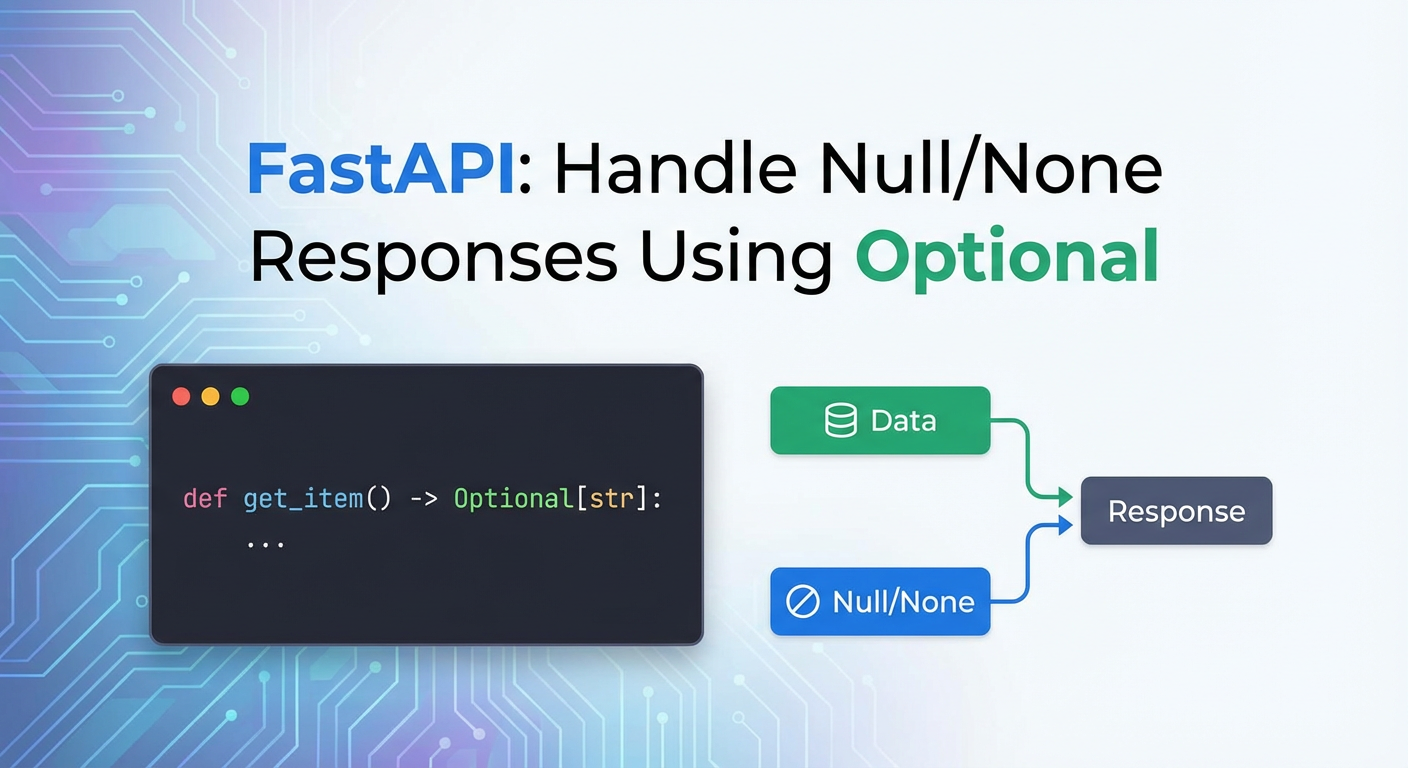
In Python's typing module, Optional[X] is simply syntactic sugar for Union[X, None]. This means that a variable or field annotated as Optional[str] can either hold a str value (e.g., "hello") or the None object. It explicitly declares that the absence of a value is an expected and valid state for that particular piece of data.
When and Why to Embrace Optional:
The decision to use Optional should be driven by the inherent nature of the data you are modeling. It's not about making every field optional; rather, it's about accurately reflecting the real-world characteristics of your data within your code and api contract.
- Clearly Signaling Potential Absence: The primary benefit of
Optionalis its ability to clearly and unambiguously communicate that a field or parameter might not be provided or might legitimately beNone. This is invaluable for readability and intent. When another developer (or your future self) readsdescription: Optional[str], they immediately understand thatdescriptionmight beNoneand should be handled accordingly. - Improving API Contract Clarity: For
apiconsumers,Optionalis a beacon of clarity. The generatedOpenAPIdocumentation will explicitly mark fields as nullable, guiding client developers on how to design their applications to gracefully handle the absence of data. This prevents clients from making incorrect assumptions and reduces the likelihood of them crashing when anullvalue appears. - Guiding Clients on Expected Data Patterns: By using
Optional, you are dictating part of theapi's behavior. If a client sends a request without an optional field, your FastAPIapiwill correctly process it withNone. If they explicitly send{"field": null}, it will also be processed asNone. This consistency is crucial. - Facilitating Robust Error Handling: When a field is explicitly
Optional, your IDE and static analysis tools will often prompt you to check forNonebefore attempting operations on that field. This encourages defensive programming and helps preventTypeErrors at runtime. For example:python def process_data(data: Optional[str]): if data is not None: # Perform operations on data, knowing it's a string print(data.upper()) else: # Handle the absence of data print("Data not provided.")This explicit check makes your code more resilient.
Practical Examples of Optional in FastAPI:
Optional can be applied across various parts of your FastAPI application:
- Query Parameters: This is a very common use case. Many API endpoints allow optional filters or search terms. ```python from typing import Optional from fastapi import FastAPIapp = FastAPI()@app.get("/techblog/en/items/") async def read_items(q: Optional[str] = None): if q: return {"message": f"Searching for '{q}'"} return {"message": "No search query provided"}
`` Here, if the client calls/items/,qwill beNone. If they call/items/?q=fastapi,qwill be"fastapi". FastAPI automatically understands thatNone` is the default if the parameter is omitted. - Path Parameters: While less common for optional path segments,
Optionalcan still be used if a segment could conceptually be omitted or have a defaultNonevalue (though often better handled with separate endpoints or query parameters for true optionality). - Header Parameters: Similar to query parameters, headers can often be optional. ```python from typing import Optional from fastapi import Header@app.get("/techblog/en/status/") async def get_status(x_api_key: Optional[str] = Header(None)): if x_api_key: return {"status": "authorized", "key": x_api_key} return {"status": "unauthorized", "detail": "X-API-Key not provided"} ```
- Body Fields in Pydantic Models (Request Body): This is where
Optionaltruly shines for defining flexible input schemas. ```python from typing import Optional from pydantic import BaseModelclass ItemCreate(BaseModel): name: str description: Optional[str] = None # description is optional, defaults to None price: float tax: Optional[float] = None # tax is optional, defaults to None`` If a client sends{"name": "Laptop", "price": 1200.0},descriptionandtaxwill automatically beNonewithin your application. If they send{"name": "Laptop", "price": 1200.0, "description": null}, it will also be treated asNone`. - Response Models: It's equally important to use
Optionalin your response models to inform clients which fields might benullin the outgoing JSON.python class ItemOut(BaseModel): id: str name: str description: Optional[str] # Client knows description might be null price: float tax: Optional[float] category: Optional[str] = None # Can also specify default None for outputIf your endpoint returns anItemOutobject wheredescriptionisNone, FastAPI/Pydantic will correctly serialize it as"description": nullin the JSON response.
Default Values with Optional:
When using Optional, explicitly setting a default value of None (e.g., field: Optional[str] = None) is often clearer than relying on the implicit default. It reinforces the optional nature and provides an explicit initial state for the field. For function parameters, setting param: Optional[str] = None is the standard way to make them optional.
Optional vs. Simply Omitting the Type Hint:
While Python allows you to omit type hints entirely, doing so for optional fields is a severe disservice to your api's clarity and robustness, especially within FastAPI.
- Ambiguity: Without
Optional, it's unclear whether a field's absence is an oversight, an error, or a deliberate design choice. - No Static Analysis: Mypy and IDEs cannot help you check for
Noneif the type isn't specified, leading to potential runtime errors. - Poor
OpenAPIDocumentation: FastAPI cannot infer the optionality of a field without an explicit type hint likeOptional. TheOpenAPIschema will be less accurate and less useful forapiconsumers, defeating one of FastAPI's core benefits. - Pydantic Validation: Pydantic will treat fields without
Optionalas required. If a client omits a field that is notOptional, Pydantic will raise a validation error, even if you conceptually intended it to be optional.
In essence, Optional is the idiomatic and highly recommended way to declare nullable fields and parameters in FastAPI. It's a powerful tool that, when wielded effectively, significantly enhances the clarity, robustness, and predictability of your apis, fostering a better experience for both developers and consumers.
APIPark is a high-performance AI gateway that allows you to securely access the most comprehensive LLM APIs globally on the APIPark platform, including OpenAI, Anthropic, Mistral, Llama2, Google Gemini, and more.Try APIPark now! 👇👇👇
FastAPI's Handling of Optional Types in Request Validation and Response Serialization
FastAPI, through its deep integration with Pydantic, exhibits sophisticated behavior when it encounters Optional types, both for incoming request data (validation) and outgoing response data (serialization). This intelligent handling is a cornerstone of its ability to generate accurate OpenAPI schemas and provide robust api contracts. Understanding these mechanics is crucial for building predictable and fault-tolerant apis.
Request Validation (Input): Bringing Clarity to Incoming Data
When a client sends a request to your FastAPI api, the framework meticulously validates all incoming data against the type hints you've provided in your path operation functions and Pydantic models. Optional types play a key role in defining the flexibility of this input.
- Query, Path, and Header Parameters: If you define a parameter as
param: Optional[str] = None:- Parameter Omitted: If the client does not provide the
paramin the request (e.g.,GET /items/without?param=value), FastAPI will correctly passNoneto your endpoint function. This is the expected and most common behavior for optional parameters. - Parameter Explicitly
null(less common for query/path/header): While less conventional for URL components, if a client were to somehow sendnullas the value for such a parameter (e.g., in a custom header that could hold a JSONnull), FastAPI/Pydantic would interpret this asNone. - Parameter Provided with a Value: If the client provides a value (e.g.,
GET /items/?param=some_value), FastAPI will validate it against the underlying type (strin this case) and pass the validated value to your function.
- Parameter Omitted: If the client does not provide the
- Body Fields in Pydantic Models: This is where
Optionalin request bodies (JSON payload) truly shines and requires careful consideration. Let's consider a Pydantic model: ```python from typing import Optional from pydantic import BaseModelclass UserUpdate(BaseModel): name: Optional[str] = None email: Optional[str] = None age: Optional[int] = None bio: Optional[str] # No default, but still Optional`` When a client sends a JSON request body: * **Field Omitted:** If a field likenameorageis declared asOptionalinUserUpdateand the client's JSON payload *omits* that field entirely (e.g.,{"email": "test@example.com"}), Pydantic will automatically assignNonetouser_update.nameanduser_update.agewithin your endpoint function. This is a powerful feature, enabling partial updates or flexible data submission. * **Field Present with Explicitnull:** If a client's JSON payload *explicitly* includes the field but sets its value tonull(e.g.,{"name": null, "email": "test@example.com"}), Pydantic also interprets this asNone. This means that from a Python perspective within your FastAPI application, there's no functional difference between a client omitting anOptionalfield and explicitly sendingnullfor it. Both result in the field beingNone. This behavior simplifies your backend logic, as you only need to check forif field is not None:. * **Field Provided with a Valid Value:** If{"name": "Jane Doe", "email": "jane@example.com"}is sent,user_update.namewill be"Jane Doe". * **Field Provided with an Invalid Value for the underlying type:** If{"age": "twenty"}is sent forage: Optional[int], Pydantic will raise a validation error because "twenty" cannot be converted to an integer, even thoughageis optional. The optionality applies to the *presence* of the value or its beingnull`, not to the validity of the underlying type if a value is provided.Interaction withField(default=...)andField(default_factory=...): You can combineOptionalwith Pydantic'sFieldto provide more nuanced defaults.python from pydantic import Field class Item(BaseModel): name: str description: Optional[str] = Field(None, example="A vivid description") # description is Optional and defaults to None if not provided # or if explicitly null.This explicitly states the default and addsOpenAPIexample documentation.Field(default_factory=...)is useful for mutable defaults (e.g.,list,dict), but forOptionalscalar types,Noneis typically sufficient.
Response Serialization (Output): Defining the Outgoing Contract
Just as FastAPI rigorously validates incoming requests, it also carefully serializes Python objects into JSON responses. Optional types in your response models dictate how fields are presented to the client when their Python value is None.
- How
Optionalin Response Models AffectsOpenAPISchema: When you define a Pydantic response model likeclass ItemOut(BaseModel): id: str; description: Optional[str], FastAPI'sOpenAPIgeneration will mark thedescriptionfield asnullable: truein the JSON schema. This is crucial forapiconsumers, as it explicitly tells them that this field might returnnull, allowing them to design their client applications accordingly. - Returning
Nonefor anOptionalField: If your endpoint logic constructs anItemOutobject whereitem.descriptionisNone, FastAPI (via Pydantic's serialization) will correctly render this as"description": nullin the JSON response. This behavior is standard and aligns with JSON's concept ofnull.python @app.get("/techblog/en/items/{item_id}", response_model=ItemOut) async def read_item(item_id: str): if item_id == "foo": return ItemOut(id="foo", name="Foo Bar", description="A great item") return ItemOut(id="baz", name="Baz Quz", description=None) # description will be null in JSONTheOpenAPIdocumentation for this endpoint would reflect thatdescriptioncan bestringornull. - The Criticality of
Optionalfor Non-Null Fields: What happens if you returnNonefor a field that is not declared asOptionalin your response model? ```python class ItemStrict(BaseModel): name: str description: str # This is NOT optional@app.get("/techblog/en/items/strict/{item_id}", response_model=ItemStrict) async def read_strict_item(item_id: str): # This will cause a validation error during serialization if item_id is "bad" if item_id == "good": return ItemStrict(name="Good Item", description="Always present") return ItemStrict(name="Bad Item", description=None) # Pydantic will raise ValueError!`` In this case, whenread_strict_itemattempts to returnItemStrict(name="Bad Item", description=None), Pydantic will raise aValueErrorduring the response serialization process becauseNoneis an invalid type for a field declared asstr. FastAPI will catch this and likely return a 500 Internal Server Error, preventing an invalid response from ever reaching the client. This demonstrates the powerful safeguarding mechanism thatOptionalprovides: it forces you to explicitly declare what can beNone`, and it enforces that contract strictly.
The api gateway Context and OpenAPI
The precise definition of your api contract, especially the explicit handling of Optional types, is of immense value not just for direct api consumers but also for infrastructure components like an api gateway.
An api gateway acts as the single entry point for all api calls, routing requests to the appropriate microservices, enforcing security policies, and often performing transformations or validations. A sophisticated api gateway, such as APIPark – an open-source AI gateway & API management platform – relies heavily on accurate OpenAPI definitions.
- Schema Validation at the Gateway: With fields explicitly marked as
nullable: truein theOpenAPIschema (thanks toOptionalin FastAPI), APIPark can perform schema validation on both incoming requests and outgoing responses at the gateway level. This means invalid data (e.g., anullvalue for a non-optional field) can be rejected before it even reaches your FastAPI service, offloading validation logic and enhancing overall system stability and security. - Request/Response Transformation: APIPark's ability to transform request and response payloads is enhanced by clear
OpenAPIdefinitions. If a client expects a field that might benull, theapi gatewaycan understand this and manage transformations gracefully, perhaps providing a default value if the downstream service returnsnull, or ensuringnullis correctly propagated. - Routing and Policy Enforcement: A well-defined
OpenAPIspec informs theapi gatewayabout the entireapisurface, helping it enforce access policies, rate limiting, and routing decisions with greater precision. - Unified API Format for AI Invocation: APIPark's capability to standardize request data format across AI models and encapsulate prompts into REST
apis particularly benefits from clear type definitions. If an AI model's input or output might have optional fields, explicitly declaring them withOptionalin FastAPI ensures the unifiedapiformat remains robust and predictable, preventing unexpectedNonevalues from disrupting the AI invocation process managed by APIPark.
By carefully using Optional types in your FastAPI application, you are not only improving your internal code quality but also providing clearer OpenAPI specifications that an api gateway can leverage for more effective management, monitoring, and robust traffic handling. This synergy between a well-designed api and an intelligent api gateway is key to scalable and resilient api ecosystems.
Best Practices and Advanced Scenarios with Optional
Leveraging Optional effectively in FastAPI goes beyond simply knowing its syntax; it involves making informed design decisions that contribute to the overall robustness, clarity, and maintainability of your apis. By adopting best practices and understanding how Optional interacts with more complex data structures, you can build apis that are both powerful and predictable.
When to Use Optional vs. Required Fields: A Design Philosophy
The choice between an Optional field and a required field is a fundamental design decision that directly impacts your api contract.
- Mandatory Data (Non-
Optional): Use non-Optionaltypes for any data that is absolutely essential for your business logic to function correctly. If your system cannot proceed without a particular piece of information, make it required. This forces clients to provide the data and ensures that your internal logic never has to deal with its absence in critical paths. For example, aproduct_idfor anitempurchase is almost always required. - Conditional/Supplementary Data (
Optional): UseOptionalfor data that may or may not be present, depending on user input, system state, or external factors. This includes profile fields (likebio,website_url), optional search filters, metadata, or fields that are only applicable under certain conditions (e.g., adelivery_tracking_numberthat only exists after an order ships).Optionalacknowledges that the absence of this data is a valid and expected state, promoting flexibleapiinteractions.
Guiding Principle: Err on the side of making fields required if their absence creates ambiguity or requires complex fallback logic. Only make fields Optional when their absence is a clear and well-understood state that your application can gracefully handle.
Client-Side Considerations: Educating Your Consumers
While Optional provides clarity on the server side, its full benefit is realized when client developers understand and anticipate null values.
- Clear Documentation: The automatically generated
OpenAPIdocumentation is your primary tool. Encourage client developers to consult it, emphasizing fields marked asnullable: true. - Example Responses: Provide example JSON responses that explicitly show
nullvalues forOptionalfields. This is often more impactful than just a schema definition. - Proactive Communication: In API changelogs or developer guides, highlight any changes to a field's optionality. Explain the implications of receiving
nullfor new or modified fields. - Robust Client-Side Handling: Advise client developers to implement
nullchecks defensively in their code, similar to how you would in Python (if value is not None:). Modern languages often haveOptionaltypes or null-safe operators (e.g.,?.in TypeScript/JavaScript) that can simplify this.
Database Interaction: Bridging NULL and None
When integrating FastAPI with a database, understanding the mapping between database NULL and Python None is critical.
- ORM Mapping: Most Object-Relational Mappers (ORMs) like SQLAlchemy or Tortoise ORM automatically map database
NULLvalues to PythonNonewhen retrieving data. Conversely, when you set a PydanticOptionalfield toNoneand then save it via an ORM, the ORM typically translates thisNoneback into a databaseNULL. - Consistency: Ensure that your database schema explicitly defines which columns are
NULLable. This should align perfectly with your Pydantic models usingOptional. If a column isNOT NULLin the database, its corresponding Pydantic field must not beOptional. Discrepancies here will lead to runtime errors (e.g.,IntegrityErrorwhen trying to saveNoneto aNOT NULLcolumn).
Using Optional with List and Dict: Nuances and Clarity
Combining Optional with collection types introduces important distinctions:
Optional[List[str]]: This means the entire list might beNone, or it might be a list containing strings. If it'sNone, it means there's no list at all. If it's[], it means there's an empty list.- Example:
tags: Optional[List[str]] - Valid values:
None,[],["tag1", "tag2"] - This is useful when a collection itself might not exist.
- Example:
List[Optional[str]]: This means the list always exists (it could be empty), but individual elements within the list can beNone.- Example:
keywords: List[Optional[str]] - Valid values:
[],["keyword1", None, "keyword2"],[None] - This is useful when you have a list where some entries might legitimately be missing or unknown.
- Example:
Optional[Dict[str, int]]vs.Dict[str, Optional[int]]: The same logic applies to dictionaries.Optional[Dict[str, int]]: The dictionary might beNoneor an empty dictionary, or a dictionary with string keys and integer values.Dict[str, Optional[int]]: The dictionary always exists (could be empty), but values for specific keys can beNone.
Choose the structure that best reflects the data's true nature. Misunderstanding these distinctions can lead to subtle bugs and incorrect data processing.
Custom Validation for None Values
While Pydantic handles basic optionality, you might need more complex validation logic when dealing with None.
- FastAPI Dependencies: For validation that spans multiple fields or requires external resources, FastAPI's dependency injection system can be used.
Pydantic Validators: Use Pydantic's @validator decorator for custom validation on Optional fields. ```python from pydantic import BaseModel, validator from typing import Optionalclass UserProfile(BaseModel): bio: Optional[str] = None min_bio_length: Optional[int] = None
@validator('min_bio_length', pre=True, always=True)
def bio_length_must_be_positive_if_present(cls, v, values):
    if v is not None and v <= 0:
        raise ValueError('minimum bio length must be positive')
    if v is not None and values.get('bio') is None:
        # If a min_bio_length is provided, bio must also be provided
        raise ValueError('bio cannot be None if min_bio_length is specified')
    return v
`` This allows you to add conditional logic. Noticepre=True, always=Trueto ensure the validator runs even if the field is omitted orNone`.
Handling None Values Returned from External Services
When your FastAPI api interacts with external apis (e.g., fetching data from a third-party service, calling an AI model), you must be prepared for those services to return null or omit fields, even if their documentation claims otherwise.
- Defensive Parsing: Always parse external responses defensively. If an external field is supposed to be a string but might return
null, map it to anOptional[str]in your internal Pydantic models. - Graceful Fallbacks: Implement fallback logic. If an
Optionalfield from an external service comes back asNone, decide whether to:- Use a default value (e.g., an empty string for a missing name).
- Return your own
nullto the client. - Raise a specific error if the missing data is critical for your
api's functionality.
- Schema Enforcement: When integrating with AI models, particularly through platforms like APIPark, ensuring a unified
apiformat is paramount. APIPark standardizes the request and response formats for various AI models. If the upstream AI service returnsnullfor an expected field, APIPark can be configured to handle this consistently, perhaps by transforming it to a default value or adhering to theOpenAPIspecification where the field is marked asnullable. This ensures that your FastAPI application, downstream from APIPark, receives predictable data, even if the raw AI model response was inconsistent.
APIPark's Role in a World of Optional APIs
When designing complex apis, especially those interacting with numerous external services or AI models, a robust api gateway becomes indispensable. Platforms like APIPark, an open-source AI gateway & API management platform, excel in standardizing API formats, managing the entire API lifecycle, and providing critical features like request/response transformation and schema validation. By using Optional types consistently in your FastAPI application, you're not just improving your internal code quality; you're also providing clearer OpenAPI specifications that an api gateway can leverage for more effective management and monitoring.
The generated OpenAPI documentation, automatically produced by FastAPI, clearly outlines which fields are potentially null thanks to Optional. This documentation is invaluable not only for human developers but also for automated tools and api gateway solutions. An api gateway like APIPark can ingest this OpenAPI specification to:
- Enforce Contracts: Validate incoming and outgoing payloads against the defined schema, including
nullableconstraints, at the network edge, preventing malformed requests or responses from reaching or leaving your FastAPI service. - Facilitate AI Integration: APIPark’s feature to quickly integrate 100+ AI models and standardize their invocation becomes much smoother when the underlying
apis (like your FastAPIapi) clearly define their data contracts, including optionality. This reduces the risk of unexpectedNonevalues breaking the AI workflow. - Centralized API Management: APIPark provides end-to-end API lifecycle management. A well-defined
apicontract, reinforced byOptionaltypes, makes API versioning, sharing within teams, and access permission management more precise and less prone to integration errors. The detailed API call logging and powerful data analysis features of APIPark can then track how oftennullvalues appear, providing insights into data completeness andapiusage patterns.
In essence, the diligent use of Optional in FastAPI enhances the clarity and predictability of your apis, making them more amenable to powerful api gateway management tools like APIPark, leading to a more robust and scalable api ecosystem.
Illustrative Code Examples and a Comparative Table
To solidify our understanding, let's explore practical FastAPI code snippets demonstrating the use of Optional in various contexts, followed by a comparative table illustrating FastAPI's behavior.
Code Examples
1. Optional Query Parameter
from typing import Optional
from fastapi import FastAPI, Query

app = FastAPI()

@app.get("/techblog/en/search-products/")
async def search_products(
    query: Optional[str] = Query(None, min_length=3, max_length=50, description="Optional search term for products"),
    category: Optional[str] = Query("all", description="Filter products by category, defaults to 'all'"),
    limit: Optional[int] = Query(10, gt=0, description="Max number of results to return")
):
    """
    Search for products with optional filters.
    """
    results = []
    if query:
        results.append(f"Searching for products matching '{query}'")
    else:
        results.append("No specific product query provided.")

    results.append(f"Filtering by category: {category}")
    results.append(f"Limiting results to {limit} items.")

    return {"status": "success", "info": results, "query_term": query, "category_filter": category, "result_limit": limit}

# Example Calls:
# GET /search-products/ -> query=None, category="all", limit=10
# GET /search-products/?query=laptop -> query="laptop", category="all", limit=10
# GET /search-products/?query=phone&limit=5 -> query="phone", category="all", limit=5
# GET /search-products/?category=electronics -> query=None, category="electronics", limit=10
In this example, query, category, and limit are all Optional. query defaults to None if not provided, while category and limit have explicit non-None defaults if omitted. FastAPI correctly handles both scenarios.
2. Optional Field in a Pydantic Request Model (Body)
from typing import Optional, List
from pydantic import BaseModel, Field

class ItemCreate(BaseModel):
    name: str = Field(..., example="Wireless Mouse", description="Name of the item (required)")
    description: Optional[str] = Field(None, example="Ergonomic design, long battery life", description="Optional detailed description")
    price: float = Field(..., gt=0, example=25.99, description="Price of the item (must be positive)")
    tax: Optional[float] = Field(None, gt=0, example=2.50, description="Optional tax amount")
    tags: Optional[List[str]] = Field(None, example=["electronics", "peripherals"], description="Optional list of tags")

class ItemUpdate(BaseModel):
    name: Optional[str] = Field(None, example="Gaming Mouse", description="Optional new name")
    description: Optional[str] = Field(None, example="High precision, customizable RGB lighting", description="Optional new description")
    price: Optional[float] = Field(None, gt=0, example=49.99, description="Optional new price")
    tax: Optional[float] = Field(None, gt=0, example=5.00, description="Optional new tax amount")
    is_active: Optional[bool] = Field(True, description="Item activation status, defaults to true")

@app.post("/techblog/en/items/")
async def create_item(item: ItemCreate):
    """
    Create a new item with some optional fields.
    """
    item_data = item.dict()
    # In a real app, save to DB and generate ID
    item_data["id"] = "item_" + str(hash(item.name))
    return {"message": "Item created successfully", "item": item_data}

@app.patch("/techblog/en/items/{item_id}")
async def update_item(item_id: str, item_update: ItemUpdate):
    """
    Update an existing item partially using Optional fields.
    """
    # In a real app, fetch item from DB
    existing_item = {"id": item_id, "name": "Old Name", "description": "Old Description", "price": 10.0, "tax": 1.0, "is_active": True}

    update_data = item_update.dict(exclude_unset=True) # exclude_unset is crucial for PATCH
    for key, value in update_data.items():
        existing_item[key] = value

    return {"message": f"Item {item_id} updated", "updated_item": existing_item}

# Example POST /items/ body:
# {"name": "Monitor", "price": 300.0}
# description and tax will be None, tags will be None

# Example POST /items/ body:
# {"name": "Keyboard", "description": "Mechanical", "price": 150.0, "tags": ["gaming", "mechanical"]}
# tax will be None

# Example PATCH /items/item_abc body:
# {"description": "Updated Description", "price": 120.0, "is_active": false}
# Only description, price, and is_active will be updated. Name and tax will remain unchanged.
# If {"description": null} is sent, the description will be explicitly set to None (null).
The ItemCreate model shows description, tax, and tags as optional, defaulting to None. ItemUpdate uses Optional for all fields, which is common for PATCH requests, allowing clients to send only the fields they wish to change. exclude_unset=True in item_update.dict() is vital for patch operations to avoid setting unprovided fields to None if they were meant to remain unchanged.
3. Optional Field in a Pydantic Response Model
class Product(BaseModel):
    id: str = Field(..., example="prod123")
    name: str = Field(..., example="Smartphone X")
    category: str = Field(..., example="Electronics")
    # This field might not always be available, hence Optional
    serial_number: Optional[str] = Field(None, example="SN123456789", description="Optional serial number")
    # This field is for internal use but can be exposed if present
    internal_notes: Optional[str] = Field(None, description="Internal notes about the product (optional)")
    # List of related products, which might be an empty list, or None if no relations data exists
    related_products: Optional[List[str]] = Field(None, example=["prod456", "prod789"], description="Optional list of related product IDs")

@app.get("/techblog/en/products/{product_id}", response_model=Product)
async def get_product_details(product_id: str):
    """
    Retrieve product details, including optional fields.
    """
    if product_id == "prod_with_sn":
        return Product(id=product_id, name="Smart Watch", category="Wearables", serial_number="SW7890", related_products=["prod111"])
    elif product_id == "prod_no_sn":
        return Product(id=product_id, name="Bluetooth Speaker", category="Audio", serial_number=None, internal_notes="New model, high demand.")
    else:
        # For any other ID, return without serial_number and internal_notes
        return Product(id=product_id, name="Generic Gadget", category="Misc", serial_number=None, internal_notes=None, related_products=[])

# Example Response for prod_with_sn:
# {
#   "id": "prod_with_sn",
#   "name": "Smart Watch",
#   "category": "Wearables",
#   "serial_number": "SW7890",
#   "internal_notes": null,
#   "related_products": ["prod111"]
# }

# Example Response for prod_no_sn:
# {
#   "id": "prod_no_sn",
#   "name": "Bluetooth Speaker",
#   "category": "Audio",
#   "serial_number": null,
#   "internal_notes": "New model, high demand.",
#   "related_products": null
# }
Here, serial_number, internal_notes, and related_products are Optional. The response_model=Product ensures that even if an Optional field is None in Python, it will be correctly serialized as null in the JSON response, and this fact will be reflected in the OpenAPI documentation. Note how related_products can be None (no relations data) or [] (empty list of relations).
Comparative Table: FastAPI's Handling of Optionality
This table summarizes how FastAPI (with Pydantic) treats various scenarios involving Optional types, illustrating the input validation and output serialization behaviors, and their reflection in the OpenAPI schema.
| Scenario / Field Type | FastAPI Parameter/Field Definition | Example JSON/URL Input | Python Value in Endpoint (Request) / From Logic (Response) | OpenAPI Schema (nullable property) |
|---|---|---|---|---|
| Request: Query Param (Optional) | query: Optional[str] = None |
GET /items/ |
query=None |
query?: string (nullable: true) |
GET /items/?query=search_term |
query='search_term' |
query?: string (nullable: true) |
||
| Request: Body Field (Optional) | name: Optional[str] = None |
POST /items/ {"price": 10} |
item.name=None |
name?: string (nullable: true) |
POST /items/ {"name": null, "price": 10} |
item.name=None |
name?: string (nullable: true) |
||
POST /items/ {"name": "Widget", "price": 10} |
item.name='Widget' |
name?: string (nullable: true) |
||
| Request: Body Field (Required) | name: str |
POST /items/ {"price": 10} |
(Pydantic ValidationError) |
name: string (required) |
POST /items/ {"name": null, "price": 10} |
(Pydantic ValidationError) |
name: string (required) |
||
POST /items/ {"name": "Gadget", "price": 10} |
item.name='Gadget' |
name: string (required) |
||
| Response: Field (Optional) | description: Optional[str] |
return {"description": None} (Python logic) |
description=None |
description?: string (nullable: true) |
return {"description": "Detailed text"} (Python logic) |
description='Detailed text' |
description?: string (nullable: true) |
||
| Response: Field (Required) | description: str |
return {"description": None} (Python logic) |
(Pydantic ValidationError during serialization) |
description: string (required) |
return {"description": "Always present"} (Python logic) |
description='Always present' |
description: string (required) |
||
Collection: Optional[List[str]] |
tags: Optional[List[str]] = None |
POST {"tags": null} / POST {} |
item.tags=None |
tags?: array of string (nullable: true) |
POST {"tags": []} |
item.tags=[] |
tags?: array of string (nullable: true) |
||
POST {"tags": ["a", "b"]} |
item.tags=['a', 'b'] |
tags?: array of string (nullable: true) |
||
Collection: List[Optional[str]] |
labels: List[Optional[str]] = [] |
POST {"labels": []} |
item.labels=[] |
labels: array of (string or null) (required) |
POST {"labels": ["x", null, "y"]} |
item.labels=['x', None, 'y'] |
labels: array of (string or null) (required) |
||
POST {"labels": [null]} |
item.labels=[None] |
labels: array of (string or null) (required) |
This table highlights FastAPI's intelligent handling, where Optional fields allow for None or omitted values in requests and serialize to null in responses, with appropriate nullable: true flags in the OpenAPI schema. Conversely, required fields strictly enforce the presence and type of data, raising validation errors if those constraints are violated. This rigorous approach ensures predictable api behavior and robust communication contracts.
Conclusion
In the demanding landscape of modern api development, where data can be dynamic, incomplete, or conditionally available, the ability to gracefully handle the absence of values is not merely a convenience but a fundamental requirement for building robust and reliable systems. FastAPI, with its elegant reliance on Python's type hints and its deep integration with Pydantic, provides a powerful and intuitive mechanism to address this challenge head-on: the Optional type hint.
Throughout this comprehensive guide, we've explored the profound implications of None values in Python, contrasting them with other empty data types and detailing the cascade of problems they can unleash if left unaddressed in apis. We delved into FastAPI's transformative use of type hints, recognizing them as the bedrock of clear api contracts and the engine behind its automatic data validation and OpenAPI documentation generation.
The introduction of Optional[X] as a succinct way to express Union[X, None] emerged as the definitive solution. By explicitly annotating fields and parameters as Optional, developers gain unparalleled clarity in their code, making the intent behind potentially missing data unambiguous. We demonstrated how FastAPI meticulously validates incoming requests, correctly interpreting omitted Optional fields and explicit null values as None, thus simplifying backend logic. Equally important is its sophisticated serialization of responses, ensuring that Optional fields with None values are accurately rendered as null in the outgoing JSON, while strictly enforcing the contract for non-optional fields.
Furthermore, we examined critical best practices, emphasizing the judicious use of Optional versus required fields, the importance of educating client developers about null handling, and the seamless integration with database NULL values. Advanced scenarios involving Optional with collection types (List, Dict) and custom validation techniques underscored the versatility and depth of this feature. Crucially, we highlighted how the precision offered by Optional types not only benefits direct API consumers but also empowers api gateway solutions like APIPark to manage, validate, and transform API traffic with greater intelligence and reliability, leveraging the rich OpenAPI specifications generated by FastAPI.
By mastering the use of Optional in your FastAPI applications, you are equipping yourself to build apis that are:
- Robust: Less prone to runtime errors stemming from unexpected
Nonevalues. - Predictable: Consistently behave as expected, even when data is sparse.
- Clear: Feature well-defined contracts that are easily understood by both human developers and automated tools.
- Maintainable: Easier to debug, extend, and evolve over time.
In essence, embracing Optional is a strategic decision towards engineering apis that are not just functional but also resilient, user-friendly, and future-proof. It represents a commitment to precision and clarity in your api design, a commitment that pays dividends across the entire software development lifecycle and ensures the longevity and trustworthiness of your services.
Frequently Asked Questions (FAQs)
1. What is the fundamental difference between an Optional field and a required field in FastAPI?
The fundamental difference lies in their contract for data presence. A required field (e.g., name: str) dictates that a value for that field must always be provided by the client (for requests) and must always be present and non-None (for responses). If omitted or provided as null, FastAPI/Pydantic will raise a validation error. An Optional field (e.g., description: Optional[str]) explicitly states that a value for that field may or may not be provided. If it's omitted in a request or its value is None in your Python logic, it is considered valid, and FastAPI will handle it gracefully (passing None to your code or serializing it as null in JSON).
2. How does FastAPI (and Pydantic) differentiate between a field being entirely absent in a request body and a field being explicitly set to null?
From FastAPI's and Pydantic's perspective, for a field declared as Optional[Type], there is no functional difference between a client omitting that field from the JSON request body and explicitly sending {"field_name": null}. In both cases, the corresponding Python attribute in your Pydantic model will be set to None. This simplifies your backend logic, as you only need to check if my_field is not None: to determine if a value was provided.
3. Can Optional be used with collection types like List or Dict, and what are the nuances?
Yes, Optional can be used with collection types, but the placement matters significantly. * Optional[List[str]]: This means the entire list itself can be None. If it's None, no list exists. If it's [] (an empty list) or ["item1"], then a list exists. * List[Optional[str]]: This means the list always exists (it can be empty []), but individual elements within that list can be None (e.g., ["item1", None, "item2"]). The same logic applies to Dict. Understanding this distinction is crucial for accurate data modeling and preventing unexpected type errors.
4. How does using Optional types benefit OpenAPI documentation and API gateways?
Using Optional types in your FastAPI application directly translates into clearer and more accurate OpenAPI specifications. FastAPI automatically marks Optional fields as nullable: true in the generated JSON schema. This explicit declaration is invaluable for: * Client Developers: They immediately know which fields might be null and can design their client applications to handle these cases defensively. * API Gateways: An api gateway like APIPark can ingest this OpenAPI schema to perform robust schema validation at the edge, ensuring that incoming requests and outgoing responses conform to the defined contract, including nullable constraints. This enhances security, offloads validation from your microservices, and enables more intelligent request/response transformation, critical for managing complex api ecosystems, especially those integrating with AI models.
5. What happens if I return None for a field that is not declared as Optional in my FastAPI response model?
If you attempt to return None for a field that is defined with a specific type (e.g., name: str) and not marked as Optional in your Pydantic response model, FastAPI (via Pydantic) will raise a validation error during the response serialization process. This is a critical safeguard. Instead of sending an invalid response (like "name": null when a string was expected), FastAPI will typically return a 500 Internal Server Error, preventing your api from violating its own contract and ensuring data integrity. This highlights why explicitly using Optional is so important for defining precise api behavior.
🚀You can securely and efficiently call the OpenAI API on APIPark in just two steps:
Step 1: Deploy the APIPark AI gateway in 5 minutes.
APIPark is developed based on Golang, offering strong product performance and low development and maintenance costs. You can deploy APIPark with a single command line.
curl -sSO https://download.apipark.com/install/quick-start.sh; bash quick-start.sh

In my experience, you can see the successful deployment interface within 5 to 10 minutes. Then, you can log in to APIPark using your account.

Step 2: Call the OpenAI API.