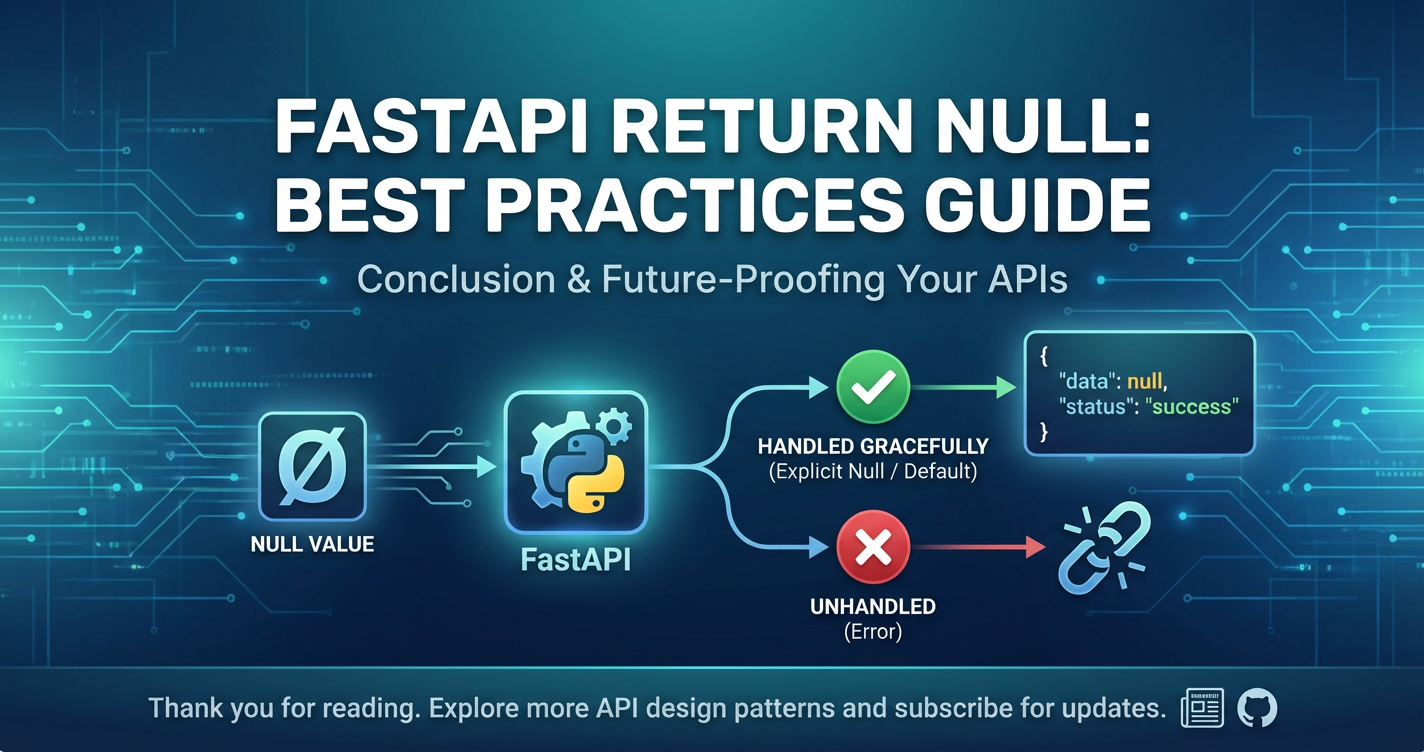
FastAPI Return Null: Best Practices Guide


In the dynamic world of web development, building robust and predictable Application Programming Interfaces (APIs) is paramount. FastAPI, a modern, fast (high-performance) web framework for building APIs with Python 3.7+ based on standard Python type hints, has rapidly gained popularity due to its speed, automatic documentation, and ease of use. However, even with such a powerful tool, developers often encounter nuanced challenges, one of the most frequently discussed being the handling of "null" values in API responses. This guide delves deep into the best practices for managing None (Python's equivalent of null) in FastAPI applications, ensuring your APIs are not only performant but also incredibly reliable, predictable, and user-friendly.
The concept of "null" might seem straightforward at first glance – it simply means "no value." Yet, its interpretation and implications can vary significantly across programming languages, database systems, and client-side applications. In the context of an API, a null value can signify various states: an optional field that was not provided, a resource that does not exist, an error condition, or even a placeholder for future data. Mismanaging these distinctions can lead to fragile client applications, confusing error messages, and a poor developer experience. Therefore, understanding when, why, and how to return None in FastAPI is not merely a technical detail but a crucial aspect of designing a well-architected API.
This extensive guide aims to provide a definitive resource for FastAPI developers, covering everything from the fundamental differences between Python's None and JSON's null, to advanced strategies for structuring your Pydantic models and handling diverse response scenarios. We will explore the various tools FastAPI and Pydantic offer to manage optionality, discuss the implications of different return strategies, and provide concrete code examples to illustrate best practices. By the end of this guide, you will possess a comprehensive understanding that empowers you to build highly resilient and explicit FastAPI APIs that gracefully handle the absence of data, fostering trust and clarity for every consumer of your api.
The Nuance of "Null": Python's None vs. JSON's null
Before we dive into FastAPI specifics, it is essential to establish a clear understanding of what "null" truly represents in the context of Python and JSON, as these are the two primary layers interacting when building a FastAPI application. While seemingly identical in concept, their origins and typical usage can differ, and FastAPI acts as the bridge between them.
Python's None
In Python, None is a special constant that represents the absence of a value or a null value. It is a singleton object of the NoneType class. None is distinct from an empty string (""), an empty list ([]), an empty dictionary ({}), or the integer zero (0). These empty representations signify a collection with no elements or a numeric value of zero, whereas None explicitly states that there is no value at all for a particular variable or field.
For example, if you declare a variable user_email = None, it means the user's email is not known or not provided, rather than the user having an empty email address. This distinction is crucial for data integrity and logical processing. In Python, None evaluates to False in a boolean context, which is often used in conditional checks (e.g., if user_email: will be false if user_email is None). However, it's generally considered good practice to explicitly check if user_email is None: for clarity and to avoid confusion with other "falsy" values.
None is pervasive in Python, often returned by functions that don't explicitly return anything else, or used as a default value for optional arguments. Its purpose is unambiguous: to signify the deliberate absence of data.
JSON's null
JSON (JavaScript Object Notation) is a lightweight data-interchange format that is language-independent. It's the standard format for data exchange in web APIs, including those built with FastAPI. In JSON, null is one of the six possible literal values (the others being true, false, numbers, strings, and objects/arrays). Like Python's None, JSON's null signifies the absence of a value for a specific key within an object or an element within an array.
When FastAPI serializes a Python object into a JSON response, it intelligently maps Python's None to JSON's null. This automatic conversion is one of FastAPI's many conveniences, abstracting away the serialization complexities and ensuring that your Python None values are correctly represented in the API response that clients consume.
For instance, if your FastAPI application defines a Pydantic model with a field description: Optional[str] = None, and you return an instance of this model where description is None, FastAPI will generate a JSON response like {"description": null}. This seamless translation is critical for maintaining consistency between your backend logic and the API contract presented to the client.
Key Differences and Implications for APIs
While Python's None and JSON's null align in meaning, understanding their underlying nature helps in designing robust APIs.
- Type System: Python's type hints (e.g.,
Optional[str]orUnion[str, None]) explicitly declare that a variable might beNone. This type information is leveraged by FastAPI and Pydantic for validation and automatic documentation, providing strong guarantees about the data types your API expects and returns. JSON itself is untyped in this sense, but a good API contract (like OpenAPI, which FastAPI generates) provides schema definitions that specify whether a field can benull. - Serialization/Deserialization: FastAPI handles the heavy lifting of converting
Nonetonullon response and convertingnullin incoming JSON payloads back toNonein Python objects. This automation simplifies development but requires developers to understand howNoneinteracts with Pydantic models during both request body validation and response serialization. - Semantic Meaning: The semantic meaning of
nullin an API response is paramount. Doesnullmean the data doesn't exist yet, it's intentionally omitted, it's sensitive and hidden, or simply that the client didn't provide it? Clear documentation and consistent handling within your API are essential to avoid ambiguity for consumers.
By grasping these foundational concepts, developers can make informed decisions about when and how to leverage None in their FastAPI applications, leading to more explicit, predictable, and maintainable APIs. The subsequent sections will build upon this understanding to explore practical strategies for handling None effectively.
Why Returning None Can Be Problematic (or Desirable): A Deep Dive
The decision to return None for a particular field or even an entire response body is rarely trivial. It carries significant implications for client-side development, API contract adherence, and overall system robustness. While None serves a crucial purpose in Python and JSON, its misuse can introduce bugs, confusion, and security vulnerabilities. Conversely, its thoughtful application can lead to cleaner, more flexible APIs.
The Pitfalls of Careless None Returns
- Client Expectations and Contract Violations: Client applications are built upon assumptions about the data they receive. If an API contract (often defined by OpenAPI/Swagger documentation, automatically generated by FastAPI) specifies a field as non-nullable, but the API occasionally returns
nullfor it, clients expecting a string, number, or object will likely encounter runtime errors. For example, a JavaScript client trying to call.lengthonnullwill throw an error. Inconsistentnullhandling violates the implicit or explicit contract and undermines client trust. - Deserialization Errors on the Client Side: Different programming languages and JSON parsers handle
nullin varying ways when mapping JSON responses to native objects. While most modern parsers gracefully handlenull, problems arise when a client-side type system expects a non-nullable type but receivesnull. This often necessitates additionalnullchecks on the client, adding boilerplate code and increasing the risk of developers forgetting to handle these edge cases. - Ambiguity and Semantic Overload: One of the biggest issues with
nullis its potential for semantic ambiguity. Doesnullmean "not found," "not applicable," "not provided," "no value," or "an error occurred"? If the meaning ofnullisn't clearly defined and consistently applied, clients are forced to guess, leading to brittle integrations. For example, ifuser.addressisnull, does it mean the user has no address, or the address data couldn't be retrieved due to a temporary issue? These distinctions are vital for client-side logic. - Security Implications (Information Disclosure/Denial of Existence): In certain scenarios, returning
nullcan inadvertently reveal information or deny existence in a way that might be undesirable. For instance, if an API endpoint forGET /users/{id}returnsnullfor a specific field when the user ID exists but the user is unauthorized to view that field, it might be safer to return a403 Forbiddenerror or simply omit the field entirely rather than providing anullvalue that still acknowledges the field's existence. Conversely, returningnullfor a resource that doesn't exist (GET /resources/non_existent_id) might confirm that the ID structure is valid but no such resource exists, potentially aiding attackers in enumeration. Often, a404 Not Foundis more appropriate in such cases. - Debugging Complexity: When errors occur on the client or server, tracing the root cause back to an unexpected
nullvalue can be time-consuming. Inconsistentnullhandling can obscure the real problem, leading to longer debugging cycles and decreased productivity.
When Returning None (JSON null) is Appropriate and Desirable
Despite the potential pitfalls, None is an indispensable tool when used judiciously. There are several scenarios where returning null is not only acceptable but often the most logical and clear approach.
- Representing a Resource That Lacks a Sub-Resource: Sometimes, a resource might exist, but a related sub-resource or embedded object does not. For instance, a
Projectmight optionally have anAssignedTeam. If no team is assigned, returning{"project_name": "Alpha", "assigned_team": null}is more semantically accurate than returning an empty team object ({}) or omitting the field entirely if the API contract expects it to always be present, even ifnull. - Data Not Yet Available/Processing: In asynchronous systems or processes where certain data fields might not be immediately available (e.g., a file upload's processing status),
nullcan serve as a temporary indicator. For example,{"report_id": "abc-123", "download_link": null, "status": "processing"}clearly communicates that the link will be available later. - Denying Existence of a Specific Field While Resource Exists: This differs from denying the existence of the entire resource. If a user exists, but a highly sensitive field (e.g.,
last_known_location) is not retrievable due to permissions, returning{"user_id": 123, "name": "John Doe", "last_known_location": null}might be an appropriate response if the API contract mandates the presence of this field but allows for its value to benullunder specific circumstances. This must be carefully considered against returning403 Forbiddenfor the field itself or simply omitting it. - Database
NULLValues: When interacting with databases,NULLis a common concept. Many ORMs (Object-Relational Mappers) and database drivers will map databaseNULLvalues directly to PythonNone. When fetching data that includes nullable database columns, it's often natural and correct to propagate theseNonevalues through your FastAPI application as JSONnull.
Optional Fields: This is the most common and straightforward use case. Many data models have fields that are genuinely optional. A user might not have a middle name, a product might not have a specified weight, or a blog post might not have a featured image URL. In such cases, returning null for these fields explicitly signals that the value is absent, without implying an error or providing an empty placeholder that could be misinterpreted. FastAPI and Pydantic's Optional[Type] (or Type | None in Python 3.10+) is specifically designed for this.```python from typing import Optional from pydantic import BaseModelclass UserProfile(BaseModel): username: str email: str bio: Optional[str] = None # bio is optional and defaults to None phone_number: Optional[str] # phone_number is optional, no default
Example response: {"username": "alice", "email": "a@example.com", "bio": null}
```
The crucial takeaway here is that the decision to return None (or null) should be deliberate and well-documented. It should reflect the semantic truth of the data and align with the API's contract. When in doubt, lean towards being explicit and consistent.
FastAPI's Mechanisms for Handling Optionality: A Practical Guide
FastAPI, powered by Pydantic, provides robust and intuitive mechanisms for defining and handling optional fields, both in incoming request bodies and outgoing responses. Leveraging Python's type hints, these tools ensure strong data validation, automatic documentation, and predictable API behavior.
1. Optional from typing (or Union[Type, None])
The most fundamental way to declare an optional field in Python is using typing.Optional. In Python 3.10 and later, this can be expressed more concisely using the union operator (|) as Type | None.
- Behavior for Request Body: If a field is
Optional[Type] = Noneand the client does not send that field in the JSON payload, Pydantic will assignNoneto it. If the client does send the field withnullas its value, Pydantic will also assignNone. - Behavior for Response Model: When an instance of
ItemResponseis returned from a path operation, any field defined asOptional[Type](orType | None) that has a PythonNonevalue will be serialized as JSONnull. - Path/Query Parameters:
Optionalis also crucial for defining optional path or query parameters.```python from typing import Optional from fastapi import FastAPI, Queryapp = FastAPI()@app.get("/techblog/en/items/") async def read_items(q: Optional[str] = None, limit: int = 10): # If 'q' is not provided in the query string, it will be None results = {"items": [{"item_id": "Foo"}, {"item_id": "Bar"}]} if q: results.update({"q": q}) return results@app.get("/techblog/en/users/{user_id}") async def read_user(user_id: int, include_email: Optional[bool] = None): user_data = {"id": user_id, "name": "John Doe"} if include_email: user_data["email"] = "john.doe@example.com" elif include_email is False: # Explicitly checking if client said no email user_data["email"] = "hidden" # Or remove it, depending on policy return user_data ```In theread_itemsexample, if the client calls/items/,qwill beNone. If they call/items/?q=some_query,qwill be"some_query".
Pydantic Models (Request Body/Response Model): When defining Pydantic models for request bodies or response models, Optional indicates that a field might be present with a value of None.```python from typing import Optional from pydantic import BaseModel, Fieldclass ItemCreate(BaseModel): name: str description: Optional[str] = None # Field is optional, defaults to None price: float tax: Optional[float] = Field(None, description="The tax to be applied") # Field is optional, explicit defaultclass ItemResponse(BaseModel): id: int name: str description: Optional[str] # Field might be None in response price: float tax: Optional[float] # Field might be None in response created_at: Optional[str] # Even if not present in ItemCreate, can be optional in response
Using the new union syntax (Python 3.10+)
class User(BaseModel): name: str email: str | None = None # email is optional ```
2. Default Values for Pydantic Models
Providing default values for Pydantic model fields, especially in conjunction with Optional, is a powerful way to define predictable behavior.
field: Type = default_value: If a field has a default value (e.g.,description: Optional[str] = "No description"), it means:```python from pydantic import BaseModel, Fieldclass Product(BaseModel): name: str price: float description: str = "A wonderful product." # Default value if not provided category: str | None = Field(None, description="Product category, if applicable.") # Optional with default None ```This distinction is crucial:Optional[str] = Nonemeans "if not provided, default toNone."Optional[str] = "default_text"means "if not provided, default to'default_text', but if explicitly provided asnull, useNone."- If the client does not provide this field in the request body, Pydantic will use
"No description". - If the client does provide this field with
null, Pydantic will assignNoneto it, overriding the default. - If the field is explicitly set to
Nonein your Python code and returned, it will serialize tonullin JSON.
- If the client does not provide this field in the request body, Pydantic will use
default_factory for Complex Defaults: For default values that are mutable objects (like lists or dictionaries), or that need to be computed dynamically, Field(default_factory=...) is the correct approach. This ensures that each instance gets its own default object, preventing unexpected shared state.```python from pydantic import BaseModel, Field from datetime import datetimeclass LogEntry(BaseModel): message: str timestamp: datetime = Field(default_factory=datetime.now) # Dynamic default tags: list[str] = Field(default_factory=list) # Mutable default details: dict = Field(default_factory=dict) # Mutable default
Example: if tags is not provided, it will be an empty list []
if details is not provided, it will be an empty dict {}
If the client sends {"message": "Test", "tags": null}, then tags will be None in Python.
```
3. Pydantic's None Handling During Validation and Serialization
Pydantic's core strength lies in its ability to validate data and serialize it efficiently. Its handling of None is intelligent and configurable.
- Validation:
- If a field is declared as
Optional[Type]and the incoming data hasnullfor that field, Pydantic will validate it asNonein Python. - If a field is declared as
Type(i.e., non-optional) and the incoming data hasnullfor that field, Pydantic will raise a validation error, asnullis not an instance ofType.
- If a field is declared as
- Serialization Options: FastAPI allows you to control how
Nonevalues are handled during serialization using parameters in your path operation decorator (@app.get,@app.post, etc.).
response_model_exclude_unset=True: This parameter excludes fields from the response if they were not explicitly set when creating the Pydantic model instance. This is useful when you want to return only the fields that were provided by the client or explicitly modified. ```python from fastapi import FastAPI from pydantic import BaseModelapp = FastAPI()class Item(BaseModel): name: str description: str | None = None price: float@app.post("/techblog/en/items/", response_model=Item, response_model_exclude_unset=True) async def create_item(item: Item): # If client sends {"name": "Foo", "price": 10.0} # The description will be None internally, but not "unset" # It will still be included as {"description": null} if not excluded by response_model_exclude_none
# Example where it matters:
# item_data = {"name": "Bar", "price": 20.0}
# created_item = Item(**item_data)
# return created_item # This would only return name and price, description is unset

# To demonstrate exclude_unset:
class PartialUpdate(BaseModel):
    name: str | None = None
    description: str | None = None
    price: float | None = None

@app.patch("/techblog/en/items/{item_id}", response_model=PartialUpdate, response_model_exclude_unset=True)
async def update_item(item_id: int, item_update: PartialUpdate):
    # Assume existing_item is {"name": "Old", "description": "Old desc", "price": 10.0}
    # If client sends {"name": "New Name"}
    # item_update will have name="New Name", description=None (from type hint), price=None (from type hint)
    # But when returning item_update with response_model_exclude_unset=True, only "name" would be in the response
    # because description and price were not "set" in the incoming payload.
    return item_update
``response_model_exclude_unsetis often more relevant forPATCH` operations where you only want to return the fields that were actually updated, or for partial responses.
response_model_exclude_none=True: This parameter, when set to True, tells FastAPI to exclude any fields from the JSON response if their value is None. This is useful for creating "sparse" responses, where only present data is sent, reducing payload size. ```python from typing import Optional from fastapi import FastAPI from pydantic import BaseModelapp = FastAPI()class UserOut(BaseModel): id: int name: str email: Optional[str] = None bio: Optional[str] = None@app.get("/techblog/en/user/{user_id}", response_model=UserOut, response_model_exclude_none=True) async def get_user_sparse(user_id: int): if user_id == 1: return UserOut(id=1, name="Alice", email="alice@example.com") return UserOut(id=2, name="Bob", email=None, bio=None)
/user/1 -> {"id": 1, "name": "Alice", "email": "alice@example.com"} (bio is excluded)
/user/2 -> {"id": 2, "name": "Bob"} (email and bio are excluded)
```
By mastering these mechanisms, you gain precise control over how None values are handled throughout your FastAPI application, ensuring that your API contracts are honored and client-side integrations are smooth and error-free. The next section will synthesize these tools into actionable best practices for various null scenarios.
APIPark is a high-performance AI gateway that allows you to securely access the most comprehensive LLM APIs globally on the APIPark platform, including OpenAI, Anthropic, Mistral, Llama2, Google Gemini, and more.Try APIPark now! 👇👇👇
Best Practices for Returning None (or Avoiding It)
Developing an API requires careful consideration of its interface and how it communicates different states to consumers. The way your FastAPI application handles None values is a significant part of this communication. Here, we outline a set of best practices to guide your decisions, ensuring your APIs are robust, clear, and maintainable.
1. Explicitly Define Optional Fields with Optional[Type]
This is the cornerstone of good None handling. Never assume a field can be None without explicitly declaring it as such using Optional[Type] (or Type | None). This has several crucial benefits:
- Clarity: It immediately tells anyone looking at your Pydantic model or function signature that this field might legitimately be absent.
- Validation: Pydantic will enforce this. If a field is
strbut receivesnull, it will raise a validation error. If it'sOptional[str]and receivesnull, it will happily assignNone. - Documentation: FastAPI's automatic OpenAPI documentation will correctly mark these fields as nullable, providing accurate schema information to API consumers.
- Static Analysis: Tools like MyPy will use this type hint to warn you about potential
Noneissues in your Python code, catching bugs before they hit production.
Example:
from typing import Optional
from pydantic import BaseModel

class UserProfile(BaseModel):
    username: str
    email: Optional[str] = None # Explicitly optional, defaults to None
    bio: str | None # Python 3.10+ syntax, explicitly optional, no default

# Bad practice:
# class UserProfileBad(BaseModel):
#     username: str
#     email: str # If you try to assign None here, Pydantic will complain
Recommendation: Always default Optional fields to None unless there's a specific reason not to. This makes their optional nature even clearer. field: Optional[Type] without a default means Pydantic will require the field to be present (even if null) in incoming data, but field: Optional[Type] = None means it's truly optional for incoming data too.
2. Maintain Consistent API Contracts and Document null Semantics
Consistency is key to a good API. Once you decide that a particular field can be null, ensure that this holds true across all relevant endpoints and versions of your API.
- OpenAPI Documentation: Leverage FastAPI's automatic documentation. For fields defined with
Optional[Type], FastAPI will generate OpenAPI schemas that mark these fields as nullable. Ensure this documentation accurately reflects the intended meaning ofnull. - Readability of API Response: Make
nullpredictable. Ifdescriptionisnullfor a product, it should consistently mean "no description provided," not "description is loading" in one endpoint and "description is forbidden" in another. - Semantic Consistency: Document the meaning of
nullin your API's broader documentation. For example: "Anullvalue foruser.addressindicates that the user has not provided address details. It does not imply that the address is unknown or temporarily unavailable."
3. Distinguish Between "Not Found," "No Content," and "Empty Data"
This is perhaps the most critical distinction for robust API design. Returning null should not be a substitute for appropriate HTTP status codes or empty data structures.
a. 404 Not Found for Non-Existent Resources
If a client requests a resource that genuinely does not exist, the correct response is a 404 Not Found HTTP status code. Returning 200 OK with a response body of null or {} for a non-existent primary resource is generally poor practice. It misleads the client into thinking the request was successful and that the absence of data is the expected outcome, rather than an indication that the target resource couldn't be located.
Example:
from fastapi import FastAPI, HTTPException

app = FastAPI()

fake_db = {"item1": {"name": "Foo", "price": 10.0}}

@app.get("/techblog/en/items/{item_id}")
async def read_item(item_id: str):
    if item_id not in fake_db:
        raise HTTPException(status_code=404, detail=f"Item '{item_id}' not found")
    return fake_db[item_id]

# Request: GET /items/item_nonexistent -> 404 Not Found with {"detail": "Item 'item_nonexistent' not found"}
b. 204 No Content for Successful Operations with No Return Body
For PUT, DELETE, or POST operations that successfully perform an action but have no meaningful data to return in the response body, 204 No Content is the appropriate status code. The client receives confirmation of success, but no unnecessary payload.
Example:
from fastapi import FastAPI, Response, status

app = FastAPI()

@app.delete("/techblog/en/items/{item_id}", status_code=status.HTTP_204_NO_CONTENT)
async def delete_item(item_id: str):
    # Logic to delete item from DB
    print(f"Deleting item {item_id}")
    return Response(status_code=status.HTTP_204_NO_CONTENT) # No content, but successful

# Request: DELETE /items/item1 -> 204 No Content
c. 200 OK with Empty Collections for No Matching Data
If a client requests a collection of resources (e.g., a list of users, search results), and there are no items that match the criteria, the correct response is 200 OK with an empty list ([]). Do not return null or a 404. The collection itself exists, but it happens to be empty.
Example:
from fastapi import FastAPI, Query

app = FastAPI()

@app.get("/techblog/en/search/")
async def search_products(query: str = Query(None)):
    if query == "nonexistent":
        return [] # Empty list if no products match
    return [{"name": "Product A", "price": 10.0}, {"name": "Product B", "price": 20.0}]

# Request: GET /search/?query=nonexistent -> 200 OK with []
d. 200 OK with null for an Optional Field
As discussed, this is the correct use of null. If a field within an existing resource is optional and has no value, return null for that specific field.
Example:
from typing import Optional
from pydantic import BaseModel
from fastapi import FastAPI

app = FastAPI()

class User(BaseModel):
    id: int
    name: str
    bio: Optional[str] = None # bio can be null

@app.get("/techblog/en/users/{user_id}", response_model=User)
async def get_user(user_id: int):
    if user_id == 1:
        return User(id=1, name="Alice", bio="Enthusiastic developer.")
    elif user_id == 2:
        return User(id=2, name="Bob", bio=None) # Bob has no bio
    raise HTTPException(status_code=404, detail="User not found")

# Request: GET /users/2 -> {"id": 2, "name": "Bob", "bio": null}
4. Custom Responses for Specific Scenarios
While FastAPI provides sensible defaults, sometimes you need more granular control over the response body and status code.
fastapi.responses.JSONResponse: For scenarios requiring a custom status code with a JSON body that doesn't fit a Pydantic model perfectly,JSONResponseis your friend. ```python from fastapi import FastAPI, Response from fastapi.responses import JSONResponse from starlette.status import HTTP_202_ACCEPTEDapp = FastAPI()@app.post("/techblog/en/tasks/{task_id}/start") async def start_task(task_id: str): # Simulate starting a long-running task if task_id == "invalid": return JSONResponse( status_code=400, content={"message": "Invalid task ID", "task_id": task_id} ) return JSONResponse( status_code=HTTP_202_ACCEPTED, content={"message": "Task started", "task_id": task_id, "status_link": "/techblog/en/tasks/status/" + task_id} ) ```HTTPException: For error conditions that warrant a specific HTTP status code (like401 Unauthorized,403 Forbidden,409 Conflict, etc.) along with a detail message,HTTPExceptionis the standard FastAPI way. It automatically generates a JSON response with the status code and detail. ```python from fastapi import FastAPI, HTTPException, statusapp = FastAPI()@app.put("/techblog/en/admin/settings") async def update_settings(is_admin: bool = False): if not is_admin: raise HTTPException( status_code=status.HTTP_401_UNAUTHORIZED, detail="Not authorized to update settings." ) return {"message": "Settings updated successfully."} ```
5. Client-Side Considerations and null Handling
Remember that your API is consumed by clients, and their ability to handle null is crucial.
- Educate Clients: Clearly document the meaning of
nullvalues for your optional fields. - Graceful Degradation: Clients should be programmed to gracefully handle
null. For example, instead of crashing whenuser.emailisnull, they should display "Email not provided" or simply hide the email field. - Type Safety on Client: In strongly typed client languages (e.g., TypeScript, Kotlin, Swift), developers should map your API's nullable fields to their respective nullable types (e.g.,
string | nullin TypeScript,String?in Kotlin). This ensures type safety and forces developers to explicitly handlenullcases.
6. Data Validation and Transformation
Ensure that data being processed in your FastAPI application aligns with your chosen None handling strategy.
- Before Pydantic: If data comes from a source that uses different
nullrepresentations (e.g., empty strings""to represent absence), transform it toNonebefore passing it to Pydantic models for consistency. - Database Interactions: When fetching data from a database that returns
NULLfor nullable columns, ensure your ORM or database driver correctly maps these to PythonNone. This natural propagation helps maintain consistency. - Middleware/Interceptors: For very complex scenarios, you might implement middleware or custom dependency injection to standardize
Nonehandling across your entire API, especially for cross-cutting concerns like sensitive data redaction.
7. Strategic Use of response_model_exclude_none
Consider using response_model_exclude_none=True in path operations where a "sparse" response is preferred. This means fields with None values will simply be omitted from the JSON response, rather than appearing as field: null.
- Pros: Smaller payload sizes, especially for resources with many optional fields. Can make client parsing slightly simpler if they prefer to check for existence rather than
null. - Cons: Can make the API contract less explicit if clients expect all defined fields to always be present (even if
null). Requires clients to explicitly check for field existence.
Recommendation: Use this when payload size is critical or when the absence of a field clearly implies its None value without ambiguity. If you need explicit null for contract clarity, avoid it.
By adhering to these best practices, you can build FastAPI APIs that are not only performant and type-safe but also incredibly clear and predictable, fostering a positive experience for both developers and end-users.
Advanced Scenarios and Edge Cases in None Handling
While the fundamental principles cover most situations, advanced API designs and specific operational contexts introduce more complex considerations for None handling. Navigating these edge cases thoughtfully is key to building truly resilient and adaptable FastAPI applications.
1. Conditional None Returns Based on User Roles or Permissions
In many enterprise applications, data access is highly granular, depending on the authenticated user's roles, permissions, or even multi-tenancy configurations. This often leads to scenarios where certain fields within a resource might be None (or effectively null) for some users but contain actual data for others.
Strategy: Post-processing/Filtering: A simpler approach for less complex scenarios is to fetch all data and then filter or set fields to None before returning.```python @app.get("/techblog/en/users/filtered/{user_id}") async def get_user_filtered(user_id: int, current_role: str = Depends(get_current_user_role)) -> User: user = fake_db.get(user_id) if not user: raise HTTPException(status_code=404, detail="User not found")
if current_role != "admin":
    user.secret_data = None # Redact for non-admins
return user # FastAPI will serialize user.secret_data as null
`` This approach is easier to implement but still sends thefield: null` for restricted fields, which might not be desirable if the field's existence itself is sensitive.
Strategy: Dynamic Pydantic Models (with create_model) For highly dynamic responses, you can programmatically create Pydantic models based on the current user's permissions. This allows you to exclude fields entirely rather than just setting them to None. This is more complex but offers the strongest control over data exposure.```python from fastapi import FastAPI, Depends, HTTPException from pydantic import BaseModel, create_model from typing import Optional, Anyapp = FastAPI()class User(BaseModel): id: int username: str email: Optional[str] secret_data: Optional[str] = None # Only for adminsfake_db = { 1: User(id=1, username="alice", email="alice@example.com", secret_data="top_secret_alice"), 2: User(id=2, username="bob", email="bob@example.com") }def get_current_user_role(role: str = "guest") -> str: # Simplified auth # In a real app, this would come from a JWT, session, etc. return role@app.get("/techblog/en/users/{user_id}") async def get_user_by_role( user_id: int, current_role: str = Depends(get_current_user_role) ) -> Any: # Use Any because the return model is dynamic user = fake_db.get(user_id) if not user: raise HTTPException(status_code=404, detail="User not found")
# Dynamically create a Pydantic model based on role
fields = {
    "id": (int, ...),
    "username": (str, ...)
}
if current_role == "admin":
    fields["email"] = (Optional[str], None)
    fields["secret_data"] = (Optional[str], None)
else: # guest, regular user
    fields["email"] = (Optional[str], None) # Allow email but not secret_data

# Use the base User model data to populate the dynamic model
DynamicUserResponse = create_model("DynamicUserResponse", **fields)
return DynamicUserResponse(**user.dict())
Example:
GET /users/1?role=guest -> {"id": 1, "username": "alice", "email": "alice@example.com"} (secret_data omitted)
GET /users/1?role=admin -> {"id": 1, "username": "alice", "email": "alice@example.com", "secret_data": "top_secret_alice"}
`` This method allows you to completely control which fields are present in the response for different users, rather than just masking them withnull`.
2. Performance Implications of Returning Large Structures with Many nulls vs. Sparse Responses
The choice between returning field: null and completely omitting the field (using response_model_exclude_none=True) has performance implications, especially for APIs dealing with large data payloads or high traffic.
- Payload Size: Omitting fields entirely leads to smaller JSON payloads. This reduces network bandwidth usage and can decrease serialization/deserialization time for both the server and the client. For mobile clients or bandwidth-constrained environments, this can be a significant optimization.
- Client-Side Processing: Clients often need to process API responses. If they receive a very sparse response, they might need more complex logic to check for the existence of fields. If they receive
nullfor optional fields, they can often rely on consistent field presence, which might simplify their object mapping. - Server-Side Serialization: FastAPI and Pydantic are highly optimized, but there's always a slight overhead in serializing
Nonetonullcompared to not including the field at all. For extremely high-throughput APIs, this micro-optimization might be worth considering.
Recommendation: For most applications, the performance difference is negligible, and clarity of the API contract should take precedence. If you're designing an API with potentially thousands of optional fields or expecting extremely high traffic, then profiling and considering response_model_exclude_none=True becomes more relevant.
3. Database Interactions and null Values
How your FastAPI application interacts with databases concerning null values is a crucial aspect of data integrity and consistency.
- ORM Handling: Modern ORMs like SQLAlchemy (often used with FastAPI) typically map database
NULLvalues directly to PythonNone. Ensure your ORM models correctly define nullable columns usingnullable=Trueordefault=None. ```python from sqlalchemy import Column, Integer, String, Text from sqlalchemy.ext.declarative import declarative_baseBase = declarative_base()class SQLAlchemyItem(Base): tablename = "items" id = Column(Integer, primary_key=True, index=True) name = Column(String, index=True) description = Column(Text, nullable=True) # This column can be NULL in the DB price = Column(Integer)`` When fetchingSQLAlchemyIteminstances,descriptionwill beNoneif its database value isNULL. ThisNonethen naturally propagates through your PydanticOptional[str]models to JSONnull`. - Default Values vs.
NULL: Be mindful of the distinction between a database column having aNULLvalue versus having a default value (e.g., an empty string''). If your database default for a text field is'', then your PythonOptional[str]field will receive'', notNone. This might necessitate transformations in your application logic if you want all "empty" states to be represented asNone.
4. Interoperability with Other Systems and APIs (Including the broader api ecosystem)
When your FastAPI API interacts with or serves data to other systems (microservices, legacy systems, external APIs), understanding their null semantics is vital. Different systems might interpret null differently or have different expectations about its presence.
- Non-Python APIs: If your FastAPI service acts as a proxy or aggregator for other services (e.g., a microservices gateway), you must normalize
nullvalues. An external Java API might return a missing field instead of anullfield. You might need to transform this intoNonefor your Pydantic models. - Schema Enforcement: An API management platform can be incredibly useful here. A platform like APIPark is designed to manage, integrate, and deploy AI and REST services with ease. It offers features like unified API formats and end-to-end API lifecycle management. When you're dealing with multiple APIs, some of which might be built with FastAPI and others with different frameworks or even languages, APIPark can help ensure that the entire API ecosystem adheres to a consistent schema, including how
nullvalues are represented. Its capability to standardize request data formats across various AI models and even encapsulate prompts into REST APIs means it can play a crucial role in maintaining semantic consistency, irrespective of the underlying service implementation. This consistency is paramount when managing an expansiveapilandscape, reducing integration headaches and ensuring predictable data exchange across disparate systems. APIPark's lifecycle management and monitoring features also allow you to track hownullvalues are being handled and consumed across your services, providing valuable insights into potential issues. - Version Control: As APIs evolve, the nullability of fields might change. A previously mandatory field might become optional, or vice-versa. Use API versioning strategies to manage these changes gracefully, ensuring older clients are not broken by new
nullsemantics.
5. GraphQL Considerations (if applicable)
If your FastAPI application also exposes a GraphQL endpoint (e.g., using strawberry or ariadne), be aware of GraphQL's strict type system regarding nullability.
- Non-Nullable by Default: In GraphQL, fields are non-nullable by default. You must explicitly mark them as nullable (
field: Typein GraphQL schema) to allownullvalues. - Python
Noneto GraphQLnull: A PythonNonevalue will map to a GraphQLnull. If a non-nullable GraphQL field receives anullfrom your resolver, it will result in an error.
This requires careful synchronization between your Pydantic models (for REST) and your GraphQL schema definitions to maintain consistent nullability rules.
By considering these advanced scenarios and actively planning for them, you can build a more robust, scalable, and maintainable FastAPI API that handles the complexities of None values with precision and predictability across your entire api architecture.
Table: Comparison of "Empty" States and Their Appropriate Use Cases
To consolidate the understanding of different "empty" or "absent" data representations, let's look at a comparative table. This table summarizes when to use Python None (JSON null), empty collections, and specific HTTP status codes.
| Representation / State | Python Equivalent | JSON Equivalent | HTTP Status Code | Best Use Case | Implications for Client | OpenAPI / Documentation |
|---|---|---|---|---|---|---|
| Optional Field (No Value) | None |
null |
200 OK |
A field within a larger resource that is explicitly optional and currently has no value. E.g., a user's bio field if they haven't written one. The resource itself exists. |
Client should expect the field to be present and explicitly check for null. Languages with nullable types (TypeScript, Kotlin) handle this gracefully. |
Field marked as nullable: true in schema. Clear description of null meaning. |
| Empty Collection | [] or {} |
[] or {} |
200 OK |
A collection (list/array or dictionary/object) exists but contains no items. E.g., a search endpoint returning no matching results, or a list of user's friends when they have none. The resource itself (the collection) exists. | Client iterates over the collection; an empty collection means no items to process. Should not treat it as an error. | Schema defines an array or object type. Empty example provided. |
| Resource Not Found | N/A | {"detail": "..."} or custom error object |
404 Not Found |
The requested primary resource does not exist at the given URI. E.g., fetching /users/999 where user 999 doesn't exist. |
Client should recognize 404 as a specific error indicating resource absence. This typically triggers different UI/error handling than a successful response. |
Response schema for 404 with error details. |
| Successful Operation, No Content | N/A | No Body | 204 No Content |
An operation (e.g., DELETE, PUT) was successful, but there is no specific data to return in the response body. E.g., successfully deleting an item. |
Client checks for 204 status code and expects no response body. Attempting to parse a body might lead to errors. |
Response schema for 204 with noContent: true. |
| Bad Request / Client Error | N/A | {"detail": "..."} or custom error object |
400 Bad Request |
The client sent an invalid request (e.g., malformed JSON, missing required fields, invalid input values). This is often handled by FastAPI's Pydantic validation automatically. | Client should interpret 400 as an indication to correct their request. Error details in the body provide specific guidance. |
Response schema for 400 with validation error details. |
| Unauthorized / Forbidden | N/A | {"detail": "..."} or custom error object |
401 Unauthorized / 403 Forbidden |
The client is either not authenticated (401) or authenticated but lacks permission to access the resource/perform the action (403). |
Client handles 401 by prompting for authentication; 403 by indicating insufficient permissions. |
Response schemas for 401 and 403 with error details. |
This table serves as a quick reference to help you decide the most appropriate way to communicate different states of data absence or operational outcomes in your FastAPI applications. Making the right choice enhances API clarity, reduces client-side errors, and improves the overall developer experience.
Conclusion
The journey through the intricacies of "null" in FastAPI, from Python's None to JSON's null, reveals that what appears to be a simple concept carries profound implications for API design and implementation. This guide has traversed the fundamental distinctions, explored the motivations behind careful None handling, and detailed the robust mechanisms FastAPI and Pydantic provide to manage optionality with precision.
We've established that returning null isn't inherently good or bad; its appropriateness is entirely dependent on the semantic context. A null value for an optional field is often the most accurate and explicit way to communicate the absence of data, provided it aligns with the API's contract. However, misinterpreting "no value" for "not found," "no content," or "error" can lead to brittle client integrations, ambiguous API behavior, and a frustrating developer experience.
Key takeaways for building resilient FastAPI APIs include:
- Explicit Typing is Paramount: Always use
Optional[Type](orType | None) for fields that can genuinely beNone. This leverages Python's type system for validation, documentation, and static analysis. - Distinguish States Clearly: Reserve
404 Not Foundfor non-existent resources,204 No Contentfor successful operations without a response body,200 OKwith empty collections for existing but empty datasets, and200 OKwithfield: nullfor optional fields within an existing resource. - Maintain Consistent API Contracts: Document the precise meaning of
nullvalues within your API's schema. Leverage FastAPI's automatic OpenAPI documentation to your advantage, ensuring clients receive accurate information. - Consider Client-Side Impact: Design your APIs with the consumer in mind. Clients should be able to gracefully handle
nullvalues, and strong typing on the client side can enforce this. - Leverage Serialization Options: Utilize
response_model_exclude_none=Truestrategically when payload size is critical and the absence of a field clearly implies aNonevalue without ambiguity. - Embrace API Management: For complex ecosystems with multiple APIs, platforms like APIPark offer invaluable capabilities for standardizing API formats, managing the API lifecycle, and ensuring consistent data handling, including
nullrepresentations, across all your services. This centralized governance simplifies integration and enhances the reliability of your entireapilandscape.
By consciously applying these best practices, you empower your FastAPI applications to communicate data states with unparalleled clarity and predictability. You move beyond merely coding a functional API to crafting a thoughtful, robust, and maintainable interface that stands the test of time and change. The mastery of null handling is not just about avoiding errors; it's about elevating your API design to a level of professionalism that inspires confidence and streamlines development for all who interact with your services.
Frequently Asked Questions (FAQs)
1. What is the difference between None and an empty string ("") in a FastAPI response?
Answer: In FastAPI (and Python generally), None explicitly signifies the absence of a value, whereas an empty string ("") represents a value that is an empty sequence of characters. When serialized to JSON, None becomes null, while "" remains an empty string. For example, a user's email: Optional[str] field being None (JSON null) means "no email provided," while "" (JSON "") implies "an email address exists, but it's empty." The choice depends on the semantic meaning you want to convey. If the field is truly optional and not provided, None is semantically clearer.
2. When should I return 404 Not Found versus 200 OK with null?
Answer: You should return 404 Not Found when the entire resource identified by the URL path does not exist. For instance, if GET /users/999 is requested and user 999 is not in your database, a 404 is appropriate. Conversely, you should return 200 OK with null for a specific field within an existing resource that is optional and currently has no value. For example, GET /users/1 where user 1 exists but their bio field is null. The distinction lies in whether the resource itself is missing or just a particular piece of its data.
3. How can I ensure my FastAPI API always returns consistent error responses when something goes wrong?
Answer: FastAPI provides excellent tools for consistent error handling. For HTTP-specific errors (like 400 Bad Request, 401 Unauthorized, 403 Forbidden, 404 Not Found, etc.), raise fastapi.HTTPException. FastAPI will automatically convert this into a JSON response with the specified status code and a detail message. For custom validation errors or other application-specific errors, you can define custom exception handlers using @app.exception_handler() to catch your custom exceptions and return standardized JSON error bodies. Pydantic also handles validation errors automatically, returning 422 Unprocessable Entity with detailed error messages.
4. What is response_model_exclude_none=True and when should I use it?
Answer: response_model_exclude_none=True is a parameter you can pass to your FastAPI path operation decorator (e.g., @app.get()). When set to True, any fields in your Pydantic response_model that have a None value will be completely omitted from the JSON response, rather than being serialized as field: null. You should use it when you prefer a "sparse" response to reduce payload size, or when the absence of a field implicitly means it has no value and explicit null isn't strictly necessary for the API contract. Be aware that clients will then need to check for the existence of a field, not just its null value.
5. How can API management platforms like APIPark help with consistent null handling in a multi-service environment?
Answer: API management platforms like APIPark play a critical role in standardizing and governing APIs across an enterprise. In a multi-service environment where different teams or technologies might handle null values differently, APIPark can enforce a unified API format. Its features for API lifecycle management, schema enforcement (through OpenAPI specifications), and unified data formats mean that even if an upstream service returns an empty string or omits a field, APIPark can transform these responses to a consistent null representation as defined in your API contract. This ensures that client applications always receive predictable data, reducing integration complexity and improving the reliability of your entire api ecosystem.
🚀You can securely and efficiently call the OpenAI API on APIPark in just two steps:
Step 1: Deploy the APIPark AI gateway in 5 minutes.
APIPark is developed based on Golang, offering strong product performance and low development and maintenance costs. You can deploy APIPark with a single command line.
curl -sSO https://download.apipark.com/install/quick-start.sh; bash quick-start.sh

In my experience, you can see the successful deployment interface within 5 to 10 minutes. Then, you can log in to APIPark using your account.

Step 2: Call the OpenAI API.