GCP API Key Ring: How Long for Enablement?


In the sprawling, interconnected landscape of cloud computing, application programming interfaces (APIs) serve as the fundamental connective tissue, allowing diverse software components to communicate and interact seamlessly. These digital bridges are indispensable, powering everything from mobile applications and web services to complex backend integrations and machine learning models. However, with great power comes the paramount responsibility of security. API keys, often the primary credential for accessing these powerful interfaces, represent a critical vulnerability if not managed with the utmost diligence. This is where robust mechanisms like Google Cloud Platform (GCP) API Key Rings enter the picture, offering a structured approach to organizing and securing these vital access tokens.
Organizations leveraging GCP rely heavily on the platform's comprehensive suite of services, and the security of their API access is non-negotiable. An API Key Ring in GCP provides a logical grouping for API keys, facilitating more organized management, lifecycle control, and security policy application. However, a common operational question that arises, particularly in high-stakes environments or during rapid deployment cycles, is: "How long does it take for a GCP API Key Ring, and the keys within it, to become fully enabled and operational?" This seemingly simple query unravels a complex interplay of underlying cloud infrastructure, distributed systems architecture, consistency models, and various operational factors. Understanding the nuances of this enablement process is not merely an academic exercise; it's crucial for architects, developers, security engineers, and operations teams to accurately plan deployments, troubleshoot issues, and ensure the continuous, secure operation of their cloud-native applications.
This comprehensive exploration will delve into the intricacies of GCP API Key Ring enablement, moving beyond surface-level answers to uncover the technical mechanics, the myriad factors influencing activation times, practical expectations, and the best practices for managing these critical security assets. We will journey through the lifecycle of an API Key Ring, from its initial creation request to its eventual global propagation, examining the roles of various GCP services, network latency, and system load. Furthermore, we will contextualize API Key Ring management within the broader framework of API Governance, emphasizing how meticulous key management contributes to a secure and efficient api ecosystem. Ultimately, this article aims to equip readers with a profound understanding, enabling them to navigate the complexities of GCP API security with confidence and precision.
The Foundation: Understanding GCP API Keys and Key Rings
Before dissecting the enablement timeline, it's essential to establish a solid understanding of what GCP API keys are and why Key Rings are a vital component of their management strategy.
What are API Keys? The Digital Passport
At its core, an API key is a simple, unique identifier, typically a long string of alphanumeric characters, that you provide in your application to authenticate requests to specific APIs. Think of it as a digital passport or a secret token that grants access to a particular resource or service. When your application makes a call to a GCP api, it includes this key in the request header or as a query parameter. The GCP service then validates the key against its records to determine if the request is authorized.
API keys in GCP are resource-specific and project-bound. They are generally used to identify the calling project and grant access to public data or APIs where fine-grained user authentication (like OAuth 2.0 or service accounts) might be overkill or impractical. For instance, if you're building a public-facing map application that uses the Google Maps Platform APIs, you'd typically use an API key. This key helps Google track usage, enforce quotas, and prevent unauthorized access by ensuring only requests originating from your specified applications or IP addresses are processed.
However, API keys present a significant security challenge. Unlike more sophisticated authentication mechanisms that involve user identity or temporary credentials, API keys are static. If an API key falls into the wrong hands, it can be used to make unauthorized calls, potentially incurring costs, exhausting quotas, or even accessing sensitive data if misconfigured. This inherent vulnerability underscores the critical need for robust management and security practices.
The Evolution: Why API Key Rings?
Initially, GCP allowed the creation of individual API keys without explicit grouping mechanisms. While functional, managing a large number of keys across multiple projects and services quickly became unwieldy. Tracking which key was used for what purpose, enforcing consistent security policies, and managing their lifecycle (rotation, disabling, deletion) became an operational headache, increasing the risk of misconfiguration and security breaches.
The introduction of API Key Rings addressed these challenges by providing a logical container for API keys. An API Key Ring is a resource within a GCP project that groups multiple API keys together. This seemingly simple abstraction offers several profound benefits:
- Organizational Clarity: Key Rings allow you to categorize keys based on application, environment (development, staging, production), team, or any other logical grouping. This significantly improves discoverability and reduces the cognitive load of managing a vast array of individual keys.
- Simplified Lifecycle Management: Instead of individually managing dozens or hundreds of keys, operations teams can apply actions (e.g., rotation schedules, disabling a set of keys) to an entire Key Ring or its contents more systematically.
- Enhanced Security Context: By associating keys with a Key Ring, you can implicitly define a security context. For instance, all keys within a "Production Web App" Key Ring might adhere to stricter usage restrictions (e.g., HTTP referrers, IP address restrictions) compared to keys in a "Development Testing" Key Ring.
- Improved Auditing and Compliance: Grouping keys makes it easier to audit their usage, track changes, and demonstrate compliance with security policies. Audit logs can be more effectively correlated with logical key groupings.
- Integration with IAM: While API keys themselves are not directly managed by IAM (Identity and Access Management) in the same way service accounts are, the management of the API Key Ring resource is governed by IAM. This means you can control who has the permissions to create, list, update, or delete keys within a specific Key Ring. This granular control over the key management plane is a significant security enhancement.
In essence, API Key Rings elevate API key management from a chaotic, ad-hoc task to a structured, governable process, thereby significantly reducing operational overhead and bolstering the overall security posture of cloud-based applications. They are a testament to the ongoing evolution of cloud security best practices, recognizing that the sheer volume and critical nature of APIs demand sophisticated management tools.
Key Rings vs. KMS and IAM: A Crucial Distinction
It's important to differentiate API Key Rings from other key management services within GCP, particularly Cloud Key Management Service (KMS) and Identity and Access Management (IAM). While all deal with "keys" and "access," their purposes are distinct:
- API Key Rings: Manage authentication tokens (API keys) that grant access to specific GCP APIs. They are a resource for grouping and managing these specific credentials.
- Cloud KMS: Manages cryptographic keys used for encryption and decryption of data at rest or in transit. This includes symmetric keys, asymmetric keys, and hardware security module (HSM) keys. KMS ensures that sensitive data stored in services like Cloud Storage or BigQuery is securely encrypted, but it does not manage the API keys used to access those services.
- IAM: Controls who (users, service accounts) can do what (permissions like
create,list,delete) to which resources (including API Key Rings, KMS keys, Compute Engine instances, etc.). IAM defines the administrative access to manage these resources, not the operational access that an API key provides.
An API key might be used by an application to access a service that stores data encrypted by a KMS key. The creation and management of that API key (potentially within an API Key Ring) would be controlled by IAM permissions, but the API key itself is distinct from the cryptographic key in KMS. This layering of security services is fundamental to GCP's robust security architecture.
The Technical Mechanics of API Key Ring Enablement: Peering Behind the Curtain
Understanding the journey an API Key Ring (and its contained keys) takes from creation request to full operational status provides critical insights into the "how long" question. This process involves a series of distributed operations across GCP's vast global infrastructure.
The Creation Process: From Request to Resource Provisioning
When a user initiates the creation of a new API Key Ring or a new API key within an existing ring, either through the GCP Console, gcloud CLI, or the Google Cloud APIs, a complex sequence of events is triggered:
- API Request Reception: The request first hits a regional frontend API endpoint within GCP. This endpoint validates the request, including the user's IAM permissions to perform the action in the specified project.
- Internal Service Coordination: Upon successful validation, the request is routed to the internal service responsible for managing API keys and Key Rings. This service acts as an orchestrator, coordinating with various backend components.
- Database Persistence: The metadata for the new Key Ring or API key (its ID, name, associated project, creation timestamp, any restrictions, etc.) is persisted to a highly distributed, globally replicated database system. This ensures durability and availability of the key information.
- Resource Provisioning: While an API Key Ring is primarily a logical grouping, the API keys themselves represent actual credentials that need to be made discoverable and usable by the GCP runtime environment. This involves:
- Generation of Cryptographically Secure Keys: For new API keys, a unique, cryptographically strong key string is generated. This is a critical security step, ensuring unpredictability.
- Association with Services: The key's metadata, including any API restrictions (e.g., limiting access to specific services like Cloud Storage or Compute Engine APIs), application restrictions (e.g., HTTP referrers, IP addresses), is configured. This configuration data tells the various GCP service endpoints which keys are valid for which operations.
- Internal Replication and Caching: The newly created key and its associated policies need to be replicated and cached across numerous GCP service frontends and internal authorization systems globally. This is where the concept of "propagation" becomes central.
Propagation and Eventual Consistency: The Distributed Nature of Cloud
GCP, like most hyperscale cloud providers, operates on a massive, globally distributed infrastructure. Services are not confined to a single server; they run across numerous data centers and regions worldwide. This architecture offers immense benefits in terms of reliability, scalability, and performance, but it introduces the challenge of data consistency.
The enablement of an API Key Ring, or a specific API key, is a classic example of an "eventually consistent" operation. This means that once a change is made (e.g., creating a key), it takes some time for that change to propagate across all relevant systems and become visible or effective everywhere.
- Internal Replication: The key's information is replicated across various internal systems. This includes authorization proxies, service frontends, and caching layers that sit in front of the actual GCP APIs your applications will call. This replication ensures that no matter which regional endpoint your application hits, the API key is recognized and its associated policies are enforced.
- Caching Mechanisms: To reduce the load on backend databases and improve response times, GCP services heavily rely on caching. When a new key is created, it needs to be pushed into these caches, or old cache entries need to be invalidated and refreshed.
- Geographic Distribution: If you create a Key Ring or key in one region (e.g.,
us-central1), its configuration needs to be replicated to other regions where your services might be running or where Google's global API endpoints operate. This cross-regional replication inherently introduces latency due to the physical distance and network hops involved.
The propagation delay is a function of the internal network topology, the load on replication systems, and the chosen consistency model for that particular data. While Google designs these systems for rapid propagation, it's never instantaneous globally.
Activation States: A Key's Lifecycle
An API key (and by extension, its containing Key Ring's state) typically moves through various states during its lifecycle, influencing its enablement duration:
- Creating/Pending: Immediately after the creation request, the key might be in a transient "creating" or "pending" state. During this time, the backend systems are actively working to provision and propagate its configuration. While in this state, the key is typically not yet functional.
- Active: Once propagation is complete and the key is recognized across the necessary systems, it transitions to an "active" state. In this state, the key is fully operational and can be used to authenticate API requests according to its defined restrictions.
- Disabled: An API key can be explicitly disabled. While disabled, it cannot be used to authenticate requests. Disabling a key often involves a similar propagation process to activation, as the "disabled" status needs to be reflected across all enforcement points.
- Deleted: When a key is deleted, its entry is removed from the database and its existence is purged from caches and enforcement systems. Similar to enablement, full deletion propagation can take some time.
Understanding these states helps in troubleshooting. If an API key isn't working immediately after creation, it might still be in a "creating" or "pending" state.
At this point, it's worth noting that while GCP provides the foundational security for api keys and their underlying infrastructure, managing the broader api ecosystem, especially in a hybrid or multi-cloud environment, often requires more sophisticated tools. For organizations dealing with a myriad of api services, including AI models and REST APIs, an integrated api gateway and management platform can significantly streamline operations. Products like APIPark offer an open-source solution that provides unified management for diverse api models, simplified invocation formats, and comprehensive lifecycle management. By encapsulating prompts into REST APIs and centralizing API service sharing, APIPark complements the infrastructure-level security of GCP by providing an application-level layer for API Governance, ensuring that the APIs themselves are managed efficiently and securely from design to decommissioning. This holistic approach combines the power of cloud-native security features with specialized api management capabilities.
Factors Influencing Enablement Duration: The "How Long" Unpacked
The question of "how long" for enablement is rarely a fixed number. Instead, it's influenced by a confluence of technical and environmental factors, ranging from near-instantaneous in ideal conditions to several minutes in less optimal scenarios.
1. Configuration Complexity
The more intricate the configuration associated with an API key, the potentially longer its enablement may take.
- Number of API Restrictions: Limiting an API key to specific GCP services (e.g., only Cloud Storage API, or only BigQuery API) requires the system to process and propagate these granular permissions. A key with no restrictions (though strongly discouraged from a security perspective) might, in theory, propagate slightly faster as there are fewer policies to enforce.
- Application Restrictions: Specifying HTTP referrers (for web applications) or IP addresses (for server-side applications) adds another layer of policy enforcement. Each specified referrer or IP needs to be factored into the key's authorization logic, which then needs to be propagated to edge locations. A larger number of allowed referrers or IP ranges can add marginal overhead.
- Associated IAM Policies: While Key Rings are managed via IAM, the API key itself has implicit access. If the project's IAM policies are extremely complex or undergoing frequent changes, this might indirectly affect the consistency verification processes.
2. GCP Region and Zone
The geographic location where you initiate the Key Ring or key creation, and where your applications consuming the key are deployed, plays a role.
- Regional Latency: If you create a key in
asia-east1but your application is inus-west1, the configuration needs to traverse Google's global network, incurring network latency. While Google's backbone is incredibly fast, distance is still a factor. - Cross-Regional Replication Overhead: For a key to be globally effective, its configuration must be replicated across many regions. This process involves numerous internal data transfers and consistency checks, which can add to the overall enablement time.
- Proximity to API Endpoints: The closer your consuming application is to the nearest replicated copy of the API key configuration, the faster it will recognize the key as valid once it's propagated.
3. Current GCP System Load
The overall demand on Google Cloud's infrastructure at any given moment can affect the speed of internal operations.
- Peak Usage Hours: During periods of high demand on GCP (e.g., peak business hours for a specific region or during major global events), internal services responsible for key management, propagation, and caching might experience higher loads. This can introduce slight delays in processing and disseminating new key configurations.
- Large-Scale Internal Operations: Occasionally, GCP might be performing large-scale internal maintenance, updates, or infrastructure scaling operations. While designed to be transparent to users, these activities can sometimes marginally impact the speed of non-critical propagation tasks.
- Network Congestion: Although rare on Google's backbone, localized network congestion within specific data centers or network segments could potentially slow down internal replication processes.
4. Network Latency (User to GCP)
While not directly impacting the GCP internal enablement time, the latency between your client (browser, gcloud CLI, CI/CD runner) and the GCP API endpoint you're interacting with can affect the perceived "time to create" if you're measuring from the moment you hit enter until you receive an OK response. This is more about the initial API call confirming creation than the key being fully propagated.
5. User Permissions and IAM
Incorrect or insufficient IAM permissions for the user or service account attempting to create or modify the API Key Ring can lead to immediate failures. While this doesn't affect enablement duration (it prevents enablement altogether), it's a common initial hurdle. Ensuring the principal has roles like API Key Admin or equivalent custom roles is critical.
6. Error Handling and Retries
Transient errors within distributed systems are common. GCP's internal systems are designed to handle these with retries and self-healing mechanisms. However, if a key creation or propagation operation encounters several transient failures before succeeding, this can extend the overall perceived enablement time. These are typically handled transparently by GCP, but they are a contributing factor to variability.
The table below summarizes these key factors and their potential impact on API Key Ring enablement time:
| Factor | Description | Potential Impact on Enablement Time | Mitigation/Consideration |
|---|---|---|---|
| Configuration Complexity | Number of API restrictions, application restrictions (HTTP referrers, IP addresses) associated with the key. | Slightly longer for more restrictive and numerous policies. | Design keys with minimal necessary restrictions. Avoid excessively long lists of IPs/referrers. |
| GCP Region & Zone | Geographic distance between creation point, consuming application, and Google's global infrastructure. | Longer for cross-regional propagation; shorter within the same region. | Deploy applications and manage keys within the same or proximate regions when possible for critical low-latency uses. |
| Current GCP System Load | Overall demand on Google Cloud's internal services for key management, replication, and caching. | Marginal increase during peak usage hours or large internal operations. | Schedule non-critical key management operations during off-peak hours if extreme predictability is required. |
| Network Latency (Internal) | Latency within Google's global network for replicating key configurations across various service endpoints and caches. | Inherent factor, generally negligible but contributes to eventual consistency. | No direct user control; rely on GCP's high-performance network. |
| Internal Consistency Checks | Time required for distributed systems to reach a consistent state after a new key or configuration is introduced. | Inherent factor, part of the eventual consistency model. | Anticipate eventual consistency; implement retry logic in client applications if immediate key usage is required. |
| User/IAM Permissions | Correctness of IAM permissions for the principal creating/modifying the key. | If incorrect, operation fails instantly; if correct, no direct impact. | Ensure API Key Admin or equivalent custom role is granted before attempting key creation/modification. |
APIPark is a high-performance AI gateway that allows you to securely access the most comprehensive LLM APIs globally on the APIPark platform, including OpenAI, Anthropic, Mistral, Llama2, Google Gemini, and more.Try APIPark now! 👇👇👇
Practical Expectations and Monitoring
Given the various factors at play, what's a realistic expectation for API Key Ring enablement, and how can you monitor its status?
Typical Enablement Times: Seconds to a Few Minutes
In most common scenarios, creating an API Key Ring or a new API key within an existing ring on GCP is remarkably fast.
- Initial Creation Confirmation: The API call confirming the successful creation of the resource (Key Ring or key) often returns within seconds. This indicates that the metadata has been persisted to the primary database.
- Basic Functionality: For a newly created key with basic restrictions, you can often start using it effectively within 10-30 seconds for applications hitting regional GCP endpoints close to where the key was created or to major global endpoints.
- Global Propagation and Full Consistency: Achieving complete global propagation, ensuring the key is recognized across all potential GCP API endpoints worldwide with all its restrictions fully enforced, can sometimes take up to 2-5 minutes. In very rare instances, due to unforeseen system events or network anomalies, this might extend slightly longer, though this is uncommon.
It's crucial to understand that while you might receive a "successful creation" response quickly, this only confirms the initial persistence. The crucial "enablement" for all API services across all regions takes a short but non-zero amount of time due to the distributed nature of the system. For applications requiring immediate, globally consistent use of a brand-new key, building in a small delay (e.g., 30-60 seconds) or implementing robust retry logic with exponential backoff is a prudent strategy.
Monitoring Tools for API Key Rings
GCP provides several tools to help you monitor the status and usage of your API Key Rings and keys:
- GCP Console: The "APIs & Services" -> "Credentials" section in the GCP Console provides an intuitive interface to view your API Key Rings and individual API keys. You can see their status (e.g., Active, Disabled), restrictions, and usage metrics. This is the primary visual interface for checking current status.
- Cloud Logging (Audit Logs): Every administrative action related to API Key Rings and API keys (creation, modification, deletion, disabling, enabling) is recorded in Cloud Audit Logs. You can search these logs to verify when a key was created or modified and by whom. This is invaluable for auditing and troubleshooting.
- Example Log Query:
resource.type="api_key" AND protoPayload.methodName="google.api.apikeys.v2.ApiKeys.CreateKey" - These logs provide granular details about the operation and its success, offering the most definitive record of a key's state transition.
- Example Log Query:
- Cloud Monitoring: While Cloud Monitoring doesn't provide a direct "key enabled" status metric, it can monitor API usage metrics associated with keys. If a key is expected to be used immediately after enablement, and you see no usage metrics or encounter authentication errors, it could indicate a propagation delay or an issue with the key's configuration. You can set up alerts for unusual API key usage patterns or for authentication errors.
gcloudCLI and API Calls: Programmatic checks usinggcloud apikeys get-key <KEY_ID>or direct API calls can return the current status of a key, allowing for automated verification in scripts or CI/CD pipelines.
Automated Deployment and CI/CD Considerations
In modern cloud environments, infrastructure-as-code (IaC) tools like Terraform or Cloud Deployment Manager are commonly used to provision and manage GCP resources, including API Key Rings and keys.
- Terraform: When
terraform applyis executed to create a newgoogle_api_keys_key, Terraform will wait for the initial API call to confirm creation. However, it won't inherently wait for full global propagation. - CI/CD Pipelines: If your CI/CD pipeline immediately attempts to use a newly provisioned API key (e.g., to deploy an application that requires it), you might encounter transient authentication failures if the key hasn't fully propagated.
Best Practice for Automation: When automating API key creation and subsequent usage, it's wise to build in a short delay or, preferably, implement a polling mechanism with exponential backoff. This mechanism would repeatedly attempt to use the key and only proceed once it consistently succeeds, ensuring that the key is fully enabled before dependent operations commence. This robust approach accounts for the eventual consistency model of distributed cloud systems.
Best Practices for API Key Ring Management and API Governance
Understanding enablement times is just one piece of the puzzle. Effective API Key Ring management must be embedded within a comprehensive API Governance strategy to ensure robust security, operational efficiency, and long-term maintainability.
1. Principle of Least Privilege: The Golden Rule
Every API key should be granted only the absolute minimum permissions required to perform its intended function.
- API Restrictions: Always specify which GCP APIs an API key can access. Never leave this unrestricted. For example, if a key is only for the Cloud Storage API, restrict it to just that.
- Application Restrictions: Use HTTP referrers for web applications and IP address restrictions for server-side applications. This ensures that even if a key is leaked, it can only be used from specific, trusted origins.
- Separate Keys for Separate Purposes: Avoid using a single, powerful API key across multiple applications or environments. Create distinct keys for different services, microservices, or environments (dev, staging, prod). This compartmentalization limits the blast radius of a compromised key.
2. Robust Lifecycle Management
API keys are not set-and-forget credentials. They require active management throughout their lifecycle.
- Regular Rotation: Implement a schedule for rotating API keys. This could be quarterly, annually, or more frequently depending on your security posture and compliance requirements. Rotation involves creating a new key, updating your applications to use it, and then disabling/deleting the old key. This significantly reduces the window of opportunity for a compromised key to be exploited.
- Timely Disabling/Deletion: When an application is decommissioned, a developer leaves the team, or a key is suspected of being compromised, disable or delete it immediately. Do not leave unused keys active.
- Automation: Automate key rotation and deletion processes using IaC tools and scripting. Manual processes are prone to errors and oversight, especially at scale.
3. Comprehensive Security Auditing
Regularly review API key usage and access patterns to detect anomalies and ensure compliance.
- Cloud Logging & Monitoring: Leverage Cloud Audit Logs to track who is creating, modifying, and deleting API keys. Use Cloud Monitoring to analyze API key usage patterns. Look for unusual spikes in usage, calls from unexpected geographical locations, or calls to APIs the key shouldn't be accessing.
- Security Command Center: Integrate API Key Ring management with GCP Security Command Center (SCC) for continuous monitoring of security posture and detection of misconfigurations (e.g., unrestricted API keys).
4. The Role of an API Gateway in Broader API Governance
While GCP API Key Rings secure access to GCP APIs at an infrastructure level, a robust api gateway is crucial for managing and securing your own published APIs or third-party APIs you consume. An api gateway acts as a single entry point for all API requests, providing a host of critical functionalities that complement Key Ring management:
- Policy Enforcement: Beyond simple API key validation, gateways can enforce complex policies such as rate limiting, request/response transformation, IP whitelisting/blacklisting, and sophisticated authentication schemes (OAuth, JWT).
- Traffic Management: Load balancing, routing, and versioning of APIs are handled by the gateway, ensuring high availability and seamless updates without impacting consumers.
- Monitoring and Analytics: Gateways provide deep insights into API traffic, performance, and errors, which is vital for troubleshooting and capacity planning.
- Security Layer: They act as the first line of defense against common web attacks, providing capabilities like DDoS protection and API threat detection.
- Developer Portal: A good api gateway often includes a developer portal, simplifying api discovery, documentation, and subscription for consumers.
This is where a platform like APIPark truly shines, offering an all-in-one AI gateway and API developer portal. APIPark extends the foundational security of GCP API Key Rings by providing a comprehensive API Governance solution. It allows enterprises to quickly integrate and manage over 100 AI models and REST services, standardizing API invocation formats, encapsulating prompts into REST APIs, and providing end-to-end API lifecycle management. With features like independent API and access permissions for each tenant, subscription approval workflows, and detailed call logging, APIPark ensures that all APIs, whether internal, external, AI-driven, or traditional REST, are managed securely and efficiently. Its ability to achieve high performance (over 20,000 TPS) and offer powerful data analytics further reinforces a robust API Governance strategy, allowing businesses to maintain system stability, ensure data security, and make data-driven decisions. By combining infrastructure-level key management with an advanced api gateway like APIPark, organizations can establish a truly impenetrable and highly efficient api ecosystem.
5. Comprehensive Documentation
Maintain clear and up-to-date documentation for all API Key Rings and individual API keys.
- Purpose: Clearly state the application, service, or team that each key is associated with.
- Restrictions: Document all applied restrictions (APIs, HTTP referrers, IP addresses).
- Owner/Contact: Identify the person or team responsible for the key's management and rotation.
- Rotation Schedule: Note the planned rotation frequency.
Good documentation is a critical, yet often overlooked, component of effective API Governance. It ensures that teams can quickly understand, manage, and audit their API credentials, reducing the risk of errors and security vulnerabilities.
6. Disaster Recovery and Incident Response Planning
Even with the best practices, compromises can occur. Have a clear plan for:
- Key Compromise Response: What steps will be taken if an API key is suspected of being compromised? (e.g., immediate disabling, auditing logs, key rotation).
- Recovery Procedures: How quickly can new keys be provisioned and applications updated in a disaster scenario?
By incorporating these best practices, organizations can move beyond simply creating API keys to actively governing their api landscape, ensuring security, compliance, and seamless operation for all their digital services.
Conclusion: Mastering the Nuances of GCP API Key Enablement
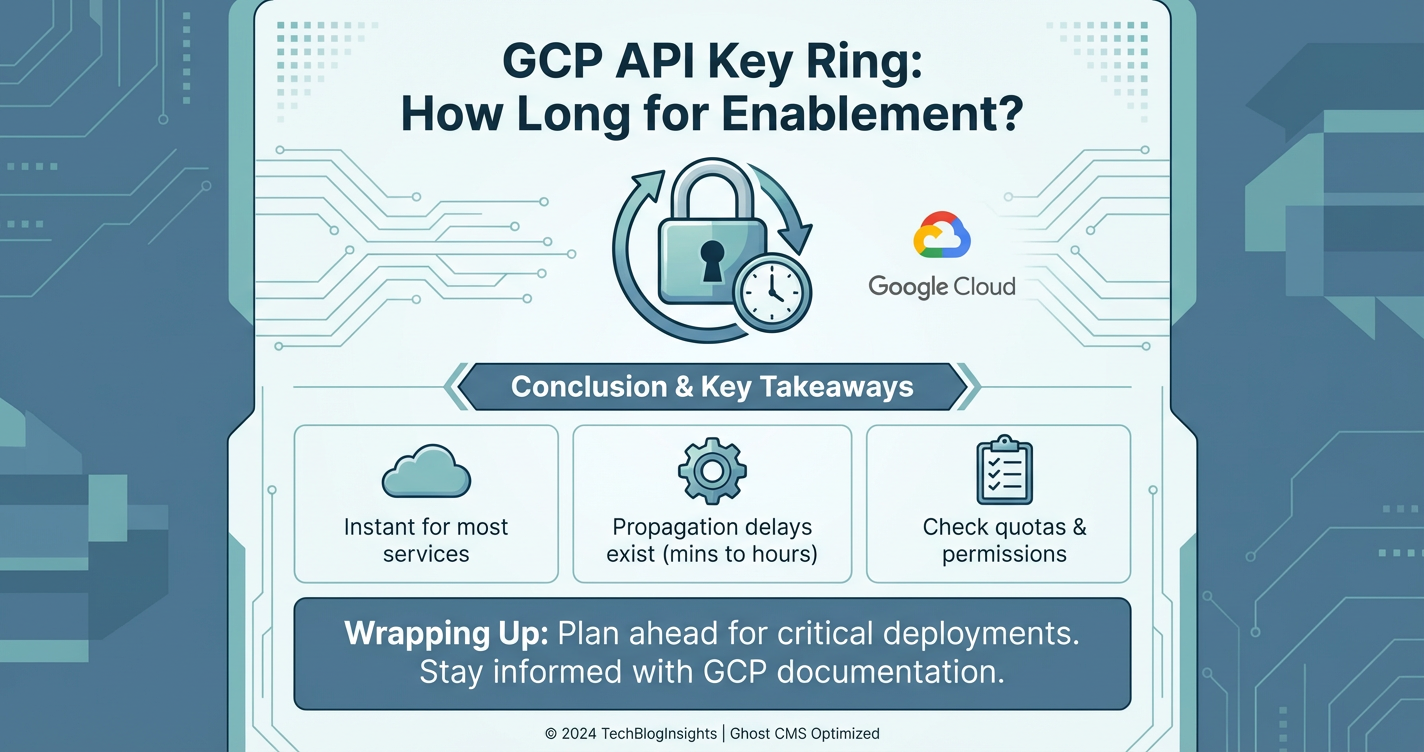
The journey of a GCP API Key Ring from creation request to full enablement is a fascinating demonstration of modern distributed cloud computing. While the initial API call confirming creation typically resolves in seconds, the complete global propagation of a new API key and its associated restrictions across Google Cloud's vast infrastructure adheres to an eventual consistency model, usually taking between 10 seconds and 5 minutes to be fully effective across all regions and services. This variability is a natural consequence of the numerous factors at play, including the complexity of the key's configuration, geographic considerations, the current system load, and the internal mechanisms of data replication and caching.
For cloud architects, developers, and security professionals, understanding these nuances is paramount. It enables realistic planning for deployments, informed troubleshooting when transient authentication issues arise, and the development of resilient applications that gracefully handle the asynchronous nature of cloud resource provisioning. Embracing strategies like implementing retry logic with exponential backoff for newly created keys in automated pipelines is not just a best practice; it's a necessity for ensuring robust and reliable operations.
Beyond the technical specifics of enablement, this deep dive underscores the broader imperative of comprehensive API Governance. API Key Rings provide a foundational layer of security and organization for accessing GCP APIs, but they are just one component of a holistic strategy. A strong API Governance framework encompasses secure design, rigorous lifecycle management, continuous auditing, and the strategic deployment of an api gateway to manage, secure, and monitor all api traffic. Solutions like APIPark exemplify how specialized api gateway and management platforms can elevate an organization's API Governance capabilities, providing a unified, secure, and efficient ecosystem for managing both traditional REST APIs and the rapidly evolving landscape of AI-driven services.
Ultimately, mastering the "how long for enablement" question is about more than just a timer; it's about gaining a deeper appreciation for the intricate dance of cloud infrastructure and leveraging that understanding to build more secure, resilient, and performant applications. By combining meticulous API Key Ring management with a robust API Governance strategy, businesses can confidently harness the power of APIs to drive innovation while mitigating the inherent risks in an increasingly interconnected digital world.
Frequently Asked Questions (FAQs)
1. What is the typical enablement time for a new GCP API Key Ring or API key? While the initial creation confirmation is usually received within seconds, a new API Key Ring or API key typically becomes fully enabled and globally consistent across all GCP services within 10 seconds to 5 minutes. This duration can vary based on factors like configuration complexity, geographical spread, and current GCP system load.
2. Why isn't API key enablement instantaneous across all regions? GCP operates on a massively distributed, global infrastructure. For a new API key's configuration (including its restrictions) to be effective everywhere, it needs to be replicated across numerous regional endpoints, internal service frontends, and caching layers worldwide. This process adheres to an "eventual consistency" model, meaning it takes a short, non-zero amount of time for changes to propagate and become globally consistent.
3. What are the key factors that can influence API Key Ring enablement duration? Key factors include: the complexity of associated API and application restrictions (e.g., HTTP referrers, IP addresses), the geographical region of creation and consumption, the current load on Google's internal systems, and internal network latency for data replication. More complex configurations and greater geographical distribution can lead to slightly longer propagation times.
4. How can I monitor the status and usage of my GCP API keys? You can monitor API key status and usage using several GCP tools: the GCP Console (under APIs & Services > Credentials), Cloud Audit Logs (to track creation, modification, and deletion events), and Cloud Monitoring (to analyze API usage metrics and set up alerts for anomalies). Programmatic checks using the gcloud CLI or API calls can also confirm a key's current state.
5. How does API Key Ring management fit into broader API Governance? API Key Ring management is a fundamental part of a comprehensive API Governance strategy. While Key Rings secure access to GCP APIs at the infrastructure level, API Governance encompasses the entire lifecycle and management of all APIs (internal, external, REST, AI). This includes secure design, lifecycle management (rotation, deletion), auditing, and often involves using an api gateway (like APIPark) to enforce policies, manage traffic, provide analytics, and ensure robust security and operational efficiency for the APIs themselves.
🚀You can securely and efficiently call the OpenAI API on APIPark in just two steps:
Step 1: Deploy the APIPark AI gateway in 5 minutes.
APIPark is developed based on Golang, offering strong product performance and low development and maintenance costs. You can deploy APIPark with a single command line.
curl -sSO https://download.apipark.com/install/quick-start.sh; bash quick-start.sh

In my experience, you can see the successful deployment interface within 5 to 10 minutes. Then, you can log in to APIPark using your account.

Step 2: Call the OpenAI API.