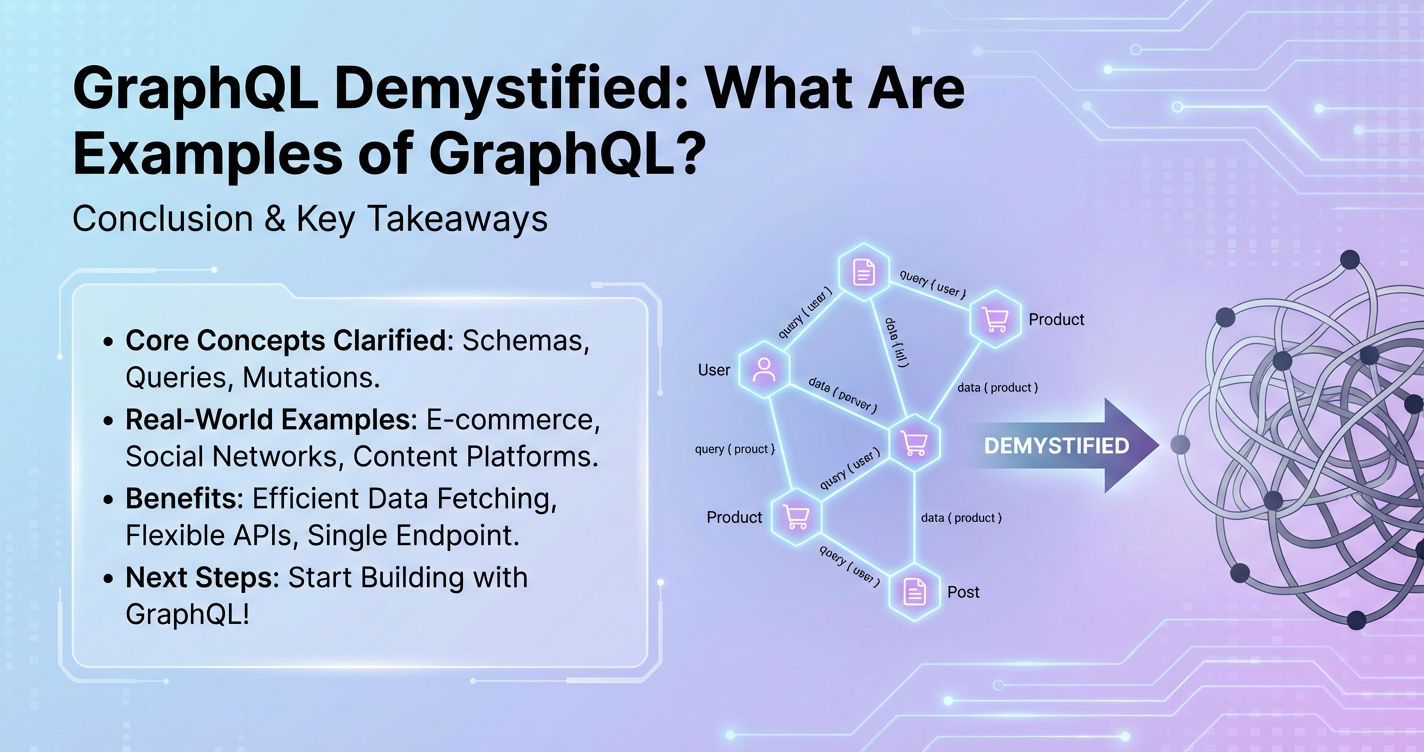
GraphQL Demystified: What Are Examples of GraphQL?


In the dynamic and ever-evolving landscape of software development, the way applications communicate with their backend services is paramount to their success. For decades, the Representational State Transfer (REST) architectural style has been the ubiquitous standard for building Web apis, offering a relatively straightforward approach to exposing resources over HTTP. However, as applications grew in complexity, particularly with the advent of mobile-first strategies and highly interactive single-page applications, developers began to encounter inherent limitations within the REST paradigm. Issues like over-fetching (receiving more data than necessary), under-fetching (requiring multiple requests to gather all needed data), and the rigid nature of fixed endpoints often led to inefficient data transfer, increased latency, and a cumbersome development experience.
It was out of this growing need for more flexible and efficient data fetching that GraphQL emerged as a powerful alternative. Developed internally by Facebook in 2012 and open-sourced in 2015, GraphQL isn't just another api protocol; it’s a robust query language for apis and a runtime for fulfilling those queries with your existing data. It empowers client applications to declare precisely what data they need, shifting the control from the server, which traditionally dictates the data structure, to the client, which customizes its data requirements. This fundamental shift allows for more agile development cycles, optimized network usage, and a more intuitive understanding of the data available through an api.
This comprehensive article aims to demystify GraphQL, delving deep into its core principles, exploring its architectural nuances, and illustrating its practical applications through a series of detailed examples. We will embark on a journey from understanding the genesis of GraphQL and the problems it sought to solve, through its foundational concepts like schemas, queries, mutations, and subscriptions. Furthermore, we will examine the tangible benefits and potential challenges associated with adopting GraphQL, providing a balanced perspective on its suitability for various projects. By the end of this exploration, you will not only grasp the "what" of GraphQL but also gain a profound insight into the "how" and "why" it is increasingly becoming a cornerstone of modern api development. We will also touch upon how GraphQL integrates into broader api management strategies, including its relationship with api gateway solutions and OpenAPI specifications, ultimately equipping you with a holistic understanding of this transformative technology.
Chapter 1: The Genesis of GraphQL: Solving the Modern API Dilemma
The journey to understanding GraphQL truly begins with appreciating the limitations of its predecessors, primarily RESTful apis, which, despite their widespread adoption and undeniable utility, started to show cracks under the pressure of increasingly complex application requirements. REST, designed around the concepts of resources and standard HTTP methods (GET, POST, PUT, DELETE), thrives on exposing distinct data entities at predictable URLs. This model worked exceedingly well for simpler applications where data requirements were clearly defined and relatively static. However, as applications evolved, particularly with the proliferation of mobile devices and dynamic web interfaces, the need for more granular and efficient data access became critical.
The Problem REST Couldn't Fully Solve
One of the most persistent challenges with traditional REST apis is the issue of over-fetching and under-fetching. * Over-fetching occurs when a client receives more data than it actually needs. Imagine fetching a user profile from /users/{id}. The REST endpoint might return a user's ID, name, email, address, creation date, last login, and a list of preferences. If the client application only needs the user's name and email for a particular UI component, it has over-fetched a significant amount of extraneous data. This additional data consumes unnecessary bandwidth, increases parsing time on the client, and contributes to slower application performance, especially critical in environments with limited network speeds or processing power, such as mobile devices. While some REST apis offer query parameters for field selection (e.g., /users/{id}?fields=name,email), this approach often lacks standardization, can become unwieldy for complex nested data, and is not a universal feature across all REST implementations. * Under-fetching, conversely, is the problem of needing to make multiple requests to gather all the necessary data for a single view or component. Consider an application displaying a list of blog posts, each with its author's name and the count of comments. A typical REST api might expose /posts for the list of posts, /authors/{id} for author details, and /posts/{id}/comments for comments. To display the complete information for a list of posts, the client would first fetch all posts, then for each post, potentially make separate requests to fetch the author's details and another request to fetch the comments count. This cascade of requests, often referred to as the "N+1 problem," leads to high latency, increased server load, and significantly more complex client-side logic to coordinate and assemble the data.
Beyond these fetching inefficiencies, REST also presented challenges with versioning and evolving schemas. As apis mature, changes to data structures are inevitable. With REST, this often led to the creation of new api versions (e.g., /v1/users, /v2/users), which meant maintaining multiple codebases on the server and forcing clients to update their integrations, a process that can be both costly and prone to errors. The rigid structure of endpoints also made it difficult for front-end teams to iterate quickly on UI components without waiting for backend modifications to create new endpoints that precisely matched their evolving data needs. This often created a bottleneck, slowing down the overall development cycle.
Facebook's Internal Struggle and the Birth of GraphQL
It was precisely these challenges that Facebook encountered on a massive scale. As Facebook transitioned from a desktop-first experience to a mobile-first paradigm in the early 2010s, their engineering teams realized that the existing RESTful api infrastructure was struggling to keep pace. Mobile applications, by their nature, require highly optimized data transfer due to slower network conditions and battery constraints. The diverse and ever-changing requirements of Facebook's various features—from news feeds to user profiles, events, and groups—meant that a "one-size-fits-all" REST endpoint was inefficient. Different parts of the application, and indeed different devices, needed varying subsets of data from the same core entities.
To address these pain points, Facebook embarked on an ambitious project in 2012 to develop a new api technology tailored specifically for their mobile applications. Their goal was to create a data-fetching mechanism that allowed clients to express their data requirements declarately, asking for exactly what they needed, no more and no less. This vision led to the creation of GraphQL. It was initially designed to power the native iOS News Feed, where the data requirements were complex, highly interconnected, and constantly evolving. By empowering the client to specify the data structure it desired, Facebook dramatically reduced the number of requests needed to render complex UI components and significantly minimized the amount of data transferred over the network.
Open Sourcing and Subsequent Adoption
Recognizing the broader utility of this innovative approach, Facebook made the strategic decision to open-source GraphQL in 2015. This move sparked a significant shift in the api development community. Developers and organizations worldwide quickly recognized GraphQL's potential to address the same challenges they faced with REST. Its open-source nature fostered a vibrant ecosystem, leading to the development of robust tools, libraries, and frameworks across various programming languages.
Since its open-sourcing, GraphQL has seen widespread adoption by numerous prominent companies, including Airbnb, GitHub, Shopify, Pinterest, and The New York Times, among many others. These organizations have leveraged GraphQL to build more efficient, flexible, and developer-friendly apis, enabling faster front-end development, better performance for their applications, and a more streamlined approach to managing complex data interactions.
Beyond REST: An Alternative, Not Always a Replacement
It is crucial to understand that GraphQL is not necessarily a direct replacement for REST, but rather an alternative or complementary approach. REST continues to be a perfectly valid and often preferred choice for simpler apis, particularly those exposing well-defined, static resources where the benefits of GraphQL's flexibility might not outweigh its added complexity. For instance, apis that primarily serve as a gateway to static content or perform simple CRUD (Create, Read, Update, Delete) operations on single resources might find REST more suitable.
However, for applications with intricate data relationships, highly dynamic UI requirements, multiple data sources, and a strong emphasis on client-driven data fetching efficiency, GraphQL presents a compelling and powerful solution. It represents a paradigm shift towards a more client-centric api design, where the focus moves from resource endpoints to a single, powerful query language that allows clients to precisely articulate their data needs. This fundamental change promises to unlock new levels of efficiency and agility in modern api development.
Chapter 2: Understanding the Core Concepts of GraphQL
To truly harness the power of GraphQL, one must first grasp its foundational concepts. Unlike REST, which is built on the architecture of resources and HTTP verbs, GraphQL introduces a new lexicon and a different way of thinking about how clients interact with data. At its heart, GraphQL is a query language for your api, and its strength lies in its strong type system and its ability to specify exactly what data is needed.
The GraphQL Query Language
The GraphQL query language is perhaps the most visible aspect of GraphQL. It allows clients to express their data requirements in a structured, hierarchical manner, mirroring the shape of the data they expect to receive.
Queries: Asking for Exactly What You Need
The primary operation in GraphQL for fetching data is called a query. Instead of making requests to multiple, predefined REST endpoints, a GraphQL client sends a single query to a single endpoint. This query precisely describes the data the client needs, including nested relationships.
Let's illustrate with an example. Imagine a system where you want to fetch details about a specific user and their most recent posts.
Traditional REST Approach (Illustrative): 1. GET /users/123 (to get user details) 2. GET /users/123/posts?limit=5 (to get the user's latest posts) This involves two separate HTTP requests and the client code then has to combine this data.
GraphQL Approach: A single GraphQL query can achieve this:
query GetUserAndPosts($userId: ID!, $postLimit: Int) {
  user(id: $userId) {
    id
    name
    email
    posts(limit: $postLimit) {
      id
      title
      publishedAt
    }
  }
}
In this query: * query GetUserAndPosts is the operation name, which is optional but good practice for debugging and logging. * ($userId: ID!, $postLimit: Int) declares variables that can be passed into the query, making it dynamic. ID! means the userId is of type ID and is non-nullable. Int means postLimit is an integer and can be null. * user(id: $userId) specifies that we want to fetch a user and pass an id argument. * The curly braces { ... } define the selection set, specifying the fields we want from the user object: id, name, email. * posts(limit: $postLimit) is a nested field, indicating we want to fetch the posts associated with this user, with a limit argument. * The inner selection set for posts specifies id, title, and publishedAt.
The server will then respond with a JSON object that exactly matches the shape of the query, eliminating over-fetching.
Key components of queries:
- Fields: These are the basic units of data you can request. In the example,
id,name,email,title,publishedAtare all fields. Fields can be scalar (likeString,Int,Boolean) or they can return object types, allowing for nested selections. - Arguments: Fields can accept arguments to modify their behavior, such as filtering, pagination, or specifying a specific item.
id: $userIdandlimit: $postLimitare examples of arguments. - Aliases: Sometimes you need to query the same field with different arguments but avoid name collisions in the result. Aliases allow you to rename the result field.
graphql query TwoUsers { user1: user(id: "1") { name } user2: user(id: "2") { name } } - Fragments: Fragments are reusable units of selection logic. They are incredibly useful for reducing repetition when multiple parts of a query need to fetch the same set of fields. ```graphql fragment UserInfo on User { id name email }query GetUsersAndAuthors { user(id: "1") { ...UserInfo } post(id: "101") { title author { ...UserInfo } } }
`` Here,UserInfois a fragment definedon Usertype, which can be reused wherever aUsertype is expected. * **Variables:** Queries and mutations can be parameterized using variables, separating static query structure from dynamic input values. This makes queries reusable and helps preventapiinjection attacks. Variables are passed as a separate JSON object alongside the query. * **Directives:** Directives are special identifiers (@include,@skip,@deprecated) that can be attached to fields or fragments to conditionally alter their execution or behavior. For example,@include(if: $condition)would only include a field if the$condition` variable is true.
Mutations: Modifying Data on the Server
While queries are for fetching data, mutations are used to create, update, or delete data on the server. Just like queries, mutations also follow the structured, nested selection set pattern, allowing clients to receive the updated state of the modified data immediately after the operation.
An important distinction is that while queries are typically executed in parallel, mutations are executed sequentially by the GraphQL server. This ensures that if you send multiple mutations in a single request, they are applied in the order they appear, preventing race conditions or unexpected state changes.
Example Mutation: To create a new post, you might use a mutation like this:
mutation CreateNewPost($title: String!, $content: String!, $authorId: ID!) {
  createPost(title: $title, content: $content, authorId: $authorId) {
    id
    title
    publishedAt
    author {
      name
    }
  }
}
Here, createPost is the mutation field. It takes arguments for the post's details. The selection set specifies what data about the newly created post we want to receive back from the server, including some details about its author. This immediate feedback loop is a powerful feature, as it means the client doesn't need to make a subsequent query to get the updated information.
Subscriptions: Real-time Data Push
Subscriptions are a crucial part of GraphQL for enabling real-time functionalities. They allow clients to receive real-time updates from the server whenever specific data changes. Unlike queries (request-response) and mutations (request-response with side effects), subscriptions establish a long-lived connection, typically over WebSockets. Once a client subscribes to an event, the server will push data to the client whenever that event occurs.
Example Subscription: In a chat application, a client might subscribe to new messages:
subscription OnNewMessage {
  newMessage {
    id
    text
    sender {
      name
    }
    timestamp
  }
}
Once this subscription is established, whenever a new message is sent and processed by the server, the newMessage field's resolver will be triggered, and the server will push the details of the new message to all subscribed clients. This eliminates the need for inefficient polling mechanisms often used in REST for real-time updates.
GraphQL Schema and Type System: The Contract
The backbone of any GraphQL api is its schema. The schema is a strongly typed contract between the client and the server. It defines all the data types, fields, and operations (queries, mutations, subscriptions) that clients can interact with. This robust type system is one of GraphQL's most significant advantages, providing self-documentation, enabling powerful tooling (like GraphiQL, a GraphQL IDE), and catching many potential errors at development time.
The schema is written using the GraphQL Schema Definition Language (SDL), a human-readable language that is independent of any programming language.
Key components of the Schema:
- Object Types & Fields: These are the most fundamental building blocks. An object type represents a kind of object you can fetch from your service, and it has a name (e.g.,
User,Post). Each object type exposes a set of fields, which are specific pieces of data associated with that object. ```graphql type User { id: ID! name: String! email: String posts: [Post!]! }type Post { id: ID! title: String! content: String publishedAt: String author: User! comments: [Comment!]! }`` Here,Useris an object type with fields likeid,name,email, andposts. Thepostsfield itself returns a list ofPostobjects. The!indicates that a field is non-nullable.[Post!]!means it's a list of non-nullablePost` objects, and the list itself is non-nullable. - Scalar Types: GraphQL comes with a set of built-in scalar types that represent atomic values:
ID: A unique identifier, often serialized as a String.String: A UTF-8 character sequence.Int: A signed 32-bit integer.Float: A signed double-precision floating-point value.Boolean:trueorfalse. You can also define custom scalar types (e.g.,Date,JSON).
- List & Non-Null Types: These are type modifiers.
[Type]: Represents a list ofTypeobjects. Can be null.Type!: Represents aTypeobject that cannot be null.[Type!]!: A non-null list of non-nullTypeobjects.
- Interfaces: Similar to interfaces in object-oriented programming, a GraphQL interface defines a set of fields that any object type implementing it must include. This is useful for polymorphic data. ```graphql interface Node { id: ID! }type User implements Node { id: ID! name: String! email: String }type Post implements Node { id: ID! title: String! content: String }
`` BothUserandPostimplementNode, meaning they both have anid` field. - Unions: A union type is a type that can return one of several distinct object types. Unlike interfaces, union types don't share common fields. ```graphql union SearchResult = User | Post | Commenttype Query { search(text: String!): [SearchResult!]! }
`` Asearchquery could return a list ofUser,Post, orComment` objects. - Input Types: When sending complex objects as arguments to mutations, regular object types cannot be used. Instead, GraphQL provides input types, which are similar to object types but are specifically designed for input arguments. ```graphql input CreatePostInput { title: String! content: String! authorId: ID! }type Mutation { createPost(input: CreatePostInput!): Post! } ```
- The Root Types (
Query,Mutation,Subscription): Every GraphQL schema must define three special root types:graphql schema { query: Query mutation: Mutation subscription: Subscription }These are the main entry points where clients begin their operations.Query: Defines all the top-level entry points for fetching data.Mutation: Defines all the top-level entry points for modifying data.Subscription: Defines all the top-level entry points for receiving real-time updates.
Resolvers: Connecting Schema to Data
The schema defines what data can be queried, but it doesn't specify how that data is retrieved. That's the job of resolvers. A resolver is a function that is responsible for fetching the data for a specific field in the schema. When a GraphQL query arrives at the server, the server traverses the query's fields, and for each field, it calls the corresponding resolver function.
Consider our User and Post schema again:
type User {
  id: ID!
  name: String!
  email: String
  posts: [Post!]!
}
For the User type, there would be resolver functions for id, name, email, and posts. * The id, name, email resolvers might simply return values from a User object that was fetched by an upstream resolver (e.g., the user field on the Query type). * The posts resolver, however, would be more complex. When it's called for a specific user, it would need to make a database query (e.g., SELECT * FROM posts WHERE author_id = $userId) or an api call to another service to fetch that user's posts.
Resolvers are the glue that connects your GraphQL schema to your actual data sources, which can be anything: a SQL database, a NoSQL database, other REST apis, microservices, third-party apis, or even in-memory data. This abstraction layer is incredibly powerful, allowing a GraphQL server to aggregate data from disparate sources and present it as a single, unified graph to the client.
GraphQL Server: The Orchestrator
The GraphQL server is the runtime environment that handles incoming GraphQL requests. Its main responsibilities include: 1. Parsing and Validation: It first parses the incoming query string into an Abstract Syntax Tree (AST) and then validates it against the defined schema to ensure it's syntactically correct and requests valid fields and arguments. 2. Execution: If the query is valid, the server executes it. This involves traversing the query's selection set, calling the appropriate resolver function for each field. The execution process is often highly optimized, executing resolvers for fields that resolve to scalar values in parallel, while ensuring mutations run in sequence. 3. Data Assembly: As resolvers return data, the server assembles the results into a JSON object that precisely mirrors the shape of the original query. 4. Response: The assembled JSON response is then sent back to the client.
The GraphQL server acts as an intelligent proxy or a façade, abstracting the complexities of backend data fetching from the client. It provides a single point of entry for all data interactions, simplifying client-side logic and reducing the number of round trips needed to compose a complete view. This comprehensive understanding of GraphQL's core concepts lays the groundwork for appreciating its practical applications in real-world scenarios.
Chapter 3: Practical Examples of GraphQL in Action
Having explored the theoretical underpinnings of GraphQL, it's time to delve into practical examples that showcase its power and versatility across various application domains. These scenarios will illustrate how GraphQL addresses the inefficiencies of traditional apis and empowers developers to build more flexible and performant applications.
Example 1: A Blogging Platform (Data Fetching)
Let's imagine building or refactoring the frontend for a blogging platform. A common requirement is to display a list of blog posts, and for each post, show its title, content snippet, the author's name, and potentially a few recent comments.
Traditional REST Approach: With a RESTful api, this task would typically involve multiple requests: 1. GET /posts: To fetch a list of all posts. This endpoint might return post IDs, titles, and content. For author information, it would likely only provide an authorId. 2. For each post in the list, you might need: * GET /authors/{authorId}: To fetch the author's name. * GET /posts/{postId}/comments?limit=3: To fetch the latest comments for that post.
This results in an "N+1" problem: N posts require N additional requests for authors and N additional requests for comments, leading to 1 (for posts) + N (for authors) + N (for comments) requests in total, which is highly inefficient.
GraphQL Approach: With GraphQL, all this data can be fetched in a single, efficient query. The schema for our blogging platform might look something like this:
type Query {
  posts(limit: Int, offset: Int): [Post!]!
  post(id: ID!): Post
}

type Post {
  id: ID!
  title: String!
  content: String
  publishedAt: String
  author: User!
  comments(limit: Int): [Comment!]!
}

type User {
  id: ID!
  name: String!
  email: String
}

type Comment {
  id: ID!
  text: String!
  user: User!
  createdAt: String
}
Now, to display a list of posts with author names and recent comments, the client would send a single GraphQL query:
query GetPostsWithAuthorsAndComments($limit: Int = 10, $commentsLimit: Int = 3) {
  posts(limit: $limit) {
    id
    title
    content
    publishedAt
    author {
      id
      name
    }
    comments(limit: $commentsLimit) {
      id
      text
      user {
        name
      }
    }
  }
}
Explanation: * This single query GetPostsWithAuthorsAndComments fetches a list of posts. * For each post, it specifies exactly which fields are needed: id, title, content, publishedAt. * It then nests the author field, asking for the id and name of the author. The GraphQL server knows how to resolve this relationship. * Furthermore, it nests the comments field, asking for id, text, and the name of the user who made the comment, limited to 3 comments per post.
The server will execute the posts resolver, which might fetch posts from a database. Then, for each post, it will execute the author resolver to fetch the author details (perhaps from a user service or a users table) and the comments resolver (from a comments service/table). Crucially, a well-implemented GraphQL server will use techniques like data loaders to batch and cache these lookups, preventing the N+1 problem on the server side despite the nested structure of the query.
The result is a single JSON response that mirrors the query's structure, containing only the requested data. This significantly reduces network overhead, simplifies client-side data management, and makes the application more responsive.
Example 2: An E-commerce Application (Data Mutation)
Beyond fetching data, applications also need to modify it. E-commerce platforms, for instance, frequently deal with adding items to a cart, updating product quantities, and placing orders.
Traditional REST Approach: * Adding an item to a cart: POST /cart/items with a request body { productId: "...", quantity: ... }. The response might just be a success status or the updated cart state. * Updating item quantity: PUT /cart/items/{itemId} with a new quantity. * Placing an order: POST /orders with cart and shipping details.
These operations typically require separate requests, and the client might then need to make another GET request to fetch the updated state of the cart or the newly created order.
GraphQL Approach: With GraphQL mutations, you can perform these operations and retrieve the resulting state in a single request. Let's assume our e-commerce schema includes Cart and Order types and relevant mutations:
type Mutation {
  addItemToCart(productId: ID!, quantity: Int!): Cart!
  updateCartItemQuantity(itemId: ID!, quantity: Int!): Cart!
  placeOrder(cartId: ID!, shippingAddress: String!): Order!
}

type Cart {
  id: ID!
  items: [CartItem!]!
  totalItems: Int!
  totalAmount: Float!
}

type CartItem {
  id: ID!
  product: Product!
  quantity: Int!
}

type Product {
  id: ID!
  name: String!
  price: Float!
}

type Order {
  orderId: ID!
  status: String!
  totalAmount: Float!
  orderedItems: [OrderItem!]!
  shippingAddress: String!
}
Adding an item to the cart and fetching the updated cart state:
mutation AddProductToCart($productId: ID!, $quantity: Int!) {
  addItemToCart(productId: $productId, quantity: $quantity) {
    id
    totalItems
    totalAmount
    items {
      id
      quantity
      product {
        name
        price
      }
    }
  }
}
Placing an order:
mutation FinalizeOrder($cartId: ID!, $shippingAddress: String!) {
  placeOrder(cartId: $cartId, shippingAddress: $shippingAddress) {
    orderId
    status
    totalAmount
    orderedItems {
      product {
        name
      }
      quantity
    }
  }
}
Explanation: * The addItemToCart mutation takes productId and quantity as arguments. Its resolver will update the database/backend cart service. * Crucially, the mutation's selection set then specifies what data about the Cart object should be returned. This means the client gets the id, totalItems, totalAmount, and details of the items (including nested product name and price) immediately after adding an item. There's no need for a separate GET /cart request. * Similarly, the placeOrder mutation allows the client to provide the necessary information to finalize an order and directly receive the orderId, status, totalAmount, and a summary of orderedItems in the response.
This pattern significantly streamlines the interaction flow for transactional operations, providing atomic actions that both modify data and return its up-to-date representation, enhancing user experience and simplifying client-side state management.
Example 3: A Real-time Chat Application (Subscriptions)
Real-time capabilities are a hallmark of modern applications, from chat platforms to live dashboards. GraphQL's subscriptions provide a powerful, standardized way to implement these features.
Traditional REST/Polling Approach: Implementing real-time features with REST typically involves: * Polling: The client repeatedly sends GET requests to an endpoint (e.g., GET /messages?since={timestamp}) at short intervals to check for new data. This is inefficient, generates a lot of unnecessary network traffic, and introduces latency. * WebSockets (Custom): For true real-time, developers often resort to raw WebSockets, which provide a persistent connection. However, managing WebSocket connections, message formats, and data serialization across various events can become complex and lack the structured query capabilities of GraphQL.
GraphQL Approach: With GraphQL subscriptions, clients can "subscribe" to specific events, and the server will push data to them over a persistent connection (typically WebSockets) whenever those events occur.
Let's imagine a chat api schema:
type Subscription {
  newMessage(channelId: ID!): Message!
  userJoined(channelId: ID!): User!
}

type Message {
  id: ID!
  text: String!
  sender: User!
  channel: Channel!
  timestamp: String!
}

type Channel {
  id: ID!
  name: String!
}

# User type as defined previously
A client wanting to receive new messages in a specific channel would establish a subscription:
subscription OnNewMessageInChannel($channelId: ID!) {
  newMessage(channelId: $channelId) {
    id
    text
    timestamp
    sender {
      id
      name
    }
    channel {
      id
      name
    }
  }
}
Explanation: * The client sends this subscription query, specifying channelId to filter messages. * The GraphQL server establishes a WebSocket connection. * Whenever a new message is posted to that channelId (e.g., via a createMessage mutation), the newMessage subscription resolver is triggered. * The server then pushes the Message object, shaped exactly as defined in the selection set (including sender and channel details), down the WebSocket connection to all subscribed clients for that channel.
This provides an efficient and elegant solution for real-time communication, ensuring clients only receive updates they've explicitly asked for, minimizing latency, and leveraging the strong type system and structured query language of GraphQL.
Example 4: Integrating with Legacy Systems / Microservices
One of GraphQL's most compelling use cases is its ability to act as a unified façade over diverse backend data sources, including legacy systems, databases, and a multitude of microservices. In complex enterprise environments, it's common to have data scattered across various services, some using REST, others direct database access, and newer ones possibly gRPC. Exposing all these disparate data sources directly to client applications can lead to severe architectural coupling and client-side complexity.
Scenario: Imagine a large organization with: * A legacy SQL database for customer information. * A microservice for product catalog (exposed via REST). * Another microservice for order processing (gRPC). * A third-party api for shipping rates.
A new frontend application needs to display a customer's profile, their recent orders, and recommend products, while also calculating shipping costs.
GraphQL as a Unifying Layer: A GraphQL server can sit in front of all these services, acting as an api gateway that orchestrates data retrieval and modification. The GraphQL schema defines a coherent, unified view of the data, regardless of its underlying source.
# Example Schema snippet
type Customer {
  id: ID!
  name: String!
  email: String
  orders(limit: Int): [Order!]!
  recommendedProducts(count: Int): [Product!]!
  shippingEstimate(productId: ID!, quantity: Int!, destination: String!): ShippingEstimate!
}

type Order {
  # ... fields ...
}

type Product {
  # ... fields ...
}

type ShippingEstimate {
  # ... fields ...
}

type Query {
  customer(id: ID!): Customer
}
The resolvers for these fields would then be responsible for calling the appropriate backend service: * Customer fields (id, name, email): Resolved by querying the legacy SQL database. * orders field for a customer: Resolved by making a gRPC call to the order processing microservice, passing the customer ID. * recommendedProducts field: Resolved by calling the RESTful product catalog microservice, perhaps with additional logic to filter recommendations. * shippingEstimate field: Resolved by calling the third-party shipping api.
Explanation and APIPark Integration: The GraphQL server effectively becomes an api gateway that abstracts away the complexities of multiple backend apis, data formats, and communication protocols. For the client, it's a single, elegant api endpoint that responds to structured queries. This significantly reduces the burden on frontend developers, allowing them to focus on UI/UX rather than api integration challenges.
When aggregating data from multiple services, particularly in a microservices architecture, a robust api gateway becomes indispensable. Solutions like APIPark excel in this domain, providing an all-in-one AI gateway and api management platform that can streamline the integration and deployment of both AI and REST services. For organizations adopting GraphQL to unify client access to diverse backends, APIPark can serve as the foundational layer, offering end-to-end api lifecycle management, traffic forwarding, load balancing, and even the ability to encapsulate prompts into REST apis for AI models, abstracting away backend complexities and ensuring consistent performance and security across the entire api landscape. By centralizing api governance and enabling quick integration of various backend services, APIPark complements a GraphQL strategy, ensuring that the underlying data sources, whether traditional or AI-driven, are managed efficiently and securely before their data is exposed through the GraphQL layer. This synergistic approach allows developers to leverage GraphQL's flexibility at the client-facing layer while maintaining robust control and performance over their backend apis through a powerful api gateway.
Example 5: OpenAPI Specification and GraphQL
The OpenAPI Specification (formerly Swagger Specification) is the industry standard for defining RESTful apis. It provides a language-agnostic, human-readable description of an api, detailing its endpoints, operations, parameters, authentication methods, and responses. This specification is invaluable for documentation, api client generation, and api testing for REST services.
Relationship with GraphQL: GraphQL has its own built-in introspection system. A GraphQL server can be queried about its own schema, allowing tools like GraphiQL (a GraphQL IDE) to dynamically explore the available types, fields, and operations. This means GraphQL apis are inherently self-documenting, eliminating the need for a separate OpenAPI-like specification for the GraphQL layer itself.
However, the question often arises: "How do OpenAPI and GraphQL relate?" They serve different, albeit related, purposes: * OpenAPI describes individual REST endpoints and their contract. * GraphQL describes a unified data graph and a query language to interact with it.
They are not mutually exclusive and can coexist within an organization's api ecosystem: 1. Hybrid Architectures: Many organizations operate with a mix of RESTful apis and GraphQL apis. OpenAPI would be used to document the REST parts of the system, while GraphQL's introspection handles its own documentation. 2. GraphQL as a Façade over REST: As seen in Example 4, a GraphQL server can aggregate data from underlying RESTful microservices. In such a scenario, the backend REST services themselves might be documented using OpenAPI. The GraphQL layer then abstracts these OpenAPI-defined apis into a single GraphQL schema. 3. Tooling for Interoperability: While there's no direct "conversion" from OpenAPI to GraphQL or vice-versa that makes perfect sense universally, tools are emerging that can: * Generate GraphQL Schemas from OpenAPI: Some tools attempt to parse OpenAPI specifications and infer a GraphQL schema to quickly expose existing REST apis through a GraphQL endpoint. This can be a good starting point but often requires manual refinement to truly leverage GraphQL's benefits. * Generate OpenAPI from GraphQL (less common): This is less common because GraphQL's single endpoint and client-driven nature don't map neatly to OpenAPI's resource-based endpoint definitions.
Conclusion: In essence, OpenAPI is indispensable for defining and documenting RESTful apis, while GraphQL's introspection fulfills a similar documentation role for its own schema. They address different api paradigms but can certainly coexist and even complement each other in complex api ecosystems, especially when GraphQL acts as an aggregation layer over existing REST services described by OpenAPI specifications. Understanding both allows developers to choose the right tool for the job or integrate them effectively into a cohesive api strategy.
APIPark is a high-performance AI gateway that allows you to securely access the most comprehensive LLM APIs globally on the APIPark platform, including OpenAI, Anthropic, Mistral, Llama2, Google Gemini, and more.Try APIPark now! 👇👇👇
Chapter 4: Benefits and Challenges of GraphQL
Adopting any new technology comes with a trade-off, and GraphQL is no exception. While it offers compelling advantages that address many modern api development pain points, it also introduces its own set of complexities and challenges. A balanced perspective is crucial for making informed decisions about its suitability for a given project.
Benefits of GraphQL
GraphQL's design principles directly lead to several significant benefits, particularly for client-heavy applications and microservices architectures.
- Efficiency and Reduced Network Overhead:
- Elimination of Over-fetching and Under-fetching: This is GraphQL's flagship advantage. Clients can request exactly the data they need, no more, no less. This translates to smaller payload sizes, especially critical for mobile applications where bandwidth and battery life are premium resources. By reducing unnecessary data transfer, applications become faster and more responsive.
- Fewer Round Trips: Instead of multiple
GETrequests to different REST endpoints, a single GraphQL query can fetch all related data required for a UI component or screen. This significantly reduces the number of network requests (round trips) between the client and the server, lowering latency and improving overall performance.
- Flexibility and Client-Driven Development:
- Client Autonomy: GraphQL empowers frontend developers to specify their data requirements without needing backend changes. This autonomy accelerates front-end development cycles, as UI iterations no longer depend on backend
apimodifications to expose new data shapes. Teams can work more independently and iterate faster. - Evolving Schemas without Versioning: GraphQL inherently supports
apievolution without forcing new versions (e.g.,/v2/api). Instead, the schema can be gradually extended. Deprecated fields can be marked as such (using the@deprecateddirective) in the schema, and clients can smoothly transition. This avoids the maintenance overhead of multipleapiversions.
- Client Autonomy: GraphQL empowers frontend developers to specify their data requirements without needing backend changes. This autonomy accelerates front-end development cycles, as UI iterations no longer depend on backend
- Strong Type System and Self-Documentation:
- Predictable Data Structures: The GraphQL schema provides a clear, strongly typed contract between client and server. Developers know precisely what data types to expect and what operations are available, leading to fewer integration errors.
- Built-in Documentation and Tooling: The introspection capabilities of GraphQL mean that the
apiis inherently self-documenting. Tools like GraphiQL (an in-browser IDE) can query the schema and automatically generate documentation, providing a live, interactive exploration of theapi. This significantly improves developer experience and reduces the effort required to understand and consume theapi.
- Aggregating Data from Multiple Sources:
- Unified API Layer: GraphQL excels as an
api gatewayor façade that unifies disparate backend services (databases, microservices, legacy RESTapis, third-partyapis) into a single, cohesive graph. This simplifies client-side development by abstracting away the complexity of integrating with multiple backend systems, each potentially having different data models and communication protocols. - Microservices Orchestration: In a microservices architecture, a GraphQL layer can act as an orchestration service, making it much easier for clients to consume data that is distributed across many independent services. The GraphQL server handles the heavy lifting of calling multiple microservices and stitching their data together.
- Unified API Layer: GraphQL excels as an
- Improved Development Workflow:
- Mocking Data: With a well-defined schema, frontend teams can easily generate mock data based on the GraphQL schema, allowing them to develop and test UI components independently even before the backend
apiis fully implemented. - Reduced Context Switching: A single endpoint and a unified query language mean fewer concepts for developers to juggle compared to managing numerous REST endpoints, their specific parameters, and response structures.
- Mocking Data: With a well-defined schema, frontend teams can easily generate mock data based on the GraphQL schema, allowing them to develop and test UI components independently even before the backend
Challenges of GraphQL
Despite its numerous advantages, GraphQL is not a panacea. Its adoption introduces several challenges that development teams must be prepared to address.
- Increased Server-Side Complexity and Learning Curve:
- Server Implementation: Building a robust GraphQL server requires a deeper understanding of schema design, resolver implementation, and performance optimization techniques (like data loaders to solve the N+1 problem on the server). This can be a steeper learning curve for backend developers accustomed to traditional REST
apidevelopment. - Performance Optimization: While GraphQL eliminates client-side N+1 problems, it can introduce server-side N+1 problems if resolvers are not efficiently implemented, especially when fetching nested data from databases or other services. Implementing data loaders is crucial but adds complexity.
- Server Implementation: Building a robust GraphQL server requires a deeper understanding of schema design, resolver implementation, and performance optimization techniques (like data loaders to solve the N+1 problem on the server). This can be a steeper learning curve for backend developers accustomed to traditional REST
- Caching:
- HTTP Caching Difficulties: Traditional HTTP caching mechanisms (like ETags, Last-Modified headers) are highly effective for RESTful
apis because resources are identified by unique URLs. With GraphQL, all queries typically go to a single/graphqlendpoint, making generic HTTP caching challenging. - Client-Side Caching Strategies: GraphQL requires more sophisticated client-side caching solutions (e.g., normalized caches like Apollo Client's in-memory cache) to manage fetched data and update the UI efficiently. This adds another layer of complexity to client-side development.
- HTTP Caching Difficulties: Traditional HTTP caching mechanisms (like ETags, Last-Modified headers) are highly effective for RESTful
- File Uploads:
- The core GraphQL specification does not natively define how to handle file uploads. While workarounds and community-driven standards (like
graphql-multipart-request-spec) exist, they add a layer of non-standard implementation that can be less straightforward than traditional multipart form data uploads in REST.
- The core GraphQL specification does not natively define how to handle file uploads. While workarounds and community-driven standards (like
API GatewayFeatures and Monitoring:- Rate Limiting: Traditional
api gatewaysolutions often apply rate limiting based on theapiendpoint and HTTP method. With GraphQL, all requests go to a single endpoint, making it harder for conventionalapi gateways to apply fine-grained rate limits. Implementing rate limiting might require custom logic based on query complexity, depth, or specific fields being accessed, which needs more intelligentapi gatewaycapabilities or server-side implementation. - Logging and Monitoring: Similarly, traditional
apilogs often rely on URL paths to identify distinct operations. For GraphQL, all operations appear as requests to/graphql. Detailed logging and monitoring require parsing the GraphQL query/mutation name and its variables to get meaningful insights, necessitating specialized tooling or custom logging logic.
- Rate Limiting: Traditional
- Error Handling:
- HTTP Status Codes: A GraphQL server typically responds with a
200 OKHTTP status code, even if there are logical errors in the data fetching process. Error details are included in anerrorsarray within the JSON response body. This deviates from REST's use of distinct HTTP status codes (e.g.,404 Not Found,401 Unauthorized,500 Internal Server Error) to signal different types of errors, which can complicate client-side error handling if not explicitly managed.
- HTTP Status Codes: A GraphQL server typically responds with a
- Tooling Maturity (Diminishing Issue):
- While the GraphQL ecosystem has matured significantly, some specialized tooling (e.g., certain types of security scanners, load testing tools) might still be more robust or readily available for REST than for GraphQL. However, this gap is rapidly closing.
- Query Complexity and Performance:
- A client can request a deeply nested and complex query, potentially leading to performance issues and denial-of-service attacks if not properly managed. GraphQL servers must implement mechanisms for query depth limiting and complexity analysis to prevent malicious or inefficient queries from overwhelming the backend.
In conclusion, GraphQL offers powerful solutions for api flexibility and efficiency, particularly in data-intensive applications. Its benefits in client autonomy and reduced over-fetching are undeniable. However, these advantages come at the cost of increased server-side complexity, specialized caching strategies, and a need for adapting existing api gateway and monitoring tools. Teams considering GraphQL should thoroughly evaluate their specific needs, team expertise, and architectural landscape to determine if its benefits outweigh these implementation challenges.
Chapter 5: Building a GraphQL Server
Building a GraphQL server is the process of implementing the logic that interprets GraphQL queries, fetches data from your backend systems, and constructs the response. It involves defining your schema, writing resolver functions, and setting up the server infrastructure. This chapter provides a high-level overview of the key steps involved.
Choosing a Language and Framework
GraphQL is language-agnostic, meaning you can implement a GraphQL server in virtually any programming language. The choice often depends on your existing technology stack, team expertise, and performance requirements. Popular choices include:
- Node.js (JavaScript/TypeScript): Very popular due to its asynchronous nature and a rich ecosystem.
Apollo Serveris the most widely used and robust framework, offering features like schema-first or code-first development, subscriptions, and integration with various HTTP frameworks (Express, Koa, Hapi). Other options includeGraphQL.js(the reference implementation),Yoga, andTypeGraphQL(for TypeScript). - Python:
Grapheneis a feature-rich library that integrates well with popular web frameworks like Django and Flask. It allows you to build GraphQL schemas using Python classes. - Ruby:
GraphQL-Rubyis a mature and well-maintained library that integrates seamlessly with Ruby on Rails. - Java:
GraphQL-Javaprovides a comprehensive implementation for building GraphQL services in the Java ecosystem, often used with Spring Boot. - Go:
gqlgenis a code-first GraphQL server generator that allows you to define your schema in Go code and then generates the necessary boilerplate.graphql-gois another popular option. - PHP:
webonyx/graphql-phpis a robust implementation for PHP applications.
The framework you choose will abstract away much of the HTTP handling and GraphQL protocol specifics, allowing you to focus on your schema and data logic.
Schema Definition Language (SDL)
The first step in building a GraphQL server is defining your schema using the GraphQL Schema Definition Language (SDL). This involves: 1. Defining Object Types: Creating types for your data entities (e.g., User, Product, Order). 2. Defining Fields: Specifying the fields for each object type, including their types (e.g., String, Int, custom types) and nullability (!). 3. Defining Root Operations: Setting up the Query, Mutation, and Subscription types, which serve as the entry points for client operations. 4. Defining Input Types, Interfaces, Unions: Using these advanced types as needed to model complex data relationships and input structures.
Some frameworks (like TypeGraphQL or gqlgen) allow a "code-first" approach where you define your schema using programming language constructs (e.g., classes and decorators), and the SDL is generated from that code. Others (like Apollo Server with makeExecutableSchema) prefer a "schema-first" approach where you write the SDL directly.
Resolvers Implementation
Once your schema is defined, you need to implement the resolver functions. For every field in your schema that doesn't simply return a scalar value directly from its parent object, you'll need a resolver.
A resolver function typically takes four arguments: 1. parent (or root): The result of the parent resolver. For a top-level field (like user on Query), this is often the root value of the api. 2. args: An object containing the arguments passed to the field (e.g., id: "123"). 3. context: An object shared across all resolvers in a single GraphQL operation. It's often used to pass authentication information, database connections, or request-specific data. 4. info: An object containing information about the execution state of the query, including the schema, fragments, and the field's AST.
Example Resolver Structure (Node.js/Apollo Server):
const resolvers = {
  Query: {
    user: (parent, args, context, info) => {
      // Logic to fetch a user from a database or another service
      // using args.id and potentially context.dataSources.userAPI
      return context.dataSources.userAPI.getUserById(args.id);
    },
    posts: (parent, args, context, info) => {
      // Logic to fetch posts, possibly filtered by args.limit, args.offset
      return context.dataSources.postAPI.getPosts(args.limit, args.offset);
    },
  },
  User: {
    posts: (parent, args, context, info) => {
      // This resolver is called for each User object
      // 'parent' here is the User object itself
      // Logic to fetch posts by parent.id (the user's ID)
      return context.dataSources.postAPI.getPostsByAuthorId(parent.id, args.limit);
    },
  },
  Mutation: {
    createPost: (parent, args, context, info) => {
      // Logic to create a post in the database using args.input
      return context.dataSources.postAPI.createPost(args.input);
    },
  },
  // ... other types and resolvers
};
Resolvers are where you integrate with your backend systems. This can involve: * Querying a SQL or NoSQL database. * Making HTTP requests to other REST apis or microservices. * Calling gRPC services. * Accessing third-party apis. * Retrieving data from in-memory caches.
Data Loaders: Solving the N+1 Problem
One critical optimization when implementing resolvers is using Data Loaders. Data Loaders are a generic utility that provides a consistent api over various caching and batching strategies. They are essential for solving the N+1 problem on the server side of a GraphQL api.
If a query requests a list of users, and for each user, their posts, naive resolvers would fetch each user's posts individually, leading to N separate database queries for posts. A Data Loader for posts would: 1. Batch: Collect all requests for posts (e.g., getPostsByAuthorId(1), getPostsByAuthorId(2), etc.) that occur within a single tick of the event loop. 2. Deduplicate: Filter out duplicate requests for the same ID. 3. Cache: Cache the results of previous loads, so subsequent requests for the same ID within the same request are served from memory.
By using Data Loaders, all requests for a particular type of data (e.g., "posts by author ID") can be batched into a single, optimized backend call (e.g., SELECT * FROM posts WHERE author_id IN (1, 2, 3)), dramatically improving performance for nested queries.
Security Considerations
Building a GraphQL server also necessitates robust security measures: * Authentication: Verifying the identity of the client (e.g., using JWTs, OAuth). The authenticated user's information is typically placed in the context object, accessible by all resolvers. * Authorization: Determining whether an authenticated client has permission to access specific data or perform certain operations. This logic is implemented within resolvers or via middleware. For example, a post resolver might check if the requesting user is the author or an administrator before returning sensitive post details. * Query Depth Limiting: Preventing excessively deep or complex queries that could lead to performance degradation or denial-of-service (DoS) attacks. This is often configured at the server level to limit the maximum nesting depth of a query. * Query Complexity Analysis: Analyzing the computational cost of a query (e.g., based on the number of fields, arguments, or the expected number of returned items) and rejecting queries that exceed a defined threshold. * Rate Limiting: As discussed in the challenges section, traditional HTTP-based rate limiting on a single /graphql endpoint is less effective. More sophisticated rate limiting based on query type, complexity, or specific field access might be required, sometimes integrated with an api gateway that understands GraphQL query structures. * Input Validation: Thoroughly validating all input arguments to mutations and queries to prevent injection attacks or malformed data.
Deployment and Monitoring
Deploying a GraphQL server is similar to deploying any other web service, typically involving containerization (Docker), orchestration (Kubernetes), and cloud platforms. However, monitoring a GraphQL api requires special considerations due to its single endpoint. Tools and practices for monitoring should focus on: * Query/Mutation Name: Logging the specific operation name (GetUserAndPosts, CreateNewPost) rather than just the URL. * Execution Time: Tracking the performance of individual resolvers and overall query execution times. * Error Rates: Monitoring errors returned in the errors array within GraphQL responses. * Query Complexity: Keeping an eye on the complexity of incoming queries to detect potential performance issues or attacks.
By carefully considering these aspects, developers can build powerful, efficient, and secure GraphQL servers that serve as the backbone for modern applications.
Comparison Table: REST vs. GraphQL
To summarize the key differences and help in deciding when to use each, here's a comparative table between RESTful APIs and GraphQL.
| Feature | RESTful APIs | GraphQL |
|---|---|---|
| Architectural Style | Resource-oriented, uses HTTP methods for operations on resources. | Graph-oriented, uses a query language for data fetching. |
| Data Fetching Model | Multiple endpoints, fixed data structures per endpoint. Client fetches data from specific URLs. | Single endpoint (/graphql), client-defined data requirements. Client sends a query asking for exact data. |
| Over/Under-fetching | Common issues due to fixed responses. | Eliminated, as client requests precise data. |
| Number of Requests | Often requires multiple round trips for related data (N+1 problem). | Typically a single request for all necessary data. |
| Versioning | Often versioned (e.g., /v1/users, /v2/users) to handle changes, leading to maintenance overhead. |
Schema evolution, no explicit versioning needed. Deprecated fields are managed within the same schema. |
| Caching | Leverages HTTP caching mechanisms (ETags, Last-Modified) due to resource-based URLs. | HTTP caching is harder. Requires client-side caching strategies (e.g., normalized cache) or server-side caching. |
| Payload Size | Can be larger than needed (over-fetching). | Optimized, only requested data is returned. |
| Learning Curve | Easier to grasp initially due to simple, explicit concepts. | Steeper initial learning curve for both client and server developers. |
| Error Handling | Uses standard HTTP status codes (4xx, 5xx) to signal different error types. | Typically returns 200 OK HTTP status, with errors detailed in an errors array within the JSON response body. |
| Real-time Capabilities | Requires separate solutions like WebSockets, long polling, or Server-Sent Events (SSE) (not native to REST). | Built-in Subscriptions provide native real-time data push via WebSockets. |
| Documentation | OpenAPI/Swagger, external tools are common. |
Introspection, GraphiQL, and other tools provide self-documentation from the schema. |
| File Uploads | Standardized multipart/form-data. | Not natively supported by the spec; requires workarounds or custom implementations. |
| Data Aggregation | Can be done with an api gateway but clients often make multiple requests. |
Excellent for aggregating data from diverse backend sources into a unified graph. |
Conclusion
GraphQL has profoundly reshaped the landscape of api development, offering a compelling alternative to traditional RESTful apis, especially for modern applications with complex data requirements and dynamic user interfaces. Born out of the necessity to address the inefficiencies of over-fetching and under-fetching, GraphQL empowers clients with unprecedented control over their data needs, allowing them to precisely articulate what data they require, in what shape, and from a single api endpoint.
Throughout this extensive exploration, we've demystified GraphQL by dissecting its core components. We started by understanding its genesis at Facebook and the critical problems it aimed to solve, primarily the rigidity and inefficiency encountered with REST in a mobile-first world. We then delved into its foundational concepts: the declarative query language for fetching data, mutations for modifying data, and subscriptions for real-time updates. The heart of GraphQL, its schema and strong type system, was revealed as the essential contract between client and server, enabling self-documentation and robust validation. Finally, we examined the role of resolvers in connecting the abstract schema to concrete data sources, whether they are databases, other REST apis, or microservices.
Our practical examples illustrated GraphQL's prowess across various domains, from optimizing data fetching in a blogging platform to streamlining transactional operations in an e-commerce application, and enabling seamless real-time communication in a chat application. A particularly powerful use case highlights GraphQL's ability to act as a unifying api gateway, aggregating data from disparate backend systems – including legacy apis and microservices – into a single, coherent graph for client consumption. This is where robust api management solutions, such as APIPark, play a complementary role, by efficiently managing the underlying REST and AI services before they are exposed through a GraphQL layer, ensuring security, performance, and streamlined operations across the entire api landscape. We also clarified its distinct relationship with the OpenAPI specification, emphasizing their complementary roles rather than direct competition.
The journey wouldn't be complete without a balanced look at the benefits and challenges. GraphQL undeniably boosts efficiency, flexibility, and developer velocity, fostering independent frontend development and simplifying data aggregation. However, it also introduces complexities in server-side implementation, caching strategies, and requires a rethinking of traditional api gateway features like rate limiting and monitoring.
As GraphQL continues to mature, its ecosystem of tools and best practices is rapidly expanding, making it an increasingly viable and attractive option for a broad range of applications. It represents a paradigm shift from resource-oriented apis to a client-driven data graph, giving developers a powerful tool to build more efficient, adaptable, and performant applications. For teams grappling with complex data requirements, evolving frontend needs, and distributed backend architectures, investing in GraphQL can unlock significant advantages, ultimately leading to a more streamlined development process and a superior user experience.
Frequently Asked Questions (FAQs)
1. What is the main difference between GraphQL and REST?
The main difference lies in their data fetching approach and architectural philosophy. REST is resource-oriented, using multiple distinct endpoints (URLs) to represent different resources, where the server dictates the data structure for each endpoint. Clients often have to make multiple requests to different endpoints and deal with either over-fetching (getting more data than needed) or under-fetching (needing more requests for complete data). GraphQL, on the other hand, is graph-oriented and uses a single endpoint. Clients send a query that precisely describes the data they need from the server, which responds with only that requested data, eliminating over-fetching and under-fetching with a single request.
2. Is GraphQL a replacement for REST?
No, GraphQL is not necessarily a direct replacement for REST; rather, it is a powerful alternative or complement. While GraphQL excels in scenarios requiring flexible data fetching, complex data relationships, and a high degree of client autonomy (e.g., dynamic frontends, mobile applications, microservices aggregation), REST remains a highly effective and often simpler choice for apis that expose well-defined, static resources or perform straightforward CRUD operations. Many organizations use both, with GraphQL often serving as an aggregation layer over existing RESTful services.
3. How does GraphQL handle security?
GraphQL security relies on several layers, often integrated with existing web security practices. Authentication (verifying client identity) is typically handled via standard mechanisms like JWTs or OAuth, with user context passed to resolvers. Authorization (determining access permissions) is implemented within resolver functions or via middleware, where server-side logic checks if the authenticated user has permission to access or modify specific data fields. Additionally, GraphQL servers employ query depth limiting and complexity analysis to prevent malicious or overly resource-intensive queries that could lead to performance issues or denial-of-service attacks.
4. What are GraphQL subscriptions used for?
GraphQL subscriptions are used to enable real-time functionality in applications. They allow clients to subscribe to specific events or data changes on the server over a persistent connection (typically WebSockets). When the subscribed event occurs (e.g., a new message in a chat, a stock price update), the server proactively pushes the relevant data to all active subscribers. This eliminates the need for inefficient client-side polling mechanisms often used with REST for real-time updates, providing a more efficient and immediate data flow.
5. Can I use GraphQL with existing databases or REST APIs?
Absolutely. One of GraphQL's major strengths is its ability to act as a unifying layer or "API gateway" over various backend data sources. Your GraphQL server's resolvers are responsible for fetching data, and they can connect to virtually any backend: SQL databases, NoSQL databases, other RESTful apis, gRPC services, microservices, or even third-party apis. This allows you to expose a consistent, flexible GraphQL api to your clients while continuing to leverage your existing backend infrastructure and data sources without extensive refactoring.
🚀You can securely and efficiently call the OpenAI API on APIPark in just two steps:
Step 1: Deploy the APIPark AI gateway in 5 minutes.
APIPark is developed based on Golang, offering strong product performance and low development and maintenance costs. You can deploy APIPark with a single command line.
curl -sSO https://download.apipark.com/install/quick-start.sh; bash quick-start.sh

In my experience, you can see the successful deployment interface within 5 to 10 minutes. Then, you can log in to APIPark using your account.

Step 2: Call the OpenAI API.