GraphQL: Query Data Without Sharing Access
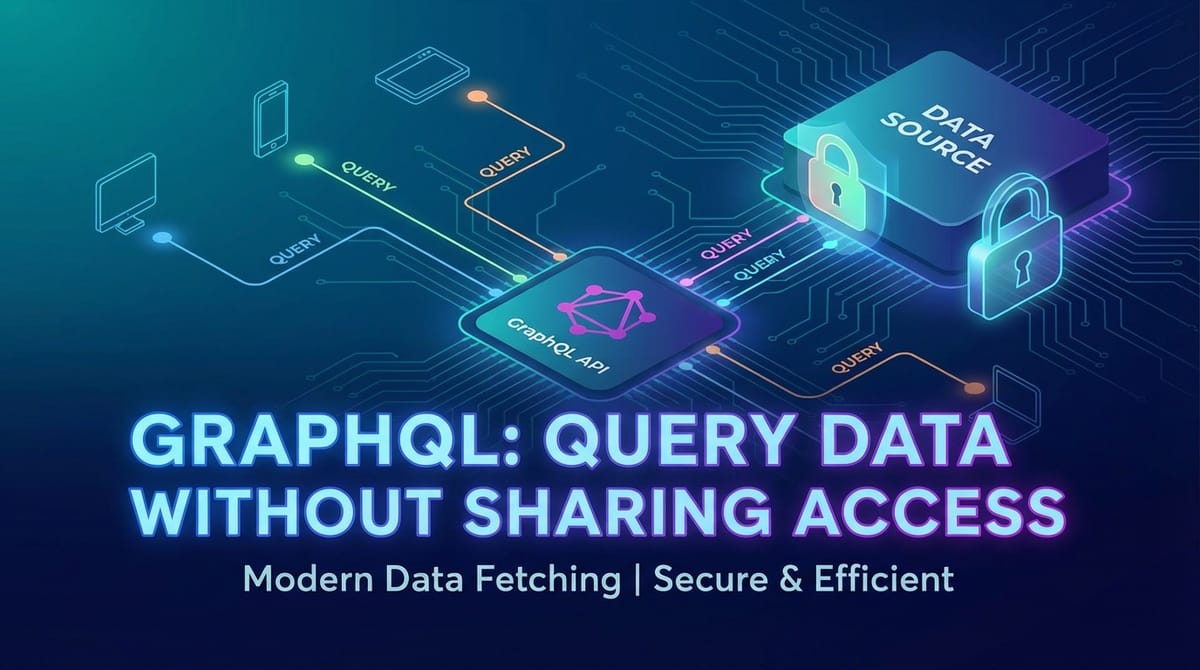


In the intricate landscape of modern web development, the efficient and secure exchange of data stands as a paramount concern. Enterprises and developers alike are constantly seeking robust mechanisms to deliver precisely the data required by client applications without inadvertently exposing sensitive information or overwhelming the network with superfluous payloads. This challenge has been a persistent one, often exacerbated by traditional data fetching paradigms that, while functional, frequently demand a compromise between data utility and data security. The prevailing sentiment often leans towards a "more is more" approach, where api endpoints serve up broader swathes of data than strictly necessary, leaving the client to sift through and discard the irrelevant. This practice not only consumes unnecessary bandwidth and processing power but also introduces inherent security vulnerabilities, as clients often gain access to fields they are not authorized to view, even if they choose not to utilize them.
Enter GraphQL, a powerful query language for your api and a server-side runtime for executing queries using a type system you define for your data. Conceived by Facebook in 2012 and open-sourced in 2015, GraphQL was born out of the necessity to efficiently fetch data for their mobile applications, addressing the limitations of RESTful architectures in a rapidly evolving ecosystem. Its fundamental innovation lies in empowering clients to precisely declare their data requirements. Instead of relying on predefined server-side endpoints, each returning a fixed structure of data, GraphQL allows the client to craft a query specifying exactly the fields and relationships it needs. This client-driven approach radically transforms the data fetching paradigm, shifting the burden of data selection from the server to the client and profoundly impacting how we think about data access, efficiency, and most importantly, security – specifically, the ability to query data without sharing excessive access.
The core promise of GraphQL in this context is its capacity to drastically minimize data over-fetching, a common problem where an api endpoint returns more information than the requesting client actually requires. While over-fetching might seem like a minor inconvenience in terms of bandwidth for simple applications, in complex enterprise environments handling sensitive data, it becomes a significant security vulnerability. Every additional piece of data sent, regardless of whether the client uses it, represents an increased attack surface. GraphQL inherently mitigates this by enforcing a strict contract between client and server, defined by a meticulously crafted schema. This schema acts as the single source of truth, describing all possible data structures and operations available through the api, thereby laying a solid foundation for robust API Governance. Within this framework, developers can implement granular access control policies at the field level, ensuring that even if a client can query a certain object, they can only retrieve the specific fields for which they possess explicit authorization. This architectural elegance not only enhances data security but also streamlines client development, as applications receive only the data pertinent to their current operational needs, leading to leaner, faster, and more secure interactions with backend services.
The Foundational Pillars of GraphQL: Schema and Type System for Granular Control
At the heart of GraphQL's ability to facilitate data querying without over-sharing lies its robust schema and type system. Unlike traditional RESTful apis, where endpoints and their responses are often implicitly understood or described through external documentation (which can easily become outdated), GraphQL mandates a strict, explicit schema that acts as a contract between the client and the server. This schema, written in GraphQL Schema Definition Language (SDL), serves as the definitive blueprint for all data that can be queried, mutated, or subscribed to through the api. It declares the types of objects available, their fields, the types of those fields, and the relationships between different objects. This explicit declaration is not merely a documentation aid; it is the very mechanism that enables intelligent data validation and, crucially, granular access control.
Consider a typical enterprise scenario where a single User object might contain a plethora of fields: id, name, email, role, department, salary, socialSecurityNumber, address, and lastLoginDate. In a traditional REST api, an endpoint like /users/{id} might return all or most of these fields by default. Implementing granular access control would typically involve creating multiple specialized endpoints (e.g., /users/{id}/public-profile, /users/{id}/admin-details), or relying on complex server-side logic to strip fields from a single response, which can be error-prone and difficult to maintain as the api evolves.
GraphQL elegantly sidesteps these challenges through its schema-first design. Within the schema, each field of an object type can be individually defined. For instance:
type User {
  id: ID!
  name: String!
  email: String
  role: Role!
  department: String
  salary: Float @auth(requires: ADMIN)
  socialSecurityNumber: String @auth(requires: ADMIN_OR_HR)
  address: Address
  lastLoginDate: String
}

type Query {
  user(id: ID!): User
  currentUser: User
}
This simple schema snippet already hints at the power of GraphQL. The salary and socialSecurityNumber fields are annotated with a hypothetical @auth directive, signaling that specific authorization levels are required to access them. While @auth is a conceptual example here, the underlying mechanism involves resolvers – functions responsible for fetching the data for each field.
The Role of Resolvers in Access Control: Every field in a GraphQL schema is backed by a resolver function on the server. When a client sends a query, the GraphQL execution engine traverses the query tree, calling the appropriate resolver for each requested field. This is where the magic of granular access control truly happens. Instead of making an all-or-nothing decision at the api endpoint level, resolvers allow developers to implement authorization logic at the field level.
For example, the resolver for the salary field of the User type would check the authenticated user's role. If the requesting user possesses an ADMIN role, the resolver would fetch and return the salary data. If the user's role is EMPLOYEE, the resolver could return null, throw an authorization error, or even return a default, redacted value, depending on the defined security policy. This means that a single query from a non-admin user asking for id, name, email, and salary would successfully return the id, name, and email, but the salary field would be null or absent due to lack of authorization, without affecting the retrieval of other authorized fields. This highly granular control ensures that clients only ever receive the exact data they are both authorized and explicitly requested, effectively preventing over-sharing by design.
Type System for Data Integrity and Clarity: Beyond fields, GraphQL's type system encompasses scalar types (like String, Int, Boolean, ID), object types, interfaces, union types, and enums. Each type strictly defines the shape of the data, ensuring data integrity and predictable responses. This strong typing is invaluable for both client and server developers. Clients know exactly what to expect, and servers are forced to adhere to the defined contract, reducing ambiguity and potential errors.
For API Governance, the schema and type system provide an unparalleled foundation. They ensure consistency across the api, serve as living documentation, and facilitate automated tooling for validation, code generation, and testing. As an api evolves, changes to the schema are explicit, allowing for careful versioning strategies or schema evolution mechanisms that inform clients about potential impacts, ensuring stability and preventing unexpected breakages. This controlled evolution is a cornerstone of effective API Governance, enabling organizations to manage their data assets with precision and confidence, minimizing risks associated with data exposure and unauthorized access.
The foundational design of GraphQL, centered around its powerful schema and flexible resolvers, directly addresses the challenge of querying data without sharing unnecessary access. It empowers developers to construct apis that are inherently more secure, more efficient, and more aligned with the principle of least privilege, thereby setting a new standard for modern data exchange.
GraphQL vs. REST: A Paradigm Shift in Access Control and Data Fetching
To truly appreciate GraphQL's distinct advantage in querying data without sharing excessive access, it's crucial to contrast it with the widely adopted REST architectural style. While REST (Representational State Transfer) has served as the backbone of the internet for decades, its inherent design principles, particularly concerning data fetching and endpoint design, often lead to challenges when granular access control and efficient data retrieval are paramount.
REST's Challenges in Granular Data Control:
- Over-fetching: The most common criticism of REST is the problem of over-fetching. A REST endpoint typically represents a resource or a collection of resources, and when a client requests that resource, the server often returns a fixed, predefined payload. For instance, an endpoint like
/products/123might return every available detail about product ID 123, including internal pricing, supplier information, and stock levels, even if the public-facing client (e.g., an e-commerce website) only needs the product name, image, and public price. The client then has to filter out the unnecessary data. From a security perspective, this means data is being transmitted that the client may not be authorized to see, creating an exposure risk. While techniques like sparse fieldsets (e.g.,?fields=name,price) exist, they are not universally adopted, add complexity to endpoint logic, and still don't inherently prevent all fields from being sent if the client doesn't explicitly restrict them. - Under-fetching (and Multiple Requests): Conversely, if a client needs data from multiple related resources, REST often necessitates multiple api calls. For example, fetching a user's profile and then their recent orders might require two separate requests:
/users/{id}and/users/{id}/orders. This "under-fetching" leads to increased network latency and client-side complexity in orchestrating and combining data from various endpoints. Each additional request is another opportunity for an authorization check, which can be inefficient, or, if not properly managed, can lead to subtle authorization bypasses if individual endpoints have slightly different security contexts. - Rigid Endpoints and Versioning: RESTful apis are organized around resources and their predefined endpoints. As data requirements evolve, developers often face a dilemma: modify existing endpoints, potentially breaking existing clients, or create new, specialized endpoints (e.g.,
/v2/products/123or/products/123/summary). This approach can lead to api sprawl, making API Governance more complex, and introducing more surface area for potential security misconfigurations. Managing access control across numerous, slightly different endpoints can become a significant operational burden.
GraphQL's Advantages for Access Control and Efficiency:
GraphQL directly addresses these challenges by fundamentally altering the client-server interaction model:
- Client-Driven Data Fetching: The "Ask for What You Need" Principle: The core tenet of GraphQL is that the client explicitly states its data requirements in a single query. Instead of receiving a fixed payload, the client asks for specific fields, nested relationships, and arguments. This eliminates over-fetching by design. If a public client only needs a product's name and price, its GraphQL query will only request those two fields. The server, via its resolvers, will then fetch and return only that data. This is pivotal for "querying data without sharing access" – the server transmits no extraneous data, drastically reducing the potential for sensitive information exposure.
- Single Endpoint, Flexible Queries: Unlike REST's multiple resource-specific endpoints, a GraphQL api typically exposes a single endpoint (e.g.,
/graphql). All data requests (queries, mutations, subscriptions) are sent to this one endpoint. This centralized approach simplifies client-side logic and, more importantly, provides a single point of entry for robust api gateway and security enforcement. The flexibility comes from the query itself; clients can combine data from multiple "resources" (types) within a single request, eliminating under-fetching and the need for multiple round-trips. - Granular Control at the Field Level: As discussed, GraphQL's resolver functions are the key to fine-grained access control. Each field in the schema can have its own resolver, allowing for authorization logic to be applied at the most atomic level. This means a user could be authorized to see
nameandemailfor aUserobject but notsalaryorsocialSecurityNumber. The server simply returnsnullor an error for unauthorized fields, while still returning the authorized data in the same response. This capability is difficult to replicate with REST without creating highly specialized and numerous endpoints. - Versionless API and Enhanced API Governance: GraphQL's schema-first approach facilitates graceful api evolution. Instead of versioning the entire api (e.g.,
/v1,/v2), new fields and types can be added to the schema without breaking existing clients, as old clients will simply ignore the new fields. Deprecated fields can be marked as such in the schema, with tooling aiding developers in migrating. This inherent flexibility simplifies API Governance, allowing apis to adapt to changing business requirements without forcing disruptive updates on client applications. The schema itself acts as the definitive contract, providing clarity and reducing ambiguity, which are critical for effective governance.
The table below summarizes some key differences between GraphQL and REST, particularly focusing on aspects relevant to data access and control:
| Feature | REST (Traditional) | GraphQL | Impact on Access Control & Efficiency |
|---|---|---|---|
| Endpoint Design | Multiple, resource-specific endpoints (e.g., /users, /products/123) |
Single, unified endpoint (e.g., /graphql) |
Centralized api gateway enforcement; simplified client routing. |
| Data Fetching Principle | Server-driven (fixed payloads) | Client-driven (explicit query) | Eliminates over-fetching; drastically reduces data exposure. |
| Over-fetching | Common; server returns more than needed | Rare; clients specify exact needs | Direct correlation to "querying data without sharing access." |
| Under-fetching/Requests | Common; multiple requests for related data | Rare; single request for complex data graphs | Reduces network latency; simplifies client-side data orchestration. |
| Access Control Granularity | Typically resource-level (endpoint-based) or complex field stripping | Field-level via resolvers; highly granular | Precisely control which parts of data are visible. |
| API Evolution/Versioning | Often requires versioning (e.g., /v1, /v2), breaking changes possible |
Schema evolution (additive changes, deprecation), backward-compatible | Improves API Governance; reduces client impact during updates. |
| Documentation | External (Swagger, OpenAPI); can become outdated | Self-documenting via schema introspection | Always up-to-date and consistent with the live api. |
In essence, GraphQL represents a significant step forward in building apis that are not only more efficient and developer-friendly but also inherently more secure in their data handling. By shifting the power of data selection to the client and implementing granular authorization through resolvers, it provides a robust framework for querying data while meticulously controlling what information is shared, aligning perfectly with modern security best practices and stringent API Governance requirements.
Implementing Robust Access Control in a GraphQL API
While GraphQL's schema and type system provide the structural foundation for fine-grained control, the actual implementation of access control requires careful consideration of various strategies. It’s not enough to simply define a schema; robust authentication and authorization mechanisms must be woven into the fabric of the GraphQL server to effectively prevent unauthorized data access.
1. Authentication: Identifying the User
The first step in any secure api interaction is authentication – verifying the identity of the client making the request. Without knowing who is making the request, it’s impossible to determine what they are allowed to access. Standard authentication mechanisms apply equally well to GraphQL as they do to REST:
- Token-based Authentication (JWT, OAuth2): This is the most prevalent method. After a user logs in, they receive a signed token (e.g., a JSON Web Token - JWT). This token, typically sent in the
Authorizationheader of subsequent GraphQL requests, contains information about the authenticated user (e.g., user ID, roles, permissions). The GraphQL server (or an upstream api gateway) validates this token to establish the user's identity. - Session-based Authentication: Less common for modern apis but still viable, where a server-side session stores user state, and a session cookie is sent with each request.
Once authenticated, the user's identity and associated roles/permissions are typically injected into the GraphQL context object. The context is a plain object or value that is provided to every resolver in the GraphQL query. This makes user information readily available for authorization checks at any level.
2. Authorization: Determining What the User Can Do
Authorization is where GraphQL's flexibility truly shines in preventing over-sharing. It involves deciding whether the authenticated user is permitted to perform a requested operation (query, mutation, subscription) or access a specific field. This can be implemented at multiple levels:
- Schema-Level Authorization (Global Permissions): This involves broad authorization rules applied to entire types or fields within the schema. While not as granular as resolver-level checks, it can be useful for defining baseline permissions. For example, an entire
AdminPaneltype might only be accessible to users with anADMINrole. This can be achieved using custom schema directives (like the@authdirective proposed earlier) or by integrating with a GraphQL server framework that provides such capabilities. When a directive is encountered during schema parsing or execution, it triggers a custom function that performs the authorization check. If the check fails, the execution for that type/field is halted, and an error is returned. - Resolver-Level Authorization (Field-Level Granularity): This is the most powerful and common place to implement fine-grained access control in GraphQL. Each resolver function receives the
contextobject (containing user information), arguments for the field, and information about the parent object. Within the resolver, developers can write logic to:- Check User Roles/Permissions: Based on the user's roles (e.g.,
ADMIN,EDITOR,VIEWER) or specific permissions (can_read_salary,can_update_product), the resolver decides whether to fetch and return the requested data. - Filter Data Based on Ownership/Relationship: For instance, a user should only be able to view their own
Orderhistory, not everyone's. Theordersresolver for aUsertype would filter the results based on thecurrent_user_idfrom thecontext. Similarly, anArticleresolver might only show articles authored by the current user or articles marked aspublic. - Redact Sensitive Fields: Instead of throwing an error, a resolver might return
nullfor a specific field if the user is unauthorized, allowing the rest of the query to succeed. For example, if aUserrequestsemailandsocialSecurityNumber, and they are only authorized foremail, thesocialSecurityNumberresolver would simply returnnull, maintaining a consistent response structure. - Conditional Field Visibility: A field might return different data or be entirely absent based on the user's role. For example, a
Producttype might have acostPricefield that is only populated for internalSALESorADMINusers, returningnullorundefinedfor external clients.
- Check User Roles/Permissions: Based on the user's roles (e.g.,
- Middleware and Request Pipeline Authorization: Many GraphQL server implementations allow for middleware functions that execute before the main resolver chain. An authorization middleware can perform checks that apply to the entire query or specific top-level fields before any individual resolvers are invoked. This can be useful for global checks, such as "is the user authenticated at all?" or "is this user allowed to query any data from the
Admintype?". This approach can simplify resolvers by offloading initial, broader authorization concerns.
3. Best Practices for Secure GraphQL Access Control:
- "Fail Safe" Principle: By default, assume a user is not authorized. Explicitly grant permissions rather than trying to revoke them. This ensures that any oversight defaults to security rather than exposure.
- Avoid Relying Solely on Client-Side Filtering: Never trust the client. All authorization logic must reside on the server. Even if a client application "hides" certain fields from unauthorized users, a malicious user could still craft a query to request that data if server-side authorization isn't in place.
- Comprehensive Error Handling: When an authorization check fails, return clear, but not overly revealing, error messages. For sensitive fields, returning
nullis often preferred over a detailed error, as it prevents giving away information about the existence or nature of the unauthorized data. - Audit and Logging: Log all access attempts, especially failed authorization attempts. This is crucial for monitoring security, detecting suspicious activity, and ensuring compliance. (This is where platforms like APIPark excel, offering "Detailed API Call Logging" as a core feature, which will be discussed further in the next section.)
- Query Complexity and Depth Limiting: To prevent Denial of Service (DoS) attacks, implement mechanisms to limit the complexity and depth of incoming GraphQL queries. A malicious user could craft a very deep or recursive query that consumes excessive server resources, even if individual field access is authorized.
- Disable Introspection in Production: GraphQL's introspection capabilities allow clients to discover the schema. While incredibly useful during development, it can provide attackers with detailed information about your data model. Consider disabling or restricting introspection in production environments.
- Persistent Queries: For highly sensitive or performance-critical environments, persistent queries (where clients refer to pre-approved, server-stored queries by ID) can further enhance security and performance by eliminating arbitrary query execution.
Implementing these robust authorization strategies within your GraphQL api ensures that clients receive only the data they are explicitly permitted and specifically request. This commitment to the principle of least privilege, facilitated by GraphQL's architecture, creates a far more secure and efficient data exchange mechanism, significantly reducing the surface area for data breaches and bolstering overall API Governance.
The Indispensable Role of an API Gateway in a GraphQL Ecosystem
Even with GraphQL's inherent capabilities for granular data access, the deployment of a robust api gateway remains a critical component of a secure, performant, and well-governed api ecosystem. An api gateway acts as the single entry point for all client requests, sitting in front of your GraphQL server (and potentially other microservices or legacy apis). It serves as a centralized traffic cop, security guard, and management layer, offloading many cross-cutting concerns from your individual services. For organizations committed to strong API Governance and scalable api operations, an api gateway is not just an add-on; it's a foundational piece of infrastructure.
How an API Gateway Enhances a GraphQL API:
- Centralized Authentication and Authorization Offloading: One of the primary benefits of an api gateway is its ability to handle initial authentication and authorization checks before requests even reach the GraphQL server. The gateway can validate tokens (JWT, OAuth2), manage API keys, or integrate with identity providers. This means the GraphQL server itself doesn't need to perform these initial, broad-stroke security checks, allowing it to focus purely on query resolution and more granular, field-level authorization. This separation of concerns simplifies the GraphQL server's codebase and enhances its performance.
- Rate Limiting and Throttling: Protecting your GraphQL api from abuse, whether malicious (DoS attacks) or accidental (runaway clients), is paramount. An api gateway provides robust rate limiting and throttling mechanisms, allowing you to define policies based on IP address, user ID, API key, or other custom criteria. This ensures fair usage and prevents any single client from overwhelming your backend resources. While GraphQL itself can implement query complexity analysis, a gateway provides an essential front-line defense.
- Caching: For frequently accessed data that doesn't change rapidly, an api gateway can implement caching strategies. This reduces the load on your GraphQL server and backend databases, improving response times for clients. The gateway can intelligently cache GraphQL query responses based on the query string and variables, serving cached data directly without involving the GraphQL server.
- Load Balancing and Routing: In a scalable deployment, you might have multiple instances of your GraphQL server. An api gateway acts as a load balancer, distributing incoming requests across these instances to ensure high availability and optimal resource utilization. It can also route requests to different backend services (e.g., a GraphQL server, a legacy REST api, a serverless function) based on path, headers, or other request attributes, facilitating a hybrid api architecture.
- Security Policies and Threat Protection: Beyond authentication, an api gateway can enforce various security policies, such as IP whitelisting/blacklisting, WAF (Web Application Firewall) capabilities to protect against common web vulnerabilities (e.g., SQL injection, XSS), and SSL/TLS termination to secure communication. It acts as a hardened perimeter for your entire api landscape.
- Monitoring, Logging, and Analytics: An api gateway provides a centralized point for logging all incoming and outgoing api traffic. This comprehensive logging is invaluable for monitoring api health, troubleshooting issues, auditing access, and gathering analytics on api usage. It offers a holistic view of your api ecosystem, which is critical for effective API Governance and operational intelligence.
- Transformation and Protocol Bridging: In environments with mixed api styles, an api gateway can perform transformations. For instance, it could bridge between a client requesting data via GraphQL and a backend service that only exposes a RESTful api, or vice versa, allowing for gradual migration or integration of disparate systems.
Introducing APIPark: An Open Source AI Gateway & API Management Platform
For organizations seeking a powerful and flexible api gateway solution that not only offers these standard capabilities but also embraces the burgeoning field of Artificial Intelligence, a platform like APIPark becomes particularly relevant.
APIPark is an all-in-one AI gateway and API developer portal that is open-sourced under the Apache 2.0 license. It's designed to help developers and enterprises manage, integrate, and deploy AI and REST services with ease. While primarily highlighted for its AI integration capabilities, its robust foundation as an api gateway makes it an excellent choice for managing any api, including GraphQL apis.
Consider how APIPark can bolster your GraphQL strategy for querying data without sharing access and strong API Governance:
- End-to-End API Lifecycle Management: APIPark assists with managing the entire lifecycle of apis, including design, publication, invocation, and decommission. For a GraphQL api, this means providing a structured environment to manage your schema, deploy new versions, and ensure consistent API Governance practices across your development teams.
- API Service Sharing within Teams: The platform allows for the centralized display of all api services, making it easy for different departments and teams to find and use the required api services. This centralized catalog includes GraphQL apis, promoting discovery and controlled access.
- API Resource Access Requires Approval: APIPark allows for the activation of subscription approval features, ensuring that callers must subscribe to an api and await administrator approval before they can invoke it. This adds an essential layer of human-driven access control before any GraphQL query is even attempted, preventing unauthorized calls at the gateway level. This initial gatekeeping complements GraphQL's field-level authorization, creating a multi-layered defense.
- Performance Rivaling Nginx: With just an 8-core CPU and 8GB of memory, APIPark can achieve over 20,000 TPS, supporting cluster deployment to handle large-scale traffic. This high performance ensures that your api gateway won't become a bottleneck, even with complex GraphQL queries.
- Detailed API Call Logging and Powerful Data Analysis: As previously hinted, APIPark provides comprehensive logging capabilities, recording every detail of each api call. This feature is invaluable for tracing and troubleshooting issues in GraphQL calls, ensuring system stability and data security. Furthermore, it analyzes historical call data to display long-term trends and performance changes, helping businesses with preventive maintenance before issues occur. This robust observability is a cornerstone of effective API Governance, allowing administrators to monitor access patterns and identify potential security threats or unauthorized access attempts against their GraphQL endpoints.
- Independent API and Access Permissions for Each Tenant: For larger organizations or SaaS providers, APIPark enables the creation of multiple teams (tenants), each with independent applications, data, user configurations, and security policies, while sharing underlying applications and infrastructure. This multi-tenancy support is crucial for isolating access and ensuring that data shared across different business units remains segregated and secure, even if they are consuming the same underlying GraphQL apis.
By deploying an api gateway like APIPark in front of your GraphQL server, you establish a fortified perimeter that not only enhances security through centralized authentication, rate limiting, and access approval but also improves performance, provides invaluable observability, and streamlines overall API Governance. It ensures that your GraphQL apis, while offering flexible and granular data access, are managed within a robust, scalable, and secure operational framework, solidifying the principle of querying data without inadvertently sharing excessive access.
GraphQL and API Governance: Ensuring Order in a Flexible Data Landscape
The term API Governance encompasses the strategies, processes, and tools organizations use to manage the entire lifecycle of their apis, from design and development to deployment, versioning, security, and retirement. Its primary goal is to ensure that apis are consistent, reliable, secure, and align with business objectives. In the context of GraphQL, which introduces a paradigm of client-driven data fetching and high flexibility, robust API Governance becomes not just important, but absolutely essential to harness its power while mitigating its potential complexities.
GraphQL's design inherently supports several aspects of good API Governance, making it a powerful tool for managed data exchange. However, its flexibility also demands a proactive and structured approach to governance to prevent chaos and ensure security.
Inherent Governance Benefits of GraphQL:
- Schema as the Single Source of Truth: The most significant contribution of GraphQL to API Governance is its schema-first approach. The GraphQL schema acts as a formal contract between client and server, explicitly defining every possible operation and data structure. This eliminates ambiguity and serves as live, up-to-date documentation. For governance, this means:
- Consistency: All developers (frontend, backend, third-party) work against the same, clearly defined data model.
- Predictability: Clients know exactly what data they can request and receive, and servers know exactly what they are expected to provide.
- Discoverability: The schema is introspectable, allowing tools to automatically generate documentation, code, and client libraries. This self-documenting nature drastically reduces the overhead associated with keeping documentation current, a common pain point in API Governance.
- Facilitated API Evolution (Versionless APIs): Traditional REST apis often struggle with versioning, leading to
/v1,/v2endpoints and the challenge of supporting multiple versions simultaneously. GraphQL, through its additive nature, allows for more graceful evolution. New fields and types can be added to the schema without breaking existing clients, as old clients will simply ignore the new additions. Deprecated fields can be marked as such in the schema, informing developers through introspection tools, but remaining available for a transition period. This "versionless api" approach significantly simplifies API Governance, as it reduces the need for disruptive changes and allows teams to evolve their apis more continuously and confidently. - Strong Type System for Data Integrity: GraphQL's strong type system, where every field has a defined type, ensures data integrity and helps prevent common data-related errors. This type safety is enforced at the query validation stage, catching many potential issues before they even reach the resolvers. From a governance perspective, this means a higher quality api with fewer data inconsistencies and bugs, leading to more reliable integrations.
- Improved Developer Experience and Collaboration: With a clear schema, self-documenting capabilities, and the ability for clients to fetch exactly what they need, GraphQL enhances the developer experience. Frontend developers can prototype faster, and backend teams can evolve their data models with less fear of breaking existing clients. This improved collaboration and autonomy, facilitated by robust tooling around the schema, contributes positively to overall API Governance.
Challenges and Best Practices for GraphQL API Governance:
Despite its inherent advantages, GraphQL's flexibility can also introduce governance challenges if not managed properly.
- Preventing Schema Sprawl and Complexity: While a single endpoint is powerful, an unchecked schema can grow unwieldy and complex. Governance strategies must be in place to ensure that the schema remains well-organized, logically structured, and does not become a monolithic entity that is hard to manage.
- Modular Schemas: Break down large schemas into smaller, manageable modules that are owned by different teams or domains. Tools like schema stitching or federation (e.g., Apollo Federation) are powerful patterns for composing a single logical schema from multiple underlying GraphQL services, allowing teams to own and evolve their parts independently while maintaining a unified api view for clients. This aligns with microservices architectures and distributed API Governance.
- Schema Review Processes: Implement regular schema review processes where design decisions, new types, and field additions are scrutinized for consistency, naming conventions, security implications, and adherence to overall api guidelines.
- Securing Against Malicious Queries: GraphQL's ability to execute complex, nested queries can be a double-edged sword. Malicious or poorly optimized queries can lead to excessive resource consumption (e.g., deeply nested queries that fetch too much data), potentially resulting in Denial of Service (DoS) attacks.
- Query Depth Limiting: Restrict the maximum nesting depth of queries.
- Query Complexity Analysis: Assign a "cost" to each field based on its computational expense and reject queries exceeding a predefined complexity threshold.
- Persistent Queries: As mentioned earlier, allow clients to use pre-approved, server-stored queries. This limits arbitrary query execution and can be a strong governance measure for public-facing apis.
- Monitoring and Alerting: Continuously monitor query performance and resource utilization. Set up alerts for unusual query patterns or spikes in resource consumption. An api gateway like APIPark with its "Detailed API Call Logging" and "Powerful Data Analysis" capabilities can provide invaluable insights here, allowing you to proactively identify and address performance bottlenecks or potential security threats stemming from complex queries.
- Managing Access Control Policies Consistently: While resolvers offer granular access control, ensuring consistency across hundreds or thousands of fields can be challenging.
- Standardized Authorization Logic: Develop reusable authorization functions or custom schema directives (e.g.,
@auth(role: ADMIN)) that encapsulate common access control rules. This promotes consistency and reduces boilerplate. - Role-Based Access Control (RBAC): Clearly define user roles and their associated permissions. Map these roles to the authorization logic within your resolvers and schema directives.
- Centralized Policy Management: For complex environments, consider integrating with external policy engines (e.g., OPA - Open Policy Agent) for centralized management and enforcement of authorization rules.
- Standardized Authorization Logic: Develop reusable authorization functions or custom schema directives (e.g.,
- Auditability and Observability: Effective API Governance requires clear visibility into who is accessing what data, when, and how.
- Comprehensive Logging: Implement detailed logging of all GraphQL requests, including the query itself, variables, and the identity of the requesting user. APIPark's logging features are perfectly suited for this, providing "every detail of each API call" to help "trace and troubleshoot issues."
- Monitoring and Metrics: Track key metrics such as query response times, error rates, and data transfer volumes. These metrics are crucial for understanding api performance, identifying bottlenecks, and detecting anomalies.
- API Gateway Analytics: Leverage the analytics capabilities of your api gateway. APIPark's "Powerful Data Analysis" can analyze historical call data to display long-term trends, helping businesses with preventive maintenance and ensuring api health and security.
In conclusion, GraphQL offers a powerful and flexible approach to data fetching that inherently supports granular access control and efficient data exchange. However, to fully leverage these benefits in an enterprise context, a well-defined and rigorously applied API Governance strategy is paramount. By focusing on modular schemas, robust security practices (including query complexity management), consistent authorization implementation, and comprehensive observability (often provided by an api gateway like APIPark), organizations can ensure their GraphQL apis remain secure, performant, and aligned with their strategic objectives, truly enabling clients to query data without inadvertently sharing excessive access.
Best Practices for Secure GraphQL APIs: A Comprehensive Approach
Securing a GraphQL api goes beyond just implementing authentication and authorization. It requires a holistic strategy that addresses various attack vectors, ensures data integrity, and maintains the performance and availability of the service. Adopting a comprehensive set of best practices is crucial for any organization aiming to build reliable and trustworthy GraphQL apis, particularly when the core objective is to query data without sharing unnecessary access.
1. Input Validation and Sanitization: Just like any other api, GraphQL queries and mutations can be vectors for malicious input. * Schema Validation (Built-in): GraphQL's strong type system inherently validates inputs against the defined schema types. If a client sends an Int when a String is expected, the GraphQL server will reject the request before it even reaches your business logic. * Custom Validation in Resolvers: Beyond type validation, resolvers should perform custom business logic validation. For example, ensure that an email address is in a valid format, that a password meets complexity requirements, or that a price is a positive number. * Sanitization: Sanitize all user-provided input before using it in database queries or displaying it to other users to prevent injection attacks (e.g., SQL injection, XSS).
2. Query Depth and Complexity Limiting: One of GraphQL's greatest strengths – the ability to fetch deeply nested data in a single request – can also be a significant vulnerability. A malicious client could craft a deeply recursive query (e.g., user { friends { friends { ... } } }) that consumes excessive server resources, leading to a Denial of Service (DoS) attack. * Query Depth Limiting: Implement a maximum allowed depth for any incoming query. If a query exceeds this depth, reject it. * Query Complexity Analysis: Assign a "cost" to each field based on its computational expense (e.g., retrieving a single scalar field is cheaper than fetching a collection of related objects). Calculate the total complexity of an incoming query and reject it if it exceeds a predefined threshold. This is more sophisticated than depth limiting and provides better protection. * Rate Limiting: As discussed in the api gateway section, rate limiting at the gateway level (e.g., using APIPark) is crucial to prevent a single client from making too many requests within a given timeframe, regardless of query complexity.
3. Persistent Queries (Whitelisting): For highly secure and performance-critical environments, especially public-facing apis, consider using persistent queries. * Mechanism: Instead of sending the full GraphQL query string, clients send a unique ID or hash that corresponds to a pre-approved, server-stored query. * Benefits: * Enhanced Security: Only whitelisted queries can be executed, eliminating the risk of arbitrary query execution and protecting against potential injection attacks or attempts to discover sensitive data through complex queries. * Performance: Shorter requests, no need for server-side parsing and validation of the query string for every request. * Simplified Caching: Easier to cache results based on a simple query ID. * Use Case: Ideal for mobile applications or controlled client environments where the set of queries is well-defined.
4. Securing Introspection in Production: GraphQL's introspection capability allows clients to discover the schema, including types, fields, arguments, and directives. This is invaluable during development for tools like GraphiQL or Apollo Studio, but in a production environment, it can provide attackers with a detailed map of your data model and potential attack surfaces. * Disable or Restrict Introspection: For public or sensitive apis, consider disabling introspection entirely in production. * Conditional Introspection: If introspection is needed for specific internal tools, restrict access to it using an api gateway (e.g., APIPark can apply IP-based restrictions) or specific authorization checks within your GraphQL server.
5. Error Handling and Masking: When an error occurs, the server's response should be informative enough for developers to debug but not reveal sensitive internal details that an attacker could exploit. * Generic Error Messages: Avoid exposing stack traces, internal data structures, or specific database error messages in production. * Error Masking: Intercept errors in your GraphQL server and transform them into generic, user-friendly messages while logging the full details internally for debugging. For authorization failures, returning null for unauthorized fields or a generic "Unauthorized" error is often safer than providing specifics.
6. Comprehensive Logging and Monitoring: Visibility into api operations is paramount for security and API Governance. * Detailed Request Logging: Log every incoming GraphQL query, including the client IP, user ID (from authentication), timestamp, the query string, and variables. This allows for auditing, troubleshooting, and detection of suspicious activity. * Error Logging: Log all errors with sufficient detail (including stack traces) internally, but mask them for external clients. * Performance Metrics: Monitor query response times, error rates, and resource utilization (CPU, memory, database connections). This helps identify performance bottlenecks or potential DoS attempts. * Anomaly Detection: Use monitoring tools to detect unusual patterns in query types, volume, or access attempts. * APIPark's Role: APIPark's "Detailed API Call Logging" and "Powerful Data Analysis" features directly support these best practices by providing a centralized, high-performance platform for capturing, analyzing, and alerting on all api interactions, significantly bolstering the observability and security posture of your GraphQL apis.
7. Secure Development Practices (SDL and Resolvers): * Principle of Least Privilege: Ensure resolvers only access the data they absolutely need and that authorization logic is applied consistently at the lowest possible level. * Database Security: GraphQL resolvers should never directly expose database credentials or allow raw SQL injection. Use ORMs or secure data access layers. * Third-Party Integrations: Securely manage credentials for any third-party services your resolvers interact with.
8. CORS Configuration: Correctly configure Cross-Origin Resource Sharing (CORS) headers to ensure that only authorized domains can make requests to your GraphQL api. Misconfigurations can lead to unauthorized access from malicious websites.
By diligently implementing these best practices, organizations can build GraphQL apis that are not only efficient and flexible but also inherently secure, effectively achieving the goal of querying data without sharing unnecessary access, all within a robust framework of API Governance and operational excellence. This comprehensive approach ensures that data integrity, confidentiality, and availability are maintained throughout the api lifecycle, protecting sensitive information and fostering trust among clients and users.
Case Studies and Scenarios: GraphQL in Action for Controlled Data Access
To solidify the understanding of how GraphQL enables querying data without sharing excessive access, let's explore a couple of illustrative scenarios. These examples highlight the practical application of GraphQL's features, especially when combined with a robust api gateway and sound API Governance.
Scenario 1: Employee Directory and HR Portal
Imagine a large organization with an internal api that provides employee information. Different departments and user roles within the organization require varying levels of access to this data.
Traditional REST Approach Challenges:
- Public Employee List (REST): An endpoint
/employeesmight return basic information:id,name,email,department. - Manager Access (REST): Managers need to see their direct reports'
hireDateandperformanceReviewScore. This might require a new endpoint like/employees/{id}/manager-viewor adding query parameters like?fields=name,email,hireDate,performanceReviewScore, which still makes the server responsible for filtering and could expose fields if the filter isn't strict. - HR Access (REST): HR personnel need sensitive data like
salary,socialSecurityNumber,benefitDetails. This would likely necessitate a completely separate, highly restricted endpoint/hr/employees/{id}/sensitive. - Over-fetching/Under-fetching: Each endpoint returns a fixed schema, potentially over-fetching for some requests or requiring multiple calls for comprehensive views, making granular access control complex.
GraphQL Solution:
A single GraphQL schema defines the Employee type with all possible fields:
type Employee {
  id: ID!
  name: String!
  email: String!
  department: String!
  hireDate: String @auth(role: [MANAGER, HR, ADMIN])
  performanceReviewScore: Int @auth(role: [MANAGER, HR, ADMIN])
  salary: Float @auth(role: [HR, ADMIN])
  socialSecurityNumber: String @auth(role: [HR, ADMIN])
  benefitDetails: BenefitDetails @auth(role: [HR, ADMIN])
  // ... other fields
}

type Query {
  employee(id: ID!): Employee
  allEmployees(department: String): [Employee!]!
}
Access Control Implementation:
- Authentication: The api gateway (e.g., APIPark) authenticates the incoming request using a JWT or OAuth token, extracting the user's role (e.g.,
EMPLOYEE,MANAGER,HR,ADMIN). This role is passed to the GraphQL server via thecontext. - Resolver-Level Authorization:
- The
employeeresolver for basic fields (id,name,email,department) allows all authenticated users. - The
hireDateandperformanceReviewScoreresolvers check if thecontext.user.roleincludesMANAGER,HR, orADMIN. If not, they returnnull. - The
salary,socialSecurityNumber, andbenefitDetailsresolvers are even more restrictive, checking forHRorADMINroles.
- The
- Client Queries:
- Regular Employee: Queries
employee(id: "emp123") { id name email department }. Gets exactly this data. - Manager: Queries
employee(id: "emp123") { id name email department hireDate performanceReviewScore }. Ifemp123is their direct report, they get all requested fields. If not,hireDateandperformanceReviewScorewould benull. (Further logic in resolver fordirect_reportcheck). - HR Personnel: Queries
employee(id: "emp123") { id name email department salary socialSecurityNumber benefitDetails }. HR gets all fields, as authorized.
- Regular Employee: Queries
Outcome: All types of users query the same employee type from the same GraphQL endpoint. However, due to granular authorization logic in the resolvers (backed by roles passed from the api gateway), each user only receives the specific fields they are authorized to view. Over-fetching is eliminated, and sensitive data is never inadvertently exposed to unauthorized clients, demonstrating precise data access without sharing access. This exemplifies strong API Governance in practice.
Scenario 2: E-commerce Product Catalog with Vendor-Specific Details
An e-commerce platform needs to display product information to customers, internal sales teams, and third-party vendors, each with different data needs and access rights.
Traditional REST Approach Challenges:
- Public Product (REST):
/products/{id}providesname,description,price,images. - Sales Team (REST): Needs
costPrice,profitMargin,supplierID. New endpoint like/products/{id}/sales-view. - Vendor (REST): Needs
inventoryCountspecific to their products,vendorSKU, and ability to update only theirinventoryCount. Separate endpoint and complex PUT/PATCH logic. - Data Exposure: Vendor might accidentally gain access to
costPriceor other vendor'sinventoryCountif not meticulously controlled.
GraphQL Solution:
The GraphQL schema defines Product and Vendor types:
type Product {
  id: ID!
  name: String!
  description: String
  price: Float!
  images: [String!]!
  costPrice: Float @auth(role: [SALES, ADMIN])
  profitMargin: Float @auth(role: [SALES, ADMIN])
  supplierID: ID @auth(role: [SALES, ADMIN])
  inventoryCount: Int @auth(role: [VENDOR, SALES, ADMIN], ownerField: "vendorID")
  vendorSKU: String @auth(role: [VENDOR, SALES, ADMIN], ownerField: "vendorID")
  vendorID: ID!
  // ... other fields
}

type Query {
  product(id: ID!): Product
}

type Mutation {
  updateInventory(productID: ID!, newCount: Int!): Product @auth(role: VENDOR, ownerField: "vendorID")
}
Access Control Implementation:
- Authentication (via API Gateway): APIPark authenticates customers, internal sales staff, and vendor users, identifying their role and, critically, for vendors, their specific
vendorID. - Resolver-Level Authorization:
productfields likename,description,price,imagesare publicly accessible.costPrice,profitMargin,supplierIDresolvers check forSALESorADMINroles.inventoryCountandvendorSKUresolvers are more complex: they check forVENDOR,SALES, orADMINroles. Crucially, forVENDORrole, the resolver also verifies if thevendorIDassociated with the product matches thecontext.user.vendorID. If not,nullis returned for these fields. This ensures a vendor only sees their own product's inventory.- The
updateInventorymutation resolver also performs a similar ownership check usingvendorIDto ensure a vendor can only update their own products' inventory.
- Client Queries:
- Customer: Queries
product(id: "prod456") { name price images }. Gets public info. - Sales Team: Queries
product(id: "prod456") { name price costPrice profitMargin supplierID }. Gets sensitive internal pricing data. - Vendor (Vendor A): Queries
product(id: "prod456") { name inventoryCount vendorSKU }. Ifprod456belongs to Vendor A, they see theirinventoryCountandvendorSKU. Ifprod456belongs to Vendor B,inventoryCountandvendorSKUfields arenullfor Vendor A. Vendor A can also sendupdateInventoryfor their products, but the mutation fails if they try to update another vendor's product.
- Customer: Queries
Outcome: A single GraphQL api serves all client types. The architecture, including the api gateway for initial authentication and the GraphQL resolvers for granular field- and ownership-based authorization, ensures that each client receives exactly the data they are authorized to see and interact with. This eliminates over-sharing, provides a seamless developer experience, and adheres to strict security and API Governance principles, all while maintaining a high-performance api (potentially enhanced by APIPark's capabilities). These scenarios vividly demonstrate GraphQL's power in creating sophisticated, secure, and highly controlled data access mechanisms.
Future Trends and Conclusion: The Evolving Landscape of Secure Data Access
The journey through GraphQL's architecture, its comparison with REST, the implementation of robust access control, the indispensable role of an api gateway like APIPark, and the crucial importance of API Governance paints a clear picture: GraphQL is not merely a trendy technology but a fundamental shift in how we approach data fetching and security for apis. As the digital landscape continues to evolve, so too will the demands on our data exchange mechanisms, making GraphQL's principles even more relevant.
Emerging Trends in GraphQL Ecosystems:
- GraphQL Federation and Supergraphs: For large enterprises with numerous microservices, managing a single, monolithic GraphQL schema becomes impractical. GraphQL Federation (pioneered by Apollo) allows organizations to build a "supergraph" composed of multiple independent GraphQL subgraphs, each owned by different teams. An api gateway typically sits in front of this supergraph, routing and combining requests. This approach enhances API Governance by enabling decentralized development while maintaining a unified client-facing api, promoting scalability and team autonomy. The gateway plays a pivotal role here in enforcing consistent security policies across federated services.
- GraphQL and Serverless Architectures: The stateless nature of serverless functions (like AWS Lambda, Google Cloud Functions) pairs well with GraphQL resolvers. Each resolver can potentially invoke a different serverless function, allowing for highly scalable and cost-effective data fetching. This combination further pushes the boundaries of efficient resource utilization and flexible api deployment.
- Increased Focus on Security Tooling: As GraphQL adoption grows, so will the ecosystem of security tools. We're seeing more advanced solutions for automated query complexity analysis, persistent query management, and specialized GraphQL-aware WAFs (Web Application Firewalls) integrated with api gateways. The emphasis will be on automating security checks and making it easier for developers to build secure GraphQL apis by default.
- Beyond Data Fetching: Real-time with Subscriptions: GraphQL subscriptions enable real-time data push from the server to clients, crucial for modern, interactive applications like chat, live dashboards, or notifications. Securing subscriptions, ensuring only authorized clients receive real-time updates for specific data streams, will continue to be a critical area of development and governance.
- AI Integration and Intelligent APIs: The rise of AI and machine learning necessitates seamless integration into application ecosystems. Platforms like APIPark, with its focus on being an "AI gateway," are at the forefront of this trend. They simplify the management, security, and integration of AI models via a unified api format, often complementing existing GraphQL apis. Imagine a GraphQL query resolving a field that, in turn, triggers an AI model through APIPark for real-time sentiment analysis or content generation, all while maintaining strict access controls.
Conclusion:
GraphQL's fundamental contribution to the api landscape is its elegant solution to the perennial problem of data over-fetching and the challenge of granular access control. By empowering clients to specify precisely what data they need, coupled with a robust schema and resolver-based authorization, GraphQL allows organizations to build apis that are inherently more secure, efficient, and aligned with the principle of least privilege. The ability to query data without sharing excessive access is not just a technical feature; it is a critical security posture that minimizes attack surfaces and protects sensitive information.
However, the power and flexibility of GraphQL come with a corresponding need for strong API Governance. A well-defined schema, meticulous authorization logic, query complexity management, and comprehensive observability are all non-negotiable for successful GraphQL adoption. The strategic deployment of an api gateway, such as APIPark, becomes an indispensable layer in this architecture. An api gateway acts as the crucial first line of defense, offloading authentication, enforcing rate limits, providing centralized logging and analytics, and generally serving as the guardian of your entire api ecosystem. Its capabilities in managing the api lifecycle, ensuring resource access approval, and providing detailed insights into api calls significantly strengthen the overall security and governance framework for GraphQL apis.
As organizations navigate the complexities of data exchange in an increasingly interconnected world, GraphQL stands as a testament to intelligent api design. Its commitment to precision, coupled with the robust enforcement mechanisms provided by modern api gateways and comprehensive API Governance strategies, ensures that developers and enterprises can confidently build scalable, performant, and, most importantly, secure data interactions, delivering exactly what is needed, and nothing more.
Frequently Asked Questions (FAQ)
1. What is the primary benefit of GraphQL for data access control compared to REST? The primary benefit of GraphQL is its ability to allow clients to specify exactly the data fields they need, eliminating over-fetching. Combined with resolver-level authorization, this means the server only returns the specific data points a user is authorized for and explicitly requested, preventing accidental exposure of sensitive information that might be included in a fixed REST endpoint payload.
2. How does an API Gateway enhance the security of a GraphQL API? An api gateway (like APIPark) enhances GraphQL api security by acting as a centralized front-line defense. It offloads critical security functions such as initial authentication, rate limiting, IP whitelisting, and WAF protection before requests even reach the GraphQL server. It can also manage API key access and subscription approvals, adding layers of security that complement GraphQL's internal field-level authorization. Furthermore, gateways provide centralized logging and monitoring, offering a holistic view of security events and api usage.
3. What is API Governance in the context of GraphQL, and why is it important? API Governance in GraphQL refers to the systematic management of the entire lifecycle of GraphQL apis, including schema design, evolution, security policies, performance, and documentation. It's crucial because while GraphQL offers immense flexibility, without proper governance, schemas can become complex, security vulnerabilities (like deep queries) can arise, and consistency across teams can suffer. Effective governance ensures GraphQL apis remain consistent, secure, scalable, and aligned with business objectives, especially when trying to query data without over-sharing.
4. Can GraphQL completely replace traditional REST APIs? GraphQL can complement or, in many cases, replace traditional REST apis for data fetching, especially in scenarios requiring flexible and granular data access, or for mobile and single-page applications. However, REST still excels in simpler resource-oriented scenarios, static file serving, or when dealing with legacy systems. Many organizations adopt a hybrid approach, using GraphQL for complex data graphs and client-driven data needs, while maintaining REST for other purposes. An api gateway can effectively manage both types of apis.
5. What are persistent queries, and how do they contribute to GraphQL API security? Persistent queries are pre-approved, server-stored GraphQL queries that clients refer to by a unique ID or hash, rather than sending the full query string. They contribute significantly to api security by creating a whitelist of executable queries. This eliminates the risk of arbitrary query execution, prevents potential injection attacks, protects against malicious or overly complex queries that could lead to DoS, and generally provides a more controlled and secure environment, especially for public-facing or highly sensitive GraphQL apis.
🚀You can securely and efficiently call the OpenAI API on APIPark in just two steps:
Step 1: Deploy the APIPark AI gateway in 5 minutes.
APIPark is developed based on Golang, offering strong product performance and low development and maintenance costs. You can deploy APIPark with a single command line.
curl -sSO https://download.apipark.com/install/quick-start.sh; bash quick-start.sh

In my experience, you can see the successful deployment interface within 5 to 10 minutes. Then, you can log in to APIPark using your account.

Step 2: Call the OpenAI API.