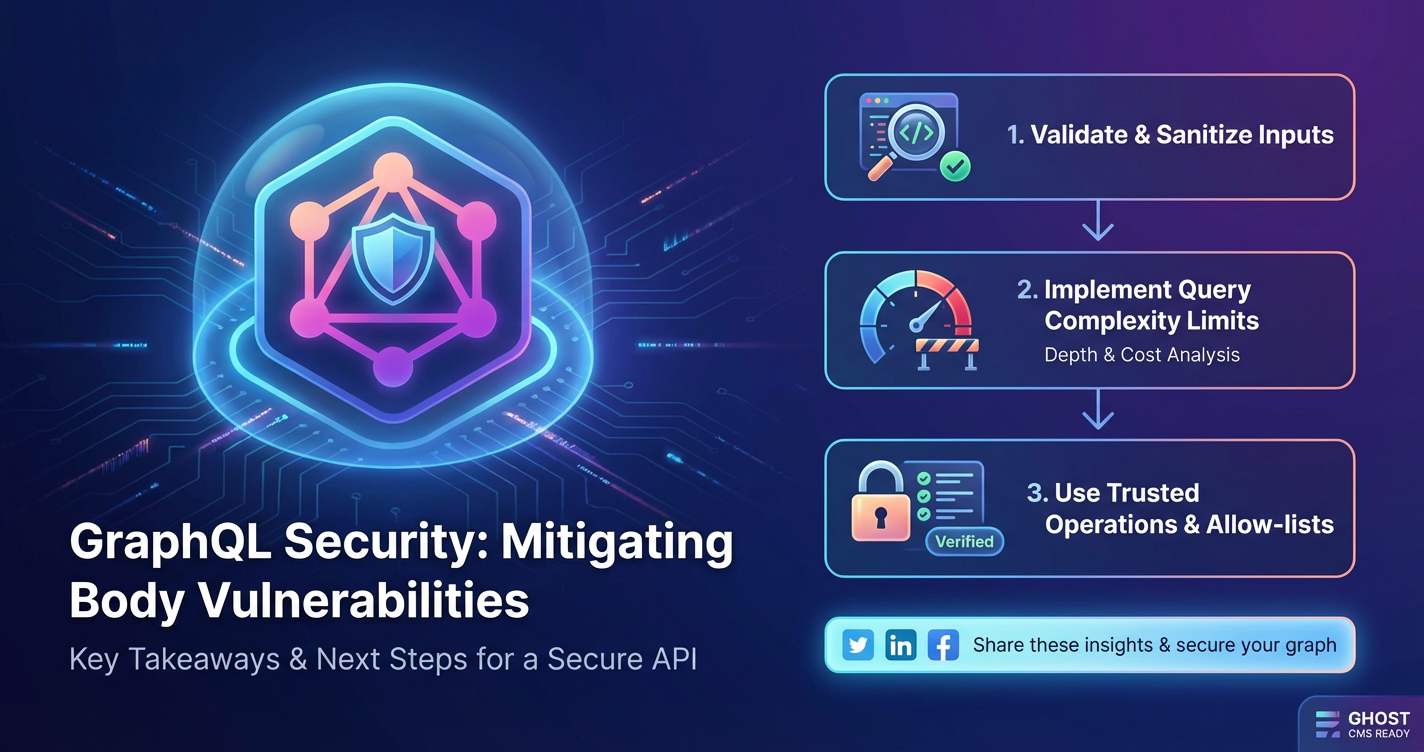
GraphQL Security: Mitigating Body Vulnerabilities


In the rapidly evolving landscape of modern software development, GraphQL has emerged as a powerful and flexible query language for APIs, offering significant advantages over traditional REST architectures. Its ability to enable clients to request exactly the data they need, avoiding over-fetching or under-fetching, has spurred its widespread adoption across industries. From social media giants to burgeoning startups, developers are increasingly leveraging GraphQL to build highly efficient and responsive applications. This paradigm shift, while revolutionary in its capacity to streamline data interaction, also introduces a unique set of security challenges, particularly concerning the integrity and security of the request body. Unlike RESTful APIs, where multiple endpoints dictate resource access, GraphQL consolidates data retrieval and manipulation through a single endpoint, making the structure and content of the request body an absolutely critical surface area for potential attacks.
The very flexibility that makes GraphQL so appealing—the client's ability to craft intricate queries and mutations—can be exploited by malicious actors if not properly secured. A poorly designed or inadequately protected GraphQL api can become a conduit for data breaches, denial-of-service attacks, and unauthorized data manipulation. Understanding and mitigating these "body vulnerabilities" is paramount for any organization deploying GraphQL. It requires a deep dive into how GraphQL processes requests, the inherent risks associated with its dynamic nature, and the comprehensive strategies needed to build a resilient and secure api gateway that stands guard against these sophisticated threats. This article will meticulously explore the various body-related vulnerabilities inherent in GraphQL, providing detailed insights into their mechanisms, potential impacts, and, crucially, the robust mitigation techniques necessary to safeguard your api infrastructure. We will delve into architectural considerations, best practices for schema design, robust input validation, sophisticated authorization models, and the indispensable role of an api gateway in creating a multi-layered defense system. The goal is to equip developers, security professionals, and api administrators with the knowledge to not just react to threats but proactively engineer security into the very fabric of their GraphQL implementations, ensuring both functionality and impregnable protection.
Understanding GraphQL's Architecture and Its Unique Vulnerability Surface
GraphQL's fundamental design deviates significantly from traditional REST principles, and it is precisely these architectural differences that give rise to its distinct security considerations, particularly within the request body. At its core, GraphQL revolves around a schema that defines the data shape and available operations (queries for reading, mutations for writing, and subscriptions for real-time updates). Clients interact with this schema via a single HTTP endpoint, typically sending POST requests where the entire operation—be it a query, mutation, or subscription—is encapsulated within the request body as a JSON payload. This payload contains the GraphQL document (the query string), optionally variables, and an operation name.
The single endpoint model, while simplifying client-side development and reducing network overhead, centralizes the security burden. Instead of protecting numerous distinct endpoints, an organization must now secure a single, highly flexible entry point that interprets arbitrary client-defined operations. This flexibility, paradoxically, is the source of many vulnerabilities. Clients can request deeply nested data structures, multiple operations in a single request, or specific fields within a type. If not properly constrained and validated, this power can be abused. For instance, an attacker might craft a query that traverses an entire database, leading to excessive data exposure, or construct a deeply nested query that exhausts server resources, culminating in a denial-of-service attack. The traditional perimeter defense strategies often employed for REST APIs, which might rely on URL path filtering or verb-based access controls, become less effective when every interaction flows through the same /graphql gateway.
Moreover, GraphQL's introspection capabilities, which allow clients to query the schema itself to understand what types, fields, and arguments are available, present another unique vulnerability surface. While incredibly useful for development tools and client-side code generation, introspection can provide malicious actors with a complete map of your api's data model, laying bare potential attack vectors if not carefully managed. Without stringent access controls or intelligent api gateway mechanisms, an attacker can enumerate sensitive data fields, discover relationships between types, and identify potential weak points in the schema without prior knowledge. This detailed schema information, once in the wrong hands, significantly simplifies the process of crafting sophisticated attacks, transforming a discovery phase that would typically involve brute-forcing or educated guessing into a trivial information retrieval exercise.
The api gateway in a GraphQL context therefore takes on an expanded and critical role. It is no longer just a simple traffic router or load balancer; it must become an intelligent policy enforcement point capable of inspecting, parsing, and validating the complex structures within GraphQL request bodies. This includes understanding the nuances of GraphQL operations, applying fine-grained authorization rules, performing deep input validation, and implementing robust rate-limiting strategies that account for query complexity, not just request volume. Without such a sophisticated gateway, the inherent flexibility of GraphQL transforms into a significant security liability, making the api vulnerable to a broad spectrum of attacks that leverage the very features designed to enhance developer experience and application performance. Securing a GraphQL api requires a comprehensive strategy that spans from careful schema design and application-level authorization to powerful api gateway capabilities and continuous monitoring, all meticulously focused on mitigating the risks embedded within the dynamic request body.
Detailed Exploration of GraphQL Body Vulnerabilities
The inherent flexibility and power of GraphQL's request body, while offering immense development advantages, concurrently open doors to a myriad of sophisticated vulnerabilities. These vulnerabilities often stem from the ability of clients to craft highly specific and potentially complex queries or mutations, which, if unchecked, can lead to severe security breaches. Understanding each type of vulnerability is the first step towards building a resilient GraphQL api.
Excessive Data Exposure and Information Disclosure
This class of vulnerabilities refers to situations where the api reveals more information than intended or necessary, often inadvertently due to the nature of GraphQL's expressive query language.
Over-fetching and Unintended Field Exposure
Unlike REST, where endpoints typically return fixed data structures, GraphQL allows clients to specify exactly which fields they want. While beneficial for performance, this can lead to over-fetching from a security perspective if authorization isn't applied at a granular field level. If a user is authorized to access an Order object but not the customer.creditCardDetails field within it, a poorly secured GraphQL api might still return that sensitive field if the client requests it. The server's default resolver might simply fetch the entire Order object from the database, including all its associated fields, and then rely on the GraphQL execution engine to filter fields for the client. If authorization checks aren't interwoven deeply into the resolver logic, sensitive data can leak. For example, a query like query { order(id: "123") { customer { name email creditCardDetails } } } could expose critical payment information if field-level authorization for creditCardDetails is missing or improperly implemented. This is particularly insidious because the api itself might be designed to prevent direct access to certain sensitive attributes via explicit REST endpoints, but the flexibility of GraphQL's body allows an attacker to construct a request that bypasses these assumptions. The problem is exacerbated when resolvers implicitly expose underlying database columns without explicit mapping and access control checks.
Introspection Queries Abuse
GraphQL's introspection feature allows clients to query the api's schema itself, revealing all available types, fields, arguments, and their relationships. This is invaluable for tools like GraphQL Playground or Apollo Studio, which use introspection to provide auto-completion and documentation. However, in a production environment, an attacker can leverage introspection to completely map your api, discovering all potential data points, relationships, and even internal api structure. This detailed schema knowledge significantly aids in crafting targeted attacks, identifying sensitive data fields, and understanding potential authorization bypass opportunities. A simple introspection query like query { __schema { types { name fields { name } } } } can reveal a wealth of information, from user profile fields to internal system configurations. Without an api gateway specifically configured to filter or restrict introspection queries for unauthorized users, this feature transforms from a development convenience into a critical information disclosure vulnerability. It essentially hands an attacker the blueprint of your entire data api, reducing the effort required for reconnaissance to almost zero.
Resource Exhaustion and Denial of Service (DoS)
GraphQL's power to allow complex, nested queries can be weaponized to overload the server, leading to performance degradation or outright denial of service. Attackers craft request bodies that demand an excessive amount of computational resources.
Deeply Nested Queries
Clients can request data with arbitrary depth in GraphQL. For instance, fetching a user, then their friends, then each friend's friends, and so on. A query like query { user(id: "1") { friends { friends { friends { ... } } } } } can quickly become computationally expensive. Each level of nesting often translates to additional database queries or complex data processing on the server. If not limited, such a query can exhaust memory, CPU cycles, or database connection pools, making the api unavailable to legitimate users. The problem isn't just the depth, but the combinatorial explosion of data retrieval that occurs when multiple nested lists are requested. For example, a request for organizations { projects { tasks { subtasks { ... } } } } where each level could potentially return hundreds or thousands of items, rapidly overwhelms server resources. The api gateway needs to be intelligent enough to analyze the complexity of the query within the body before forwarding it to the backend.
Large Argument Lists
While less common than deep nesting, attackers can craft queries with excessively long lists of arguments to specific fields, intended to consume server resources during validation or processing. For example, query { products(ids: ["id1", "id2", ..., "id_N"]) { name } } where N is extremely large. Although usually handled efficiently, edge cases or specific resolver implementations might become vulnerable to such oversized input arrays. The sheer volume of data in the request body itself can trigger memory allocation issues or significantly increase processing time during the initial parsing and validation phases, even before database interaction begins.
Alias Abuse
GraphQL allows clients to use aliases for fields, which means they can request the same field multiple times with different names within a single query. For example: query { user1: user(id: "1") { name } user2: user(id: "2") { name } user3: user(id: "3") { name } }. While legitimate for comparing data, an attacker can use this to send a single request body containing hundreds or thousands of identical but aliased operations, bypassing simple rate-limiting mechanisms that count requests rather than individual operations or their complexity. This effectively multiplies the workload on the server for a single HTTP request. An api gateway that only counts incoming HTTP requests per second would fail to prevent this, as a single request might contain 1000 aliased operations, each hitting the backend.
Batching Attacks
GraphQL clients often support batching, sending multiple distinct GraphQL operations (queries or mutations) within a single HTTP request body, typically as a JSON array of operations. While intended for efficiency, this can be abused to bypass rate limiting that is applied on a per-request basis. An attacker can send a single HTTP request containing hundreds of distinct, complex operations, each contributing to resource exhaustion, while only counting as one request against simple api gateway rate limits. The distinction between a single HTTP request and the logical operations contained within its GraphQL body is critical here. An effective api gateway must be able to parse the GraphQL body and apply policies to each contained operation.
Injection Attacks
Similar to traditional apis, GraphQL apis can be vulnerable to various injection attacks if arguments are not properly validated and sanitized before being used in backend operations.
SQL, NoSQL, and Command Injection
If GraphQL arguments are directly concatenated into SQL queries, NoSQL queries, or OS commands without proper sanitization or parameterization, an attacker can inject malicious code. For example, if a user field's id argument is used in a SQL query like SELECT * FROM users WHERE id = '${args.id}', an attacker could supply id: "1 OR 1=1" to bypass authentication or extract arbitrary data. Similarly, if an argument is passed to a shell command, command: "ls ${args.path}", an attacker could inject path: "; rm -rf /" leading to command execution. The request body is the vehicle for these malicious inputs, highlighting the necessity for robust validation at every stage.
Broken Access Control and Authorization Bypass
GraphQL apis, like any other api, must enforce strict access controls. However, their flexibility can make this more challenging, leading to authorization bypasses if not carefully implemented.
Missing Authorization on Fields/Types
It is a common mistake to apply authorization only at the top-level resolvers (e.g., ensuring a user can query Order objects) but neglect field-level authorization. This can lead to horizontal or vertical privilege escalation. For instance, a user might be authorized to view their own Order details but not the internalNotes field on that Order, which is meant only for administrators. If the resolver for internalNotes does not explicitly check the user's role, any authenticated user could query it. Similarly, an attacker might discover a user ID through legitimate means and then attempt to query query { user(id: "anotherUser") { email } }. If the user resolver doesn't check if the querying user has permission to access anotherUser's profile, it becomes an IDOR (Insecure Direct Object Reference) combined with missing authorization.
Insecure Direct Object References (IDOR)
While not unique to GraphQL, IDORs can manifest effectively through GraphQL's flexible querying. If an api exposes objects by simple, guessable IDs (e.g., sequential integers, UUIDs), an attacker can iterate through these IDs in their query body to access records they are not authorized for. For example, query { order(id: "123") { ... } } for an order belonging to another user. Robust object-level authorization, ensuring the requesting user has permission for the specific id requested, is crucial.
Mass Assignment and Insecure Direct Object References (IDOR) in Mutations
Mutations, which are GraphQL's way of modifying data, are particularly susceptible to mass assignment vulnerabilities.
Unrestricted Field Updates in Mutations
Mass assignment occurs when a client can update fields that they should not have access to, often by including them in a mutation's input object. For example, a User mutation might allow updating name and email. If the mutation input also accepts an isAdmin field and the resolver doesn't explicitly filter or whitelist allowed fields, an attacker could potentially send mutation { updateUser(id: "123", input: { name: "Attacker", isAdmin: true }) { ... } } and escalate their privileges. This is a subtle yet dangerous vulnerability, as the api might implicitly trust the input rather than explicitly define what can be changed. The danger lies in the api accepting a broad input object for a mutation, allowing an attacker to inject fields like admin or status that the application then blindly persists, bypassing intended access controls.
Server-Side Request Forgery (SSRF) and Cross-Site Scripting (XSS)
Though less directly related to the "body" itself, these attacks can be initiated or exacerbated by how GraphQL arguments are handled within the request body.
SSRF via Argument Values
If a GraphQL api has a field or argument that accepts a URL, and the server then fetches content from that URL (e.g., for an image upload service or a webhook configuration), it can be vulnerable to SSRF. An attacker could provide an internal api endpoint or a local file path, causing the server to make requests to internal resources or files that should not be publicly accessible. For example, mutation { uploadImage(url: "http://internal-service/admin-config") { ... } }. The URL provided in the request body is the vector.
XSS via Reflected Arguments
If GraphQL arguments, especially string types, are reflected directly back into a client-side api explorer or error message without proper sanitization and encoding, they can lead to XSS. An attacker could inject malicious JavaScript into an argument, which then executes in another user's browser when they view logs or api documentation that reflects the unsanitized input. For example, if an error message includes Invalid input for 'name': <script>alert('XSS')</script>, this could execute.
GraphQL Batching Attacks
As mentioned under resource exhaustion, batching is a legitimate feature for efficiency but poses a security risk when combined with inadequate rate limiting. The ability to send multiple queries or mutations in a single HTTP request body (as an array of operations) can circumvent simple rate limiters that only count the number of HTTP requests per second or minute. An attacker can package hundreds of resource-intensive operations into a single batched request, thereby bypassing the intended protections and rapidly exhausting server resources. This is particularly problematic for api gateway solutions that do not perform deep packet inspection of the GraphQL payload, treating every HTTP POST to the GraphQL endpoint as a single, undifferentiated unit. Without granular control at the operation level within the GraphQL body, batching transforms from a performance feature into a denial-of-service vector.
To summarize, the request body in GraphQL is a rich attack surface. The very features that provide flexibility—deep nesting, introspection, dynamic field selection, and mutation capabilities—require rigorous security controls. Each of these vulnerabilities necessitates a distinct yet integrated mitigation strategy, from careful schema design and strict input validation to advanced api gateway functionalities and comprehensive authorization frameworks.
Mitigation Strategies and Best Practices
Securing a GraphQL api against body vulnerabilities requires a multi-layered, comprehensive approach that addresses risks at every level, from schema design to network infrastructure. No single solution is sufficient; rather, a combination of robust practices and intelligent tooling forms an impregnable defense.
Schema Design Principles
The schema is the contract of your GraphQL api, and its design is foundational to security. Proactive security starts here.
- Least Privilege Principle: Design your schema such that it exposes only the data and operations absolutely necessary for clients. Avoid exposing internal
apidetails, database table names, or excessive fields that are not intended for public consumption. Each field, type, and argument should have a clear, justified purpose. This minimizes the attack surface by reducing the amount of exploitable information available to an adversary. For instance, if aUsertype has asalaryfield that should only be accessible internally, do not include it in the public schema at all, or ensure it's protected by robust authorization. - Explicit Type Definitions: Be precise with your types. Use specific scalar types (e.g.,
ID,Int,String, custom scalars likeEmailAddressorDateTime) to constrain input values. Avoid using genericStringtypes where a more restrictive type would be appropriate, as this simplifies input validation. Custom scalars can enforce complex validation rules directly within the schema definition, providing an initial layer of defense against malformed or malicious input. - Controlled Introspection: Introspection is a powerful feature for development but can be a security risk in production. Consider disabling introspection entirely in production environments or, at minimum, restricting access to it based on roles or
api gatewaypolicies. For example, only authenticated administrators or internal tools might be allowed to perform introspection queries. This prevents attackers from easily mapping your entireapisurface. Some organizations choose to only allow introspection from specific IP addresses or during limited time windows, adding another layer of control.
Input Validation and Sanitization
Every piece of data entering your GraphQL api through the request body must be rigorously validated and, if necessary, sanitized.
- Strict Validation of All Arguments: Beyond basic type checking (which GraphQL handles), implement detailed validation for all arguments. This includes checking format (e.g., email regex, UUID format), range (e.g., positive integers, date ranges), and acceptable values (e.g., enum values). This validation should occur as early as possible in the request processing pipeline, ideally before reaching resolver logic. Using validation libraries or frameworks integrated with your GraphQL server can streamline this process. For example, ensuring that an
idargument is a valid UUID, not an arbitrary string that could be interpreted as part of a SQL injection. - Server-Side Sanitization: For any input that will be stored, displayed to other users, or used in backend commands (especially strings), perform robust server-side sanitization. This involves stripping or encoding potentially malicious characters to prevent XSS, HTML injection, or other content-based attacks. Never rely solely on client-side validation, as it can be easily bypassed.
- Parameterized Queries (for Database Interactions): When GraphQL resolvers interact with databases, always use parameterized queries or ORMs (Object-Relational Mappers) that automatically handle parameterization. This is the most effective defense against SQL and NoSQL injection attacks, as it separates the query structure from the input values, preventing malicious input from being interpreted as executable code. Avoid concatenating string arguments directly into database queries under any circumstances.
Authorization and Authentication
Granular and context-aware authorization is non-negotiable for GraphQL security.
- Field-level, Type-level, and Argument-level Authorization: Implement authorization checks not just at the top-level query or mutation but also at individual fields, types, and even specific argument values. A user might be authorized to query an
Orderobject but not thecustomer.creditCardDetailsfield within it, or only their ownOrderobjects. Frameworks often provide mechanisms (e.g., directives, middleware) to attach authorization logic directly to schema definitions or resolvers. This ensures that even if a field is exposed, unauthorized users cannot retrieve its data. - Context-Aware Authorization: Authorization decisions should be based on the authenticated user's identity, role, and the context of the request (e.g., ownership of the requested resource). For instance, a user can
updateUser(id: $id)only if$idmatches their own user ID, or if they have an administrator role. - Authentication at the API Gateway and Application Layer: All requests to your GraphQL
apishould be authenticated. Anapi gatewayis an ideal place to enforce initial authentication checks (e.g., validating JWTs,apikeys). This offloads authentication from the GraphQL server itself and provides a centralized control point. Additionally, application-level authentication within your GraphQL server confirms the user's identity for subsequent authorization decisions.
Rate Limiting and Throttling
To prevent resource exhaustion and denial-of-service attacks, intelligent rate limiting is essential.
- Per-IP, Per-User, Per-Operation Rate Limits: Implement rate limiting that considers not just the number of HTTP requests but also the number of individual GraphQL operations within a batched request. An advanced
api gatewaycan parse the GraphQL request body to apply limits per unique operation or per user. For highly sensitive operations, even stricter limits may be necessary. This prevents alias abuse and batching attacks from overwhelming your server. - Query Depth and Complexity Analysis: Implement mechanisms to analyze the depth and computational complexity of incoming GraphQL queries. For instance, define a maximum allowed query depth (e.g., 5 levels) and reject queries that exceed it. Furthermore, assign a "cost" to each field or resolver based on its expected resource consumption (e.g., database queries,
apicalls). Sum these costs for a given query and reject queries exceeding a predefined complexity threshold. This proactive approach prevents deeply nested or computationally expensive queries from ever reaching your backend. This is a critical feature often handled by specialized GraphQL security libraries or by an advancedapi gateway.
Logging and Monitoring
Comprehensive logging and real-time monitoring are crucial for detecting and responding to security incidents.
- Comprehensive Logging of All GraphQL Requests and Responses: Log all incoming GraphQL request bodies, including the query string, variables, and operation name. Also, log outgoing responses, especially for errors or sensitive data access. Ensure logs include context like user ID, IP address, and timestamps. These logs are invaluable for forensic analysis during an incident.
- Anomaly Detection: Implement monitoring tools that can detect unusual patterns in GraphQL traffic. This includes sudden spikes in query depth, complexity, error rates, or access patterns to sensitive fields. Automated alerts should notify security teams immediately of potential attacks.
- Security Information and Event Management (SIEM) Integration: Integrate your GraphQL logs with a SIEM system to centralize security event analysis, correlate events across different systems, and enable long-term trend analysis for proactive threat hunting.
Leveraging an API Gateway for Enhanced Security
An api gateway plays a pivotal role in securing GraphQL apis, acting as the first line of defense and providing a centralized control plane for enforcing security policies. A robust api gateway can offload many security concerns from your GraphQL server, allowing the server to focus purely on business logic.
A sophisticated api gateway should be able to:
- Authenticate and Authorize Requests: Enforce authentication protocols (e.g., OAuth2, JWT validation) and initial authorization checks before requests even reach the GraphQL server. This reduces the attack surface on your backend.
- Rate Limit and Throttling: As discussed, apply intelligent rate limiting that can inspect the GraphQL request body to count individual operations and analyze query complexity, going beyond simple HTTP request counts. This is crucial for mitigating DoS and batching attacks.
- Input Validation: Perform initial validation of the GraphQL request body structure and basic argument types, blocking malformed requests before they consume backend resources.
- Schema Enforcement and Validation: Ensure incoming queries conform to the published schema. Some
api gateways can even rewrite or transform queries to enforce specific schema versions or hide certain fields. - Logging and Monitoring: Provide comprehensive logging of all
apitraffic, including detailed GraphQL request bodies, which is invaluable for security audits and anomaly detection. Centralized logging from theapi gatewaygives a holistic view ofapiusage and potential abuses. - Caching: While primarily a performance feature, caching responses for frequently accessed queries can reduce the load on your backend, making it more resilient to resource exhaustion attacks.
- Threat Protection: Implement Web Application Firewall (WAF) capabilities to detect and block common web attack patterns, even if not GraphQL-specific.
For organizations leveraging AI models and REST services, a solution like APIPark stands out as an exemplary open-source AI gateway and API management platform. APIPark is engineered to manage, integrate, and deploy AI and REST services with remarkable ease, offering robust features that directly address GraphQL body vulnerabilities. Its capability for end-to-end API lifecycle management, including design, publication, invocation, and decommissioning, inherently contributes to a more secure api posture. By centralizing traffic forwarding, load balancing, and versioning, APIPark ensures consistent policy enforcement across all apis. The platform’s ability to standardize the request data format across AI models helps reduce the attack surface by ensuring predictable input structures. Crucially, APIPark offers api resource access approval features, preventing unauthorized api calls and potential data breaches by requiring callers to subscribe and await administrator approval before invocation. Its detailed api call logging, which records every aspect of each api call, provides unparalleled visibility for tracing and troubleshooting issues, directly aiding in the detection and investigation of body-related attacks. Furthermore, APIPark's powerful data analysis capabilities, which display long-term trends and performance changes, assist businesses in proactive threat prevention and anomaly detection. This comprehensive approach from an api gateway like APIPark allows organizations to benefit from GraphQL's flexibility while maintaining stringent security controls, effectively mitigating the risks posed by body vulnerabilities.
Security Headers and Network Configuration
Beyond the GraphQL layer, fundamental network and api security practices remain vital.
- Web Application Firewall (WAF): Deploy a WAF in front of your
api gatewayto provide an additional layer of protection against common web vulnerabilities, including some forms of injection and DoS. While WAFs might not understand GraphQL's specific syntax, they can still block generic malicious patterns. - TLS Enforcement: Ensure all communication with your GraphQL
apiuses TLS (HTTPS) to protect data in transit from eavesdropping and tampering. This should be enforced at theapi gatewaylevel. - Restrict Network Access: Limit network access to your GraphQL endpoint from specific IP ranges if possible (e.g., for internal-only
apis). For publicapis, ensure yourapi gatewayand backend servers are properly segmented and secured within your network infrastructure. - Content Security Policy (CSP): Implement a robust CSP to mitigate XSS risks, especially if you host a GraphQL
apiexplorer alongside yourapi. A CSP can restrict the sources from which scripts, styles, and other resources can be loaded, preventing malicious injected scripts from executing.
Continuous Security Auditing and Testing
Security is not a one-time setup; it's an ongoing process.
- Regular Security Audits: Conduct regular security audits and penetration testing specifically targeting your GraphQL
apis. Engage security experts who specialize in GraphQL to uncover vulnerabilities that might be missed by generic testers. - Automated Security Testing: Integrate GraphQL-specific security testing tools into your CI/CD pipeline. These tools can perform static analysis of your schema, identify common anti-patterns, and run dynamic tests to detect vulnerabilities like excessive nesting or unauthorized field access.
- Bug Bounty Programs: Consider launching a bug bounty program to leverage the global security community in finding and reporting vulnerabilities in your GraphQL
api. - Dependency Security Scanning: Regularly scan your project's dependencies for known vulnerabilities, as an insecure library could inadvertently introduce weaknesses into your GraphQL server.
By systematically implementing these mitigation strategies, organizations can transform the dynamic and flexible nature of GraphQL from a potential security liability into a robust, high-performance, and secure api solution. The integration of an intelligent api gateway like APIPark is not just a best practice but a fundamental requirement for achieving comprehensive GraphQL security in today's complex api ecosystems.
APIPark is a high-performance AI gateway that allows you to securely access the most comprehensive LLM APIs globally on the APIPark platform, including OpenAI, Anthropic, Mistral, Llama2, Google Gemini, and more.Try APIPark now! 👇👇👇
Tools and Technologies for GraphQL Security
While the principles and best practices form the foundation, a variety of tools and technologies are available to aid in the practical implementation of GraphQL security. These tools can help automate detection, enforce policies, and streamline the security lifecycle.
- GraphQL Server Libraries/Frameworks: Most GraphQL server implementations (e.g., Apollo Server for Node.js, Strawberry for Python, Hot Chocolate for .NET) offer built-in features for security. These often include:
- Schema directives: Custom directives (e.g.,
@auth,@hasRole) can be used to attach authorization logic directly to fields or types in your schema, enforcing access control at a granular level. - Plugins/Middleware: Hooks into the execution pipeline allow for custom logic like query validation, complexity analysis, and logging.
- Input validation capabilities: Mechanisms to integrate with validation libraries (e.g., Joi, Yup) for rigorous argument validation.
- Schema directives: Custom directives (e.g.,
- Query Analysis Tools: These are crucial for preventing resource exhaustion attacks.
- GraphQL-depth-limit / GraphQL-query-complexity: Libraries available in various languages that parse incoming queries to calculate their depth or a defined complexity score, rejecting requests that exceed configured thresholds. These can be integrated directly into your GraphQL server.
- API Gateway Integrations: As discussed, advanced
api gatewaysolutions like APIPark incorporate these types of query analysis features natively, providing centralized enforcement before the request even hits the backend GraphQL server.
- Static Analysis Tools:
- GraphQL-ESLint / Soly for GraphQL: Linters and static analyzers that can inspect your GraphQL schema and resolver code for security anti-patterns, common mistakes, or potential vulnerabilities before deployment. They can identify exposed sensitive fields, missing authorization directives, or overly broad types.
- Dynamic Analysis (Penetration Testing) Tools:
- InQL Scanner: A Burp Suite extension designed specifically for testing GraphQL APIs. It can discover endpoints, generate queries and mutations, and identify common vulnerabilities like injection, IDOR, and broken access control.
- Graphql-path-enum: A tool for identifying potential authorization issues by enumerating all possible paths in a GraphQL API.
- Dalfox / XSStrike: While not GraphQL-specific, these Fuzzing tools can be adapted to test for XSS vulnerabilities if GraphQL arguments are reflected in responses without proper sanitization.
- OWASP ZAP / Nessus: General-purpose
apisecurity scanners can be configured to interact with GraphQL endpoints, although they might require custom scripting to handle GraphQL-specific payloads effectively.
- API Gateways with GraphQL Support:
- APIPark: As highlighted, APIPark is an open-source AI gateway and API management platform that offers comprehensive features crucial for GraphQL security. It provides unified
apiformat, prompt encapsulation into RESTapis, end-to-endapilifecycle management, and robust security features like resource access approval, detailedapicall logging, and performance rivaling Nginx. These capabilities make it an excellent choice for mitigating body vulnerabilities by providing a central point for authentication, authorization, rate limiting, and traffic management, all while supporting both AI and REST services. - Apollo
Gateway/ Federation: While primarily for composing multiple GraphQL services, ApolloGatewaycan also enforce some security policies at the edge, especially when combined with Apollo Studio's analytics and operations registry features. - Kong
Gateway/ Tyk / Nginx Plus: These are powerfulapi gateways that, with proper configuration and plugins, can be extended to provide GraphQL-aware security features, although they may require more manual setup compared to specialized GraphQLgateways. Plugins can be developed to parse GraphQL payloads and apply policies.
- APIPark: As highlighted, APIPark is an open-source AI gateway and API management platform that offers comprehensive features crucial for GraphQL security. It provides unified
- Authentication and Authorization Libraries:
- Passport.js (Node.js), Authlib (Python), Spring Security (Java): These robust authentication libraries help implement secure user authentication.
- OPA (Open Policy Agent): A general-purpose policy engine that can be used to define and enforce fine-grained authorization policies for GraphQL, externalizing policy decisions from application code and providing a consistent policy layer across your stack.
By strategically deploying a combination of these tools—from integrated server-side capabilities to dedicated api gateways and specialized security scanners—organizations can establish a proactive and resilient security posture for their GraphQL apis, effectively mitigating the diverse range of body vulnerabilities that characterize this powerful api paradigm.
Case Studies and Real-World Implications
The theoretical understanding of GraphQL body vulnerabilities becomes starkly real when observing their impact in actual applications. While specific company names are often redacted in public security reports, the patterns of attack and their consequences offer valuable lessons.
Case Study 1: Information Disclosure via Introspection and Over-fetching
A prominent e-commerce platform utilized GraphQL to power its mobile and web frontends. In their production environment, GraphQL introspection was left enabled, and crucially, their backend resolvers performed insufficient field-level authorization. An attacker discovered the GraphQL endpoint and, using introspection, mapped out the entire schema, including internal admin-only fields on Order and User types (e.g., adminNotes, commissionRate, internalUserId). While directly querying these fields was initially blocked for regular users by rudimentary top-level authorization, the attacker found that by carefully crafting queries with multiple nested objects, they could sometimes bypass these checks or cause unintended side effects where some sensitive fields were briefly exposed in the response duees to asynchronous resolver execution and race conditions. More directly, the lack of granular field-level authorization meant that even if a user was only intended to see their order history, a crafted query could fetch shippingAddress details of other users by guessing order_id values or leveraging other legitimate api access that returned lists of objects. The ultimate impact was the exposure of hundreds of thousands of customer records, including names, addresses, and internal order metadata, which became a significant data breach.
Mitigation Lesson: This case underscores the absolute necessity of disabling or strictly restricting GraphQL introspection in production and implementing robust, granular field-level authorization checks within every resolver. An api gateway configured to block introspection queries for non-authorized users could have prevented the initial schema mapping, while a well-architected GraphQL server with proper authorization middleware would have prevented the over-fetching.
Case Study 2: Denial of Service via Deeply Nested Queries and Alias Abuse
A social media api, designed with GraphQL, allowed users to fetch their friends, their friends' friends, and so on. They had implemented a basic rate limiter on their api gateway that counted HTTP requests per minute. An attacker exploited this by sending a single HTTP POST request containing a deeply nested query (e.g., user { friends { friends { ... 10 levels deep ... } } }) combined with alias abuse, repeating this query hundreds of times within the same batched request body. Each individual nested query triggered a cascade of database lookups and object materializations on the backend. Because the api gateway only registered one HTTP request, the rate limiter was not triggered. The server quickly ran out of memory and CPU resources, leading to a complete service outage for several hours during a peak usage period.
Mitigation Lesson: Simple HTTP request-based rate limiting is insufficient for GraphQL. The api gateway must be capable of parsing the GraphQL request body to apply query depth limiting, complexity analysis, and per-operation rate limiting. Solutions like APIPark, which offer performance rivaling Nginx and powerful data analysis, are designed to handle such complex traffic patterns, providing the necessary intelligence to protect against sophisticated DoS attacks that leverage GraphQL's flexibility. Implementing a maximum query depth and a complexity score for each operation could have prevented the server from processing such resource-intensive requests.
Case Study 3: Mass Assignment in a GraphQL Mutation
A SaaS platform provided a GraphQL mutation for updating user profiles. The mutation accepted an input object (UpdateUserInput) that contained fields like firstName, lastName, and email. Unfortunately, the backend resolver for this mutation blindly took all fields from UpdateUserInput and applied them to the User database object, without explicitly whitelisting allowed fields or checking roles for certain sensitive fields. The User object also had an isAdmin boolean field, which was never meant to be exposed or mutable by regular users. An attacker, having a valid user api token, crafted a mutation: mutation { updateUser(id: "currentUserId", input: { email: "new@example.com", isAdmin: true }) { id email isAdmin } }. The api processed this mutation, and the attacker successfully elevated their privileges to an administrator, gaining unauthorized access to critical administrative functionalities.
Mitigation Lesson: Mutations require strict validation and whitelisting of allowed fields. Resolvers should never blindly assign all input fields to an object. Instead, explicitly define which fields can be updated by which roles, using a robust authorization framework. This is a classic "mass assignment" vulnerability, made potent by GraphQL's input object structure if not handled with care.
These real-world examples highlight that GraphQL security is not merely about patching known vulnerabilities but about adopting a security-first mindset throughout the entire api development lifecycle. From the initial schema design to the deployment of intelligent api gateways, every decision impacts the overall security posture. The dynamic nature of GraphQL's request body necessitates equally dynamic and intelligent security controls to prevent these powerful features from being turned against the system.
| Vulnerability Type | Description | Key Mitigation Strategy | API Gateway Role (Example: APIPark) |
|---|---|---|---|
| Excessive Data Exposure | Revealing more data than authorized/necessary (e.g., sensitive fields, schema details). | Field-level authorization; disable/restrict introspection in production; principle of least privilege in schema design. | Centralized authentication/authorization; introspection blocking/restriction; detailed call logging for auditing exposed data. |
| Resource Exhaustion (DoS) | Server overload from complex/deep queries, large arguments, alias abuse, or batching. | Query depth limiting; complexity analysis; granular rate limiting (per operation, per user); timeout mechanisms. | Intelligent rate limiting (per operation, per user, per complexity score); query depth/complexity enforcement; traffic management, load balancing (high TPS like APIPark). |
| Injection Attacks | Malicious code injection via arguments (SQL, NoSQL, Command). | Strict input validation and sanitization for all arguments; parameterized queries/ORMs for database interactions. | Initial input validation; WAF capabilities; request content inspection for suspicious patterns. |
| Broken Access Control | Unauthorized access to resources/fields due to missing or weak authorization logic. | Robust field-level, type-level, and argument-level authorization; context-aware authorization (e.g., ownership checks); role-based access control. | Centralized authentication/authorization enforcement; api resource access approval; tenant-based access policies. |
| Mass Assignment | Unintended updates to sensitive fields via mutations by including them in input objects. | Explicit whitelisting of allowed fields in mutation inputs; strict authorization checks on mutable fields. | Schema enforcement; input validation before forwarding to backend; detailed logging of mutation payloads. |
| SSRF / XSS | Server making unauthorized requests (SSRF) or client-side script execution (XSS) via URL/string arguments. | Strict URL validation and whitelisting; robust output encoding for reflected data; Content Security Policy (CSP). | URL validation; WAF for XSS/SSRF patterns; api call logging for tracking suspicious URLs/inputs. |
| GraphQL Batching Attacks | Bypassing rate limits by packaging multiple operations into a single HTTP request. | Rate limiting applied per logical operation within the GraphQL body, not just per HTTP request. | Deep packet inspection of GraphQL payload; per-operation rate limiting; advanced traffic shaping. |
Conclusion
GraphQL has undeniably revolutionized the way modern applications interact with data, offering unparalleled flexibility and efficiency. However, this power comes with a significant responsibility: the need for a robust and intelligent security posture, particularly concerning the request body. As we have explored in depth, the very features that make GraphQL so appealing—its single endpoint, dynamic query capabilities, and flexible mutation inputs—also present a unique and complex attack surface. From the subtle risks of excessive data exposure through over-fetching and introspection abuse to the critical threats of resource exhaustion via deeply nested queries and alias attacks, and the insidious nature of injection and broken access control vulnerabilities, GraphQL body vulnerabilities demand meticulous attention and a multi-layered defense strategy.
Mitigating these risks requires more than just reactive measures; it necessitates a proactive approach that begins at the earliest stages of api design. Adhering to the principle of least privilege, designing precise schemas, and rigorously validating and sanitizing all input arguments are foundational steps. Beyond the application layer, the role of a sophisticated api gateway becomes indispensable. An advanced gateway acts as the primary guardian, capable of intelligent traffic management, granular rate limiting, deep GraphQL payload inspection, and centralized authentication and authorization enforcement. Platforms like APIPark exemplify this, providing not just an open-source AI gateway but a comprehensive api management platform that directly addresses many of these vulnerabilities through features like api resource access approval, detailed call logging, and performance optimized for handling large-scale traffic.
Ultimately, securing a GraphQL api against body vulnerabilities is an ongoing journey that combines thoughtful architecture, vigilant development practices, and the strategic deployment of advanced security tools. By embracing these best practices and leveraging powerful api gateway solutions, organizations can fully harness the immense benefits of GraphQL while ensuring the integrity, confidentiality, and availability of their critical data and services. The future of api interactions is undoubtedly flexible, but with careful planning and robust security measures, it can also be remarkably secure.
Frequently Asked Questions (FAQs)
Q1: What makes GraphQL's request body more vulnerable than traditional REST API bodies?
GraphQL's request body is inherently more flexible and expressive than traditional REST API bodies, which often have fixed structures for specific endpoints. In GraphQL, a single endpoint accepts a dynamic query language that allows clients to specify exactly what data they want, how deeply nested it should be, and what operations to perform. This power, if unchecked, allows malicious actors to craft highly complex queries that can expose excessive data, trigger resource exhaustion (e.g., deep nesting, large data fetches), or bypass authorization checks. REST typically limits the scope of a single request to a predefined resource and operation, making the attack surface more predictable, whereas GraphQL's dynamic nature centralizes the security challenge to the interpretation of the body itself.
Q2: How can an API Gateway specifically help in mitigating GraphQL body vulnerabilities?
An api gateway plays a crucial role by acting as an intelligent intermediary. For GraphQL, a sophisticated api gateway goes beyond basic routing and can parse the GraphQL request body. It can then enforce policies such as: 1. Query Depth and Complexity Limiting: Analyzing the structure and cost of a query before it reaches the backend. 2. Granular Rate Limiting: Applying limits based on individual GraphQL operations within a batched request, rather than just per HTTP request. 3. Authentication and Authorization: Centralizing validation of api keys, JWTs, and initial access control checks. 4. Schema Enforcement: Ensuring incoming queries conform to the published schema and blocking malformed requests. 5. Introspection Control: Restricting or disabling introspection queries for unauthorized users in production. 6. Detailed Logging: Providing comprehensive logs of GraphQL requests for security monitoring and anomaly detection, as offered by platforms like APIPark.
Q3: What is "mass assignment" in the context of GraphQL mutations, and how is it prevented?
Mass assignment in GraphQL mutations occurs when a client can update fields that they should not have access to, by including them in a mutation's input object. For example, if a User mutation input object implicitly allows updating an isAdmin field, an attacker could include isAdmin: true in their request to gain administrative privileges, even if the UI doesn't expose this field. This is prevented by explicitly whitelisting allowed fields within the mutation's resolver logic or using GraphQL server features that enforce strict input definitions. Resolvers should never blindly assign all fields from an input object to a database record without explicit validation and authorization checks for each field.
Q4: Why is it risky to enable GraphQL introspection in a production environment?
Enabling GraphQL introspection in a production environment allows any client to query the api's entire schema, revealing all available types, fields, arguments, and their relationships. While useful for development tools, in a production setting, this provides a complete blueprint of your api's data model to potential attackers. They can use this information to identify sensitive fields, understand internal data structures, and craft highly targeted attacks, significantly simplifying their reconnaissance phase and increasing the likelihood of discovering and exploiting vulnerabilities like excessive data exposure or broken access control. It's best to disable introspection or restrict its access to authorized users only in production.
Q5: Can traditional Web Application Firewalls (WAFs) fully protect against GraphQL body vulnerabilities?
Traditional WAFs provide a crucial layer of defense against common web attack patterns (e.g., generic SQL injection, XSS), but they are often not sufficient to fully protect against GraphQL-specific body vulnerabilities. This is because traditional WAFs typically operate at a lower layer, inspecting HTTP request headers and simple URL paths, and matching against known patterns without understanding the intricate, dynamic, and nested structure of GraphQL payloads. They usually cannot parse the GraphQL query language itself to analyze query depth, complexity, or individual operations within a batched request. For comprehensive protection against GraphQL body vulnerabilities, a WAF needs to be complemented by an api gateway or GraphQL server-side logic that is "GraphQL-aware," capable of deep packet inspection and policy enforcement specific to GraphQL's unique characteristics.
🚀You can securely and efficiently call the OpenAI API on APIPark in just two steps:
Step 1: Deploy the APIPark AI gateway in 5 minutes.
APIPark is developed based on Golang, offering strong product performance and low development and maintenance costs. You can deploy APIPark with a single command line.
curl -sSO https://download.apipark.com/install/quick-start.sh; bash quick-start.sh

In my experience, you can see the successful deployment interface within 5 to 10 minutes. Then, you can log in to APIPark using your account.

Step 2: Call the OpenAI API.