gRPC vs tRPC: A Deep Dive into Modern API Communication


The landscape of API communication has undergone a profound transformation over the past decade. What began primarily with RESTful services, characterized by their simplicity and ubiquitous HTTP-based interactions, has evolved to embrace more sophisticated and specialized paradigms. This evolution is driven by an ever-increasing demand for performance, real-time capabilities, strong type safety, and an enhanced developer experience across complex distributed systems. As applications become more intricate, spanning microservices architectures, serverless functions, mobile clients, and web interfaces, the need for efficient, reliable, and maintainable communication protocols has never been more critical. This shift has paved the way for technologies that challenge the conventional wisdom of REST, offering alternative approaches to building robust and scalable APIs.
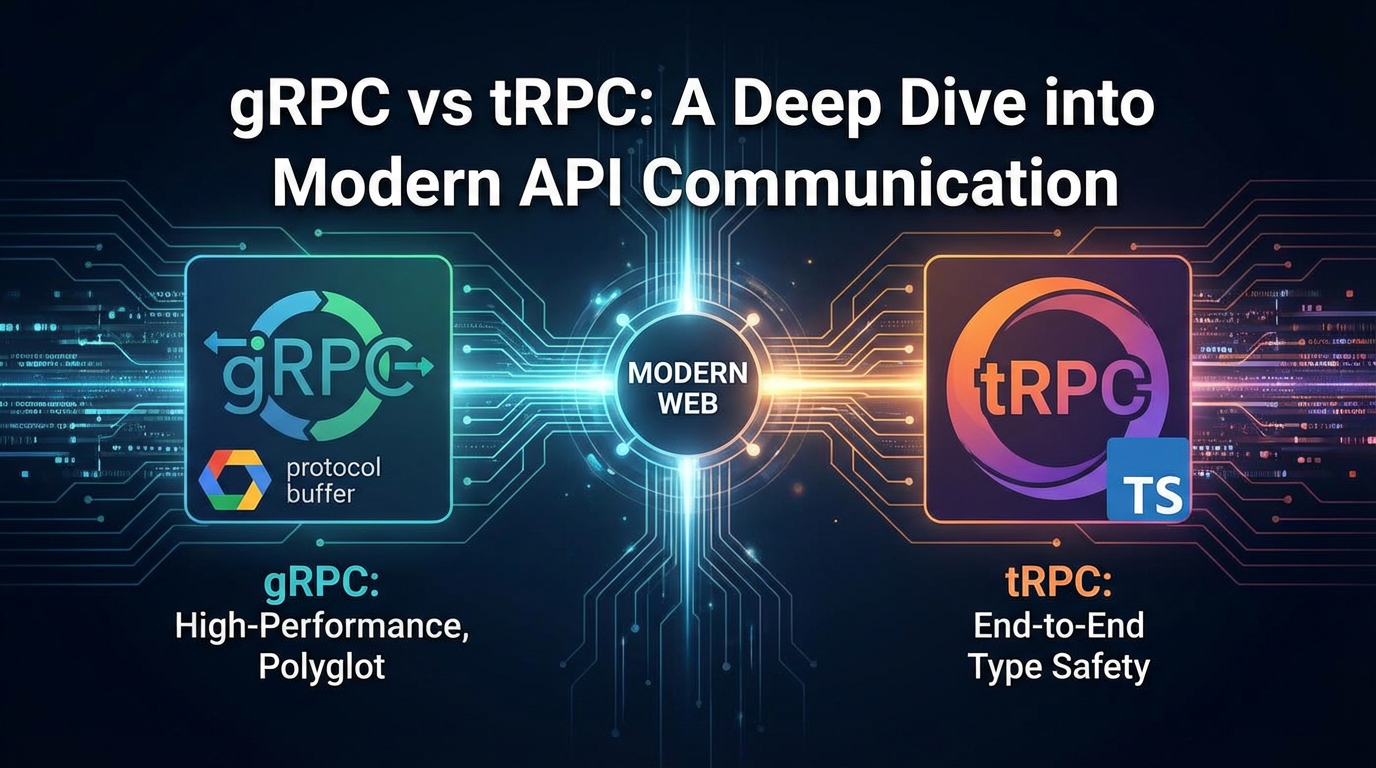
In this dynamic environment, two prominent frameworks have emerged as compelling contenders: gRPC and tRPC. While both aim to improve upon traditional API communication, they do so with distinct philosophies, targeting different problem spaces and developer priorities. gRPC, a powerful and battle-tested Remote Procedure Call (RPC) framework developed by Google, focuses on high-performance, language-agnostic communication, leveraging binary serialization and HTTP/2 for efficiency. It’s a workhorse for inter-service communication in polyglot microservices architectures. In stark contrast, tRPC champions an unparalleled developer experience and end-to-end type safety exclusively within the TypeScript ecosystem, eliminating the need for schema definition files or code generation by leveraging TypeScript's robust inference capabilities. This article will embark on a comprehensive journey, dissecting gRPC and tRPC, exploring their fundamental architectures, elucidating their respective benefits and drawbacks, examining their ideal use cases, and ultimately guiding you in understanding where each fits into a modern API ecosystem, often complementing or being managed by an advanced API gateway.
The Foundations of Modern API Communication
The journey of API communication from its rudimentary beginnings to its current sophisticated state reflects the relentless pursuit of efficiency, reliability, and developer productivity. Understanding this evolution is crucial to appreciating the innovations brought forth by frameworks like gRPC and tRPC.
The API Landscape Evolution: Beyond Traditional REST
For many years, REST (Representational State Transfer) has been the de facto standard for building web APIs. Its principles, rooted in standard HTTP methods, statelessness, and resource-based URLs, offered a clear, human-readable, and easily discoverable approach to service interaction. RESTful APIs gained immense popularity due to their simplicity, widespread tooling support, and alignment with the web's existing infrastructure. Developers could interact with these APIs using standard HTTP clients, and their JSON or XML payloads were easy to inspect and debug.
However, as applications grew in complexity and demands for performance and specific data interactions intensified, the limitations of traditional REST began to surface. One significant challenge was the problem of over-fetching and under-fetching. Clients often received more data than they needed (over-fetching) or had to make multiple requests to gather all necessary information (under-fetching), leading to increased network latency and inefficient resource utilization. Another pain point stemmed from the lack of strong typing and schema enforcement. While OpenAPI (Swagger) specifications attempted to address this, maintaining synchronization between documentation, client code, and server implementations often became a manual and error-prone process. This absence of compile-time guarantees could lead to runtime errors, particularly in rapidly evolving services or when integrating with multiple teams. Furthermore, REST's request-response model was not inherently suited for real-time, streaming, or long-lived connections, necessitating workarounds like WebSockets or server-sent events, which often felt like bolted-on solutions rather than native capabilities. The overhead of text-based JSON serialization, while human-readable, was also less efficient than binary formats for high-volume, low-latency inter-service communication within a microservices architecture. These challenges highlighted a growing need for more specialized and performant API communication paradigms that could address the demands of modern distributed systems.
Why gRPC and tRPC? Addressing Modern Development Challenges
The emergence of gRPC and tRPC represents a direct response to the shortcomings and evolving requirements that REST struggled to meet. They were born out of a necessity to optimize different aspects of the API development and consumption lifecycle.
gRPC, originating from Google's internal RPC infrastructure, was designed with an emphatic focus on raw performance, efficiency, and robustness for inter-service communication. Its core innovation lies in the combination of Protocol Buffers (Protobuf) for compact binary serialization and HTTP/2 for its efficient transport layer. This pairing dramatically reduces payload sizes and leverages multiplexing and header compression, making gRPC exceptionally fast and resource-efficient. It also brings strong schema definition and code generation to the forefront, ensuring that services communicate with precise, type-safe contracts, regardless of the programming language they are written in. This language-agnostic nature is a massive advantage in polyglot microservices environments, where different teams might choose the best language for a specific service, yet still need seamless and performant communication. gRPC also natively supports various streaming patterns, from server-side to bidirectional streaming, opening up possibilities for real-time applications, IoT communication, and long-lived connections that are cumbersome to implement with standard REST. The problems it solves primarily revolve around performance bottlenecks, data efficiency, cross-language interoperability, and the need for robust, contract-first API design in large-scale distributed systems.
tRPC, on the other hand, pivots to solve a different, yet equally pressing problem: the friction and type-safety issues inherent in developing full-stack TypeScript applications. Its radical approach eliminates the traditional "compile-time type safety gap" between the frontend and backend. Instead of defining a separate schema (like Protobuf or GraphQL SDL) and generating types, tRPC leverages TypeScript's powerful inference system to derive API types directly from the backend's TypeScript procedures. This means that when a backend function changes, the frontend automatically receives type errors at compile time, providing an unprecedented level of end-to-end type safety without any manual synchronization or code generation steps. The primary focus of tRPC is on maximizing developer experience and productivity for teams operating exclusively within the TypeScript ecosystem. It addresses the pain points of maintaining type consistency, reducing boilerplate, and eliminating a significant class of runtime errors that often plague full-stack development. It simplifies the mental model of API interaction, making it feel almost like directly calling a function across the network rather than dealing with the complexities of HTTP requests and responses. While not prioritizing raw network performance to the same degree as gRPC, tRPC provides a highly efficient and safe development workflow for specific application architectures.
In essence, gRPC and tRPC are specialized tools, each excelling in distinct domains. gRPC is the workhorse for high-performance, multi-language backends, while tRPC is the artisan's choice for highly productive, type-safe full-stack TypeScript development. Understanding their unique strengths and the problems they are designed to solve is the first step in determining which framework, or combination thereof, is best suited for your project's particular needs.
gRPC: High-Performance, Language-Agnostic RPC
gRPC stands as a testament to Google's expertise in building highly scalable and performant distributed systems. It's not just a framework; it's a comprehensive ecosystem designed to address the challenges of inter-service communication in modern, complex architectures.
What is gRPC?
gRPC, an acronym for gRPC Remote Procedure Call, is an open-source, high-performance RPC framework initially developed by Google. Launched in 2015, it was born out of the need to standardize and optimize the diverse RPC mechanisms used internally at Google for years. At its core, gRPC enables a client application to directly call a method on a server application located on a different machine as if it were a local object, simplifying the creation of distributed applications and services. This abstraction greatly enhances developer productivity by allowing engineers to focus on business logic rather than the intricacies of network communication.
The fundamental principles underpinning gRPC are its reliance on Protocol Buffers for defining service interfaces and message structures, and its use of HTTP/2 as its underlying transport protocol. This combination is crucial for gRPC's promise of efficient, low-latency, and highly scalable communication. Unlike REST, which typically uses text-based JSON over HTTP/1.1, gRPC leverages binary data serialization and a more advanced transport layer to achieve significant performance gains. It's designed from the ground up to support modern distributed computing paradigms, including microservices, where numerous small, independent services need to communicate seamlessly and efficiently. Its emphasis on contract-first API design, enforced by Protocol Buffers, ensures a strong and consistent interface between services, reducing the likelihood of integration issues and making API evolution more manageable.
Key Architectural Components
The robustness and efficiency of gRPC are attributed to its ingenious integration of several key architectural components that work in concert to deliver its high-performance capabilities.
Protocol Buffers (Protobuf)
At the heart of gRPC's data serialization and service definition lies Protocol Buffers, often referred to as Protobuf. This is a language-neutral, platform-neutral, extensible mechanism developed by Google for serializing structured data. Think of Protobuf as a more efficient, binary alternative to JSON or XML. Instead of sending human-readable text, Protobuf serializes data into a compact binary format, significantly reducing payload sizes and parsing overhead.
Developers define their service methods and message structures in .proto files using a simple, intuitive syntax. These .proto files serve as the single source of truth for the API contract. For example, a simple message for a user might look like this:
syntax = "proto3";

package users;

message User {
  string id = 1;
  string name = 2;
  string email = 3;
}

service UserService {
  rpc GetUser (GetUserRequest) returns (User);
  rpc CreateUser (CreateUserRequest) returns (User);
}
From these .proto definitions, gRPC provides code generation tools that automatically generate client and server code in a wide array of programming languages, including Go, Java, Python, C++, C#, Node.js, Ruby, PHP, and more. This generated code includes language-specific data structures (e.g., classes in Java, structs in Go) for your messages and boilerplate code for sending and receiving these messages, as well as service interfaces for both the server to implement and the client to call. This approach ensures strong typing and compile-time checks, meaning that if the API contract changes, any consuming client or implementing server that hasn't updated its generated code will fail at compile time, preventing runtime surprises. The efficiency and compactness of Protobuf make it ideal for high-volume data exchange, especially in environments where network bandwidth and latency are critical considerations. Its extensible nature also allows for backward and forward compatibility, simplifying API evolution without breaking existing clients.
HTTP/2
The second pillar of gRPC's performance is its exclusive use of HTTP/2 as the underlying transport protocol. HTTP/2 is a major revision of the HTTP network protocol, designed to address many of the performance limitations of HTTP/1.1. gRPC capitalizes on several key features of HTTP/2:
- Multiplexing: Unlike HTTP/1.1, which typically requires multiple TCP connections for concurrent requests, HTTP/2 allows multiple concurrent requests and responses to be sent over a single TCP connection. This eliminates head-of-line blocking and reduces connection overhead, making gRPC highly efficient for scenarios with many concurrent API calls. A gRPC client can have multiple pending remote calls to the same gRPC server over a single HTTP/2 connection.
- Header Compression (HPACK): HTTP/2 employs HPACK, an algorithm for compressing HTTP header fields. Since HTTP headers can be repetitive, especially in sequential requests from the same client, HPACK significantly reduces the size of headers, leading to further bandwidth savings. This is particularly beneficial in microservices architectures where numerous small messages are exchanged.
- Server Push: While not as heavily utilized by gRPC itself, HTTP/2's server push feature allows servers to proactively send resources to clients that they anticipate will be needed, further improving perceived performance.
- Binary Framing Layer: HTTP/2 introduces a binary framing layer that breaks down HTTP messages into smaller, independent frames. This makes the protocol more efficient to parse and transmit, further contributing to gRPC's speed advantage over text-based protocols.
By exclusively leveraging HTTP/2, gRPC ensures that communication between services is not only fast but also highly optimized for modern network conditions, making it an excellent choice for demanding, low-latency applications.
RPC Communication Patterns
gRPC is not limited to a simple request-response model. It natively supports four types of service methods, allowing developers to choose the most appropriate communication pattern for their specific needs, ranging from traditional synchronous calls to complex bidirectional streaming.
- Unary RPC: This is the most straightforward and common type, similar to a traditional request-response API call. The client sends a single request message to the server, and the server responds with a single response message. This is suitable for operations like retrieving a single user, creating a new record, or performing a specific calculation.
- Example: A
GetUsercall where the client sends aGetUserRequestand the server replies with aUserobject.
- Example: A
- Server Streaming RPC: In this pattern, the client sends a single request message to the server, but the server responds with a sequence of messages. After sending all its messages, the server sends a final status indicating the completion of the call. This is ideal for scenarios where the server needs to send a stream of data back to the client over an extended period, such as receiving live updates, monitoring data, or large data sets that can be processed incrementally.
- Example: A
StreamWeatherDatacall where the client requests weather data for a region, and the server continuously streams updates as conditions change.
- Example: A
- Client Streaming RPC: Here, the client sends a sequence of messages to the server. After the client has finished sending all its messages, the server responds with a single response message. This pattern is useful for situations where the client needs to send a large amount of data to the server incrementally, such as uploading a file in chunks, sending a log stream, or performing a bulk insertion operation.
- Example: A
UploadFilecall where the client streams chunks of a file to the server, and the server sends a single "upload complete" response.
- Example: A
- Bidirectional Streaming RPC: This is the most flexible and complex pattern. Both the client and the server send a sequence of messages using a read-write stream. These two streams operate independently, meaning the client and server can read and write messages in any order they wish. This is perfect for real-time, interactive communication, such as chat applications, live gaming updates, or real-time analytics dashboards.
- Example: A
ChatRoomservice where multiple clients and the server can send and receive messages in real-time within a chat session.
- Example: A
These diverse communication patterns make gRPC an incredibly versatile tool, capable of handling a wide range of application requirements, from simple data retrieval to complex real-time interactions, all while maintaining its core principles of performance and efficiency.
Advantages of gRPC
gRPC's architectural choices and design principles yield a host of compelling advantages, making it a strong contender for various distributed system scenarios.
- Exceptional Performance: This is arguably gRPC's most touted benefit. By combining Protocol Buffers' efficient binary serialization with HTTP/2's multiplexing, header compression, and binary framing, gRPC significantly reduces bandwidth usage and latency. Payloads are smaller, and network communication is more streamlined compared to verbose text-based formats like JSON over HTTP/1.1. This performance edge is crucial for high-throughput, low-latency microservices communication where every millisecond and byte counts.
- Strong Typing and Code Generation: The contract-first approach with Protocol Buffers enforces strict API schemas. This means that both the client and server must adhere to the defined message structures and service methods. The automatic code generation for multiple languages eliminates manual boilerplate code, reduces the potential for human error, and ensures compile-time type safety. Developers gain instant access to type-safe client stubs and server interfaces, complete with auto-completion and static analysis, which drastically improves developer confidence and reduces debugging time.
- Language Agnostic (Polyglot Environments): gRPC's ability to generate client and server code for a multitude of popular programming languages (Go, Java, Python, C++, Node.js, Ruby, C#, PHP, Dart, etc.) is a monumental advantage for polyglot microservices architectures. Teams can choose the best language for each service without compromising on seamless, high-performance communication. This fosters flexibility and allows organizations to leverage diverse skill sets across their engineering teams.
- Efficient Network Usage: Beyond just payload size, HTTP/2's features like connection multiplexing (multiple concurrent requests over a single TCP connection) and header compression contribute to more efficient utilization of network resources. This translates to fewer open connections, less overhead, and better performance, especially in environments with numerous small services communicating frequently.
- Built-in Features for Distributed Systems: gRPC is designed with distributed systems in mind. It inherently supports features beneficial for such environments, including pluggable authentication, load balancing, health checking, and tracing. While not all features are built directly into the core library, the ecosystem provides robust patterns and integrations to easily implement these crucial aspects of a scalable system.
- Stream Support: The native support for server-streaming, client-streaming, and bidirectional-streaming RPCs is a powerful differentiator. This allows gRPC to elegantly handle use cases that are challenging for traditional REST, such as real-time data feeds, live updates, long-running processes, and interactive chat applications, without resorting to external protocols like WebSockets.
Disadvantages of gRPC
Despite its formidable advantages, gRPC is not without its limitations and considerations that developers must weigh before adopting it.
- Browser Support Challenges: One of the most significant drawbacks of gRPC is its inherent incompatibility with standard web browsers. Browsers do not expose the necessary HTTP/2 control over requests to allow the gRPC client to work directly. This means that for web applications to communicate with gRPC backends, a translation layer, typically a proxy or API gateway like gRPC-Web, is required. This adds an additional component to the architecture, increasing complexity and deployment overhead. While gRPC-Web bridges this gap effectively by translating browser HTTP/1.1 requests into gRPC messages, it's still an extra step compared to direct HTTP/1.1 REST calls.
- Steeper Learning Curve: Compared to the relative simplicity and widespread familiarity of RESTful APIs, gRPC introduces new concepts such as Protocol Buffers,
.protofiles, code generation, and different streaming patterns. Developers accustomed to REST might find the initial setup and understanding of these new paradigms to be more challenging, requiring a dedicated learning investment. Debugging binary payloads can also be more complex than inspecting human-readable JSON. - Tooling Maturity and Ecosystem: While the gRPC ecosystem is robust and maturing rapidly, especially for server-side languages, it might still feel less mature or have fewer readily available tools compared to the vast and diverse ecosystem surrounding REST/HTTP/1.1. Debugging tools, monitoring solutions, and integration with certain legacy systems might require more effort or custom development.
- Human Readability of Payloads: The binary nature of Protocol Buffers, while excellent for machine efficiency, makes the raw network payloads unreadable to humans. This can complicate manual debugging, troubleshooting, and network inspection using standard tools like browser developer consoles or simple
curlcommands. Specialized tools are often needed to decode gRPC messages. - Overkill for Simple Services: For very simple CRUD (Create, Read, Update, Delete) services with low traffic or where performance is not a critical concern, the overhead of setting up Protocol Buffers, code generation, and understanding HTTP/2 complexities might be an unnecessary burden. REST might still be a simpler and quicker solution for such straightforward use cases.
Use Cases for gRPC
Given its unique strengths, gRPC excels in specific architectural contexts and application types.
- Microservices Communication: This is perhaps the most common and ideal use case for gRPC. In a microservices architecture, numerous small, independent services need to communicate with each other efficiently and reliably. gRPC's high performance, strong typing, and language-agnostic nature make it perfect for inter-service communication, ensuring fast, contract-enforced interactions across a heterogeneous technology stack. It streamlines the communication backbone of complex distributed systems.
- Real-time Streaming Services: Applications requiring real-time data updates, continuous data feeds, or long-lived connections can greatly benefit from gRPC's native support for various streaming RPC patterns. Examples include IoT data ingestion pipelines, live dashboards, real-time gaming services, chat applications, and financial trading platforms where low-latency, continuous data flow is paramount.
- Inter-service Communication in High-Performance Systems: Any system where raw speed and efficiency are critical, such as ad-tech platforms, large-scale data processing pipelines, or high-frequency trading applications, can leverage gRPC to minimize communication overhead and maximize throughput. Its binary serialization and HTTP/2 transport are tailor-made for these demanding environments.
- Multi-language Environments: Organizations that operate with diverse programming languages across their backend services—for instance, some services in Go for performance, others in Python for machine learning, and others in Node.js for event handling—will find gRPC's language-agnostic code generation invaluable. It allows teams to pick the best tool for the job without creating integration headaches.
- Mobile App Backends: For mobile applications, where network bandwidth can be limited and latency is a concern, gRPC offers a more efficient communication protocol compared to traditional REST. Smaller payloads and faster communication can lead to a more responsive user experience and reduced data consumption for users.
In these scenarios, gRPC provides a robust, performant, and maintainable foundation for building modern, scalable applications.
tRPC: End-to-End Type Safety for TypeScript
While gRPC focuses on raw performance and polyglot communication, tRPC carves out its niche by prioritizing developer experience and ironclad type safety within the increasingly popular TypeScript ecosystem. It offers a paradigm shift for full-stack TypeScript developers, making API interactions feel more like local function calls.
What is tRPC?
tRPC, which stands for "TypeScript Remote Procedure Call," is a lightweight framework designed to help developers build end-to-end type-safe APIs with TypeScript, without the need for schema definition languages or code generation. Created by Alex Johansson, tRPC rapidly gained traction within the TypeScript community due to its innovative approach to solving a long-standing pain point in full-stack development: keeping frontend and backend types in sync.
The core philosophy of tRPC is elegantly simple yet profoundly impactful: leverage TypeScript's powerful inference system to infer API types directly from the backend procedures. This means developers write their backend APIs as standard TypeScript functions, and tRPC automatically infers the types for the input and output of these functions. On the client side, using the tRPC client library, developers can then "call" these backend procedures with full auto-completion, type-checking, and refactoring safety, as if they were local functions. There are no .proto files, no .graphql schemas, no swagger.json files, and no separate code generation steps. The TypeScript type system itself becomes the single source of truth for the API contract.
This approach dramatically reduces boilerplate, eliminates a whole class of runtime errors related to mismatched types between the client and server, and significantly accelerates development cycles. It's particularly well-suited for full-stack TypeScript monorepos, where the client and server codebases reside within the same project and can share type definitions effortlessly. While gRPC is designed for broad interoperability and maximum network efficiency, tRPC is laser-focused on providing the best possible developer experience for TypeScript developers, ensuring that API interactions are as seamless and error-free as possible. It generally operates over standard HTTP/1.1 or HTTP/2, using JSON for data serialization, which means it retains compatibility with web browsers out-of-the-box without requiring proxies.
Key Architectural Components & Philosophy
tRPC's architecture is minimalist and revolves around a single, powerful idea: type inference. Understanding this core principle is key to grasping how tRPC delivers its unique benefits.
TypeScript Inference: The Magic Behind the Scenes
The cornerstone of tRPC is its reliance on TypeScript's advanced type inference capabilities. Instead of a separate schema definition language (like Protobuf for gRPC or SDL for GraphQL), tRPC directly uses the types defined in your backend TypeScript code to create a type-safe API.
Here’s how it fundamentally works:
- Backend Procedure Definition: On the server, you define your API "procedures" as simple TypeScript functions. These functions take an input and return an output. tRPC provides utilities to wrap these functions, allowing them to be exposed as API endpoints. For instance:```typescript // server/trpc.ts import { initTRPC } from '@trpc/server'; import { z } from 'zod'; // For input validationconst t = initTRPC.create();const appRouter = t.router({ getUser: t.procedure .input(z.string()) // Input type: string (user ID) .query(({ input }) => { // Logic to fetch user by ID return { id: input, name: 'John Doe', email: 'john@example.com' }; }), createUser: t.procedure .input(z.object({ name: z.string(), email: z.string().email() })) // Input type: object .mutation(({ input }) => { // Logic to create a user return { id: 'new-id', ...input }; }), });export type AppRouter = typeof appRouter; ```
- Type Derivation: tRPC introspects the
appRouterobject and, using TypeScript'stypeofand inference utilities, creates a complete type definition for your entire API. This definition encapsulates all procedure names, their input types, and their output types. This happens implicitly; you don't write this type definition manually. - Client-Side Type Safety: On the client, you import this generated type definition (e.g.,
AppRouter) and use it to initialize the tRPC client. The client then becomes "aware" of all your backend procedures and their exact types. When you call a backend procedure from the client, TypeScript provides immediate feedback:- Auto-completion: As you type
trpc.getUser.query(...), your IDE will suggest thequerymethod and show you the expected input type (e.g.,string). - Type Checking: If you pass an incorrect type (e.g., a number instead of a string for
getUser's input), TypeScript will flag a compile-time error. - Refactoring Safety: If you change an input parameter or return type on the server, the client will immediately show type errors wherever that procedure is called, ensuring that your client code is always in sync with your API contract.
- Auto-completion: As you type
This entire process bypasses the need for intermediary schema files or separate code generation steps, leading to an incredibly fluid and safe development experience. The zod library (or similar validation libraries) is commonly used with tRPC to define runtime input validation, which then also informs the TypeScript types, creating a harmonious ecosystem.
RPC-like Communication
While tRPC leverages standard HTTP (usually JSON over HTTP/1.1 by default), its communication pattern feels distinctly RPC-like. The client-side API calls directly mirror the server-side function definitions. For instance, if you have a getUser procedure on the server, your client code might look like:
// client/index.ts
import { createTRPCClient, httpBatchLink } from '@trpc/client';
import type { AppRouter } from '../server/trpc'; // Shared type definition

const trpc = createTRPCClient<AppRouter>({
  links: [
    httpBatchLink({
      url: 'http://localhost:3000/api/trpc',
    }),
  ],
});

async function main() {
  try {
    const user = await trpc.getUser.query('123'); // Fully type-safe call
    console.log(user.name);

    // This would cause a compile-time error if 'name' was missing
    // const newUser = await trpc.createUser.mutation({ email: 'test@example.com' });
    const newUser = await trpc.createUser.mutation({ name: 'Jane Doe', email: 'jane@example.com' });
    console.log(newUser.id);
  } catch (error) {
    console.error(error);
  }
}

main();
Under the hood, tRPC converts these "function calls" into standard HTTP GET (for queries) or POST (for mutations) requests, serializing inputs to JSON and deserializing responses. It also supports request batching, where multiple tRPC calls made in rapid succession are bundled into a single HTTP request, reducing network overhead. The beauty is that as a developer, you rarely need to think about the HTTP details; you interact with a purely type-safe TypeScript API.
Focus on Monorepos/Full-stack TypeScript
tRPC's design naturally lends itself to full-stack TypeScript applications, particularly those organized as monorepos. In a monorepo, the client (e.g., a React or Next.js app) and the server (e.g., an Express or Fastify app) share a common package or directory for shared types. This shared type definition (e.g., AppRouter in the example above) is what enables the seamless end-to-end type safety.
While it is possible to use tRPC with separate client and server repositories by publishing the AppRouter type definition, it's undeniably at its most powerful and convenient within a monorepo structure. This setup allows for instant feedback loops during development, where a change to a backend procedure's signature immediately reflects as a type error in the client, allowing for rapid and safe refactoring across the entire application stack. This tight coupling of types is a deliberate design choice that maximizes developer velocity and minimizes integration headaches for teams committed to a TypeScript-first approach.
Advantages of tRPC
tRPC offers a compelling suite of benefits, particularly for teams immersed in the TypeScript ecosystem.
- Unmatched Developer Experience (DX) for TypeScript Users: This is tRPC's paramount strength. For full-stack TypeScript developers, tRPC makes API interaction feel incredibly intuitive and natural. The ability to call backend functions with full auto-completion, intelligent type suggestions, and immediate compile-time feedback directly within the IDE is a game-changer. It eliminates the cognitive overhead of constantly referring to API documentation, manually synchronizing types, or dealing with API request/response mapping. This significantly streamlines the development workflow and makes building features faster and more enjoyable.
- True End-to-End Type Safety (Zero Runtime Type Errors): By deriving types directly from your backend code, tRPC guarantees that your client-side API calls will always match the server's expectations. Any mismatch in input, output, or even procedure names will result in a compile-time error, preventing a vast category of runtime bugs that plague traditional APIs. This leads to much more robust and reliable applications, reducing the time spent debugging type-related issues.
- No Code Generation or Schema Files: Unlike gRPC or GraphQL, tRPC requires no separate schema definition files (like
.protoor.graphqlSDL) and no code generation step to keep types in sync. The TypeScript type system handles all the heavy lifting. This drastically reduces boilerplate, simplifies the project structure, and removes an entire layer of tooling and configuration complexity from the development process. Developers can iterate faster without waiting for code generation steps. - Fast Development Cycles: The combination of superior DX, end-to-end type safety, and minimal boilerplate contributes to significantly faster development cycles. Developers can implement features more rapidly, confident that their API interactions are correctly typed and validated. Refactoring backend APIs becomes a safe operation, as any impact on the frontend is immediately highlighted by the TypeScript compiler.
- Minimal Overhead (Lean Library): tRPC itself is a very lean library. It doesn't introduce a complex runtime or heavy dependencies. It integrates smoothly with existing web frameworks like Next.js, Express, and Fastify, and often uses standard
fetchAPIs under the hood for communication. This keeps the application bundle size small and avoids unnecessary complexity. - Excellent for Full-Stack TypeScript Monorepos: tRPC shines brightest in a monorepo setup where the frontend and backend share type definitions. This setup unlocks the full potential of end-to-end type safety and seamless development, making it an ideal choice for building cohesive, high-productivity full-stack TypeScript applications.
Disadvantages of tRPC
While tRPC offers compelling advantages, it also comes with specific limitations that dictate its suitability for certain projects.
- TypeScript-Only: This is the most significant constraint. tRPC is inextricably tied to TypeScript for both the client and server. If your backend services are written in multiple languages (e.g., Go, Python, Java alongside Node.js/TypeScript), tRPC is not a viable solution for inter-service communication. It requires the shared type inference across the entire stack.
- Not Language Agnostic: Following from the above, tRPC is explicitly not designed for polyglot environments. If you need to expose APIs to clients written in different languages or integrate with services that are not TypeScript-based, tRPC would require a separate, language-agnostic API layer (like REST or gRPC) on top, or some form of manual adaptation, which defeats its primary purpose. It's less suitable for broad public API exposure where consumers are unknown.
- Less Mature Ecosystem/Community (Compared to gRPC/REST/GraphQL): As a relatively newer framework, tRPC's ecosystem, community, and tooling are still growing. While rapidly expanding, it may not have the same breadth of established libraries, extensive documentation, or a massive community presence as more mature API paradigms like REST, gRPC, or GraphQL. This could mean fewer readily available solutions for niche problems or a smaller pool of developers familiar with the technology.
- Primarily HTTP/1.1 Based (JSON Payloads): By default, tRPC uses standard HTTP/1.1 and JSON for serialization. While this offers excellent browser compatibility and human readability, it means tRPC does not inherently offer the same raw performance benefits (e.g., binary serialization, HTTP/2 multiplexing) that gRPC does for highly optimized, high-throughput scenarios. While tRPC can technically run over HTTP/2, its primary advantage isn't in network efficiency but in developer experience.
- Not Designed for Public APIs: tRPC's tight coupling with TypeScript types makes it less suitable for exposing public APIs where consumers are external and may use any programming language. It excels in controlled environments, typically within a single organization or a full-stack application where the client and server are developed by the same team and share a common type system. For a public-facing API, REST or GraphQL are generally more appropriate choices due to their language neutrality and broad tooling.
Use Cases for tRPC
Given its specific strengths and constraints, tRPC is an exceptional fit for particular types of projects and development philosophies.
- Full-stack TypeScript Applications (Next.js, React, Vue): This is the quintessential use case for tRPC. When building modern web applications with a TypeScript frontend (e.g., React, Next.js, Vue) and a TypeScript backend (e.g., Node.js with Express/Fastify), tRPC provides an unparalleled development experience. It allows for seamless data fetching and mutation with complete type safety across the entire stack.
- Internal APIs within a Monorepo: For organizations that structure their applications as monorepos, where multiple services and client applications coexist within a single repository, tRPC is an excellent choice for internal API communication. The shared type definitions within the monorepo make tRPC's end-to-end type safety extremely powerful for managing internal service contracts safely and efficiently.
- Rapid Prototyping where Type Safety is Paramount: When the primary goal is to quickly build a robust web application with high confidence in the API interactions, tRPC accelerates development. Its minimal setup, lack of schema management, and instant type safety checks enable developers to iterate rapidly without sacrificing reliability.
- Teams Committed to a TypeScript-First Approach: For development teams deeply invested in the TypeScript ecosystem and prioritizing a superior developer experience, tRPC aligns perfectly with their philosophy. It leverages the strengths of TypeScript to its fullest, transforming API development into an almost enjoyable task.
In summary, tRPC is the ideal solution for developers who are building full-stack applications purely within the TypeScript ecosystem and want to maximize productivity, eliminate a class of runtime errors, and enjoy a truly type-safe development workflow.
APIPark is a high-performance AI gateway that allows you to securely access the most comprehensive LLM APIs globally on the APIPark platform, including OpenAI, Anthropic, Mistral, Llama2, Google Gemini, and more.Try APIPark now! 👇👇👇
gRPC vs tRPC: A Comprehensive Comparison
Having delved into the individual characteristics of gRPC and tRPC, it's time to place them side-by-side for a direct comparison. Understanding their differences across various dimensions is crucial for making an informed decision about which framework best suits a particular project.
Core Philosophy and Design Goals
The fundamental divergence between gRPC and tRPC lies in their core design philosophies and the primary problems they set out to solve.
gRPC was engineered with an unwavering focus on performance, efficiency, and broad interoperability in distributed systems. Its design prioritizes minimizing network overhead, maximizing throughput, and providing a robust mechanism for inter-service communication across diverse programming languages. It's a "contract-first" approach, where a strict schema (Protobuf) dictates the API, ensuring that all parties adhere to a precise agreement. This makes gRPC an ideal choice for building the high-speed communication backbone of complex microservices architectures, where heterogeneity of services is common and raw speed is a critical requirement. Its goal is to make remote procedure calls feel as performant and reliable as local ones, regardless of the underlying language.
tRPC, conversely, is driven by the goal of achieving an unparalleled developer experience and end-to-end type safety exclusively within the TypeScript ecosystem. Its philosophy revolves around leveraging TypeScript's inference capabilities to eliminate the traditional "type gap" between frontend and backend. It's a "code-first" approach, where the API contract is implicitly derived from the actual TypeScript code. tRPC aims to make API development as seamless and error-free as possible for full-stack TypeScript developers, treating remote API calls almost like direct function invocations. Its primary concern is developer velocity and confidence, ensuring that type mismatches are caught at compile-time rather than becoming insidious runtime bugs.
Performance
When it comes to raw performance, gRPC generally holds a significant advantage. This superiority stems from several key architectural choices: * Binary Serialization: gRPC uses Protocol Buffers, which serialize data into a compact binary format. This results in significantly smaller payloads compared to tRPC's default JSON (text-based) serialization. Smaller payloads mean less data transmitted over the network and faster serialization/deserialization times. * HTTP/2 Transport: gRPC mandates HTTP/2, which offers features like multiplexing (multiple requests over a single TCP connection), header compression (HPACK), and binary framing. These features dramatically improve network efficiency, reduce latency, and enable features like streaming that are highly optimized. * Streaming Capabilities: gRPC's native support for server, client, and bidirectional streaming is highly optimized for performance, allowing for continuous, low-latency data flow.
tRPC, while efficient for most web applications, is less optimized for raw speed and network efficiency than gRPC. * JSON Serialization: tRPC primarily uses JSON for data serialization, which is human-readable but more verbose and less compact than Protobuf's binary format. * HTTP/1.1 (by default): While tRPC can operate over HTTP/2, it typically relies on standard fetch APIs, which often default to HTTP/1.1. This means it doesn't inherently benefit from HTTP/2's multiplexing and header compression unless specifically configured or proxied. However, its request batching feature can help mitigate some HTTP/1.1 overhead by bundling multiple calls into one request.
For typical web APIs, tRPC's performance is usually "good enough" and rarely a bottleneck, especially given the developer experience benefits. However, for high-throughput, low-latency microservices, IoT, or real-time streaming where every byte and millisecond matters, gRPC's performance advantages are clear.
Type Safety
Both frameworks emphasize type safety, but they achieve it through different mechanisms and offer varying degrees of "end-to-end" coverage based on their ecosystems.
gRPC provides strong, compile-time type safety through its Protocol Buffers schema. The .proto files define a precise contract, and the generated code (in various languages) ensures that messages and service calls adhere to this contract. If the schema changes, regenerating the code will expose type errors in any consuming client or implementing server that hasn't adapted. This provides robust type safety across potentially polyglot environments.
tRPC offers unparalleled end-to-end type safety for the TypeScript ecosystem. Its unique strength is that it infers the API contract directly from the backend TypeScript code, eliminating any manual synchronization or separate schema definitions. This means that type errors are caught at compile-time across the entire stack (from client to server) without any intermediate steps. Developers get instant feedback, auto-completion, and refactoring safety, significantly reducing runtime type-related bugs. This is a level of seamless type safety that is hard to match in multi-language environments or with other API paradigms.
Language Support
This is a stark differentiator between the two.
gRPC is fundamentally language agnostic. Its Protocol Buffers definition and code generation tools support a vast array of popular programming languages, including Go, Java, Python, C++, C#, Node.js, Ruby, PHP, and many more. This makes it an excellent choice for polyglot microservices architectures where different services might be written in different languages, but all need to communicate efficiently and reliably using a consistent protocol.
tRPC is TypeScript-only. Its entire premise hinges on leveraging TypeScript's inference system, meaning both the client and the server must be written in TypeScript (or at least have their API definitions exposed as TypeScript types). This makes it unsuitable for environments where services are implemented in a mix of different programming languages. It thrives where the entire stack, or at least the relevant client-server parts, are consistently TypeScript.
Ecosystem and Maturity
gRPC is a highly mature, industry-standard framework with years of battle-testing by Google and widespread adoption across numerous enterprises. Its ecosystem is robust, with extensive documentation, a large community, and integrations with various cloud services, monitoring tools, and service meshes. Google's backing ensures ongoing development and long-term support.
tRPC is a newer framework, though it is rapidly growing in popularity, especially within the Next.js and full-stack TypeScript communities. Its ecosystem is maturing quickly, with a vibrant community and increasing adoption. However, it still has a smaller footprint and fewer established integrations compared to gRPC or other long-standing API paradigms. This means there might be fewer pre-built solutions for complex enterprise requirements, and the community support, while enthusiastic, may not be as broad or deep as gRPC's.
Use Cases
| Feature | gRPC | tRPC |
|---|---|---|
| Primary Goal | High performance, polyglot RPC, efficient data. | End-to-end type safety, superior DX for TypeScript. |
| Communication Style | RPC (Procedure calls) | RPC-like (function calls) over HTTP. |
| Data Serialization | Protocol Buffers (binary) | JSON (text-based) |
| Transport Layer | HTTP/2 (mandatory) | HTTP/1.1 or HTTP/2 (flexible, usually default fetch API) |
| Type Definition | .proto files, code generation |
TypeScript inference, no separate schema files |
| Language Support | Many languages (Go, Java, Python, C#, Node.js, etc.) | TypeScript (both client and server) |
| Performance | Excellent (binary, HTTP/2, streaming) | Good for typical web apps, less optimized than gRPC |
| Developer Experience | Good with generated types, but setup overhead. | Exceptional for TypeScript developers (zero-config type safety). |
| Browser Support | Requires gRPC-Web gateway/proxy. | Native browser support (standard HTTP calls). |
| Maturity | High, industry-standard. | Medium, rapidly growing. |
| Best For | Microservices, high-throughput systems, polyglot environments, streaming. | Full-stack TypeScript monorepos, internal APIs, rapid web app development. |
The Role of an API Gateway in Modern Architectures
Regardless of whether you choose gRPC, tRPC, REST, or GraphQL for your API communication, a robust API gateway often plays a pivotal role in managing the complexity, security, and scalability of modern distributed architectures. It acts as a single entry point for all client requests, providing a crucial layer of abstraction and control between external consumers and internal services.
Why an API Gateway is Essential
In today's intricate microservices landscapes, direct client-to-service communication can quickly become unmanageable. Clients would need to know the addresses of numerous backend services, handle different communication protocols, and implement cross-cutting concerns (like authentication) for each service. An API gateway resolves these challenges by centralizing these concerns:
- Centralized Entry Point: It provides a unified façade for all backend services, simplifying client interactions. Clients only need to know the gateway's address, and the gateway intelligently routes requests to the appropriate backend service.
- Decoupling Clients from Backend Services: The gateway acts as an abstraction layer, shielding clients from the complexity and potential instability of the backend microservices. Backend service changes (e.g., service discovery, refactoring, versioning) do not directly impact clients.
- Cross-Cutting Concerns: An API gateway is the ideal place to implement common, cross-cutting concerns that apply to multiple services. This prevents duplication of logic in individual services, making them leaner and more focused on business logic. These concerns include:
- Authentication and Authorization: Verifying client identity and permissions before forwarding requests.
- Rate Limiting: Protecting backend services from abuse or overload by controlling the number of requests clients can make.
- Logging and Monitoring: Centralizing request logging and providing metrics for API performance and usage.
- Caching: Storing responses to reduce the load on backend services and improve response times for frequently requested data.
- Routing and Load Balancing: Directing requests to specific service instances and distributing traffic evenly.
- Request/Response Transformation: Modifying request or response payloads to suit client needs or normalize data formats.
- Protocol Translation: Bridging different communication protocols (e.g., REST to gRPC).
- Circuit Breaking: Preventing cascading failures in a distributed system by stopping requests to failing services.
- Managing Diverse API Protocols: In a polyglot environment where different services might use REST, gRPC, or even tRPC, an API gateway can act as a universal translator or router, allowing clients to interact through a consistent interface while the backend uses its preferred protocol.
API Gateway with gRPC
The combination of gRPC and an API gateway is particularly powerful and often necessary, especially when exposing gRPC services to external clients like web browsers.
- Browser Compatibility (gRPC-Web): As discussed, standard web browsers cannot directly consume gRPC APIs due to their reliance on HTTP/2's advanced features. An API gateway can serve as a gRPC-Web proxy, translating incoming HTTP/1.1 requests from browsers into gRPC calls and vice-versa. This allows web clients to interact with high-performance gRPC backends seamlessly.
- Authentication and Authorization: The API gateway can handle initial authentication and authorization checks before forwarding requests to gRPC services. This offloads security concerns from individual gRPC services, allowing them to focus purely on their business logic.
- Load Balancing and Traffic Management: For a cluster of gRPC services, the gateway can distribute incoming traffic efficiently, monitor service health, and perform sophisticated routing based on various criteria.
- Monitoring and Observability: Centralized logging, tracing, and metrics collection at the gateway level provide a comprehensive view of gRPC API usage and performance, aiding in troubleshooting and capacity planning.
- API Versioning: The gateway can help manage different versions of gRPC APIs, directing clients to the appropriate service version without them needing to be aware of the underlying changes.
API Gateway with tRPC
While tRPC is often used for internal, direct client-server communication within a full-stack TypeScript application, an API gateway can still play a valuable role in certain scenarios:
- Exposing Internal tRPC Services to External Clients: If a subset of functionality provided by a tRPC-powered internal service needs to be exposed to external clients (e.g., third-party developers, mobile apps not using TypeScript), the API gateway can act as a translation layer, exposing these as standard REST or GraphQL APIs. The gateway would handle the necessary protocol and data transformations.
- Security and Rate Limiting for Exposed APIs: Even if tRPC services are primarily internal, if they are exposed in any form, the gateway can enforce security policies, apply rate limits, and manage access permissions to prevent unauthorized usage or abuse.
- Unified Monitoring and Analytics: In an organization using various API technologies, including tRPC for internal web applications, a central API gateway provides a unified point for collecting logs, metrics, and analytics across all API traffic, offering a holistic view of the system's performance and usage.
In complex enterprise environments, especially those dealing with diverse API protocols and demanding API management features, a robust API gateway becomes indispensable. Platforms like ApiPark offer comprehensive solutions. APIPark, as an open-source AI gateway and API management platform, is designed to streamline the management, integration, and deployment of both AI and REST services. It boasts features such as quick integration of 100+ AI models, unified API formats, end-to-end API lifecycle management, and performance rivaling Nginx. For organizations looking to manage a multitude of APIs, including potential interfaces to gRPC or even proxying certain tRPC endpoints, an advanced API gateway like APIPark can provide the necessary governance, security, and scalability. Its ability to handle diverse API needs and provide detailed logging and analytics makes it a critical component in a modern API infrastructure, ensuring that communication, regardless of its underlying protocol, is secure, performant, and well-managed.
The Future of API Gateways
The evolution of API gateways continues at a rapid pace. As architectures become even more distributed and intelligent, so too do the demands on the gateway. We are seeing the rise of:
- Intelligent Gateways and AI Gateways: Gateways that leverage AI and machine learning for advanced traffic routing, anomaly detection, predictive scaling, and intelligent threat protection. APIPark, for instance, highlights its capabilities as an AI gateway, indicating a clear trend towards integrating AI-specific management and optimization features directly into the gateway layer.
- Service Mesh Integration: For internal service-to-service communication, service meshes like Istio or Linkerd provide granular control, observability, and traffic management. While they can seem to overlap with API gateways, they often complement each other, with the gateway handling north-south (external-to-internal) traffic and the service mesh managing east-west (internal-to-internal) traffic.
- Hybrid Approaches: Organizations are increasingly adopting hybrid API strategies, using different protocols for different use cases and environments. The API gateway acts as the crucial glue, harmonizing these disparate approaches and providing a consistent developer experience for consumers.
The role of an API gateway will only grow in importance, evolving to meet the complex demands of future API ecosystems, ensuring efficiency, security, and scalability across all forms of communication.
Choosing the Right Tool for Your Project
The decision between gRPC and tRPC, or indeed any API communication framework, is rarely a simple one-size-fits-all answer. It fundamentally depends on a project's specific requirements, the existing technology stack, team expertise, and long-term strategic goals. Both gRPC and tRPC are powerful tools, but they excel in different domains and address distinct sets of challenges.
When to Choose gRPC
gRPC is an outstanding choice when your project's priorities align with high performance, cross-language interoperability, and robust, contract-first API design.
- High-Performance Microservices Communication: If you are building a microservices architecture where services need to communicate with minimal latency and maximum throughput, gRPC's binary serialization (Protocol Buffers) and efficient HTTP/2 transport make it an ideal backbone. It's designed to optimize inter-service communication where raw speed is paramount.
- Polyglot Environments (Multiple Programming Languages): For organizations with diverse technology stacks, where different microservices are written in various languages (e.g., Go, Java, Python, Node.js), gRPC provides a seamless, language-agnostic communication mechanism. Its code generation ensures type-safe interactions across all supported languages, fostering flexibility without sacrificing consistency.
- Real-time Streaming Requirements (IoT, Chat): Applications that demand real-time data flow, continuous updates, or long-lived connections will benefit immensely from gRPC's native support for server, client, and bidirectional streaming RPCs. This is crucial for IoT devices, live dashboards, gaming, and chat applications that require persistent, low-latency communication channels.
- Mobile App Backends where Bandwidth and Latency are Critical: For mobile applications, optimizing network usage is vital. gRPC's smaller binary payloads and efficient transport can lead to faster app responsiveness, reduced data consumption, and a better user experience, especially in areas with limited bandwidth.
- Need for Strict Schema Enforcement: When a strong, explicit API contract is essential—for instance, to ensure backward compatibility, manage complex data structures, or facilitate clear communication between independent teams—gRPC's Protocol Buffers provide a rigorous schema definition and enforcement mechanism.
When to Choose tRPC
tRPC is the definitive choice for projects that prioritize an exceptional developer experience and bulletproof end-to-end type safety within the TypeScript ecosystem.
- Full-Stack TypeScript Applications (Monorepos): This is tRPC's sweet spot. If you are developing a modern web application with a TypeScript frontend (e.g., Next.js, React, Vue) and a TypeScript backend, especially within a monorepo, tRPC delivers an unparalleled development workflow. It eliminates the friction of API interaction, making it feel like calling local functions.
- Prioritizing Developer Experience and End-to-End Type Safety Above All Else: If your team values developer productivity, fast iteration cycles, and catching API-related type errors at compile-time (rather than runtime) more than raw network performance or language agnosticism, tRPC is an clear winner. It significantly boosts developer confidence and reduces debugging time.
- Internal APIs where Client and Server Share Type Definitions: For internal services or modules within a single organization where the client and server teams both use TypeScript and can share type definitions easily, tRPC provides a highly efficient and safe way to manage API contracts without external schema languages.
- Rapid Development of Web Applications: When the goal is to quickly prototype and build robust web applications, tRPC's minimal setup, lack of schema management, and instant type safety checks enable developers to iterate at high velocity without sacrificing reliability.
Hybrid Approaches
It's also important to recognize that gRPC and tRPC are not mutually exclusive. In fact, many complex architectures can benefit from a hybrid approach, leveraging the strengths of each framework for different layers of communication.
For example, an organization might use: * gRPC for internal microservices communication: To ensure high performance, efficiency, and language interoperability between their backend services. * tRPC for frontend-to-backend communication in specific TypeScript-based web applications: To provide an excellent developer experience and end-to-end type safety for their web development teams. * RESTful APIs (possibly managed by an API gateway): To expose public-facing APIs to external partners or mobile clients who might not use gRPC or TypeScript.
An API gateway becomes indispensable in such hybrid scenarios. It acts as the central orchestrator, translating between different protocols, applying security policies, and routing requests to the appropriate backend services, regardless of their underlying communication framework. This intelligent gateway layer ensures that the entire API ecosystem functions harmoniously, enabling developers to choose the best tool for each specific job without creating silos or insurmountable integration challenges. The decision, ultimately, is about understanding your unique requirements and strategically deploying the tools that best address them, often in a complementary fashion.
Conclusion
The evolution of API communication is a continuous journey driven by the relentless pursuit of efficiency, reliability, and an improved developer experience. In this dynamic landscape, gRPC and tRPC stand out as two formidable contenders, each offering distinct advantages tailored to specific architectural needs and development philosophies.
gRPC, forged in the crucible of Google's massive distributed systems, is the epitome of high-performance, language-agnostic Remote Procedure Call. Its reliance on compact Protocol Buffers and the advanced features of HTTP/2 delivers unparalleled speed, efficiency, and robustness for inter-service communication. With native support for diverse streaming patterns and strong, contract-first type safety across a multitude of programming languages, gRPC is the workhorse for demanding microservices architectures, real-time applications, and polyglot environments where every byte and millisecond counts. However, its steeper learning curve and browser compatibility challenges necessitate additional tooling or an API gateway for web-facing applications.
In contrast, tRPC represents a paradigm shift for full-stack TypeScript development, focusing intensely on developer productivity and an unmatched end-to-end type-safe experience. By cleverly leveraging TypeScript's inference system, tRPC eliminates the need for separate schema definitions or code generation, making API interactions feel like calling local functions with full compile-time safety and auto-completion. While it doesn't aim for the raw network performance of gRPC and is confined to the TypeScript ecosystem, its ability to virtually eliminate a class of runtime type errors and significantly accelerate development cycles makes it an exceptional choice for full-stack TypeScript monorepos and internal APIs.
The choice between gRPC and tRPC is not about one being inherently "better" than the other; rather, it's about selecting the right tool for the right job. Your decision should be guided by a clear understanding of your project's specific requirements: * Do you prioritize maximum performance, efficiency, and multi-language support for complex microservices or real-time streaming? Choose gRPC. * Are you building a full-stack application purely within the TypeScript ecosystem, prioritizing developer experience, rapid iteration, and guaranteed compile-time type safety above all else? Choose tRPC.
Furthermore, it's crucial to acknowledge the indispensable role of an API gateway in managing the intricacies of modern API ecosystems. Whether you're bridging gRPC services to web clients, centralizing security for diverse APIs, or orchestrating a hybrid architecture, an advanced API gateway provides the essential layer for governance, security, observability, and scalability. Platforms like ApiPark exemplify how a comprehensive API gateway and management platform can harmonize disparate API protocols and provide critical features like AI model integration, lifecycle management, and robust analytics, ensuring that your API infrastructure is resilient and future-proof.
The future of API communication will likely see continued innovation and a trend towards specialized solutions addressing specific challenges. By carefully evaluating the strengths and weaknesses of gRPC and tRPC, and understanding how they integrate within a broader API management strategy often facilitated by a powerful API gateway, developers can architect systems that are not only performant and scalable but also a joy to build and maintain.
Frequently Asked Questions (FAQs)
1. What is the primary difference between gRPC and tRPC?
The primary difference lies in their core focus: gRPC prioritizes high performance, language agnosticism, and efficient communication using binary serialization (Protocol Buffers) and HTTP/2 for distributed systems across various languages. tRPC, conversely, focuses on providing an unparalleled developer experience and end-to-end type safety exclusively within the TypeScript ecosystem, inferring API types directly from code without separate schema files or code generation.
2. When should I choose gRPC over tRPC, or vice versa?
Choose gRPC for high-performance microservices, polyglot environments, real-time streaming, and mobile backends where efficiency and multi-language support are critical. Choose tRPC for full-stack TypeScript applications, especially in monorepos, where maximizing developer experience, rapid iteration, and compile-time type safety are the highest priorities, and your entire stack is TypeScript-based.
3. Can gRPC and tRPC be used together in the same project?
Yes, they can be used in a hybrid approach. For example, gRPC can be used for internal, high-performance inter-service communication between backend microservices (which might be in different languages), while tRPC could be used for the frontend-to-backend communication within a specific full-stack TypeScript web application. An API gateway would typically help bridge and manage these different communication protocols.
4. Does tRPC offer the same performance as gRPC?
Generally, no. gRPC typically offers superior raw performance due to its binary serialization (Protocol Buffers) and exclusive use of HTTP/2's advanced features like multiplexing and header compression. tRPC primarily uses JSON over HTTP/1.1 (though it can leverage HTTP/2), which is less efficient for raw data transfer. However, tRPC's performance is usually more than adequate for typical web APIs, and its developer experience benefits often outweigh the minor performance difference for its specific use cases.
5. What role does an API gateway play with gRPC and tRPC?
An API gateway is essential for managing, securing, and scaling APIs regardless of the underlying protocol. For gRPC, it's crucial for browser compatibility (e.g., gRPC-Web proxies), authentication, and load balancing. For tRPC, while often direct, a gateway can expose internal tRPC services to external, non-TypeScript clients, provide centralized security (rate limiting, authentication), and offer unified monitoring and analytics across all your APIs, acting as a critical control point for your entire API ecosystem.
🚀You can securely and efficiently call the OpenAI API on APIPark in just two steps:
Step 1: Deploy the APIPark AI gateway in 5 minutes.
APIPark is developed based on Golang, offering strong product performance and low development and maintenance costs. You can deploy APIPark with a single command line.
curl -sSO https://download.apipark.com/install/quick-start.sh; bash quick-start.sh

In my experience, you can see the successful deployment interface within 5 to 10 minutes. Then, you can log in to APIPark using your account.

Step 2: Call the OpenAI API.