gRPC vs. tRPC: Choosing the Right RPC Framework
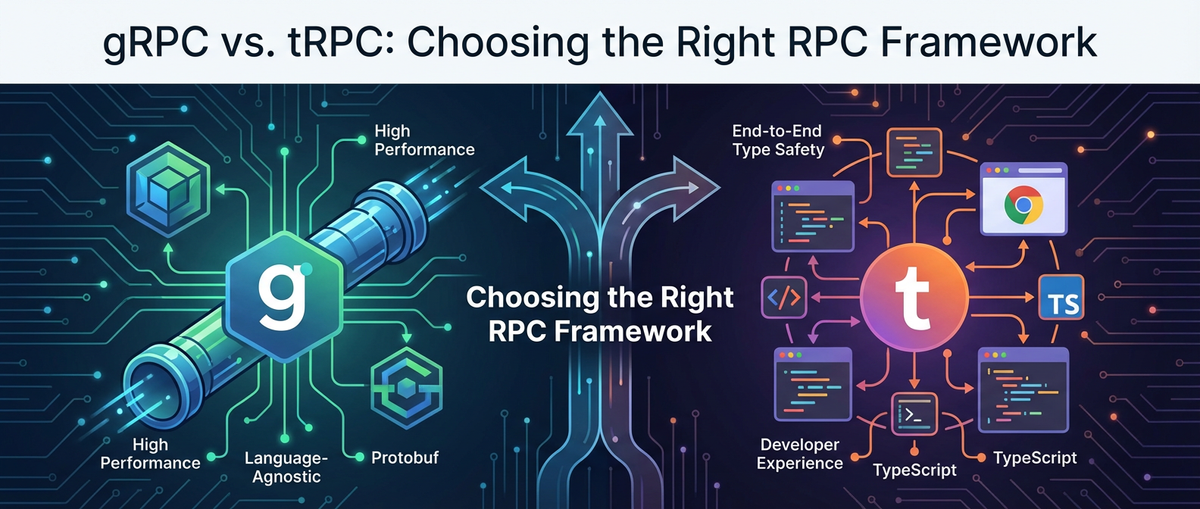


The architectural landscape of software development has undergone a profound transformation over the past decade, shifting from monolithic applications to distributed systems, microservices, and serverless functions. This paradigm shift, driven by the demands for scalability, resilience, and independent deployability, has placed an unprecedented emphasis on efficient, reliable, and well-managed inter-service communication. At the heart of this challenge lies the Remote Procedure Call (RPC) framework, a foundational technology that allows one program to request a service from a program located on another computer on a network without having to understand the network's details. As developers grapple with increasingly complex ecosystems, the choice of an RPC framework is no longer a trivial decision; it profoundly impacts system performance, developer experience, maintenance overhead, and the long-term scalability of the entire infrastructure. This comprehensive exploration delves into two prominent yet distinct RPC frameworks: gRPC, a battle-tested, high-performance solution backed by Google, and tRPC, a newer, innovative framework specifically tailored for end-to-end type safety in TypeScript applications. We will dissect their underlying philosophies, technical merits, use cases, and inherent trade-offs, ultimately guiding you towards making an informed decision for your specific project needs in the ever-evolving api economy. The selection of an appropriate communication protocol is paramount for any modern api or microservice architecture, influencing everything from data transfer efficiency to development velocity.
Understanding RPC: The Foundation of Distributed Communication
Before diving into the specifics of gRPC and tRPC, it is essential to establish a firm understanding of what RPC is and why it remains a cornerstone of distributed computing. RPC, or Remote Procedure Call, is a protocol that allows a program to cause a procedure (subroutine or function) to execute in another address space (typically on another computer on a shared network) without the programmer explicitly coding the details for this remote interaction. The programmer writes essentially the same code whether the subroutine is local or remote, abstracting away the complexities of network communication. This abstraction is incredibly powerful because it allows developers to think about network interactions as simple function calls, significantly simplifying the development of distributed applications.
How RPC Works Under the Hood
The magic of RPC lies in its ability to simulate local function calls over a network. This is primarily achieved through a mechanism involving stubs and a marshalling/unmarshalling process. When a client invokes a remote procedure:
- Client Stub: The client makes a local call to a client-side stub function. This stub is typically generated from an Interface Definition Language (IDL) file that defines the remote service.
- Marshalling: The client stub is responsible for marshalling the procedure name and its parameters into a standardized message format. Marshalling is the process of converting in-memory data structures or objects into a format suitable for transmission. This usually involves serialization, transforming complex data into a byte stream.
- Network Transmission: The marshalled message is then sent across the network to the server. The underlying transport protocol (e.g., TCP/IP, HTTP/2) handles the actual byte transmission.
- Server Stub (Skeleton): On the server side, a server-side stub (sometimes called a skeleton) receives the incoming message.
- Unmarshalling: The server stub unmarshalls the message, deserializing the byte stream back into the original procedure name and parameters.
- Server-Side Execution: The server stub then invokes the actual local procedure on the server with the unmarshalled parameters.
- Result Marshalling: Once the server procedure completes, its return value or any output parameters are marshalled back into a message by the server stub.
- Result Transmission: This response message is sent back across the network to the client.
- Client Unmarshalling & Return: The client stub receives the response, unmarshalls it, and returns the result to the calling client application, completing the remote procedure call as if it were a local one.
This intricate dance of stubs and serialization ensures that developers can largely remain oblivious to the underlying network complexities, focusing instead on the business logic of their services.
Benefits and Challenges of Traditional RPC
The primary benefit of RPC is undoubtedly the abstraction of network details, which significantly enhances developer productivity. It fosters a clear separation of concerns, allowing teams to develop client and server components independently, provided they adhere to the agreed-upon interface contract. Furthermore, RPC can offer performance advantages over other communication styles like REST, especially when employing efficient binary serialization formats, as it reduces message overhead and parsing time. This makes it particularly attractive for high-throughput, low-latency inter-service communication within a microservices architecture.
However, traditional RPC frameworks have historically presented their own set of challenges. Early RPC systems, such as CORBA (Common Object Request Broker Architecture) or DCOM (Distributed Component Object Model), were often language-specific and platform-dependent, leading to vendor lock-in and difficulties in building truly heterogeneous distributed systems. They could also be complex to configure and deploy, requiring significant boilerplate code and intricate setup. The lack of standardized tools for introspection, debugging, and service discovery often made troubleshooting a nightmare. The advent of simpler, more web-friendly protocols like SOAP and later REST aimed to address some of these complexities, but often at the cost of performance and strict type enforcement. Modern RPC frameworks, including gRPC and tRPC, have emerged to address these historical shortcomings, providing a renewed focus on performance, developer experience, and language interoperability, crucial for any robust api gateway implementation.
The Evolution of RPC in the Microservices Era
With the rise of microservices, the need for efficient and robust inter-service communication became paramount. REST (Representational State Transfer) quickly became the de facto standard for building public-facing apis due to its simplicity, human-readable JSON format, and excellent browser support. However, for internal microservice communication, REST's text-based serialization (JSON/XML) and connection-per-request model over HTTP/1.1 often proved less efficient than desired, especially at scale. This performance bottleneck and the lack of strong type contracts across different services led many organizations, particularly those with high-performance requirements like Google, to revisit and modernize the RPC paradigm. This resurgence of modern RPC frameworks has culminated in powerful solutions designed for the demands of cloud-native applications, aiming to optimize internal api calls while still offering robust external api management capabilities, often facilitated by an api gateway.
gRPC: The Google-Powered Contender for High-Performance Microservices
gRPC is a modern, high-performance, open-source RPC framework developed by Google. It leverages powerful technologies like Protocol Buffers (Protobuf) for efficient serialization and HTTP/2 for its transport protocol, making it an excellent choice for microservices architectures, mobile backends, and scenarios demanding high throughput and low latency. Introduced in 2015, gRPC quickly gained traction due to its robust features, polyglot support, and alignment with modern distributed system principles. It represents a significant evolution in the RPC landscape, addressing many of the limitations of older RPC systems while providing a compelling alternative to REST for internal service communication. Building an efficient api gateway often involves understanding and integrating such high-performance protocols.
Core Concepts of gRPC
Understanding gRPC requires familiarity with its foundational components: Protocol Buffers for defining service contracts and data structures, and HTTP/2 for the underlying communication transport.
Protocol Buffers (Protobuf): The Efficient IDL and Serialization Format
At the heart of gRPC lies Protocol Buffers, or Protobuf. It's an open-source, language-agnostic, extensible mechanism for serializing structured data. Protobuf serves two critical roles in gRPC:
- Interface Definition Language (IDL): Developers define their services and the messages (data structures) they exchange using a
.protofile, which acts as the contract for theapi. This IDL is clear, concise, and language-neutral. - Binary Serialization Format: Protobuf compiles these
.protodefinitions into code for various programming languages (e.g., C++, Java, Python, Go, Node.js, C#, Ruby). This generated code handles the efficient serialization and deserialization of data to and from a compact binary format.
Comparison with JSON/XML: Unlike text-based formats like JSON or XML, Protobuf serializes data into a binary format. This offers several significant advantages:
- Smaller Message Sizes: Binary data is inherently more compact than text, leading to reduced network bandwidth consumption.
- Faster Serialization/Deserialization: Parsing binary data is considerably faster than parsing human-readable text, resulting in lower latency and higher throughput.
- Strong Type Safety: The
.protodefinition enforces strict data types, ensuring that both client and server agree on the data structure, preventing commonapiintegration errors that often plague loosely typed JSONapis. Changes to the schema are explicitly managed, providing backward and forward compatibility mechanisms. - Code Generation: The automatic code generation for multiple languages eliminates manual parsing boilerplate, standardizes data access, and reduces the chance of implementation errors.
Example .proto Definition: To illustrate, consider a simple service for managing a list of products:
syntax = "proto3";

package product;

service ProductService {
  rpc GetProduct(GetProductRequest) returns (Product);
  rpc CreateProduct(CreateProductRequest) returns (Product);
  rpc ListProducts(ListProductsRequest) returns (stream Product);
  rpc UpdateProductPrice(stream UpdatePriceRequest) returns (UpdatePriceResponse);
}

message Product {
  string id = 1;
  string name = 2;
  string description = 3;
  double price = 4;
  int64 stock_quantity = 5;
}

message GetProductRequest {
  string product_id = 1;
}

message CreateProductRequest {
  string name = 1;
  string description = 2;
  double price = 3;
  int64 stock_quantity = 4;
}

message ListProductsRequest {
  int32 page_size = 1;
  string page_token = 2;
}

message UpdatePriceRequest {
  string product_id = 1;
  double new_price = 2;
}

message UpdatePriceResponse {
  bool success = 1;
  string message = 2;
}
This .proto file defines a ProductService with several RPC methods, each taking specific request messages and returning response messages. The Product message defines the structure of a product entity. The stream keyword indicates streaming RPCs, which will be discussed next. This declarative approach to defining api contracts is a powerful feature that underpins gRPC's robustness and interoperability.
HTTP/2: The Foundation for gRPC Transport
While Protobuf defines what data is sent, HTTP/2 defines how it's sent. gRPC exclusively uses HTTP/2 as its transport layer, distinguishing it significantly from traditional REST apis that often rely on HTTP/1.1. HTTP/2 introduces several features that are critical for gRPC's performance and functionality:
- Multiplexing: HTTP/2 allows multiple concurrent requests and responses to be sent over a single TCP connection. In HTTP/1.1, each request typically required its own connection, leading to significant overhead. Multiplexing reduces latency by eliminating head-of-line blocking and connection establishment overhead.
- Header Compression (HPACK): HTTP/2 compresses HTTP headers using the HPACK compression algorithm, which reduces overhead, especially for requests with many headers or repetitive headers, further optimizing bandwidth usage.
- Server Push: Although not directly used for standard gRPC unary calls, HTTP/2's server push capability allows a server to proactively send resources to a client that it anticipates the client will need, without the client explicitly requesting them.
- Binary Framing Layer: HTTP/2 messages are broken down into smaller, binary-encoded frames, which allows for efficient parsing and transmission. This contrasts with HTTP/1.1's text-based message parsing, which can be slower.
These HTTP/2 features make gRPC highly efficient for long-lived connections and streaming scenarios, which are commonplace in modern distributed systems. It's particularly beneficial for communication between services in a data center or for mobile apis where connection efficiency is crucial.
gRPC RPC Types: Unary, Server Streaming, Client Streaming, Bidirectional Streaming
gRPC supports four distinct types of RPC interactions, catering to various communication patterns:
- Unary RPC: This is the most straightforward RPC, analogous to a traditional function call. The client sends a single request, and the server responds with a single response. This is the most common type and resembles traditional request-response
apis.- Example:
GetProduct(GetProductRequest) returns (Product)
- Example:
- Server Streaming RPC: The client sends a single request, but the server responds with a stream of messages. The client reads from this stream until the server indicates completion. This is useful for retrieving large datasets or for real-time updates where the server pushes new data to the client as it becomes available.
- Example:
ListProducts(ListProductsRequest) returns (stream Product)– The client requests a list of products, and the server streams them back one by one.
- Example:
- Client Streaming RPC: The client sends a stream of messages to the server. After the client finishes sending all its messages, the server responds with a single response. This is suitable for scenarios like uploading large files in chunks or sending a sequence of telemetry data.
- Example:
UpdateProductPrice(stream UpdatePriceRequest) returns (UpdatePriceResponse)– The client streams multiple price update requests for different products, and the server processes them, then sends a single confirmation.
- Example:
- Bidirectional Streaming RPC: Both the client and the server send a stream of messages to each other, independently. The order of messages within each stream is preserved, but messages from the two streams can be interleaved. This enables real-time, interactive communication, such as chat applications or live data feeds where both sides can send and receive asynchronously.
- Example: A real-time stock trading application where client sends buy/sell orders and server sends market updates, all over a single connection.
These diverse RPC types provide gRPC with the flexibility to handle a wide array of distributed communication challenges, from simple query-response patterns to complex real-time data flows, making it a versatile tool for any sophisticated api architecture.
Key Features and Advantages of gRPC
gRPC's design and underlying technologies bestow it with a robust set of features and significant advantages, making it a compelling choice for many distributed system architectures.
- Exceptional Performance: This is arguably gRPC's most significant draw. The combination of Protobuf's compact binary serialization and HTTP/2's multiplexing and header compression results in significantly lower latency and higher throughput compared to traditional REST
apis over HTTP/1.1 with JSON payloads. This efficiency is critical for high-volume microservices where every millisecond and byte counts. - Polyglot Support and Interoperability: Through its language-agnostic Protobuf IDL and code generation, gRPC natively supports client and server implementations in a wide array of programming languages, including C++, Java, Python, Go, Node.js, C#, Ruby, PHP, and more. This makes it ideal for polyglot microservice environments where different teams might prefer different languages, ensuring seamless communication across diverse tech stacks. It provides a universal contract for
apiinteractions. - Strong Type Safety and Contract Enforcement: The Protobuf schema serves as a strict contract, enforcing data types and message structures at compile time. This strong type safety reduces runtime errors, simplifies
apiintegration, and enhances overall system reliability. Developers benefit from compile-time checks and auto-completion, which significantly improve the developer experience by preventing common data mismatch issues. - Built-in Features and Ecosystem Maturity: gRPC comes with built-in support for crucial distributed system functionalities, including:
- Authentication: TLS/SSL for secure communication, and pluggable authentication mechanisms.
- Load Balancing: Client-side load balancing capabilities.
- Health Checks: Standardized ways for services to report their health status.
- Cancellation and Timeouts: Mechanisms to abort long-running RPCs or set deadlines.
- Observability: Integration points for tracing, logging, and monitoring. The gRPC ecosystem is mature, with extensive documentation, a large community, and robust tooling for development, testing, and deployment.
- Efficient Streaming: The native support for server, client, and bidirectional streaming over a single HTTP/2 connection is a powerful feature that is often cumbersome or inefficient to implement with REST. This makes gRPC excellent for real-time data processing, IoT communication, and live updates.
- Suitable for Microservices and Internal APIs: gRPC's performance, type safety, and polyglot support make it an ideal choice for internal communication between microservices within a distributed system. It provides a robust and efficient backbone for intricate service graphs. For organizations leveraging an
api gatewayto manage their internal and externalapis, gRPC services can be seamlessly integrated, with thegatewaypotentially handling protocol translation for external clients.
Disadvantages and Considerations of gRPC
Despite its many strengths, gRPC is not a silver bullet and comes with its own set of challenges and trade-offs that developers must consider.
- Steeper Learning Curve: Adopting gRPC requires teams to learn new concepts such as Protocol Buffers IDL, the gRPC programming model (stubs, services, messages), and potentially HTTP/2 specifics. This can be a barrier for teams accustomed to simpler REST-JSON interactions, especially if they are new to compiled languages or strong typing.
- Challenging Browser Support: Directly calling gRPC services from web browsers is not straightforward because browsers do not expose the necessary HTTP/2 frames required for gRPC. To enable browser clients to interact with gRPC backends, a gRPC-Web gateway (like Envoy or gRPC-Web proxy) is typically required. This
gatewaytranslates gRPC calls into HTTP/1.1 requests (often with a Protobuf-encoded payload) that browsers can understand and then translates HTTP/1.1 responses back to gRPC. This adds an extra layer of complexity and an additional component to manage within the architecture. - Debugging Complexity: The binary nature of Protobuf makes gRPC traffic less human-readable than JSON. Debugging network requests often requires specialized tooling (e.g., Wireshark with Protobuf dissectors, gRPC reflection tools, or proxy tools that can decode gRPC messages) rather than simple browser developer consoles or
curlcommands. This can slow down the troubleshooting process without adequate tooling. - Text Readability vs. Efficiency: While the binary format contributes to performance, it sacrifices human readability. For developers who frequently need to inspect
apitraffic manually, this can be a drawback. The trade-off is efficiency for convenience. - Tooling Integration: While the ecosystem is mature, integrating gRPC into existing monitoring, logging, and tracing solutions might require specific gRPC-aware plugins or configurations, as generic HTTP/1.1 tools might not fully understand the HTTP/2 and Protobuf specificities.
- Overhead for Simple
apis: For very simpleapis that only perform basic CRUD operations and don't require high performance or streaming, the overhead of setting up Protobuf definitions and gRPC infrastructure might be overkill compared to a straightforward RESTapi.
For organizations managing a diverse array of apis, encompassing various protocols and complexities, a comprehensive api gateway becomes indispensable. A solution like APIPark can effectively manage both gRPC and RESTful services, acting as a unified gateway to handle authentication, routing, rate limiting, and analytics across all service types. This centralized management simplifies the operational burden, regardless of the underlying RPC framework chosen for individual microservices.
tRPC: The Type-Safe TypeScript Savior
Emerging from the vibrant TypeScript ecosystem, tRPC (TypeScript Remote Procedure Call) offers a fundamentally different approach to RPC, prioritizing an unparalleled developer experience through end-to-end type safety. Unlike gRPC, which is language-agnostic and relies on an IDL, tRPC is explicitly designed for full-stack TypeScript applications, where both the frontend and backend are written in TypeScript and ideally share types within a monorepo structure. It aims to eliminate manual api contract syncing, boilerplate, and runtime type errors by leveraging TypeScript's powerful type inference capabilities. The core philosophy of tRPC is simple: define your backend procedures directly in TypeScript, and your frontend client automatically infers their types, providing autocompletion and error checking directly in your editor. This approach creates a seamless development flow that feels more like importing a local function than making a network request.
Core Philosophy and How tRPC Works
tRPC is not a new protocol; it doesn't invent its own transport or serialization format. Instead, it ingeniously leverages existing web standards (HTTP, JSON) and TypeScript's type system to provide a zero-cost api contract.
- Schema-less RPC (from a separate IDL perspective): Unlike gRPC which requires a
.protofile, tRPC doesn't have a separate schema definition language. Your TypeScript server-side code is the schema. - TypeScript Monorepos (Ideal Scenario): tRPC shines brightest in a full-stack TypeScript monorepo where the client and server share the same type definitions. This allows the client to import the server's
apidefinition (types only, not implementation) and infer all necessary types for requests and responses. - Automatic Type Inference: This is the cornerstone of tRPC. When you define a procedure on your backend using tRPC's API, TypeScript infers the input types, output types, and even potential errors. On the client side, when you initialize the tRPC client and point it to your backend's API definition, it automatically picks up these inferred types. This means that if you change an input parameter type on the server, your frontend code will immediately show a type error in your IDE, before you even run the application. This eliminates an entire class of
apiintegration bugs. - Minimalist Transport: tRPC typically uses standard HTTP/1.1 (or HTTP/2 if available) and JSON for serialization. It’s designed to be lightweight, with minimal overhead. The actual network request details are abstracted away by the tRPC client library.
In essence, tRPC tricks your TypeScript compiler into thinking your remote API calls are just local function calls, providing type safety and autocompletion that usually only comes with local imports. This significantly enhances the developer experience and reduces the cognitive load associated with distributed api interactions.
Key Features and Advantages of tRPC
tRPC's design choices translate into a highly developer-friendly experience, especially for TypeScript-centric projects.
- Unparalleled Developer Experience (DX): This is tRPC's strongest selling point.
- End-to-End Type Safety: From the server-side
apidefinition to the client-sideapicall, all types are automatically inferred and checked by TypeScript. There are no runtime type errors related toapicontracts. - Autocompletion in the IDE: As soon as you type
trpc.myProcedure.query, your IDE (e.g., VS Code) provides autocompletion for parameters and expected return types, directly reflecting the server's implementation. This eliminates the need to constantly refer toapidocumentation or guessapistructures. - Zero-Cost API Contract: No separate IDL to maintain, no code generation step for the core types. The TypeScript code is the contract. This significantly reduces boilerplate and keeps your
apidefinitions DRY (Don't Repeat Yourself). - Instant Feedback: Type errors appear immediately in your IDE if the client-side code doesn't match the server's expected
apisignature, allowing for rapid iteration and bug fixing before deployment.
- End-to-End Type Safety: From the server-side
- Blazing Fast Development: With automatic type safety and excellent IDE support, developers can iterate on
apis much faster. Changes on the server are instantly reflected and checked on the client, leading to a highly productive workflow. It dramatically reduces the time spent onapiintegration and debuggingapicontract mismatches. - Lightweight and Performant: While it uses JSON by default, tRPC itself is very lightweight. It doesn't add significant runtime overhead. The primary focus is on developer experience, but it's still efficient for typical web application
apis. It avoids the complexities of specialized binary protocols unless specifically configured to use them. - Framework Agnostic (Frontend): While designed for TypeScript, the tRPC client can integrate seamlessly with popular frontend frameworks like React, Vue, Svelte, and Angular, providing hooks and utilities tailored for each.
- No Code Generation (for types): For the core types, tRPC leverages TypeScript's native capabilities, meaning you don't run a separate code generation step just to get your
apitypes. This simplifies the build pipeline. - Focus on TypeScript: It fully embraces and leverages the power of TypeScript, making it a natural fit for projects already committed to the TypeScript ecosystem.
- Small Bundle Size: The client-side library for tRPC is exceptionally small, contributing to faster load times for web applications.
Disadvantages and Considerations of tRPC
Despite its compelling advantages in developer experience, tRPC also has limitations that make it unsuitable for certain scenarios.
- TypeScript Only: This is the most significant limitation. tRPC is inextricably tied to the TypeScript ecosystem. If your backend is in Go, Python, Java, or any language other than TypeScript, tRPC is not a viable option for direct communication. It is designed for homogeneous TypeScript stacks. This limits its use in polyglot microservice architectures.
- Monorepo Preference and Type Sharing: While technically possible to use tRPC in a multi-repo setup, it works best and provides maximum benefit in a monorepo where the client and server can easily share the same
apidefinition files (types). If types cannot be directly shared (e.g., across separate repositories without a robust publishing/syncing mechanism), some of the end-to-end type safety benefits might be diminished or require more manual effort to maintain. It is less suited for truly independent microservices developed by separate teams without shared type definitions. - Maturity and Ecosystem: tRPC is a relatively newer framework compared to gRPC (and REST). Its community, tooling, and ecosystem are growing rapidly but are not as mature or extensive as gRPC's. This might mean fewer ready-to-use integrations, fewer examples, and a smaller pool of developers familiar with it.
- Interoperability Challenges: tRPC is primarily designed for internal, full-stack TypeScript communication. It is generally not suitable for exposing public-facing
apis that need to be consumed by diverse clients (e.g., native mobile apps written in Swift/Kotlin, third-party integrations, other microservices in different languages). While you can wrap tRPC procedures in a traditional RESTapiif needed, it adds an extra layer and defeats the purpose of end-to-end type safety for non-TS clients. It's not designed to be a universalapicontract for heterogeneous systems. - Lack of Native Streaming: Unlike gRPC's native, highly efficient streaming capabilities over HTTP/2, tRPC doesn't have built-in support for advanced streaming RPC types (server, client, or bidirectional streaming) out-of-the-box in the same way. While it can handle websockets or SSE (Server-Sent Events) for streaming data, it often requires additional setup and custom implementation outside of the core tRPC paradigm. For applications heavily reliant on real-time bidirectional data flows, tRPC might require more effort to achieve the same level of functionality as gRPC.
- Less Emphasis on Network Efficiency: While efficient, tRPC's default use of JSON over HTTP/1.1 (though HTTP/2 is possible) generally means it won't match gRPC's raw performance in terms of message size and serialization/deserialization speed, especially for high-volume, low-latency scenarios. The trade-off here is performance for developer convenience.
For companies seeking to optimize the internal development of their TypeScript applications, tRPC is an incredibly powerful tool. However, for managing and exposing these apis, or for integrating them with other services built in different languages, an api gateway still plays a crucial role. Even if internal tRPC communication is schema-less, the broader api ecosystem still benefits from centralized management offered by platforms like APIPark. Such a gateway can ensure consistent security, monitor performance, and provide a unified developer portal, irrespective of the underlying internal communication framework.
APIPark is a high-performance AI gateway that allows you to securely access the most comprehensive LLM APIs globally on the APIPark platform, including OpenAI, Anthropic, Mistral, Llama2, Google Gemini, and more.Try APIPark now! 👇👇👇
Comparative Analysis: gRPC vs. tRPC - The Showdown
Having explored the individual merits and considerations of gRPC and tRPC, it's time to place them side-by-side for a direct comparison. The choice between these two powerful RPC frameworks largely hinges on your project's specific requirements, team's language preferences, performance needs, and desired developer experience. There is no universally "better" framework; rather, there is a "right" framework for a given context. Understanding their fundamental differences is key to making that informed decision.
Key Differences Explored
Let's delve deeper into the distinctions across several critical dimensions:
Language Agnosticism vs. TypeScript-Native
- gRPC: Truly language-agnostic. Its
.protoIDL serves as a universal contract that can be compiled into client and server code for dozens of programming languages. This makes gRPC the quintessential choice for polyglot microservices architectures, where different services might be written in Go, Java, Python, Node.js, and C++, yet need to communicate seamlessly and efficiently. It promotes interoperability across diverse technology stacks. If you're building an enterprise system where different teams own different services in their preferred languages, gRPC provides the glue. - tRPC: Strictly TypeScript-native. It leverages TypeScript's powerful type inference system to provide its core benefits. This means your backend must be in TypeScript, and your frontend (if using the client library for full type safety) also needs to be in TypeScript. tRPC is the ideal solution for full-stack TypeScript monorepos, where a single language and codebase manage both client and server logic, promoting a highly cohesive development environment. It is not designed for communication with services written in other languages.
Performance and Efficiency
- gRPC: Optimized for raw performance and efficiency. It achieves this through:
- Protocol Buffers: Binary serialization leads to significantly smaller message sizes and faster serialization/deserialization compared to text-based formats like JSON.
- HTTP/2: Multiplexing, header compression, and a binary framing layer ensure efficient use of network resources, reduced latency, and improved throughput, especially for concurrent requests and streaming. gRPC is built for scenarios demanding high throughput, low latency, and efficient bandwidth usage, such as high-volume data pipelines, real-time analytics, and mobile backends.
- tRPC: While lightweight and efficient for typical web application
apis, it doesn't prioritize raw network performance to the same extent as gRPC.- JSON Serialization: By default, tRPC uses JSON, which is human-readable but less compact and slower to parse than Protobuf's binary format.
- HTTP/1.1 (often): While HTTP/2 can be used with tRPC, it's not a fundamental requirement or specific optimization of the framework itself. The focus is on developer experience, and for most CRUD operations in a typical web application, its performance is more than adequate. For extreme performance-critical scenarios or very high data volumes, gRPC typically holds an edge due to its core design choices.
Developer Experience (DX)
- gRPC: Provides a good DX with strong type safety through its IDL and robust code generation. Developers get compile-time checks and autocompletion in many languages. However, the requirement to maintain
.protofiles, potentially run code generation steps, and deal with binary payloads for debugging can introduce some friction. The learning curve for Protobuf and HTTP/2 concepts is also a factor. - tRPC: Offers arguably one of the best developer experiences in the modern
apilandscape for TypeScript developers. Its "zero-costapicontract" (where TypeScript types are the contract) means:- Instantaneous type checking and autocompletion.
- No manual
apicontract syncing. - No separate IDL files or explicit code generation steps for types.
- Errors are caught at compile time, eliminating an entire class of runtime bugs. This leads to incredibly fast iteration cycles and a highly productive workflow, making it a joy to work with for full-stack TypeScript teams.
Serialization
- gRPC: Exclusively uses Protocol Buffers, a highly efficient binary serialization format. This is a core part of its performance story.
- tRPC: Typically uses JSON for serialization. While configurable, JSON is the default and most common choice, prioritizing human readability and browser compatibility over raw binary efficiency.
IDL/Schema Management
- gRPC: Relies on Protocol Buffers IDL (
.protofiles) to formally define service contracts and data structures. This explicit schema definition is essential for language interoperability and strong contract enforcement across different services. Changes to the schema require careful versioning and compatibility planning. - tRPC: Does not use a separate IDL. The TypeScript type definitions in your server-side code are the schema. This implicit schema management, driven by type inference, simplifies the development process for homogeneous TypeScript applications. There's no separate file to maintain; the contract is derived directly from your implementation types.
Streaming Capabilities
- gRPC: Offers native and highly optimized support for all four RPC streaming types (server, client, bidirectional) over a single HTTP/2 connection. This makes it exceptionally well-suited for real-time applications, long-lived connections, and scenarios involving continuous data flows.
- tRPC: Does not have native, built-in support for streaming in the same way as gRPC. While it can integrate with other streaming technologies like WebSockets or Server-Sent Events, these often require separate implementations and are not part of tRPC's core RPC model. For applications with heavy streaming requirements, gRPC provides a more direct and efficient solution.
Maturity and Ecosystem
- gRPC: A mature and well-established framework, backed by Google, with a large community, extensive documentation, and a robust ecosystem of tools, libraries, and integrations. It has been battle-tested in production environments at massive scale.
- tRPC: A much newer framework, still rapidly evolving. Its community is growing quickly, especially within the Next.js and React ecosystems, but it doesn't have the same level of maturity, breadth of tooling, or enterprise adoption as gRPC. This might mean less readily available expertise, fewer integration options, and a potentially faster pace of breaking changes as the framework evolves.
Interoperability and External APIs
- gRPC: Excellent for interoperability across diverse language environments and well-suited for exposing internal APIs to various microservices, mobile applications, or even public APIs (with a gRPC-Web gateway). Its explicit IDL makes it a robust choice for defining stable, versioned
apicontracts for heterogeneous consumers. - tRPC: Best suited for internal, full-stack TypeScript communication within a controlled environment (like a monorepo). It is generally not designed for exposing public-facing APIs to a broad range of clients (e.g., native iOS/Android apps, third-party developers, services in other languages) due to its TypeScript-centric nature and lack of an explicit, universal IDL.
The Comparison Table
To summarize these differences, here's a comparative table:
| Feature/Aspect | gRPC | tRPC |
|---|---|---|
| Primary Use Case | High-performance microservices, polyglot environments, mobile backends, streaming data, internal apis, cross-platform communication |
Full-stack TypeScript applications, internal apis within a monorepo, rapid prototyping, prioritizing DX |
| Language Support | Polyglot (C++, Java, Python, Go, Node.js, C#, Ruby, etc.) | TypeScript-only (for core benefits) |
| Serialization | Protocol Buffers (binary, compact, fast) | JSON (text-based, human-readable, generally slower than Protobuf) |
| Transport Protocol | HTTP/2 (multiplexing, header compression) | HTTP/1.1 (default), HTTP/2 possible |
| Schema Definition | .proto files (explicit IDL, strong contract) |
Implicit from TypeScript types (server code is the contract) |
| Type Safety | Strong type safety via Protobuf IDL and generated code | End-to-end type safety via TypeScript inference (zero-cost api contract) |
| Developer Experience | Good (compile-time checks, autocompletion), but steeper learning curve, debugging binary | Excellent (real-time autocompletion, type checking, no manual syncing, rapid iteration) |
| Streaming | Native support for Unary, Server, Client, Bidirectional streaming | Not natively built-in; often requires custom WebSocket/SSE implementation |
| Browser Support | Requires gRPC-Web gateway for direct browser calls |
Direct browser calls possible via standard HTTP/JSON |
| Maturity | High (battle-tested, extensive ecosystem, Google-backed) | Growing (newer, smaller community, rapidly evolving, focused on TS ecosystem) |
| Interoperability | Excellent for heterogeneous systems | Limited to TypeScript clients; less suitable for diverse external clients |
| Debugging | Requires specialized tools due to binary format | Easier due to human-readable JSON; standard browser tools applicable |
api gateway Relevance |
Highly beneficial for external exposure, protocol translation, general api management |
Still beneficial for broader api management, security, and integration with non-TS services, even if internal tRPC is seamless |
When to Choose gRPC
You should lean towards gRPC if your project exhibits one or more of the following characteristics:
- Polyglot Microservices: Your architecture involves multiple services written in different programming languages that need to communicate efficiently. gRPC acts as a lingua franca.
- High Performance and Low Latency Requirements: You are building systems where every millisecond matters, such as real-time analytics, financial trading platforms, gaming backends, or high-volume data processing pipelines.
- Streaming Data: Your application requires efficient server streaming (e.g., real-time sensor data, stock quotes), client streaming (e.g., large file uploads, continuous logging), or bidirectional streaming (e.g., chat applications, IoT control).
- Mobile Backends: For mobile applications, gRPC's efficient binary serialization and HTTP/2 usage can significantly reduce bandwidth consumption and improve battery life.
- Public-Facing APIs with Diverse Consumers: If you need to expose your
apis to a wide range of clients (e.g., mobile apps, other microservices, partner integrations) developed in various languages, gRPC provides a robust and versionable contract, even if a gRPC-Webgatewayis needed for browser clients. - Strong Contract Enforcement: You prioritize strict
apicontracts and compile-time validation across services to prevent integration issues in complex distributed systems. - Existing Google Cloud Ecosystem: If you are heavily invested in Google Cloud, gRPC integrates seamlessly with many of its services and tooling.
When to Choose tRPC
tRPC becomes the ideal choice under these conditions:
- Full-Stack TypeScript Application (especially Monorepo): Your entire application, both frontend and backend, is written in TypeScript, and you can share types directly (e.g., within a monorepo or via a well-managed shared types package).
- Prioritizing Developer Experience (DX) Above All Else: You want to maximize developer productivity, minimize
apiintegration bugs, and enjoy an almost magical autocompletion experience in your IDE. - Rapid Prototyping and Iteration: You need to develop and iterate on
apis quickly without the overhead of maintaining separate IDLs or manual type syncing. - Internal
apis within a Homogeneous Stack: Theapis are primarily for internal consumption within your TypeScript application and don't need to be exposed to a wide variety of external, non-TypeScript clients. - Less Emphasis on Raw Network Performance: While performant for most web applications, you're not building a system where the absolute minimum message size or maximum request per second is the primary driver. The benefits of DX outweigh the marginal performance gains of binary protocols for your use case.
- Small to Medium-Sized Teams: The benefits of simplified
apidevelopment and reduced integration overhead are particularly pronounced for smaller teams or projects where efficiency is key.
In scenarios where gRPC excels for internal microservice communication, and tRPC shines for full-stack TypeScript development, there often arises a need for a centralized management layer for all these diverse services. This brings us to the crucial role of api gateways.
The Role of API Gateways and APIPark in a Diverse RPC Landscape
Regardless of whether you choose gRPC for its high performance and polyglot nature, or tRPC for its unparalleled developer experience in a TypeScript ecosystem, managing the lifecycle, security, and exposure of your apis remains a critical challenge. This is precisely where an api gateway becomes an indispensable component in modern distributed architectures. An api gateway acts as a single entry point for all client requests, routing them to the appropriate backend services, aggregating results, and often enforcing various policies. It's the front door to your microservices world, offering a centralized control point for your apis.
What is an API Gateway and Why Use One?
An api gateway is a service that sits in front of your backend services (microservices, legacy systems, serverless functions) and acts as an api entry point for clients. Instead of clients making direct requests to multiple backend services, they make a single request to the api gateway, which then intelligently routes, transforms, and processes the request before forwarding it to the relevant backend.
The motivations for deploying an api gateway are numerous and compelling:
- Centralized Authentication and Authorization: Instead of each microservice implementing its own security logic, the
gatewaycan handle authentication (e.g., OAuth, JWT validation) and authorization checks (e.g., role-based access control) for all incoming requests, simplifying security management across the board. - Traffic Management:
api gateways can implement intelligent routing, load balancing, rate limiting (to prevent abuse and ensure fair usage), circuit breaking (to prevent cascading failures), and caching, all of which enhance the resilience and performance of your system. - Protocol Translation and Aggregation: A
gatewaycan translate client-friendly protocols (e.g., REST/JSON) into backend-specific protocols (e.g., gRPC, SOAP) and vice versa. It can also aggregate multiple backend service calls into a single client response, reducing network chatter and simplifying client-side logic. - Monitoring and Analytics: By centralizing request processing,
api gateways provide a natural point for collecting metrics, logging requests, and monitoringapiusage and performance, offering valuable insights into system health andapiadoption. - API Versioning and Lifecycle Management:
gateways can help manage different versions of yourapis, ensuring backward compatibility and smooth transitions for clients. They facilitate the entireapilifecycle, from design and publication to deprecation. - Security Policies: Beyond authentication,
gateways can enforce other security policies like IP whitelisting/blacklisting, WAF (Web Application Firewall) functionalities, and encryption policies, providing an additional layer of defense. - Developer Portal: Many
api gatewaysolutions come with or integrate with a developer portal, offering documentation,apiexploration tools, and subscription management for externalapiconsumers.
Relevance to gRPC and tRPC
The presence of a diverse api landscape, featuring both gRPC and tRPC services, only amplifies the need for a robust api gateway.
- Relevance to gRPC:
- Browser Compatibility (gRPC-Web): As discussed, direct gRPC calls from browsers are problematic. An
api gatewaycan act as a gRPC-Web proxy, translating browser-friendly HTTP/1.1 requests (with Protobuf payload) into gRPC requests for your backend services and vice-versa. This allows you to leverage gRPC's performance for internal communication while still serving web clients. - External API Exposure: For exposing gRPC services to external clients (e.g., mobile apps, partner systems) that might not natively support gRPC, the
gatewaycan provide a REST/JSON interface that internally translates to gRPC calls, simplifying consumption for a broader audience. - Unified Management: Even if clients are gRPC-aware, managing a large number of gRPC services for authentication, authorization, rate limiting, and observability across an enterprise is best done through a centralized
gateway.
- Browser Compatibility (gRPC-Web): As discussed, direct gRPC calls from browsers are problematic. An
- Relevance to tRPC:
- Broader API Ecosystem Management: While tRPC shines for internal, full-stack TypeScript communication, the entire enterprise
apiecosystem rarely consists solely of tRPC services. There will be other RESTapis, perhaps gRPC services, or even third-partyapiintegrations. Anapi gatewayprovides a single pane of glass to manage all theseapis, offering consistent security, monitoring, and lifecycle governance. - Security for Exposed Functionality: If certain tRPC-backed functionalities need to be exposed to non-TypeScript clients or external systems (perhaps wrapped in a REST layer), the
api gatewaybecomes essential for applying security policies, rate limits, and monitoring to these exposedapis. - Performance Optimization: While tRPC focuses on DX, a
gatewaycan still apply performance optimizations like caching, compression, and advanced load balancing techniques to requests routed to tRPC-backed services, further enhancing the overall system performance.
- Broader API Ecosystem Management: While tRPC shines for internal, full-stack TypeScript communication, the entire enterprise
Introducing APIPark: An Open Source AI Gateway & API Management Platform
For organizations building complex ecosystems with diverse services, whether gRPC or tRPC based, managing these apis becomes crucial. This is where a robust api gateway solution shines. Products like APIPark, an open-source AI gateway and API management platform, offer comprehensive capabilities designed to streamline the management, integration, and deployment of both traditional REST and modern AI-driven services.
APIPark is designed to be an all-in-one solution for api governance, catering to the growing demands of the api economy, especially with the surge in AI applications. It's released under the Apache 2.0 license, making it a powerful and flexible choice for developers and enterprises.
Here's how APIPark addresses the challenges of api management in a world utilizing frameworks like gRPC and tRPC:
- End-to-End API Lifecycle Management: Regardless of the underlying RPC framework, APIPark assists with managing the entire lifecycle of APIs, including design, publication, invocation, and decommission. This helps regulate
apimanagement processes, manage traffic forwarding, load balancing, and versioning of published APIs. It provides a consistent operational model for all your services. - Performance Rivaling Nginx: With its high-performance architecture, APIPark can achieve over 20,000 TPS with modest resources, supporting cluster deployment to handle large-scale traffic. This ensures that your chosen RPC framework's performance benefits are not negated by the
api gatewayitself. - Detailed API Call Logging and Powerful Data Analysis: APIPark provides comprehensive logging capabilities, recording every detail of each
apicall. This is invaluable for troubleshooting issues, ensuring system stability, and data security. Furthermore, it analyzes historical call data to display long-term trends and performance changes, helping businesses with preventive maintenance. This centralized observability is crucial for monitoring diverse services, be they gRPC or tRPC. - Security and Access Control: Features like API resource access requiring approval and independent
apiand access permissions for each tenant mean thatAPIParkcan enforce stringent security policies across all yourapis. This is vital for protecting both gRPC and tRPC-backed services from unauthorized access. - Unified API Format for AI Invocation (and broader extensibility): While primarily focused on AI models, its capability to standardize request data formats ensures that changes in underlying services (or models) do not affect the application or microservices. This principle extends to managing various
apiprotocols, offering a path to unify how different services are invoked and managed at thegatewaylevel. - Quick Integration and Deployment: APIPark can be quickly deployed in just 5 minutes with a single command, demonstrating its ease of adoption, which is a significant advantage for any enterprise.
In essence, while gRPC and tRPC solve specific problems of inter-service communication with distinct philosophies, an api gateway like APIPark addresses the broader, overarching challenge of api management, ensuring that all services – irrespective of their internal communication mechanisms – are secure, performant, well-governed, and easily discoverable within an organization. It bridges the gap between disparate backend implementations and a cohesive, manageable api ecosystem.
Conclusion
The journey through gRPC and tRPC reveals two distinct yet powerful approaches to building modern distributed systems, each with its unique strengths and ideal use cases. gRPC, with its foundations in Protocol Buffers and HTTP/2, stands as a mature, performance-driven champion for polyglot microservices, high-throughput data processing, and robust cross-platform communication. It excels in environments where raw speed, efficient resource utilization, and strong, language-agnostic api contracts are paramount, making it a cornerstone for complex enterprise architectures. Its native streaming capabilities further cement its position for real-time applications, though developers must contend with a steeper learning curve and the challenges of binary protocol debugging.
In contrast, tRPC carves out a niche for itself within the vibrant TypeScript ecosystem, offering an unparalleled developer experience through end-to-end type safety. By leveraging TypeScript's type inference, tRPC virtually eliminates api contract mismatches and boilerplate, accelerating development and reducing runtime errors for full-stack TypeScript applications. It prioritizes developer delight and rapid iteration, making it an excellent choice for internal apis within monorepos where TypeScript is king, albeit at the cost of language agnosticism, broader interoperability, and gRPC's raw network efficiency for specific high-volume scenarios.
The decision between gRPC and tRPC is not about identifying a superior framework, but rather about aligning the framework's strengths with your project's specific context. Consider the following:
- Team and Language Stack: If your team is primarily TypeScript-focused and building a full-stack application, tRPC offers an unbeatable DX. If you have a polyglot environment with services in different languages, gRPC is the clear choice for seamless communication.
- Performance and Scale: For critical systems demanding the utmost performance, low latency, and efficient bandwidth (especially with streaming), gRPC's binary Protobuf and HTTP/2 architecture is unparalleled. For typical web application
apis where DX is paramount, tRPC's performance is often more than sufficient. - Interoperability and External APIs: If your
apis need to be consumed by diverse external clients (mobile, third-party, services in other languages), gRPC, possibly with agatewayfor browser clients, provides the necessary interoperability and stable contract. tRPC is best kept for internal, homogeneous TypeScript communication. - Maturity and Ecosystem: gRPC offers a more mature ecosystem with extensive tooling and battle-tested reliability. tRPC is rapidly maturing and offers cutting-edge DX for TypeScript, but with a smaller community and faster evolution.
Finally, remember that the choice of an RPC framework for internal communication doesn't negate the need for comprehensive api management. Whether you're building a network of high-performance gRPC microservices or a tightly integrated tRPC-powered full-stack application, an api gateway remains a vital component. Solutions like APIPark provide the overarching governance, security, performance optimization, and observability layers necessary to manage your entire api landscape effectively, bridging the gap between diverse backend implementations and a cohesive, robust api ecosystem. The intelligent selection of your RPC framework, coupled with robust api gateway practices, will undoubtedly pave the way for successful, scalable, and maintainable distributed applications in the ever-evolving api economy.
Frequently Asked Questions (FAQs)
1. What are the main differences between gRPC and tRPC?
The main differences lie in their fundamental philosophies, language specificity, and target use cases. gRPC is a language-agnostic, high-performance RPC framework developed by Google, using Protocol Buffers for efficient binary serialization and HTTP/2 for transport. It’s ideal for polyglot microservices, mobile backends, and high-throughput systems that require native streaming. tRPC, on the other hand, is a TypeScript-native framework focused on providing end-to-end type safety and an exceptional developer experience by leveraging TypeScript's inference, often within full-stack monorepos. It primarily uses JSON over HTTP and does not offer native streaming capabilities like gRPC.
2. When should I choose gRPC over tRPC?
You should choose gRPC if: * Your project involves multiple microservices written in different programming languages (polyglot environment). * High performance, low latency, and efficient bandwidth utilization are critical requirements. * Your application needs native support for various streaming patterns (server, client, bidirectional streaming). * You need to expose apis to a diverse range of external clients, including mobile applications and other services not written in TypeScript. * You prioritize a strictly enforced api contract through an explicit Interface Definition Language (IDL).
3. When should I choose tRPC over gRPC?
You should choose tRPC if: * Your entire application (frontend and backend) is written in TypeScript, ideally within a monorepo structure. * You want to prioritize developer experience (DX) and end-to-end type safety above all else, minimizing api integration bugs and boilerplate. * You're looking for rapid development and iteration cycles, with instant feedback on api contract changes. * The apis are primarily for internal communication within your homogeneous TypeScript application. * You prefer a "schema-less" approach where the TypeScript code itself defines the api contract, avoiding separate IDL files.
4. Can I use gRPC and tRPC together in the same project?
Yes, it's entirely possible and sometimes even beneficial to use both gRPC and tRPC in a larger, complex project. For instance, you might use gRPC for high-performance, polyglot communication between your core microservices (e.g., a Go backend communicating with a Java service). Simultaneously, you could use tRPC for a specific full-stack TypeScript application (e.g., an internal dashboard built with Next.js and a Node.js/TypeScript backend) to benefit from its superior developer experience. An api gateway can then act as a unified entry point, managing and exposing these diverse services to various clients.
5. What role does an API Gateway like APIPark play with gRPC and tRPC?
An api gateway serves as a crucial management layer for any distributed system, regardless of the RPC framework used. For gRPC, a gateway (like a gRPC-Web proxy) is often necessary to enable browser clients to interact with gRPC services and can provide unified api management for external exposure. For tRPC, while often used for direct internal communication, an api gateway still plays a vital role in managing the broader api ecosystem. It centralizes functionalities like authentication, authorization, rate limiting, traffic management, logging, and analytics for all your apis. APIPark is an open-source AI gateway and API management platform that offers these capabilities, ensuring that your services – whether gRPC, tRPC, or traditional REST – are secure, performant, and well-governed, simplifying api lifecycle management across diverse backend implementations.
🚀You can securely and efficiently call the OpenAI API on APIPark in just two steps:
Step 1: Deploy the APIPark AI gateway in 5 minutes.
APIPark is developed based on Golang, offering strong product performance and low development and maintenance costs. You can deploy APIPark with a single command line.
curl -sSO https://download.apipark.com/install/quick-start.sh; bash quick-start.sh

In my experience, you can see the successful deployment interface within 5 to 10 minutes. Then, you can log in to APIPark using your account.

Step 2: Call the OpenAI API.