GRPC vs TRPC: Choosing Your Next API Stack
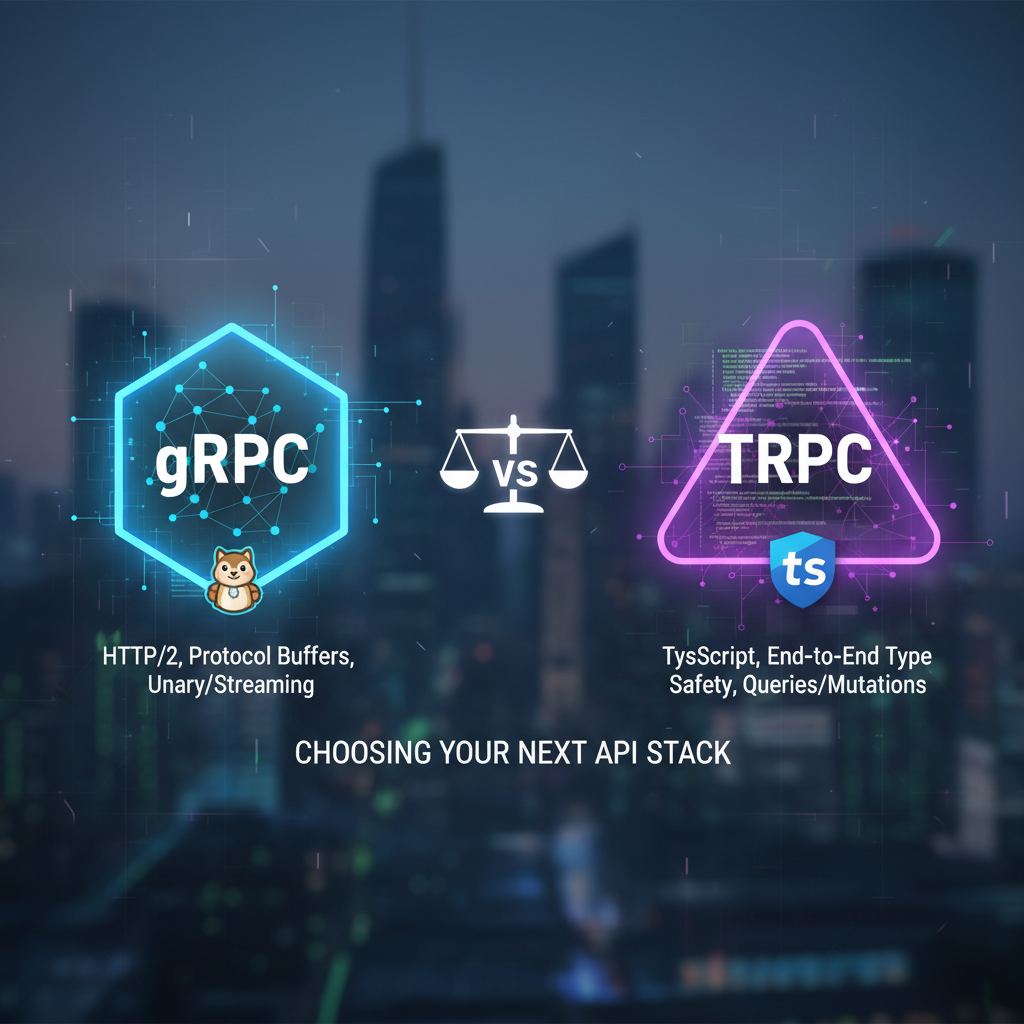


In the rapidly evolving landscape of modern software development, the choice of an Application Programming Interface (API) stack is a foundational decision that impacts everything from performance and scalability to developer experience and long-term maintainability. As systems grow more distributed and complex, developers are constantly seeking protocols and frameworks that can meet the rigorous demands of microservices, real-time applications, and highly interactive user interfaces. This deep dive will thoroughly explore two prominent contenders in the API communication arena: gRPC and tRPC. While both aim to streamline inter-service communication and client-server interactions, they approach these challenges from distinct philosophical standpoints and leverage different underlying technologies. Understanding their core principles, architectural implications, advantages, and disadvantages is crucial for making an informed decision that aligns with your project's unique requirements and your team's expertise. Furthermore, we will examine the indispensable role of an api gateway in managing and securing these diverse API paradigms, ensuring a robust and efficient api ecosystem.
The journey to selecting the optimal api technology is not merely about technical specifications; it’s about weighing trade-offs, considering the future growth of your application, and empowering your development team. As we dissect gRPC and tRPC, we will provide a comprehensive framework to help you navigate these choices, ultimately guiding you toward an api stack that not only performs exceptionally but also fosters a productive and error-resistant development environment.
The Enduring Challenge of API Development
For decades, developers have grappled with the complexities of API design and implementation. The goal has always been clear: create a reliable, efficient, and easily consumable interface for software components to communicate. From SOAP to REST, each paradigm has brought its own set of solutions and, inevitably, its own set of challenges. REST, with its simplicity, ubiquity, and reliance on standard HTTP methods, has dominated the web api space for a considerable period. However, as applications demand higher performance, lower latency, and more rigorous type safety, the limitations of traditional RESTful approaches have become more apparent, particularly in highly distributed microservices architectures or full-stack TypeScript environments.
The need for faster, more efficient communication protocols led to the emergence of technologies like gRPC, which prioritizes performance and structured data exchange. Concurrently, the rise of TypeScript and the desire for end-to-end type safety across the entire application stack spurred the creation of innovative frameworks like tRPC, which focuses intently on developer experience and compile-time guarantees. Both represent significant advancements, but they cater to different sets of priorities and operate within different ecosystems, making the choice between them a nuanced decision for any modern software project. This comparison will equip you with the insights necessary to weigh these factors effectively.
Deep Dive into gRPC: Performance and Polyglot Powerhouse
gRPC, an open-source Remote Procedure Call (RPC) framework initially developed by Google, has rapidly gained traction as a high-performance, language-agnostic communication protocol for modern distributed systems. Its design principles are rooted in efficiency, robust tooling, and seamless interoperability across diverse programming languages. At its core, gRPC enables a client application to directly call methods on a server application located on a different machine as if it were a local object, abstracting away the complexities of network communication. This paradigm shift from resource-oriented REST to method-oriented RPC offers significant advantages for specific use cases.
What is gRPC?
At a fundamental level, gRPC is built upon two key technologies: HTTP/2 for its transport layer and Protocol Buffers (ProtoBuf) as its Interface Definition Language (IDL) and message serialization format. This combination is what gives gRPC its distinct characteristics and performance edge.
HTTP/2, the successor to HTTP/1.1, provides several crucial features that gRPC leverages: 1. Multiplexing: Allows multiple requests and responses to be in flight over a single TCP connection concurrently, eliminating head-of-line blocking and reducing latency. 2. Header Compression (HPACK): Reduces overhead by compressing HTTP headers, which can be substantial in highly verbose API interactions. 3. Server Push: Enables servers to proactively send responses to clients that they anticipate will be needed, though gRPC primarily uses this for its streaming capabilities rather than speculative pushing. 4. Binary Framing: All communications are framed in binary, which is more efficient for machines to parse than text-based protocols.
Protocol Buffers, on the other hand, are a language-neutral, platform-neutral, extensible mechanism for serializing structured data. They are smaller, faster, and simpler than XML or JSON for data serialization. With Protocol Buffers, you define your service methods and message structures in a .proto file. From this definition, gRPC then generates client and server code in various programming languages (e.g., C++, Java, Python, Go, Node.js, C#, Ruby, PHP, Dart, Objective-C). This code generation step is central to gRPC's polyglot nature and its strong type safety, as it ensures that both client and server adhere to the same contract.
How gRPC Works
The workflow of a gRPC interaction typically involves the following steps:
- Define the Service: Developers define their service using Protocol Buffers. This involves specifying message types (the structure of data to be exchanged) and service methods (the callable functions, including their request and response message types). ```protobuf syntax = "proto3";package mypackage;service Greeter { rpc SayHello (HelloRequest) returns (HelloReply); rpc SayHelloStream (HelloRequest) returns (stream HelloReply); // Server streaming rpc RecordGreetings (stream HelloRequest) returns (HelloReply); // Client streaming rpc SayHelloBidirectional (stream HelloRequest) returns (stream HelloReply); // Bidirectional streaming }message HelloRequest { string name = 1; }message HelloReply { string message = 1; }
`` 2. **Generate Code:** Aprotoccompiler is used to generate client stubs (or client SDKs) and server interface code from the.protofile in the desired programming languages. 3. **Implement Server:** The server-side developer implements the service interface generated byprotoc`, providing the actual logic for each RPC method. 4. Implement Client: The client-side developer uses the generated client stub to invoke methods on the remote server, passing structured data as Protocol Buffer messages. 5. Communication: When a client calls a gRPC method, the client library serializes the request parameters into a binary Protocol Buffer message, sends it over an HTTP/2 connection to the server. The server receives the binary data, deserializes it, executes the method, and then serializes the response back to the client.
This entire process is highly optimized, ensuring minimal overhead and efficient data transfer, making gRPC particularly well-suited for high-throughput, low-latency communication between services.
Key Features and Advantages of gRPC
gRPC offers a compelling set of features that address many pain points in modern distributed system design:
- Exceptional Performance:
- HTTP/2 Transport: Leverages the advanced features of HTTP/2, such as multiplexing, header compression, and binary framing, to minimize network overhead and latency. This makes it significantly faster than HTTP/1.1-based REST APIs, especially in environments with many small requests.
- Protocol Buffers: Data is serialized into a compact binary format using Protocol Buffers, which are much smaller and faster to parse than verbose text-based formats like JSON or XML. This reduces bandwidth consumption and processing time on both ends of the connection.
- Persistent Connections: HTTP/2 allows multiple requests over a single TCP connection, reducing connection establishment overhead for subsequent calls.
- Language Agnostic and Strong Interoperability:
- Code Generation: The use of Protocol Buffers and the
protoccompiler generates client and server code in numerous programming languages. This means a service defined once can be consumed by clients written in Go, Java, Python, C#, Node.js, Ruby, and many others, promoting true polyglot development in microservices architectures. - Well-Defined Contracts: The
.protofiles serve as a single source of truth for the API contract, ensuring that all interacting services and clients adhere to the exact same message structures and method signatures, significantly reducing integration bugs.
- Code Generation: The use of Protocol Buffers and the
- Built-in Streaming Capabilities:
- gRPC natively supports four types of service methods, offering great flexibility for real-time and continuous data flows:
- Unary RPC: The classic request-response model, where the client sends a single request and gets a single response.
- Server Streaming RPC: The client sends a single request, and the server responds with a sequence of messages. This is ideal for scenarios like receiving real-time updates or long-lived data feeds.
- Client Streaming RPC: The client sends a sequence of messages to the server, and after all messages are sent, the server responds with a single message. Useful for sending large amounts of data to the server incrementally.
- Bidirectional Streaming RPC: Both client and server send a sequence of messages to each other independently. This is powerful for real-time interactive applications, chat services, or live data synchronization.
- gRPC natively supports four types of service methods, offering great flexibility for real-time and continuous data flows:
- Strong Typing and Schema Enforcement:
- Protocol Buffers enforce strict type checking and schema validation at design time. Any mismatch between client and server data structures will be caught during compilation or code generation, preventing common runtime errors associated with loosely typed APIs. This leads to more robust and reliable systems.
- Robust Tooling and Ecosystem:
- Backed by Google, gRPC has a mature ecosystem with extensive documentation, robust client and server libraries for various languages, and integration with other Google technologies. Tools like
grpc-gatewaycan even generate RESTful JSON APIs from gRPC service definitions, bridging the gap with existing HTTP/1.1 infrastructure.
- Backed by Google, gRPC has a mature ecosystem with extensive documentation, robust client and server libraries for various languages, and integration with other Google technologies. Tools like
- Reduced Payload Size: The binary nature of Protocol Buffers significantly reduces the size of data transmitted over the network compared to text-based formats like JSON or XML. For data-intensive applications or those operating in bandwidth-constrained environments, this can translate into substantial cost savings and performance gains.
Disadvantages and Challenges of gRPC
While gRPC offers many compelling advantages, it also comes with its own set of trade-offs and challenges that developers must consider:
- Limited Browser Support:
- Direct gRPC calls from web browsers are not natively supported due to browsers' lack of direct HTTP/2 frame access and specific CORS requirements. To use gRPC from a web browser, a proxy layer like
gRPC-Webis required. This proxy translates HTTP/1.1 requests from the browser into gRPC messages and vice-versa, adding an extra layer of complexity and potential latency. This makes gRPC less straightforward for direct front-end consumption compared to REST.
- Direct gRPC calls from web browsers are not natively supported due to browsers' lack of direct HTTP/2 frame access and specific CORS requirements. To use gRPC from a web browser, a proxy layer like
- Steeper Learning Curve:
- Developers unfamiliar with RPC concepts, Protocol Buffers, and HTTP/2 might find gRPC more challenging to adopt than traditional REST. Understanding
.protosyntax, the code generation process, and the nuances of streaming RPCs requires a dedicated learning effort. Debugging binary protocols can also be less intuitive than inspecting human-readable JSON.
- Developers unfamiliar with RPC concepts, Protocol Buffers, and HTTP/2 might find gRPC more challenging to adopt than traditional REST. Understanding
- Debugging Complexity:
- The binary nature of gRPC payloads means that debugging tools like browser developer consoles or simple command-line utilities (like
curl) cannot directly inspect gRPC traffic. Specialized tools (e.g.,grpcurl, Postman with gRPC support, or specific proxy tools) are often needed, which can make troubleshooting more cumbersome.
- The binary nature of gRPC payloads means that debugging tools like browser developer consoles or simple command-line utilities (like
- Tooling Maturity (Compared to REST):
- While the gRPC ecosystem is growing, it is still less mature and widespread than the tooling available for REST APIs. For instance, generic
api gatewaysolutions might require specific gRPC modules or configurations to properly proxy, secure, and monitor gRPC traffic. Development environments and testing frameworks for gRPC are also evolving.
- While the gRPC ecosystem is growing, it is still less mature and widespread than the tooling available for REST APIs. For instance, generic
- Human Readability:
- Unlike JSON or XML, Protocol Buffer messages are not human-readable out of the box. This can make it difficult for developers to quickly understand the data being exchanged without specialized tools to decode the binary payloads. This impacts rapid prototyping and manual testing.
- Version Management of
.protoFiles:- Managing changes to
.protofiles in a large microservices architecture can become complex. While Protocol Buffers support backward and forward compatibility, careful planning is required to avoid breaking changes when updating message schemas and service definitions across multiple services and clients.
- Managing changes to
Use Cases for gRPC
Given its strengths and weaknesses, gRPC shines in specific architectural contexts:
- Microservices Communication: Ideal for high-performance, low-latency communication between services within a distributed system. Its efficiency, strong typing, and language agnosticism make it a natural fit for internal service-to-service calls where different microservices might be implemented in various languages.
- Real-time Applications: The streaming capabilities of gRPC are perfect for building applications that require real-time data push from the server (e.g., live dashboards, chat applications, gaming backends) or continuous data flows from the client (e.g., sensor data ingestion).
- Inter-Process Communication (IPC): When processes on the same or different machines need to communicate efficiently, gRPC can serve as a robust IPC mechanism.
- IoT Devices: Due to its compact message format and efficient communication, gRPC is well-suited for resource-constrained IoT devices where bandwidth and power consumption are critical concerns.
- High-Performance Data Streaming: For scenarios involving the continuous transfer of large datasets or streams of events, gRPC's HTTP/2 streaming excels, providing better performance than traditional polling or long-polling over HTTP/1.1.
Deep Dive into tRPC: The TypeScript-First Developer Experience
tRPC, which stands for "TypeScript Remote Procedure Call," emerges from a fundamentally different philosophy than gRPC. While gRPC prioritizes performance and polyglot interoperability through code generation and binary protocols, tRPC is laser-focused on providing an unparalleled developer experience and end-to-end type safety specifically within the TypeScript ecosystem. Its core promise is to let you "call your backend functions directly from your frontend, with full type safety," effectively eliminating the need for manual API schema definitions, client-side data fetching libraries, or complex type generation pipelines.
What is tRPC?
tRPC is a framework that allows you to build fully type-safe APIs without the need for code generation, schema definition languages (like GraphQL SDL or ProtoBuf), or manual type synchronization between your backend and frontend. It achieves this magic by leveraging TypeScript's powerful inference capabilities. When you define your API procedures on the server using TypeScript, tRPC's client library can directly "infer" the types of those procedures, including their inputs and outputs, automatically on the frontend. This means that if you change an api signature on the server, your frontend code will immediately show a TypeScript error at compile time, preventing runtime bugs related to api contract mismatches.
Unlike gRPC, which operates over HTTP/2 with binary Protocol Buffers, tRPC typically uses standard HTTP (often HTTP/1.1) with JSON payloads. It abstracts away the traditional api layer, making server-side functions feel almost like local functions callable from the client. This dramatically simplifies the developer workflow, especially for full-stack TypeScript applications, reducing boilerplate and increasing confidence in data consistency across the stack.
How tRPC Works
The operational model of tRPC is surprisingly elegant due to its reliance on TypeScript inference:
Define Routers on the Server: You define your API "procedures" (functions) within "routers" on your backend. These procedures are regular TypeScript functions that define their input schemas (using a library like Zod for validation) and return data. ```typescript // server/src/routers/post.ts import { z } from 'zod'; import { publicProcedure, router } from '../trpc';export const postRouter = router({ getPosts: publicProcedure .input(z.object({ limit: z.number().min(1).max(100).nullish() })) .query(async ({ input }) => { // In a real app, fetch posts from a database const posts = Array.from({ length: input.limit ?? 10 }).map((_, i) => ({ id: i, title: Post ${i}, content: 'Lorem ipsum...', })); return { posts }; }), createPost: publicProcedure .input(z.object({ title: z.string(), content: z.string() })) .mutation(async ({ input }) => { // In a real app, save post to database const newPost = { id: Math.random(), ...input }; console.log('Created post:', newPost); return newPost; }), }); 2. **Export the App Router:** All individual routers are merged into a single `appRouter` that is exported.typescript // server/src/trpc.ts import { initTRPC } from '@trpc/server'; export const t = initTRPC.create(); export const router = t.router; export const publicProcedure = t.procedure;// server/src/index.ts import { postRouter } from './routers/post'; import { router } from './trpc';export const appRouter = router({ post: postRouter, // ... other routers });export type AppRouter = typeof appRouter; // Export the type! 3. **Create Client-Side Type-Safe Hooks:** On the frontend, you import the `AppRouter` *type* from your backend and use tRPC's client utilities (often integrated with React Query/TanStack Query) to create type-safe hooks. The client library then inspects this type and generates proxy functions that mirror your server procedures.typescript // client/src/utils/trpc.ts import { createTRPCReact } from '@trpc/react-query'; import type { AppRouter } from '../../../server/src'; // Path to your server's AppRouter typeexport const trpc = createTRPCReact();// client/src/App.tsx import { trpc } from './utils/trpc';function App() { const { data: postsData, isLoading } = trpc.post.getPosts.useQuery({ limit: 5 }); const createPostMutation = trpc.post.createPost.useMutation();const handleCreatePost = async () => { await createPostMutation.mutateAsync({ title: 'New Post', content: 'Fantastic content!' }); // Invalidate queries to refetch posts await trpc.post.getPosts.invalidate(); };if (isLoading) returnLoading posts...;return (
Posts
{postsData?.posts.map((post) => (
{post.title}
{post.content}))}Create New Post); } `` 4. **Runtime Communication:** When a client calls a tRPC hook (e.g.,trpc.post.getPosts.useQuery()`), the tRPC client sends a standard HTTP GET or POST request to your tRPC server. The server receives the request, calls the corresponding procedure, and sends back a JSON response. The client then parses the JSON response, and because of the earlier type inference, TypeScript knows exactly what shape that data will take.
This deep integration of TypeScript across both frontend and backend is tRPC's superpower, drastically simplifying development and virtually eliminating an entire class of API-related bugs.
Key Features and Advantages of tRPC
tRPC's design offers a distinct set of benefits, particularly for teams working predominantly in TypeScript:
- End-to-End Type Safety (Zero Runtime Errors):
- This is the paramount feature of tRPC. By inferring types directly from your server code to your client, tRPC ensures that
apicontract mismatches are caught at compile time, not runtime. This eliminates frustrating bugs where the frontend expects one data shape and the backend provides another, leading to a much more reliable application. - Developers gain immense confidence knowing that their client-side
apicalls align perfectly with the server's expectations.
- This is the paramount feature of tRPC. By inferring types directly from your server code to your client, tRPC ensures that
- Exceptional Developer Experience (DX):
- Auto-completion: IDEs provide full auto-completion for
apicalls, inputs, and outputs directly on the client, as if you were calling a local function. This drastically speeds up development and reduces reliance on documentation. - Refactoring Safety: Changing an
apisignature on the server automatically propagates type errors to the client, guiding developers to update client calls without manually searching for affected code. - No Code Generation/Schema Files: Unlike gRPC or GraphQL, tRPC requires no separate schema files or code generation steps. Your TypeScript server code is your
apidefinition, simplifying the build process and reducing boilerplate.
- Auto-completion: IDEs provide full auto-completion for
- Simplicity and Reduced Boilerplate:
- Defining an API becomes as simple as writing a TypeScript function. There's no need to define
apiendpoints, HTTP methods, headers, or request/response bodies explicitly on the client. tRPC handles all this under the hood. - It feels like writing a monolith, even when you're building a distributed application, blurring the lines between client and server code.
- Defining an API becomes as simple as writing a TypeScript function. There's no need to define
- Seamless Integration with React Query (TanStack Query):
- tRPC is designed to integrate beautifully with React Query (and other TanStack Query libraries), providing powerful caching, automatic refetching, background updates, and optimistic UI features out-of-the-box. This handles a huge portion of the data fetching and state management logic effortlessly.
- Reduced Bundle Size (for client):
- Since there's no need for a complex GraphQL client, gRPC-web runtime, or large schema definitions, the client-side bundle size can be smaller, leading to faster loading times for web applications.
- Framework Agnostic (Backend):
- While primarily associated with Node.js/TypeScript backends, tRPC can be integrated with various HTTP servers like Express, Next.js API Routes, Fastify, and more.
Disadvantages and Challenges of tRPC
Despite its developer-centric approach, tRPC has certain limitations that make it unsuitable for all scenarios:
- TypeScript-Only (Major Limitation):
- The most significant constraint of tRPC is its absolute reliance on TypeScript for both the backend and frontend. If your backend is written in a language other than TypeScript (e.g., Go, Python, Java), tRPC is not an option. This makes it unsuitable for polyglot microservices architectures.
- Furthermore, client applications must also be in TypeScript to leverage the end-to-end type safety.
- Limited Ecosystem and Maturity (Newer Technology):
- tRPC is a relatively new framework compared to gRPC or REST. Its community and ecosystem are smaller, meaning fewer third-party integrations, specialized tools, and potentially less community support for niche use cases. This can be a concern for large enterprises looking for battle-tested solutions.
- HTTP/1.1 by Default (Potential Performance Considerations):
- While tRPC can run over HTTP/2, its default implementations often use HTTP/1.1 with JSON. For applications requiring extreme performance, very high throughput, or advanced streaming beyond simple request-response or server-sent events, gRPC's native HTTP/2 and binary serialization might offer superior performance characteristics due to multiplexing and smaller payloads. However, for most web applications, tRPC's performance is more than adequate.
- Monorepo Bias / Tightly Coupled Repositories:
- tRPC works best when the frontend and backend codebases are in a monorepo or are tightly coupled such that the frontend can import the
AppRoutertype directly from the backend. While there are workarounds for polyrepos (e.g., publishing a types-only package), they add complexity and can somewhat diminish the "zero-config" developer experience. - This close coupling means tRPC is less ideal for truly independent teams or public APIs where the client consuming the API is entirely separate and unknown to the backend.
- tRPC works best when the frontend and backend codebases are in a monorepo or are tightly coupled such that the frontend can import the
- Not for Public APIs:
- Because tRPC requires a TypeScript client to get its full benefits, it is generally not suitable for public-facing APIs that need to be consumed by arbitrary clients written in various languages and frameworks. Its strength lies in internal APIs or full-stack applications where you control both ends of the communication.
Use Cases for tRPC
tRPC excels in scenarios where developer experience and end-to-end type safety are paramount:
- Full-Stack TypeScript Applications: The perfect fit for applications where both frontend (e.g., React, Next.js, Vue with Composition API) and backend (Node.js/Express/Next.js API Routes) are written entirely in TypeScript.
- Internal Tools and Dashboards: For internal applications where development speed, maintainability, and reliability within a known team are crucial, tRPC dramatically reduces development time and bug count.
- Rapid Prototyping: Its simplicity and minimal boilerplate make it excellent for quickly building and iterating on new features or entire applications.
- Projects Prioritizing Developer Experience: Teams that value a smooth, error-free development workflow and want to leverage TypeScript's full potential will find tRPC highly rewarding.
- Monorepos: tRPC naturally integrates into monorepo structures, making it incredibly easy to share types and
apidefinitions between client and server.
APIPark is a high-performance AI gateway that allows you to securely access the most comprehensive LLM APIs globally on the APIPark platform, including OpenAI, Anthropic, Mistral, Llama2, Google Gemini, and more.Try APIPark now! 👇👇👇
Comparative Analysis: gRPC vs. tRPC
Choosing between gRPC and tRPC requires a careful evaluation of your project's specific needs, team expertise, and long-term architectural goals. They are fundamentally different tools designed to solve different primary problems, though with some overlapping benefits. Here’s a detailed comparison across key dimensions:
| Feature/Aspect | gRPC | tRPC |
|---|---|---|
| Core Philosophy | High-performance, language-agnostic RPC; efficiency, scale, interoperability. | End-to-end type safety, exceptional developer experience (DX); TypeScript-first. |
| Primary Goal | Efficient inter-service communication in polyglot microservices, real-time data streaming. | Streamlined, type-safe API development for full-stack TypeScript applications. |
| Transport Protocol | HTTP/2 (binary framing, multiplexing, header compression). | HTTP/1.1 (default) or HTTP/2 (JSON payloads). |
| Data Serialization | Protocol Buffers (compact binary format). | JSON (human-readable text format). |
| Schema Definition | .proto files (Interface Definition Language - IDL). |
TypeScript code directly (types inferred). |
| Type Safety | Strong type enforcement via generated code from ProtoBuf IDL. | End-to-end type safety via TypeScript inference from server to client. |
| Language Support | Polyglot (C++, Java, Python, Go, Node.js, C#, etc.). | TypeScript-only (both server and client). |
| Code Generation | Required (client stubs, server interfaces from .proto). |
Not required (types inferred directly from server code). |
| Performance | Extremely high (HTTP/2, binary payloads). Ideal for high throughput, low latency. | Very good (standard HTTP/JSON). Excellent for most web applications. |
| Complexity/Learning | Higher (ProtoBuf, HTTP/2 concepts, tooling). | Lower (familiar TypeScript/HTTP concepts), highly intuitive for TS devs. |
| Debugging | More complex (binary, specialized tools needed). | Simpler (standard HTTP requests, JSON payloads, browser dev tools). |
| Ecosystem/Maturity | Mature, broad, extensive enterprise adoption. | Newer, smaller, growing rapidly, primarily within TS community. |
| Browser Support | Requires gRPC-Web proxy for direct browser calls. | Native browser support (standard HTTP). |
| Public API Suitability | Yes, with considerations for tooling/client libraries. | No, due to TypeScript requirement for consumers. Ideal for internal APIs. |
| Monorepo Suitability | No inherent bias, works well in any setup. | Strong preference for monorepos or tightly coupled repos for optimal DX. |
| Streaming | Unary, Server, Client, Bidirectional streaming natively supported. | Typically unary, can support server-sent events for streaming, but less comprehensive than gRPC. |
Core Philosophy: Performance vs. Developer Experience
This is perhaps the most fundamental differentiator. gRPC is engineered for raw performance, efficiency, and scalability in distributed systems, especially where language barriers exist between services. Its strength lies in optimizing network utilization and enabling high-volume, low-latency inter-service communication. tRPC, on the other hand, prioritizes the developer's journey, aiming to eliminate an entire class of bugs and make API development feel seamless and intuitive within a purely TypeScript environment. It's about type safety and code quality first, with performance being a strong secondary consideration.
Protocol and Serialization: Binary Efficiency vs. Human Readability
gRPC’s reliance on HTTP/2 and Protocol Buffers makes it exceptionally efficient. HTTP/2’s multiplexing and binary framing, combined with ProtoBuf’s compact binary serialization, reduce network overhead and parsing times significantly. This is critical for microservices architectures that involve numerous rapid communications. However, this efficiency comes at the cost of human readability; gRPC payloads are not easily inspectable without specific tools.
tRPC, by contrast, typically uses standard HTTP (often HTTP/1.1) with JSON payloads. This is inherently less performant than gRPC for very high-throughput scenarios due to the text-based nature of JSON and HTTP/1.1’s limitations (e.g., head-of-line blocking if not HTTP/2). However, JSON is universally human-readable and easily debuggable with standard browser developer tools or curl. For most web applications, the performance difference is negligible, and the debugging ease of JSON is a significant advantage for developer productivity.
Type System and Schema Definition: IDL vs. Inference
gRPC uses Protocol Buffers as a strict Interface Definition Language (IDL). This .proto file serves as a canonical contract that is language-agnostic. Code is generated from this IDL for both client and server, guaranteeing type safety and contract adherence across different languages. This approach enforces a strong, explicit contract that is excellent for complex, multi-language systems.
tRPC bypasses explicit IDLs and code generation entirely. It leverages TypeScript's advanced inference system to derive types directly from your backend code and expose them to your frontend. This means your TypeScript code itself is the schema. While this approach is incredibly powerful for TypeScript-only stacks, it fundamentally ties the API definition to the language itself, making it unsuitable for polyglot environments.
Language Support and Interoperability: Polyglot vs. Monoglot
gRPC is inherently polyglot. Its generated code supports a wide array of programming languages, making it the go-to choice for microservices architectures where different services might be implemented in the language best suited for their specific task (e.g., Go for high-concurrency services, Python for machine learning models, Java for enterprise applications). This facilitates diverse teams and technologies working together seamlessly.
tRPC is strictly TypeScript-only. This is its greatest strength for full-stack TypeScript developers but also its most significant limitation. If your backend is not in TypeScript, or if you need to expose an API to clients written in other languages, tRPC is not a viable option. It thrives in homogeneous, end-to-end TypeScript environments.
Browser Support and Public APIs
Direct gRPC from browsers is a challenge, requiring a proxy (gRPC-Web) to translate between HTTP/1.1 (what browsers understand) and HTTP/2 gRPC. This adds an extra layer and potentially impacts performance and debugging. While solutions exist, they add complexity.
tRPC, by contrast, uses standard HTTP and JSON, making it natively compatible with all web browsers without any special proxies. However, because its type-safety benefits depend on TypeScript clients, tRPC is generally not suitable for public APIs where the consumers are external, unknown, and likely not using TypeScript. It shines brightest for internal APIs or applications where you control both the client and server.
The Indispensable Role of an API Gateway in a Diverse API Landscape
Regardless of whether you choose gRPC, tRPC, traditional REST, or a combination thereof, the management of your API ecosystem quickly becomes a complex undertaking, especially as your application scales and the number of apis grows. This is where an api gateway becomes an absolutely critical component of your infrastructure. An api gateway acts as a single entry point for all client requests, routing them to the appropriate backend services. More than just a traffic director, it is a powerful gateway that provides a centralized control plane for crucial concerns like security, observability, and traffic management.
An api gateway is not just a tool; it's a strategic architectural pattern that brings order to the potential chaos of a microservices environment. It aggregates, abstracts, and enhances your backend apis, offering a unified, secure, and performant interface to your consumers, whether they are internal microservices, external partners, or client applications.
What an API Gateway Does
A robust api gateway provides a wide array of functionalities that are essential for modern api management:
- Request Routing and Load Balancing: The primary function is to receive all incoming
apirequests and intelligently route them to the correct backend service based on defined rules (e.g., path, headers, query parameters). It also distributes traffic across multiple instances of a service to ensure high availability and optimal performance, effectively acting as a reverse proxy. - Authentication and Authorization: It acts as the first line of defense, authenticating incoming requests before they reach your backend services. This offloads security concerns from individual microservices, simplifying their development. It can integrate with various identity providers and enforce authorization policies.
- Rate Limiting and Throttling: Protects backend services from being overwhelmed by too many requests. It can enforce limits on the number of requests a client can make within a certain timeframe, preventing abuse and ensuring fair usage.
- Monitoring and Analytics: Collects metrics and logs all
apicalls, providing invaluable insights intoapiusage, performance, and potential issues. This data is crucial for performance optimization, capacity planning, and troubleshooting. - Caching: Can cache responses for frequently requested data, reducing the load on backend services and improving response times for clients.
- Protocol Translation: A crucial feature, especially when dealing with diverse
apiprotocols. For gRPC, anapi gatewaycan translate HTTP/1.1 requests (e.g., from browsers via gRPC-Web) into gRPC calls, making gRPC services consumable by web clients without direct gRPC support. Similarly, it can handle standard HTTP/JSON for tRPC services. apiComposition and Aggregation: Can combine multiple backend service calls into a singleapiresponse, reducing chatty communication between client and server and simplifying client logic.- Version Management: Facilitates seamless
apiversioning, allowing you to run multiple versions of anapiconcurrently and gracefully transition clients to newer versions. - Security Policies: Enforces security policies like IP whitelisting/blacklisting, WAF (Web Application Firewall) rules, and SSL/TLS termination, providing a centralized security layer.
API Gateway in the Context of gRPC and tRPC
For both gRPC and tRPC, an api gateway serves distinct yet equally important roles:
- For gRPC: An
api gatewayis almost a necessity for any gRPC service that needs to be consumed by web browsers or managed centrally. It provides the crucial gRPC-Web proxy functionality, translating browser-friendly HTTP/1.1 calls into gRPC's HTTP/2 binary protocol. Beyond this, it handles load balancing across gRPC service instances, applies centralized authentication, and provides observability into gRPC traffic, which is otherwise difficult to inspect. Without agateway, managing and exposing gRPC services effectively can be significantly more complex, especially in hybrid environments. - For tRPC: While tRPC doesn't require a protocol translation layer, an
api gatewaystill offers immense value. Since tRPC uses standard HTTP, thegatewaycan apply all its traditional HTTP management capabilities: rate limiting, request routing, centralized authentication/authorization, caching, and robust monitoring. It ensures that even highly performant and developer-friendly tRPC services are secure, stable, and observable within a largerapiecosystem. It acts as a shield, protecting your backend tRPC services from direct exposure and providing a consistent interface.
In essence, an api gateway elevates your api strategy from individual service endpoints to a cohesive, well-managed, and secure api product. It decouples clients from backend implementation details, adds resilience, and provides the necessary controls for scaling and operating a complex api landscape.
Introducing APIPark: An Open Source AI Gateway & API Management Platform
When dealing with a diverse set of APIs, including those built with gRPC, tRPC, or traditional REST, an advanced api gateway becomes indispensable for both internal service-to-service communication and external exposure. Platforms like APIPark offer comprehensive solutions for managing the entire API lifecycle, offering both an open-source option and commercial support for enterprises.
APIPark is an all-in-one AI gateway and API developer portal that is open-sourced under the Apache 2.0 license. It's designed to help developers and enterprises manage, integrate, and deploy AI and REST services with ease, but its powerful gateway capabilities extend to managing any type of API, providing a unified api gateway solution regardless of the underlying protocol. This allows you to orchestrate various APIs, including those leveraging gRPC for high-performance internal communication and tRPC for seamless full-stack TypeScript applications, all under a single, robust management platform.
Here’s how APIPark’s features are highly relevant to building and managing a modern API stack, encompassing gRPC and tRPC:
- End-to-End API Lifecycle Management: APIPark assists with managing the entire lifecycle of APIs, from design and publication to invocation and decommissioning. This includes regulating API management processes, managing traffic forwarding, load balancing, and versioning of published APIs. Whether you’re deploying a new gRPC service or a tRPC-powered microservice, APIPark ensures consistent governance.
- Performance Rivaling Nginx: With just an 8-core CPU and 8GB of memory, APIPark can achieve over 20,000 TPS, supporting cluster deployment to handle large-scale traffic. This high performance ensures that your
api gatewayitself doesn't become a bottleneck, crucial for both high-throughput gRPC services and frequently accessed tRPC endpoints. - Detailed API Call Logging and Powerful Data Analysis: APIPark provides comprehensive logging capabilities, recording every detail of each API call. This allows businesses to quickly trace and troubleshoot issues in API calls – invaluable for debugging gRPC's binary traffic or understanding tRPC's HTTP interactions. Furthermore, it analyzes historical call data to display long-term trends and performance changes, helping with preventive maintenance.
- Independent API and Access Permissions for Each Tenant: APIPark enables the creation of multiple teams (tenants), each with independent applications, data, user configurations, and security policies. This is vital for managing access to different internal gRPC or tRPC services for various development teams or external partners, enhancing security and organization.
- API Resource Access Requires Approval: APIPark allows for the activation of subscription approval features, ensuring that callers must subscribe to an API and await administrator approval before they can invoke it. This prevents unauthorized API calls and potential data breaches, offering an essential security layer for all your APIs.
- API Service Sharing within Teams: The platform allows for the centralized display of all API services, making it easy for different departments and teams to find and use the required API services. This improves discoverability and collaboration across an organization, whether teams are consuming gRPC services or integrating with tRPC backends.
- Quick Integration of 100+ AI Models & Unified API Format for AI Invocation (as an AI Gateway): While primarily an AI gateway, APIPark's ability to unify and manage different AI models demonstrates its core strength in handling diverse API types. It standardizes request data formats, ensuring that changes in underlying models or prompts do not affect the application or microservices. This capability showcases its flexibility in abstracting complexities, a principle that applies equally to managing various RPC and REST APIs. Users can also quickly combine AI models with custom prompts to create new APIs, effectively turning complex AI functionalities into easily consumable REST APIs, which can then be governed alongside gRPC and tRPC endpoints.
By deploying a robust api gateway like APIPark, organizations can effectively manage the complexities introduced by adopting diverse api technologies like gRPC and tRPC, ensuring security, performance, and seamless operation across their entire api landscape.
Choosing Your Next API Stack: A Decision Framework
The choice between gRPC and tRPC, or indeed any api technology, is rarely black and white. It hinges on a multitude of factors specific to your project, team, and organizational context. Here’s a structured framework to guide your decision-making process:
1. Project Type and Scope
- Internal Microservices Communication (Polyglot): If you're building a large-scale microservices architecture where different services might be written in various programming languages (Go, Java, Python, Node.js, etc.) and require high performance and low latency for inter-service communication, gRPC is likely the superior choice. Its language agnosticism, efficiency, and robust streaming capabilities are ideal for this scenario.
- Full-Stack TypeScript Application (Monorepo/Tightly Coupled): If your entire application (frontend and backend) is built using TypeScript, especially within a monorepo or tightly coupled repositories, and you prioritize developer experience and end-to-end type safety above all else, then tRPC is an excellent fit. It will drastically speed up development and virtually eliminate a class of runtime errors.
- Public/External APIs: For APIs that need to be consumed by unknown external clients using a variety of languages and frameworks, neither gRPC (without gRPC-Web proxy considerations) nor tRPC (due to its TypeScript client dependency) are ideal out-of-the-box solutions. Traditional REST or GraphQL might be more suitable, offering broader compatibility and easier consumption. However, gRPC can be exposed publicly with appropriate
api gatewaytooling for specific high-performance use cases. - Real-time Data Streaming / IoT: For applications requiring continuous, bidirectional data streams or communication with resource-constrained IoT devices, gRPC's native streaming and binary protocol offer a significant advantage.
2. Team Skillset and Familiarity
- Strong TypeScript Expertise: If your team is deeply proficient in TypeScript and values the benefits of a fully type-safe development experience, tRPC will have a much lower learning curve and higher adoption rate. Developers will feel productive almost immediately.
- Familiarity with RPC/Protocol Buffers: If your team has prior experience with RPC concepts, schema definition languages, and understanding binary protocols, or if they are willing to invest in learning them, gRPC is a viable option. Otherwise, the initial ramp-up time might be higher.
- Polyglot Team: If your team comprises developers working in different programming languages, gRPC's language agnosticism will be a major asset, enabling seamless collaboration and integration across the different tech stacks.
3. Performance Requirements
- Extreme Performance, Low Latency, High Throughput: For scenarios where every millisecond and byte counts, such as high-frequency trading platforms, real-time analytics, or demanding microservices interactions, gRPC's HTTP/2 and binary Protocol Buffers will outperform tRPC's typical HTTP/JSON stack.
- General Web Application Performance: For most web applications, where network latency is often dominated by other factors (e.g., database queries, client-side rendering), tRPC's performance with standard HTTP/JSON is generally more than sufficient. The developer experience benefits often outweigh any marginal performance gains from gRPC.
4. Architectural Considerations
- Monorepo vs. Polyrepo: tRPC thrives in monorepos where the client can directly import server-side types. While workarounds exist for polyrepos, they add complexity. gRPC has no specific bias here.
- Existing Infrastructure: Consider your current infrastructure. Do you already have an
api gatewaythat supports gRPC, or can it be easily configured to do so? Are your deployment pipelines set up to handle code generation for gRPC? For tRPC, it integrates well with standard Node.js/HTTP server setups. - Future Scalability and Maintenance: Both frameworks are scalable. gRPC offers robust solutions for large-scale distributed systems. tRPC's type safety improves maintainability, reducing the likelihood of API-related bugs as the codebase grows.
5. Ecosystem and Maturity
- Battle-Tested, Enterprise-Grade: gRPC is a mature, battle-tested technology with significant adoption in large enterprises and a broad ecosystem. If stability, extensive tooling, and long-term support are critical, gRPC offers a safer bet in many enterprise contexts.
- Rapid Innovation, Modern Tooling: tRPC is newer and rapidly evolving, often integrating with the latest frontend technologies (e.g., React Query). If you're comfortable with a slightly smaller community and faster iteration cycles, and prioritize cutting-edge DX, tRPC might appeal more.
The Role of the API Gateway in Your Decision
Crucially, the presence of a robust api gateway can significantly influence your choice and mitigate some of the challenges associated with both gRPC and tRPC. An api gateway like APIPark can:
- Bridge Gaps: Translate gRPC to HTTP/1.1 for browser clients, making gRPC more accessible.
- Unify Management: Centralize security, monitoring, rate limiting, and routing for all your APIs, regardless of whether they are gRPC, tRPC, or REST. This means you can leverage the specific strengths of each protocol for different parts of your application while maintaining a consistent management plane.
- Abstract Complexity: Hide the underlying protocol details from clients, simplifying consumption.
- Enhance Security and Observability: Provide critical features like authentication, authorization, detailed logging, and analytics across your entire
apilandscape.
Therefore, your choice of api stack shouldn't be made in a vacuum. A comprehensive api strategy that includes an advanced api gateway can empower you to select the best tool for each specific job, knowing that the overall api ecosystem remains manageable, secure, and performant.
Conclusion
The debate between gRPC and tRPC is not about identifying a universally "better" technology, but rather about understanding which tool is best suited for a particular problem domain. Both represent significant advancements in API communication, each excelling in distinct areas and catering to different sets of priorities for modern developers.
gRPC stands out as a powerful, performance-oriented framework, ideal for high-throughput, low-latency inter-service communication within polyglot microservices architectures. Its reliance on HTTP/2 and Protocol Buffers delivers exceptional efficiency, strong typing through generated code, and robust streaming capabilities, making it a cornerstone for complex, distributed systems where raw performance and language interoperability are paramount.
tRPC, conversely, shines in the realm of full-stack TypeScript development, offering an unparalleled developer experience and end-to-end type safety. By leveraging TypeScript's inference, it virtually eliminates an entire class of API-related bugs, making API development feel intuitive and seamless. It's the go-to choice for teams building homogeneous TypeScript applications who prioritize rapid development, compile-time guarantees, and an enjoyable coding workflow.
The decision-making process requires a careful evaluation of your project's technical requirements, team's skill set, architectural goals, and long-term vision. Considerations such as the need for polyglot support, performance demands, the type of client consuming the API, and the preference for monorepos versus polyrepos will heavily influence the optimal choice.
Crucially, regardless of your chosen API stack, the implementation of a robust api gateway is an indispensable component of a resilient and scalable API ecosystem. An api gateway, acting as a central gateway for all incoming requests, provides a unified layer for security, traffic management, monitoring, and even protocol translation. Platforms like APIPark exemplify how a modern api gateway can effectively manage diverse API paradigms—whether they are high-performance gRPC services or developer-friendly tRPC endpoints—ensuring consistency, security, and optimal performance across your entire api landscape.
In conclusion, both gRPC and tRPC are excellent technologies designed to solve specific problems in modern API development. By understanding their strengths, weaknesses, and the crucial role of an api gateway, developers can make informed decisions that empower their teams to build robust, efficient, and maintainable applications well into the future.
Frequently Asked Questions (FAQs)
1. When should I choose gRPC over tRPC? You should choose gRPC when your primary concerns are maximum performance, low latency, and efficient communication between services in a polyglot microservices architecture. It's ideal for scenarios requiring real-time data streaming, language-agnostic service integration, or communication with resource-constrained devices like IoT. If your backend services are written in multiple languages (e.g., Go, Java, Python) and you need a consistent, strongly typed contract across all of them, gRPC is the better fit.
2. When is tRPC the better choice for my API stack? tRPC is the superior choice when you are building a full-stack application entirely within the TypeScript ecosystem, especially if you prioritize an exceptional developer experience and end-to-end type safety. It excels in monorepos or tightly coupled repositories where the frontend can directly infer types from the backend, virtually eliminating API contract errors at runtime. For internal tools, dashboards, or rapid prototyping where the entire stack is TypeScript, tRPC significantly boosts productivity and reduces bugs.
3. Can gRPC and tRPC be used together in the same application? Yes, it is entirely possible and often advantageous to use gRPC and tRPC in different parts of a larger application. For instance, you might use gRPC for high-performance internal service-to-service communication between different microservices (some written in Go, some in Python), and then use tRPC for your full-stack TypeScript frontend to communicate with a specific Node.js/TypeScript backend service. An api gateway is crucial in such hybrid architectures to manage and secure traffic for both protocols.
4. What role does an api gateway play when using gRPC or tRPC? An api gateway is a critical component that acts as a single entry point for all API requests. For gRPC, it can provide essential features like gRPC-Web proxying (to enable browser compatibility), load balancing, authentication, and monitoring of binary traffic. For tRPC, while not strictly necessary for protocol translation, a gateway still provides vital functionalities such as centralized authentication/authorization, rate limiting, logging, caching, and robust traffic management for its HTTP/JSON endpoints. It ensures that both types of APIs are secure, performant, and easily observable within a unified management plane, abstracting complexity from clients.
5. How do gRPC and tRPC handle API versioning and schema changes? gRPC manages API versioning and schema changes through its .proto files and Protocol Buffers. ProtoBuf is designed for backward and forward compatibility, allowing you to add new fields (with appropriate tags) without breaking existing clients/servers. Breaking changes, however, require careful planning and often new service versions. tRPC, being TypeScript-based, handles schema changes by simply modifying the TypeScript types on the server. Any breaking change will immediately result in a compile-time error on the frontend, guiding developers to update client code accordingly. This immediate feedback loop is a core advantage of tRPC's approach to type safety.
🚀You can securely and efficiently call the OpenAI API on APIPark in just two steps:
Step 1: Deploy the APIPark AI gateway in 5 minutes.
APIPark is developed based on Golang, offering strong product performance and low development and maintenance costs. You can deploy APIPark with a single command line.
curl -sSO https://download.apipark.com/install/quick-start.sh; bash quick-start.sh

In my experience, you can see the successful deployment interface within 5 to 10 minutes. Then, you can log in to APIPark using your account.

Step 2: Call the OpenAI API.