gRPC vs tRPC: Which RPC Framework is Right for You?


In the rapidly evolving landscape of distributed systems and microservices architectures, the choice of a Remote Procedure Call (RPC) framework profoundly impacts application performance, developer experience, and system maintainability. As organizations strive for ever-increasing efficiency and scalability, they often find themselves at a crossroads, evaluating various RPC technologies. Among the leading contenders that have garnered significant attention are gRPC, a battle-tested framework from Google, and tRPC, a modern, TypeScript-first solution gaining traction in the web development community. Both offer distinct advantages and address different sets of challenges, making the decision between them a nuanced one.
This comprehensive exploration delves into the intricacies of gRPC and tRPC, dissecting their core principles, architectural designs, feature sets, and operational considerations. We aim to provide a detailed comparison that illuminates their strengths and weaknesses, offering a clear perspective on when each framework is best suited for particular use cases. By the end of this article, developers, architects, and technical leaders will possess a robust understanding necessary to make an informed decision, optimizing their api communication strategies for the future.
Understanding the Core: What is RPC?
Before we dive into the specifics of gRPC and tRPC, it's crucial to establish a foundational understanding of what RPC is and why it's a cornerstone of modern distributed computing. Remote Procedure Call (RPC) is a protocol that allows a program to request a service from a program located on another computer on a network without having to understand the network's details. The programmer writes the same code whether the subroutine is local or remote. This abstraction simplifies the development of distributed applications, making remote function calls feel almost as natural as local ones.
Historically, RPC mechanisms have been around for decades, evolving from early systems like Sun RPC to more sophisticated approaches. The fundamental idea remains consistent: abstract away the complexities of network communication. When a client makes an RPC call, the underlying RPC system serializes the parameters, transmits them over the network to a remote server, deserializes them, executes the remote procedure, and then returns the results in a similar fashion. This elegant simplification dramatically reduces the burden on developers, allowing them to focus on business logic rather than low-level networking concerns.
The benefits of RPC in building robust and scalable systems are numerous. Firstly, it promotes modularity and separation of concerns, enabling different services to be developed, deployed, and scaled independently. This is particularly vital in microservices architectures, where applications are broken down into small, independently deployable services that communicate over the network. Secondly, RPC frameworks often come with built-in mechanisms for handling common distributed computing challenges such as serialization, deserialization, network errors, and retries, thereby improving system reliability. Thirdly, by standardizing the communication contract between services, RPC facilitates clearer api definitions and easier integration across heterogeneous environments.
However, the effectiveness of an RPC framework heavily depends on its design choices, particularly concerning data serialization, underlying transport protocols, and language support. The choice between efficient binary serialization and human-readable text formats, or between lightweight HTTP/1.1 and high-performance HTTP/2, can significantly impact performance, interoperability, and development overhead. This context sets the stage for our detailed examination of gRPC and tRPC, two modern RPC frameworks that embody different philosophies and technical approaches to these challenges.
Deep Dive into gRPC: Google's High-Performance RPC Framework
gRPC, an open-source RPC framework developed by Google, has become a stalwart in the realm of high-performance, polyglot microservices communication. Released in 2015, gRPC was designed from the ground up to address the demands of large-scale, distributed systems, drawing heavily on Google's vast experience with internal RPC systems like Stubby. It distinguishes itself through its strong emphasis on efficiency, reliability, and interoperability across a wide range of programming languages.
What is gRPC?
At its heart, gRPC is a modern RPC framework that leverages HTTP/2 for transport, Protocol Buffers (Protobuf) as its Interface Definition Language (IDL) and message interchange format, and provides features like authentication, load balancing, health checking, and more. Its primary goal is to facilitate efficient and low-latency communication between services, making it an ideal choice for connecting microservices, mobile clients to backend services, and IoT devices. The "g" in gRPC originally stood for different things in different versions, but it's now simply gRPC, echoing its recursive acronym nature.
Core Concepts of gRPC
The robustness and efficiency of gRPC stem from several foundational concepts:
- Protocol Buffers (Protobuf): This is gRPC's default and recommended IDL and serialization mechanism. Protobuf is a language-neutral, platform-neutral, extensible mechanism for serializing structured data. Unlike XML or JSON, Protobuf messages are binary, making them much smaller, faster to parse, and more efficient to transmit over the network. Developers define their service methods and message structures in
.protofiles, which then serve as the contract for communication. These definitions are compiled into client and server-side code in various programming languages, ensuring strong type-checking and preventing common data marshaling errors. For example, a simple message might look like this: ```protobuf syntax = "proto3";package mypackage;message HelloRequest { string name = 1; }message HelloReply { string message = 1; }service Greeter { rpc SayHello (HelloRequest) returns (HelloReply) {} }`` ThisGreeterservice defines a singleSayHellomethod that takes aHelloRequestand returns aHelloReply. The numbers1inname = 1` are field tags, which are crucial for backward compatibility and efficient serialization. - HTTP/2: gRPC mandates HTTP/2 as its underlying transport protocol. HTTP/2 offers significant advantages over HTTP/1.x, particularly in terms of performance. Key features include:
- Binary Framing: HTTP/2 messages are broken down into binary frames, which makes them more efficient to parse and transmit.
- Multiplexing: Multiple requests and responses can be sent concurrently over a single TCP connection. This eliminates the "head-of-line blocking" issue prevalent in HTTP/1.x, where only one request could be processed at a time per connection.
- Header Compression (HPACK): HTTP/2 uses HPACK compression to reduce the size of request and response headers, which often contain redundant information across multiple requests.
- Server Push: Although less commonly used directly by gRPC itself, HTTP/2 supports server push, allowing a server to send resources to a client before the client explicitly requests them. These features collectively contribute to lower latency and higher throughput, especially in environments with numerous small messages or high concurrency.
- gRPC Communication Patterns (RPC Types): gRPC supports four fundamental types of service methods, offering flexibility for various interaction models:
- Unary RPC: The most straightforward pattern, where the client sends a single request message to the server and gets a single response message back. This is analogous to a traditional function call or a typical REST API request-response cycle.
- Server-Streaming RPC: The client sends a single request message to the server, and the server responds with a sequence of messages. After sending all its messages, the server indicates completion. This is useful for scenarios like receiving continuous updates (e.g., stock quotes, log streams) where the server needs to push multiple data points over time for a single client request.
- Client-Streaming RPC: The client sends a sequence of messages to the server using a stream. Once the client has finished sending its messages, it waits for the server to send back a single response message. This pattern is suitable for situations where the client needs to send a large amount of data or a series of events to the server, such as uploading a large file in chunks or sending a stream of sensor readings.
- Bi-directional Streaming RPC: Both the client and the server send a sequence of messages to each other, independently. The two streams operate concurrently, and either side can read or write messages in any order. This powerful pattern enables real-time, interactive communication, ideal for chat applications, online gaming, or real-time data synchronization.
- Interceptors: gRPC provides interceptors (similar to middleware) that can be chained together on both the client and server sides. These allow for common functionality to be applied to RPC calls, such as authentication, logging, monitoring, error handling, and rate limiting, without cluttering the core business logic. For instance, a server-side interceptor could inspect the incoming request's metadata to validate an API key before the request reaches the actual service method.
gRPC Architecture
The architecture of a gRPC application involves several layers working in concert:
- Service Definition (.proto file): The starting point, defining the service interface and message structures using Protobuf.
- Code Generation: The
protoccompiler (Protobuf compiler) generates client-side stubs (also called proxies or clients) and server-side interfaces (or abstract base classes) in the chosen programming languages. These generated files contain the necessary serialization/deserialization logic and network communication boilerplate. - Client Implementation: The client application uses the generated client stub to invoke remote methods as if they were local. The stub serializes the request, sends it over the network via gRPC runtime, and deserializes the response.
- Server Implementation: The server application implements the generated service interface, providing the actual business logic for each RPC method. The gRPC server handles incoming requests, deserializes them, invokes the appropriate server method, serializes the response, and sends it back to the client.
- gRPC Runtime: This is the underlying library that handles the HTTP/2 transport, stream management, connection pooling, and error handling.
Key Features and Benefits of gRPC
- High Performance and Efficiency: Leveraging HTTP/2 and Protobuf, gRPC significantly reduces network overhead and improves throughput compared to traditional REST over HTTP/1.x with JSON. Binary serialization results in smaller payloads, and multiplexing reduces latency.
- Polyglot Support: gRPC offers first-class support for a wide array of programming languages, including C++, Java, Python, Go, Node.js, C#, Ruby, PHP, and Dart. This makes it an excellent choice for heterogeneous environments where different services might be written in different languages, promoting seamless interoperability.
- Strong Type Safety: The use of Protobuf for defining service contracts ensures strong type checking at compile-time across all supported languages. This eliminates many common data-related errors and provides better developer tooling, such as auto-completion and static analysis.
- Streaming Capabilities: The built-in support for server-streaming, client-streaming, and bi-directional streaming makes gRPC highly suitable for real-time applications, long-lived connections, and scenarios requiring continuous data flow.
- Robust Ecosystem: Being backed by Google, gRPC has a mature ecosystem with extensive documentation, tooling, and community support. It integrates well with other Google technologies and cloud services.
- Built-in Features: gRPC comes with out-of-the-box features for authentication (SSL/TLS), load balancing, health checking, and retry mechanisms, simplifying the development of resilient distributed systems.
Drawbacks and Challenges of gRPC
- Steeper Learning Curve: For developers unfamiliar with Protobuf or HTTP/2 specifics, gRPC can have a steeper learning curve compared to REST with JSON. Understanding
.protosyntax, code generation, and streaming paradigms requires an initial investment of time. - Browser Support Limitations: Direct gRPC calls from web browsers are not natively supported due to the lack of HTTP/2 framing API in browsers and the binary nature of Protobuf. This typically necessitates the use of a proxy layer (like
gRPC-Web) to translate HTTP/1.1 requests from browsers into gRPC requests. - Protobuf Schema Management: As systems grow, managing a large number of
.protofiles across different services can become complex, requiring careful versioning and dependency management. Changes to schemas must be handled with backward compatibility in mind. - Debugging Complexity: Debugging gRPC communication can be more challenging than debugging text-based HTTP/1.1 requests (e.g., with
curlor browser developer tools) due to its binary nature and reliance on HTTP/2. Specialized tools are often required. - Human Readability: While efficient for machines, Protobuf's binary format is not human-readable, which can complicate manual inspection of payloads during development or troubleshooting.
Use Cases for gRPC
gRPC shines in environments demanding high performance, low latency, and robust interoperability:
- Microservices Communication: Ideal for inter-service communication within a microservices architecture, where services need to communicate efficiently and reliably.
- Mobile and IoT Devices: Its efficiency and small payload size make it excellent for resource-constrained devices or mobile applications communicating with backend services, optimizing battery life and data usage.
- Real-time Data Streaming: Perfect for applications requiring real-time data push, such as live updates, notifications, chat applications, or telemetry data ingestion.
- Multi-language Environments: When an organization uses multiple programming languages across different teams or services, gRPC's polyglot support ensures seamless integration.
- High-Throughput Data Pipelines: Efficiently moving large volumes of data between different processing stages.
For complex api environments, especially those involving diverse protocols and AI models, an advanced api gateway like APIPark can provide a unified interface, ensuring consistent management and security policies across your gRPC, tRPC, and even REST services. This centralizes control, simplifies development, and enhances the overall resilience of your distributed system.
Deep Dive into tRPC: The TypeScript-First RPC for End-to-End Type Safety
While gRPC caters to broad, polyglot, high-performance needs, tRPC (short for TypeScript RPC) addresses a more specific, yet increasingly common, niche: full-stack TypeScript applications where end-to-end type safety and an unparalleled developer experience are paramount. Born out of the desire to eliminate manual type synchronization between frontend and backend in TypeScript projects, tRPC has rapidly gained popularity among developers working with technologies like React, Next.js, and Node.js.
What is tRPC?
tRPC is a lightweight RPC framework that allows you to build fully type-safe APIs without the need for schema generation or code generation. It achieves this by inferring types directly from your backend code and making them available on the frontend. The core idea is to leverage the TypeScript compiler as the single source of truth for your API contract, thus ensuring that your frontend calls exactly match your backend procedures, catching type mismatches at compile time rather than runtime. This dramatically reduces the potential for bugs and enhances developer velocity.
Core Concepts of tRPC
tRPC's innovative approach is built upon a few key concepts that set it apart:
- End-to-End Type Safety: This is the cornerstone of tRPC. By writing your API procedures in TypeScript on the backend and exporting their types, tRPC allows your frontend to consume these types directly. When you call a backend procedure from your frontend, TypeScript ensures that the parameters you pass match the expected types and that the response you receive also adheres to the defined return types. This eliminates the need for manual type declarations, generated schema files (like Protobuf or GraphQL schemas), or runtime validation. Consider a simple example: ```typescript // Backend (server/trpc.ts) import { initTRPC } from '@trpc/server'; import { z } from 'zod'; // For input validationconst t = initTRPC.create();const appRouter = t.router({ greeting: t.procedure .input(z.object({ name: z.string().optional() })) .query(({ input }) => { return { text:
Hello ${input?.name ?? 'world'}}; }), postMessage: t.procedure .input(z.object({ message: z.string().min(1) })) .mutation(({ input }) => { // Logic to save message return { status: 'success', message: input.message }; }), });export type AppRouter = typeof appRouter;// Frontend (client/index.ts) import { createTRPCReact } from '@trpc/react-query'; import type { AppRouter } from '../server/trpc'; // Import type directlyexport const trpc = createTRPCReact();// Usage in a React component: function MyComponent() { const helloQuery = trpc.greeting.useQuery({ name: 'Alice' }); const postMutation = trpc.postMessage.useMutation();if (helloQuery.isLoading) returnLoading...; if (helloQuery.isError) returnError!;return ({helloQuery.data.text}postMutation.mutate({ message: 'Hello tRPC!' })}> Post Message ); }`` In this example, the frontendtrpc.greeting.useQueryautomatically infers thenameparameter as optional string and thetextproperty of the response, directly from the backendappRouter`. - TypeScript Inference, Not Code Generation: Unlike gRPC which relies on
protocto generate code from.protofiles, tRPC leverages TypeScript's powerful inference capabilities. When you define your API procedures on the backend using tRPC helpers, TypeScript automatically understands their input and output types. By exposing the type of your backend router to the frontend, the frontend client can infer all the necessary types without any intermediate code generation step. This significantly simplifies the development workflow and eliminates the need for build steps purely for API types. - No Schema Files (IDL): Because types are inferred directly from your TypeScript code, there's no separate Interface Definition Language (IDL) file to maintain, unlike Protobuf for gRPC or GraphQL schema files. Your TypeScript code itself is the schema. This reduces boilerplate and keeps your API contract close to your implementation.
- Queries and Mutations: tRPC adopts a nomenclature similar to GraphQL, categorizing API procedures into
queriesfor fetching data (read operations) andmutationsfor sending data or triggering side effects (write operations). This clear distinction helps structure APIs logically and often integrates seamlessly with caching libraries like React Query or SWR. - Small Bundle Size: tRPC itself is very lightweight. It doesn't ship a large runtime or require extensive client-side libraries. Since much of its magic happens at compile time via TypeScript inference, the runtime footprint is minimal, which is beneficial for web applications.
tRPC Architecture
The architecture of a tRPC application is typically simpler and more vertically integrated than gRPC, largely due to its TypeScript-centric nature:
- Backend Definition: The backend defines a
tRPC routercomposed ofprocedures. Each procedure specifies its input validation (often using Zod for schema definition and validation) and its resolver function, which contains the business logic. - Type Export: The type of the entire backend router is exported from the backend.
- Frontend Client: The frontend imports this router type and uses the
createTRPCReact(for React) orcreateTRPCProxyClient(for vanilla JS/TS) utility to create a type-safe client. - Communication: When a frontend calls a procedure (e.g.,
trpc.greeting.useQuery(...)), the tRPC client makes a standard HTTP request (GET for queries, POST for mutations) to the backend. The data is typically sent as JSON. - Backend Resolver: The backend tRPC server receives the HTTP request, validates the input against the Zod schema, invokes the corresponding procedure's resolver, and sends the JSON response back.
- Type Safety in Action: Throughout this process, TypeScript continuously verifies that the data shapes match, providing instant feedback in your IDE if there's any mismatch between what the frontend expects and what the backend provides.
Key Features and Benefits of tRPC
- Unparalleled End-to-End Type Safety: This is tRPC's killer feature. It eliminates an entire class of runtime errors related to API contract mismatches, dramatically improving reliability and reducing debugging time. Refactoring is also much safer, as TypeScript catches breaking changes across the stack immediately.
- Exceptional Developer Experience (DX): The seamless type inference provides excellent auto-completion in IDEs for both parameters and return types. This makes developing and consuming APIs feel incredibly intuitive and fast, almost like calling a local function.
- Zero Code Generation: Developers don't need to run any extra build steps for type or API code generation, simplifying the development pipeline and reducing friction.
- Automatic Input Validation: Integration with libraries like Zod allows for robust input validation directly within the API definition, ensuring data integrity before it reaches business logic.
- Easy Integration with Frontend State Management: tRPC provides adapters for popular React state management libraries like React Query (TanStack Query) and SWR, offering automatic caching, revalidation, and loading states out of the box.
- Lightweight and Performant: It leverages standard HTTP and JSON, and its minimal runtime footprint makes it performant for typical web application scenarios.
- Simplified API Evolution: Because types are inferred, evolving your API is often as simple as changing the backend code and letting TypeScript propagate the changes, flagging any breaking usages in the frontend.
Drawbacks and Challenges of tRPC
- TypeScript-Only: tRPC is strictly a TypeScript-only framework. If your backend is written in a language other than TypeScript (e.g., Python, Go, Java), or if your frontend is not TypeScript-based, tRPC is not a viable option. This limits its use in polyglot environments.
- Less Mature Ecosystem: While growing rapidly, tRPC's ecosystem is newer and less mature than gRPC's. It might have fewer integrations, tools, and community resources compared to established frameworks, especially for enterprise-grade features beyond simple client-server communication.
- Focus on Web Applications: tRPC is heavily optimized for full-stack web applications. Its underlying HTTP/1.1 (often over JSON) transport and lack of built-in complex streaming primitives make it less suitable for high-performance, low-latency, or bi-directional streaming use cases that gRPC excels at. While WebSockets can be added for real-time, it's not a core, first-class feature like in gRPC.
- Less Language Agnostic: The core strength of tRPC (TypeScript inference) is also its biggest limitation when it comes to interoperability with non-TypeScript services. It's not designed for service-to-service communication in a highly distributed system with heterogeneous language stacks.
- Not an API Gateway Replacement: tRPC itself does not offer typical api gateway functionalities like authentication, rate limiting, and traffic management out of the box. These would still need to be implemented separately or managed by a dedicated api gateway solution.
Use Cases for tRPC
tRPC shines brightest in environments where TypeScript reigns supreme:
- Full-Stack TypeScript Applications: Its primary and most compelling use case is in monorepos or projects where both the frontend and backend are written in TypeScript, providing unparalleled end-to-end type safety.
- Internal Tools and Dashboards: For internal applications where developer velocity and correctness are highly valued, tRPC dramatically speeds up development and reduces bugs.
- Single Page Applications (SPAs): Integrating seamlessly with React Query or SWR, tRPC simplifies data fetching, caching, and state management in complex SPAs.
- Rapid Prototyping: The minimal setup and excellent DX make tRPC ideal for quickly building and iterating on applications where types are crucial.
Comparative Analysis: gRPC vs. tRPC
Now that we've explored each framework individually, let's conduct a side-by-side comparison across several critical dimensions to highlight their differences and help you decide which is more appropriate for your specific needs.
Language Support
- gRPC: Truly polyglot, offering first-class support for a vast array of languages (C++, Java, Python, Go, Node.js, C#, Ruby, PHP, Dart, and more). This makes it an excellent choice for heterogeneous environments where different microservices might be implemented in different languages.
- tRPC: Strictly TypeScript-only. Its core innovation relies on TypeScript's inference capabilities, making it unsuitable for projects where the backend or frontend is not written in TypeScript. This is its biggest strength within the TypeScript ecosystem, but also its primary limitation for broader adoption.
Type Safety & Developer Experience (DX)
- gRPC: Provides strong type safety through its generated code from Protobuf definitions. Developers get auto-completion and compile-time checks based on the
.protofiles. However, maintaining.protofiles and regenerating code is an extra step in the development workflow. - tRPC: Offers unparalleled end-to-end type safety by inferring types directly from backend TypeScript code. This results in an incredibly smooth DX with instant auto-completion, refactoring support, and immediate compile-time error detection for API contract mismatches. No separate schema files or code generation steps are needed, streamlining the development loop.
Performance
- gRPC: Designed for high performance. It leverages HTTP/2 features like multiplexing, binary framing, and header compression, along with efficient binary serialization via Protobuf, resulting in smaller payloads, lower latency, and higher throughput. This makes it a strong contender for high-volume, low-latency scenarios.
- tRPC: While performant for typical web application use cases, it generally operates over HTTP/1.1 (though HTTP/2 is possible with specific server configurations) and uses JSON for data serialization. JSON is human-readable but typically larger and slower to parse than binary Protobuf. For standard web APIs, the performance difference might not be a bottleneck, but for extreme high-throughput or low-latency requirements, gRPC often has an edge.
Schema Definition & Code Generation
- gRPC: Requires explicit schema definition using Protocol Buffers (
.protofiles). These files are then used by theprotoccompiler to generate client and server code in various languages. This clear contract is excellent for cross-language compatibility but adds a code generation step. - tRPC: Relies entirely on TypeScript's type inference. Your TypeScript backend code is the schema. There is no separate IDL file and no code generation step. Types are simply imported and inferred, making the development process extremely fluid for TypeScript developers.
Streaming Capabilities
- gRPC: A first-class citizen for streaming. It natively supports four distinct streaming patterns (server-streaming, client-streaming, bi-directional streaming) over HTTP/2, making it exceptionally well-suited for real-time applications, long-lived connections, and continuous data flows.
- tRPC: Does not have built-in, first-class streaming RPC methods like gRPC. While it can be combined with WebSockets or other real-time solutions for streaming capabilities, this would be an additional layer on top of tRPC, not an inherent feature of the RPC framework itself. Its primary focus is on request-response patterns.
Ecosystem & Maturity
- gRPC: A mature, enterprise-grade framework with extensive adoption by large organizations and a robust ecosystem. It has been battle-tested in production environments for years and has wide community support, numerous integrations, and a rich set of tools for various languages and platforms.
- tRPC: A relatively newer framework, though rapidly growing and gaining significant traction, especially within the Next.js/React/Node.js community. Its ecosystem is still evolving, and while it has excellent integrations with modern web development tools (like React Query), it might not yet have the same breadth of enterprise-level tooling or community resources as gRPC.
Browser Support
- gRPC: Direct calls from browsers are challenging due to its reliance on HTTP/2's binary framing and Protobuf. Typically requires a
gRPC-Webproxy that translates browser HTTP/1.1 requests into gRPC and handles Protobuf serialization. This adds an extra layer of complexity to the deployment. - tRPC: Works seamlessly in browsers because it uses standard HTTP (GET/POST) and JSON payloads. No special proxies or translation layers are needed, making it straightforward to integrate into web applications.
Complexity & Learning Curve
- gRPC: Has a steeper learning curve, particularly for developers new to Protobuf, HTTP/2 internals, and the concepts of different RPC streaming types. Setting up and debugging gRPC services can be more involved.
- tRPC: Generally has a gentler learning curve for developers already familiar with TypeScript and modern web development practices (like React Query). The "no code generation" and intuitive type inference greatly simplify the setup and usage.
Deployment & Operational Overhead
- gRPC: Can introduce more operational overhead due to the need for managing
.protofiles, code generation pipelines, and potentiallygRPC-Webproxies for browser clients. Monitoring and debugging binary protocols might also require specialized tools. - tRPC: Typically has lower operational overhead for full-stack TypeScript applications. Fewer build steps, standard HTTP/JSON communication, and direct browser compatibility simplify deployment and debugging, especially when running a monorepo.
API Gateway Integration
This is a crucial point for both frameworks, as modern distributed systems often rely on an api gateway to manage external and sometimes internal traffic.
- gRPC: Integrates well with api gateway solutions that support gRPC. Gateways can provide protocol translation (e.g., REST to gRPC), authentication, authorization, rate limiting, and observability for gRPC services. Some gateways even offer capabilities like request/response transformation or handling
gRPC-Webproxies. For complex API environments, especially those involving diverse protocols and AI models, an advanced api gateway like APIPark can provide a unified interface, ensuring consistent management and security policies across your gRPC, tRPC, and even REST services. - tRPC: Being HTTP/JSON based, tRPC services can be managed by any standard api gateway. The gateway can handle common concerns like authentication, rate limiting, logging, and traffic routing without needing special gRPC protocol awareness. While tRPC handles internal type safety, a robust api gateway provides the external facade for security and operational control. Managing a diverse set of APIs, whether traditional REST, high-performance gRPC, or cutting-edge AI services, necessitates robust tooling. Platforms such as APIPark emerge as crucial components in this landscape, providing end-to-end API lifecycle management and unified control.
Here's a table summarizing the key differences:
| Feature | gRPC | tRPC |
|---|---|---|
| Primary Use Case | Microservices, IoT, mobile, high-performance | Full-stack TypeScript web applications (monorepos) |
| Language Support | Polyglot (C++, Java, Go, Python, Node.js, etc.) | TypeScript only |
| Type Safety | Strong, via Protobuf generated code | Unparalleled, end-to-end via TypeScript inference |
| Schema Definition (IDL) | Protocol Buffers (.proto files) |
None, inferred directly from TypeScript code |
| Code Generation | Required, using protoc compiler |
None, leverages TypeScript inference |
| Transport Protocol | HTTP/2 (binary) | HTTP/1.1 (or HTTP/2), JSON over standard HTTP |
| Serialization Format | Protocol Buffers (binary) | JSON (text-based) |
| Performance | Excellent (low latency, high throughput) | Good for web apps (standard HTTP/JSON overhead) |
| Streaming | First-class support (Unary, Server, Client, Bi-directional) | Not built-in, typically relies on WebSockets for real-time |
| Browser Compatibility | Requires gRPC-Web proxy for direct use |
Native (uses standard HTTP/JSON) |
| Ecosystem Maturity | Mature, enterprise-grade, broad tools | Rapidly growing, web-focused, excellent DX |
| Learning Curve | Steeper (Protobuf, HTTP/2 concepts) | Gentler for TS developers |
| Operational Overhead | Higher (schema mgmt, code gen, proxy) | Lower (simplified dev workflow, standard HTTP) |
| Input Validation | Requires manual implementation/libraries | Often integrates with Zod for automatic validation |
| API Gateway Integration | Requires gRPC-aware gateway | Compatible with any standard API gateway |
APIPark is a high-performance AI gateway that allows you to securely access the most comprehensive LLM APIs globally on the APIPark platform, including OpenAI, Anthropic, Mistral, Llama2, Google Gemini, and more.Try APIPark now! 👇👇👇
When to Choose gRPC
Based on our detailed analysis, gRPC emerges as the superior choice in several specific scenarios:
- Heterogeneous Microservices Architectures: If your distributed system is composed of services written in different programming languages (e.g., a backend in Go, another service in Java, and a data processing component in Python), gRPC's polyglot nature is invaluable for ensuring seamless and efficient inter-service communication.
- High-Performance, Low-Latency Requirements: For applications where every millisecond counts, such as high-frequency trading platforms, real-time analytics, gaming backends, or any system demanding maximum throughput and minimal latency, gRPC's use of HTTP/2 and Protobuf provides a significant performance advantage.
- Real-time Data Streaming and Long-Lived Connections: If your application heavily relies on continuous data streams, such as live updates, sensor data ingestion, chat applications, or any bi-directional communication, gRPC's native streaming capabilities are perfectly suited.
- Resource-Constrained Environments: For mobile applications, IoT devices, or edge computing scenarios where bandwidth and processing power are limited, gRPC's compact binary payloads and efficient serialization minimize data transfer and energy consumption.
- Cross-Organizational API Contracts: When defining external APIs that will be consumed by partners or external developers who might use various technology stacks, gRPC's strong, language-agnostic schema definition via Protobuf ensures a clear and unambiguous contract.
- Existing Google Cloud Ecosystem Users: Organizations heavily invested in Google Cloud's ecosystem will find gRPC to be a natural fit, as many of Google's internal and external services are built on gRPC.
When to Choose tRPC
Conversely, tRPC presents a highly compelling option for a distinct set of use cases:
- Full-Stack TypeScript Applications (Especially Monorepos): This is tRPC's sweet spot. If both your frontend (e.g., React, Next.js, SvelteKit) and backend (Node.js/Express) are written in TypeScript, tRPC delivers an unparalleled developer experience by providing end-to-end type safety with zero boilerplate or code generation.
- Prioritizing Developer Experience and Velocity: For teams focused on rapid development, frequent iterations, and minimizing runtime errors caused by API contract mismatches, tRPC's intuitive type inference and strong IDE support drastically improve developer productivity and confidence.
- Internal Tools and Dashboards: Building internal applications where the primary goal is to quickly develop robust and error-free interfaces for internal users, tRPC can significantly accelerate development cycles.
- Applications Where Frontend-Backend Synchronization is a Pain Point: If your team has struggled with keeping frontend data types in sync with backend API changes, leading to tedious manual updates or runtime bugs, tRPC offers a revolutionary solution.
- Lean, Agile Development Teams: For smaller teams or startups aiming for maximum agility and minimal overhead in their API development, tRPC's simplicity and seamless integration within a TypeScript stack are highly beneficial.
- Standard Web Application Architectures: For typical web applications that mostly involve client-server request-response patterns over HTTP and JSON, tRPC provides a type-safe alternative to traditional REST without introducing the complexity of gRPC's ecosystem.
The Indispensable Role of an API Gateway in Modern Architectures
Regardless of whether you choose gRPC for its polyglot performance or tRPC for its unparalleled TypeScript developer experience, the role of an api gateway remains critically important in modern distributed systems. An api gateway acts as a single entry point for all clients, external or internal, into your microservices ecosystem. It is much more than a simple reverse proxy; it is a powerful component that encapsulates the internal architecture of the system and provides a unified, secure, and managed facade for consuming your services.
The functions of an api gateway are diverse and essential for operational efficiency and system resilience. These include:
- Traffic Management: An api gateway can handle routing requests to the correct backend services, performing load balancing to distribute traffic evenly, and implementing circuit breakers to prevent cascading failures. It manages traffic surges and ensures service availability.
- Security and Authentication: Centralizing authentication and authorization at the gateway offloads this responsibility from individual microservices. It can enforce api keys, JWT validation, OAuth, and other security policies, providing a robust first line of defense against unauthorized access.
- Rate Limiting and Throttling: To protect backend services from abuse or overload, a gateway can implement rate limiting to control the number of requests a client can make within a specified period.
- Request/Response Transformation: An api gateway can modify requests before they reach the backend service and responses before they are sent back to the client. This is particularly useful for adapting different client needs or translating between different protocols (e.g., transforming a REST request into a gRPC call for a backend service).
- Monitoring and Logging: By serving as the central point of ingress, the gateway is an ideal place to collect metrics, logs, and traces for all incoming api calls. This provides valuable insights into API usage, performance, and potential issues across the entire system.
- API Versioning: It facilitates the management of different API versions, allowing older clients to continue using an older version of an api while new clients can consume the latest.
For gRPC services, an api gateway is often indispensable, especially for integrating with browser-based clients that cannot directly invoke gRPC. The gateway can act as a gRPC-Web proxy, translating HTTP/1.1 requests to gRPC and vice versa. It also centralizes the management of gRPC service contracts and ensures consistent security.
For tRPC services, while direct browser compatibility is a strength, an api gateway still provides critical external-facing functionalities. It secures the tRPC endpoints, monitors their usage, and can provide a unified api strategy if your system also includes other types of APIs (e.g., REST, GraphQL, or even other tRPC instances).
Managing a diverse set of APIs, whether traditional REST, high-performance gRPC, or cutting-edge AI services, necessitates robust tooling. Platforms such as APIPark emerge as crucial components in this landscape. APIPark stands out as an open-source AI gateway and api management platform that not only handles traditional API management concerns but also specializes in integrating and managing over 100 AI models with a unified format. This level of comprehensive api governance is invaluable for enterprises seeking to streamline their development and deployment workflows, regardless of the underlying RPC framework chosen.
An effective api gateway like APIPark goes beyond simple routing, offering features like quick integration of 100+ AI models, unified API format for AI invocation, and end-to-end API lifecycle management. Its ability to centralize API service sharing within teams and provide independent API and access permissions for each tenant underscores its enterprise readiness. Performance rivaling Nginx and detailed API call logging further solidify its position as a robust solution for managing modern api ecosystems. Furthermore, for enterprises aiming to streamline their API operations, enhance security, and scale efficiently, leveraging a comprehensive platform such as APIPark can significantly reduce operational complexity and accelerate development by simplifying the integration and management of even the most complex AI and REST services.
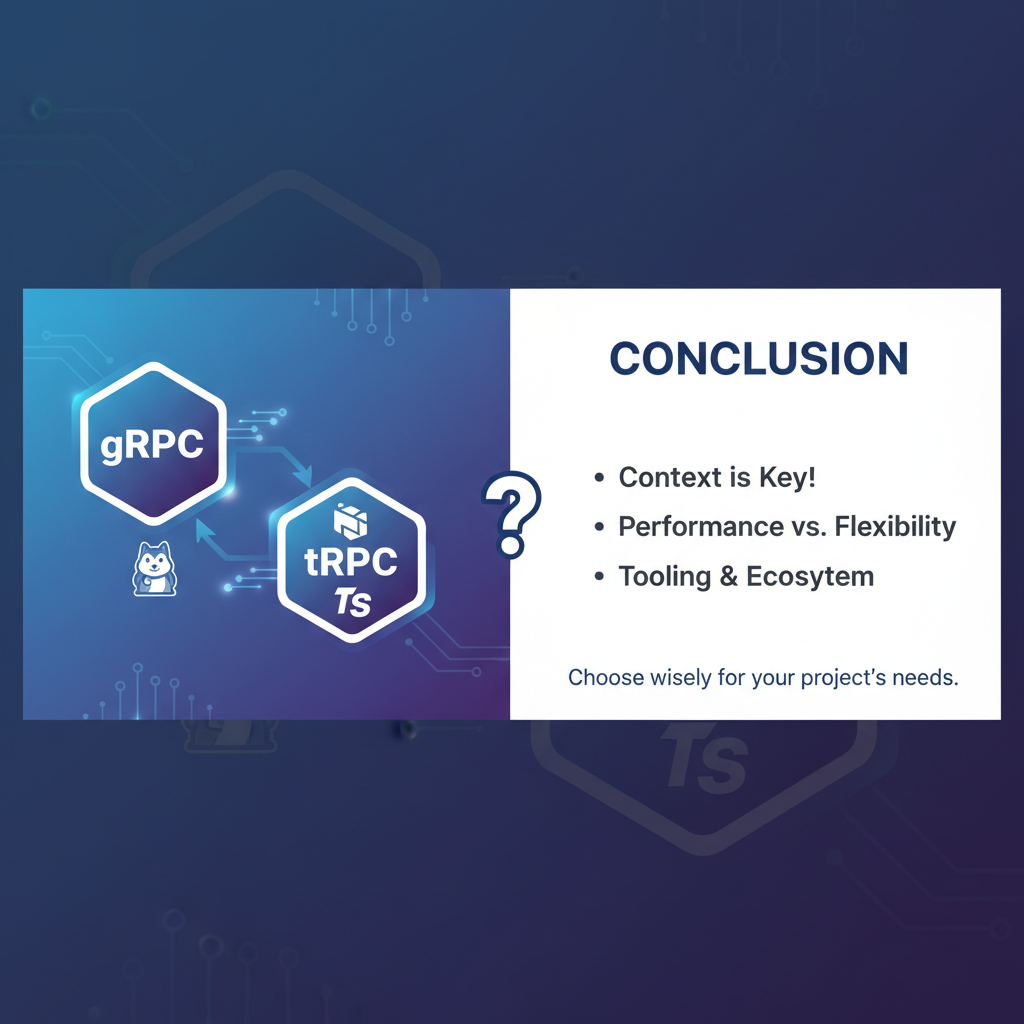
Conclusion: Making the Right RPC Choice for Your Project
The decision between gRPC and tRPC is not about one being inherently "better" than the other; rather, it's about selecting the framework that best aligns with your project's specific requirements, technology stack, and team expertise. Both are powerful tools for building modern distributed applications, but they excel in different domains.
gRPC is the workhorse for high-performance, polyglot microservices architectures. Its strengths lie in its exceptional speed, efficient binary serialization, robust streaming capabilities, and broad language support, making it ideal for large-scale, enterprise-level systems, cross-language communication, and real-time data flows. However, its complexity, browser limitations, and a steeper learning curve require a significant investment.
tRPC, on the other hand, is a game-changer for full-stack TypeScript development. Its unparalleled end-to-end type safety, zero-code-generation approach, and superb developer experience make it an incredibly productive choice for monorepos and web applications where TypeScript is the primary language across the stack. Its simplicity and focus on developer ergonomics come at the cost of polyglot support and inherent advanced streaming capabilities.
Ultimately, consider these guiding questions:
- What is your primary technology stack? If you are 100% TypeScript from frontend to backend, tRPC offers an undeniable advantage in DX and type safety. If your services are written in multiple languages, gRPC is your clear choice.
- What are your performance requirements? For extreme performance, low latency, and high throughput, gRPC with HTTP/2 and Protobuf will likely outperform tRPC. For typical web application performance, tRPC is perfectly adequate.
- Do you need real-time streaming capabilities? If your application heavily relies on server-sent events, client-sent events, or bi-directional communication, gRPC's native streaming is a powerful feature.
- How critical is browser compatibility without proxies? tRPC provides direct, hassle-free browser integration, whereas gRPC requires a
gRPC-Webproxy layer. - What is your team's familiarity with each technology? The learning curve for gRPC is steeper than for tRPC (assuming TypeScript proficiency).
By carefully evaluating these factors, you can make an informed decision that empowers your team to build efficient, maintainable, and scalable applications. And irrespective of your RPC framework choice, remember that a robust api gateway solution, such as APIPark, is an invaluable component for managing, securing, and optimizing your entire api ecosystem, especially in a world increasingly reliant on integrating diverse services, including advanced AI models.
Frequently Asked Questions (FAQs)
1. What is the main difference in how gRPC and tRPC handle API contracts?
The main difference lies in their approach to defining and enforcing the API contract. gRPC uses Protocol Buffers (Protobuf) as an explicit Interface Definition Language (IDL). Developers write .proto files to define messages and services, and then a protoc compiler generates code in various programming languages, ensuring strong type-checking based on this external schema. In contrast, tRPC leverages TypeScript's type inference directly from your backend code. There are no separate schema files or code generation steps; the TypeScript types of your backend procedures are imported and used by the frontend, providing end-to-end type safety simply by sharing the router's type definition.
2. Can I use gRPC and tRPC in the same project?
Yes, it is entirely possible and often practical to use both gRPC and tRPC within the same larger system. You might choose gRPC for high-performance, polyglot microservice communication between your backend services, or for mobile clients. Simultaneously, you could use tRPC for building a specific full-stack TypeScript web application that consumes some of those backend services (perhaps through an intermediate tRPC backend layer or a dedicated gateway). The key is to select the right tool for the right job within your architecture, often with an api gateway like APIPark acting as a central orchestration and management point.
3. Which framework offers better performance for web applications?
For typical web applications where the primary interaction is client-server request/response, the performance difference between gRPC (with gRPC-Web proxy) and tRPC is often negligible in real-world scenarios, and factors like database queries or complex business logic usually dominate latency. However, gRPC inherently uses HTTP/2 with binary Protobuf, which is generally more efficient for network transfer (smaller payloads, multiplexing) than tRPC's standard HTTP/1.1 (or HTTP/2 if configured) with JSON. For extremely high-throughput, low-latency, or streaming-heavy web applications (if gRPC-Web is deployed efficiently), gRPC might offer a performance edge, but tRPC's simplicity and developer experience often outweigh this for most web projects.
4. Is tRPC a replacement for GraphQL or REST?
tRPC isn't a direct replacement for GraphQL or traditional REST in all contexts, but it offers a powerful alternative for full-stack TypeScript applications. Like GraphQL, tRPC uses queries and mutations, but it doesn't have a single query language like GraphQL's GQL. It bypasses the need for schema introspection or explicit schema definitions by inferring types directly from TypeScript. Compared to REST, tRPC offers significantly better type safety and developer experience within a TypeScript ecosystem, eliminating common issues with manual type synchronization. It excels where REST might feel cumbersome and GraphQL might be overkill, especially in monorepos.
5. How does an api gateway like APIPark interact with gRPC and tRPC?
An api gateway plays a crucial role for both gRPC and tRPC services. For gRPC, an api gateway can act as a protocol translator (e.g., from REST to gRPC), handle gRPC-Web proxying for browser clients, and provide centralized authentication, rate limiting, and monitoring. For tRPC, while it's inherently web-friendly, an api gateway still offers essential services like global authentication, authorization, traffic management, logging, and potentially transforming requests if integrating with other service types. APIPark specifically, as an AI gateway and api management platform, provides a unified platform to manage and secure all your apis (REST, gRPC, and even AI models), regardless of their underlying framework, ensuring consistent governance, security, and observability across your entire distributed system.
🚀You can securely and efficiently call the OpenAI API on APIPark in just two steps:
Step 1: Deploy the APIPark AI gateway in 5 minutes.
APIPark is developed based on Golang, offering strong product performance and low development and maintenance costs. You can deploy APIPark with a single command line.
curl -sSO https://download.apipark.com/install/quick-start.sh; bash quick-start.sh

In my experience, you can see the successful deployment interface within 5 to 10 minutes. Then, you can log in to APIPark using your account.

Step 2: Call the OpenAI API.