Guide: How to Inspect Incoming TCP Packets Using eBPF
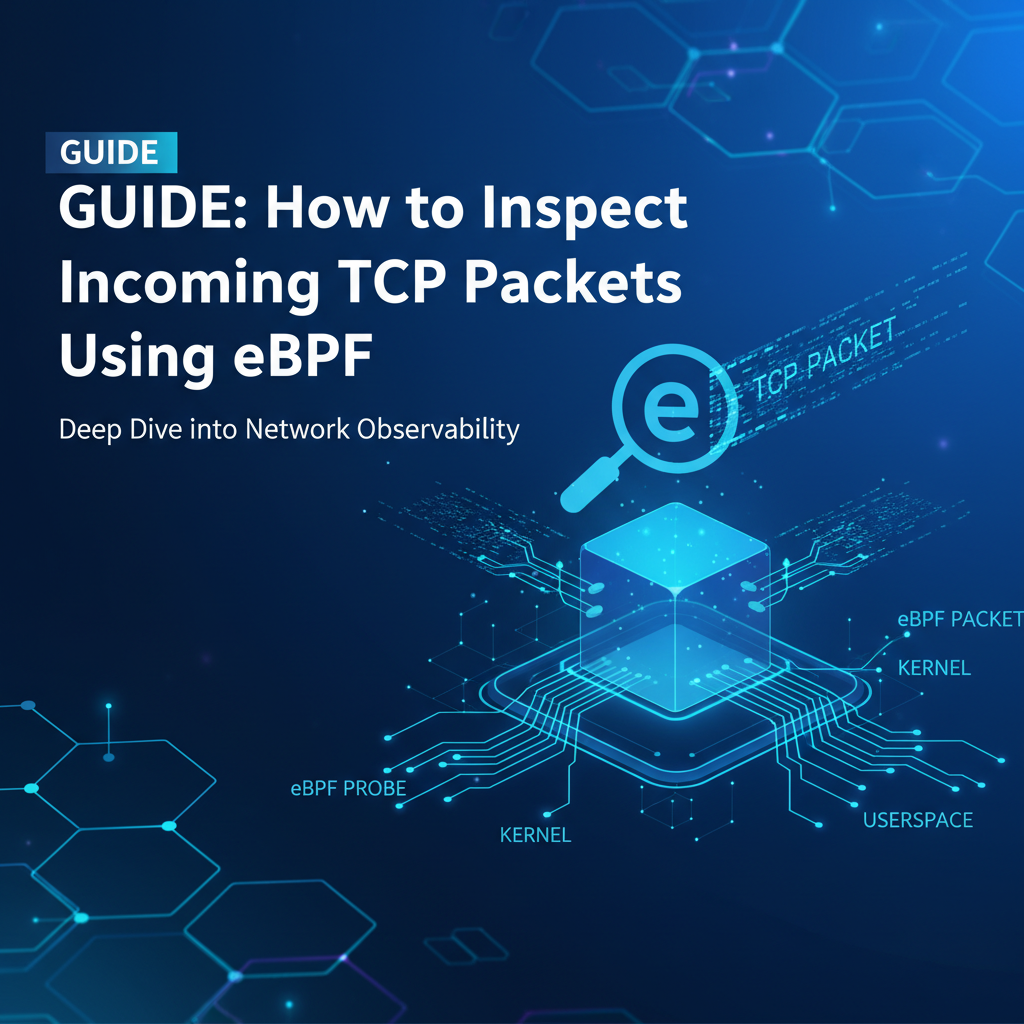


I. Introduction: The Unseen Flow – Why Deep TCP Packet Inspection Matters
In the intricate tapestry of modern computing, network communication forms the bedrock upon which all distributed systems, cloud services, and interactive applications are built. At the heart of this communication lies the Transmission Control Protocol (TCP), a foundational protocol responsible for establishing, maintaining, and tearing down connections, ensuring reliable, ordered, and error-checked delivery of data streams between applications. From a simple web browser request to complex microservice interactions, virtually every meaningful data exchange across a network relies on TCP. Yet, despite its omnipresence, the inner workings of TCP often remain a black box, a realm of invisible handshakes and data flows that are difficult to observe and understand in real-time.
Traditional network troubleshooting tools, while useful, often fall short when deep, real-time, and granular analysis of TCP packet flows is required. Tools like tcpdump or Wireshark capture packets, but analyzing vast volumes of data offline can be cumbersome and reactive. They also operate from user space, incurring overhead and potentially missing crucial kernel-level events. For developers, system administrators, and security professionals striving for optimal performance, robust security, and precise debugging, merely seeing packets isn't enough; they need to understand their context, their journey through the kernel, and their immediate impact on applications. This is especially true for systems operating at scale, such as those behind an api gateway or managing numerous api calls, where even subtle network anomalies can cascade into significant service disruptions.
Enter eBPF (extended Berkeley Packet Filter), a revolutionary technology that has fundamentally transformed how we observe, secure, and optimize Linux systems. eBPF empowers developers to run sandboxed programs directly within the Linux kernel, without requiring kernel module modifications or recompilations. It offers an unparalleled vantage point into the kernel's inner workings, enabling dynamic and programmable introspection of network events at their very source. For the inspection of incoming TCP packets, eBPF provides the surgical precision needed to filter, analyze, and react to network traffic with minimal overhead and maximum fidelity, making the unseen flow of data visible and actionable.
Understanding the nuances of TCP packet behavior is not merely an academic exercise; it is a critical skill for maintaining healthy and performant systems. For instance, diagnosing latency spikes in an api call, identifying the root cause of service unresponsiveness in a microservices architecture, or detecting sophisticated network attacks often requires delving into the byte-level details of TCP headers and payloads. eBPF provides the sophisticated instrumentation to achieve this, moving beyond superficial metrics to provide deep, actionable insights directly from the kernel network stack. This guide will take you on a journey to harness the power of eBPF for dissecting incoming TCP packets, revealing the hidden truths of your network traffic, and ultimately building more resilient and observable systems.
II. Unpacking eBPF: A Revolution in Kernel Programming
The Linux kernel is a complex and highly optimized piece of software, traditionally a monolithic entity where extending or modifying functionality required recompiling the kernel or loading kernel modules—processes fraught with risks, stability concerns, and significant overhead. The emergence of eBPF (extended Berkeley Packet Filter) has irrevocably changed this paradigm, offering a safe, efficient, and programmable way to extend the kernel's capabilities, particularly in the domain of network observability, security, and performance.
What is eBPF?
At its core, eBPF is a virtual machine inside the Linux kernel that allows users to run custom, sandboxed programs. It evolved from the classic BPF (Berkeley Packet Filter), which was originally designed for filtering network packets efficiently, famously used by tools like tcpdump. While classic BPF was limited to a specific instruction set for packet filtering, eBPF significantly extends this capability, providing a more general-purpose instruction set, additional data structures (e.g., maps), and a wider array of attach points within the kernel.
The eBPF ecosystem comprises several key components:
- BPF Programs: These are small, event-driven programs written in a restricted C syntax (or other languages that compile to BPF bytecode), which are then loaded into the kernel. These programs are designed to execute when specific events occur, such as a network packet arriving, a system call being made, or a kernel function being entered.
- BPF Maps: These are efficient key-value data structures that reside in kernel space. BPF programs can read from and write to these maps to share data between different BPF programs, or to communicate results and statistics back to user-space applications. Maps enable stateful operations and aggregation of data from events.
- BPF Verifier: Before any BPF program is loaded and executed, it must pass through the eBPF verifier. This critical component ensures that the program is safe to run in the kernel. It checks for memory safety (no out-of-bounds access), termination guarantees (no infinite loops), and ensures the program won't crash the kernel. This verifier is what makes eBPF so secure and stable, allowing unprivileged (under strict conditions) or privileged users to load kernel-level programs without compromising system integrity.
- JIT Compiler: Once verified, the BPF bytecode is typically translated by a Just-In-Time (JIT) compiler into native machine instructions specific to the host architecture. This compilation step ensures that BPF programs execute with near-native kernel performance, minimizing overhead.
Why eBPF for Network Observability?
eBPF's unique architecture makes it exceptionally well-suited for network observability and manipulation:
- No Kernel Module Recompilation: This is perhaps the most significant advantage. Developers can dynamically load and unload eBPF programs without modifying kernel source code, recompiling the kernel, or rebooting the system. This agility allows for rapid prototyping, deployment, and iteration of network monitoring and security solutions.
- High Performance, Minimal Overhead: By executing directly in the kernel and leveraging JIT compilation, eBPF programs operate with extreme efficiency. They can process packets and events at line rates with negligible performance impact, making them ideal for high-throughput network environments like those found in data centers or at the front of an
api gatewayhandling millions of requests. - Unparalleled Visibility into Network Stack: eBPF programs can be attached to various hooks within the kernel's network stack, from the very earliest points of packet reception (e.g.,
XDP) to higher layers of protocol processing. This deep introspection allows for granular analysis of packet headers, metadata, and even payload data (with careful consideration for privacy and security), providing insights that are impossible to obtain from user space. - Enhanced Security Benefits: The verifier ensures that eBPF programs are safe. This inherent security, combined with the ability to observe and filter network events at a low level, empowers the creation of highly effective security tools, such as custom firewalls, DDoS mitigation systems, and intrusion detection mechanisms that can operate with kernel-level privileges but user-level safety.
eBPF Program Types Relevant to TCP Inspection
To inspect incoming TCP packets, eBPF programs can be attached to specific points in the kernel's network processing pipeline. Understanding these attachment points is crucial for choosing the right approach:
- XDP (eXpress Data Path): XDP programs run at the earliest possible point in the network driver, even before the kernel has allocated a socket buffer (
sk_buff). This makes XDP extremely efficient for high-volume packet processing, especially for tasks like dropping unwanted traffic, forwarding packets, or performing load balancing. While powerful for basic filtering, it requires careful handling as packets are not yet fully processed by the kernel's network stack. For example, anapi gatewaycould potentially use XDP for extreme front-line filtering of malicious traffic before it even hits the main processing pipeline. - TC (Traffic Control) /
tc_clsact:tc_clsactallows eBPF programs to be attached to the ingress (incoming) and egress (outgoing) points of a network interface's traffic control queueing discipline. At this stage, packets are encapsulated in ansk_buffand have undergone some initial processing, meaning their metadata and header information are more readily accessible.tc_clsactis an excellent choice for detailed packet inspection, classification, and modification before the packet proceeds further up the network stack or is transmitted. This is often the sweet spot for detailed TCP packet analysis. - Socket Filters (
sock_filter): eBPF programs can be attached directly to individual sockets usingSO_ATTACH_BPF. These programs filter packets that would be delivered to that specific socket. This is useful for application-specific filtering or for observing traffic destined for a particular application without affecting other system traffic. - Kprobes/Uprobes: Kprobes allow eBPF programs to dynamically attach to almost any kernel function's entry or exit point. Uprobes do the same for user-space functions. While not directly designed for raw packet processing,
kprobescan be incredibly useful for observing the behavior of kernel functions that handle TCP packets, such astcp_recvmsgorip_rcv, to gain insights into how the kernel itself is processing and delivering TCP data to applications. This provides a very high-fidelity view of kernel-application interaction.
By mastering these concepts and attachment points, developers can leverage eBPF to gain unprecedented control and visibility over the network traffic flowing into their systems, laying the groundwork for sophisticated monitoring, troubleshooting, and security solutions.
III. The Language of Networks: Demystifying TCP
Before diving into the practicalities of eBPF packet inspection, it is imperative to have a thorough understanding of the Transmission Control Protocol (TCP) itself. TCP is the backbone of reliable communication on the internet, providing a connection-oriented, byte-stream service that ensures data is delivered reliably, in order, and without duplication. To effectively inspect TCP packets with eBPF, one must speak the language of TCP, recognizing its structure, flags, and operational nuances.
TCP/IP Model Overview
TCP operates at Layer 4 (Transport Layer) of the TCP/IP model, sitting above the Internet Layer (Layer 3, IP) and below the Application Layer (Layer 5, where protocols like HTTP, FTP, SSH reside). Its primary role is to provide end-to-end communication services to applications. When an api request is sent, or a response from an api gateway is received, TCP handles the reliable delivery of the underlying data.
A typical network packet containing TCP data would be structured as follows:
- Ethernet Header (Layer 2): Contains MAC addresses.
- IP Header (Layer 3): Contains source and destination IP addresses.
- TCP Header (Layer 4): Contains information for reliable data delivery.
- Application Data (Layer 5+): The actual payload, such as an HTTP request/response.
Our focus with eBPF will primarily be on the TCP Header and potentially the application data if it's safe and relevant to inspect.
TCP Header Structure: A Field-by-Field Breakdown
The TCP header is a minimum of 20 bytes long (without options) and can extend up to 60 bytes with options. Each field plays a crucial role in managing the TCP connection. Understanding these fields is fundamental for effective eBPF inspection.
Let's break down the typical TCP header fields:
- Source Port (16 bits): Identifies the port number of the sending application. For example, a web server usually listens on port 80 or 443. An
api gatewaywould also typically expose specific ports for clients to connect to its variousapis. - Destination Port (16 bits): Identifies the port number of the receiving application. This is often the first field an eBPF program might inspect to filter traffic to a specific service.
- Sequence Number (32 bits): Represents the byte number of the first byte of data in the current segment. During connection establishment, this is the Initial Sequence Number (ISN). It's crucial for reordering and retransmission.
- Acknowledgment Number (32 bits): If the ACK flag is set, this field contains the next sequence number the sender of the ACK is expecting to receive. It acknowledges successful receipt of previous data.
- Data Offset (4 bits) / Header Length: Specifies the length of the TCP header in 32-bit words. Since the TCP header can include variable-length options, this field is necessary to determine where the actual data payload begins. A value of 5 means a 20-byte header (5 * 4 bytes).
- Reserved (6 bits): Reserved for future use and should be zero.
- Control Flags (6 bits): These individual bits, often referred to as TCP flags, control the state and flow of the TCP connection. They are arguably the most important fields for understanding the connection's lifecycle and current status.
- URG (Urgent Pointer Field Significant): Indicates that the Urgent Pointer field is significant.
- ACK (Acknowledgment Field Significant): Indicates that the Acknowledgment Number field contains a valid acknowledgment. This flag is set on almost all segments after the initial SYN segment.
- PSH (Push Function): Instructs the receiving application to immediately push the buffered data to the application, without waiting for the buffer to fill.
- RST (Reset Connection): Resets a connection, typically due to an error, a refusal to connect, or to abort an existing connection.
- SYN (Synchronize Sequence Numbers): Used to initiate a connection (the first step of the three-way handshake).
- FIN (Finish Sending Data): Used to gracefully terminate a connection (the first step of the four-way handshake).
- Window Size (16 bits): Specifies the number of data bytes, starting from the one indicated in the Acknowledgment Number field, that the sender of this segment is willing to accept. It's a flow control mechanism.
- Checksum (16 bits): Used for error-checking the integrity of the TCP header and data.
- Urgent Pointer (16 bits): If the URG flag is set, this field indicates an offset from the sequence number, pointing to the last byte of urgent data.
- TCP Options (Variable Length): An optional field that can extend the TCP header. Common options include:
- MSS (Maximum Segment Size): Negotiates the largest amount of data that a host can receive in a single TCP segment.
- Window Scaling (WS): Extends the maximum window size beyond 65,535 bytes, crucial for high-speed, long-distance networks.
- SACK (Selective Acknowledgment): Allows the receiver to inform the sender about all segments that have been successfully received, not just the last contiguous one. This improves performance by reducing retransmissions.
- Timestamp (TS): Used for RTT measurement and protection against wrapped sequence numbers (PAWS).
TCP Connection Lifecycle
Understanding how these header fields change throughout the TCP connection lifecycle is critical for analysis:
- 3-Way Handshake (Connection Establishment):
- SYN: Client sends a SYN packet to the server, initiating the connection. Sequence Number is set.
- SYN-ACK: Server receives SYN, responds with a SYN-ACK packet. Its Sequence Number is set, and Acknowledgment Number is set to client's Sequence Number + 1.
- ACK: Client receives SYN-ACK, responds with an ACK packet. Acknowledgment Number is set to server's Sequence Number + 1. Connection established.
- Data Transfer: After the handshake, data segments are exchanged. Each data segment includes an ACK for previously received data, and its Sequence Number indicates the position of the data in the stream. Window Size is continually updated for flow control.
- 4-Way Handshake (Connection Teardown):
- FIN: One side (e.g., client) sends a FIN packet, indicating it has no more data to send.
- ACK: The other side (server) acknowledges the FIN.
- FIN: The server then sends its own FIN packet when it has no more data.
- ACK: The client acknowledges the server's FIN. Connection closed.
- (Note: A
RSTflag can abort a connection abruptly without the graceful handshake.)
Common TCP Anomalies and What They Indicate
Inspecting TCP packets with eBPF isn't just about reading fields; it's about interpreting patterns to diagnose problems:
- Excessive Retransmissions: Indicates packet loss or network congestion. Can manifest as application slowdowns or timeouts, impacting
apiresponsiveness. - Zero Window or Small Window Sizes: Suggests the receiver is overwhelmed and cannot process data quickly enough (flow control issue), leading to sender pauses. This can cause significant latency in an
api gatewayif its backend services are struggling. - Out-of-Order Packets: Packets arriving in an unexpected sequence. The receiver will reorder them, but this adds latency.
- Duplicate ACKs: Signifies that a packet was likely lost, prompting the sender to retransmit quickly.
- Unexpected RST Flags: Can indicate an abrupt connection termination, possibly due to a service crash, a firewall blocking traffic, or a malicious attempt to close legitimate connections. For an
api gateway, frequent RSTs could signal backend service health issues. - SYN Floods: A high volume of
SYNpackets without correspondingACKs, a common form of Denial of Service (DoS) attack. eBPF is excellent for detecting and mitigating these.
By thoroughly understanding the TCP header fields and the lifecycle of a connection, you are well-equipped to write powerful eBPF programs that can precisely inspect, analyze, and react to incoming TCP packets, turning raw network data into actionable intelligence for diagnosing performance issues, enhancing security, and optimizing your systems.
IV. Setting Up Your eBPF Environment for Packet Inspection
Before you can start writing and deploying eBPF programs for TCP packet inspection, you need to prepare your development environment. This involves ensuring you have the correct kernel version, essential compiler tools, and the necessary libraries to interact with the eBPF subsystem. The choice between different toolchains often comes down to balancing ease of use with flexibility and performance.
Prerequisites: The Foundation of Your eBPF Lab
To run eBPF programs, your Linux system needs to meet a few fundamental requirements:
- Linux Kernel Version: eBPF features have evolved significantly over time. For robust network packet inspection capabilities, especially with
XDPand modernTChooks, a kernel version of 4.9 or later is generally recommended. For many advanced features and the modernlibbpf(CO-RE) workflow, 5.x or newer is preferred (e.g., 5.4+ forbpf_ringbuf, 5.8+ forBPF_PROG_TYPE_TRACING). Always check the specific kernel version on your target system (uname -r). clangandllvm: These are the primary compilers used to translate your C code (or other languages that compile to LLVM IR) into eBPF bytecode.clangis specifically designed to output BPF bytecode. You'll needllvmutilities as well for things likellc(LLVM static compiler) andllvm-objdump.- Installation on Debian/Ubuntu:
sudo apt update && sudo apt install clang llvm libelf-dev zlib1g-dev - Installation on Fedora/RHEL:
sudo dnf install clang llvm elfutils-libelf-devel zlib-devel
- Installation on Debian/Ubuntu:
bpftool: This essential utility, typically distributed with the Linux kernel source or as part ofiproute2(ipcommand), is used to inspect and manage eBPF programs and maps. It allows you to load/unload programs, view loaded programs, inspect map contents, and debug.libbpf(BPF library): This user-space library simplifies the interaction with the eBPF kernel subsystem. It handles boilerplate tasks like loading BPF programs, creating and managing maps, and communicating withperf_event_openfor receiving data. Modern eBPF development largely favorslibbpfdue to its support for CO-RE (Compile Once – Run Everywhere), which dramatically improves program portability across different kernel versions by resolving kernel data structure offsets at load time, rather than compile time.
Basic Toolchain Setup
Once the prerequisites are installed, you essentially have a functional eBPF development toolchain. Your workflow will typically involve:
- Writing BPF C code: This code will contain the logic for your packet inspection, designed to run in the kernel.
- Compiling with
clang:clangwill compile this C code into an ELF object file containing the BPF bytecode.clang -target bpf -O2 -g -Wall -c bpf_program.c -o bpf_program.o
- Writing User-space C/Python code: This application will load the compiled BPF program into the kernel, attach it to a specific hook (e.g.,
tc_clsact), interact with BPF maps, and read data (e.g., fromperforring buffers). - Running and Observing: Execute your user-space application, observe its output, and use
bpftoolfor further introspection or debugging.
Introduction to BCC (BPF Compiler Collection) and libbpf (CO-RE)
There are two primary approaches to eBPF development, each with its strengths:
- BCC (BPF Compiler Collection):
- Overview: BCC is a rich toolkit for creating efficient kernel tracing and manipulation programs. It consists of a Python (or Lua, C++) front-end that dynamically compiles BPF C code at runtime. It handles all the heavy lifting of compilation, loading, and attaching programs, making it very quick to get started and prototype.
- Advantages:
- Rapid Prototyping: Extremely easy to write short Python scripts to attach BPF programs.
- Rich Library: Comes with a vast collection of existing tools for various kernel-level tasks, which can be adapted or learned from.
- Dynamic Compilation: No need for a separate
clangcompilation step for BPF programs; BCC handles it.
- Disadvantages:
- Runtime Dependency: Requires
clangandLLVMdevelopment headers to be present on the target machine at runtime, not just the development machine. This can be problematic in production environments where dev tools might be stripped. - Larger Footprint: The BCC framework itself adds a layer of abstraction and its own dependencies.
- Runtime Dependency: Requires
- Use Case: Excellent for interactive debugging, performance analysis, and one-off scripts where the target environment is well-controlled or development tools are readily available.
libbpf(CO-RE - Compile Once – Run Everywhere):- Overview:
libbpfis a lightweight C library provided by the kernel developers. It allows BPF programs to be compiled once into a standard ELF object file (with.oextension) and then loaded onto various kernel versions. This magic is achieved through CO-RE, which uses BPF Type Format (BTF) data embedded in the kernel and the BPF object file to resolve kernel structure offsets and types at load time. - Advantages:
- Portability (CO-RE): The "Compile Once – Run Everywhere" promise is a huge win for production deployments. You compile your BPF program once on your development machine, and it can run on any kernel with BTF support (Linux 5.2+) even if the kernel versions or compiler toolchains differ slightly.
- Minimal Runtime Dependencies: Only
libbpfitself and the kernel are needed on the target system.clangandLLVMare only needed for compilation on the development machine. - Closer to Kernel: Offers finer-grained control and is often preferred for more robust, production-grade eBPF applications.
- Smaller Footprint: The resulting user-space program linked against
libbpfis typically very compact.
- Disadvantages:
- Steeper Learning Curve: More boilerplate C code is typically required for the user-space loader than with BCC's Python front-end.
- Requires BTF: For full CO-RE benefits, the target kernel needs to be compiled with BTF support (
CONFIG_DEBUG_INFO_BTF=y). Most modern distributions enable this by default.
- Use Case: Ideal for long-running services, production deployments, and building robust eBPF-based agents where portability and minimal dependencies are paramount.
- Overview:
Choosing Your Development Approach
For learning and initial prototyping, BCC might seem more appealing due to its lower barrier to entry. However, for building serious, deployable eBPF applications that inspect incoming TCP packets, especially in environments where kernel versions vary or system dependencies are tightly controlled (e.g., within containers or VMs that might run an api gateway), the libbpf with CO-RE approach is overwhelmingly recommended. It provides the stability and portability required for production systems.
This guide will focus on explaining the concepts and providing code snippets in a general C-like syntax for BPF programs, with user-space interaction conceptualized for both libbpf and general principles. If you're new to eBPF, starting with libbpf and understanding CO-RE from the outset will set you up for long-term success. Ensure your system has libbpf-dev or similar packages installed if you intend to use libbpf as your user-space library.
Having your environment correctly set up is the crucial first step. With these tools in place, you are now ready to write and deploy eBPF programs that will peek into the very heart of your incoming TCP traffic.
APIPark is a high-performance AI gateway that allows you to securely access the most comprehensive LLM APIs globally on the APIPark platform, including OpenAI, Anthropic, Mistral, Llama2, Google Gemini, and more.Try APIPark now! 👇👇👇
V. Hands-On with eBPF: Inspecting Incoming TCP Packets
With our environment ready and a deep understanding of TCP, it's time to get hands-on. This section will walk through conceptual and illustrative eBPF code examples, demonstrating how to attach programs to the network stack and extract meaningful information from incoming TCP packets. We will primarily focus on using the TC (Traffic Control) hook with tc_clsact for detailed packet inspection, as it provides a robust and flexible point for analyzing sk_buff data.
Conceptual Overview: Attaching eBPF to the Network Stack
To inspect incoming TCP packets, your eBPF program needs to be strategically placed within the kernel's network processing pipeline. The choice of attachment point depends on the level of detail and the desired action (e.g., drop, modify, analyze).
XDP(eXpress Data Path): As mentioned, XDP operates very early, beforesk_buffallocation. It's excellent for high-performance filtering and forwarding decisions based on basic header information (e.g., L2/L3/L4 headers). If you need to drop a massive SYN flood at the absolute earliest point, XDP is your choice. However, extracting complex TCP options might be more challenging here due to the raw packet buffer context.TC_CLS_ACT(Traffic Control Classifier and Action): This is often the preferred hook for comprehensive TCP packet inspection. When attached to the ingress (incoming) side of a network interface usingtc_clsact, your eBPF program receives ansk_buffpointer. Thesk_buffis the kernel's central data structure for packets, containing not only the raw packet data but also extensive metadata. This allows for easier access to parsed headers and various kernel helper functions.Kprobesonip_rcvortcp_v4_rcv: Attachingkprobesto specific kernel functions likeip_rcv(IP receive) ortcp_v4_rcv(TCP IPv4 receive) provides an even more intimate view of how the kernel processes packets. While powerful, this approach is more intrusive, relies heavily on kernel function signatures (which can change between versions, although CO-RE helps), and might be overkill for simple packet header inspection. It's more suited for advanced debugging of kernel behavior.
For the examples below, we will primarily use the TC_CLS_ACT ingress hook, as it offers a good balance of performance and detailed sk_buff context for TCP inspection.
Setting up TC_CLS_ACT
Before demonstrating eBPF programs, let's briefly look at how you would attach an eBPF program to the ingress side of a network interface using tc (Traffic Control) command-line tool (usually done by your user-space loader program, but good to know the underlying command):
# Assuming 'eth0' is your network interface
# 1. Add 'clsact' qdisc (queueing discipline) to the interface
sudo tc qdisc add dev eth0 clsact

# 2. Attach an eBPF program (e.g., from bpf_program.o) to the ingress hook
# The 'handle 1' is a classifier, 'prio 1' is priority
sudo tc filter add dev eth0 ingress bpf da obj bpf_program.o sec ingress handle 1 prio 1

# To remove:
sudo tc filter del dev eth0 ingress
sudo tc qdisc del dev eth0 clsact
Your user-space libbpf application would handle these steps programmatically.
eBPF C Code Structure for Packet Inspection
An eBPF program for packet inspection typically follows this pattern:
- Include Headers: Necessary BPF headers (
bpf/bpf_helpers.h,bpf/bpf_endian.h) and standard network headers (linux/ip.h,linux/tcp.h,linux/if_ether.h). - Define Maps (if needed): For collecting statistics, sharing data, or communicating with user space.
- Define Program Entry Point: The function that will be executed, typically taking an
sk_buffpointer as an argument forTC_CLS_ACT. - Parse Headers: Safely access the packet data to extract Ethernet, IP, and TCP headers. The
bpf_skb_load_byteshelper or pointer arithmetic with bounds checking (skb->data + len <= skb->data_end) is crucial for safety. - Apply Logic: Filter, analyze, modify (if allowed), or record data based on header fields.
- Return Action: Typically
TC_ACT_OKto allow the packet to continue,TC_ACT_SHOTto drop it.
Let's illustrate with some examples.
Table: Common Network Header Offsets for eBPF Packet Parsing
| Header | Field | Offset from sk_buff->data (bytes) |
Data Type | Notes |
|---|---|---|---|---|
| Ethernet | h_proto (EthType) |
12 | __be16 |
Indicates next protocol (e.g., IP, IPv6) |
| IPv4 | ihl (Header Length) |
ETH_HLEN + 0 (first 4 bits) |
nibble | In 4-byte words. Multiply by 4 for bytes. |
| IPv4 | protocol |
ETH_HLEN + 9 |
__u8 |
Indicates next protocol (e.g., TCP, UDP) |
| IPv4 | saddr (Source IP) |
ETH_HLEN + 12 |
__be32 |
|
| IPv4 | daddr (Dest IP) |
ETH_HLEN + 16 |
__be32 |
|
| TCP | source (Source Port) |
ETH_HLEN + ip_hdr_len + 0 |
__be16 |
ip_hdr_len is dynamic |
| TCP | dest (Dest Port) |
ETH_HLEN + ip_hdr_len + 2 |
__be16 |
|
| TCP | doff (Data Offset) |
ETH_HLEN + ip_hdr_len + 12 (first 4 bits) |
nibble | In 4-byte words. Multiply by 4 for bytes. |
| TCP | flags |
ETH_HLEN + ip_hdr_len + 13 |
__u8 |
Bitmask for SYN, ACK, FIN, RST, etc. |
Note: ETH_HLEN is 14 bytes for standard Ethernet. ip_hdr_len needs to be calculated from ip->ihl.
Example 1: Simple TCP Port Filtering and Counting with TC_CLS_ACT
Goal: Count all incoming TCP packets destined for a specific port (e.g., 8080). This could be useful for monitoring traffic to a specific api service behind a gateway.
BPF C Code (tcp_port_counter.c):
#include <linux/bpf.h>
#include <linux/if_ether.h>
#include <linux/ip.h>
#include <linux/tcp.h>
#include <bpf/bpf_helpers.h>
#include <bpf/bpf_endian.h>

// Define a BPF map to store our counts
// A hash map with key = dest port, value = packet count
struct {
    __uint(type, BPF_MAP_TYPE_HASH);
    __uint(max_entries, 256); // Max 256 different ports to track
    __type(key, __u16);
    __type(value, __u64);
} port_counts SEC(".maps");

// Define a BPF map for a single counter (e.g., total packets)
// BPF_MAP_TYPE_ARRAY is simpler for single counters
struct {
    __uint(type, BPF_MAP_TYPE_ARRAY);
    __uint(max_entries, 1);
    __type(key, __u32);
    __type(value, __u64);
} total_packets SEC(".maps");


SEC("tc_ingress") // Attach point: Traffic Control Ingress
int tcp_port_counter(struct __sk_buff *skb) {
    // Pointers for parsing
    void *data_end = (void *)(long)skb->data_end;
    void *data = (void *)(long)skb->data;

    struct ethhdr *eth = data;
    if (data + sizeof(*eth) > data_end) {
        return TC_ACT_OK; // Malformed packet, pass
    }

    // Check if it's an IP packet (IPv4 or IPv6)
    // We'll focus on IPv4 for simplicity in this example
    if (bpf_ntohs(eth->h_proto) != ETH_P_IP) {
        return TC_ACT_OK; // Not IPv4, pass
    }

    struct iphdr *ip = data + sizeof(*eth);
    if (data + sizeof(*eth) + sizeof(*ip) > data_end) {
        return TC_ACT_OK; // Malformed IP, pass
    }

    // Check if it's a TCP packet
    if (ip->protocol != IPPROTO_TCP) {
        return TC_ACT_OK; // Not TCP, pass
    }

    // Calculate IP header length (in bytes)
    // ip->ihl is in 4-byte words, so multiply by 4
    __u32 ip_hdr_len = ip->ihl * 4;
    if (ip_hdr_len < sizeof(*ip)) { // Minimum IP header length is 20 bytes
        return TC_ACT_OK; // Malformed IP, pass
    }

    struct tcphdr *tcp = data + sizeof(*eth) + ip_hdr_len;
    if (data + sizeof(*eth) + ip_hdr_len + sizeof(*tcp) > data_end) {
        return TC_ACT_OK; // Malformed TCP, pass
    }

    __u16 dest_port = bpf_ntohs(tcp->dest); // Get destination port in host byte order

    // Increment count for this specific destination port
    __u64 *count = bpf_map_lookup_elem(&port_counts, &dest_port);
    if (count) {
        *count += 1;
    } else {
        // If port not in map, add it and initialize to 1
        __u64 initial_count = 1;
        bpf_map_update_elem(&port_counts, &dest_port, &initial_count, BPF_NOEXIST);
    }

    // Increment total packet count
    __u32 zero = 0;
    __u64 *total_cnt = bpf_map_lookup_elem(&total_packets, &zero);
    if (total_cnt) {
        *total_cnt += 1;
    } else {
        __u64 initial_total_cnt = 1;
        bpf_map_update_elem(&total_packets, &zero, &initial_total_cnt, BPF_NOEXIST);
    }

    // Optionally, use bpf_printk for debugging (visible via `sudo cat /sys/kernel/debug/tracing/trace_pipe`)
    // bpf_printk("TCP packet to port: %d", dest_port);

    return TC_ACT_OK; // Allow the packet to continue its journey
}
Explanation: 1. Safety First: The data + header_size > data_end checks are paramount for eBPF. The verifier enforces these bounds checks to prevent out-of-bounds memory access, which could crash the kernel. 2. Header Parsing: We progressively parse the Ethernet, IP, and TCP headers using pointer arithmetic. bpf_ntohs (network to host short) and bpf_ntohl (network to host long) are crucial for converting network byte order to host byte order, ensuring correct interpretation of multi-byte fields like port numbers. 3. Filtering: We check eth->h_proto for ETH_P_IP (IPv4) and ip->protocol for IPPROTO_TCP to ensure we are only processing IPv4 TCP packets. 4. bpf_map_lookup_elem and bpf_map_update_elem: These are eBPF helper functions used to interact with BPF maps. In this case, we use a hash map port_counts to store counts per destination port and an array map total_packets for an overall count.
User-space C/Python Loader (Conceptual libbpf approach):
Your user-space application would typically: 1. Load tcp_port_counter.o using libbpf's bpf_object__open and bpf_object__load. 2. Find the tc_ingress program and attach it to the eth0 interface using bpf_program__attach_tc. 3. Periodically (e.g., every second) read the port_counts map and total_packets map using bpf_map_get_next_key and bpf_map_lookup_elem to display the current statistics. 4. Handle graceful shutdown, detaching the program.
Example 2: Analyzing TCP Flags for Connection State
Goal: Monitor the SYN, ACK, FIN, and RST flags to understand the lifecycle of TCP connections, identify new connections, and detect unexpected resets. This can be critical for an api gateway to understand the health and state of its client or backend connections.
BPF C Code (tcp_flag_monitor.c):
#include <linux/bpf.h>
#include <linux/if_ether.h>
#include <linux/ip.h>
#include <linux/tcp.h>
#include <bpf/bpf_helpers.h>
#include <bpf/bpf_endian.h>

// Define a map to store flag counts
struct {
    __uint(type, BPF_MAP_TYPE_ARRAY);
    __uint(max_entries, 6); // For SYN, ACK, FIN, RST, PSH, URG
    __type(key, __u32); // Index for each flag
    __type(value, __u64); // Count for each flag
} tcp_flag_counts SEC(".maps");

// Enum for map indices
enum {
    SYN_FLAG = 0,
    ACK_FLAG = 1,
    FIN_FLAG = 2,
    RST_FLAG = 3,
    PSH_FLAG = 4,
    URG_FLAG = 5,
};

SEC("tc_ingress")
int tcp_flag_monitor(struct __sk_buff *skb) {
    void *data_end = (void *)(long)skb->data_end;
    void *data = (void *)(long)skb->data;

    struct ethhdr *eth = data;
    if (data + sizeof(*eth) > data_end) return TC_ACT_OK;
    if (bpf_ntohs(eth->h_proto) != ETH_P_IP) return TC_ACT_OK;

    struct iphdr *ip = data + sizeof(*eth);
    if (data + sizeof(*eth) + sizeof(*ip) > data_end) return TC_ACT_OK;
    if (ip->protocol != IPPROTO_TCP) return TC_ACT_OK;

    __u32 ip_hdr_len = ip->ihl * 4;
    if (ip_hdr_len < sizeof(*ip)) return TC_ACT_OK;

    struct tcphdr *tcp = data + sizeof(*eth) + ip_hdr_len;
    if (data + sizeof(*eth) + ip_hdr_len + sizeof(*tcp) > data_end) return TC_ACT_OK;

    // Access TCP flags. The flags are in a single byte.
    // We need to extract them using bitwise operations.
    // The `th_flags` macro (from <linux/tcp.h>) provides convenient access but
    // sometimes raw access is safer for verifier.
    // The flags byte is typically at offset 13 from the start of the TCP header.
    __u8 flags = *(__u8 *)(tcp + 1); // Access the byte after `doff` field.
                                    // A safer, explicit way would be:
                                    // __u8 flags_byte = *((__u8 *)tcp + 13);
                                    // This assumes `tcp` points to the start of the header.

    // Using `tcp->th_flags` if available and verified to be safe (less portable).
    // Let's use direct access for CO-RE compatibility.
    // The flags are bits in tcp->doff_and_flags (which is 16 bits)
    // or sometimes `tcp->ack_seq` + 1 if not aligned exactly.
    // For `struct tcphdr` in `linux/tcp.h`, `doff` is 4 bits, then 6 reserved, then 6 flags.
    // The byte at `tcp->doff_flags` usually contains the flags.
    // A robust way: `__u8 tcp_flags = ((unsigned char *)tcp)[13];`
    // Let's use the field `tcp->flags` if available, or direct byte access for simplicity and robustness.
    // On many systems, `struct tcphdr` might have `th_flags` or `doff_and_flags`.
    // Let's assume `flags` is at `tcp->doff` byte boundary.
    // It's safer to access the specific byte that contains the flags.
    // In `struct tcphdr` definition, data_offset (doff) is first 4 bits, then 6 reserved, then 6 flags (URG, ACK, PSH, RST, SYN, FIN).
    // The `flags` byte is actually part of `doff_and_flags` or `res1` field depending on kernel definition.
    // A common way to get flags is to take `tcp->doff_and_flags` and shift/mask.
    // More portable and common way: `tcp->fin | tcp->syn | tcp->rst | tcp->psh | tcp->ack | tcp->urg` if `tcp` is an `sk_buff` based pointer.
    // For raw `tcphdr`, `tcp->th_flags` if defined, or directly checking the bits.
    // Example: `__u8 tcp_flags = (((__u8 *)tcp)[13] & 0x3F);` (taking last 6 bits)

    // Let's use direct bit access as often flags are defined as individual bit fields.
    // For portability and robustness across different kernel headers, we extract flags by masking from a byte.
    // TCP flags are typically the last 6 bits of the 13th byte (0-indexed) of the TCP header.
    __u8 tcp_flags_byte = *(__u8 *)(tcp) + 13; // This would point to the 13th byte relative to `tcp`
    // Ensure we are within bounds
    if ((void*)&tcp_flags_byte + sizeof(__u8) > data_end) return TC_ACT_OK;

    // Check each flag bit and increment counter
    __u32 index;
    __u64 *count;

    if (tcp_flags_byte & TCP_SYN) {
        index = SYN_FLAG;
        count = bpf_map_lookup_elem(&tcp_flag_counts, &index);
        if (count) (*count)++;
        else { __u64 initial = 1; bpf_map_update_elem(&tcp_flag_counts, &index, &initial, BPF_NOEXIST); }
    }
    if (tcp_flags_byte & TCP_ACK) {
        index = ACK_FLAG;
        count = bpf_map_lookup_elem(&tcp_flag_counts, &index);
        if (count) (*count)++;
        else { __u64 initial = 1; bpf_map_update_elem(&tcp_flag_counts, &index, &initial, BPF_NOEXIST); }
    }
    if (tcp_flags_byte & TCP_FIN) {
        index = FIN_FLAG;
        count = bpf_map_lookup_elem(&tcp_flag_counts, &index);
        if (count) (*count)++;
        else { __u64 initial = 1; bpf_map_update_elem(&tcp_flag_counts, &index, &initial, BPF_NOEXIST); }
    }
    if (tcp_flags_byte & TCP_RST) {
        index = RST_FLAG;
        count = bpf_map_lookup_elem(&tcp_flag_counts, &index);
        if (count) (*count)++;
        else { __u64 initial = 1; bpf_map_update_elem(&tcp_flag_counts, &index, &initial, BPF_NOEXIST); }
    }
    if (tcp_flags_byte & TCP_PSH) {
        index = PSH_FLAG;
        count = bpf_map_lookup_elem(&tcp_flag_counts, &index);
        if (count) (*count)++;
        else { __u64 initial = 1; bpf_map_update_elem(&tcp_flag_counts, &index, &initial, BPF_NOEXIST); }
    }
    if (tcp_flags_byte & TCP_URG) {
        index = URG_FLAG;
        count = bpf_map_lookup_elem(&tcp_flag_counts, &index);
        if (count) (*count)++;
        else { __u64 initial = 1; bpf_map_update_elem(&tcp_flag_counts, &index, &initial, BPF_NOEXIST); }
    }

    // bpf_printk("TCP Flags: SYN=%d ACK=%d FIN=%d RST=%d", (flags & TCP_SYN) ? 1:0, (flags & TCP_ACK) ? 1:0, (flags & TCP_FIN) ? 1:0, (flags & TCP_RST) ? 1:0);

    return TC_ACT_OK;
}
Explanation: 1. Flag Access: This example demonstrates accessing individual TCP flags. The constants TCP_SYN, TCP_ACK, etc., are defined in linux/tcp.h. We access the byte containing the flags (the 13th byte of the TCP header, 0-indexed) and apply bitwise AND operations (&) to check if a specific flag is set. 2. Array Map: An array map tcp_flag_counts is used, where each index corresponds to a specific flag (defined by the enum), making it easy to count occurrences of each flag. 3. Use Cases: * SYN/SYN-ACK/ACK: Monitor the 3-way handshake progress. A high ratio of SYN without subsequent ACK can indicate a SYN flood attack. * RST: Track unexpected connection resets, which could signify application crashes, network misconfigurations, or active attacks. * FIN/ACK: Observe graceful connection teardowns.
Example 3: Extracting TCP Options (e.g., MSS)
Goal: Extract specific TCP options, such as the Maximum Segment Size (MSS), negotiated during the 3-way handshake. This information is crucial for understanding network performance and optimizing data transfer. Extracting TCP options is more complex because they are variable in length.
BPF C Code (tcp_option_extractor.c):
#include <linux/bpf.h>
#include <linux/if_ether.h>
#include <linux/ip.h>
#include <linux/tcp.h>
#include <bpf/bpf_helpers.h>
#include <bpf/bpf_endian.h>

// Define a map to store MSS values, keyed by destination IP
struct {
    __uint(type, BPF_MAP_TYPE_HASH);
    __uint(max_entries, 1024);
    __type(key, __be32); // Destination IP address
    __type(value, __u16); // MSS value
} mss_per_dest_ip SEC(".maps");

SEC("tc_ingress")
int tcp_option_extractor(struct __sk_buff *skb) {
    void *data_end = (void *)(long)skb->data_end;
    void *data = (void *)(long)skb->data;

    struct ethhdr *eth = data;
    if (data + sizeof(*eth) > data_end) return TC_ACT_OK;
    if (bpf_ntohs(eth->h_proto) != ETH_P_IP) return TC_ACT_OK;

    struct iphdr *ip = data + sizeof(*eth);
    if (data + sizeof(*eth) + sizeof(*ip) > data_end) return TC_ACT_OK;
    if (ip->protocol != IPPROTO_TCP) return TC_ACT_OK;

    __u32 ip_hdr_len = ip->ihl * 4;
    if (ip_hdr_len < sizeof(*ip)) return TC_ACT_OK;

    struct tcphdr *tcp = data + sizeof(*eth) + ip_hdr_len;
    if (data + sizeof(*eth) + sizeof(*tcp) > data_end) return TC_ACT_OK;

    // Check if this is a SYN packet, as MSS is negotiated during the handshake
    __u8 tcp_flags_byte = *(__u8 *)(tcp) + 13;
    if ((void*)&tcp_flags_byte + sizeof(__u8) > data_end) return TC_ACT_OK;
    if (!(tcp_flags_byte & TCP_SYN)) return TC_ACT_OK; // Only interested in SYN/SYN-ACK

    // Calculate TCP header length using `doff` field (Data Offset)
    // `doff` is in 4-byte words, so multiply by 4
    __u32 tcp_hdr_len = tcp->doff * 4;
    if (tcp_hdr_len < sizeof(*tcp)) return TC_ACT_OK; // Minimum TCP header is 20 bytes

    // If TCP header length is just 20 bytes, there are no options
    if (tcp_hdr_len == sizeof(*tcp)) return TC_ACT_OK;

    // Pointer to the start of TCP options
    void *tcp_options_start = (void *)tcp + sizeof(*tcp);
    void *tcp_options_end = (void *)tcp + tcp_hdr_len;

    // Iterate through TCP options
    void *opt_ptr = tcp_options_start;
    while (opt_ptr + 1 < tcp_options_end) { // Ensure at least 2 bytes (kind + length)
        __u8 opt_kind = *(bpf_u8 *)opt_ptr;
        __u8 opt_len = 0;

        if (opt_kind == TCPOPT_EOL) break; // End of options
        if (opt_kind == TCPOPT_NOP) { // No operation, 1 byte
            opt_ptr++;
            continue;
        }

        // For other options, need to check length byte
        if (opt_ptr + 1 < tcp_options_end) {
            opt_len = *(bpf_u8 *)(opt_ptr + 1);
        } else {
            break; // Malformed option
        }

        // Ensure option length is valid and within bounds
        if (opt_len < 2 || opt_ptr + opt_len > tcp_options_end) {
            break; // Malformed or out-of-bounds option
        }

        if (opt_kind == TCPOPT_MSS && opt_len == TCPOLEN_MSS) {
            if (opt_ptr + TCPOLEN_MSS > tcp_options_end) break; // Bounds check
            __u16 mss_val = bpf_ntohs(*(bpf_u16 *)(opt_ptr + 2)); // MSS value is 2 bytes after kind+length

            // Store MSS for this destination IP
            __be32 dest_ip = ip->daddr;
            bpf_map_update_elem(&mss_per_dest_ip, &dest_ip, &mss_val, BPF_ANY);
            // bpf_printk("MSS %d for IP %x", mss_val, bpf_ntohl(dest_ip));
            return TC_ACT_OK; // Found MSS, we can exit
        }

        opt_ptr += opt_len; // Move to the next option
    }

    return TC_ACT_OK;
}
Explanation: 1. TCP Header Length: The tcp->doff (data offset) field is used to determine the actual length of the TCP header, which includes options. 2. Iterating Options: The code iterates byte by byte through the TCP options field, parsing opt_kind and opt_len. Robust bounds checking (opt_ptr + len > tcp_options_end) is vital here. 3. MSS Extraction: When opt_kind is TCPOPT_MSS, it extracts the 2-byte MSS value and stores it in the mss_per_dest_ip map. 4. BPF_ANY: BPF_ANY flag for bpf_map_update_elem will either update an existing entry or create a new one.
Example 4: Real-time Latency Measurement (Conceptual)
Measuring latency requires correlating incoming and outgoing packets (e.g., request and response). This is a more complex task often involving a kprobe on a send function to record timestamps and then matching with an ingress packet based on sequence/acknowledgment numbers.
Conceptual Workflow: 1. On kprobe (e.g., tcp_sendmsg): Record a timestamp and key (e.g., (src_ip, src_port, dst_ip, dst_port, seq_num)) in an eBPF map. 2. On tc_ingress: * Identify the incoming ACK packet. * Extract its ack_num. * Look up the corresponding entry in the map using a key derived from the ack_num (which should match the seq_num of the sent packet). * Calculate the RTT (current_timestamp - recorded_timestamp). * Store or aggregate the RTT.
This requires careful state management within eBPF maps and precise matching logic, often facilitated by a more sophisticated user-space component.
Data Export and Userspace Interaction
The examples above rely on BPF Maps to store and share data. For more dynamic or event-driven communication with user space, eBPF offers:
Perf Buffers: These are efficient, low-overhead mechanisms for streaming events from kernel space to user space. An eBPF program can callbpf_perf_event_outputto push a custom data structure (e.g., a struct containing parsed TCP flags, timestamp, IP addresses) into a perf buffer, which user space then reads asynchronously. This is ideal for logging individual packet events or alarms.Ring Buffers: Introduced in kernel 5.4, ring buffers are an even more efficient and user-friendly alternative to perf buffers for event streaming. They offer atomic operations and better cache locality.
By combining the power of eBPF programs for in-kernel inspection with BPF maps and perf/ring buffers for data export, you can build powerful and custom network monitoring solutions. This granular, real-time visibility into TCP traffic is invaluable for diagnosing issues with api performance, optimizing gateway operations, and bolstering network security.
VI. Advanced Use Cases and Performance Considerations
Having explored the fundamentals of eBPF for TCP packet inspection, let's delve into more advanced applications and discuss the critical aspects of performance and integration. The insights gained from deep packet inspection with eBPF are not merely academic; they translate directly into tangible benefits for security, performance troubleshooting, and the overall robustness of complex networked systems, including those that rely heavily on api communication managed by an api gateway.
Security Monitoring
eBPF's ability to operate deep within the kernel's network stack provides an unparalleled vantage point for security monitoring and threat detection:
- DDoS Detection and Mitigation:
- SYN Flood Detection: As seen in Example 2, eBPF can count
SYNpackets and detect a rapid influx without correspondingACKs from the same source, indicative of a SYN flood. An eBPF program could then dynamically update a map of offending IPs, which a separate XDP program could use to drop packets from those IPs at line rate, mitigating the attack close to the wire. - Slowloris Attacks: These attacks try to keep connections open by sending partial HTTP requests slowly. While more application-layer focused, eBPF can monitor TCP session state and identify connections that are established but show minimal data transfer over extended periods, especially targeting specific
apiports orgatewayendpoints.
- SYN Flood Detection: As seen in Example 2, eBPF can count
- Unauthorized Port Scans: An eBPF program can detect rapid attempts to connect to multiple ports on a server (many
SYNs to different destination ports from a single source IP) or specific forbidden ports, indicating a port scan. This data can be exported to user space to trigger alerts or firewall rules. - Anomaly Detection: By establishing baselines of normal TCP flag distributions, connection rates, and traffic patterns to specific services (e.g.,
apiendpoints), eBPF can identify deviations that might signal anomalous or malicious activity, such as unexpectedRSTfloods, unusualFINsequences, or traffic to non-standard ports. - Application-Layer Protocol Parsing (Limited): While eBPF is primarily for lower layers, in some controlled scenarios, it can perform limited parsing of application-layer headers (like HTTP request lines) for very specific filtering or logging, for example, identifying
GETrequests versusPOSTrequests to a specificapiendpoint, though this increases complexity and vulnerability to malformed packets.
Performance Troubleshooting
For optimizing network performance and diagnosing bottlenecks, eBPF is an indispensable tool:
- Identifying Network Bottlenecks: By analyzing TCP flags, window sizes, and retransmissions in real-time, eBPF can pinpoint where congestion or packet loss is occurring. If
apicalls through agatewayare experiencing intermittent slowness, eBPF can reveal if the problem lies in the underlying network fabric (e.g., dropped packets, low MSS negotiation) or higher-level application logic. - Latency Analysis for
APICalls: While not directly measuring application processing time, eBPF can provide highly accurate network RTTs (Round Trip Times) for TCP connections. By correlatingSYNtoSYN-ACKorDatatoACKsequences (as conceptually discussed in Example 4), you can get a precise measurement of network transport latency, which is a significant component of overallapiresponse time. This helps differentiate between network-induced latency and application-induced latency. - Monitoring Application-Specific Metrics from TCP Payloads (with Caution): In very specific, controlled environments, eBPF could theoretically extract small, non-sensitive identifiers from TCP payloads (e.g., a request ID in a custom protocol header) to correlate network events with application-level transactions. However, this is generally discouraged for security and privacy reasons, and higher-level tools are usually more appropriate for application payload analysis.
Integration with Higher-Level Systems
The granular data collected by eBPF programs needs to be aggregated, visualized, and acted upon. This typically involves integrating eBPF with existing monitoring and observability platforms:
- Monitoring Dashboards: User-space applications that read eBPF maps or
perf/ringbuffers can feed data into time-series databases (e.g., Prometheus, InfluxDB) which are then visualized in dashboards (e.g., Grafana). This allows for real-time monitoring of TCP connection metrics, flag counts, and custom network events. - SIEMs (Security Information and Event Management) and Alerting Systems: Security-relevant events detected by eBPF (e.g., port scans, SYN floods, unexpected
RSTs) can be pushed to SIEMs for centralized logging, correlation with other security events, and triggering automated alerts to security teams.
A note on APIPark: While eBPF provides foundational network insights at the lowest layers of the network stack, offering granular control and observability over TCP packets, it operates below the application layer where apis and api gateways function. However, the performance, reliability, and security of an api gateway critically depend on the health and behavior of the underlying network. This is where the powerful, low-level insights from eBPF become invaluable. For instance, if an api gateway is experiencing performance degradation, eBPF can help determine if the issue stems from packet loss, congestion, or unexpected TCP resets at the network layer, which would be invisible to higher-level api management tools alone.
For robust api management with high performance and detailed logging, enterprises often look for comprehensive solutions that abstract away these lower-level network complexities while still ensuring optimal operation. ApiPark offers an all-in-one AI gateway and API developer portal designed to manage, integrate, and deploy AI and REST services with ease. APIPark provides capabilities like unified API formats, prompt encapsulation, and end-to-end API lifecycle management, alongside performance rivaling Nginx. It ensures that while eBPF provides the deep network pulse, platforms like APIPark handle the sophisticated orchestration of api traffic, including authentication, rate limiting, traffic forwarding, load balancing, and comprehensive logging of every api call. The detailed network insights from eBPF can perfectly complement APIPark's advanced api gateway functionality by helping diagnose any underlying infrastructure issues that might impact the delivery and performance of the many apis it manages, thereby enhancing overall system reliability and efficiency.
Performance Impact of eBPF
One of the defining characteristics of eBPF is its minimal performance overhead, but it's important to understand the nuances:
- Minimal Overhead, Not Zero: Running any code, even in the kernel, consumes CPU cycles. eBPF programs are highly optimized and JIT-compiled for speed, but complex programs that perform extensive data processing or loop iterations can introduce measurable overhead.
- Optimizing BPF Code:
- Minimize Helper Calls: Each
bpf_helper_funccall has a cost. Use them judiciously. - Efficient Map Operations:
bpf_map_lookup_elemandbpf_map_update_elemare fast, but frequent or large map operations can still add overhead. Design maps efficiently. - Avoid Loops (if possible): The verifier strictly limits loop iterations to guarantee termination. While bounded loops are now supported, excessive looping for data parsing (e.g., parsing all TCP options) should be avoided if possible in very high-performance paths.
- Focus on Specifics: Write programs that do one thing well. Don't try to cram too much logic into a single eBPF program if it can be split.
- Prioritize
XDPfor Early Filtering: For dropping large volumes of unwanted traffic,XDPis superior because it processes packets before costlysk_buffallocation and full kernel processing.
- Minimize Helper Calls: Each
- Verifier Constraints: The eBPF verifier ensures safety by imposing strict rules:
- No Infinite Loops: All loops must have a known maximum iteration count.
- Memory Safety: No out-of-bounds memory access. Pointers must be validated.
- Bounded Stack Size: Programs have a limited stack size.
- Limited Instruction Count: Programs have a maximum number of instructions (e.g., 1 million for tracing, less for networking).
- These constraints, while ensuring kernel stability, mean that some highly complex logic might need to be offloaded to user space or simplified.
Understanding these considerations helps in designing eBPF solutions that are both powerful and performant, ensuring they enhance observability and security without becoming a new source of performance degradation for critical systems.
VII. Challenges, Best Practices, and Future Directions
While eBPF offers unprecedented capabilities for inspecting incoming TCP packets and observing kernel events, working with it comes with its own set of challenges. Adopting best practices can smooth the development process, and understanding the future trajectory of eBPF reveals its growing importance in the cloud-native ecosystem.
Challenges
- Kernel Dependency and API Stability: eBPF programs run in the kernel, meaning they are inherently tied to kernel internal structures and APIs. While
libbpfwith CO-RE (Compile Once – Run Everywhere) significantly alleviates this by resolving offsets at load time, changes in kernel functions, structures, or BPF helper APIs can still require code adjustments or compilation on newer kernels. This creates a dependency on kernel versions and configurations. - Debugging BPF Programs: Debugging eBPF programs can be notoriously challenging. Unlike user-space applications, you cannot easily attach a debugger like GDB directly to a BPF program running in the kernel.
bpf_printk: The most common debugging tool, allowing programs to print messages to thetrace_pipe(viewable viasudo cat /sys/kernel/debug/tracing/trace_pipe). However, it's limited in message length and number.bpftool: Essential for inspecting loaded programs, map contents, and verifying program integrity.- Verifier Logs: If a program fails to load, the verifier provides detailed error messages, which are crucial for understanding why your code is deemed unsafe or invalid. Interpreting these logs often requires a deep understanding of BPF internals.
- Complexity of Network Protocols: Correctly parsing complex network headers and options (like TCP options that are variable length) requires meticulous attention to detail and robust bounds checking. A single off-by-one error can lead to verifier rejection or, worse, incorrect data interpretation. This steep learning curve is especially apparent when dealing with more exotic protocols or custom
apicommunication protocols. - Security Implications of Powerful Kernel Access: While the verifier guarantees memory safety and termination, eBPF still grants powerful access to kernel context. A malicious or poorly written eBPF program could potentially consume excessive CPU, impact network throughput, or leak sensitive information if not carefully designed and secured. Proper access control (e.g.,
CAP_BPFandCAP_NET_ADMINcapabilities for loading programs) is paramount.
Best Practices
- Start Simple, Iterate Incrementally: Begin with the most basic eBPF program (e.g., just printing "hello world" from a
kprobe), ensure it loads and runs, then gradually add complexity. Test each feature in isolation. - Extensive Testing: Test your eBPF programs rigorously on various kernel versions if possible. Utilize existing BPF test suites and consider writing unit tests for your user-space loader and integration tests for the entire solution.
- Leverage Existing Libraries (
libbpf,BCC): Don't reinvent the wheel.libbpfis the standard for production-grade eBPF applications due to its CO-RE capabilities and robust API. BCC is excellent for rapid prototyping and learning. - Prioritize CO-RE for Portability: For any serious deployment, design your eBPF programs with CO-RE in mind. Use BTF-aware definitions and helper macros provided by
libbpfto ensure your programs run across different kernel versions without recompilation. This minimizes operational burden for environments with diverse Linux distributions or kernel updates, such as large cloud deployments running anapi gateway. - Robust Bounds Checking: Always, always, always perform bounds checking (
data + size <= data_end) when accessing packet data or kernel structures. The verifier will enforce this, but explicitly writing these checks makes your code safer and clearer. - Minimal Code in Kernel: Keep your eBPF programs as lean and focused as possible. Offload complex logic, aggregation, and long-term storage to user-space applications. eBPF should be about efficient data collection and initial filtering, not heavy computation.
- Choose the Right Hook: Select the eBPF attach point that best suits your needs.
XDPfor early drops,TC_CLS_ACTfor detailedsk_buffinspection,kprobesfor kernel function tracing. Don't use a hammer when a screwdriver is needed. - Security by Design: Consider the security implications of your eBPF programs. Restrict their capabilities to the minimum necessary. Ensure that user-space components are also secure and have appropriate permissions.
The Future of eBPF
The eBPF ecosystem is one of the most vibrant and rapidly evolving areas in Linux kernel development. Its future holds immense promise:
- Growing Adoption in Cloud-Native Environments: eBPF is becoming a cornerstone of cloud-native infrastructure, powering service meshes (e.g., Cilium), network observability tools, and security agents in Kubernetes and other container orchestration platforms. Its ability to provide deep, programmable insights into ephemeral workloads is unmatched. This means that solutions monitoring
apitraffic orapi gatewaybehavior in dynamic cloud environments will increasingly rely on eBPF. - Further Integration with Observability Platforms: As more vendors and open-source projects adopt eBPF, we will see tighter integration with existing observability stacks, allowing eBPF data to seamlessly flow into metrics, logs, and tracing systems, creating a holistic view of system health.
- Hardware Offloading: Work is ongoing to offload eBPF programs, particularly XDP, to network interface card (NIC) hardware. This would allow packet processing to occur even before the kernel touches the data, enabling truly line-rate performance for specific tasks, further pushing the boundaries of network efficiency.
- New Use Cases in Security and Network Function Virtualization: eBPF is continuously finding new applications in advanced firewalling, intrusion prevention systems, and the implementation of virtual network functions (VNFs) with high performance and flexibility, challenging traditional approaches to network security and infrastructure.
- Simplified Development Experience: Tools and libraries are constantly improving to make eBPF development more accessible, abstracting away some of the kernel complexities and providing higher-level programming interfaces.
In conclusion, eBPF is more than just a passing trend; it's a fundamental shift in how we interact with the Linux kernel, particularly for networking. By embracing its power while navigating its challenges with best practices, you can unlock unprecedented visibility and control over your incoming TCP packets, leading to more resilient, performant, and secure systems.
VIII. Conclusion
The journey through the intricacies of TCP packet inspection using eBPF reveals a powerful paradigm shift in network observability and control. We've traversed the foundational principles of TCP, meticulously dissected its header structure and lifecycle, and then empowered ourselves with eBPF's ability to peer directly into the kernel's network stack. From simple port filtering to nuanced flag analysis and the complex parsing of TCP options, eBPF offers surgical precision with remarkable efficiency.
This guide has demonstrated how eBPF can transform raw network bytes into actionable intelligence, allowing us to diagnose performance bottlenecks that plague api calls, bolster security defenses against sophisticated attacks targeting our gateway infrastructure, and gain an unparalleled understanding of network behavior. The agility to dynamically load and update kernel-level programs without recompilation, coupled with the security guarantees of the verifier, positions eBPF as an indispensable tool for modern network diagnostics and security. While tools like APIPark provide crucial api management and api gateway functionalities at a higher, application-centric layer, the deep network insights enabled by eBPF form the crucial foundation that ensures the underlying infrastructure can flawlessly support such advanced services. Embracing eBPF is not just about adopting a new technology; it's about gaining a deeper mastery over the very fabric of network communication, empowering engineers to build and maintain the high-performing, secure, and observable systems demanded by today's interconnected world.
IX. FAQs
- What is the main advantage of using eBPF for TCP packet inspection compared to traditional tools like
tcpdumpor Wireshark? The primary advantage of eBPF lies in its kernel-level execution and programmability. Unliketcpdumpor Wireshark, which capture packets from user space and analyze them, eBPF programs run directly inside the Linux kernel. This allows for extremely high-performance processing (near line rate) with minimal overhead, the ability to filter and process packets at the earliest stages (e.g., XDP), and dynamic manipulation or observation of kernel-internal data structures. It provides real-time, granular insights and can take immediate actions (like dropping packets) without needing to copy data to user space, making it ideal for high-throughput environments or proactive security. - How does eBPF ensure security and stability when running custom code in the kernel? eBPF ensures security and stability through its integral BPF Verifier. Before any eBPF program is loaded into the kernel, the verifier performs an exhaustive static analysis of the program's bytecode. It checks for memory safety (no out-of-bounds access), guarantees termination (no infinite loops), limits the program's complexity and resource usage, and ensures the program won't cause a kernel crash or security vulnerability. Only after passing these rigorous checks is the program allowed to be JIT-compiled and executed.
- What is the difference between
XDPandTC_CLS_ACTattachment points for eBPF networking programs?XDP(eXpress Data Path) programs execute at the earliest possible point in the network driver, often before the kernel allocates ansk_buff(socket buffer). This makes XDP exceptionally fast for tasks like high-volume packet dropping, forwarding, or load balancing.TC_CLS_ACT(Traffic Control Classifier and Action) programs, on the other hand, attach later in the network stack, to the ingress or egress traffic control queueing disciplines. At this stage, packets are encapsulated in ansk_buff, providing richer metadata and easier access to parsed headers, makingTC_CLS_ACTsuitable for more detailed packet inspection, classification, and modification that benefits fromsk_buffcontext. - How can I debug an eBPF program if it's running in the kernel? Debugging eBPF programs can be challenging due to their kernel-level execution. The primary debugging tool is
bpf_printk, which allows your eBPF program to print messages to the kernel's trace pipe (viewable viasudo cat /sys/kernel/debug/tracing/trace_pipe). You can also use thebpftoolutility to inspect loaded programs, check the contents of BPF maps, and view detailed verifier logs if your program fails to load. Understanding the verifier's error messages is crucial for identifying issues related to memory safety, infinite loops, or incorrect helper function usage. - Can eBPF be used to analyze application-layer data in TCP packets, for example, HTTP requests to an
api gateway? While eBPF primarily operates at lower network layers (L2, L3, L4), it is technically possible for eBPF programs to inspect parts of the TCP payload, which contains application-layer data (e.g., HTTP headers). However, this comes with significant complexities and cautions. Parsing variable-length application protocols is much harder and error-prone in the constrained eBPF environment, increasing complexity and potential for verifier rejection. More importantly, inspecting application payloads often involves sensitive data, raising privacy and security concerns. Generally, it's recommended to limit eBPF to network-layer analysis and use higher-level tools (like APIPark's logging or dedicated application performance monitoring tools) for application-layer inspection andapi management.
🚀You can securely and efficiently call the OpenAI API on APIPark in just two steps:
Step 1: Deploy the APIPark AI gateway in 5 minutes.
APIPark is developed based on Golang, offering strong product performance and low development and maintenance costs. You can deploy APIPark with a single command line.
curl -sSO https://download.apipark.com/install/quick-start.sh; bash quick-start.sh

In my experience, you can see the successful deployment interface within 5 to 10 minutes. Then, you can log in to APIPark using your account.

Step 2: Call the OpenAI API.