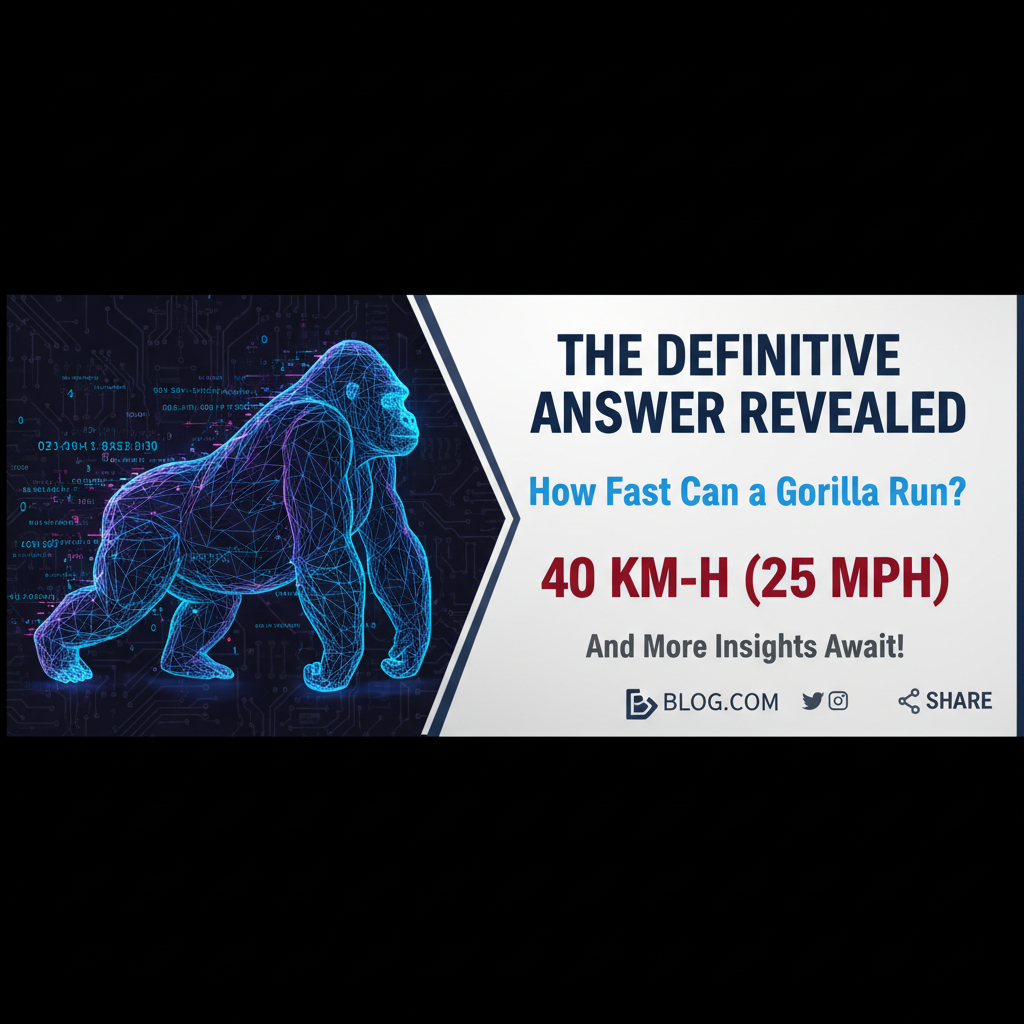
How Fast Can a Gorilla Run? The Definitive Answer Revealed



The image of a gorilla is often one of imposing strength, a majestic giant ruling its forest domain. For centuries, these magnificent creatures have captivated human imagination, inspiring tales of awe, and sometimes, fear. A common question that arises from this fascination, often fueled by cinematic portrayals, is "How fast can a gorilla run?" This seemingly straightforward query opens a window into the complex biology, behavior, and ecological niche of these incredible primates. While Hollywood might depict gorillas as blur-fast behemoths capable of chasing down vehicles, the reality is far more nuanced and, arguably, even more compelling. This comprehensive exploration will delve into the scientific understanding of gorilla locomotion, anatomy, observed speeds, and compare their capabilities to other animals, ultimately providing a definitive answer to their running prowess.
From the dense, humid forests of central Africa to the mist-shrouded volcanic slopes, gorillas navigate their complex environments with a grace and power that belies their enormous size. They are primarily herbivores, spending most of their day foraging for leaves, stems, fruits, and bark. Their lives are governed by intricate social structures, led by a dominant silverback male, and their movements are typically measured and deliberate, optimized for energy conservation rather than high-speed pursuits. Yet, under specific circumstances – be it a perceived threat, a territorial dispute, or even playful exuberance – these powerful primates can unleash surprising bursts of speed. Understanding this aspect of their movement requires us to look beyond simple numbers and appreciate the full context of their evolutionary adaptations. We will uncover the true capabilities of a gorilla's sprint, dissecting the popular myths and grounding our findings in scientific observation and expert consensus, to offer a complete picture of how fast these forest giants can truly move.
Deconstructing the Myth: Beyond the Silver Screen
The popular culture depiction of gorillas, particularly in films like "King Kong" or "Gorillas in the Mist," has indelibly shaped public perception. In these cinematic narratives, gorillas are often portrayed as aggressive, unstoppable forces capable of incredible feats of speed and strength, frequently shown charging with astonishing velocity. While these portrayals are effective for dramatic storytelling, they often stray significantly from the reality of gorilla behavior and physical capabilities. The sheer size and power of a gorilla, particularly a mature silverback, naturally evoke a sense of immense potential speed, leading many to assume they are incredibly swift runners. However, this assumption is largely a misconception when compared to animals truly built for sustained high-speed locomotion.
One of the most pervasive myths is that gorillas routinely engage in long, high-speed chases or escapes, similar to a cheetah pursuing its prey. In reality, gorillas are not predators and do not rely on speed to hunt. Their diet of vegetation means they have no need to outrun swift prey. Similarly, their primary defense mechanism against threats is rarely outright flight. Instead, their strategy often involves intimidation displays – chest-beating, roaring, tearing vegetation, and short, powerful charges – designed to deter intruders or rivals. These charges, while undeniably terrifying and incredibly fast over very short distances, are not sustained runs in the traditional sense. They are bursts of explosive power meant to send a clear message, rather than a prolonged chase. If an actual threat like a leopard or human poacher persists, gorillas are more likely to seek refuge in dense vegetation or use their immense strength to defend themselves, often in a group.
The confusion also stems from anthropomorphizing their movements. Humans are bipedal runners, capable of endurance and bursts of speed over varying terrains. We naturally project our understanding of "running" onto other animals. However, a gorilla's anatomy and primary mode of locomotion, knuckle-walking, are fundamentally different. Their bodies are optimized for power, climbing, and efficient foraging across rugged terrain, not for long-distance, high-speed running on two or four limbs. The sheer muscle mass required to move their large bodies at high velocity comes with a significant metabolic cost, making prolonged sprints impractical and unnecessary for their survival strategy. Therefore, to truly understand how fast a gorilla can run, we must first shed the preconceptions built by entertainment and embrace the scientific reality of their unique physical adaptations and behavioral patterns. This accurate understanding is not only crucial for answering our speed question but also for fostering a deeper respect and appreciation for these remarkable, often misunderstood, creatures in their natural habitats.
The Engineering Marvel: Gorilla Anatomy and Locomotion
To truly grasp a gorilla's speed capabilities, one must first appreciate the intricate engineering of its body. These magnificent primates are biological masterpieces, each bone, muscle, and joint honed by millions of years of evolution to thrive in their challenging forest environments. Their anatomy is a testament to power, stability, and controlled movement, rather than the lightweight, streamlined form of a dedicated sprinter.
A. Skeletal and Muscular Foundation
The gorilla's skeletal structure is exceptionally robust, a formidable framework designed to support immense weight and withstand powerful forces. Their bones are denser and thicker than those of humans or even other great apes, providing the necessary strength for their large size. The spine is incredibly sturdy, particularly in the lumbar region, offering a strong anchor for powerful limb movements. Crucially, their broad shoulders and massive chest are indicative of the incredible strength concentrated in their upper body. This architecture supports powerful arm muscles and allows for the impressive knuckle-walking gait, as well as enabling their adeptness at climbing and tearing through tough vegetation.
Beneath this powerful skeleton lies a marvel of musculature. Gorillas possess an extraordinary amount of muscle mass, far exceeding that of an average human. These muscles are not only voluminous but also incredibly dense, capable of generating immense force. While often perceived as having disproportionately long arms, their limbs are actually built for a specific kind of power. The forelimbs, particularly the biceps, triceps, and shoulder muscles, are exceptionally developed. This upper body dominance is a key adaptation for their knuckle-walking locomotion, where the arms bear significant weight, and for their ability to pull themselves through dense foliage and climb trees. Their hindlimbs, while shorter in comparison to their arms, are also incredibly muscular, especially the gluteal and thigh muscles. These powerful legs provide the propulsive force for their movements, whether it's a casual stroll, a quick charge, or a vertical leap. However, these legs are designed more for stability, bursts of raw power, and strong pushes rather than the rapid, cyclic movements of a cursorial animal built for sustained high-speed running. The muscle fiber composition in gorillas is likely geared towards strength and short, explosive movements rather than long-distance endurance.
B. Gait and Movement Patterns
The primary mode of terrestrial locomotion for gorillas is knuckle-walking. This unique quadrupedal gait involves placing the knuckles of their clenched fists on the ground, allowing them to support their massive weight while protecting their palms. The mechanics of knuckle-walking are energy-efficient for their typical activities of foraging and moving slowly through dense undergrowth. When knuckle-walking, their weight is distributed across all four limbs, with the long, powerful arms providing leverage and propulsion, and the strong legs pushing them forward. This gait allows for remarkable stability on uneven terrain, up and down slopes, and through thick forest floors, which is crucial for a ground-dwelling herbivore. The flexibility of their spine and the powerful musculature around their hips and shoulders contribute to this steady, controlled, yet powerful movement.
While knuckle-walking is their default, gorillas are also capable of occasional bipedalism. They can stand and walk on two legs for short distances, particularly when performing display behaviors, reaching for food that is just out of reach, or carrying objects. A silverback male might stand bipedally during an intimidation display, appearing even larger and more formidable to a rival or perceived threat. These bipedal movements are typically brief and are not sustained runs. When they do engage in a bipedal sprint, it is usually an awkward, hunched posture, relying on powerful leg drives but lacking the fluid, upright posture of a human runner. It’s an act of necessity or display, not an efficient mode of sustained locomotion.
The term "running" for a gorilla also needs careful distinction from a "charge." An actual charge, usually performed by a silverback, is a display of aggression or intimidation. It begins with a slow walk, escalates to chest-beating and roaring, and culminates in a powerful, explosive sprint towards the perceived threat. This sprint is incredibly fast and terrifying over a very short distance, but it is rarely a prolonged chase. It's designed to scare off, not to outrun over a mile. Juveniles and younger gorillas might "run" in play, chasing each other through the trees or across open clearings, demonstrating surprising agility despite their developing size. Even these playful sprints, however, are typically short bursts of energy. Understanding these different modes of movement highlights that a gorilla's body is a magnificent engine built for power, climbing, and bursts of explosive force, rather than the sustained, high-speed running seen in many other terrestrial mammals.
The "Run" Defined: Contextualizing Gorilla Speed
When we ask "How fast can a gorilla run?", the definition of "running" itself becomes critical. For a human, running typically implies an upright, bipedal gait where both feet are momentarily off the ground. For a gorilla, the term is far more ambiguous, encompassing powerful quadrupedal sprints, rapid bipedal lunges, or even an aggressive charge. Understanding the context in which a gorilla exhibits speed is paramount to accurately assessing its capabilities, as their "running" is always purpose-driven and fundamentally different from that of a gazelle or a greyhound.
What constitutes "running" for a gorilla? It usually refers to a rapid forward movement, whether on all fours (knuckle-walking at an accelerated pace) or, less commonly, in short, powerful bipedal bursts. The key characteristic is its explosive nature – a sudden, rapid acceleration over a very limited distance. This is not the sustained, rhythmic motion of a human marathon runner or a predator tracking prey over kilometers. Instead, it is an output of raw, unadulterated power designed for immediate impact.
There are several primary reasons why a gorilla might engage in such a burst of speed:
- Flight from Perceived Threat: While generally preferring to intimidate or defend, if a threat is overwhelming or unexpected, a gorilla might briefly sprint to escape into denser cover or put distance between itself and the danger. This is a rare occurrence, as gorillas are confident in their ability to deter most threats.
- Aggressive Displays/Charges: This is perhaps the most common context for high-speed movement in gorillas, especially for silverbacks. A charge is a bluff, a dramatic demonstration of power intended to scare off rivals, predators, or human intruders. It involves an impressive display of chest-beating, roaring, tearing vegetation, and then a rapid sprint towards the perceived threat, usually stopping just short of contact. The sheer speed and power of these charges are what contribute to the myth of gorillas being incredibly fast runners.
- Play: Juvenile and sub-adult gorillas are much more playful and agile than their older counterparts. They often engage in mock fights, chasing games, and energetic sprints through their environment, showcasing surprising bursts of speed and acrobatic agility as they navigate branches and forest floors. These playful runs are vital for developing motor skills and social bonds.
- Short Distances for Resource Access: Occasionally, a gorilla might sprint a short distance to reach a particularly desirable food source before another troop member, or to quickly access a safer spot within their foraging area.
The physiological cost of high-speed movement for such a massive animal is considerable. A gorilla's large body mass requires an enormous amount of energy to accelerate and decelerate quickly. Their muscle composition, while immensely powerful, is likely geared towards strength and short bursts rather than the aerobic efficiency needed for sustained running. Imagine the effort it takes for a human bodybuilder to sprint a hundred meters versus a lean long-distance runner. The gorilla is akin to the bodybuilder – tremendous power, but less suited for prolonged exertion. Their circulatory and respiratory systems are adapted for a relatively low-intensity, herbivorous lifestyle, not the extreme demands of prolonged high-speed pursuits.
Therefore, when comparing a gorilla's "sprint" to a human's endurance running or a predator's chase, it's essential to understand that we are comparing two entirely different evolutionary strategies. A gorilla's speed is a demonstration of brute force and acceleration, an impressive, momentary burst rather than a continuous, sustained effort. Their power-to-weight ratio allows for incredible acceleration, making them formidable over those crucial first few meters, which is precisely what their survival strategy demands in moments of conflict or immediate escape. This contextual understanding paves the way for a more accurate quantification of their maximum speed.
The Definitive Answer: Quantifying Gorilla Speed
After dissecting their anatomy and behavioral context, we arrive at the core question: How fast can a gorilla actually run? Pinpointing an exact, universally agreed-upon speed for a gorilla is challenging due to various factors. Unlike Olympic sprinters, gorillas don't run on measured tracks under controlled conditions. Their natural habitat is dense, uneven, and unpredictable, making precise scientific measurement difficult.
A. Challenges in Measurement
One of the primary difficulties in quantifying gorilla speed lies in their natural environment. Gorillas inhabit dense, often rugged forests and mountainous regions, where visibility is limited, and the terrain is far from ideal for high-speed running. Conducting controlled experiments to measure their speed in the wild is practically impossible and ethically questionable. Researchers rely on observational data, often glimpsed during brief, spontaneous encounters or through camera traps. Such observations are inherently difficult to standardize, as factors like terrain, motivation, and the individual gorilla's condition can vary wildly.
Furthermore, gorillas are generally elusive and shy animals. While silverbacks can be assertive, their natural inclination is to avoid direct conflict with humans. This means that opportunities to observe them at their maximum speed are rare and often occur under stressful circumstances, making objective measurement even harder. Unlike animals studied in captivity with controlled environments, wild gorillas provide fleeting glimpses that require careful interpretation and estimation rather than precise stopwatch timings. There are no "gorilla speed trials" in the scientific literature, meaning any definitive number is derived from careful inference rather than direct, repeatable measurements.
B. Expert Estimates and Observations
Despite these challenges, primatologists and wildlife experts have arrived at a consensus range for a gorilla's top speed. The commonly cited estimate for a gorilla's maximum sprint speed is 20 to 25 miles per hour (approximately 32 to 40 kilometers per hour). This speed is typically achieved over very short distances, during a charge or a rapid escape into cover.
Sources for these estimates come from several areas: * Field Primatologists' Accounts: Researchers who have spent decades observing gorillas in their natural habitats have witnessed charges and rapid movements, often estimating speeds based on their experience and comparison to known speeds of other animals or human movements. * Zoo Observations (limited): While gorillas in zoos don't typically "run" in the wild sense, some observations in larger enclosures, particularly during playful interactions or moments of agitation, have offered anecdotal evidence that aligns with these wild estimates. However, these are not ideal conditions for top-speed measurement. * General Wildlife Encyclopedias and Expert Consensus: Reputable wildlife organizations and encyclopedias often compile data from various field reports and scientific papers, consistently listing the gorilla's top speed within this 20-25 mph range.
It is crucial to understand that this speed represents a maximum burst speed, not an average or sustained running pace. A gorilla can accelerate to this speed very quickly due to its immense leg and arm power, but it cannot maintain it for more than a few seconds or a very short distance (perhaps 10-30 meters). After such a burst, they would likely be winded and require recovery, much like a human powerlifter after a maximal effort. Their everyday movement is significantly slower, a deliberate and efficient knuckle-walk suited for foraging and navigating their environment without expending excessive energy.
C. Variations by Species and Individual
It's also worth noting that gorilla speed can vary based on several factors:
- Species: There are two main species of gorilla, Eastern and Western, each with subspecies. While all are robust, subtle differences in build (e.g., Mountain Gorillas are typically more heavily built than Western Lowland Gorillas) might lead to minor variations in agility and speed. However, the overall range remains consistent across species.
- Age and Sex: Younger, more agile gorillas, particularly juveniles and sub-adults, might be slightly quicker and more prone to playful sprints. Adult silverback males, while incredibly powerful and capable of fearsome charges, might prioritize raw power and intimidation over sheer agility in a full sprint. Females, while smaller, are also capable of impressive bursts of speed, especially when protecting their young.
- Terrain: A gorilla's speed will be significantly affected by the terrain. While capable of moving quickly through dense undergrowth, they would likely achieve their maximum speed on a relatively flat, open patch of ground, which is rare in their typical forest habitat. Running uphill or through thick vegetation would naturally reduce their top speed.
- Motivation: The urgency of the situation plays a huge role. A gorilla fleeing a direct, serious threat might push itself to its absolute limit, whereas a playful sprint might be fast but not necessarily maximal.
In summary, while a gorilla's speed isn't comparable to that of a cheetah or an antelope, it is remarkably fast for an animal of its size and build, demonstrating an explosive power that can propel it to 20-25 mph (32-40 km/h) in short, terrifying bursts. This speed is perfectly suited for its ecological role, allowing for effective intimidation, rapid defensive maneuvers, and efficient navigation within its complex forest home.
APIPark is a high-performance AI gateway that allows you to securely access the most comprehensive LLM APIs globally on the APIPark platform, including OpenAI, Anthropic, Mistral, Llama2, Google Gemini, and more.Try APIPark now! 👇👇👇
Comparative Analysis: Gorillas, Humans, and the Animal Kingdom
Understanding a gorilla's speed in isolation is informative, but its true significance comes into focus when compared to other creatures, particularly humans and other terrestrial animals. This comparative analysis helps contextualize their "fast" and appreciate where their strengths truly lie in the broader animal kingdom.
A. Gorilla vs. Human Speed
This is a frequently asked comparison, often fantasized in hypothetical races. Let's look at the facts:
- Usain Bolt (World Record Holder): The fastest human ever recorded, Usain Bolt, achieved a top speed of approximately 27.8 miles per hour (44.7 km/h) during his 100-meter dash world record. This is an extraordinary feat of human athleticism.
- Average Human Sprinter: A well-trained amateur sprinter might reach speeds of 15-18 mph (24-29 km/h).
- Average Adult Human: Most average adults can sprint at 10-15 mph (16-24 km/h) over very short distances.
When comparing these to a gorilla's estimated top speed of 20-25 mph (32-40 km/h), a surprising picture emerges. A gorilla, in its absolute peak sprint, is likely faster than an average human sprinter, and could even give Usain Bolt a significant challenge in the initial few meters due to its explosive power and acceleration. However, it's crucial to remember the differences in locomotion strategy. Bolt's speed is a sustained bipedal run, optimized for distance, whereas a gorilla's speed is a raw, quadrupedal or awkward bipedal burst of power over an extremely short distance. In a race of 100 meters, Bolt would likely pull ahead as the gorilla's burst fades. Over any significant distance, a human athlete, even an amateur, would easily outpace a gorilla. The gorilla's sprint is about immediate impact and deterrence, not sustained chase or escape.
B. Gorilla vs. Other Primates
- Chimpanzees: Often considered the most agile of the great apes, chimpanzees can also be incredibly fast. They primarily knuckle-walk but can burst into bipedal runs during chases or displays. Their top speed is estimated to be similar to gorillas, around 25 mph (40 km/h), and they are arguably more agile and quicker to change direction due to their slightly lighter build.
- Baboons: These Old World monkeys are known for their terrestrial habits and are remarkably fast and agile runners, especially across open ground. They can reach speeds of 30 mph (48 km/h) or more, making them faster than gorillas, a necessary adaptation for evading predators in more open environments.
- Orangutans: Primarily arboreal, orangutans are slower and more deliberate on the ground, often moving with an awkward waddle. Their bodies are built for climbing and swinging through trees, not for terrestrial speed.
C. Gorilla vs. Other Terrestrial Animals
To provide further context, let's compare gorillas to some other well-known land animals:
- Cheetah: The undisputed king of land speed, capable of reaching 70-75 mph (112-120 km/h), although only for very short bursts (around 30 seconds). Their bodies are the epitome of speed.
- Grizzly Bear: Surprisingly fast for their size, grizzly bears can sprint at 30-35 mph (48-56 km/h) over short distances. This is faster than a gorilla, highlighting that size does not always equate to slowness.
- African Elephant: While massive, elephants can charge at impressive speeds of up to 25 mph (40 km/h). Their movement is more of a powerful, ground-covering walk/run, rather than a true sprint, but it demonstrates the capability of large animals.
- Rhinoceros: Known for their formidable charges, rhinos can reach speeds of 30-35 mph (48-56 km/h), making them another surprisingly fast large animal.
Here's a table summarizing these comparisons:
| Animal / Type | Primary Locomotion | Typical Top Speed (mph) | Typical Top Speed (km/h) | Notes |
|---|---|---|---|---|
| Gorilla | Knuckle-walking / Quadrupedal Sprint | 20 - 25 | 32 - 40 | Primarily for short bursts, charges, or escaping immediate threats. Not built for sustained running. |
| Human (Sprinter) | Bipedal Sprint | 27.8 (World Record) | 44.7 (World Record) | Max recorded speed by Usain Bolt. Average human sprint is significantly lower. |
| Human (Average Adult) | Bipedal Sprint | 10 - 15 | 16 - 24 | Varies greatly with fitness, age, and motivation. |
| Chimpanzee | Knuckle-walking / Bipedal | 25 | 40 | Can be very quick over short distances, often bipedal during chases. |
| Baboon | Quadrupedal Sprint | 30 - 35 | 48 - 56 | Extremely agile and fast, particularly across open savannah. |
| Cheetah | Quadrupedal Sprint | 70 - 75 | 112 - 120 | World's fastest land animal, built for extreme acceleration and pursuit. |
| Grizzly Bear | Quadrupedal Sprint | 30 - 35 | 48 - 56 | Surprisingly fast despite their size, especially over short distances. |
| African Elephant | Quadrupedal Walk / Charge | 25 | 40 | Can charge at impressive speeds, but it's a powerful walk/run rather than a true sprint. |
| Rhinoceros | Quadrupedal Charge | 30 - 35 | 48 - 56 | Can reach high speeds when charging, a powerful, unstoppable force. |
The comparison clearly illustrates that while a gorilla is incredibly powerful and capable of impressive acceleration, its top speed is generally within the range of other large, powerful animals like elephants and bears, and can even rival or exceed that of an average human. However, they are not built for the blistering pace of true sprinters like cheetahs or even the sustained speed of baboons. Their speed is a tool, not their defining characteristic for survival.
Speed as a Survival Trait: Beyond Just Running
The diverse speeds observed across the animal kingdom are not arbitrary numbers; they are finely tuned adaptations reflecting an organism's survival strategy within its unique ecological niche. For gorillas, speed, particularly sustained high-speed running, is simply not a primary determinant of their survival or reproductive success. Their evolutionary path has prioritized other traits that are far more critical to their way of life.
Gorillas are herbivores, and their survival strategy does not rely on speed for hunting. They don't need to outrun a gazelle or ambush a swift-moving prey animal. Instead, their lives revolve around foraging for a vast quantity of vegetation, a task that demands efficient movement across uneven terrain, not rapid sprints. Their primary mode of locomotion, knuckle-walking, is energy-efficient for covering the daily distances required to find sufficient food without expending undue metabolic resources. This "slow and steady" approach to resource acquisition is a hallmark of many large herbivores.
Instead of relying on flight, a gorilla's defense mechanisms are rooted in its immense strength, powerful intimidation displays, and cohesive group dynamics. A dominant silverback, with its formidable presence, can often deter potential threats—whether a leopard, a rival gorilla, or a human—through a series of escalating behaviors: hooting, chest-beating, tearing vegetation, and finally, a short but terrifying charge. This charge, as we've discussed, is a burst of speed and power designed to bluff and scare, not to physically pursue. If a threat persists, the gorilla troop will often rely on group cohesion and the strength of the silverback to defend itself directly, rather than scatter and flee. Their detailed knowledge of their territory, including escape routes and safe havens in dense vegetation, also contributes significantly to their survival.
Within their social structure, physical prowess certainly plays a role, especially for male gorillas vying for dominance or protecting their troop. The ability to execute a powerful charge, demonstrating strength and intimidation, is a critical social tool. However, this is distinct from needing to be the fastest runner in the forest. Their survival hinges more on their intelligence, their ability to navigate complex social hierarchies, their vast knowledge of food sources, and their collective strength. A slow, deliberate pace conserves energy, minimizes detection by predators (though adult gorillas have few natural predators other than humans), and allows for thorough foraging in their rich but often challenging habitats.
Therefore, while gorillas are indeed capable of impressive bursts of speed, this capability is contextual. It serves specific purposes—intimidation, immediate escape, or play—and is not a defining characteristic of their overall survival strategy. Their true strengths lie in their incredible power, their complex social intelligence, and their remarkable adaptation to a herbivorous, forest-dwelling existence. For a gorilla, being "fast enough" for immediate threats, combined with overwhelming strength and cleverness, is a far more effective survival trait than being the fastest animal on the planet.
Conservation and the Future of Gorilla Research
Understanding the intricate details of gorilla biology, including their locomotive capabilities, is not merely an academic exercise; it is profoundly intertwined with urgent conservation efforts. Gorillas across all species (Eastern and Western) are critically endangered, facing an existential crisis driven by a multitude of human-induced threats. Their majestic presence in the wild is diminishing at an alarming rate, making every piece of knowledge about their lives crucial for their survival.
The primary threats to gorilla populations are severe and multifaceted: * Habitat Loss and Fragmentation: As human populations expand, forests are cleared for agriculture, logging, mining, and infrastructure, directly destroying gorilla homes and fragmenting their populations, making genetic exchange difficult and increasing vulnerability. * Poaching: Gorillas are hunted for bushmeat, traditional medicine, and unfortunately, infant gorillas are sometimes captured for the illegal pet trade, often resulting in the death of multiple adults during the capture process. * Disease: Being genetically close to humans, gorillas are susceptible to human diseases, including Ebola and respiratory illnesses, which can decimate entire populations in short periods. * Civil Unrest and Conflict: Many gorilla habitats overlap with regions experiencing political instability and armed conflict, which disrupts conservation efforts, increases poaching, and displaces gorilla populations.
In the face of such profound challenges, scientific research plays an indispensable role. Understanding all aspects of gorilla biology and behavior—from their foraging habits and social structures to their movement patterns and communication—provides critical insights necessary for effective conservation strategies. Field research, employing meticulous observation and non-invasive technologies, helps conservationists map their territories, monitor population numbers, assess health, and identify specific threats. This data informs anti-poaching initiatives, guides habitat protection efforts, and helps develop community-based conservation programs that benefit both humans and gorillas.
Modern conservation relies heavily on data. Remote sensing via satellites provides broad overviews of habitat changes. GPS trackers affixed to individual animals (when ethically justified and carefully managed) offer fine-grained data on movement and range use. Camera traps capture behavioral patterns without human interference. Environmental sensors monitor climate and ecosystem health. Genetic analysis reveals population structure and health. All these diverse sources generate vast amounts of information – big data that needs to be collected, processed, shared, and analyzed efficiently to yield actionable insights.
This is where advanced technological tools become invaluable. Researchers and conservation organizations, often spread across different continents and institutions, need robust platforms to manage this deluge of data. They require systems that can quickly integrate data from various sources, standardize access for different analytical tools (including sophisticated AI models for pattern recognition, predictive modeling, or habitat suitability analysis), and facilitate secure collaboration among dispersed research teams. For instance, an AI model could process thousands of camera trap images to identify individual gorillas, track their health, or even detect poaching activities, but this requires seamless data flow.
This is precisely the kind of challenge that an open-source AI gateway and API management platform like APIPark is designed to address. APIPark enables the quick integration of diverse data sources, from GPS sensor streams to weather station APIs, and standardizes how these data points can be accessed. For a conservation project, this means different research tools and analytical models (including custom-built AI solutions for specific ecological problems) can easily "talk" to each other through well-managed APIs, without needing to rewrite code for every new data source. It simplifies the invocation of AI models, for instance, to process satellite imagery for deforestation detection or analyze acoustic data for illegal logging. By managing the full API lifecycle – from initial data ingestion to the deployment of AI-powered insights – APIPark helps scientists and conservationists focus on discovery and strategic planning rather than grappling with complex data plumbing and integration issues. This acceleration of data-driven insights ultimately helps us better understand and implement critical protection efforts for magnificent creatures like gorillas, securing their future in a rapidly changing world. The ability to efficiently collect, share, and analyze information across a global network of researchers is crucial for making informed decisions that can literally save species from extinction.
Conclusion: The Majestic Pace of the Silverback
Our journey into the world of gorilla locomotion has revealed a creature of immense power, intelligence, and adaptability, whose movements are finely tuned to its unique ecological niche. The question, "How fast can a gorilla run?" is answered not with a simple number, but with a nuanced understanding of its anatomy, behavior, and the contexts in which it displays speed.
We've established that gorillas are indeed capable of impressive bursts of speed, generally estimated at 20-25 miles per hour (32-40 kilometers per hour). This speed, achieved primarily over very short distances, during a charge or a rapid dash for cover, is formidable for an animal of its size. It surpasses the sprint capabilities of an average human and even gives the fastest human sprinters a run for their money over the initial few meters. However, it is not a sustained running pace, nor is it the hallmark of a cursorial animal built for long-distance chases.
The gorilla's body is an engineering marvel optimized for strength, stability, and controlled movement across rugged forest terrain. Their robust skeletal structure, dense musculature concentrated in their upper body, and their energy-efficient knuckle-walking gait are all adaptations for a herbivorous lifestyle that prioritizes power and endurance in foraging, rather than pure speed in pursuit or flight. Their "running" is a powerful display of force, a tool for intimidation and immediate defense, rather than a primary mode of escape.
Ultimately, the gorilla's survival strategy is not predicated on being the fastest animal in the forest. Instead, their success lies in their overwhelming strength, their sophisticated social structures, their profound intelligence, and their mastery of their dense, intricate habitats. The awe-inspiring presence of a silverback, capable of both gentle foraging and terrifying charges, reminds us that true power often manifests in diverse ways, not just in raw velocity.
As we continue to marvel at these incredible primates, our understanding of their unique attributes fuels our resolve for their protection. The majestic, deliberate pace of the silverback, interspersed with surprising bursts of speed, is a testament to the wonders of natural selection. Preserving these magnificent creatures and their habitats is not just about safeguarding a species; it is about protecting a vital part of our planet's biodiversity and a living testament to the incredible tapestry of life.
Frequently Asked Questions (FAQs)
1. How fast can a gorilla run compared to a human? A gorilla can run at an estimated top speed of 20-25 mph (32-40 km/h) over short distances. This is faster than an average human sprinter (10-15 mph) and could even rival the initial acceleration of an Olympic sprinter like Usain Bolt (who peaks at 27.8 mph). However, gorillas cannot sustain this speed for long distances, and a trained human athlete would quickly outpace them over anything beyond a very short sprint.
2. Why do gorillas run, and how often? Gorillas primarily run in short bursts for specific reasons: as part of an intimidation display or charge (especially by silverbacks to deter threats or rivals), to escape an immediate and severe threat, or during playful interactions, particularly among juveniles. These high-speed movements are not a regular part of their daily routine, which is mostly slow, deliberate foraging.
3. Is a gorilla's running gait bipedal or quadrupedal? Gorillas primarily move terrestrially via knuckle-walking, a quadrupedal gait. When they "run" or charge, it's typically an accelerated, powerful quadrupedal sprint. They can also move bipedally, but this is usually for very short distances, for displays, or to reach for food, and is generally an awkward, less efficient form of running compared to their quadrupedal bursts.
4. Are all types of gorillas equally fast? While there might be minor variations due to differences in build between species (e.g., Mountain Gorillas vs. Lowland Gorillas) and individual factors like age, sex, and motivation, the overall estimated top speed range of 20-25 mph applies to all gorilla species. Younger, more agile gorillas might be quicker in certain situations, while powerful silverbacks excel at explosive, intimidating charges.
5. What is faster, a gorilla or a chimpanzee? Chimpanzees and gorillas have similar estimated top speeds, both around 20-25 mph (32-40 km/h). Chimpanzees are generally lighter and more agile, making them potentially quicker and more adept at changing direction over short distances, especially when climbing or navigating complex arboreal environments.
🚀You can securely and efficiently call the OpenAI API on APIPark in just two steps:
Step 1: Deploy the APIPark AI gateway in 5 minutes.
APIPark is developed based on Golang, offering strong product performance and low development and maintenance costs. You can deploy APIPark with a single command line.
curl -sSO https://download.apipark.com/install/quick-start.sh; bash quick-start.sh

In my experience, you can see the successful deployment interface within 5 to 10 minutes. Then, you can log in to APIPark using your account.

Step 2: Call the OpenAI API.