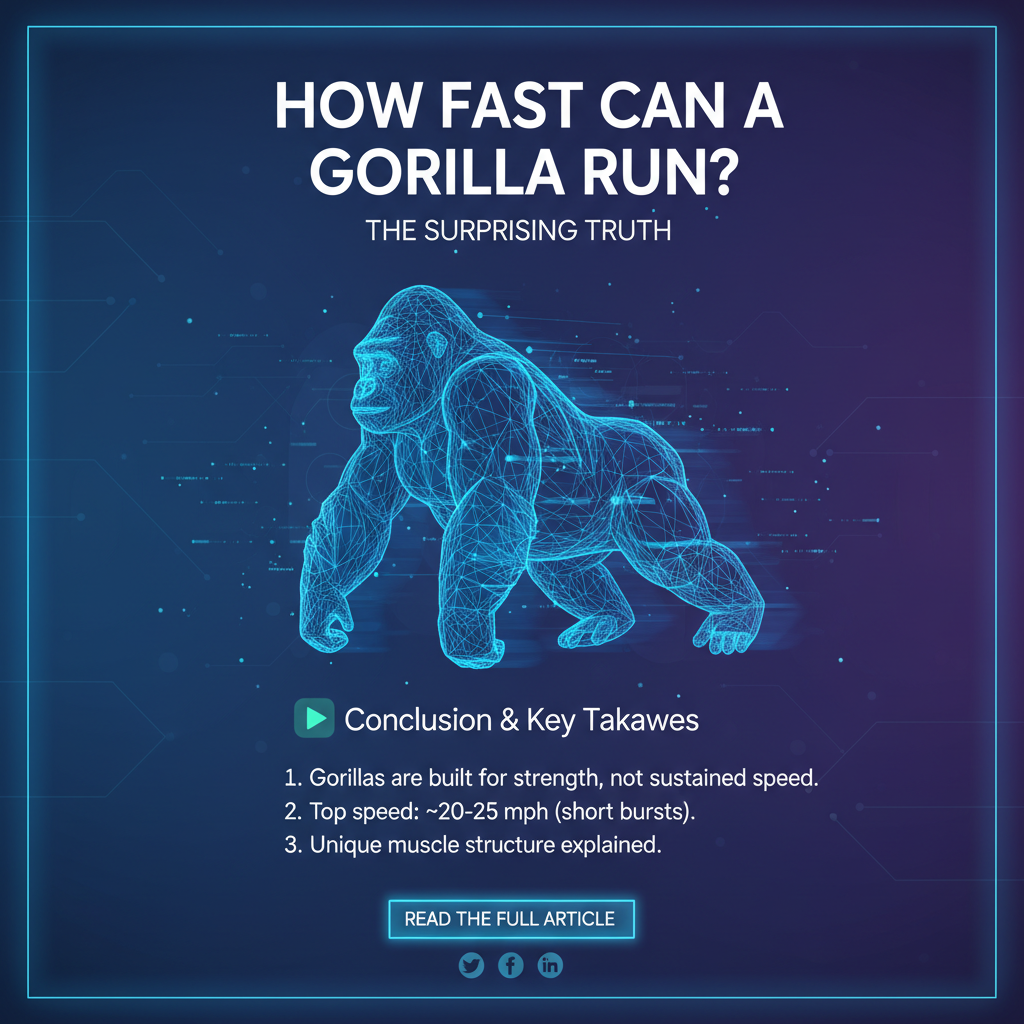
How Fast Can a Gorilla Run? The Surprising Truth



The dense, enigmatic forests of Africa hold a myriad of secrets, and among their most compelling inhabitants are the gorillas – magnificent, powerful primates that command respect and intrigue. Often depicted in popular culture as lumbering giants or aggressive beasts, gorillas are, in reality, complex creatures with a rich social structure, profound intelligence, and a remarkable physical prowess that belies many common misconceptions. One question that frequently captures the public's imagination, echoing through documentaries and casual conversations alike, is a seemingly simple one: "How fast can a gorilla run?" The answer, as with many aspects of the natural world, is far from straightforward and unravels a more surprising truth about these incredible animals, extending beyond mere physical speed into the very methodologies we employ to understand and protect them in an increasingly complex world.
Our journey to uncover the surprising truth about gorilla speed will delve deep into their biology, behavior, and the ecological niches they inhabit. We will dissect their unique anatomical adaptations, examine their various modes of locomotion, and contextualize their speed within the realities of their forest homes. But more than just quantifying their sprint capabilities, we will also explore the broader implications of studying such magnificent creatures, including the vital role that advanced technology, from artificial intelligence to sophisticated API management platforms, plays in modern conservation efforts. This exploration reveals not only the physical capacities of gorillas but also the profound human ingenuity being harnessed to ensure their survival and our continued understanding of the natural world.
The Mighty Gorilla: Anatomy, Strength, and Presence
Before we can accurately assess a gorilla's speed, it's imperative to understand the foundational elements of its existence: its anatomy, immense strength, and formidable presence. Gorillas are the largest living primates, with adult males (silverbacks) standing over 6 feet tall when upright and weighing between 300 and 500 pounds, sometimes even more in captivity. Females are typically smaller, though still substantially built, ranging from 150 to 250 pounds. This sheer size and mass are immediately indicative of their power, but also raise questions about their agility and speed compared to lighter, more gracile animals.
Their skeletal structure is robust, designed to support their substantial musculature. Gorillas possess incredibly powerful arms, disproportionately longer and stronger than their legs, a testament to their evolutionary history which includes significant arboreal (tree-dwelling) phases. Their broad chests and massive shoulders anchor muscles capable of extraordinary feats of strength, allowing them to tear through dense vegetation, climb formidable trees, and engage in powerful displays when necessary. The knuckles on their hands are specially adapted for knuckle-walking, their primary mode of terrestrial locomotion, providing a stable, almost tripod-like base for their immense upper body. This adaptation is crucial, as it distributes their weight efficiently and allows for sustained movement through challenging terrain. The feet, too, are adapted, with opposable big toes that aid in gripping branches, even if their terrestrial life has somewhat reduced the dexterity seen in more arboreal primates.
The perception of gorillas as slow, deliberate creatures often stems from observations of their typical foraging behavior. They spend significant portions of their day quietly consuming vast quantities of vegetation – leaves, stems, fruits, and bark – moving methodically through their habitat. This unhurried pace is energy-efficient and perfectly suited to their herbivorous diet and the need to process large amounts of fibrous plant matter. However, this calm demeanor can shift dramatically under specific circumstances, revealing an underlying capacity for bursts of speed and immense power that can be startling to witness. Understanding these nuances is key to appreciating the "surprising truth" about their locomotion.
Modes of Locomotion: Knuckle-Walking, Climbing, and Bipedal Bursts
Gorillas exhibit a fascinating repertoire of locomotion, each adapted to specific environmental demands and behavioral contexts. The primary mode, as mentioned, is knuckle-walking. This quadrupedal gait involves placing the weight on the knuckles of the forelimbs and the soles of the feet on the hindlimbs. It's an energy-efficient way to move through the forest floor, allowing them to cover substantial distances daily while foraging. The robust knuckles provide a stable platform, protecting their hands, and the slightly splayed posture allows for effective balance over uneven ground, through thick undergrowth, and up modest inclines. It is within this mode that much of their terrestrial speed is observed.
Arboreal locomotion, or climbing, remains a significant aspect of gorilla life, particularly for younger, lighter individuals who readily ascend trees to forage for fruits or to sleep in nests high above the ground. Even large silverbacks, despite their bulk, can climb with surprising agility, leveraging their powerful arm strength and prehensile feet. This ability underscores their deep connection to the forest canopy and provides a critical escape route from terrestrial threats or access to essential food resources. While not directly related to horizontal speed, their climbing prowess speaks volumes about their overall physical capabilities and coordination.
Perhaps the most dramatic and least understood mode is bipedalism, or walking on two legs. Gorillas are capable of standing and walking upright for short distances, especially when performing a display of dominance, carrying food, or navigating particularly shallow water. While they do not sustain bipedal locomotion for long periods like humans, these brief excursions showcase their latent abilities. In moments of extreme aggression or defense, a charging gorilla might briefly stand upright, beat its chest, and then drop back to all fours for a powerful charge, blurring the lines between these different modes of movement. These bipedal moments are crucial to understanding the perceived speed and intimidation factor of a charging gorilla.
The efficiency and speed of these different modes are influenced by several factors: the terrain (dense jungle, open ground, inclines), the individual's motivation (foraging, fleeing, charging, playing), and demographic variables like age, sex, and physical condition. A young, agile gorilla might move with more alacrity than an older, heavier silverback, for instance, particularly in complex arboreal environments. The interplay of these factors creates a dynamic picture of gorilla movement that defies simplistic categorization.
The Surprising Truth About Gorilla Speed: Faster Than You Think?
So, how fast can a gorilla run? The "surprising truth" often lies in challenging our preconceived notions. Popular culture often pits gorillas against humans in a direct sprint, leading to misconceptions. While a gorilla’s top speed is difficult to measure precisely in the wild, due to the dense forest environment and the unpredictable nature of their movements, observations and estimations provide a compelling picture.
Estimates suggest that gorillas, particularly when motivated by a threat, fear, or aggression, can reach speeds of approximately 20 to 25 miles per hour (32 to 40 kilometers per hour) over short distances. Some reports even push this closer to 30 mph (48 km/h) in extreme circumstances. To put this in perspective, the average human can sprint at about 15 mph (24 km/h), and even the fastest human sprinters, like Usain Bolt, reach speeds of around 27 mph (43 km/h) for very brief periods. This means a gorilla, especially a motivated one, can certainly outpace most humans in a short burst.
Why is this surprising? 1. Perception vs. Reality: Their sheer size and typical unhurried demeanor lead many to believe they are slow. The image of a silverback lumbering through the forest doesn't immediately suggest a creature capable of such velocity. 2. Locomotion Type: The fact that they achieve these speeds primarily through knuckle-walking, a quadrupedal gait that doesn't seem inherently built for rapid sprinting compared to bipedal running in humans or galloping in quadrupeds like big cats, is counter-intuitive. However, their incredibly powerful leg and arm muscles, combined with a low center of gravity and a wide base, provide immense propulsion and stability. 3. Context of Speed: Gorillas don't run for sport. Their speed is a tool for survival. When they do run, it's typically for critical reasons: * Escape: Fleeing from a perceived danger, such as human encroachment or natural disasters. * Charge/Defense: Protecting their family group from predators (though adult gorillas have few natural predators other than humans) or rival gorilla groups. A charging silverback is one of nature's most formidable sights, a combination of speed, power, and intimidating vocalizations. * Play: Younger gorillas engage in boisterous play that involves fast-paced chasing and wrestling.
It's important to differentiate between sustained running and short bursts. Gorillas are not built for endurance running over long distances. Their heavy build and energy-intensive musculature make prolonged high-speed locomotion unsustainable. Instead, they are masters of powerful, explosive movements precisely when needed. This tactical use of speed, rather than its continuous application, is a key part of their survival strategy and contributes to the "surprising truth" – they are fast enough when it truly matters.
Below is a table summarizing key physical attributes and their implications for speed:
| Feature | Description | Implication for Speed |
|---|---|---|
| Massive Build | Large body size (up to 500 lbs for males). | Requires significant muscle power for propulsion, limits endurance, but provides momentum for powerful bursts. |
| Powerful Arms | Disproportionately long and strong, anchored by broad shoulders. | Crucial for knuckle-walking propulsion, climbing, and generating force during charges. |
| Robust Legs | Muscular, though shorter relative to arm length. | Provides strong push-off for bursts of speed and supports bipedal stance/walks. |
| Knuckle-Walking Gait | Primary quadrupedal terrestrial locomotion. | Energy-efficient for daily travel, but capable of high speeds over short distances due to powerful limb coordination. |
| Low Center of Gravity | Contributes to stability and balance, especially on uneven forest floors. | Aids in rapid directional changes and prevents falls during high-speed movements. |
| High Muscle Density | Muscles are dense and adapted for strength and short bursts of power. | Enables explosive acceleration and maximum force generation for charges or escapes. |
Beyond Raw Speed: The Rich Tapestry of Gorilla Life
While their speed is an intriguing aspect, it is but one thread in the rich tapestry of gorilla life. To truly appreciate these animals, we must look beyond their physical capabilities to their complex social structures, profound intelligence, and critical ecological roles. Gorillas are highly social animals, living in structured family groups typically led by a dominant silverback. This leader is responsible for the group's safety, mediating disputes, and guiding them to food sources. Their communication is rich, involving a diverse array of vocalizations, facial expressions, and body language, often subtle yet highly effective within the group.
Gorillas demonstrate remarkable intelligence, evidenced by their problem-solving abilities, capacity for tool use (though less frequently observed than in chimpanzees), and self-awareness. Their interactions within the group showcase empathy, cooperation, and even grief. They are also gardeners of the forest, playing a vital role in seed dispersal and maintaining the health and diversity of their ecosystems. By consuming vast amounts of vegetation, they clear pathways, stimulate new growth, and help shape the forest structure, making them key species for the health of their habitats.
However, the future of these magnificent creatures is precarious. All gorilla species – Eastern Gorillas (including Mountain and Eastern Lowland Gorillas) and Western Gorillas (including Cross River and Western Lowland Gorillas) – are critically endangered. Threats include habitat loss and fragmentation due to deforestation for agriculture, logging, and mining; poaching for bushmeat and illegal pet trade; and the devastating impact of diseases like Ebola. Understanding their speed or any other facet of their biology becomes not just an academic exercise but a crucial component of broader conservation strategies aimed at protecting them from extinction.
APIPark is a high-performance AI gateway that allows you to securely access the most comprehensive LLM APIs globally on the APIPark platform, including OpenAI, Anthropic, Mistral, Llama2, Google Gemini, and more.Try APIPark now! 👇👇👇
Connecting Nature and Technology: The Digital Lens on Conservation
The study and conservation of gorillas, and indeed all wildlife, in the 21st century have been profoundly transformed by technological advancements. Gone are the days when field research relied solely on pen, paper, and direct observation. Today, researchers and conservationists are equipped with a formidable arsenal of digital tools, from remote sensing technologies to sophisticated data analytics platforms. This technological revolution has opened new avenues for understanding complex animal behaviors, monitoring populations, combating poaching, and managing vast amounts of ecological data. It is here that the seemingly disparate worlds of majestic primates and cutting-edge software solutions begin to converge.
Consider the immense volume and variety of data generated in modern wildlife research. This includes:
- Sensor Data: GPS trackers on animals, acoustic sensors for vocalizations, camera traps capturing images and videos, environmental sensors monitoring temperature, humidity, and vegetation health.
- Genetic Data: DNA analysis from scat or hair samples provides insights into population structure, genetic diversity, and kinship.
- Behavioral Observations: Detailed field notes, synchronized video recordings, and even biometric data collection.
- Satellite Imagery: Used for mapping habitat changes, monitoring deforestation, and tracking illegal activities.
Managing and making sense of this deluge of information is a monumental task. This is where the principles of Artificial Intelligence (AI) and robust API management platforms become indispensable. AI, particularly in its subfields like machine learning and computer vision, excels at pattern recognition and data analysis at scales impossible for humans. For instance, AI algorithms can rapidly process thousands of camera trap images to identify individual animals, count populations, or detect the presence of poachers. Similarly, Large Language Models (LLMs) can be trained to analyze vast scientific literature, extract key insights from field notes, or even help researchers draft conservation reports and grant proposals more efficiently.
However, the power of AI models and diverse data sources can only be fully realized if they are seamlessly integrated and accessible. This is the crucial role of APIs (Application Programming Interfaces) and API Gateways. In a typical conservation project, researchers might use different data collection tools, various analytical software, and multiple AI models (some custom-built, others off-the-shelf). Each of these components might speak a different "language" or have unique access requirements. An API Gateway acts as a central hub, standardizing access, managing authentication, and routing requests between different services and data sources. It creates a unified access point for all these disparate tools, allowing researchers to build integrated workflows without having to deal with the underlying complexities of each individual system.
Imagine a conservation team needing to: 1. Ingest camera trap data (images/videos) from remote locations. 2. Run these through an AI model (e.g., using a Claude-like model or a specialized computer vision algorithm) to identify gorillas and humans. 3. Cross-reference these sightings with GPS data from collared animals and satellite imagery showing recent deforestation. 4. Generate real-time alerts for potential poaching activity. 5. Visualize all this data on a dashboard for rapid decision-making.
Each of these steps involves different software components, data formats, and potentially different AI services. An effective API Gateway simplifies this intricate process. It provides a single point of entry for all these different services, ensuring consistent data formats, handling authentication for various users (researchers, park rangers, administrators), and efficiently managing the flow of information. It acts as the digital nervous system for a complex conservation technology stack, ensuring that valuable data and powerful AI tools are not isolated but work together in harmony.
This need for streamlined integration and robust management of AI and API services is precisely what platforms like APIPark address. APIPark, an open-source AI gateway and API management platform, offers a comprehensive solution for managing, integrating, and deploying a variety of AI and REST services. For conservation organizations and researchers, APIPark could serve as a powerful backbone, enabling them to quickly integrate over 100 AI models for tasks like image recognition, sound analysis, or environmental data processing. It standardizes the API format for AI invocation, meaning that if a research team decides to switch from one LLM (like Claude) to another for processing textual field notes, the core application or microservices built by the team don't need to be rewritten, dramatically reducing maintenance costs and speeding up research cycles. This unified approach allows conservationists to focus on biological insights rather than technical integration hurdles, ensuring that the critical data gathered from the field can be rapidly analyzed and translated into actionable strategies for protecting magnificent creatures like gorillas.
Deep Dive into AI & API's Role in Modern Conservation
The application of AI and APIs in modern conservation extends far beyond simple data aggregation. It is transforming every facet of wildlife protection and ecological research.
AI for Predictive Analytics and Monitoring: One of the most impactful uses of AI is in predictive analytics. By analyzing historical data on deforestation rates, weather patterns, human activity, and animal movements, AI models can predict areas at high risk for poaching or habitat degradation. For instance, satellite imagery combined with machine learning algorithms can detect changes in forest cover with incredible accuracy, far outpacing manual analysis. These AI Gateway systems can then trigger alerts or deploy resources to prevent issues before they escalate. For rare species like the Cross River Gorilla, whose populations are critically low and scattered, precision monitoring enabled by AI is paramount.
LLMs for Knowledge Management and Scientific Discovery: Large Language Models (LLMs) are revolutionizing how researchers interact with vast amounts of textual data. Conservation science is incredibly interdisciplinary, involving ecology, biology, sociology, economics, and policy. Researchers need to synthesize information from countless scientific papers, government reports, field journals, and traditional ecological knowledge. An LLM Gateway can provide a unified interface to process and query these massive text corpora. A researcher could ask an LLM to summarize all known literature on gorilla foraging behavior in specific forest types, or to identify potential correlations between human settlement patterns and disease transmission risk for primates. This accelerates the knowledge discovery process, helping conservationists develop more informed strategies. Imagine using an LLM to quickly analyze decades of gorilla behavioral observations to identify subtle trends that might indicate stress or changes in social dynamics, feeding this data back into a predictive model.
API Infrastructure for Collaboration and Scalability: Conservation is inherently a collaborative effort, often involving multiple research institutions, government agencies, NGOs, and local communities across different geographic regions. Effective data sharing and integration are critical. This is where the robust framework of APIs shines. APIs provide standardized methods for different systems to communicate, enabling secure and controlled exchange of data. A centralized API infrastructure allows various stakeholders to access relevant data without compromising data integrity or security. For example, a wildlife authority might expose an API that provides anonymized animal movement data to research teams, while another API might allow local communities to report wildlife sightings or illegal activities.
The concept of an API Gateway becomes even more vital in a multi-stakeholder environment. It ensures that all incoming requests, whether from a mobile app used by park rangers, a research team's analytical software, or a public-facing dashboard, are authenticated, authorized, and routed correctly. It also handles concerns like rate limiting, ensuring fair usage, and caching, to improve performance. For a global conservation initiative, managing these complex interactions across various cloud environments and on-premise systems might even involve an MCP (Multi-Cloud Platform or Management Control Plane), ensuring consistent deployment and management of API and AI services regardless of the underlying infrastructure. This scalability is critical for handling the massive data loads generated by increasingly sophisticated monitoring tools across vast geographical areas where gorillas reside.
Example: Leveraging Claude for Conservation Insights Specific LLMs, such as Claude, can be integrated into these API-driven workflows. For example, a conservation organization might use a fine-tuned Claude model through an LLM Gateway to: * Translate Field Notes: Automatically translate field notes written in local dialects or obscure scientific jargon into a common language for broader understanding. * Summarize Research: Condense lengthy scientific papers into key findings relevant to specific conservation questions. * Generate Hypotheses: Based on existing data, suggest new research questions or potential correlations that might not be immediately obvious to human researchers. * Public Engagement: Create engaging educational content or answer common questions about gorillas for public outreach efforts, drawing on a vast knowledge base.
By centralizing access to such powerful tools via an API Gateway, conservationists can dramatically increase their efficiency and the scope of their work.
Challenges and Future Directions in Tech-Enabled Conservation
While the integration of AI and APIs offers unprecedented opportunities for gorilla conservation, it also presents significant challenges and necessitates careful consideration of future directions.
Ethical Considerations: The use of AI in wildlife raises ethical questions. How do we ensure these technologies do not inadvertently harm animals or disrupt their natural behaviors? For instance, overly intrusive sensors or surveillance could cause stress. There's also the question of data privacy and ownership, especially when involving indigenous communities whose traditional knowledge might be integrated into AI models. Transparent and responsible AI development, prioritizing animal welfare and local community engagement, is paramount.
Data Security and Integrity: The collection and management of vast amounts of sensitive ecological data necessitate robust security protocols. Protecting against data breaches, ensuring data integrity, and establishing clear data governance policies are critical. An API Gateway plays a vital role here, acting as a secure perimeter that authenticates every request and enforces access controls, safeguarding valuable information.
Accessibility and Capacity Building: The advanced nature of these technologies means there's a significant knowledge gap in many regions where conservation is most needed. Building local capacity through training, providing open-source tools, and fostering digital literacy among field researchers and conservation practitioners is essential for equitable and effective implementation. Platforms like APIPark, being open-source, can contribute to this by lowering the barrier to entry for API and AI management.
The Pace of Technological Change: The rapid evolution of AI and API technologies means that conservation strategies must be adaptable. What is cutting-edge today might be obsolete tomorrow. Continuous learning, agile development methodologies, and flexible API infrastructures are necessary to keep pace. The ability to quickly integrate new AI models or switch between different services, as enabled by a platform that offers a unified API format for AI invocation, is key to future-proofing conservation efforts.
Looking ahead, the synergy between technological innovation and ecological stewardship will only deepen. We can anticipate more sophisticated autonomous monitoring systems, hyper-localized predictive models, and increasingly intelligent AI agents assisting in every phase of conservation, from anti-poaching operations to habitat restoration planning. The surprising truth about a gorilla's speed serves as a powerful reminder of nature's hidden capabilities, and the surprising truth about technology's role is its ever-expanding capacity to help us unravel, protect, and cherish these wonders.
Conclusion: The Unseen Speed and the Digital Guardians
The question of "How fast can a gorilla run?" unlocks a fascinating exploration of one of nature's most impressive primates. The surprising truth is that these immense, powerful creatures, often perceived as slow, possess an explosive speed of 20 to 25 mph (and potentially higher), enabling them to rapidly escape danger or launch a formidable defense. This speed, utilized strategically in short, powerful bursts, is a testament to their evolutionary adaptations and their survival instincts within the challenging forest environments they call home. It highlights that true understanding often requires looking beyond superficial observations and delving into the intricate biological and behavioral nuances of a species.
But our journey didn't end with a simple number. It expanded into the critical role that modern technology plays in our continued quest to understand and protect these magnificent animals. In an era where all gorilla species face critical threats, the deployment of advanced tools like Artificial Intelligence, sophisticated APIs, and robust API management platforms has become indispensable. These technologies act as digital guardians, enabling researchers and conservationists to collect, analyze, and interpret vast quantities of data, predict threats, and coordinate interventions with unprecedented efficiency and precision.
From AI algorithms processing camera trap images to LLM Gateways sifting through scientific literature, and from the seamless integration provided by API Gateways to the overarching management facilitated by platforms like APIPark, technology is bridging the gap between human understanding and the complex, endangered ecosystems of the world. The speed of a gorilla is surprising, but perhaps even more surprising is the speed and ingenuity with which humanity is now leveraging digital tools to ensure that future generations will also have the privilege of witnessing the profound majesty of these forest giants in their natural habitats. The ultimate truth is that to preserve the wild, we must sometimes embrace the cutting edge.
Frequently Asked Questions (FAQs)
1. How fast can a gorilla run compared to a human? A gorilla can run at speeds of approximately 20 to 25 miles per hour (32 to 40 kilometers per hour) over short distances. The average human can sprint around 15 mph (24 km/h), while elite human sprinters reach about 27 mph (43 km/h). This means a motivated gorilla can outpace most humans in a short burst, making them surprisingly fast despite their large size.
2. Are gorillas built for endurance running? No, gorillas are not built for endurance running. Their massive build and dense musculature are adapted for short, powerful bursts of speed, immense strength, and efficient knuckle-walking over varied terrain. Sustained high-speed locomotion would be metabolically very costly for them. They conserve energy through their deliberate foraging habits and use speed strategically when absolutely necessary for defense or escape.
3. What is the primary mode of locomotion for gorillas? The primary mode of locomotion for gorillas on the ground is knuckle-walking. This quadrupedal gait involves walking on the soles of their feet and the knuckles of their forelimbs. This method provides stability, protects their hands, and is energy-efficient for covering long distances while foraging through dense forest environments. They also climb trees and can walk bipedally for short distances.
4. Why is understanding gorilla speed important for conservation? Understanding gorilla speed and other physical capabilities helps scientists build a complete ecological profile of the species. This knowledge aids in designing effective conservation strategies, such as determining appropriate safe zones, understanding their movement patterns in response to threats, and developing anti-poaching measures. Furthermore, studying their physiology contributes to broader primatological research, informing our understanding of primate evolution and behavior.
5. How is technology helping to study and conserve gorillas? Technology is revolutionizing gorilla conservation by enabling advanced data collection, analysis, and management. AI is used for processing camera trap images, analyzing vocalizations, and predictive modeling for threats like poaching. APIs and API Gateways, such as APIPark, provide the infrastructure to integrate diverse data sources (GPS, satellite imagery, genetic data) and various AI models, creating unified platforms for researchers and conservationists. This streamlines workflows, enhances monitoring capabilities, and facilitates collaborative efforts to protect these critically endangered primates.
🚀You can securely and efficiently call the OpenAI API on APIPark in just two steps:
Step 1: Deploy the APIPark AI gateway in 5 minutes.
APIPark is developed based on Golang, offering strong product performance and low development and maintenance costs. You can deploy APIPark with a single command line.
curl -sSO https://download.apipark.com/install/quick-start.sh; bash quick-start.sh

In my experience, you can see the successful deployment interface within 5 to 10 minutes. Then, you can log in to APIPark using your account.

Step 2: Call the OpenAI API.