How to Access REST API Through GraphQL: A Comprehensive Guide


The landscape of modern web development is a constantly evolving tapestry of technologies and architectural paradigms. As applications grow in complexity and user expectations soar, the methods by which data is accessed and delivered become critical determinants of success. For years, REST (Representational State Transfer) APIs have reigned supreme, offering a simple, stateless, and widely understood approach to building networked applications. Yet, with the proliferation of diverse client devices and the demand for highly tailored data experiences, a new challenger has emerged: GraphQL. While GraphQL brings significant advantages in terms of data fetching efficiency and client flexibility, the vast majority of existing services and data sources remain firmly rooted in the RESTful paradigm. The challenge, then, is not to choose one over the other, but to find intelligent, efficient ways to bridge the gap, allowing modern GraphQL clients to seamlessly interact with established RESTful backends.
This comprehensive guide delves deep into the fascinating intersection of REST and GraphQL, exploring the motivations, architectural patterns, practical implementation steps, and critical considerations for accessing REST APIs through a GraphQL layer. We will uncover how organizations can leverage their existing investments in RESTful services while simultaneously empowering their client-side developers with the declarative power and efficiency of GraphQL. This journey is about modernization, strategic integration, and unlocking new levels of flexibility in API consumption, without the disruptive cost of a complete system overhaul. We'll examine how an effective API strategy, often incorporating a robust API Gateway and well-defined OpenAPI specifications, becomes instrumental in this transitional process. By the end, you will possess a clear understanding of how to orchestrate this powerful synergy, positioning your applications for future growth and enhanced developer experience.
1. Understanding the Landscape – REST vs. GraphQL
Before we embark on the journey of integrating these two powerful paradigms, it's essential to have a profound understanding of each, particularly their inherent strengths and weaknesses. This foundational knowledge will illuminate why bridging them is not just a technical exercise but a strategic imperative for many organizations navigating the complexities of modern API ecosystems.
1.1 Deep Dive into REST API: The Enduring Standard
REST, or Representational State Transfer, is an architectural style that has dominated the world of web services for over two decades. Conceived by Roy Fielding in his 2000 doctoral dissertation, it defines a set of constraints that, when applied to a system, promote scalability, reliability, and independent evolution of client and server. REST is not a protocol or a specific technology; rather, it’s a design philosophy that guides how networked applications communicate.
The core principles of REST include:
- Client-Server Architecture: A clear separation between the client and the server, allowing them to evolve independently. The client is responsible for the user interface, while the server handles data storage and processing.
- Statelessness: Each request from client to server must contain all the information necessary to understand the request. The server should not store any client context between requests. This enhances scalability and reliability.
- Cacheability: Responses must explicitly or implicitly define themselves as cacheable or non-cacheable. This prevents clients from reusing stale or inappropriate data, improving network efficiency and performance.
- Layered System: A client cannot ordinarily tell whether it is connected directly to the end server or to an intermediary along the way. This allows for intermediate servers like load-balancers, proxies, or
API Gateways to be introduced, providing scalability and security without affecting the client or the end server. - Uniform Interface: This is the most crucial constraint, simplifying the overall system architecture. It encompasses:
- Resource Identification in Requests: Individual resources are identified in requests, for example, using URIs.
- Resource Manipulation Through Representations: Clients manipulate resources using representations, which are typically JSON or XML documents.
- Self-descriptive Messages: Each message includes enough information to describe how to process the message.
- Hypermedia as the Engine of Application State (HATEOAS): This principle suggests that
APIresponses should include links to related resources, guiding the client on available actions and transitions. While often overlooked in practical RESTAPIimplementations, it's a cornerstone of pure REST.
Strengths of REST:
- Simplicity and Wide Adoption: REST is relatively easy to understand and implement, leading to its widespread adoption across industries. A vast ecosystem of tools, libraries, and frameworks supports RESTful
APIdevelopment. - HTTP-Based: It leverages standard HTTP methods (GET, POST, PUT, DELETE) and status codes, making it familiar to web developers and easily consumable by web browsers.
- Cache-Friendliness: Due to its stateless nature and use of HTTP methods, REST
APIs can be easily cached at various layers (client, proxy,API Gateway), significantly improving performance for frequently accessed data. - Clear Resource-Oriented Design: The concept of resources makes
APIdesign intuitive and manageable, especially for systems that map well to nouns (e.g., /users, /products).
Weaknesses of REST:
Despite its strengths, REST exhibits certain limitations that become more pronounced with the increasing complexity of modern applications, particularly those serving diverse client needs:
- Over-fetching: Clients often receive more data than they actually need because
APIendpoints typically return a fixed structure of data for a resource. This wastes bandwidth and processing power, especially problematic for mobile clients on limited networks. - Under-fetching and Multiple Round Trips: Conversely, a single REST endpoint might not provide all the necessary data for a particular UI view, forcing the client to make multiple requests to different endpoints to gather related information (e.g., fetching a user, then fetching their posts, then their comments). This leads to increased latency and a more complex client-side data orchestration.
- Versioning Complexities: As
APIs evolve, developers need to manage different versions (e.g., /v1/users, /v2/users). This can be cumbersome for bothAPIproviders and consumers. - Lack of Strong Typing and Schema: While
OpenAPI(formerly Swagger) specifications address this by providing a standardized description format, REST itself doesn't enforce a strong type system. This can lead to ambiguity and requires clients to have prior knowledge of theAPI's data structures.
1.2 The Rise of GraphQL: A Query Language for APIs
GraphQL, developed by Facebook in 2012 and open-sourced in 2015, emerged as a pragmatic solution to the very problems REST faced, particularly in the context of mobile application development where efficient data fetching is paramount. It's not a replacement for REST in all scenarios, but rather a powerful alternative or complementary technology. GraphQL is essentially a query language for your API and a runtime for fulfilling those queries with your existing data.
Core Principles of GraphQL:
- Single Endpoint: Unlike REST, which exposes multiple endpoints for different resources, a GraphQL
APItypically exposes a single endpoint (e.g.,/graphql). All client requests go to this one endpoint. - Request Exactly What You Need: Clients send a query to the GraphQL server, explicitly specifying the data fields they require. The server responds with precisely that data, and nothing more. This eliminates over-fetching and under-fetching.
- Strong Type System with Schema: At the heart of every GraphQL
APIis a schema, which defines all the types, fields, and relationships available in theAPI. This schema acts as a contract between the client and the server, ensuring data consistency and enabling powerful tooling (e.g., auto-completion, validation). - Hierarchical Structure: GraphQL queries mirror the hierarchical structure of the data relationships on the server, making it intuitive to fetch nested data in a single request.
- Real-time Capabilities with Subscriptions: Beyond queries (fetching data) and mutations (modifying data), GraphQL supports subscriptions, allowing clients to receive real-time updates when specific data changes on the server.
Strengths of GraphQL:
- Eliminates Over-fetching and Under-fetching: This is GraphQL's most celebrated advantage. Clients get precisely what they ask for, leading to more efficient network utilization and faster application loading times.
- Efficient Data Fetching (Single Request): Clients can retrieve all necessary data for a complex UI view in a single request, even if that data comes from multiple underlying data sources or microservices. This drastically reduces the number of round trips, improving performance and simplifying client-side code.
- Strong Type System and Introspection: The schema provides a robust contract, making
APIconsumption predictable and enabling powerful development tools. Clients can introspect the schema to understand what data is available. - Simplified Client-Side Development: Client developers no longer need to piece together data from multiple REST endpoints. They can focus on defining their data requirements in a clear, declarative manner.
- Evolvable APIs: Adding new fields to a GraphQL schema doesn't create breaking changes for existing clients, as they only receive the data they explicitly request. This simplifies
APIevolution and versioning.
Weaknesses of GraphQL:
- Learning Curve: Adopting GraphQL requires teams to learn new concepts (schema definition language, resolvers, queries, mutations, subscriptions) and potentially new client-side libraries.
- Caching Complexities: REST leverages HTTP caching mechanisms effectively. GraphQL, with its single endpoint and POST-only queries (though GET is possible), complicates traditional HTTP caching. This necessitates alternative caching strategies (e.g., client-side caching libraries like Apollo Client's normalized cache).
- File Uploads: While possible, handling file uploads in GraphQL is often less straightforward compared to direct REST endpoints designed for multipart form data.
- Rate Limiting: Implementing granular rate limiting can be more challenging with GraphQL's flexible queries compared to REST's clear endpoint structure.
- Server-Side Complexity: The server needs to handle complex query parsing, validation, and resolution logic, potentially adding overhead.
1.3 Why Bridge the Gap? The Strategic Imperative
Given the distinct advantages and disadvantages of both REST and GraphQL, the question naturally arises: why not simply choose one? The reality for many enterprises is far more nuanced. Large organizations rarely have the luxury of starting from a blank slate. They operate with:
- Extensive Legacy Systems: Decades of development have often resulted in a vast ecosystem of RESTful
APIs and microservices that power existing applications. A complete rewrite to GraphQL is usually impractical, prohibitively expensive, and carries immense risk. - Gradual Adoption Strategies: Organizations often seek to adopt new technologies incrementally. Introducing GraphQL as a facade over existing REST
APIs allows teams to experiment, learn, and gradually migrate or enhance client applications without disrupting core services. - Combining the Best of Both Worlds: For internal, service-to-service communication, the simplicity and cacheability of REST might still be preferred. However, for client-facing
APIs, especially those serving mobile or single-page applications with complex UI requirements, GraphQL's flexibility is invaluable. Bridging allowsAPIproviders to offer a modern, efficientAPIexperience to external consumers while retaining the stability and familiarity of REST for internal systems. - Unified API Layer: Even if multiple backend services are RESTful, a GraphQL layer can present them as a single, coherent
APIto clients, abstracting away the underlying microservice architecture. This simplifies client development significantly.
The strategic imperative, therefore, is clear: to combine the agility and client-side efficiency of GraphQL with the robustness and established infrastructure of existing RESTful APIs. This synergy empowers developers to build sophisticated applications faster, improve user experiences, and future-proof their API ecosystem without the monumental task of a full-scale migration.
| Feature / Aspect | REST API | GraphQL |
|---|---|---|
| Architectural Style | Resource-oriented, uses multiple endpoints | Query language, single endpoint |
| Data Fetching | Over-fetching & Under-fetching often occur | Exact data fetching (no over/under-fetching) |
| HTTP Methods | Leverages standard HTTP verbs (GET, POST, PUT, DELETE) | Primarily uses POST (GET also possible for queries) |
| Schema & Typing | Less strict, often relies on documentation (OpenAPI) |
Strongly typed, explicit schema definitions |
| Caching | Leverages HTTP caching mechanisms effectively | More complex, often requires client-side libraries |
| Endpoints | Multiple, resource-specific endpoints | Typically a single /graphql endpoint |
| Versioning | Often handled via URL (e.g., /v1/) or headers | Schema evolution is non-breaking by default |
| Real-time | Achieved via WebSockets or polling | Built-in subscriptions for real-time data |
| Learning Curve | Generally lower, widely understood | Higher initial learning curve |
| Use Case | Traditional web services, internal APIs, CRUD operations | Complex UIs, mobile apps, data aggregation |
2. Architectural Patterns for Bridging REST and GraphQL
The decision to bridge REST and GraphQL necessitates careful consideration of the architectural patterns available. This section explores the most common and effective ways to establish this crucial connection, detailing how a GraphQL server can act as a sophisticated intermediary, translating client GraphQL requests into calls to underlying RESTful services. We will also touch upon the broader role of API Gateways and how OpenAPI specifications can streamline this integration.
2.1 The GraphQL Server as a Facade/Gateway
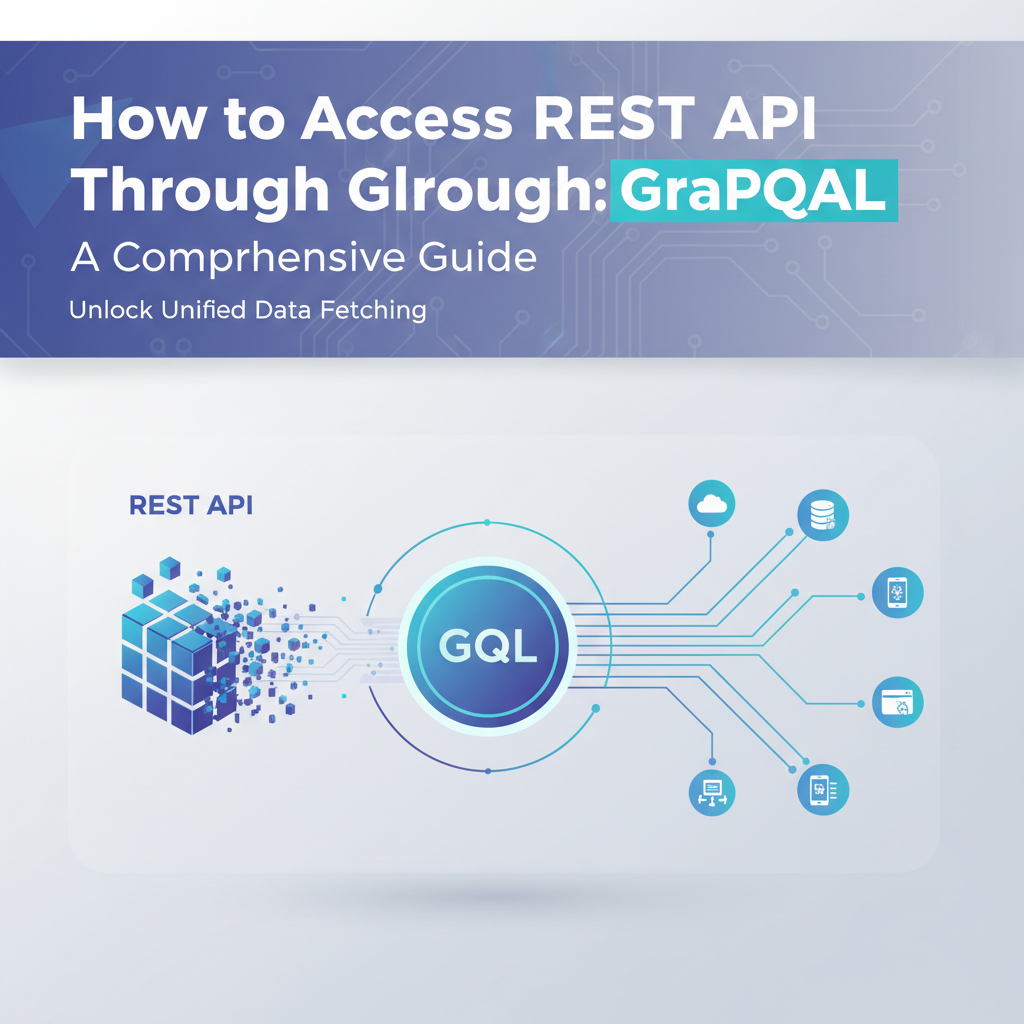
This is arguably the most prevalent and effective pattern for accessing REST APIs through GraphQL. In this model, a dedicated GraphQL server sits as a facade in front of one or more existing RESTful services. The client application interacts exclusively with this GraphQL server, which then takes on the responsibility of translating GraphQL queries and mutations into appropriate calls to the backend REST APIs.
How it Works in Detail:
- Client Request: A client application (e.g., a web or mobile app) sends a GraphQL query or mutation to the GraphQL server's single endpoint. The query specifies exactly what data the client needs, potentially from multiple conceptual "resources."
- Schema Definition: The GraphQL server hosts a schema that defines all the data types, queries, and mutations available to clients. This schema represents a unified view of the data, even if it originates from disparate REST APIs. The schema typically abstracts away the specifics of the underlying REST endpoints, presenting a clean, client-friendly data model.
- Resolver Functions: The core of this pattern lies in the resolver functions. For each field defined in the GraphQL schema, there is an associated resolver. When the GraphQL server receives a query, it traverses the requested fields and executes their corresponding resolvers. These resolvers are responsible for:
- Making HTTP Requests: Issuing HTTP calls (GET, POST, PUT, DELETE) to the appropriate backend REST API endpoints. For example, a
userquery's resolver might make a GET request to/api/v1/users/{id}. - Data Transformation: Receiving the JSON response from the REST API and transforming it into the shape and format expected by the GraphQL schema. This might involve renaming fields, combining data from multiple REST responses, or performing light business logic.
- Error Handling: Catching errors from the REST API and translating them into a GraphQL-friendly error format.
- Making HTTP Requests: Issuing HTTP calls (GET, POST, PUT, DELETE) to the appropriate backend REST API endpoints. For example, a
- Response Aggregation: Once all necessary resolvers have fetched and transformed their data, the GraphQL server aggregates these results into a single, JSON response that precisely matches the structure requested in the client's GraphQL query.
Key Benefits of this Facade Pattern:
- Unified API Layer: Clients perceive a single, coherent
API, regardless of how many underlying REST services are contributing data. This simplifies client-side development significantly. - Optimized Data Fetching: Eliminates over-fetching and under-fetching, as clients only receive the data they explicitly request.
- Abstraction of Backend Complexity: The GraphQL layer completely hides the complexities of the underlying RESTful microservices, including their individual endpoints, authentication mechanisms (if federated), and data formats.
- Gradual Modernization: Allows organizations to introduce GraphQL benefits without requiring a full rewrite of existing RESTful backends.
- Improved Developer Experience: Provides introspection, strong typing, and auto-completion for client developers.
Managing the lifecycle of these underlying REST services is paramount for maintaining a stable and performant GraphQL layer. An API Gateway can play a crucial role here. Platforms like ApiPark, for instance, offer robust end-to-end API lifecycle management, enabling organizations to effectively design, publish, and govern their diverse set of APIs, including those RESTful services that will eventually be exposed through a GraphQL façade. This ensures that the backend services consumed by the GraphQL layer are secure, well-documented, and performant, forming a solid foundation for your unified API.
2.2 Proxying with an API Gateway (Generic API Gateway Context)
While a GraphQL server can act as a specialized API Gateway for data fetching, a traditional, general-purpose API Gateway plays a broader, complementary role in the overall architecture. An API Gateway is a single entry point for all client requests, sitting in front of your microservices or APIs. Its functionalities extend beyond mere routing:
- Authentication and Authorization: Centralizing security policies, authenticating clients, and authorizing access to specific
APIs or data. - Rate Limiting and Throttling: Protecting backend services from overload by limiting the number of requests clients can make.
- Caching: Caching responses from backend services to reduce load and improve response times.
- Monitoring and Logging: Providing a centralized point for
APItraffic logging, analytics, and performance monitoring. - Request/Response Transformation: Modifying requests before forwarding them to backend services or responses before sending them back to clients.
- Load Balancing: Distributing incoming
APIrequests across multiple instances of backend services.
How it integrates:
In an architecture bridging REST and GraphQL, the API Gateway can sit in front of the GraphQL server itself, or in front of both the GraphQL server and potentially some direct RESTful APIs (for clients that still consume REST directly).
- Gateway in front of GraphQL Server: The
API Gatewayhandles general concerns like authentication, rate limiting, and DDoS protection for all incoming requests, including those destined for the GraphQL endpoint. Once a request passes these checks, it's forwarded to the GraphQL server for query resolution. - Gateway with Hybrid Routing: A more sophisticated
API Gatewaycan route requests intelligently. Some requests might go directly to a REST service, while others are routed to the GraphQL server. The gateway can also perform basic request/response transformations or apply policies based on the request's path or headers.
The distinction between a GraphQL server as a facade and a general API Gateway is important. The GraphQL server is specifically designed for API composition and data fetching efficiency. The API Gateway provides a broader set of operational concerns and security features at the edge of your network. In a robust system, they often work in tandem, with the API Gateway handling the perimeter and the GraphQL server orchestrating data access.
2.3 Using a Library/Framework for Resolver Implementation
Implementing the GraphQL server that fronts your REST APIs often involves leveraging existing libraries and frameworks, which significantly reduce the development effort and provide robust capabilities. These tools simplify the process of defining schemas, writing resolvers, and handling the underlying HTTP communication.
Common choices across different programming languages include:
- Node.js/JavaScript:
- Apollo Server: A popular, production-ready GraphQL server library that can be integrated with various HTTP frameworks (Express, Koa, Hapi). It provides powerful features like caching, error handling, and
OpenAPIintegration. - GraphQL Yoga: A performant and easy-to-use GraphQL server that builds on
graphql-jsandenvelop. graphql-js: The reference implementation for GraphQL in JavaScript, providing the foundational building blocks for creating a GraphQL server.
- Apollo Server: A popular, production-ready GraphQL server library that can be integrated with various HTTP frameworks (Express, Koa, Hapi). It provides powerful features like caching, error handling, and
- Python:
- Graphene: A popular library for building GraphQL APIs in Python, with integrations for Django, Flask, and other frameworks.
- Java/Kotlin:
- Spring for GraphQL: Offers comprehensive support for building GraphQL APIs using Spring Boot.
- Netflix DGS (Domain Graph Service) Framework: A powerful, opinionated framework for building GraphQL services.
- Go:
- gqlgen: A GraphQL server generator that uses your GraphQL schema to generate Go types and resolvers.
Example Resolver Concept (Node.js with axios):
Let's imagine you have a REST API endpoint /api/v1/users/{id} that returns user details. In your GraphQL schema, you might define a User type and a user(id: ID!): User query. The resolver for this user query would look something like this:
// Example using Apollo Server and axios
const { ApolloServer, gql } = require('apollo-server');
const axios = require('axios');

// 1. Define your GraphQL schema
const typeDefs = gql`
  type User {
    id: ID!
    name: String
    email: String
    // ... other fields from REST API
  }

  type Query {
    user(id: ID!): User
    users: [User]
  }
`;

// 2. Implement resolvers
const resolvers = {
  Query: {
    user: async (parent, args, context, info) => {
      try {
        const response = await axios.get(`http://your-rest-api.com/api/v1/users/${args.id}`);
        return response.data; // Return the data from the REST API
      } catch (error) {
        console.error("Error fetching user from REST API:", error);
        throw new Error(`Failed to fetch user with ID ${args.id}`);
      }
    },
    users: async () => {
      try {
        const response = await axios.get(`http://your-rest-api.com/api/v1/users`);
        return response.data;
      } catch (error) {
        console.error("Error fetching users from REST API:", error);
        throw new Error("Failed to fetch users");
      }
    }
  },
  // You might have resolvers for nested fields if they come from different REST endpoints
  // For example, if 'User' had a 'posts' field that came from a '/users/{id}/posts' endpoint
  // User: {
  //   posts: async (user) => {
  //     const response = await axios.get(`http://your-rest-api.com/api/v1/users/${user.id}/posts`);
  //     return response.data;
  //   }
  // }
};

// 3. Start the Apollo Server
const server = new ApolloServer({ typeDefs, resolvers });

server.listen().then(({ url }) => {
  console.log(`🚀 Server ready at ${url}`);
});
This simple example demonstrates how a resolver function acts as a bridge, taking the arguments from the GraphQL query (args.id), making an HTTP call to the REST API, and returning the data. More complex scenarios involve error handling, data transformation, and possibly combining data from multiple REST calls within a single resolver or across nested resolvers.
2.4 Considerations for OpenAPI (Swagger) Specification
The OpenAPI Specification (OAS), formerly known as Swagger Specification, is a language-agnostic, human-readable, and machine-readable interface description for RESTful APIs. It allows both humans and computers to discover and understand the capabilities of a service without access to source code, documentation, or network traffic inspection. For bridging REST and GraphQL, OpenAPI plays a pivotal role in streamlining the process.
How OpenAPI Aids in Generating GraphQL Schemas:
One of the most significant challenges in mapping REST to GraphQL is manually creating and maintaining the GraphQL schema and its corresponding resolvers. As REST APIs evolve, keeping the GraphQL layer in sync can become a laborious and error-prone task. OpenAPI can significantly mitigate this.
- Automated Schema Generation: Tools exist that can read an
OpenAPIdocument and automatically (or semi-automatically) generate a GraphQL schema. These tools parse theOpenAPIdefinitions for:- Paths and HTTP Methods: Mapping REST endpoints and HTTP verbs (GET, POST, PUT, DELETE) to GraphQL queries and mutations.
- Request Bodies and Query Parameters: Translating these into GraphQL input types and arguments.
- Response Schemas: Converting JSON schemas defined in
OpenAPIinto GraphQL object types.
- Resolver Scaffolding: While
OpenAPItools can generate the schema, they often also provide scaffolding for resolver functions. These generated resolvers might contain placeholder logic that still requires manual implementation to make the actual HTTP calls to the REST endpoints. However, the structure and argument mapping are already provided, saving significant development time. - Consistency and Single Source of Truth: By deriving the GraphQL schema from
OpenAPI, you establish a single source of truth for yourAPIdefinitions. Any changes to the REST API, if reflected in itsOpenAPIdocument, can then be used to regenerate or update the GraphQL schema, ensuring consistency.
Benefits of Using OpenAPI in a REST-to-GraphQL Bridge:
- Reduced Manual Effort: Automates a substantial part of the schema and resolver creation, especially for large
APIs. - Improved Consistency: Helps maintain alignment between your REST
APIs and the GraphQL facade. - Faster Development Cycles: Speeds up the initial setup and subsequent updates of the GraphQL layer.
- Better Documentation: Both the
OpenAPIdocument and the introspectable GraphQL schema serve as excellent documentation for differentAPIconsumers. - Validation: The strong typing provided by
OpenAPI(for REST) and GraphQL (for the facade) ensures better data validation throughout theAPIecosystem.
While OpenAPI doesn't magically create a fully functional GraphQL server from your REST services, it significantly enhances the efficiency and maintainability of the integration process, making it an invaluable asset for any team embarking on this architectural endeavor.
3. Implementing the Bridge – Practical Steps and Code Concepts
Having understood the architectural patterns, the next crucial step is to delve into the practical implementation. This section guides you through the concrete steps involved in setting up a GraphQL layer over existing REST APIs, providing code concepts and considerations for each stage.
3.1 Designing the GraphQL Schema
The GraphQL schema is the contract between your client applications and your data. When bridging REST APIs, the schema design involves mapping your REST resources and operations to GraphQL types, queries, and mutations in a way that is intuitive and efficient for client consumption.
Mapping REST Resources to GraphQL Types:
- REST Resource: Typically represents a single entity (e.g., a user, a product, a blog post).
- GraphQL Type: Define a corresponding GraphQL
Object Typefor each significant REST resource.graphql type User { id: ID! name: String! email: String }* Handling Relationships: REST often handles relationships by embedding nested objects or providing links to related resources (e.g.,/users/{id}/posts). In GraphQL, you can naturally embed related types: * Example: If aUserhasPosts, and your REST API provides/users/{id}/posts, you can add apostsfield to theUsertype:```graphql type Post { id: ID! title: String! content: String authorId: ID! }type User { id: ID! name: String! email: String posts: [Post!]! # A user can have many posts } ``` This allows clients to fetch a user and their posts in a single GraphQL query, even if the underlying REST calls are separate.- Example: If your REST API has an endpoint
/api/users/{id}that returns a JSON object like{ "id": 1, "name": "Alice", "email": "alice@example.com" }, you would define aUsertype in GraphQL:
- Example: If your REST API has an endpoint
Mapping REST Operations to GraphQL Queries and Mutations:
- GET Requests (Read Operations): Typically map to GraphQL Queries.
- Fetching a single resource:
GET /api/users/{id}becomesuser(id: ID!): User - Fetching a collection of resources:
GET /api/usersbecomesusers: [User!]! - Filtering/Pagination:
GET /api/users?status=active&limit=10becomesusers(status: UserStatus, limit: Int): [User!]!
- Fetching a single resource:
- POST, PUT, DELETE Requests (Write Operations): Typically map to GraphQL Mutations.
- Creating a resource (POST /api/posts):
graphql input CreatePostInput { title: String! content: String authorId: ID! } type Mutation { createPost(input: CreatePostInput!): Post! } - Updating a resource (PUT/PATCH /api/posts/{id}):
graphql input UpdatePostInput { title: String content: String } type Mutation { updatePost(id: ID!, input: UpdatePostInput!): Post } - Deleting a resource (DELETE /api/posts/{id}):
graphql type Mutation { deletePost(id: ID!): Boolean }
- Creating a resource (POST /api/posts):
3.2 Writing Resolvers
Resolvers are the core logic that connects your GraphQL schema fields to your backend data sources (in this case, REST APIs). For every field in your schema that needs to fetch data, you'll write a resolver function.
Basic Resolver Structure:
A resolver function typically takes four arguments: (parent, args, context, info).
parent(orroot): The result of the parent resolver. Useful for nested fields (e.g.,user'spostsresolver receives theuserobject).args: An object containing the arguments passed into the field in the GraphQL query.context: An object shared across all resolvers in a single query, often used for authentication details, database connections, or common utilities.info: An object containing execution state info, including the field's AST (Abstract Syntax Tree).
Example: Fetching a User and their Posts:
Let's assume we have two REST endpoints: 1. GET /api/users/{id} for user details. 2. GET /api/users/{id}/posts for posts by a specific user.
// ... typeDefs from previous example ...

const resolvers = {
  Query: {
    user: async (parent, args, context) => {
      // Make a GET request to the REST API for user details
      const response = await context.dataSources.userAPI.getUser(args.id);
      return response.data;
    },
    // ... other queries
  },
  User: { // This resolver runs when the 'posts' field is requested on a 'User' object
    posts: async (user, args, context) => {
      // 'user' here is the result from the parent 'user' resolver
      const response = await context.dataSources.postAPI.getPostsByUser(user.id);
      return response.data;
    }
  },
  Mutation: {
    createPost: async (parent, { input }, context) => {
      // Make a POST request to the REST API to create a post
      const response = await context.dataSources.postAPI.createPost(input);
      return response.data;
    },
    // ... other mutations
  }
};
Data Loading Patterns (e.g., DataLoader):
One common pitfall when fetching related data from REST APIs in GraphQL is the N+1 problem. If you have a list of users, and for each user, you fetch their posts (as in the User.posts resolver above), you might end up making N+1 (1 for users, N for each user's posts) separate HTTP requests to the REST API. This can be highly inefficient.
DataLoader (a utility developed by Facebook) is designed to solve this. It provides a consistent API over various caches and batching strategies, typically:
- Batching: Coalescing multiple individual requests into a single request (e.g., if multiple
User.postsresolvers are triggered for different user IDs,DataLoadercan batch these into a singleGET /api/posts?userIds=1,2,3request). - Caching: Caching previously loaded values for the duration of a single GraphQL request to avoid redundant fetches.
Implementing DataLoader for your REST calls is crucial for performance optimization in this architecture.
3.3 Data Transformation and Normalization
REST APIs from different sources, or even different versions of the same API, can have inconsistencies in data format, field names, or nesting structures. The GraphQL server, acting as a facade, must normalize this disparate data into a consistent format defined by its schema.
Common Transformation Scenarios:
- Field Renaming: A REST API might return
user_name, but your GraphQL schema expectsuserName. The resolver handles this:return { ...response.data, userName: response.data.user_name }; - Combining Data: A single GraphQL field might require data from multiple REST endpoints. For example, a
productDetailsfield might combine data from/products/{id}and/product-inventory/{id}. - Flattening/Nesting: A REST API might return deeply nested data that you want to flatten in GraphQL, or vice-versa.
- Type Conversion: Converting string representations of dates from REST into proper Date objects (if your GraphQL schema uses a custom
Datescalar). - Handling Nulls and Defaults: Ensuring that fields that are non-nullable in GraphQL (
String!) always return a value, potentially using a default if the REST API omits it.
This transformation logic lives within your resolvers, making them more complex than simple pass-through functions but essential for a robust GraphQL layer.
3.4 Authentication and Authorization
Security is paramount for any API. When bridging REST and GraphQL, you need a clear strategy for authentication (verifying who the user is) and authorization (determining what resources the user can access).
Authentication:
- Centralized Authentication at GraphQL Layer: This is often the most practical approach. The GraphQL
API Gatewayhandles client authentication (e.g., using JWT tokens, OAuth,APIkeys). Once authenticated, the GraphQL server extracts the user's identity. - Propagating Credentials to REST: The GraphQL server then needs to forward appropriate credentials (e.g., an internal JWT, an
APIkey, or a session token) to the underlying REST APIs for their own authentication/authorization checks. This ensures that REST services still receive context about the requesting user. - Context Object: The
contextargument in GraphQL resolvers is ideal for passing authentication details. After authenticating the client, you populate thecontextwith user information, which can then be accessed by resolvers when making calls to REST APIs.
Authorization:
- Delegated Authorization: The GraphQL server might simply pass the user's identity to the REST API, and the REST API itself enforces authorization policies based on its own business logic. This keeps authorization logic closer to the data it protects.
- Authorization in GraphQL Resolvers: For fine-grained control, you can implement authorization checks directly within your GraphQL resolvers. Before calling a REST API, a resolver can check if the authenticated user has permission to access the requested data or perform a specific mutation. This is particularly useful for complex scenarios where GraphQL aggregates data from multiple sources with different access rules.
- Schema Directives: Advanced GraphQL implementations can use custom schema directives (e.g.,
@auth) to declare authorization rules directly in the schema, which are then enforced by an underlying authorization layer before resolvers are executed.
A combination of these strategies is common, with an API Gateway or the GraphQL layer handling primary authentication, and resolvers or underlying REST services handling granular authorization.
3.5 Caching Strategies
Caching is critical for performance and scalability. While REST benefits from simple HTTP caching, GraphQL's single endpoint and POST-heavy nature (for queries) necessitate different approaches.
- Client-Side GraphQL Caching: Libraries like Apollo Client and Relay provide sophisticated client-side caching mechanisms. They normalize GraphQL responses into a local cache, allowing subsequent queries for the same data to be resolved instantly without a network request. This is highly effective for improving client-side responsiveness.
- GraphQL Server-Side Caching (Resolver Caching):
- Per-Request Caching: As discussed with
DataLoader, caching within a single GraphQL request prevents redundant REST calls. - Shared Cache: For data that is static or changes infrequently, you can implement a shared cache (e.g., Redis, Memcached) within your GraphQL server. Resolvers would first check this cache before making a REST call. This requires careful invalidation strategies.
- Per-Request Caching: As discussed with
- API Gateway Level Caching: If an
API Gatewaysits in front of your GraphQL server, it can cache GraphQL responses. However, due to the dynamic nature of GraphQL queries, genericAPI Gatewaycaching is often less effective than client-side or resolver-level caching unless queries are highly predictable. - REST API Level Caching: The underlying REST APIs themselves should still implement their own caching mechanisms where appropriate, leveraging HTTP caching headers or internal caches.
A multi-layered caching strategy, combining client-side, GraphQL server-side, and backend REST caching, typically yields the best performance results.
3.6 Error Handling and Monitoring
Robust error handling and comprehensive monitoring are indispensable for maintaining the stability and reliability of your API ecosystem. When bridging REST and GraphQL, these aspects become particularly nuanced due to the multi-layered architecture.
Error Handling:
- Translating REST Errors to GraphQL Errors: REST APIs typically use HTTP status codes (4xx for client errors, 5xx for server errors) and sometimes return detailed error bodies. GraphQL, on the other hand, typically returns a 200 OK status code even if an error occurs within the query resolution. Instead, errors are communicated within a dedicated
errorsarray in the GraphQL response payload.- Your resolvers must catch exceptions from REST API calls.
- These exceptions should then be formatted into GraphQL
GraphQLErrorobjects, including relevantmessage,path, and potentiallyextensions(for custom error codes or context). - Example: If a REST API returns a 404 Not Found, your resolver might throw a
NotFoundError(custom error type) which is then translated into a GraphQL error object with a specific error code inextensions.
- Consistent Error Formats: Ensure that all errors, whether originating from validation failures in GraphQL, issues in resolvers, or errors from backend REST services, are presented to the client in a consistent, well-defined GraphQL error format.
- Partial Data: One advantage of GraphQL is its ability to return partial data even if some fields fail to resolve. Ensure your error handling allows for this graceful degradation when possible.
Monitoring:
- GraphQL Server Metrics: Monitor the performance of your GraphQL server itself:
- Query execution times.
- Number of queries, mutations, and subscriptions.
- Error rates within resolvers.
- Cache hit/miss ratios for
DataLoaderor shared caches.
- REST API Interaction Monitoring: Crucially, monitor the calls your GraphQL server makes to the backend REST APIs:
- Latency of REST calls.
- Success/failure rates of each REST endpoint invoked.
- Number of calls to individual REST endpoints.
- Resource utilization (CPU, memory) of the GraphQL server, as it's performing data aggregation.
- Distributed Tracing: Implementing distributed tracing (e.g., with OpenTelemetry, Jaeger) is highly recommended. This allows you to trace a single client GraphQL request through the GraphQL server, down to the multiple REST API calls it might make, and back up. This provides invaluable insights for debugging performance bottlenecks and understanding the flow of a request across services.
- Centralized Logging: All
APIinteractions, errors, and significant events should be logged to a centralized logging system. This enables easier debugging, auditing, and trend analysis.
For comprehensive oversight, integrating an advanced API Gateway or management platform can be invaluable. Solutions such as ApiPark provide detailed API call logging and powerful data analysis features, which are crucial for tracking every interaction between your GraphQL layer and the backend REST services. This granular insight allows businesses to quickly pinpoint and resolve issues, ensuring system stability and data security while offering a clear view of performance trends and potential bottlenecks before they escalate. Such platforms contribute significantly to proactive maintenance and enhanced API governance.
APIPark is a high-performance AI gateway that allows you to securely access the most comprehensive LLM APIs globally on the APIPark platform, including OpenAI, Anthropic, Mistral, Llama2, Google Gemini, and more.Try APIPark now! 👇👇👇
4. Benefits and Challenges of Bridging REST and GraphQL
The decision to implement a GraphQL facade over existing REST APIs is a strategic one, offering a multitude of benefits while also introducing a new set of complexities. A balanced understanding of both is crucial for a successful implementation.
4.1 Key Benefits
Embracing a GraphQL layer to consume REST APIs offers significant advantages, primarily focused on improving client-side development, optimizing data fetching, and extending the lifespan of existing API infrastructure.
- Client-Side Flexibility and Control: This is perhaps the most compelling benefit. Client developers can craft precise queries, requesting exactly the data fields they need, and nothing more. This eliminates the burden of processing large, often irrelevant, REST responses and empowers the client to define its data requirements. This flexibility is particularly valuable for applications with diverse user interfaces or rapidly evolving feature sets.
- Reduced Over-fetching and Under-fetching: By fetching only the necessary data in a single request, the system dramatically reduces wasted bandwidth and the number of round trips between the client and the server. This leads to faster application load times, improved responsiveness, and a more efficient use of network resources, especially beneficial for mobile users on constrained networks or users in regions with high latency.
- Unified API for Disparate Backends: A GraphQL facade acts as a single, coherent
APIendpoint, abstracting away the underlying complexity of multiple RESTful microservices. Client developers no longer need to know which specific REST service provides which piece of data or manage calls to numerous endpoints. They interact with a single, intuitive graph, simplifyingAPIconsumption and reducing client-side code complexity. - Improved Developer Experience (DX):
- Strong Typing and Introspection: The GraphQL schema provides a robust contract, enabling powerful tooling like auto-completion, real-time validation, and interactive documentation (e.g., GraphiQL). This makes
APIdiscovery and usage much more straightforward for client developers. - Faster Iteration: With less reliance on backend changes for minor data adjustments, frontend teams can iterate faster on UI features, reducing dependencies and accelerating time to market.
- Strong Typing and Introspection: The GraphQL schema provides a robust contract, enabling powerful tooling like auto-completion, real-time validation, and interactive documentation (e.g., GraphiQL). This makes
- Gradual Adoption and Leverage of Existing Investments: This architecture allows organizations to introduce GraphQL's benefits without undertaking a costly and risky complete rewrite of their existing RESTful infrastructure. It's a strategic pathway to modernize
APIconsumption while preserving the value of mature backend services and domain logic. - Simplified API Evolution and Versioning: Changes in the underlying REST APIs can often be absorbed and transformed within the GraphQL layer without impacting existing GraphQL clients. Adding new fields to the GraphQL schema is non-breaking, as clients must explicitly request them. This simplifies
APIversioning and reduces the risk of breaking changes for consumers. - Enhanced Data Aggregation: For complex UIs that require data from several different REST endpoints, the GraphQL layer can efficiently aggregate this data server-side, reducing the number of requests and the complexity of data stitching on the client.
4.2 Challenges and Considerations
While the benefits are substantial, integrating REST with GraphQL is not without its challenges. These complexities need to be carefully considered and managed during the design and implementation phases.
- Increased System Complexity and Overhead: Introducing an additional GraphQL layer undoubtedly adds another moving part to your architecture. This means more components to deploy, monitor, and maintain. The GraphQL server itself will introduce some processing overhead as it parses queries, executes resolvers, and aggregates data. Careful design and optimization are required to ensure this overhead doesn't negate the performance benefits.
- Performance Overhead and N+1 Problems: Although GraphQL aims to reduce over-fetching, inefficient resolver implementation can lead to the "N+1 problem." If a list of items is fetched, and then each item requires a separate REST call to fetch related data, this results in N+1 requests to the backend. While
DataLoaderpatterns help mitigate this, their correct implementation adds complexity to resolvers. - Caching Strategy Divergence: REST's reliance on HTTP caching (ETags, Last-Modified, status codes) is straightforward. GraphQL, with its single endpoint and dynamic queries, requires more sophisticated caching. This often involves client-side normalized caches (like Apollo Client), or complex server-side caching strategies that need careful invalidation. Reconciling these different caching paradigms can be challenging.
- Handling File Uploads and Downloads: While GraphQL supports file uploads (typically via multipart/form-data extensions), it's generally less idiomatic and often more cumbersome than direct REST endpoints specifically designed for file transfers. For large files or streaming, dedicated REST endpoints might still be preferred, bypassing the GraphQL layer.
- Learning Curve for Teams: Adopting GraphQL, even as a facade, requires developers to learn new concepts: the GraphQL Schema Definition Language (SDL), resolver functions, query/mutation syntax, and potentially client-side GraphQL libraries. This can represent a significant learning curve for teams accustomed solely to REST.
- Tooling and Ecosystem Maturity: While the GraphQL ecosystem is maturing rapidly, the tooling for seamlessly integrating with existing REST APIs is still evolving. Generating GraphQL schemas and resolvers from
OpenAPIspecifications is becoming more common but isn't always a "magic button" solution, often requiring manual adjustments. - Maintaining Schema Consistency: As underlying REST APIs evolve, maintaining the consistency between their specifications (e.g.,
OpenAPIdocuments) and the GraphQL schema can be challenging. Without robust automation, manual updates can lead to discrepancies and errors. - Error Handling Complexity: Translating HTTP status codes and RESTful error structures into a unified GraphQL error format (within the
errorsarray) requires careful implementation in resolvers to ensure clients receive meaningful and actionable error messages. - Security Considerations: While an
API Gatewaycan handle top-level security, fine-grained authorization logic might need to be replicated or carefully delegated between the GraphQL layer and the underlying REST services, potentially introducing complexity or inconsistencies if not well-planned.
Despite these challenges, the benefits often outweigh the drawbacks for organizations seeking to modernize their API consumption model while preserving their existing backend investments. Careful planning, robust implementation, and continuous monitoring are key to overcoming these hurdles.
5. Best Practices and Future Trends
Successfully bridging REST and GraphQL requires not just technical prowess but also adherence to best practices and an eye toward future developments. This section outlines key recommendations for implementation and explores emerging trends that will shape the API landscape.
5.1 Best Practices for a Seamless Integration
To maximize the benefits and mitigate the challenges of exposing REST APIs through GraphQL, consider the following best practices:
- Start Small and Iterate: Don't attempt to facade your entire REST
APIsuite at once. Begin by wrapping a few core REST endpoints or a single microservice with GraphQL. This allows your team to learn, validate the approach, and refine your implementation strategy with lower risk. - Design a Client-Centric GraphQL Schema: The GraphQL schema should be designed from the perspective of the client application's data needs, not as a direct mirror of your REST APIs. Abstract away the underlying REST complexities and optimize for query efficiency and developer experience. Focus on creating an intuitive, flexible data graph.
- Leverage OpenAPI for Schema Generation (Where Possible): If your REST APIs are well-documented with
OpenAPI(Swagger) specifications, use tools to automatically generate a baseline GraphQL schema and initial resolver scaffolding. This significantly reduces manual effort and helps maintain consistency between your RESTAPIs and the GraphQL facade. While it might not be a perfect 1-to-1 mapping, it provides a solid starting point. - Implement DataLoader for Efficient Data Fetching: This is critical to prevent N+1 problems. Wherever your GraphQL resolvers make multiple REST calls for related data within a single request, utilize
DataLoaderto batch and cache these requests. This dramatically improves performance and reduces load on your backend REST services. - Centralize Authentication and Authorization: Ideally, handle primary authentication at the GraphQL
API Gatewaylevel. Pass the authenticated user's context down to resolvers, which can then propagate appropriate tokens/headers to the backend REST APIs. For authorization, consider a combination of in-resolver checks and relying on the REST services' own authorization mechanisms. - Prioritize Robust Error Handling and Logging: Ensure that errors from backend REST APIs are gracefully caught and translated into a consistent GraphQL error format. Implement comprehensive logging, ideally with distributed tracing, to monitor
APIcall latencies, success rates, and identify bottlenecks across the entire request flow (client -> GraphQL -> REST). - Implement Multi-Layered Caching: Combine client-side GraphQL caches (e.g., Apollo Client's normalized cache) with server-side resolver caching (
DataLoaderfor per-request caching, and potentially shared caches for static data) and ensure your backend REST APIs also employ efficient caching strategies. - Thorough Documentation and Introspection: Take full advantage of GraphQL's introspection capabilities. Provide clear, comprehensive documentation for your GraphQL schema using tools like GraphiQL or GraphQL Playground. This empowers client developers to discover and consume your
APIeffectively. - Monitor Performance Continuously: Establish robust monitoring for your GraphQL server, tracking query execution times, resolver performance, and the latency of calls to backend REST services. Use this data to identify and address performance bottlenecks proactively. An
API Gatewaylike ApiPark with its detailed logging and data analysis features can be invaluable here, offering crucial insights intoAPIperformance and usage trends. - Communicate and Collaborate: Foster strong collaboration between frontend and backend teams. The GraphQL schema design should be a collaborative effort to ensure it meets both client needs and backend capabilities.
5.2 Future Trends in API Integration
The convergence of REST and GraphQL is not a static state but an evolving field. Several trends are shaping the future of API integration:
- More Sophisticated GraphQL-to-REST Tools: Expect to see increasingly intelligent tools that can automate more of the GraphQL schema and resolver generation from
OpenAPIspecifications, potentially even suggesting optimized data fetching patterns. These tools will likely integrate more deeply with existingAPImanagement platforms. - Native GraphQL Support in API Gateways: Traditional
API Gatewaysolutions are increasingly adding native support for GraphQL, not just as a pass-through proxy but with capabilities for introspection, query validation, and fine-grained access control directly at the gateway level. This pushes some of the GraphQL facade responsibilities closer to the network edge. - Hybrid API Strategies as the Norm: The idea of choosing strictly between REST and GraphQL is diminishing. Organizations will increasingly adopt hybrid strategies, using REST for simpler, resource-oriented operations and internal microservices, while exposing a flexible GraphQL layer for client-facing applications or complex data aggregation.
- GraphQL Federation and Schema Stitching: For larger organizations with multiple independent GraphQL services (some potentially fronting REST, others direct to databases), advanced concepts like GraphQL Federation (e.g., Apollo Federation) and Schema Stitching will become more prevalent. These allow you to combine multiple GraphQL schemas into a single, unified "supergraph" that clients can query.
- The Role of AI in API Management: With advancements in AI and machine learning, we might see
APImanagement platforms (like APIPark's general approach to AI models) leverage AI for optimizingAPIperformance, predicting traffic patterns, automating security policies, and even assisting in the design of efficient GraphQL schemas from disparate data sources. AI could enhance the observability and self-healing capabilities ofAPIecosystems. - Event-Driven Architectures and Subscriptions: As real-time capabilities become more critical, the integration of GraphQL subscriptions with event-driven architectures (e.g., Kafka, RabbitMQ) will become more sophisticated, enabling seamless real-time data flow to clients.
The future of API integration is one of increasing flexibility, automation, and intelligence. By adopting best practices and staying abreast of these trends, organizations can build API architectures that are resilient, performant, and adaptable to ever-changing business demands.
Conclusion
The journey from traditional RESTful services to a modern, flexible GraphQL API layer is a strategic evolution, not a revolutionary overthrow. As this comprehensive guide has detailed, accessing REST APIs through GraphQL offers a compelling pathway for organizations to empower their client developers, optimize data fetching, and future-proof their API ecosystem without the disruptive cost of completely re-architecting their existing backend infrastructure.
We began by dissecting the fundamental characteristics of REST, acknowledging its enduring strengths while pinpointing its limitations in the face of diverse client needs. We then explored the rise of GraphQL, highlighting its power to eliminate over-fetching, streamline data retrieval, and provide a unified, strongly-typed API experience. The imperative for bridging these two paradigms became clear: to leverage existing investments while embracing the agility and efficiency of modern API consumption.
The architectural patterns, particularly the GraphQL server acting as a facade, provide the blueprint for this integration. Practical steps, from designing a client-centric GraphQL schema and writing intelligent resolvers to implementing robust authentication, caching, error handling, and monitoring, laid out the implementation roadmap. The strategic use of tools like OpenAPI was identified as a critical accelerator, streamlining schema generation and maintaining consistency. Furthermore, we explored how robust API Gateway solutions, like ApiPark, play a vital role in providing end-to-end management, detailed logging, and performance analysis, ensuring the underlying REST services are secure, observable, and reliable.
While challenges such as increased complexity, potential performance overhead, and learning curves demand careful attention, the benefits – including unparalleled client-side flexibility, reduced network overhead, and a superior developer experience – consistently outweigh these considerations for many enterprises.
Ultimately, the choice to integrate REST with GraphQL is about strategic modernization. It's not about declaring a victor in an API paradigm war, but rather about augmenting, enhancing, and evolving. By embracing a hybrid API strategy, organizations can offer the best of both worlds: a stable, well-understood backend operating on REST principles, fronted by an agile, efficient, and client-friendly GraphQL interface. This intelligent synergy empowers developers, optimizes application performance, and positions businesses to thrive in an increasingly data-driven and interconnected world, providing a future-proof foundation for digital innovation.
Frequently Asked Questions (FAQ)
1. Why would I use GraphQL to access REST APIs instead of just consuming REST directly? You would do this to gain the benefits of GraphQL, primarily client-side flexibility, reduced over-fetching and under-fetching, and a unified API experience, without having to rewrite your existing RESTful backend services. It allows you to modernize your client-facing APIs and improve developer experience while preserving your investment in established REST infrastructure.
2. Is it always a good idea to put a GraphQL layer in front of REST APIs? Not always. While beneficial for many, it introduces an additional layer of complexity, which can add overhead and requires careful management. For very simple applications with straightforward data needs, or for internal service-to-service communication, direct REST consumption might still be the most efficient approach. It's best suited for applications with diverse client needs, complex data aggregation requirements, or those looking to gradually transition to GraphQL.
3. How does authentication and authorization work when GraphQL fronts REST? Typically, the GraphQL API Gateway or server handles initial client authentication (e.g., verifying a JWT token). Once authenticated, the GraphQL server extracts user context and propagates relevant credentials (e.g., another internal token or API key) to the underlying REST APIs when making calls. Authorization can be handled either by the GraphQL resolvers (for fine-grained control) or delegated to the backend REST services themselves.
4. What are the main performance considerations I need to keep in mind? The primary performance challenge is the "N+1 problem," where a GraphQL query might inadvertently trigger numerous individual REST calls. This is mitigated by using DataLoader for batching and caching requests. Additionally, optimizing resolvers, implementing multi-layered caching (client-side, GraphQL server-side, and REST backend), and robust monitoring are crucial to ensure the GraphQL layer doesn't introduce significant latency.
5. Can I use OpenAPI (Swagger) to automatically generate my GraphQL schema and resolvers? Yes, tools and libraries exist that can parse an OpenAPI specification and generate a GraphQL schema along with basic resolver scaffolding. This significantly reduces manual development effort and helps maintain consistency between your REST APIs and the GraphQL facade. However, these tools often provide a starting point, and you may still need to manually refine resolvers for complex data transformations, error handling, and performance optimizations.
🚀You can securely and efficiently call the OpenAI API on APIPark in just two steps:
Step 1: Deploy the APIPark AI gateway in 5 minutes.
APIPark is developed based on Golang, offering strong product performance and low development and maintenance costs. You can deploy APIPark with a single command line.
curl -sSO https://download.apipark.com/install/quick-start.sh; bash quick-start.sh

In my experience, you can see the successful deployment interface within 5 to 10 minutes. Then, you can log in to APIPark using your account.

Step 2: Call the OpenAI API.