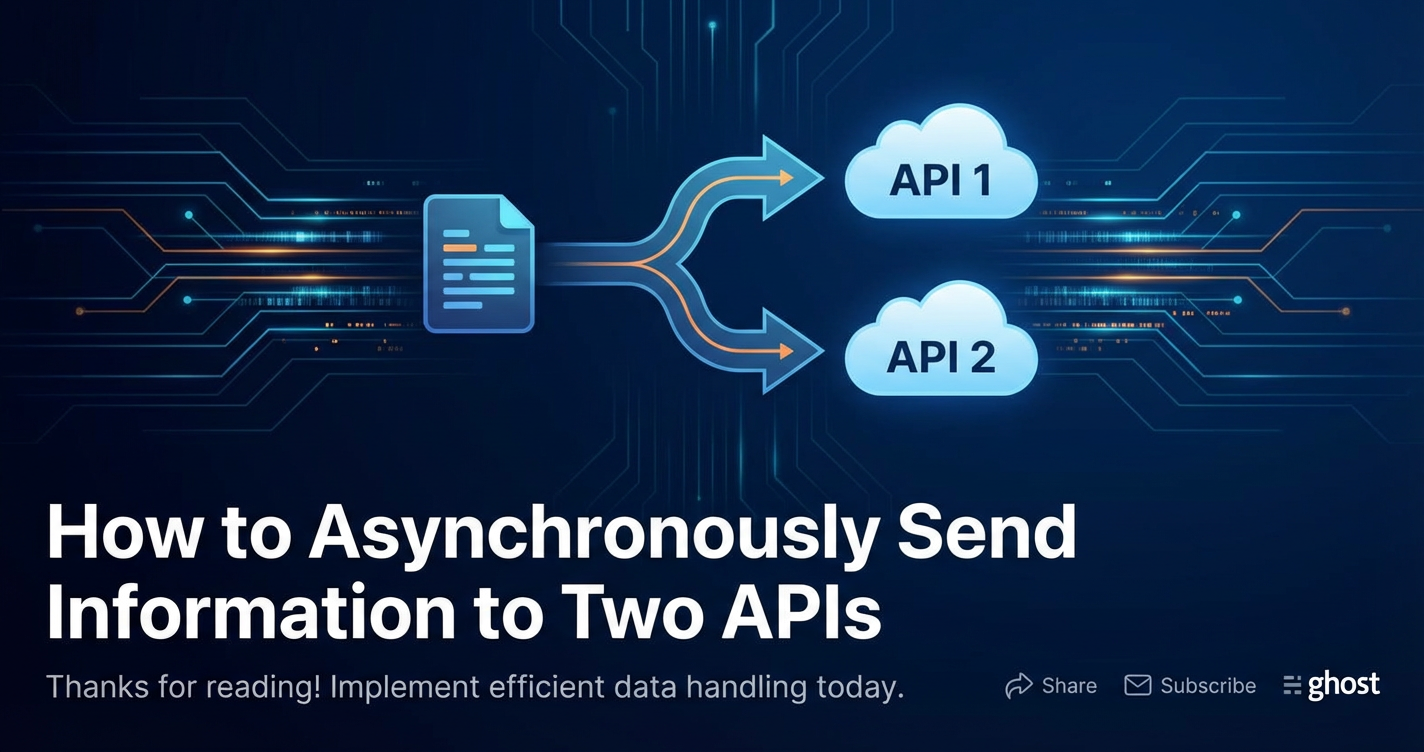
How to Asynchronously Send Information to Two APIs


In the intricate tapestry of modern software architecture, the ability to communicate effectively and efficiently between disparate services is paramount. As applications become increasingly distributed, relying on microservices, cloud functions, and external third-party integrations, the simple act of "sending information" transforms into a complex orchestration challenge. While synchronous API calls – where one system waits for an immediate response from another – have their place, they often become bottlenecks, hindering performance, scalability, and resilience. This is particularly true when an action within one system needs to trigger subsequent actions across multiple independent external services or api endpoints.
The demand to send information not just to one, but to two or more distinct apis, often in parallel or without waiting for immediate feedback, introduces a critical architectural decision: asynchronous communication. This paradigm shift from immediate, blocking interactions to non-blocking, event-driven processes unlocks a realm of possibilities for building robust, high-performance, and user-friendly applications. From processing e-commerce orders to updating user profiles across various platforms, the need to reliably dispatch data to multiple api endpoints without holding up the primary transaction is a cornerstone of sophisticated system design.
This comprehensive guide delves deep into the methodologies, architectural patterns, and practical considerations involved in asynchronously sending information to two or more apis. We will explore the fundamental differences between synchronous and asynchronous communication, identify compelling use cases that necessitate an asynchronous approach, and meticulously examine the array of technologies—from message queues and serverless functions to the critical role of an api gateway—that facilitate these complex interactions. Furthermore, we will address the inherent challenges of distributed systems, such as error handling, idempotency, and data consistency, providing actionable strategies to ensure reliability and maintainability. By the end of this journey, you will possess a profound understanding of how to engineer resilient and scalable solutions for multi-api asynchronous communication, positioning your systems for optimal performance in today's demanding digital landscape.
Part 1: Understanding Asynchronous Communication
Before diving into the intricacies of sending data to multiple apis, it's crucial to firmly grasp the concept of asynchronous communication itself. This foundational understanding will illuminate why it's not merely a "nice-to-have" feature, but often a critical requirement for scalable and resilient applications.
1.1 Synchronous vs. Asynchronous: A Fundamental Distinction
At the heart of any communication between software components lies a fundamental choice: synchronous or asynchronous interaction. The distinction is simple yet profoundly impacts system behavior and user experience.
1.1.1 The Synchronous Paradigm: Waiting for a Response
Synchronous communication is the most straightforward and often the default mental model for interaction. When system A makes a synchronous api call to system B, system A pauses its current operation and waits for system B to process the request and send back a response. Only after receiving that response (or a timeout/error) does system A resume its execution.
Characteristics of Synchronous Communication: * Blocking: The calling thread or process is blocked until the called api responds. * Immediate Feedback: The caller receives an immediate result (success or failure) from the specific api call. * Simpler Error Handling (for single call): Errors typically propagate back directly to the caller, making debugging individual api interactions relatively straightforward. * Sequential Execution: Operations happen one after another.
Real-World Analogy: Imagine calling a restaurant to order food. You place your order, and you stay on the phone, waiting for them to confirm your order details, price, and estimated delivery time. You cannot do anything else (like browsing the menu of another restaurant) until this conversation is complete.
Drawbacks in Multi-API Scenarios: When your application needs to interact with two or more apis synchronously, these drawbacks become glaring. If API1 takes 500ms and API2 takes 800ms, and you call them sequentially, the total time for the user to receive feedback is at least 1300ms plus your application's processing time. If one api is slow or fails, the entire user experience is impacted, and the calling thread remains tied up, consuming resources.
1.1.2 The Asynchronous Paradigm: Fire and Forget, or Callback Later
Asynchronous communication, by contrast, operates on a non-blocking principle. When system A makes an asynchronous api call to system B, system A does not wait for system B's response. Instead, it immediately continues with its own operations. System B processes the request independently, and if a response or notification is required, it communicates back to system A through a separate mechanism, often a callback, an event, or a message.
Characteristics of Asynchronous Communication: * Non-blocking: The calling thread or process is freed immediately to perform other tasks. * Delayed or Indirect Feedback: The caller might not receive an immediate response from the specific api call, or the response comes through a separate channel. * Complex Error Handling (initial setup): Errors and success notifications need to be handled via callbacks, queues, or other event-driven mechanisms, which can be more complex to set up initially. * Concurrent Execution: Operations can happen in parallel, improving overall throughput.
Real-World Analogy: Continuing the restaurant example, this is like ordering food online or via a delivery app. You place your order, confirm it, and immediately close the app or switch to another task (like watching a movie). You don't wait for the restaurant to cook the food while you're staring at the screen. You'll receive notifications (SMS, push notification) later when the order is confirmed, prepared, or out for delivery.
Benefits in Multi-API Scenarios: When you need to send information to two or more apis asynchronously, the benefits are compounded. Instead of waiting for API1 then API2, you can dispatch requests to both almost simultaneously and continue your primary task. This drastically reduces the perceived latency for the end-user and allows your system to process a much higher volume of requests with the same resources. It fundamentally decouples services, making the system more resilient to failures in individual components.
1.2 Why Asynchronous for Multiple APIs? The Compelling Advantages
The decision to adopt an asynchronous strategy for communicating with multiple apis is driven by several powerful advantages that address core challenges in distributed systems.
1.2.1 Improved User Experience (Reduced Latency)
Perhaps the most immediately tangible benefit of asynchronous multi-api calls is the significant improvement in user experience. When a user initiates an action (e.g., placing an order, submitting a form), the primary goal is often to provide immediate feedback that the action has been initiated or completed successfully. If this action triggers several backend api calls that don't directly impact the immediate user feedback, performing them synchronously will needlessly increase the response time for the user.
By offloading these secondary api calls to an asynchronous process, the primary api endpoint can respond to the user much faster. For instance, an e-commerce platform can confirm an order with the customer almost instantly, while the background tasks of updating inventory, sending a confirmation email, and notifying the fulfillment system proceed asynchronously. This makes the application feel snappier and more responsive, directly contributing to user satisfaction.
1.2.2 Enhanced System Throughput and Scalability
Asynchronous communication allows a single incoming request to initiate multiple api calls without blocking the processing of other incoming requests. This non-blocking nature means that your application server or service can handle a far greater number of concurrent operations. Instead of dedicating a thread or process to wait for external api responses, that resource can be immediately freed to serve another client.
This "do more with less" approach directly translates to enhanced system throughput. Furthermore, it enables superior scalability. As load increases, you can scale your asynchronous processing infrastructure (e.g., message queue consumers, serverless functions) independently from your primary api endpoints. This architectural flexibility ensures that bottlenecks in one part of the system don't cripple the entire application, making it far easier to accommodate spikes in demand.
1.2.3 Increased Resilience and Fault Tolerance
Decoupling is a cornerstone of resilient system design, and asynchronous multi-api communication is a powerful decoupling mechanism. When services interact asynchronously, they become less dependent on the immediate availability and performance of each other.
- Isolation of Failures: If one of the target
apis is temporarily down or experiencing high latency, the primary service can still successfully complete its immediate task (e.g., acknowledge a user's request). The asynchronous message or event can be retried later, or rerouted, preventing a cascading failure that would bring down the entire system. - Buffering Against Spikes: Message queues, a common asynchronous pattern, act as buffers. If a downstream
apibecomes overwhelmed, messages can queue up rather than being dropped or causing upstream services to fail. The downstream service can then process these messages at its own pace when capacity becomes available. - Graceful Degradation: In extreme scenarios, even if an asynchronous
apicall ultimately fails, the core functionality of the application might remain intact. For example, if a "send analytics"apicall fails, the user's main transaction (e.g., completing a purchase) is unaffected.
This inherent resilience makes systems more robust and less prone to complete outages due to transient issues in external dependencies.
1.2.4 Efficient Resource Utilization (No Idle Waiting)
In synchronous operations, threads or processes often spend significant time in an idle waiting state, consuming memory and CPU cycles without performing any useful work, simply because they are waiting for an external api call to complete. This is a highly inefficient use of valuable computing resources.
Asynchronous patterns eliminate this idle waiting. Once a request is dispatched asynchronously, the resource can immediately pick up the next task. This allows a given amount of hardware to perform significantly more productive work, leading to better resource utilization and, consequently, lower operational costs. For cloud-based deployments, where you pay for compute time and resources, this efficiency can translate into substantial savings.
1.2.5 Facilitating Microservices Architectures
Modern microservices architectures thrive on autonomy and loose coupling between services. Asynchronous communication is a natural fit for this paradigm. Each microservice can operate independently, publishing events or messages that other services can subscribe to and react to asynchronously, without direct dependencies on their runtime availability.
When a microservice needs to notify or update multiple other services or external apis, an asynchronous approach allows it to do so without becoming tightly coupled to the specific implementation details, response times, or even the existence of those downstream services. This architectural flexibility fosters independent development, deployment, and scaling of individual services, which is a core tenet of effective microservices design.
By embracing asynchronous communication for multi-api interactions, developers can build systems that are not only faster and more responsive but also inherently more scalable, resilient, and maintainable in the face of ever-increasing complexity and demand.
Part 2: Common Scenarios Demanding Asynchronous Multi-API Interaction
The theoretical benefits of asynchronous communication become most apparent when examining real-world use cases. Many common business processes naturally lend themselves to an asynchronous, multi-api interaction model, where a single trigger initiates a cascade of independent actions across various systems.
2.1 The "Fan-Out" Pattern: One Action, Multiple Consequences
The "fan-out" pattern is one of the most prevalent scenarios for asynchronous multi-api communication. It describes a situation where a single event or request needs to trigger multiple independent operations, each potentially interacting with a different api. Instead of performing these operations sequentially and synchronously, which would significantly increase latency for the initiating request, they are fanned out for parallel, asynchronous execution.
2.1.1 User Registration: Orchestrating Onboarding
Consider the process of a new user registering on an online platform. When a user submits their registration details, several backend actions typically need to occur:
- Create User Record (API 1 - Core User Management): The most critical step is creating an account in the primary user database or identity management system. This might involve generating a unique user ID, hashing the password, and storing basic profile information. This step is often synchronous initially for immediate feedback to the user ("Registration Successful!").
- Send Welcome Email (API 2 - Email Service): After the account is created, a welcome email needs to be dispatched. This involves calling an external email
api(e.g., SendGrid, Mailgun) with the user's email address and a template. Waiting for the emailapito respond is unnecessary for the user to proceed with their registration. - Update Marketing CRM (API 3 - CRM System): The new user's details should be pushed to the company's Customer Relationship Management (CRM) system (e.g., Salesforce, HubSpot). This allows the marketing team to track engagement, segment users, and initiate nurturing campaigns. This
apicall is entirely independent of the user's immediate experience. - Log for Analytics (API 4 - Analytics Platform): A record of the new registration should be sent to an analytics platform (e.g., Google Analytics, Mixpanel, custom data warehouse) for user growth tracking and behavioral analysis. This is a low-priority, fire-and-forget operation.
By making API 2, API 3, and API 4 calls asynchronous, the user registration process can provide immediate confirmation to the user, while the backend system efficiently handles all auxiliary tasks in parallel. If the email api is temporarily unavailable, it doesn't prevent the user from logging in, nor does it block the CRM update.
2.1.2 E-commerce Order Processing: A Symphony of Updates
Another classic example is the processing of an e-commerce order. When a customer clicks "Place Order," a multitude of systems needs to be updated:
- Process Payment (API 1 - Payment Gateway): This is often a critical synchronous step to ensure the payment is authorized and captured. However, subsequent payment-related actions (e.g., fraud checks, settlement) might be asynchronous.
- Update Inventory (API 2 - Inventory Management System): Once payment is confirmed, the inventory of the purchased items must be decremented. This might involve calling an internal inventory
apior an external warehouse management system. - Send Order Confirmation (API 3 - Email/SMS Service): An email or SMS confirmation, detailing the order, total, and estimated delivery, needs to be sent to the customer. This can be handled asynchronously.
- Notify Fulfillment System (API 4 - Logistics/Shipping): The order details need to be transmitted to the fulfillment center or shipping partner (e.g., FedEx, UPS
api) to initiate picking, packing, and shipping. This is a background operation. - Log for Business Intelligence (API 5 - Data Warehouse): The entire transaction needs to be logged into a data warehouse for sales reporting, trend analysis, and other business intelligence purposes. This is typically a non-urgent, asynchronous task.
In this scenario, waiting for each of these apis to respond synchronously would lead to unacceptably long transaction times for the customer. Asynchronous calls allow the core payment and inventory updates to proceed quickly, while the other notifications and logging activities happen gracefully in the background, significantly enhancing the customer experience and system efficiency.
2.2 Data Replication and Synchronization
Maintaining data consistency across multiple systems is a pervasive challenge in distributed architectures. Asynchronous communication provides elegant solutions for replicating data and keeping various data stores synchronized, especially when immediate consistency is not strictly required.
- Primary Database to Search Index: When a new product is added to an e-commerce database, or an article is published in a CMS, the primary database (e.g., PostgreSQL, MySQL) is updated. For users to find this new content, it must also be indexed by a search service (e.g., Elasticsearch, Algolia). Instead of synchronously updating the search index
api(which can be slow), an asynchronous approach (e.g., publishing an event to a queue that a search indexer consumes) ensures the primary database transaction is fast, and the search index eventually becomes consistent. - Customer Data Across Systems: A customer's profile might exist in multiple systems: a CRM, a marketing automation platform, and a support ticketing system. When a customer updates their address in one system, that change needs to propagate to the others. Asynchronous events or messages (e.g., "CustomerAddressUpdated") can trigger
apicalls to update the relevant fields in each downstream system, ensuring eventual consistency without tightly coupling them. - Multi-Region Data Distribution: For global applications, data might need to be replicated across different geographical regions for performance and disaster recovery. Asynchronous mechanisms are ideal for propagating data changes between regional databases or caches without blocking local transactions.
2.3 Logging, Auditing, and Analytics
Virtually every significant action within an application generates valuable data for logging, auditing, and analytics. However, the act of recording this data rarely requires synchronous confirmation from the core business process.
- Centralized Logging: When a user logs in, a payment is processed, or an error occurs, these events need to be sent to a centralized logging system (e.g., ELK stack, Splunk, Datadog). Making these
apicalls synchronous would add overhead to critical paths. Asynchronous dispatch ensures that logs are recorded without impacting the primary application flow. - Security Auditing: For compliance and security, specific actions (e.g., administrative changes, data access) must be recorded in an immutable audit trail. An asynchronous
apicall to a dedicated audit service ensures that the audit record is created without blocking the user's action, while still providing robust traceability. - Real-time Analytics: Tracking user behavior, feature usage, and conversion funnels involves sending data points to an analytics
api. These calls are typically fire-and-forget, processed asynchronously to avoid any performance impact on the user experience.
2.4 Notifications and Event Broadcasting
Many applications need to notify users or other systems about specific events. These notifications are prime candidates for asynchronous processing, especially when multiple channels or subscribers are involved.
- Multi-Channel Notifications: After an event occurs (e.g., order shipped, password reset, new message received), notifications might need to be sent via email (API 1), SMS (API 2), and push notification (API 3). A single asynchronous event can trigger multiple
apicalls to these different notification services. - Event-Driven Architectures (EDA): In an EDA, when a significant event occurs (e.g.,
OrderPlaced,UserActivated), it is published to an event bus or broker. Multiple independent services can subscribe to this event and react accordingly. For example, aLoyaltyServicemight call anapito award points, while aRecommendationServicemight call anapito update product suggestions, all in response to a singleOrderPlacedevent.
These scenarios illustrate that the need for asynchronous multi-api communication is not an edge case but a recurring design pattern for building efficient, scalable, and resilient distributed systems across a myriad of industries and application types. By understanding these patterns, developers can strategically apply asynchronous techniques to optimize their architectures.
Part 3: Architectural Patterns and Technologies for Asynchronous Multi-API Calls
Implementing asynchronous communication with multiple apis requires careful selection and integration of various architectural patterns and technologies. Each approach offers distinct advantages and trade-offs, making the choice dependent on the specific requirements for reliability, scalability, complexity, and latency.
3.1 Message Queues: The Backbone of Asynchronicity
Message queues are arguably the most fundamental and widely used pattern for achieving asynchronous communication and decoupling services. They provide a robust, buffered mechanism for sending messages between applications or services without requiring them to be directly connected or simultaneously available. This makes them exceptionally well-suited for fanning out api calls to multiple targets asynchronously.
3.1.1 How Message Queues Work: Producers, Consumers, and Queues
At its core, a message queue system consists of three main components: * Producers: Applications or services that send messages to the queue. * Consumers: Applications or services that retrieve and process messages from the queue. * Queue (Broker): A middleware layer that temporarily stores messages until consumers are ready to process them. It acts as a buffer and a mediator.
When a producer sends a message, it doesn't need to know who or what will consume it, or even if a consumer is currently active. It simply sends the message to the queue and continues its own work. Consumers, on the other hand, listen to the queue and pull messages when they are available and have the capacity to process them. This inherently asynchronous flow enables strong decoupling.
3.1.2 Benefits for Multi-API Interactions
For sending information to two or more apis, message queues offer significant benefits: * Decoupling: The service initiating the api calls (the producer) doesn't directly call the downstream apis. Instead, it places a message on a queue. The consumers for each target api then pick up these messages. This means the producer is insulated from the availability or performance of the downstream apis. * Buffering: If one or more target apis become slow or temporarily unavailable, messages will accumulate in the queue rather than being lost or causing the upstream service to fail. Consumers can then process the backlog once the downstream api recovers. * Retries: Message queue systems often have built-in retry mechanisms. If a consumer fails to process a message (e.g., due to a downstream api error), the message can be returned to the queue for a retry after a delay, or moved to a Dead-Letter Queue (DLQ) for manual inspection. * Fan-Out: A single message produced to a queue or topic can be consumed by multiple distinct consumers, each responsible for calling a different api. For example, a "NewOrder" message can trigger one consumer to call the "InventoryUpdate" api and another consumer to call the "SendConfirmationEmail" api. * Load Balancing and Scaling: Multiple instances of a consumer service can read from the same queue, allowing messages to be processed in parallel and scaling horizontally based on demand.
3.1.3 Popular Message Queue Choices
- RabbitMQ: An open-source message broker that implements the Advanced Message Queuing Protocol (AMQP). It's robust, supports various messaging patterns (point-to-point, publish/subscribe), and is known for its reliability and sophisticated routing capabilities.
- Apache Kafka: A distributed streaming platform designed for high-throughput, fault-tolerant real-time data feeds. While often considered an event streaming platform, it functions effectively as a message queue for certain use cases, especially for log aggregation and processing large volumes of events. Its concept of "topics" and "consumer groups" is excellent for fan-out scenarios.
- AWS SQS (Simple Queue Service): A fully managed message queuing service by Amazon Web Services. It's highly scalable, durable, and easy to integrate with other AWS services. It offers both standard queues (high throughput, best-effort ordering) and FIFO queues (exactly-once processing, strict ordering).
- Azure Service Bus: Microsoft Azure's fully managed enterprise message broker. It supports various messaging patterns, including queues and topics, and offers advanced features like message sessions, dead-lettering, and scheduled messages, making it suitable for complex enterprise integration patterns.
- Google Cloud Pub/Sub: Google Cloud's asynchronous messaging service that provides reliable, many-to-many, asynchronous messaging between independently written applications. It's a global service that scales automatically and supports both push and pull subscriptions.
3.1.4 Implementing Fan-Out with Message Queues
To send information to two APIs using a message queue: 1. The initiating service (producer) creates a message containing the necessary data for both downstream API calls. 2. The producer sends this message to a designated queue or topic within the message broker. 3. Two separate consumer services are configured: * Consumer 1 listens to the queue/topic, retrieves the message, extracts the relevant data, and makes an api call to API 1. * Consumer 2 also listens to the same queue/topic (or a different subscription to the same topic), retrieves the message, extracts data, and makes an api call to API 2. This way, a single message triggers two independent asynchronous actions.
3.2 Event-Driven Architectures (EDA)
Event-Driven Architectures take the concept of decoupling a step further than simple message queues. While message queues focus on delivering specific messages to specific consumers, EDAs revolve around publishing "events" that represent significant state changes in a system. Multiple services can then react to these events, often by calling their own apis.
3.2.1 Core Concepts of EDA
- Events: Immutable, fact-based records of something that has happened (e.g.,
OrderPlaced,UserAuthenticated,ProductPriceUpdated). They don't contain commands; they announce facts. - Event Producers: Services that detect a state change and publish an event to an Event Broker.
- Event Consumers: Services that subscribe to specific types of events from the Event Broker and react to them.
- Event Broker/Bus: The middleware that facilitates the communication, distributing events from producers to all interested consumers. Kafka is a prominent example often used as an event broker.
3.2.2 How EDA Facilitates Multi-API Interaction
In an EDA, when a core business event occurs (e.g., a customer places an order), the service responsible for that event publishes an OrderPlaced event to the event broker. * A "Fulfillment Service" might subscribe to OrderPlaced events and, upon receiving one, make an api call to the "Warehouse Management" api to initiate shipping. * A "Notification Service" might also subscribe to OrderPlaced events and, upon receiving one, make an api call to the "Email Service" api to send an order confirmation. * An "Analytics Service" might subscribe to the same event to update business intelligence dashboards via an analytics api.
The beauty of EDA is that the "Order Service" (the producer) has no direct knowledge of or dependency on the Fulfillment, Notification, or Analytics services. It simply announces that an order has been placed. This enables extremely loose coupling, allowing new services to subscribe to existing events and react to them without modifying the original producer.
3.2.3 Comparison with Message Queues
While message queues can be used to build EDAs, there's a conceptual difference: * Message Queues: Often focus on point-to-point or specific task distribution. A message might contain instructions (process this order, send this email). * Event-Driven: More about broadcasting facts. An event describes what happened, and consumers decide how to react. This allows for a more flexible and extensible architecture where multiple services can independently react to the same event.
3.3 Serverless Functions for "Fire-and-Forget" and Event Handling
Serverless functions (e.g., AWS Lambda, Azure Functions, Google Cloud Functions) provide an excellent platform for executing small, single-purpose pieces of code in response to events, without provisioning or managing servers. Their inherent event-driven nature makes them ideal for asynchronous multi-api calls.
3.3.1 Asynchronous Invocation Patterns
Serverless functions can be invoked asynchronously in several ways: * Direct Asynchronous Invocation: A service can directly invoke a serverless function asynchronously. The caller sends the request and immediately gets a response that the invocation was accepted, without waiting for the function's execution to complete. This is the simplest "fire-and-forget" mechanism. * Via Messaging Services: Functions can be triggered by messages arriving in a message queue (e.g., SQS, Service Bus) or events published to an event stream (e.g., Kafka, Kinesis, Pub/Sub). This combines the benefits of message queues with the operational simplicity of serverless. * Via API Gateway Integration: An api gateway can be configured to integrate with a serverless function. For asynchronous execution, the api gateway can pass the incoming request to the function and immediately return an HTTP 202 Accepted response to the client, while the function processes the request in the background.
3.3.2 Orchestration for Complex Workflows
For scenarios requiring multiple sequential or conditional api calls asynchronously, serverless orchestration services come into play: * AWS Step Functions: Allows you to define state machines that coordinate multiple AWS Lambda functions and other AWS services into serverless workflows. You can define parallel branches to call two APIs simultaneously, or sequential steps with error handling and retries. * Azure Logic Apps / Microsoft Power Automate: Similar to Step Functions, these services allow you to visually design workflows that integrate with hundreds of services, including custom apis. They can orchestrate calls to multiple apis, handle approvals, and manage complex business processes.
Example: A user signup process could trigger a Lambda function asynchronously. This function could then: 1. Call API 1 (e.g., an internal user service) to create the user record. 2. If successful, trigger another Lambda function asynchronously (or call a separate api directly) to send a welcome email (API 2). 3. In parallel, trigger a third Lambda function (or call an api directly) to update the CRM (API 3). This provides immense flexibility and scalability without managing servers.
3.4 Background Job Processors
For applications built on traditional web frameworks (e.g., Ruby on Rails, Django, Spring Boot), background job processors are a common way to offload long-running or non-critical tasks from the main request-response cycle, enabling asynchronous api calls.
3.4.1 How They Work
Background job processors typically involve: * Job Enqueuers: The main application (e.g., web server) creates "jobs" (units of work) and enqueues them into a persistent queue (often backed by Redis or a database). * Workers: Separate processes or threads that constantly monitor the queue, pull jobs, and execute the associated code.
3.4.2 Examples
- Celery (Python): A powerful distributed task queue used for processing large amounts of messages. It can handle scheduling, retries, and monitoring.
- Sidekiq (Ruby): A simple, efficient background processing for Ruby applications, backed by Redis.
- Spring Batch (Java): A comprehensive framework for robust batch processing, often used for enterprise-level asynchronous tasks.
3.4.3 Sending to Multiple APIs
When a background job is executed, it can contain logic to make multiple api calls. For instance, a ProcessOrderJob might be enqueued. When a worker picks it up: 1. It calls API 1 (e.g., inventory update). 2. It then calls API 2 (e.g., shipping notification). The key difference from message queues is that the job itself orchestrates the multiple api calls, rather than multiple consumers independently reacting to a single message. However, job processors often use message queues internally for their own enqueue/dequeue mechanisms. This approach is suitable when the sequence or relationship between the multiple api calls is tightly coupled within a single logical task.
3.5 The Pivotal Role of an API Gateway
An api gateway serves as a single entry point for all api calls, routing requests to the appropriate backend services. More than just a reverse proxy, an api gateway can play a pivotal role in enabling and managing asynchronous communication, especially when sending information to multiple apis. The keywords api gateway and gateway are central to understanding modern api management and distributed system architecture.
3.5.1 Definition and Core Functions
An api gateway is a fundamental component in microservices architectures and distributed systems. It acts as a facade, sitting in front of your backend services, providing a unified api endpoint for clients. Its core functions include: * Request Routing: Directing incoming client requests to the correct backend service. * Authentication and Authorization: Verifying client identity and permissions before forwarding requests. * Rate Limiting: Protecting backend services from being overwhelmed by too many requests. * Traffic Management: Load balancing, canary deployments, A/B testing. * Request/Response Transformation: Modifying request/response payloads to match backend service expectations or client needs. * Analytics and Monitoring: Collecting metrics and logs about api usage and performance. * Security Policies: Applying security headers, DDoS protection, and other measures.
3.5.2 API Gateway as an Orchestrator and Asynchronous Facilitator
The api gateway is not just a passive router; it can actively facilitate asynchronous multi-api interactions: * Initial Fan-Out Point: An api gateway can receive a single client request and, instead of forwarding it to just one service, intelligently fan it out to multiple backend services. This can be done by invoking multiple downstream apis (some synchronously, some asynchronously) or by integrating with message queues. * Synchronous Façade for Asynchronous Backends: One of the most powerful capabilities is allowing a client to make a synchronous request to the gateway, which then triggers an asynchronous backend process (e.g., placing a message on a queue or invoking a serverless function) and immediately returns a 202 Accepted response to the client. This provides the client with immediate feedback while the heavy lifting happens in the background. * Centralized Asynchronous Logic: The gateway can encapsulate the logic for deciding which apis to call asynchronously based on the incoming request, simplifying the client-side implementation.
3.5.3 Integrating with Asynchronous Backends
An api gateway can directly integrate with various asynchronous components: * Message Queues/Event Buses: Upon receiving a request, the gateway can publish a message to a Kafka topic or an SQS queue. This message can then be consumed by multiple services, each making calls to their respective apis. * Serverless Functions: The gateway can directly invoke serverless functions asynchronously, treating them as api endpoints that return immediately. * Webhooks: While primarily about receiving events, an api gateway can be configured to trigger webhooks to notify external systems about asynchronous processing completion.
3.5.4 The APIPark Advantage
For organizations seeking a robust solution for managing their apis, especially in an event-driven or AI-centric environment, an advanced api gateway like APIPark can be invaluable. APIPark, an open-source AI gateway and api management platform, excels at unifying api formats, integrating various AI models, and offering comprehensive lifecycle management, which can significantly simplify the complexities of orchestrating asynchronous calls to multiple backends, whether they are traditional REST services or cutting-edge AI models. By acting as a central control point, APIPark can help ensure that all api calls, including those dispatched asynchronously to multiple targets, are managed, secured, and monitored effectively. Its ability to encapsulate prompts into REST apis means a single request to APIPark could trigger complex asynchronous workflows involving multiple AI models or traditional services, all while maintaining unified authentication and detailed logging. This level of api governance is crucial for large-scale asynchronous architectures.
By leveraging an api gateway effectively, you not only centralize api management and security but also gain a powerful tool for orchestrating complex asynchronous workflows, thereby enhancing the overall resilience, scalability, and performance of your distributed system. The gateway serves as the intelligent traffic cop, ensuring that client requests efficiently initiate the necessary multi-api asynchronous dance in the backend.
Table: Comparison of Asynchronous Technologies for Multi-API Calls
| Feature / Technology | Message Queues (e.g., Kafka, SQS) | Serverless Functions (e.g., Lambda, Azure Functions) | Background Job Processors (e.g., Celery, Sidekiq) | API Gateway (with Async Integration) |
|---|---|---|---|---|
| Primary Mechanism | Pub/Sub or Queue-based messaging | Event-triggered code execution | Enqueuing tasks for dedicated workers | Facade for backend services, often with async offload |
| Best Use Case | High-throughput events, strong decoupling, buffering | Event-driven reactions, "fire-and-forget", small tasks | Batch processing, long-running tasks, complex logic | Centralized API management, exposing async backends |
| Decoupling Level | High (producer unaware of consumers) | High (function unaware of trigger) | Moderate (main app knows about job type) | High (client unaware of backend complexity) |
| Scalability | Very High (horizontal scaling of brokers & consumers) | Very High (automatic scaling based on load) | High (horizontal scaling of workers) | Very High (scales with cloud provider's infra) |
| Error Handling/Retries | Built-in (DLQs, configurable retries) | Built-in (configurable retries, DLQs) | Built-in (configurable retries) | Can be configured, often by integrating with queues |
| Cost Model | Managed service cost / self-hosted infra | Pay-per-invocation + duration | Managed service cost / self-hosted infra | Pay-per-request + data transfer |
| Development Complexity | Moderate (setup broker, consumers) | Low-Moderate (write function, configure trigger) | Moderate (setup worker, queue, define jobs) | Low-Moderate (configure routing, transformations) |
| Orchestration Capability | Event-driven fan-out, not explicit workflow | Single task, or chained with orchestrators (Step Functions) | Orchestrates multiple steps within a job | Can orchestrate initial async trigger point |
APIPark is a high-performance AI gateway that allows you to securely access the most comprehensive LLM APIs globally on the APIPark platform, including OpenAI, Anthropic, Mistral, Llama2, Google Gemini, and more.Try APIPark now! 👇👇👇
Part 4: Designing for Robustness and Reliability
Asynchronous communication, while offering tremendous benefits, introduces its own set of challenges, primarily centered around ensuring data consistency, handling failures gracefully, and maintaining observability in distributed systems. Designing for robustness and reliability is not merely an afterthought; it is an integral part of the architectural process.
4.1 Idempotency: The Safety Net for Retries
In asynchronous systems, messages or events can be delivered "at least once," meaning there's a possibility of duplicate processing due to retries (e.g., network timeout, consumer crash before acknowledging message). This makes idempotency a critical design principle.
4.1.1 Why It's Crucial
An operation is idempotent if applying it multiple times produces the same result as applying it once. For example, setting a value to "X" is idempotent, but incrementing a counter is not (unless handled carefully). If an api call that decrements inventory by 1 is retried and executed twice, your inventory count will be incorrect. If a "send email" api is called twice, the user receives duplicate emails.
4.1.2 Mechanisms to Achieve Idempotency
To ensure api calls are idempotent: * Unique Request IDs (Idempotency Keys): The most common approach. The client or the initiating service generates a unique identifier (e.g., UUID) for each logical request and includes it in the api call header or body. The downstream api service stores these IDs for a certain period (e.g., 24 hours) and checks if an incoming request with the same ID has already been processed successfully. If so, it returns the previous successful response without re-executing the operation. * State-Based Updates: Design apis to update resources based on their desired final state rather than incremental changes. For instance, instead of decrement_inventory(item_id, quantity), use set_inventory(item_id, new_quantity). * Conditional Updates: For database operations, use conditional updates (e.g., UPDATE ... WHERE ... AND version = current_version) to ensure that an update only occurs if the state hasn't changed since the request was first initiated. * Locking Mechanisms: For critical sections, use distributed locks, though this can introduce its own overhead and complexity. * Natural Idempotency: Some api calls are naturally idempotent (e.g., GET requests, PUT requests that replace an entire resource).
By implementing idempotency, you can safely retry asynchronous api calls without fear of unintended side effects, significantly boosting the reliability of your system.
4.2 Error Handling and Retry Mechanisms
Failures are inevitable in distributed systems. Network glitches, temporary api unavailability, or transient load issues can all cause an api call to fail. A robust asynchronous architecture must anticipate and gracefully handle these failures.
4.2.1 Transient vs. Permanent Errors
It's crucial to distinguish between: * Transient Errors: Temporary issues that are likely to resolve themselves with a retry (e.g., network timeout, service busy, database connection pool exhaustion). * Permanent Errors: Non-recoverable errors that will not succeed on retry (e.g., invalid input, authentication failure, resource not found). Retrying these would be futile and wasteful.
4.2.2 Strategies for Handling Transient Errors
- Retry with Exponential Backoff: The most common and effective strategy. If an
apicall fails due to a transient error, the system waits for an increasing amount of time before retrying. For example, retry after 1 second, then 2 seconds, then 4 seconds, up to a maximum number of retries or a total elapsed time. This prevents overwhelming the struggling downstreamapiand allows it time to recover. Message queues and serverless functions often have built-in support for this. - Jitter: Adding a small random delay to the backoff interval helps prevent multiple retrying instances from all hitting the downstream
apiat the exact same moment, which could trigger another cascade of failures. - Max Retries and Dead-Letter Queues (DLQs): After a certain number of failed retries, if the
apicall still hasn't succeeded, the message or event should be moved to a Dead-Letter Queue (DLQ). A DLQ is a special queue for messages that couldn't be processed successfully. This prevents poison pill messages from indefinitely blocking the main queue and allows operators to inspect, fix, and potentially reprocess these failed messages manually.
4.2.3 Circuit Breakers
A circuit breaker pattern is essential for preventing repeated requests to a failing api and allowing it time to recover. * Open State: If a downstream api experiences a high rate of failures, the circuit breaker "opens," immediately failing subsequent calls to that api without actually sending the request. This protects the failing api from further load and prevents the calling service from wasting resources on doomed requests. * Half-Open State: After a timeout, the circuit breaker enters a "half-open" state, allowing a small number of test requests to pass through. If these succeed, the circuit closes; otherwise, it re-opens. * Closed State: Normal operation; requests pass through.
Implementing a circuit breaker ensures that your system gracefully handles sustained failures in external dependencies, promoting stability.
4.3 Data Consistency and Eventual Consistency
In synchronous systems, transactions are typically ACID (Atomicity, Consistency, Isolation, Durability), ensuring immediate consistency. In asynchronous distributed systems, immediate global consistency is often impossible or prohibitively expensive. Instead, we aim for eventual consistency.
4.3.1 Understanding Eventual Consistency
Eventual consistency means that after data is updated, it will eventually (given enough time and no new updates) propagate throughout the system, and all replicas will converge to the same value. The system might be temporarily inconsistent, but it will eventually become consistent.
4.3.2 Strategies for Managing Consistency
- Saga Pattern: For complex business transactions that span multiple services (and thus multiple
apicalls), the Saga pattern provides a way to maintain eventual consistency. A saga is a sequence of local transactions, where each transaction updates data within a single service and publishes an event that triggers the next step in the saga. If a step fails, compensating transactions are executed to undo the effects of previous successful steps. This is particularly useful for multi-apicalls where rolling back is necessary. - Read-Your-Writes Consistency: Ensuring that after a user writes data, their subsequent reads reflect that update, even if other parts of the system are still propagating the change.
- Compensating Actions: Designing
apis with "undo" or compensating operations that can be invoked if a subsequentapicall in a multi-step asynchronous process fails. For example, if inventory is decremented but payment fails, a compensating action would increment inventory back. - Idempotency and Conflict Resolution: Idempotency, as discussed, helps with retries. For conflicting updates, strategies like "last-write-wins" or custom merge logic are needed.
- Outbox Pattern: When a service needs to both update its database and publish an event (or send a message to a queue), the outbox pattern ensures atomicity. The event/message is first written to an "outbox" table within the same database transaction as the primary data update. A separate process then reads from the outbox, publishes the events, and marks them as sent. This guarantees that either both the database update and event publication succeed, or neither does.
Achieving data consistency in an asynchronous multi-api environment requires careful design and acceptance of eventual consistency, along with robust mechanisms to manage state transitions and potential rollbacks.
4.4 Monitoring, Logging, and Tracing: Seeing the Unseen
Debugging and understanding the flow of requests in a synchronous, monolithic application is relatively straightforward. In asynchronous, distributed systems involving multiple apis, it becomes significantly more challenging. Comprehensive observability – through monitoring, logging, and tracing – is indispensable.
4.4.1 The Challenge of Asynchronous Debugging
When a single user action triggers a chain of asynchronous api calls across different services, potentially processed by different workers or functions at different times, determining the root cause of an issue can be like finding a needle in a haystack. Traditional stack traces only show what happened within a single service.
4.4.2 Strategies for Observability
- Correlation IDs: This is the most critical tool for tracing asynchronous flows. A unique correlation ID (also known as a trace ID or request ID) should be generated at the very beginning of an incoming user request. This ID must then be propagated through every subsequent interaction:
- Included in every message sent to a queue.
- Passed as a header in every
apicall. - Included in every log entry. By searching for this single ID in your centralized logging system, you can reconstruct the entire journey of a request across all services and asynchronous boundaries.
- Centralized Logging: All services should send their logs to a central logging platform (e.g., Elasticsearch with Kibana, Splunk, Datadog Logs). This allows for quick searching, filtering, and analysis of logs across the entire system, especially with the use of correlation IDs.
- Distributed Tracing Tools: Tools like Jaeger, Zipkin, or OpenTelemetry (which provides a standard for collecting telemetry data) are designed specifically for visualizing request flows across distributed services. They automatically propagate trace contexts (including correlation IDs and span IDs) and generate visual maps of how a request traversed various services and
apicalls, showing timing and dependencies. This is invaluable for identifying latency bottlenecks or failure points. - Metrics and Monitoring:
- Service-level metrics: Track
apicall success rates, latency, error rates for each individualapiand service. - Queue-level metrics: Monitor queue depth (number of messages), message age, consumer processing rates, and dead-letter queue size. Spikes in queue depth or message age can indicate a bottleneck downstream.
- Resource metrics: Monitor CPU, memory, network I/O for all services and infrastructure components.
- Alerting: Set up alerts for critical thresholds (e.g., high error rates, long queue depth, service unavailability) to proactively identify and address issues.
- Service-level metrics: Track
- Health Checks: Implement
/healthor/statusendpoints on your services to allow load balancers,api gateways, and orchestrators to determine their operational status.
With effective monitoring, logging, and tracing, the complexities of asynchronous multi-api interactions become transparent, enabling rapid identification and resolution of issues, and providing deep insights into system performance.
4.5 Scalability and Performance Considerations
When designing for asynchronous multi-api communication, scalability and performance are not just about raw speed but also about efficiently handling increasing loads and ensuring responsiveness under stress.
4.5.1 Horizontal Scaling of Consumers
The primary way to scale an asynchronous system is to horizontally scale the consumers. If a single consumer instance can process 10 messages per second, and your queue receives 100 messages per second, you need at least 10 consumer instances. Cloud-native solutions like serverless functions and managed message queue services (SQS, Kafka) often handle auto-scaling of consumers seamlessly. For self-managed systems, you need to implement auto-scaling groups or container orchestration (Kubernetes) to dynamically adjust the number of worker instances based on queue depth or CPU utilization.
4.5.2 Batching API Calls When Appropriate
While sending individual messages or events offers granular control and resilience, there are scenarios where batching api calls can significantly improve performance and reduce overhead, especially for apis that are designed for bulk operations (e.g., logging apis, analytics apis, certain data upload apis). * A consumer might accumulate several messages from a queue for a short period (e.g., 1 second or 100 messages) and then make a single api call to the downstream service with a batch of data. * This reduces network overhead, api request/response cycles, and potentially the computational cost on the receiving end. * Caveat: Batching introduces a slight delay and potentially increases the complexity of error handling (what if only some items in the batch fail?).
4.5.3 Rate Limiting at the API Gateway or Individual API Level
Even with asynchronous processing, downstream apis (especially third-party ones) have rate limits. Hitting these limits can lead to throttling errors and service degradation. * API Gateway Rate Limiting: An api gateway (like APIPark) is an ideal place to enforce rate limits on outgoing api calls to external services. It can act as a circuit breaker or throttle outbound traffic to ensure you don't exceed a partner's allowance. * Consumer-Side Rate Limiting: Consumers themselves can implement internal rate limiting to ensure they don't flood a particular api. This might involve token buckets or leaky bucket algorithms. * Backpressure: Message queue systems inherently provide backpressure. If consumers are slow, messages back up in the queue, implicitly slowing down the producers without them actively knowing it. This is a form of passive rate limiting.
4.5.4 Choosing the Right Asynchronous Technology for the Workload
The choice of asynchronous technology directly impacts scalability. * High-throughput, real-time data streams: Kafka or Kinesis are often preferred for their ability to handle massive volumes. * Individual, critical messages with strict ordering: SQS FIFO or Azure Service Bus Premium queues. * Event-driven logic with flexible scaling: Serverless functions triggered by various events. * Complex workflows with stateful orchestration: AWS Step Functions or Azure Logic Apps.
Understanding the performance characteristics and scalability models of each technology is vital for making informed architectural decisions. A well-designed asynchronous system is not just fast, but predictably fast and resilient under varying loads.
Part 5: Practical Implementation Strategies and Best Practices
Having explored the theoretical underpinnings and core technologies, let's distill practical advice into actionable strategies and best practices for implementing asynchronous multi-api communication.
5.1 Choose the Right Tool for the Job
The landscape of asynchronous technologies is rich and varied. Selecting the appropriate tools for your specific use case is paramount.
- For Simple Background Tasks within an Application: If you need to offload a quick, non-critical
apicall that's tightly coupled to your main application's logic (e.g., sending a single email after a user action), language-specific asynchronous features (like Python'sasyncio, Node.js's promises/async-await, Java'sCompletableFuture, C#'sasync/await) or a simple background job processor might suffice. These keep the complexity within a single codebase. - For Decoupling with Reliability and Scalability: When you need strong decoupling between services, guaranteed message delivery (even if a service is down), buffering against load spikes, and the ability to fan out messages to multiple independent consumers, a message queue or event broker (e.g., Kafka, SQS, RabbitMQ, Azure Service Bus) is the go-to solution. This is ideal for core business processes like order fulfillment or data synchronization that touch multiple distinct
apis. - For Event-Driven Reactions to State Changes: If your architecture is built around services reacting to significant business events rather than direct commands, an Event-Driven Architecture (EDA) with an event broker at its core is best. This allows new services to easily plug in and react to existing events by calling their own
apis, fostering extreme flexibility. - For Ad-Hoc, Event-Triggered Tasks or Workflows: Serverless functions (Lambda, Azure Functions, GCP Functions) are excellent for fire-and-forget
apicalls, reacting to specific events (e.g., a file upload, a database change), or orchestrating simple workflows. They shine for tasks that are inherently event-driven and benefit from automatic scaling and pay-per-execution pricing. For more complex, stateful asynchronous workflows, consider serverless orchestration services (AWS Step Functions, Azure Logic Apps). - For Centralized API Management and Asynchronous Offloading: An API Gateway (such as APIPark) is critical as a unified entry point. It can manage authentication, rate limiting, and routing. Crucially, it can also act as the initial point for asynchronous offloading, receiving a synchronous request, and then publishing a message to a queue or invoking a serverless function, returning immediate feedback to the client while backend processes kick off to interact with multiple
apis.
Don't over-engineer with a full-blown event streaming platform if a simple message queue will do, but also don't rely on basic in-memory queues if reliability and scale are paramount.
5.2 Design for Failure
In distributed systems, especially those relying on asynchronous communication with multiple apis, failures are a certainty, not an exception. Your architecture must anticipate and gracefully handle these failures.
- Assume External APIs Will Fail: Treat every external
apicall as potentially unreliable. Implement comprehensive error handling, retries with exponential backoff, and circuit breakers for all outboundapiinteractions. - Idempotency is Non-Negotiable: For any operation that modifies state, ensure it is idempotent. This protects your system from data corruption and incorrect states due to retried messages or events.
- Dead-Letter Queues (DLQs) for Unprocessable Messages: Configure DLQs for all your message queues. Messages that fail repeated processing attempts should be moved to a DLQ for manual inspection and eventual reprocessing or discarding. Never silently drop messages.
- Compensating Transactions for Complex Workflows: For multi-step asynchronous processes where immediate transactional consistency isn't possible, design compensating actions. If a later step fails, you need a mechanism to undo the effects of prior successful steps to maintain overall consistency (eventual consistency).
- Graceful Degradation: Identify non-critical
apicalls. If these fail, can the core system still function? For example, if the analyticsapiis down, the user can still complete a purchase. Design your system to degrade gracefully rather than fail entirely.
5.3 Start Simple, Iterate
The temptation to build the most robust, feature-rich asynchronous system from day one can be strong. However, it often leads to over-engineering and unnecessary complexity.
- Begin with the Simplest Viable Asynchronous Pattern: For example, start with basic message queues for decoupling. As you gain experience and understand your system's evolving needs, you can introduce more sophisticated patterns like event-driven architectures or serverless orchestration.
- Identify Critical vs. Non-Critical Asynchronicity: Not every
apicall needs the same level of asynchronous sophistication. Prioritize the areas where asynchronous patterns provide the most significant benefit (e.g., user experience, scalability, resilience for core business processes). - Measure and Optimize: Continuously monitor your asynchronous flows. Identify bottlenecks, analyze error rates, and measure latency. Use this data to iteratively refine your architecture, optimizing for performance, cost, and reliability.
5.4 Test Thoroughly
Testing asynchronous multi-api interactions is inherently more challenging than synchronous flows due to non-determinism, timing issues, and distributed components.
- Unit Tests: Test individual components (e.g., message producers, consumers,
apiclient logic) in isolation. - Integration Tests: Crucial for verifying the interaction between your service and the message queue, and between your consumer and the downstream
api. Use test doubles or mockapis for external dependencies during these tests. - End-to-End Tests: Simulate real-world scenarios, from the initial trigger event to the successful completion of all asynchronous
apicalls across multiple services. These are complex but invaluable for verifying the entire flow. - Chaos Engineering: For highly critical systems, introduce controlled failures (e.g., simulate
apitimeouts, network partitions, service crashes) to see how your asynchronous system reacts and recovers. - Performance and Load Testing: Ensure your asynchronous infrastructure (queues, consumers,
apis) can handle expected and peak loads without degradation or message loss.
5.5 Documentation
In distributed systems, clarity and shared understanding are paramount. Poor documentation can quickly turn an asynchronous architecture into a maintenance nightmare.
- Document Asynchronous Flows: Clearly map out the entire asynchronous journey for key business processes. Use diagrams (sequence diagrams, event storming diagrams) to illustrate how messages flow, which services consume them, and which
apis are called. - Define Message/Event Schemas: Document the structure and meaning of all messages and events published to queues or event brokers. Use schema registries (like Avro or Protobuf) if possible to enforce compatibility.
- API Specifications: Maintain up-to-date OpenAPI (Swagger) specifications for all your
apis, internal and external. - Error Handling and Retry Policies: Document the error handling strategies, retry policies, and DLQ procedures for each asynchronous flow.
- Observability Strategy: Document how to monitor, log, and trace requests through the asynchronous system, including how to use correlation IDs and distributed tracing tools.
By adhering to these practical strategies and best practices, you can navigate the complexities of asynchronous multi-api communication, building systems that are not only powerful and scalable but also reliable, observable, and maintainable in the long run. The strategic use of tools, disciplined design, rigorous testing, and clear documentation will empower your teams to leverage the full potential of asynchronous architectures.
Conclusion
The journey through the realm of asynchronous communication for sending information to two or more apis reveals a landscape of architectural sophistication and operational efficiency. In an era dominated by distributed systems, microservices, and cloud-native applications, relying solely on synchronous interactions is no longer sustainable for building highly responsive, scalable, and resilient platforms. The ability to offload non-critical or long-running tasks, fan out requests to multiple external apis without blocking the user, and decouple services from one another is a cornerstone of modern software engineering.
We've explored the fundamental distinctions between synchronous and asynchronous paradigms, highlighting how the latter drastically improves user experience, enhances system throughput, and significantly boosts fault tolerance and resource utilization. From processing complex e-commerce orders and managing user registrations across disparate systems to ensuring data consistency and broadcasting notifications, numerous real-world scenarios unequivocally demand an asynchronous approach.
The architectural patterns and technologies available to achieve this are diverse and powerful. Message queues like Kafka and SQS provide the robust backbone for reliable message delivery and consumer decoupling. Event-driven architectures, centered around event brokers, enable services to react autonomously to system-wide state changes. Serverless functions, with their inherent event-driven nature, offer flexible and scalable execution environments for fire-and-forget api calls and complex workflows when combined with orchestration services. Even traditional background job processors provide a reliable mechanism for offloading heavy tasks.
Crucially, the role of an api gateway emerges as a central orchestrator and management layer in this intricate dance. Solutions like APIPark exemplify how an advanced api gateway can streamline the complexities of api management, standardize invocation formats (especially for AI models), and serve as an intelligent entry point that can initiate asynchronous multi-api interactions, shielding clients from internal system complexity while providing invaluable features like unified authentication, rate limiting, and comprehensive logging. The api gateway stands as a testament to the fact that effective api governance is not merely about security, but also about enabling sophisticated architectural patterns.
However, the power of asynchronous communication comes with responsibilities. Designing for robustness and reliability requires meticulous attention to idempotency, ensuring that operations can be safely retried without adverse side effects. Comprehensive error handling, employing strategies like exponential backoff, circuit breakers, and dead-letter queues, is essential for graceful recovery from transient failures. The acceptance of eventual consistency, coupled with patterns like Sagas, helps manage data consistency across distributed boundaries. Above all, robust observability—through correlation IDs, centralized logging, and distributed tracing—is indispensable for understanding and debugging the complex, non-linear flows of asynchronous systems.
In conclusion, mastering how to asynchronously send information to two or more apis is not just a technical skill; it's an architectural mindset. It's about designing systems that are not only fast and efficient but also inherently resilient, scalable, and adaptable to the ever-changing demands of the digital world. By embracing these principles and strategically applying the right technologies, developers can build the next generation of robust and high-performing applications that truly stand the test of time.
Frequently Asked Questions (FAQ)
1. What is the main difference between synchronous and asynchronous API calls? Synchronous api calls are blocking, meaning the caller waits for a response from the api before continuing its own execution. This is like calling a person and waiting on the phone for their reply. Asynchronous api calls are non-blocking; the caller dispatches the request and immediately continues its own work, receiving a response later through a separate mechanism (e.g., callback, message queue). This is like sending an email and expecting a reply later, without waiting by your inbox.
2. Why would I need to send information to two APIs asynchronously? You would typically do this to improve user experience (faster initial response), enhance system scalability and throughput (processing multiple tasks in parallel), increase fault tolerance (one api failure doesn't block the other), and decouple services in a microservices architecture. Common scenarios include updating inventory and sending a confirmation email after an order, or creating a user record and updating a CRM simultaneously.
3. What are the most common technologies used for asynchronous multi-API communication? The most common technologies include: * Message Queues/Event Brokers: Like Apache Kafka, AWS SQS, Azure Service Bus, or RabbitMQ, which act as intermediaries for reliable message delivery and fan-out. * Serverless Functions: Such as AWS Lambda, Azure Functions, or Google Cloud Functions, which can be triggered by events and perform api calls in the background. * Background Job Processors: Frameworks like Celery (Python) or Sidekiq (Ruby) that offload tasks to dedicated workers. * API Gateways: An api gateway can serve as the initial entry point to trigger asynchronous workflows, routing requests to message queues or serverless functions.
4. What is idempotency and why is it important in asynchronous API calls? Idempotency means that performing an operation multiple times has the same effect as performing it once. It's crucial in asynchronous api calls because messages/events might be processed "at least once," meaning duplicates can occur due to retries or system failures. Without idempotency (e.g., using unique request IDs or designing state-based updates), duplicate processing could lead to incorrect data (e.g., double-charging a customer or decrementing inventory twice).
5. How does an API Gateway like APIPark facilitate asynchronous multi-API interactions? An api gateway serves as a centralized control point. It can receive a single client request and intelligently initiate multiple asynchronous actions in the backend, such as publishing messages to different queues or invoking multiple serverless functions. For instance, APIPark, as an AI gateway and api management platform, can standardize inbound api requests, then, based on configuration, fan out specific data to multiple backend services (including AI models or traditional REST apis) asynchronously. It handles aspects like authentication, rate limiting, and comprehensive logging for all these api interactions, simplifying the overall management and observability of complex asynchronous workflows.
🚀You can securely and efficiently call the OpenAI API on APIPark in just two steps:
Step 1: Deploy the APIPark AI gateway in 5 minutes.
APIPark is developed based on Golang, offering strong product performance and low development and maintenance costs. You can deploy APIPark with a single command line.
curl -sSO https://download.apipark.com/install/quick-start.sh; bash quick-start.sh

In my experience, you can see the successful deployment interface within 5 to 10 minutes. Then, you can log in to APIPark using your account.

Step 2: Call the OpenAI API.