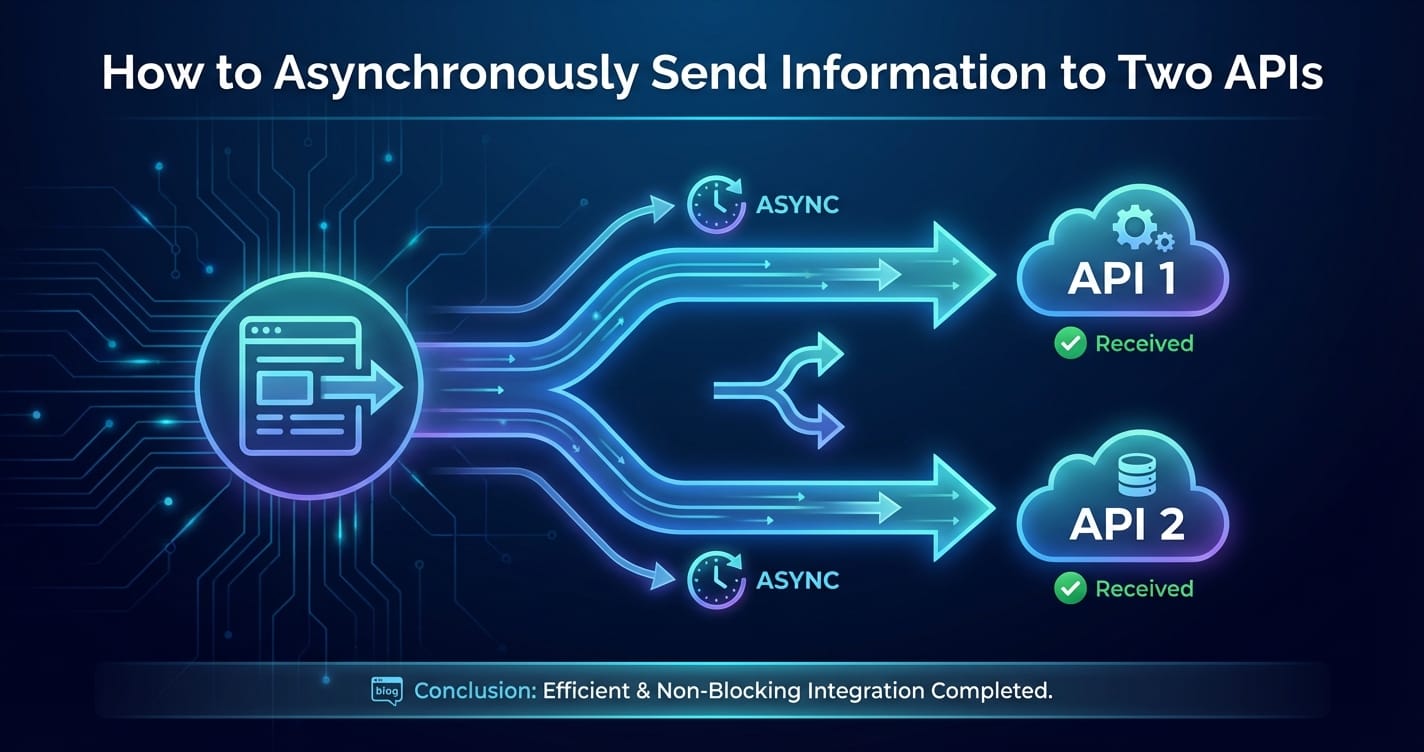
How to Asynchronously Send Information to Two APIs


The digital landscape is a vast, interconnected tapestry woven from countless services communicating with one another. In this intricate web, the ability to exchange information efficiently and reliably is paramount. Modern applications rarely operate in isolation; they frequently need to interact with multiple external services or internal microservices, often necessitating simultaneous updates or data retrieval from several endpoints. The synchronous paradigm, where one operation must complete before the next can begin, quickly becomes a bottleneck, leading to sluggish performance, poor user experience, and a brittle system architecture.
This challenge is particularly pronounced when an application needs to send information to two distinct APIs. Imagine a user registering on a platform: their details might need to be saved in a primary user database via one API, while simultaneously, a welcome email needs to be triggered through a separate notification service API. If these operations are performed sequentially, any delay in the email service directly impacts the user's registration completion time, regardless of how quickly the user data was saved. This is where asynchronous communication steps in as a transformative approach, allowing these operations to proceed in parallel without one blocking the other, thus enhancing responsiveness, resilience, and scalability.
This comprehensive guide will delve deep into the methodologies, architectural considerations, and best practices for asynchronously sending information to two APIs. We will explore various technical avenues, from client-side JavaScript paradigms to sophisticated server-side frameworks, message queueing systems, and the pivotal role of an API gateway. Our aim is not just to demonstrate how to achieve this, but to provide a foundational understanding of why certain approaches are preferred in different scenarios, empowering developers and architects to build more robust and performant distributed systems. By the end, you will have a clear roadmap to navigate the complexities of multi-API interactions, ensuring your applications remain responsive and reliable even under demanding conditions.
The Imperative of Asynchronous Communication: Why Not Synchronous?
Before we dive into the "how," it's crucial to thoroughly understand the "why." Why is asynchronous communication not merely a convenience but often a necessity in modern software development, especially when dealing with multiple API interactions? The answer lies in the fundamental limitations of synchronous operations in a distributed environment.
1. Performance and User Experience: In a synchronous model, every API call is a blocking operation. If a client needs to call API A and then API B, it must wait for API A's response before it can even initiate the request to API B. When communicating with two APIs, this means the total response time is at least the sum of the individual API latencies, plus network overheads and processing times. This accumulated delay directly translates to a sluggish application. For a web application, this could mean a spinning loader, an unresponsive UI, or a frustrated user. In a backend service, it could mean delayed processing of crucial business logic, impacting downstream systems or batch jobs. Asynchronous operations, by contrast, allow multiple API calls to be initiated almost simultaneously. While the individual calls still take time, the overall wait time for the initiating system can be dramatically reduced, as it doesn't wait for each call to complete sequentially. This parallelism is the bedrock of a responsive system, significantly improving perceived performance and actual throughput.
2. Resilience and Fault Tolerance: Synchronous coupling introduces a strong dependency between services. If API A goes down or experiences a significant slowdown, any system synchronously calling it will either hang, timeout, or fail. When you add a second API (API B) into the mix, the failure surface expands. If the interaction with API A fails, the interaction with API B might not even be attempted, or if it's attempted and fails, the entire compound operation fails. Asynchronous patterns, particularly those involving message queues or robust error handling mechanisms, can decouple these dependencies. If an API call fails, the initiating system isn't necessarily blocked. The failed operation might be retried later, or alternative paths might be taken without immediately impacting other parts of the system. This decoupling fosters greater system resilience, preventing a failure in one component from cascading and bringing down the entire application.
3. Scalability and Resource Utilization: Synchronous operations often tie up system resources. When a thread or process makes a blocking API call, it effectively enters a waiting state, holding onto memory, CPU cycles (even if idle), and connection resources until a response is received. In scenarios with many concurrent users or high throughput requirements, this quickly exhausts available resources, leading to bottlenecks and an inability to scale. An application might hit its maximum number of open connections or threads, preventing new requests from being processed. Asynchronous patterns, especially those leveraging event loops (like Node.js) or lightweight concurrency primitives (like Go's goroutines), allow a single thread or process to manage thousands of concurrent operations without blocking. When an API call is made asynchronously, the underlying system can switch to handling other tasks while waiting for the response. This dramatically improves resource utilization, enabling the application to handle a far greater load with the same infrastructure, thus enhancing scalability.
4. Decoupling and Modularity: Asynchronous communication naturally promotes a more loosely coupled architecture. When services interact asynchronously, they don't need to know the immediate status or internal workings of each other. They simply send information and potentially react to responses or events. This separation of concerns enhances modularity, making it easier to develop, deploy, and maintain individual services independently. If API A changes its internal implementation, as long as its contract remains stable, services interacting with it asynchronously are less likely to be affected. This independence accelerates development cycles and reduces the risk of unintended side effects across the system.
In essence, embracing asynchronous communication when sending information to two APIs is a fundamental shift towards building modern, high-performance, resilient, and scalable distributed systems. It allows developers to break free from the constraints of sequential execution, unlocking the full potential of parallel processing and distributed architectures.
Fundamental Asynchronous Paradigms
To effectively send information to two APIs asynchronously, it's vital to grasp the underlying paradigms that enable non-blocking operations. Different programming languages and environments offer distinct mechanisms, but they generally fall into a few core categories:
1. Callbacks: The most basic form of asynchrony. A callback is a function passed as an argument to another function, which is then executed once the asynchronous operation completes. In the context of API calls, you'd initiate an HTTP request and provide a callback function to handle the response (or error) when it eventually arrives. * Pros: Simple to understand for basic cases. * Cons: Prone to "callback hell" or "pyramid of doom" when chaining multiple asynchronous operations, leading to deeply nested, unreadable code. Error handling can also become complex.
2. Promises/Futures: Promises (or Futures in some languages) represent the eventual result of an asynchronous operation. A promise can be in one of three states: pending (initial state, neither fulfilled nor rejected), fulfilled (meaning the operation completed successfully), or rejected (meaning the operation failed). Promises provide a cleaner way to chain asynchronous operations and handle errors compared to callbacks, using .then() for success and .catch() for errors. * Pros: Improved readability and flow control, easier error handling through a single .catch() block for a chain. * Cons: Still can be challenging to coordinate multiple independent promises, especially when waiting for all to complete.
3. Async/Await: Built on top of Promises, async/await provides a syntax that makes asynchronous code look and behave more like synchronous code, making it significantly easier to read and write. An async function implicitly returns a Promise, and the await keyword can only be used inside an async function to pause execution until a Promise settles (resolves or rejects), then unwraps its value. * Pros: Highly readable and maintainable code, simplified error handling with standard try...catch blocks. * Cons: Requires a runtime that supports these constructs (e.g., modern JavaScript environments, Python 3.5+, C#). If used improperly (e.g., awaiting every call sequentially when parallel is possible), it can negate performance benefits.
4. Event-Driven Architecture (EDA): In an EDA, services communicate by emitting and reacting to events. Instead of directly calling an API, a service might publish an event to a central event bus or message broker. Other services interested in that event subscribe to it and react accordingly. When sending information to two APIs, this could involve one service publishing an event, and two different downstream services consuming that event, each then calling its respective API. * Pros: Extreme decoupling, high scalability, resilience (events can be retried or stored). * Cons: Increased complexity with message brokers, eventual consistency challenges, harder to trace a full transaction flow.
5. Message Queues: Message queues are specialized software components that facilitate asynchronous communication between different parts of an application or different applications. A producer sends a message to a queue, and one or more consumers retrieve messages from the queue for processing. This acts as a buffer and a reliable communication channel. When sending information to two APIs, a single message can be placed in a queue, and two separate consumers (or a single consumer with fan-out logic) can retrieve and process it, each calling one of the target APIs. * Pros: Decoupling, reliability (messages can be persisted), load leveling, support for various messaging patterns (e.g., publish-subscribe). * Cons: Adds another infrastructure component, increases operational overhead, introduces latency for message processing.
Understanding these paradigms forms the bedrock for selecting and implementing the most appropriate strategy for your specific use case. Each has its strengths and weaknesses, and the optimal choice often depends on factors like the required level of reliability, latency tolerance, system scale, and existing infrastructure.
Core Challenge: Sending Information to Two APIs
The specific challenge of asynchronously sending information to two APIs introduces a layer of complexity beyond simple single-API asynchronous calls. It's not just about initiating a non-blocking request; it's about coordinating multiple such requests, managing their independent lifecycles, and often, handling their individual outcomes.
What Does "Send Information" Entail? When we speak of "sending information," we're typically referring to HTTP methods that modify or create resources: * POST: Creating a new resource (e.g., creating a new user, submitting an order). * PUT: Fully replacing an existing resource. * PATCH: Partially updating an existing resource. While less common for the "sending information" context, sometimes "sending" can also refer to concurrent GET requests where the data retrieved from two different APIs is then processed. However, for this article, we'll primarily focus on operations that modify state.
Typical Scenarios Demanding Dual-API Asynchrony: 1. Fan-out Operations: A single logical action triggers multiple independent actions across different services. * Example: User registration (API 1: save user data; API 2: send welcome email). * Example: E-commerce order (API 1: update inventory; API 2: process payment; API 3: notify shipping). 2. Data Replication/Synchronization: Maintaining consistency across disparate data stores. * Example: Creating a product (API 1: save to primary product database; API 2: update search index). 3. Cross-cutting Concerns: Applying common logic across multiple, otherwise unrelated, operations. * Example: Audit logging (API 1: perform primary action; API 2: log action details to an audit service). 4. Notifications/Alerts: Triggering multiple forms of communication simultaneously. * Example: Critical system event (API 1: send SMS alert; API 2: post to internal Slack channel).
Handling Independent Responses and Errors: A key aspect of dual-API asynchrony is managing the responses and potential errors from each API call independently. * Partial Success/Failure: What if API A succeeds but API B fails? Is the overall operation considered successful, failed, or partially successful? This requires careful design to define the transactional boundaries and potential rollback or compensation strategies. * Independent Error Handling: Each API call might have its own set of error conditions. A robust asynchronous system needs to capture and process these errors individually, perhaps triggering different retry mechanisms or alerting specific teams based on which API failed. * Response Aggregation (less common for "sending" but possible): If the initiating system needs to know the outcome of both API calls, it must wait for both responses to arrive and then potentially combine their results. This is often where constructs like Promise.all or Task.WhenAll become invaluable.
The methods we explore in the subsequent sections directly address these complexities, providing architectural patterns and coding techniques to effectively manage these dual, asynchronous interactions.
Methods for Asynchronously Sending Information to Two APIs
The approach you choose will largely depend on where the logic resides (client-side or server-side), the required reliability, system scale, and the existing technology stack. We'll explore several prominent methods.
1. Client-Side Asynchrony (e.g., JavaScript in Browsers/Node.js)
For many modern web applications or Node.js-based backend services, JavaScript offers powerful primitives for handling asynchronous operations directly. This approach is suitable when the client (be it a browser frontend or a Node.js microservice) is responsible for coordinating the calls to multiple APIs.
Core Principles: * Non-blocking I/O: JavaScript's event loop model ensures that network requests do not block the main thread. * Promises and Async/Await: These modern constructs provide a clean, readable way to manage asynchronous operations.
Implementation with fetch and Promise.all: The fetch API is the standard way to make HTTP requests in modern browsers and Node.js. Promise.all is crucial for sending requests to multiple APIs concurrently and waiting for all of them to resolve.
Let's illustrate with an example: a user updates their profile, which requires updating a profile API and also notifying a search-index API to re-index their data.
async function updateUserAndIndex(userId, userData) {
    const profileApiUrl = `https://api.example.com/users/${userId}/profile`;
    const searchIndexApiUrl = `https://api.example.com/search-index/users/${userId}`;

    const headers = {
        'Content-Type': 'application/json',
        'Authorization': 'Bearer YOUR_AUTH_TOKEN'
    };

    try {
        // Prepare the requests
        const updateProfileRequest = fetch(profileApiUrl, {
            method: 'PATCH', // Or PUT, POST depending on API contract
            headers: headers,
            body: JSON.stringify(userData)
        });

        const notifySearchIndexRequest = fetch(searchIndexApiUrl, {
            method: 'POST', // Or PUT, to trigger re-indexing
            headers: headers,
            // Body might be empty or contain minimal data like { userId: userId }
            body: JSON.stringify({ userId: userId, action: 'update' })
        });

        // Use Promise.all to send both requests concurrently
        // Promise.all waits for ALL promises to resolve. If ANY promise rejects, Promise.all rejects.
        const [profileResponse, searchIndexResponse] = await Promise.all([
            updateProfileRequest,
            notifySearchIndexRequest
        ]);

        // Check individual responses for success
        if (!profileResponse.ok) {
            const errorData = await profileResponse.json();
            console.error(`Failed to update profile: ${profileResponse.status} - ${JSON.stringify(errorData)}`);
            // Depending on business logic, you might throw an error or handle partial failure
            throw new Error(`Profile update failed: ${profileResponse.statusText}`);
        }
        console.log('Profile updated successfully.');

        if (!searchIndexResponse.ok) {
            const errorData = await searchIndexResponse.json();
            console.error(`Failed to notify search index: ${searchIndexResponse.status} - ${JSON.stringify(errorData)}`);
            // This might be a "soft" failure where the profile update is more critical
            // You might log and continue, or initiate a retry mechanism
            console.warn(`Search index notification failed, will attempt retry later or notify admin.`);
        } else {
            console.log('Search index notified successfully.');
        }

        console.log('All operations completed (with potential warnings).');
        return { success: true, profileUpdated: profileResponse.ok, searchIndexNotified: searchIndexResponse.ok };

    } catch (error) {
        console.error('An error occurred during asynchronous API calls:', error);
        // Centralized error handling for network issues or unhandled promise rejections
        throw new Error(`Overall operation failed: ${error.message}`);
    }
}

// Example usage:
// updateUserAndIndex('user123', { name: 'Jane Doe', email: 'jane.doe@example.com' })
//     .then(result => console.log('Operation Summary:', result))
//     .catch(err => console.error('Overall failure:', err));
Using Promise.allSettled for Independent Outcomes: In the above example, if updateProfileRequest fails, Promise.all will immediately reject, and notifySearchIndexRequest's outcome won't be processed by the then block (though the request itself might still complete in the background). Often, you want to know the outcome of each request independently, even if some fail. Promise.allSettled is perfect for this. It waits for all promises to settle (either fulfill or reject) and returns an array of objects describing the outcome of each promise.
async function updateUserAndIndexWithSettled(userId, userData) {
    const profileApiUrl = `https://api.example.com/users/${userId}/profile`;
    const searchIndexApiUrl = `https://api.example.com/search-index/users/${userId}`;

    const headers = {
        'Content-Type': 'application/json',
        'Authorization': 'Bearer YOUR_AUTH_TOKEN'
    };

    try {
        const updateProfileRequest = fetch(profileApiUrl, { method: 'PATCH', headers, body: JSON.stringify(userData) });
        const notifySearchIndexRequest = fetch(searchIndexApiUrl, { method: 'POST', headers, body: JSON.stringify({ userId, action: 'update' }) });

        // Use Promise.allSettled to get the outcome of all promises, regardless of success/failure
        const results = await Promise.allSettled([
            updateProfileRequest,
            notifySearchIndexRequest
        ]);

        let profileSuccess = false;
        let searchIndexSuccess = false;

        if (results[0].status === 'fulfilled' && results[0].value.ok) {
            console.log('Profile updated successfully.');
            profileSuccess = true;
        } else {
            const errorResponse = results[0].status === 'fulfilled' ? await results[0].value.json() : results[0].reason;
            console.error(`Failed to update profile:`, errorResponse);
        }

        if (results[1].status === 'fulfilled' && results[1].value.ok) {
            console.log('Search index notified successfully.');
            searchIndexSuccess = true;
        } else {
            const errorResponse = results[1].status === 'fulfilled' ? await results[1].value.json() : results[1].reason;
            console.error(`Failed to notify search index:`, errorResponse);
        }

        console.log('All operations settled.');
        return { profileSuccess, searchIndexSuccess };

    } catch (error) {
        console.error('An unexpected error occurred:', error);
        throw error;
    }
}
Pros of Client-Side Asynchrony: * Simplicity: For simple fan-out, it's straightforward to implement. * Direct Control: The client has direct control over the API calls and error handling. * Reduced Latency (perceived): When done in a browser, the user sees faster UI updates because the browser isn't blocked.
Cons of Client-Side Asynchrony: * Security Concerns: Exposing multiple API endpoints directly to the client can be a security risk if not properly managed (e.g., sensitive API keys, unauthenticated access). * CORS Issues: Cross-Origin Resource Sharing (CORS) policies can complicate direct API calls from a browser to different domains. * Network Overhead: Each API call involves a separate network round trip from the client, potentially increasing overall network traffic and latency if the client is far from the APIs. * Limited Reliability: If the client disconnects or crashes, ongoing asynchronous requests might be lost or their status unknown. No built-in retry mechanisms usually. * Complexity for Many APIs: Coordinating many APIs and complex error recovery logic becomes unwieldy on the client.
Client-side asynchrony is excellent for frontend applications making a few independent backend calls or for lightweight Node.js services. For more complex, mission-critical, or high-volume scenarios, server-side approaches offer greater control and robustness.
2. Server-Side Asynchrony
Server-side environments offer more robust and scalable mechanisms for asynchronous operations, primarily leveraging threads, event loops, or dedicated concurrency primitives. This is the preferred approach for mission-critical applications, backend services, and scenarios requiring high reliability and performance.
a) Python with asyncio and aiohttp
Python's asyncio module is its answer to asynchronous programming, built around an event loop. aiohttp is a popular library for making asynchronous HTTP requests.
import asyncio
import aiohttp
import json

async def send_data_to_two_apis_python(user_id: str, user_data: dict):
    profile_api_url = f"https://api.example.com/users/{user_id}/profile"
    search_index_api_url = f"https://api.example.com/search-index/users/{user_id}"

    headers = {
        'Content-Type': 'application/json',
        'Authorization': 'Bearer YOUR_AUTH_TOKEN'
    }

    async with aiohttp.ClientSession(headers=headers) as session:
        try:
            # Prepare data for each API
            profile_payload = json.dumps(user_data)
            search_index_payload = json.dumps({"userId": user_id, "action": "update"})

            # Create coroutines for each request
            profile_task = session.patch(profile_api_url, data=profile_payload)
            search_index_task = session.post(search_index_api_url, data=search_index_payload)

            # Gather both tasks to run concurrently
            # asyncio.gather waits for all coroutines to complete. If any raises an exception, gather will also raise it.
            profile_response, search_index_response = await asyncio.gather(
                profile_task,
                search_index_task,
                return_exceptions=True # Allows gathering results even if some tasks fail
            )

            profile_success = False
            search_index_success = False

            # Check profile API response
            if isinstance(profile_response, aiohttp.ClientResponse):
                if profile_response.status == 200:
                    print(f"Profile for {user_id} updated successfully.")
                    profile_success = True
                else:
                    error_data = await profile_response.json()
                    print(f"Failed to update profile for {user_id}: {profile_response.status} - {error_data}")
            elif isinstance(profile_response, Exception):
                print(f"Network error updating profile for {user_id}: {profile_response}")

            # Check search index API response
            if isinstance(search_index_response, aiohttp.ClientResponse):
                if search_index_response.status == 200:
                    print(f"Search index for {user_id} notified successfully.")
                    search_index_success = True
                else:
                    error_data = await search_index_response.json()
                    print(f"Failed to notify search index for {user_id}: {search_index_response.status} - {error_data}")
            elif isinstance(search_index_response, Exception):
                print(f"Network error notifying search index for {user_id}: {search_index_response}")

            return {"profile_success": profile_success, "search_index_success": search_index_success}

        except Exception as e:
            print(f"An unexpected error occurred during API calls: {e}")
            raise # Re-raise for higher-level handling

# To run this:
# async def main():
#     result = await send_data_to_two_apis_python('user456', {'name': 'Alice Smith', 'address': '123 Main St'})
#     print("Operation summary:", result)

# if __name__ == "__main__":
#     asyncio.run(main())
b) Java with CompletableFuture
Java's CompletableFuture class, introduced in Java 8, is a powerful tool for asynchronous programming, allowing you to compose and combine asynchronous computations. It's ideal for making non-blocking HTTP calls.
import java.net.URI;
import java.net.http.HttpClient;
import java.net.http.HttpRequest;
import java.net.http.HttpResponse;
import java.util.concurrent.CompletableFuture;
import java.util.concurrent.ExecutorService;
import java.util.concurrent.Executors;
import java.util.concurrent.TimeUnit;

public class ApiSenderJava {

    private final HttpClient httpClient;
    private final ExecutorService executorService; // For custom thread pool if needed

    public ApiSenderJava() {
        this.executorService = Executors.newFixedThreadPool(5); // Example fixed thread pool
        this.httpClient = HttpClient.newBuilder()
                                    .executor(executorService) // Use custom executor
                                    .version(HttpClient.Version.HTTP_2)
                                    .connectTimeout(java.time.Duration.ofSeconds(10))
                                    .build();
    }

    public CompletableFuture<ApiResult> sendDataToTwoApis(String userId, String userDataJson) {
        String profileApiUrl = String.format("https://api.example.com/users/%s/profile", userId);
        String searchIndexApiUrl = String.format("https://api.example.com/search-index/users/%s", userId);
        String authToken = "Bearer YOUR_AUTH_TOKEN";

        // Prepare HttpRequest for profile update
        HttpRequest profileRequest = HttpRequest.newBuilder()
                .uri(URI.create(profileApiUrl))
                .header("Content-Type", "application/json")
                .header("Authorization", authToken)
                .method("PATCH", HttpRequest.BodyPublishers.ofString(userDataJson))
                .timeout(java.time.Duration.ofSeconds(5)) // Specific timeout for this request
                .build();

        // Prepare HttpRequest for search index notification
        String searchIndexPayload = String.format("{\"userId\": \"%s\", \"action\": \"update\"}", userId);
        HttpRequest searchIndexRequest = HttpRequest.newBuilder()
                .uri(URI.create(searchIndexApiUrl))
                .header("Content-Type", "application/json")
                .header("Authorization", authToken)
                .POST(HttpRequest.BodyPublishers.ofString(searchIndexPayload))
                .timeout(java.time.Duration.ofSeconds(5))
                .build();

        // Send requests asynchronously
        CompletableFuture<HttpResponse<String>> profileFuture =
                httpClient.sendAsync(profileRequest, HttpResponse.BodyHandlers.ofString());

        CompletableFuture<HttpResponse<String>> searchIndexFuture =
                httpClient.sendAsync(searchIndexRequest, HttpResponse.BodyHandlers.ofString());

        // Combine both futures
        return CompletableFuture.allOf(profileFuture, searchIndexFuture)
                .thenApply(__ -> { // __ is a placeholder as we don't need the result of allOf
                    boolean profileSuccess = false;
                    boolean searchIndexSuccess = false;
                    String profileError = null;
                    String searchIndexError = null;

                    try {
                        HttpResponse<String> profileResponse = profileFuture.join(); // Get result, blocks only if not ready
                        if (profileResponse.statusCode() >= 200 && profileResponse.statusCode() < 300) {
                            System.out.println("Profile updated successfully.");
                            profileSuccess = true;
                        } else {
                            profileError = String.format("Failed to update profile: %d - %s",
                                    profileResponse.statusCode(), profileResponse.body());
                            System.err.println(profileError);
                        }
                    } catch (Exception e) {
                        profileError = "Exception updating profile: " + e.getMessage();
                        System.err.println(profileError);
                    }

                    try {
                        HttpResponse<String> searchIndexResponse = searchIndexFuture.join();
                        if (searchIndexResponse.statusCode() >= 200 && searchIndexResponse.statusCode() < 300) {
                            System.out.println("Search index notified successfully.");
                            searchIndexSuccess = true;
                        } else {
                            searchIndexError = String.format("Failed to notify search index: %d - %s",
                                    searchIndexResponse.statusCode(), searchIndexResponse.body());
                            System.err.println(searchIndexError);
                        }
                    } catch (Exception e) {
                        searchIndexError = "Exception notifying search index: " + e.getMessage();
                        System.err.println(searchIndexError);
                    }

                    return new ApiResult(profileSuccess, searchIndexSuccess, profileError, searchIndexError);
                }).exceptionally(ex -> { // Handle any exceptions that occurred before thenApply (e.g., allOf failure)
                    System.err.println("An exception occurred in one of the futures: " + ex.getMessage());
                    return new ApiResult(false, false, "Overall failure: " + ex.getMessage(), "Overall failure: " + ex.getMessage());
                });
    }

    public static class ApiResult {
        public final boolean profileSuccess;
        public final boolean searchIndexSuccess;
        public final String profileError;
        public final String searchIndexError;

        public ApiResult(boolean profileSuccess, boolean searchIndexSuccess, String profileError, String searchIndexError) {
            this.profileSuccess = profileSuccess;
            this.searchIndexSuccess = searchIndexSuccess;
            this.profileError = profileError;
            this.searchIndexError = searchIndexError;
        }

        @Override
        public String toString() {
            return "ApiResult{" +
                    "profileSuccess=" + profileSuccess +
                    ", searchIndexSuccess=" + searchIndexSuccess +
                    ", profileError='" + profileError + '\'' +
                    ", searchIndexError='" + searchIndexError + '\'' +
                    '}';
        }
    }

    public void shutdown() {
        executorService.shutdown();
        try {
            if (!executorService.awaitTermination(60, TimeUnit.SECONDS)) {
                executorService.shutdownNow();
            }
        } catch (InterruptedException ex) {
            executorService.shutdownNow();
            Thread.currentThread().interrupt();
        }
    }

    public static void main(String[] args) {
        ApiSenderJava sender = new ApiSenderJava();
        String userId = "user789";
        String userData = "{\"name\": \"Charlie Brown\", \"city\": \"Peanuts Town\"}";

        sender.sendDataToTwoApis(userId, userData)
                .thenAccept(result -> System.out.println("Final Result: " + result))
                .exceptionally(ex -> {
                    System.err.println("Main error handling: " + ex.getMessage());
                    return null;
                })
                .thenRun(sender::shutdown); // Ensure shutdown after all tasks
    }
}
c) Go with Goroutines and Channels
Go's built-in concurrency model, based on goroutines and channels, makes asynchronous parallel execution exceptionally straightforward and efficient. Goroutines are lightweight threads managed by the Go runtime, and channels are used for communication between goroutines.
package main

import (
    "bytes"
    "encoding/json"
    "fmt"
    "io"
    "io/ioutil"
    "net/http"
    "sync"
    "time"
)

// APIResponse encapsulates the outcome of an individual API call
type APIResponse struct {
    ServiceName string
    Success     bool
    StatusCode  int
    Message     string
    Error       error
}

// UserData represents the data to send for profile update
type UserData struct {
    Name    string `json:"name"`
    Address string `json:"address"`
}

// SearchIndexPayload represents the data for search index notification
type SearchIndexPayload struct {
    UserID string `json:"userId"`
    Action string `json:"action"`
}

func callAPI(client *http.Client, method, url, authToken string, payload []byte, serviceName string, resultChan chan<- APIResponse) {
    req, err := http.NewRequest(method, url, bytes.NewBuffer(payload))
    if err != nil {
        resultChan <- APIResponse{ServiceName: serviceName, Success: false, Message: "Request creation failed", Error: err}
        return
    }
    req.Header.Set("Content-Type", "application/json")
    req.Header.Set("Authorization", authToken)

    resp, err := client.Do(req)
    if err != nil {
        resultChan <- APIResponse{ServiceName: serviceName, Success: false, Message: "HTTP request failed", Error: err}
        return
    }
    defer resp.Body.Close()

    bodyBytes, err := ioutil.ReadAll(resp.Body)
    if err != nil {
        resultChan <- APIResponse{ServiceName: serviceName, Success: false, Message: "Failed to read response body", Error: err}
        return
    }

    if resp.StatusCode >= 200 && resp.StatusCode < 300 {
        resultChan <- APIResponse{ServiceName: serviceName, Success: true, StatusCode: resp.StatusCode, Message: "Operation successful"}
    } else {
        resultChan <- APIResponse{
            ServiceName: serviceName,
            Success:     false,
            StatusCode:  resp.StatusCode,
            Message:     fmt.Sprintf("API returned error status: %s, body: %s", resp.Status, string(bodyBytes)),
            Error:       fmt.Errorf("API error status %d", resp.StatusCode),
        }
    }
}

func sendDataToTwoApisGo(userID string, userData UserData) map[string]APIResponse {
    profileAPIURL := fmt.Sprintf("https://api.example.com/users/%s/profile", userID)
    searchIndexAPIURL := fmt.Sprintf("https://api.example.com/search-index/users/%s", userID)
    authToken := "Bearer YOUR_AUTH_TOKEN"

    client := &http.Client{Timeout: 10 * time.Second} // HTTP client with timeout

    resultChan := make(chan APIResponse, 2) // Buffered channel for 2 responses
    var wg sync.WaitGroup                   // WaitGroup to wait for all goroutines to finish

    // Prepare payload for profile API
    profilePayload, _ := json.Marshal(userData)
    wg.Add(1)
    go func() {
        defer wg.Done()
        callAPI(client, http.MethodPatch, profileAPIURL, authToken, profilePayload, "ProfileService", resultChan)
    }()

    // Prepare payload for search index API
    searchIndexData := SearchIndexPayload{UserID: userID, Action: "update"}
    searchIndexPayload, _ := json.Marshal(searchIndexData)
    wg.Add(1)
    go func() {
        defer wg.Done()
        callAPI(client, http.MethodPost, searchIndexAPIURL, authToken, searchIndexPayload, "SearchIndexService", resultChan)
    }()

    wg.Wait()      // Wait for both goroutines to complete
    close(resultChan) // Close the channel once all producers are done

    finalResults := make(map[string]APIResponse)
    for res := range resultChan { // Collect results from the channel
        finalResults[res.ServiceName] = res
        if res.Success {
            fmt.Printf("[%s] SUCCESS: %s\n", res.ServiceName, res.Message)
        } else {
            fmt.Printf("[%s] FAILED: %s (Status: %d, Error: %v)\n", res.ServiceName, res.Message, res.StatusCode, res.Error)
        }
    }
    return finalResults
}

func main() {
    user := UserData{Name: "Go Developer", Address: "Gopher Street"}
    results := sendDataToTwoApisGo("userGo123", user)
    fmt.Println("\nOverall operation results:")
    for service, res := range results {
        fmt.Printf("- %s: Success=%t, Status=%d, Message='%s'\n", service, res.Success, res.StatusCode, res.Message)
    }
}
Pros of Server-Side Asynchrony (General): * Enhanced Reliability: Better error handling, retry mechanisms, and logging capabilities. * Security: API keys and sensitive logic are securely managed on the server, never exposed to the client. * Performance (Scale): Can handle a significantly larger number of concurrent requests due to efficient resource management. * Complexity Management: More suitable for complex business logic, data transformations, and orchestration across many services. * Observability: Easier to implement comprehensive monitoring, logging, and tracing.
Cons of Server-Side Asynchrony (General): * Increased Server Load: While efficient, processing many requests will still consume server resources. * Development Complexity: Requires understanding of server-side concurrency models (threads, event loops, goroutines). * Deployment Complexity: Requires deploying and managing server-side applications.
Server-side asynchronous calls are the backbone of robust distributed systems, offering the flexibility and power needed to manage complex interactions with multiple APIs.
3. Message Queues/Brokers
For scenarios demanding high reliability, extreme decoupling, and eventual consistency, message queues (like RabbitMQ, Apache Kafka, AWS SQS, Azure Service Bus) offer a powerful architectural pattern. Instead of direct API calls, the originating service publishes a message to a queue, and one or more independent consumers then pick up these messages and interact with their respective APIs.
How it Works for Dual-API Interactions: 1. Producer: The initiating service (e.g., a web server processing a user request) creates a message describing the event (e.g., "UserRegisteredEvent"). 2. Message Queue/Broker: The producer sends this message to a specific topic or queue on the message broker. The broker ensures the message is stored reliably. 3. Consumers: * Consumer 1: Subscribes to the "UserRegisteredEvent." When it receives a message, it extracts the user data and calls the Profile API to save the user's details. * Consumer 2: Also subscribes to the "UserRegisteredEvent." When it receives the same message, it extracts relevant information and calls the Notification API to send a welcome email. * This is a "publish-subscribe" or "fan-out" pattern, where one message triggers actions in multiple independent services.
Example Scenario (Conceptual - pseudo-code):
// Producer Service (e.g., User Registration Service)
function registerUser(userData) {
    // Validate userData
    // ...

    // Create an event message
    const userRegisteredEvent = {
        eventType: "UserRegistered",
        userId: generateUniqueId(),
        username: userData.username,
        email: userData.email,
        timestamp: new Date().toISOString()
    };

    // Publish the event to a message broker (e.g., Kafka topic "user_events")
    messageBroker.publish('user_events', JSON.stringify(userRegisteredEvent));

    console.log(`User registration event for ${userRegisteredEvent.userId} published.`);
    return { success: true, message: "Registration initiated asynchronously." };
}

// Consumer Service 1 (e.g., Profile Management Service)
messageBroker.subscribe('user_events', (message) => {
    const event = JSON.parse(message);
    if (event.eventType === "UserRegistered") {
        console.log(`Profile Service received UserRegistered event for ${event.userId}`);
        // Call Profile API to save user details
        profileApi.saveUser({
            id: event.userId,
            username: event.username,
            email: event.email
        })
        .then(() => console.log(`Profile for ${event.userId} saved successfully.`))
        .catch(error => console.error(`Failed to save profile for ${event.userId}:`, error));
    }
});

// Consumer Service 2 (e.g., Notification Service)
messageBroker.subscribe('user_events', (message) => {
    const event = JSON.parse(message);
    if (event.eventType === "UserRegistered") {
        console.log(`Notification Service received UserRegistered event for ${event.userId}`);
        // Call Notification API to send welcome email
        notificationApi.sendEmail({
            to: event.email,
            subject: "Welcome to our platform!",
            body: `Dear ${event.username}, welcome aboard!`
        })
        .then(() => console.log(`Welcome email sent to ${event.email}.`))
        .catch(error => console.error(`Failed to send welcome email to ${event.email}:`, error));
    }
});
Pros of Message Queues: * Extreme Decoupling: Producer is completely unaware of the consumers. Services can evolve independently. * Reliability: Messages are persisted, ensuring delivery even if consumers are down. Built-in retry mechanisms, dead-letter queues. * Scalability: Consumers can be scaled independently based on load. * Load Leveling: Queues act as buffers, smoothing out spikes in demand. * Asynchronous by Nature: Designed for non-blocking communication from the ground up. * Fault Tolerance: A failure in one consumer does not affect others.
Cons of Message Queues: * Increased Complexity: Introduces a new infrastructure component (the message broker) to deploy, monitor, and manage. * Eventual Consistency: Operations are not synchronous. There's a delay before all consumers process the event, leading to eventual consistency rather than immediate consistency. This needs to be acceptable for the business logic. * Debugging Challenges: Tracing the flow of a single "transaction" across multiple services reacting to events can be more complex. * Higher Latency (Perceived): While highly scalable, the end-to-end latency for a single message through a queue might be slightly higher than a direct HTTP call due to serialization, deserialization, and broker processing.
Message queues are best suited for high-volume, event-driven architectures where immediate consistency across multiple services is not a strict requirement, and robust, reliable delivery is paramount.
4. API Gateway as an Orchestrator
An API gateway sits between the client and a collection of backend services. It acts as a single entry point for all client requests, abstracting away the complexities of the microservices architecture. Crucially, an api gateway can also serve as an orchestrator, receiving a single client request and fanning it out to multiple upstream APIs asynchronously. This is an extremely powerful pattern for managing and simplifying multi-API interactions, especially in complex distributed systems.
How an API Gateway Orchestrates Dual-API Calls: 1. Client Request: A client sends a single request to the api gateway (e.g., POST /users/register). 2. Gateway Routing and Transformation: The api gateway receives this request. Based on predefined rules (e.g., configuration, scripting, or workflow definitions), it: * Transforms the incoming request if necessary (e.g., extracts relevant data for different backend APIs). * Initiates multiple, parallel, asynchronous calls to the relevant backend APIs (e.g., one to User Profile Service and another to Notification Service). 3. Backend API Interaction: The backend APIs process their respective requests independently. 4. Gateway Response Aggregation (Optional): The api gateway waits for responses from all initiated backend calls. It can then: * Aggregate these responses into a single, unified response for the client. * Handle individual backend API failures (e.g., log, retry, return partial success). * Apply further transformations or add cross-cutting concerns (e.g., audit logging, metrics). 5. Client Response: The api gateway sends the consolidated (or tailored) response back to the client.
Benefits of using an API Gateway for Asynchronous Dual-API Calls: * Simplified Client Logic: The client only ever interacts with a single api gateway endpoint, even if the request internally fans out to dozens of services. This significantly reduces client-side complexity and development effort. * Centralized Control: Authentication, authorization, rate limiting, caching, logging, and monitoring can all be managed at the api gateway level for all backend APIs. * Request/Response Transformation: The api gateway can adapt client requests to backend API requirements and unify diverse backend responses before sending them back to the client. * Resilience: The api gateway can implement robust error handling, retry mechanisms, circuit breakers, and timeouts for upstream calls, making the system more resilient. * Decoupling: It decouples clients from specific backend service implementations, allowing backend services to evolve without impacting clients. * Load Balancing and Routing: Efficiently distributes traffic to multiple instances of backend services.
For organizations seeking a comprehensive solution to manage their APIs, especially when dealing with complex asynchronous interactions and AI models, an api gateway like APIPark offers significant advantages. APIPark, as an open-source AI gateway and API management platform, excels at unifying the management of diverse API services. It can abstract away the complexities of interacting with multiple backend services or even external APIs, offering a single, unified endpoint to consumers while internally managing asynchronous fan-out patterns, ensuring robust API lifecycle management, and providing features like quick integration of 100+ AI models, unified API format for AI invocation, and prompt encapsulation into REST API. Its capability to handle traffic forwarding, load balancing, and versioning of published APIs makes it an invaluable asset in orchestrating asynchronous interactions reliably and at scale. Moreover, with performance rivaling Nginx and powerful data analysis capabilities, APIPark provides the necessary infrastructure to confidently manage high-volume, asynchronous API calls to two or more backend services, whether they are traditional REST APIs or advanced AI models.
Considerations for API Gateway Orchestration: * Latency: The gateway adds an additional hop and processing overhead, potentially increasing latency if not optimized. * Single Point of Failure: If the api gateway is not highly available and scalable, it can become a single point of failure. * Complexity: Configuring and managing a sophisticated api gateway can be complex, especially for dynamic orchestration logic. It needs to be carefully balanced against the benefits it provides.
An api gateway is often the architectural choice for enterprise-grade applications dealing with a multitude of microservices and requiring fine-grained control over API interactions. It shifts the burden of multi-API orchestration from individual clients or microservices to a dedicated infrastructure layer, streamlining the overall system architecture.
Advanced Considerations and Best Practices
Implementing asynchronous communication to two APIs goes beyond mere coding. It requires thoughtful architectural design and adherence to best practices to ensure robustness, observability, and maintainability.
1. Error Handling and Retries
The nature of distributed systems means failures are inevitable. A robust asynchronous system must anticipate and gracefully handle these failures. * Individual Error Handling: Each API call must have its own error handling logic. What happens if the profile update succeeds but the search index notification fails? * Partial Success: Design your system to acknowledge partial successes. For example, the profile update is critical, so if it succeeds, the user can proceed, but a background task or alert is triggered for the failed search index update. * Compensation: If one API call fails after another succeeded, a compensation action might be needed (e.g., if payment goes through but order creation fails, refund the payment). This leads to complex distributed transaction patterns like the Saga pattern. * Retry Strategies: Network glitches, temporary service unavailability, or transient errors are common. * Exponential Backoff: Instead of immediately retrying a failed request, wait for incrementally longer periods (e.g., 1s, 2s, 4s, 8s) before retrying. This prevents overwhelming a struggling service. * Jitter: Add a small random delay to the backoff strategy to prevent all retries from hammering the service simultaneously. * Max Retries: Define a maximum number of retries to prevent infinite loops. * Circuit Breakers: Implement a circuit breaker pattern. If a service consistently fails, stop sending requests to it for a period, allowing it to recover, instead of continuously hitting it. This prevents cascading failures. * Idempotency: Design your API endpoints to be idempotent. This means that making the same request multiple times has the same effect as making it once. If a retry sends the same "create user" request again, the API should ideally recognize the existing user and not create a duplicate. This simplifies retry logic significantly.
2. Concurrency Limits and Rate Limiting
While asynchronous calls enable concurrency, unchecked parallelism can overwhelm downstream APIs. * Client-side Limits: If your client is calling many APIs, implement a limit on concurrent requests to avoid exhausting client resources or hitting server-side rate limits. Tools like p-limit in Node.js can help. * API Gateway Rate Limiting: An api gateway is the ideal place to enforce rate limits, preventing any single client or service from making too many requests to your backend APIs within a given timeframe. This protects your backend services from abuse and ensures fair usage. * Backend Service Rate Limiting: Even without an api gateway, backend services should implement their own rate limiting to protect themselves from upstream systems. * Connection Pooling: Reuse existing HTTP connections instead of opening a new one for every request. This reduces overhead and speeds up subsequent requests. Most HTTP clients (like aiohttp in Python, HttpClient in Java) manage connection pools automatically or can be configured for it.
3. Data Consistency and ACID Properties
When updating two different APIs, you are effectively modifying two different data stores. This raises the question of data consistency. * ACID vs. Eventual Consistency: * ACID (Atomicity, Consistency, Isolation, Durability): Traditional database transactions aim for ACID properties, meaning all parts of a transaction succeed or all fail. Achieving true ACID across multiple independent APIs is extremely complex (distributed transactions are hard and often avoided). * Eventual Consistency: This is often the practical trade-off in distributed asynchronous systems. It means that while data might not be immediately consistent across all services, it will eventually become consistent. For example, the user profile might be updated instantly, but the search index might take a few seconds to reflect the change. Your business logic must be able to tolerate this temporary inconsistency. * Saga Pattern: For operations requiring strong consistency across multiple services, but where true distributed ACID transactions are not feasible, the Saga pattern can be used. A saga is a sequence of local transactions, where each transaction updates its own database and publishes an event that triggers the next local transaction in the saga. If a local transaction fails, the saga executes a series of compensating transactions to undo the changes made by previous local transactions. This pattern is complex but provides a mechanism for consistency in highly distributed systems.
4. Monitoring and Observability
Understanding the behavior of asynchronous multi-API calls is crucial for debugging and performance optimization. * Distributed Tracing: Implement distributed tracing (e.g., OpenTelemetry, Zipkin, Jaeger). This allows you to follow a single request as it flows through your api gateway and multiple backend services, providing invaluable insights into latency, errors, and inter-service dependencies. * Comprehensive Logging: Log detailed information about each API call: request sent, response received, status codes, latencies, and any errors. Ensure logs are structured and contain correlation IDs to link related events. * Metrics and Alerts: Collect metrics (e.g., request count, error rate, latency percentiles) for each API call. Set up alerts for anomalies (e.g., sudden spikes in error rates, increased latency). * Health Checks: Implement health check endpoints for your services and the api gateway to monitor their operational status.
5. Security
Securing asynchronous multi-API interactions is as critical as for synchronous ones. * Authentication and Authorization: Ensure that every API call, whether initiated by the client, a backend service, or an api gateway, is properly authenticated and authorized. Use mechanisms like OAuth2, JWTs, or API keys. * Token Management: If an api gateway is involved, it needs to handle token forwarding or token exchange to ensure backend APIs receive appropriate credentials. * Least Privilege: Grant only the necessary permissions to each service or client interacting with an API. * Secure Communication: Always use HTTPS/TLS for all API communications to encrypt data in transit.
6. Performance Tuning
Optimizing the performance of asynchronous calls is an ongoing effort. * Payload Optimization: Minimize the size of data sent over the network. Use efficient serialization formats (e.g., Protobuf, MessagePack) if JSON becomes a bottleneck. * Timeouts: Configure appropriate timeouts for each API call to prevent services from hanging indefinitely and consuming resources. * Concurrency Settings: Tune thread pool sizes, event loop workers, or goroutine limits to match your system's capabilities and the characteristics of the downstream APIs.
By meticulously addressing these advanced considerations, you can build asynchronous multi-API interaction patterns that are not only performant but also resilient, secure, and maintainable in the face of evolving business requirements and operational challenges.
Choosing the Right Approach: A Decision Framework
Selecting the optimal method for asynchronously sending information to two APIs depends on a multitude of factors, including the nature of your application, performance requirements, reliability needs, team expertise, and existing infrastructure. There's no one-size-fits-all solution; instead, it's about making informed trade-offs.
To aid in this decision, let's compare the primary approaches discussed, highlighting their characteristics and ideal use cases.
| Feature / Approach | Client-Side Asynchrony (JS, Browser/Node.js) | Server-Side Asynchrony (Python, Java, Go, etc.) | Message Queues (RabbitMQ, Kafka, SQS) | API Gateway Orchestration (e.g., APIPark) |
|---|---|---|---|---|
| Complexity | Low for simple cases, grows with more APIs/logic | Moderate to high, depending on language/framework | High, introduces new infrastructure and async patterns | Moderate to high, requires gateway configuration/logic |
| Reliability | Low (client-dependent, no built-in retries) | Moderate to High (custom retries, error handling possible) | Very High (message persistence, retries, dead-letter queues) | High (centralized error handling, retries, circuit breakers) |
| Scalability | Limited by client resources, network; individual client scaling | High (server resources can be scaled horizontally) | Very High (producers/consumers scale independently) | Very High (gateway scales, abstracts backend scaling) |
| Latency (Perceived) | Low (UI responsive), but direct network calls from client | Low (efficient network calls from server) | Moderate (additional hop to broker) | Low (optimizes client-server calls), but adds processing hop |
| Decoupling | Low (client directly coupled to APIs) | Moderate (server service coupled to backend APIs) | Very High (producer/consumer fully decoupled) | High (client decoupled from backend services) |
| Error Handling | Basic (try/catch, Promise rejections) | Robust (custom logic, libraries for retries, circuit breakers) | Advanced (DLQs, message replay, robust consumer logic) | Advanced (centralized policies, error mapping, retries) |
| Security | Challenging (API keys/logic exposed) | Strong (sensitive info on server) | Strong (broker security, consumer auth) | Very Strong (centralized auth, token management) |
| Best For | Simple frontend fan-out, non-critical actions | General-purpose backend fan-out, transactional needs | Event-driven architectures, high-volume, reliable delivery, eventual consistency | Microservices management, complex routing, centralized policies, AI API management (APIPark) |
| Key Use Case Example | Analytics events to 2 logging endpoints | User registration, order processing, data synchronization | Notifications, data streaming, complex workflow triggers | Unified access to heterogeneous APIs, AI model orchestration |
Decision Pointers:
- If you're building a simple web frontend and need to make two non-critical API calls (e.g., sending analytics data to two different vendors), Client-Side Asynchrony might suffice due to its simplicity. Be mindful of security and CORS.
- For most backend services that need to initiate parallel operations to other internal or external APIs, Server-Side Asynchrony using native language constructs (async/await, CompletableFuture, goroutines) is often the sweet spot. It offers a good balance of control, performance, and reliability.
- When extreme reliability, decoupling, or handling high event volumes is paramount, and you can tolerate eventual consistency, then Message Queues are an excellent choice. This is particularly true for event-driven microservices architectures where many services might react to a single event.
- In a microservices ecosystem where clients interact with many backend services, or when you need centralized control over security, rate limiting, and request/response transformations, an API Gateway is a strategic architectural decision. It not only handles fan-out to multiple APIs but also provides a robust management layer. For modern scenarios involving AI, a specialized
api gatewaylike APIPark becomes particularly valuable due to its unique capabilities for AI model integration and API lifecycle management, ensuring efficient and secure interactions with both traditional REST and complex AI services.
Often, a hybrid approach is adopted. For instance, a client might call an api gateway synchronously, which then asynchronously fans out requests to multiple backend services using server-side asynchrony or by publishing messages to a queue. The api gateway might then return a quick "202 Accepted" status to the client, indicating that the request has been received and will be processed asynchronously by the backend, leveraging the strengths of multiple paradigms. The critical factor is to align your choice with your system's non-functional requirements and the specific needs of the dual-API interaction.
Real-world Use Cases and Examples
To solidify the understanding of these asynchronous patterns, let's explore common real-world scenarios where sending information to two APIs asynchronously is a crucial design choice.
1. User Registration Flow (Backend Server-Side Asynchrony / API Gateway)
- Scenario: A new user signs up for a service.
- APIs Involved:
- User Management API: To create and store the user's profile and credentials in the primary user database.
- Notification API: To send a welcome email and possibly an SMS verification.
- Analytics API: To log the new user registration event for business intelligence.
- Asynchronous Approach:
- The primary registration service (or an
api gateway) receives the user's details. - It initiates a non-blocking call to the User Management API to save the profile.
- Concurrently, it makes a non-blocking call to the Notification API to queue the welcome message.
- Another non-blocking call might be made to the Analytics API.
- The primary registration service (or an
- Why Asynchronous? The user should receive immediate feedback that their registration was successful, even if sending the welcome email takes a few extra seconds or if the analytics service is temporarily slow. The core functionality (user account creation) is prioritized and decoupled from secondary actions. An
api gatewaylike APIPark could effectively manage this by receiving the client's single registration request, performing initial validation, and then fanning out to these multiple backend services, potentially transforming payloads as needed for each.
2. E-commerce Order Processing (Message Queues / Server-Side Asynchrony)
- Scenario: A customer places an order.
- APIs Involved:
- Order Service API: To record the order details in the order database.
- Inventory Service API: To deduct stock from the inventory.
- Payment Gateway API: To process the credit card transaction.
- Shipping Service API: To initiate the shipping process.
- Notification API: To send an order confirmation email/SMS.
- Asynchronous Approach:
- The initial order placement request hits an Order Service.
- Instead of making direct synchronous calls to all other services (which would be very slow and brittle), the Order Service publishes an "OrderPlaced" event to a message queue.
- Separate microservices (Inventory, Payment, Shipping, Notification) subscribe to this event.
- Each consumer processes the event independently:
- Inventory Service calls Inventory API to update stock.
- Payment Service calls Payment Gateway API to authorize/capture payment.
- Shipping Service calls Shipping API to create a shipment.
- Notification Service calls Notification API to send confirmation.
- Why Asynchronous? High reliability is crucial. If the Inventory API is temporarily unavailable, the order can still be recorded, and the inventory update can be retried later. The customer gets an immediate "Order Received" confirmation. This pattern also handles high volumes efficiently by decoupling the order placement from subsequent, potentially time-consuming, operations. It embraces eventual consistency, where all parts of the order might not be updated simultaneously but will eventually synchronize.
3. Content Publishing with Search Indexing (Server-Side Asynchrony / Message Queues)
- Scenario: A new article or product description is published.
- APIs Involved:
- Content Management API: To save the article/product details to the primary content database.
- Search Indexing API: To add/update the content in a search engine (e.g., Elasticsearch).
- Asynchronous Approach:
- The publishing service saves the content via the Content Management API.
- Concurrently, it initiates a non-blocking call to the Search Indexing API to update the search index.
- Alternatively, it could publish a "ContentPublished" event to a message queue, and a dedicated search indexing consumer picks up this event.
- Why Asynchronous? The act of publishing should be quick. Waiting for the search index to fully update synchronously would delay the author. If the search index service is temporarily down, the content is still live and the indexing can be retried without affecting content availability.
4. IoT Data Ingestion (Message Queues)
- Scenario: Thousands of IoT devices continuously send telemetry data.
- APIs Involved:
- Raw Data Storage API: To save raw, high-volume sensor readings to a data lake or time-series database.
- Real-time Analytics API: To send aggregated data points or anomaly alerts to a real-time dashboard or monitoring system.
- Asynchronous Approach:
- An IoT
gatewayor ingestion service receives data from devices. - It immediately publishes these data points (or batches of them) to a message queue.
- Two different consumers subscribe: one sends data to the Raw Data Storage API, and another processes/aggregates data and sends it to the Real-time Analytics API.
- An IoT
- Why Asynchronous? High throughput and fault tolerance are paramount. The ingestion service cannot afford to block waiting for storage or analytics. Message queues buffer the incoming data, absorb spikes, and ensure reliable delivery to both downstream systems, even if one temporarily struggles.
These examples illustrate that asynchronous multi-API communication is not just an optimization but a fundamental pattern for building resilient, scalable, and responsive distributed applications across various domains. The choice of implementation hinges on the specific operational requirements and architectural landscape.
Conclusion
The journey of sending information asynchronously to two APIs, and indeed to any number of distributed services, is a defining characteristic of modern software architecture. We've traversed the landscape from the fundamental "why" – highlighting the critical advantages over synchronous methods in terms of performance, resilience, scalability, and modularity – to the diverse "how."
We explored various technical paradigms: the foundational callbacks, the more structured promises, the elegant async/await patterns in client-side JavaScript, and robust server-side implementations across languages like Python, Java, and Go, leveraging their distinct concurrency models. Each of these methods offers specific benefits for different contexts, from simple front-end fan-out to complex backend orchestrations.
Beyond direct service-to-service communication, we delved into powerful architectural patterns like message queues, which provide unparalleled decoupling, reliability, and scalability for event-driven systems. Crucially, we examined the pivotal role of an api gateway as an orchestrator, offering a centralized control point for managing, securing, and efficiently fanning out requests to multiple backend services, abstracting complexity away from clients. A platform like APIPark exemplifies this by providing a comprehensive solution for managing API lifecycles and facilitating interactions, particularly with the growing complexity of AI models, by offering unified API formats and robust management features.
The discussion extended to advanced considerations, emphasizing the necessity of meticulous error handling, sophisticated retry strategies, intelligent concurrency limits, and vigilant monitoring. We grappled with the implications for data consistency, recognizing that eventual consistency is often a practical and acceptable trade-off in highly distributed asynchronous environments.
Ultimately, the choice of the right approach is a strategic one, guided by the specific demands of your application, your tolerance for complexity, and your system's non-functional requirements. There is no single silver bullet, but rather a spectrum of tools and patterns that, when understood and applied judiciously, empower developers to construct systems that are not only performant and scalable but also remarkably resilient in the face of an unpredictable distributed world. Embracing asynchronous communication is more than just a technical decision; it's a commitment to building responsive, robust, and future-proof digital experiences.
Frequently Asked Questions (FAQ)
1. When should I choose client-side vs. server-side asynchronous calls for sending information to two APIs? Client-side asynchronous calls (e.g., using fetch and Promise.all in JavaScript) are best for simpler, less critical scenarios where the client directly benefits from parallel requests, and security concerns (like exposing API keys) are mitigated, or the APIs are public. Server-side asynchronous calls (e.g., Python's asyncio, Java's CompletableFuture, Go's Goroutines) are preferred for mission-critical operations, scenarios requiring high reliability, complex business logic, or when sensitive API keys must be protected. Server-side approaches offer better control over error handling, retries, and scalability.
2. What are the main benefits of using a message queue for asynchronously sending information to two APIs? Message queues provide extreme decoupling between the sender and receivers, enhancing reliability significantly. If one of the target APIs or its consumer service is temporarily down, the message remains in the queue and can be processed later, ensuring eventual delivery. They also offer excellent scalability, load leveling, and support complex fan-out patterns, making them ideal for high-volume, event-driven architectures where immediate transactional consistency across services is not a strict requirement (eventual consistency is acceptable).
3. How does an API Gateway improve asynchronous multi-API interactions? An api gateway acts as a single entry point for clients, abstracting the complexity of interacting with multiple backend services. For asynchronous multi-API interactions, it can receive a single client request and internally fan it out to several upstream APIs in parallel. This simplifies client-side logic, centralizes authentication, authorization, rate limiting, and monitoring, and enables robust error handling and retry mechanisms at the gateway level. It allows for advanced request/response transformations and enhances the overall resilience and manageability of the system. Platforms like APIPark specialize in this kind of API management and orchestration, especially for diverse API types including AI models.
4. What are the critical error handling strategies for asynchronous multi-API calls? Key strategies include: * Individual Error Handling: Each API call should have its own error detection and handling. * Partial Success/Failure: Design your system to account for scenarios where one API call succeeds while another fails, defining appropriate compensation actions or logging strategies. * Retry Mechanisms: Implement retry logic with exponential backoff and jitter for transient errors to prevent overwhelming struggling services. * Circuit Breakers: Prevent cascading failures by temporarily stopping requests to services that are consistently failing, allowing them to recover. * Idempotency: Design your API endpoints to be idempotent, so retrying the same request multiple times has the same effect as making it once, simplifying retry logic.
5. Is eventual consistency acceptable when sending information to two APIs? Often, yes. In many distributed asynchronous systems, achieving strong, immediate consistency across multiple independent APIs (and their underlying data stores) is exceptionally complex and costly, potentially leading to performance bottlenecks. Eventual consistency means that while data may not be perfectly synchronized across all services immediately, it will eventually become consistent. For many business processes (like sending a welcome email after user registration, or updating a search index after content publication), a brief period of inconsistency is perfectly acceptable and allows for a more scalable and resilient system architecture. However, for operations requiring strict transactional integrity across services, careful consideration of patterns like Saga or two-phase commit (though generally avoided in microservices) is necessary.
🚀You can securely and efficiently call the OpenAI API on APIPark in just two steps:
Step 1: Deploy the APIPark AI gateway in 5 minutes.
APIPark is developed based on Golang, offering strong product performance and low development and maintenance costs. You can deploy APIPark with a single command line.
curl -sSO https://download.apipark.com/install/quick-start.sh; bash quick-start.sh

In my experience, you can see the successful deployment interface within 5 to 10 minutes. Then, you can log in to APIPark using your account.

Step 2: Call the OpenAI API.