How to Asynchronously Send Information to Two APIs
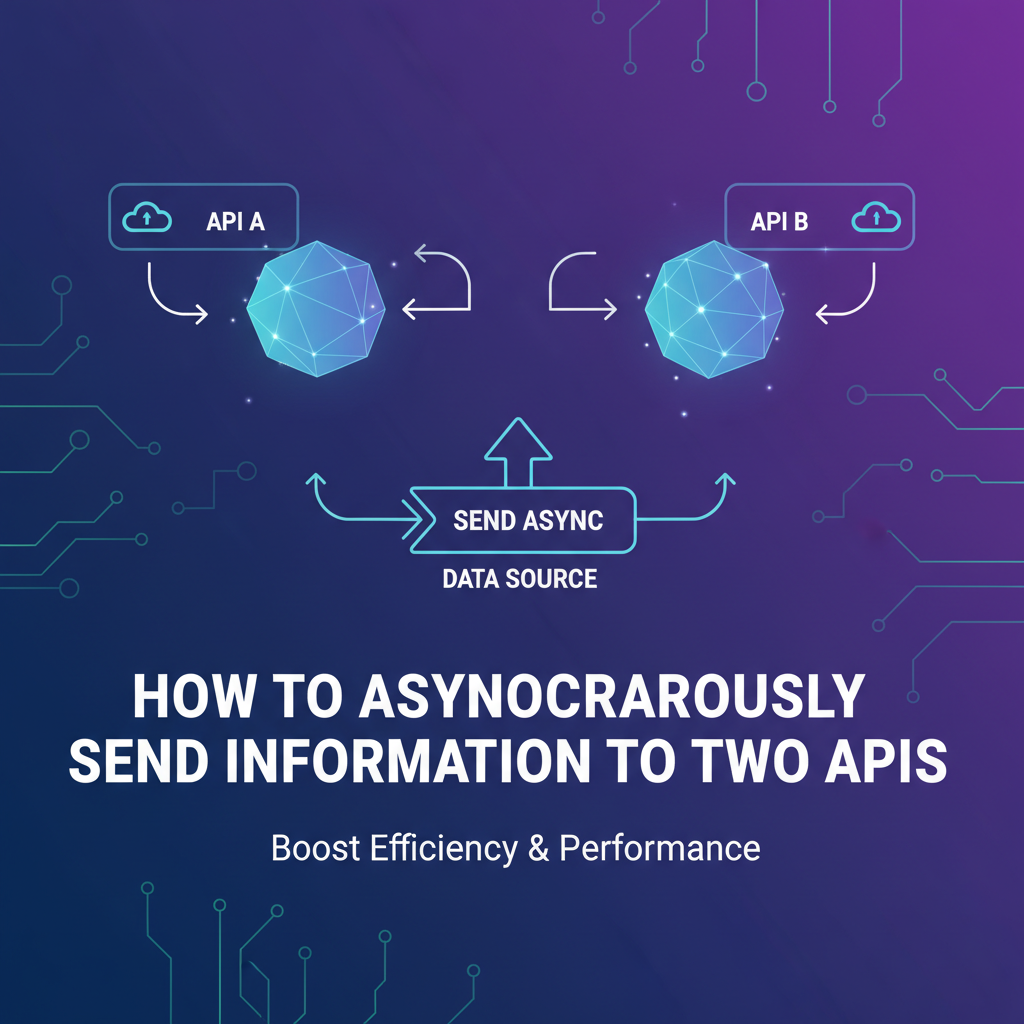


In the rapidly evolving landscape of modern software development, where applications are increasingly distributed, cloud-native, and reliant on external services, the ability to communicate efficiently and reliably between different components is paramount. Application Programming Interfaces (APIs) serve as the backbone of this interconnected ecosystem, enabling diverse systems to interact seamlessly. However, as the complexity of these interactions grows, particularly when an application needs to send information to multiple external APIs, the traditional synchronous request-response model can quickly become a bottleneck, leading to degraded performance, unresponsive user interfaces, and brittle systems.
This extensive guide delves deep into the methodologies, patterns, and best practices for asynchronously sending information to two distinct APIs. We will explore why asynchronicity is not merely a desirable feature but often a fundamental necessity for building resilient, scalable, and high-performance applications. From fundamental concepts to advanced architectural considerations, error handling strategies, and the pivotal role of an API gateway, we will cover the full spectrum of knowledge required to master this critical aspect of modern API integration. The aim is to provide a comprehensive resource that not only elucidates the technical mechanisms but also offers practical insights into designing and implementing robust asynchronous workflows, ensuring your applications can efficiently interact with the myriad services they depend on without compromise.
Understanding Asynchronous Communication: Beyond the Basics
At its core, asynchronous communication represents a paradigm shift from the conventional synchronous model, where a requesting entity (client or service) sends a request and then pauses its operation, waiting for a response before proceeding. In an asynchronous setup, the requesting entity sends its request and immediately continues with other tasks, without blocking its execution flow. The response, or the completion of the operation, is handled at a later time, often through callbacks, promises, or event mechanisms.
What is Asynchronicity? Decoupling Time from Execution
Asynchronicity, in simple terms, means "not happening at the same time." In computing, this translates to operations that do not block the main thread of execution. When a program performs an asynchronous operation, it initiates the task and then moves on to execute subsequent lines of code, rather than waiting for the asynchronous task to complete. The completion of the asynchronous task is typically signaled through a callback function, an event, or a future/promise object that resolves once the task is done. This non-blocking nature is fundamental to achieving high concurrency and responsiveness in applications, especially those interacting with I/O-bound operations like network requests to external APIs.
The contrast with synchronous operations is stark. A synchronous API call would mean your application sends data to API A, waits for API A to respond (which might take hundreds of milliseconds or even seconds due to network latency, server processing, or external dependencies of API A), and only then proceeds to send data to API B. This sequential execution can accumulate delays, leading to significant slowdowns, especially if either API is slow or prone to temporary outages.
Why Asynchronous for Two APIs? The Multiplicative Benefits
When the requirement is to send information to not just one, but two (or more) APIs, the benefits of asynchronous communication are multiplied. The collective delays of synchronous calls become substantial, often leading to unacceptable user experiences and inefficient resource utilization.
- Improved User Experience (UX) and Responsiveness: In client-facing applications, a user's interaction should feel immediate. If an action triggers two backend API calls, and these are handled synchronously, the user interface would freeze or show a loading spinner for the cumulative duration of both calls. Asynchronous calls allow the UI thread to remain responsive, enabling users to continue interacting with the application while background processes complete. For example, a "submit order" button can immediately confirm receipt to the user while asynchronously sending order details to a fulfillment API and customer details to a CRM API.
- Enhanced System Throughput and Scalability: For server-side applications, asynchronous processing means that a single server instance can handle a significantly higher number of concurrent requests. Instead of threads or processes sitting idle, waiting for external API responses, they are freed up to handle other incoming requests. This maximizes the utilization of server resources (CPU, memory, network I/O) and allows the application to scale more efficiently to accommodate increased load without necessarily scaling up hardware at the same rate. This is particularly crucial in microservices architectures where services frequently communicate.
- Resource Optimization: Blocking I/O operations waste valuable computational resources. While a thread is waiting for an API response, it consumes memory and potentially thread-pool resources without doing any useful work. Asynchronous operations, especially those leveraging event loops and non-blocking I/O (like Node.js or Python's
asyncio), enable a smaller number of threads or even a single thread to manage thousands of concurrent I/O operations. This leads to more efficient use of memory and CPU cycles, reducing operational costs. - Fault Tolerance and Resilience: Asynchronous patterns often inherently lead to more resilient systems. If one of the two APIs is slow or temporarily unavailable, an asynchronous setup allows the other API call to proceed independently. This isolation of failures prevents one problematic service from cascading issues throughout the entire system. Furthermore, asynchronous communication often pairs well with retry mechanisms, dead-letter queues, and circuit breakers, enabling the system to gracefully handle transient failures and ensure eventual delivery or processing of information.
- Decoupling Services and Modularity: By their very nature, asynchronous interactions promote loose coupling between services. When using message queues, for instance, the service sending the information doesn't need to know the direct endpoint or implementation details of the services consuming that information. This decoupling enhances modularity, making it easier to develop, deploy, and maintain individual services independently. It allows different teams to work on different parts of the system with minimal dependencies on each other's deployment schedules.
Core Concepts: The Building Blocks of Asynchronicity
To effectively implement asynchronous communication, especially when interacting with multiple APIs, it's essential to grasp several core programming concepts:
- Callbacks: A function passed as an argument to another function, which is then invoked inside the outer function to complete some kind of routine or action. In asynchronous programming, callbacks are executed once the asynchronous operation completes.
- Promises/Futures: Objects that represent the eventual completion (or failure) of an asynchronous operation and its resulting value. They provide a more structured way to handle asynchronous results and errors compared to deeply nested callbacks (callback hell).
- Async/Await: Syntactic sugar built on top of Promises/Futures in many modern languages (e.g., JavaScript, Python, C#). It allows asynchronous code to be written in a more sequential, synchronous-like style, making it easier to read and maintain while still reaping the benefits of non-blocking I/O.
- Event Loops: A programming construct that waits for and dispatches events or messages in a program. It's the core mechanism behind many single-threaded, non-blocking asynchronous I/O models, such as Node.js, ensuring that CPU-bound operations don't block I/O.
- Non-blocking I/O: An operation that, when initiated, returns immediately without waiting for the I/O operation to complete. The system will notify the program when the I/O operation is done, often through an event or a callback. This is crucial for network communication where latency is inherent.
Mastering these concepts forms the bedrock upon which robust asynchronous API integrations are built. The choice of specific techniques often depends on the programming language, framework, and the complexity of the interaction required.
Fundamental Patterns for Asynchronous Dual-API Interaction
When faced with the task of sending information to two APIs asynchronously, several architectural patterns emerge, each with its own trade-offs regarding complexity, reliability, and performance. Understanding these patterns is crucial for selecting the most appropriate approach for a given scenario.
Pattern 1: Parallel Direct Calls
The most straightforward approach to asynchronously interacting with two APIs is to initiate both calls in parallel from the same requesting service or client. This method leverages concurrency primitives available in most programming languages to launch independent network requests simultaneously.
Description: In this pattern, once the initial request is received by your application (be it a frontend client, a backend microservice, or a serverless function), it immediately dispatches two separate, non-blocking network requests: one to API A and another to API B. These requests are executed concurrently, meaning their execution timelines can overlap, significantly reducing the total time taken compared to sequential calls. Your application then waits for both responses (or handles them as they arrive) before potentially aggregating any results or signaling overall completion.
Implementation Details:
- Threading (e.g., Python's
threading, Java'sExecutorService, Go's Goroutines): In languages that support multi-threading, you can spawn separate threads for each API call. Each thread will execute its network request independently. A common approach involves using a thread pool to manage resources efficiently, preventing the overhead of creating new threads for every request. The main thread can then use mechanisms likejoin()orFutureobjects to await the completion of these concurrent tasks.- Example (Java with
ExecutorService): You'd submit twoCallabletasks to anExecutorService, each making an API call. You'd then getFutureobjects for each and callfuture.get()to retrieve results, though this can block if not carefully managed (e.g., usingCompletableFuturefor non-blocking aggregation).
- Example (Java with
async/await(e.g., Pythonasyncio, JavaScriptPromise.all(), C#Task.WhenAll()): Modern asynchronous programming models, particularlyasync/await, provide a highly ergonomic way to achieve parallelism for I/O-bound tasks without explicit threading. These constructs allow you to define asynchronous functions and then "await" their completion in a non-blocking manner. To make parallel calls, you initiate bothasyncoperations and then await their collective completion using a utility function (likePromise.all()in JavaScript orasyncio.gather()in Python) that resolves only when all provided asynchronous tasks have finished.- Concurrency Primitives (e.g., Channels in Go): Languages like Go offer built-in concurrency features through goroutines and channels, which are excellent for parallelizing tasks. You can launch two goroutines, each responsible for an API call, and use channels to send their results back to the main goroutine for processing.
Example (JavaScript with Promise.all()): ```javascript async function sendToTwoAPIs(data) { try { const apiACall = fetch('https://api.a.com/endpoint', { method: 'POST', body: JSON.stringify(data) }); const apiBCall = fetch('https://api.b.com/endpoint', { method: 'POST', body: JSON.stringify(data) }); const [apiAResponse, apiBResponse] = await Promise.all([apiACall, apiBCall]);
    const apiAData = await apiAResponse.json();
    const apiBData = await apiBResponse.json();
    console.log("API A Response:", apiAData);
    console.log("API B Response:", apiBData);
    // Further processing...
} catch (error) {
    console.error("Error sending to APIs:", error);
}
} ```
Pros: * Simplicity for Simple Cases: For basic scenarios where you just need to fire off two requests and perhaps collect their responses, this pattern is often the easiest to implement. * Direct Control: The requesting service has direct control over initiating, waiting for, and handling the results of both API calls. * Low Latency (Compared to Sequential): By executing calls in parallel, the total elapsed time is roughly dictated by the slower of the two API responses (plus any processing overhead), rather than the sum of their latencies.
Cons: * Client Responsibility for Coordination and Error Handling: The calling service is fully responsible for managing the parallel execution, handling individual call failures, and deciding what to do if one call succeeds and the other fails. This can lead to complex conditional logic. * Resource Exhaustion Potential: While better than synchronous, if not managed with care (e.g., without connection pooling or proper asyncio event loop management), a very high volume of parallel requests could still exhaust system resources (sockets, file descriptors, memory). * Tight Coupling: The calling service is tightly coupled to the existence and endpoints of both API A and API B. Changes in either API's interface directly impact the calling service. * Limited Reliability for Guaranteed Delivery: If the calling service crashes after initiating the calls but before receiving both responses, the state of the API calls (whether they completed successfully or not) can be unknown, potentially leading to data inconsistencies or missed operations.
Pattern 2: Message Queues (MQ) / Event Streams
When reliability, scalability, and loose coupling are paramount, especially for critical operations or high-volume data distribution, integrating message queues or event streams becomes a highly effective asynchronous pattern.
Description: Instead of directly calling the two APIs, your application publishes a "message" or "event" containing the relevant information to a message broker (e.g., RabbitMQ, Apache Kafka, AWS SQS, Azure Service Bus, Google Pub/Sub). This message is then picked up by one or more independent "worker" services or consumers. Each worker service is configured to listen for specific types of messages and, upon receiving one, it performs its designated task – in this case, calling one of the target APIs (API A or API B).
This pattern fundamentally decouples the sender of the information from its consumers. The sender doesn't need to know who will process the message or how they will process it, only that the message has been successfully delivered to the queue.
How it Works: 1. Producer (Your Application): Publishes a message (e.g., a JSON payload representing an event like "NewOrderCreated") to a designated topic or queue on the message broker. This operation is typically fast and non-blocking. 2. Message Broker: Stores the message reliably and distributes it to interested consumers. It ensures messages are durable (persisted) and can handle various delivery semantics (at-most-once, at-least-once, exactly-once). 3. Consumers (Worker Services): * Consumer A: A dedicated service or function subscribes to the topic/queue and listens for messages. When it receives a message, it extracts the necessary information and makes an asynchronous call to API A. * Consumer B: Another dedicated service or function, also subscribed to the same (or a different, but related) topic/queue, receives the same message (or a relevant subset) and makes an asynchronous call to API B.
Examples of Message Brokers: * Apache Kafka: High-throughput, distributed streaming platform, excellent for event-driven architectures and real-time data processing. * RabbitMQ: Robust, general-purpose message broker supporting various messaging patterns, often used for task queues and inter-service communication. * AWS SQS (Simple Queue Service): Fully managed message queuing service, highly scalable and reliable, great for decoupling microservices. * Azure Service Bus / Google Cloud Pub/Sub: Cloud-native messaging services offering similar capabilities within their respective ecosystems.
Benefits: * Extreme Decoupling: The producer (your application) is completely decoupled from the consumers (the services calling API A and API B). They can be developed, deployed, and scaled independently. * Resilience and Reliability: Message brokers are designed for durability. If API A or API B's consumer is temporarily down, the message remains in the queue until the consumer recovers and can process it. This ensures guaranteed delivery of the information (at least to the queue). * Scalability and Load Leveling: Consumers can be scaled independently. If API A receives a surge of requests, you can spin up more instances of Consumer A to handle the load. Message queues also act as a buffer, smoothing out traffic spikes to the downstream APIs. * Retries and Dead-Letter Queues (DLQs): Message brokers often support automatic retry mechanisms. If an API call fails, the message can be returned to the queue for a retry after a delay. If it continuously fails, it can be moved to a DLQ for manual inspection, preventing message loss. * Backpressure Handling: If a downstream API or consumer becomes overwhelmed, the message queue naturally handles backpressure by accumulating messages, preventing the upstream producer from being blocked.
Challenges: * Operational Overhead: Deploying, managing, and monitoring a message broker introduces additional operational complexity. While managed services alleviate some of this, it's still an extra component in your architecture. * Eventual Consistency: Data processed through message queues will eventually be consistent across all systems, but there might be a delay. This pattern is not suitable for scenarios requiring immediate, strong consistency across all updated systems. * Message Ordering (if required): While some brokers offer strict ordering guarantees within a single partition, ensuring global ordering across multiple consumers can be complex and requires careful design. * Debugging Complexity: Tracing the flow of a message through a queue to multiple consumers and then to external APIs can be more challenging than direct calls, necessitating robust logging and distributed tracing.
Pattern 3: Webhooks / Callbacks (for one API notifying another)
This pattern is particularly useful in event-driven workflows where the completion of an operation in one system triggers an action in another. While not always directly "sending information to two APIs from your initial request," it's a common asynchronous mechanism where one API's actions implicitly lead to another API being called.
Description: In this scenario, your application sends information to API A. API A processes this information and, upon successful completion of its internal task, it then sends a notification (a webhook HTTP POST request or a direct callback) to a specified endpoint. This endpoint could be another service within your system, which in turn calls API B, or it could even be API B directly if API A is configured to do so. The key is that the second API call is initiated asynchronously by the first API or an intermediary service, not directly by your initial application's request.
Use Cases: * Payment Processing: Your application sends a payment request to a payment gateway (API A). The gateway processes the payment and, once complete, sends a webhook to your system's "payment confirmed" endpoint. Your system then asynchronously updates your order database and triggers a call to a fulfillment API (API B). * Long-Running Jobs: Your application submits a data processing job to a powerful compute API (API A). When the job finishes hours later, API A sends a webhook to your system, which then calls a reporting API (API B) to update dashboards. * Third-Party Integrations: Many SaaS platforms (Stripe, GitHub, Slack) use webhooks to notify your applications of events that occur within their systems.
How it Works: 1. Your Application: Makes an asynchronous call to API A, potentially providing a callback URL or webhook configuration if API A supports it. 2. API A: Processes the initial request. Once its internal operations are complete (which could be immediate or long-running), it initiates a new HTTP request (the webhook) to the pre-configured endpoint. 3. Webhook Listener (Your Service or API B): An endpoint configured to receive webhooks from API A. Upon receiving the webhook, it processes the notification and then makes its own asynchronous call to API B.
Pros: * Simplicity for Sequential Asynchronous Tasks: When the second action is naturally dependent on the completion of the first (but not necessarily synchronous), webhooks provide a clean way to chain operations. * Clear Ownership: The responsibility for initiating the second step (calling API B) resides with API A or a dedicated listener service, simplifying the initial application's logic. * Reduced Latency for Initial Response: Your application gets an immediate response from API A (often just an acknowledgment), and the subsequent actions happen asynchronously in the background.
Cons: * Dependent on API A's Reliability: If API A fails to send the webhook, the second API call (to API B) will never happen. This requires robust error handling and retry mechanisms within API A's webhook delivery system. * Increased Complexity in Callback Management: You need to manage the endpoints that receive webhooks, secure them, and ensure they are always available. * Idempotency Challenges: Webhooks can sometimes be delivered multiple times. The receiving service (your listener or API B) must be designed to handle duplicate requests gracefully (i.e., be idempotent). * Firewall and Network Configuration: The webhook URL from API A must be publicly accessible or configured with appropriate firewall rules to reach your listener.
Pattern 4: API Gateway Orchestration
An API gateway acts as a central entry point for all API requests, providing a robust layer between clients and backend services. Its capabilities extend far beyond simple routing; it can be leveraged for complex orchestration, including fanning out requests to multiple downstream APIs asynchronously.
Description: In this pattern, your client or upstream service sends a single request to the API gateway. The API gateway is then configured with rules and logic to interpret this incoming request and, based on its payload or path, independently dispatch requests to API A and API B in parallel. The gateway handles the coordination, potentially aggregates responses (if required, though for pure "sending information" this is less common), and returns a single, consolidated response (or an acknowledgment) to the initial client.
Role of an API Gateway: An API gateway is a critical component in modern microservices architectures, offering: * Routing: Directing requests to appropriate backend services. * Load Balancing: Distributing traffic across multiple instances of a service. * Authentication and Authorization: Centralizing security policies. * Rate Limiting: Protecting backend services from overload. * Caching: Improving performance by storing frequently accessed responses. * Request/Response Transformation: Modifying payloads on the fly. * Monitoring and Logging: Providing a centralized view of API traffic. * Orchestration: Composing multiple backend services into a single, unified API call.
How it Works for Asynchronous Fan-Out: 1. Client Request: A client sends a single HTTP request to the API gateway endpoint. 2. Gateway Logic: The API gateway receives this request. Its internal configuration, often defined through declarative rules or code (e.g., using Lua scripts, custom plugins, or configuration files), specifies that this particular incoming request should trigger two simultaneous, non-blocking requests to API A and API B. 3. Parallel Dispatch: The API gateway dispatches these two requests concurrently to their respective backend services. 4. Response Handling: * For purely "sending information" asynchronously, the API gateway might simply return an immediate 202 Accepted response to the client, acknowledging receipt and indicating that the background processing has been initiated. The results from API A and API B are handled by those services independently. * In more complex orchestration scenarios, the gateway might wait for both responses, combine them, and return a unified response to the client.
Natural APIPark Mention: This is a perfect spot to discuss how platforms like APIPark can facilitate such complex routing and management. As an open-source AI gateway and API management platform, APIPark is specifically designed to help developers and enterprises manage, integrate, and deploy AI and REST services with ease. Its capabilities for end-to-end API lifecycle management, performance rivaling Nginx, and detailed API call logging make it an invaluable tool for orchestrating multiple API calls, ensuring high availability, and maintaining observability in asynchronous patterns. For instance, APIPark can unify API formats across diverse services, including those that might require asynchronous invocation, thereby simplifying the gateway's orchestration logic and reducing the burden on backend services.
Benefits: * Centralized Control and Simplification for Clients: Clients only interact with a single endpoint (the API gateway), simplifying their logic. The complexity of parallel calls is encapsulated within the gateway. * Improved Security: The gateway acts as a single enforcement point for security policies (authentication, authorization), protecting backend services from direct exposure. * Consistent Policies: Rate limiting, caching, logging, and monitoring can be applied uniformly across all API interactions managed by the gateway. * Flexibility and Agility: Changes to backend API endpoints, authentication mechanisms, or even the addition/removal of downstream APIs can be managed at the gateway level without impacting client code. * Reduced Backend Load: The gateway can handle common tasks (like caching or request validation), offloading work from backend services.
Challenges: * Gateway as a Single Point of Failure: While highly available configurations (clusters, load balancers) mitigate this, a poorly managed API gateway can become a critical bottleneck or failure point. * Potential for Increased Latency: If the gateway itself performs extensive processing, transformations, or waits for multiple responses before aggregating, it can introduce its own latency. For pure "fire-and-forget" asynchronous sending, this is minimized. * Configuration Complexity: Managing the rules and logic within a sophisticated API gateway can become complex, especially with numerous APIs and intricate orchestration requirements. * Vendor Lock-in: Choosing a specific API gateway solution might introduce some level of vendor lock-in, though open-source options like APIPark offer greater flexibility.
Each of these patterns offers distinct advantages and disadvantages. The choice largely depends on the specific requirements for reliability, scalability, performance, architectural preferences, and the level of coupling deemed acceptable for your application. In many real-world scenarios, a combination of these patterns might be employed across different parts of a larger system.
Deep Dive into Implementation Techniques and Tools
Implementing asynchronous API communication effectively requires an understanding of specific tools and techniques available within popular programming languages, alongside robust strategies for error handling, retries, and monitoring.
Programming Language Specifics: Leveraging Native Asynchronous Features
The way asynchronous operations are expressed and managed varies significantly across programming languages, though many modern languages have converged on similar conceptual models like async/await.
Python
Python's asyncio library (introduced in Python 3.4) provides a framework for writing concurrent code using the async/await syntax. It's built around an event loop, allowing a single thread to manage multiple concurrent I/O operations efficiently.
asyncio.gather(): To send information to two APIs in parallel, you'd use asyncio.gather() with aiohttp or httpx (async HTTP clients) to execute multiple HTTP requests concurrently. ```python import asyncio import httpx # A modern, async-compatible HTTP clientasync def send_to_api(api_url, data): async with httpx.AsyncClient() as client: response = await client.post(api_url, json=data, timeout=10) response.raise_for_status() # Raise an exception for HTTP errors print(f"Successfully sent data to {api_url}") return response.json()async def send_to_two_apis_python(data): api_a_url = "https://api.example.com/apiA" api_b_url = "https://api.example.com/apiB"
try:
    # Create two tasks to run concurrently
    task_a = send_to_api(api_a_url, data)
    task_b = send_to_api(api_b_url, data)

    # Wait for both tasks to complete
    results = await asyncio.gather(task_a, task_b, return_exceptions=True)

    for i, result in enumerate(results):
        if isinstance(result, Exception):
            print(f"API call {i+1} failed: {result}")
        else:
            print(f"API call {i+1} succeeded with result: {result}")

except Exception as e:
    print(f"An unexpected error occurred: {e}")
Example usage
asyncio.run(send_to_two_apis_python({"message": "hello async world"}))
`` * **ThreadPoolExecutor:** For scenarios where you might be using blocking HTTP clients (e.g.,requestslibrary) or integrating with libraries that aren'tasyncio-native,concurrent.futures.ThreadPoolExecutorallows you to run blocking functions in separate threads, abstracting away thread management. This is often used when anasyncio` native client isn't feasible or for CPU-bound tasks.
JavaScript/Node.js
JavaScript, especially with Node.js on the server-side, is inherently asynchronous, built around an event loop. Promises and async/await are the standard for managing asynchronous operations.
Promise.all() with async/await: This is the most common and idiomatic way to send multiple API requests in parallel. ```javascript const axios = require('axios'); // A popular Promise-based HTTP clientasync function sendToApi(api_url, data) { try { const response = await axios.post(api_url, data, { timeout: 10000 }); console.log(Successfully sent data to ${api_url}); return response.data; } catch (error) { console.error(Error sending data to ${api_url}:, error.message); throw error; // Re-throw to be caught by Promise.all's catch } }async function sendToTwoApisNodejs(data) { const apiAUrl = "https://api.example.com/apiA"; const apiBUrl = "https://api.example.com/apiB";
try {
    // Initiate both API calls, which return Promises
    const promiseA = sendToApi(apiAUrl, data);
    const promiseB = sendToApi(apiBUrl, data);

    // Wait for all promises to resolve
    const results = await Promise.all([promiseA, promiseB]);
    console.log("All API calls completed.");
    console.log("API A Result:", results[0]);
    console.log("API B Result:", results[1]);
    return results;
} catch (error) {
    // Promise.all rejects if any of the promises reject
    console.error("One or more API calls failed:", error.message);
    throw error;
}
}// Example usage: // sendToTwoApisNodejs({"message": "hello async world"}) // .then(results => console.log("Final success:", results)) // .catch(error => console.error("Final error:", error)); `` * **worker_threads(for CPU-bound tasks):** While Node.js excels at I/O-bound async tasks, CPU-bound tasks can still block the event loop.worker_threadsallows running such tasks in separate threads, though for simple API calls,Promise.all()` is usually sufficient and preferred.
Java
Java has evolved significantly in its concurrency features, moving from raw threads to more sophisticated constructs.
CompletableFuture: Introduced in Java 8, CompletableFuture is a powerful class for asynchronous programming, allowing you to chain, combine, and compose asynchronous tasks in a non-blocking manner. ```java import java.util.concurrent.CompletableFuture; import java.util.concurrent.ExecutorService; import java.util.concurrent.Executors; import java.net.http.HttpClient; import java.net.http.HttpRequest; import java.net.http.HttpResponse; import java.net.URI;public class AsyncApiCaller { private static final ExecutorService executor = Executors.newFixedThreadPool(2); // For non-blocking compute
public static CompletableFuture<String> sendToApi(String apiUrl, String data) {
    return CompletableFuture.supplyAsync(() -> {
        try {
            HttpClient client = HttpClient.newHttpClient();
            HttpRequest request = HttpRequest.newBuilder()
                    .uri(URI.create(apiUrl))
                    .header("Content-Type", "application/json")
                    .POST(HttpRequest.BodyPublishers.ofString(data))
                    .build();
            HttpResponse<String> response = client.send(request, HttpResponse.BodyHandlers.ofString());
            if (response.statusCode() != 200) {
                throw new RuntimeException("API call failed with status: " + response.statusCode());
            }
            System.out.println("Successfully sent data to " + apiUrl);
            return response.body();
        } catch (Exception e) {
            System.err.println("Error sending data to " + apiUrl + ": " + e.getMessage());
            throw new RuntimeException(e); // Propagate exception
        }
    }, executor); // Use the executor for parallel execution
}

public static void sendToTwoApisJava(String data) {
    String apiAUrl = "https://api.example.com/apiA";
    String apiBUrl = "https://api.example.com/apiB";

    CompletableFuture<String> futureA = sendToApi(apiAUrl, data);
    CompletableFuture<String> futureB = sendToApi(apiBUrl, data);

    // Combine both futures. allOf waits for both to complete.
    CompletableFuture<Void> allFutures = CompletableFuture.allOf(futureA, futureB);

    allFutures.thenRun(() -> {
        try {
            System.out.println("All API calls completed.");
            System.out.println("API A Result: " + futureA.get());
            System.out.println("API B Result: " + futureB.get());
        } catch (Exception e) {
            System.err.println("Error retrieving results: " + e.getMessage());
        } finally {
            executor.shutdown();
        }
    }).exceptionally(ex -> {
        System.err.println("One or more API calls failed: " + ex.getMessage());
        executor.shutdown();
        return null;
    });

    // Keep the main thread alive until futures complete if not a server application
    // try { Thread.sleep(5000); } catch (InterruptedException e) {}
}

public static void main(String[] args) {
    sendToTwoApisJava("{\"message\": \"hello async world\"}");
}
} `` * **ExecutorService:** For more general-purpose thread pooling,ExecutorServiceallows you to manage a pool of threads for executingRunnableorCallable` tasks. * Spring WebFlux: For reactive programming and building non-blocking web applications, Spring WebFlux (using Project Reactor) offers a powerful asynchronous model.
Go
Go is designed for concurrency, with goroutines and channels as its core primitives.
Goroutines and Channels: Launching lightweight goroutines for each API call and using channels to communicate results back is idiomatic Go. ```go package mainimport ( "bytes" "fmt" "io/ioutil" "net/http" "sync" "time" )type APIResponse struct { API string Status int Body string Error error }func sendToAPI(url string, data []byte, resultChan chan<- APIResponse, wg *sync.WaitGroup) { defer wg.Done()
client := &http.Client{Timeout: 10 * time.Second}
req, err := http.NewRequest("POST", url, bytes.NewBuffer(data))
if err != nil {
    resultChan <- APIResponse{API: url, Error: fmt.Errorf("failed to create request: %w", err)}
    return
}
req.Header.Set("Content-Type", "application/json")

resp, err := client.Do(req)
if err != nil {
    resultChan <- APIResponse{API: url, Error: fmt.Errorf("failed to send request: %w", err)}
    return
}
defer resp.Body.Close()

bodyBytes, err := ioutil.ReadAll(resp.Body)
if err != nil {
    resultChan <- APIResponse{API: url, Status: resp.StatusCode, Error: fmt.Errorf("failed to read response body: %w", err)}
    return
}

if resp.StatusCode < 200 || resp.StatusCode >= 300 {
    resultChan <- APIResponse{API: url, Status: resp.StatusCode, Body: string(bodyBytes), Error: fmt.Errorf("API call failed with status: %d", resp.StatusCode)}
    return
}

resultChan <- APIResponse{API: url, Status: resp.StatusCode, Body: string(bodyBytes)}
fmt.Printf("Successfully sent data to %s\n", url)
}func main() { data := []byte({"message": "hello async world"}) apiAURL := "https://api.example.com/apiA" apiBURL := "https://api.example.com/apiB"
resultChan := make(chan APIResponse, 2) // Buffered channel for results
var wg sync.WaitGroup

wg.Add(1)
go sendToAPI(apiAURL, data, resultChan, &wg)

wg.Add(1)
go sendToAPI(apiBURL, data, resultChan, &wg)

// Wait for both goroutines to complete
wg.Wait()
close(resultChan) // Close the channel once all senders are done

// Collect and print results
for result := range resultChan {
    if result.Error != nil {
        fmt.Printf("API %s FAILED: %v\n", result.API, result.Error)
    } else {
        fmt.Printf("API %s SUCCEEDED (Status: %d, Body: %s)\n", result.API, result.Status, result.Body)
    }
}
} ```
Choosing the Right Tool/Library: Context is King
The selection of specific tools and libraries for asynchronous communication depends on several factors: * Language Ecosystem: Stick to idiomatic and well-supported libraries within your chosen language. * Project Requirements: Consider performance needs, reliability, and error handling complexity. For critical, high-volume scenarios, message queues might be necessary. * Team Expertise: Leverage existing team knowledge to minimize learning curves and improve maintainability. * Existing Infrastructure: Integrate with existing message brokers, API gateway solutions, or cloud services.
Error Handling and Retries: Building Robustness
Asynchronous calls to external APIs inherently introduce an increased risk of transient failures (network glitches, API rate limits, temporary service unavailability). Robust error handling and retry mechanisms are critical.
- Idempotency: Design your API endpoints to be idempotent. This means that making the same request multiple times has the same effect as making it once. For example, if you send an "Update User" request, sending it twice with the same data should not corrupt the user record or create duplicates. Idempotency is crucial for safe retries, preventing unintended side effects.
- Exponential Backoff and Jitter: Instead of immediately retrying a failed API call, wait for progressively longer intervals between retries. This is exponential backoff. Add "jitter" (randomness) to these intervals to prevent all retrying clients from hitting the API simultaneously, which could overwhelm it further. Most HTTP client libraries or SDKs for cloud services offer built-in retry mechanisms with exponential backoff.
- Circuit Breakers: Implement a circuit breaker pattern to prevent cascading failures. If an API repeatedly fails, the circuit breaker "opens," preventing further calls to that API for a set period. Instead of making the failing call, the system immediately returns an error or a fallback response, saving resources and allowing the upstream service to recover. After a timeout, the circuit breaker goes into a "half-open" state, allowing a few test requests to see if the service has recovered before fully closing.
- Dead-Letter Queues (DLQs): When using message queues, configure a DLQ. If a message fails to be processed after a certain number of retries, it's moved to the DLQ. This prevents poison messages from endlessly blocking the main queue and allows for manual inspection and reprocessing of failed messages, ensuring no data is lost.
- Fallback Mechanisms: For non-critical API calls, consider implementing fallback mechanisms where if an API call fails, a default value or alternative less critical operation is performed.
Monitoring and Observability: Seeing What's Happening
Asynchronous systems, especially those spanning multiple services and APIs, are inherently harder to debug and understand. Comprehensive monitoring and observability are non-negotiable.
- Logging: Implement detailed, structured logging at every critical step: when an asynchronous request is initiated, when a response is received, and when errors occur. Include correlation IDs (trace IDs) to link related log entries across different services, making it possible to trace a single transaction from end-to-end.
- Metrics: Collect and expose metrics about your asynchronous operations:
- Latency: Time taken for each API call (P50, P90, P99 percentiles).
- Error Rates: Number of failed API calls per minute/second.
- Throughput: Number of requests processed per second.
- Queue Depths: For message queues, monitor the number of messages waiting to be processed.
- Retry Counts: How often are retries occurring for specific APIs?
- Distributed Tracing: Tools like OpenTelemetry, Zipkin, or Jaeger allow you to visualize the flow of a single request as it propagates through multiple services, queues, and external APIs. This is invaluable for pinpointing latency bottlenecks and error sources in complex asynchronous workflows.
- Alerting: Set up alerts based on critical metrics (e.g., high error rates, increased latency, growing queue depths) to proactively notify operations teams of issues before they impact users.
By integrating these implementation techniques and tools, you can build asynchronous API interactions that are not only performant but also robust, resilient, and manageable in the face of the inherent unpredictability of distributed systems.
Architectural Considerations for Robust Asynchronous Dual-API Interaction
Beyond individual implementation details, the choice of an asynchronous pattern for sending information to two APIs often has profound implications for the overall architecture of your application. These considerations revolve around how services are structured, how events are propagated, and how security is maintained across distributed components.
Microservices Architectures: Asynchronicity as a Cornerstone
In microservices architectures, applications are composed of small, independent services that communicate with each other. Asynchronous communication is not just a feature but a fundamental principle for effective microservices design.
- Decoupling: Asynchronous communication is inherently suited for decoupling microservices. Each service can operate independently without directly blocking or waiting for other services. This allows teams to develop, deploy, and scale services autonomously, leading to faster development cycles and reduced dependencies.
- Choreography vs. Orchestration:
- Choreography: Services react to events published by other services. For example, a "New Order" event might be published, and separate services (e.g., Fulfillment Service, Billing Service, Notification Service) independently consume this event and react by calling their respective external APIs (e.g., to a shipping provider, a payment gateway, a CRM system). This aligns well with message queues/event streams.
- Orchestration: A central orchestrator (which could be a dedicated service, or an
API gatewaywith advanced capabilities) explicitly coordinates the sequence of operations across multiple services. The orchestrator invokes services, awaits their responses, and then decides which service to call next. AnAPI gatewayorchestrating two parallel API calls is an example of this. The choice between choreography and orchestration depends on the complexity of the workflow and the desired level of coupling. Choreography often leads to more flexible and scalable systems but can be harder to trace, while orchestration offers more control but can introduce a central point of failure if not designed resiliently.
Event-Driven Architectures (EDA): Reactive and Scalable
Event-driven architectures leverage the production, detection, consumption, and reaction to events. They are highly scalable and resilient, particularly well-suited for scenarios where many services need to react to a single change or piece of information.
- Core Principle: Instead of calling other services directly, services publish events to an event broker (a sophisticated message queue like Kafka) whenever a significant state change occurs. Other services that are interested in these events subscribe to them and react accordingly.
- Sending to Two APIs in EDA: When your application needs to send information to two APIs, it publishes an event (e.g.,
UserDataUpdated,ProductPurchased) to an event stream. Dedicated event consumers, each responsible for interacting with one of the target APIs, subscribe to this event. Consumer A picks up the event and calls API A; Consumer B picks up the event and calls API B. This pattern offers maximum decoupling and resilience, as the event stream acts as a durable log of all changes. - Benefits: High scalability, resilience, real-time data processing capabilities, auditability (the event log provides a complete history of changes).
- Drawbacks: Increased complexity in designing event schemas, ensuring eventual consistency, and managing distributed transactions.
Stateless vs. Stateful Processing: Managing the Flow
When dealing with asynchronous API calls, especially those involving multiple external services, how you manage state is crucial.
- Preference for Stateless Components: In asynchronous systems, components are generally preferred to be stateless. A stateless service processes a request based solely on the information contained within that request, without relying on prior interactions or stored session data. This makes services easier to scale horizontally and recover from failures, as any instance can handle any request.
- Managing State Transitions: If the information sent to API A depends on a previous step, or if the overall process requires tracking progress across multiple asynchronous calls, you need a mechanism to manage this state reliably.
- Database: A common approach is to persist the state of an asynchronous workflow in a database. For instance, when an order is placed, an "Order Processing" record is created. As API A and API B calls complete (perhaps via webhooks or acknowledgments back to your service), the state in the database is updated (e.g.,
ShippingInfoSent,MarketingEmailDispatched). - Process Managers/Sagas: For complex, long-running business transactions spanning multiple services and requiring eventual consistency, a "saga" pattern can be used. A saga is a sequence of local transactions, where each transaction updates the state within a single service and publishes an event that triggers the next local transaction in another service. If any step fails, compensating transactions are executed to undo the effects of previous successful steps.
- Database: A common approach is to persist the state of an asynchronous workflow in a database. For instance, when an order is placed, an "Order Processing" record is created. As API A and API B calls complete (perhaps via webhooks or acknowledgments back to your service), the state in the database is updated (e.g.,
Security in Asynchronous Flows: Protecting the Data
Securing asynchronous API interactions is a multi-faceted challenge. Each step in the asynchronous flow presents a potential vulnerability that must be addressed.
- API Keys, OAuth 2.0, JWTs:
- API Keys: Simplest form of authentication, typically used to identify the calling application. Securely transmit and store API keys.
- OAuth 2.0: A robust authorization framework that grants third-party applications limited access to an HTTP service, either on behalf of a resource owner (user) or by acting on its own behalf. Often used for delegated access.
- JSON Web Tokens (JWTs): Compact, URL-safe means of representing claims to be transferred between two parties. JWTs are commonly used to transmit authenticated user identity information and permissions across services. For asynchronous calls, ensure JWTs are signed and validated at each service boundary.
- Securing Message Queues:
- Authentication/Authorization: Configure your message broker with robust authentication (e.g., username/password, client certificates) for producers and consumers. Implement fine-grained authorization to control which queues/topics producers can publish to and consumers can subscribe from.
- Encryption in Transit: Ensure all communication with the message broker (producer to broker, broker to consumer) is encrypted using TLS/SSL.
- Encryption at Rest: For sensitive data, consider encrypting messages stored within the message queue, if the broker supports it.
- Ensuring Data Integrity and Confidentiality:
- End-to-End Encryption: For highly sensitive data, consider encrypting the payload before sending it to the message queue or directly to an API, and decrypting it only at the final destination.
- Input Validation: Every service that receives data (whether from a queue or another API) must rigorously validate its input to prevent injection attacks and ensure data quality.
- Role of an API Gateway in Centralizing Security Policies: An
API gatewayserves as an ideal enforcement point for security. It can:- Centralize Authentication: All incoming requests are authenticated at the gateway, offloading this responsibility from backend services.
- Apply Authorization Rules: Policy engines at the gateway can enforce granular access controls based on user roles, scopes, or other attributes.
- SSL/TLS Termination: Handle secure communication with clients, simplifying backend service configuration.
- Rate Limiting and Throttling: Protect against denial-of-service (DoS) attacks and prevent individual services from being overwhelmed.
- API Key Management: Manage and validate API keys for external consumers. Platforms like APIPark excel in this area, offering features like independent API and access permissions for each tenant and resource access requiring approval, which are crucial for maintaining a secure and controlled API ecosystem, especially when coordinating multiple asynchronous interactions.
By meticulously considering these architectural aspects, you can design an asynchronous system that is not only performant and scalable but also secure, maintainable, and resilient to the inherent complexities of distributed computing.
APIPark is a high-performance AI gateway that allows you to securely access the most comprehensive LLM APIs globally on the APIPark platform, including OpenAI, Anthropic, Mistral, Llama2, Google Gemini, and more.Try APIPark now! 👇👇👇
Challenges and Best Practices
While asynchronous communication offers tremendous benefits, it also introduces its own set of challenges. Addressing these challenges through best practices is key to building robust and reliable systems.
Challenges: Navigating the Complexities of Asynchronicity
- Debugging:
- Complexity: Asynchronous flows are inherently harder to debug than synchronous ones. The execution path is not linear, and operations might be interleaved or distributed across multiple services, making it difficult to trace the cause of an issue.
- Lack of Immediate Feedback: Errors might not be immediately apparent to the initiating service, as they occur in a separate, non-blocking execution context or even in a downstream service hours later.
- Race Conditions: Unpredictable timing of concurrent operations can lead to subtle bugs that are hard to reproduce.
- Consistency:
- Eventual Consistency vs. Strong Consistency: Asynchronous patterns, especially with message queues, naturally lead to eventual consistency. This means that data across different systems will eventually converge to a consistent state, but there might be a temporary period of inconsistency. For business operations requiring strong, immediate consistency across all systems, asynchronous patterns might require careful design (e.g., two-phase commit or sagas, which add complexity).
- Ordering:
- Message Ordering: In scenarios where the order of operations matters (e.g., a "Create User" message followed by an "Update User Email" message), ensuring messages are processed in the correct sequence across asynchronous consumers can be challenging. Message queues often guarantee ordering within a single partition or queue, but not necessarily globally across multiple independent queues or consumers.
- Resource Management:
- Connection Pools: Inefficient management of HTTP connections (e.g., not reusing connections, creating too many new ones) can lead to resource exhaustion (e.g., too many open sockets).
- Memory Leaks: Improper handling of callbacks or long-lived asynchronous tasks can lead to memory leaks if resources are not properly released.
- Backpressure: Downstream services or APIs might become overwhelmed by the volume of asynchronous requests. Without proper backpressure mechanisms, this can lead to cascading failures.
- Testing:
- Unit and Integration Testing: Asynchronous code, with its callbacks, promises, and event loops, requires specific testing methodologies and tools to ensure all paths, especially error paths, are covered.
- End-to-End Testing: Testing a complete asynchronous workflow spanning multiple services and external APIs is significantly more complex, often requiring mock services, delayed responses, and robust assertions about the eventual state of the system.
Best Practices: Strategies for Success
- Design for Idempotency: This is arguably the most crucial best practice for any API involved in an asynchronous flow. Ensure that repeated calls with the same data produce the same result without unintended side effects. This simplifies retry logic and enhances system resilience.
- Implement Robust Error Handling:
- Retries with Exponential Backoff and Jitter: Use intelligent retry strategies for transient errors.
- Circuit Breakers: Employ circuit breakers to prevent hammering failing services and allowing them to recover.
- Dead-Letter Queues (DLQs): For message-based systems, use DLQs to capture messages that cannot be processed successfully, ensuring no data loss and allowing for manual intervention.
- Fallback Logic: Provide graceful degradation or alternative actions when critical services are unavailable.
- Leverage Message Queues for Reliability and Decoupling: For high-throughput, critical operations, or scenarios demanding high decoupling and guaranteed delivery, message queues are invaluable. They provide buffers, ensure durability, and facilitate independent scaling of producers and consumers.
- Use an API Gateway Wisely: An
API gatewaycan centralize many cross-cutting concerns (security, rate limiting, routing) and orchestrate complex asynchronous interactions. It simplifies client-side logic and provides a single control plane. When implementing anAPI gatewayfor asynchronous fan-out, choose a solution that is performant and supports the necessary orchestration capabilities. Again, this is where a platform like APIPark shines, with its robust performance, ability to integrate 100+ AI models (often with asynchronous invocation patterns), and end-to-end API lifecycle management, it can significantly simplify the management and scaling of complex API ecosystems involving multiple asynchronous calls. - Prioritize Observability:
- Comprehensive Logging: Implement structured logging with correlation IDs.
- Detailed Metrics: Monitor latency, error rates, throughput, and queue depths.
- Distributed Tracing: Utilize tools to visualize the flow of requests across services. This trio is essential for understanding system behavior and quickly diagnosing issues.
- Monitor System Health Proactively: Set up alerts on key metrics to detect anomalies and potential issues before they escalate. Early detection is critical in asynchronous, distributed systems.
- Start Simple, Scale Gradually: Avoid over-engineering from the outset. Begin with simpler asynchronous patterns (like parallel direct calls if suitable) and introduce more complex patterns (like message queues or
API gatewayorchestration) as your needs for reliability, scalability, and decoupling evolve. - Document Thoroughly: Document API contracts, expected asynchronous flows, error handling strategies, and retry policies. Clear documentation is crucial for team collaboration and system maintainability.
By adhering to these best practices, developers can mitigate the inherent complexities of asynchronous API interactions, building systems that are not only performant and scalable but also reliable, resilient, and easier to operate in the long run.
Case Study: E-commerce Order Processing
Let's illustrate the concepts discussed with a tangible example: an e-commerce platform handling a new order. When a customer successfully places an order, the system needs to perform several actions, two of which are critical and can (and should) happen asynchronously and in parallel:
- Notify Shipping API: Send order details to an external Shipping Provider's API (API A) to initiate the fulfillment process.
- Notify Marketing API: Send customer and order summary data to an internal Marketing Automation API (API B) to trigger an order confirmation email and potentially update loyalty points.
Scenario Details: * A user clicks "Place Order" on the e-commerce website. * The web application's backend receives this request. * The order details are persisted in the local order database (this part is typically synchronous and transactional). * After successful database persistence, the system needs to notify API A and API B.
How Different Patterns Would Handle This:
1. Parallel Direct Calls (from E-commerce Backend)
- Implementation: The e-commerce backend service, upon successfully saving the order, would use
async/await(e.g., in Node.js, Python, or Java withCompletableFuture) or thread pooling to make two separate, concurrent HTTP POST requests:- One to
https://shipping.provider.com/orderswith shipping details. - One to
https://marketing.internal.com/confirmationswith customer email and order summary.
- One to
- Pros:
- Relatively simple to implement if the e-commerce backend has native async capabilities.
- Fast initial dispatch – both calls start almost immediately.
- Cons:
- If the Shipping API is temporarily down, the Marketing API call might succeed, but the order won't be shipped. The e-commerce backend needs complex retry logic and error handling for both external calls.
- The e-commerce backend's thread/process remains occupied (albeit non-blocking for I/O) until both external APIs respond, potentially holding resources longer than desired under heavy load.
- Tight coupling: The e-commerce backend directly knows the endpoints and contracts of both external APIs.
2. Message Queues (e.g., Kafka or RabbitMQ)
- Implementation:
- After persisting the order, the e-commerce backend publishes a single "OrderCreated" event message to a Kafka topic (e.g.,
ecommerce.orders). The message payload includes all necessary order and customer details. - A dedicated "Shipping Consumer" service subscribes to the
ecommerce.orderstopic. Upon receiving an "OrderCreated" message, it extracts shipping details and calls the Shipping Provider's API (API A). It implements retries and error handling specific to API A. - A separate "Marketing Consumer" service also subscribes to the
ecommerce.orderstopic. Upon receiving the same "OrderCreated" message, it extracts customer and order summary and calls the Marketing Automation API (API B). It handles its own retries and errors for API B.
- After persisting the order, the e-commerce backend publishes a single "OrderCreated" event message to a Kafka topic (e.g.,
- Pros:
- High Decoupling: The e-commerce backend simply publishes an event; it doesn't care who processes it or how. Shipping and Marketing services are fully independent.
- Resilience: If either API A or B is down, the message remains in the queue, and the respective consumer will retry later, ensuring eventual delivery.
- Scalability: Both Shipping and Marketing consumers can scale independently based on the load.
- Fault Isolation: Failure in one consumer or API doesn't impact the other.
- Cons:
- Operational overhead of managing a message broker.
- Eventual consistency: There's a slight delay between the order being placed and the shipping/marketing actions being taken.
3. API Gateway Orchestration
- Implementation:
- The e-commerce backend (or even the frontend directly for some simple cases) sends a single "PlaceOrderAndNotify" request to the
API gateway. The request payload includes all required data for both shipping and marketing. - The
API gateway(e.g., Kong, AWS API Gateway, or APIPark) is configured to:- Receive this request.
- Extract relevant data for API A and API B.
- Concurrently make two asynchronous requests: one to the Shipping Provider's API (API A) and one to the Marketing Automation API (API B).
- Immediately return a
202 Acceptedresponse to the e-commerce backend, indicating that the order has been received and processing is underway, without waiting for the external API responses.
- The e-commerce backend (or even the frontend directly for some simple cases) sends a single "PlaceOrderAndNotify" request to the
- Pros:
- Client Simplification: The e-commerce backend (client of the gateway) makes only one call to a single endpoint.
- Centralized Control: All routing, security (e.g., authenticating the e-commerce backend), and logging for these external integrations are handled at one point.
- Rapid Acknowledgment: The e-commerce backend receives a quick response, allowing it to move on without blocking.
- Cons:
- The
API gatewaybecomes a critical component; high availability is a must. - Error handling for individual API calls still needs to be managed within the gateway's orchestration logic (e.g., retries within the gateway). If one API call fails within the gateway's logic, the client only gets a
202without knowing the exact state. This usually means the gateway would need to publish events to a message queue for actual status updates or detailed error handling.
- The
Choosing the Best Approach for the E-commerce Scenario:
For an e-commerce platform, Pattern 2 (Message Queues) is often the most robust and scalable choice, especially for the post-order actions. It provides maximum decoupling, ensures eventual consistency with retries, and allows different aspects of the order fulfillment to scale independently. While it introduces operational overhead, the benefits in terms of reliability and scalability for critical business processes often outweigh this cost. The initial synchronous database write ensures the order is recorded, and then the event-driven asynchronous processing takes over for subsequent actions.
However, an API Gateway (Pattern 4) could still play a crucial role in front of the message queue. For example, the API gateway could receive the "Place Order" request, perform initial validation and authentication, then publish the "OrderCreated" event to the message queue, and immediately return a 202 Accepted to the client. This combines the benefits of centralized control with the robustness of message queues.
This case study demonstrates that the choice of asynchronous pattern is not one-size-fits-all and depends heavily on the specific requirements for consistency, reliability, scalability, and complexity tolerance.
The Crucial Role of an API Gateway in Modern Architectures
The evolution of software architectures, particularly the widespread adoption of microservices and the increasing reliance on external and internal APIs, has elevated the API gateway from a niche solution to an indispensable component. It is far more than a simple router; it is a powerful orchestration and management layer that simplifies the complexities inherent in modern, distributed systems, especially those involving multiple, often asynchronous, api interactions.
Simplifying Multi-API Interaction Complexity
An API gateway acts as a facade, abstracting the intricacies of a backend service landscape from the clients. When your application needs to send information to two or more APIs, the gateway can shoulder the burden of:
- Unified Access: Clients interact with a single, stable gateway endpoint instead of having to know and manage the individual endpoints of API A, API B, and potentially dozens of other services. This simplifies client-side logic and reduces maintenance when backend services change.
- Orchestration and Aggregation: As seen in Pattern 4, the
API gatewaycan receive a single request and intelligently fan it out to multiple downstream APIs concurrently. This internal parallelization offloads complexity from the client and can significantly reduce perceived latency. For "sending information," the gateway might simply acknowledge receipt immediately, making it a powerful tool for initiating asynchronous workflows. - Protocol Translation and Data Transformation: If API A expects XML and API B expects JSON, the
API gatewaycan handle these transformations on the fly, presenting a consistent interface to the client. This is particularly useful when integrating with legacy systems or disparate third-party services. - Version Management: As APIs evolve, the gateway can manage different versions of backend services, allowing clients to continue using older versions while new ones are deployed.
Centralized Security, Monitoring, and Policy Enforcement
Beyond routing and orchestration, an API gateway provides a centralized control point for critical cross-cutting concerns:
- Security Enforcement: The gateway is the first line of defense. It can handle all authentication (e.g., API keys, OAuth 2.0, JWT validation) and authorization checks, shielding backend services from direct exposure. This centralization ensures consistent security policies across all APIs and reduces the security burden on individual microservices.
- Rate Limiting and Throttling: To protect backend APIs from overload and abuse, the gateway can enforce global and per-API rate limits, ensuring fair usage and system stability.
- Logging and Monitoring: By being the central point of entry, the gateway can capture comprehensive logs for all API traffic, providing a unified view of requests, responses, errors, and performance metrics. This data is invaluable for monitoring system health, debugging issues, and performing analytics.
- Caching: For idempotent read operations (though less relevant for "sending information"), a gateway can cache responses, dramatically improving performance and reducing the load on backend services.
APIPark: An Open-Source Solution for Comprehensive API Management
In this context, platforms like APIPark emerge as powerful enablers for managing the complexities of modern API ecosystems, particularly when dealing with asynchronous interactions and the burgeoning landscape of AI services. APIPark, as an open-source AI gateway and API management platform, brings several capabilities to the table that are directly beneficial for handling scenarios involving sending information to multiple APIs asynchronously:
- Quick Integration of 100+ AI Models & Unified API Format: Many AI models involve asynchronous processing, especially for complex tasks. APIPark’s ability to quickly integrate a variety of AI models and standardize their invocation format simplifies the process of sending data to different AI APIs. This unified format reduces the complexity of downstream services or gateway orchestration logic, making it easier to fan out requests to various AI services without worrying about their individual API quirks. This is particularly relevant as AI capabilities are increasingly integrated into enterprise applications, often requiring asynchronous calls to external or internal AI inference engines.
- End-to-End API Lifecycle Management: Managing APIs from design to publication, invocation, and decommission is crucial for maintaining reliability in asynchronous systems. APIPark assists in regulating API management processes, managing traffic forwarding, load balancing, and versioning of published APIs. These features are vital for ensuring that your asynchronous calls always reach the correct, healthy, and scaled instances of your target APIs.
- Performance Rivaling Nginx: For an
API gatewayorchestrating multiple requests, performance is paramount. APIPark boasts high throughput, capable of handling over 20,000 TPS with modest resources and supporting cluster deployment. This ensures that the gateway itself doesn't become a bottleneck when fanning out numerous asynchronous requests. - Detailed API Call Logging & Powerful Data Analysis: Asynchronous flows can be challenging to debug. APIPark's comprehensive logging capabilities, recording every detail of each API call, are invaluable. This allows businesses to quickly trace and troubleshoot issues, understand latency patterns, and ensure system stability. The powerful data analysis features further help in understanding long-term trends and performance changes, aiding in proactive maintenance.
- API Service Sharing within Teams & Independent Access Permissions: For organizations with multiple teams or tenants, APIPark allows for centralized display and management of all API services. This means different departments can easily find and use the required API services, while independent access permissions for each tenant ensure secure and controlled access, even to the APIs involved in asynchronous processing.
By leveraging a robust API gateway solution like APIPark, organizations can effectively centralize the management, security, and orchestration of their API landscape. This offloads significant complexity from individual services and clients, allowing them to focus on core business logic, while the gateway ensures that information is sent to multiple APIs efficiently, securely, and reliably, even when operating asynchronously. It transforms the challenging task of managing diverse API integrations into a streamlined and highly performant process.
Conclusion: Mastering Asynchronous API Interactions
The modern digital landscape is a tapestry woven from interconnected services, where APIs form the threads that bind them together. As applications become increasingly distributed, real-time, and user-centric, the ability to interact with multiple external services asynchronously has transcended being a mere optimization; it has become a fundamental requirement for building high-performance, resilient, and scalable systems. The synchronous, blocking request-response model, while simpler to reason about in isolation, buckles under the weight of accumulating latency and the inherent unreliability of network communication when faced with numerous external dependencies.
This comprehensive exploration has delved into the multifaceted world of asynchronously sending information to two APIs, unraveling the core concepts, practical patterns, and critical considerations essential for success. We've seen how asynchronous paradigms—through techniques like parallel direct calls using async/await, the robust decoupling offered by message queues, event-driven workflows powered by webhooks, and the centralized orchestration capabilities of an API gateway—empower developers to overcome the limitations of sequential execution.
The benefits are profound: enhanced user experience through responsive interfaces, maximized system throughput, efficient resource utilization, improved fault tolerance, and a fundamental decoupling that is the bedrock of agile microservices architectures. However, achieving these benefits is not without its challenges. The inherent complexities of debugging non-linear flows, managing eventual consistency, ensuring message ordering, and handling resource contention demand a disciplined approach.
To navigate these complexities, we've outlined a set of indispensable best practices: designing for idempotency to enable safe retries, implementing robust error handling with exponential backoff and circuit breakers, judiciously leveraging message queues for critical reliability, and prioritizing comprehensive observability through logging, metrics, and distributed tracing.
Crucially, the API gateway has emerged as a linchpin in this architectural shift. It provides a centralized control plane for security, routing, traffic management, and—vitally—the orchestration of multiple asynchronous API calls. Solutions like APIPark exemplify how a modern API gateway can not only streamline the management of diverse APIs (including AI models) but also ensure the peak performance and detailed visibility required to manage complex asynchronous interactions effectively.
Ultimately, mastering asynchronous communication is not merely a technical skill; it is a strategic imperative. It enables organizations to build applications that are not only faster and more efficient but also more adaptable to change, resilient to failure, and capable of scaling to meet the ever-growing demands of the digital world. By embracing the principles and practices outlined in this guide, developers and architects can confidently construct the next generation of interconnected, high-performing systems, ensuring that information flows seamlessly and reliably across their entire ecosystem.
Frequently Asked Questions (FAQ)
Q1: What's the main benefit of sending information asynchronously to two APIs?
A1: The primary benefit is improved system responsiveness and efficiency. By initiating both API calls in parallel without waiting for each one to complete, your application can continue processing other tasks or remain responsive to the user. This significantly reduces the total time taken for the operation, enhances throughput, and allows for more efficient resource utilization compared to sequential synchronous calls.
Q2: When should I choose a message queue over direct parallel API calls?
A2: You should choose a message queue when reliability, extreme decoupling, and scalability are paramount. Message queues ensure guaranteed delivery (even if a downstream API is temporarily unavailable, messages are stored and retried), provide robust error handling with dead-letter queues, and allow producers and consumers to scale independently. Direct parallel calls are simpler for immediate, less critical operations but offer less resilience and can couple the calling service more tightly to the target APIs.
Q3: How do I handle errors and ensure data consistency in asynchronous API calls?
A3: Robust error handling is crucial. Implement retry mechanisms with exponential backoff and jitter to manage transient failures. Use circuit breakers to prevent cascading failures to overwhelmed services. For data consistency, design your API endpoints to be idempotent so that repeated calls don't cause unintended side effects. For complex distributed transactions, consider patterns like Sagas or ensure eventual consistency is acceptable for your business logic, potentially using a database to track the state of the asynchronous workflow.
Q4: Can an API Gateway help with asynchronous API interactions?
A4: Absolutely. An API gateway can serve as a central orchestration point. It can receive a single client request and then internally fan out that request to multiple downstream APIs asynchronously, immediately returning an acknowledgment to the client. This offloads complexity from the client, centralizes security, rate limiting, and logging, and provides a unified interface, making the management of diverse asynchronous API integrations much simpler and more robust. Platforms like APIPark are designed for this very purpose.
Q5: What are common challenges in implementing asynchronous API communication?
A5: Common challenges include increased debugging complexity due to non-linear execution paths, ensuring data consistency (especially eventual consistency) across distributed systems, managing message ordering if dependencies exist, effective resource management (e.g., connection pools), and comprehensive testing of asynchronous flows. These challenges necessitate diligent use of observability tools (logging, metrics, distributed tracing) and robust error handling strategies.
🚀You can securely and efficiently call the OpenAI API on APIPark in just two steps:
Step 1: Deploy the APIPark AI gateway in 5 minutes.
APIPark is developed based on Golang, offering strong product performance and low development and maintenance costs. You can deploy APIPark with a single command line.
curl -sSO https://download.apipark.com/install/quick-start.sh; bash quick-start.sh

In my experience, you can see the successful deployment interface within 5 to 10 minutes. Then, you can log in to APIPark using your account.

Step 2: Call the OpenAI API.