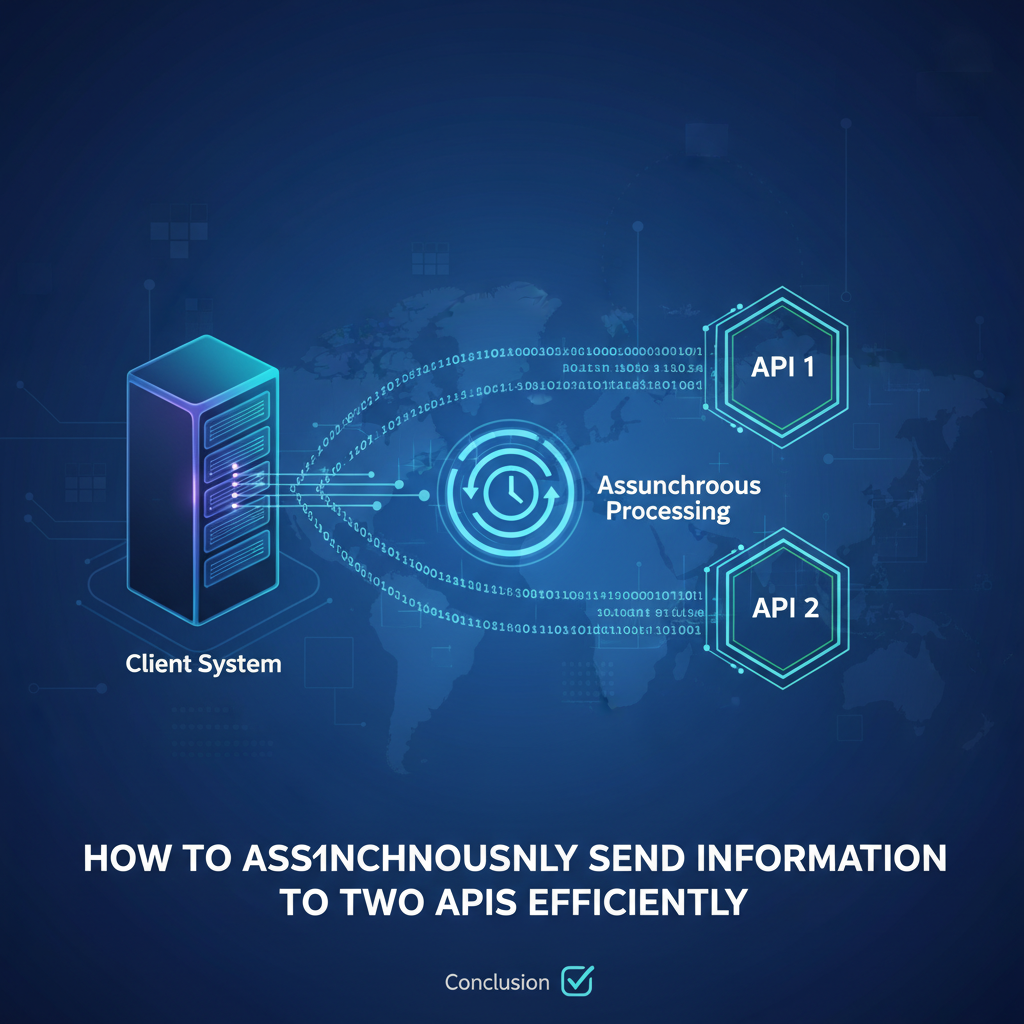
How to Asynchronously Send Information to Two APIs Efficiently
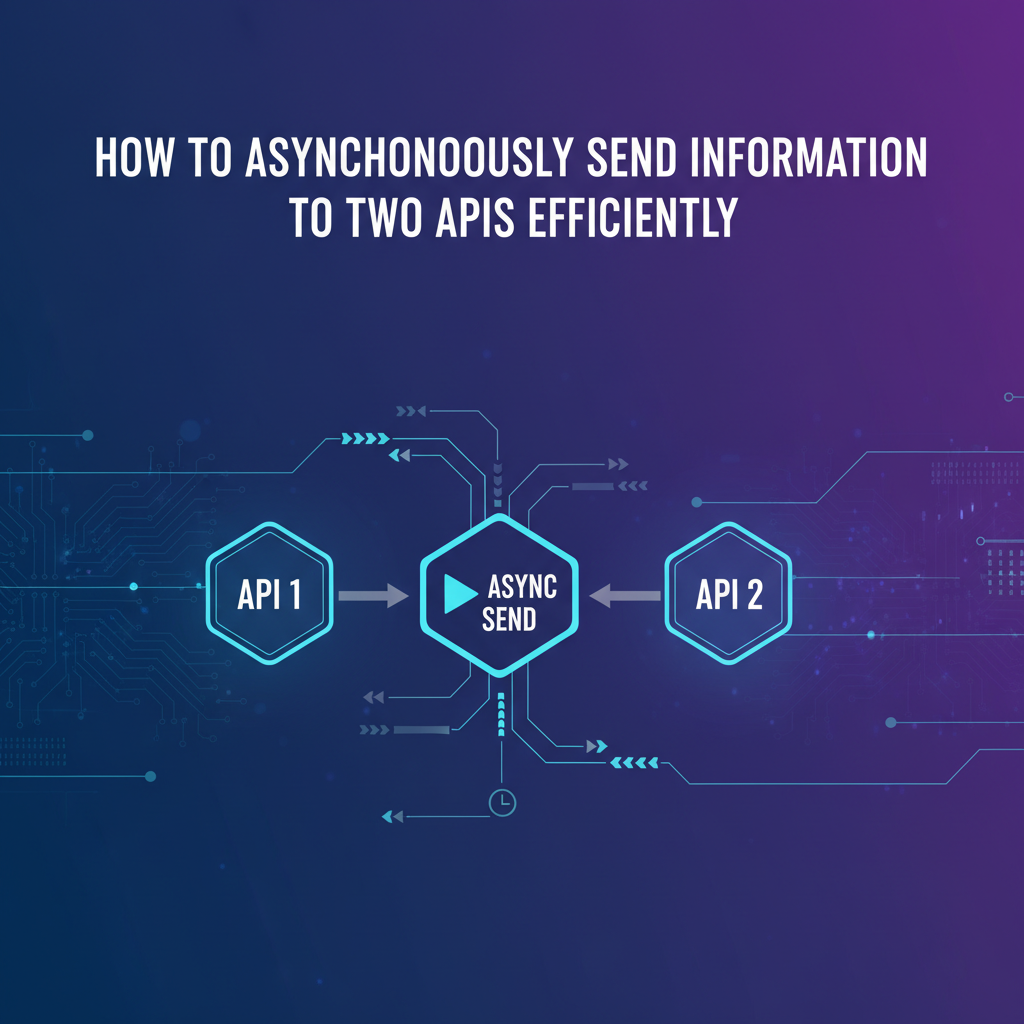


In the intricate tapestry of modern software architecture, the need to interact with external services and internal microservices is ubiquitous. Applications frequently find themselves in a position where they must dispatch information to not just one, but often multiple, distinct Application Programming Interfaces (APIs). Whether it’s updating a user profile in a primary database and simultaneously notifying a separate analytics service, or processing an order that requires calls to both an inventory management system and a payment gateway, these multi-api interactions are fundamental to complex business logic. However, the naive approach of making sequential, synchronous api calls can quickly become a bottleneck, severely impacting application performance, user experience, and overall system scalability.
The inherent latency involved in network communication, coupled with the processing time of remote services, means that a series of synchronous calls will accumulate delay additively. If one api takes 500ms and another takes 300ms, a synchronous sequence will block the caller for at least 800ms, plus any network overhead. In a world where users expect instantaneous feedback and applications must handle thousands or millions of concurrent requests, such delays are simply unacceptable. This article delves deep into the methodologies and architectural patterns for asynchronously sending information to two APIs efficiently, exploring the 'why,' the 'how,' and the essential considerations for building robust, high-performance, and scalable systems. We will journey through the foundational principles of asynchronous programming, dissect various architectural solutions including the pivotal role of an api gateway, and discuss critical aspects like error handling, observability, and data consistency, providing a comprehensive guide for developers aiming to master efficient api integration.
Understanding the Problem: Why Asynchronicity is Imperative
The contemporary software landscape is increasingly characterized by distributed systems, microservices, and reliance on third-party services. This paradigm often necessitates an application to perform multiple operations that involve communicating with different external apis to fulfill a single user request or business process. For instance, consider a typical e-commerce transaction: when a user clicks "Place Order," the system might need to: 1. Debit the user's account via a payment api. 2. Update inventory levels through a stock management api. 3. Generate a shipping label using a logistics api. 4. Send an order confirmation email via an email service api. 5. Log the transaction for analytics in a separate data warehousing api.
If each of these steps is executed sequentially, the total response time for the "Place Order" operation would be the sum of the latencies of all individual api calls and the internal processing time. This additive delay can quickly escalate into seconds, leading to a frustrating user experience, potential timeouts, and inefficient resource utilization.
The Pitfalls of Synchronous API Interactions
To fully appreciate the benefits of asynchronous communication, it's crucial to understand the inherent challenges posed by its synchronous counterpart when dealing with multiple api endpoints:
- Accumulated Latency: As previously illustrated, the most immediate and impactful drawback of synchronous calls is the serial execution. Each call must complete before the next one begins. Even if individual
apis respond quickly, their cumulative latency can become a significant bottleneck, especially when external network conditions or third-party service performance vary. A user waiting for a page to load or a transaction to complete will directly experience this combined delay. - Blocking Operations: In many programming models, a synchronous
apicall is a blocking operation. This means that the thread or process initiating the call halts its execution and waits idly until a response is received from the externalapi. While waiting, this thread cannot perform any other useful work. In high-concurrency environments, this can quickly deplete the available pool of threads, leading to resource exhaustion, degraded performance, and ultimately, system unresponsiveness or crashes under heavy load. - Reduced Throughput: Due to blocking operations and accumulated latency, a synchronous architecture inherently limits the number of requests a server can process concurrently. If each request ties up a thread for an extended period, the system's capacity to handle simultaneous user interactions diminishes. This directly translates to lower overall system throughput and a reduced ability to scale to meet demand.
- Increased Resource Consumption: Holding open connections and threads for extended periods while waiting for
apiresponses consumes valuable system resources such as memory and CPU cycles. These resources could otherwise be allocated to processing active computations or handling new incoming requests. Over time, this inefficient resource utilization can necessitate more powerful (and expensive) hardware or lead to premature scaling limits. - Fragile Error Handling and Failure Propagation: In a synchronous chain, if any one of the
apicalls fails (e.g., due to network issues, service unavailability, or invalid data), the entire sequence often halts, and the failure immediately propagates back to the caller. This can result in partial operations being committed, leading to inconsistent data states, and requires complex, immediate rollback mechanisms. Designing robust error handling for interdependent synchronous calls, especially with retries and compensation logic, can be notoriously difficult and error-prone. The user is also immediately exposed to the failure of any single component.
The Inherent Advantages of Asynchronous Communication
By contrast, asynchronous communication offers a suite of compelling benefits that directly address the shortcomings of synchronous interactions, making it an indispensable strategy for efficient multi-api operations:
- Improved Responsiveness and User Experience: The primary advantage is the ability for the calling application or service to continue processing other tasks without waiting for an
apicall to complete. For a user-facing application, this means the user receives faster feedback, potentially allowing them to proceed with other actions while background operations complete. This significantly enhances the perceived performance and overall user experience. - Higher Throughput and Concurrency: Non-blocking operations are the cornerstone of asynchronicity. When a request is sent to an
apiasynchronously, the calling thread is immediately freed up to handle other tasks or process new incoming requests. This dramatically increases the number of concurrent operations a single server can manage, leading to significantly higher throughput and better utilization of computing resources. - Better Resource Utilization: By minimizing idle waiting times for threads and connections, asynchronous models make more efficient use of system resources. Instead of threads sitting idle, they are actively processing other work, leading to a more economical use of CPU, memory, and network bandwidth. This can translate into lower infrastructure costs and greater scalability.
- Enhanced Resilience and Decoupling: Asynchronous communication often involves decoupling the caller from the callee. Techniques like message queues allow services to communicate without direct knowledge of each other's immediate availability. If a target
apiis temporarily down, the message can persist in the queue and be processed later when theapirecovers, preventing immediate failure propagation. This isolation increases the overall resilience of the system, making it more fault-tolerant and less susceptible to cascading failures. - Simplified Scalability: Decoupled, asynchronous components are generally easier to scale independently. If a particular
apiintegration point becomes a bottleneck, only the workers responsible for that specificapicall need to be scaled up, without affecting other parts of the system. This modular scalability is a hallmark of modern, distributed architectures. - Flexibility in Processing: Asynchronous patterns provide greater flexibility in how responses are handled. Operations can proceed "fire-and-forget" style where no immediate response is needed, or the system can collect results from multiple concurrent
apicalls and process them once all are available. This allows for tailored solutions based on specific business requirements for immediacy and consistency.
In summary, embracing asynchronous communication when dealing with multiple apis is not merely an optimization; it's often a fundamental requirement for building high-performance, scalable, and resilient applications in today's interconnected digital landscape.
Core Principles of Asynchronous API Interaction
Before diving into specific architectural patterns and implementation details, it's essential to establish a solid understanding of the fundamental concepts that underpin asynchronous api interactions. These principles govern how modern software handles operations that don't yield immediate results, allowing applications to remain responsive and efficient.
Concurrency vs. Parallelism: A Crucial Distinction
While often used interchangeably, "concurrency" and "parallelism" represent distinct concepts:
- Concurrency: Deals with managing multiple tasks at the same time. A concurrent system can make progress on more than one task simultaneously by interleaving their execution. This often involves context switching on a single processor core, giving the illusion of simultaneous execution. For instance, a single CPU core might rapidly switch between processing parts of two different API calls, making them both appear to be progressing at the same time. The goal of concurrency is to ensure that while one operation might be waiting (e.g., for an
apiresponse), the system can immediately switch to another task, maximizing throughput and responsiveness. - Parallelism: Deals with executing multiple tasks literally at the same time. This requires multiple processing units (e.g., multiple CPU cores) working simultaneously on different parts of the same problem or entirely different problems. If you have two separate API calls that can be made independently, and you have two available CPU cores, you could execute both API calls and process their results in true parallel, significantly reducing the total wall-clock time.
In the context of asynchronous API calls, we are primarily concerned with concurrency. Even on a single-core machine, asynchronous programming allows us to concur with multiple API calls by not blocking the main thread while waiting for I/O operations (like network requests) to complete. On multi-core machines, this concurrency can naturally lead to parallelism, where different API calls (or the processing of their responses) are handled by different cores simultaneously.
Non-Blocking I/O: The Foundation of Asynchronicity
The ability to perform asynchronous operations, especially those involving external resources like apis over a network, hinges on Non-Blocking I/O (Input/Output). Traditional, blocking I/O operations cause the executing thread to pause and wait until the I/O operation (e.g., reading from a disk, receiving data over a network) is complete. This is inefficient, as the thread sits idle.
Non-blocking I/O, on the other hand, allows an application to initiate an I/O operation and immediately regain control, without waiting for the operation to finish. The application can then perform other tasks. When the I/O operation eventually completes, the system notifies the application (e.g., via a callback, an event, or a future/promise resolution). This mechanism is fundamental to achieving high concurrency in network-bound applications, as it frees up threads to handle other requests while waiting for slow external api responses. Most modern programming languages and frameworks offer robust non-blocking I/O capabilities, enabling efficient handling of numerous concurrent network requests.
Event-Driven Architecture: A Paradigm Shift
An Event-Driven Architecture (EDA) is a software design paradigm that promotes the production, detection, consumption of, and reaction to events. An event is essentially a significant change in state or an occurrence in the system. When an api call completes (successfully or with an error), that can be considered an event.
In an EDA context, instead of directly calling an api and waiting for a response, a component might simply publish an event (e.g., "UserRegisteredEvent"). Other components that are interested in this event (e.g., an email service, a CRM updater) can subscribe to it and react accordingly, potentially making their own api calls asynchronously. This approach significantly decouples components, making systems more flexible, scalable, and resilient. Message queues and brokers are common technologies used to facilitate event propagation in an EDA.
Programming Constructs for Asynchronous Operations
Different programming languages and environments offer specific constructs to manage asynchronous operations, moving beyond simple callbacks to more structured and readable patterns:
- Callbacks: This is one of the earliest and most basic patterns. You pass a function (the "callback") as an argument to an asynchronous function. When the asynchronous operation completes, it invokes the callback function, often passing the result or an error as arguments.
- Pros: Simple for single, independent async operations.
- Cons: Can lead to "callback hell" or "pyramid of doom" when chaining multiple dependent asynchronous operations, making code hard to read and maintain. Error handling can also become complex.
- Promises (or Futures/Deferreds): Promises provide a more structured way to handle the eventual result of an asynchronous operation. A promise represents a value that might be available now, or in the future, or never. It can be in one of three states:
- Pending: Initial state, neither fulfilled nor rejected.
- Fulfilled (Resolved): The operation completed successfully, and the promise now has a value.
- Rejected: The operation failed, and the promise has a reason for the failure. Promises allow chaining
.then()clauses for successive asynchronous operations and.catch()for centralized error handling, making code much flatter and more readable than nested callbacks. - Examples: JavaScript Promises, Python's
asyncio.Future, Java'sCompletableFuture, C#'sTask.
- Async/Await: Building upon Promises/Futures,
async/awaitsyntax provides an even more synchronous-looking way to write asynchronous code, significantly improving readability and maintainability.- The
asynckeyword marks a function as asynchronous, indicating it will always return a Promise (or a Future/Task). - The
awaitkeyword can only be used inside anasyncfunction. It pauses the execution of theasyncfunction until the Promise it'sawaiting settles (either fulfills or rejects). Crucially,awaitdoes not block the entire thread; it only pauses theasyncfunction's execution, allowing the underlying event loop to process other tasks. - This combination makes asynchronous code look and behave much like traditional synchronous code, simplifying error handling (with standard
try...catchblocks) and sequential logic while retaining the non-blocking benefits. - Examples: Python (
async def/await), JavaScript (async function/await), C# (async/await).
- The
Reactive Programming: Streams of Events
Reactive Programming is a paradigm focused on data streams and the propagation of change. It allows you to compose asynchronous and event-based programs by using observable sequences. Instead of just handling a single event (like a promise resolving), reactive programming deals with streams of events over time.
- Observables: Represent a stream of data or events. You
subscribeto an observable to receive notifications (data, errors, or completion signals) as they occur. - Operators: Functional methods that allow you to transform, filter, combine, and manipulate these streams.
- Benefits: Excellent for managing complex event sequences, user interactions, real-time data, and combining results from multiple asynchronous sources. It naturally handles backpressure (controlling the rate of data flow).
- Examples: RxJS (JavaScript), Project Reactor (Java), RxJava (Android), ReactiveX libraries across many languages.
By leveraging these core principles and programming constructs, developers can architect and implement sophisticated solutions for efficiently sending information to multiple APIs asynchronously, laying the groundwork for highly responsive and scalable applications.
Architectural Patterns for Asynchronous Dual-API Sends
When the requirement arises to send information to two (or more) APIs asynchronously, the choice of architectural pattern is critical. It influences not only the efficiency and responsiveness of the system but also its scalability, resilience, and maintainability. This section explores several prominent patterns, ranging from client-side approaches to robust backend solutions, highlighting their respective strengths, weaknesses, and ideal use cases.
Client-Side Asynchronicity: Direct Parallel Calls
The most straightforward approach to calling multiple APIs asynchronously is to have the client application (e.g., a web browser, mobile app, or desktop client) initiate both API calls in parallel. Modern web browsers and mobile platforms provide built-in capabilities for making concurrent network requests.
- How it works: When a user action triggers the need to interact with two APIs, the client-side code immediately dispatches two separate, non-blocking HTTP requests to the respective API endpoints. It then waits for both responses (using Promises,
async/await, or similar constructs) before proceeding with any client-side logic that depends on the combined results. - Pros:
- Simplicity for Simple Cases: For a limited number of independent API calls, this can be quick to implement directly in the client.
- Reduced Server Load: The backend server responsible for serving the client application only needs to handle the initial request, offloading the subsequent API interactions to the client.
- Cons:
- Client Burden and Network Overhead: The client directly bears the latency and bandwidth costs of two separate network trips. For mobile users or those with unstable connections, this can be detrimental.
- Complex Error Handling and Retries: Managing failures, retries, and partial successes across multiple independent client-side API calls can become cumbersome, requiring sophisticated client-side logic.
- Security Concerns: Exposing direct API endpoints to the client might necessitate more complex CORS policies and careful handling of API keys or authentication tokens, which could be less secure than proxying through a trusted backend.
- API Exposure: The client needs direct knowledge of and access to all backend APIs, which might not be desirable from an architectural or security standpoint.
- Data Aggregation: If the client needs to aggregate or transform data from both APIs, it adds complexity to the client-side logic.
- When to use: This pattern is best suited for scenarios where the client has good network connectivity, the number of parallel API calls is small, security implications are well-managed, and the client directly consumes the results of each API without needing complex backend orchestration. For example, fetching user details from one API and their notification preferences from another, where both are simple GET requests and UI can update progressively.
Backend-Side Asynchronicity: The Recommended Approach
For most enterprise-grade applications, delegating asynchronous API interactions to the backend is the preferred and more robust approach. This allows for better control, security, scalability, and resilience.
1. Asynchronous HTTP Requests (Within a Single Service)
This pattern involves a single backend service receiving an initial request and then internally making concurrent, non-blocking HTTP calls to two or more target APIs.
- How it works: The backend service uses language-specific
async/awaitconstructs, Futures, or reactive programming paradigms to initiate multiple HTTP requests simultaneously. It waits for all internal API calls to complete, aggregates their responses if necessary, and then sends a consolidated response back to the client. The key here is that the backend's thread that initiated theapicalls is not blocked; it's released to handle other work while the HTTP requests are in flight. - Pros:
- Improved Client Responsiveness: The client only makes one request to the backend, which then handles the internal complexities.
- Centralized Logic: All orchestration, error handling, and data aggregation logic resides in a controlled backend environment.
- Security: Backend can securely manage API keys and credentials for external services without exposing them to the client.
- Good for Faster Feedback: If the client needs a response only after all backend API calls have completed, this method provides relatively faster feedback than serial synchronous calls.
- Cons:
- Still Tied to Request Lifespan: The initial client request still typically waits for all internal API calls to finish before receiving a final response. If one of the internal calls is very slow, the client still experiences that cumulative delay.
- Error Handling Complexity: Managing failures and retries for concurrent internal calls still requires careful implementation within the service. A failure in one
apicall needs to be gracefully handled without necessarily failing the entire operation or blocking other calls. - Resource Management: While non-blocking, a high volume of concurrent internal HTTP requests can still consume significant resources (e.g., connection pools) within the single service.
- When to use: Ideal when the client needs an immediate, consolidated response that depends on data from multiple backend APIs, and the overall latency of the internal concurrent calls is acceptable. Examples include fetching data for a complex dashboard from several microservices, or creating a composite
apithat combines data from different sources.
2. Fire-and-Forget (with Message Queues)
This pattern introduces an intermediary: a message queue. It's particularly powerful when one or both of the API calls do not require an immediate response back to the client, or can be processed eventually.
- How it works:
- The client sends a request to the initial backend service.
- This service performs any immediate necessary work (e.g., validating data, saving initial record) and then immediately sends an acknowledgement (e.g., "Request Received") back to the client.
- Crucially, instead of making direct API calls, the service publishes one or more messages to a message queue (e.g., RabbitMQ, Kafka, AWS SQS, Azure Service Bus). Each message contains the necessary information for the target API.
- Separate, independent worker processes or consumers continuously monitor these message queues.
- When a worker retrieves a message, it then makes the actual API call to the respective external service. These workers can handle retries, dead-letter queues, and other resilience patterns independently.
- Pros:
- High Scalability: The message queue acts as a buffer, decoupling the producer (initial service) from the consumers (workers). Workers can be scaled independently based on load.
- Exceptional Resilience: If a target API is down or a worker fails, messages remain in the queue and can be retried later. This prevents cascading failures and ensures eventual processing. Dead-Letter Queues (DLQs) can capture messages that repeatedly fail.
- Improved Client Responsiveness: The client receives an immediate acknowledgment, allowing it to proceed without waiting for potentially long-running or external API operations to complete.
- Complete Decoupling: The initial service doesn't need to know the details of the target APIs or even if they are currently available. It just publishes messages.
- Load Leveling: Message queues absorb bursts of traffic, smoothing out peaks and valleys in processing, preventing downstream APIs from being overwhelmed.
- Cons:
- Eventual Consistency: The primary drawback is that operations are eventually consistent. The client is told the request was received, but the actual updates to external APIs happen asynchronously, potentially seconds or minutes later. This must be acceptable for the business logic.
- Increased Complexity: Introducing a message queue adds another component to manage, monitor, and troubleshoot.
- Monitoring Challenges: Tracing messages through queues and multiple workers can be more complex than direct API calls.
- No Immediate Feedback (for API outcomes): If the client needs to know the success or failure of the target API calls, a separate mechanism (e.g., webhooks, polling, notifications) is needed to communicate that back.
- When to use: This pattern is ideal for non-critical, background operations where immediate feedback on the external API call outcome is not required, and eventual consistency is acceptable. Common use cases include sending email notifications, updating analytics, generating reports, processing long-running tasks, or synchronizing data with CRM systems after an initial user action.
3. Using an API Gateway as a Central Orchestrator
An api gateway is a powerful architectural component that acts as a single entry point for all clients consuming your apis. It's like a facade that sits in front of your backend services, routing requests, enforcing security policies, and sometimes even performing aggregation or transformation. When dealing with asynchronous dual-API sends, an api gateway can play a pivotal role in simplifying client interactions and centralizing complex orchestration logic. The term gateway here specifically refers to this api gateway pattern.
- Concept of an
api gateway: Anapi gatewayis responsible for:- Request Routing: Directing incoming requests to the appropriate backend service.
- Authentication and Authorization: Verifying client credentials and permissions before forwarding requests.
- Rate Limiting and Throttling: Protecting backend services from overload by controlling the number of requests allowed within a certain period.
- Load Balancing: Distributing requests across multiple instances of backend services.
- Caching: Storing responses to reduce the load on backend services and improve response times.
- Request/Response Transformation: Modifying requests or responses on the fly (e.g., converting XML to JSON, adding headers).
- API Composition/Aggregation: Combining responses from multiple backend services into a single response for the client.
- Logging and Monitoring: Centralizing access logs and collecting metrics.
- Gateway for Fan-out and Asynchronous Orchestration: An
api gatewaycan be configured to perform a fan-out operation, where a single incoming client request is split into multiple concurrent requests to different backend APIs.- How it works:
- The client sends a single, consolidated request to the
api gatewayendpoint. - The
api gateway, based on its configuration, transforms the incoming request as needed and then concurrently dispatches multiple requests to two (or more) different backend APIs. - The
gatewaycan be configured to either:- Aggregate Responses: Wait for all backend API responses, combine them (if necessary), and send a single, unified response back to the client. This is similar to the "Asynchronous HTTP Requests (Within a Single Service)" pattern, but the logic is externalized to the gateway.
- Fire-and-Forget (Gateway Initiated): Initiate the backend API calls and immediately respond to the client with an acknowledgement, without waiting for the backend API calls to complete. This offloads the responsibility of managing the asynchronous calls to the
gatewayor a downstream message queue initiated by the gateway.
- The client sends a single, consolidated request to the
- How it works:
- Pros:
- Decouples Client from Backend Complexity: The client doesn't need to know about the existence or endpoints of multiple backend APIs; it only interacts with the
gateway. - Centralized Management: Policies like security, rate limiting, and caching are applied uniformly across all APIs through a single point.
- Improved Security: The
gatewayacts as a protective layer, shielding backend services from direct exposure to the internet. - Simplified Client Development: Clients have a simpler
apito interact with. - Scalability and Performance: Many
api gatewaysolutions are built for high performance and can handle a large volume of concurrent requests, efficiently managing the fan-out process. - Service Mesh Complement: While a service mesh handles inter-service communication within a cluster, an
api gatewaymanages communication into the cluster from external clients. They can work together.
- Decouples Client from Backend Complexity: The client doesn't need to know about the existence or endpoints of multiple backend APIs; it only interacts with the
- Cons:
- Single Point of Failure (if not properly configured): A poorly designed or deployed
api gatewaycan become a bottleneck or a single point of failure. This is mitigated by deploying gateways in high-availability clusters. - Increased Latency (minimal): An additional network hop and processing layer is introduced, though for well-optimized gateways, this latency is typically negligible.
- Configuration Complexity: Setting up routing, transformations, and fan-out logic within a
gatewaycan sometimes be complex, requiring specific knowledge of thegatewayproduct.
- Single Point of Failure (if not properly configured): A poorly designed or deployed
- When to use: An
api gatewayis highly recommended for microservices architectures, when managing a large number of APIs, or when client applications need to interact with multiple backend services via a single, simplified endpoint. It's particularly useful for enforcing consistent policies, improving security, and offloading orchestration logic from individual backend services.For organizations dealing with numerous APIs, an open-sourceapi gatewaylike APIPark can be a game-changer. It not only centralizes API management, including aspects like authentication, rate limiting, and analytics, but also facilitates efficient handling of multiple API calls. APIPark, for instance, provides features for end-to-end API lifecycle management and offers performance rivaling Nginx, making it an excellent choice for orchestrating complex, asynchronous integrations, especially for AI and REST services. Its ability to unify API formats for AI invocation and encapsulate prompts into REST APIs can further streamline the process of fanning out requests to various AI models or custom services derived from them. This kind of unifiedgatewayapproach simplifies the entire lifecycle of APIs, from design and publication to invocation and decommission, making it easier to manage asynchronous interactions across diverse services.
Comparison of Architectural Patterns
To summarize the different backend-centric approaches for asynchronous dual-API sends, here's a comparative table:
| Feature/Pattern | Asynchronous HTTP (within Service) | Fire-and-Forget (Message Queues) | API Gateway (Orchestration/Fan-out) |
|---|---|---|---|
| Client Interaction | Single request, waits for backend | Single request, immediate ack | Single request, waits/immediate ack |
| Responsiveness | Good (parallel backend calls) | Excellent (client not blocked) | Excellent (client not blocked) |
| Scalability | Good (service scales) | Excellent (queues & workers scale) | Excellent (gateway scales) |
| Resilience | Good (internal error handling) | Excellent (messages persist) | Good (gateway handles policies) |
| Consistency Model | Strong (if all calls succeed) | Eventual | Strong (if aggregated), Eventual (if fire-and-forget) |
| Complexity | Moderate (internal async logic) | High (queue infrastructure) | Moderate to High (gateway config) |
| Error Handling | Internal try-catch, retries |
DLQs, worker retries | Gateway policies, upstream retries |
| Decoupling | Moderate | High | High (client from backend) |
| Best Use Cases | Immediate aggregated response needed | Background tasks, event-driven | Centralized API management, complex routing |
The choice among these patterns depends heavily on the specific requirements of your application, including latency tolerance, consistency needs, scale requirements, and existing infrastructure. Often, a combination of these patterns is used within a larger system architecture. For instance, an api gateway might handle initial routing and authentication, then pass a request to a backend service that uses internal asynchronous HTTP calls for immediate aggregation, or pushes a message to a queue for fire-and-forget operations.
APIPark is a high-performance AI gateway that allows you to securely access the most comprehensive LLM APIs globally on the APIPark platform, including OpenAI, Anthropic, Mistral, Llama2, Google Gemini, and more.Try APIPark now! 👇👇👇
Implementing Asynchronous API Calls: Practical Considerations
Beyond selecting an appropriate architectural pattern, the successful implementation of asynchronous API calls requires meticulous attention to a range of practical considerations. These aspects are crucial for building systems that are not only efficient but also reliable, secure, and maintainable in the long term.
Error Handling and Retries: Building Robustness
Asynchronous operations, especially those involving external network calls to apis, are inherently prone to transient failures due to network fluctuations, temporary service unavailability, or intermittent timeouts. Robust error handling and intelligent retry mechanisms are paramount for ensuring system reliability.
- Idempotency: A critical concept for retry logic. An idempotent operation is one that produces the same result whether it's executed once or multiple times. For instance, updating a user's
last_logintimestamp is idempotent, but a simplePOST /orderswithout a unique client-generated ID might not be. When designing APIs that might be retried, ensure they are idempotent where possible. If not, carefully consider how retries affect system state. - Exponential Backoff: When retrying failed API calls, simply retrying immediately can overwhelm a struggling service or network. Exponential backoff is a strategy where the waiting time between retries increases exponentially with each successive failed attempt. For example, wait 1 second, then 2 seconds, then 4, then 8, and so on, often with some jitter (random small additions) to prevent all retrying clients from hitting the service at the exact same time. This gives the struggling service time to recover.
- Circuit Breakers: The Circuit Breaker pattern is a vital resilience mechanism, particularly in microservices architectures. When a service or API repeatedly fails or performs poorly, the circuit breaker "trips," preventing further calls to that failing service. Instead of continually attempting requests that are likely to fail, the circuit breaker immediately returns an error or a fallback response. After a configured period, it enters a "half-open" state, allowing a limited number of requests to pass through to check if the service has recovered. If successful, it "closes" and normal traffic resumes; if not, it "opens" again. This prevents cascading failures and gives the struggling service time to stabilize. Libraries like Hystrix (Java) or Polly (.NET) implement this pattern.
- Dead-Letter Queues (DLQs): In message queue-based asynchronous systems, messages that cannot be processed successfully after a certain number of retries (or due to invalid format) should not be lost. A Dead-Letter Queue (DLQ) is a designated queue where these "dead" messages are moved. This allows developers to inspect failed messages, diagnose the root cause, fix the issue, and potentially reprocess them, preventing data loss and providing insights into systemic failures.
- Transactional Outbox Pattern: When an application needs to update its own database and also publish a message to a message queue (e.g., to trigger an asynchronous API call), ensuring atomicity (either both succeed or both fail) is crucial. The transactional outbox pattern addresses this by storing outgoing messages in a dedicated "outbox" table within the application's local database transaction. After the local database transaction commits, a separate process reads messages from the outbox table and publishes them to the message queue. This guarantees that messages are only published if the local database changes are successfully committed, preventing inconsistencies.
Observability and Monitoring: Seeing What's Happening
In distributed, asynchronous systems, understanding the flow of requests and the health of various components is challenging. Comprehensive observability and monitoring are essential for diagnosing issues, tracking performance, and ensuring system stability.
- Logging: Implement structured logging across all services and components. Logs should contain sufficient context (e.g., correlation IDs, request IDs, user IDs) to trace a single request's journey across multiple services and asynchronous operations. This correlation ID is particularly vital when a single client request fans out to multiple asynchronous API calls. Logs should also capture details of API calls, including target endpoint, request payload (sanitized), response status, and latency.
- Metrics: Collect detailed metrics on the performance and health of your API integrations. Key metrics include:
- Latency: Response times for each external API call.
- Error Rates: Percentage of failed calls to each API.
- Throughput: Number of requests per second to each API.
- Queue Depths: (For message queues) Number of messages awaiting processing, indicating potential bottlenecks.
- Resource Utilization: CPU, memory, network I/O for worker processes and services involved in API calls. Monitoring dashboards should visualize these metrics, allowing for quick identification of anomalies.
- Distributed Tracing: Tools like OpenTelemetry, Zipkin, or Jaeger are invaluable for visualizing the end-to-end flow of a request through multiple services and asynchronous boundaries. They propagate a unique trace ID across service calls, allowing you to see the exact path a request took, the latency at each step, and identify bottlenecks in a complex system involving multiple API interactions. This is especially powerful when a single client request fans out to several asynchronous API calls, as you can see how each individual call contributes to the overall processing time.
- Alerts: Configure alerts based on predefined thresholds for critical metrics (e.g., high error rates to a specific API, increased latency, growing queue depths). Timely alerts enable proactive incident response, minimizing the impact of potential issues.
Security: Protecting Data and Access
Integrating with multiple APIs, especially asynchronously, introduces several security considerations that must be addressed diligently.
- Authentication and Authorization: Each external API call must be properly authenticated and authorized. This often involves securely managing API keys, OAuth tokens, or JWTs. For backend-initiated calls, these credentials must be stored securely (e.g., in environment variables, secret management services) and never hardcoded or exposed to client-side code. An
api gatewaycan centralize and enforce authentication/authorization policies before routing requests to backend services. - Data Encryption: Ensure that all data exchanged with external APIs is encrypted in transit (using HTTPS/TLS) and at rest (if storing sensitive data). This protects against eavesdropping and data breaches.
- Rate Limiting and Throttling: Protect target APIs (both internal and external) from being overwhelmed by excessive requests. Implement rate limiting on your side to adhere to external API usage policies, and on your services to protect them. An
api gatewayis an excellent place to enforce rate limits globally across all your integrated APIs. - Input Validation and Sanitization: Before sending data to any API, rigorously validate and sanitize all input to prevent injection attacks (e.g., SQL injection, XSS) and ensure data integrity. Never trust input, even from internal sources.
- Principle of Least Privilege: Ensure that the credentials used to call external APIs have only the minimum necessary permissions required for their task. This limits the potential damage if credentials are compromised.
Data Consistency: Managing Distributed State
In asynchronous, distributed systems, maintaining data consistency, especially across multiple external API calls, presents a unique challenge.
- Eventual Consistency: This is a common model in asynchronous systems where not all replicas of a data item are updated simultaneously. Instead, changes propagate over time, and all replicas eventually converge to the same value. While it offers high availability and scalability, applications must be designed to tolerate temporary inconsistencies. For example, after an order is placed, the inventory might not immediately reflect the deduction from a separate API call, but it will eventually. Users must be informed or the system must gracefully handle this delay.
- Sagas: For complex business transactions that span multiple services and require multiple asynchronous API calls, a Saga pattern can be used. A Saga is a sequence of local transactions, where each local transaction updates its own database and publishes an event to trigger the next local transaction in the saga. If a step in the saga fails, compensating transactions are executed to undo the effects of preceding successful transactions, ensuring overall consistency (or a well-defined failure state). There are two main approaches:
- Choreography-based Saga: Services communicate directly via events, without a central orchestrator.
- Orchestration-based Saga: A central orchestrator (saga coordinator) tells each service what to do.
Performance Tuning: Maximizing Efficiency
Even with asynchronous patterns, continuous performance tuning is necessary to maximize efficiency and minimize latency.
- Connection Pooling: Reusing existing HTTP connections instead of establishing a new one for every API call can significantly reduce overhead and latency. Most modern HTTP clients and
api gateways offer robust connection pooling features. - Batching: If the target APIs support it, group multiple small requests into a single, larger batch request. This reduces the number of HTTP round trips and can be much more efficient, especially for operations like updating multiple records or sending multiple notifications.
- Caching: Implement caching mechanisms to store responses from frequently accessed or slow APIs. Before making an external API call, check the cache. If the data is available and fresh enough, use the cached response, avoiding the costly network trip. This is a common feature implemented by
api gateways. - Profiling and Benchmarking: Regularly profile your services and API integrations to identify performance bottlenecks. Conduct benchmarks under various load conditions to understand how your asynchronous system performs and where optimizations are needed.
By diligently addressing these practical considerations, developers can build highly efficient, resilient, secure, and maintainable systems capable of gracefully handling complex asynchronous interactions with multiple APIs.
Advanced Topics and Future Trends in Asynchronous API Integration
As the complexity and scale of modern applications continue to grow, new technologies and architectural paradigms emerge to further enhance the efficiency and resilience of asynchronous API interactions. Exploring these advanced topics can provide a glimpse into the future of API integration and offer sophisticated solutions for even the most demanding scenarios.
Serverless Functions: Event-Driven Powerhouses
Serverless computing, exemplified by services like AWS Lambda, Azure Functions, and Google Cloud Functions, has revolutionized the way developers deploy and manage backend logic. These functions are inherently event-driven and designed to scale automatically, making them an excellent fit for asynchronous API processing.
- How it works: Instead of provisioning and managing persistent servers, you deploy individual functions that execute in response to specific events. For asynchronous API calls, an event (e.g., a message arriving in a queue, an HTTP request to an API Gateway that then triggers a Lambda) can invoke a serverless function. This function can then make the necessary external API calls concurrently or sequentially, potentially publishing new events or writing results to a database.
- Benefits:
- Automatic Scaling: Functions scale automatically based on demand, eliminating the need for manual server provisioning.
- Cost-Effectiveness: You only pay for the compute time consumed by your function, not for idle servers.
- High Availability and Fault Tolerance: Cloud providers manage the underlying infrastructure, ensuring high availability.
- Rapid Development: Focus on writing business logic rather than infrastructure management.
- Use Cases: Ideal for processing messages from queues (e.g., acting as the worker in a fire-and-forget pattern), handling webhook events, running scheduled tasks that call APIs, or building lightweight API aggregators. For example, an API Gateway might trigger a Lambda function that then asynchronously calls two external APIs and consolidates their responses.
GraphQL and the N+1 Problem
While not strictly an asynchronous pattern itself, GraphQL can significantly influence how efficiently data is fetched from multiple sources, which indirectly impacts the number of API calls and their potential for asynchronous execution. GraphQL is a query language for APIs and a runtime for fulfilling those queries with your existing data.
- Addressing the N+1 Problem: Traditional REST APIs often suffer from the N+1 problem, where fetching a list of resources requires one API call, and then fetching details for each item in that list requires N additional API calls. GraphQL allows clients to specify exactly what data they need, enabling a single query to fetch data from multiple underlying services or databases.
- Asynchronous Resolvers: In a GraphQL server, the "resolvers" (functions that fetch data for a specific field in the query) can be implemented asynchronously. When a query requires data from two different backend APIs, the GraphQL server can internally make these calls concurrently using
async/awaitor similar patterns, combining the results before sending a single, consolidated response back to the client. This effectively centralizes the "Asynchronous HTTP Requests (within Service)" pattern within the GraphQL layer. - Benefits:
- Reduced Over-fetching/Under-fetching: Clients get precisely what they ask for.
- Simplified Client Development: One endpoint for all data needs.
- Backend Flexibility: GraphQL can query data from multiple microservices or data sources.
- Considerations: Adds a layer of complexity to the backend, and careful design of resolvers is crucial to prevent performance issues.
Service Mesh: Enhancing Inter-Service Communication
A Service Mesh is a dedicated infrastructure layer that handles inter-service communication within a microservices architecture. Tools like Istio, Linkerd, and Consul Connect operate at the network level, providing capabilities such as traffic management, security, and observability for communications between services.
- Complementing an API Gateway: While an
api gatewaymanages north-south (client-to-service) traffic, a service mesh manages east-west (service-to-service) traffic. In an asynchronous dual-API scenario where your initial service needs to call two other internal microservices, a service mesh can enhance the reliability and efficiency of these internal calls. - Features for Asynchronous Calls:
- Automatic Retries and Circuit Breaking: Service meshes can automatically apply retry policies and circuit breakers to internal service calls, abstracting this logic away from application code.
- Load Balancing: Intelligent load balancing ensures requests are distributed efficiently across service instances.
- Traffic Shifting: Enables seamless blue/green deployments and canary releases for services involved in API calls.
- Observability: Provides rich metrics, logs, and distributed tracing for all inter-service communication, giving deep insight into the performance of internal API calls.
- Benefits: Increases the resilience, security, and observability of internal asynchronous API interactions without requiring changes to application code.
- Considerations: Adds significant operational complexity and overhead, usually justified only for large-scale microservices deployments.
Event Streaming Platforms: Beyond Simple Queues
While message queues (like RabbitMQ or SQS) are excellent for point-to-point asynchronous messaging, event streaming platforms like Apache Kafka offer more powerful capabilities for handling continuous streams of events and building highly scalable, fault-tolerant, and real-time data pipelines.
- Key Differences: Unlike traditional message queues which often delete messages after consumption, Kafka retains messages for a configurable period, allowing multiple consumers to read the same stream of events at their own pace.
- Use Cases for Dual-API Sends:
- Complex Event Flows: For scenarios where the outcome of one API call needs to trigger multiple subsequent, potentially diverse, asynchronous operations.
- Real-time Analytics: Consuming API responses and immediately feeding them into analytical pipelines.
- Data Replication/Synchronization: Ensuring data consistency across multiple systems by using event streams to propagate changes.
- Microservices Communication: Acting as the central nervous system for inter-service communication, where services publish events and other services subscribe to react, potentially making their own API calls.
- Benefits: High throughput, low latency, fault tolerance, data durability, and the ability to replay events.
- Considerations: Higher operational complexity than simple queues, requires expertise in distributed systems.
Domain-Driven Design and Bounded Contexts: Structured Decoupling
Domain-Driven Design (DDD) is an approach to software development that focuses on modeling software to match a domain according to input from domain experts. A key concept in DDD, especially relevant for asynchronous integrations, is Bounded Contexts.
- Bounded Contexts: Each bounded context defines a specific area of the business domain with its own ubiquitous language, models, and rules. Services within a bounded context are tightly coupled, but communication between bounded contexts should be explicit and loose.
- Impact on Asynchronous API Calls: When two APIs belong to different bounded contexts (e.g., an Order API and an Inventory API), asynchronous communication (often via events or message queues) becomes the natural and preferred way for them to interact. This prevents tight coupling, where changes in one context directly impact another, and allows each context to evolve independently.
- Benefits: Leads to more cohesive and loosely coupled services, which are easier to understand, develop, and maintain. It inherently promotes asynchronous, event-driven integration patterns as the primary means of cross-context communication.
- Considerations: Requires significant upfront domain modeling and discipline in defining boundaries.
By integrating these advanced patterns and understanding emerging trends, architects and developers can construct highly sophisticated, performant, and resilient systems capable of handling the most challenging asynchronous API integration requirements, pushing the boundaries of what efficient software can achieve.
Conclusion
The journey to efficiently send information to two or more APIs asynchronously is a critical one in the landscape of modern software development. As applications evolve to be more distributed, responsive, and scalable, moving away from synchronous, blocking API calls becomes not just an optimization but a fundamental architectural imperative. We've explored the profound disadvantages of synchronous interactions—accumulated latency, blocking operations, reduced throughput, and fragile error handling—and contrasted them with the transformative benefits of asynchronicity, including enhanced responsiveness, higher throughput, better resource utilization, and increased resilience.
Our exploration delved into the core principles that enable this paradigm shift: the distinction between concurrency and parallelism, the power of non-blocking I/O, and the elegance of event-driven architectures. We then dissected the practical programming constructs, from callbacks and Promises to the intuitive async/await syntax and the dynamic nature of reactive programming, which empower developers to implement asynchronous logic effectively across various programming languages.
The heart of our discussion focused on the architectural patterns that facilitate efficient dual-API communication. We examined client-side direct parallel calls for their simplicity in limited scenarios, but emphasized the robust advantages of backend-side approaches. The pattern of making asynchronous HTTP requests within a single service offers controlled aggregation, while the fire-and-forget approach utilizing message queues provides unparalleled scalability and resilience through eventual consistency. Central to these backend strategies, the API Gateway emerged as a powerful orchestrator. Acting as a unified entry point, an api gateway like APIPark can centralize management, enforce security policies, and elegantly fan out requests to multiple backend services, simplifying client interactions and enhancing overall system performance and manageability, especially for complex AI and REST service integrations. Its capabilities for end-to-end API lifecycle management and high performance underscore its value in modern architectures.
Beyond the core patterns, we addressed the indispensable practical considerations for building production-ready systems: * Robust error handling and retry mechanisms like idempotency, exponential backoff, circuit breakers, and dead-letter queues, which are vital for system reliability. * Comprehensive observability and monitoring, leveraging structured logging, metrics, and distributed tracing to gain deep insights into system behavior. * Vigilant security practices, encompassing authentication, authorization, data encryption, and rate limiting to protect data and resources. * Careful management of data consistency, acknowledging the implications of eventual consistency and understanding patterns like Sagas for complex distributed transactions. * Continuous performance tuning, through techniques like connection pooling, batching, and caching, to squeeze every ounce of efficiency from the system.
Finally, we peered into advanced topics and future trends, recognizing the growing influence of serverless functions, the data fetching optimizations offered by GraphQL, the resilience enhancements of service meshes for inter-service communication, the power of event streaming platforms, and the architectural guidance provided by Domain-Driven Design and Bounded Contexts.
The decision of which asynchronous pattern to adopt is nuanced, hinging on factors such as required latency, acceptable consistency levels, scalability needs, and existing infrastructure. However, the overarching message is clear: embracing asynchronous communication is not merely an option but a strategic imperative for building modern applications that are responsive, resilient, and capable of scaling to meet the ever-increasing demands of the digital age. By thoughtfully applying the principles, patterns, and practical considerations discussed, developers can master the art of asynchronous API integration, paving the way for more efficient, robust, and future-proof software systems.
Frequently Asked Questions (FAQs)
1. What is the main benefit of sending information to multiple APIs asynchronously compared to synchronously?
The main benefit is significantly improved performance and responsiveness. Synchronous calls block the application thread, accumulating latency with each successive API call. Asynchronous calls, conversely, allow the application to initiate multiple API requests concurrently without waiting for each one to complete, freeing up the thread to perform other tasks. This leads to faster overall response times, higher system throughput, and a better user experience, especially in distributed systems where network latency is a factor.
2. When should I choose a message queue for asynchronous API calls versus making internal asynchronous HTTP requests?
You should choose a message queue (like RabbitMQ, Kafka, or SQS) when: * Immediate feedback on the API call's outcome is not required by the client. The client receives an immediate acknowledgment that the request was received, but the actual API call happens later. * High scalability and resilience are paramount. Message queues decouple producers and consumers, allowing independent scaling and providing fault tolerance (messages persist if the target API or worker is temporarily down). * Eventual consistency is acceptable for the operation.
Internal asynchronous HTTP requests (using async/await within a single service) are better when: * The client needs a consolidated response that depends on the outcome of all backend API calls, and that response should be returned relatively quickly. * The overall latency of the concurrent backend calls is acceptable within the client's waiting window. * Simpler orchestration is preferred without the added operational complexity of managing a message queue.
3. What is an API Gateway, and how does it help with asynchronous dual-API sends?
An API Gateway is a central entry point for all client requests to your backend services. It acts as a facade, handling responsibilities like request routing, authentication, rate limiting, and request/response transformation. For asynchronous dual-API sends, an API Gateway can: * Simplify Client Interaction: The client makes a single request to the gateway, which then orchestrates the fan-out to multiple backend APIs. * Centralize Logic: It can be configured to concurrently call multiple backend APIs, aggregate their responses, or initiate "fire-and-forget" operations, all externalized from your core services. * Enhance Security and Performance: It applies policies consistently, shields backend services, and often provides high-performance traffic management. Products like APIPark offer comprehensive API management and can efficiently orchestrate such complex asynchronous integrations.
4. What are the key challenges in implementing asynchronous API calls, and how can they be mitigated?
Key challenges include: * Complex Error Handling: Managing retries, timeouts, and partial failures across multiple independent asynchronous operations. Mitigation: Use patterns like exponential backoff, circuit breakers, and dead-letter queues. * Debugging and Observability: Tracing the flow of a single request across multiple services and asynchronous boundaries. Mitigation: Implement robust structured logging, detailed metrics, and distributed tracing tools. * Data Consistency: Ensuring data integrity when updates happen eventually across different services. Mitigation: Understand eventual consistency models, and for critical transactions, consider patterns like Sagas or the Transactional Outbox. * Increased Complexity: Introducing asynchronous patterns and additional components (like message queues or API gateways) adds to the overall system complexity. Mitigation: Choose patterns appropriate for your scale and needs, and invest in good monitoring and automation tools.
5. What is idempotency, and why is it important for asynchronous API integrations?
Idempotency refers to an operation that produces the same result whether it is executed once or multiple times. In the context of asynchronous API integrations, idempotency is crucial because transient network issues or service failures might cause a client or worker to retry an API call. If the target API is not idempotent, retrying a request that partially succeeded could lead to unintended side effects, duplicate records, or inconsistent data. Designing APIs to be idempotent (e.g., by using unique request IDs, performing conditional updates, or using "UPSERT" operations) ensures that multiple attempts to perform the same operation do not change the state beyond the initial successful execution, thereby making retry mechanisms safe and reliable.
🚀You can securely and efficiently call the OpenAI API on APIPark in just two steps:
Step 1: Deploy the APIPark AI gateway in 5 minutes.
APIPark is developed based on Golang, offering strong product performance and low development and maintenance costs. You can deploy APIPark with a single command line.
curl -sSO https://download.apipark.com/install/quick-start.sh; bash quick-start.sh

In my experience, you can see the successful deployment interface within 5 to 10 minutes. Then, you can log in to APIPark using your account.

Step 2: Call the OpenAI API.