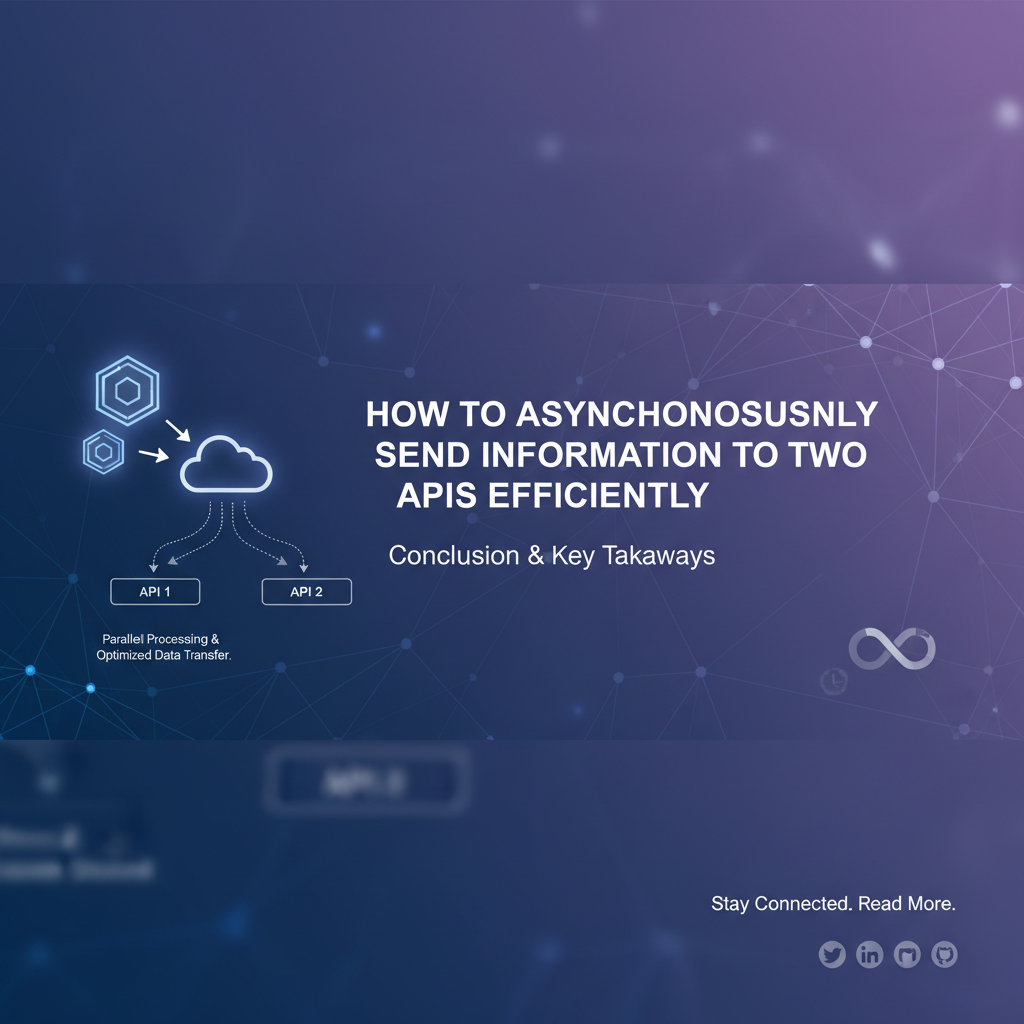
How to Asynchronously Send Information to Two APIs Efficiently
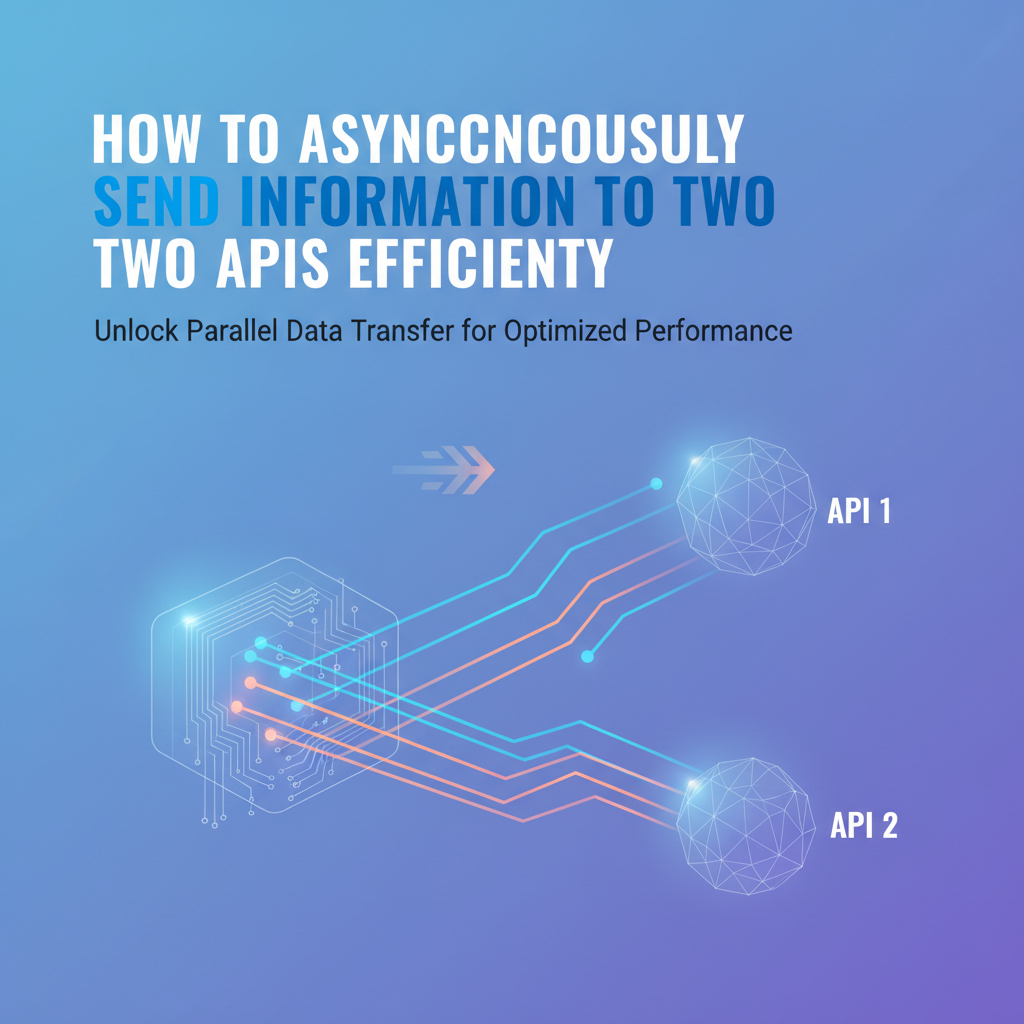


In the intricate tapestry of modern software architecture, applications rarely operate in isolation. They are, more often than not, deeply interwoven with a myriad of external services and internal components, communicating through Application Programming Interfaces (APIs). The demand for real-time responsiveness, seamless user experiences, and robust, scalable systems has pushed developers to move beyond traditional synchronous interaction models. When an application needs to interact with multiple services, perhaps two distinct API endpoints, the efficiency of this communication becomes paramount. This article delves into the strategies, challenges, and best practices for asynchronously sending information to two APIs efficiently, emphasizing the critical role played by concepts like API gateway and general gateway architectures in achieving this.
The journey towards building highly performant and resilient applications often involves embracing asynchronous programming paradigms. While simple, sequential API calls might suffice for trivial tasks, they quickly become a bottleneck when dealing with distributed systems, network latency, and the need to process multiple operations concurrently. Understanding the nuances of asynchronous communication, leveraging appropriate architectural patterns, and deploying powerful tools such as API gateways are not just advantageous but often indispensable for any system aiming for high efficiency and scalability.
The Paradigm Shift: Understanding Asynchronous Operations
At its core, asynchronous programming is about initiating an operation that might take time to complete, without blocking the execution of other tasks. Instead of waiting for the operation to finish, the system proceeds with other work, and only returns to handle the result of the initial operation once it's ready. This is a fundamental departure from synchronous programming, where each operation must complete before the next one can begin, often leading to performance bottlenecks and unresponsive applications, especially when network I/O is involved.
Imagine you're trying to prepare a multi-course meal. In a synchronous approach, you would chop vegetables, then wait for them to cook, then start seasoning the meat, then wait for it to cook, and so on. Your total meal preparation time would be the sum of all individual tasks. Now, consider an asynchronous approach: while the vegetables are cooking, you start seasoning the meat. While the meat is cooking, you prepare the sauce. You're constantly working on different tasks in parallel, significantly reducing the total time to serve the meal. This analogy perfectly illustrates the power of asynchronous operations in software.
In the context of API communication, this means that when your application makes a call to an external API, it doesn't just sit idly, waiting for the response. Instead, it can immediately move on to process other data, update the user interface, or even make another API call. When the response from the first API eventually arrives, a predefined mechanism (like a callback, promise, or future) handles it. This non-blocking nature is particularly vital for web applications and microservices, where responsiveness directly translates to user satisfaction and system throughput.
The benefits of adopting an asynchronous paradigm are multifaceted:
- Improved Responsiveness: Applications remain fluid and interactive, as long-running API calls don't freeze the main execution thread. For user interfaces, this means no more "spinning wheels."
- Enhanced Scalability: By not tying up resources (like threads) while waiting for I/O operations, a system can handle a much larger number of concurrent requests with the same underlying hardware. This leads to more efficient resource utilization and lower operational costs.
- Higher Throughput: More operations can be processed in a given time frame, leading to a significant boost in the overall performance of the application or service.
- Better Resource Utilization: CPU cycles aren't wasted on idle waiting; instead, they are used to process other tasks, leading to a more efficient use of computational resources.
- Decoupling and Resilience: Asynchronous communication, especially when facilitated by message queues, naturally promotes decoupling between services. If one service is temporarily unavailable, messages can queue up and be processed once it recovers, enhancing system resilience.
However, asynchronous programming introduces its own set of complexities, including managing state across non-blocking operations, handling errors in a distributed manner, and ensuring data consistency. These challenges become even more pronounced when you need to interact with not just one, but two or more distinct APIs simultaneously and efficiently.
Why Sending to Multiple APIs is a Challenge
Interacting with a single API presents its own set of challenges, from managing network latency to handling authentication and error responses. Multiplying this by two or more APIs amplifies these complexities exponentially, requiring careful consideration of several critical factors. The goal isn't just to make multiple calls, but to make them efficiently, reliably, and coherently.
Firstly, network latency is a constant adversary. Each API call traverses the network, introducing delays that are unpredictable and can vary significantly based on geographical distance, network congestion, and the API provider's infrastructure. If you're making two sequential API calls, the total time will be the sum of their individual latencies, which can quickly become unacceptable for user-facing applications. Even if calls are made in parallel, a slow response from one API might hold up the aggregation of results.
Secondly, error handling becomes significantly more complex. What happens if one API call succeeds but the other fails? Do you retry the failed call? If so, with what strategy (e.g., exponential backoff)? Do you roll back the successful call? This is particularly challenging if the APIs are performing state-changing operations (e.g., one API debits an account, the other updates an order status). Ensuring data consistency across multiple external services, which might not offer transactional guarantees, requires robust compensation mechanisms or idempotent operations. Partial failures are a common scenario in distributed systems, and designing for them proactively is crucial.
Thirdly, data consistency and ordering present a formidable hurdle. If the two APIs rely on inter-dependent data, ensuring that the data sent to the second API reflects the most up-to-date state from the first API (or vice versa) is critical. For instance, if you're creating a user in one API and then assigning roles in another, you need to ensure the user creation is complete and successful before attempting role assignment. Moreover, for truly asynchronous, event-driven systems, the order in which events are processed by different services might not always be guaranteed without explicit sequencing mechanisms.
Fourthly, resource contention and rate limiting can impact efficiency. Each API typically has rate limits to prevent abuse and ensure fair usage. Making multiple simultaneous calls can quickly exhaust these limits, leading to rejected requests and further delays. Your application needs intelligent mechanisms to manage the concurrency of API calls, potentially queueing requests or implementing circuit breakers to prevent overwhelming external services or itself. Without careful management, parallel calls can inadvertently create a Denial-of-Service (DoS) situation against the external APIs or your own infrastructure.
Finally, authentication and authorization can add overhead. While an API gateway can centralize this, making separate calls to two different APIs might involve separate authentication tokens or mechanisms, adding complexity to the client-side logic. Managing the lifecycle of these tokens securely and efficiently across multiple concurrent operations is another layer of architectural consideration.
These challenges underscore the need for sophisticated strategies and tools that can orchestrate, manage, and secure multi-API interactions, moving beyond simple client-side parallelism to more resilient and scalable architectural patterns.
Core Strategies for Asynchronous Multi-API Communication
Achieving efficient asynchronous communication with multiple APIs requires a blend of client-side techniques and server-side architectural patterns. Each approach offers distinct advantages and is suited for different scenarios, often complementing each other within a broader system design.
Client-Side Asynchronicity: Direct Parallelism
For scenarios where an application needs to fetch independent pieces of data from two APIs and then combine them, client-side asynchronicity is often the most straightforward approach. Modern programming languages provide powerful constructs to facilitate this.
Promises and Async/Await (JavaScript, TypeScript): JavaScript, especially in Node.js environments and modern browsers, heavily relies on Promises and the async/await syntax to manage asynchronous operations. To send information to two APIs in parallel, Promise.all is an invaluable tool.
async function sendDataToTwoAPIs(dataForApi1, dataForApi2) {
    try {
        const [response1, response2] = await Promise.all([
            fetch('https://api.example.com/service1', {
                method: 'POST',
                headers: { 'Content-Type': 'application/json' },
                body: JSON.stringify(dataForApi1)
            }),
            fetch('https://api.example.com/service2', {
                method: 'POST',
                headers: { 'Content-Type': 'application/json' },
                body: JSON.stringify(dataForApi2)
            })
        ]);

        const result1 = await response1.json();
        const result2 = await response2.json();

        if (!response1.ok) {
            console.error('API 1 error:', result1);
            // Handle specific error for API 1
        }
        if (!response2.ok) {
            console.error('API 2 error:', result2);
            // Handle specific error for API 2
        }

        console.log('API 1 Success:', result1);
        console.log('API 2 Success:', result2);
        return { result1, result2 };

    } catch (error) {
        console.error('An error occurred during API calls:', error);
        // Centralized error handling for network issues or unhandled exceptions
        throw error; // Re-throw to inform caller
    }
}

// Example usage
sendDataToTwoAPIs({ /* data */ }, { /* more data */ })
    .then(results => console.log('All calls completed:', results))
    .catch(error => console.error('Overall failure:', error));
This pattern initiates both fetch requests almost simultaneously. The await Promise.all(...) expression pauses the async function until all promises in the array have either resolved successfully or one of them has rejected. This provides a clean way to aggregate results or handle collective failure. The primary benefit here is reducing the perceived latency by executing independent tasks concurrently.
Futures and CompletableFuture (Java): In Java, CompletableFuture offers similar capabilities for asynchronous and non-blocking computations.
import java.util.concurrent.CompletableFuture;
import java.util.concurrent.Executors;
import java.util.concurrent.ExecutorService;

public class AsyncAPICaller {

    private static final ExecutorService executor = Executors.newFixedThreadPool(4); // Adjust pool size as needed

    public CompletableFuture<String> callApi1(String data) {
        return CompletableFuture.supplyAsync(() -> {
            // Simulate API call 1 latency and processing
            try { Thread.sleep(1000); } catch (InterruptedException e) { Thread.currentThread().interrupt(); }
            System.out.println("API 1 received: " + data);
            return "Response from API 1 for " + data;
        }, executor);
    }

    public CompletableFuture<String> callApi2(String data) {
        return CompletableFuture.supplyAsync(() -> {
            // Simulate API call 2 latency and processing
            try { Thread.sleep(1500); } catch (InterruptedException e) { Thread.currentThread().interrupt(); }
            System.out.println("API 2 received: " + data);
            return "Response from API 2 for " + data;
        }, executor);
    }

    public void sendDataAndProcessResults(String dataForApi1, String dataForApi2) {
        CompletableFuture<String> api1Future = callApi1(dataForApi1);
        CompletableFuture<String> api2Future = callApi2(dataForApi2);

        CompletableFuture<Void> combinedFuture = CompletableFuture.allOf(api1Future, api2Future);

        combinedFuture.thenRun(() -> {
            try {
                String result1 = api1Future.join(); // Gets the result of the future, blocks if not complete
                String result2 = api2Future.join();
                System.out.println("Combined results: " + result1 + ", " + result2);
            } catch (Exception e) {
                System.err.println("Error getting results: " + e.getMessage());
            } finally {
                executor.shutdown(); // Shutdown executor when done or manage lifecycle appropriately
            }
        }).exceptionally(ex -> {
            System.err.println("One or more API calls failed: " + ex.getMessage());
            executor.shutdown();
            return null;
        });
        System.out.println("Initiated API calls, continuing other tasks...");
    }

    public static void main(String[] args) {
        AsyncAPICaller caller = new AsyncAPICaller();
        caller.sendDataAndProcessResults("Data A", "Data B");
        // Other tasks can run here while API calls are in progress
    }
}
CompletableFuture.allOf() is analogous to Promise.all(), allowing you to wait for multiple asynchronous tasks to complete. These client-side patterns are excellent for immediate parallelism but place the burden of error handling, retries, and result aggregation directly on the calling application. They are most suitable when the operations are independent, and a failure in one can be gracefully handled without needing complex rollback mechanisms across external services.
Server-Side Asynchronicity: Message Queues and Event-Driven Architectures
When the need for efficiency extends beyond simply parallelizing immediate calls, especially for robustness, decoupling, and resilience against external API failures or slowdowns, server-side asynchronous patterns become essential. These often involve introducing an intermediary system, acting as a gateway for messages, that facilitates communication without tight coupling.
Message Queues (e.g., Kafka, RabbitMQ, AWS SQS, Azure Service Bus): Message queues provide a robust mechanism for asynchronous communication between different services. Instead of directly calling an API, your application publishes a message to a queue. Another service (or a dedicated worker) subscribes to that queue, consumes the message, and then calls the external API. If you need to send information to two APIs, you might publish a single event, and two different consumers (or one smart consumer) would pick up the event and interact with their respective APIs.
- Mechanism: The producer service puts a message onto a message queue. One or more consumer services listen to the queue, retrieve messages, and process them.
- Decoupling: Producers don't need to know anything about consumers, and vice-versa. This enhances modularity and makes the system more resilient to changes or failures in individual components.
- Resilience: If an external API is temporarily down or slow, messages can simply queue up. The consumer can retry processing messages (often with built-in retry mechanisms and dead-letter queues) until the API becomes available, without blocking the producer.
- Load Leveling: Message queues can absorb bursts of traffic. If your application suddenly needs to make hundreds of calls to two APIs, it can dump messages into the queue, and consumers can process them at a rate the external APIs (and your own infrastructure) can handle, preventing rate-limiting issues.
- Fan-out: A single message can be distributed to multiple consumers, each responsible for interacting with a different API. For example, an "Order Placed" event could trigger one consumer to call a payment API and another to call an inventory update API.
Event-Driven Architectures (EDA): Message queues are often the backbone of EDAs. In an EDA, services communicate primarily by emitting and reacting to events. When an event occurs (e.g., "UserRegistered"), it's published to an event bus or message broker. Multiple services, each interested in that event, can subscribe to it.
For sending information to two APIs: 1. Your primary service publishes an event (e.g., DataProcessedForExternalAPIsEvent) containing the necessary data. 2. A dedicated "API Gateway Service" (or two separate worker services) subscribes to this event. 3. Upon receiving the event, one worker calls API 1 with the relevant data. 4. Another worker (or the same worker, depending on logic) calls API 2 with its relevant data. 5. Each worker handles its own retries, error logging, and potential compensation logic if its specific API call fails.
This pattern is highly scalable and resilient but introduces operational complexity (managing message brokers, ensuring exactly-once processing, handling eventual consistency). It's particularly powerful for complex business workflows spanning multiple services and external integrations where immediate, synchronous responses are not strictly necessary.
Workflows and Orchestration Engines: For highly complex scenarios involving multiple API calls, conditional logic, human approvals, and long-running processes, specialized workflow or orchestration engines (e.g., Camunda, Cadence, AWS Step Functions) can be employed. These engines allow you to define a multi-step process where each step might involve an API call. They handle state management, retries, and failure recovery across the entire workflow, providing a robust solution for complex asynchronous interactions. A workflow engine effectively acts as an intelligent gateway for coordinating these complex interactions.
Choosing between client-side direct parallelism and server-side message queues depends on factors like the coupling requirements, resilience needs, transactionality, and overall system architecture. Often, a hybrid approach is employed, where client-side asynchronicity handles immediate parallelism within a service, while message queues manage asynchronous communication between services or with external, less reliable APIs.
The Role of an API Gateway in Efficient Asynchronous Multi-API Communication
When discussing efficient interaction with multiple APIs, especially in complex, distributed environments, the concept of an API Gateway inevitably comes to the forefront. An API Gateway acts as a single entry point for all client requests, abstracting the internal architecture of the system from the clients. It’s a powerful tool that can significantly enhance the efficiency, security, and manageability of asynchronous multi-API communication. Think of an API Gateway as the sophisticated traffic controller at the entrance of a bustling city, directing vehicles to various destinations, managing congestion, and ensuring smooth flow.
What is an API Gateway?
An API Gateway is a server that acts as an API front-end, sitting between the client applications and the backend services. It takes all API calls from a client and routes them to the appropriate microservice. It can also aggregate multiple requests, ensuring that clients only have to make one call. But its role extends far beyond simple routing; it's a centralized point for managing cross-cutting concerns.
How an API Gateway Facilitates Efficient Asynchronous Multi-API Communication:
- Request Fan-out and Aggregation: One of the most significant advantages of an API gateway for multi-API interactions is its ability to perform "fan-out" and "fan-in" operations. A single client request to the gateway can trigger multiple asynchronous calls to different backend services or external APIs in parallel. The gateway then waits for all these responses, aggregates them, and composes a single response back to the client. This offloads the complexity of parallel execution and result aggregation from the client, simplifying client-side logic and reducing the number of network round trips.
- Example: A client requests a user's profile. The API gateway simultaneously calls a User Service for basic info, an Order Service for recent orders, and a Review Service for product reviews. It then combines these three asynchronous responses into one comprehensive user profile for the client.
- Centralized Security, Authentication, and Authorization: Rather than each backend service or client having to implement its own security mechanisms, the API gateway can handle authentication (verifying client identity) and authorization (checking if the client has permission to access a resource) centrally. This simplifies development, ensures consistent security policies, and improves efficiency by performing these checks once at the gateway level. For asynchronous calls, this means tokens are managed by the gateway before distributing requests.
- Rate Limiting and Throttling: To prevent abuse and protect backend services from being overwhelmed, an API gateway can enforce rate limits. It can restrict the number of requests a client can make within a certain time frame. This is crucial when interacting with multiple external APIs, as the gateway can manage the flow of requests to respect each external API's limits while intelligently distributing the load.
- Caching: The gateway can cache responses from backend services. If multiple clients request the same data, the gateway can serve the cached response without hitting the backend services again, significantly reducing latency and load on the APIs. This is particularly effective for read-heavy operations.
- Load Balancing: If you have multiple instances of a backend service, the API gateway can intelligently distribute incoming requests across these instances, ensuring optimal resource utilization and high availability. This improves the efficiency and resilience of the overall system, especially when processing high volumes of asynchronous requests.
- Request and Response Transformation: The gateway can transform request payloads or response structures to meet the specific requirements of different clients or backend services. This is invaluable when integrating with legacy APIs or external services that have different data formats, reducing the burden of transformation on individual services.
- Monitoring, Logging, and Tracing: An API gateway provides a central point for collecting metrics, logs, and tracing information for all API traffic. This unified view is essential for understanding system performance, diagnosing issues in asynchronous workflows (especially when calls fan out to multiple services), and ensuring compliance. Comprehensive logging capabilities, like those offered by advanced platforms, can record every detail of each API call, allowing businesses to quickly trace and troubleshoot issues, ensuring system stability and data security.
- Circuit Breaking and Retries: An API gateway can implement resilience patterns like circuit breakers. If a backend API starts failing or becomes unresponsive, the gateway can "open the circuit" and immediately return an error (or a cached response) instead of continuously retrying the failing API. This prevents cascading failures and allows the backend to recover. It can also manage intelligent retry strategies with exponential backoff for transient failures.
APIPark - an Open Source AI Gateway & API Management Platform - is an excellent example of a robust solution that embodies many of these features. For those looking for a comprehensive solution to manage their API ecosystem, especially when dealing with complex asynchronous interactions and AI integrations, an open-source platform like APIPark offers a robust AI gateway and API management platform. It's designed to help developers and enterprises manage, integrate, and deploy AI and REST services with ease, supporting capabilities such as quick integration of 100+ AI models, unified API format, prompt encapsulation into REST APIs, and end-to-end API lifecycle management. Its ability to achieve high performance, rivaling Nginx, with over 20,000 TPS, and support cluster deployment, makes it well-suited for handling large-scale asynchronous traffic to multiple APIs. Furthermore, APIPark's powerful data analysis capabilities, which analyze historical call data to display long-term trends and performance changes, assist businesses in preventive maintenance, critical for maintaining efficiency in asynchronous multi-API environments.
By centralizing these cross-cutting concerns, an API gateway streamlines the development of backend services, enforces consistent policies, and significantly improves the overall efficiency and resilience of an application that relies on multiple APIs. It moves the complex orchestration logic from individual services or clients to a dedicated layer, making the entire system more manageable and scalable.
APIPark is a high-performance AI gateway that allows you to securely access the most comprehensive LLM APIs globally on the APIPark platform, including OpenAI, Anthropic, Mistral, Llama2, Google Gemini, and more.Try APIPark now! 👇👇👇
Architectural Patterns and Best Practices for Resilient Multi-API Communication
Building efficient and robust systems that interact asynchronously with multiple APIs requires more than just knowing how to make parallel calls; it demands adopting specific architectural patterns and adhering to best practices that enhance resilience, maintainability, and scalability. These patterns help mitigate the inherent challenges of distributed systems, such as network unreliability, service failures, and data inconsistency.
1. Fan-out/Fan-in Pattern
This pattern is fundamental to asynchronous multi-API communication. * Fan-out: A single request triggers multiple independent operations (e.g., calls to different APIs) to run in parallel. This is typically implemented using client-side async/await with Promise.all, CompletableFuture.allOf, or through an API Gateway that orchestrates these parallel calls. * Fan-in: The results from these parallel operations are then collected and aggregated to form a single, unified response or to trigger a subsequent action.
Best Practice: Design your fan-out operations to be as independent as possible. If one operation fails, it should not necessarily block the others. Consider what constitutes a "successful" overall response: do you need all results, or are some optional? Implement robust error handling for individual branches of the fan-out.
2. Circuit Breaker Pattern
When a service makes an API call to an external service, there's always a risk that the external service might be slow or unavailable. Constantly retrying a failing service can lead to cascading failures, exhausting resources in the calling service and potentially making the problem worse. The Circuit Breaker pattern helps prevent this.
- Mechanism: It works like an electrical circuit breaker. If calls to a particular API repeatedly fail (or time out), the circuit "opens." For a defined period, all subsequent calls to that API immediately fail without even attempting to connect. After this "cool-down" period, the circuit enters a "half-open" state, allowing a limited number of test requests. If these succeed, the circuit "closes," and normal operations resume. If they fail, it re-opens.
- Benefits: Prevents overloading a failing service, conserves resources in the calling service, and allows the failing service time to recover.
- Implementation: Libraries like Polly (.NET), Hystrix (Java - though now in maintenance mode, alternatives exist), or integrated features in an API gateway (like APIPark's resilience features) can implement this pattern.
3. Bulkhead Pattern
This pattern isolates elements of an application into pools of resources (e.g., thread pools, connection pools) so that if one element fails or experiences high load, the others remain functional.
- Mechanism: If your application sends information to two APIs, you would dedicate separate resource pools (e.g., a specific set of threads and network connections) for communication with API 1 and another set for API 2.
- Benefits: A failure or slowdown in API 1 will only exhaust its dedicated resource pool, leaving the resources for API 2 untouched and ensuring that communication with API 2 can continue unimpeded. This is vital for maintaining overall system stability.
- Implementation: Often managed at the application level through thread pool configuration or by an API gateway providing resource isolation per upstream service.
4. Retry Pattern with Exponential Backoff
Transient errors (temporary network glitches, brief service unavailability) are common in distributed systems. Simply giving up after the first failure is inefficient.
- Mechanism: When an API call fails due to a transient error, the service retries the call. Exponential backoff means the delay between retries increases exponentially with each subsequent attempt (e.g., 1 second, then 2 seconds, then 4 seconds). A maximum number of retries and a maximum total delay should be defined to prevent infinite loops.
- Considerations: Only retry for idempotent operations (operations that produce the same result no matter how many times they are performed). Otherwise, retrying could lead to duplicate data or incorrect state changes.
- Implementation: Many HTTP client libraries offer retry middleware. API gateways or message queues often have built-in retry mechanisms, often paired with dead-letter queues (DLQ) for messages that persistently fail.
5. Idempotency
Idempotency is a property of an operation that means it can be applied multiple times without changing the result beyond the initial application. This is absolutely critical for distributed systems and asynchronous communication, especially when retries are involved.
- Mechanism: Design your API endpoints such that sending the same request multiple times has the same effect as sending it once. This is often achieved by using unique transaction IDs or correlation IDs in the request payload. If a service receives a request with an ID it has already processed, it simply returns the original successful response without re-executing the operation.
- Benefits: Allows for safe retries and prevents duplicate processing in the event of network delays or failures, significantly enhancing the reliability of asynchronous interactions.
- Example: A payment processing API might use a
transactionId. If a request toPOST /paymentswithtransactionId=ABCis sent and succeeds, and then the same request is sent again (perhaps due to a network timeout on the client side, causing a retry), the API recognizesABCas already processed and returns the original success response, rather than processing a duplicate payment.
6. Comprehensive Error Handling and Observability
- Structured Logging: Ensure all API calls, requests, responses, and errors are logged in a structured format (e.g., JSON). Include correlation IDs to link related asynchronous operations across different services and API calls.
- Centralized Monitoring: Use monitoring tools to track the health, performance, and error rates of your services and external API calls. Set up alerts for anomalies.
- Distributed Tracing: Tools like Jaeger or OpenTelemetry are invaluable for visualizing the flow of requests across multiple services and APIs in an asynchronous workflow. This allows you to pinpoint performance bottlenecks and understand where failures occur in a complex chain of calls. This is particularly useful for debugging fan-out/fan-in scenarios.
- Dead-Letter Queues (DLQ): For message queue-based asynchronous patterns, a DLQ collects messages that could not be processed successfully after a certain number of retries. This prevents poison messages from blocking the queue and allows manual inspection and reprocessing.
By diligently applying these architectural patterns and best practices, developers can build systems that not only efficiently send information to multiple APIs asynchronously but also remain resilient, observable, and maintainable in the face of the inevitable failures and complexities of distributed computing. The strategic use of an API gateway can simplify the implementation of many of these patterns, providing a centralized control plane for complex interactions.
Practical Implementation Scenarios for Asynchronous Multi-API Communication
To truly grasp the efficiency gains of asynchronous multi-API interactions, it's helpful to consider practical implementation scenarios across different programming environments. While the core principles remain consistent, the syntax and specific libraries used will vary. Here, we'll illustrate how to achieve this with common language ecosystems, focusing on conceptual clarity rather than exhaustive code.
Scenario: Processing an E-commerce Order
Imagine an e-commerce platform where, after a customer places an order, the system needs to perform two crucial and largely independent actions:
- Update Inventory: Decrement the stock count for the ordered items via an Inventory API.
- Process Payment: Initiate the payment transaction via a Payment API.
Both operations are critical, and their success is required for a complete order. However, they can occur in parallel to speed up the overall order confirmation process.
Node.js (JavaScript/TypeScript) Implementation
Node.js, with its non-blocking I/O model and async/await syntax, is particularly well-suited for such tasks.
// orderService.js
const axios = require('axios'); // A popular promise-based HTTP client

const INVENTORY_API_BASE = 'https://inventory.api.example.com';
const PAYMENT_API_BASE = 'https://payment.api.example.com';
const API_KEY_INVENTORY = process.env.INVENTORY_API_KEY;
const API_KEY_PAYMENT = process.env.PAYMENT_API_KEY;

async function processOrderAsync(orderId, items, paymentDetails) {
    console.log(`[Order ${orderId}] Starting asynchronous processing...`);

    try {
        // Prepare data for API calls
        const inventoryUpdatePayload = { orderId, items };
        const paymentProcessPayload = { orderId, ...paymentDetails, amount: calculateTotal(items) };

        // Initiate both API calls in parallel using Promise.all
        const [inventoryResponse, paymentResponse] = await Promise.all([
            axios.post(`${INVENTORY_API_BASE}/deductStock`, inventoryUpdatePayload, {
                headers: { 'Authorization': `Bearer ${API_KEY_INVENTORY}` }
            }),
            axios.post(`${PAYMENT_API_BASE}/charge`, paymentProcessPayload, {
                headers: { 'Authorization': `Bearer ${API_KEY_PAYMENT}` }
            })
        ]);

        // Process responses after both have completed
        console.log(`[Order ${orderId}] Inventory API Response Status: ${inventoryResponse.status}`);
        console.log(`[Order ${orderId}] Payment API Response Status: ${paymentResponse.status}`);

        // Check for specific success criteria within the responses
        if (inventoryResponse.data.success && paymentResponse.data.success) {
            console.log(`[Order ${orderId}] Successfully updated inventory and processed payment.`);
            return {
                status: 'success',
                inventoryResult: inventoryResponse.data,
                paymentResult: paymentResponse.data
            };
        } else {
            // Handle partial success or specific API errors
            const errors = [];
            if (!inventoryResponse.data.success) errors.push('Inventory update failed.');
            if (!paymentResponse.data.success) errors.push('Payment processing failed.');
            console.error(`[Order ${orderId}] Partial failure: ${errors.join(' ')}`);
            // Here, you might trigger compensation logic (e.g., refund if payment succeeded but inventory failed)
            return { status: 'partial_failure', errors: errors.join(' ') };
        }

    } catch (error) {
        // Catch any network errors or unhandled exceptions from Promise.all
        console.error(`[Order ${orderId}] Critical error during order processing:`, error.message);
        // Implement robust error handling, logging, and potentially retry mechanisms or manual intervention
        throw new Error(`Order processing failed: ${error.message}`);
    }
}

function calculateTotal(items) {
    return items.reduce((sum, item) => sum + (item.price * item.quantity), 0);
}

// Example Usage:
(async () => {
    const orderData = {
        orderId: 'ORD12345',
        items: [{ productId: 'PROD001', quantity: 2, price: 50 }, { productId: 'PROD002', quantity: 1, price: 120 }],
        paymentDetails: { cardNumber: 'xxxx-xxxx-xxxx-1111', expiry: '12/25', cvv: '123' }
    };

    try {
        const result = await processOrderAsync(orderData.orderId, orderData.items, orderData.paymentDetails);
        console.log(`[Order ${orderData.orderId}] Final result:`, result);
    } catch (e) {
        console.error(`[Order ${orderData.orderId}] Overall processing failed:`, e.message);
    }
})();
In this Node.js example, Promise.all ensures that both the inventory and payment API calls are initiated concurrently. The await then waits for both to complete. If either fetch call encounters a network error or the underlying service is unavailable, the catch block will handle it. Specific business logic errors (e.g., payment declined) would be handled by inspecting the response.data.
Python (asyncio) Implementation
Python's asyncio library provides similar capabilities for asynchronous programming.
# order_service.py
import asyncio
import httpx # A modern, async-compatible HTTP client for Python

INVENTORY_API_BASE = 'https://inventory.api.example.com'
PAYMENT_API_BASE = 'https://payment.api.example.com'
API_KEY_INVENTORY = "your_inventory_api_key" # In real app, use environment variables
API_KEY_PAYMENT = "your_payment_api_key"

async def deduct_stock(order_id: str, items: list):
    payload = {"orderId": order_id, "items": items}
    headers = {"Authorization": f"Bearer {API_KEY_INVENTORY}"}
    async with httpx.AsyncClient() as client:
        response = await client.post(f"{INVENTORY_API_BASE}/deductStock", json=payload, headers=headers)
        response.raise_for_status() # Raises HTTPStatusError for 4xx/5xx responses
        return response.json()

async def process_payment(order_id: str, payment_details: dict, amount: float):
    payload = {"orderId": order_id, **payment_details, "amount": amount}
    headers = {"Authorization": f"Bearer {API_KEY_PAYMENT}"}
    async with httpx.AsyncClient() as client:
        response = await client.post(f"{PAYMENT_API_BASE}/charge", json=payload, headers=headers)
        response.raise_for_status()
        return response.json()

async def process_order_async(order_id: str, items: list, payment_details: dict):
    print(f"[Order {order_id}] Starting asynchronous processing...")

    try:
        total_amount = sum(item['price'] * item['quantity'] for item in items)

        # Create awaitable tasks for each API call
        task_inventory = deduct_stock(order_id, items)
        task_payment = process_payment(order_id, payment_details, total_amount)

        # Run tasks concurrently and await their completion
        inventory_result, payment_result = await asyncio.gather(task_inventory, task_payment)

        print(f"[Order {order_id}] Inventory API Result: {inventory_result}")
        print(f"[Order {order_id}] Payment API Result: {payment_result}")

        if inventory_result.get('success') and payment_result.get('success'):
            print(f"[Order {order_id}] Successfully updated inventory and processed payment.")
            return {
                'status': 'success',
                'inventory_result': inventory_result,
                'payment_result': payment_result
            }
        else:
            errors = []
            if not inventory_result.get('success'): errors.append('Inventory update failed.')
            if not payment_result.get('success'): errors.append('Payment processing failed.')
            print(f"[Order {order_id}] Partial failure: {' '.join(errors)}")
            return {'status': 'partial_failure', 'errors': ' '.join(errors)}

    except httpx.HTTPStatusError as e:
        print(f"[Order {order_id}] HTTP error during API call: {e.response.status_code} - {e.response.text}")
        raise
    except httpx.RequestError as e:
        print(f"[Order {order_id}] Network error during API call: {e}")
        raise
    except Exception as e:
        print(f"[Order {order_id}] An unexpected error occurred: {e}")
        raise

# Example Usage:
async def main():
    order_data = {
        "orderId": "ORDPY789",
        "items": [{"productId": "PRODPY001", "quantity": 1, "price": 100}],
        "paymentDetails": {"cardNumber": "xxxx-xxxx-xxxx-2222", "expiry": "12/26", "cvv": "456"}
    }

    try:
        result = await process_order_async(order_data['orderId'], order_data['items'], order_data['paymentDetails'])
        print(f"[Order {order_data['orderId']}] Final result: {result}")
    except Exception as e:
        print(f"[Order {order_data['orderId']}] Overall processing failed: {e}")

if __name__ == "__main__":
    asyncio.run(main())
Here, asyncio.gather() is the Python equivalent of Promise.all(), allowing multiple coroutines (async functions) to run concurrently. Error handling is done through try-except blocks, catching httpx specific errors for network issues and HTTP status errors.
Using an API Gateway for Orchestration
While the above examples show client-side parallelism, for more complex scenarios, an API Gateway would encapsulate this logic. A client would send a single request to the API Gateway (e.g., POST /orders), and the gateway would internally perform the fan-out to the Inventory API and Payment API, aggregate the results, and return a single response to the client. This shifts the complexity away from the client and centralizes it in a well-managed gateway layer.
An API Gateway like APIPark could be configured with a route /orders that, upon receiving a request: 1. Extracts order items and payment details. 2. Initiates a non-blocking call to the Inventory Service's deductStock endpoint. 3. Initiates a non-blocking call to the Payment Service's charge endpoint. 4. Awaits both responses. 5. Constructs a unified JSON response for the original client, including statuses from both services. 6. Handles errors, retries, and potentially triggers compensation flows if one service fails.
This not only simplifies client applications but also provides a central point for applying security policies, rate limiting, logging, and monitoring across these critical multi-API interactions. The choice of implementation (client-side vs. API Gateway orchestration) often depends on the scale, complexity, and specific requirements of the overall system architecture.
Advanced Considerations for High-Performance and Resilience
Achieving efficient asynchronous multi-API communication often involves addressing a spectrum of advanced challenges related to performance, scalability, and resilience. Moving beyond basic parallelization, robust systems incorporate sophisticated mechanisms to handle real-world complexities.
1. Backpressure Management
Backpressure occurs when a producer generates data or requests faster than a consumer can process them. In asynchronous multi-API scenarios, this can happen if your service is sending requests to an external API at a higher rate than the API can handle, or if the external API is temporarily slowed down.
- Impact: Without backpressure management, buffers can overflow, leading to memory exhaustion, increased latency, dropped requests, and ultimately system instability.
- Solutions:
- Throttling/Rate Limiting: Implement limits on how many requests can be sent per unit of time to an external API. This can be done at the application level or, more effectively, by an API gateway.
- Queuing: Use message queues (as discussed) to buffer requests. If a consumer (e.g., the service calling the external API) slows down, messages simply accumulate in the queue, allowing the producer to continue at its pace without being blocked.
- Flow Control Protocols: Reactive programming frameworks (like Project Reactor in Java or RxJS in JavaScript) often include built-in flow control mechanisms that allow consumers to signal back to producers when they are ready to receive more data, effectively applying backpressure.
- Circuit Breakers: While not directly a backpressure mechanism, a circuit breaker can indirectly alleviate backpressure by stopping requests to an overwhelmed service, allowing it to recover.
2. Distributed Tracing
In a system where a single logical operation (like placing an order) triggers multiple asynchronous API calls to different services, understanding the end-to-end flow and identifying bottlenecks or failures can be extremely challenging. This is where distributed tracing comes in.
- Mechanism: Distributed tracing systems (e.g., Jaeger, Zipkin, OpenTelemetry) assign a unique "trace ID" to the initial request. This ID is then propagated through all subsequent API calls, message queue events, and service interactions. Each step in the trace also has its own "span ID," representing a specific operation.
- Benefits:
- Visibility: Provides a visual representation of the entire request path, showing which services were called, the order of execution, and how long each step took.
- Troubleshooting: Drastically simplifies debugging by allowing engineers to quickly pinpoint the exact service or API call that introduced latency or failed within a complex asynchronous workflow.
- Performance Analysis: Helps identify performance bottlenecks and optimize critical paths, especially in fan-out/fan-in scenarios.
- Implementation: Requires instrumentation of your code to inject and extract trace contexts in API headers, message payloads, or database queries. An API gateway can be a critical point for initiating traces and ensuring their propagation.
3. Service Mesh vs. API Gateway (Brief Comparison)
While both API gateways and service meshes facilitate communication in distributed systems, they operate at different layers and serve distinct primary purposes. Understanding their roles is crucial for designing efficient asynchronous interactions.
- API Gateway:
- Focus: Edge traffic management (client-to-service communication).
- Functionality: Routing, authentication, authorization, rate limiting, caching, request/response transformation, API orchestration (fan-out/fan-in), exposure of public APIs.
- Placement: At the perimeter of the microservices architecture, acting as the public-facing gateway.
- Use Case: Managing external traffic, providing a unified API experience, often for synchronous and asynchronous orchestration of multiple backend calls.
- Service Mesh:
- Focus: Internal service-to-service communication within the cluster.
- Functionality: Traffic management (load balancing, routing), service discovery, resilience (retries, circuit breakers), security (mutual TLS), observability (metrics, tracing).
- Placement: Deploys a "sidecar" proxy alongside each service instance.
- Use Case: Enhancing reliability and observability of internal communications between microservices, abstracting network concerns from developers.
- Relationship: An API gateway (like APIPark) and a service mesh are complementary. The API gateway handles incoming requests from external clients, potentially orchestrating initial asynchronous calls to internal services. Once inside the cluster, the service mesh takes over, managing the internal asynchronous communication between those services. An efficient architecture often employs both.
4. Choosing the Right Message Broker
If your asynchronous strategy heavily relies on message queues (e.g., for event-driven architecture, long-running processes, or reliable delivery to external APIs), selecting the appropriate message broker is critical.
- Considerations:
- Throughput & Latency: Some brokers (e.g., Kafka) are optimized for high throughput and low-latency stream processing. Others (e.g., RabbitMQ) excel at complex routing and message durability for individual messages.
- Durability & Reliability: Can the broker guarantee message delivery even if consumers fail or the broker itself restarts? Look for features like persistent queues and acknowledgments.
- Scalability: Can the broker scale horizontally to handle increasing message volumes and consumers?
- Features: Does it support pub/sub, point-to-point, dead-letter queues, message ordering guarantees, transactionality, and consumer groups?
- Ecosystem & Management: Ease of deployment, monitoring tools, client libraries, and community support.
- Examples:
- Kafka: High-throughput, fault-tolerant, distributed streaming platform, excellent for event sourcing and real-time data pipelines.
- RabbitMQ: General-purpose message broker supporting various messaging patterns, good for task queues and inter-service communication where complex routing is needed.
- AWS SQS/SNS, Azure Service Bus, Google Cloud Pub/Sub: Managed cloud services that abstract away much of the operational overhead.
By thoughtfully considering these advanced aspects, system architects and developers can move beyond merely "making it work" to building highly efficient, resilient, and observable asynchronous systems that seamlessly interact with multiple APIs, forming the backbone of modern, scalable applications.
Case Studies and Use Cases: Real-World Efficiency
The principles of asynchronously sending information to two APIs efficiently are not theoretical constructs but practical necessities driving real-world applications across various industries. Here are a few compelling case studies and use cases that highlight their importance:
1. E-commerce Transaction Processing
Scenario: A customer completes a purchase on an online store. This single action triggers multiple critical backend operations that must be performed quickly and reliably.
- Multiple APIs Involved:
- Payment Gateway API: To authorize and capture funds.
- Inventory Management API: To decrement stock levels for purchased items.
- Order Fulfillment API: To initiate shipping and logistics.
- Customer Notification API: To send order confirmation emails or SMS.
- Analytics/Data Warehouse API: To log the transaction for business intelligence.
- Asynchronous Efficiency: Instead of processing these sequentially (which would make the customer wait an unacceptably long time), the e-commerce platform uses an API gateway or a dedicated order processing service (often backed by message queues) to:
- Immediately initiate the Payment Gateway API call.
- Concurrently initiate the Inventory Management API call.
- If both succeed, publish an "Order Confirmed" event to a message queue.
- Separate consumers then pick up this event to interact with the Order Fulfillment, Customer Notification, and Analytics APIs.
- Benefits:
- Improved User Experience: The customer receives instant order confirmation, leading to higher satisfaction.
- Reduced Latency: The critical path of payment and inventory updates is minimized due to parallel processing.
- Increased Throughput: The system can handle a larger volume of concurrent orders.
- Resilience: If the notification API temporarily fails, it doesn't block payment or inventory updates; the message can be retried later. Compensation logic (e.g., refunding if inventory is out after payment) is also crucial.
2. Social Media Content Posting
Scenario: A user posts an update (text, image, video) on a social media platform. This single action has broad implications across the platform.
- Multiple APIs Involved:
- Content Storage API: To save the media and text (e.g., S3, blob storage).
- Search Indexing API: To make the content discoverable.
- Notification API: To alert followers.
- Feed Generation API: To update individual user feeds.
- Moderation API: To check content for policy violations (often an AI-powered service).
- Asynchronous Efficiency: When a user clicks "Post," the system first saves the content to storage (which can be a relatively quick, near-synchronous operation). Then, it leverages asynchronous patterns:
- The content service publishes a "New Post" event to an event bus.
- Multiple independent services subscribe to this event:
- A search indexing service calls the Search Indexing API.
- A notification service calls the Notification API.
- A feed generation service calls the Feed Generation API.
- A moderation service calls the Moderation API (potentially an AI model through an AI gateway like APIPark).
- Benefits:
- Instant User Feedback: The user's post appears almost immediately, even if behind-the-scenes processing is still ongoing.
- Scalability: Each downstream service can scale independently to handle the volume of posts.
- Feature Extensibility: New features (e.g., sentiment analysis, language translation) can be added by simply adding new subscribers to the "New Post" event without modifying existing services.
- Resource Optimization: CPU-intensive tasks like video transcoding or complex moderation can run asynchronously in the background without impacting user-facing responsiveness.
3. IoT Data Ingestion and Processing
Scenario: Thousands of IoT devices (sensors, smart meters) continuously send data to a central platform. This data needs to be stored, analyzed, and sometimes trigger alerts.
- Multiple APIs Involved:
- Data Ingestion API: To receive raw sensor data.
- Data Storage API: To persist data in a time-series database or data lake.
- Analytics API: To feed data into real-time analytics engines.
- Alerting API: To trigger alerts if data points exceed thresholds.
- Device Management API: To update device status or configurations.
- Asynchronous Efficiency: The high volume and velocity of IoT data make synchronous processing impossible.
- IoT devices send data to a highly scalable data ingestion API (often behind an API gateway).
- This API immediately publishes the raw data to a high-throughput message broker (like Kafka).
- Multiple consumers process this stream of data asynchronously:
- One consumer calls the Data Storage API to persist the data.
- Another consumer calls the Analytics API to update dashboards.
- A third consumer calls the Alerting API if anomalies are detected.
- Another might call an AI service via an AI gateway (like APIPark) to perform predictive maintenance analysis.
- Benefits:
- Massive Scale: Handles millions of data points per second without overwhelming individual services.
- Real-time Insights: Enables near real-time analytics and alerting.
- Robustness: If one processing component fails, data is buffered in the message broker and can be reprocessed later.
- Decoupling: New analysis models or storage solutions can be introduced without affecting the data ingestion pipeline or other consumers.
These case studies vividly demonstrate that efficient asynchronous communication with multiple APIs is not merely a technical optimization but a fundamental requirement for building scalable, responsive, and resilient applications in today's distributed and data-intensive world. The judicious application of client-side parallelism, server-side message queues, and robust API gateways (such as APIPark) provides the architectural bedrock for these modern systems.
Conclusion
The journey through the complexities of asynchronously sending information to two APIs efficiently reveals a landscape rich with architectural patterns, nuanced challenges, and powerful solutions. In an era where applications are inherently distributed and interconnected, the ability to manage multiple external interactions without compromising performance or reliability is not just an advantage, but a fundamental requirement for modern software development.
We began by contrasting synchronous and asynchronous paradigms, highlighting the profound benefits of the latter in terms of responsiveness, scalability, and resource utilization. The intrinsic challenges of multi-API communication – network latency, intricate error handling, data consistency, and rate limiting – underscored the need for a sophisticated approach beyond simple sequential calls.
Our exploration of core strategies revealed the power of client-side parallelism through constructs like Promise.all and asyncio.gather for immediate concurrent execution. For more robust and decoupled systems, server-side solutions like message queues and event-driven architectures emerged as indispensable, offering resilience, load leveling, and the ability to process long-running or failure-prone operations reliably.
Crucially, the role of an API gateway emerged as a central pillar in this architectural landscape. Acting as a unified entry point, an API gateway, whether a generic gateway or a specialized AI gateway like APIPark, consolidates critical cross-cutting concerns such as request fan-out and aggregation, centralized security, rate limiting, caching, and comprehensive monitoring. Its ability to orchestrate complex multi-API interactions, manage the lifecycle of APIs, and offer high performance makes it an invaluable asset for efficiency and manageability, particularly for integrating diverse AI and REST services.
Furthermore, adopting architectural patterns such as Circuit Breaker, Bulkhead, and the Retry pattern with exponential backoff, coupled with the critical principle of idempotency, ensures that systems are not only efficient but also resilient to the inevitable failures in distributed environments. Advanced considerations like backpressure management, distributed tracing, and the thoughtful selection of message brokers further refine these systems for high-performance and robust observability.
From the intricate dance of e-commerce transactions to the rapid fire of social media posts and the torrent of IoT data, real-world case studies affirm the indispensable nature of these asynchronous strategies. They are the enabling technologies behind seamless user experiences, scalable backend operations, and the ability to rapidly evolve application functionality.
In essence, efficiently sending information to two APIs asynchronously is about more than just making two calls at once. It's about designing a coherent, resilient, and observable system that can intelligently navigate the complexities of distributed communication, ensuring that applications remain fast, reliable, and capable of meeting the ever-growing demands of the digital age. By strategically combining client-side techniques, server-side patterns, and powerful tools like API gateways, developers can unlock unparalleled levels of efficiency and forge the future of interconnected software.
Frequently Asked Questions (FAQs)
Q1: What is the primary benefit of sending information to two APIs asynchronously compared to synchronously?
A1: The primary benefit is a significant improvement in overall efficiency and responsiveness. Synchronous calls block the execution flow, meaning the application must wait for the first API call to complete before initiating the second. Asynchronous calls, conversely, allow both API calls to be initiated almost simultaneously and run in parallel. This non-blocking nature drastically reduces the perceived latency for the user or the overall processing time for backend operations, as the system isn't idle while waiting for network I/O. It also leads to better resource utilization and higher throughput.
Q2: When should I use client-side asynchronous patterns (e.g., Promise.all) versus server-side message queues for multi-API communication?
A2: Client-side asynchronous patterns like Promise.all (JavaScript) or asyncio.gather (Python) are ideal for scenarios where your application needs to fetch or send independent data to multiple APIs and then aggregate their immediate responses. They are simpler to implement for direct parallelism within a single service instance. Server-side message queues (e.g., Kafka, RabbitMQ) are preferred for greater decoupling, resilience, and scalability. Use message queues when: 1. API calls are long-running or prone to failure, requiring robust retry mechanisms and eventual consistency. 2. Your service needs to process high volumes of requests without overwhelming downstream APIs. 3. You need to fan out a single event to multiple independent consumers (each calling a different API). 4. There's a need for load leveling or buffering against traffic spikes.
Q3: How does an API Gateway contribute to efficient asynchronous multi-API communication?
A3: An API Gateway acts as a central orchestrator and management layer. It can efficiently handle asynchronous multi-API communication by: 1. Request Fan-out/Aggregation: Taking a single client request and internally fanning it out to multiple backend APIs in parallel, then aggregating the results into a single response for the client. 2. Centralized Management: Providing a single point for security (authentication, authorization), rate limiting, caching, and logging across all API calls. 3. Resilience Patterns: Implementing circuit breakers and retries to protect backend services from cascading failures and handle transient errors. 4. Traffic Management: Load balancing requests across multiple service instances and managing internal routing logic. 5. Transformation: Adapting request/response formats between clients and backend APIs. Platforms like APIPark exemplify how an AI gateway can centralize these critical functions, simplifying complex integrations and enhancing overall system performance and manageability.
Q4: What is idempotency and why is it important for asynchronous multi-API calls, especially with retries?
A4: Idempotency means that an operation can be performed multiple times without causing different results beyond the initial execution. For asynchronous multi-API calls, especially when using retry mechanisms (which are common for resilience against transient failures), idempotency is crucial. If an API call that modifies state (e.g., POST /create-order) is not idempotent, retrying it after a network timeout might result in duplicate orders being created. By designing APIs to be idempotent (e.g., using a unique transaction ID for each request), the system can safely retry operations, knowing that subsequent identical requests will simply return the original successful response without unintended side effects, thus ensuring data consistency and reliability.
Q5: What are some key metrics or tools for monitoring the efficiency of asynchronous multi-API communication?
A5: To effectively monitor the efficiency and health of asynchronous multi-API communication, several tools and metrics are essential: 1. Latency & Throughput: Monitor the response times and request volumes for each API call, both at the client and at the API Gateway. 2. Error Rates: Track the percentage of failed API calls, broken down by specific error codes. 3. Queue Depths (for Message Queues): Monitor the number of messages waiting in queues to detect backpressure or processing bottlenecks. 4. Resource Utilization: Keep an eye on CPU, memory, and network usage of services involved in API calls. 5. Distributed Tracing: Tools like Jaeger or OpenTelemetry are invaluable for visualizing the end-to-end flow of a request across multiple services and APIs, helping pinpoint latency issues or failures in complex asynchronous workflows. 6. Structured Logging & Alerting: Comprehensive, structured logs for all API interactions, combined with proactive alerts for anomalies, are critical for rapid troubleshooting. Platforms like APIPark offer powerful data analysis and detailed API call logging capabilities, which can be instrumental in tracking performance trends and identifying issues.
🚀You can securely and efficiently call the OpenAI API on APIPark in just two steps:
Step 1: Deploy the APIPark AI gateway in 5 minutes.
APIPark is developed based on Golang, offering strong product performance and low development and maintenance costs. You can deploy APIPark with a single command line.
curl -sSO https://download.apipark.com/install/quick-start.sh; bash quick-start.sh

In my experience, you can see the successful deployment interface within 5 to 10 minutes. Then, you can log in to APIPark using your account.

Step 2: Call the OpenAI API.