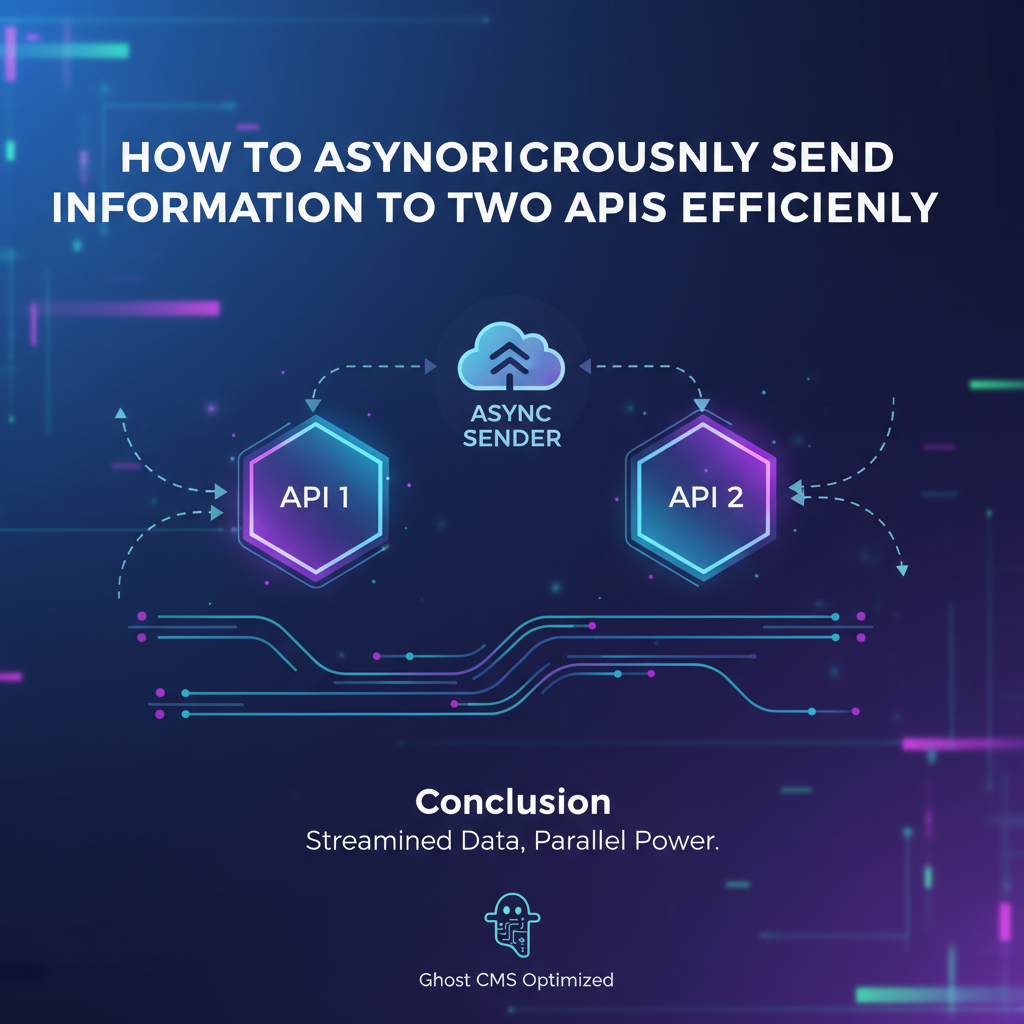
How to Asynchronously Send Information to Two APIs Efficiently


In the intricate tapestry of modern software architecture, the ability to seamlessly communicate with various external services is not merely a feature, but a fundamental necessity. Applications, from sprawling enterprise systems to nimble mobile apps, increasingly rely on the agility and specialized capabilities offered by Application Programming Interfaces (APIs). Whether it’s fetching user data from an authentication service, processing payments through a financial gateway, or enriching content with AI-driven insights, interacting with multiple APIs simultaneously has become a commonplace challenge for developers. However, the seemingly straightforward act of sending information to two APIs, or even more, conceals a labyrinth of complexities, particularly when striving for efficiency, responsiveness, and resilience.
The traditional, synchronous approach, where operations execute sequentially, one after the other, quickly becomes a bottleneck. Imagine a scenario where your application needs to update a customer's profile in a CRM system (API A) and simultaneously notify an email marketing service (API B) about a new subscription. If these calls are made synchronously, the entire user experience or backend process grinds to a halt, waiting for the slowest API to respond before proceeding. This not only leads to frustrating delays but also ties up valuable system resources, significantly impacting the application's overall performance and scalability. As users demand instant feedback and systems require high throughput, the imperative to move beyond this sequential paradigm becomes undeniable.
This comprehensive guide delves into the art and science of asynchronously sending information to two (or more) APIs efficiently. We will embark on a journey starting from the fundamental distinctions between synchronous and asynchronous communication, dissecting the inherent challenges of concurrent API interactions, and exploring a spectrum of architectural patterns and robust technical solutions. From client-side JavaScript promises to sophisticated server-side message queues and the transformative power of an API gateway, we will unravel the strategies that empower developers to build responsive, scalable, and fault-tolerant systems. Our exploration will also touch upon crucial aspects like error handling, data consistency, and performance optimization, culminating in practical insights and best practices designed to elevate your API integration prowess. The goal is not just to send data, but to do so intelligently, leveraging concurrency to unlock unparalleled efficiency and robustness in your applications.
Understanding Synchronous vs. Asynchronous API Calls: The Foundational Divide
Before diving into the intricacies of orchestrating concurrent API interactions, it's crucial to firmly grasp the fundamental difference between synchronous and asynchronous communication paradigms. This distinction forms the bedrock of efficient system design, particularly when dealing with the inherent latencies of network requests to external services.
The Synchronous Paradigm: A Sequential March
In a synchronous operation, tasks are executed one after another, in a strict, sequential order. When your application initiates a synchronous API call, it sends a request and then pauses, effectively blocking further execution of the current thread or process, until it receives a response from the API. Only after the response (or a timeout/error) is received does the application proceed to the next line of code or the next task.
How it Works: Imagine a chef preparing a meal. If they operate synchronously, they would first chop all the vegetables, then wait until all vegetables are chopped before moving on to sautéing them. After sautéing is complete, they would then wait before starting to boil water for pasta, and so on. Each step is a blocking operation; no other cooking can happen concurrently.
Pros of Synchronous Calls: * Simplicity: For single, independent operations, synchronous code is often easier to write, read, and reason about. The execution flow is straightforward and predictable. * Predictable Order: The order of operations is guaranteed, which can simplify state management and data dependencies when one operation strictly relies on the immediate outcome of the previous one. * Easier Debugging: The linear execution path often makes it simpler to trace bugs, as you can follow the program's progression step-by-step.
Cons of Synchronous Calls: * Latency Accumulation: The most significant drawback. Network requests introduce latency, which can vary significantly due to factors like network congestion, server load, and geographical distance. In a synchronous chain of calls, these latencies sum up, leading to prolonged overall execution times. If API A takes 500ms and API B takes 700ms, a synchronous call to both sequentially will take at least 1200ms (1.2 seconds), plus any processing time. * Resource Blocking: While waiting for an API response, the thread or process that initiated the call is blocked. This means it cannot perform any other useful work. In server-side applications, this can tie up valuable server threads, limiting the number of concurrent requests the server can handle and severely impacting scalability and throughput. In client-side applications (like a web browser or mobile app), this can lead to a "frozen" user interface, causing a poor user experience. * Poor User Experience: Users expect applications to be responsive. A synchronous call that blocks the UI thread can lead to perceived sluggishness, unresponsive buttons, or even "application not responding" errors. * Increased Error Propagation Risk: A failure in any one synchronous call can immediately halt the entire sequence, making it harder to gracefully degrade service or continue with independent operations.
Example Scenario: A common synchronous pattern for two APIs might look like this: 1. Call API A to fetch user details. 2. Wait for API A response. 3. Use user ID from API A's response to call API B to fetch user's recent orders. 4. Wait for API B response. 5. Process combined data.
The Asynchronous Paradigm: Orchestrating Concurrency
Asynchronous operations, in contrast, allow tasks to be initiated without blocking the main execution thread. When an asynchronous API call is made, the application sends the request and immediately continues with other tasks, without waiting for the response. The API response will arrive at some later point, at which time a pre-defined callback function, promise handler, or async/await continuation will be triggered to process the result.
How it Works: Revisit our chef. An asynchronous chef would put the vegetables on to chop, and while they are being chopped, they would start boiling water for pasta. Once the vegetables are ready, a timer (or event) would notify them, and they'd move to sautéing, all the while other tasks might be progressing. The key is that the chef isn't idle, waiting for a single task to complete.
Pros of Asynchronous Calls: * Improved Responsiveness: By not blocking, the application can remain responsive to user input or continue processing other background tasks, leading to a smoother user experience. * Higher Throughput and Scalability: Server-side applications can handle many more concurrent requests because threads are not tied up waiting for I/O operations. Instead, a single thread can manage multiple outstanding API calls, dramatically improving throughput and scalability. * Better Resource Utilization: Resources (CPU, memory, network connections) are used more efficiently, as the system isn't idling during I/O waits. * Parallel Execution Potential: Multiple independent asynchronous operations can be initiated nearly simultaneously, running in parallel (if the underlying hardware and OS support it) or concurrently (interleaving execution on a single thread). This is critical for our scenario of sending information to two APIs. If API A and API B are independent, they can be called at the same time, and the total execution time becomes the time of the slowest API, not their sum. * Fault Tolerance: It's often easier to implement strategies for gracefully handling failures in one asynchronous operation without necessarily bringing down others.
Cons of Asynchronous Calls: * Increased Complexity: Asynchronous code can be more challenging to write, debug, and reason about. Managing callbacks, promises, async/await, and potential race conditions requires careful design. The "callback hell" or "pyramid of doom" is a notorious example of poorly structured asynchronous code. * State Management: Tracking the state across multiple concurrent operations can be difficult. * Error Handling: Propagating errors through chains of asynchronous operations requires specific patterns (e.g., .catch() in Promises, try...catch with async/await).
Example Scenario: Sending data to API A and API B asynchronously: 1. Initiate call to API A (don't wait). 2. Immediately initiate call to API B (don't wait). 3. Continue with other tasks. 4. When API A responds, process its data. 5. When API B responds, process its data. 6. Once both have responded, combine and finalize.
This distinction is paramount. For scenarios involving two or more APIs where their operations are independent or can be initiated concurrently, embracing the asynchronous paradigm is the most effective path to achieving high performance, responsiveness, and scalability. The rest of this article will build upon this foundation, exploring the various tools and patterns available to master asynchronous communication.
The Challenge of Sending Information to Two APIs Concurrently
While the asynchronous paradigm offers clear advantages, the practical implementation of sending information to two APIs concurrently introduces a unique set of challenges that developers must meticulously address. It's not simply about firing off two requests; it's about managing their lifecycle, responses, and potential failures in a coherent and efficient manner.
Latency Management and Optimizing for Responsiveness
One of the primary motivations for concurrent API calls is to mitigate the impact of network latency. When dealing with two external services, their response times can vary wildly due to their own backend processing, network conditions, or even geographical distance. The challenge lies in ensuring that the application doesn't wait unnecessarily. If API A responds in 100ms and API B responds in 500ms, a truly concurrent approach means the total waiting time for both operations to complete will be approximately 500ms (the duration of the slower call), rather than 600ms (the sum). This is a significant improvement, but careful design is needed to ensure the system can truly process these calls in parallel and efficiently aggregate their results. Optimizing network interactions, such as using HTTP/2 for multiplexing requests over a single connection, or leveraging Content Delivery Networks (CDNs) for static assets, can further reduce perceived latency. For operations that don't strictly require immediate processing, queueing mechanisms can defer work, providing an immediate "accepted" response to the client while the server handles the dual API calls in the background. This allows the system to remain highly responsive to incoming user requests.
Robust Error Handling and Resiliency
The probability of an error occurring increases with the number of external services an application interacts with. When sending information to two APIs, there are several failure scenarios: * One API Fails, the Other Succeeds: How should the system react? Should the entire operation be considered a failure? Should the successful operation be rolled back, or should the system gracefully handle a partial success state? * Both APIs Fail: What is the appropriate fallback or error message? * One API Times Out: Is this treated as a failure, or should a retry mechanism be invoked?
Effective error handling strategies are crucial. This includes: * Retry Mechanisms: Implementing automatic retries for transient errors (e.g., network glitches, temporary service unavailability) with an exponential backoff strategy to avoid overwhelming the failing service. * Circuit Breakers: A design pattern that prevents an application from repeatedly trying to invoke a service that is likely to fail, thus saving resources and allowing the failing service time to recover. Once the circuit is "open," subsequent calls fail fast without hitting the problematic API. * Fallback Mechanisms: Defining alternative actions or default values if an API call fails or returns unexpected data. * Idempotency: Designing the API calls and the target services to be idempotent, meaning making the same request multiple times has the same effect as making it once. This is vital for safe retries without unintended side effects. * Compensating Transactions: For critical operations, if one API succeeds but the other fails, a compensating transaction might be needed to undo the successful operation, ensuring data consistency across systems (e.g., if a payment goes through but the order creation fails, the payment needs to be refunded).
Data Consistency and Atomicity Across Distributed Systems
Maintaining data consistency across multiple, independent APIs is perhaps one of the most profound challenges. When two APIs are involved in a single logical transaction, ensuring that either both succeed or both fail (an "all or nothing" or atomic operation) becomes incredibly complex in a distributed environment. Unlike a single database transaction, there's no inherent two-phase commit protocol readily available across disparate external services.
Consider updating a user's subscription status in a billing system (API A) and simultaneously updating their access permissions in an authorization system (API B). If API A succeeds but API B fails, the user might be billed for a service they can't access, leading to a broken user experience and operational headaches.
Strategies to address this include: * Eventual Consistency: Accepting that data across systems might be temporarily out of sync but will eventually reconcile. This is suitable for non-critical operations where immediate consistency isn't paramount. Message queues often facilitate eventual consistency. * Saga Pattern: A sequence of local transactions where each transaction updates data within a single service and publishes an event that triggers the next local transaction in the saga. If a local transaction fails, the saga executes compensating transactions to undo the changes made by preceding transactions. * Idempotent Operations and Reconciliation: Designing operations to be idempotent, combined with background reconciliation processes that periodically check for discrepancies and correct them.
Resource Utilization and Scalability
Making concurrent API calls requires efficient management of system resources, including network connections, CPU, and memory. * Network Connection Pooling: Opening and closing TCP connections for every API call is expensive. Using connection pooling (e.g., HTTP connection pooling in application servers or API gateways) reuses existing connections, reducing overhead. * Asynchronous I/O Models: Leveraging non-blocking I/O models (like Node.js's event loop, Python's asyncio, or Go's goroutines) is critical. These models allow a small number of threads to handle a large number of concurrent network operations without blocking, maximizing CPU utilization. * Thread vs. Event-Driven: While traditional multi-threaded models can achieve concurrency, they often come with higher memory footprints per thread and increased complexity in managing shared state. Event-driven, non-blocking models are often more memory-efficient and scalable for I/O-bound tasks. * Horizontal Scaling: Designing the application to be stateless or semi-stateless enables easy horizontal scaling, allowing you to add more instances of your service as load increases. An API gateway can distribute traffic across these instances.
Security Considerations
Interacting with multiple APIs inherently expands the attack surface. Each API likely requires its own authentication and authorization mechanisms. * Credential Management: Securely storing and managing API keys, tokens, and secrets for multiple external services. This often involves secret management tools (e.g., HashiCorp Vault, AWS Secrets Manager). * Least Privilege: Ensuring that your application only has the minimum necessary permissions for each API it interacts with. * OAuth2/OpenID Connect: Utilizing robust authentication and authorization protocols that allow for delegated access without sharing raw credentials. * Data in Transit: Ensuring all communication with external APIs is encrypted using TLS/SSL. * API Gateway for Centralized Security: An API gateway can serve as a centralized point for authentication, authorization, and potentially even API key management, simplifying the security posture for downstream services and abstracting these concerns from the core application logic.
Observability: Monitoring, Logging, and Tracing
When calls are fired asynchronously to multiple services, understanding the flow of a single user request and diagnosing issues becomes significantly more complex. * Centralized Logging: Aggregating logs from all services involved (your application, API A, API B if possible) into a central logging system (e.g., ELK Stack, Splunk, Datadog). Logs should include correlation IDs to link related events across services. * Distributed Tracing: Tools like OpenTelemetry, Zipkin, or Jaeger are invaluable for visualizing the end-to-end flow of a request across multiple microservices and external APIs, showing latency at each hop and pinpointing bottlenecks. * Metrics and Alerting: Collecting performance metrics (latency, error rates, throughput) for each API call. Setting up alerts for anomalies helps proactive issue detection. * APIPark's Detailed Logging and Data Analysis: Platforms like ApiPark, an open-source AI gateway and API management platform, offer comprehensive logging capabilities, recording every detail of each API call. This feature is critical for troubleshooting and ensuring system stability. Furthermore, APIPark's powerful data analysis capabilities can analyze historical call data to display long-term trends and performance changes, assisting businesses with preventive maintenance before issues escalate.
Addressing these challenges systematically is key to building resilient, high-performance applications that efficiently leverage the power of concurrent API interactions. Each architectural choice and implementation detail must be made with these considerations in mind to ensure robustness and maintainability.
Architectural Patterns for Asynchronous Dual-API Communication
Achieving efficient asynchronous communication with two APIs isn't a one-size-fits-all problem; it depends heavily on the application's architecture, programming language, scale requirements, and the nature of the data being exchanged. Several powerful architectural patterns and technical approaches have emerged to tackle this challenge.
1. Client-Side Concurrency
For certain scenarios, especially when the calls are independent and don't involve sensitive backend credentials, the client (web browser, mobile app) can directly make concurrent calls.
Mechanism: Modern JavaScript, fundamental to web development, provides robust primitives for asynchronous operations. * Promise.all(): This is a common and effective way to execute multiple promises in parallel. It takes an array of Promises and returns a single Promise that resolves when all the input Promises have resolved, or rejects as soon as any of the input Promises rejects. * async/await with Promise.all(): This combination provides a cleaner syntax for handling asynchronous operations, making concurrent calls look almost synchronous in their structure while retaining the non-blocking benefits.
Example (Conceptual JavaScript):
async function sendDataToBothAPIs(data) {
    try {
        const apiA_promise = fetch('https://api.example.com/apiA', {
            method: 'POST',
            headers: { 'Content-Type': 'application/json' },
            body: JSON.stringify(data.forApiA)
        });

        const apiB_promise = fetch('https://api.example.com/apiB', {
            method: 'POST',
            headers: { 'Content-Type': 'application/json' },
            body: JSON.stringify(data.forApiB)
        });

        const [apiA_response, apiB_response] = await Promise.all([apiA_promise, apiB_promise]);

        const resultA = await apiA_response.json();
        const resultB = await apiB_response.json();

        console.log("API A result:", resultA);
        console.log("API B result:", resultB);
        return { resultA, resultB };

    } catch (error) {
        console.error("One or both API calls failed:", error);
        throw error;
    }
}
Limitations: * CORS Issues: Cross-Origin Resource Sharing (CORS) policies can restrict direct client-side calls to APIs not hosted on the same domain. * Security: Exposing API keys or sensitive logic directly in client-side code is generally a bad practice. Backend proxies or API gateways are preferred for such scenarios. * Network Overhead: All data and responses must travel over the client's network connection, which might be unreliable or slow, especially on mobile devices. * Transformation/Aggregation: Clients typically have limited capabilities for complex data transformation or aggregation of responses from multiple APIs.
2. Backend Concurrency
For most robust applications, backend concurrency is the preferred approach, offering greater control, security, and scalability.
a. Thread Pools / Task Queues (Traditional Multi-threading)
In languages like Java or Python (with libraries like concurrent.futures), you can use thread pools to manage and execute multiple API calls concurrently. * Mechanism: A fixed-size pool of worker threads is created. When an API call needs to be made, it's submitted as a task to the pool. An available thread picks up the task and executes it. Since network I/O is typically blocking at a low level, having multiple threads allows multiple I/O operations to proceed "simultaneously" from the application's perspective. * Example (Conceptual Java using ExecutorService): ```java ExecutorService executor = Executors.newFixedThreadPool(10); // Or appropriate number
Callable<ApiResponseA> taskA = () -> callApiA(dataForA);
Callable<ApiResponseB> taskB = () -> callApiB(dataForB);

Future<ApiResponseA> futureA = executor.submit(taskA);
Future<ApiResponseB> futureB = executor.submit(taskB);

try {
    ApiResponseA resultA = futureA.get(); // Blocks until A is done
    ApiResponseB resultB = futureB.get(); // Blocks until B is done
    // Process combined results
} catch (InterruptedException | ExecutionException e) {
    // Handle errors
} finally {
    executor.shutdown();
}
```
- Considerations: While effective, managing threads directly can be resource-intensive (each thread has its own stack) and prone to deadlocks or race conditions if shared state is not handled carefully.
b. Event-Driven Architectures (Non-blocking I/O)
Languages and frameworks designed for asynchronous, non-blocking I/O excel at concurrent API calls with minimal overhead. * Node.js Event Loop: Node.js operates on a single-threaded event loop. When an I/O operation (like an API call) is initiated, it's offloaded to the operating system, and the Node.js thread continues processing other tasks. When the I/O operation completes, a callback is placed in the event queue, to be processed by the event loop. This makes it highly efficient for I/O-bound tasks. async/await syntax makes this pattern particularly elegant. * Python asyncio: Python's asyncio module provides similar capabilities for writing concurrent code using the async/await syntax, allowing for highly efficient non-blocking I/O. * Go Routines and Channels: Go's concurrency model, built around lightweight goroutines and channels for communication, is incredibly powerful for concurrent network operations. Goroutines are cheaper than OS threads, and channels provide a safe way to share data between them.
Example (Conceptual Node.js with async/await):
async function sendDataConcurrently(dataForA, dataForB) {
    try {
        const [resultA, resultB] = await Promise.all([
            callApiA(dataForA),
            callApiB(dataForB)
        ]);
        console.log("Results:", resultA, resultB);
        return { resultA, resultB };
    } catch (error) {
        console.error("Concurrent API calls failed:", error);
        throw error;
    }
}

// Assume callApiA and callApiB are async functions returning Promises
async function callApiA(data) { /* ... fetch, return response ... */ }
async function callApiB(data) { /* ... fetch, return response ... */ }
c. Message Queues (Decoupling and Asynchronous Processing)
For scenarios requiring high reliability, decoupling, or fan-out capabilities, message queues (like Kafka, RabbitMQ, Amazon SQS, Azure Service Bus) are an excellent choice. * Mechanism: Instead of making direct API calls, the application publishes a message (e.g., "user_registered_event") to a message queue. Dedicated "worker" services subscribe to this queue. Upon receiving a message, a worker can then make the necessary API calls (e.g., one worker calls API A, another calls API B, or a single worker calls both if they are closely related). * Benefits: * Decoupling: The original application doesn't need to know the details of API A or B. It just publishes an event. * Reliability: Messages are persisted in the queue, ensuring that if an API is temporarily down, the worker can retry later. * Scalability: You can easily scale workers independently of the main application. * Fan-out: A single message can trigger multiple, independent downstream actions (e.g., send to API A, API B, update a database, send an internal notification). * Load Leveling: Queues can absorb bursts of traffic, preventing downstream APIs from being overwhelmed. * Drawbacks: Increases architectural complexity and introduces eventual consistency (the user might get a success message before both APIs have been successfully updated).
d. The API Gateway Pattern: Orchestration and Centralized Control
The API Gateway pattern is arguably one of the most powerful and versatile solutions for managing interactions with multiple APIs, especially when striving for efficiency, security, and unified control. An API gateway acts as a single entry point for all client requests, routing them to the appropriate backend services. More than just a router, it can perform a multitude of functions: authentication, authorization, rate limiting, caching, logging, and crucially for our discussion, request aggregation and transformation.
How an API Gateway Orchestrates Dual-API Calls: 1. Single Request from Client: The client sends a single, simplified request to the API gateway. The client doesn't need to know about the two downstream APIs. 2. Internal Fan-out and Concurrency: Upon receiving the request, the gateway can internally trigger calls to API A and API B concurrently. Many modern API gateways are built on non-blocking I/O foundations, allowing them to manage these concurrent calls very efficiently. 3. Request Transformation: The gateway can transform the incoming client request into the specific formats required by API A and API B, abstracting away differences in their data models. 4. Response Aggregation and Transformation: Once responses from both API A and API B are received (which the gateway waits for asynchronously), the gateway can aggregate these responses, combine relevant data, and transform them into a single, cohesive response format tailored for the client. This offloads complex data manipulation from both the client and the individual backend services. 5. Centralized Error Handling: The gateway can implement unified error handling, retries, and circuit breakers for downstream services.
Benefits of using an API Gateway: * Abstraction for Clients: Clients interact with a single, simplified interface, unaware of the underlying microservices or external APIs. This reduces client-side complexity. * Improved Security: The gateway can centralize authentication and authorization, providing a robust security perimeter. Clients only need to authenticate with the gateway, which then manages secure communication with backend APIs using appropriate credentials. * Performance Optimizations: Caching at the gateway level, intelligent routing, and efficient connection pooling can significantly boost performance. * Reduced Network Calls: Instead of the client making multiple network calls, it makes just one to the gateway. * Centralized Management: Rate limiting, logging, monitoring, and versioning of APIs can all be managed from a single point. * Unified API Format: Especially crucial in complex ecosystems.
Leveraging ApiPark as an API Gateway: For organizations dealing with a multitude of APIs, especially those involving AI models, leveraging a robust API gateway like ApiPark can be a game-changer. APIPark, as an open-source AI gateway and API management platform, excels at unifying API formats, managing the API lifecycle, and even encapsulating prompts into REST APIs, making it uniquely suited for complex integration scenarios involving AI and traditional services. Its capability to provide a single, performant entry point, rivaling Nginx in performance, drastically simplifies the orchestration of multiple API calls, enhancing both efficiency and security.
APIPark's key features directly address many of the challenges of concurrent API communication: * Unified API Format: It standardizes the request data format across different AI models and REST services. This means your application doesn't have to adapt to disparate interfaces of API A and API B; APIPark handles the translation. * End-to-End API Lifecycle Management: From design to publication and invocation, APIPark helps regulate API management processes, manage traffic forwarding, load balancing, and versioning of published APIs. This means when you integrate API A and API B, APIPark provides the tools to manage them efficiently. * Performance Rivaling Nginx: With just an 8-core CPU and 8GB of memory, APIPark can achieve over 20,000 TPS, supporting cluster deployment to handle large-scale traffic. This performance is crucial when your gateway is orchestrating concurrent calls to multiple services, ensuring it doesn't become the bottleneck. * Detailed API Call Logging: APIPark records every detail of each API call, providing comprehensive logs essential for monitoring and troubleshooting concurrent interactions. If one of your dual API calls fails, APIPark's logs offer immediate insight into the cause. * Powerful Data Analysis: Beyond logs, APIPark analyzes historical call data to display long-term trends and performance changes, which is invaluable for understanding the behavior of your combined API operations and for proactive maintenance. * API Service Sharing within Teams: The platform allows for the centralized display of all API services, making it easy for different departments and teams to find and use the required API services. This fosters collaboration and reuse, simplifying the management of your dual API setup.
By centralizing the logic for concurrently calling and aggregating responses from multiple APIs within a performant gateway like APIPark, developers can significantly reduce the complexity within their core application logic, improve maintainability, and ensure a higher degree of consistency, security, and scalability for their multi-API integrations.
APIPark is a high-performance AI gateway that allows you to securely access the most comprehensive LLM APIs globally on the APIPark platform, including OpenAI, Anthropic, Mistral, Llama2, Google Gemini, and more.Try APIPark now! 👇👇👇
Practical Implementation Strategies and Conceptual Code Examples
Having explored the architectural patterns, let's delve into more practical strategies and conceptual code examples across different programming environments to illustrate how asynchronous dual-API communication can be implemented effectively. The core principle remains consistent: fire requests concurrently and await their combined results.
1. Language Agnostic Approach: The Concurrent Execution Pattern
Regardless of the specific language, the underlying pattern for concurrent API calls involves: 1. Initiating multiple independent asynchronous operations. 2. Waiting for all of them to complete (or for any one to fail). 3. Processing their collective results.
This pattern often leverages language features like promises, futures, coroutines, or goroutines.
Conceptual Example: Node.js (async/await with Promise.all)
Node.js, with its event-driven, non-blocking I/O model, is exceptionally well-suited for orchestrating concurrent API calls. The async/await syntax, combined with Promise.all(), provides a clean and readable way to achieve this.
// Assume 'axios' or 'node-fetch' for making HTTP requests
const axios = require('axios'); // or import fetch from 'node-fetch';

/**
 * Asynchronously sends data to two different APIs and processes their responses.
 * @param {object} primaryData - The main data to be sent.
 * @param {string} userToken - Authentication token for the APIs.
 * @returns {Promise<object>} A promise that resolves with an object containing results from both APIs.
 */
async function sendToMultipleApis(primaryData, userToken) {
    console.log("Starting concurrent API calls...");

    // Prepare headers for both requests
    const headers = {
        'Content-Type': 'application/json',
        'Authorization': `Bearer ${userToken}`
    };

    // Construct data payloads for each API.
    // This could involve transformations based on 'primaryData'
    const payloadForApiA = {
        entityId: primaryData.id,
        statusUpdate: primaryData.status,
        timestamp: new Date().toISOString()
    };
    const payloadForApiB = {
        userId: primaryData.ownerId,
        notificationType: 'status_change',
        message: `Item ${primaryData.id} status updated to ${primaryData.status}.`
    };

    try {
        // Step 1: Initiate both API calls concurrently
        const apiA_requestPromise = axios.post('https://api.example.com/serviceA/update', payloadForApiA, { headers });
        const apiB_requestPromise = axios.post('https://api.example.com/notificationService/send', payloadForApiB, { headers });

        // Step 2: Use Promise.all to wait for both promises to resolve
        // If any promise in the array rejects, Promise.all will immediately reject.
        const [responseA, responseB] = await Promise.all([
            apiA_requestPromise,
            apiB_requestPromise
        ]);

        console.log("Both API calls completed successfully.");

        // Step 3: Process the responses
        const resultA = responseA.data;
        const resultB = responseB.data;

        console.log("Response from API A:", resultA);
        console.log("Response from API B:", resultB);

        // Aggregate and return the results
        return {
            serviceA_status: resultA.status || 'unknown',
            serviceB_notificationId: resultB.notificationId || null,
            overall_success: true
        };

    } catch (error) {
        console.error("An error occurred during concurrent API calls.");
        if (error.response) {
            // The request was made and the server responded with a status code
            // that falls out of the range of 2xx
            console.error("Error Response Data:", error.response.data);
            console.error("Error Status:", error.response.status);
            console.error("Error Headers:", error.response.headers);
        } else if (error.request) {
            // The request was made but no response was received
            console.error("No response received for the request.");
        } else {
            // Something else happened in setting up the request
            console.error("Error message:", error.message);
        }
        // Rethrow the error to be handled by the caller
        throw new Error('Failed to send data to one or both APIs: ' + error.message);
    }
}

// Example usage:
// sendToMultipleApis({ id: 'item-123', status: 'processed', ownerId: 'user-abc' }, 'your_jwt_token')
//     .then(finalResult => console.log("Final aggregated result:", finalResult))
//     .catch(err => console.error("Overall operation failed:", err.message));
This Node.js example clearly demonstrates the concurrent initiation and aggregated waiting, showcasing a robust way to handle both success and error paths.
Conceptual Example: Python (asyncio)
Python's asyncio module provides a framework for writing single-threaded concurrent code using coroutines, often ideal for I/O-bound tasks like network requests.
import asyncio
import httpx # A modern, async-friendly HTTP client

async def call_api_a(data, headers):
    async with httpx.AsyncClient() as client:
        response = await client.post('https://api.example.com/serviceA/update', json=data, headers=headers)
        response.raise_for_status() # Raise an exception for 4xx/5xx responses
        return response.json()

async def call_api_b(data, headers):
    async with httpx.AsyncClient() as client:
        response = await client.post('https://api.example.com/notificationService/send', json=data, headers=headers)
        response.raise_for_status()
        return response.json()

async def send_to_multiple_apis_py(primary_data, user_token):
    print("Starting concurrent API calls (Python)...")
    headers = {
        'Content-Type': 'application/json',
        'Authorization': f'Bearer {user_token}'
    }

    payload_a = {
        "entityId": primary_data["id"],
        "statusUpdate": primary_data["status"],
        "timestamp": "2023-10-27T10:00:00Z" # Example, should be dynamically generated
    }
    payload_b = {
        "userId": primary_data["ownerId"],
        "notificationType": "status_change",
        "message": f"Item {primary_data['id']} status updated to {primary_data['status']}."
    }

    try:
        # Step 1 & 2: Initiate both calls and wait for them using asyncio.gather
        results_a, results_b = await asyncio.gather(
            call_api_a(payload_a, headers),
            call_api_b(payload_b, headers),
            return_exceptions=False # If True, returns exceptions as results, allowing partial success
        )

        print("Both API calls completed successfully (Python).")
        print("Response from API A:", results_a)
        print("Response from API B:", results_b)

        return {
            "serviceA_status": results_a.get("status", "unknown"),
            "serviceB_notification_id": results_b.get("notificationId", None),
            "overall_success": True
        }

    except httpx.HTTPStatusError as e:
        print(f"HTTP error occurred: {e.response.status_code} - {e.response.text}")
        raise
    except httpx.RequestError as e:
        print(f"Request error occurred: {e}")
        raise
    except Exception as e:
        print(f"An unexpected error occurred: {e}")
        raise

# Example usage (run within an async context):
# async def main():
#     try:
#         result = await send_to_multiple_apis_py({"id": "item-456", "status": "shipped", "ownerId": "user-def"}, "python_jwt_token")
#         print("Final aggregated result (Python):", result)
#     except Exception as e:
#         print("Overall operation failed (Python):", e)

# if __name__ == "__main__":
#     asyncio.run(main())
Conceptual Example: Go (goroutines and channels)
Go’s built-in concurrency features make it exceptionally powerful for concurrent network operations, offering excellent performance and control.
package main

import (
    "bytes"
    "encoding/json"
    "fmt"
    "io/ioutil"
    "net/http"
    "sync"
    "time"
)

// APIResponseA defines the structure for API A's response
type APIResponseA struct {
    Status string `json:"status"`
    Code   int    `json:"code"`
}

// APIResponseB defines the structure for API B's response
type APIResponseB struct {
    NotificationID string `json:"notificationId"`
    Message        string `json:"message"`
}

// AggregatedResult combines results from both APIs
type AggregatedResult struct {
    ServiceAStatus     string `json:"serviceA_status"`
    ServiceBNotificationID string `json:"serviceB_notification_id"`
    OverallSuccess     bool   `json:"overall_success"`
    Error              error  `json:"error,omitempty"`
}

// callAPI sends a POST request to a given URL with a payload and headers.
// It returns the HTTP response body and an error.
func callAPI(url string, payload interface{}, headers map[string]string, client *http.Client) ([]byte, error) {
    jsonPayload, err := json.Marshal(payload)
    if err != nil {
        return nil, fmt.Errorf("failed to marshal payload: %w", err)
    }

    req, err := http.NewRequest("POST", url, bytes.NewBuffer(jsonPayload))
    if err != nil {
        return nil, fmt.Errorf("failed to create request: %w", err)
    }

    for key, value := range headers {
        req.Header.Set(key, value)
    }

    resp, err := client.Do(req)
    if err != nil {
        return nil, fmt.Errorf("failed to send request: %w", err)
    }
    defer resp.Body.Close()

    if resp.StatusCode != http.StatusOK && resp.StatusCode != http.StatusCreated && resp.StatusCode != http.StatusAccepted {
        bodyBytes, _ := ioutil.ReadAll(resp.Body)
        return nil, fmt.Errorf("API call to %s failed with status %d: %s", url, resp.StatusCode, string(bodyBytes))
    }

    bodyBytes, err := ioutil.ReadAll(resp.Body)
    if err != nil {
        return nil, fmt.Errorf("failed to read response body: %w", err)
    }
    return bodyBytes, nil
}

// sendToMultipleApisGo orchestrates concurrent API calls using goroutines and channels.
func sendToMultipleApisGo(primaryData map[string]interface{}, userToken string) AggregatedResult {
    fmt.Println("Starting concurrent API calls (Go)...")
    var wg sync.WaitGroup
    result := AggregatedResult{OverallSuccess: true}

    headers := map[string]string{
        "Content-Type":  "application/json",
        "Authorization": "Bearer " + userToken,
    }

    client := &http.Client{Timeout: 10 * time.Second} // Shared HTTP client for efficiency

    // Prepare payloads
    payloadA := map[string]interface{}{
        "entityId":    primaryData["id"],
        "statusUpdate": primaryData["status"],
        "timestamp":    time.Now().Format(time.RFC3339),
    }
    payloadB := map[string]interface{}{
        "userId":         primaryData["ownerId"],
        "notificationType": "status_change",
        "message":        fmt.Sprintf("Item %s status updated to %s.", primaryData["id"], primaryData["status"]),
    }

    // Channel to receive results from API A
    apiAChan := make(chan struct {
        data *APIResponseA
        err  error
    }, 1)
    // Channel to receive results from API B
    apiBChan := make(chan struct {
        data *APIResponseB
        err  error
    }, 1)

    wg.Add(2) // We have two goroutines to wait for

    // Goroutine for API A
    go func() {
        defer wg.Done()
        body, err := callAPI("https://api.example.com/serviceA/update", payloadA, headers, client)
        if err != nil {
            apiAChan <- struct {
                data *APIResponseA
                err  error
            }{nil, fmt.Errorf("API A call failed: %w", err)}
            return
        }
        var apiAResponse APIResponseA
        if err := json.Unmarshal(body, &apiAResponse); err != nil {
            apiAChan <- struct {
                data *APIResponseA
                err  error
            }{nil, fmt.Errorf("failed to parse API A response: %w", err)}
            return
        }
        apiAChan <- struct {
            data *APIResponseA
            err  error
        }{&apiAResponse, nil}
    }()

    // Goroutine for API B
    go func() {
        defer wg.Done()
        body, err := callAPI("https://api.example.com/notificationService/send", payloadB, headers, client)
        if err != nil {
            apiBChan <- struct {
                data *APIResponseB
                err  error
            }{nil, fmt.Errorf("API B call failed: %w", err)}
            return
        }
        var apiBResponse APIResponseB
        if err := json.Unmarshal(body, &apiBResponse); err != nil {
            apiBChan <- struct {
                data *APIResponseB
                err  error
            }{nil, fmt.Errorf("failed to parse API B response: %w", err)}
            return
            }
        apiBChan <- struct {
            data *APIResponseB
            err  error
        }{&apiBResponse, nil}
    }()

    wg.Wait() // Wait for both goroutines to finish
    close(apiAChan)
    close(apiBChan)

    // Collect results from channels
    apiARes := <-apiAChan
    apiBRes := <-apiBChan

    if apiARes.err != nil {
        result.Error = fmt.Errorf("error from API A: %w", apiARes.err)
        result.OverallSuccess = false
    } else {
        result.ServiceAStatus = apiARes.data.Status
    }

    if apiBRes.err != nil {
        if result.Error != nil { // If API A also had an error, combine them
            result.Error = fmt.Errorf("%w; error from API B: %v", result.Error, apiBRes.err)
        } else {
            result.Error = fmt.Errorf("error from API B: %w", apiBRes.err)
        }
        result.OverallSuccess = false
    } else {
        result.ServiceBNotificationID = apiBRes.data.NotificationID
    }

    if result.OverallSuccess {
        fmt.Println("Both API calls completed successfully (Go).")
    } else {
        fmt.Println("One or more API calls failed (Go).")
    }

    return result
}

func main() {
    // Example usage
    data := map[string]interface{}{
        "id":      "item-789",
        "status":  "completed",
        "ownerId": "user-xyz",
    }
    token := "go_jwt_token"

    finalResult := sendToMultipleApisGo(data, token)
    fmt.Printf("Final aggregated result (Go): %+v\n", finalResult)
}
These conceptual examples showcase the power of concurrent programming primitives available in popular languages. The choice of language and specific features depends on the existing tech stack, developer familiarity, and performance requirements.
2. Error Handling Strategies in Concurrency
Error handling in concurrent scenarios is more nuanced than sequential flows. * Catching Individual Errors: Each promise, goroutine, or async task should have its own error handling mechanism. For example, in Promise.all(), if one promise rejects, the entire Promise.all() chain rejects. If you need to process successful results even if one fails, you might use Promise.allSettled() (in JavaScript) or manually filter successful results. * Circuit Breakers (e.g., Hystrix, Polly, Resilience4j): Before attempting an API call, a circuit breaker checks if the downstream service is likely to be down. If too many recent calls have failed, the circuit "opens," and subsequent calls immediately fail without hitting the service, allowing it to recover and preventing cascading failures. * Retries with Exponential Backoff: For transient errors, an immediate retry is often ineffective. Instead, implement a strategy that retries the failed API call after progressively longer intervals (e.g., 1s, 2s, 4s, 8s), often with a maximum number of retries. * Timeout Mechanisms: Set explicit timeouts for API calls. If an API doesn't respond within a reasonable timeframe, the call should fail, releasing resources and preventing indefinite waiting. * Dead Letter Queues (DLQs): When using message queues, if a message repeatedly fails to be processed by a worker (e.g., due to an API error), it can be moved to a DLQ for later inspection and manual intervention, preventing it from indefinitely blocking the main queue.
3. Data Aggregation and Transformation
Once responses from both APIs are received, they often need to be combined and transformed into a unified format that is useful for the calling application or client. * Simple Merging: If the response structures are compatible, a simple merge operation might suffice. * Field Mapping: More commonly, specific fields from each API's response need to be extracted, renamed, and combined into a new data structure. * Conflict Resolution: If both APIs return conflicting data for the same logical field, a predefined resolution strategy is necessary (e.g., prioritize API A's data, use the latest timestamp, or combine into an array). * The Role of an API Gateway: An API gateway like ApiPark is particularly adept at this. It can define complex transformation rules (e.g., using scripting or configuration) to map, combine, and reshape responses from multiple backend services before sending a single, unified response to the client. This offloads the transformation logic from the core application, keeping it lean and focused.
4. Monitoring and Observability
Effective observability is paramount in distributed, asynchronous systems. * Detailed Logging: Each API call, including its request, response, duration, and any errors, should be logged. Crucially, a unique correlation ID (or request ID) should be generated at the start of an end-to-end operation and passed through all subsequent internal and external API calls. This allows tracing the full journey of a request across multiple services. ApiPark's detailed API call logging capabilities are specifically designed for this, providing crucial visibility into each interaction. * Distributed Tracing: Tools like OpenTelemetry, Zipkin, or Jaeger allow you to visualize the entire call graph of a request as it traverses multiple services. This helps identify bottlenecks and understand the causal relationships between concurrent operations. * Metrics and Dashboards: Collect metrics for each API call: success rate, error rate, average latency, p99 latency, throughput. These metrics should be visualized in dashboards (e.g., Grafana, Datadog) to provide real-time operational insights. APIPark's powerful data analysis can complement this by showing long-term trends. * Alerting: Set up alerts for deviations from normal behavior, such as sudden spikes in error rates for API A or increased latency for API B.
By meticulously planning and implementing these strategies, developers can build robust and efficient systems capable of handling the complexities of asynchronously interacting with multiple external APIs, ensuring reliability and a superior user experience.
Advanced Considerations and Best Practices for Multi-API Efficiency
Beyond the core mechanics of asynchronous communication, a set of advanced considerations and best practices are essential for building truly resilient, scalable, and maintainable systems that interact with multiple APIs efficiently. These factors address various aspects from API design to operational excellence.
1. Idempotency: The Cornerstone of Reliable Retries
When designing or integrating with APIs, especially in an asynchronous environment with retries, idempotency is a critical concept. An operation is idempotent if executing it multiple times produces the same result as executing it once. This property is invaluable for dealing with network failures or partial successes.
- Why it Matters: If your application sends data to API A and the network connection drops before you receive a confirmation, you might not know if API A processed the request. If you retry the request, an idempotent API A would ensure that the operation (e.g., creating a record) isn't duplicated.
- Implementation:
- For resource creation, use unique, client-generated IDs (often called "idempotency keys" or "request IDs") to allow the server to detect and ignore duplicate creation requests.
- For updates, ensure updates are based on the current state rather than blindly incrementing or appending.
- For deletions, attempting to delete an already deleted resource should simply indicate that the resource no longer exists, rather than causing an error.
- Best Practice: Always strive for idempotent API designs, especially for
POSTandPATCHoperations where retries are common.
2. Rate Limiting and Throttling: Respecting Boundaries
External APIs often impose rate limits to prevent abuse and ensure fair usage across all consumers. Failure to adhere to these limits can lead to your application being temporarily or permanently blocked.
- Understanding Limits: Carefully read the documentation for each external API (API A and API B) to understand their rate limits (e.g., requests per second, requests per minute, burst limits).
- Client-Side Throttling: Implement client-side logic to queue and space out API calls to stay within the limits. This might involve token bucket algorithms or simple delays between requests.
- Exponential Backoff for Rate Limit Errors: When an API returns a 429 Too Many Requests (or similar) error, your application should implement exponential backoff before retrying, giving the API time to cool down.
- Centralized Rate Limiting with an
API Gateway: AnAPI gatewaycan enforce global rate limits across all consumers or per-client/per-route. This centralizes the management of rate limits, preventing individual microservices from being overwhelmed and ensuring compliance with external API limits. ApiPark as anAPI gatewaycan provide these features for more robust API management.
3. Caching Strategies: Reducing Redundant Calls
Caching is a powerful technique to reduce the number of redundant API calls, decrease latency, and lighten the load on backend services and external APIs.
- When to Cache: Cache responses for data that is relatively static, frequently accessed, or expensive to generate.
- Cache Location:
- Client-Side Cache: Browsers and mobile apps can cache API responses, reducing network round trips for repeated data.
API GatewayCache: AnAPI gatewaycan cache responses centrally, serving them directly to clients without hitting the backend services. This is especially useful when many clients request the same data.- Service-Level Cache: Your backend service can cache results from external APIs (API A or B) in an in-memory cache (e.g., Redis, Memcached) or a local cache.
- Cache Invalidation: The most challenging aspect of caching. Strategies include:
- Time-to-Live (TTL): Data expires after a set period.
- Event-Driven Invalidation: Invalidate cache entries when source data changes.
- Stale-While-Revalidate: Serve stale data immediately, then revalidate in the background.
4. Security Enhancements: Protecting Your API Ecosystem
Security is paramount when orchestrating interactions with multiple APIs. Each point of interaction is a potential vulnerability.
- Centralized Authentication and Authorization: An
API gatewaycan centralize authentication for all incoming requests, delegating to an identity provider (e.g., OAuth2, OpenID Connect). This simplifies client-side code and ensures consistent security policies. Thegatewaycan then use its own securely managed credentials to authenticate with downstream APIs A and B. ApiPark allows for the activation of subscription approval features, ensuring that callers must subscribe to an API and await administrator approval before they can invoke it, preventing unauthorized API calls and potential data breaches. - Secret Management: Never hardcode API keys or sensitive credentials in your application code. Use secure secret management solutions (e.g., HashiCorp Vault, AWS Secrets Manager, Azure Key Vault) to store and retrieve credentials at runtime.
- Mutual TLS (mTLS): For highly sensitive service-to-service communication, mTLS provides mutual authentication (both client and server verify each other's certificates) and encrypts all traffic.
- Input Validation and Sanitization: Rigorously validate and sanitize all data received from clients before forwarding it to external APIs, preventing injection attacks and ensuring data integrity.
5. Version Control for APIs: Managing Evolution Gracefully
External APIs evolve over time, introducing new features or making breaking changes. Managing these changes smoothly is crucial.
- API Versioning Strategies:
- URI Versioning (
/v1/resource): Simple and widely used. - Header Versioning (
Accept-version: v1): Keeps URIs clean. - Query Parameter Versioning (
?version=1): Less common for major versions.
- URI Versioning (
- Graceful Degradation: Design your application to handle older API versions or missing fields gracefully, especially during migration periods.
API Gatewayfor Version Management: AnAPI gatewaycan abstract API versions from clients. It can route requests for/v1/resourceto an older backend service and/v2/resourceto a newer one, allowing for seamless transitions and supporting multiple versions concurrently. APIPark's end-to-end API lifecycle management assists with managing published API versions.
6. Robust Testing Strategies: Ensuring Reliability
Thorough testing is non-negotiable for asynchronous, multi-API interactions.
- Unit Tests: Test individual components that prepare data, process responses, and handle errors.
- Integration Tests: Test the interaction between your service and external APIs. This often involves mocking external APIs to control their responses (success, failure, latency) and ensure your error handling and data aggregation logic works correctly.
- End-to-End Tests: Simulate real user flows, ensuring the entire chain of events, including concurrent API calls, works as expected.
- Chaos Engineering: Deliberately introduce failures (e.g., network delays, API timeouts, HTTP 500 errors) to see how your system reacts and recovers.
- Load Testing: Simulate high traffic volumes to assess how your asynchronous implementation and the external APIs perform under stress, identifying bottlenecks and scalability limits.
7. Deployment and Operational Excellence
Efficient deployment and robust operational practices are crucial for the long-term success of systems reliant on multiple APIs.
- Containerization (Docker, Kubernetes): Package your application and its dependencies into containers for consistent deployment across environments. Orchestration platforms like Kubernetes simplify scaling, load balancing, and self-healing.
- Infrastructure as Code (IaC): Manage your infrastructure (servers, network, API Gateway configurations) using code (e.g., Terraform, CloudFormation). This ensures repeatable and consistent deployments.
- Automated CI/CD Pipelines: Implement continuous integration and continuous deployment to automate the build, test, and deployment process, enabling faster and more reliable releases.
- Proactive Monitoring and Alerting: As discussed, detailed metrics, logs, and traces, combined with effective alerting, are essential for identifying and resolving issues quickly. ApiPark's capabilities for detailed logging and powerful data analysis directly contribute to this operational excellence, allowing businesses to understand long-term trends and proactively address potential issues.
By diligently applying these advanced considerations and best practices, developers can navigate the complexities of asynchronous multi-API communication, building systems that are not only efficient and performant but also secure, resilient, and manageable in the long run. The initial investment in these areas pays significant dividends in terms of system stability, reduced operational overhead, and a superior experience for both end-users and development teams.
Table: Comparison of Concurrent API Orchestration Methods
To summarize some of the key approaches and their characteristics, here's a comparative table, highlighting how different methods stack up for asynchronously sending information to two APIs.
| Feature / Method | Client-Side Concurrency (Promise.all()) |
Backend Concurrency (asyncio, Goroutines) |
Message Queue System | API Gateway Pattern (e.g., APIPark) |
|---|---|---|---|---|
| Primary Use Case | Simple, non-sensitive parallel client calls | Complex, high-performance server-side I/O | Decoupling, reliability, fan-out, eventual consistency | Centralized control, aggregation, security, performance, lifecycle management |
| Complexity | Low-Medium | Medium-High | High | Medium-High (initial setup), Low (client perspective) |
| Performance | Dependent on client network/device | Very High (optimized I/O) | High throughput (eventual) | Very High (optimized internal routing, caching) |
| Scalability | Client-side limit | Highly scalable backend services | Highly scalable (queue, workers) | Highly scalable (gateway instances, backend services) |
| Error Handling | Basic try/catch, Promise.allSettled |
Robust try/catch, circuit breakers, retries |
Dead-letter queues, retries, idempotent workers | Centralized, configurable retries, circuit breakers, fallbacks |
| Security | Limited (exposes client details) | High (server-side, secret management) | High (secure queue, worker auth) | Very High (centralized auth/auth, secret management) |
| Data Aggregation/Transformation | Basic (client-side JS) | Programmatic (flexible) | Programmatic (flexible in workers) | Configurable at gateway (unified format, powerful) |
| Observability | Browser dev tools, client-side logging | Application logs, distributed tracing | Queue monitoring, worker logs, tracing | Comprehensive logs, metrics, tracing, data analysis (e.g., APIPark) |
| Decoupling | Low (client directly calls APIs) | Medium (backend service calls APIs) | Very High (sender decoupled from receiver) | High (client decoupled from backend services) |
| Resource Overhead | Client CPU/Network | Backend server CPU/Memory, network | Queue infrastructure, worker resources | Gateway infrastructure, backend server CPU/Memory |
| Suitable for AI Integration | No (sensitive, compute-heavy) | Yes | Yes | Yes, especially with features like APIPark's AI model integration and prompt encapsulation |
This table provides a high-level overview, and the optimal choice often involves a combination of these patterns (e.g., a backend service using asyncio that sits behind an API Gateway and occasionally uses a message queue for certain tasks). The API Gateway pattern, particularly with a capable platform like ApiPark, stands out for its ability to centralize and simplify many of the complexities inherent in multi-API orchestration, especially in dynamic environments incorporating AI services.
Conclusion
The journey through asynchronously sending information to two APIs efficiently reveals that this seemingly straightforward task is, in fact, a critical nexus where performance, reliability, and scalability converge. In an era where applications are increasingly distributed and reliant on a diverse ecosystem of services, abandoning the sequential constraints of synchronous communication is not merely an optimization, but a strategic imperative. By embracing asynchronous paradigms, developers unlock the potential for applications that are not only faster and more responsive but also more resilient to the inevitable failures and latencies inherent in network interactions.
We have traversed the fundamental divide between synchronous and asynchronous operations, highlighting how the latter liberates system resources and enhances user experience by allowing multiple tasks to proceed concurrently. The inherent challenges of concurrent dual-API communication—ranging from managing disparate latencies and ensuring data consistency to robust error handling and maintaining stringent security—underscore the need for deliberate architectural choices.
Our exploration of architectural patterns revealed a spectrum of solutions, from client-side Promise.all() for simple scenarios to sophisticated backend concurrency models leveraging asyncio, goroutines, and message queues for high-performance and decoupled systems. Standing out among these, the API gateway pattern emerges as a particularly powerful paradigm. By serving as a single, intelligent entry point, an API gateway can orchestrate complex interactions, abstracting away the intricacies of multiple backend services, centralizing security, and providing critical functionalities like request aggregation, transformation, and comprehensive observability.
Platforms like ApiPark exemplify the value of a robust API gateway. As an open-source AI gateway and API management platform, APIPark not only offers an performant backbone for routing and managing diverse API traffic, but also brings specialized capabilities for integrating AI models, standardizing API formats, and providing detailed logging and data analysis. These features directly empower developers to tackle the complexities of concurrent API calls with greater ease, offering a unified control plane for security, performance, and lifecycle management across their entire API estate.
Ultimately, the choice of implementation strategy will depend on specific project requirements, existing infrastructure, and the nature of the APIs being integrated. However, the overarching principle remains constant: proactive design with concurrency, error handling, and observability in mind will yield systems that are efficient, stable, and capable of gracefully navigating the dynamic landscape of modern API-driven applications. By adopting these strategies and leveraging advanced tools, teams can transform the challenge of multi-API integration into a powerful accelerator for innovation and superior user experiences.
5 Frequently Asked Questions (FAQs)
1. What are the main benefits of sending information to two APIs asynchronously compared to synchronously? The primary benefits of asynchronous communication are significantly improved responsiveness, higher throughput, and better resource utilization. Synchronous calls block the application thread, causing delays and potentially unresponsive user interfaces, especially when waiting for slow APIs. Asynchronous calls, conversely, allow the application to initiate multiple requests concurrently and continue processing other tasks, waiting for responses without blocking, thereby reducing overall execution time (to that of the slowest call rather than the sum) and enhancing user experience and system scalability.
2. When should I use an API Gateway to orchestrate calls to multiple APIs? An API Gateway is ideal when you need to centralize control, enhance security, simplify client interactions, or perform complex request/response transformations. It's particularly beneficial for microservices architectures, when exposing multiple backend services as a single endpoint, for managing API versions, implementing caching, rate limiting, and collecting comprehensive observability data. For complex scenarios involving both traditional REST services and AI models, an advanced API Gateway like ApiPark offers specialized features like unified AI invocation formats and lifecycle management.
3. What happens if one of the two asynchronous API calls fails? How should I handle it? When one asynchronous call fails, your error handling strategy depends on the criticality of each API's operation. If both operations are essential and must succeed together, you should rollback the successful operation or mark the entire transaction as failed. If they are independent, you might log the failure of one and continue processing the successful response from the other, potentially with a retry mechanism or a fallback. Robust error handling often involves try-catch blocks, retry mechanisms with exponential backoff, and circuit breakers to prevent cascading failures.
4. Can I achieve partial success when sending information to two APIs? Yes, partial success is possible and often desirable, especially if the operations are independent. For example, if updating a user profile in API A succeeds but sending an email notification via API B fails, you might still consider the profile update successful and log the notification failure for later retry or manual intervention. Tools like JavaScript's Promise.allSettled() (instead of Promise.all()) allow you to get the status of all promises, whether they fulfilled or rejected, enabling you to process successful outcomes even if others failed.
5. How do I ensure data consistency when updating information across two different APIs? Ensuring data consistency across distributed systems is challenging. Strategies include: * Eventual Consistency: Accept that data might be temporarily out of sync but will eventually reconcile. This is suitable for non-critical operations. * Idempotent Operations: Design both APIs such that repeated requests have the same effect as a single request, which is crucial for safe retries and reconciliation. * Saga Pattern: For critical operations, implement a sequence of local transactions, where failure at any step triggers compensating transactions to undo previous successful changes. * Regular Reconciliation: Implement background jobs that periodically check for discrepancies between the two systems and correct them. An API Gateway can also help centralize logging and monitoring, providing the visibility needed to track and resolve consistency issues.
🚀You can securely and efficiently call the OpenAI API on APIPark in just two steps:
Step 1: Deploy the APIPark AI gateway in 5 minutes.
APIPark is developed based on Golang, offering strong product performance and low development and maintenance costs. You can deploy APIPark with a single command line.
curl -sSO https://download.apipark.com/install/quick-start.sh; bash quick-start.sh

In my experience, you can see the successful deployment interface within 5 to 10 minutes. Then, you can log in to APIPark using your account.

Step 2: Call the OpenAI API.