How-To: Asynchronously Send Information to Two APIs
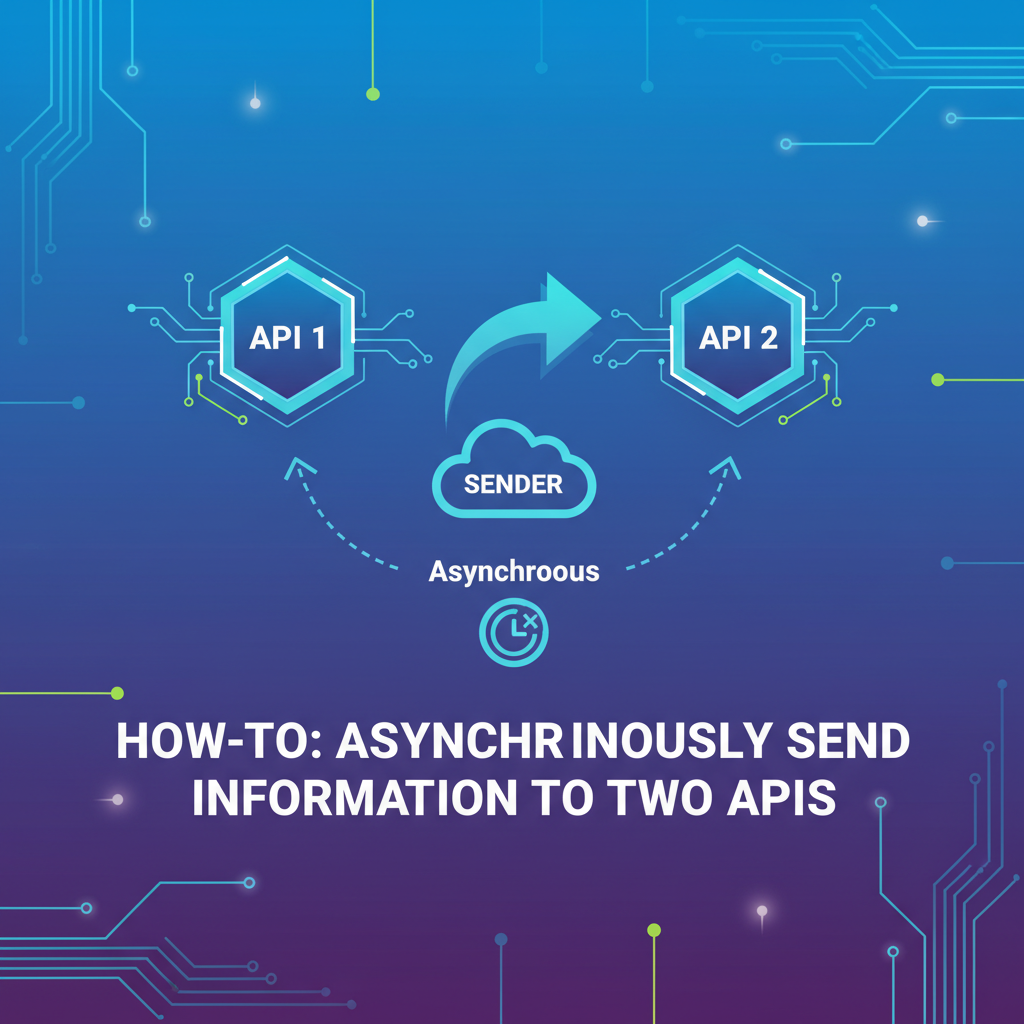


In the intricate tapestry of modern software architecture, the ability to communicate efficiently and reliably between services is paramount. As applications grow in complexity, the need to interact with multiple external or internal APIs concurrently becomes a common requirement. However, merely sending data to two APIs isn't enough; the manner in which this data is transmitted—specifically, asynchronously—can profoundly impact performance, user experience, and system resilience. This comprehensive guide delves into the methodologies, architectural patterns, and best practices for asynchronously sending information to two APIs, equipping you with the knowledge to build highly responsive and robust systems.
I. Introduction: Embracing Asynchronous Power in API Interactions
The digital landscape is a relentless pursuit of speed and responsiveness. Users expect instantaneous feedback, and businesses demand systems that can handle immense loads without faltering. In this environment, the traditional synchronous model of API interaction, where a request blocks until a response is received, often becomes a bottleneck. Imagine a scenario where a user signs up for a service. The primary action is to create a user account in your database. However, this action might also trigger secondary processes: sending a welcome email, updating a CRM system, or logging analytics data. If all these operations are performed synchronously, the user has to wait for the slowest link in the chain, leading to frustrating delays and a subpar experience.
This is precisely where asynchronous communication steps in as a game-changer. By decoupling the initiation of a task from its completion, asynchronous operations allow your application to continue processing other requests or performing other work while waiting for external services to respond. When you need to send information to two distinct APIs, adopting an asynchronous approach means that your system can initiate both calls without waiting for either to complete, significantly reducing perceived latency and improving overall system throughput. It's not just about speed; it's about building a more resilient system that can gracefully handle the inevitable transient failures of external services without grinding to a halt. This paradigm shift is fundamental to scaling applications and delivering superior user experiences in today's demanding digital ecosystem.
II. Understanding the Core Concepts
Before we dive into the practicalities of asynchronous communication with multiple APIs, it's crucial to solidify our understanding of the underlying concepts that govern this approach. A clear grasp of these principles will provide the foundation for making informed architectural decisions.
Synchronous vs. Asynchronous: A Fundamental Distinction
At its heart, the difference between synchronous and asynchronous operations lies in their blocking behavior.
- Synchronous Operations: In a synchronous model, when a task is initiated (e.g., calling an
API), the calling thread or process is blocked and waits for the task to complete and return a result before it can proceed with any further operations. Think of it like calling a customer service hotline where you must wait on the line for a representative to finish assisting another customer before they can attend to you. While simple to reason about in sequential code, this model can lead to significant delays and poor resource utilization when dealing with I/O-bound operations like network requests to anAPI. If oneAPIcall takes a long time, all subsequent operations are stalled. - Asynchronous Operations: Conversely, an asynchronous operation initiates a task and then immediately returns control to the calling thread or process, allowing it to continue with other work. The calling entity is notified (e.g., via a callback, a Promise, or an awaitable function) when the asynchronous task eventually completes. Using the customer service analogy, this is like sending an email inquiry; you send it, and you can immediately move on to other tasks while you wait for a response. When applied to
APIcalls, this means your application can initiate requests to twoAPIsconcurrently without waiting for either of them to finish, leading to much better responsiveness and efficiency. The application remains unblocked, handling other requests or performing computations, until the responses from theAPIsarrive.
Concurrency vs. Parallelism: More Than Just Speed
These two terms are often used interchangeably, but they represent distinct concepts critical to understanding asynchronous execution:
- Concurrency: Concurrency is about dealing with many things at once. It's an organizational principle, allowing multiple tasks to make progress seemingly simultaneously. A single CPU core can achieve concurrency by rapidly switching between different tasks, giving the illusion of parallel execution. For example, a web server can handle multiple incoming
APIrequests concurrently by rapidly switching between processing each request's I/O and computation phases. The context switching overhead is typically low enough that all requests appear to progress without significant delay. - Parallelism: Parallelism, on the other hand, is about doing many things at once, truly simultaneously. This requires multiple execution units (e.g., multiple CPU cores, threads, or distinct machines). If you have two CPU cores, you can genuinely execute two independent tasks at the exact same moment. When sending information to two
APIs, you might achieve parallelism if your system uses multiple threads or processes that can make these network calls simultaneously. However, even with a single thread, asynchronous I/O can achieve high levels of concurrency by not blocking on network operations, effectively making progress on other tasks while waiting forAPIresponses.
Latency and Throughput: The Performance Metrics
Asynchronous communication directly impacts these two critical performance metrics:
- Latency: The time delay between the cause and the effect in a system. In
APIcalls, it's the time from sending a request to receiving a response. Asynchronous operations, by not blocking, can reduce the perceived latency for the end-user by allowing the primary task to complete quickly, even if secondary tasks are still in progress. The total wall-clock time for all tasks might not decrease, but the user receives feedback faster. - Throughput: The rate at which a system can process units of work over a given period. By allowing your application to handle multiple
APIcalls and other tasks concurrently, asynchronous designs significantly increase the number of requests your system can process per second. Instead of one thread handling one request at a time, many requests can be "in flight" simultaneously, drastically improving overall system capacity.
Idempotency: A Safety Net for Retries
When dealing with asynchronous operations, especially those involving external API calls, failures are an inevitable part of distributed systems. Network glitches, API service unavailability, or timeouts can occur. This often necessitates retry mechanisms. Here, the concept of idempotency becomes paramount.
An operation is idempotent if executing it multiple times produces the same result as executing it once. For example, setting a value (e.g., PUT /users/123 {name: "Alice"}) is typically idempotent; calling it twice doesn't change the final state beyond the first call. Conversely, an operation like POST /orders {item: "book"} (creating a new order) is usually not idempotent, as calling it twice would create two separate orders.
When sending information to two APIs asynchronously, particularly if you implement retries for failed calls, ensuring that the API endpoints you are interacting with are idempotent (or that your system can handle non-idempotent operations safely) is critical. Without idempotency, a retried request that actually succeeded the first time could lead to duplicate data, incorrect state, or unintended side effects across your integrated systems. Thoughtful design around idempotency is a cornerstone of robust asynchronous API integrations.
III. Why Send Information to Two APIs Asynchronously? Real-World Scenarios
The decision to send information to two APIs asynchronously isn't an arbitrary one; it's driven by practical needs to improve system performance, resilience, and user experience. Let's explore several common real-world scenarios where this architectural choice provides significant benefits.
Primary Action + Secondary Notification/Logging
This is perhaps the most ubiquitous use case for asynchronous dual-API communication. Many user-facing actions require an immediate primary response while also triggering several "background" or non-critical secondary actions.
- User Signup/Registration: When a new user registers for a service, the immediate priority is to create their account in your primary user database and confirm the registration to the user. This is the critical, synchronous part. However, several other tasks can be performed asynchronously:
- Sending a welcome email or SMS via a third-party
API(e.g., SendGrid, Twilio). - Updating a Customer Relationship Management (CRM) system (e.g., Salesforce, HubSpot) with the new user's details via its
API. - Pushing user data to an analytics platform (e.g., Google Analytics, Mixpanel) for tracking and reporting via their respective
API. - Triggering an internal audit log
APIfor compliance purposes. The user doesn't need to wait for these secondaryAPIcalls to complete to know their account has been created. Performing these asynchronously allows for a much faster registration experience.
- Sending a welcome email or SMS via a third-party
- Order Placement/Transaction Processing: When a customer places an order on an e-commerce site, the immediate critical step is to process the payment and confirm the order.
- The payment
APIcall must be synchronous to confirm success or failure. - However, updating inventory levels via an inventory management
API, sending an order confirmation email, or notifying a fulfillment center'sAPIcan all happen asynchronously. The customer receives immediate confirmation that their order is placed, while the backend systems catch up without delaying the customer's experience.
- The payment
Data Replication/Duplication for Different Purposes
In complex data environments, information often needs to reside in multiple systems for different operational or analytical purposes. Asynchronously pushing data to these systems ensures eventual consistency without blocking primary operations.
- Operational Database + Analytics Data Lake/Warehouse: A new record created in your primary transactional database might also need to be pushed to an analytics data lake or warehouse for business intelligence and reporting. Sending this data to the analytics
APIasynchronously prevents the analytical data update from impacting the performance of the core transactional system. For example, a customer changing their shipping address in the main database can have that change asynchronously propagated to a separateAPIthat manages shipping preferences for a third-party logistics provider. - Search Indexing: When new content is added to a content management system or a product is updated in an e-commerce platform, the primary operation is to save the data. Simultaneously, this data needs to be indexed by a search service (e.g., Elasticsearch, Algolia) to make it searchable. Pushing updates to the search
APIasynchronously ensures that content updates are fast, and the search index eventually reflects the latest state without blocking the user interface.
Enrichment Services: Enhancing Data Post-Processing
Sometimes, a primary data submission needs to be enriched with additional information that comes from an external API. While the core data is saved quickly, the enrichment can occur in the background.
- User IP Address Geo-coding: When a user interacts with your service, you might log their IP address. Asynchronously, you could send this IP address to a geo-location
API(e.g., MaxMind) to enrich the user's profile with their country, region, and city, without adding latency to the initial interaction. - Content Moderation/Analysis: If users can submit text or images, the immediate action is to save the content. Subsequently, this content can be sent asynchronously to a moderation
API(e.g., Google Cloud Vision, AWS Rekognition for images, or a custom NLPAPIfor text) to check for inappropriate content or perform sentiment analysis. The user's submission is immediate, while the moderation process runs in the background.
Event-Driven Workflows: Triggering Multiple Downstream Services
In a microservices architecture, a single event occurring in one service might need to trigger actions in multiple other services. Asynchronous communication, often facilitated by message queues or event buses, is the backbone of such systems.
- Product Update Event: A product update in a "Product Management" microservice could trigger:
- An update to the inventory
APIin the "Inventory Service." - An update to the pricing
APIin the "Pricing Service." - An update to the search
APIin the "Search Service." All these downstream services react to the single "product updated" event asynchronously, ensuring loose coupling and scalability.
- An update to the inventory
By carefully considering these scenarios, developers can identify opportunities to leverage asynchronous communication when sending information to two or more APIs, leading to more performant, resilient, and user-friendly applications. The choice of pattern will depend on factors like consistency requirements, fault tolerance needs, and the overall complexity of the system architecture.
IV. Architectural Patterns for Asynchronous Dual-API Communication
Achieving asynchronous communication with two APIs can be approached through several architectural patterns, each with its own advantages, disadvantages, and suitability for different scenarios. The choice often depends on the level of decoupling desired, the complexity of error handling, scalability requirements, and existing infrastructure.
A. Client-Side Asynchrony: Delegating the Fan-Out to the Client
This is the simplest form of asynchronous communication, where the responsibility for initiating multiple API calls concurrently falls directly on the client application. The client makes two separate, non-blocking requests to the target APIs.
- Description: The user's browser (for web applications), mobile app, or desktop client directly sends two distinct
APIrequests. Modern web browsers and programming languages offer native constructs to manage these concurrent requests efficiently. - Pros:
- Simplicity: For straightforward cases, the implementation can be very simple, especially with modern
JavaScriptor client-side libraries. - Direct Feedback: The client can receive immediate feedback from each
APIindependently. - Reduced Server Load: The backend server responsible for the initial interaction doesn't need to orchestrate additional
APIcalls.
- Simplicity: For straightforward cases, the implementation can be very simple, especially with modern
- Cons:
- Client Burden: The client shoulders the responsibility of managing multiple requests, error handling for each, and potentially merging responses.
- Increased Network Overhead: The client makes more direct network calls, potentially increasing latency if the client is geographically distant from the
APIs. - Security Concerns: Exposing direct
APIendpoints to the client might raise security issues, requiring robust CORS policies andAPIkey management on the client-side. - Limited Backend Control: The backend has less control over the secondary operations, making centralized logging or detailed error handling more complex.
Example (JavaScript with Promise.all): ```javascript async function sendDataToTwoAPIsClientSide(data) { try { const api1Call = fetch('https://api1.example.com/endpoint', { method: 'POST', headers: {'Content-Type': 'application/json'}, body: JSON.stringify(data) }); const api2Call = fetch('https://api2.example.com/endpoint', { method: 'POST', headers: {'Content-Type': 'application/json'}, body: JSON.stringify(data) });
    const [response1, response2] = await Promise.all([api1Call, api2Call]);

    if (!response1.ok || !response2.ok) {
        // Handle non-2xx responses
        console.error('One or both API calls failed');
    }

    const result1 = await response1.json();
    const result2 = await response2.json();

    console.log('API 1 Success:', result1);
    console.log('API 2 Success:', result2);
    return { result1, result2 };

} catch (error) {
    console.error('Error sending data to APIs:', error);
    throw error;
}
} ```
B. Server-Side Asynchrony: Orchestration within a Single Service
In this pattern, a single backend service receives the initial request and then internally orchestrates the asynchronous calls to the two target APIs. This keeps the complexity away from the client and centralizes control.
- Description: Your backend application server handles an incoming request and then, instead of waiting for a response from the first external
APIbefore calling the second, it initiates bothAPIcalls in a non-blocking fashion. This can be achieved using various programming language constructs designed for asynchronous I/O. - Pros:
- Centralized Logic: All complex logic, error handling, and data transformations are managed server-side.
- Enhanced Security: External
APIkeys and credentials are never exposed to the client. - Improved Client Experience: The client only makes one request and receives a response faster, often before the secondary
APIcalls have even completed. - Greater Control: Better logging, monitoring, and retry mechanisms can be implemented.
- Cons:
- Service Complexity: The backend service needs to be designed to handle concurrency effectively, which can add complexity to the code.
- Resource Management: If not managed properly, too many concurrent outbound
APIcalls can exhaust server resources (e.g., open connections, memory).
- Implementation Techniques:
- Thread Pools/Task Queues: In languages like Java, an
ExecutorServicecan manage a pool of threads to executeAPIcalls in parallel. In Python,ThreadPoolExecutorserves a similar purpose. - Asynchronous I/O Frameworks:
- Node.js: Built around an event loop,
async/awaitsyntax with libraries likeaxiosornode-fetchmakes this pattern very natural. - Python: The
asynciolibrary withhttpxoraiohttpallows for highly concurrent network operations. - Java:
CompletableFutureprovides a powerful way to compose and manage asynchronous operations. Spring WebFlux offers a reactive programming model. - Go: Goroutines and channels provide a lightweight and efficient way to achieve concurrency.
- Node.js: Built around an event loop,
- Thread Pools/Task Queues: In languages like Java, an
Example (Python with asyncio): ```python import asyncio import httpx import jsonasync def send_data_to_api(client, api_url, data): try: response = await client.post(api_url, json=data) response.raise_for_status() # Raises HTTPStatusError for bad responses (4xx or 5xx) return response.json() except httpx.HTTPStatusError as e: print(f"API call to {api_url} failed with status {e.response.status_code}: {e.response.text}") raise except httpx.RequestError as e: print(f"API call to {api_url} encountered a request error: {e}") raiseasync def send_data_to_two_apis_server_side(data): async with httpx.AsyncClient() as client: api1_url = 'https://api1.example.com/endpoint' api2_url = 'https://api2.example.com/endpoint'
    task1 = asyncio.create_task(send_data_to_api(client, api1_url, data))
    task2 = asyncio.create_task(send_data_to_api(client, api2_url, data))

    try:
        result1, result2 = await asyncio.gather(task1, task2, return_exceptions=True)

        if isinstance(result1, Exception):
            print(f"API 1 call failed: {result1}")
        else:
            print("API 1 Success:", result1)

        if isinstance(result2, Exception):
            print(f"API 2 call failed: {result2}")
        else:
            print("API 2 Success:", result2)

        return {"api1": result1, "api2": result2}

    except Exception as e:
        print(f"An unexpected error occurred during concurrent API calls: {e}")
        raise
```
C. Message Queues: Decoupling and Durability
For highly scalable, resilient, and decoupled systems, message queues are an indispensable tool for asynchronous communication.
- Description: Instead of directly calling the target
APIs, the initial service publishes a message (representing the data to be sent) to a message queue. Separate consumer services (or even multiple instances of the same consumer) then subscribe to this queue, pick up messages, and interact with the targetAPIs. This introduces an intermediary layer that decouples the producer from the consumers. - Pros:
- High Decoupling: The producer (your initial service) doesn't need to know anything about the consumers or the target
APIs. It just publishes a message. This makes the system easier to evolve and maintain. - Resilience: Messages are typically persisted in the queue, ensuring that if a consumer or target
APIis temporarily unavailable, the message won't be lost and can be processed later. - Scalability: You can easily scale consumers horizontally by adding more instances to process messages from the queue in parallel.
- Load Leveling/Backpressure Handling: Queues can buffer spikes in traffic, protecting downstream
APIsfrom being overwhelmed. - Guaranteed Delivery: Most message queues offer mechanisms for guaranteed message delivery (at-least-once or exactly-once semantics).
- High Decoupling: The producer (your initial service) doesn't need to know anything about the consumers or the target
- Cons:
- Increased Complexity: Introduces a new component (the message queue infrastructure) that needs to be managed, monitored, and understood.
- Eventual Consistency: Data updates across systems are eventually consistent, meaning there might be a short delay before all systems reflect the latest state. This might not be suitable for all scenarios requiring strong consistency.
- Operational Overhead: Managing a message queue system can require specialized knowledge.
- Popular Message Queues:
- RabbitMQ: A robust, general-purpose message broker.
- Apache Kafka: A distributed streaming platform, often used for high-throughput, real-time data feeds.
- AWS SQS (Simple Queue Service): A fully managed message queuing service by AWS.
- Azure Service Bus: Microsoft's fully managed enterprise message broker.
- Workflow:
- Your initial service (Producer) receives a request.
- It serializes the data and publishes it as a message to a predefined queue.
- The service responds to the client (often immediately).
- A dedicated Consumer service (or two separate consumers) monitors the queue.
- Upon receiving a message, Consumer 1 processes it and sends data to
API1. - Consumer 2 (or a part of Consumer 1's logic) processes the same or a similar message and sends data to
API2. - Note: If two distinct
APIcalls are needed, you might have one message for eachAPI, or a single message consumed by two different consumers, each responsible for oneAPI.
- Example (Conceptual with Python and RabbitMQ):
Producer: ```python import pika import jsonconnection = pika.BlockingConnection(pika.ConnectionParameters('localhost')) channel = connection.channel() channel.queue_declare(queue='api_data_queue')def publish_data(data): message = json.dumps(data) channel.basic_publish(exchange='', routing_key='api_data_queue', body=message) print(" [x] Sent '%s'" % message)
In your main service's request handler:
publish_data({"user_id": "123", "email": "test@example.com"})
connection.close() * **Consumer (processing for API 1):**python import pika import json import requestsconnection = pika.BlockingConnection(pika.ConnectionParameters('localhost')) channel = connection.channel() channel.queue_declare(queue='api_data_queue')def callback_api1(ch, method, properties, body): data = json.loads(body) print(f" [x] Received for API 1: {data}") try: response = requests.post('https://api1.example.com/endpoint', json=data) response.raise_for_status() print(f"API 1 call successful for {data}") except requests.exceptions.RequestException as e: print(f"API 1 call failed: {e}") # Re-queue message or send to Dead-Letter Queue (DLQ) ch.basic_ack(method.delivery_tag)channel.basic_consume(queue='api_data_queue', on_message_callback=callback_api1) print(' [*] Waiting for messages for API 1. To exit press CTRL+C') channel.start_consuming() `` * A similar consumer would be set up forAPI` 2, possibly subscribing to the same queue if it processes the same data, or a different queue if the data payloads are distinct.
D. Event-Driven Architectures with Event Buses
An event-driven architecture extends the concept of message queues by focusing on events—immutable facts that have occurred in a system. An event bus acts as a central nervous system, routing these events to multiple interested subscribers.
- Description: Instead of sending a specific message to a specific queue for a specific
API, a service publishes a domain event (e.g., "UserRegisteredEvent," "OrderPlacedEvent") to an event bus. Multiple other services or functions can subscribe to these events. When an event occurs, the bus intelligently routes it to all subscribers, which can then independently decide how to react, including calling relevantAPIs. - Pros:
- Extreme Decoupling: Producers and consumers have no direct knowledge of each other.
- Highly Scalable: Can handle very high volumes of events and propagate them to a large number of consumers.
- Microservices Friendly: Ideal for complex microservices landscapes where many services need to react to state changes in others.
- Flexibility: New services can easily subscribe to existing events without altering producers.
- Cons:
- Distributed Tracing Complexity: Following the flow of an event through multiple services and
APIcalls can be challenging. - Eventual Consistency: Similar to message queues, strong consistency across all systems is not guaranteed immediately.
- Debugging Challenges: Debugging issues in a highly distributed, event-driven system can be complex.
- Distributed Tracing Complexity: Following the flow of an event through multiple services and
- Example: AWS EventBridge, Kafka as an event log.
- Workflow:
- Service A emits a "UserCreated" event to the Event Bus.
- The Event Bus routes this event to all subscribed targets.
- Target 1 (e.g., a Lambda function) receives the event, extracts user data, and calls
API1 (e.g., email service). - Target 2 (e.g., another Lambda function or a microservice) receives the same event, extracts user data, and calls
API2 (e.g., CRM system).
E. The Role of an API Gateway in Orchestration and Fan-Out
An API Gateway serves as a single entry point for all client requests, acting as a facade for multiple backend services. It can play a crucial role in orchestrating asynchronous calls and facilitating a "fan-out" pattern to multiple APIs.
- Description: An API Gateway receives a single request from a client. Instead of forwarding it to just one backend service, the gateway itself is configured to either:
- Directly initiate multiple asynchronous calls to two (or more) downstream
APIsand aggregate their responses (if needed). - Trigger a message queue or event bus internally, which then fans out to the target
APIsas described in patterns C and D. - Act as a reverse proxy that routes specific parts of the request to different backends based on rules.
- Directly initiate multiple asynchronous calls to two (or more) downstream
- Pros:
- Centralized Control: Handles authentication, authorization, rate limiting, caching, and logging in a single place before requests even reach your backend services.
- Simplified Client: The client only needs to know one
APIendpoint (the gateway). - Backend Decoupling: Shields the client from backend service changes or deployments.
- Orchestration Capabilities: Can perform light orchestration, transforming requests and responses, or even initiating multiple backend calls.
- Improved Security: Provides a perimeter defense for your backend
APIs.
- Cons:
- Single Point of Failure: Needs to be highly available and fault-tolerant.
- Increased Latency: Adds an extra hop in the request path, though often negligible with well-optimized gateways.
- Complexity: Configuring and managing a sophisticated API gateway can be complex.
APIPark Integration: This is an excellent juncture to introduce APIPark. As an open-source AI gateway and API management platform, APIPark is precisely designed to handle the complexities of managing, integrating, and deploying diverse API services, making it an ideal candidate for orchestrating asynchronous calls to multiple APIs. APIPark can act as that crucial API gateway layer, intercepting incoming requests and, based on its powerful configuration capabilities, intelligently forwarding or fanning out information.
With APIPark, you can define rules that, upon receiving a single client request, trigger calls to multiple backend APIs—be they traditional REST services or AI models. Its features like "Unified API Format for AI Invocation" and "Prompt Encapsulation into REST API" become incredibly valuable when you need to send similar data to disparate API types or even different versions of the same API. For instance, if you're sending user data to an internal CRM API and also to an external AI sentiment analysis API upon a user interaction, APIPark can streamline this process. It manages the traffic forwarding, load balancing, and versioning of published APIs, ensuring that your asynchronous calls are handled efficiently and reliably. Furthermore, APIPark's "End-to-End API Lifecycle Management" assists in regulating these complex API management processes, ensuring security with features like "API Resource Access Requires Approval" and providing "Detailed API Call Logging" and "Powerful Data Analysis" crucial for monitoring these asynchronous flows. APIPark's high performance, rivaling Nginx, ensures that even with the added orchestration, your system can handle over 20,000 TPS, supporting cluster deployment for large-scale traffic.
F. Serverless Functions for Specific Asynchronous Tasks
Serverless functions (e.g., AWS Lambda, Azure Functions, Google Cloud Functions) offer an excellent way to offload specific, often short-lived, asynchronous tasks, including making API calls.
- Description: Your main service can trigger a serverless function, passing it the necessary data. This function then becomes responsible for making the calls to the two target
APIs. The trigger could be a message in a queue (pattern C), an event on an event bus (pattern D), or a direct invocation from your main service. - Pros:
- Scalability: Functions scale automatically based on demand.
- Pay-per-execution: You only pay for the compute time consumed, making it cost-effective for intermittent workloads.
- Reduced Operational Burden: No servers to manage or patch.
- High Availability: Inherently highly available within the cloud provider's infrastructure.
- Cons:
- Cold Starts: Functions might experience a slight delay on their first invocation after a period of inactivity.
- Vendor Lock-in: Tightly coupled to a specific cloud provider's ecosystem.
- Debugging Complexity: Debugging distributed serverless workflows can be more challenging than traditional monolithic applications.
- Execution Limits: Functions often have memory and execution duration limits.
- Workflow:
- Your main service completes its primary task.
- It sends a message to an SQS queue, publishes an event to EventBridge, or directly invokes a Lambda function.
- The Lambda function is triggered.
- Inside the Lambda, code makes the two asynchronous
APIcalls using standard HTTP clients (e.g.,requestsin Python,axiosin Node.js). - The Lambda function completes its execution.
By understanding these architectural patterns, you can select the most appropriate strategy for your specific asynchronous dual-API communication needs, considering trade-offs between complexity, scalability, resilience, and performance.
APIPark is a high-performance AI gateway that allows you to securely access the most comprehensive LLM APIs globally on the APIPark platform, including OpenAI, Anthropic, Mistral, Llama2, Google Gemini, and more.Try APIPark now! 👇👇👇
V. Deep Dive into Implementation Considerations and Best Practices
Implementing asynchronous communication to multiple APIs goes beyond merely choosing an architectural pattern. It demands careful consideration of various challenges inherent in distributed systems, coupled with robust best practices to ensure reliability, consistency, and maintainability.
A. Data Consistency: Navigating the Trade-offs
When sending information to two APIs asynchronously, especially if these APIs represent different data stores or services, managing data consistency becomes a paramount concern.
- Eventual Consistency vs. Strong Consistency:
- Strong Consistency: Requires that all data replicas are updated and consistent before a read operation can return success. This is typically achieved with synchronous transactions but significantly increases latency and reduces availability in distributed systems. For asynchronous dual-API calls, strong consistency is usually impractical or impossible without complex distributed transaction managers (which often introduce their own performance issues).
- Eventual Consistency: A more common and practical model for asynchronous systems. It means that after an update, eventually, all replicas will reflect the same data, but there might be a period during which they are inconsistent. For instance, if you asynchronously update a user profile in your main database and also in an analytics API, the analytics data might lag behind for a few milliseconds or seconds.
- Strategies for Reconciliation: When eventual consistency is accepted, you need strategies to handle the temporary inconsistencies and ensure that the system eventually converges. This might involve:
- Idempotency: As discussed, ensuring API calls can be retried without side effects.
- Compensating Transactions: If one API call succeeds and another fails, you might need to "undo" the successful one or notify relevant parties. For example, if user signup fails to update the CRM API, a separate process might eventually detect this discrepancy and attempt to reconcile it.
- Auditing and Logging: Comprehensive logs help identify and diagnose consistency issues.
- Regular Synchronization Jobs: Batch jobs can run periodically to compare data between systems and synchronize any discrepancies.
B. Robust Error Handling and Retries
Failures are inevitable in distributed systems. Network glitches, API rate limits, temporary service unavailability, or malformed requests can all cause an asynchronous API call to fail. A robust system must anticipate and gracefully handle these situations.
- Network Failures and Timeouts:
- Configure reasonable timeouts for external API calls to prevent indefinite blocking.
- Distinguish between transient (recoverable) and permanent (non-recoverable) errors. Network errors or 5xx HTTP codes are often transient.
- Exponential Backoff with Jitter: When retrying failed API calls, simply retrying immediately can overload a struggling service.
- Exponential Backoff: Gradually increase the delay between retries (e.g., 1s, 2s, 4s, 8s).
- Jitter: Add a random component to the backoff delay to prevent all retries from hitting the service simultaneously, which can happen if many instances retry at the same exponential interval.
- Dead-Letter Queues (DLQs): For messages that consistently fail to be processed after multiple retries, a Dead-Letter Queue is essential. Messages are moved to a DLQ after exceeding a maximum retry count, allowing human operators to inspect them, diagnose the issue, and potentially reprocess them manually or after a fix. This prevents poisoned messages from indefinitely blocking a queue.
- Circuit Breakers: Implement a circuit breaker pattern to prevent your system from repeatedly calling a failing external API. When a certain number of failures occur within a threshold, the circuit "trips," and subsequent calls to that API are immediately failed without attempting a network request. After a set timeout, the circuit moves to a "half-open" state, allowing a few test requests to see if the API has recovered. This protects the downstream API and prevents your service from wasting resources on failed calls.
C. Ensuring Idempotency
As previously discussed, idempotency is paramount when designing retry mechanisms for asynchronous API calls.
- Why It's Critical: If an API call (e.g., creating a new user) is not idempotent, retrying it after a network timeout (where the original request might have actually succeeded) could lead to duplicate users or unintended data.
- Strategies for Idempotency:
- Unique Request IDs: Include a unique, client-generated request ID in the header or body of every API call. The downstream API can then use this ID to detect duplicate requests within a certain time window and return the original response without reprocessing.
- Conditional Operations: Use operations that are inherently idempotent, like "set if not exists" or "update if version matches."
- API Design: Design your APIs to be idempotent where possible (e.g.,
PUTfor updates/creation, rather thanPOST).
D. Monitoring, Logging, and Observability
In a distributed, asynchronous system, understanding what's happening becomes exponentially harder without robust observability.
- Distributed Tracing: Tools like OpenTelemetry, Zipkin, or Jaeger are crucial. They assign a unique trace ID to each request as it enters your system and propagate it across all services and asynchronous calls. This allows you to visualize the entire flow of an operation, identifying bottlenecks and failures across multiple service boundaries, including those involving
APIcalls. - Centralized Logging: Aggregate logs from all services and
APIinteractions into a central platform (e.g., ELK stack, Splunk, AWS CloudWatch Logs, Google Cloud Logging). Ensure logs are structured (JSON) and include correlation IDs (like trace IDs) to link related events. Detailed logging of request payloads, responses, errors, and retry attempts for eachAPIcall is indispensable. - Metrics and Alerting: Collect metrics on the success rate, latency, and error rate of each external
APIcall. Set up alerts for deviations from normal behavior (e.g., increased error rates, unusual latency spikes). - APIPark's Detailed
APICall Logging and Powerful Data Analysis: This is where APIPark shines as a critical asset. Its robust logging capabilities record every detail of eachAPIcall, providing a single pane of glass to trace and troubleshoot issues in asynchronousAPIinvocations. By collecting comprehensive logs and offering powerful data analysis, APIPark helps businesses not only react to problems but also perform preventive maintenance by displaying long-term trends and performance changes, ensuring system stability and data security even in complex asynchronous setups.
E. Security Considerations
Sending data to multiple APIs, especially asynchronously, introduces several security vectors that need careful management.
- API Keys, OAuth, JWTs: Ensure that credentials for accessing each external API are securely stored and transmitted. Avoid hardcoding sensitive information. Use secure credential management systems (e.g., AWS Secrets Manager, HashiCorp Vault).
- Protecting Credentials for Multiple API Calls: If your service is making multiple external
APIcalls, eachAPImight require its own authentication. Manage these securely, perhaps using environment variables, anAPI gateway(which can inject credentials), or a secrets management service. - API Gateway's Role in Centralized Security: An API gateway is invaluable here. It can centralize authentication and authorization logic, validating incoming client requests before they even touch your backend services. It can also securely store and inject credentials for downstream
APIcalls. APIPark, for example, offers "Independent API and Access Permissions for Each Tenant" and "API Resource Access Requires Approval" features, which are vital for controlling who can invoke which API, preventing unauthorized calls and potential data breaches, even in an asynchronous environment.
F. Performance Tuning and Scalability
While asynchronicity inherently boosts performance and scalability, specific tuning and strategies can further optimize your dual-API communication.
- Connection Pooling: Reusing HTTP connections for subsequent requests to the same host can significantly reduce overhead. Most modern HTTP client libraries offer connection pooling.
- Concurrent Requests Limits: While you want to be asynchronous, avoid overwhelming downstream APIs or your own server resources by making an uncontrolled number of concurrent requests. Implement limits on the number of simultaneous outbound
APIcalls. - Load Balancing (especially relevant for API Gateway): If your
API gatewayor backend services are distributed, ensure they are load-balanced to distribute incoming traffic evenly and improve resilience. - Caching Strategies: If data from external
APIsis frequently requested and doesn't change rapidly, implement caching to reduce the number of actualAPIcalls.
G. Versioning of APIs
When dealing with multiple APIs, changes to one can impact others. API versioning is a strategy to manage these changes gracefully.
- Backward Compatibility: Strive for backward compatibility in your
APIdesigns. - Clear Versioning Strategy: Use URL versioning (
/v1/users), header versioning (Accept: application/vnd.example.v1+json), or query parameter versioning (?api-version=1.0). - Coexistence: Allow different versions of
APIsto coexist for a period, giving consumers time to migrate.
By meticulously addressing these considerations, you can build asynchronous dual-API communication systems that are not only fast and responsive but also robust, secure, and maintainable in the long term.
VI. Choosing the Right Asynchronous Approach: A Comparative Table
Selecting the optimal architectural pattern for asynchronously sending information to two APIs depends on a multitude of factors, including the desired level of decoupling, system complexity, resilience requirements, budget constraints, and team expertise. To aid in this decision-making process, the following comparative table outlines the key characteristics of each pattern discussed.
| Feature/Criterion | Client-Side Async | Server-Side Async | Message Queue | API Gateway Fan-Out | Serverless Function |
|---|---|---|---|---|---|
| Decoupling Level | Low (Client to each API) | Medium (Backend to each API) | High (Producer from Consumer) | Medium (Client from Backend; Gateway from APIs) | High (Trigger from Function; Function from APIs) |
| Complexity | Low (for simple cases) | Medium | High (Infrastructure) | Medium (Configuration) | Medium (Orchestration, Cold Starts) |
| Resilience | Low (Client must retry) | Medium (Backend can retry) | High (Persistent messages) | Medium (Gateway retries/DLQ) | High (Platform managed) |
| Data Consistency | Hard to manage | Moderate (Backend logic) | Eventual (via messages) | Moderate | Eventual |
| Latency | Best perceived (direct calls) | Good (Internal concurrency) | Increased (Queue hop) | Moderate (Gateway hop) | Variable (Cold starts) |
| Security | Low (API keys exposed) | High (Backend handles keys) | High (Queue access control) | High (Centralized control) | High (Platform managed) |
| Scalability | Client dependent | Backend instance limits | High (Horizontal scaling) | High (Gateway scaling) | High (Automatic scaling) |
| Cost | Low (No extra infra) | Moderate (Server resources) | High (Managed service/Ops) | Moderate (Gateway infra) | Variable (Pay-per-use) |
| Use Case Examples | Simple UI updates, Analytics tracking | Backend workflows, Data synchronization | Event-driven microservices, Data pipelines | Centralized routing, API aggregation, Microservice proxy | Event handlers, Background tasks, IoT processing |
| Ideal For | Light, non-critical updates from frontend | Core business logic, Moderate volume | High-volume, highly decoupled systems, Guarantees | Unifying APIs, Centralized security/policy, Multi-backend routing | Specific, intermittent tasks, Low operational overhead |
| Keywords Emphasis | API |
API |
API, Gateway (as source) |
API Gateway, Gateway, API |
API |
Explanation of Criteria:
- Decoupling Level: How independent the communicating parties are. Higher decoupling means changes in one part are less likely to break another.
- Complexity: The effort required for implementation, deployment, and ongoing management.
- Resilience: The ability of the system to recover from failures and continue operating.
- Data Consistency: The degree to which data across different systems is synchronized. "Eventual" means temporary inconsistencies are accepted.
- Latency: The time delay from initiating a request to receiving a meaningful response. "Perceived" refers to what the end-user experiences.
- Security: How well the pattern allows for secure handling of credentials and access control.
- Scalability: The ability to handle increasing loads by adding resources.
- Cost: The financial outlay for infrastructure, operations, and development.
- Use Case Examples: Typical scenarios where the pattern is commonly applied.
- Ideal For: The types of projects or requirements where the pattern particularly excels.
- Keywords Emphasis: How naturally
api,api gateway, andgatewaykeywords are integrated into the explanation of the pattern.
This table serves as a quick reference to guide your architectural decisions. Often, a hybrid approach combining elements from multiple patterns (e.g., using an API Gateway that publishes to a Message Queue) might be the most effective solution for complex environments.
VII. Practical Steps to Implement Asynchronous Dual-API Communication
With a clear understanding of the concepts and architectural patterns, let's outline a practical, step-by-step approach to implementing asynchronous communication when sending information to two APIs.
Step 1: Identify Your APIs and Their Requirements
Before writing any code, gain a deep understanding of the APIs you intend to interact with:
- Purpose of Each API: Clearly define what each API does and what data it expects.
- API Documentation: Thoroughly review the documentation for each API, noting endpoints, request methods (GET, POST, PUT, DELETE), required headers, authentication schemes, rate limits, and response formats (JSON, XML).
- Synchronous vs. Asynchronous Nature: Determine if the APIs themselves offer any asynchronous endpoints or webhooks that could simplify your integration.
- Criticality: Assess the criticality of each API call. Is one more important than the other? Can the system function if one fails? This will inform your error handling strategy.
- Data Dependencies: Is the data sent to API 2 dependent on the response from API 1? If so, this introduces a partial synchronous dependency that needs to be managed within your asynchronous flow.
- Idempotency: Determine if the target API endpoints are idempotent. This is crucial for designing robust retry mechanisms.
Step 2: Choose the Appropriate Pattern
Based on the requirements identified in Step 1 and the comparative table in Section VI, select the architectural pattern that best fits your needs.
- Simple Client-Side: If the secondary API calls are non-critical, security isn't a major concern for direct client access, and simplicity is key.
- Server-Side Asynchrony: For centralized control, security, and a balance of complexity and performance when immediate processing is required but can be non-blocking. This is a common choice for many backend applications.
- Message Queues/Event Buses: For high-volume, highly decoupled systems, where resilience and eventual consistency are acceptable, and you want to scale producers and consumers independently.
- API Gateway Fan-Out: If you need centralized authentication, rate limiting, and the ability to route to multiple backends, potentially abstracting client interaction from backend complexity. Consider APIPark here for its robust management and AI integration capabilities, especially if you're dealing with a mix of REST and AI-driven APIs.
- Serverless Functions: For specific, isolated asynchronous tasks that benefit from automatic scaling and pay-per-execution models.
Step 3: Design Error Handling and Retry Mechanisms
Robust error handling is non-negotiable for asynchronous interactions.
- Identify Error Types: Categorize potential errors (network issues, API-specific errors, timeouts, rate limits).
- Transient vs. Permanent: Distinguish errors that can be retried (transient) from those that indicate a fundamental problem (permanent) and should not be retried.
- Retry Strategy: Implement exponential backoff with jitter for transient errors.
- Max Retries: Define a maximum number of retries to prevent infinite loops.
- Dead-Letter Queues (DLQs): If using message queues, configure DLQs for messages that consistently fail to process.
- Circuit Breakers: Consider implementing circuit breakers for external APIs to prevent cascading failures.
- Fallback Mechanisms: If an API call fails, can you provide a degraded but still functional experience, or log the failure for later manual reconciliation?
Step 4: Implement Idempotency
Address idempotency from both the calling client and the receiving API perspective.
- Client-Side: When sending requests, include a unique
Idempotency-KeyorRequest-IDheader if the target APIs support it. Generate this key using a UUID or a hash of the request payload and timestamp. - API-Side (if you control the target APIs): Implement logic within your APIs to check for duplicate request IDs and prevent reprocessing.
- Data Structures: Design your data structures and database schemas to support idempotency checks.
Step 5: Set Up Monitoring, Logging, and Observability
Visibility into your asynchronous flows is crucial for debugging and operational health.
- Centralized Logging: Ensure all your services, including those making
APIcalls, log to a centralized system. Include relevant context such asrequest IDs,trace IDs, timestamps, and specificAPIcall details (endpoint, status code, duration, any error messages). - Distributed Tracing: Integrate a distributed tracing solution. This is paramount for understanding the flow of a single logical operation across multiple asynchronous
APIcalls and services. - Metrics Collection: Instrument your code to collect metrics on
APIcall success rates, latency, and error counts. - Alerting: Configure alerts for critical thresholds, such as increased
APIerror rates, prolonged latency, or messages accumulating in DLQs. - Leverage Gateway Features: If using an
API gatewaylike APIPark, utilize its built-in detailedAPIcall logging and powerful data analysis features to gain deep insights into yourAPItraffic, performance, and potential issues, especially when managing numerous asynchronous interactions.
Step 6: Test Thoroughly
Asynchronous and distributed systems are notoriously difficult to test. A comprehensive testing strategy is vital.
- Unit Tests: Test the logic of your
APIintegration components in isolation, mocking externalAPIresponses. - Integration Tests: Test the interaction between your service and the actual external
APIs(using test environments, not production). - End-to-End Tests: Verify that the entire asynchronous flow, from client request to both
APIcalls completing, works as expected. - Failure Scenario Tests: Crucially, test how your system behaves when one or both
APIsfail, time out, or return error responses. Verify that retries, DLQs, and circuit breakers function correctly. - Load Testing: Simulate high traffic to ensure your asynchronous implementation scales and performs under stress without exhausting resources or overwhelming downstream APIs.
By meticulously following these steps, you can build robust, resilient, and performant systems capable of efficiently sending information to two APIs asynchronously, providing a superior experience for your users and maintaining the health of your services.
VIII. Conclusion: Mastering Asynchronous API Interactions for Modern Systems
The journey through the complexities of asynchronously sending information to two APIs reveals a fundamental truth about modern software development: complexity is inevitable, but manageability is a choice. By embracing asynchronous communication patterns, developers unlock a powerful paradigm that transcends the limitations of traditional synchronous processing. We've explored how decoupling API calls can dramatically enhance application performance, responsiveness, and resilience, moving away from bottlenecks towards a more fluid and efficient system architecture.
From the simplicity of client-side Promise.all to the robust decoupling offered by message queues, the orchestrated power of an API gateway like APIPark, and the elasticity of serverless functions, a diverse toolkit exists to tackle various asynchronous integration challenges. Each pattern brings its own set of trade-offs, demanding careful consideration of factors like data consistency, error handling, security, and scalability.
Ultimately, mastering asynchronous API interactions is not merely a technical exercise; it's a strategic imperative for building systems that can meet the dynamic demands of today's digital landscape. It requires a holistic approach that prioritizes thoughtful design, meticulous error handling, rigorous testing, and comprehensive observability. By diligently applying the principles and practices outlined in this guide, you can confidently architect and implement solutions that are not only capable of sending data to multiple APIs efficiently but are also resilient, scalable, and a pleasure to maintain. The future of robust, high-performance applications lies in the intelligent orchestration of asynchronous power, ensuring that your systems are always responsive, even when facing the inherent uncertainties of distributed environments.
IX. Frequently Asked Questions (FAQs)
1. What is the primary benefit of sending information to two APIs asynchronously instead of synchronously?
The primary benefit is improved performance, responsiveness, and resilience. Asynchronous communication allows your application to initiate both API calls simultaneously without waiting for either to complete. This prevents the slowest API call from blocking the entire operation, leading to faster response times for the end-user, better resource utilization, and a more robust system that can gracefully handle transient failures in external services.
2. When should I choose an API Gateway for asynchronous fan-out versus a Message Queue?
Choose an API Gateway (like APIPark) when you need centralized control over authentication, authorization, rate limiting, and routing, or when you want to abstract the backend complexity from the client. An API Gateway can directly orchestrate the fan-out to multiple APIs or even integrate with message queues internally. Choose a Message Queue (e.g., Kafka, RabbitMQ) when you need higher levels of decoupling, guaranteed message delivery, load leveling (buffering spikes in traffic), and the ability to scale producers and consumers independently. Message queues are ideal for event-driven architectures and long-running background tasks where immediate response aggregation is not critical.
3. How do I handle data consistency when asynchronously sending information to multiple systems?
Data consistency in asynchronous systems typically leans towards eventual consistency, meaning all systems will eventually reflect the same data, but there might be a temporary lag. To manage this, implement strategies like: * Idempotency: Ensure API calls can be retried without creating duplicate data. * Compensating Transactions: Design mechanisms to undo or correct operations if one part of a multi-API transaction fails. * Auditing and Logging: Maintain comprehensive logs to identify and diagnose discrepancies. * Reconciliation Processes: Implement periodic jobs to compare and synchronize data across systems. * User Expectations: Clearly communicate to users that some secondary updates might take a moment to reflect.
4. What are some key error handling strategies for asynchronous API calls?
Robust error handling is crucial. Key strategies include: * Timeouts: Configure reasonable timeouts for all external API calls. * Retry Mechanisms: Implement exponential backoff with jitter to retry transient failures, preventing overwhelming the failing API. * Dead-Letter Queues (DLQs): For messages that consistently fail after multiple retries in message-based systems, move them to a DLQ for manual inspection and reprocessing. * Circuit Breakers: Implement circuit breakers to prevent your service from repeatedly calling a known-failing API, protecting both your service and the downstream API. * Fallback Mechanisms: Define alternative actions or provide a degraded experience if an API call fails.
5. Why is idempotency so important in asynchronous API communication?
Idempotency is critical because asynchronous operations are prone to retries due to transient network issues, timeouts, or API service unavailability. If an operation is not idempotent (e.g., creating a resource), retrying a request that might have actually succeeded (but whose response was lost) could lead to unintended side effects like duplicate records, incorrect state, or double charging. By ensuring operations are idempotent, you guarantee that executing them multiple times produces the same result as executing them once, making your system much more resilient and reliable when dealing with retries.
🚀You can securely and efficiently call the OpenAI API on APIPark in just two steps:
Step 1: Deploy the APIPark AI gateway in 5 minutes.
APIPark is developed based on Golang, offering strong product performance and low development and maintenance costs. You can deploy APIPark with a single command line.
curl -sSO https://download.apipark.com/install/quick-start.sh; bash quick-start.sh

In my experience, you can see the successful deployment interface within 5 to 10 minutes. Then, you can log in to APIPark using your account.

Step 2: Call the OpenAI API.