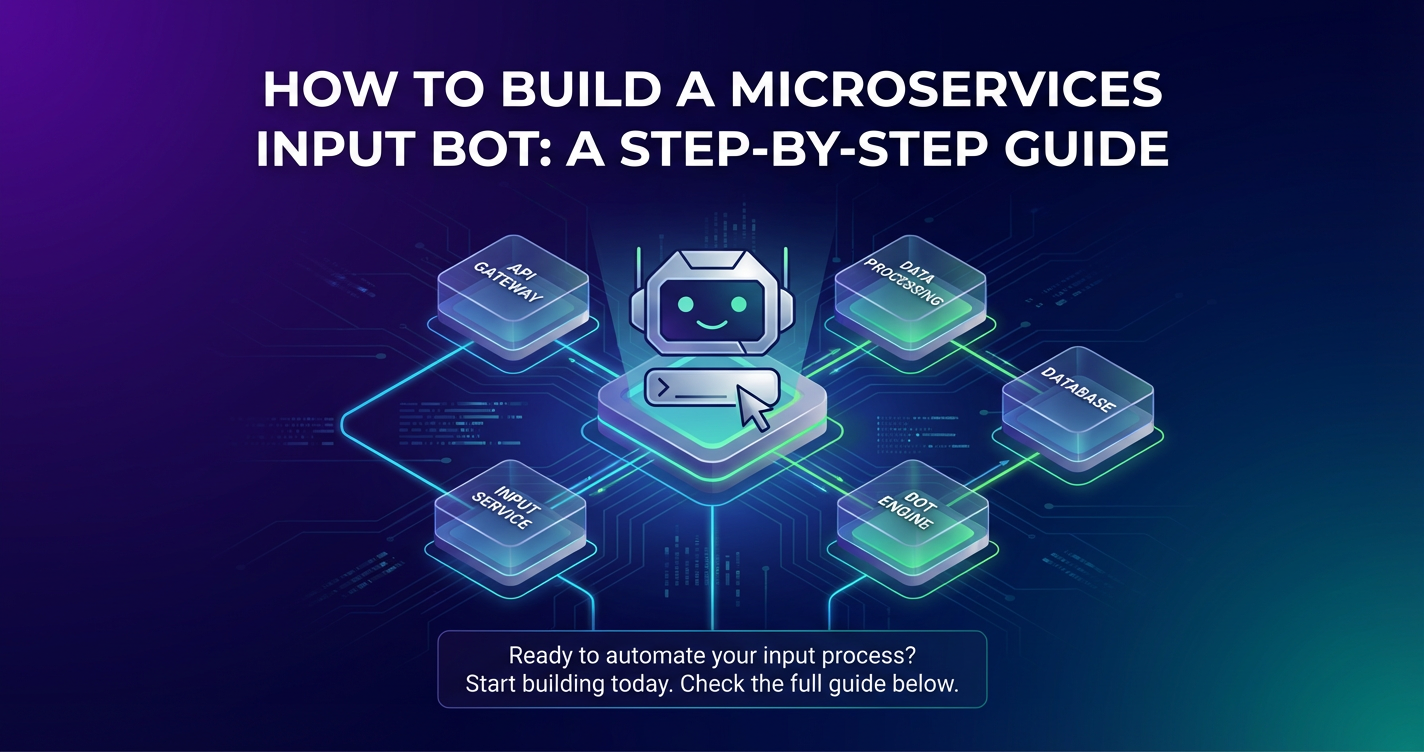
How to Build a Microservices Input Bot: A Step-by-Step Guide


The digital landscape is continuously evolving, demanding more intelligent, responsive, and scalable applications. Among these, input bots, capable of understanding and interacting with users through various modalities, have emerged as indispensable tools for enhancing customer service, streamlining operations, and delivering personalized experiences. From simple chatbots answering frequently asked questions to sophisticated virtual assistants orchestrating complex workflows, the utility of these bots is undeniable. However, building such systems, especially those designed for enterprise-grade performance and future extensibility, requires a robust architectural foundation. This guide delves into the intricate process of constructing a microservices-based input bot, offering a comprehensive, step-by-step approach that embraces modern architectural patterns and critical components like api gateway solutions, LLM Gateway functionalities, and robust Model Context Protocol implementations.
The decision to adopt a microservices architecture for an input bot is not merely a technical preference but a strategic choice driven by the inherent complexities and dynamic nature of conversational AI systems. Unlike monolithic applications, where all functionalities are tightly coupled within a single codebase, microservices decompose the application into a collection of small, independently deployable services. Each service is designed to perform a specific business capability, communicating with others through well-defined APIs. This modularity offers unparalleled benefits: it enhances agility by allowing different teams to work on services independently, boosts scalability by enabling individual services to be scaled based on demand, and improves resilience by isolating failures, preventing a single point of failure from crippling the entire system. For an input bot, which often needs to integrate diverse AI models, manage complex dialogue states, and interact with numerous external systems, a microservices approach is not just advantageous but often essential for long-term success and maintainability.
Throughout this extensive guide, we will dissect the fundamental components of a microservices input bot, from the initial capture and processing of user input to the intelligent generation and delivery of responses. We will explore the architectural considerations that underpin a successful deployment, the specific technologies that power each service, and the best practices for ensuring security, observability, and seamless operation. By the end, readers will possess a deep understanding of how to architect, build, and deploy an intelligent input bot that is not only functional but also future-proof, capable of adapting to new technologies and evolving user expectations.
Understanding the Core Components of an Input Bot
Before diving into the architectural intricacies, it's crucial to grasp the fundamental building blocks that constitute any intelligent input bot. These components can be broadly categorized into the "Input" aspect, the "Bot" aspect, and the "Microservices" aspect, each playing a distinct yet interconnected role in the bot's overall functionality.
The "Input" Aspect: Capturing and Interpreting User Intent
The journey of an input bot begins with the user's interaction. The "input" aspect encompasses everything from the physical medium of interaction to the initial processing required to make sense of the user's request. This is often more complex than simply receiving text; it involves a multi-modal perception layer that can handle various forms of human communication.
Various Input Channels: An effective input bot must be agnostic to the channel through which a user chooses to communicate. This means supporting a wide array of interfaces, each with its own specific characteristics and data formats.
- Text-based Input: This is perhaps the most common and straightforward channel, including messaging apps (WhatsApp, Telegram, WeChat), web-based chat widgets, SMS, and email. The raw input is typically a string of characters, which then requires linguistic processing.
- Voice-based Input: Increasingly prevalent, voice interactions through smart speakers (Alexa, Google Assistant), voice assistants on smartphones, or call center IVR systems demand sophisticated speech-to-text (STT) capabilities. The initial input here is an audio waveform, which must be converted into text before further processing can occur. This introduces latency and potential transcription errors that the bot system must account for.
- Image/Vision-based Input: For specialized bots, input might come in the form of images or video streams. This could involve object recognition, facial recognition, sentiment analysis from facial expressions, or even document scanning and optical character recognition (OCR) for information extraction. Such inputs require advanced computer vision (CV) techniques.
- Sensor/IoT-based Input: In industrial or smart home contexts, bots might receive input directly from sensors, such as temperature readings, motion detection, or device status updates. These are typically structured data feeds but still require interpretation within the bot's context to trigger appropriate actions or responses.
Preprocessing Inputs: Turning Raw Data into Meaningful Signals: Once the raw input is received, it undergoes a crucial preprocessing phase to transform it into a format that the bot's core logic can understand and act upon. This phase is heavily reliant on advanced AI techniques tailored to the input modality.
- Natural Language Processing (NLP) for Text: For text inputs, NLP is paramount. This involves a series of steps:
- Tokenization: Breaking down text into individual words or sub-word units.
- Lemmatization/Stemming: Reducing words to their base form to handle variations (e.g., "running," "ran," "runs" all become "run").
- Part-of-Speech Tagging: Identifying the grammatical role of each word (noun, verb, adjective, etc.).
- Named Entity Recognition (NER): Extracting specific entities like names, dates, locations, organizations, and product codes. For example, in "Book a flight to Paris for tomorrow," "Paris" is a location, and "tomorrow" is a date.
- Intent Recognition: The most critical NLP task for a bot, determining the user's goal or purpose behind their utterance (e.g., "book flight," "check status," "cancel reservation"). This is often achieved using machine learning models trained on large datasets of user utterances mapped to specific intents.
- Sentiment Analysis: Understanding the emotional tone of the user's input (positive, negative, neutral), which can influence the bot's response strategy.
- Automatic Speech Recognition (ASR) for Voice: Voice inputs are first converted into text using ASR engines. The accuracy of ASR is vital, as errors at this stage propagate throughout the system. Advanced ASR systems often leverage deep learning models trained on massive audio datasets. The output is typically a transcript, which then feeds into the NLP pipeline.
- Computer Vision (CV) for Images: Image inputs are processed by CV models for tasks such as:
- Object Detection and Recognition: Identifying specific objects within an image.
- Scene Understanding: Interpreting the context or environment depicted in an image.
- OCR: Extracting text from images, crucial for processing documents or screenshots.
The preprocessing stage is a complex orchestration of specialized AI services, each meticulously designed to extract maximum meaning from diverse raw inputs, setting the stage for the bot's intelligent decision-making.
The "Bot" Aspect: Intelligence and Interaction Logic
Once the input is understood, the "bot" aspect takes over. This is the brain of the operation, responsible for processing the extracted intent and entities, managing the flow of conversation, and deciding on appropriate actions or responses.
Core Logic: Intent Recognition, Entity Extraction, Dialogue Management: While intent and entity extraction begin in preprocessing, the bot's core logic further refines and uses this information to drive the conversation.
- Refined Intent and Entity Interpretation: The initial intent and entities might be ambiguous or require disambiguation based on conversational context. The core logic handles this by maintaining a dialogue state.
- Dialogue Management: This is the heart of the bot's conversational intelligence. It governs how the bot interacts with the user, tracks the state of the conversation, remembers previous turns, and determines the next best action.
- State Tracking: Keeping track of all relevant information gathered during the conversation, such as user preferences, previously mentioned entities, or the current step in a multi-turn task.
- Contextual Understanding: Using the state to interpret subsequent user inputs more accurately. For instance, if a user asks "What about Rome?" after discussing flights to Paris, the bot understands "Rome" is likely another destination for a flight search.
- Response Generation Strategy: Deciding whether to ask a clarifying question, provide information, execute an action, or escalate to a human agent. This can be rule-based (finite state machines) or more dynamic and AI-driven (e.g., using reinforcement learning or deep learning models for policy management).
Integration with External Services: Expanding Capabilities: A truly useful bot rarely operates in isolation. Its intelligence is often amplified by its ability to tap into vast external knowledge bases and operational systems.
- Databases: Accessing internal databases for information retrieval (e.g., checking order status, querying product availability, fetching user profiles). This requires robust data access layers within the bot's architecture.
- APIs: Interacting with third-party APIs for specific functionalities, such as:
- Payment Gateways: Processing transactions.
- CRM Systems: Updating customer records.
- Booking Systems: Making reservations for flights, hotels, or appointments.
- Weather Services: Providing real-time weather forecasts.
- Geocoding Services: Converting addresses to coordinates or vice versa.
- AI Models: Beyond basic NLP, bots often integrate with more specialized AI models, particularly Large Language Models (LLMs), for:
- Advanced Summarization: Condensing long texts into concise summaries.
- Complex Question Answering: Retrieving answers from unstructured data.
- Creative Content Generation: Drafting emails, marketing copy, or even code snippets.
- Sentiment Augmentation: Deeper analysis of emotional nuances in user inputs. Integrating these external AI models efficiently and robustly is a significant challenge that modern LLM Gateway solutions aim to address, as we will explore later.
The "Microservices" Aspect: Architecture for Scale and Agility
The decision to adopt microservices for an input bot is a strategic one, aimed at overcoming the limitations of monolithic architectures, especially as the bot's complexity and user base grow.
Principles of Microservices Architecture: Microservices adhere to several core principles that differentiate them from traditional monolithic designs:
- Single Responsibility Principle: Each service should be responsible for one specific business capability and do it well. For an input bot, this could mean separate services for NLU, dialogue management, external API integration, and user authentication.
- Loose Coupling: Services should be independent of each other, with minimal dependencies. Changes in one service should ideally not require changes in others.
- High Cohesion: The components within a single service should be strongly related and focused on a single responsibility.
- Independent Deployability: Each service can be developed, tested, and deployed independently of other services. This speeds up release cycles and reduces deployment risks.
- Data Autonomy: Each service typically owns its data store, encapsulating its data within its boundaries. This avoids shared databases, which can become a bottleneck and a source of coupling in monolithic systems.
- Decentralized Governance: Teams can choose the best technologies (programming languages, databases, frameworks) for their specific service, rather than being bound by a single technology stack for the entire application.
Benefits and Challenges in this Context: Applying microservices to an input bot yields significant advantages but also introduces new challenges.
Benefits: * Enhanced Scalability: Individual services can be scaled independently. If the NLU service experiences high load, only that service needs more resources, not the entire bot application. * Increased Resilience: Failure in one service is isolated and less likely to bring down the entire bot. Well-designed microservices include circuit breakers and retry mechanisms to handle partial failures gracefully. * Faster Development Cycles: Smaller, independent teams can work on different services concurrently, accelerating feature development and deployment. * Technological Diversity: Teams can choose the best language and framework for a particular service, optimizing performance or development speed where needed (e.g., Python for AI/ML services, Go for high-performance network services). * Easier Maintenance: Smaller codebases are easier to understand, debug, and maintain.
Challenges: * Increased Operational Complexity: Managing numerous independent services introduces complexity in deployment, monitoring, and debugging. Distributed tracing becomes essential. * Inter-Service Communication Overhead: Services need to communicate, often over a network, which introduces latency and requires robust communication protocols (REST, gRPC, message queues). * Data Consistency: Maintaining data consistency across multiple autonomous data stores can be challenging (e.g., using eventual consistency patterns). * Distributed Transactions: Handling business transactions that span multiple services requires careful design, often using patterns like Saga. * Security Management: Securing communication between many services and managing authentication/authorization across a distributed system is more complex. This is where an api gateway becomes indispensable.
Service Discovery, Inter-Service Communication: In a microservices architecture, services need to find and communicate with each other.
- Service Discovery: When a service starts, it registers itself with a service registry (e.g., Eureka, Consul, Kubernetes DNS). Other services can then query this registry to find the network location of a desired service.
- Inter-Service Communication:
- Synchronous Communication: Often via RESTful APIs or gRPC. A client service sends a request and waits for a response. Suitable for request/response patterns where immediate feedback is needed.
- Asynchronous Communication: Using message brokers (e.g., Kafka, RabbitMQ, ActiveMQ). Services publish messages to a queue/topic, and other services subscribe to consume them. This decouples services, improves resilience, and facilitates event-driven architectures. Ideal for tasks that don't require an immediate response or for broadcasting events.
Understanding these core components and the fundamental principles of microservices lays the groundwork for designing a robust, scalable, and intelligent input bot capable of meeting the demands of modern applications. The following sections will build upon this foundation, detailing the architectural design and step-by-step implementation.
Architectural Design for a Microservices Input Bot
Designing the architecture for a microservices input bot requires careful consideration of service boundaries, communication patterns, and the integration of various AI and data components. The goal is to create a modular, scalable, and resilient system that can process diverse inputs, manage complex dialogues, and interact seamlessly with external services.
High-Level Architecture Diagram
A visual representation helps in understanding the interplay between different services. While specific implementations may vary, a typical high-level architecture for a microservices input bot would look something like this:
+---------------------------------+
|          User Channels          |
| (Web Chat, Voice, SMS, Email)   |
+---------------------------------+
          |
          v
+---------------------------------+
|           API Gateway           | <-- APIPark (Traffic Management, Auth, Logging)
+---------------------------------+
          |
+---------+----------+
| Messenger Service  |
+--------------------+
          |
          v
+---------------------------------+
|  Input Processing Service       |
| (ASR, NLU, OCR, Image Analysis) |
+---------------------------------+
          | (Intent, Entities, Text)
          v
+---------------------------------+
|  Dialogue Management Service    |
| (State Tracking, Context Mgmt)  |
+---------------------------------+
          | (Requests to external systems, LLM prompts)
+---------+----------+
| LLM Integration Service |
| (LLM Gateway)           | <-- APIPark (Unified LLM access, Model Context Protocol)
+--------------------+
          |
          v
+---------------------------------+
|  Knowledge Base Service         |
| (Vector DB, RAG, Domain Data)   |
+---------------------------------+
          |
+---------+----------+
| External Integrations Service |
| (CRM, Booking, Payment, Weather) |
+--------------------+
          | (Responses, Actions)
          v
+---------------------------------+
|  Response Generation Service    |
| (Text Generation, TTS, Media)   |
+---------------------------------+
          |
          v
+---------------------------------+
|  Output Delivery Service        |
| (Channel Adaptation, Formatting)|
+---------------------------------+
          |
          v
+---------------------------------+
|          User Channels          |
+---------------------------------+

(Monitoring, Logging, Telemetry services span across all components)
This diagram illustrates the logical flow of a user request from input channel, through various processing stages, to the final response delivery. Each box represents an independent microservice or a cluster of services.
Service Decomposition Strategy
The art of microservices lies in defining appropriate service boundaries. For an input bot, a functional decomposition approach often works best, where each service encapsulates a distinct capability.
- User-Facing Gateway Service (Messenger Service):
- Responsibility: Handles initial connection from various user channels, manages channel-specific protocols, and forwards raw user input to the API Gateway. It acts as the bot's direct interface with users.
- Key Functionality: Channel adapter (WebSockets for chat, HTTP for webhooks, dedicated SDKs for voice platforms), initial authentication, session management.
- Input Processing Service:
- Responsibility: Transforms raw, multi-modal user input into structured, semantically rich data. This is where the core AI for understanding input resides.
- Key Functionality:
- ASR (Automatic Speech Recognition): Converts spoken language to text.
- NLU (Natural Language Understanding): Performs intent recognition, entity extraction, sentiment analysis, and general text processing for textual inputs.
- OCR/CV (Optical Character Recognition/Computer Vision): Processes image and video inputs, extracting text or identifying objects/scenes.
- Output: Standardized JSON payload containing transcribed text (if voice), detected intent, extracted entities, sentiment, and any other relevant metadata.
- Dialogue Management Service:
- Responsibility: The brain of the bot. It manages the conversational flow, tracks dialogue state, maintains context, and decides the next action based on the processed input.
- Key Functionality:
- State Machine: Tracks the current state of the conversation (e.g., "awaiting destination," "confirming booking").
- Context Management: Stores and retrieves conversational history and user-specific information to inform decisions.
- Policy Engine: Determines the bot's next action (ask clarifying question, fetch data, call external API, generate response).
- Disambiguation Logic: Handles ambiguous user inputs by asking clarifying questions.
- Knowledge Base Service:
- Responsibility: Provides access to various forms of information the bot needs to answer questions or fulfill requests. This can range from structured data to unstructured documents.
- Key Functionality:
- Internal Data Query: Interfaces with internal databases (SQL, NoSQL) holding product catalogs, user profiles, order histories, etc.
- RAG (Retrieval Augmented Generation): Integrates with vector databases and retrieval systems to fetch relevant document snippets or facts for LLMs to generate more accurate, grounded responses. This is critical for preventing LLM hallucinations.
- Domain-Specific Knowledge: Stores FAQs, business rules, and pre-defined responses.
- LLM Integration Service (LLM Gateway):
- Responsibility: Acts as a centralized proxy for all interactions with Large Language Models (LLMs). This service is crucial for abstracting away the complexities and diversities of various LLM providers.
- Key Functionality:
- Unified API Endpoint: Presents a single, consistent API for internal services to interact with any LLM.
- Prompt Engineering & Templating: Manages system prompts, few-shot examples, and dynamic prompt injection based on the
Model Context Protocol. - Context Window Management: Handles the concatenation and truncation of conversation history to fit within the LLM's context window.
- Rate Limiting & Cost Management: Controls the rate of requests to external LLMs and tracks usage for cost optimization.
- Model Routing: Dynamically selects the most appropriate LLM for a given task (e.g., GPT-4 for complex reasoning, Llama for cheaper responses, a specialized fine-tuned model for specific tasks).
- Caching: Caches frequent LLM responses to reduce latency and cost.
- Security: Adds an additional layer of security for sensitive LLM API keys.
- External Integrations Service:
- Responsibility: Handles all communication with external third-party systems and APIs that are not LLMs.
- Key Functionality:
- API Adapters: Contains specific logic and credentials for integrating with CRM, ERP, payment gateways, booking systems, weather APIs, etc.
- Data Transformation: Formats data for outgoing requests and parses responses from external systems.
- Error Handling: Manages failures and retries for external API calls.
- Response Generation Service:
- Responsibility: Constructs the final bot response based on the dialogue manager's instructions and information retrieved from other services.
- Key Functionality:
- Text Response Generation: Creates natural language responses, potentially leveraging LLMs (via the LLM Integration Service) or pre-defined templates.
- Rich Media Generation: Incorporates images, videos, cards, or buttons into the response for channels that support them.
- TTS (Text-to-Speech): Converts text responses into spoken audio for voice-based channels.
- Output Delivery Service:
- Responsibility: Adapts the generated response to the specific format and protocol required by the original user channel.
- Key Functionality:
- Channel Formatting: Converts the generic bot response into the appropriate JSON/XML structure for Facebook Messenger, Slack, etc.
- Error Handling: Manages delivery failures and provides fallback messages.
- Monitoring, Logging, and Telemetry Service:
- Responsibility: Collects metrics, logs, and traces from all other services to ensure operational visibility, performance monitoring, and rapid troubleshooting.
- Key Functionality: Aggregates logs, provides dashboards, generates alerts, and traces requests across service boundaries.
This detailed decomposition ensures clear responsibilities, promoting independent development and easier management of complexity.
Choosing the Right Technologies
The selection of technologies for each microservice is crucial and should be driven by the service's specific requirements, team expertise, and ecosystem considerations.
- Languages:
- Python: Excellent for AI/ML-heavy services (Input Processing, LLM Integration, Response Generation) due to its rich ecosystem of libraries (TensorFlow, PyTorch, SpaCy, NLTK, Hugging Face).
- Node.js/TypeScript: Well-suited for I/O-bound services (Messenger, API Gateway, External Integrations) due to its asynchronous, event-driven nature. Also good for web applications.
- Go: Ideal for high-performance, low-latency services (API Gateway, Internal Communication, specific processing services) due to its efficiency, strong concurrency model, and small binary size.
- Java/Kotlin: Robust choice for enterprise-grade services (Dialogue Management, Knowledge Base, complex business logic) with mature frameworks like Spring Boot, offering strong typing and extensive tooling.
- Frameworks:
- Python: Flask or FastAPI for lightweight REST APIs, Django for more comprehensive web applications.
- Node.js: Express.js for REST APIs, NestJS for a more structured, enterprise-grade framework.
- Go: Gin or Echo for fast web frameworks, standard library for networking.
- Java: Spring Boot for building robust microservices with extensive features (dependency injection, data access, messaging).
- Communication Protocols:
- REST (HTTP/JSON): The most common choice for synchronous, request-response communication between services and with external APIs. Simple, widely supported, and stateless.
- gRPC (HTTP/2 + Protocol Buffers): A high-performance, language-agnostic RPC framework. Offers better performance than REST due to binary serialization and multiplexing, especially for internal service-to-service communication.
- Message Queues (Kafka, RabbitMQ, SQS): Essential for asynchronous, event-driven communication. Decouples services, enables fault tolerance, and supports complex workflows. Kafka is excellent for high-throughput, fault-tolerant message streaming. RabbitMQ is a general-purpose message broker.
By strategically selecting technologies based on the specific needs of each service, teams can build a highly optimized and performant microservices input bot. The next section will delve into the practical implementation steps, beginning with the critical infrastructure components.
Step-by-Step Implementation Guide
Building a microservices input bot is an iterative process. This section breaks down the implementation into manageable steps, focusing on key components and best practices.
Step 1: Setting up the Foundation (Infrastructure & Communication)
A robust foundation is paramount for any microservices architecture. This involves containerization, orchestration, and a critical component: the API Gateway.
Containerization with Docker: Docker is an industry standard for packaging applications and their dependencies into portable, lightweight containers. Each microservice should be containerized.
- Benefits:
- Isolation: Each service runs in its isolated environment, preventing conflicts between dependencies.
- Portability: Containers run consistently across different environments (developer's machine, staging, production).
- Efficiency: Containers are much lighter than virtual machines, sharing the host OS kernel.
- Process:
- Create a
Dockerfilefor each service, specifying the base image, dependencies, code, and entrypoint. - Build the Docker image:
docker build -t my-service:1.0 . - Run the container:
docker run -p 8080:8080 my-service:1.0 - Use
docker-composefor local development to orchestrate multiple services and their dependencies (databases, message brokers).
- Create a
Orchestration with Kubernetes (Optional but Recommended for Production): While Docker handles individual containers, Kubernetes orchestrates multiple containers across a cluster of machines. It automates deployment, scaling, and management of containerized applications.
- Key Kubernetes Concepts:
- Pods: The smallest deployable unit, containing one or more containers.
- Deployments: Manages the desired state of Pods, enabling rolling updates and rollbacks.
- Services: An abstract way to expose an application running on a set of Pods as a network service.
- Ingress: Manages external access to services within the cluster, typically HTTP/S.
- ConfigMaps & Secrets: Externalize configuration and sensitive data.
- Benefits:
- Automated Deployment & Scaling: Kubernetes can automatically scale services up or down based on traffic or resource utilization.
- Self-healing: Automatically restarts failed containers, replaces unhealthy nodes.
- Load Balancing: Distributes traffic across healthy instances of a service.
- Service Discovery: Provides built-in DNS-based service discovery for inter-service communication.
Message Brokers for Asynchronous Communication: For non-blocking, event-driven interactions, message brokers are indispensable.
- Apache Kafka:
- Use Case: High-throughput data streaming, log aggregation, event sourcing, real-time analytics. Ideal for events that need to be processed by multiple consumers or for maintaining an immutable log of changes.
- Benefits: Durability, scalability, fault tolerance, high throughput.
- Example: When the Input Processing Service finishes analyzing an input, it can publish an "InputProcessed" event to a Kafka topic. The Dialogue Management Service, Monitoring Service, and potentially others can subscribe to this topic and react independently.
- RabbitMQ:
- Use Case: General-purpose messaging, task queues, pub/sub scenarios where delivery guarantees are critical.
- Benefits: Flexible routing, good for complex messaging patterns, mature ecosystem.
- Example: A request to update a user profile might be sent to a RabbitMQ queue, ensuring the update happens even if the user service is temporarily down.
The Role of an API Gateway: In a microservices architecture, direct client-to-service communication is discouraged due to security, routing, and management complexities. This is where an api gateway steps in as the single entry point for all external client requests. It acts as a facade, abstracting the internal microservice architecture from the clients.
- Key Functions of an API Gateway:
- Request Routing: Directs incoming requests to the appropriate microservice based on the request path or other criteria. This is crucial as microservices often have dynamic network locations.
- Authentication and Authorization: Centralizes security checks. Instead of each service implementing its own authentication logic, the gateway handles user authentication and often initial authorization before forwarding the request. This can involve validating API keys, JWTs, or OAuth tokens.
- Traffic Management: Implements policies like rate limiting (to prevent abuse and ensure fair usage), request throttling, and circuit breakers (to prevent cascading failures to backend services).
- Load Balancing: Distributes incoming traffic across multiple instances of a microservice to ensure high availability and optimal performance.
- Request/Response Transformation: Modifies request or response bodies/headers to adapt to client needs or internal service expectations. For example, converting XML to JSON or adding common headers.
- Logging and Monitoring: Centralizes logging of all API requests, providing valuable insights into traffic patterns, errors, and performance.
- Cross-Cutting Concerns: Handles SSL termination, caching, API versioning, and other non-functional requirements.
- APIPark as an API Gateway Solution: For teams building a sophisticated microservices bot, an open-source solution like APIPark offers a compelling choice for managing API access. APIPark provides a comprehensive AI gateway and API management platform, designed to streamline the integration and deployment of AI and REST services. It centralizes functionalities such as authentication, traffic forwarding, load balancing, and versioning for your various microservices. This means your external clients (the user channels) interact solely with APIPark, which then intelligently routes and secures the calls to your underlying Input Processing, Dialogue Management, and other services. Its ability to handle high TPS (Transactions Per Second) and support cluster deployment ensures that your bot can scale to meet demand, while its detailed API call logging provides crucial visibility into system behavior.
Step 2: Building the Input Processing Service
This service is the first point of contact for the bot's intelligence, translating raw user input into actionable data.
- Detailed Explanation of NLU:
- Intent Recognition: Uses machine learning models (e.g., based on transformer architectures like BERT, or simpler statistical models like SVMs) trained on labeled examples of user utterances mapped to specific intents. For instance, "I want to book a flight" ->
book_flight_intent. - Entity Extraction: Identifies and extracts key pieces of information (slots) from the user's utterance. This often uses NER (Named Entity Recognition) models or custom dictionary-based approaches. For "Book a flight from London to New York tomorrow,"
from_city: London,to_city: New York,date: tomorrow. - Pipeline: The service typically exposes a REST API endpoint (e.g.,
/process_input) that receives raw text, audio files, or image data. It then orchestrates calls to internal ASR, NLU, or CV sub-modules.
- Intent Recognition: Uses machine learning models (e.g., based on transformer architectures like BERT, or simpler statistical models like SVMs) trained on labeled examples of user utterances mapped to specific intents. For instance, "I want to book a flight" ->
- Leveraging Pre-trained Models or Custom Training:
- Pre-trained Models: For generic tasks (basic NLU, general ASR), leveraging pre-trained models from libraries like Hugging Face Transformers, SpaCy, or cloud AI services (Google Cloud NLP, AWS Comprehend) can significantly accelerate development. These models are powerful and require less data to get started.
- Custom Training: For domain-specific language or highly specialized intents/entities (e.g., medical terminology, unique product codes), custom training is often necessary. This requires collecting and labeling a substantial dataset, which is a significant effort. Transfer learning (fine-tuning a pre-trained model on your custom data) is a common and effective strategy.
- Handling Different Input Modalities:
- Voice: If the input is an audio file, it's first sent to an ASR module (either an open-source solution like Vosk/DeepSpeech or a cloud service). The ASR output (text) is then passed to the NLU module.
- Image: Image inputs are directed to a Computer Vision module for tasks like OCR or object detection.
- Video: For video, frames can be extracted and analyzed by CV models, or speech tracks can be processed by ASR.
- Output Format for Downstream Services: The Input Processing Service should output a standardized JSON object that clearly defines the processed input.
json { "original_text": "I want to book a flight from London to New York tomorrow.", "processed_text": "i want to book a flight from london to new york tomorrow", "intent": { "name": "book_flight", "confidence": 0.98 }, "entities": [ {"entity": "from_city", "value": "London"}, {"entity": "to_city", "value": "New York"}, {"entity": "date", "value": "tomorrow"} ], "sentiment": {"label": "neutral", "score": 0.85}, "language": "en" }This structured output ensures that the Dialogue Management Service can consistently consume and act upon the information.
Step 3: Developing the Core Dialogue Management Service
This is the control center, orchestrating the conversation flow and making intelligent decisions based on user intent and current context.
- State Management in Conversations:
- Dialogue State: At any point, the Dialogue Management Service maintains the
dialogue state, which includes the current intent being pursued, the slots that have been filled, and any pending questions. - Session Management: Each user conversation needs a unique session ID. The service stores and retrieves the
dialogue statefor each session, often in a fast key-value store like Redis or a document database.
- Dialogue State: At any point, the Dialogue Management Service maintains the
- Context Tracking:
- Short-term Context: Refers to the immediate history of the conversation, allowing the bot to understand pronouns (e.g., "it" referring to a previously mentioned item) or follow-up questions.
- Long-term Context: Includes user preferences, historical interactions, and profile information, usually retrieved from the Knowledge Base Service. This enables personalization.
- Rule-based vs. AI-driven Dialogue Management:
- Rule-based (Finite State Machines): Simpler for well-defined, linear conversations. The bot moves through pre-programmed states based on user input. Easy to debug and predict, but inflexible.
- AI-driven (Policy Learning): More flexible and natural. Uses machine learning models (e.g., reinforcement learning, deep learning models like Rasa's DIET classifier) to learn optimal policies for responding to user inputs in various contexts. Can handle unexpected turns and complex dialogues but requires more data and is harder to interpret.
- Hybrid Approach: Often the most practical. Use rules for common, critical paths, and AI for more open-ended or complex interactions.
- Integrating with the Input Processing Service: The Dialogue Management Service initiates a call to the Input Processing Service with the raw user input. It then receives the structured JSON output (intent, entities, text) and updates its internal dialogue state and context accordingly. This interaction typically happens via a synchronous REST call or asynchronously via a message queue (e.g., Input Processing publishes to a Kafka topic, Dialogue Management consumes).
Step 4: Integrating with External AI Models (LLMs)
The advent of Large Language Models (LLMs) has revolutionized bot capabilities, enabling more natural, creative, and comprehensive responses. However, integrating raw LLMs presents unique challenges.
- The Rise of Large Language Models (LLMs): LLMs like GPT-3/4, Llama, Claude, etc., are powerful general-purpose AI models capable of generating human-like text, answering questions, summarizing information, translating languages, and performing complex reasoning tasks. Their ability to understand and generate nuanced language makes them invaluable for enhancing bot intelligence.
- Challenges of Integrating Raw LLMs:
- API Complexity & Diversity: Different LLM providers (OpenAI, Anthropic, Google, Hugging Face) have varying APIs, authentication mechanisms, and request/response formats. Integrating multiple models directly into different services becomes a management nightmare.
- Context Window Management: LLMs have a limited "context window" – the maximum amount of input tokens they can process in a single request. Managing conversation history (token usage, truncation strategies) is critical to ensure relevant context is passed without exceeding limits.
- Cost Management: LLM API calls can be expensive, often priced per token. Monitoring usage and implementing strategies to optimize cost (e.g., caching, intelligent model selection) is essential.
- Rate Limits: Providers impose rate limits (requests per minute/second), requiring careful management to avoid service interruptions.
- Data Privacy & Security: Sending sensitive user data directly to third-party LLM providers raises privacy concerns.
- Prompt Engineering Complexity: Crafting effective prompts to elicit desired responses from LLMs is an art and science. This often involves defining system roles, providing few-shot examples, and structuring the conversation.
- The Necessity of an LLM Gateway: To address these challenges, an LLM Gateway becomes an indispensable component. This dedicated service acts as an abstraction layer between your internal microservices and various LLM providers. It centralizes LLM interaction, simplifies integration, and enforces critical policies.
- Unified API for AI Invocation: Instead of individual microservices (e.g., Dialogue Management, Response Generation) directly calling different LLM APIs, they interact with a single, consistent API provided by the LLM Gateway. This gateway translates internal requests into the specific format required by the chosen LLM provider.
- Prompt Encapsulation into REST API: The LLM Gateway can encapsulate complex prompt engineering logic. Developers can define reusable "prompt templates" or "AI functions" (e.g., "summarize_text," "extract_entities_from_product_review") within the gateway, exposing them as simple REST API endpoints. This means changes to an LLM's prompt structure or even switching to a different LLM provider do not impact the calling microservices, significantly reducing maintenance costs.
- Model Routing and Load Balancing: The gateway can intelligently route requests to different LLMs based on criteria like cost, performance, availability, or the specific task. It can also load balance across multiple instances of the same model or provider.
- Caching: Store common LLM responses to avoid redundant calls, reducing latency and cost.
- Rate Limiting and Quotas: Enforce internal and external rate limits, and manage token consumption quotas across different teams or use cases.
- Observability: Centralize logging and monitoring of all LLM interactions, providing insights into usage, latency, and errors.
- APIPark's LLM Gateway Capabilities: This is where APIPark demonstrates its unique value. As an open-source AI gateway, APIPark is designed to tackle the complexities of integrating diverse AI models, including LLMs. It offers the capability to integrate 100+ AI models with a unified management system for authentication and cost tracking. Its "Unified API Format for AI Invocation" directly addresses the challenge of API diversity, ensuring that your application or microservices are insulated from changes in underlying AI models or prompts. Furthermore, APIPark's "Prompt Encapsulation into REST API" feature allows users to quickly combine AI models with custom prompts to create new, specialized APIs (e.g., a sentiment analysis API, a translation API), which can be directly invoked by your Dialogue Management or Response Generation services. This significantly simplifies AI usage and maintenance, enabling developers to leverage the full power of LLMs without getting bogged down by integration specifics.
- The Importance of a Model Context Protocol: Beyond merely calling an LLM, managing the conversational context is paramount for coherent and continuous dialogue. A Model Context Protocol defines the standardized way in which conversation history, system instructions, and user input are structured and passed to an LLM, ensuring it has all necessary information to generate an informed response.
- Conversation History: The protocol dictates how previous turns of dialogue are formatted (e.g., as
userandassistantroles) and maintained within the context window. - System Prompts: It standardizes the injection of "system" messages that define the LLM's persona, rules, and constraints (e.g., "You are a helpful customer service bot," "Always answer questions concisely").
- User Input & Goals: Clearly separates the current user query from historical context.
- External Data (RAG): If Retrieval Augmented Generation (RAG) is used (where relevant knowledge base snippets are retrieved and injected into the prompt), the Model Context Protocol ensures these snippets are correctly positioned within the LLM's input.
- APIPark's Role in Model Context Protocol: APIPark's unified API format and prompt encapsulation capabilities naturally facilitate the implementation of a robust Model Context Protocol. By standardizing how prompts are constructed and invoked, APIPark allows developers to focus on defining the logical flow and context management rules, rather than the low-level API specificities of each LLM. This consistency enables effective management of conversational context, ensuring that LLMs receive the right information at the right time for more accurate and relevant responses, irrespective of the underlying model.
- Conversation History: The protocol dictates how previous turns of dialogue are formatted (e.g., as
Step 5: Creating the Knowledge Base/Data Service
This service provides the factual information and memory for the bot.
- Storing Conversational History, User Profiles, Domain-Specific Knowledge:
- Conversational History: Stored alongside the dialogue state for each session. Used by the Dialogue Management Service to maintain context and by the LLM Gateway for constructing the
Model Context Protocol. - User Profiles: Contains user-specific information (preferences, past orders, contact details) to personalize interactions.
- Domain-Specific Knowledge: Includes FAQs, product information, business rules, and any static data the bot needs to access.
- Conversational History: Stored alongside the dialogue state for each session. Used by the Dialogue Management Service to maintain context and by the LLM Gateway for constructing the
- Database Choices:
- SQL Databases (PostgreSQL, MySQL): Excellent for structured data (user profiles, order history) where data integrity, complex queries, and ACID compliance are critical.
- NoSQL Document Databases (MongoDB, Couchbase): Ideal for semi-structured or unstructured data, such as conversational logs, dialogue states, or flexible knowledge articles. Their schema-less nature allows for rapid iteration.
- Key-Value Stores (Redis, Memcached): Perfect for caching frequently accessed data (e.g., LLM responses) and for very fast storage and retrieval of session-specific dialogue state.
- Vector Databases (Pinecone, Weaviate, Milvus): Increasingly important for RAG architectures. They store vector embeddings of documents or text snippets, enabling semantic search and retrieval of relevant information based on similarity to a user's query. This allows LLMs to access and synthesize information from a large, up-to-date knowledge base, greatly reducing "hallucinations."
- How the Dialogue Management Service Queries this Service: The Dialogue Management Service interacts with the Knowledge Base Service via its API (typically REST or gRPC). For instance, if the intent is
check_order_statusand anorder_identity is extracted, the Dialogue Management Service calls the Knowledge Base Service with theorder_idto retrieve the order details. Similarly, for general knowledge queries, it might pass the user's question to the Knowledge Base Service, which then performs a semantic search on a vector database to retrieve relevant documents.
Step 6: Output Generation and Delivery Service
This service translates the bot's internal decision into a user-friendly response and sends it back through the appropriate channel.
- Converting Bot Responses into Appropriate Formats:
- Text: The simplest form, but can be enhanced with Markdown for formatting.
- Rich Media: For channels supporting it (e.g., WhatsApp, Messenger), responses can include buttons, carousels, images, or cards to create more engaging and interactive experiences.
- Voice: For voice channels, text responses are fed into a Text-to-Speech (TTS) engine (e.g., Google Cloud Text-to-Speech, AWS Polly) to generate natural-sounding audio.
- Delivering Responses to Various Channels: The Output Delivery Service acts as another set of adapters, similar to the Messenger Service on the input side. It takes the standardized response from the Response Generation Service and formats it according to the specific API and requirements of the target channel (e.g., a specific JSON payload for Facebook Messenger, an SMS string, an email body).
- Error Handling and Fallback Mechanisms:
- Delivery Failures: The service must handle cases where a message fails to send (e.g., network issues, invalid recipient).
- Fallback Messages: If the bot cannot generate a meaningful response or if an external service fails, the system should have graceful fallback mechanisms, such as directing the user to a human agent, providing a generic "I'm sorry, I don't understand" message, or asking for clarification.
Step 7: Monitoring, Logging, and Observability
In a microservices environment, understanding the system's behavior and diagnosing issues can be complex due to the distributed nature of the application. Robust monitoring, logging, and observability are non-negotiable.
- Importance in Microservices:
- Visibility: Knowing the health and performance of individual services.
- Troubleshooting: Quickly identifying the root cause of issues across service boundaries.
- Performance Optimization: Pinpointing bottlenecks and areas for improvement.
- Security Auditing: Tracking access and activities.
- Tools:
- Logging (ELK Stack - Elasticsearch, Logstash, Kibana; Grafana Loki):
- Structured Logging: Each service should emit logs in a structured format (e.g., JSON) containing timestamps, service name, request ID, severity, and contextual information.
- Centralized Logging: Logstash (or Fluentd/Fluent Bit) collects logs from all services and sends them to Elasticsearch for indexing. Kibana provides a powerful interface for searching, analyzing, and visualizing logs.
- Metrics (Prometheus, Grafana):
- Prometheus: A time-series database for collecting and storing metrics from services (CPU usage, memory, request latency, error rates, message queue lengths). Services expose
/metricsendpoints for Prometheus to scrape. - Grafana: A visualization tool for creating dashboards from Prometheus data, allowing for real-time monitoring of key performance indicators (KPIs) and alerts.
- Prometheus: A time-series database for collecting and storing metrics from services (CPU usage, memory, request latency, error rates, message queue lengths). Services expose
- Distributed Tracing (Jaeger, Zipkin, OpenTelemetry):
- Tracing Requests: When a request traverses multiple microservices, distributed tracing tools assign a unique trace ID to it. Each service involved in processing the request adds its span (information about its operation) to the trace.
- Call Flow Visualization: Tools like Jaeger allow developers to visualize the entire request flow, identifying latency bottlenecks and error points across the distributed system.
- Logging (ELK Stack - Elasticsearch, Logstash, Kibana; Grafana Loki):
- Tracing Requests Across Services: The API Gateway should inject a unique
request_id(ortrace_id) into the headers of every incoming request. Each subsequent microservice that processes this request must propagate thisrequest_idin its logs and when making calls to other services. This allows for end-to-end correlation of logs and traces, simplifying debugging. - APIPark's Detailed API Call Logging and Data Analysis: APIPark provides comprehensive logging capabilities, recording every detail of each API call that passes through it. This feature is invaluable for a complex microservices architecture, as it allows businesses to quickly trace and troubleshoot issues at the gateway level, which is often the first point of failure or bottleneck. Furthermore, APIPark offers powerful data analysis by analyzing historical call data to display long-term trends and performance changes. This predictive capability helps businesses perform preventive maintenance and identify potential issues before they impact users, ensuring system stability and data security across your bot's microservices.
APIPark is a high-performance AI gateway that allows you to securely access the most comprehensive LLM APIs globally on the APIPark platform, including OpenAI, Anthropic, Mistral, Llama2, Google Gemini, and more.Try APIPark now! 👇👇👇
Deployment and Scaling
Deploying and scaling a microservices input bot requires a robust infrastructure and automation to handle dynamic workloads and ensure high availability.
Container Orchestration (Kubernetes)
As previously mentioned, Kubernetes is the de facto standard for orchestrating containers in production environments.
- Deployment Strategies:
- Rolling Updates: Kubernetes allows for gradual updates to services, replacing old versions with new ones instance by instance, minimizing downtime.
- Blue/Green Deployments: Two identical environments (Blue and Green) run simultaneously. New version is deployed to Green, tested, and then traffic is switched from Blue to Green. Provides zero-downtime deployments with easy rollback.
- Canary Deployments: A new version is rolled out to a small subset of users (canaries). If it performs well, it's gradually rolled out to more users.
- Resource Management: Kubernetes allows defining CPU and memory requests/limits for each container, ensuring fair resource allocation and preventing resource starvation.
- Networking: Kubernetes handles internal DNS for service discovery and provides Ingress controllers (like Nginx Ingress or APIPark's underlying gateway capabilities) for external access.
CI/CD Pipelines for Microservices
Continuous Integration/Continuous Deployment (CI/CD) pipelines automate the software delivery process, from code commit to production deployment.
- Benefits: Faster release cycles, reduced manual errors, higher quality software.
- Typical Pipeline Steps:
- Code Commit: Developer pushes code to a Git repository (e.g., GitHub, GitLab).
- Build: CI server (e.g., Jenkins, GitLab CI, GitHub Actions) builds the Docker image for the affected microservice.
- Test: Runs unit tests, integration tests, and potentially end-to-end tests.
- Container Registry Push: Pushes the built Docker image to a container registry (e.g., Docker Hub, AWS ECR).
- Deployment: Updates the Kubernetes deployment manifest for the service, triggering a rolling update.
- Monitoring & Alerting: Post-deployment, the pipeline integrates with monitoring systems to ensure the new deployment is stable.
Horizontal Scaling Strategies
Microservices excel at horizontal scaling, adding more instances of a service to handle increased load.
- Autoscaling: Kubernetes' Horizontal Pod Autoscaler (HPA) can automatically scale the number of pod replicas for a service up or down based on metrics like CPU utilization or custom metrics (e.g., message queue length, requests per second).
- Stateless Services: Design microservices to be stateless as much as possible, making them easier to scale horizontally without worrying about session affinity or data consistency across instances.
- Event-Driven Scaling: For services consuming from message queues, scaling can be tied to the queue depth (more messages = scale up).
Ensuring High Availability and Fault Tolerance
- Redundancy: Deploy multiple instances of each service across different availability zones or regions to protect against single points of failure.
- Health Checks: Each service should expose a health endpoint (
/health) that Kubernetes or a load balancer can periodically check. Unhealthy instances are automatically removed from service. - Circuit Breakers: Implement circuit breaker patterns (e.g., using libraries like Hystrix or Resilience4j) in client services. If a called service consistently fails, the circuit breaker "trips," preventing further calls to the failing service and allowing it to recover, while providing a fallback response.
- Retry Mechanisms: Implement exponential backoff and retry logic for transient network or service errors when calling other services or external APIs.
- Idempotent Operations: Design API operations to be idempotent, meaning performing the same operation multiple times has the same effect as performing it once. This is crucial for safely retrying failed requests.
Security Considerations
Security is paramount for any production system, especially for an input bot that handles user data and interacts with sensitive external systems.
Authentication and Authorization (OAuth, JWT)
- API Gateway as Enforcement Point: The api gateway is the first line of defense. All external requests should pass through it, where initial authentication and authorization checks are performed.
- Authentication:
- OAuth 2.0: A standard protocol for delegated authorization. Users grant the bot access to their resources on other platforms (e.g., Google, Facebook) without sharing their credentials directly.
- API Keys: For machine-to-machine communication or specific client applications, API keys can be used, though they are less secure than token-based approaches.
- JWT (JSON Web Tokens): After a user authenticates (e.g., via OAuth or username/password), the API Gateway issues a JWT. This token, signed by the server, contains claims (user ID, roles, expiry) and can be used by the client for subsequent requests. Backend microservices can validate the JWT's signature and claims without needing to call an authentication service for every request.
- Authorization:
- Role-Based Access Control (RBAC): Users are assigned roles, and roles are granted permissions to access specific resources or perform actions.
- Attribute-Based Access Control (ABAC): More granular, authorization decisions are based on attributes of the user, resource, and environment.
- Inter-Service Authentication: Microservices often need to communicate with each other. This communication should also be secured, typically using mTLS (mutual TLS) or short-lived, encrypted tokens.
API Security (Rate Limiting, Input Validation)
- Rate Limiting: Implemented at the api gateway level to prevent abuse, DDoS attacks, and ensure fair usage. Limits the number of requests a client can make in a given time period.
- Input Validation: Every microservice should rigorously validate all incoming data. Never trust client input.
- Schema Validation: Ensure data conforms to expected formats and types.
- Sanitization: Remove potentially malicious content (e.g., SQL injection attempts, XSS scripts) from inputs.
- Size Limits: Prevent excessively large inputs that could cause resource exhaustion.
- HTTPS/TLS: All communication, both external (client to gateway) and internal (between services), should use HTTPS/TLS to encrypt data in transit and prevent eavesdropping and tampering.
Data Privacy and Compliance
- Data Minimization: Only collect and store the data that is absolutely necessary for the bot's functionality.
- Data Encryption: Encrypt sensitive data at rest (in databases, storage) and in transit (via TLS).
- Access Control: Strictly limit who can access sensitive data, both within the bot system and by operations personnel.
- GDPR/CCPA Compliance: Design the system to comply with relevant data privacy regulations, including mechanisms for data subject rights (access, correction, deletion).
- Audit Trails: Maintain comprehensive audit logs of all access and modifications to sensitive data.
- APIPark's Security Features: APIPark inherently strengthens the security posture of your microservices bot. Its centralized API management allows for granular control over who can access which API services. Features like "API Resource Access Requires Approval" ensure that callers must subscribe to an API and await administrator approval before they can invoke it, preventing unauthorized API calls and potential data breaches. Furthermore, APIPark enables the creation of multiple teams (tenants) with "Independent API and Access Permissions for Each Tenant," allowing for segregated environments with their own security policies while sharing underlying infrastructure. This multi-tenancy support is critical for large enterprises deploying complex bot solutions across different departments or client bases, ensuring strong security boundaries and compliance.
Advanced Topics and Best Practices
To truly master microservices bot development, several advanced concepts and best practices are worth exploring.
Event-Driven Architecture
- Concept: Services communicate primarily through events. When a service performs an action, it publishes an event to a message broker. Other services interested in that event can subscribe and react asynchronously.
- Benefits:
- Loose Coupling: Services don't need to know about each other's existence, only about the events they consume or produce.
- Scalability: Event processing can be scaled independently.
- Resilience: Producer and consumer services are decoupled, allowing temporary failures without blocking the entire system.
- Real-time Processing: Enables immediate reactions to changes in the system.
- Example: When a
BookingConfirmedevent is published, multiple services can react: one sends an email confirmation, another updates a CRM system, and a third updates the user's flight itinerary in the Knowledge Base.
Serverless Functions for Specific Microservices
- Concept: Instead of deploying long-running containers, specific, lightweight microservices or individual functions can be deployed as serverless functions (e.g., AWS Lambda, Azure Functions, Google Cloud Functions).
- Benefits:
- Pay-per-execution: Only pay for the compute time consumed when the function runs.
- Automatic Scaling: The cloud provider automatically scales functions based on demand.
- Reduced Operational Overhead: No servers to manage.
- Use Cases for Bots:
- Small, specific tasks like image resizing, data transformation, or scheduled data cleanup tasks.
- Webhook handlers for integrating with third-party services that send specific events.
- Low-traffic, infrequent tasks that don't require always-on services.
Testing Strategies (Unit, Integration, End-to-End)
A comprehensive testing strategy is crucial for microservices.
- Unit Tests: Test individual components or functions within a service in isolation.
- Integration Tests: Verify the interaction between different components within a service, or between a service and its immediate dependencies (e.g., database, external API mocks).
- Contract Tests: Ensure that services adhere to their API contracts. A consumer service tests that the producer service's API matches its expectations. This prevents breaking changes.
- End-to-End Tests: Simulate real user scenarios, testing the entire bot flow from input to output, traversing multiple microservices. These are more complex and slower but provide high confidence.
- Performance Tests: Load testing and stress testing to ensure services can handle expected (and peak) traffic.
Versioning Microservices and APIs
As microservices evolve, their APIs will change. Effective versioning is key to managing these changes without breaking compatibility for consumers.
- URL Versioning: Include the version number in the URL (e.g.,
/api/v1/flights). Simple but can lead to "API sprawl." - Header Versioning: Pass the API version in a custom HTTP header (e.g.,
X-API-Version: 1). Cleaner URLs. - Content Negotiation: Use the
Acceptheader to specify the desired media type and version (e.g.,Accept: application/json;version=1). - Backward Compatibility: Strive for backward compatibility where possible, adding new fields but avoiding removal or renaming of existing ones in minor versions.
- API Gateway for Version Management: An api gateway like APIPark can simplify API versioning by routing requests to different backend service versions based on the version specified in the request.
Domain-Driven Design (DDD)
- Concept: Focuses on modeling the software to reflect the business domain. Microservice boundaries are often aligned with "bounded contexts" identified through DDD.
- Benefits for Bots: Helps in defining clear responsibilities for each service (e.g., "Flight Booking Context," "Customer Profile Context," "Dialogue Context"), preventing services from becoming too large or having overlapping responsibilities. This leads to more cohesive and maintainable services.
By incorporating these advanced topics and adhering to best practices, developers can build an input bot that is not only functional and scalable but also resilient, secure, and adaptable to future demands.
Conclusion
Building a microservices input bot is an ambitious yet incredibly rewarding endeavor, transforming complex conversational AI into a modular, scalable, and highly maintainable system. We have embarked on a comprehensive journey, dissecting the bot into its core "input," "bot," and "microservices" components, each playing a vital role in processing user interactions, managing dialogue flow, and delivering intelligent responses. From the initial multi-modal input channels and intricate preprocessing services like ASR and NLU, to the sophisticated dialogue management that orchestrates the conversation, every piece contributes to the bot's overall intelligence and responsiveness.
The strategic adoption of a microservices architecture, despite its inherent operational complexities, offers unparalleled benefits in terms of agility, scalability, and resilience. By decomposing the bot into specialized services – such as Input Processing, Dialogue Management, Knowledge Base, LLM Integration, and Output Delivery – developers can build robust, independently deployable units that can be scaled and updated without impacting the entire system. Crucial infrastructure components like containerization with Docker and orchestration with Kubernetes provide the foundation for robust deployment and management.
A cornerstone of this architecture, particularly in a distributed environment, is the API Gateway. It acts as the intelligent front door, centralizing traffic management, authentication, authorization, and logging for all internal microservices. For those seeking a powerful and open-source solution, platforms like APIPark stand out. APIPark's capabilities extend beyond traditional API management, offering specialized features tailored for AI services, making it an ideal choice for streamlining the integration of diverse AI models and securing API access.
The integration of Large Language Models (LLMs) represents a significant leap in bot capabilities, enabling more natural and sophisticated interactions. However, managing the complexity, cost, and diversity of LLM providers necessitates an LLM Gateway. This dedicated service, a core offering within APIPark, simplifies LLM invocation, normalizes APIs, and encapsulates complex prompt engineering. Complementing this is a well-defined Model Context Protocol, which ensures that conversational history and system instructions are consistently and effectively managed, allowing LLMs to deliver contextually relevant and coherent responses across turns. APIPark’s unified API format and prompt encapsulation contribute directly to a robust implementation of this protocol, reducing developer burden and improving AI model utilization.
Furthermore, we delved into critical aspects such as knowledge base management, sophisticated response generation, and comprehensive observability through monitoring, logging, and distributed tracing. The importance of robust security measures, including authentication, authorization, API security, and data privacy compliance, cannot be overstated, with APIPark providing essential features for granular access control and secure API resource management. Finally, we explored advanced topics like event-driven architectures, serverless functions, and comprehensive testing strategies, all of which contribute to building a truly enterprise-grade input bot.
The journey to construct a microservices input bot is multifaceted, demanding careful planning, meticulous implementation, and continuous optimization. However, by embracing these architectural patterns, leveraging powerful tools and platforms like APIPark, and adhering to best practices, organizations can develop intelligent, scalable, and resilient conversational AI systems that revolutionize user interaction and drive significant business value in an increasingly digital world. The future of intelligent automation is here, and a well-architected microservices input bot stands at its forefront.
5 Frequently Asked Questions (FAQs)
1. What are the primary benefits of using a microservices architecture for an input bot compared to a monolithic approach? A microservices architecture offers several key advantages for an input bot, primarily enhanced scalability, as individual services (like NLU or Dialogue Management) can be scaled independently based on demand without affecting the entire system. It also provides greater resilience, meaning a failure in one service is less likely to bring down the entire bot. Furthermore, microservices promote agility with faster development cycles, allowing different teams to work on distinct services concurrently, and enable technological diversity, where teams can choose the best programming language or framework for each specific service's requirements. This modularity makes the bot easier to maintain, update, and extend with new functionalities over time.
2. How does an API Gateway, like APIPark, contribute to the security and efficiency of a microservices input bot? An API Gateway acts as a single entry point for all external requests to your microservices bot. It significantly enhances security by centralizing authentication and authorization, rate limiting to prevent abuse, and traffic management functionalities. For efficiency, it routes requests to the correct internal microservice, performs load balancing across service instances, and can handle request/response transformations. APIPark, specifically, provides an open-source AI gateway and API management platform that centralizes these features, including detailed API call logging, powerful data analysis, and advanced security policies like access approval and independent permissions for multi-tenant environments, ensuring both security and optimal performance for your bot's APIs.
3. What role does an LLM Gateway play in integrating Large Language Models (LLMs) into a bot, and why is it necessary? An LLM Gateway is crucial for integrating LLMs into a bot because it abstracts away the complexities and diversities of various LLM providers (e.g., OpenAI, Anthropic). It provides a unified API endpoint for your internal services to interact with any LLM, simplifying integration, managing API keys, and handling differences in request/response formats. It's necessary to manage challenges like context window limitations, rate limits, and cost optimization for LLM calls. The gateway can also encapsulate complex prompt engineering, route requests to different models based on criteria, and provide caching for frequent responses. Solutions like APIPark offer LLM Gateway capabilities that simplify the integration of 100+ AI models with a unified API format and prompt encapsulation, significantly reducing maintenance costs and operational overhead.
4. What is a Model Context Protocol, and how does it ensure coherent conversations with LLMs? A Model Context Protocol defines a standardized method for structuring and passing conversational context—including conversation history, system instructions, and current user input—to an LLM. This protocol ensures that the LLM receives all necessary information in a consistent format to generate coherent, relevant, and context-aware responses. It manages how previous turns are formatted (e.g., as user/assistant roles), how system prompts defining the LLM's persona are injected, and how external data (via RAG) is integrated into the prompt. By adhering to a robust Model Context Protocol, the bot can maintain long-running, meaningful dialogues, preventing the LLM from losing track of previous statements or acting out of character.
5. How do you ensure high availability and fault tolerance for a microservices input bot in production? Ensuring high availability and fault tolerance in a microservices bot involves several strategies. Firstly, redundancy is key: deploy multiple instances of each service across different availability zones or regions, often managed by container orchestration platforms like Kubernetes. Secondly, implement robust health checks for each service, allowing the orchestrator to automatically detect and replace unhealthy instances. Thirdly, incorporate circuit breakers and retry mechanisms in inter-service communication to prevent cascading failures and handle transient network issues gracefully. Finally, design services to be as stateless as possible to facilitate easy horizontal scaling, and leverage message queues for asynchronous communication to decouple services and improve overall system resilience against individual service failures.
🚀You can securely and efficiently call the OpenAI API on APIPark in just two steps:
Step 1: Deploy the APIPark AI gateway in 5 minutes.
APIPark is developed based on Golang, offering strong product performance and low development and maintenance costs. You can deploy APIPark with a single command line.
curl -sSO https://download.apipark.com/install/quick-start.sh; bash quick-start.sh

In my experience, you can see the successful deployment interface within 5 to 10 minutes. Then, you can log in to APIPark using your account.

Step 2: Call the OpenAI API.