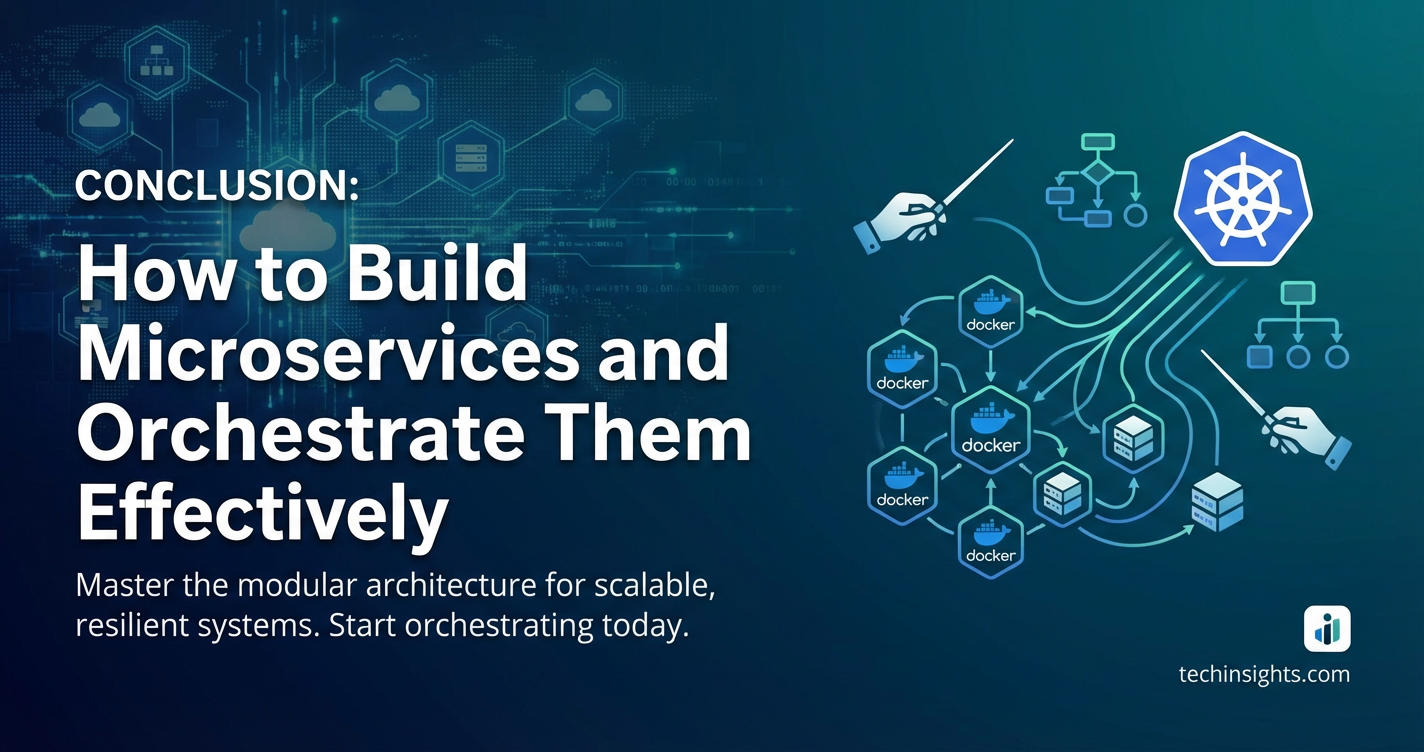
How to Build Microservices and Orchestrate Them Effectively



Introduction: Navigating the Complexities of Modern Software Architecture
In the rapidly evolving landscape of software development, the quest for agility, scalability, and resilience has led many organizations away from traditional monolithic architectures towards more distributed paradigms. Among these, microservices architecture stands out as a transformative approach, promising enhanced flexibility and faster innovation cycles. At its core, microservices involve breaking down a large application into a collection of small, independent, and loosely coupled services, each responsible for a specific business capability. This modularity empowers individual teams to develop, deploy, and scale their services autonomously, fostering a culture of ownership and continuous delivery.
However, the transition to microservices is not without its inherent challenges. While offering significant advantages, this architectural shift introduces a new layer of complexity, particularly concerning inter-service communication, data consistency, distributed transactions, and, most importantly, the orchestration and management of numerous independent components. Imagine a symphony orchestra where each musician plays their instrument perfectly, but without a conductor, the performance would devolve into chaos. Similarly, in a microservices ecosystem, effective orchestration is the conductor that harmonizes individual services into a cohesive, high-performing application.
This comprehensive guide delves deep into the intricacies of building microservices and orchestrating them effectively. We will explore the fundamental principles of microservices design, best practices for their implementation, and the crucial role of robust orchestration platforms. A significant focus will be placed on understanding how to manage the external and internal interactions of these services, highlighting the indispensable function of an API Gateway in providing a unified, secure, and performant entry point. By the end of this article, readers will possess a profound understanding of the strategies, tools, and patterns required to harness the full potential of microservices, ensuring their successful deployment and efficient operation in production environments.
Part 1: Understanding Microservices Architecture
What are Microservices? Deconstructing the Distributed Paradigm
Microservices architecture represents a fundamental shift from monolithic design principles, where an entire application is built as a single, indivisible unit. Instead, microservices advocates for decomposing an application into a suite of small, independent services, each running in its own process and communicating with lightweight mechanisms, often an API-based approach. Each service is designed around a specific business capability, such as user management, order processing, or inventory control, and can be developed, deployed, and scaled independently of other services. This autonomy is a cornerstone of the microservices paradigm, allowing teams to choose the best technology stack for their specific service without imposing constraints on the entire application.
Consider a large e-commerce platform. In a monolithic setup, customer profiles, product catalogs, shopping cart logic, payment processing, and recommendation engines would all reside within a single codebase, sharing a common database. Any change, no matter how minor, would necessitate rebuilding and redeploying the entire application, introducing significant risk and downtime. In contrast, a microservices approach would break this down: a "Customer Service" manages user data, a "Product Catalog Service" handles product listings, a "Cart Service" manages shopping carts, and a "Payment Service" processes transactions. Each service is a self-contained unit, owning its data and exposing an API for other services or clients to interact with. This granular separation significantly reduces the blast radius of failures and accelerates development cycles.
The Evolution from Monolith to Microservices: A Comparative Analysis
To truly appreciate microservices, it's essential to understand the limitations they aim to address in monolithic architectures. Monoliths, while simpler to develop initially, often become cumbersome as applications grow in size and complexity. The tight coupling of components means that changes in one part of the system can unintentionally affect others, leading to extensive testing requirements and slow release cycles. Scaling a monolithic application typically involves scaling the entire application, even if only a specific module is experiencing high load, leading to inefficient resource utilization. Furthermore, technology stack lock-in is common, making it difficult to introduce new languages or frameworks without a complete rewrite.
Microservices, conversely, aim to alleviate these issues by promoting loose coupling and high cohesion. Each service is self-contained, with a clear boundary and a well-defined API. This architectural choice facilitates independent deployments, meaning a team can update their service without impacting or requiring the redeployment of other services. The ability to scale individual services based on demand ensures more efficient resource allocation. Moreover, microservices encourage a polyglot approach, allowing teams to select the most appropriate programming language, framework, and database for each service, thereby leveraging specific technologies' strengths. This agility and flexibility are paramount in today's fast-paced digital environment, where continuous innovation is a key differentiator.
Key Characteristics of a Microservices Architecture
Several defining characteristics underpin a successful microservices implementation:
- Single Responsibility Principle: Each microservice should focus on doing one thing and doing it well. This principle, derived from object-oriented design, ensures that services are cohesive and maintainable. For instance, a "User Authentication Service" handles only authentication, not user profile management.
- Independent Deployment: Services can be developed, tested, and deployed independently. This characteristic is crucial for achieving continuous delivery and enables small, focused teams to work autonomously, reducing coordination overhead.
- Loose Coupling: Services should be designed to be loosely coupled, meaning changes in one service should have minimal impact on others. This is often achieved through well-defined API contracts and asynchronous communication patterns.
- Technology Agnostic: Different microservices can be built using different programming languages, frameworks, and data storage technologies. This polyglot capability empowers teams to choose the best tool for the job and avoid technology lock-in.
- Decentralized Data Management: Each microservice typically owns its data store, rather than sharing a single, centralized database. This autonomy enhances independence and avoids data contention issues common in monolithic systems, though it introduces challenges related to data consistency across services.
- Fault Isolation: The failure of one microservice should not bring down the entire application. Well-designed microservices architectures incorporate resilience patterns like circuit breakers and bulkheads to contain failures and ensure overall system stability.
- Automation: Given the increased number of components, extensive automation for building, testing, deploying, and monitoring services is essential. This includes continuous integration/continuous deployment (CI/CD) pipelines and automated infrastructure provisioning.
Benefits of Adopting Microservices
The advantages of embracing a microservices architecture are compelling for organizations striving for agility and resilience:
- Improved Scalability: Individual services can be scaled independently based on demand, leading to more efficient resource utilization and better performance under varying loads. If the "Product Search Service" experiences a spike in traffic, only that service needs to be scaled up, not the entire application.
- Enhanced Resilience: Fault isolation ensures that the failure of one service does not lead to a cascading failure across the entire system. This improves the overall availability and reliability of the application.
- Faster Development Cycles: Smaller, focused teams can work on individual services concurrently, accelerating development and reducing time-to-market for new features. The smaller codebase of each service is also easier to understand and manage.
- Technology Diversity (Polyglot Capability): Teams are free to choose the best technology stack for each service, fostering innovation and allowing for the adoption of modern tools and languages without impacting the entire system.
- Easier Maintenance and Upgrades: Smaller codebases are easier to maintain, debug, and refactor. Upgrading a technology stack or library within a single service is far less disruptive than doing so in a large monolith.
- Organizational Alignment: Microservices promote smaller, autonomous teams that align with specific business domains, fostering greater ownership and accountability, and often improving communication and collaboration.
Challenges of Microservices Architecture
While offering significant benefits, microservices introduce their own set of complexities that require careful planning and robust solutions:
- Increased Operational Complexity: Managing, deploying, and monitoring dozens or even hundreds of independent services is significantly more complex than managing a single monolithic application. This necessitates robust automation, orchestration tools, and comprehensive observability.
- Distributed Data Management: Maintaining data consistency across multiple, independent databases is challenging. Traditional ACID transactions are difficult to implement across service boundaries, often requiring patterns like event sourcing and the Saga pattern, which introduce eventual consistency.
- Inter-Service Communication: Services need to communicate reliably. Choosing between synchronous (e.g., REST, gRPC) and asynchronous (e.g., message queues, event streams) communication patterns, and handling network latency, retries, and failures, requires careful design.
- Monitoring and Logging: Centralized logging, distributed tracing, and comprehensive monitoring across numerous services are crucial for understanding system behavior, diagnosing issues, and ensuring performance.
- Testing Complexity: End-to-end testing becomes more intricate due to the distributed nature of the application. Strategies for effective unit, integration, and contract testing are paramount.
- Network Latency and Failures: Communication over a network is inherently less reliable and slower than in-process communication. Services must be designed to be resilient to network failures and high latency.
- Security Management: Securing communication between numerous services and managing authentication and authorization across a distributed system adds considerable complexity.
Understanding these benefits and challenges forms the foundation for designing and building effective microservices. The subsequent sections will delve into how to mitigate these challenges through thoughtful design, robust tooling, and strategic orchestration.
Part 2: Designing Microservices Thoughtfully
Effective microservices begin with meticulous design. Unlike monoliths where boundaries can be fluid, microservices demand clear, well-defined service boundaries that align with business capabilities. Poor design can lead to "distributed monoliths" where services are tightly coupled, negating the very advantages microservices promise.
Domain-Driven Design (DDD): Sculpting Service Boundaries
Domain-Driven Design (DDD) is a powerful methodology for modeling complex software systems, making it particularly well-suited for microservices architecture. DDD emphasizes understanding the core business domain and reflecting that understanding in the software design.
- Bounded Contexts: The cornerstone of DDD for microservices is the concept of a Bounded Context. A Bounded Context defines an explicit boundary within which a particular domain model is valid. It's a conceptual boundary, often aligning perfectly with a microservice. For instance, in an e-commerce system, a "Customer" might have different attributes and behaviors in the "Sales Bounded Context" (e.g., shipping address, purchase history) than in the "Marketing Bounded Context" (e.g., communication preferences, demographic data). Each Bounded Context would likely translate into a distinct microservice (e.g., a "Customer Service" for sales, and a "Marketing Profile Service" for marketing). Identifying these contexts helps in defining natural, cohesive service boundaries, minimizing coupling between services.
- Ubiquitous Language: DDD encourages the use of a "Ubiquitous Language"—a common vocabulary shared by domain experts and developers within a Bounded Context. This ensures clear communication and prevents misunderstandings that often arise from ambiguous terminology, directly translating into clearer API names and service functions.
- Aggregates, Entities, Value Objects: Within each Bounded Context, DDD further refines the model using Aggregates (clusters of entities and value objects treated as a single unit for data changes), Entities (objects with identity that persist over time), and Value Objects (objects that describe characteristics but have no conceptual identity). These constructs guide the internal structure and data ownership within a microservice, ensuring internal consistency and transaction boundaries.
By applying DDD principles, developers can design microservices that truly reflect distinct business capabilities, leading to more resilient, maintainable, and understandable systems.
Service Granularity: Finding the Right Balance
One of the most frequent dilemmas in microservices design is determining the optimal granularity of a service. How small should a service be? The answer is nuanced and depends on various factors.
- Too Small (Nano-services): Services that are too small, often called "nano-services," can lead to excessive inter-service communication overhead, complex deployment pipelines, and a proliferation of operational concerns (too many services to manage, monitor, and troubleshoot). While individual development might seem fast, the overall system can become an unmanageable mesh of tiny, chatty services. For example, creating separate services for "User Name," "User Address," and "User Email" is likely too granular, as these are often updated together and represent a single conceptual entity.
- Too Large (Mini-monoliths): Conversely, services that are too large risk becoming "mini-monoliths," where a single service encompasses too many responsibilities, leading to tight internal coupling, slower development, and difficulties in scaling specific components. This negates many of the benefits of microservices. If a "User Service" handles authentication, profile management, subscription logic, and loyalty points, it might be too large and should be broken down further.
Balancing Act: The ideal granularity lies in a balance, often guided by the single responsibility principle and Bounded Contexts. A good heuristic is to consider whether a service can be independently developed, deployed, and scaled by a small, autonomous team without significant coordination with other teams. The "two-pizza team" rule (teams small enough to be fed by two pizzas) is often cited in this context. Focus on business capabilities, not just technical functions. For example, an "Order Fulfillment Service" might involve multiple technical functions (inventory check, payment processing, shipping notification), but from a business perspective, it's a cohesive unit. Refactoring is always an option; it's often better to start with slightly larger services and split them as more is learned about the domain and communication patterns.
API Design for Microservices: The Contract of Communication
The API is the public contract of a microservice. A well-designed API is crucial for enabling seamless communication between services and between clients and services. It dictates how services interact, how data is exchanged, and how resilient the overall system will be.
- RESTful APIs: Representational State Transfer (REST) remains a popular choice for API design due to its simplicity, statelessness, and adherence to standard HTTP methods (GET, POST, PUT, DELETE). RESTful APIs are resource-oriented, meaning they expose resources that can be manipulated through standard operations. They are generally easy to understand and consume, making them suitable for external and internal service communication.
- gRPC: Google's Remote Procedure Call (gRPC) is gaining traction, especially for internal service-to-service communication. It uses Protocol Buffers for defining service contracts and data serialization, offering advantages like strong typing, smaller message sizes, and faster performance compared to REST/JSON. gRPC also supports bidirectional streaming, which is beneficial for real-time communication patterns.
- GraphQL: While less common for inter-service communication (often used as an API Gateway layer), GraphQL allows clients to request precisely the data they need, reducing over-fetching or under-fetching of data. It can be useful for flexible data querying from a unified API endpoint.
- Principles of Good API Design:
- Versioning: APIs must be versioned (e.g.,
/v1/users,/v2/products) to allow for backward-compatible changes and safe evolution of services without breaking existing clients. - Statelessness: APIs should ideally be stateless, meaning each request from a client to a server contains all the information needed to understand the request. This simplifies scaling and improves resilience.
- Discoverability: Well-designed APIs should be easily discoverable, often through comprehensive documentation (e.g., OpenAPI/Swagger), and potentially HATEOAS (Hypermedia as the Engine of Application State) for RESTful services.
- Clear Contracts: The API contract (input, output, error codes) must be explicit and stable. Any changes to the contract should be carefully managed, ideally through versioning.
- Error Handling: Provide clear, consistent error responses with appropriate HTTP status codes and descriptive error messages.
- Versioning: APIs must be versioned (e.g.,
Thoughtful API design is not merely a technical exercise; it's a strategic decision that impacts the maintainability, extensibility, and usability of the entire microservices ecosystem. It ensures that services can communicate effectively and evolve independently, which is a core tenet of microservices architecture.
Part 3: Building Microservices - Implementation Best Practices
Once the design phase is complete, the focus shifts to the actual implementation of microservices. This involves selecting appropriate technologies, managing data, and establishing robust communication channels between services.
Programming Languages and Frameworks: Embracing Polyglot Development
One of the significant advantages of microservices is the freedom to choose the best programming language and framework for each specific service. This "polyglot" approach allows teams to leverage the strengths of different technologies:
- Java with Spring Boot: A dominant choice, Spring Boot provides a comprehensive ecosystem for building production-ready microservices rapidly, with features like embedded servers, auto-configuration, and extensive libraries for data access, security, and cloud integration. Its maturity, large community, and enterprise support make it a robust option.
- Node.js with Express/NestJS: For I/O-bound services, especially those requiring real-time capabilities or high concurrency, Node.js offers excellent performance due to its asynchronous, event-driven architecture. Frameworks like Express provide a minimalistic foundation, while NestJS offers a more opinionated, enterprise-grade structure.
- Go (Golang) with Gin/Echo: Go is increasingly popular for microservices due to its strong performance, efficient concurrency model (goroutines), and excellent tooling for building high-performance network services. Its static compilation results in small, self-contained binaries, ideal for containerization.
- Python with Flask/Django: Python, with frameworks like Flask (lightweight) or Django (full-featured), is often chosen for data-intensive services, machine learning components, or services requiring rapid prototyping due to its extensive libraries and ease of development.
- .NET Core: Microsoft's cross-platform .NET Core (now .NET) provides a modern, high-performance framework for building microservices, offering strong language features (C#), excellent tooling, and cloud-native capabilities.
The key is to select languages and frameworks that align with the service's requirements, team expertise, and operational considerations. Consistency within a single team might be beneficial, but imposing a single technology across all services defeats the purpose of polyglot microservices.
Data Management in Microservices: The Challenge of Distributed State
Decentralized data management is a hallmark of microservices, where each service owns its data store. While this promotes independence and avoids database contention, it introduces complexities related to data consistency and transactions across service boundaries.
- Database per Service Pattern: This is the most common approach, where each microservice has its own dedicated database (or schema within a shared database, if isolation is strict). This allows services to choose the most suitable database technology (e.g., relational for transactional data, NoSQL for high-volume unstructured data) and evolve their schema independently.
- Saga Pattern for Distributed Transactions: Traditional ACID transactions cannot span multiple services with independent databases. The Saga pattern provides a way to manage distributed transactions by sequencing a series of local transactions, where each transaction updates its own database and publishes an event that triggers the next step in the saga. If a step fails, compensating transactions are executed to undo preceding changes. This ensures eventual consistency rather than immediate consistency.
- Eventual Consistency: This model accepts that data might not be immediately consistent across all services but will eventually converge to a consistent state. It's suitable for many business processes where immediate consistency is not strictly required, trading consistency for higher availability and scalability.
- CQRS (Command Query Responsibility Segregation): CQRS separates the read and write models of an application. Commands (writes) are handled by one model (e.g., a service with a transactional database), while queries (reads) are handled by another, potentially optimized for read performance (e.g., a denormalized view or a search index). This can significantly improve performance and scalability for read-heavy applications and simplify data consistency challenges by having a dedicated read model that consumes events from write models.
- Event Sourcing: Instead of storing the current state of an aggregate, event sourcing stores a sequence of immutable events that represent all changes to that aggregate. The current state is reconstructed by replaying these events. This pattern is often combined with CQRS, where events can update read models and serve as a reliable source of truth for audit trails and temporal queries.
Careful consideration of data management patterns is crucial for avoiding pitfalls in a distributed microservices environment, ensuring both data integrity and system performance.
Inter-Service Communication Patterns: The Nervous System of Microservices
How microservices communicate is critical to their overall performance and reliability. There are two primary categories of communication patterns:
- Synchronous Communication (Request/Response):
- RESTful APIs: The most common pattern, where services communicate over HTTP using JSON or XML. It's simple to implement and widely understood. However, synchronous calls introduce coupling, latency, and single points of failure.
- gRPC: Offers higher performance and stronger contracts using Protocol Buffers and HTTP/2. It's ideal for high-throughput, low-latency internal service-to-service communication.
- Challenges: If a called service is unavailable or slow, the calling service can become blocked or experience timeouts, potentially leading to cascading failures. Resilience patterns like circuit breakers, retries, and timeouts are essential.
- Asynchronous Communication (Event-Driven):
- Message Brokers (e.g., Apache Kafka, RabbitMQ, Amazon SQS/SNS): Services publish events to a message broker, and other services subscribe to these events. This decouples services, making them more resilient to failures and enabling higher scalability. For example, when an "Order Service" processes an order, it publishes an "OrderCreated" event. A "Payment Service" subscribes to this event to initiate payment, and an "Inventory Service" subscribes to update stock.
- Advantages: Increased resilience (sender doesn't wait for receiver), improved scalability (message queues buffer requests), and greater decoupling (services don't need to know about each other directly).
- Challenges: Eventual consistency, increased complexity in managing message brokers, and potential for message ordering issues or duplicate messages that need to be handled with idempotency.
- Idempotency: When using asynchronous communication, it's vital for services to be idempotent, meaning processing the same message multiple times has the same effect as processing it once. This is crucial for handling message retries and ensuring data consistency in the face of network or service failures.
A common approach is a hybrid model: synchronous communication for immediate request-response needs (e.g., user interface to API Gateway to core services) and asynchronous communication for long-running processes, event propagation, and internal service coordination.
Containerization with Docker: Packaging for Portability
Containerization has become an indispensable technology for building and deploying microservices. Docker is the de facto standard for creating and managing containers.
- What is Docker? Docker allows developers to package an application and all its dependencies (libraries, configuration files, environment variables, runtime) into a single, isolated unit called a container image. This image can then be run consistently across any environment (developer's laptop, testing server, production cloud).
- Why Containers are Essential for Microservices:
- Consistency: "It works on my machine" issues are minimized because the environment is standardized.
- Isolation: Each service runs in its own container, isolated from other services, preventing conflicts between dependencies.
- Portability: Containers can be easily moved and run on any infrastructure that supports Docker.
- Efficiency: Containers are lightweight and start quickly, making them ideal for rapid scaling and deployment in a microservices context.
- Simplified Deployment: Once a service is containerized, deploying it involves simply pulling and running the container image, abstracting away underlying infrastructure differences.
Dockerfiles, Images, and Containers: A Dockerfile is a text file that contains instructions for building a Docker image. A Docker image is a read-only template that defines the application and its environment. A Docker container is a runnable instance of a Docker image. Mastering Docker is fundamental for modern microservices development, enabling seamless packaging and deployment of individual services.
Part 4: Orchestrating Microservices Effectively
The proliferation of containers and independent services necessitates powerful orchestration tools to manage their lifecycle, scaling, networking, and overall health. Orchestration is the process of automating the deployment, management, scaling, and networking of containers. Without it, managing a microservices ecosystem would quickly become an operational nightmare.
The Need for Orchestration: Taming the Distributed Beast
In a typical microservices application, there might be dozens or even hundreds of service instances running concurrently. Manual management of these instances is simply not feasible. Orchestration platforms address this by providing capabilities for:
- Automated Deployment: Deploying new service versions with minimal downtime (e.g., rolling updates).
- Scaling: Automatically adjusting the number of service instances based on demand (horizontal scaling).
- Self-healing: Detecting and replacing failed containers, ensuring continuous availability.
- Service Discovery: Enabling services to find and communicate with each other dynamically.
- Load Balancing: Distributing incoming requests across multiple instances of a service.
- Resource Management: Allocating CPU, memory, and storage resources efficiently to containers.
- Configuration Management: Managing environment variables, secrets, and configuration files for services.
- Networking: Configuring internal and external network access for containers.
Container Orchestration Platforms: The Conductors of the Microservices Symphony
Several platforms have emerged to tackle the challenges of container orchestration, with Kubernetes leading the pack.
Kubernetes: The De Facto Standard
Kubernetes, an open-source system originally designed by Google, has become the dominant platform for orchestrating containerized applications. It provides a robust, extensible framework for managing workloads and services across clusters of machines.
- Core Concepts of Kubernetes:
- Pods: The smallest deployable units in Kubernetes. A Pod encapsulates one or more containers (which are tightly coupled and share resources like network and storage) and represents a single instance of a running process in your cluster.
- Deployments: An abstraction layer above Pods that manages the desired state of your application. Deployments ensure that a specified number of Pod replicas are running and facilitate rolling updates, rollbacks, and self-healing.
- Services: An abstract way to expose an application running on a set of Pods as a network service. Services provide stable IP addresses and DNS names, acting as internal load balancers for Pods, enabling other services or external clients to discover and communicate with them.
- Ingress: Manages external access to services in a cluster, typically HTTP(S). Ingress can provide load balancing, SSL termination, and name-based virtual hosting, acting as the entry point for outside traffic into the cluster. This is where an API Gateway often sits or integrates.
- ConfigMaps and Secrets: Used to store non-confidential configuration data (ConfigMaps) and sensitive data like passwords and API keys (Secrets) separately from application code, making configurations easier to manage and update.
- Service Discovery and Load Balancing: Kubernetes automatically registers services and provides internal DNS for discovery. Its Service resource includes built-in load balancing across Pods.
- Self-healing Capabilities: If a Pod crashes, Kubernetes detects it and automatically restarts or replaces it, ensuring high availability.
- Horizontal Pod Autoscaler (HPA): Automatically scales the number of Pod replicas based on observed CPU utilization or other custom metrics, ensuring your application can handle varying loads.
- Resource Management: You can define CPU and memory requests and limits for containers, allowing Kubernetes to schedule Pods efficiently and prevent resource starvation.
Kubernetes' comprehensive feature set, vibrant community, and wide adoption make it the go-to choice for orchestrating complex microservices architectures, offering unparalleled control and automation over distributed workloads.
Other Orchestrators (Brief Mention):
While Kubernetes dominates, other orchestrators have their niche:
- Docker Swarm: Docker's native container orchestration tool, simpler to set up and use for smaller deployments, but less feature-rich and scalable than Kubernetes.
- Apache Mesos: A general-purpose cluster manager that can run various workloads, including containerized ones (via Marathon). It offers powerful resource scheduling but has a steeper learning curve compared to Kubernetes.
Service Mesh: Enhancing Inter-Service Communication
As microservices ecosystems grow, managing inter-service communication becomes increasingly challenging. This is where a Service Mesh comes into play.
- What is a Service Mesh? A service mesh (e.g., Istio, Linkerd, Consul Connect) is a dedicated infrastructure layer that handles service-to-service communication. It provides a transparent way to add capabilities like observability, traffic management, security, and resilience to microservices without requiring changes to the application code itself.
- Sidecar Proxy Pattern: The core component of a service mesh is the "sidecar proxy." For each microservice instance (Pod in Kubernetes), a lightweight proxy (e.g., Envoy) is deployed alongside it. All inbound and outbound traffic for that microservice passes through its sidecar proxy.
- Capabilities Provided by a Service Mesh:
- Observability: Automatically collects metrics (latency, error rates), logs, and distributed traces for all service communication, providing deep insights into system behavior.
- Traffic Management: Enables fine-grained control over traffic routing (e.g., A/B testing, canary deployments), load balancing, retries, and timeouts.
- Security: Provides mutual TLS (mTLS) for encrypted and authenticated communication between services, API authorization, and policy enforcement.
- Resilience: Implements patterns like circuit breakers, timeouts, and fault injection to improve the robustness of inter-service calls.
- Benefits and Complexities: A service mesh significantly enhances the operational capabilities of a microservices platform, offloading cross-cutting concerns from individual services and centralizing their management. However, it also adds another layer of complexity to the infrastructure, requiring expertise to set up, configure, and operate. It's typically considered for larger, more mature microservices deployments where the benefits outweigh the operational overhead.
The combination of a robust container orchestrator like Kubernetes and, for larger systems, a service mesh, forms the backbone of effective microservices orchestration, ensuring that individual services can operate harmoniously and reliably.
APIPark is a high-performance AI gateway that allows you to securely access the most comprehensive LLM APIs globally on the APIPark platform, including OpenAI, Anthropic, Mistral, Llama2, Google Gemini, and more.Try APIPark now! 👇👇👇
Part 5: Centralizing Access with an API Gateway
In a microservices architecture, a critical component for managing external client interactions and often internal service-to-service communication is the API Gateway. It acts as the single entry point for all clients, external or internal, into the microservices ecosystem. Without an API Gateway, clients would need to directly interact with multiple services, leading to increased complexity on the client side and exposing internal service details.
What is an API Gateway? The Front Door to Your Microservices
An API Gateway is a server that acts as an API frontend, sitting between clients and a collection of backend microservices. Instead of clients making direct requests to specific services, they make requests to the API Gateway, which then routes the requests to the appropriate services, aggregates responses, and applies various cross-cutting concerns. It's more than just a reverse proxy; it adds significant value by providing a layer of abstraction and control.
Imagine a large building with many departments. Instead of visitors having to find each department's door individually, there's a central reception desk. The receptionist (the API Gateway) directs visitors, checks their credentials, and might even combine information from several departments before providing it to the visitor. This simplifies the visitor's experience and centralizes security and access control.
Key Functions and Features of an API Gateway
A robust API Gateway provides a wealth of functionalities that are crucial for managing and securing a microservices architecture:
- Request Routing: The fundamental function of an API Gateway is to route incoming client requests to the correct backend microservice based on predefined rules (e.g., URL path, HTTP method, headers). For example, a request to
/usersmight go to the User Service, while a request to/productsgoes to the Product Catalog Service. - Authentication and Authorization: The API Gateway can centralize security enforcement. It can authenticate clients (e.g., validate JWT tokens, OAuth2) and authorize their access to specific services or resources before forwarding the request. This offloads security logic from individual microservices, simplifying their development.
- Rate Limiting and Throttling: To protect backend services from overload or abuse, the API Gateway can implement rate limiting (e.g., "no more than 100 requests per minute per user") and throttling. This ensures fair usage and maintains service stability.
- Load Balancing: While Kubernetes Services provide internal load balancing for Pods, an API Gateway can provide another layer of load balancing at the edge, distributing incoming traffic across multiple instances of services, potentially across different clusters or data centers.
- Caching: The API Gateway can cache responses from backend services for frequently accessed data, reducing the load on services and improving response times for clients.
- Protocol Translation: Clients might use different protocols (e.g., HTTP/1.1 for web browsers, gRPC for internal services). The API Gateway can translate between these protocols, presenting a unified API to clients while allowing backend services to use their preferred communication method.
- Monitoring and Logging: All requests passing through the API Gateway can be centrally logged and monitored, providing a comprehensive view of traffic patterns, error rates, and performance metrics across the entire application. This is a critical aspect of observability.
- API Composition/Aggregation: For complex client requests that require data from multiple microservices, the API Gateway can aggregate responses from these services and compose a single, unified response for the client. This reduces the number of requests clients need to make.
- Circuit Breaker: Implementing the circuit breaker pattern at the API Gateway level can prevent cascading failures. If a backend service is unresponsive, the gateway can "trip the circuit" and immediately return an error or a fallback response, preventing client requests from piling up and further stressing the failing service.
- Service Versioning: The API Gateway can help manage different versions of services, allowing clients to specify which version of an API they want to interact with, facilitating seamless upgrades and A/B testing.
Why an API Gateway is Crucial for Microservices Architecture
The benefits of deploying an API Gateway in a microservices environment are profound:
- Simplifies Client-Side Complexity: Clients interact with a single, well-defined API endpoint, rather than needing to know the addresses and specific APIs of dozens of individual microservices. This makes client development easier and more robust.
- Decouples Clients from Service Changes: Changes in backend service implementation, scaling, or deployment locations are abstracted away by the API Gateway. Clients remain unaffected as long as the gateway's API contract remains stable.
- Centralizes Cross-Cutting Concerns: Security, rate limiting, caching, logging, and monitoring are handled in one place, reducing redundancy and ensuring consistent application of policies across all services. This simplifies development for individual service teams who can focus on business logic.
- Enhances Security: By acting as a single choke point, the API Gateway provides a strong defensive layer, enabling centralized security policies, input validation, and protection against common API attacks.
- Improves Resilience: Features like circuit breakers, timeouts, and graceful degradation at the API Gateway level protect the entire system from individual service failures, enhancing overall system reliability.
- Facilitates Evolution: The API Gateway can enable gradual migration from monoliths to microservices, support different API versions, and facilitate A/B testing of new service features.
Designing an Effective API Gateway
Choosing and configuring an API Gateway requires careful consideration of several factors:
- Performance and Scalability: The gateway is a critical path component; it must be highly performant and scalable to handle peak traffic loads. Its own architecture should be distributed and resilient.
- Feature Set: The chosen gateway should offer the necessary features for your specific requirements (e.g., authentication, rate limiting, transformation, aggregation).
- Ease of Management and Configuration: A user-friendly interface or robust API for configuration management is essential, especially with a large number of services.
- Extensibility: The ability to add custom plugins or logic is often valuable for specific business needs.
- Integration with Orchestration: Seamless integration with container orchestration platforms like Kubernetes is crucial for automated deployment and scaling.
Numerous API Gateway solutions exist, ranging from open-source options to commercial products. Examples include NGINX (often used as a powerful reverse proxy with API Gateway functionalities via extensions), Kong, Ocelot (for .NET), Spring Cloud Gateway, and Amazon API Gateway.
One notable open-source solution in this space is APIPark. APIPark stands out as an open-source AI Gateway & API Management Platform, designed specifically to help developers and enterprises manage, integrate, and deploy AI and REST services with remarkable ease. For organizations building microservices, particularly those incorporating AI capabilities, APIPark offers a compelling suite of features that align directly with the needs of effective orchestration and API governance.
APIPark’s capabilities extend beyond basic routing:
- End-to-End API Lifecycle Management: It assists with managing the entire lifecycle of APIs, from design and publication to invocation and decommission. This helps regulate API management processes, traffic forwarding, load balancing, and versioning of published APIs—all crucial for a complex microservices setup.
- Unified API Format & AI Model Integration: A unique aspect is its ability to quickly integrate over 100 AI models with a unified management system. It standardizes the request data format across all AI models, ensuring that changes in AI models or prompts do not affect the application or microservices, thereby simplifying AI usage and maintenance costs. This is particularly valuable for microservices that might consume or expose AI functionalities.
- Performance Rivaling Nginx: APIPark is engineered for high performance, capable of achieving over 20,000 TPS with modest hardware, supporting cluster deployment to handle large-scale traffic. This performance is vital for an API Gateway that sits at the front of potentially thousands of requests per second.
- Detailed API Call Logging and Data Analysis: Providing comprehensive logging and powerful data analysis, APIPark enables businesses to quickly trace and troubleshoot issues, understand long-term trends, and perform preventive maintenance. This observability is a cornerstone of managing distributed systems.
- Team Collaboration and Security: Features like API service sharing within teams, independent API and access permissions for each tenant, and subscription approval mechanisms enhance collaboration while enforcing robust security and access control, preventing unauthorized API calls.
By leveraging a platform like APIPark, organizations can effectively centralize API management, enhance security, improve observability, and streamline the integration of advanced functionalities, such as AI models, into their microservices landscape. It acts as a sophisticated gateway that not only directs traffic but also provides a layer of intelligent management and control over all exposed APIs, both human- and machine-facing.
Here's a simplified comparison of common API Gateway features to illustrate their breadth:
| Feature Category | Common API Gateway Capabilities | Benefit in Microservices |
|---|---|---|
| Traffic Management | Request Routing (Path, Host, Header-based), Load Balancing, Rate Limiting, Throttling, Circuit Breaker, Retries, Timeouts, Request/Response Transformation, Protocol Translation (e.g., HTTP to gRPC), API Versioning. | Ensures requests reach correct services efficiently, protects backend services from overload, manages network resilience, and allows for seamless API evolution and internal tech changes. |
| Security & Access | Authentication (JWT, OAuth2, API Keys), Authorization (RBAC, ABAC), SSL/TLS Termination, IP Whitelisting/Blacklisting, CORS Management, Input Validation, Bot Protection. | Centralizes security, offloads security burden from individual services, and protects against unauthorized access and common web vulnerabilities. |
| Observability | Request Logging, Metrics Collection (Latency, Error Rates), Distributed Tracing Integration, Health Checks, Alerting. | Provides a single point of visibility into external API traffic, facilitates troubleshooting, performance monitoring, and understanding system health. |
| Developer Experience | Developer Portal (for discovering and testing APIs), Documentation Generation (OpenAPI/Swagger), API Monetization, API Product Management, Sandboxing environments. | Enhances developer productivity, fosters API adoption, and allows businesses to treat their APIs as products. |
| Advanced Features | API Aggregation/Composition, Caching, WebSockets/SSE Support, Policy Enforcement, Custom Plugin Support, Integration with Service Mesh, AI Model Integration (like APIPark), Serverless Function Proxying. | Enables complex API interactions, reduces backend load, supports real-time communication, and extends capabilities for specific business or technical requirements. |
The strategic implementation of an API Gateway is not just a best practice; it's a foundational element for building a manageable, secure, and scalable microservices architecture. It simplifies the client's view of the distributed system and provides a powerful control plane for all external interactions.
Part 6: Ensuring Observability, Resilience, and Security
Building microservices is only half the battle; ensuring they operate reliably, securely, and are understandable in production is equally, if not more, critical. This necessitates robust strategies for observability, resilience, and security.
Observability: Seeing What's Happening Inside
In a distributed system, traditional debugging methods often fall short. Observability is the ability to understand the internal state of a system by examining its external outputs. It's about asking arbitrary questions about the system without knowing its internal details beforehand. The three pillars of observability are logging, monitoring, and tracing.
- Logging:
- Centralized Logging: With numerous services, logs scattered across individual containers and hosts are useless. All service logs must be aggregated into a central logging system (e.g., ELK stack - Elasticsearch, Logstash, Kibana; Splunk; Grafana Loki; Datadog).
- Structured Logging: Logs should be emitted in a structured format (e.g., JSON) rather than plain text. This makes them easily parsable, searchable, and analyzable.
- Contextual Information: Logs should include relevant contextual information, such as correlation IDs (for tracing requests across services), service names, request IDs, user IDs, and timestamps, to aid in debugging.
- Monitoring:
- Metrics Collection: Collect quantitative data about service performance and health (e.g., CPU utilization, memory usage, request rates, error rates, latency, garbage collection pauses).
- Tools: Prometheus (for time-series data collection and alerting) with Grafana (for visualization and dashboards) is a popular open-source stack. Commercial solutions like Datadog, New Relic, and Dynatrace offer comprehensive monitoring capabilities.
- Alerting: Define alerts based on critical metrics thresholds. Prompt notifications are essential for proactive issue resolution.
- SLOs/SLAs: Define Service Level Objectives (SLOs) and Service Level Agreements (SLAs) for services and monitor compliance to ensure performance expectations are met.
- Tracing:
- Distributed Tracing: When a request flows through multiple microservices, distributed tracing systems (e.g., Jaeger, Zipkin, OpenTelemetry) track the full journey of that request. Each service adds trace information (span ID, parent span ID, service name, duration) as the request passes through, linking all operations to a single trace ID.
- Call Graphs: Tracing provides visual call graphs that show the sequence of service calls, their latency, and any errors encountered. This is invaluable for identifying performance bottlenecks and debugging complex distributed interactions.
- Health Checks: Each service should expose health endpoints (e.g.,
/health,/readiness,/liveness) that orchestration platforms (like Kubernetes) can use to determine if a service instance is operational, ready to receive traffic, or if it needs to be restarted.
Comprehensive observability tooling and practices are the eyes and ears of your microservices environment, enabling operations teams to understand, diagnose, and resolve issues quickly.
Resilience Patterns: Building for Failure
In a distributed system, failures are inevitable. Resilience is the ability of the system to recover from failures and continue to function. Microservices must be designed with failure in mind.
- Circuit Breaker: Prevents a service from repeatedly calling a failing downstream service. When a predefined number of failures occur within a certain timeframe, the circuit "trips" (opens), and subsequent calls immediately fail without attempting to reach the service. After a timeout, it allows a limited number of "test" calls to see if the service has recovered, closing the circuit if successful.
- Bulkhead: Isolates failures by partitioning service instances into separate groups (like watertight compartments in a ship). If one group fails, the others remain unaffected. For example, dedicating separate thread pools or connection pools for different downstream service calls prevents one slow service from exhausting resources for others.
- Retry: Services should implement a retry mechanism for transient failures (e.g., network glitches, temporary service unavailability) but with caution. Retries should use exponential backoff and a maximum number of attempts to avoid overwhelming the failing service.
- Timeout: All network calls between services should have reasonable timeouts to prevent services from hanging indefinitely and consuming resources while waiting for an unresponsive dependency.
- Fallback: If a service call fails (even after retries) or the circuit breaker is open, the calling service should provide a fallback mechanism. This could involve returning cached data, default values, or a degraded user experience, rather than a complete failure.
- Chaos Engineering: Proactively inject failures into the system (e.g., latency, service outages, resource exhaustion) in a controlled manner to identify weaknesses and validate resilience mechanisms. Tools like Netflix's Chaos Monkey are famous examples.
Implementing these patterns ensures that the system can gracefully degrade and recover from failures, maintaining a high level of availability and responsiveness.
Security: Protecting Your Distributed Assets
Securing a microservices architecture is more complex than securing a monolith, as there are many more endpoints, communication channels, and deployment units. A multi-layered security approach is essential.
- Authentication (Who are you?):
- OAuth2 and OpenID Connect: For client-to-API Gateway authentication, OAuth2 (for authorization) and OpenID Connect (for authentication built on OAuth2) are industry standards, providing secure delegation of access.
- Service-to-Service Authentication: For internal communication, services need to authenticate with each other. This can be achieved using mutual TLS (mTLS), API keys (less secure, but sometimes used), or short-lived tokens issued by a central identity provider. A service mesh can greatly simplify mTLS implementation.
- Authorization (What can you do?):
- Role-Based Access Control (RBAC): Assigns permissions based on roles (e.g., "admin," "user," "guest").
- Attribute-Based Access Control (ABAC): More fine-grained, dynamic authorization based on attributes of the user, resource, and environment.
- Centralized Authorization: The API Gateway can handle initial authorization, but services themselves should enforce their own granular authorization rules based on data provided by the gateway (e.g., user roles, permissions).
- Data Encryption:
- Encryption in Transit (TLS/SSL): All communication, both external (client-to-API Gateway) and internal (service-to-service), should be encrypted using TLS/SSL to prevent eavesdropping and tampering.
- Encryption at Rest: Sensitive data stored in databases or file systems should be encrypted.
- API Security Best Practices (OWASP API Security Top 10): Follow industry best practices for securing APIs, addressing common vulnerabilities like broken authentication, excessive data exposure, and security misconfiguration.
- Secrets Management: Sensitive configurations (database credentials, API keys, encryption keys) should not be hardcoded. Use dedicated secrets management solutions (e.g., Kubernetes Secrets, HashiCorp Vault, AWS Secrets Manager) and inject them securely at runtime.
- Network Segmentation: Isolate services into different network segments or subnets to limit lateral movement in case of a breach. Firewalls and network policies should control traffic flow.
- Container Security: Secure Docker images by using minimal base images, scanning for vulnerabilities, and applying security best practices for containers.
A comprehensive security strategy is paramount for protecting sensitive data, maintaining user trust, and complying with regulatory requirements in a microservices environment. It involves securing every layer from the infrastructure to the application code and the communication channels between services.
Part 7: Deployment and CI/CD for Microservices
The advantages of microservices – independent deployment and faster release cycles – are fully realized through robust continuous integration and continuous delivery (CI/CD) pipelines. Automation is not just a luxury; it's a necessity for managing the increased complexity of a microservices landscape.
Automated Deployment Strategies: Minimizing Downtime and Risk
Deploying changes to individual microservices should be frequent, fast, and low-risk. Automated deployment strategies are key to achieving this.
- Rolling Updates: This is the most common deployment strategy. New versions of a service are gradually rolled out, instance by instance, replacing old instances. If issues arise, the rollout can be paused or rolled back, ensuring minimal disruption. Kubernetes Deployments inherently support rolling updates.
- Blue/Green Deployments: Two identical production environments, "Blue" (current version) and "Green" (new version), are maintained. Traffic is initially routed entirely to "Blue." Once the "Green" environment is fully tested and validated, traffic is instantaneously switched from "Blue" to "Green" via a load balancer or API Gateway. If issues occur, traffic can be immediately switched back to "Blue," enabling near-zero downtime rollbacks. This strategy is more complex and resource-intensive as it requires double the infrastructure for a short period.
- Canary Releases: A small percentage of live traffic is routed to the new version (the "canary") of a service. The canary is monitored closely for errors, performance degradation, and other issues. If it performs well, gradually more traffic is shifted to the new version until it handles 100% of the traffic. This allows for early detection of problems with minimal impact on users and provides a controlled way to validate new features in a production environment. An API Gateway or service mesh can play a crucial role in managing traffic splitting for canary releases.
- Zero-Downtime Deployments: The ultimate goal of most modern deployment strategies. It ensures that users experience no interruption or degradation of service during a deployment. Achieved through a combination of rolling updates, blue/green, or canary releases, coupled with careful management of database migrations and backward-compatible API changes.
The choice of deployment strategy depends on the criticality of the service, the tolerance for risk, and available infrastructure.
Continuous Integration/Continuous Delivery (CI/CD): The Engine of Agility
CI/CD pipelines automate the entire software delivery process, from code commit to production deployment, ensuring speed, quality, and reliability. In a microservices context, each service typically has its own independent CI/CD pipeline.
- Continuous Integration (CI):
- Automated Builds: Every code commit triggers an automated build process to compile code, resolve dependencies, and create deployable artifacts (e.g., Docker images).
- Automated Testing: Comprehensive automated tests are executed, including:
- Unit Tests: Verify individual components or functions in isolation.
- Integration Tests: Verify communication and interaction between components within a service or between a service and its immediate dependencies (e.g., database).
- Contract Tests: Ensure that the API contracts between dependent services are compatible. Consumer-Driven Contract (CDC) testing is particularly valuable here, where consumers define the expected API contract of their providers.
- Code Quality Checks: Static code analysis, linting, and security scans are performed to maintain code quality and identify vulnerabilities early.
- Artifact Repositories: Successfully built and tested artifacts (e.g., Docker images pushed to a container registry like Docker Hub, Quay.io, or AWS ECR) are stored and versioned for later deployment.
- Continuous Delivery (CD):
- Automated Deployment to Staging/Testing Environments: After successful CI, the validated artifact is automatically deployed to various staging, testing, or pre-production environments for further testing (e.g., end-to-end testing, performance testing, user acceptance testing).
- Environment Provisioning: Infrastructure-as-Code (IaC) tools (e.g., Terraform, Ansible) automate the provisioning and configuration of environments, ensuring consistency.
- Promotional Approvals: While deployment to production can be automated, it often requires manual approvals at certain stages, especially in highly regulated environments, to ensure human oversight.
- Continuous Deployment (Optional but Desired):
- If all automated tests and quality gates pass in the CD pipeline, the artifact is automatically deployed to production without human intervention. This is the ultimate goal for maximizing agility but requires high confidence in automated testing and monitoring.
Tools like Jenkins, GitLab CI/CD, GitHub Actions, CircleCI, Travis CI, and Azure DevOps are commonly used to implement these pipelines. A well-designed CI/CD pipeline for each microservice dramatically accelerates development, reduces human error, and ensures that changes can be delivered to production frequently and reliably, allowing organizations to adapt quickly to market demands.
Part 8: Advanced Topics and Future Trends
The microservices landscape is continually evolving. Beyond the core principles and orchestration, several advanced topics and emerging trends are shaping the future of distributed systems.
Serverless Microservices (Functions as a Service - FaaS)
Serverless computing, particularly Functions as a Service (FaaS), takes the microservices concept to an even finer granularity. Instead of deploying long-running services, developers deploy individual functions (like a single API endpoint or an event handler) that are executed only when triggered by an event (e.g., HTTP request, database change, message queue event).
- Characteristics:
- No Server Management: Developers don't manage servers or underlying infrastructure. The cloud provider automatically provisions, scales, and manages the execution environment.
- Event-Driven: Functions are triggered by events, leading to a highly reactive and scalable architecture.
- Auto-Scaling: Functions automatically scale up or down to handle fluctuating loads, even to zero instances when not in use.
- Pay-per-Execution: You only pay for the compute time consumed by your function executions, often leading to cost savings for intermittent workloads.
- Benefits: Reduces operational overhead, potentially lowers costs, and enables extreme scalability.
- Challenges: Vendor lock-in, cold start latency, debugging distributed functions, and managing state across stateless functions.
- Examples: AWS Lambda, Azure Functions, Google Cloud Functions.
Serverless functions can complement traditional containerized microservices, particularly for specific use cases like lightweight APIs, data processing pipelines, or scheduled tasks.
Event-Driven Architectures (EDA)
While asynchronous communication via message brokers was discussed, Event-Driven Architectures (EDA) take this a step further by making events the central piece of communication. In an EDA, services communicate primarily by producing and consuming events, rather than direct API calls.
- Core Concepts:
- Event Producer: A service that publishes an event when a significant state change occurs (e.g., "OrderPlaced," "UserRegistered").
- Event Broker: A central system (e.g., Kafka, RabbitMQ) that distributes events from producers to consumers.
- Event Consumer: A service that subscribes to and reacts to events, performing its specific business logic.
- Benefits: Extreme decoupling, enhanced scalability, improved resilience, and auditing capabilities (events create a historical log of system changes). It naturally supports eventual consistency.
- Challenges: Complexity in managing event schemas, ensuring idempotency, debugging event flows, and handling distributed data consistency.
- Use Cases: Real-time data processing, IoT applications, complex business workflows, and integrating disparate systems.
EDAs are powerful for building highly responsive and scalable microservices systems, especially when combined with patterns like event sourcing and CQRS.
Service Mesh Evolution
The service mesh continues to evolve, becoming more intelligent and integrated with the underlying orchestration platforms.
- Wider Adoption: As microservices grow, more organizations are adopting service meshes for their advanced traffic management, security, and observability features.
- WebAssembly (Wasm) for Proxies: Emerging trends include using WebAssembly to extend service mesh proxies (like Envoy) with custom logic. This allows for language-agnostic extensibility and tighter control over data plane functionality without recompiling the proxy itself.
- API Gateway Integration: Tighter integration between API Gateways and service meshes is a key area. The API Gateway handles edge traffic and north-south communication (external to internal), while the service mesh handles internal east-west communication (service-to-service). Combined, they offer a comprehensive traffic management and security solution for the entire application.
AI/ML in Microservices and API Management
The integration of Artificial Intelligence and Machine Learning into microservices architectures is becoming increasingly prevalent.
- AI as a Service: Microservices can encapsulate AI models as independent services, exposing their capabilities via APIs. This allows different parts of the application to consume AI functionalities (e.g., sentiment analysis, recommendation engines, fraud detection) without needing to understand the underlying ML complexities.
- MLOps with Microservices: Microservices principles can be applied to MLOps pipelines, where model training, deployment, and inference are handled by separate, independent services.
- AI-Powered API Gateways: API Gateways are evolving to incorporate AI capabilities. For instance, APIPark directly supports the integration of over 100 AI models and offers prompt encapsulation into REST APIs. This means the gateway itself can become intelligent, performing tasks like real-time anomaly detection in API traffic, intelligent routing based on context, or even providing AI-driven API suggestions or transformations. This brings the power of AI closer to the edge, enhancing security, performance, and developer experience.
- Observability with AI: AI and machine learning can analyze vast amounts of log, metric, and trace data to automatically detect anomalies, predict failures, and suggest root causes, moving beyond simple threshold-based alerting to more intelligent insights.
These advanced topics represent the cutting edge of microservices development, offering exciting possibilities for building even more scalable, resilient, and intelligent distributed systems. Staying abreast of these trends is crucial for any organization looking to future-proof its software architecture.
Conclusion: Mastering the Microservices Paradigm
The journey of building and orchestrating microservices is a transformative one, offering unparalleled advantages in terms of scalability, resilience, and agility. However, it is also a path fraught with complexity, demanding a meticulous approach to design, implementation, and operations. As we have explored throughout this extensive guide, the transition from monolithic architectures introduces new paradigms in data management, inter-service communication, and distributed system management, each requiring careful consideration and robust solutions.
From the foundational principles of Domain-Driven Design that help sculpt clear service boundaries, to the pragmatic choice of polyglot technologies and sophisticated data consistency patterns like the Saga, every decision impacts the maintainability and evolutionary capacity of your system. Containerization with Docker provides the essential packaging for portability and isolation, while powerful orchestration platforms like Kubernetes act as the tireless conductors, managing the myriad moving parts of your distributed symphony, ensuring services are deployed, scaled, and healed automatically.
Crucially, an effective microservices architecture cannot thrive without a robust API Gateway. This single entry point simplifies client interactions, centralizes critical cross-cutting concerns such as authentication, authorization, and rate limiting, and acts as a shield protecting your backend services. Solutions like APIPark exemplify how a modern API Gateway extends this functionality, offering not just traffic management but comprehensive API lifecycle governance, high performance, advanced observability, and even seamless integration with AI models, making it an indispensable tool for today's dynamic digital landscape.
Beyond these core components, the emphasis on comprehensive observability—through centralized logging, detailed monitoring, and distributed tracing—is non-negotiable for understanding the internal state of a complex, distributed system. Building resilience through patterns like circuit breakers and bulkheads ensures that individual service failures do not cascade into catastrophic system-wide outages. And in an era of ever-increasing cyber threats, a multi-layered security strategy, encompassing authentication, authorization, data encryption, and robust secrets management, is paramount for protecting your distributed assets.
Finally, the continuous integration and continuous delivery (CI/CD) pipeline, with automated testing and sophisticated deployment strategies like blue/green and canary releases, is the engine that drives agility, allowing for rapid, low-risk delivery of new features. Looking ahead, advanced topics like serverless microservices, event-driven architectures, evolving service meshes, and the increasing integration of AI/ML into API management will continue to shape how we build and operate these intricate systems.
Mastering the microservices paradigm requires a commitment to embracing distributed systems thinking, investing in automation, and fostering a culture of continuous learning and adaptation. By carefully designing, implementing, and orchestrating your microservices with the right tools and practices, organizations can unlock unprecedented levels of innovation, scalability, and resilience, positioning themselves to thrive in the demanding digital future.
Frequently Asked Questions (FAQs)
1. What is the primary difference between a monolithic architecture and a microservices architecture? The primary difference lies in their structure and deployment. A monolithic architecture builds an entire application as a single, indivisible unit, sharing a common codebase and often a single database. Any change requires rebuilding and redeploying the entire application. In contrast, a microservices architecture decomposes an application into small, independent, loosely coupled services, each responsible for a specific business capability, running in its own process, and owning its data. This allows each service to be developed, deployed, and scaled independently, offering greater flexibility and agility but introducing more operational complexity.
2. Why is an API Gateway essential in a microservices environment? An API Gateway serves as the single entry point for all client requests into the microservices ecosystem. It is essential because it simplifies client-side complexity by abstracting away the internal structure of microservices, centralizes cross-cutting concerns like authentication, authorization, rate limiting, and caching, and enhances security by providing a unified point of enforcement. It also improves resilience through patterns like circuit breakers and can perform API aggregation and transformation, reducing the burden on individual microservices and clients.
3. How do microservices communicate with each other? Microservices communicate using two primary patterns: synchronous and asynchronous. Synchronous communication typically involves direct request/response interactions, most commonly via RESTful APIs (using HTTP/JSON) or gRPC (using Protocol Buffers over HTTP/2) for faster, strongly typed contracts. Asynchronous communication, often preferred for increased decoupling and resilience, involves services publishing and subscribing to events or messages via a message broker (e.g., Apache Kafka, RabbitMQ). The choice depends on the specific requirements for coupling, latency, and data consistency.
4. What is the role of Kubernetes in microservices orchestration? Kubernetes is a powerful open-source container orchestration platform that automates the deployment, scaling, and management of containerized applications, making it the de facto standard for microservices. Its role includes managing the lifecycle of service instances (Pods), ensuring desired states, automatically scaling services based on demand, providing service discovery and load balancing, performing rolling updates, and self-healing in case of failures. It significantly reduces the operational overhead of running numerous microservices in production.
5. What are the key challenges of adopting microservices and how can they be mitigated? Key challenges include increased operational complexity, distributed data management, inter-service communication overhead, monitoring, testing, and security. These can be mitigated by: * Operational Complexity: Leveraging robust orchestration platforms like Kubernetes and comprehensive CI/CD pipelines. * Distributed Data Management: Adopting patterns like database-per-service, event sourcing, Saga for eventual consistency, and CQRS. * Inter-Service Communication: Employing API Gateways for external access and message brokers for internal asynchronous communication, coupled with resilience patterns (circuit breakers, retries, timeouts). * Monitoring & Testing: Implementing comprehensive observability (centralized logging, metrics, distributed tracing) and rigorous automated testing strategies (unit, integration, contract, end-to-end tests). * Security: Enforcing centralized authentication/authorization via the API Gateway and implementing strong security practices (mTLS, data encryption, secrets management, OWASP API Security Top 10) across all services.
🚀You can securely and efficiently call the OpenAI API on APIPark in just two steps:
Step 1: Deploy the APIPark AI gateway in 5 minutes.
APIPark is developed based on Golang, offering strong product performance and low development and maintenance costs. You can deploy APIPark with a single command line.
curl -sSO https://download.apipark.com/install/quick-start.sh; bash quick-start.sh

In my experience, you can see the successful deployment interface within 5 to 10 minutes. Then, you can log in to APIPark using your account.

Step 2: Call the OpenAI API.