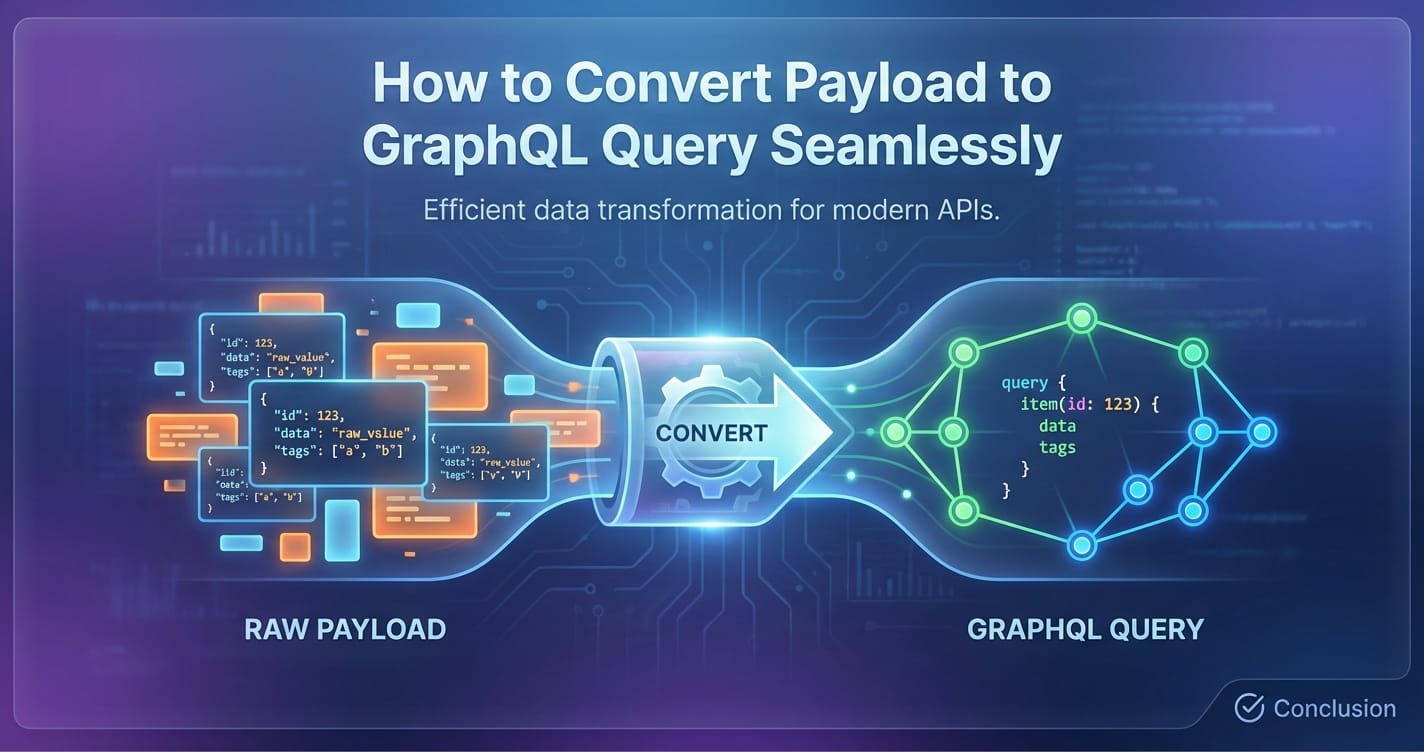
How to Convert Payload to GraphQL Query Seamlessly
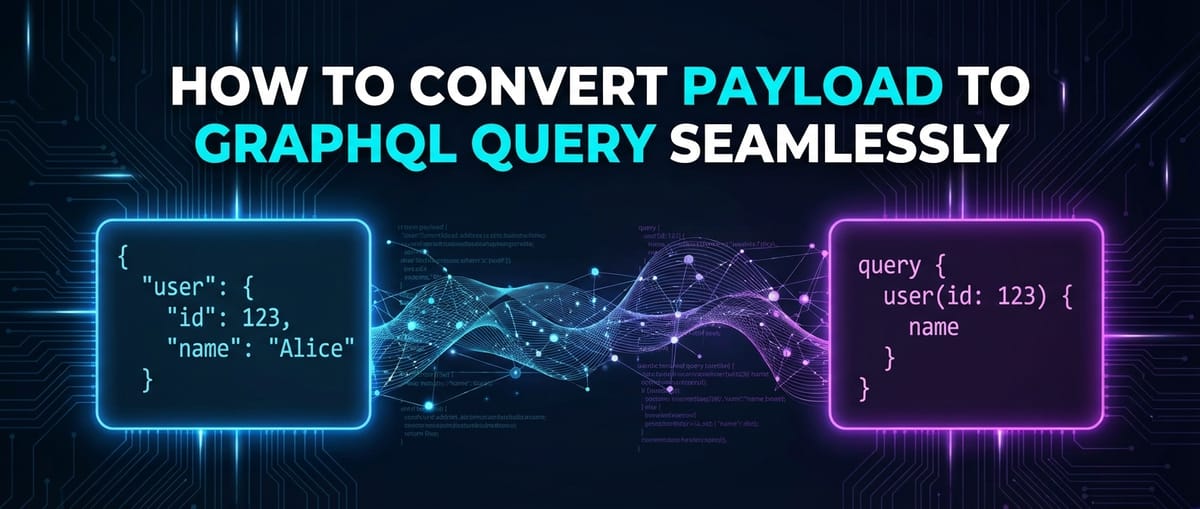


In the intricate landscape of modern web development, the efficient management and consumption of data stand as paramount concerns. Developers today navigate a complex ecosystem where various architectural paradigms coexist, each with its own strengths and nuances. Among these, RESTful APIs have long been the backbone of internet communication, offering a simple, stateless, and resource-oriented approach to data exchange. However, with the increasing demands for flexibility, efficiency, and precise data fetching from client applications, GraphQL has rapidly emerged as a powerful alternative, redefining how clients interact with servers. The challenge then arises: how does one bridge the gap between these two worlds, specifically, how does one seamlessly convert traditional RESTful payloads into sophisticated GraphQL queries? This question is not merely an academic exercise; it's a critical technical hurdle for organizations looking to modernize their infrastructure, consolidate disparate services, and empower their frontend teams with unparalleled data-fetching capabilities, all while maintaining robust api management practices.
This extensive guide will delve deep into the methodologies, strategies, and architectural considerations involved in transforming existing data payloads—typically JSON or XML structures from REST endpoints—into well-formed GraphQL queries. We will explore the fundamental differences between these two paradigms, illuminate the practical steps for mapping data structures, and discuss the various tools and patterns, including the crucial role of an advanced api gateway, that can facilitate this transition. Our objective is to provide a comprehensive roadmap for developers and architects aiming to harness the power of GraphQL without completely overhauling their existing RESTful backends, ensuring a smooth, incremental adoption that enhances developer experience and optimizes data flow.
Chapter 1: Understanding the Landscape – RESTful Payloads and GraphQL Queries
Before embarking on the journey of conversion, it is imperative to possess a clear and profound understanding of the source and destination architectures. Both REST and GraphQL offer distinct approaches to api design and data interaction, and appreciating these differences is the first step towards a successful and seamless integration.
1.1 The Ubiquity of RESTful APIs
Representational State Transfer (REST) has been the dominant architectural style for building web services for over two decades. Its principles, first articulated by Roy Fielding in his doctoral dissertation, leverage the existing HTTP protocol to create scalable, stateless, and cacheable interactions between clients and servers. A RESTful api is typically centered around resources, identifiable by unique URLs, and manipulated using standard HTTP methods such (GET, POST, PUT, DELETE, PATCH).
The very essence of a RESTful interaction involves sending a request to a specific endpoint and receiving a "payload" in response. This payload is traditionally a JSON (JavaScript Object Notation) or XML (Extensible Markup Language) document, containing all the data associated with the requested resource. For instance, a GET request to /users/123 might return a JSON payload like:
{
  "id": 123,
  "firstName": "John",
  "lastName": "Doe",
  "email": "john.doe@example.com",
  "address": {
    "street": "123 Main St",
    "city": "Anytown",
    "zipCode": "12345"
  },
  "orders": [
    {"orderId": 1, "total": 50.00},
    {"orderId": 2, "total": 75.50}
  ]
}
Characteristics of RESTful Payloads: * Fixed Structures: Each endpoint typically returns a predefined data structure. While some parameters might influence the data returned (e.g., pagination, filtering), the fundamental shape of the payload for a given resource remains constant. * Over-fetching and Under-fetching: A significant challenge with REST is the phenomenon of over-fetching, where the client receives more data than it actually needs, or under-fetching, where multiple requests are required to gather all necessary information (the "N+1 problem"). For example, if a client only needs the user's name and email, it still receives the entire address and orders array. Conversely, if it needs detailed order items, it might have to make separate requests to an /orders/{orderId} endpoint. * Multiple Endpoints: Managing various resources often means maintaining numerous distinct API endpoints, each serving a specific purpose. This can lead to increased complexity in client-side code responsible for orchestrating multiple requests and combining data. * HTTP Status Codes: Error handling in REST is typically communicated via standard HTTP status codes (e.g., 200 OK, 404 Not Found, 500 Internal Server Error) and often supplemented with an error message in the response body.
The advantages of REST lie in its simplicity, widespread adoption, and alignment with fundamental web principles. It's relatively easy to understand and implement, making it a go-to choice for many applications. However, as applications grow in complexity and client requirements become more granular, the limitations of REST, particularly concerning data fetching efficiency and the rigidity of its payloads, become increasingly apparent.
1.2 The Emergence of GraphQL
GraphQL, developed by Facebook in 2012 and open-sourced in 2015, fundamentally shifts the paradigm of api interaction. Instead of clients making requests to multiple endpoints to retrieve fixed data structures, GraphQL empowers clients to declare exactly what data they need, and the server responds with precisely that data, and nothing more. It's a query language for your api, executed by a runtime on your server.
A GraphQL api typically exposes a single endpoint, and clients send "queries" to this endpoint. These queries are strongly typed, meaning the server has a predefined schema that dictates what data can be requested and in what format.
Consider the same user data as before, but requested via GraphQL. If a client only needs the user's firstName and email, the query would look like this:
query GetUserBasicInfo($id: ID!) {
  user(id: $id) {
    firstName
    email
  }
}
And the corresponding response payload:
{
  "data": {
    "user": {
      "firstName": "John",
      "email": "john.doe@example.com"
    }
  }
}
Key Features of GraphQL: * Client-Driven Data Fetching: Clients specify their data requirements in the query, allowing for highly optimized data retrieval. This eliminates both over-fetching and under-fetching. * Single Endpoint: All data operations (queries, mutations, subscriptions) typically go through a single URL, simplifying client-side configuration and interaction. * Strongly Typed Schema: The GraphQL schema acts as a contract between the client and the server, defining all available data types, fields, and operations. This provides robust validation and introspection capabilities. * Queries, Mutations, and Subscriptions: * Queries: Used for fetching data (analogous to GET requests in REST). * Mutations: Used for modifying data (creating, updating, deleting resources, analogous to POST, PUT, DELETE in REST). * Subscriptions: Used for real-time, event-driven data updates, allowing clients to receive push notifications from the server when specific data changes. * Hierarchical Data Structures: GraphQL naturally supports fetching complex, nested data structures in a single request, mirroring the graph-like nature of relationships between data entities. * Predictable Error Handling: Errors are typically returned within the errors field of the GraphQL response payload, alongside a potentially partial data field, allowing clients to handle errors gracefully without relying solely on HTTP status codes.
The advantages of GraphQL are compelling: improved performance for clients (especially on mobile), reduced network overhead, faster iteration cycles for frontend teams, and a more intuitive data model. However, it also introduces its own set of challenges, such as the need for robust server-side implementation, potential complexities in caching strategies, and the learning curve associated with its unique query language and schema design principles.
1.3 The Conversion Challenge
The coexistence of REST and GraphQL creates a fascinating, yet challenging, integration scenario. Many organizations possess extensive investments in existing RESTful api infrastructure, with mature services, robust security measures, and well-established operational workflows. A complete, rip-and-replace migration to GraphQL is often impractical, costly, and disruptive. Yet, the benefits of GraphQL for new client applications, particularly those demanding highly customizable data access and real-time capabilities, are too significant to ignore.
This is where the need for seamless payload-to-GraphQL query conversion becomes critical. The challenge is multi-faceted:
- Bridging Paradigms: It involves translating the resource-oriented, endpoint-specific nature of REST into the graph-oriented, strongly typed structure of GraphQL. This means mapping HTTP methods to GraphQL operations, transforming URL parameters and request bodies into GraphQL arguments, and aligning diverse JSON/XML schemas with a unified GraphQL type system.
- Maintaining Data Integrity: During conversion, it's crucial to ensure that data types are correctly interpreted, relationships between entities are preserved, and no information is lost or corrupted.
- Optimizing Performance: The conversion process itself should not introduce significant latency. The goal is to leverage GraphQL's efficiency while still relying on existing RESTful backends.
- Simplifying Client Consumption: The ultimate aim is to provide a single, consistent GraphQL interface to clients, abstracting away the underlying complexity of interacting with multiple REST endpoints.
- Supporting Legacy Systems: Many organizations operate with legacy systems that expose data solely through REST. The ability to expose this data via a GraphQL interface without modifying the legacy services is a powerful enabler for modernization.
- Managing Evolution: As REST APIs evolve or new GraphQL features emerge, the conversion layer must be adaptable and easy to maintain.
Addressing these challenges requires a thoughtful combination of data modeling, transformation logic, and architectural patterns, often centralized within a sophisticated api gateway that can intelligently mediate between the two worlds. The ability to seamlessly convert payloads means organizations can incrementally adopt GraphQL, extending the lifespan of their existing REST investments while paving the way for future innovation.
Chapter 2: Core Concepts of Payload-to-GraphQL Mapping
Successfully converting payloads into GraphQL queries requires a methodical approach, grounded in understanding how to map disparate data structures and operational semantics. This chapter lays out the foundational concepts essential for this transformation.
2.1 Data Structure Alignment
The cornerstone of any payload conversion is the meticulous alignment of data structures. RESTful payloads arrive in various shapes, often as JSON or XML, reflecting the specific resource being accessed. GraphQL, on the other hand, operates on a strongly typed schema, where every piece of data has a predefined type, including scalar types (like String, Int, Boolean, ID, Float), object types, enum types, and list types.
Identifying Common Fields: The first step is to analyze your existing REST payloads and identify the common data fields that represent entities within your domain. For instance, if your REST API exposes /users, /products, and /orders endpoints, you'll likely find fields such as id, name, description, price, quantity, email, address, etc. These fields will directly correspond to fields within your GraphQL User, Product, and Order types.
Handling Nested Objects and Arrays: REST payloads frequently contain nested objects and arrays to represent relationships between entities. For example, a user payload might include an address object and an orders array. In GraphQL, these directly translate into nested types and list types.
- Nested Objects: A REST JSON object like
{"address": {"street": "...", "city": "..."}}maps directly to a GraphQLAddresstype nested within aUsertype. - Arrays of Objects: An array like
"orders": [{"orderId": 1, ...}, {"orderId": 2, ...}]maps to a GraphQL list ofOrdertypes[Order!].
Schema Definition in GraphQL – The Foundation: The GraphQL schema is the definitive contract for your API. It dictates what queries, mutations, and subscriptions are available, what types of data they return, and what arguments they accept. When converting from REST, the schema acts as the target data model. You must design a GraphQL schema that can represent all the relevant data exposed by your REST APIs.
Consider a REST endpoint /api/users/{id} returning:
{
  "id": "1",
  "name": "Alice",
  "email": "alice@example.com",
  "profile": {
    "age": 30,
    "bio": "Software Engineer"
  },
  "posts": [
    {"postId": "a1", "title": "My First Post"},
    {"postId": "b2", "title": "Another Post"}
  ]
}
The corresponding GraphQL schema definitions would look like this:
type User {
  id: ID!
  name: String!
  email: String
  profile: Profile
  posts: [Post!]
}

type Profile {
  age: Int
  bio: String
}

type Post {
  postId: ID!
  title: String
}

type Query {
  user(id: ID!): User
}
This mapping process involves careful design to ensure the GraphQL schema is intuitive, consistent, and provides the flexibility clients expect. It's not just a direct one-to-one translation but often an opportunity to normalize and unify data that might be scattered across different REST endpoints.
2.2 Mapping HTTP Methods to GraphQL Operations
RESTful APIs rely heavily on HTTP methods (verbs) to define the action to be performed on a resource. GraphQL, in contrast, uses three primary types of operations: Queries, Mutations, and Subscriptions. Understanding how to translate HTTP verbs into these GraphQL operations is fundamental.
- GET -> Query: REST's
GETrequests are designed for retrieving data. This directly maps to GraphQLQueryoperations. When a client needs to fetch data, it sends a GraphQL query. For example, a RESTGET /users/123would be transformed into a GraphQLquery { user(id: "123") { ... } }. - POST, PUT, PATCH, DELETE -> Mutation: HTTP methods that modify data (creating, updating, deleting resources) correspond to GraphQL
Mutationoperations. A GraphQL mutation bundles the operation, its input arguments, and the desired return data into a single request.- POST (Create): A REST
POST /userswith a request body to create a new user translates to a GraphQL mutation likemutation CreateUser($input: CreateUserInput!) { createUser(input: $input) { id name } }. - PUT/PATCH (Update): A REST
PUT /users/123orPATCH /users/123to update a user maps to a GraphQL mutation likemutation UpdateUser($id: ID!, $input: UpdateUserInput!) { updateUser(id: $id, input: $input) { id name email } }. - DELETE (Delete): A REST
DELETE /users/123to remove a user maps to a GraphQL mutation likemutation DeleteUser($id: ID!) { deleteUser(id: $id) { success } }.
- POST (Create): A REST
It's crucial to define distinct input types for mutations to encapsulate the data being sent to the server. For instance, CreateUserInput or UpdateUserInput in the examples above.
- Subscriptions for Real-time Data: While REST does not have a native equivalent for real-time, event-driven data pushing (often requiring techniques like WebSockets or long polling alongside REST), GraphQL
Subscriptionsfill this gap. If your RESTful system uses WebSockets for real-time updates, those events can be modeled as GraphQL subscriptions, providing a unified real-time data layer alongside your query and mutation operations. This enables clients to subscribe to specific events and receive data pushed from the server whenever those events occur.
2.3 Parameter Transformation
REST APIs utilize various methods to pass parameters: path parameters (e.g., /users/{id}), query parameters (e.g., /users?status=active), and request body parameters (for POST/PUT/PATCH). GraphQL, on the other hand, uses a unified system of "arguments" for fields and operations.
Mapping Strategies: * Path Parameters: A REST path parameter like {id} in /users/{id} becomes an argument to a GraphQL field, e.g., user(id: "123"). * Query Parameters: REST query parameters (e.g., page, pageSize, filter, sort) also translate directly into arguments for GraphQL fields, often within a nested filter or pagination input object. For example, a REST GET /products?category=electronics&price_gt=100 might become a GraphQL products(filter: { category: "electronics", price: { gt: 100 } }). * Request Body Parameters: The JSON or XML payload sent in the body of POST, PUT, or PATCH requests in REST becomes the input arguments for GraphQL Mutation operations. These are typically wrapped in a dedicated input type to ensure strong typing and validation. For instance, a REST POST body like {"name": "New Product", "price": 29.99} would map to a GraphQL mutation with an input: { name: "New Product", price: 29.99 } argument.
Type Checking and Validation: During transformation, rigorous type checking and validation are paramount. GraphQL's strong typing system inherently provides a layer of validation, ensuring that arguments passed to operations match the defined types in the schema. When converting from weakly typed (or less strictly enforced) REST parameters, the conversion layer must perform necessary type coercion and validation to align with the GraphQL schema. This could involve converting strings to integers, booleans, or specific date formats, and handling default values or required fields. If validation fails, appropriate GraphQL errors should be returned.
2.4 Error Handling and Status Codes
Error handling is a critical aspect of any api, and there are distinct differences between how REST and GraphQL manage it.
- RESTful Error Handling: REST typically relies on HTTP status codes to indicate the outcome of a request:
2xx(Success): 200 OK, 201 Created, 204 No Content.4xx(Client Error): 400 Bad Request, 401 Unauthorized, 403 Forbidden, 404 Not Found, 429 Too Many Requests.5xx(Server Error): 500 Internal Server Error, 503 Service Unavailable. Often, these status codes are accompanied by a JSON error object in the response body providing more details.
- GraphQL Error Handling: GraphQL, by design, typically returns a
200 OKHTTP status code, even if there are errors within the GraphQL operation itself. Errors are communicated within the GraphQL response payload in a dedicatederrorsarray, alongside a potentially partialdatafield. Each error object in the array typically includes:message: A human-readable description of the error.locations: The line and column in the query where the error occurred.path: The path to the field in the response where the error occurred.extensions: An optional field for custom error codes, additional context, or stack traces.
Translating HTTP Status Codes to GraphQL Error Structures: When converting from REST to GraphQL, the conversion layer or api gateway needs to interpret HTTP status codes from the underlying REST services and translate them into appropriate GraphQL error objects. * A 404 Not Found from a REST endpoint might become a NotFoundError in GraphQL with a specific error code in extensions. * A 401 Unauthorized or 403 Forbidden would translate to AuthenticationError or AuthorizationError. * A 400 Bad Request or 422 Unprocessable Entity would often map to a ValidationError. * A 500 Internal Server Error would generally be a ServerError.
Standardizing Error Responses: A key benefit of this translation is the ability to standardize error responses across your GraphQL api, even if the underlying REST services have inconsistent error formats. The GraphQL schema can define custom error types (e.g., using interfaces or unions) to provide richer, typed error information to clients, moving beyond generic error messages. This consistency greatly improves the developer experience for clients consuming the GraphQL API.
This methodical mapping of data structures, operations, parameters, and errors forms the conceptual bedrock upon which practical conversion strategies are built. With these core concepts firmly established, we can now explore the practical implementation techniques.
Chapter 3: Practical Strategies for Seamless Conversion
With a solid understanding of the conceptual mapping, the next step is to explore the practical strategies and tools that enable the seamless conversion of REST payloads into GraphQL queries. This involves moving beyond theoretical alignment to concrete implementation techniques.
3.1 Manual Conversion and Its Limitations
One approach to bridging the gap is manual conversion. This involves writing custom code—often in the form of server-side resolvers—that acts as an intermediary. A GraphQL server would define its schema, and for each field or operation, a resolver function would be implemented. Inside this resolver, the logic would: 1. Receive GraphQL arguments. 2. Construct an appropriate RESTful HTTP request (e.g., building the URL, setting headers, forming the request body). 3. Make the HTTP call to the underlying REST api. 4. Receive the REST response payload (e.g., JSON). 5. Parse the REST payload and transform it into the shape expected by the GraphQL schema. 6. Return the transformed data.
Example of a manual resolver:
// In a Node.js GraphQL server using Apollo Server
const resolvers = {
  Query: {
    user: async (parent, { id }, context, info) => {
      try {
        const response = await fetch(`https://api.example.com/users/${id}`);
        if (!response.ok) {
          throw new Error(`REST API error: ${response.statusText}`);
        }
        const restPayload = await response.json();
        // Manual transformation from REST payload to GraphQL User type
        return {
          id: restPayload.id,
          name: `${restPayload.firstName} ${restPayload.lastName}`,
          email: restPayload.email,
          profile: {
            age: restPayload.age, // Assuming age exists in restPayload
            bio: restPayload.bio
          }
        };
      } catch (error) {
        console.error("Error fetching user from REST API:", error);
        throw new Error("Failed to retrieve user data.");
      }
    },
  },
  // ... other resolvers for mutations, nested fields etc.
};
Limitations of Manual Conversion: While offering granular control, manual conversion quickly becomes unsustainable for large api surfaces: * Maintenance Overhead: Every change in the underlying REST api (e.g., field name changes, new endpoints) requires updates to the GraphQL resolvers. This can be cumbersome and error-prone. * Scalability Issues: As the number of REST endpoints and GraphQL fields grows, the sheer volume of resolver code can become unmanageable. * Boilerplate Code: Much of the transformation logic might be repetitive (e.g., mapping id, name). * N+1 Problem: Without careful implementation (e.g., using DataLoader), fetching nested data can lead to the "N+1 problem," where a query for a list of items and their associated details results in one request for the list and N subsequent requests for each item's details.
For small, contained conversions, manual resolvers can work, but for comprehensive api integration, more automated and scalable solutions are typically required.
3.2 Schema-First vs. Code-First Approaches
When designing your GraphQL API that will consume REST services, you generally have two primary approaches for defining your GraphQL schema:
- Schema-First (or Schema Definition Language - SDL First): In this approach, you first define your entire GraphQL schema using the GraphQL Schema Definition Language (SDL). This SDL serves as the single source of truth for your api's structure. Once the schema is defined, you then write resolver functions that implement the logic to fetch and transform data according to that schema.
- Pros: Clear contract for communication, easy to read and understand, allows for schema design upfront (even before backend implementation), facilitates collaboration between frontend and backend teams.
- Cons: Requires manual synchronization between schema and resolver implementations, changes in schema necessitate changes in code.
- Relevance to REST conversion: You would design your GraphQL schema to best represent your data graph, and then write resolvers that call your REST APIs and transform their payloads to fit the schema.
- Code-First: In a code-first approach, you define your GraphQL schema directly in code using programming language constructs (e.g., classes, decorators in TypeScript/JavaScript, structs in Go). Libraries like TypeGraphQL (for TypeScript), NestJS's GraphQL module, or GraphQL-Ruby can automatically generate the SDL schema from your code.
- Pros: Keeps schema and resolvers closely coupled, benefits from type safety and IDE tooling, reduces boilerplate in some cases.
- Cons: Schema might be harder to read and understand without special tools, changes in code can implicitly change the schema.
- Relevance to REST conversion: Your code would define GraphQL types and fields, and within those definitions, you'd implement the logic to fetch data from REST and perform the mapping.
Choosing between these depends on team preferences, project size, and existing tooling. For integrating existing REST APIs, a schema-first approach often provides a clearer design path, allowing architects to model the desired GraphQL interface independently before diving into the implementation details of fetching from REST.
3.3 Utilizing GraphQL Gateways and Proxies
Perhaps the most robust and scalable strategy for converting REST payloads to GraphQL queries seamlessly is to leverage specialized GraphQL gateways or API proxies. These tools sit in front of your existing REST services, providing a unified GraphQL entry point for clients.
A GraphQL gateway acts as a sophisticated api gateway, intercepting incoming GraphQL requests, routing them to the appropriate backend services (which could be REST APIs, other GraphQL services, databases, or even serverless functions), and then composing the results into a single GraphQL response.
How a GraphQL Gateway Facilitates Conversion: 1. Schema Stitching/Federation: Gateways can combine multiple, independent GraphQL schemas (or even generate schemas from existing REST services) into a single, unified "supergraph." This allows different teams or services to own their specific GraphQL domains while presenting a cohesive API to clients. For REST integration, the gateway can define a GraphQL schema that models the REST resources. 2. Resolver Orchestration: Instead of individual resolvers making direct HTTP calls to REST endpoints, the gateway handles the orchestration. It can introspect the incoming GraphQL query, determine which underlying REST APIs need to be called, execute those calls (potentially in parallel or batch), and then perform the necessary payload transformations. 3. Automatic or Configurable Mapping: Many GraphQL gateways offer mechanisms to automatically generate a GraphQL schema from an OpenAPI/Swagger specification of a REST api, or provide configuration options to define mapping rules between REST paths/payloads and GraphQL types/fields. This significantly reduces manual coding. 4. Centralized Concerns: An api gateway is inherently designed to handle cross-cutting concerns such as authentication, authorization, rate limiting, caching, logging, and monitoring. When it's also a GraphQL gateway, it can apply these policies uniformly across all underlying services, regardless of whether they are REST or GraphQL.
Mentioning APIPark: In this context, it's worth highlighting how modern api gateway solutions can significantly streamline the conversion and management of diverse api types. Platforms like APIPark are designed as advanced API Gateways that not only manage the entire lifecycle of APIs but also excel at integrating and unifying disparate services. APIPark, an open-source AI gateway and API management platform, specifically addresses challenges related to a unified API format, which is precisely what's needed when converting payloads.
APIPark offers powerful features that are highly relevant here: * Unified API Format for AI Invocation: While primarily focused on AI models, this feature's core principle—standardizing request data format—is directly applicable to abstracting varied REST payloads into a consistent GraphQL interface. It ensures that changes in underlying service implementations (like a REST API) do not affect the application's consumption of data, simplifying maintenance and usage costs. * Prompt Encapsulation into REST API: APIPark allows users to combine AI models with custom prompts to create new APIs. This demonstrates its capability to encapsulate complex logic and expose it through a simplified API, a pattern that can be extended to abstracting REST calls behind GraphQL resolvers. * End-to-End API Lifecycle Management: Managing the entire lifecycle—design, publication, invocation, and decommission—is crucial for any conversion strategy. APIPark helps regulate these processes, including traffic forwarding, load balancing, and versioning of published APIs. This ensures that your GraphQL layer, which is built on top of REST, is managed professionally. * Quick Integration of 100+ AI Models: This feature highlights APIPark's underlying architecture designed for integrating diverse services quickly, a capability that can be leveraged for integrating various REST endpoints into a unified GraphQL API.
By centralizing API management and providing a unified abstraction layer, an api gateway like APIPark becomes an indispensable tool for organizations looking to expose their existing REST infrastructure via a performant and manageable GraphQL interface, effectively streamlining the conversion process and ensuring long-term maintainability. Its focus on standardizing API formats makes it particularly adept at handling the payload transformation requirements.
3.4 Open-Source Libraries and Frameworks
Beyond commercial gateways, a rich ecosystem of open-source libraries and frameworks exists to aid in GraphQL implementation and REST integration.
- GraphQL Mesh: This powerful tool allows you to create a GraphQL gateway that pulls data from any source (including OpenAPI/Swagger, gRPC, databases, other GraphQL APIs) and transforms it into a unified GraphQL API. It can generate a GraphQL schema from your REST OpenAPI specification and provide resolvers that automatically fetch data from the REST endpoints. This significantly automates the payload-to-GraphQL conversion.
- Apollo Federation: While primarily for stitching multiple GraphQL services, Apollo Federation can be adapted to integrate REST. You'd typically create "subgraphs" that expose GraphQL wrappers around your REST services, and then the Apollo Gateway combines these subgraphs. This is more about gradual migration and distributed GraphQL architecture.
- Hasura: Hasura is a GraphQL engine that gives you instant, real-time GraphQL APIs over your existing databases. While not directly converting REST payloads, if your REST APIs primarily act as proxies to a database, Hasura could replace that layer with a direct GraphQL connection to the DB, potentially removing the need for REST-to-GraphQL conversion for data fetching. It can also integrate with custom business logic (e.g., calling REST APIs) via remote schemas.
- Prisma: Prisma is an open-source ORM that automatically generates a type-safe GraphQL schema (and resolvers) from your database schema. Similar to Hasura, it bypasses the need for REST if your REST API is a thin wrapper over the database.
- Express-GraphQL / Apollo Server / etc.: These are GraphQL server implementations that provide the core runtime for your GraphQL api. You'd use these in conjunction with manual resolvers or other libraries to implement the conversion logic.
Choosing the right library or framework depends on your specific needs: whether you want full automation from OpenAPI specs (GraphQL Mesh), a sophisticated distributed GraphQL architecture (Apollo Federation), or a direct database-to-GraphQL approach (Hasura/Prisma).
3.5 Best Practices for Data Transformation Logic
Regardless of the chosen strategy, certain best practices for the actual data transformation are critical to ensure performance, reliability, and security.
- Idempotency for Mutations: Ensure that GraphQL mutations that interact with REST
PUTorDELETEmethods are idempotent. This means performing the operation multiple times has the same effect as performing it once. ForPOSToperations, it's often desirable to return an existing resource if it matches the input, or create a new one. - Handling Pagination and Filtering: REST APIs typically use query parameters for pagination (
?page=1&limit=10) and filtering (?status=active). The GraphQL layer must translate these into appropriate arguments and pass them to the underlying REST service. The GraphQL schema should expose pagination fields (e.g.,first,after,last,before) and filtering arguments that map to the REST API's capabilities. The GraphQL Cursor Connections Specification is a common pattern for pagination. - Optimizing Data Fetching (N+1 Problem Solutions): When a GraphQL query requests a list of items and then details for each item, naive resolvers can lead to the N+1 problem.
- DataLoader: This is a popular solution for batching and caching requests. A DataLoader can collect all individual requests for a particular type of data (e.g., user by ID) over a short period and then make a single batched request to the underlying REST API, significantly reducing the number of HTTP calls.
- Field-level Optimization: Design your resolvers to fetch only the data that is explicitly requested in the GraphQL query. This might involve conditional fetching from the REST API or projecting specific fields in the REST request if the REST API supports it.
- Security Considerations (Authorization, Authentication):
- Authentication: The GraphQL gateway or resolvers must correctly propagate authentication tokens (e.g., JWTs, API keys) from the GraphQL client to the underlying REST APIs. This often involves securely storing and managing credentials at the gateway level.
- Authorization: Implement robust authorization checks at the GraphQL layer. This means ensuring that the authenticated user has permission to access the requested data or perform the requested mutation. The GraphQL resolver logic should translate GraphQL authorization rules into the equivalent checks required by the underlying REST services, or perform the checks directly before calling REST. An api gateway is an ideal place to enforce these policies centrally.
- Input Validation: Beyond GraphQL's type system, perform additional input validation in resolvers to prevent malicious or malformed data from reaching the REST services.
- Rate Limiting: Protect your underlying REST APIs from abuse by implementing rate limiting at the GraphQL gateway. This prevents a single client from overwhelming your backend services with too many requests, even if they are well-formed GraphQL queries. APIPark, for example, offers performance rivaling Nginx and supports cluster deployment, indicating its capability to handle high traffic and potentially enforce rate limits effectively.
By adhering to these best practices, developers can create a robust, performant, and secure GraphQL layer that seamlessly integrates with existing RESTful services, providing an enhanced developer experience without compromising on the quality of the underlying api.
APIPark is a high-performance AI gateway that allows you to securely access the most comprehensive LLM APIs globally on the APIPark platform, including OpenAI, Anthropic, Mistral, Llama2, Google Gemini, and more.Try APIPark now! 👇👇👇
Chapter 4: Architectural Patterns for Hybrid Environments
Integrating REST and GraphQL effectively often necessitates adopting specific architectural patterns that facilitate a harmonious coexistence. These patterns help organize the different layers and responsibilities, leading to more maintainable and scalable solutions.
4.1 Backend for Frontend (BFF) Pattern
The Backend for Frontend (BFF) pattern is a specialized API gateway pattern where a separate backend service is created for each distinct frontend client (e.g., web, mobile, internal dashboard). Each BFF is tailored to the specific needs of its corresponding client, simplifying the client-side code and optimizing data fetching.
How BFF Can Expose a GraphQL Endpoint: In a hybrid REST-GraphQL environment, a BFF is an ideal place to implement the GraphQL layer. Instead of a generic GraphQL gateway serving all clients, each BFF could expose a GraphQL endpoint specifically designed for its client. * Tailored Queries: The BFF's GraphQL schema can be highly optimized for a specific client's data requirements, avoiding the need for a monolithic GraphQL schema that tries to serve all possible client needs. * Client-Specific Aggregation: The BFF's GraphQL resolvers would be responsible for calling multiple underlying REST APIs, aggregating the data, and transforming it into the specific GraphQL payload required by its client. This shifts the complexity of data orchestration from the client to the BFF. * Simplified Client Logic: Frontend teams can consume a clean, client-optimized GraphQL API without needing to understand the intricacies of the underlying REST services or perform complex data transformations themselves. * Independent Deployment: Each BFF can be developed, deployed, and scaled independently, reducing coupling and improving agility.
For example, a mobile app BFF might expose a GraphQL endpoint with specific mutations for mobile-optimized interactions, while a web app BFF might have different queries for desktop views. Both BFFs would resolve their GraphQL queries by calling the same set of core RESTful microservices. This pattern naturally fosters the seamless conversion of REST payloads as the BFF acts as the dedicated translation layer for its specific client.
4.2 API Gateway Pattern Revisited
The general api gateway pattern positions a single, intelligent entry point in front of a collection of backend services. This gateway handles requests, routes them to the appropriate services, and can also perform various cross-cutting concerns. When integrating GraphQL, the api gateway takes on an even more pivotal role.
Centralized Control and Conversion: * Unified Access: The api gateway provides a single URL for all clients to interact with, regardless of whether the underlying services are REST, GraphQL, or something else. * GraphQL Endpoint: The gateway itself can expose a GraphQL endpoint. Incoming GraphQL queries are then processed by the gateway, which translates them into calls to the appropriate REST APIs. * Authentication and Authorization: As discussed, the api gateway is the perfect place to centralize authentication and authorization logic. It can validate client credentials and enforce access policies before routing requests to backend REST services. This prevents unauthorized access to the underlying APIs and ensures consistent security. * Rate Limiting and Throttling: The gateway can implement rate limiting rules to protect backend services from being overwhelmed by traffic. This is particularly important for REST services that might not have their own sophisticated rate-limiting capabilities. * Caching: The api gateway can cache responses from frequently accessed REST endpoints, significantly improving performance and reducing the load on backend services. This can be complex for GraphQL due to its flexible queries but can be implemented for specific, common query patterns. * Load Balancing and Service Discovery: The gateway can intelligently route requests to different instances of backend services for load balancing and automatically discover new service instances, improving scalability and resilience.
The role of an api gateway in unifying diverse backend services under a single GraphQL interface is transformative. It abstracts away the heterogeneity of the underlying architecture, presenting a cohesive and flexible data graph to consumers. Advanced gateways, like APIPark, extend this concept further by offering AI capabilities and unified management across various API types, simplifying what would otherwise be a complex integration challenge. Its performance capabilities (over 20,000 TPS on an 8-core CPU, 8GB memory) ensure that such a centralized gateway can handle high volumes of converted requests efficiently.
4.3 Microservices and GraphQL
The microservices architecture breaks down a monolithic application into a collection of small, independent services, each responsible for a specific business capability. Each microservice typically exposes its own API, often RESTful. Integrating GraphQL into a microservices environment can be particularly powerful for client consumption.
GraphQL as an Aggregation Layer: * Each Microservice Exposes REST/GraphQL: Individual microservices can continue to expose their own RESTful APIs. Alternatively, if a microservice is new or being heavily refactored, it could expose its own GraphQL API. * API Gateway or Dedicated GraphQL Layer: An api gateway (or a dedicated GraphQL aggregation service) sits in front of these microservices. Its role is to: * Receive incoming GraphQL queries from clients. * Determine which microservices need to be called to resolve the query. * Call the respective REST (or GraphQL) endpoints of those microservices. * Aggregate the data from various microservices. * Transform the data into the structure requested by the GraphQL query. * Return a single, unified GraphQL response. * Benefits for Scalability and Independent Deployment: * Loose Coupling: Microservices remain independent, allowing teams to develop, deploy, and scale them autonomously. The GraphQL layer is concerned with aggregation, not internal microservice logic. * Optimized Client Fetching: Clients get the benefit of GraphQL's selective data fetching without needing to make multiple requests to different microservices. * Technology Agnostic Backend: The GraphQL layer can integrate with microservices written in different languages and using different database technologies, abstracting these details from the client.
This pattern empowers frontend teams to consume data efficiently from a complex microservices backend through a simplified GraphQL interface. The conversion of REST payloads happens at the aggregation layer, where the GraphQL server's resolvers (or the gateway's internal logic) perform the necessary transformations before presenting the data to the client. This approach is highly flexible and aligns well with the principles of modern distributed systems.
Table 1: Comparison of REST Payload and GraphQL Query Elements
To further illustrate the mapping concepts, let's present a comparison of typical elements and their conversion:
| Aspect | REST Payload (Example: JSON) | GraphQL Query / Schema (Example: SDL) | Conversion Logic / Implications |
|---|---|---|---|
| Data Structure | Flat or deeply nested JSON/XML objects/arrays. | Strongly typed schema (Objects, Scalars, Lists, Enums). | Manual parsing, field-by-field mapping, type coercion. |
| Resource ID | Path parameter (/users/{id}), field in payload ("id": 1). |
Argument to a field (user(id: "1")), field in type (id: ID!). |
Direct mapping of ID values, ensuring type consistency (e.g., String to ID). |
| HTTP Method / Action | GET, POST, PUT, DELETE, PATCH. | Query (read), Mutation (write), Subscription (real-time). | GET -> Query, POST/PUT/PATCH/DELETE -> Mutation. |
| Request Parameters | Path params, Query params (?sort=name), Request Body. |
Field arguments (users(limit: 10, offset: 0)), Input Objects. |
Aggregation of various REST params into single GraphQL argument structure. |
| Response Scope | Fixed, often over-fetches or under-fetches data. | Client-defined, exact data requested. | Resolvers fetch relevant data from REST based on GraphQL selection set. |
| Error Handling | HTTP Status Codes (404, 500) + optional error body. | 200 OK + errors array in response body. |
Translate HTTP status codes into structured GraphQL error objects (message, code, extensions). |
| Relationships | Separate endpoints (/users/1/orders), includes in payload. |
Nested fields (user { orders { ... } }). |
Requires intelligent resolvers to fetch related data from other REST endpoints or join within the conversion layer. |
| Real-time | Often requires WebSockets or polling (separate concerns). | Subscriptions (built-in GraphQL operation). | Map existing real-time streams (e.g., WebSockets) to GraphQL subscription events. |
This table succinctly summarizes the core differences and the corresponding requirements for a robust conversion layer, highlighting the complexity and attention to detail required in mapping between these two distinct API paradigms.
Chapter 5: Advanced Considerations and Future Trends
Beyond the foundational concepts and practical strategies, there are several advanced considerations and emerging trends that further refine the seamless conversion of REST payloads to GraphQL queries. These aspects delve into performance, security, and the evolving landscape of api management.
5.1 Performance Optimization in Conversion
While GraphQL's ability to fetch precise data is inherently efficient, the conversion layer itself can introduce overhead if not carefully optimized. Performance is crucial for a truly "seamless" experience.
- Batching and DataLoader for Efficient Data Fetching: As discussed, the N+1 problem is a significant performance bottleneck when fetching related data. DataLoader is a powerful library (available in various languages) that batches requests to the backend. Instead of making separate REST calls for each item in a list (e.g., getting details for 100 users individually), DataLoader collects all these individual requests over a short time frame (e.g., within a single event loop tick) and then dispatches a single batched request to the underlying REST API (if the REST API supports batching, like
GET /users?ids=1,2,3). If the REST API doesn't support batching natively, DataLoader still helps by caching results, preventing redundant requests within the same GraphQL query. This significantly reduces network round trips and improves overall query performance. - Caching Strategies at Different Layers (Gateway, Resolver):
- API Gateway Caching: An api gateway can implement HTTP-level caching for REST responses, especially for
GETrequests to frequently accessed, immutable resources. This means the GraphQL layer might not even need to call the underlying REST API if the gateway serves a cached response. - GraphQL Resolver Caching: Within GraphQL resolvers, you can implement caching mechanisms (e.g., in-memory caches, Redis) for data that changes infrequently. This prevents repeated calls to the REST API for the same data within different parts of a complex GraphQL query or across multiple queries.
- Client-Side Caching: Modern GraphQL clients (like Apollo Client or Relay) have sophisticated normalized caches that help avoid re-fetching data that has already been retrieved. This doesn't directly optimize the conversion but contributes to the overall perceived "seamlessness" for the end-user.
- API Gateway Caching: An api gateway can implement HTTP-level caching for REST responses, especially for
- Monitoring and Logging for Performance Bottlenecks: Implementing comprehensive monitoring and logging across the GraphQL gateway, resolvers, and underlying REST services is paramount.
- Traceability: Use distributed tracing tools (e.g., OpenTelemetry, Jaeger) to trace a single GraphQL request across all intermediate services and REST calls. This helps identify latency hot spots and bottlenecks.
- Metrics: Collect metrics on GraphQL query execution times, REST API response times, cache hit rates, and error rates. This data is invaluable for identifying areas for optimization and ensuring the system performs as expected.
- APIPark's Detailed API Call Logging and Powerful Data Analysis: As an example, APIPark offers "Detailed API Call Logging" which records every detail of each API call, enabling businesses to quickly trace and troubleshoot issues. Its "Powerful Data Analysis" feature analyzes historical call data to display long-term trends and performance changes, which is directly applicable to identifying performance bottlenecks in the conversion layer and the underlying REST services, helping with preventive maintenance. This type of deep insight is critical for maintaining high-performance API ecosystems.
5.2 Security Implications
The introduction of a GraphQL layer on top of existing REST APIs introduces new security considerations and also provides opportunities for enhanced security.
- Input Validation and Sanitization: While GraphQL's strong typing provides some level of validation, it's essential to perform additional, business-logic-driven validation in your resolvers before making calls to the underlying REST APIs. This protects against injection attacks, ensures data integrity, and prevents malformed data from reaching downstream services. Sanitize all user inputs to remove potentially malicious content.
- Rate Limiting and Denial-of-Service Protection: GraphQL's flexibility means a single complex query could be very expensive to resolve, potentially overwhelming backend REST services.
- Query Cost Analysis: Implement query cost analysis to estimate the computational complexity of an incoming GraphQL query before execution. Block or throttle queries that exceed a defined cost threshold.
- Depth and Amount Limiting: Restrict the maximum depth of nested queries and the maximum number of items that can be requested in a list.
- API Gateway Rate Limiting: As previously mentioned, an api gateway is an ideal place to enforce global rate limits per client, protecting all underlying services. This can be based on IP address, API key, or authenticated user.
- Authorization and Authentication Integration:
- Unified Auth Layer: The GraphQL gateway should be the central point for authentication, verifying client identities before any backend calls are made. This often involves integrating with existing Identity Providers (IdPs).
- Fine-Grained Authorization: Implement field-level or resolver-level authorization, ensuring that authenticated users only have access to the specific data and actions they are permitted to perform. This might involve translating GraphQL authorization rules into permissions understood by the underlying REST APIs or performing the checks directly within the GraphQL resolvers based on the user's role and context.
- Subscription Authorization: For GraphQL subscriptions, ensure that authorization checks are performed when a client initially subscribes and potentially re-evaluated periodically for long-lived connections.
- Preventing Unauthorized API Calls (APIPark's Approval Features): APIPark's feature, "API Resource Access Requires Approval," is a prime example of advanced security. It allows for the activation of subscription approval features, ensuring that callers must subscribe to an API and await administrator approval before they can invoke it. This prevents unauthorized API calls and potential data breaches, which is a crucial layer of security, especially for sensitive data exposed through a GraphQL interface. This kind of robust access control at the api gateway level adds a significant layer of defense.
5.3 Evolving Standards and Tools
The GraphQL ecosystem is rapidly evolving, bringing new standards and tools that simplify integration and enhance capabilities.
- GraphQL Subscriptions for Real-time Updates: As an alternative to polling or custom WebSocket implementations, GraphQL subscriptions provide a standardized way for clients to receive real-time data updates. When converting from REST, if your existing system involves polling REST endpoints for changes, consider modeling those updates as GraphQL subscriptions, which can then push data from the REST services to clients efficiently.
- Schema Stitching and Federation Advancements:
- Schema Stitching: This technique allows you to combine multiple GraphQL schemas into a single, unified schema programmatically. It's useful for creating a monolithic GraphQL API from multiple smaller GraphQL services, or even combining generated schemas from REST APIs.
- Apollo Federation: A more advanced approach, Apollo Federation, enables you to build a distributed graph composed of multiple independent GraphQL services (subgraphs). A central gateway then federates queries across these subgraphs. This is ideal for large organizations where different teams own different parts of the data graph. While primarily for GraphQL-to-GraphQL, subgraphs can wrap REST APIs. These advancements simplify the creation of a unified GraphQL experience over a heterogeneous backend.
- Automatic Schema Generation from Existing REST APIs: Tools like GraphQL Mesh have already pioneered this, but the trend towards more intelligent and automated schema generation from existing REST specifications (e.g., OpenAPI/Swagger) is gaining traction. The goal is to minimize manual effort in designing the GraphQL schema and writing resolvers, by inferring types, fields, and operations directly from the REST API documentation. This significantly accelerates the conversion process.
5.4 The Role of AI in API Management
The advent of Artificial Intelligence and Machine Learning is beginning to revolutionize various aspects of software development, and api management is no exception. AI can play a significant role in making the payload-to-GraphQL conversion even more seamless and intelligent.
- Automated Schema Generation: AI models could potentially analyze existing REST API traffic, documentation, and even code to intelligently propose or automatically generate GraphQL schemas. They could infer relationships, suggest optimal types, and even identify common query patterns, drastically reducing the manual effort in schema design.
- Query Optimization: AI could analyze GraphQL query patterns and underlying REST API performance to suggest or automatically apply optimizations, such as dynamic batching strategies, intelligent caching decisions, or even rewriting portions of the GraphQL query for more efficient backend calls.
- Security Monitoring and Anomaly Detection: AI-powered security systems within an api gateway can monitor API traffic for anomalies that indicate potential threats (e.g., unusual query patterns, abnormal request volumes, suspicious data access attempts). This proactive monitoring can protect both the GraphQL layer and the underlying REST services.
- Self-Healing APIs: In the future, AI could enable "self-healing" API gateways that automatically detect issues in underlying REST services, reroute traffic, or even apply temporary fixes (e.g., serving cached data) to maintain service availability during outages.
APIPark's AI Integration: APIPark, as an "Open Source AI Gateway & API Management Platform," is at the forefront of this trend. Its core proposition revolves around the quick integration of 100+ AI models and the standardization of API formats for AI invocation. While its direct features are tailored for AI models, the underlying architectural principles and capabilities that enable it to seamlessly integrate and manage diverse AI services with a unified API format are directly transferable to the challenge of unifying RESTful services under a GraphQL umbrella. This includes its ability to handle prompt encapsulation and provide a robust platform for end-to-end API lifecycle management, which are all building blocks for an intelligent, AI-assisted api gateway that can make complex conversions appear effortless. The insights from APIPark's powerful data analysis, for example, could be enhanced with AI to predict issues or suggest optimizations for the REST-to-GraphQL conversion layer.
By embracing AI and leveraging platforms designed for intelligent api management, organizations can move towards a future where the conversion and governance of APIs become increasingly automated, efficient, and resilient, truly embodying the concept of seamless integration.
Conclusion
The journey to seamlessly convert REST payloads into GraphQL queries is a strategic imperative for organizations striving for agility, efficiency, and a superior developer experience in the modern digital landscape. We have embarked on a comprehensive exploration, beginning with a deep dive into the foundational differences between REST's resource-oriented, fixed-payload approach and GraphQL's client-driven, strongly typed data fetching capabilities. Understanding these distinct paradigms is the first critical step in bridging the gap.
We then dissected the core concepts of payload-to-GraphQL mapping, detailing how to align data structures, translate HTTP methods into GraphQL operations (queries, mutations, subscriptions), transform diverse parameters into standardized arguments, and gracefully manage error handling across these architectural boundaries. This methodical conceptual mapping forms the intellectual bedrock for any successful conversion.
From there, we transitioned to practical strategies, moving from the limitations of manual conversion to the power of schema-first and code-first approaches. A significant focus was placed on the transformative role of GraphQL gateways and proxies, which act as intelligent intermediaries, orchestrating calls to underlying REST services and composing unified GraphQL responses. In this context, we naturally recognized the capabilities of platforms like APIPark, an advanced api gateway that, with its emphasis on unified API formats and end-to-end API lifecycle management, exemplifies how modern solutions can abstract away the complexity of integrating diverse api types, including the challenging task of standardizing REST payloads. We also explored the rich ecosystem of open-source libraries and frameworks that empower developers in this conversion process, alongside essential best practices for data transformation logic, performance optimization, and robust security.
Finally, we ventured into advanced architectural patterns for hybrid environments, examining how patterns like Backend for Frontend (BFF), the api gateway pattern itself, and microservices architectures can be leveraged to effectively integrate GraphQL with existing REST infrastructure. We concluded by looking at future trends, emphasizing the growing importance of performance optimization, rigorous security measures, evolving standards, and the burgeoning role of AI in further automating and enhancing api management.
The strategic importance of seamless conversion cannot be overstated. It represents an evolution, not a revolution, allowing organizations to incrementally adopt the benefits of GraphQL while maximizing their investment in existing RESTful infrastructure. By thoughtfully designing their GraphQL schemas, implementing intelligent resolvers, and leveraging sophisticated api gateway solutions, developers and architects can empower their client applications with unparalleled data-fetching flexibility and efficiency. This transition is not merely about changing an api format; it's about redefining how clients interact with data, enhancing developer productivity, and ultimately, building more resilient and adaptable digital experiences. Embracing robust api management and sophisticated api gateway solutions, especially those incorporating AI capabilities, is key to navigating this complex yet rewarding transition, ensuring that the integration is truly seamless, efficient, and secure.
5 Frequently Asked Questions (FAQs)
Q1: What is the primary benefit of converting REST payloads to GraphQL queries? A1: The primary benefit is improved data fetching efficiency and flexibility for client applications. GraphQL allows clients to request precisely the data they need, eliminating over-fetching (receiving too much data) and under-fetching (needing multiple requests for all necessary data) often experienced with fixed REST payloads. This leads to faster client-side development, reduced network overhead, and better performance, especially for mobile applications. It also provides a unified and strongly typed API contract, simplifying client interactions with complex backend systems.
Q2: Can I convert REST APIs to GraphQL without rewriting my entire backend? A2: Absolutely, and this is one of the main motivations for such conversion strategies. You can implement a GraphQL layer (often using a GraphQL gateway or a separate service with resolvers) that sits in front of your existing RESTful backend services. This layer translates incoming GraphQL queries into appropriate REST API calls, fetches the data, transforms the REST payloads into the GraphQL response format, and returns it to the client. This approach allows for incremental adoption of GraphQL without a "rip and replace" of your proven backend infrastructure.
Q3: What role does an API Gateway play in this conversion process? A3: An api gateway plays a crucial role. It acts as a single entry point for all client requests, sitting between clients and backend REST services. A GraphQL-aware api gateway can receive GraphQL queries, route them to the correct underlying REST endpoints, perform the necessary payload transformations, and compose the final GraphQL response. Beyond conversion, an api gateway centralizes critical functions like authentication, authorization, rate limiting, caching, and logging, making the entire API ecosystem more manageable, secure, and performant. Platforms like APIPark, as an advanced API Gateway, are specifically designed to facilitate such unified API management and integration.
Q4: What are the main challenges when converting REST payloads to GraphQL? A4: Key challenges include: 1. Data Structure Alignment: Mapping flexible REST JSON/XML schemas to a strongly typed GraphQL schema. 2. Operational Semantics: Translating HTTP methods (GET, POST, PUT, DELETE) to GraphQL operations (Queries, Mutations, Subscriptions). 3. Parameter Transformation: Converting diverse REST parameters (path, query, body) into GraphQL arguments. 4. Error Handling: Translating HTTP status codes into structured GraphQL error objects. 5. Performance Optimization: Avoiding the N+1 problem and ensuring efficient data fetching from multiple REST endpoints (often addressed with solutions like DataLoader). 6. Security and Authorization: Ensuring robust authentication and fine-grained authorization policies are consistently applied across both layers.
Q5: Are there any tools or frameworks that can automate this conversion? A5: Yes, several tools and frameworks can significantly automate parts of the conversion: * GraphQL Mesh: Allows you to create a GraphQL gateway from various sources, including OpenAPI/Swagger specifications for REST APIs, automatically generating a GraphQL schema and resolvers. * Apollo Federation: While primarily for composing multiple GraphQL services, subgraphs can be built to wrap REST APIs. * APIPark: As an advanced API Gateway, it focuses on providing a unified API format and managing API lifecycles, which can be leveraged to abstract and standardize diverse backend services, including REST APIs, into a more consistent interface that aligns well with GraphQL's principles. * Custom Libraries/Resolvers: For more specific needs, developers can write custom resolvers using GraphQL server frameworks (e.g., Apollo Server, Express-GraphQL) that manually fetch data from REST and transform it. The goal is often to minimize this manual effort with more automated tooling.
🚀You can securely and efficiently call the OpenAI API on APIPark in just two steps:
Step 1: Deploy the APIPark AI gateway in 5 minutes.
APIPark is developed based on Golang, offering strong product performance and low development and maintenance costs. You can deploy APIPark with a single command line.
curl -sSO https://download.apipark.com/install/quick-start.sh; bash quick-start.sh

In my experience, you can see the successful deployment interface within 5 to 10 minutes. Then, you can log in to APIPark using your account.

Step 2: Call the OpenAI API.