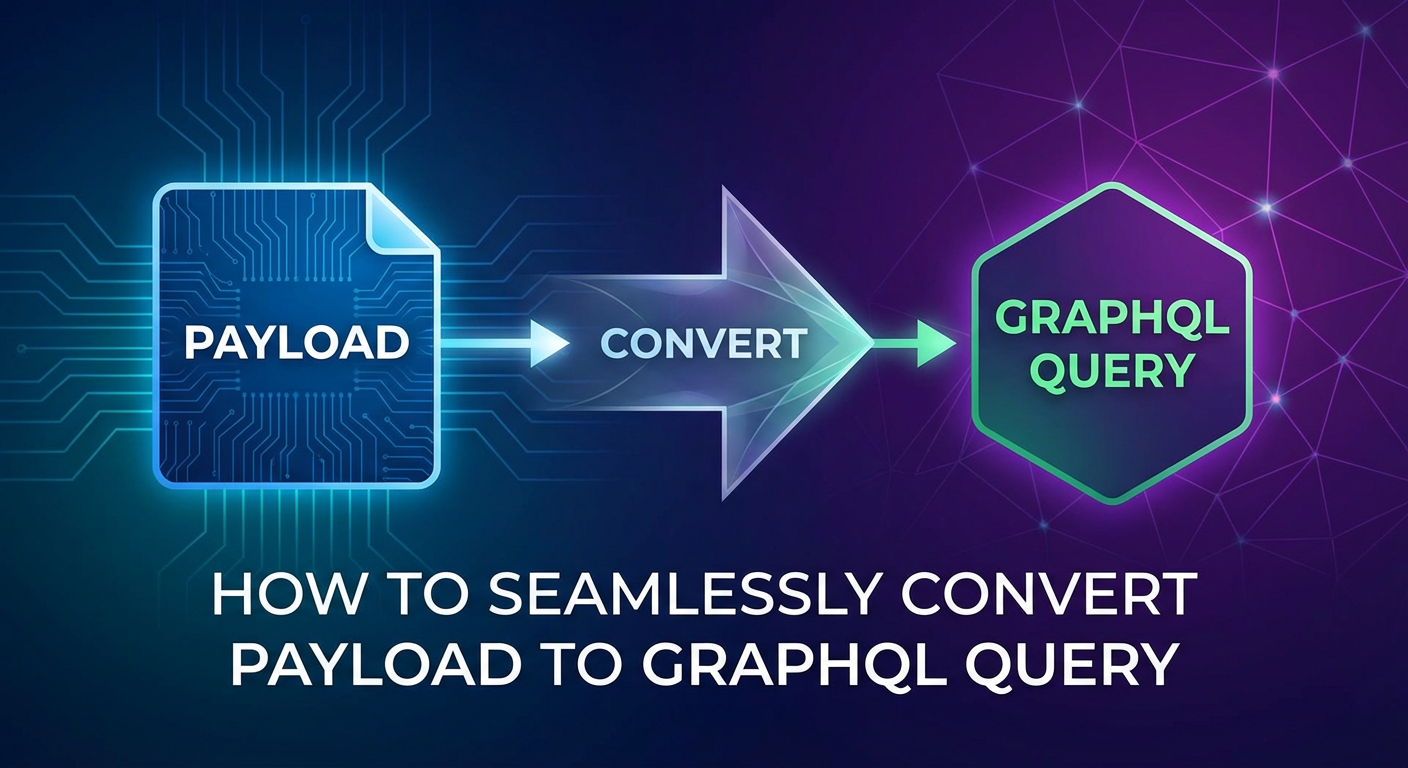
How to Seamlessly Convert Payload to GraphQL Query


The digital landscape is relentlessly evolving, marked by an ever-increasing demand for efficient data exchange and flexible service consumption. In this dynamic environment, Application Programming Interfaces (APIs) serve as the fundamental backbone, enabling disparate systems to communicate and collaborate. For years, RESTful APIs have dominated this space, providing a relatively straightforward, stateless approach to accessing resources. However, as applications grow in complexity and user expectations for tailored data experiences escalate, the limitations of traditional REST often become apparent. Developers frequently encounter scenarios involving over-fetching (receiving more data than needed), under-fetching (requiring multiple requests to gather all necessary data), and the inherent rigidity of fixed endpoints. These challenges can lead to suboptimal performance, increased network latency, and a more cumbersome development process, particularly for clients consuming data from diverse sources.
Enter GraphQL, a powerful query language for APIs, which has rapidly gained traction as a compelling alternative to REST. Conceived by Facebook in 2012 and open-sourced in 2015, GraphQL fundamentally shifts the paradigm of data interaction. Instead of predefined endpoints that return fixed data structures, GraphQL empowers clients to precisely declare what data they need, and nothing more, from a single endpoint. This client-driven approach offers unparalleled flexibility, reduces network payload sizes, and simplifies the aggregation of data from multiple sources. It achieves this through a robust type system, a schema that defines the available data, and the ability to compose complex queries, mutations (for data modification), and subscriptions (for real-time updates) within a single request. For modern applications, especially those with diverse client requirements, GraphQL presents a compelling vision for efficient and flexible data access.
However, the transition to or integration with GraphQL is not always a clean slate. Many organizations possess extensive existing infrastructures built upon RESTful principles, relying heavily on various payload formats like JSON, XML, or URL-encoded data. The challenge then becomes how to bridge this gap: how can these diverse incoming payloads, often originating from established systems or external partners, be seamlessly transformed into the structured, type-safe queries and mutations that GraphQL expects? This conversion imperative is crucial for fostering interoperability, leveraging existing assets, and gradually migrating towards a more flexible api ecosystem without necessitating a complete overhaul. It’s about enabling legacy systems, or even contemporary REST services, to interact with and benefit from a GraphQL layer, effectively creating a unified data gateway for all consumers.
This article delves deep into the methodologies, tools, and best practices for converting various incoming payload formats into valid GraphQL queries or mutations. We will explore the intricacies of different payload types, detail strategic approaches for translation, discuss the vital role of an api gateway in orchestrating these transformations, and outline key considerations for error handling, performance, and security. Our aim is to provide a comprehensive guide for developers and architects seeking to integrate GraphQL into their existing infrastructure, ensuring a smooth and efficient transition that unlocks the full potential of this powerful query language. By understanding and implementing effective payload conversion techniques, organizations can overcome integration hurdles, enhance data accessibility, and build more resilient and performant api ecosystems.
Understanding the Fundamentals: Payloads and GraphQL
Before diving into the conversion process, it’s essential to establish a clear understanding of the core components involved: payloads and GraphQL itself. The interaction between these two concepts forms the bedrock of our discussion.
What is a Payload?
In the context of network communication, a "payload" refers to the actual data being transmitted, distinct from any headers or metadata used for routing and connection management. It's the content or message that carries the substance of a request or response. Think of it like a package being sent through the mail: the payload is the item inside the box, while the shipping label and packaging materials are the metadata.
Payloads can manifest in various formats, each with its own structure and typical use cases:
- JSON (JavaScript Object Notation): By far the most prevalent payload format in modern web apis, JSON is a lightweight, human-readable data interchange format. It's built on two structures: a collection of name/value pairs (like an object or dictionary) and an ordered list of values (like an array). Its simplicity and direct mapping to programming language data structures make it ideal for RESTful services and single-page applications. A typical JSON payload might look like:
json { "id": "user123", "name": "Alice Wonderland", "email": "alice@example.com", "preferences": { "newsletter": true, "theme": "dark" } } - XML (Extensible Markup Language): Once the dominant format for web services, especially in enterprise environments (e.g., SOAP), XML uses a tree-like structure with tags to define data elements. While still in use for legacy systems and specific industry standards, its verbosity often makes it less preferred than JSON for new developments. An XML payload for the same user data might appear as:
xml <user> <id>user123</id> <name>Alice Wonderland</name> <email>alice@example.com</email> <preferences> <newsletter>true</newsletter> <theme>dark</theme> </preferences> </user> - URL-Encoded Form Data: This format is commonly used when submitting HTML forms via HTTP POST requests, or for query parameters in GET requests. Data is sent as key-value pairs, where keys and values are URL-encoded and separated by ampersands (
&). For example:id=user123&name=Alice+Wonderland&email=alice%40example.com. While simple, it's less suitable for complex, nested data structures compared to JSON or XML. - Plain Text: Sometimes, especially for very simple apis or debugging purposes, the payload might just be raw text, like a message string or a log entry. This is less common for structured data exchange.
- Binary Data: For file uploads (images, documents), the payload is often raw binary data, typically sent with
multipart/form-dataencoding.
In the context of RESTful apis, payloads are central to how resources are represented and manipulated. A GET request might receive a JSON payload representing a resource, while a POST or PUT request sends a JSON payload containing the data to create or update a resource. The structure and content of these payloads are often implicitly defined by the api's documentation or conventions.
What is GraphQL?
GraphQL, as mentioned, is a query language for your API, but it's much more than just a querying tool. It's also a server-side runtime for executing queries by using a type system you define for your data. This dual nature is key to its power and flexibility.
At its core, GraphQL revolves around a schema. The schema is a strongly typed contract between the client and the server, defining all the data and operations (queries, mutations, subscriptions) that clients can perform. This schema is written in the GraphQL Schema Definition Language (SDL), which looks something like this:
type User {
  id: ID!
  name: String!
  email: String
  preferences: UserPreferences
}

type UserPreferences {
  newsletter: Boolean
  theme: String
}

type Query {
  user(id: ID!): User
  users: [User!]!
}

type Mutation {
  createUser(name: String!, email: String, newsletter: Boolean, theme: String): User
  updateUser(id: ID!, name: String, email: String, newsletter: Boolean, theme: String): User
}
Key features and advantages of GraphQL over traditional REST include:
- Single Endpoint: Unlike REST, which typically exposes multiple endpoints (
/users,/products,/orders), a GraphQL api usually has a single endpoint (e.g.,/graphql). All data requests go through this one endpoint. - Precise Data Fetching (No Over-fetching or Under-fetching): Clients specify exactly what fields they need in a query. The server then responds with precisely that data. For example, to get a user's name and email:
graphql query GetUserNameAndEmail($userId: ID!) { user(id: $userId) { name email } }This eliminates the problem of over-fetching (where a REST endpoint might return the entire user object when only name and email are needed) and under-fetching (where a REST client might need to make multiple requests to get related data). - Strong Typing and Introspection: The schema's strong typing ensures data consistency and provides powerful introspection capabilities. Clients can query the schema itself to understand what data is available, facilitating auto-completion and robust tooling in development environments.
- Hierarchical Structure: GraphQL queries naturally mirror the structure of the data they request, making them intuitive to write and understand.
- Mutations for Data Modification: Similar to how
POST,PUT,PATCH, andDELETErequests modify data in REST, GraphQL uses "mutations." These are explicitly defined in the schema and allow clients to send data to the server to create, update, or delete resources.graphql mutation CreateNewUser($name: String!, $email: String!) { createUser(name: $name, email: $email) { id name } }The server processes the mutation and can return the newly created or updated data. - Subscriptions for Real-time Updates: GraphQL also supports "subscriptions," enabling clients to receive real-time updates from the server, which is crucial for applications requiring live data feeds.
The Conversion Imperative: Bridging the Gap
Given the distinct paradigms, the need for payload conversion becomes apparent when:
- Migrating Existing Services: An organization might want to expose its existing RESTful apis through a new GraphQL layer to offer clients more flexibility without rewriting the entire backend.
- Integrating Diverse Data Sources: When building a GraphQL api that aggregates data from various backend services—some RESTful, some perhaps even legacy SOAP—the GraphQL server needs to understand how to interpret incoming client requests and translate them into calls to these disparate services, potentially involving payload transformations.
- Modernizing Client Interactions: Even if the backend remains largely REST-based, a GraphQL façade can dramatically improve the developer experience for client-side engineers by offering a unified and flexible query language. This façade would be responsible for taking the GraphQL query, translating it into one or more REST requests with appropriate payloads, and then transforming the REST responses back into the GraphQL structure.
The conversion imperative is thus about creating a seamless bridge. It allows organizations to leverage the benefits of GraphQL for client-facing apis while strategically managing the underlying heterogeneity of their backend services. This approach fosters an api ecosystem that is both forward-looking and respectful of existing investments, enabling a gradual evolution rather than a disruptive revolution.
Common Payload Formats and Their GraphQL Equivalents
Understanding how different source payload formats map to GraphQL's structured query and mutation inputs is fundamental to successful conversion. Each format presents its own set of challenges and opportunities for transformation.
JSON Payloads: The Most Common Scenario
Converting JSON payloads is arguably the most common and often the most straightforward scenario, given JSON's widespread use in modern apis and its natural compatibility with JavaScript and object-oriented paradigms. When a client sends a JSON payload, typically to a REST endpoint, the goal is to transform this into a GraphQL query or, more frequently, a mutation with its corresponding input variables.
Mapping JSON Fields to GraphQL Arguments/Variables: The core of this conversion lies in mapping JSON key-value pairs to GraphQL input types and their fields.
Consider a RESTful API endpoint /users that accepts a POST request with a JSON body to create a new user:
Incoming JSON Payload (REST POST /users):
{
    "firstName": "John",
    "lastName": "Doe",
    "emailAddress": "john.doe@example.com",
    "isActive": true,
    "role": "MEMBER",
    "addressDetails": {
        "street": "123 Main St",
        "city": "Anytown",
        "zipCode": "12345"
    }
}
Now, let's define a corresponding GraphQL mutation for creating a user:
GraphQL Schema:
input AddressInput {
  street: String!
  city: String!
  zipCode: String!
}

enum Role {
  ADMIN
  MEMBER
  GUEST
}

input CreateUserInput {
  firstName: String!
  lastName: String!
  email: String!
  isActive: Boolean
  role: Role
  address: AddressInput
}

type User {
  id: ID!
  firstName: String!
  lastName: String!
  email: String!
  isActive: Boolean
  role: Role
  address: Address
}

type Address {
  street: String!
  city: String!
  zipCode: String!
}

type Mutation {
  createUser(input: CreateUserInput!): User
}
Desired GraphQL Mutation:
mutation CreateUser($input: CreateUserInput!) {
  createUser(input: $input) {
    id
    firstName
    email
  }
}
Desired GraphQL Variables:
{
  "input": {
    "firstName": "John",
    "lastName": "Doe",
    "email": "john.doe@example.com",
    "isActive": true,
    "role": "MEMBER",
    "address": {
      "street": "123 Main St",
      "city": "Anytown",
      "zipCode": "12345"
    }
  }
}
The conversion process involves: 1. Renaming Fields: firstName from JSON to firstName in GraphQL (same name in this case), emailAddress to email, addressDetails to address. 2. Handling Nested Objects: The addressDetails JSON object maps directly to the address input type in GraphQL. 3. Type Coercion: Ensuring isActive (boolean) and role (enum) are correctly recognized by GraphQL.
This mapping can be done programmatically, often involving a simple key-value iteration and transformation logic.
URL-Encoded Form Data Payloads
URL-encoded form data is typically less structured than JSON, representing data as flat key-value pairs. While less common for modern api payloads, it's frequently encountered when dealing with traditional web forms or simpler integration scenarios where data is sent as query parameters or in the request body with Content-Type: application/x-www-form-urlencoded.
Conversion Strategy: The primary strategy is to parse the key-value pairs from the URL-encoded string and then map these individual values to GraphQL arguments or fields within an input object.
Incoming URL-Encoded Payload (REST POST /subscribe): email=jane.doe%40example.com&newsletterOptIn=true&category=Marketing
Corresponding GraphQL Schema:
enum SubscriptionCategory {
  MARKETING
  PRODUCT_UPDATES
  ANNOUNCEMENTS
}

input SubscribeInput {
  email: String!
  newsletterOptIn: Boolean
  category: SubscriptionCategory
}

type Mutation {
  subscribe(input: SubscribeInput!): UserSubscription
}
Desired GraphQL Variables:
{
  "input": {
    "email": "jane.doe@example.com",
    "newsletterOptIn": true,
    "category": "MARKETING"
  }
}
Here, the conversion steps include: 1. URL Decoding: Unpacking the email=jane.doe%40example.com into email and jane.doe@example.com. 2. Type Conversion: Converting the string "true" to a boolean true, and "Marketing" to the MARKETING enum value. 3. Mapping: Assigning the decoded values to the appropriate fields of the SubscribeInput type.
This usually requires a parser that can handle application/x-www-form-urlencoded format, followed by custom logic for type casting and field mapping.
XML Payloads: Bridging Legacy Systems
XML payloads are typically found in older enterprise systems, SOAP web services, or specific industry standards that predate JSON's widespread adoption. Converting XML to GraphQL is generally more complex due to XML's verbose, tree-like structure and the variety of ways data can be represented (attributes, elements, text content).
Conversion Complexity and Strategy: The conversion process for XML typically involves: 1. XML Parsing: Using an XML parser (e.g., DOM parser, SAX parser, or libraries like xml2js in Node.js, lxml in Python, JAXB in Java) to load the XML into an in-memory data structure. 2. Data Extraction: Navigating the parsed XML tree to extract relevant data points. This often involves using XPath expressions or similar query mechanisms to locate specific elements and their values or attributes. 3. Mapping to GraphQL: Once data is extracted, it's mapped to GraphQL input types and variables, similar to the JSON conversion process, including field renaming and type coercion.
Incoming XML Payload (SOAP-like Request):
<soapenv:Envelope xmlns:soapenv="http://schemas.xmlsoap.org/soap/envelope/" xmlns:user="http://example.com/userService">
   <soapenv:Header/>
   <soapenv:Body>
      <user:createProfileRequest>
         <user:profileData>
            <user:personName>
               <user:firstName>Robert</user:firstName>
               <user:lastName>Smith</user:lastName>
            </user:personName>
            <user:contactEmail>robert.smith@legacy.com</user:contactEmail>
            <user:status>ACTIVE</user:status>
         </user:profileData>
      </user:createProfileRequest>
   </soapenv:Body>
</soapenv:Envelope>
Corresponding GraphQL Schema:
enum UserStatus {
  ACTIVE
  INACTIVE
  PENDING
}

input PersonNameInput {
  firstName: String!
  lastName: String!
}

input CreateProfileInput {
  personName: PersonNameInput!
  contactEmail: String!
  status: UserStatus
}

type Mutation {
  createProfile(input: CreateProfileInput!): UserProfile
}
Desired GraphQL Variables:
{
  "input": {
    "personName": {
      "firstName": "Robert",
      "lastName": "Smith"
    },
    "contactEmail": "robert.smith@legacy.com",
    "status": "ACTIVE"
  }
}
This conversion requires more sophisticated parsing logic, potentially involving namespaces, nested elements, and attribute handling. Tools that provide XML-to-JSON conversion capabilities can be a useful intermediate step, after which the JSON-to-GraphQL logic can be applied.
Other Less Common Payloads
While JSON, URL-encoded data, and XML cover the majority of web-based api integration scenarios, other payload formats exist:
- CSV (Comma Separated Values): Primarily used for bulk data imports/exports. Converting CSV requires parsing rows and columns into structured data, then mapping to GraphQL input lists or individual arguments.
- Protocol Buffers (Protobuf) / gRPC: These are binary serialization formats designed for high-performance inter-service communication. If a service communicates via gRPC with Protobuf, an intermediary layer would need to deserialize the Protobuf message into a language-specific object, which can then be mapped to GraphQL. This is typically for deep backend integration rather than client-facing apis.
For these less common formats, the general principle remains the same: deserialize the payload into a structured, language-native data representation, and then map that structure to the GraphQL schema's input types and arguments. The choice of parsing libraries and the complexity of the mapping logic will vary significantly based on the specific format.
Strategies and Techniques for Conversion
Transforming diverse payloads into GraphQL queries is a critical step in building a flexible and unified api layer. The chosen strategy depends heavily on the complexity of the transformation, the scale of the system, and the existing infrastructure. This section explores various approaches, from simple manual mapping to sophisticated code-based solutions and the role of specialized tools.
Manual Mapping (for Simple Cases)
For very simple, one-to-one mapping scenarios, manual transformation might be sufficient. This approach involves writing direct code that explicitly takes values from the source payload and assigns them to the corresponding GraphQL variables or input fields.
Example Scenario: Imagine a REST POST request to /users/create with a JSON payload { "username": "testuser", "pass": "securepass" }. The corresponding GraphQL mutation is createUser(username: String!, password: String!): User.
A manual mapping function in a server-side language like Node.js might look like this:
function convertRestPayloadToGraphQL(restPayload) {
  if (!restPayload || typeof restPayload !== 'object') {
    throw new Error('Invalid REST payload');
  }

  const graphqlVariables = {
    username: restPayload.username,
    password: restPayload.pass // Direct mapping with renaming
  };

  const graphqlQuery = `
    mutation CreateUser($username: String!, $password: String!) {
      createUser(username: $username, password: $password) {
        id
        username
      }
    }
  `;

  return { query: graphqlQuery, variables: graphqlVariables };
}

const restData = { username: "testuser", pass: "securepass123" };
const graphqlRequest = convertRestPayloadToGraphQL(restData);
console.log(graphqlRequest);
Limitations: * Rigidity: This approach becomes unwieldy quickly with complex, nested payloads or when field names differ significantly. * Maintenance: Any change in the source payload structure or the GraphQL schema requires manual updates to the conversion logic. * Scalability: Not suitable for a large number of diverse apis or frequent schema changes.
Manual mapping is best reserved for proof-of-concept implementations or very isolated, static integration points where the cost of developing a more generic solution isn't justified.
Using Middleware/Proxy Layers
A more robust and scalable approach involves introducing an intermediate service or proxy layer specifically designed to handle the translation between different api paradigms. This layer sits between the client and the backend services, intercepting incoming requests, performing transformations, and forwarding them.
Advantages: * Decoupling: Clients don't need to know about the backend's data formats. The translation logic is encapsulated. * Scalability: The middleware can be scaled independently of the backend services. * Centralized Logic: All transformation, routing, and authentication logic can be managed in one place. * Reduced Backend Load: Backend services only receive requests in their native format.
This concept naturally leads to the discussion of API Gateways. A powerful api gateway is precisely this kind of middleware. It acts as a single entry point for all api calls, capable of handling various cross-cutting concerns like authentication, authorization, rate limiting, and crucially, request and response transformations. When an incoming request (e.g., a REST call) needs to be routed to a GraphQL backend, the api gateway can be configured to perform the necessary payload conversion.
For organizations looking to streamline such transformations and manage a complex array of APIs, including AI models and REST services, an advanced api gateway solution becomes invaluable. Platforms like APIPark offer comprehensive API lifecycle management, including robust features for integration and deployment, which can be critical when bridging different service paradigms like REST and GraphQL. It provides a unified management system that can significantly simplify the integration of various data sources and their conversion workflows, especially when dealing with prompt encapsulation into REST API for AI invocation, which might later need GraphQL exposure. An api gateway such as APIPark can be configured with rules that specify how to transform an incoming JSON body into GraphQL mutation variables, and how to construct the GraphQL query string itself, before forwarding the request to the GraphQL server.
Schema-Driven Transformations
Leveraging GraphQL's strong type system and schema is a powerful way to guide the conversion process, particularly when building a GraphQL "facade" over existing REST services. In this scenario, the GraphQL server itself acts as the conversion layer.
The core idea is to define GraphQL resolvers that understand how to fetch or mutate data from the underlying REST (or other) services. When a GraphQL query or mutation comes in, the resolver is responsible for: 1. Extracting GraphQL arguments: The resolver receives the arguments passed to the GraphQL field. 2. Constructing the REST payload: Based on these arguments, the resolver builds the appropriate JSON, URL-encoded, or XML payload for the target REST endpoint. 3. Making the REST call: It then invokes the REST service. 4. Transforming the REST response: Finally, it takes the REST response and transforms it back into the shape expected by the GraphQL schema.
This approach effectively encapsulates the transformation logic within the GraphQL server's resolvers, making it highly maintainable and consistent with the defined schema. Libraries like Apollo Server or GraphQL Yoga provide the necessary framework for defining these resolvers.
Example (Conceptual Node.js Resolver for createUser mutation):
const resolvers = {
  Mutation: {
    createUser: async (_, { input }) => {
      // input is already the GraphQL-typed object (CreateUserInput)

      // 1. Convert GraphQL input to REST JSON payload
      const restPayload = {
        firstName: input.firstName,
        lastName: input.lastName,
        emailAddress: input.email, // Renaming
        isActive: input.isActive || false,
        role: input.role || 'MEMBER',
        addressDetails: input.address ? { // Handling nested object
          street: input.address.street,
          city: input.address.city,
          zipCode: input.address.zipCode
        } : undefined
      };

      // 2. Make REST API call
      const response = await fetch('http://rest-backend/api/users', {
        method: 'POST',
        headers: { 'Content-Type': 'application/json' },
        body: JSON.stringify(restPayload)
      });

      if (!response.ok) {
        const errorData = await response.json();
        throw new Error(`REST API error: ${errorData.message}`);
      }

      const restResult = await response.json();

      // 3. Convert REST response back to GraphQL User type
      return {
        id: restResult.id,
        firstName: restResult.firstName,
        lastName: restResult.lastName,
        email: restResult.emailAddress, // Renaming back
        isActive: restResult.isActive,
        role: restResult.role,
        address: restResult.addressDetails ? {
          street: restResult.addressDetails.street,
          city: restResult.addressDetails.city,
          zipCode: restResult.addressDetails.zipCode
        } : undefined
      };
    },
  },
};
This resolver-based approach is extremely powerful for creating a "GraphQL API Gateway" or a "GraphQL Federation" layer over existing services.
Code-Based Solutions
For scenarios where off-the-shelf tools or an api gateway's transformation capabilities aren't sufficient, or for very specific, complex logic, writing custom code offers maximum flexibility. This involves using general-purpose programming languages and libraries to parse, manipulate, and construct the necessary data structures.
This could be implemented as: * Standalone microservice: A dedicated service whose sole responsibility is to translate incoming requests into GraphQL. * Library within an existing application: Integration of transformation logic directly into an application that needs to interact with both traditional payloads and GraphQL.
Key components of code-based solutions: * Parsing Libraries: * JSON: Native JSON.parse() and JSON.stringify() in JavaScript; json module in Python; Jackson, Gson in Java. * XML: xml2js, fast-xml-parser in Node.js; lxml, xml.etree.ElementTree in Python; JAXB, DOM/SAX parsers in Java. * URL-encoded: querystring in Node.js; urllib.parse in Python. * Data Transformation Libraries: Libraries that help with object mapping and manipulation, e.g., Lodash in JavaScript, or custom utility functions. * GraphQL Client Libraries: To construct and send the GraphQL query/mutation to the GraphQL server. Examples include graphql-request or Apollo Client's HttpLink for client-side, or node-fetch for server-side HTTP requests carrying GraphQL payloads.
Example: Node.js Function for XML to GraphQL Conversion
This example would require an XML parser library (e.g., xml2js to convert XML to JSON first), then a JSON to GraphQL mapping.
const xml2js = require('xml2js');
const { request, gql } = require('graphql-request'); // Assuming graphql-request library

async function convertXmlToGraphQLMutation(xmlPayload) {
  // 1. Parse XML to a JS object (using xml2js as an example)
  const parser = new xml2js.Parser({ explicitArray: false });
  const jsObject = await parser.parseStringPromise(xmlPayload);

  // Example: Extract data from a complex XML structure
  const profileData = jsObject.soapenv.Body.user_createProfileRequest.user_profileData;
  const firstName = profileData.user_personName.user_firstName;
  const lastName = profileData.user_personName.user_lastName;
  const contactEmail = profileData.user_contactEmail;
  const status = profileData.user_status;

  // 2. Construct GraphQL variables
  const variables = {
    input: {
      personName: { firstName, lastName },
      contactEmail,
      status: status.toUpperCase() // Ensure enum casing
    }
  };

  // 3. Define GraphQL mutation
  const mutation = gql`
    mutation CreateProfile($input: CreateProfileInput!) {
      createProfile(input: $input) {
        id
        personName {
          firstName
        }
        contactEmail
      }
    }
  `;

  // 4. Send GraphQL request
  try {
    const data = await request('http://your-graphql-server/graphql', mutation, variables);
    return data;
  } catch (error) {
    console.error('Error sending GraphQL request:', error);
    throw error;
  }
}

// Example XML payload (simplified for brevity)
const xmlString = `
<soapenv:Envelope xmlns:soapenv="http://schemas.xmlsoap.org/soap/envelope/" xmlns:user="http://example.com/userService">
   <soapenv:Body>
      <user:createProfileRequest>
         <user:profileData>
            <user:personName>
               <user:firstName>Jane</user:firstName>
               <user:lastName>Doe</user:lastName>
            </user:personName>
            <user:contactEmail>jane.doe@example.com</user:contactEmail>
            <user:status>ACTIVE</user:status>
         </user:profileData>
      </user:createProfileRequest>
   </soapenv:Body>
</soapenv:Envelope>
`;

// convertXmlToGraphQLMutation(xmlString).then(data => console.log(data));
Code-based solutions offer the highest degree of customization but also demand more development and maintenance effort. They are typically chosen when transformations are highly specific, involve complex business logic, or when existing infrastructure makes other solutions impractical. Regardless of the approach, the goal remains consistent: transform the incoming payload into a format that the GraphQL server can readily understand and process, allowing for efficient and flexible data operations.
APIPark is a high-performance AI gateway that allows you to securely access the most comprehensive LLM APIs globally on the APIPark platform, including OpenAI, Anthropic, Mistral, Llama2, Google Gemini, and more.Try APIPark now! 👇👇👇
The Role of an API Gateway in Payload Conversion
In the modern microservices architecture, an api gateway is much more than just a reverse proxy; it is a critical component that acts as the single entry point for all client requests into the backend system. Its strategic position makes it an ideal place to implement various cross-cutting concerns, and crucially, to perform complex request and response transformations, including the conversion of diverse payloads to GraphQL queries.
Centralized Traffic Management and Policy Enforcement
An api gateway sits at the edge of your network, intercepting all inbound api traffic. This central vantage point offers several fundamental benefits that indirectly support payload conversion:
- Unified Entry Point: All client requests are directed to a single, well-known gateway endpoint. This simplifies client configuration and reduces the number of external endpoints clients need to manage.
- Policy Enforcement: Before a request even reaches a backend service, the api gateway can enforce a wide array of policies. These include:
- Authentication and Authorization: Verifying client identity and permissions.
- Rate Limiting: Protecting backend services from overload by controlling the number of requests clients can make.
- Caching: Improving performance by serving cached responses for frequently requested data.
- Logging and Monitoring: Providing a central point for collecting api usage metrics and detailed call logs for troubleshooting and analysis.
- Routing and Load Balancing: The gateway can intelligently route requests to different backend services based on defined rules (e.g., path, headers, client ID) and distribute traffic across multiple instances of a service for high availability and performance.
Request/Response Transformation: A Key Capability
The ability of an api gateway to modify incoming requests before forwarding them to an upstream service, and to alter responses before sending them back to the client, is paramount for seamless payload conversion. This feature allows the gateway to act as a translation layer between different api paradigms, such as REST and GraphQL.
How an API Gateway Facilitates Payload Conversion to GraphQL:
Imagine a scenario where you have a GraphQL backend, but external clients or legacy systems still send traditional RESTful JSON or URL-encoded payloads. The api gateway can be configured to intercept these incoming requests and perform the necessary transformation:
- Incoming Request Interception: A client sends a
POSTrequest to/legacy/userswith a JSON body. The api gateway intercepts this request. - Payload Extraction: The gateway extracts the JSON body from the incoming request.
- Transformation Logic: Configured rules within the gateway then apply transformation logic. This logic typically involves:
- Mapping: Identifying fields in the incoming JSON payload and mapping them to specific arguments or input fields of a GraphQL mutation or query. This often includes renaming fields (e.g.,
emailAddresstoemail). - Type Coercion: Converting data types if necessary (e.g., string "true" to boolean
true, string "Admin" toADMINenum). - Structure Adjustment: Handling nested JSON objects and restructuring them to fit the GraphQL input type.
- Query/Mutation Construction: Dynamically building the GraphQL query or mutation string, along with its
variablesobject, using the transformed payload data.
- Mapping: Identifying fields in the incoming JSON payload and mapping them to specific arguments or input fields of a GraphQL mutation or query. This often includes renaming fields (e.g.,
- Forwarding to GraphQL Backend: The gateway then creates a new HTTP
POSTrequest, setting itsContent-Typetoapplication/json(standard for GraphQL), and placing the constructed GraphQL query string and variables in the request body. This new request is then forwarded to the actual GraphQL server's single endpoint (e.g.,/graphql). - Response Transformation (Optional but powerful): After the GraphQL server processes the request and returns a GraphQL response, the api gateway can also intercept this response. If the original client expects a different response format (e.g., a simplified JSON structure or even XML), the gateway can transform the GraphQL response back into the desired format before sending it to the client.
This process essentially allows the api gateway to present a uniform RESTful interface to clients while interacting with a GraphQL backend, or vice versa, creating an abstraction layer that shields clients from backend complexities.
Here's a conceptual table illustrating how an api gateway might handle different payload conversions to GraphQL:
| Source Payload Type | Incoming Endpoint/Method | API Gateway Transformation Actions | Target GraphQL Operation/Input | Example Use Case |
|---|---|---|---|---|
JSON (e.g., application/json) |
POST /api/v1/users |
- Extract JSON body - Map firstName, lastName to CreateUserInput.firstName, lastName - Map emailAddress to CreateUserInput.email - Construct createUser mutation with variables |
mutation createUser(input: CreateUserInput!) |
Migrating REST-based user creation to GraphQL |
URL-Encoded (application/x-www-form-urlencoded) |
POST /submit/contact |
- Parse key-value pairs - Map email to ContactFormInput.email - Map message to ContactFormInput.message - Type coercion for optIn (string to boolean) - Construct submitContactForm mutation with variables |
mutation submitContactForm(input: ContactFormInput!) |
Legacy web form submission to GraphQL |
XML (e.g., text/xml for SOAP) |
POST /soap/legacy/orders |
- Parse XML using XPath/XSLT or internal XML-to-JSON engine - Extract values (e.g., //orderId, //item/productId) - Map extracted data to ProcessOrderInput fields - Construct processOrder mutation with variables |
mutation processOrder(input: ProcessOrderInput!) |
Integrating legacy SOAP order processing with modern GraphQL |
Query Parameters (GET /search?q=term&limit=10) |
GET /search/products |
- Extract query parameters - Map q to SearchQuery.term - Map limit to SearchQuery.limit - Construct products(term: String, limit: Int) query |
query products(term: String, limit: Int) |
Exposing a REST search endpoint via GraphQL |
Advantages of Using an API Gateway for Conversion
- Decoupling: Clients are completely decoupled from the underlying GraphQL implementation. They can continue to interact with the familiar RESTful endpoints and payloads, while the gateway handles the translation.
- Improved Security: Consolidating transformation logic in the gateway allows for centralized input validation and sanitization, reducing the attack surface on backend GraphQL services.
- Simplified Backend Development: Backend GraphQL services can focus solely on implementing the GraphQL schema without needing to worry about handling diverse incoming payload formats.
- Enhanced Performance: By centralizing logic, the gateway can optimize conversions, potentially cache transformed queries, and offload processing from backend services.
- Unified API Management: The api gateway provides a single platform to manage all APIs, whether they are REST, GraphQL, or any other type. This includes lifecycle management, versioning, and publishing. Solutions like APIPark excel in this area, offering features that enable end-to-end API lifecycle management and unified API formats across various services, significantly simplifying the complex landscape of modern API integrations.
- Gradual Migration: Organizations can incrementally expose their services via GraphQL without requiring all clients to immediately switch to GraphQL, enabling a smooth, phased migration strategy.
While an api gateway introduces an additional layer of infrastructure, its benefits in terms of centralized control, security, performance, and the ability to seamlessly bridge different api paradigms, especially for payload conversion, make it an indispensable component in complex api ecosystems. It transforms a potentially fragmented api landscape into a cohesive, manageable, and highly adaptable system.
Best Practices and Advanced Considerations
Successfully converting payloads to GraphQL queries involves more than just mapping fields; it requires careful planning, robust error handling, security measures, and ongoing maintenance. Adhering to best practices can significantly improve the reliability, performance, and developer experience of your integration.
Error Handling and Validation
One of the most critical aspects of any api integration is how it responds to invalid or malformed input. When converting payloads to GraphQL, robust error handling and validation are paramount.
- Schema Validation First: The GraphQL schema itself provides a powerful layer of validation. Any input that doesn't conform to the defined types, nullability constraints (
!), or enums will be rejected by the GraphQL server. However, errors caught here might be too late for the conversion layer to provide specific feedback. - Pre-conversion Validation: Implement validation checks at the conversion layer (e.g., within your api gateway or custom middleware) before attempting to construct the GraphQL query. This allows you to:
- Check for Missing Required Fields: Ensure all fields designated as
NOT NULLin the GraphQL schema are present in the incoming payload. - Validate Data Types: Verify that incoming data types are compatible with GraphQL types (e.g., ensure a field expected to be an integer is indeed numeric).
- Enforce Business Rules: Beyond basic type checking, apply any specific business logic validation (e.g., email format, password strength, valid enum values).
- Check for Missing Required Fields: Ensure all fields designated as
- Meaningful Error Messages: When validation fails, provide clear, concise, and actionable error messages. These messages should indicate what went wrong (e.g., "Missing required field 'email'", "Invalid format for 'phoneNumber'") and ideally where the error occurred. Avoid generic error messages like "Bad Request."
- Standardized Error Responses: Structure your error responses consistently. For GraphQL, this often involves the
errorsarray in the response. If your conversion layer is exposing a RESTful interface, ensure its error responses follow REST conventions (e.g., appropriate HTTP status codes like400 Bad Request,422 Unprocessable Entity, with a detailed JSON error body).
Performance Optimization
Payload conversion, especially for complex transformations (e.g., XML parsing, deep JSON restructuring), introduces processing overhead. Optimizing performance is crucial for maintaining responsiveness.
- Efficient Parsing: Use highly optimized libraries for parsing JSON, XML, or URL-encoded data. Avoid inefficient string manipulations for complex structures.
- Caching Transformed Queries: For requests that involve dynamic query construction (e.g., based on simple parameters), if the resulting GraphQL query structure is frequently the same for similar incoming payloads, consider caching the generated GraphQL query string (not the data response) to avoid re-generating it on every request.
- Minimize Transformation Steps: Streamline your conversion logic. Avoid unnecessary intermediate data structures or redundant processing steps.
- Asynchronous Processing: If transformations are resource-intensive, consider offloading them to asynchronous workers or non-blocking processes to prevent blocking the main request thread.
- Profile and Benchmark: Regularly profile your conversion logic to identify performance bottlenecks. Use benchmarking tools to measure the latency introduced by the transformation layer under various load conditions.
Security Considerations
Security is paramount when dealing with any apis, and payload conversion introduces specific attack vectors if not handled carefully.
- Input Sanitization: Always sanitize incoming payloads to prevent common vulnerabilities like SQL injection, cross-site scripting (XSS), or command injection. While GraphQL helps with strong typing, the transformation layer must ensure that malicious input in the source payload doesn't lead to vulnerabilities in the generated GraphQL query or downstream systems.
- Access Control and Authorization: The api gateway or conversion layer should enforce authentication and authorization policies before any transformation occurs. Ensure that only authorized users can initiate requests that lead to specific GraphQL operations. This might involve mapping roles or permissions from the incoming request to the specific GraphQL mutations/queries they are allowed to execute.
- Rate Limiting: Implement rate limiting at the api gateway level to protect both the conversion layer and the backend GraphQL services from denial-of-service (DoS) attacks or abuse.
- Schema Exposure: Be cautious about exposing internal GraphQL schema details if your conversion layer is meant to abstract the GraphQL backend. While GraphQL's introspection is powerful, you might want to limit its exposure to external clients if the intent is to only offer a "REST-like" facade.
- Sensitive Data Handling: Ensure sensitive data (e.g., API keys, personally identifiable information) is handled securely throughout the conversion process, using encryption in transit and at rest where appropriate, and avoiding logging of such data in plain text.
Versioning
As your apis evolve, both the source payload formats and the GraphQL schema will change. A robust versioning strategy is essential.
- API Gateway Versioning: If your api gateway is handling the conversion, it should be capable of routing different versions of incoming REST requests to different versions of your transformation logic or GraphQL schema. For instance,
GET /v1/usersmight map to an older GraphQL query, whileGET /v2/usersmaps to a newer one, or even to a different set of GraphQL fields. - GraphQL Schema Versioning: While GraphQL often advocates for non-breaking changes and deprecation rather than explicit versioning (e.g., using
@deprecateddirective), sometimes breaking changes are unavoidable. In such cases, the conversion layer must be updated in sync with the GraphQL schema version it targets. - Backward Compatibility: Strive to maintain backward compatibility for incoming payloads as long as possible. If breaking changes are necessary, provide clear migration paths and deprecation warnings.
Testing and Monitoring
Thorough testing and continuous monitoring are indispensable for ensuring the reliability and efficiency of your payload conversion process.
- Unit Tests: Write unit tests for all individual transformation functions and mapping logic.
- Integration Tests: Conduct integration tests to verify the end-to-end flow: from an incoming source payload, through the conversion layer, to the GraphQL backend, and back to the client (if response transformation is also in place). Test various valid and invalid payload scenarios.
- Performance Tests: Include performance tests to measure latency and throughput under different loads, ensuring the conversion process doesn't become a bottleneck.
- Monitoring and Alerting: Implement comprehensive monitoring for the conversion layer. Track metrics such as:
- Success Rate: Percentage of successful conversions.
- Error Rate: Percentage of failed conversions, categorized by error type.
- Latency: Time taken for the conversion process itself.
- Resource Utilization: CPU, memory, network usage of the conversion service or api gateway.
- Set up alerts for significant deviations from normal behavior (e.g., sudden spikes in error rates or latency).
- Detailed Logging: Maintain detailed logs of incoming payloads, transformed GraphQL requests, and responses. This is invaluable for debugging issues and understanding user behavior. Ensure logs are structured and easily searchable.
By meticulously addressing these best practices and advanced considerations, organizations can build a resilient, secure, and high-performing payload conversion mechanism that effectively bridges traditional api paradigms with the power and flexibility of GraphQL. This strategic approach not only facilitates seamless integration but also lays the groundwork for a more adaptable and future-proof api infrastructure.
Conclusion
The journey of digital transformation is ceaseless, and at its heart lies the efficient exchange of data through APIs. While RESTful APIs have served as the bedrock of web communication for years, the advent of GraphQL presents a compelling evolution, offering unparalleled flexibility and precision in data fetching. However, the path to embracing GraphQL is rarely a complete overhaul; it often involves navigating a complex landscape of existing services and diverse payload formats. The ability to seamlessly convert these traditional payloads—be they JSON, XML, or URL-encoded data—into structured GraphQL queries and mutations is not merely a technical challenge but a strategic imperative for fostering interoperability, leveraging existing investments, and gradually modernizing an organization's api ecosystem.
Throughout this extensive exploration, we have dissected the fundamental differences between various payload formats and the strongly typed, client-driven nature of GraphQL. We've examined practical strategies for conversion, ranging from direct manual mapping for simple scenarios to the sophisticated, schema-driven transformations embedded within GraphQL resolvers, and the immense power offered by dedicated code-based solutions. A central theme that emerged is the indispensable role of the api gateway. Acting as the intelligent frontier of your backend services, an api gateway is uniquely positioned to intercept, transform, and route diverse incoming requests, effectively creating a unified gateway that harmonizes disparate api paradigms. Tools and platforms like APIPark exemplify how modern API management solutions can empower organizations to achieve this seamless integration, offering robust features for lifecycle management and format standardization across complex api landscapes.
Implementing such conversion mechanisms requires more than just technical prowess; it demands a commitment to best practices. Meticulous error handling and comprehensive validation ensure system robustness, safeguarding against malformed inputs and providing clear feedback. Performance optimization strategies are crucial to prevent the conversion layer from becoming a bottleneck, ensuring that the benefits of GraphQL's efficiency are not undermined. Furthermore, stringent security measures, from input sanitization to robust access control, are vital to protect sensitive data and ward off malicious attacks. Finally, thoughtful versioning, coupled with rigorous testing and continuous monitoring, guarantees the long-term maintainability and reliability of your integrated api services.
In essence, the seamless conversion of payloads to GraphQL queries is a testament to the adaptability of modern api design. It enables developers to unlock the full potential of GraphQL for flexible data access, empowering client applications with precise control over their data needs, while simultaneously preserving and integrating the wealth of existing api assets. By embracing these methodologies and leveraging advanced api gateway solutions, organizations can build a more agile, secure, and performant api infrastructure, ready to meet the ever-evolving demands of the digital future. This strategic integration is not just about technology; it's about enabling a more efficient, interconnected, and responsive digital experience for all.
Frequently Asked Questions (FAQs)
1. What is the primary benefit of converting existing payloads to GraphQL queries? The primary benefit is achieving greater flexibility and efficiency in data fetching for clients. By converting diverse payloads (e.g., from RESTful JSON) into GraphQL queries, clients can precisely specify the data they need, eliminating over-fetching (receiving unnecessary data) and under-fetching (requiring multiple requests for related data). This results in smaller network payloads, faster response times, and a simplified client-side development experience, as all data can often be retrieved from a single GraphQL endpoint.
2. Can an API Gateway truly handle complex payload transformations, including nested structures and type conversions? Yes, modern api gateway solutions are specifically designed to handle complex request and response transformations. They can be configured with rules that extract data from various payload formats (JSON, XML, URL-encoded), map them to specific GraphQL input types, perform necessary type coercions (e.g., string to boolean/enum), handle nested objects, and then construct the complete GraphQL query or mutation along with its variables. While basic gateways might require custom scripting, advanced api gateway platforms often provide declarative configuration or powerful plugin systems for highly granular control over these transformations.
3. Is it better to convert payloads at the client-side, in a dedicated middleware, or at the GraphQL server? The "best" approach depends on the specific use case and architectural context. * Client-side: Only suitable for very simple, direct mappings, as it burdens the client with conversion logic and increases bundle size. * Dedicated Middleware/API Gateway: This is generally the most recommended approach for complex, enterprise-level integrations. It centralizes transformation logic, decouples clients from backend complexities, enhances security, and allows for consistent policy enforcement and API management (as exemplified by solutions like APIPark). It's ideal when you need to expose a GraphQL backend through a REST-like facade or integrate diverse legacy systems. * GraphQL Server (via Resolvers): This is excellent when the GraphQL server acts as a "gateway" or "federation layer" itself, fetching data from various backend microservices (some RESTful). Resolvers handle the conversion of GraphQL arguments into backend service calls and transform backend responses back into GraphQL types. This keeps conversion logic close to the schema but might decentralize it across many resolvers. Often, an api gateway handles incoming client requests, while GraphQL server resolvers handle interactions with backend data sources.
4. What are the main security considerations when converting payloads to GraphQL? Security is paramount. Key considerations include: * Input Sanitization: Thoroughly sanitize incoming payloads to prevent injection attacks (SQL, XSS, command injection) that could be embedded in the transformed GraphQL variables. * Authorization and Authentication: Enforce robust access control at the conversion layer (e.g., api gateway) before any transformation or forwarding to the GraphQL backend. Ensure users can only execute authorized GraphQL operations. * Rate Limiting: Protect the conversion service and backend GraphQL server from abuse and DoS attacks by implementing rate limits. * Sensitive Data Handling: Securely handle sensitive information, ensuring it's not logged in plain text or exposed inadvertently during transformation. * Schema Exposure: Carefully manage how much of the underlying GraphQL schema is exposed, especially if the conversion layer aims to abstract the GraphQL backend from external clients.
5. How does the conversion process affect API versioning? Payload conversion necessitates a thoughtful approach to api versioning. If the source payload format changes, or the target GraphQL schema evolves, the conversion logic must be updated accordingly. An effective strategy often involves: * API Gateway Versioning: Using the api gateway to route different client api versions (e.g., /v1/users vs. /v2/users) to corresponding versions of conversion logic or different GraphQL schemas/fields. * GraphQL Deprecation: Leveraging GraphQL's @deprecated directive for non-breaking changes in the schema, which signals to the conversion layer that certain fields or arguments are being phased out. * Backward Compatibility: Striving to maintain backward compatibility for incoming payloads as long as feasible, providing clear migration paths and documentation for clients when breaking changes are unavoidable. Consistent testing of versioned endpoints is crucial to ensure smooth transitions.
🚀You can securely and efficiently call the OpenAI API on APIPark in just two steps:
Step 1: Deploy the APIPark AI gateway in 5 minutes.
APIPark is developed based on Golang, offering strong product performance and low development and maintenance costs. You can deploy APIPark with a single command line.
curl -sSO https://download.apipark.com/install/quick-start.sh; bash quick-start.sh

In my experience, you can see the successful deployment interface within 5 to 10 minutes. Then, you can log in to APIPark using your account.

Step 2: Call the OpenAI API.