How to Transfer Monolith to System Start in Space Engineers
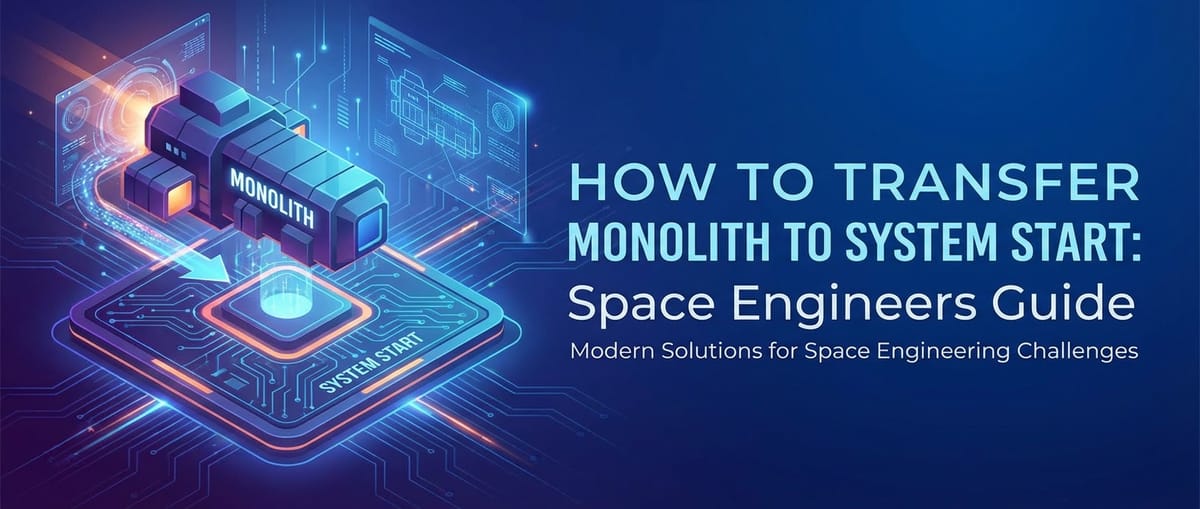


The vast, unforgiving expanse of space in Space Engineers beckons with promises of grand construction, intricate engineering, and boundless creativity. From the humble beginnings of a lone survival kit to the towering majesty of a deep-space battleship or an automated asteroid mining complex, the journey of every engineer is one of constant innovation. Yet, amidst the excitement of scaling up operations and adding new functionalities, many players inadvertently fall into a common architectural pitfall: the monolithic design. This approach, while seemingly straightforward in its infancy, quickly transforms into a tangled web of dependencies, making expansion a nightmare, maintenance a Herculean task, and diagnosing failures akin to finding a needle in a cosmic haystack.
Imagine a colossal vessel, painstakingly assembled block by block, where every system – power generation, propulsion, production, life support, and weaponry – is intertwined in a single, sprawling grid. A single power conduit failure might cripple half the ship, a rogue thruster adjustment could throw off critical alignment, and attempting to upgrade a refinery system could inadvertently disrupt the oxygen supply. This is the essence of a monolithic design in Space Engineers: a single, undifferentiated entity where everything relies on everything else. While perhaps charming in its initial simplicity for smaller, less complex builds, this approach quickly becomes a crippling limitation as your creations grow in size and sophistication. The sheer inertia of such a structure, coupled with its inherent fragility and convoluted interdependencies, drains the joy from engineering and replaces it with frustration.
This comprehensive guide proposes a transformative shift: moving from the cumbersome, fragile monolith to a robust, resilient "System Start" architecture. This paradigm advocates for breaking down your creations into distinct, manageable, and independently operable subsystems, each with a clearly defined purpose and interface. Think of it not as a single, sprawling nervous system, but rather as a collection of specialized organs, each performing its function while communicating effectively with the others through well-defined pathways. This isn't merely about rearranging blocks; it's a fundamental change in design philosophy, one that embraces modularity, redundancy, and intelligent control. By adopting a "System Start" approach, you gain the ability to bring systems online in a controlled sequence, diagnose issues with surgical precision, upgrade components without domino effects, and ultimately, build creations that are not only larger and more capable but also far more stable and maintainable.
Throughout this exploration, we will draw parallels to real-world engineering principles, particularly those found in software development, where concepts like clear apis, robust gateways, and the advantages of an Open Platform architecture have revolutionized how complex systems are built and managed. Just as enterprise software relies on well-defined interfaces for its microservices, your Space Engineers creations can benefit from a similar structured approach. This isn't just about building bigger; it's about building smarter, ensuring that your magnificent creations are not just functional, but enduring monuments to clever design and thoughtful engineering, capable of facing the rigors of space with unparalleled resilience.
Part 1: The Allure and The Abyss of Monolithic Design in Space Engineers
The journey for many Space Engineers begins with a single, immediate goal: to build something functional, quickly. Whether it’s a basic miner, a simple cargo hauler, or a foundational outpost, the initial instinct is often to connect everything directly. Power generators directly feed components, conveyor lines snake haphazardly from one block to the next, and control panels are scattered wherever they fit. This organic, emergent design process often results in what we term a "monolith" in the context of Space Engineers. It’s a single, massive grid where all systems are deeply intertwined, sharing common resources without clear logical or physical segregation.
A monolithic design is characterized by its singular nature. There is often one primary power gateway for the entire structure, with power lines crisscrossing every deck and bulkhead. A central conveyor system, often a single, lengthy artery, attempts to service all production and storage needs, leading to potential bottlenecks and significant material routing inefficiencies. Control panels and flight seats might be placed opportunistically, often requiring the engineer to physically navigate complex spaces just to interact with specific subsystems. For a small, early-game scout ship or a compact mining rig, this approach appears efficient and straightforward. With fewer components, the direct connections seem intuitive, and the immediate gratification of seeing everything "just work" is a powerful motivator. The single, unified grid offers a seemingly seamless operational experience, requiring minimal thought about inter-system communication or resource allocation beyond simply plugging things in.
However, the advantages of this initial simplicity quickly evaporate as the creation grows. What starts as a compact and functional unit rapidly scales into an unmanageable behemoth. Imagine a capital ship where the primary reactor powers everything from the thrusters to the smallest interior light, and all cargo containers are linked into one enormous, undifferentiated inventory. While this may seem robust at first glance, it creates a multitude of critical vulnerabilities. A single breach in an exterior wall could expose a vital power conduit, leading to a cascade failure that cripples multiple essential systems simultaneously. A single, overloaded conveyor junction can bring material flow to a grinding halt for the entire production chain. Debugging a power drain or a blocked conveyor becomes an exercise in frustration, requiring a meticulous, often block-by-block, inspection across the entire vessel. The sheer number of interwoven connections means that a change in one area, however minor, can have unforeseen and often detrimental ripple effects across seemingly unrelated systems.
The performance impact of monolithic designs can also be significant, both for the game engine and the player’s ability to manage. A single, massive grid with thousands of blocks and complex, non-optimized conveyor paths can contribute to sim speed drops, especially on servers. From a player management perspective, the cognitive load required to understand, operate, and maintain such an intricate and undifferentiated system becomes immense. Upgrades, which should be exciting opportunities for improvement, instead become dreaded surgical procedures, fraught with the risk of accidentally severing a critical connection or introducing new, unidentifiable bugs. The lack of clear apis, or defined interaction points, for various subsystems means that modifying one part often requires understanding the entire context of the build, making collaborative engineering or even personal future modifications prohibitively difficult. This "spaghetti code" equivalent in Space Engineers leads to fragile, difficult-to-maintain, and ultimately, less enjoyable creations, underscoring the pressing need for a more structured, resilient architectural approach.
Part 2: Embracing the Vision of "System Start" Architecture
The inherent limitations of monolithic designs in Space Engineers naturally lead to the exploration of more structured and resilient architectural paradigms. This is where the concept of "System Start" comes into its own. Far from being just a technical term, "System Start" represents a fundamental shift in how engineers conceptualize, design, and operate their creations. It is the embrace of modularity, the intelligent decoupling of functions, and the establishment of controlled, sequential initialization processes, much like a real-world spacecraft or industrial complex powering up its various segments in a predetermined, safe order.
At its core, "System Start" architecture champions modularity. Instead of a sprawling, undifferentiated mass, your creation is envisioned as a collection of distinct, self-contained subsystems. Each subsystem—be it power generation, propulsion, production, life support, or weaponry—is designed to perform a specific function with a clear boundary, minimizing its direct dependencies on other modules. This isn't just about physical separation; it’s about logical isolation, ensuring that a malfunction in one area is contained and does not cascade catastrophically across the entire structure. For example, your power generation might be a dedicated module, with its own reactors, batteries, and even emergency power sources, providing energy to other modules through clearly defined energy conduits or power distributors that act as internal gateways.
The benefits of this modular approach are manifold and profoundly impactful on the engineering experience. Firstly, enhanced reliability and resilience become central. If a weapon system takes a hit and goes offline, the rest of the ship – life support, propulsion, and navigation – continues to function unimpeded, allowing for tactical retreat or damage control. Secondly, easier maintenance and troubleshooting are dramatically improved. When a problem arises, the engineer can quickly isolate which module is malfunctioning, thanks to the clear functional boundaries. Diagnosing a power issue means checking the power module, not trawling through the entire grid. This surgical precision vastly reduces downtime and frustration. Thirdly, scalability and flexibility are inherent. Need more production capacity? Simply add another production module, integrating it into the main system through a standardized api (interface) without redesigning the entire logistics network. Want to upgrade your thrusters? Swap out the propulsion module. This plug-and-play capability transforms expansion from a dreaded chore into an exciting opportunity. Finally, better resource management and potentially improved performance are achieved by optimizing conveyor networks and power distribution within specific modules, reducing overall grid complexity and allowing the game engine to process smaller, more contained systems more efficiently.
Central to the "System Start" philosophy are several core principles, each contributing to a more robust and intelligent design:
- Modularity: As discussed, this is the foundational principle. Breaking down the total functionality into distinct, manageable blocks. Think of a power module, a refinery module, a command module, etc.
- Decoupling: Reducing direct, hard-coded dependencies between systems. Instead of system A directly manipulating components in system B, system A sends a request to system B's
gatewayinterface, and system B handles its internal operations. This allows systems to evolve independently. - Standardized Interfaces (APIs): Every module should have a clear "API" – a defined set of inputs it expects and outputs it provides. For instance, a power module provides X amount of power, a thruster module accepts direction commands, a production module takes raw materials and outputs finished goods. This conceptual
apimakes integration predictable and robust. - Hierarchical Control / Gateway: Implementing a central command
gatewayor distributed control points that orchestrate and monitor subsystems. This could be a programmable block managing sequences, a series of LCD panels displaying system statuses, or even a dedicated control room that acts as the primary interface to all major systems. Thesegateways manage communication and resource flow, preventing chaos. - Redundancy & Fail-safes: Building in backup systems for critical functions. Duplicate reactors, redundant gyroscopes, compartmentalized storage – all designed to ensure that a single point of failure does not cripple the entire operation.
- Phased Rollout / System Start Sequence: This is where "System Start" truly shines. Rather than everything powering on at once, critical systems are initialized in a logical, controlled order. Life support first, then minimal power, then navigation, then weapons, etc. This prevents power spikes, allows for self-diagnostics, and ensures a stable operational state from the moment of activation.
Drawing an analogy to real-world software architecture is incredibly pertinent here. Historically, large software applications were often developed as monoliths—single, large executables where all functionalities were tightly coupled. While simple to deploy initially, these became maintenance nightmares, difficult to scale, and prone to "bug cascades." The industry largely shifted towards microservices architecture, where applications are broken down into small, independent services, each with its own responsibilities, communicating via well-defined apis through an API gateway. This allows for independent development, deployment, and scaling of each service. Similarly, in Space Engineers, applying a microservices mindset to your grid design, where each "service" (power, propulsion, production) is a self-contained module, significantly enhances agility and resilience. Furthermore, thinking about your Space Engineers creations as an Open Platform for future expansion and modification encourages designing with these modular principles from the outset, making them more adaptable to new technologies, community scripts, or even entirely new playstyles. This vision moves beyond mere construction; it embraces true engineering.
APIPark is a high-performance AI gateway that allows you to securely access the most comprehensive LLM APIs globally on the APIPark platform, including OpenAI, Anthropic, Mistral, Llama2, Google Gemini, and more.Try APIPark now! 👇👇👇
Part 3: Practical Steps for Transitioning - A Detailed Blueprint
The theoretical benefits of a "System Start" architecture are compelling, but the real challenge lies in its practical implementation. Transitioning from a monolithic design, or planning a new build with this philosophy, requires a structured approach. This blueprint outlines the phases and detailed steps necessary to achieve a robust, modular, and resilient Space Engineers creation.
Phase 1: Assessment and Planning (The "Decomposition" Phase)
Before any construction or deconstruction begins, a thorough understanding of your existing or planned creation is paramount. This phase is about identifying every function and component, and then logically dissecting them.
- Inventory Existing Functions: Begin by listing every single major function your vessel or station performs. Don't assume anything is too small to be considered.
- Core Systems: Power Generation (Reactors, Solar, Hydrogen Engines), Power Storage (Batteries), Life Support (O2/H2 Generators, Air Vents, Medical Bays), Propulsion (Atmospheric, Ion, Hydrogen Thrusters, Gyroscopes), Navigation (Remote Control, Flight Seats, Jump Drives).
- Production & Logistics: Refineries, Assemblers, Cargo Containers (all types), Connectors, Conveyor Junctions, Collectors, Projectors.
- Defense & Offense: Gatling Guns, Missile Launchers, Interior Turrets, Shield Generators (if modded), Warheads.
- Utilities & Specialization: Drills, Welders, Grinders, Merge Blocks, Piston/Rotor systems, Antennas, Beacons, Sensor Arrays, Programmable Blocks, Event Controllers.
- Command & Control: Control Seats, Control Panels, LCD Panels.
- Identify Core Dependencies: For each function, ask: "What absolutely needs to be connected to this, and why?"
- Example: Thrusters need power and hydrogen (if applicable). Assemblers need power and raw materials from storage. Medical bays need power and oxygen. This helps in understanding the fundamental connections, distinguishing them from incidental or poorly planned ones.
- Focus on identifying critical resources: power, conveyor access (for materials), and control signals.
- Define Module Boundaries: This is the most creative and crucial step. Based on your inventory and dependency analysis, group related functions into logical modules. Each module should aim for high internal cohesion and low external coupling.
- Example Modules:
- Power Core Module: All reactors, solar panels, hydrogen engines, and main battery banks. This module should generate and distribute power.
- Propulsion Module: All thrusters, gyroscopes, and potentially dedicated hydrogen tanks. This module is solely responsible for movement and stability.
- Life Support Module: O2/H2 generators, air vents, medical bay, survival kit. Ensures crew survival.
- Production Module: Refineries, assemblers, associated cargo for raw/processed materials. Responsible for manufacturing.
- Logistics Module: Cargo containers, connectors, dedicated conveyor lines for material transfer between modules, or to external points (e.g., docking ports).
- Command Module: Bridge, primary control seats, navigation computers, main communication arrays, critical LCDs for system status.
- Weapon Systems Module(s): Grouped turrets, missile launchers, ammunition storage.
- Utility Module(s): Drills, welders, grinders, projectors, potentially attached via sub-grids (pistons/rotors).
- Consider redundancy: Can you create a primary power module and an emergency backup power module?
- Example Modules:
- Sketching the New Architecture: Before touching a single block, diagram your new modular layout. Use paper, a digital drawing tool, or even a creative mode blueprint.
- Draw boxes for each module.
- Draw lines indicating connections between modules:
- Thick lines for critical power conduits (your main power bus).
- Dashed lines for conveyor connections (material flow).
- Thin lines for control signals (programmable block commands, sensor triggers).
- This visual representation is your blueprint for the "System Start" design, showing how each
gatewayto a system interacts with the overallOpen Platformof your vessel.
Phase 2: Implementing Modular Subsystems
With a solid plan in place, the physical implementation begins. This phase focuses on building or refactoring each module as an independent entity with clear interfaces.
- Power System Module:
- Dedicated Power Generation & Storage: Centralize your primary power sources (reactors, hydrogen engines, solar arrays) in a physically distinct and armored section. Group batteries together.
- Main Power Bus & Distribution
Gateway: Create a robust internal power distribution network (e.g., heavy armor blocks with embedded power conduits, or dedicated heavy armor blocks serving as junction points). This acts as the main powergateway. From this bus, branch out power lines to each individual module. - Emergency Power: Integrate a separate, isolated battery bank or small reactor with its own emergency power lines, designed to power only critical systems (life support, minimal thrusters for emergency maneuvers, basic command functions) in case of main power failure. Use power switches or programmable block logic to manage this.
- Propulsion System Module:
- Thruster Grouping: Group thrusters by direction (forward, backward, up, down, left, right). Each group should have its own set of gyroscopes.
- Dedicated Control: Link each thruster group to specific flight seats or remote control blocks. A programmable block can act as a sophisticated
gatewayfor flight control, allowing for custom flight modes or automated maneuvers. - Hydrogen Tanks: If using hydrogen thrusters, place hydrogen tanks within or adjacent to the propulsion module, with dedicated pipelines to the thrusters. Avoid running lengthy hydrogen lines through unrelated sections of the ship.
- Production & Logistics Module:
- Centralized Production Core: Group all refineries and assemblers in a dedicated area. Optimize their layout for efficiency and minimal conveyor distance.
- Optimized Conveyor Network: Design a tiered conveyor system. A primary heavy armor conveyor backbone can connect the production core to main storage and external connectors. Lighter conveyors can branch off to distribute processed goods.
- Smart Storage & Sorting: Implement automatic sorting systems using programmable blocks or sorter blocks to categorize raw materials, components, and finished products into dedicated cargo containers. This ensures efficient material flow and acts as an internal
apifor materials access.
- Life Support Module:
- Self-Contained Unit: Place O2/H2 generators, air vents, and medical bays in a dedicated, armored, and hermetically sealed section.
- Independent Power Feed: Ensure the life support module has a direct, ideally redundant, power feed from the main power bus, and potentially from the emergency power system.
- Oxygen Tank Integration: Store oxygen tanks within or immediately adjacent to the life support module.
- Control Systems & Command Module:
- Central Bridge/Control Room: A dedicated, heavily armored command center acting as the primary
gatewayfor all operations. - LCD Panels: Use LCD panels extensively to display real-time status updates from various modules (power levels, oxygen levels, ammo counts, production queues). Programmable blocks can feed these displays, offering a unified
apifor system diagnostics. - Programmable Blocks as Orchestrators: These are your central processing units. Write scripts to manage power cycling, automated production, advanced flight control, system diagnostics, and the "System Start" sequence itself. They act as the intelligent
gatewaybetween human input and automated system responses. - Remote Access: Use antennas and remote control blocks to provide external
gatewayaccess for remote operations, drone control, or emergency overrides.
- Central Bridge/Control Room: A dedicated, heavily armored command center acting as the primary
- Sub-Grids for Specialization:
- Utility Attachments: Utilize hinges, rotors, and pistons to attach specialized utility sub-grids (e.g., detachable mining drills, deployable welding arms, external sensor arrays).
- Communication
API: Understand that sub-grids have limited direct communication. Use merge blocks, connectors, and remote control blocks to facilitate power, conveyor access, and control signals. Programmable blocks on the main grid can monitor and control sub-grid components through the game's in-gameapi.
To illustrate the stark contrast and the advantages of modularity, consider the following simplified comparison:
| Feature | Monolithic Design | Modular ("System Start") Design |
|---|---|---|
| Power Distribution | Single, complex grid; critical failures propagate. | Dedicated power module, distributed via main power bus to subsystems. Emergency power. |
| Conveyor System | Spaghetti-like, inefficient, single points of failure. | Optimized, tiered networks; dedicated lines for materials. |
| Fault Tolerance | Low; single breach/failure can cripple entire ship. | High; compartmentalized, redundant systems; contained failures. |
| Maintenance/Upgrades | Difficult; high risk of unforeseen consequences. | Easy; swap out modules; clear api for integration. |
| Scalability | Challenging; requires redesigning core infrastructure. | Simple; add new modules, integrate via established apis. |
| Control Interface | Scattered control panels, manual operation. | Centralized command gateway, LCDs for status, automated via PBs. |
| Debugging | Extremely difficult; extensive search required. | Targeted; identify and isolate the malfunctioning module. |
This systematic approach, breaking down a large, complex problem into smaller, manageable parts with clear interfaces, is a cornerstone of good engineering. In the real world, managing thousands of complex software services requires sophisticated tools. Just as we define explicit interfaces for subsystems in Space Engineers, in the enterprise world, developers leverage platforms like APIPark to manage and integrate hundreds of real-world AI and REST APIs. APIPark provides a unified gateway and Open Platform for managing these diverse services, ensuring seamless interaction, robust lifecycle management, and scalable performance, much like a well-designed Space Engineers vessel has a robust control gateway for its various systems. This platform allows for prompt encapsulation into REST APIs, comprehensive logging, and powerful data analysis, features that, conceptually, align with the structured monitoring and control we aim for in our Space Engineers builds.
Phase 4: Implementing the "System Start" Sequence and Advanced Concepts
With modular systems in place, the true power of the "System Start" architecture comes to life through the implementation of controlled operational sequences and advanced concepts for resilience and scalability. This is where your creation transcends a mere collection of blocks and becomes an intelligently managed machine.
- Designing the Start-up Procedure:
- Prioritization of Critical Systems: The "System Start" isn't about powering everything on at once. It's about bringing systems online in a logical, safe, and efficient order. What needs to be operational first?
- Phase 1: Emergency & Life Support: Begin with essential life support (O2/H2 generators, air vents) and minimal power generation (perhaps a small battery bank or emergency reactor) to ensure survivability. This secures the crew and provides a stable base for subsequent operations.
- Phase 2: Core Power & Navigation: Bring online the main power generation (larger reactors, hydrogen engines) and primary power distribution
gateway. Simultaneously, activate essential navigation systems like gyroscopes and a few directional thrusters, allowing for basic control. - Phase 3: Auxiliary & Production: Once the core is stable, activate auxiliary systems like jump drives, production modules (refineries, assemblers), and larger cargo storage.
- Phase 4: Defensive & Specialization: Finally, arm weapon systems, deploy specialized utility sub-grids (drills, welders), and activate non-essential features.
- Sequential Activation using Timers & Programmable Blocks: The backbone of an automated "System Start" sequence is the combination of timers and programmable blocks.
- Timers: Set up sequences of timers, each triggering specific groups of blocks (e.g., "Activate Life Support Group," then "Activate Reactor Group 1"). This provides a simple, direct method for phased activation.
- Programmable Blocks: For truly sophisticated control, programmable blocks are indispensable. A single programmable block can act as the central
gatewayfor your entire "System Start" script. It can iterate through predefined block groups, check their status, and activate them in sequence. This offers greater flexibility, allowing for conditional activation (e.g., "only activate main thrusters if primary power is at 100%").
- Pre-flight Checks & Diagnostics: Integrate automated diagnostics into your start-up sequence.
- Sensor Arrays: Use sensors to detect breaches, open doors, or other anomalies before full power-up.
- Event Controllers: Configure event controllers to trigger warnings or halt sequences if specific conditions (e.g., low power, damaged block) are met.
- LCD Status Reports: Programmable blocks can output real-time status reports to LCD panels, providing visual confirmation of each step in the start-up, indicating whether systems are "GREEN" or "RED." This acts as a user-friendly
apifor system health.
- Emergency Shut-down Protocols: Just as important as starting up is shutting down. Design a "Panic Button" or "Emergency Power Down" sequence that quickly cuts power to non-essential systems, redirects power to critical ones, or even shuts down everything to prevent further damage. This might involve disabling thrusters, turning off assemblers, and isolating power grids.
- Prioritization of Critical Systems: The "System Start" isn't about powering everything on at once. It's about bringing systems online in a logical, safe, and efficient order. What needs to be operational first?
- Redundancy and Fault Tolerance:
- Backup Power: Beyond an emergency reactor, consider multiple, geographically separated battery banks. If one is destroyed, others can still provide power. Power lines to critical systems can also be duplicated, running through different sections of the ship.
- Redundant Critical Systems: Duplicate gyroscopes, crucial thrusters, and even O2/H2 generators. Space Engineers is a harsh environment; losing a single critical component shouldn't mean game over.
- Armor and Compartmentalization: Physically separate modules with heavy armor. Use interior walls and air vents to create sealed compartments. This prevents oxygen loss from spreading and contains damage from breaches.
- Automated Repair Systems: Implement automated welders (controlled by programmable blocks or sensors) that repair damage in specific areas. Keep spare components in local cargo containers for these welders, creating a self-sustaining repair
api.
- Scalability and Evolution:
- Designing for Future Expansion: From the outset, leave designated spaces or attachment points for future modules. Think of an empty bay for "future weapon module" or a "utility arm expansion slot."
- Ease of Swapping Out Modules: Because your modules have clear
apis (defined inputs/outputs), upgrading is simpler. Want more efficient refineries? Build a new, better refinery module and simply swap it into the designated space, reconnecting power and conveyor lines at the definedgatewaypoints. - The
Open PlatformConcept: A well-designed modular system naturally lends itself to extensibility. Community scripts, custom block mods, and even new game mechanics can be more easily integrated when your base design is structured and flexible. Your vessel itself becomes anOpen Platformfor innovation. A highly modular ship is a living entity, capable of adapting to new threats and opportunities without a complete overhaul.
- Performance Optimization:
- Reducing Grid Complexity: While large, the modular design aims to reduce inter-module complexity. Minimize excessively long conveyor lines or power conduits. Keep connections within modules as tight as possible.
- Optimizing Conveyor Flow: Ensure materials have the shortest, most direct path to their destination within and between modules. Avoid complex loops or unnecessary junctions.
- Efficient Use of Scripts: While programmable blocks are powerful, poorly optimized scripts can impact sim speed. Aim for efficient code, leveraging event controllers to trigger scripts only when necessary, rather than constantly polling block statuses.
By meticulously planning and implementing these "System Start" sequences and advanced concepts, you transform your Space Engineers creation from a mere collection of blocks into a resilient, intelligent, and highly adaptable machine. The satisfaction of initiating a flawless, automated start-up sequence, watching your vessel come alive in a controlled and precise manner, is one of the most rewarding experiences the game has to offer. This commitment to thoughtful engineering not only enhances gameplay but also develops valuable real-world problem-solving and architectural design skills.
Conclusion
The journey through the cosmos of Space Engineers is one of constant learning and evolution, where the scale of your ambitions often clashes with the complexities of your designs. We've traversed the perilous terrain of monolithic architectures, revealing how their initial allure of simplicity quickly devolves into a quagmire of intertwined dependencies, single points of failure, and insurmountable maintenance burdens. The "spaghetti code" equivalent in Space Engineers—a vessel where every component is haphazardly connected to every other—ultimately stifles creativity and invites frustration, preventing grand visions from ever reaching their full, stable potential.
Our exploration has illuminated a more enlightened path: the "System Start" architecture. This philosophy, rooted in principles of modularity, decoupling, and controlled operational sequences, offers a profound shift from chaos to order. By meticulously breaking down your creations into distinct, self-contained subsystems, each with a clearly defined purpose and interface, you unlock a realm of unprecedented resilience, maintainability, and scalability. Imagine a capital ship where a critical hit to the propulsion system doesn't shut down life support, or a mining outpost where upgrading a refinery doesn't require dismantling half the base. This is the promise of the "System Start" – a future where your engineering marvels are not just functional, but inherently stable and capable of enduring the harshest challenges of space.
We've detailed the practical steps for this transformation, from the crucial "Decomposition" phase of inventorying functions and defining module boundaries, to the meticulous implementation of dedicated power systems, optimized logistics, and intelligent command gateways. We've shown how conceptual apis within your designs, much like those in software engineering, allow subsystems to communicate effectively without deep, fragile interdependencies. The deployment of programmable blocks as orchestrators for a phased "System Start" sequence transforms a static build into a dynamic, responsive machine, capable of automated diagnostics and controlled operational readiness. Furthermore, embracing redundancy, compartmentalization, and forward-thinking design ensures your creation functions as an Open Platform, ready for future enhancements and adaptations.
The parallels to real-world software architecture, with its reliance on microservices, clear apis, and robust gateways for managing complex systems, are not accidental. They highlight universal engineering principles that transcend the medium, proving that thoughtful design is the bedrock of any successful complex system. Just as platforms like APIPark.com provide the necessary gateway and management tools for integrating diverse APIs in the enterprise world, your disciplined approach to design in Space Engineers offers you the ultimate gateway to efficient control and resilient operation of your in-game creations.
Ultimately, transitioning from a monolith to a "System Start" architecture is more than just a building technique; it's a mindset shift. It’s an embrace of methodical planning, foresight, and elegant problem-solving. The satisfaction derived from watching a well-engineered, modular vessel perform its automated "System Start," bringing each system online with precision and grace, is a testament to the power of structured design. It's the difference between a house of cards and a fortress – both may stand, but only one will endure. We encourage every engineer to apply these principles, to move beyond the entanglement, and to build not just ships and stations, but truly intelligent, resilient, and enduring monuments to their boundless creativity in the vast canvas of Space Engineers.
Frequently Asked Questions (FAQs)
1. What exactly is a "monolithic design" in Space Engineers, and why is it problematic? A monolithic design in Space Engineers refers to a single, large grid (ship or station) where all systems (power, propulsion, production, etc.) are deeply interconnected without clear logical or physical separation. While easy to start with, it becomes problematic as builds grow because a failure in one area can easily cascade and cripple the entire structure. It makes troubleshooting, maintenance, and future upgrades incredibly difficult due to complex, interwoven dependencies, often leading to performance issues and frustration.
2. How does a "System Start" architecture improve upon the monolithic approach? The "System Start" architecture breaks down your creation into distinct, modular subsystems, each responsible for a specific function (e.g., a dedicated power module, a separate propulsion module). These modules operate with minimal direct dependencies and communicate through well-defined interfaces (conceptual apis), managed by control gateways (like programmable blocks). This dramatically improves reliability, makes troubleshooting surgical, simplifies upgrades, enhances scalability, and allows for controlled, sequential power-up procedures, much like a real-world spacecraft.
3. What are "APIs" and "Gateways" in the context of Space Engineers? In Space Engineers, "APIs" (Application Programming Interfaces) can be thought of as the standardized input/output expectations for each module. For instance, a power module has an "API" that provides a certain amount of power, and a thruster module has an "API" that accepts directional commands. "Gateways" are central control points or interfaces that manage communication and resource flow between these modules, or between the player and the systems. Examples include a central control room, programmable blocks orchestrating system sequences, or even a main power bus distributing energy to various subsystems. These concepts draw parallels to real-world software engineering practices.
4. How can I implement a controlled "System Start" sequence using in-game blocks? A controlled "System Start" sequence prioritizes bringing critical systems online in a logical order. This is primarily achieved using Programmable Blocks (for advanced, conditional logic and orchestration) and Timers (for simpler, timed activations). You would group related blocks (e.g., all O2/H2 generators) and use timers or a programmable block script to activate these groups sequentially, often with delays between steps. LCD panels can provide real-time status updates, acting as a visual gateway for the sequence.
5. How does APIPark relate to these Space Engineers design principles? APIPark is an open-source AI gateway and API management platform for real-world enterprise applications. The connection lies in the shared principles of managing complex systems. Just as you define clear interfaces (APIs) and central control points (gateways) for your modular Space Engineers builds, APIPark provides these exact tools for managing hundreds of real-world AI and REST services. It ensures a unified gateway for diverse services, promotes an Open Platform for integration, and offers features like lifecycle management and detailed logging, which are all crucial for building robust and scalable systems, whether in a game or in enterprise software.
🚀You can securely and efficiently call the OpenAI API on APIPark in just two steps:
Step 1: Deploy the APIPark AI gateway in 5 minutes.
APIPark is developed based on Golang, offering strong product performance and low development and maintenance costs. You can deploy APIPark with a single command line.
curl -sSO https://download.apipark.com/install/quick-start.sh; bash quick-start.sh

In my experience, you can see the successful deployment interface within 5 to 10 minutes. Then, you can log in to APIPark using your account.

Step 2: Call the OpenAI API.